Ontologies for multimedia:Ontologies for multimedia:
the Semantic Culture Webthe Semantic Culture Web
Guus SchreiberGuus Schreiber
Free University AmsterdamFree University Amsterdam
Co-chair W3C Semantic Web Deployment WGCo-chair W3C Semantic Web Deployment WG
Overview
• My target: a Semantic Culture Web
• Ontology perspective:
– Principles for ontology engineering on Web scale
– Some remarks about web standards
• Technologies for realizing a Culture Web
– Ontology-based methods
– Image analysis
– NLP / information extraction
– Combinations are key!
Acknowledgements
• MultimediaN E-Culture Project:
– Alia Amin, Mark van Assem, Victor de Boer, Lynda
Hardman, Michiel Hildebrand, Laura Hollink, Zhisheng
Huang, Marco de Niet, Borys Omelayenko, Jacco van
Ossenbruggen, Ronny Siebes, Jos Taekema, Anna Tordai,
Jan Wielemaker, Bob Wielinga
• CHOICE Project @ Sound & Vision
– Hennie Brugman, Luit Gazendam, Veronique Malaise,
Johan Oomen, Mettina Veenstra
• MuNCH project @ Sound & Vision
– Laura Hollink, Bouke Hunning, Michiel van Liempt, Johan
Oomen Maarten de Rijke, Arnold Smeulders, Cees Snoek,
Marcel Worring,
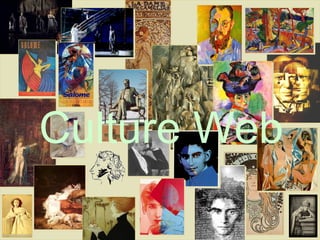
Culture Web
Principles for ontology
engineering in a distributed world
1. Modesty principle
• Ontology engineers should refrain from
developing their own idiosyncratic ontologies
• Instead, they should make the available rich
vocabularies, thesauri and databases
available in web format
• Initially, only add the originally intended
semantics
Implicit WordNet semantics
“The ent operator specifies that the second
synset is an entailment of first synset. This
relation only holds for verbs. “
• Example: [breathe, inhale] entails [sneeze,
exhale]
• Semantics (OWL statements):
– Transitive property
– Inverse property: entailedBy
– Value restrictions for VerbSynSet (subclass of
SynSet)
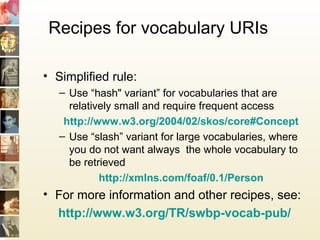
Recipes for vocabulary URIs
• Simplified rule:
– Use “hash" variant” for vocabularies that are
relatively small and require frequent access
http://www.w3.org/2004/02/skos/core#Concept
– Use “slash” variant for large vocabularies, where
you do not want always the whole vocabulary to
be retrieved
http://xmlns.com/foaf/0.1/Person
• For more information and other recipes, see:
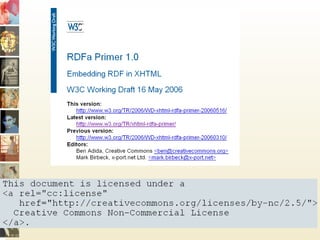
http://www.w3.org/TR/swbp-vocab-pub/
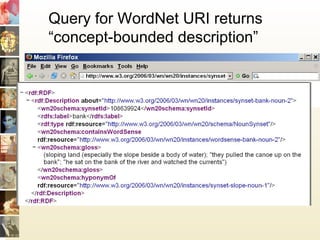
Query for WordNet URI returns
“concept-bounded description”
How useful are RDF and OWL?
• RDF: basic level of interoperability
• Some constructs of OWL are key:
– Logical characteristics of properties: symmetric,
transitive, inverse
– Identity: sameAs
• OWL pitfalls
– Bad: if it is written in OWL it is an ontology
– Worse: if it is not in OWL, then it is not an
ontology
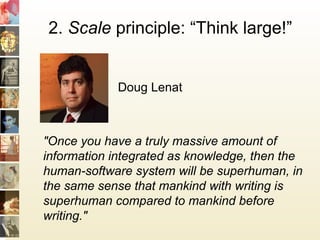
2. Scale principle: “Think large!”
"Once you have a truly massive amount of
information integrated as knowledge, then the
human-software system will be superhuman, in
the same sense that mankind with writing is
superhuman compared to mankind before
writing."
Doug Lenat
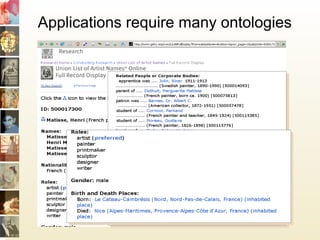
Applications require many ontologies
3. Pattern principle:
don’t try to be too creative!
• Ontology engineering should not be an art
but a discipline
• Patterns play a key role in methodology for
ontology engineering
• See for example patterns developed by the
W3C Semantic Web Best Practices group
http://www.w3.org/2001/sw/BestPractices/
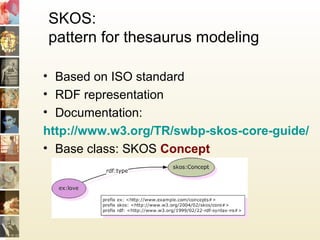
SKOS:
pattern for thesaurus modeling
• Based on ISO standard
• RDF representation
• Documentation:
http://www.w3.org/TR/swbp-skos-core-guide/
• Base class: SKOS Concept
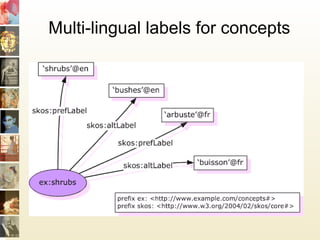
Multi-lingual labels for concepts
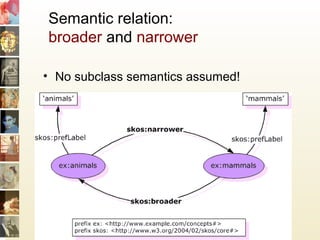
Semantic relation:
broader and narrower
• No subclass semantics assumed!
4. Enrichment principle
• Don’t modify, but add!
• Techniques:
– Learning ontology relations/mappings
– Semantic analysis, e.g. OntoClean
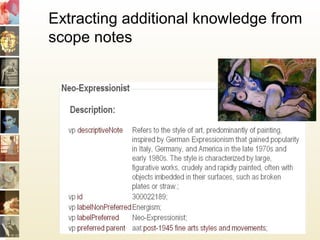
– Processing of scope notes in thesauri
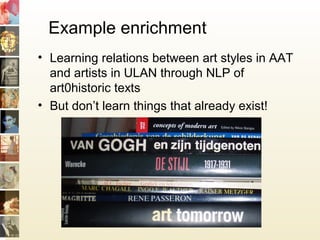
Example enrichment
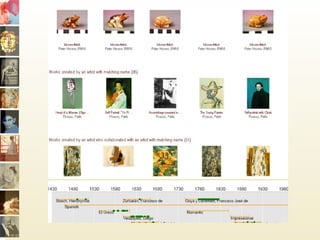
• Learning relations between art styles in AAT
and artists in ULAN through NLP of
art0historic texts
• But don’t learn things that already exist!
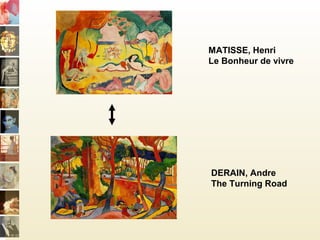
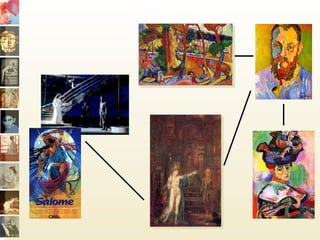
DERAIN, Andre
The Turning Road
MATISSE, Henri
Le Bonheur de vivre
Extracting additional knowledge from
scope notes
Hypothesis underlying Culture Web
• Semantic Web technology is in particular
useful in knowledge-rich domains
or formulated differently
• If we cannot show added value in
knowledge-rich domains, then it may have no
value at all
Baseline architecture for a
Semantic Culture Web
• Should be fully based on web standards
– XML, RDF/OWL, SVG, AJAX
• OWL use is typically limited
• Methodology for metadata conversion
– Information extraction
– Should be professional service
• Scalability is key issue
– 100+ collections is minimum
• New search paradigms
• Public annotation facilities
• Evaluation studies with stakeholders!
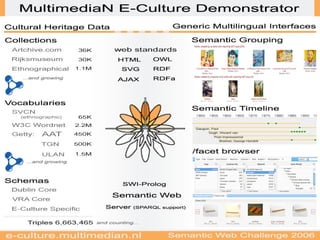
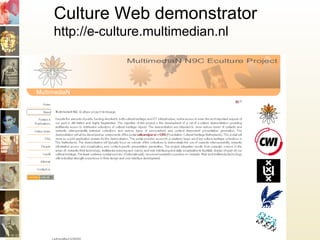
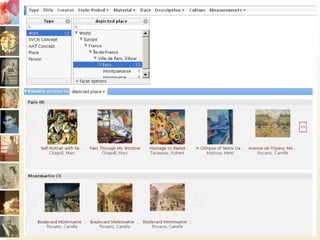
Culture Web demonstrator
http://e-culture.multimedian.nl
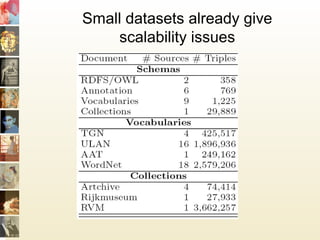
Small datasets already give
scalability issues
??
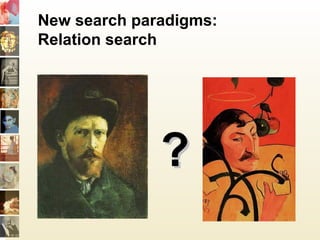
New search paradigms:
Relation search
Search in digital media archives:
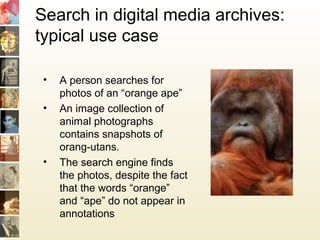
typical use case
• A person searches for
photos of an “orange ape”
• An image collection of
animal photographs
contains snapshots of
orang-utans.
• The search engine finds
the photos, despite the fact
that the words “orange”
and “ape” do not appear in
annotations
Techniques that can be used
• Ontologies: explicit background knowledge
plus semantic annotation: semantic link
between annotated concept and vocabulary
• Natural-language processing: co-occurrence
of ‘orange”, “ape” and “orangutans”
• Image processing: e.g. detectors for “orange”
and “ape”
Observation: no single technique can solve
every problem!
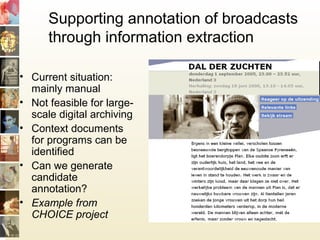
Supporting annotation of broadcasts
through information extraction
• Current situation:
mainly manual
• Not feasible for large-
scale digital archiving
• Context documents
for programs can be
identified
• Can we generate
candidate
annotation?
• Example from
CHOICE project
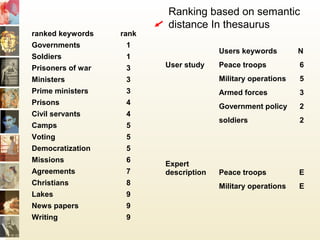
ranked keywords rank
Governments 1
Soldiers 1
Prisoners of war 3
Ministers 3
Prime ministers 3
Prisons 4
Civil servants 4
Camps 5
Voting 5
Democratization 5
Missions 6
Agreements 7
Christians 8
Lakes 9
News papers 9
Writing 9
Users keywords N
User study Peace troops 6
Military operations 5
Armed forces 3
Government policy 2
soldiers 2
Expert
description Peace troops E
Military operations E
Ranking based on semantic
distance In thesaurus
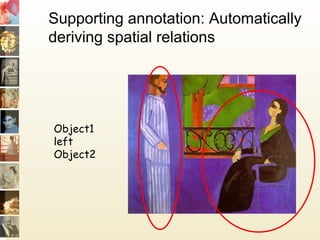
Supporting annotation: Automatically
deriving spatial relations
Object1
left
Object2
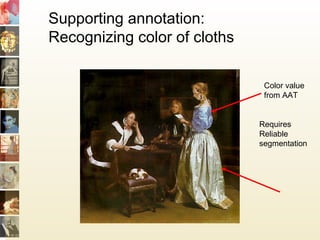
Supporting annotation:
Recognizing color of cloths
Requires
Reliable
segmentation
Color value
from AAT
Visual WordNet (Stein et al.)
• Adding knowledge about visual
characteristics to WordNet: mobility,
color, …
• Build detectors for the visual features
• Use visual data to prune the tree of
categories when analyzing a visual
object
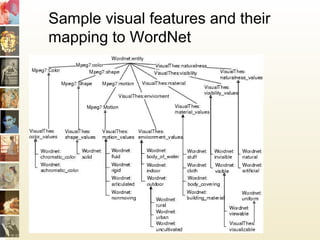
Sample visual features and their
mapping to WordNet
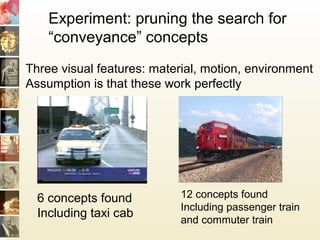
Experiment: pruning the search for
“conveyance” concepts
6 concepts found
Including taxi cab
12 concepts found
Including passenger train
and commuter train
Three visual features: material, motion, environment
Assumption is that these work perfectly
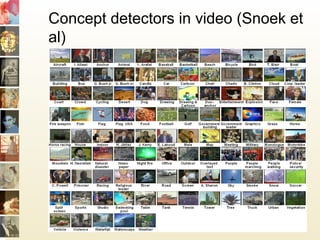
Concept detectors in video (Snoek et
al)
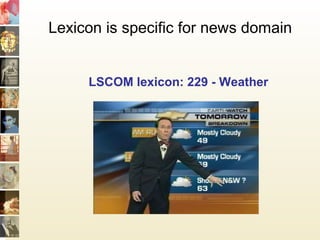
Lexicon is specific for news domain
LSCOM lexicon: 229 - Weather
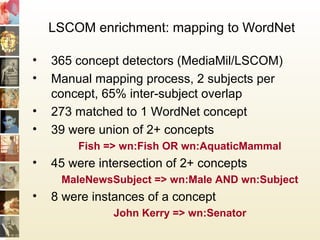
LSCOM enrichment: mapping to WordNet
• 365 concept detectors (MediaMil/LSCOM)
• Manual mapping process, 2 subjects per
concept, 65% inter-subject overlap
• 273 matched to 1 WordNet concept
• 39 were union of 2+ concepts
Fish => wn:Fish OR wn:AquaticMammal
• 45 were intersection of 2+ concepts
MaleNewsSubject => wn:Male AND wn:Subject
• 8 were instances of a concept
John Kerry => wn:Senator
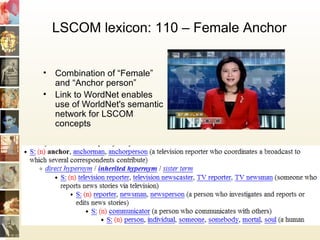
LSCOM lexicon: 110 – Female Anchor
• Combination of “Female”
and “Anchor person”
• Link to WordNet enables
use of WorldNet's semantic
network for LSCOM
concepts
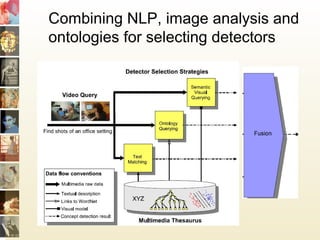
Combining NLP, image analysis and
ontologies for selecting detectors
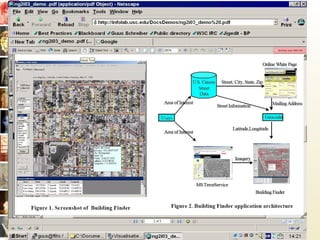
Building Finder: integrating image
analysis and textual sources
• Knoblock et al. (USC/ISI)
• Multiple heterogeneous sources
– Satellite images (Microsoft Terraservice)
– Road map info (US)
– Address information (white pages)
• Image analysis techniques to map satellite
data to road map
• RDF used for syntactic interoperability
Take home message
• There’s lots of existing semantics out there.
Use it!
• Think multi-disciplinary!
– Realistic applications require combination of
techniques
• In open knowledge-rich environments there
are loys of opportunities for SW technology
– But we have to take them
Ontologies for multimedia: the Semantic Culture Web

Ontologies for multimedia: the Semantic Culture Web

  • 1.
    Ontologies for multimedia:Ontologiesfor multimedia: the Semantic Culture Webthe Semantic Culture Web Guus SchreiberGuus Schreiber Free University AmsterdamFree University Amsterdam Co-chair W3C Semantic Web Deployment WGCo-chair W3C Semantic Web Deployment WG
  • 2.
    Overview • My target:a Semantic Culture Web • Ontology perspective: – Principles for ontology engineering on Web scale – Some remarks about web standards • Technologies for realizing a Culture Web – Ontology-based methods – Image analysis – NLP / information extraction – Combinations are key!
  • 3.
    Acknowledgements • MultimediaN E-CultureProject: – Alia Amin, Mark van Assem, Victor de Boer, Lynda Hardman, Michiel Hildebrand, Laura Hollink, Zhisheng Huang, Marco de Niet, Borys Omelayenko, Jacco van Ossenbruggen, Ronny Siebes, Jos Taekema, Anna Tordai, Jan Wielemaker, Bob Wielinga • CHOICE Project @ Sound & Vision – Hennie Brugman, Luit Gazendam, Veronique Malaise, Johan Oomen, Mettina Veenstra • MuNCH project @ Sound & Vision – Laura Hollink, Bouke Hunning, Michiel van Liempt, Johan Oomen Maarten de Rijke, Arnold Smeulders, Cees Snoek, Marcel Worring,
  • 4.
  • 7.
  • 8.
    1. Modesty principle •Ontology engineers should refrain from developing their own idiosyncratic ontologies • Instead, they should make the available rich vocabularies, thesauri and databases available in web format • Initially, only add the originally intended semantics
  • 10.
    Implicit WordNet semantics “Theent operator specifies that the second synset is an entailment of first synset. This relation only holds for verbs. “ • Example: [breathe, inhale] entails [sneeze, exhale] • Semantics (OWL statements): – Transitive property – Inverse property: entailedBy – Value restrictions for VerbSynSet (subclass of SynSet)
  • 11.
    Recipes for vocabularyURIs • Simplified rule: – Use “hash" variant” for vocabularies that are relatively small and require frequent access http://www.w3.org/2004/02/skos/core#Concept – Use “slash” variant for large vocabularies, where you do not want always the whole vocabulary to be retrieved http://xmlns.com/foaf/0.1/Person • For more information and other recipes, see: http://www.w3.org/TR/swbp-vocab-pub/
  • 12.
    Query for WordNetURI returns “concept-bounded description”
  • 13.
    How useful areRDF and OWL? • RDF: basic level of interoperability • Some constructs of OWL are key: – Logical characteristics of properties: symmetric, transitive, inverse – Identity: sameAs • OWL pitfalls – Bad: if it is written in OWL it is an ontology – Worse: if it is not in OWL, then it is not an ontology
  • 14.
    2. Scale principle:“Think large!” "Once you have a truly massive amount of information integrated as knowledge, then the human-software system will be superhuman, in the same sense that mankind with writing is superhuman compared to mankind before writing." Doug Lenat
  • 15.
  • 16.
    3. Pattern principle: don’ttry to be too creative! • Ontology engineering should not be an art but a discipline • Patterns play a key role in methodology for ontology engineering • See for example patterns developed by the W3C Semantic Web Best Practices group http://www.w3.org/2001/sw/BestPractices/
  • 17.
    SKOS: pattern for thesaurusmodeling • Based on ISO standard • RDF representation • Documentation: http://www.w3.org/TR/swbp-skos-core-guide/ • Base class: SKOS Concept
  • 18.
  • 19.
    Semantic relation: broader andnarrower • No subclass semantics assumed!
  • 20.
    4. Enrichment principle •Don’t modify, but add! • Techniques: – Learning ontology relations/mappings – Semantic analysis, e.g. OntoClean – Processing of scope notes in thesauri
  • 21.
    Example enrichment • Learningrelations between art styles in AAT and artists in ULAN through NLP of art0historic texts • But don’t learn things that already exist!
  • 22.
    DERAIN, Andre The TurningRoad MATISSE, Henri Le Bonheur de vivre
  • 23.
  • 24.
    Hypothesis underlying CultureWeb • Semantic Web technology is in particular useful in knowledge-rich domains or formulated differently • If we cannot show added value in knowledge-rich domains, then it may have no value at all
  • 25.
    Baseline architecture fora Semantic Culture Web • Should be fully based on web standards – XML, RDF/OWL, SVG, AJAX • OWL use is typically limited • Methodology for metadata conversion – Information extraction – Should be professional service • Scalability is key issue – 100+ collections is minimum • New search paradigms • Public annotation facilities • Evaluation studies with stakeholders!
  • 27.
  • 28.
    Small datasets alreadygive scalability issues
  • 29.
  • 31.
    Search in digitalmedia archives: typical use case • A person searches for photos of an “orange ape” • An image collection of animal photographs contains snapshots of orang-utans. • The search engine finds the photos, despite the fact that the words “orange” and “ape” do not appear in annotations
  • 32.
    Techniques that canbe used • Ontologies: explicit background knowledge plus semantic annotation: semantic link between annotated concept and vocabulary • Natural-language processing: co-occurrence of ‘orange”, “ape” and “orangutans” • Image processing: e.g. detectors for “orange” and “ape” Observation: no single technique can solve every problem!
  • 33.
    Supporting annotation ofbroadcasts through information extraction • Current situation: mainly manual • Not feasible for large- scale digital archiving • Context documents for programs can be identified • Can we generate candidate annotation? • Example from CHOICE project
  • 34.
    ranked keywords rank Governments1 Soldiers 1 Prisoners of war 3 Ministers 3 Prime ministers 3 Prisons 4 Civil servants 4 Camps 5 Voting 5 Democratization 5 Missions 6 Agreements 7 Christians 8 Lakes 9 News papers 9 Writing 9 Users keywords N User study Peace troops 6 Military operations 5 Armed forces 3 Government policy 2 soldiers 2 Expert description Peace troops E Military operations E Ranking based on semantic distance In thesaurus
  • 35.
    Supporting annotation: Automatically derivingspatial relations Object1 left Object2
  • 36.
    Supporting annotation: Recognizing colorof cloths Requires Reliable segmentation Color value from AAT
  • 37.
    Visual WordNet (Steinet al.) • Adding knowledge about visual characteristics to WordNet: mobility, color, … • Build detectors for the visual features • Use visual data to prune the tree of categories when analyzing a visual object
  • 38.
    Sample visual featuresand their mapping to WordNet
  • 39.
    Experiment: pruning thesearch for “conveyance” concepts 6 concepts found Including taxi cab 12 concepts found Including passenger train and commuter train Three visual features: material, motion, environment Assumption is that these work perfectly
  • 40.
    Concept detectors invideo (Snoek et al)
  • 41.
    Lexicon is specificfor news domain LSCOM lexicon: 229 - Weather
  • 42.
    LSCOM enrichment: mappingto WordNet • 365 concept detectors (MediaMil/LSCOM) • Manual mapping process, 2 subjects per concept, 65% inter-subject overlap • 273 matched to 1 WordNet concept • 39 were union of 2+ concepts Fish => wn:Fish OR wn:AquaticMammal • 45 were intersection of 2+ concepts MaleNewsSubject => wn:Male AND wn:Subject • 8 were instances of a concept John Kerry => wn:Senator
  • 43.
    LSCOM lexicon: 110– Female Anchor • Combination of “Female” and “Anchor person” • Link to WordNet enables use of WorldNet's semantic network for LSCOM concepts
  • 44.
    Combining NLP, imageanalysis and ontologies for selecting detectors
  • 45.
    Building Finder: integratingimage analysis and textual sources • Knoblock et al. (USC/ISI) • Multiple heterogeneous sources – Satellite images (Microsoft Terraservice) – Road map info (US) – Address information (white pages) • Image analysis techniques to map satellite data to road map • RDF used for syntactic interoperability
  • 47.
    Take home message •There’s lots of existing semantics out there. Use it! • Think multi-disciplinary! – Realistic applications require combination of techniques • In open knowledge-rich environments there are loys of opportunities for SW technology – But we have to take them