what makes  Web 2.0   applications unique? 30 October 2006 Wesley Willett CS260
Web 2.0 According to O’Reilly “ Web 2.0 is the  network as platform , spanning all connected devices; Web 2.0 applications are those that make the most of the intrinsic advantages of that platform: delivering software as a  continually-updated service  that  gets better the more people use it , consuming and  remixing data  from multiple sources, including individual users, while providing their own data and services in a form that allows remixing by others,  creating network effects  through an "architecture of participation," and going beyond the page metaphor of Web 1.0 to deliver rich user experiences.”  - Tim O'Reilly October 01, 2005
Outline From Early Hypertext to Web 2.0 Implementing aspirations of hypertext pioneers What “2.0” adds that “1.0” lacked A group discussion exercise Authorship and Information Aggregation in Blogs, Wikis, and Beyond (time permitting)
Drawing on Readings Millard, D. E. and Ross, M. 2006.  Web 2.0: Hypertext by Any Other Name?.  In HT’06. Carter, S. 2005.  The Role of the Author in Topical Blogs.  In CHI 2005. Walker, J. 2005.  Feral Hypertext.  In HT’05.
Disclaimer  (2.0)
Web 2.0: Hypertext by Any Other Name?
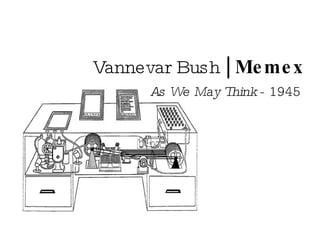
Vannevar Bush  | Memex As We May Think  - 1945
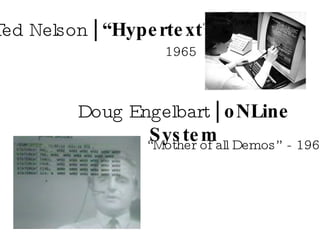
Ted Nelson  | “Hypertext”   1965 Doug Engelbart  | oNLine System “ Mother of all Demos” - 1968
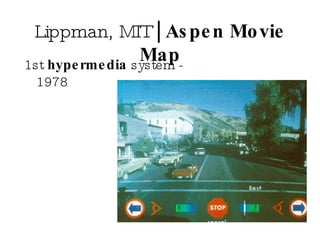
Lippman, MIT  | Aspen Movie Map 1st  hypermedia  system - 1978
Vision of  hypertext/hypermedia A non-linear medium of information Not just the WWW To look at: How well do “Web 2.0” systems implement/refine “ideal” hypertext/hypermedia models?  How are they better than “Web 1.0”? An interesting lens through which to examine what makes these new systems unique, useful.
Aspirations of Hypertext |  Millard & Ross Search Structure Adaptive Versioning Authoring 5 major categories
Aspirations of Hypertext |  Millard & Ross As we step through: What systems realize these aspirations? How well do they do so? What are the implications for how we use these systems?
Aspirations  | Search Content  Context Structural
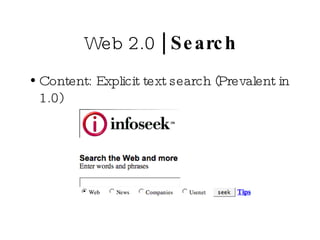
Web 2.0  | Search Content: Explicit text search (Prevalent in 1.0)
Web 2.0  | Search Context: Implicating tags and other metadata  Structural: Not commonly seen. Examples?
Aspirations  | Structure & Content Typed n-ary links Composition Extended navigation structures User Trails
Web 2.0  | Structure & Content Typed n-ary links: Only in research systems?
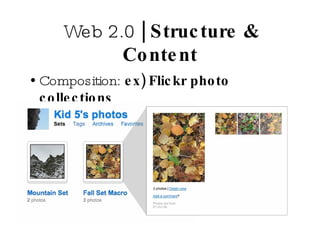
Web 2.0  | Structure & Content Composition:  ex) Flickr photo collections
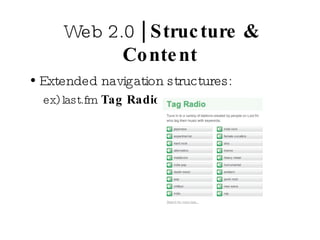
Web 2.0  | Structure & Content Extended navigation structures:  ex) last.fm  Tag Radio
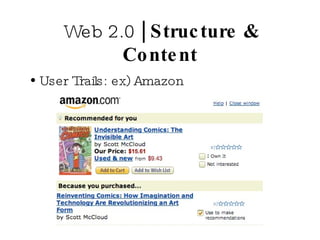
Web 2.0  | Structure & Content User Trails: ex) Amazon
Aspirations  | Dynamic / Adaptive Content  Structures Computation over the network Personalization
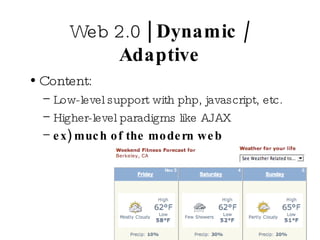
Web 2.0  | Dynamic / Adaptive Content:  Low-level support with php, javascript, etc. Higher-level paradigms like AJAX ex) much of the modern web
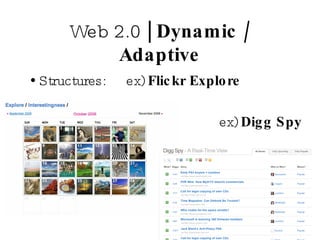
Web 2.0  | Dynamic / Adaptive Structures:  ex)  Flickr Explore ex)  Digg Spy
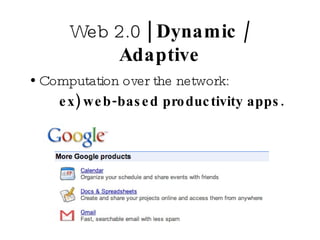
Web 2.0  | Dynamic / Adaptive Computation over the network:  ex) web-based productivity apps.
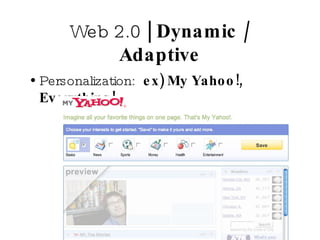
Web 2.0  | Dynamic / Adaptive Personalization:  ex) My Yahoo!, Everything!
Aspirations  | Versioning  Entity Network
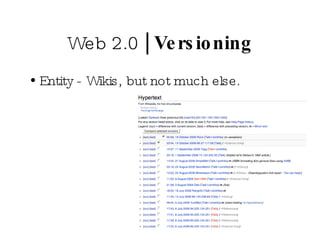
Web 2.0  | Versioning Entity - Wikis, but not much else.
Web 2.0  | Versioning Network: twiki, etc. Also, versioning entire apps incrementally “ End of the software release cycle.”
Aspirations  | Authoring  Private Annotation Public Annotation Global Collaboration Restricted Collaboration Extensibility
Web 2.0  | Authoring Private Annotation:  ex)  primitive blogs, editing basic html
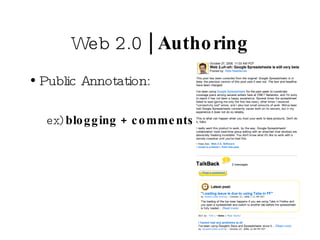
Web 2.0  | Authoring Public Annotation: ex)  blogging + comments
Web 2.0  | Authoring Global Collaboration:  ex) review/commendation systems ex) Wikipedia
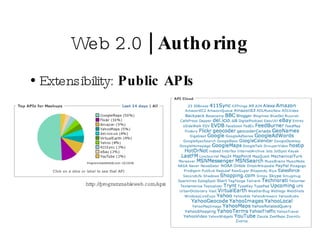
Web 2.0  | Authoring Extensibility:  Public APIs http://programmableweb.com/apis
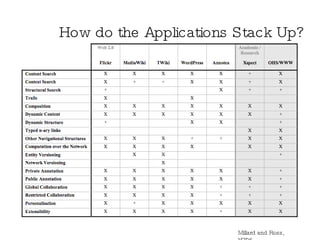
How do the Applications Stack Up?  Millard and Ross, HT06
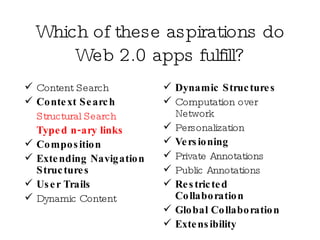
Which of these aspirations do Web 2.0 apps fulfill? Content Search Context Search Structural Search Typed n-ary links Composition Extending Navigation Structures User Trails Dynamic Content Dynamic Structures Computation over Network  Personalization Versioning Private Annotations Public Annotations Restricted Collaboration Global Collaboration  Extensibility
What other aspects of modern web apps aren’t covered here?  Millard & Ross only look at  Flickr , a  few wikis/blogs What about  social networks ?  Doesn’t address  interface richness
Some Questions Which of these aspirations do specific web apps fulfill? How much of this is application dependent? Are some of Millard & Ross’ ideals not useful or practical for many systems? Are these attributes useful criteria to consider when  classifying, analyzing,  and  designing  web applications?
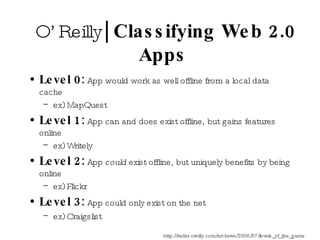
O’Reilly  | Classifying Web 2.0 Apps   Another  very different  way of grouping these applications. “ A hierarchy of ‘Web 2.0-ness’.”  http://radar.oreilly.com/archives/2006/07/levels_of_the_game.html
O’Reilly  | Classifying Web 2.0 Apps   Level 0:  App would work as well offline from a local data cache ex) MapQuest Level 1:  App can and does exist offline, but gains features online ex) Writely   Level 2:  App  could  exist offline, but uniquely benefits by being online ex) Flickr Level 3:  App could only exist on the net ex) Craigslist http://radar.oreilly.com/archives/2006/07/levels_of_the_game.html
An Exercise
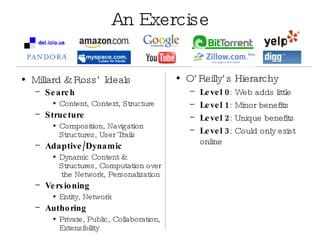
An Exercise Millard & Ross’ Ideals Search Content, Context, Structure Structure Composition, Navigation Structures, User Trails Adaptive/Dynamic Dynamic Content & Structures, Computation over  the Network, Personalization Versioning Entity, Network Authoring Private, Public, Collaboration, Extensibility O’Reilly’s Hierarchy Level 0 : Web adds little Level 1 : Minor benefits Level 2 : Unique benefits Level 3 : Could only exist online
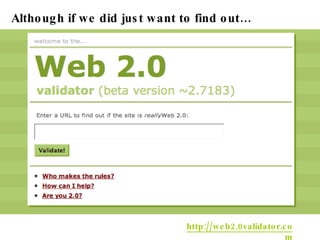
Although if we did just want to find out… http://web2.0validator.com
Blogs, Wikis, & Beyond
Blurring the Distinctions Between Authors and Readers Blogging & Comments Wikis Ratings (& meta-ratings)
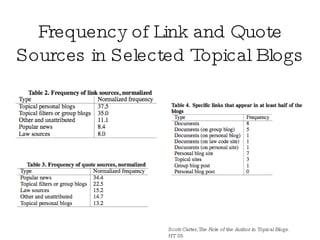
Blogs  | Accumulating and Digesting Information Information from a variety of sources. Posts reference other blogs, outside sources, and introduce new material. Multiple authors create and digest content and structure through posts, links, and comments. Success, conflict resolution largely gauged via popularity and  stickiness  of the content.
Frequency of Link and Quote Sources in Selected Topical Blogs Scott Carter ,The Role of the Author in Topical Blogs.  HT’05
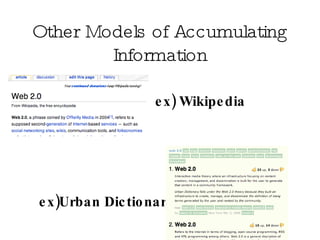
Other Models of Accumulating Information   ex) Wikipedia ex)Urban Dictionary
Jill Walker  | Feral Hypertext “ Massive possibility for collaboration and emergence in the network creates truly  feral  and uncontrollable hypertext.” Wikipedia, Flickr, CiteULike, del.icio.us as examples of feral structures. Important to consider how to make them navigable. Jill Walker,  Feral Hypertext:When Hypertext Literature Escapes Control.  HT’05
A Few Final Questions How successful are these systems at creating and structuring content? What are the implications of multiple authorship?  How do we design web interaction to better facilitate/convey it?

web 2.0

  • 1.
    what makes Web 2.0 applications unique? 30 October 2006 Wesley Willett CS260
  • 2.
    Web 2.0 Accordingto O’Reilly “ Web 2.0 is the network as platform , spanning all connected devices; Web 2.0 applications are those that make the most of the intrinsic advantages of that platform: delivering software as a continually-updated service that gets better the more people use it , consuming and remixing data from multiple sources, including individual users, while providing their own data and services in a form that allows remixing by others, creating network effects through an "architecture of participation," and going beyond the page metaphor of Web 1.0 to deliver rich user experiences.” - Tim O'Reilly October 01, 2005
  • 3.
    Outline From EarlyHypertext to Web 2.0 Implementing aspirations of hypertext pioneers What “2.0” adds that “1.0” lacked A group discussion exercise Authorship and Information Aggregation in Blogs, Wikis, and Beyond (time permitting)
  • 4.
    Drawing on ReadingsMillard, D. E. and Ross, M. 2006. Web 2.0: Hypertext by Any Other Name?. In HT’06. Carter, S. 2005. The Role of the Author in Topical Blogs. In CHI 2005. Walker, J. 2005. Feral Hypertext. In HT’05.
  • 5.
  • 6.
    Web 2.0: Hypertextby Any Other Name?
  • 7.
    Vannevar Bush | Memex As We May Think - 1945
  • 8.
    Ted Nelson | “Hypertext” 1965 Doug Engelbart | oNLine System “ Mother of all Demos” - 1968
  • 9.
    Lippman, MIT | Aspen Movie Map 1st hypermedia system - 1978
  • 10.
    Vision of hypertext/hypermedia A non-linear medium of information Not just the WWW To look at: How well do “Web 2.0” systems implement/refine “ideal” hypertext/hypermedia models? How are they better than “Web 1.0”? An interesting lens through which to examine what makes these new systems unique, useful.
  • 11.
    Aspirations of Hypertext| Millard & Ross Search Structure Adaptive Versioning Authoring 5 major categories
  • 12.
    Aspirations of Hypertext| Millard & Ross As we step through: What systems realize these aspirations? How well do they do so? What are the implications for how we use these systems?
  • 13.
    Aspirations |Search Content Context Structural
  • 14.
    Web 2.0 | Search Content: Explicit text search (Prevalent in 1.0)
  • 15.
    Web 2.0 | Search Context: Implicating tags and other metadata Structural: Not commonly seen. Examples?
  • 16.
    Aspirations |Structure & Content Typed n-ary links Composition Extended navigation structures User Trails
  • 17.
    Web 2.0 | Structure & Content Typed n-ary links: Only in research systems?
  • 18.
    Web 2.0 | Structure & Content Composition: ex) Flickr photo collections
  • 19.
    Web 2.0 | Structure & Content Extended navigation structures: ex) last.fm Tag Radio
  • 20.
    Web 2.0 | Structure & Content User Trails: ex) Amazon
  • 21.
    Aspirations |Dynamic / Adaptive Content Structures Computation over the network Personalization
  • 22.
    Web 2.0 | Dynamic / Adaptive Content: Low-level support with php, javascript, etc. Higher-level paradigms like AJAX ex) much of the modern web
  • 23.
    Web 2.0 | Dynamic / Adaptive Structures: ex) Flickr Explore ex) Digg Spy
  • 24.
    Web 2.0 | Dynamic / Adaptive Computation over the network: ex) web-based productivity apps.
  • 25.
    Web 2.0 | Dynamic / Adaptive Personalization: ex) My Yahoo!, Everything!
  • 26.
    Aspirations |Versioning Entity Network
  • 27.
    Web 2.0 | Versioning Entity - Wikis, but not much else.
  • 28.
    Web 2.0 | Versioning Network: twiki, etc. Also, versioning entire apps incrementally “ End of the software release cycle.”
  • 29.
    Aspirations |Authoring Private Annotation Public Annotation Global Collaboration Restricted Collaboration Extensibility
  • 30.
    Web 2.0 | Authoring Private Annotation: ex) primitive blogs, editing basic html
  • 31.
    Web 2.0 | Authoring Public Annotation: ex) blogging + comments
  • 32.
    Web 2.0 | Authoring Global Collaboration: ex) review/commendation systems ex) Wikipedia
  • 33.
    Web 2.0 | Authoring Extensibility: Public APIs http://programmableweb.com/apis
  • 34.
    How do theApplications Stack Up? Millard and Ross, HT06
  • 35.
    Which of theseaspirations do Web 2.0 apps fulfill? Content Search Context Search Structural Search Typed n-ary links Composition Extending Navigation Structures User Trails Dynamic Content Dynamic Structures Computation over Network Personalization Versioning Private Annotations Public Annotations Restricted Collaboration Global Collaboration Extensibility
  • 36.
    What other aspectsof modern web apps aren’t covered here? Millard & Ross only look at Flickr , a few wikis/blogs What about social networks ? Doesn’t address interface richness
  • 37.
    Some Questions Whichof these aspirations do specific web apps fulfill? How much of this is application dependent? Are some of Millard & Ross’ ideals not useful or practical for many systems? Are these attributes useful criteria to consider when classifying, analyzing, and designing web applications?
  • 38.
    O’Reilly |Classifying Web 2.0 Apps Another very different way of grouping these applications. “ A hierarchy of ‘Web 2.0-ness’.” http://radar.oreilly.com/archives/2006/07/levels_of_the_game.html
  • 39.
    O’Reilly |Classifying Web 2.0 Apps Level 0: App would work as well offline from a local data cache ex) MapQuest Level 1: App can and does exist offline, but gains features online ex) Writely Level 2: App could exist offline, but uniquely benefits by being online ex) Flickr Level 3: App could only exist on the net ex) Craigslist http://radar.oreilly.com/archives/2006/07/levels_of_the_game.html
  • 40.
  • 41.
    An Exercise Millard& Ross’ Ideals Search Content, Context, Structure Structure Composition, Navigation Structures, User Trails Adaptive/Dynamic Dynamic Content & Structures, Computation over the Network, Personalization Versioning Entity, Network Authoring Private, Public, Collaboration, Extensibility O’Reilly’s Hierarchy Level 0 : Web adds little Level 1 : Minor benefits Level 2 : Unique benefits Level 3 : Could only exist online
  • 42.
    Although if wedid just want to find out… http://web2.0validator.com
  • 43.
  • 44.
    Blurring the DistinctionsBetween Authors and Readers Blogging & Comments Wikis Ratings (& meta-ratings)
  • 45.
    Blogs |Accumulating and Digesting Information Information from a variety of sources. Posts reference other blogs, outside sources, and introduce new material. Multiple authors create and digest content and structure through posts, links, and comments. Success, conflict resolution largely gauged via popularity and stickiness of the content.
  • 46.
    Frequency of Linkand Quote Sources in Selected Topical Blogs Scott Carter ,The Role of the Author in Topical Blogs. HT’05
  • 47.
    Other Models ofAccumulating Information ex) Wikipedia ex)Urban Dictionary
  • 48.
    Jill Walker | Feral Hypertext “ Massive possibility for collaboration and emergence in the network creates truly feral and uncontrollable hypertext.” Wikipedia, Flickr, CiteULike, del.icio.us as examples of feral structures. Important to consider how to make them navigable. Jill Walker, Feral Hypertext:When Hypertext Literature Escapes Control. HT’05
  • 49.
    A Few FinalQuestions How successful are these systems at creating and structuring content? What are the implications of multiple authorship? How do we design web interaction to better facilitate/convey it?