


RESEARCH METHODOLOGY
Department of Pharmaceutics
Girijananda Chowdhury Institute of Pharmaceutical Science
Hatkhowapara, Azara, Guwahati-17
CONTENT:
 DEFINATION
 OBJECTIVE OF RESEARCH
 SIGNIFICANCE OF RESEARCH
 RESEARCH METHODS:
 RESEARCH PROBLEM
 TYPES OF RESEARCH
 REVIEW OF LITERATURE
 STEPS IN RESEARCH
11/2/2019 Mustafizur Rahman, M.Pharm, Dept. Pharmaceutics. (GIPS) 2
Definition of Research
“Research is a
systematized effort
to gain new knowledge”.
Research can also be defined as
Search for knowledge
Systematic and scientific search for getting relevant
answers on any taken up specific topic.
Scientific enquiry into a subject.
Research is a movement from the unknown to the known.
11/2/2019 Mustafizur Rahman, M.Pharm, Dept. Pharmaceutics. (GIPS) 4
RESEARCH OBJECTIVES
 Research Objectives are the statement of the questions that is
to be investigated with the goal of answering the overall
research problem.
 Research Objectives should be clear and achievable.
 Generally, they are written as statements, using the word “to”
(For example : to discover … „ to determine …„ to
establish....,to find out…, to assess …..,etc. )
The objectives are:
 To gain familiarity with a phenomenon or to achieve new insights
into it. – Exploratory or Formulative Research.
 To portray accurately the characteristics of a particular individual,
situation or a group. – Descriptive Research.
 To determine the frequency with which something occurs or with
which it is associated with something else. – Diagnostic Research.
 To test a hypothesis of a causal relationship between variables. –
Hypothesis Testing Research.
11/2/2019 Mustafizur Rahman, M.Pharm, Dept. Pharmaceutics. (GIPS) 6
SIGNIFICANCE OF RESEARCH
 Identify alternative course of action.
 Help in economics use of resources.
 Help in project identification.
 Solves investment problem.
 For students, research means a careerism or a way to
attain a high position in the social structure
 Solves various operational and planning problems of
business and industry
Research Methods
May be understood as all those methods or
techniques that are used by a researcher
for conducting a Research
depending upon the methods.
11/2/2019 Mustafizur Rahman, M.Pharm, Dept. Pharmaceutics. (GIPS)
(1) Library Research:
Analysis of historical records and documents. – Statistical
compilation, references, abstracts, guides manipulation (handle
with skill)
(2) Field Research:
Observation, questionnaires, personal, Group or telephonic
interviews, case study.
(3) Laboratory Research:
A laboratory is a facility that provides controlled conditions in
which scientific or technological research, experiments, and
measurement may be performed.
9
11/2/2019 Mustafizur Rahman, M.Pharm, Dept. Pharmaceutics. (GIPS)
Research Methodology:
Is the way do systematically solve the research problem.
In it we study the various steps that are generally
adopted by a researcher in studying his research problem logically.
Steps:
1) Why a particular research study has been undertaken?
2) How the Research problem has been defined?
3) What way and why the hypothesis (basic idea) has been formulated?
4) Why a particular technique of analyzing data is used? (or) How the
data were collected?
5) How the collected data were interpreted?
6) What deletion was made?
7) What was the conclusion?
Finally what was the solution for the Research problem?
10
RESEARCH PROBLEM ?
Research Problem refers to some difficulty which
a researcher experiences and wants to obtain a
solution for the same.
i.e. a question or issue to be examined.
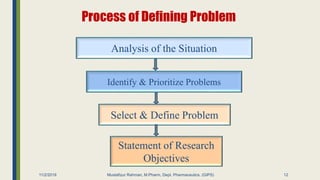
Process of Defining Problem
11/2/2019 Mustafizur Rahman, M.Pharm, Dept. Pharmaceutics. (GIPS)
Analysis of the Situation
Identify & Prioritize Problems
Select & Define Problem
Statement of Research
Objectives
12
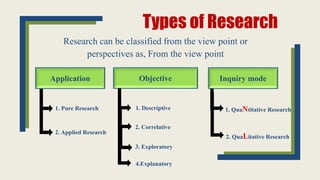
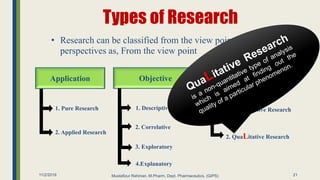
Types of Research
Research can be classified from the view point or
perspectives as, From the view point
Application Objective Inquiry mode
1. Pure Research
2. Applied Research
2. Correlative
4.Explanatory
3. Exploratory
1. Descriptive 1. QuaNtitative Research
2. QuaLitative Research
Mustafizur Rahman, M.Pharm, Dept. Pharmaceutics. (GIPS)
Types of Research
• Research can be classified from the view point or
perspectives as, From the view point
Application Objective Inquiry mode
1. Pure Research
2. Applied Research
2. Correlative
4.Explanatory
3. Exploratory
1. Descriptive 1. QuaNtitative Research
2. QuaLitative Research
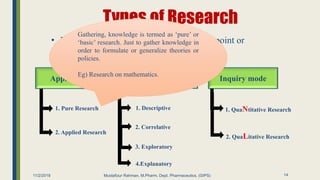
Gathering, knowledge is termed as ‘pure’ or
‘basic’ research. Just to gather knowledge in
order to formulate or generalize theories or
policies.
Eg) Research on mathematics.
11/2/2019 14
Types of Research
• Research can be classified from the view point or
perspectives as, From the view point
15
Application Objective Inquiry mode
1. Pure Research
2. Applied Research
2. Correlative
4.Explanatory
3. Exploratory
1. Descriptive 1. QuaNtitative Research
2. QuaLitative Research
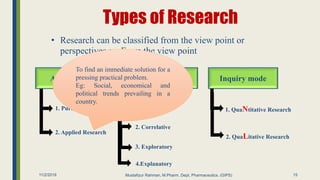
To find an immediate solution for a
pressing practical problem.
Eg: Social, economical and
political trends prevailing in a
country.
Mustafizur Rahman, M.Pharm, Dept. Pharmaceutics. (GIPS)11/2/2019
Types of Research
• Research can be classified from the view point or
perspectives as, From the view point
16
Application Objective Inquiry mode
1. Pure Research
2. Applied Research
2. Correlative
4.Explanatory
3. Exploratory
1. Descriptive 1. QuaNtitative Research
2. QuaLitative Research
Mustafizur Rahman, M.Pharm, Dept. Pharmaceutics. (GIPS)11/2/2019
Types of Research
• Research can be classified from the view point or
perspectives as, From the view point
17
Application Objective Inquiry mode
1. Pure Research
2. Applied Research
2. Correlative
4.Explanatory
3. Exploratory
1. Descriptive 1. QuaNtitative Research
2. QuaLitative Research
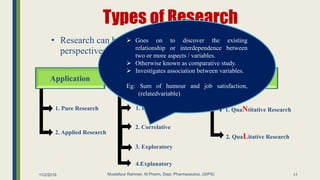
 Goes on to discover the existing
relationship or interdependence between
two or more aspects / variables.
 Otherwise known as comparative study.
 Investigates association between variables.
Eg: Sum of humour and job satisfaction,
(relatedvariable)
11/2/2019 Mustafizur Rahman, M.Pharm, Dept. Pharmaceutics. (GIPS)
Types of Research
• Research can be classified from the view point or
perspectives as, From the view point
18
Application Objective Inquiry mode
1. Pure Research
2. Applied Research
2. Correlative
4.Explanatory
3. Exploratory
1. Descriptive 1. QuaNtitative Research
2. QuaLitative Research
11/2/2019 Mustafizur Rahman, M.Pharm, Dept. Pharmaceutics. (GIPS)
Types of Research
• Research can be classified from the view point or
perspectives as, From the view point
19
Application Objective Inquiry mode
1. Pure Research
2. Applied Research
2. Correlative
4.Explanatory
3. Exploratory
1. Descriptive 1. QuaNtitative Research
2. QuaLitative Research
11/2/2019 Mustafizur Rahman, M.Pharm, Dept. Pharmaceutics. (GIPS)
Types of Research
• Research can be classified from the view point or
perspectives as, From the view point
20
Application Objective Inquiry mode
1. Pure Research
2. Applied Research
2. Correlative
4.Explanatory
3. Exploratory
1. Descriptive 1. QuaNtitative Research
2. QuaLitative Research
11/2/2019 Mustafizur Rahman, M.Pharm, Dept. Pharmaceutics. (GIPS)
Types of Research
• Research can be classified from the view point or
perspectives as, From the view point
21
Application Objective Inquiry mode
1. Pure Research
2. Applied Research
2. Correlative
4.Explanatory
3. Exploratory
1. Descriptive 1. QuaNtitative Research
2. QuaLitative Research
11/2/2019 Mustafizur Rahman, M.Pharm, Dept. Pharmaceutics. (GIPS)
Review of Literature
Review of literature
11/2/2019 Mustafizur Rahman, M.Pharm, Dept. Pharmaceutics. (GIPS)
 What ?
 Why ?
 Where?
23
What ?
REVIEW OF LITERATURE
11/2/2019 Mustafizur Rahman, M.Pharm, Dept. Pharmaceutics. (GIPS)
Literature Review is the documentation of a published
and unpublished work from secondary sources of data
in the areas of specific interest to the researcher.
24
Why ?
PURPOSE OF REVIEW
11/2/2019 Mustafizur Rahman, M.Pharm, Dept. Pharmaceutics. (GIPS)
 To find out already investigated problems and those that
need further investigation.
 To formulate researchable hypothesis.
 To gain a background knowledge
 To identify data sources
 To learn how others structured their reports.
25
Where ?
SOURCES OF LITERATURE
11/2/2019 Mustafizur Rahman, M.Pharm, Dept. Pharmaceutics. (GIPS)
 Books and Journals
 Databases
 Bibliographic Databases
 Abstract Databases
 Full-Text Databases
 Govt. and NGO Records & Reports
 Internet
 On line journals
 E. Databases – Popline, Medline
 Research Dissertations / Thesis
26
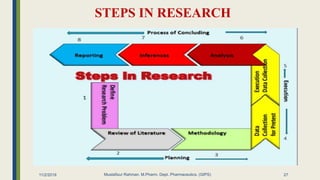
STEPS IN RESEARCH
11/2/2019 Mustafizur Rahman, M.Pharm, Dept. Pharmaceutics. (GIPS) 27
MUSTAFIZUR
RAHMAN
Department of Pharmaceutics
Girijananda Chowdhury Institute of Pharmaceutical Science
Hatkhowapara, Azara, Guwahati-17
M.Pharm,3rd Sem, Roll No: 07
Dept. Pharmaceutics. (GIPS)
Email id : mustafizur7465@rediffmail.com
Phn No : +91 9706136714/ +91 7002689088
Website: www.mustafizur.ml

Research methodology

  • 1.
    RESEARCH METHODOLOGY Department ofPharmaceutics Girijananda Chowdhury Institute of Pharmaceutical Science Hatkhowapara, Azara, Guwahati-17
  • 2.
    CONTENT:  DEFINATION  OBJECTIVEOF RESEARCH  SIGNIFICANCE OF RESEARCH  RESEARCH METHODS:  RESEARCH PROBLEM  TYPES OF RESEARCH  REVIEW OF LITERATURE  STEPS IN RESEARCH 11/2/2019 Mustafizur Rahman, M.Pharm, Dept. Pharmaceutics. (GIPS) 2
  • 3.
    Definition of Research “Researchis a systematized effort to gain new knowledge”.
  • 4.
    Research can alsobe defined as Search for knowledge Systematic and scientific search for getting relevant answers on any taken up specific topic. Scientific enquiry into a subject. Research is a movement from the unknown to the known. 11/2/2019 Mustafizur Rahman, M.Pharm, Dept. Pharmaceutics. (GIPS) 4
  • 5.
    RESEARCH OBJECTIVES  ResearchObjectives are the statement of the questions that is to be investigated with the goal of answering the overall research problem.  Research Objectives should be clear and achievable.  Generally, they are written as statements, using the word “to” (For example : to discover … „ to determine …„ to establish....,to find out…, to assess …..,etc. )
  • 6.
    The objectives are: To gain familiarity with a phenomenon or to achieve new insights into it. – Exploratory or Formulative Research.  To portray accurately the characteristics of a particular individual, situation or a group. – Descriptive Research.  To determine the frequency with which something occurs or with which it is associated with something else. – Diagnostic Research.  To test a hypothesis of a causal relationship between variables. – Hypothesis Testing Research. 11/2/2019 Mustafizur Rahman, M.Pharm, Dept. Pharmaceutics. (GIPS) 6
  • 7.
    SIGNIFICANCE OF RESEARCH Identify alternative course of action.  Help in economics use of resources.  Help in project identification.  Solves investment problem.  For students, research means a careerism or a way to attain a high position in the social structure  Solves various operational and planning problems of business and industry
  • 8.
    Research Methods May beunderstood as all those methods or techniques that are used by a researcher for conducting a Research depending upon the methods.
  • 9.
    11/2/2019 Mustafizur Rahman,M.Pharm, Dept. Pharmaceutics. (GIPS) (1) Library Research: Analysis of historical records and documents. – Statistical compilation, references, abstracts, guides manipulation (handle with skill) (2) Field Research: Observation, questionnaires, personal, Group or telephonic interviews, case study. (3) Laboratory Research: A laboratory is a facility that provides controlled conditions in which scientific or technological research, experiments, and measurement may be performed. 9
  • 10.
    11/2/2019 Mustafizur Rahman,M.Pharm, Dept. Pharmaceutics. (GIPS) Research Methodology: Is the way do systematically solve the research problem. In it we study the various steps that are generally adopted by a researcher in studying his research problem logically. Steps: 1) Why a particular research study has been undertaken? 2) How the Research problem has been defined? 3) What way and why the hypothesis (basic idea) has been formulated? 4) Why a particular technique of analyzing data is used? (or) How the data were collected? 5) How the collected data were interpreted? 6) What deletion was made? 7) What was the conclusion? Finally what was the solution for the Research problem? 10
  • 11.
    RESEARCH PROBLEM ? ResearchProblem refers to some difficulty which a researcher experiences and wants to obtain a solution for the same. i.e. a question or issue to be examined.
  • 12.
    Process of DefiningProblem 11/2/2019 Mustafizur Rahman, M.Pharm, Dept. Pharmaceutics. (GIPS) Analysis of the Situation Identify & Prioritize Problems Select & Define Problem Statement of Research Objectives 12
  • 13.
    Types of Research Researchcan be classified from the view point or perspectives as, From the view point Application Objective Inquiry mode 1. Pure Research 2. Applied Research 2. Correlative 4.Explanatory 3. Exploratory 1. Descriptive 1. QuaNtitative Research 2. QuaLitative Research
  • 14.
    Mustafizur Rahman, M.Pharm,Dept. Pharmaceutics. (GIPS) Types of Research • Research can be classified from the view point or perspectives as, From the view point Application Objective Inquiry mode 1. Pure Research 2. Applied Research 2. Correlative 4.Explanatory 3. Exploratory 1. Descriptive 1. QuaNtitative Research 2. QuaLitative Research Gathering, knowledge is termed as ‘pure’ or ‘basic’ research. Just to gather knowledge in order to formulate or generalize theories or policies. Eg) Research on mathematics. 11/2/2019 14
  • 15.
    Types of Research •Research can be classified from the view point or perspectives as, From the view point 15 Application Objective Inquiry mode 1. Pure Research 2. Applied Research 2. Correlative 4.Explanatory 3. Exploratory 1. Descriptive 1. QuaNtitative Research 2. QuaLitative Research To find an immediate solution for a pressing practical problem. Eg: Social, economical and political trends prevailing in a country. Mustafizur Rahman, M.Pharm, Dept. Pharmaceutics. (GIPS)11/2/2019
  • 16.
    Types of Research •Research can be classified from the view point or perspectives as, From the view point 16 Application Objective Inquiry mode 1. Pure Research 2. Applied Research 2. Correlative 4.Explanatory 3. Exploratory 1. Descriptive 1. QuaNtitative Research 2. QuaLitative Research Mustafizur Rahman, M.Pharm, Dept. Pharmaceutics. (GIPS)11/2/2019
  • 17.
    Types of Research •Research can be classified from the view point or perspectives as, From the view point 17 Application Objective Inquiry mode 1. Pure Research 2. Applied Research 2. Correlative 4.Explanatory 3. Exploratory 1. Descriptive 1. QuaNtitative Research 2. QuaLitative Research  Goes on to discover the existing relationship or interdependence between two or more aspects / variables.  Otherwise known as comparative study.  Investigates association between variables. Eg: Sum of humour and job satisfaction, (relatedvariable) 11/2/2019 Mustafizur Rahman, M.Pharm, Dept. Pharmaceutics. (GIPS)
  • 18.
    Types of Research •Research can be classified from the view point or perspectives as, From the view point 18 Application Objective Inquiry mode 1. Pure Research 2. Applied Research 2. Correlative 4.Explanatory 3. Exploratory 1. Descriptive 1. QuaNtitative Research 2. QuaLitative Research 11/2/2019 Mustafizur Rahman, M.Pharm, Dept. Pharmaceutics. (GIPS)
  • 19.
    Types of Research •Research can be classified from the view point or perspectives as, From the view point 19 Application Objective Inquiry mode 1. Pure Research 2. Applied Research 2. Correlative 4.Explanatory 3. Exploratory 1. Descriptive 1. QuaNtitative Research 2. QuaLitative Research 11/2/2019 Mustafizur Rahman, M.Pharm, Dept. Pharmaceutics. (GIPS)
  • 20.
    Types of Research •Research can be classified from the view point or perspectives as, From the view point 20 Application Objective Inquiry mode 1. Pure Research 2. Applied Research 2. Correlative 4.Explanatory 3. Exploratory 1. Descriptive 1. QuaNtitative Research 2. QuaLitative Research 11/2/2019 Mustafizur Rahman, M.Pharm, Dept. Pharmaceutics. (GIPS)
  • 21.
    Types of Research •Research can be classified from the view point or perspectives as, From the view point 21 Application Objective Inquiry mode 1. Pure Research 2. Applied Research 2. Correlative 4.Explanatory 3. Exploratory 1. Descriptive 1. QuaNtitative Research 2. QuaLitative Research 11/2/2019 Mustafizur Rahman, M.Pharm, Dept. Pharmaceutics. (GIPS)
  • 22.
  • 23.
    Review of literature 11/2/2019Mustafizur Rahman, M.Pharm, Dept. Pharmaceutics. (GIPS)  What ?  Why ?  Where? 23
  • 24.
    What ? REVIEW OFLITERATURE 11/2/2019 Mustafizur Rahman, M.Pharm, Dept. Pharmaceutics. (GIPS) Literature Review is the documentation of a published and unpublished work from secondary sources of data in the areas of specific interest to the researcher. 24
  • 25.
    Why ? PURPOSE OFREVIEW 11/2/2019 Mustafizur Rahman, M.Pharm, Dept. Pharmaceutics. (GIPS)  To find out already investigated problems and those that need further investigation.  To formulate researchable hypothesis.  To gain a background knowledge  To identify data sources  To learn how others structured their reports. 25
  • 26.
    Where ? SOURCES OFLITERATURE 11/2/2019 Mustafizur Rahman, M.Pharm, Dept. Pharmaceutics. (GIPS)  Books and Journals  Databases  Bibliographic Databases  Abstract Databases  Full-Text Databases  Govt. and NGO Records & Reports  Internet  On line journals  E. Databases – Popline, Medline  Research Dissertations / Thesis 26
  • 27.
    STEPS IN RESEARCH 11/2/2019Mustafizur Rahman, M.Pharm, Dept. Pharmaceutics. (GIPS) 27
  • 28.
    MUSTAFIZUR RAHMAN Department of Pharmaceutics GirijanandaChowdhury Institute of Pharmaceutical Science Hatkhowapara, Azara, Guwahati-17 M.Pharm,3rd Sem, Roll No: 07 Dept. Pharmaceutics. (GIPS) Email id : mustafizur7465@rediffmail.com Phn No : +91 9706136714/ +91 7002689088 Website: www.mustafizur.ml

Editor's Notes

  • #11 When we talk of Research Methodology, we not only talk of research methods but also consider the logic behind the methods we use in the context of our research study and explain why we are using a particular method or we are not using a particular method or technique so that research results are capable of being evaluated either by the researcher or others.
  • #15 This types of research adds knowledge to the already existing organized body.
  • #24 Why ?-- PURPOSE OF REVIEW
  • #27 Outcome of the review will be the knowledge so as to pre determine what data or materials are available for operational purposes.