Research Methodology: Types of
Research Designs
Dr. Rajeev Kumar
MSW (TISS, Mumbai), M.Phil (CIP, Ranchi)
UGC-JRF, Ph.D. (IIT Kharagpur)
9/8/2021 ©Dr. Rajeev Kumar 2021 1
9/8/2021 ©Dr. Rajeev Kumar 2021 2
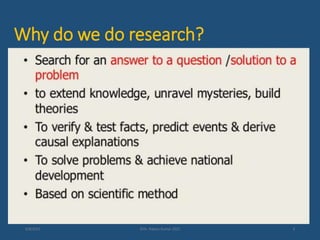
Why do we do research?
9/8/2021 ©Dr. Rajeev Kumar 2021 3
9/8/2021 ©Dr. Rajeev Kumar 2021 4
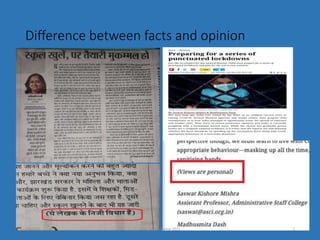
Difference between facts and opinion
9/8/2021 ©Dr. Rajeev Kumar 2021 5
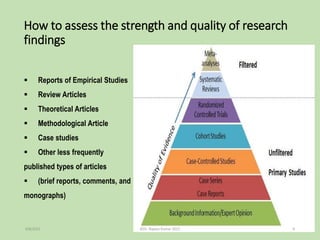
 Reports of Empirical Studies
 Review Articles
 Theoretical Articles
 Methodological Article
 Case studies
 Other less frequently
published types of articles
 (brief reports, comments, and
monographs)
How to assess the strength and quality of research
findings
9/8/2021 ©Dr. Rajeev Kumar 2021 6
Before moving ahead …..lets learn few terms
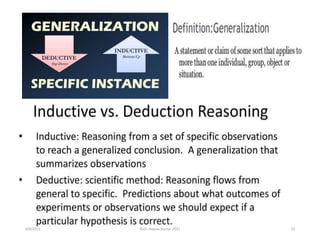
What is generalization?
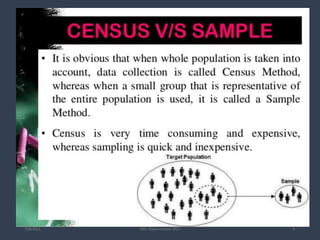
Difference between sample and census
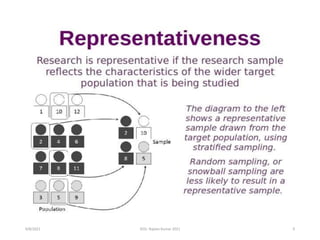
What is representativeness
Inductive reasoning
Deductive reasoning
9/8/2021 ©Dr. Rajeev Kumar 2021 7
9/8/2021 ©Dr. Rajeev Kumar 2021 8
9/8/2021 ©Dr. Rajeev Kumar 2021 9
9/8/2021 ©Dr. Rajeev Kumar 2021 10
9/8/2021 ©Dr. Rajeev Kumar 2021 11
9/8/2021 ©Dr. Rajeev Kumar 2021 12
9/8/2021 ©Dr. Rajeev Kumar 2021 13
9/8/2021 ©Dr. Rajeev Kumar 2021 14
9/8/2021 ©Dr. Rajeev Kumar 2021 15
9/8/2021 ©Dr. Rajeev Kumar 2021 16
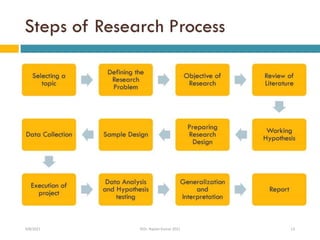
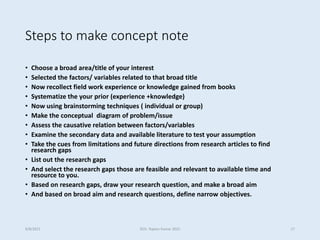
Steps to make concept note
• Choose a broad area/title of your interest
• Selected the factors/ variables related to that broad title
• Now recollect field work experience or knowledge gained from books
• Systematize the your prior (experience +knowledge)
• Now using brainstorming techniques ( individual or group)
• Make the conceptual diagram of problem/issue
• Assess the causative relation between factors/variables
• Examine the secondary data and available literature to test your assumption
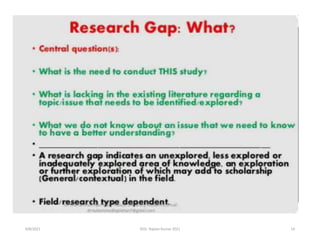
• Take the cues from limitations and future directions from research articles to find
research gaps
• List out the research gaps
• And select the research gaps those are feasible and relevant to available time and
resource to you.
• Based on research gaps, draw your research question, and make a broad aim
• And based on broad aim and research questions, define narrow objectives.
9/8/2021 ©Dr. Rajeev Kumar 2021 17
9/8/2021 ©Dr. Rajeev Kumar 2021 18
19
9/8/2021 ©Dr. Rajeev Kumar 2021
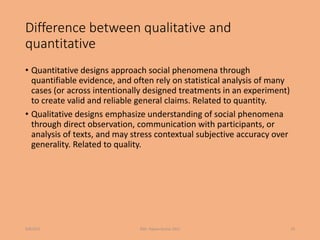
Difference between qualitative and
quantitative
• Quantitative designs approach social phenomena through
quantifiable evidence, and often rely on statistical analysis of many
cases (or across intentionally designed treatments in an experiment)
to create valid and reliable general claims. Related to quantity.
• Qualitative designs emphasize understanding of social phenomena
through direct observation, communication with participants, or
analysis of texts, and may stress contextual subjective accuracy over
generality. Related to quality.
9/8/2021 ©Dr. Rajeev Kumar 2021 20
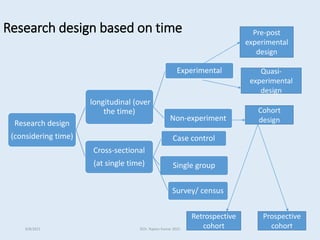
Research design
(considering time)
longitudinal (over
the time)
Experimental
Non-experiment
Cross-sectional
(at single time)
Case control
Single group
Survey/ census
Pre-post
experimental
design
Quasi-
experimental
design
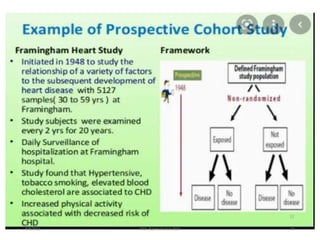
Cohort
design
Retrospective
cohort
Prospective
cohort
Research design based on time
9/8/2021 ©Dr. Rajeev Kumar 2021 21
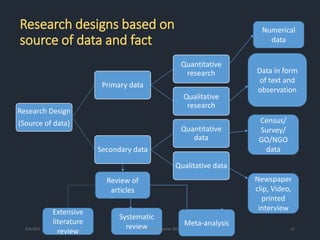
Research Design
(Source of data)
Primary data
Quantitative
research
Qualitative
research
Secondary data
Quantitative
data
Qualitative data
Census/
Survey/
GO/NGO
data
Data in form
of text and
observation
Numerical
data
Newspaper
clip, Video,
printed
interview
Review of
articles
Extensive
literature
review
Systematic
review Meta-analysis
Research designs based on
source of data and fact
9/8/2021 ©Dr. Rajeev Kumar 2021 22
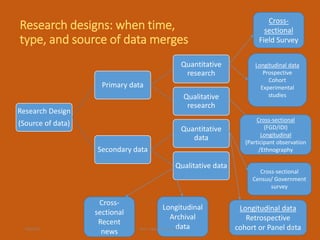
Research Design
(Source of data)
Primary data
Quantitative
research
Qualitative
research
Secondary data
Quantitative
data
Qualitative data
Cross-sectional
(FGD/IDI)
Longitudinal
(Participant observation
/Ethnography
Longitudinal data
Prospective
Cohort
Experimental
studies
Cross-
sectional
Field Survey
Longitudinal data
Retrospective
cohort or Panel data
Research designs: when time,
type, and source of data merges
Cross-
sectional
Recent
news
Cross-sectional
Census/ Government
survey
Longitudinal
Archival
data
9/8/2021 ©Dr. Rajeev Kumar 2021 23
9/8/2021 ©Dr. Rajeev Kumar 2021 24
9/8/2021 ©Dr. Rajeev Kumar 2021 25
9/8/2021 ©Dr. Rajeev Kumar 2021 26
9/8/2021 ©Dr. Rajeev Kumar 2021 27
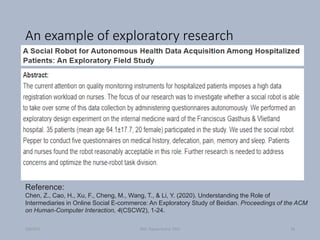
An example of exploratory research
9/8/2021 ©Dr. Rajeev Kumar 2021 28
Reference:
Chen, Z., Cao, H., Xu, F., Cheng, M., Wang, T., & Li, Y. (2020). Understanding the Role of
Intermediaries in Online Social E-commerce: An Exploratory Study of Beidian. Proceedings of the ACM
on Human-Computer Interaction, 4(CSCW2), 1-24.
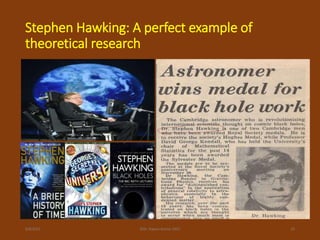
Stephen Hawking: A perfect example of
theoretical research
9/8/2021 ©Dr. Rajeev Kumar 2021 29
9/8/2021 ©Dr. Rajeev Kumar 2021 30
9/8/2021 ©Dr. Rajeev Kumar 2021 31
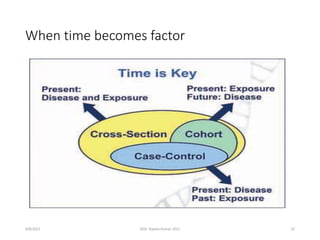
When time becomes factor
9/8/2021 ©Dr. Rajeev Kumar 2021 32
9/8/2021 ©Dr. Rajeev Kumar 2021 33
9/8/2021 ©Dr. Rajeev Kumar 2021 34
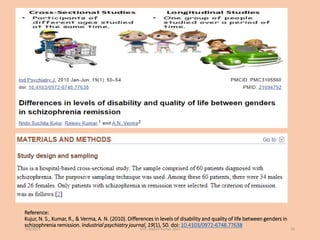
Reference:
Kujur, N. S., Kumar, R., & Verma, A. N. (2010). Differences in levels of disability and quality of life between genders in
schizophrenia remission. Industrial psychiatry journal, 19(1), 50. doi: 10.4103/0972-6748.77638
9/8/2021 ©Dr. Rajeev Kumar 2021 35
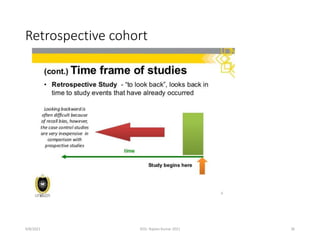
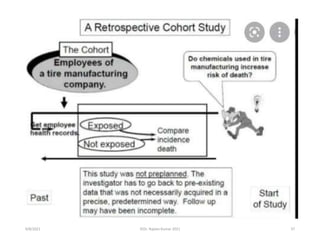
Retrospective cohort
9/8/2021 ©Dr. Rajeev Kumar 2021 36
9/8/2021 ©Dr. Rajeev Kumar 2021 37
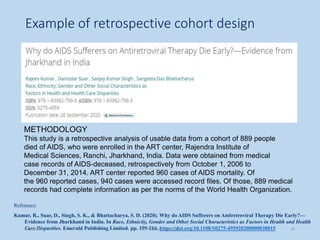
Example of retrospective cohort design
METHODOLOGY
This study is a retrospective analysis of usable data from a cohort of 889 people
died of AIDS, who were enrolled in the ART center, Rajendra Institute of
Medical Sciences, Ranchi, Jharkhand, India. Data were obtained from medical
case records of AIDS-deceased, retrospectively from October 1, 2006 to
December 31, 2014. ART center reported 960 cases of AIDS mortality. Of
the 960 reported cases, 940 cases were accessed record files. Of those, 889 medical
records had complete information as per the norms of the World Health Organization.
Reference:
Kumar, R., Suar, D., Singh, S. K., & Bhattacharya, S. D. (2020). Why do AIDS Sufferers on Antiretroviral Therapy Die Early?—
Evidence from Jharkhand in India. In Race, Ethnicity, Gender and Other Social Characteristics as Factors in Health and Health
Care Disparities. Emerald Publishing Limited. pp. 199-216. https://doi.org/10.1108/S0275-495920200000038015
9/8/2021 ©Dr. Rajeev Kumar 2021 38
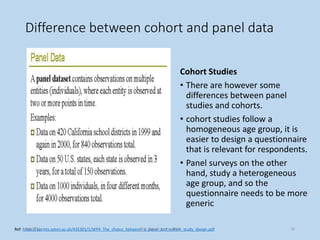
Difference between cohort and panel data
Cohort Studies
• There are however some
differences between panel
studies and cohorts.
• cohort studies follow a
homogeneous age group, it is
easier to design a questionnaire
that is relevant for respondents.
• Panel surveys on the other
hand, study a heterogeneous
age group, and so the
questionnaire needs to be more
generic
Ref: https://eprints.soton.ac.uk/435301/1/WP4_The_choice_between_a_panel_and_cohort_study_design.pdf
9/8/2021 ©Dr. Rajeev Kumar 2021 39
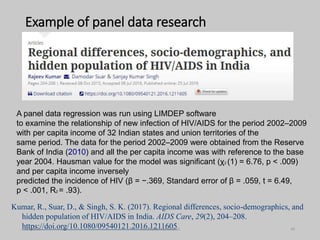
Example of panel data research
A panel data regression was run using LIMDEP software
to examine the relationship of new infection of HIV/AIDS for the period 2002–2009
with per capita income of 32 Indian states and union territories of the
same period. The data for the period 2002–2009 were obtained from the Reserve
Bank of India (2010) and all the per capita income was with reference to the base
year 2004. Hausman value for the model was significant (χ2 (1) = 6.76, p < .009)
and per capita income inversely
predicted the incidence of HIV (β = −.369, Standard error of β = .059, t = 6.49,
p < .001, R2 = .93).
Kumar, R., Suar, D., & Singh, S. K. (2017). Regional differences, socio-demographics, and
hidden population of HIV/AIDS in India. AIDS Care, 29(2), 204–208.
https://doi.org/10.1080/09540121.2016.1211605
9/8/2021 ©Dr. Rajeev Kumar 2021 40
9/8/2021 ©Dr. Rajeev Kumar 2021 41
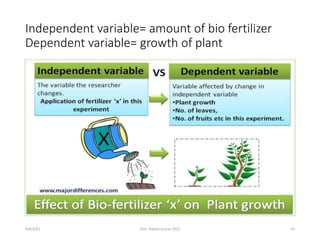
Independent variable= amount of bio fertilizer
Dependent variable= growth of plant
9/8/2021 ©Dr. Rajeev Kumar 2021 42
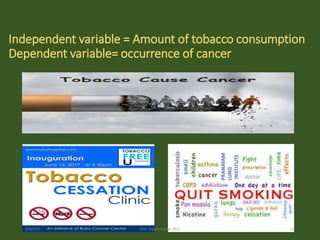
Independent variable = Amount of tobacco consumption
Dependent variable= occurrence of cancer
9/8/2021 ©Dr. Rajeev Kumar 2021 43
9/8/2021 ©Dr. Rajeev Kumar 2021 44
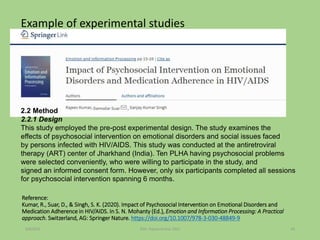
Reference:
Kumar, R., Suar, D., & Singh, S. K. (2020). Impact of Psychosocial Intervention on Emotional Disorders and
Medication Adherence in HIV/AIDS. In S. N. Mohanty (Ed.), Emotion and Information Processing: A Practical
approach. Switzerland, AG: Springer Nature. https://doi.org/10.1007/978-3-030-48849-9
Example of experimental studies
2.2 Method
2.2.1 Design
This study employed the pre-post experimental design. The study examines the
effects of psychosocial intervention on emotional disorders and social issues faced
by persons infected with HIV/AIDS. This study was conducted at the antiretroviral
therapy (ART) center of Jharkhand (India). Ten PLHA having psychosocial problems
were selected conveniently, who were willing to participate in the study, and
signed an informed consent form. However, only six participants completed all sessions
for psychosocial intervention spanning 6 months.
9/8/2021 ©Dr. Rajeev Kumar 2021 45
9/8/2021 ©Dr. Rajeev Kumar 2021 46
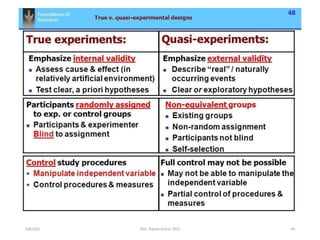
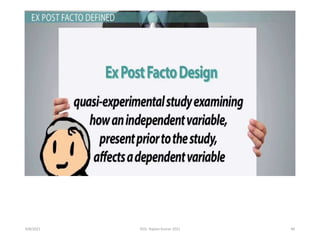
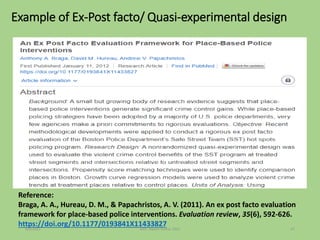
Example of Ex-Post facto/ Quasi-experimental design
Reference:
Braga, A. A., Hureau, D. M., & Papachristos, A. V. (2011). An ex post facto evaluation
framework for place-based police interventions. Evaluation review, 35(6), 592-626.
https://doi.org/10.1177/0193841X11433827
9/8/2021 ©Dr. Rajeev Kumar 2021 47
Keep learning……………………..to be continued
In the next session, we will discuss about sampling
methods, appropriateness, and its practical
demonstration.
Thanks for your patience and inclination to learn.
9/8/2021 ©Dr. Rajeev Kumar 2021 48

Research Method: Types of Research Designs

  • 1.
    Research Methodology: Typesof Research Designs Dr. Rajeev Kumar MSW (TISS, Mumbai), M.Phil (CIP, Ranchi) UGC-JRF, Ph.D. (IIT Kharagpur) 9/8/2021 ©Dr. Rajeev Kumar 2021 1
  • 2.
  • 3.
    Why do wedo research? 9/8/2021 ©Dr. Rajeev Kumar 2021 3
  • 4.
  • 5.
    Difference between factsand opinion 9/8/2021 ©Dr. Rajeev Kumar 2021 5
  • 6.
     Reports ofEmpirical Studies  Review Articles  Theoretical Articles  Methodological Article  Case studies  Other less frequently published types of articles  (brief reports, comments, and monographs) How to assess the strength and quality of research findings 9/8/2021 ©Dr. Rajeev Kumar 2021 6
  • 7.
    Before moving ahead…..lets learn few terms What is generalization? Difference between sample and census What is representativeness Inductive reasoning Deductive reasoning 9/8/2021 ©Dr. Rajeev Kumar 2021 7
  • 8.
  • 9.
  • 10.
    9/8/2021 ©Dr. RajeevKumar 2021 10
  • 11.
    9/8/2021 ©Dr. RajeevKumar 2021 11
  • 12.
    9/8/2021 ©Dr. RajeevKumar 2021 12
  • 13.
    9/8/2021 ©Dr. RajeevKumar 2021 13
  • 14.
    9/8/2021 ©Dr. RajeevKumar 2021 14
  • 15.
    9/8/2021 ©Dr. RajeevKumar 2021 15
  • 16.
    9/8/2021 ©Dr. RajeevKumar 2021 16
  • 17.
    Steps to makeconcept note • Choose a broad area/title of your interest • Selected the factors/ variables related to that broad title • Now recollect field work experience or knowledge gained from books • Systematize the your prior (experience +knowledge) • Now using brainstorming techniques ( individual or group) • Make the conceptual diagram of problem/issue • Assess the causative relation between factors/variables • Examine the secondary data and available literature to test your assumption • Take the cues from limitations and future directions from research articles to find research gaps • List out the research gaps • And select the research gaps those are feasible and relevant to available time and resource to you. • Based on research gaps, draw your research question, and make a broad aim • And based on broad aim and research questions, define narrow objectives. 9/8/2021 ©Dr. Rajeev Kumar 2021 17
  • 18.
    9/8/2021 ©Dr. RajeevKumar 2021 18
  • 19.
  • 20.
    Difference between qualitativeand quantitative • Quantitative designs approach social phenomena through quantifiable evidence, and often rely on statistical analysis of many cases (or across intentionally designed treatments in an experiment) to create valid and reliable general claims. Related to quantity. • Qualitative designs emphasize understanding of social phenomena through direct observation, communication with participants, or analysis of texts, and may stress contextual subjective accuracy over generality. Related to quality. 9/8/2021 ©Dr. Rajeev Kumar 2021 20
  • 21.
    Research design (considering time) longitudinal(over the time) Experimental Non-experiment Cross-sectional (at single time) Case control Single group Survey/ census Pre-post experimental design Quasi- experimental design Cohort design Retrospective cohort Prospective cohort Research design based on time 9/8/2021 ©Dr. Rajeev Kumar 2021 21
  • 22.
    Research Design (Source ofdata) Primary data Quantitative research Qualitative research Secondary data Quantitative data Qualitative data Census/ Survey/ GO/NGO data Data in form of text and observation Numerical data Newspaper clip, Video, printed interview Review of articles Extensive literature review Systematic review Meta-analysis Research designs based on source of data and fact 9/8/2021 ©Dr. Rajeev Kumar 2021 22
  • 23.
    Research Design (Source ofdata) Primary data Quantitative research Qualitative research Secondary data Quantitative data Qualitative data Cross-sectional (FGD/IDI) Longitudinal (Participant observation /Ethnography Longitudinal data Prospective Cohort Experimental studies Cross- sectional Field Survey Longitudinal data Retrospective cohort or Panel data Research designs: when time, type, and source of data merges Cross- sectional Recent news Cross-sectional Census/ Government survey Longitudinal Archival data 9/8/2021 ©Dr. Rajeev Kumar 2021 23
  • 24.
    9/8/2021 ©Dr. RajeevKumar 2021 24
  • 25.
    9/8/2021 ©Dr. RajeevKumar 2021 25
  • 26.
    9/8/2021 ©Dr. RajeevKumar 2021 26
  • 27.
    9/8/2021 ©Dr. RajeevKumar 2021 27
  • 28.
    An example ofexploratory research 9/8/2021 ©Dr. Rajeev Kumar 2021 28 Reference: Chen, Z., Cao, H., Xu, F., Cheng, M., Wang, T., & Li, Y. (2020). Understanding the Role of Intermediaries in Online Social E-commerce: An Exploratory Study of Beidian. Proceedings of the ACM on Human-Computer Interaction, 4(CSCW2), 1-24.
  • 29.
    Stephen Hawking: Aperfect example of theoretical research 9/8/2021 ©Dr. Rajeev Kumar 2021 29
  • 30.
    9/8/2021 ©Dr. RajeevKumar 2021 30
  • 31.
    9/8/2021 ©Dr. RajeevKumar 2021 31
  • 32.
    When time becomesfactor 9/8/2021 ©Dr. Rajeev Kumar 2021 32
  • 33.
    9/8/2021 ©Dr. RajeevKumar 2021 33
  • 34.
    9/8/2021 ©Dr. RajeevKumar 2021 34
  • 35.
    Reference: Kujur, N. S.,Kumar, R., & Verma, A. N. (2010). Differences in levels of disability and quality of life between genders in schizophrenia remission. Industrial psychiatry journal, 19(1), 50. doi: 10.4103/0972-6748.77638 9/8/2021 ©Dr. Rajeev Kumar 2021 35
  • 36.
  • 37.
    9/8/2021 ©Dr. RajeevKumar 2021 37
  • 38.
    Example of retrospectivecohort design METHODOLOGY This study is a retrospective analysis of usable data from a cohort of 889 people died of AIDS, who were enrolled in the ART center, Rajendra Institute of Medical Sciences, Ranchi, Jharkhand, India. Data were obtained from medical case records of AIDS-deceased, retrospectively from October 1, 2006 to December 31, 2014. ART center reported 960 cases of AIDS mortality. Of the 960 reported cases, 940 cases were accessed record files. Of those, 889 medical records had complete information as per the norms of the World Health Organization. Reference: Kumar, R., Suar, D., Singh, S. K., & Bhattacharya, S. D. (2020). Why do AIDS Sufferers on Antiretroviral Therapy Die Early?— Evidence from Jharkhand in India. In Race, Ethnicity, Gender and Other Social Characteristics as Factors in Health and Health Care Disparities. Emerald Publishing Limited. pp. 199-216. https://doi.org/10.1108/S0275-495920200000038015 9/8/2021 ©Dr. Rajeev Kumar 2021 38
  • 39.
    Difference between cohortand panel data Cohort Studies • There are however some differences between panel studies and cohorts. • cohort studies follow a homogeneous age group, it is easier to design a questionnaire that is relevant for respondents. • Panel surveys on the other hand, study a heterogeneous age group, and so the questionnaire needs to be more generic Ref: https://eprints.soton.ac.uk/435301/1/WP4_The_choice_between_a_panel_and_cohort_study_design.pdf 9/8/2021 ©Dr. Rajeev Kumar 2021 39
  • 40.
    Example of paneldata research A panel data regression was run using LIMDEP software to examine the relationship of new infection of HIV/AIDS for the period 2002–2009 with per capita income of 32 Indian states and union territories of the same period. The data for the period 2002–2009 were obtained from the Reserve Bank of India (2010) and all the per capita income was with reference to the base year 2004. Hausman value for the model was significant (χ2 (1) = 6.76, p < .009) and per capita income inversely predicted the incidence of HIV (β = −.369, Standard error of β = .059, t = 6.49, p < .001, R2 = .93). Kumar, R., Suar, D., & Singh, S. K. (2017). Regional differences, socio-demographics, and hidden population of HIV/AIDS in India. AIDS Care, 29(2), 204–208. https://doi.org/10.1080/09540121.2016.1211605 9/8/2021 ©Dr. Rajeev Kumar 2021 40
  • 41.
    9/8/2021 ©Dr. RajeevKumar 2021 41
  • 42.
    Independent variable= amountof bio fertilizer Dependent variable= growth of plant 9/8/2021 ©Dr. Rajeev Kumar 2021 42
  • 43.
    Independent variable =Amount of tobacco consumption Dependent variable= occurrence of cancer 9/8/2021 ©Dr. Rajeev Kumar 2021 43
  • 44.
    9/8/2021 ©Dr. RajeevKumar 2021 44
  • 45.
    Reference: Kumar, R., Suar,D., & Singh, S. K. (2020). Impact of Psychosocial Intervention on Emotional Disorders and Medication Adherence in HIV/AIDS. In S. N. Mohanty (Ed.), Emotion and Information Processing: A Practical approach. Switzerland, AG: Springer Nature. https://doi.org/10.1007/978-3-030-48849-9 Example of experimental studies 2.2 Method 2.2.1 Design This study employed the pre-post experimental design. The study examines the effects of psychosocial intervention on emotional disorders and social issues faced by persons infected with HIV/AIDS. This study was conducted at the antiretroviral therapy (ART) center of Jharkhand (India). Ten PLHA having psychosocial problems were selected conveniently, who were willing to participate in the study, and signed an informed consent form. However, only six participants completed all sessions for psychosocial intervention spanning 6 months. 9/8/2021 ©Dr. Rajeev Kumar 2021 45
  • 46.
    9/8/2021 ©Dr. RajeevKumar 2021 46
  • 47.
    Example of Ex-Postfacto/ Quasi-experimental design Reference: Braga, A. A., Hureau, D. M., & Papachristos, A. V. (2011). An ex post facto evaluation framework for place-based police interventions. Evaluation review, 35(6), 592-626. https://doi.org/10.1177/0193841X11433827 9/8/2021 ©Dr. Rajeev Kumar 2021 47
  • 48.
    Keep learning……………………..to becontinued In the next session, we will discuss about sampling methods, appropriateness, and its practical demonstration. Thanks for your patience and inclination to learn. 9/8/2021 ©Dr. Rajeev Kumar 2021 48