This document discusses selection bias, which occurs when there are systematic differences in the characteristics of those selected for a study compared to the overall population from which they were selected. It provides examples of selection bias in case-control and cohort studies. Selection bias can be introduced when the probability of being included in the study depends on both the exposure and outcome of interest. This distorts the association observed in the study sample compared to the true association in the population. Differential participation or loss to follow up based on exposure and outcome status are common causes of selection bias.
1
Selection bias
• Selectionbias
– Bias resulting from systematic error in
ascertainment or participation of study subjects
– People having different probabilities of being
included in the study sample based on exposure
and outcome
2.
2
Selection bias
• Selectionbias
– Generally, when both exposure and outcome affect
selection/participation, the exposure-outcome
association in the sample is no longer
representative of that association in the source
population
3.
3
Selection bias
• Selectionbias in case-control studies
– Cases are generally more likely to participate in
case-control studies than controls – the fact that
they have a disease increases motivation to
participate
– The bias arises when exposure status also affects
probability of participation in a case-control study
– If among either the case or the control subjects,
exposure makes subjects more or less likely to
participate in the study, then selection bias is
introduced
5
Selection bias
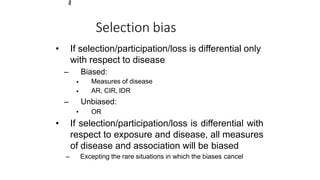
• Selectionbias in cohort studies
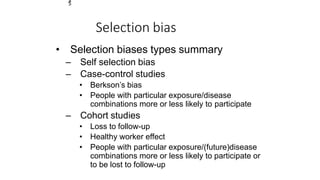
– Selection bias related to differential participation by
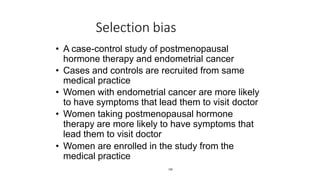
exposure and disease status is less likely to occur in
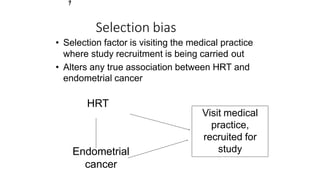
cohort studies because subjects are selected and
enrolled prior to disease onset
– If exposure status does affect selection into the
study it is still unlikely that (future) outcome will
affect selection
6.
Selection bias
• Selectionbias in cohort studies
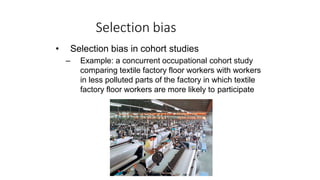
– Example: a concurrent occupational cohort study
comparing textile factory floor workers with workers
in less polluted parts of the factory in which textile
factory floor workers are more likely to participate
90
8
Selection bias
• Selectionbias in cohort studies
– Differential loss to follow-up is a substantial concern
in cohort studies
• It is sometimes discussed as information bias,
sometimes as selection bias
• If the outcome or some factor associated with the
outcome affects the probability of being lost, and
exposure affects probability being lost as well, then
selection bias will be present
9.
9
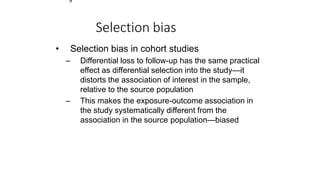
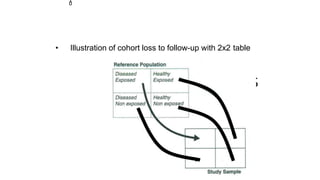
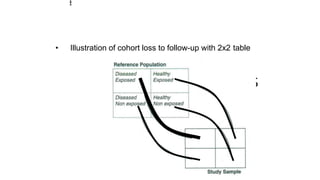
Selection bias
• Selectionbias in cohort studies
– Differential loss to follow-up has the same practical
effect as differential selection into the study—it
distorts the association of interest in the sample,
relative to the source population
– This makes the exposure-outcome association in
the study systematically different from the
association in the source population—biased
Selection bias
• Somespecific selection biases
– Berkson’s bias: occurs in case-control
studies of hospitalized patients
1
2
13.
1
3
Selection bias
– Berkson’sbias:
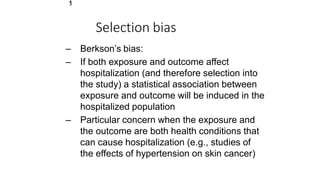
– If both exposure and outcome affect
hospitalization (and therefore selection into
the study) a statistical association between
exposure and outcome will be induced in the
hospitalized population
– Particular concern when the exposure and
the outcome are both health conditions that
can cause hospitalization (e.g., studies of
the effects of hypertension on skin cancer)
14.
Selection bias
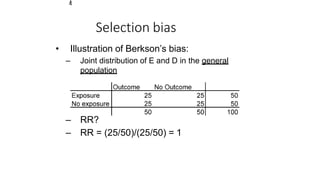
• Illustrationof Berkson’s bias:
– Joint distribution of E and D in the general
population
– RR?
– RR = (25/50)/(25/50) = 1
1
4
15.
1
5
Selection bias
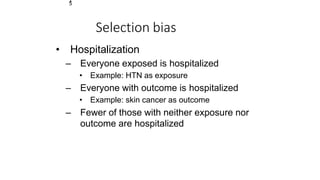
• Hospitalization
–Everyone exposed is hospitalized
• Example: HTN as exposure
– Everyone with outcome is hospitalized
• Example: skin cancer as outcome
– Fewer of those with neither exposure nor
outcome are hospitalized
16.
Selection bias
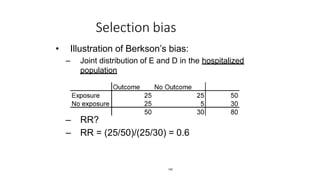
• Illustrationof Berkson’s bias:
– Joint distribution of E and D in the hospitalized
population
– RR?
– RR = (25/50)/(25/30) = 0.6
100
17.
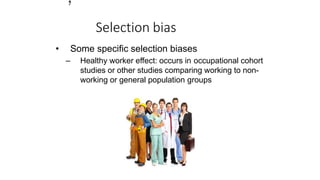
Selection bias
• Somespecific selection biases
– Healthy worker effect: occurs in occupational cohort
studies or other studies comparing working to non-
working or general population groups
1
7
18.
1
8
Selection bias
– Healthyworker effect:
– Workers have lower rates of disease than
comparison cohorts from the general population
• Self-selection of hardier workers into more taxing jobs
• Attrition of sick workers from the workforce
– Comparison of occupational cohort of workers to
non-workers, general population groups, or workers
in less taxing jobs may cause the health effects of
occupational exposures to be under-estimated
19.
1
9
Selection bias
• Somespecific selection biases
– Self-selection bias: occurs in all studies in which
individuals decide whether to participate
– When people who choose to enroll in studies are
different from those who do not, selection bias may
be introduced
– This becomes more problematic as response
rate/participation rate decreases
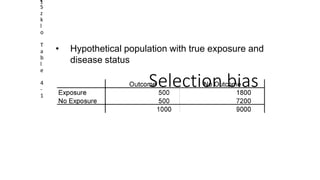
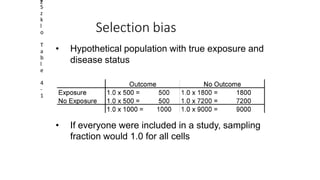
Selection bias
• Hypotheticalpopulation with true exposure and
disease status
• If everyone were included in a study, sampling
fraction would 1.0 for all cells
22
S
z
k
l
o
T
a
b
l
e
4
-
1
23.
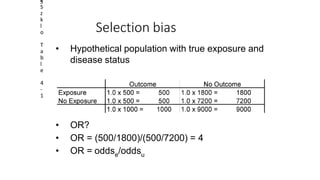
Selection bias
• Hypotheticalpopulation with true exposure and
disease status
• OR?
• OR = (500/1800)/(500/7200) = 4
• OR = oddse/oddsu
23
S
z
k
l
o
T
a
b
l
e
4
-
1
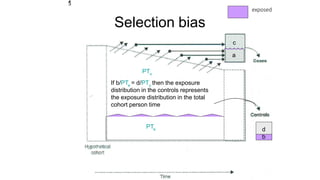
Selection bias
exposed
PTe d
b
c
a
PTu
Ifb/PTe = d/PTu then the exposure
distribution in the controls represents
the exposure distribution in the total
cohort person time
2
5
26.
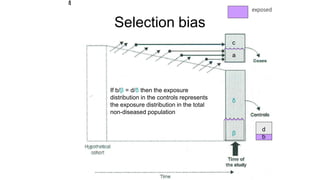
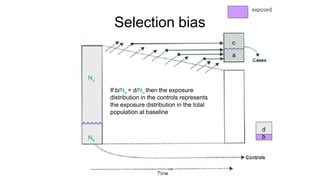
Selection bias
exposed
c
a
d
b
110
If b/Ne= d/Nu then the exposure
distribution in the controls represents
the exposure distribution in the total
population at baseline
Nu
Ne
27.
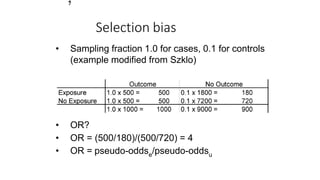
Selection bias
• Samplingfraction 1.0 for cases, 0.1 for controls
(example modified from Szklo)
• OR?
• OR = (500/180)/(500/720) = 4
• OR = pseudo-oddse/pseudo-oddsu
2
7
28.
2
8
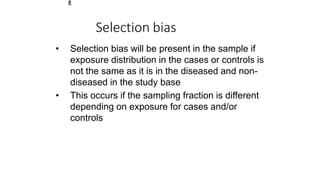
Selection bias
• Selectionbias will be present in the sample if
exposure distribution in the cases or controls is
not the same as it is in the diseased and non-
diseased in the study base
• This occurs if the sampling fraction is different
depending on exposure for cases and/or
controls
29.
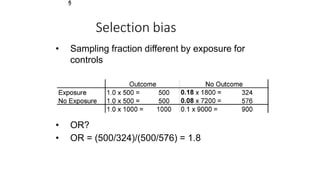
Selection bias
• Samplingfraction different by exposure for
controls
• OR?
• OR = (500/324)/(500/576) = 1.8
2
9
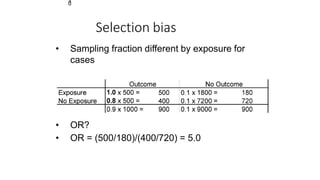
30.
Selection bias
• Samplingfraction different by exposure for
cases
• OR?
• OR = (500/180)/(400/720) = 5.0
3
0
31.
3
1
Selection bias
• Differentselection biases can end up canceling
each other out theoretically, however in
practice it’s impossible to know whether the
biases cancel
• Biases cancelled or equalized if magnitude of
bias in selection of cases same as in selection
of controls
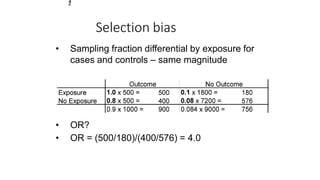
32.
Selection bias
• Samplingfraction differential by exposure for
cases and controls – same magnitude
• OR?
• OR = (500/180)/(400/576) = 4.0
3
2
33.
Selection bias
• Selectionfractions cancel in OR calculation
• OR = [(a*1)/(β*0.1)]/[(c*0.8)/(δ*0.08)]
• OR = [10(a/β)]/[10(c/δ)]
• OR = (a/β)/(c/δ)
3
3
34.
3
4
Selection bias
• Ifselection/participation/loss is differential only
with respect to disease
– Biased:
•
•
•
Measures of disease
AR, CIR, IDR
– Unbiased:
OR
• If selection/participation/loss is differential with
respect to exposure and disease, all measures
of disease and association will be biased
– Excepting the rare situations in which the biases cancel
35.
3
5
Selection bias
• Selectionbiases types summary
– Self selection bias
– Case-control studies
• Berkson’s bias
• People with particular exposure/disease
combinations more or less likely to participate
– Cohort studies
• Loss to follow-up
• Healthy worker effect
• People with particular exposure/(future)disease
combinations more or less likely to participate or
to be lost to follow-up
36.
120
• A case-controlstudy of postmenopausal
hormone therapy and endometrial cancer
• Cases and controls are recruited from same
medical practice
• Women with endometrial cancer are more likely
to have symptoms that lead them to visit doctor
• Women taking postmenopausal hormone
therapy are more likely to have symptoms that
lead them to visit doctor
• Women are enrolled in the study from the
medical practice
Selection bias
37.
• Selection factoris visiting the medical practice
where study recruitment is being carried out
• Alters any true association between HRT and
endometrial cancer
HRT
Endometrial
cancer
Visit medical
practice,
recruited for
study
Selection bias
3
7