Political Social Ideologies
and Development
Dr. Rajeev Kumar
MSW (TISS, Mumbai), M.Phil., (CIP, Ranchi), UGC-JRF., Ph.D., (IIT Kharagpur)
Content of the session
In this session, we will discuss various political and social thoughts and
ideologies. And you can related it with rural development.
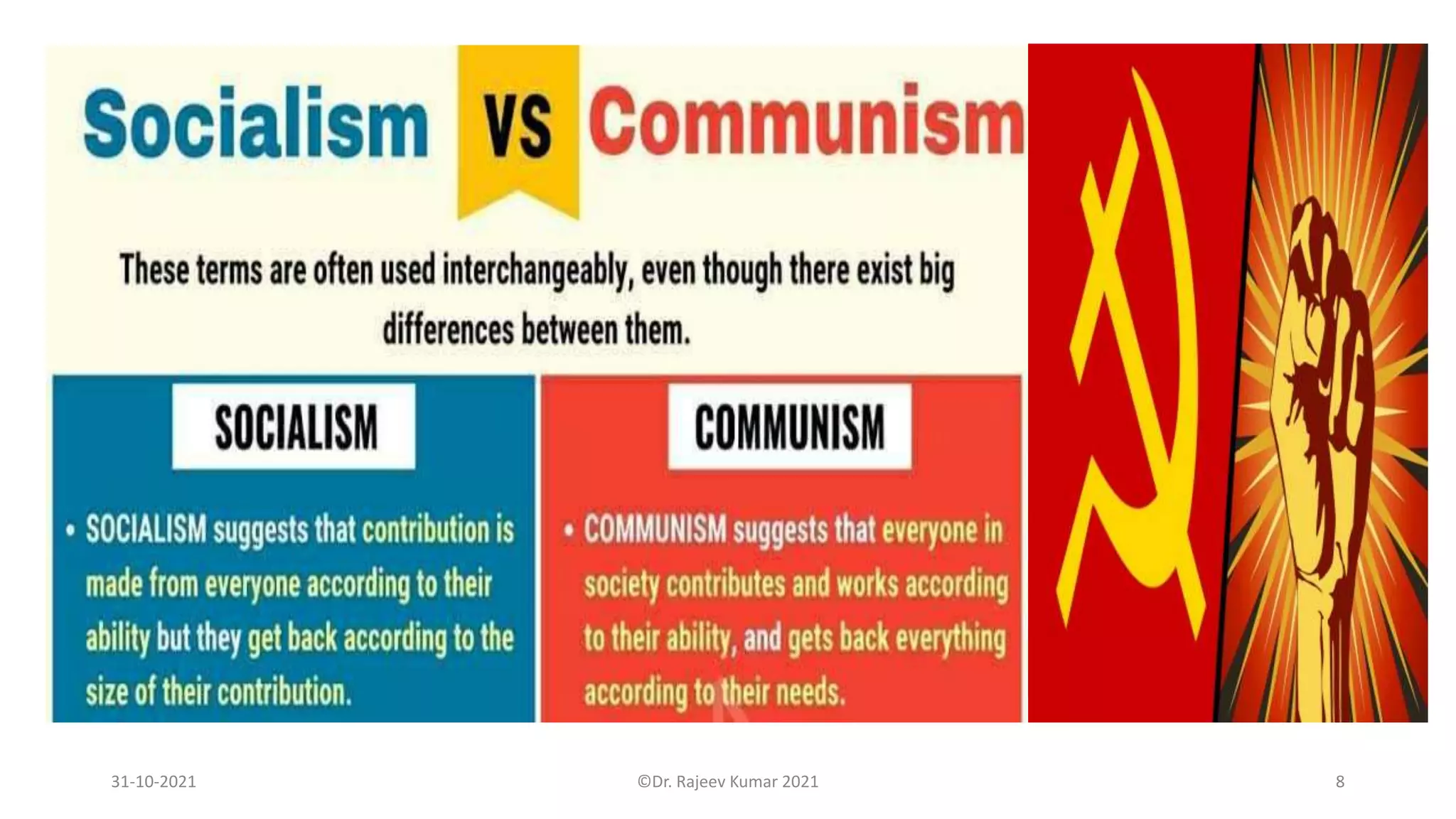
Communism
Socialism
Capitalism
Left and right wing and its relevance to Indian context
Naxalism
Feminism
Dalit ideology
And pressure groups.
31-10-2021 ©Dr. Rajeev Kumar 2021 2
Inequality in society: A perennial truth
31-10-2021 ©Dr. Rajeev Kumar 2021 3
In communism, there is
no government
no country, no currency,
no state, no border, no
religion. Everything is
governed by community
31-10-2021 ©Dr. Rajeev Kumar 2021 4
31-10-2021 ©Dr. Rajeev Kumar 2021 5
31-10-2021 ©Dr. Rajeev Kumar 2021 6
31-10-2021 ©Dr. Rajeev Kumar 2021 7
31-10-2021 ©Dr. Rajeev Kumar 2021 8
31-10-2021 ©Dr. Rajeev Kumar 2021 9
Socialist countries
where social policies
implemented
successfully
• Denmark
• Sweden
• Finland
• Iceland
• Norway
31-10-2021 ©Dr. Rajeev Kumar 2021 10
What are left and right political ideologies?
31-10-2021 ©Dr. Rajeev Kumar 2021 11
31-10-2021 ©Dr. Rajeev Kumar 2021 12
Political ideologies versus leftism and rightism
31-10-2021 ©Dr. Rajeev Kumar 2021 13
31-10-2021 ©Dr. Rajeev Kumar 2021 14
Some salient features of ideologies
Left ideology
Oppose death penalty and immigration
Support globalization and tax on rich
Right wing ideology
Support religion and demand a national official religion
Oppose abortion. Conservative
Somewhat support capitalism
31-10-2021 ©Dr. Rajeev Kumar 2021 15
Continued …………..
Most of the parties are
mixed: either left leaning or
right leaning.
Economic left and economic
right
Social left or social right
Economical (tax and govt
interference)
Social (abortion, same sex
marriage)
31-10-2021 ©Dr. Rajeev Kumar 2021 16
Left and right wing in India
Left wing parties
Congress
AAP
JDU (Janta Dal United, centre
left)
TMC (Trinamul Congress)
CPI-M (Marxist)
Right wing parties
BJP
Shiv Sena
AIMIM (All India Majlis-e-
ittehadul Muslimeen) Telangana
for muslim, dalit and minorities
31-10-2021 ©Dr. Rajeev Kumar 2021 17
Salient features of Indian political parties
Considering economic aspect, almost all parties of India are leftist, because
they support subsidy and high tax.
India allow same sex marriage and oppose death penalty.
Centre is the midway of left and right political ideology
Extreme of any ideology is bad.
China and Russia have seen left party rule. Both Stalin and Mao tse Tung did
mass killing
Extreme right in middle east, where one can face death penalty on
blasphemy.
For economic system right wing is better, because it support open market.
Some example: Finland, Netherland, Sweden
31-10-2021 ©Dr. Rajeev Kumar 2021 18
Political parties in the world
Right wing parties in the world
• Alliance for Peace and Freedom.
• Alliance of European National
Movements.
• European Christian Political
Movement.
• European Conservatives and
Reformists Party.
• European Party for Individual Liberty.
• European People's Party.
• Identity and Democracy Party.
31-10-2021 ©Dr. Rajeev Kumar 2021 19
Taliban in Afghanistan: A case of extreme
rightist ideology
31-10-2021 ©Dr. Rajeev Kumar 2021 20
Condition of Syria
31-10-2021 ©Dr. Rajeev Kumar 2021 21
Left wing political violence in the world
Asia
Stefan M. Audrey describes the Japanese Red Army and
the Liberation Tigers of Tamil Eelam (LTTE) as the main left-
wing terrorist organizations in Asia, although he notes that
the LTTE later transformed into a nationalist
terrorist organization
Pakistan
Left-wing groups like the Pakhtoon Zalmay, Al-Zulfiqar
organisation (AZO) and the MQM including its predecessor
the Muhajir Qaumi Movement committed numerous acts of
violence including bombings, targeted killings, disinformation
and assassinations
31-10-2021 ©Dr. Rajeev Kumar 2021 22
Naxalism in India
• The origins of the LWE can be traced back to 1967
in the three areas of Naxalbari (from which the
term Naxal originates), Phansidewa and Khoribari
in West Bengal’s Darjeeling District.
• The initial uprising was led by Charu Majumdar,
Kanu Sanyal and Jangal Santhal, who were
members of the Communist Party of India
(Marxist). The initial uprising was in the form of a
peasant revolt.
• Two years later in 1969, the Communist Party of
India (Marxist–Leninist) was formed.
31-10-2021 ©Dr. Rajeev Kumar 2021 23
Reason of Naxalism in India
• The chief reason behind the rise of the movement
was the severe lack of development of these regions
despite being mineral-rich.
• They were largely tribal belts that were neglected by
the government and also by the mainstream media.
• There were gross ineffectiveness and
mismanagement in the administrative machinery.
Corruption was also rampant leading to misery for
the people.
• The alienation and social exclusion of large groups of
people led to sections of them feeling a disconnect
with the government of the day and also society at
large.
• The issue of Jal-Jangal-Jameen (water, forest, land) is
at the centre of these revolts initially. Tribal people
are routinely exploited for their mineral-rich land.
There is illegal encroachment and the forest-dwellers
are bereft of rights in their own land.
31-10-2021 ©Dr. Rajeev Kumar 2021 24
Spread of Naxalism in India
• Although originated in West Bengal, the
movement spread to the less-developed
rural regions of southern and eastern India,
in Telangana, Andhra Pradesh, Odisha and
Chhattisgarh.
• Today, almost all the Naxal groups trace
their origins to the CPI (M-L).
• The Maoist Communist Centre (MCC) was
formed in 1975.
• This group merged with the People’s War
Group in 2004, to form the CPI (Maoist).
31-10-2021 ©Dr. Rajeev Kumar 2021 25
Red Corridor
• The Red Corridor is the region in the central,
eastern and southern parts of India that
experience severe Naxalite–Maoist
insurgency.
• The districts affected by this and part of the
Corridor are among the poorest in India.
• Most of the region has a high tribal
population. The region is also marked by
severe caste and economic disparities.
• Roughly, the Corridor stretches from the
Indian border with Nepal and extends to the
northern fringes of Tamil Nadu.
• The region also has a significantly lower
literacy rate compared to the national
average.
31-10-2021 ©Dr. Rajeev Kumar 2021 26
Regions affected by Naxal violence in India
• According to the Home Ministry, the districts
affected by LWE are in the states of
Telangana, Andhra Pradesh, Chhattisgarh,
Bihar, Jharkhand, Odisha, Maharashtra,
Odisha, West Bengal and Uttar Pradesh.
• However, in the past decade, owing to the
severe government crackdown on the
Naxalite organisations, and the intense work
of the country’s security forces, particularly,
the CRPF, the number of incidents of Naxal
violence has reduced. The number of people
giving up arms and surrendering to the
security forces is also on the rise.
31-10-2021 ©Dr. Rajeev Kumar 2021 27
Item 2009 2018
Number of
incidents
2258 833
Deaths
(security force
+ civilian)
1005 240
Number of
affected
districts
96 (2010) 60
Naxal violence over the decades
31-10-2021 ©Dr. Rajeev Kumar 2021 28
2007 2013 2018
Naxalism and effect on development
• It is clear that the Maoists do not want development to take place, which is clear by
their targeting schools and communication channels. Whatever their goals, they are
now armed insurgency groups intended only to capture power to serve their own
interests.
• The government has initiated a tribal development schemes aimed at bringing social,
economic, cultural and educational inclusion for the tribal population into the
mainstream.
• It is also suspected that Pakistan’s ISI is trying to influence these groups through the
land border with Nepal. This has serious implications for the country’s security. Proper
intelligence inputs coupled with the adequate fortification of security forces should be
done.
• Along with these, sufficient and speedy development should be brought about in the
worst-affected areas as only this will render the Maoists insignificant. As long as there
is disillusionment with the authorities, such elements will always find sympathizers
among sections of the people. Hence, to root out the problem in its entirety, proper
inclusive development should be ushered in.
31-10-2021 ©Dr. Rajeev Kumar 2021 29
Government Measures to Counter Naxal Violence
• The D Bandopadhyay Committee (2006) highlighted the lack of governance, economic, socio-
political and cultural discrimination against the tribals as the chief reason for the spread of
Naxalism. The Committee recommended tribal-friendly land acquisition and rehabilitation as a
means to counter this issue.
• In May 2017, the Government of India allocated Rs 11,000 crores to build road connectivity in 44
districts affected by Maoists activities.
• Under the current Government, by 2018, 1326 km of roads were constructed in Bastar,
Rajnandgaon, and Surguja areas, the highly Naxal infested areas of Chhattisgarh.
• 995 bridges were constructed and 138 of them were in the worst affected area – Bastar.
• The annual budget of the Public Works Department in Chhattisgarh was Rs 7795 crores in 2016-17.
• Roads and bridges were constructed in Sukma, another area massively hit by Naxalism.
• Local villagers are being provided with basic facilities like healthcare, education and more
employment opportunities.
• Due to developmental activities and choking the funding of Naxalism, there was a spike in
surrenders in Jharkhand from 676 in 2014 to 1442 in 2016.
31-10-2021 ©Dr. Rajeev Kumar 2021 30
Some other ideologies
31-10-2021 ©Dr. Rajeev Kumar 2021 31
Feminism ideology
31-10-2021 ©Dr. Rajeev Kumar 2021 32
Ambedkar Ideology/ Dalit right ideology
31-10-2021 ©Dr. Rajeev Kumar 2021 33
31-10-2021 ©Dr. Rajeev Kumar 2021 34
31-10-2021 ©Dr. Rajeev Kumar 2021 35
Pressure groups in India
31-10-2021 ©Dr. Rajeev Kumar 2021 36
Pyramid of social hierarchy
31-10-2021 ©Dr. Rajeev Kumar 2021 37
31-10-2021 ©Dr. Rajeev Kumar 2021 38
Thanks for your patience!!!
31-10-2021 ©Dr. Rajeev Kumar 2021 39

Political ideology and development

  • 1.
    Political Social Ideologies andDevelopment Dr. Rajeev Kumar MSW (TISS, Mumbai), M.Phil., (CIP, Ranchi), UGC-JRF., Ph.D., (IIT Kharagpur)
  • 2.
    Content of thesession In this session, we will discuss various political and social thoughts and ideologies. And you can related it with rural development. Communism Socialism Capitalism Left and right wing and its relevance to Indian context Naxalism Feminism Dalit ideology And pressure groups. 31-10-2021 ©Dr. Rajeev Kumar 2021 2
  • 3.
    Inequality in society:A perennial truth 31-10-2021 ©Dr. Rajeev Kumar 2021 3
  • 4.
    In communism, thereis no government no country, no currency, no state, no border, no religion. Everything is governed by community 31-10-2021 ©Dr. Rajeev Kumar 2021 4
  • 5.
  • 6.
  • 7.
  • 8.
  • 9.
    31-10-2021 ©Dr. RajeevKumar 2021 9 Socialist countries where social policies implemented successfully • Denmark • Sweden • Finland • Iceland • Norway
  • 10.
  • 11.
    What are leftand right political ideologies? 31-10-2021 ©Dr. Rajeev Kumar 2021 11
  • 12.
  • 13.
    Political ideologies versusleftism and rightism 31-10-2021 ©Dr. Rajeev Kumar 2021 13
  • 14.
  • 15.
    Some salient featuresof ideologies Left ideology Oppose death penalty and immigration Support globalization and tax on rich Right wing ideology Support religion and demand a national official religion Oppose abortion. Conservative Somewhat support capitalism 31-10-2021 ©Dr. Rajeev Kumar 2021 15
  • 16.
    Continued ………….. Most ofthe parties are mixed: either left leaning or right leaning. Economic left and economic right Social left or social right Economical (tax and govt interference) Social (abortion, same sex marriage) 31-10-2021 ©Dr. Rajeev Kumar 2021 16
  • 17.
    Left and rightwing in India Left wing parties Congress AAP JDU (Janta Dal United, centre left) TMC (Trinamul Congress) CPI-M (Marxist) Right wing parties BJP Shiv Sena AIMIM (All India Majlis-e- ittehadul Muslimeen) Telangana for muslim, dalit and minorities 31-10-2021 ©Dr. Rajeev Kumar 2021 17
  • 18.
    Salient features ofIndian political parties Considering economic aspect, almost all parties of India are leftist, because they support subsidy and high tax. India allow same sex marriage and oppose death penalty. Centre is the midway of left and right political ideology Extreme of any ideology is bad. China and Russia have seen left party rule. Both Stalin and Mao tse Tung did mass killing Extreme right in middle east, where one can face death penalty on blasphemy. For economic system right wing is better, because it support open market. Some example: Finland, Netherland, Sweden 31-10-2021 ©Dr. Rajeev Kumar 2021 18
  • 19.
    Political parties inthe world Right wing parties in the world • Alliance for Peace and Freedom. • Alliance of European National Movements. • European Christian Political Movement. • European Conservatives and Reformists Party. • European Party for Individual Liberty. • European People's Party. • Identity and Democracy Party. 31-10-2021 ©Dr. Rajeev Kumar 2021 19
  • 20.
    Taliban in Afghanistan:A case of extreme rightist ideology 31-10-2021 ©Dr. Rajeev Kumar 2021 20
  • 21.
    Condition of Syria 31-10-2021©Dr. Rajeev Kumar 2021 21
  • 22.
    Left wing politicalviolence in the world Asia Stefan M. Audrey describes the Japanese Red Army and the Liberation Tigers of Tamil Eelam (LTTE) as the main left- wing terrorist organizations in Asia, although he notes that the LTTE later transformed into a nationalist terrorist organization Pakistan Left-wing groups like the Pakhtoon Zalmay, Al-Zulfiqar organisation (AZO) and the MQM including its predecessor the Muhajir Qaumi Movement committed numerous acts of violence including bombings, targeted killings, disinformation and assassinations 31-10-2021 ©Dr. Rajeev Kumar 2021 22
  • 23.
    Naxalism in India •The origins of the LWE can be traced back to 1967 in the three areas of Naxalbari (from which the term Naxal originates), Phansidewa and Khoribari in West Bengal’s Darjeeling District. • The initial uprising was led by Charu Majumdar, Kanu Sanyal and Jangal Santhal, who were members of the Communist Party of India (Marxist). The initial uprising was in the form of a peasant revolt. • Two years later in 1969, the Communist Party of India (Marxist–Leninist) was formed. 31-10-2021 ©Dr. Rajeev Kumar 2021 23
  • 24.
    Reason of Naxalismin India • The chief reason behind the rise of the movement was the severe lack of development of these regions despite being mineral-rich. • They were largely tribal belts that were neglected by the government and also by the mainstream media. • There were gross ineffectiveness and mismanagement in the administrative machinery. Corruption was also rampant leading to misery for the people. • The alienation and social exclusion of large groups of people led to sections of them feeling a disconnect with the government of the day and also society at large. • The issue of Jal-Jangal-Jameen (water, forest, land) is at the centre of these revolts initially. Tribal people are routinely exploited for their mineral-rich land. There is illegal encroachment and the forest-dwellers are bereft of rights in their own land. 31-10-2021 ©Dr. Rajeev Kumar 2021 24
  • 25.
    Spread of Naxalismin India • Although originated in West Bengal, the movement spread to the less-developed rural regions of southern and eastern India, in Telangana, Andhra Pradesh, Odisha and Chhattisgarh. • Today, almost all the Naxal groups trace their origins to the CPI (M-L). • The Maoist Communist Centre (MCC) was formed in 1975. • This group merged with the People’s War Group in 2004, to form the CPI (Maoist). 31-10-2021 ©Dr. Rajeev Kumar 2021 25
  • 26.
    Red Corridor • TheRed Corridor is the region in the central, eastern and southern parts of India that experience severe Naxalite–Maoist insurgency. • The districts affected by this and part of the Corridor are among the poorest in India. • Most of the region has a high tribal population. The region is also marked by severe caste and economic disparities. • Roughly, the Corridor stretches from the Indian border with Nepal and extends to the northern fringes of Tamil Nadu. • The region also has a significantly lower literacy rate compared to the national average. 31-10-2021 ©Dr. Rajeev Kumar 2021 26
  • 27.
    Regions affected byNaxal violence in India • According to the Home Ministry, the districts affected by LWE are in the states of Telangana, Andhra Pradesh, Chhattisgarh, Bihar, Jharkhand, Odisha, Maharashtra, Odisha, West Bengal and Uttar Pradesh. • However, in the past decade, owing to the severe government crackdown on the Naxalite organisations, and the intense work of the country’s security forces, particularly, the CRPF, the number of incidents of Naxal violence has reduced. The number of people giving up arms and surrendering to the security forces is also on the rise. 31-10-2021 ©Dr. Rajeev Kumar 2021 27 Item 2009 2018 Number of incidents 2258 833 Deaths (security force + civilian) 1005 240 Number of affected districts 96 (2010) 60
  • 28.
    Naxal violence overthe decades 31-10-2021 ©Dr. Rajeev Kumar 2021 28 2007 2013 2018
  • 29.
    Naxalism and effecton development • It is clear that the Maoists do not want development to take place, which is clear by their targeting schools and communication channels. Whatever their goals, they are now armed insurgency groups intended only to capture power to serve their own interests. • The government has initiated a tribal development schemes aimed at bringing social, economic, cultural and educational inclusion for the tribal population into the mainstream. • It is also suspected that Pakistan’s ISI is trying to influence these groups through the land border with Nepal. This has serious implications for the country’s security. Proper intelligence inputs coupled with the adequate fortification of security forces should be done. • Along with these, sufficient and speedy development should be brought about in the worst-affected areas as only this will render the Maoists insignificant. As long as there is disillusionment with the authorities, such elements will always find sympathizers among sections of the people. Hence, to root out the problem in its entirety, proper inclusive development should be ushered in. 31-10-2021 ©Dr. Rajeev Kumar 2021 29
  • 30.
    Government Measures toCounter Naxal Violence • The D Bandopadhyay Committee (2006) highlighted the lack of governance, economic, socio- political and cultural discrimination against the tribals as the chief reason for the spread of Naxalism. The Committee recommended tribal-friendly land acquisition and rehabilitation as a means to counter this issue. • In May 2017, the Government of India allocated Rs 11,000 crores to build road connectivity in 44 districts affected by Maoists activities. • Under the current Government, by 2018, 1326 km of roads were constructed in Bastar, Rajnandgaon, and Surguja areas, the highly Naxal infested areas of Chhattisgarh. • 995 bridges were constructed and 138 of them were in the worst affected area – Bastar. • The annual budget of the Public Works Department in Chhattisgarh was Rs 7795 crores in 2016-17. • Roads and bridges were constructed in Sukma, another area massively hit by Naxalism. • Local villagers are being provided with basic facilities like healthcare, education and more employment opportunities. • Due to developmental activities and choking the funding of Naxalism, there was a spike in surrenders in Jharkhand from 676 in 2014 to 1442 in 2016. 31-10-2021 ©Dr. Rajeev Kumar 2021 30
  • 31.
    Some other ideologies 31-10-2021©Dr. Rajeev Kumar 2021 31
  • 32.
  • 33.
    Ambedkar Ideology/ Dalitright ideology 31-10-2021 ©Dr. Rajeev Kumar 2021 33
  • 34.
  • 35.
  • 36.
    Pressure groups inIndia 31-10-2021 ©Dr. Rajeev Kumar 2021 36
  • 37.
    Pyramid of socialhierarchy 31-10-2021 ©Dr. Rajeev Kumar 2021 37
  • 38.
  • 39.
    Thanks for yourpatience!!! 31-10-2021 ©Dr. Rajeev Kumar 2021 39