MADDA WALABU UNIVERSITY
Course title:
Research methodology and scientific writing
(Chem 2072)
College of Natural and Computational Science
Department of Chemistry
Instructor’s Name: Tekalign Kasa (Ass. professor)
March, 2019
 Introduction to scientific research
 Scientific writing/methods
 Use of chemical literature (handbooks, encyclopedia,
spectral collection , monographs)
 Research methods
 Accessing journals, abstracts and indexes
 Preparing scientific paper and presentation
 Evaluating scientific papers
 Project work
1
Course Outline
Science:
defines the intellectual and practical activity including the
systematic study of the structure and behaviour of the
physical and natural world through observation and
experimentation.
 Research
detailed study of a subject, especially in order to discover
new information or search for new understanding or
knowledge. Research fill gaps of Knowledge.
2
1. Introduction to scientific
research
Scientific research:
 systematic investigation of scientific theories and
hypotheses.
 hypothesis is a single assertion, a proposed explanation
of something based on available knowledge, for
something yet to be explained.
Objectives of Research:
The purpose of research is to discover answers to
questions through the application of scientific procedures.
2
Introduction (con’d…)
 The main purpose of research is to find out the truth
which is hidden and which has not been discovered as yet.
 Research study has its own general and specific purpose.
i. To gain familiarity with a phenomenon
ii. To achieve new insights into it.
iii. To describe accurate characteristics of a particular
individual, situation or a group
iv. To determine the frequency with which something occurs
or with which it is associated with something else.
v. To test a hypothesis of causal relationship between
variables 2
Introduction (con’d…)
Characteristics of Scientific Research:
 science is the preferable way to obtain reliable and valid
knowledge about the natural world.
 In order to produce reliable and justified knowledge, the
scientific process relies on several important
characteristics.
 Three of the most important characteristics of scientific
research are control, operationalism, and replication.
2
Introduction (con’d…)
Control
 refers to holding constant or eliminating the influence
of unrelated variables so that an unambiguous claim
about cause and effect can be made.
 experiments are the preferred research method
whenever you need to address the issue of cause and
effect.
 Experiments are conducted in an attempt to answer
questions, researchers must rely on control.
2
Introduction (con’d…)
Operationalism
 The principle of operationalism was originally set forth
by the physicist Percy Bridgman.
 Bridgman (1927) argued that science must be specific
and precise and each concept must be defined by the
steps or operations used to measure them.
 Example, If length was measured with a ruler in terms
of inches, length would be defined as a specific number
of inches.
2
Introduction (con’d…)
Replication
 refers to the reproduction of the results obtained from
one study in additional studies.
 Scientific knowledge is greatly advanced by replication.
Basic Assumptions of Scientific Research
 In order for scientists to have confidence in the capacity
of scientific research to achieve solutions to questions
and problems, they make several working assumptions
so that they can get on with the day-to-day practice of
science.
2
Introduction (con’d…)
Uniformity or Regularity in Nature
 Science searches for regularities in nature.
 If there were no uniformity in nature, there could be no
understanding, explanation, or knowledge about nature.
 Without regularity, we could not develop theories or laws or
generalizations.
Reality in Nature
 A related assumption is that there is reality in nature.
 In our daily lives we see, hear, feel, smell, and taste things that are
real, and these experiences are real.
Discoverability
 Scientists believe not only that there is regularity and reality in
nature, but also, there is discoverability-that is, it is possible to
discover the regularities and reality.
2
Introduction (con’d…)
Basic Elements of the Scientific Research
 There are many procedures to obtain information about a given
phenomenon or situation.
 These elements are; intuition, authority, Rationalism and Empiricism
Intuition
 is the first approach to acquire knowledge that we examine or an
approach to acquire knowledge that is not based on a known reasoning
process.
 Webster’s Third New International Dictionary “the process of coming
to direct knowledge or certainty without reasoning or inferring.”
Authority
 an approach to acquire knowledge represents an acceptance of
information or facts stated by another, because that person is highly
respected source.
 A basis for acceptance of information, because it is acquired from a
highly respected source.
2
Introduction (con’d…)
Rationalism
 This approach uses reasoning to arrive at knowledge and assumes
that valid knowledge is acquired if the correct reasoning process
is used.
 The acquisition of knowledge through reasoning.
Empiricism
 In its native form, this approach would say, “If I have experienced
something, then it is valid and true.”
 Therefore, facts that concur with experience are accepted, and
those that do not are rejected.
 The acquisition of knowledge through experience.
2
Introduction (con’d…)
Types of Scientific Research
Quantitative Vs Qualitative research:
 Quantitative research: it aims to measure the quantity or amount
and compares it with past records and tries to project for future
period.
 The objective of quantitative research is to develop and employ
mathematical models, theories or hypothesis pertaining to
phenomena.
 The process of measurement is central to quantitative research
because it provides fundamental connection between empirical
observation and mathematical expression of quantitative
relationships.
2
Introduction (con’d…)
 Statistics is the most widely used branch of mathematics in
quantitative research.
 Quantitative research involving the use of structured
questions, where the response options have been Pre-
determined and large number of respondents is involved.
 Qualitative research: non-quantitative type of analysis.
 It is collecting, analyzing and interpreting data by observing
what people do and say and also refers to the meanings,
definitions, characteristics, symbols, metaphors, and
description of things.
 much more subjective and uses very different methods of
collecting information, mainly individual, in-depth
interviews and focus groups.
2
Introduction (con’d…)
 Qualitative research can be classified as;
Phenomenology:
 a form of research in which the researcher attempts to
understand how one or more individuals experience a
phenomenon.
Ethnography:
 It focuses on describing the culture of a group of people.
 A culture is the shared attributes, values, norms, practices,
language, and material things of a group of people.
Case study:
 focused on providing a detailed account of one or more cases.
Example, we may study a classroom that was given a new
curriculum for technology use.
2
Introduction (con’d…)
Grounded theory research:
 it is an inductive type of research, based or grounded in the
observations of data from which it was developed;
 it uses a variety of data sources, including quantitative data,
review of records, interviews, observation and surveys.
Historical research:
 it allows one to discuss past and present events in the context of
the present condition, and allows one to reflect and provide
possible answers to current issues and problems.
 Eg:-the lending pattern of business in the 19th century.
2
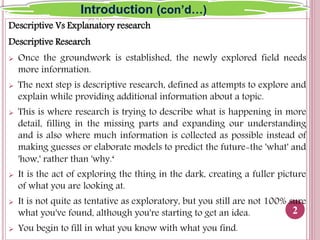
Introduction (con’d…)
Descriptive Vs Explanatory research
Descriptive Research
 Once the groundwork is established, the newly explored field needs
more information.
 The next step is descriptive research, defined as attempts to explore and
explain while providing additional information about a topic.
 This is where research is trying to describe what is happening in more
detail, filling in the missing parts and expanding our understanding
and is also where much information is collected as possible instead of
making guesses or elaborate models to predict the future-the 'what' and
'how,' rather than 'why.‘
 It is the act of exploring the thing in the dark, creating a fuller picture
of what you are looking at.
 It is not quite as tentative as exploratory, but you still are not 100% sure
what you've found, although you're starting to get an idea.
 You begin to fill in what you know with what you find.
2
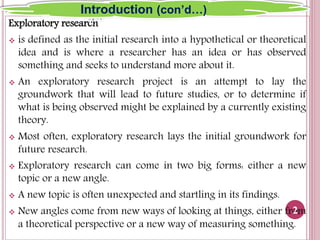
Introduction (con’d…)
Exploratory research
 is defined as the initial research into a hypothetical or theoretical
idea and is where a researcher has an idea or has observed
something and seeks to understand more about it.
 An exploratory research project is an attempt to lay the
groundwork that will lead to future studies, or to determine if
what is being observed might be explained by a currently existing
theory.
 Most often, exploratory research lays the initial groundwork for
future research.
 Exploratory research can come in two big forms: either a new
topic or a new angle.
 A new topic is often unexpected and startling in its findings.
 New angles come from new ways of looking at things, either from
a theoretical perspective or a new way of measuring something.
2
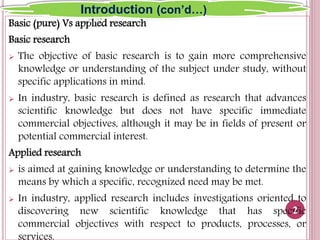
Introduction (con’d…)
Basic (pure) Vs applied research
Basic research
 The objective of basic research is to gain more comprehensive
knowledge or understanding of the subject under study, without
specific applications in mind.
 In industry, basic research is defined as research that advances
scientific knowledge but does not have specific immediate
commercial objectives, although it may be in fields of present or
potential commercial interest.
Applied research
 is aimed at gaining knowledge or understanding to determine the
means by which a specific, recognized need may be met.
 In industry, applied research includes investigations oriented to
discovering new scientific knowledge that has specific
commercial objectives with respect to products, processes, or
2
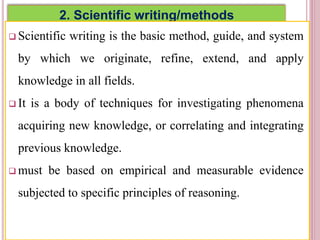
Introduction (con’d…)
2. Scientific writing/methods
 Scientific writing is the basic method, guide, and system
by which we originate, refine, extend, and apply
knowledge in all fields.
 It is a body of techniques for investigating phenomena
acquiring new knowledge, or correlating and integrating
previous knowledge.
 must be based on empirical and measurable evidence
subjected to specific principles of reasoning.
3
Scientific writing/methods (cont’d…)
 Importance of Scientific Methods
 To Global Competitiveness
 To National Competitiveness
 To Educational Competitiveness
 To Individual Competitiveness
3
Scientific writing/methods (con’d…)
 scientific writing is the complete method of creative
problem solving and decision making for all fields
 It is a body of techniques for investigating phenomena
acquiring new knowledge, or correlating and integrating
previous knowledge.
 To be termed scientific method of inquiry must be based
on empirical and measurable evidence subjected to
specific principles of reasoning.
4
Steps of Scientific writing/methods
 Centuries of study, debate, and experimentation
has established that the best of all methods of
obtaining reliable knowledge in all fields is the
scientific method.
 For all competitiveness in all areas, the scientific
method is the guide to the mental activities and
systems needed to solve the complex
competitiveness problems
4
Steps in scientific writing/methods (cont’d…)
 Scientific method involves various steps like
observation, defining a problem, forming hypothesis,
testing it by controlled experiment and coming to
conclusion to formulate a theory which may or may not
be acceptable.
 The scientific method is not only for laboratory, but part
of everyday life.
4
Steps in scientific writing/methods (cont’d…)
 There is no fixed formula for the steps followed in scientific
method/writing, here are the usual steps of the scientific steps:
 Observation
 Identifying the problem
 Hypothesizing
 Reasoning /Inductive and Deductive Reasoning/
 Testing Hypothesis Through Experimentation
 Observing, Collecting and Recording Results
 Analysis and Interpretation of collected data
 Drawing Conclusion /Generalizing from Test Results /
4
1. Observation
 What is observation? Is it peculiar to human being?
 Observation is the activity of living being, such as human
being.
 Scientific observation is the central element of scientific
method or process. It is the first step in scientific inquiry.
 This step immediately limits the scientific domain, and helps
to suggest whether or not something can be observed directly
or indirectly, if a given observation can be made directly
through systems of vision, hearing, taste, or smell and touch
which would provide firsthand information.
4
Observation (cont’d…)
 Senses are limited, and are subjected to errors in perception such as optical
illusions.
 The core skill of scientist is to make observation.
 Observation consists of receiving knowledge of the outside world through our
senses, or recording information using scientific tools and instruments.
 Any recorded data during experiment is called an observation.
 Remember that in a single scientific activity observation can be carried out, at
different stages.
 First when identifying the problem for investigation
 Second when trying to formulate the hypothesis
 Finally when trying to prove or disprove the hypothesis through repeated
observations
4
2. Identifying the problem and Propose a hypothesis
Hypothesis (Hypotheses, plural)
 could be defined as possible explanation of a certain observed
phenomenon or it could be defined as “Best guess” or intelligent
guess that explains the observation in terms of what one already
knows.
 It is a conjecture based on knowledge obtained while formulating
the question that may explain the observed behavior of part of our
universe.
5
What is hypothesis?
What is hypothesis (cont’d…)
 Generally regarding hypothesis we can say:
 It is tentative theory
 It consists of interconnected statements that give a
possible solution to a problem
 It places a data into a conceptual frame work
 It makes up the lattice-work upon which scientific
understanding is structured
 It constitutes a generalization that describes the state of
affairs within an area of investigation
5
What is hypothesis (cont’d…)
 The hypothesis might be very specific or it might be very broad.
 A statistical hypothesis is a conjecture about some population.
 terms commonly associated with statistical hypothesis are null
hypothesis and alternative hypothesis.
A null hypothesis is the conjecture that a statistical hypothesis is false.
 It is easiest to test the null or no difference hypothesis because you
can prove it to be wrong.
 When a hypothesis is scientific, it will be tested through
experiments.
 Why? Because scientific hypotheses are assumptions or tentative
explanation of existing information.
5
What is hypothesis (cont’d…)
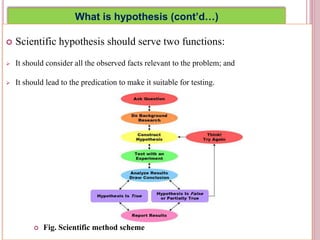
 Scientific hypothesis should serve two functions:
 It should consider all the observed facts relevant to the problem; and
 It should lead to the predication to make it suitable for testing.
 Fig. Scientific method scheme
5
 logic enables scientists to draw conclusions from existing
information.
 Inductive and deductive reasoning are patterns of thought often
recognized in the creation of hypothesis.
 Inductive Logic
 helps to generate scientific knowledge by synthesizing a general
truth from individual incidences
 deductive logic
 helps to generate specific scientific truths from general facts to
resolve the specifics.
6
3. Using logic /Inductive and Deductive Reasoning/
 Example1. Inductive reasoning
 Solids expand up on heating
 Liquids expand up on heating
 Gases expand up on heating
conclusion drawn: Substances expand up on heating
 Example2. Deductive reasoning
 Ionic compounds conduct electricity in solution or molten form
 NaCl is ionic compound
 Conclusion drawn: NaCl conduct electricity in solution or molten form
8
Inductive and Deductive Reasoning (cont’d…)
9
Test the Hypothesis
4. Testing the Hypothesis through Experiment
step in scientific method is heart of the scientific inquiry.
Aim is to control all variables except the one under study.
Experimenting is the hardest part of a scientific process.
It is devised to test whether predictions derived from the
hypothesis are correct or not.
10
Test the Hypothesis (cont’d…)
 For each experiment one needs to alter only one feature
of the investigation at a time, otherwise one will find it
difficult to make easier comparisons.
 If changes two or more features in a single experiment, it
will be difficult to say which one of the features is more
important.
 The feature to controlled, changed and measured are
called Variables
10
Test the Hypothesis (cont’d…)
Experimental Variables:
 are events or conditions subjected to change.
 Examples of variable that are common to many chemical
experiments include the amount of heat, exposure to air,
concentration change, temperature change, pH factor,
catalyzed/uncatalyzed reactions are among others.
Independent variables:
 Is the event or condition under study, i.e., the independent variable
to discover how each test affects the system.
 An independent variable is usually potted on the x-axis of a graph.
10
Test the Hypothesis (cont’d…)
Dependent Variables:
 The variable that can possibly change because of the presence or
change in independent variable.
 It is usually plotted on the y-axis of the graph
Controlled variables:
 Conditions that affect the outcome of an experiment and they held
constant throughout the experiment.
 The fact that they could be changed makes them variables.
 The fact that the decision has been taken to keep them unchanged
makes them controlled.
11
carefully planned experiment consists of two components:
The treated or experimental group and
The untreated or control group
A controlled experiment tests only one factor at a time
keeping the rest of the factors constant.
Test the Hypothesis (cont’d…)
11
 An experimental investigation should generally follow a specific
pattern that is universally accepted by scientists.
 The following are the necessary steps that should be followed in
initiating and performing an experiment:
1. Statement of the problem(Title): involves Specifying the title of
the experiment and identifying the gap with scientific evidence
2. Aim or objective: involves writing a short explanation of the
problem to be investigated.
3. Materials required: includes a list of all the chemicals and
equipments to be used in the experiment.
Steps in conducting experiment
11
4. Procedure or method:
Indicates the steps to be followed; it clearly indicates what should be done first, next
and so on and so forth.
5. Writing your results and observations:
could be qualitative or quantitative information and should be presented as verbal
description, tables of data, graphs
Results and precaution can also be included depending upon the nature of the
experiments
6. Discussion and conclusion:
The discussion should be brief and take the form of the answer(s) to the question
posed by the hypothesis or confirmation of the objective of the experiment.
It should attempt to relate the theoretical knowledge of the experimental variables to
the results obtained
Steps in conducting experiment(cont’d…)
11
 Experimental results are collected, recorded carefully
and systematically, and usually organized in the form of:
 data tables,
 graphs in addition to verbal explanations.
5. Observing, Collecting and Recording Results
6. Analysis and Interpretation of Collected Data
 Analysis means studying the organized material in order to discover
the essential facts.
 studied from many angles as possible to explore the new facts
 The four helpful modes that help to analyze the data are:
 To think in terms of clear tables or figures for presenting the data.
 To examine carefully the statement of problem and earlier analyses
as well as the original records or the raw data.
 To get away from the data and to think about the problem by
further discussing it with others
 To treat the data by making various statistical calculations and
finding relationships, trends, similarities and differences
17
 Interpretation is essentially to state what the result show,
i.e., to explain and make clear or bring out the intended
meaning of the features, composition etc. of your results.
 Interpretation requires a careful, logical and critical
examination of the limitation of:
 the samples chosen,
 the tools selected and used in the study.
18
Analysis and Interpretation of Collected Data
(con’d…)
 Conclusion or generalization requires careful and objective
analysis of the data gathered.
 the hypothesis under test is accepted or rejected on the basis of the
conclusion drawn.
 A statement is written about what new insights have been gained
into the original problem.
 Apparent trends are noted when the same data appear in test results
gathered over a period of time.
 Often further questions and hypotheses are posed in an attempt
guide additional studies of the problem.
19
7. Drawing Conclusion (Generalizing from
Test Results)
 Focus
 write your results as a series of linked conclusions
 identify the most important variables, when writing up any
information.
 make a comment about your confidence in your findings
 Have an opportunity to check the significance of the result of an
experiment using statistical tests.
 Statistical tests help scientists to decide the degree of importance
they should give to a particular result.
 If you discover through a statistical test that your result would be
expected to occur 95 times out of 100 tests (95%), you can have a
high degree of confidence of the result.
20
Drawing Conclusion ( cont’d…)
 In real scientific investigation, each experiment is done
over and over again until consistent result is obtained.
 The investigation must be repeated until a hypothesis is
supported with confirmatory experimental evidence.
 one can be sure of the results valid and conclusions,
many rounds of the experiments need to be undertaken.
 This procedure of scientific experimentation (scientific
inquiry) is known as evaluation.
20
8. Evaluating Evidences (Test Results)
 Advantages of Evaluation
 It enables an investigator to think of a new way of predication
and plan an experiment to test it and collect more information
 It helps a scientist to judge the degree of confidence of the
results of an experiment using statistical tests.
 It enables the scientist to conclude comparisons of his results
with those from other groups who previously carried out
experiments on the same investigation.
 It helps scientist to confirm whether or not his results is valid’
 Hypotheses that stand test of time, and often tested and never
rejected, are called theories.
20
Evaluating Evidences ( cont’d…)
 What is a literature and chemical literatures in particular?
 All discoveries made in the laboratories must be published
somewhere if the information to be known “is known “or
has been done” really mean “has been published” is
known as literature
 Chemical literature is a literature of discoveries related to
all chemical fields
20
3. Use of Chemical Literature
 PRIMARY-
 The original publication of data: Journals, patents,
technical reports, conferences, dissertations, preprints,
some books,
 SECONDARY-
 Publications which provide access to primary literature:
Review, indexes, abstracts, data collection, book series,
text books etc 20
Types of Scientific Literature
 Classification and data collection - physically
 Grouping related data by some common elements.
 Libraries use classification schemes to group related books
together for browsing by subjects
 Data collections bring information from various primary
sources for easier location, example, the CRC hand book
series.
20
Approaches to Organizing the Scientific Literature
 Define what you are looking for; determine what information
will satisfy your need
 Determine what you already know- a subject term, an author, a
known reference that can serve as starting point for your search
 Decide which tools can best find answers on your initial
information
 Indexing-creating pointers to original literature based on some
piece of information in the original, example, author names or
subject terms
 Defining the problem
 Intellectual scope
20
a) Key Steps for Intelligent Information seeking
 Forms of secondary literature in which an editor
selects information from primary sources and arranges
it to facilitate a particular type of access.
data collection can be more useful than searching
primary sources, depending on the objective of your
search.
20
b) Data Collections
 Dictionaries:
E g. Merck index
 Encyclopedias: (a comprehensive reference work with in
depth articles on a range of subjects, sometimes general
/limited to a particular field.
Eg. Kirk-Othmer
 Physical data collections ( including spectra collections)
 Secondary Sources : Journal articles, Patents and the
internet contain virtually all the original work in organic
chemistry.
20
Types of Data Collection
What is monograph?
is detailed book, article, paper, essay, thesis, profile,
and critique on a very specific, often limited subject.
It is designed to stand alone, and is usually not a part
of a series, unless monograph is being released in
several parts.
A monograph usually brings new light to the subject
and, it may contain breakthrough research.
20
Using Monographs
 A monograph is published once as a general rule, unless it
catches on as a text book.
 It used as secondary source increased over time.
 Monograph is now becoming the integral part of research
centers , since today full text journal articles are easy to
access through aggregator data base or publisher web site.
20
Using Monographs ( cont’d…)
 Encyclopedia of Chemical Technology
 Commonly referred to as “Kirk-Othmer” after its early editors.
 Wide ranging, authoritative encyclopedia of chemical and process
information.
 Key features of the Kirk-Othmer Encyclopedia of Chemical
Technology Online include:
 Over 1,000 articles -- with content updated regularly
 New and updated articles keep the online version on the cutting edge of
chemical technology
 Previous versions of articles are archived for posterity
 Easy to use interface that allows one to Search or Browse through the
articles for quick
20
Chemical Encyclopedia
 The structures vary with the type of article, but a typical research
article will include:
 Bibliographic information( article title, authors, author addresses)
 Abstract
 Introduction
 Experimental Section
 Results and Discussion
 Conclusions
 Acknowledgements
 References.
20
The structures of research article
The CRC Handbook of Chemistry and Physics
 A comprehensive one volume reference resource for
science research, currently in its 93rd edition.
 Nicknamed ‘The Rubber Bible’ as CRC originally stood
for “Chemical Rubber Company”
 The handbook contains myriad information for every
branch of science and engineering.
 It includes; Mathematics, Properties and Physical
Constants, Chemical Tables, Properties
20
Use of Handbooks
 is very useful for researcher in the fields of natural science like chemistry and
physics to obtain detailed information regarding the new compound synthesized.
 It helps to confirm whether the compound of interest actually synthesized or not.
 It includes spectral collection like:
 Infrared(IR)
 Vibrational Circular Dichroism (VCD)
 Atomic Absorption spectra (AAS)
 Nuclear Magnetic Resonance (NMR), which includes
 H-NMR
 C-NMR
 O-NMR
 N-NMR
 S-NMR are available.
20
Spectral collections
Types of Research
 There are four major classifications of research designs.
 These include:
 Observational research
 Correlational research
 True experiments
 Quasi experiments
Observational research
 The observational research including; case studies, ethnographic
studies, ethological studies, etc.
 The primary characteristic phenomena are being observed and
recorded.
 qualitative in nature.
 psychological case study would entail extensive notes based on
observations and interviews with the client.
 Surveys are often classified as a type of observational research.
20
4. RESEARCH METHODS
Correlational research
 examines the co-variation of two or more variables.
example, the early research on cigarette smoking examines the
co-variation of cigarette smoking and a variety of lung diseases.
 It accomplished by a variety of techniques which include the
collection of empirical data.
 Often times, considered type of observational research as
nothing is manipulated by the experimenter or individual
conducting the research.
 early studies on cigarette smoking did not manipulate how
many cigarettes were smoked. researcher only collected the
data on the two variables.
 It is not causal research.
 often conducted as exploratory or beginning research.
 Once variables have been identified and defined, experiments
are conductible.
20
Types of research (cont’d…)
True Experiments
 an experiment conducted where an effort is made to
impose control over all other variables except the one
under study.
 it is easier to impose this sort of control in a laboratory
setting.
 To understand the nature of the experiment:
 Experimental or treatment group -the group that receives
the experimental treatment and manipulation, or is
different from the control group on the variable under
study.
 Control group - used to produce comparisons. The
treatment of interest is manipulated to provide a baseline
performance with which to compare the experimental or
treatment group's performance.
20
Types of research (cont’d…)
 Independent variable -the variable that the experimenter
manipulates in a study.
 Dependent variable - the variable that is measured in a
study. The experimenter does not control this variable.
 Random assignment - in a study, each subject has an
equal probability of being selected for either the
treatment or control group.
 Double blind - neither the subject nor the experimenter
knows whether the subject is in the treatment of the
control condition.
 every experiment must have at least two groups: an
experimental and a control group.
20
Types of research (cont’d…)
Quasi-Experiments
 very similar to true experiments but use naturally formed
or pre-existing groups.
 For example, if we wanted to compare young and old
subjects on lung capacity, it is impossible to randomly
assign subjects to either the young or old group
(naturally formed groups).
 If we were to conduct the quasi-experiment, we would
find that the older group had less lung capacity as
compared to the younger group. We might conclude that
old age thus results in less lung capacity. But other
variables might also account for this result.
20
Types of research (cont’d…)
Validity
 four types of validity that can be discussed in relation to research
and statistics.
a) Statistical Conclusion Validity
 without a background in basic statistics, this type of validity is
difficult to understand.
 Essentially, the question that is being asked is - "Are the variables
under study related?" or "Is variable A correlated with Variable B?".
If a study has good statistical conclusion validity, the answer to
these questions is "yes".
b) Internal Validity
 Once it has been determined that the two variables (A & B) are
related, the next issue to be determined is one of causality. Does A
cause B? If a study is lacking internal validity, one cannot make
cause and effect statements based on the research. There are many
potential threats to internal validity. 20
Concepts used to relate RM
c. Construct Validity
 One is examining the issue of construct validity when one is asking the
questions "Am I really measuring the construct that I want to study?" or "Is my
study confounded?”
 For example, if I want to know a particular drug (Va. A) will be effective for
treating depression (Va. B), I will need at least one measure of depression. If
that measure does not truly reflect depression levels but rather anxiety levels
(Confounding Variable X), then my study will be lacking construct validity.
d. External Validity
 addresses the issue of generalize the results of your study to other time, places,
and persons.
 example, if you conduct a study looking at heart disease in men, can these
results be generalized to women? one needs to ask the following questions to
determine if a threat to the external validity exists:
 "Would I find these same results with a difference sample?",
 "Would I get these same results if I conducted my study in a different setting?",
 and "Would I get these same results if I had conducted this study in the past or
if I do this study in the future?"
 If I cannot answer "yes" to each of these questions, then the external validity of
my study is threatened.
20
Validity (cont’d….)
 The practice of science involves many possible pathways.
 The classic description of the scientific method as a linear or circular
process does not adequately capture the dynamic yet rigorous nature
of the practice
 Scientists use multiple research methods to gather data and develop
hypothesis. These methods include:
 Description
 Experimentation
 Modeling, and
 Comparison
Description
 is used to gather regarding natural phenomena and natural
relationships and includes observations and measurements of
behaviors.
 A classic example of descriptive study is Copernicusis’s observation
and sketches of the movement of planets in the sky in an effort to
determine if the Earth or the sun is the orbital center of those objects.
20
Methods of Research
Comparison
 is used to determine and quantify relationships between
two or more variables by observing different groups that
either by choice or circumstances is exposed to different
treatments.
 Examples, the relationship between cigarette smoking and
lung cancer in which scientists compared individuals
who had chosen to smoke of their own accord with non-
smokers and correlate the decision to make with various
health problems including lung cancer.
20
Methods of Research(cont’d)
Modeling
 Natural and comparative – based models are built to
mimic natural systems and then used to conduct
experiments or make observations.
 These methods are interconnected and are often used in
combination to fully understand complex phenomenon.
 Modeling and experimentation are ways of simplifying
systems toward understanding causality and future events.
 However, both rely on assumptions and knowledge
experiments.
 Descriptive and comparison are used to examine the
application of experimental and modeling results in real
world system. 20
Methods of Research(cont’d)
Experimentation
 A controlled experiment tests only one factor at a
time keeping the rest of the factors as constant.
 A laboratory is a place with the necessary and
essential equipments and adequate facilities to
perform and observe experiments. In other words,
it is a workshop where not only the truth of ideas is
tested but also many theoretical aspects are verified.
20
Methods of Research(cont’d)
 What are journals?
 What are abstracts?
 What are indexes?
 What are digests?
 Special magazines known as scientific journals enable
scientists to announce formally the result of their work.
 Most scientific journals carry technical articles concerning
research in particular field.
20
5. Accessing journals, Abstracts,
Indexes and digests
 Scientists rely on reference publications known as
indexes, abstracts and digests
 Indexes list the vast number of scientific books and
articles published each year.
 Abstracts and digests contain summaries of such
materials.
 Indexes, abstracts and digests are available in printed
form, either through mailings to subscribers or through
library reference departments and in computer databases
20
Accessing journals, Abstracts (cont’d…)
 Journals vary in types of articles:
 News and reviews (short summaries of “hot” current research)
 None specialist.
 Major reviews (Specialize in longer articles)
 Major original papers:
 Dalton Transactions; Tetrahedron (Scholarly journals)
 Carry full-length articles on original research
 Brief Communications
 Chemical Communications; Organic Letters, Rapid
Communications I etc.
20
Accessing journals, Abstracts and Indexes ( cont’d….)
 emphasis on publishing quality papers quickly
 freely available to researchers worldwide.
 Scientific research reports and journal articles should generally be
published following an accepted format which includes the
following headings or structure of journal article
 The structure vary with the type of article
 typical research article will include:
 Bibliographic information( article title, authors, author addresses)
 Abstract (may include key words)
 Introduction
 Experimental Section
 Results and Discussion
 Conclusions
 Acknowledgements
 References 20
Open AcOpen Access journals
 Long back, scientists used to go the libraries to manually
look for journal articles of their interest.
 large public libraries employ professional reference
librarians who assist users in finding information.
 Some public libraries also maintain information hotlines
staffed by reference librarians who provide brief answers
to specific questions.
 access these information hotlines via the telephone, e-
mail, conventional mail, or fax.
20
How we can access the indexes, abstract and digests?
 Now a days more than 400 online Abstracts and
Indexing (A and I) services provide these search
capabilities for the various disciplines
Abstract and Index services provider
Google:
 indexes every journal article and every (e) book Springer
publishes by routinely downloading new publication
information as it becomes available on Springer link.
 provides information about journal articles cited by other
articles which doubles as a vital information source for
researchers to determine the quality of a journal.
 about 50% of Springer link visitors come to us through
Google’s search engine.
20
How we can access the indexes, abstract and digests?
Thomson Reuters /ISI
 provide a ranking of journal by important factor that is
widely used in the scientific community.
 It is very selective with the journals they index in their
database,
 journals undergo a lengthy evaluation process that may
take a year or more.
20
How we can access the indexes, abstract and
digests?(cont’d…..)
 An evaluation of quality of an article, both Editorial
(quality of abstracts, figures, tables, author lists, and
reference lists), as well as scientific, is the bases for
Thomson of Reuter’s journal ranking.
 Well known discipline specific indexing services include:
 Chemical abstracts (chemistry).
 ADS (Astronomy and physics among many others)
20
How we can access the indexes, abstract and
digests? (cont’d…..)
 Research paper is a written report describing original research
results in science, mathematics, or engineering.
 It should rely on previously published literature primarily for
background and comparative purposes.
 Contents of an article is organized as follows:
 Title page, or cover page
 Abstract
 Acknowledgments
 Table of contents
 List of tables and/or list of figures
 Introduction
 Materials and methods
 Results and Discussion
 Conclusions
 References, or literature cited
 Appendices (optional)
20
6. Preparing Scientific Paper and Presentation
 It is always intended to convey information.
 Scientific writing is not creative writing nor advertising.
 A good scientific title simply orients the reader to the content
of the paper in the fewest words possible.
 A title is:
 Concise,
 Descriptive, and
 Informative.
 Rules when writing a title:
 do not write the title as a question;
 do not use abbreviations.
 avoid "excess" words such as a, an, or the, or phrases such as a
study of or investigations of.
 consider its length. A two or three word title may be too short,
but a 14 or 15 word title is probably too wordy.
20
Title of the paper
 It is the reader’s first encounter with the paper.
 Reviewers will form first impressions of the research by
reading the abstract.
 Day (1994) states, “Usually, a good abstract is followed by a
good paper; a poor abstract is a harbinger of woes to come.”
abstract is a:
 Brief summary of the principal findings of the paper.
 Preview of the paper.
 Stand-alone, self-contained document that can be read
independent of the paper.
20
Abstract of the paper
abstract should briefly state:
 purpose/research problem (introduction),
 How the problem was studied (methods),
 The findings, including statistical analyses (results),
 What the findings mean (discussion and conclusions).
the abstract should be:
 One or two paragraphs, and
 No more than 175 words
20
Abstract of the paper (cont’d…)
 is not considered as part of typical scientific research
paper and is not a numbered page.
 an outline that indicates the location of the sections and
subsections of the paper.
 It’s main purpose is to enable the reader to quickly find
any section of the paper.
Rules when making a Table of Contents:
 list only the number of the first page of any section
 consider using leaders, a series of horizontal dots, to "lead"
the eye across the page to the right number.
 do not use the word "page" with the number.
 It is self-explanatory.
20
Table of Contents
 are outlines that indicate the location of any tables or
figures in the paper.
Rules when making a List of Tables, include:
 Table numbers,
 Titles, and
 Page numbers.
When making a List of Figures, include:
 figure numbers,
 Captions, and
 Page numbers.
20
List of Tables & Figures
 A clear statement of the problem or project and why we are
studying it (Dodd, 1986).
 A map of the path we are going to take from problem to
solution (Day, 1994).
 It is not simply a literature and concept review.
It should contain:
 Sufficient background information to allow the reader to
understand and evaluate the results of the study(Day, 1994)
 A brief literature review.
 Cite and discuss previous research from relevant literature,
 state how the research relates/differs from others' work;20
Introduction of the paper
 should describe the experimental design with sufficient
detail for a trained researcher to replicate the experiments
and obtain similar results.
 should enable the reader to evaluate the appropriateness of
the methods and the reliability and validity of the results.
Materials and Methods describes:
 How you conducted your study,
 What materials and equipment you used, and
 What methods or procedures you followed.
 It is not a numbered list of experimental steps or a cook
book recipe. 20
Materials and Methods
Rules: Materials and Methods should be written:
 In narrative paragraph format.
 Precisely be specific.
 Don't leave the reader with unanswered questions.
 should not include any of the Results.
 Materials are not listed separately, but rather included in
the description of Methods.
20
Materials and Methods (cont’d….)
 Include exact technical specifications for:
Chemicals:
 purity and names of suppliers.
 Use generic or chemical names, not trade names, Unless the known
difference is critical.
Apparatus:
 type, brand, model.
Techniques:
 standardization methods, solvent, concentrations, times, temperature.
Methods:
 include precise description of the sample;
 include methods of data collection;
 provide all needed detail for new, non-standard, or
 Modification of standard methods; and cite the literature reference and give
only the details specific to the experiment when using a standard method.
20
Materials and Methods (cont’d….)
 It present the data, the most important part of the paper.
 The whole paper must stand or fall on the basis of the Results
(Day, 1994).
 contains all the major experimental findings of the study
 the statistical analyses, presented in a logical order with text
 visuals that complement and supplement the other.
Contains:
 visuals (tables, figures, and/or illustrations) where necessary
for clarity and conciseness, text that summarizes the data
collected and points out highlights of visuals, and any
appropriate statistical analyses of the data.
20
Results and discussion
Making a scientific presentation:
Introduction
 quality of presentations in scientific meetings often leaves much to be desired.
 A good scientific presentation must follow the following three “Ps”.
It should be:
 Planned with care, Prepared with care and Presented with care.
Planning of the presentation
 presenters need to ask the organizers of the scientific meeting about:
 the audience and their level of knowledge and interest in the subject
 planning of the presentation will be different for a specialist audience, a
generalist audience or a mixed audience;
 the time available for the presentation; and the type of visual aids available.
 manuscript of an article should not be used for a scientific presentation.
20
6.2. Presenting Scientific Papers
 difference b/n speaking and writing is the same as the difference b/n hearing and
reading.
 To change a written scientific paper into an oral presentation;
 the presenter must follow three “s words”:
 Select, Synthesize, and Simplify.
 Select from the written article the points to present.
 Synthesize the information in the article based on time availability.
 Simplify the presentation of the data
 easily followed and understood by the audience.
 In the planning stage, the title of the presentation has to be decided and an
abstract has to be submitted to the organizers of the scientific meeting before the
deadline and in the format and length requested.
 Making a scientific presentation abstract can attract or put off the audience.
20
6.2. Presenting Scientific Papers
Preparation of text
In preparing the text of a scientific presentation:
 Avoid too much detail and resist the temptation to overload the presentation with
information.
 Avoid jargon and abbreviations, unless they are clear to all the audience.
 Aim at the average person in the audience.
 Use plain English.
 It should consist of three parts: introduction, main message and conclusions.
Introduction:
 should tell the audience what the presentation will be about.
 the opening sentences should capture the attention of the audience.
main message:
 should be clear and concise.
Conclusion:
 should summarize the main points.
 Try for a strong finish.
 Stopping speaking is not finishing.
 Leave the audience with a “take home message”.
20
Presenting Scientific Papers(cont’d…)
Preparation of visual aids:
Objectives for using visual aids
 we remember 20% of what we hear, 30% of what we see, but
between 50% and 75% of what we see and hear (Sorgi and
Hawkins, 1985).
 They are used to serve one or more of the following objectives:
 To holding the attention of the audience
 presenting the data in a clear way
 Delivering the presentation without having to read from notes.
 Commonly used visual aids include slides, overhead transparencies
and computer assisted presentations.
20
Presenting Scientific Papers(cont’d…)
Slides
 Slides are the commonest visual aid used in scientific
presentations.
 three main types of slide:
 text slides, data slides (tables, graphs, flow charts) and
figure slides.
 A mix of text, data and figure slides helps to maintain the
interest of the audience.
20
Presenting Scientific Papers(cont’d…)
A practical guide for a researchers
 Get ready
 Speak well: Perfection in speaking is acquired.
 Manage your slides
 Keep to the time:
 The speaker who exceeds his allotted time is guilty of
gross bad manners.
 It is a sign of poor preparation.
 Be prepared to answer questions. 20
Presenting Scientific Papers(cont’d…)
Answer politely:
 Do not answer questions in a dismissive or
confrontational manner.
Answer knowledgeably:
 Remember that “I do not know” is a good answer.
Poster Presentation:
 The poster is a hybrid between the research paper and the
oral presentation.
The most important differences are:
 A poster is more concise since the author is present to
explain and elaborate.
 There is more emphasis on graphics.
 use photographs in addition to other illustrations.
 Figures may be in colour.
20
Presenting Scientific Papers(cont’d…)
 we will be reading, presenting, “writing”, and critically
evaluating journal articles.
 the format of a scientific report, conventionally divided
into 6 sections and used the checklist as a reference for
your;
 term paper,
 peer review, and
 as a guide when reading journal articles in general.
1. Abstract
 The abstract serves as a summary of the paper, presenting
the purpose, scope, and major findings. 20
7. Evaluation of a Scientific Paper
2. Introduction
 logically present the background information/provide
context for the study.
 What is the question (research/scientific hypothesis)?
Why is it important (rationale & justification)?
 What are the alternative hypotheses & how do you test
among them (statistical hypotheses)?
 Remember that a lot of studies begin by observing a
pattern (correlation/association).
 Hence, we test our predictions (statistical hypotheses)
using statistical tests & use results of these tests to either
support or refute the research hypothesis.
20
Evaluation of a Scientific Paper (cont’d…)
3. Methods
 should be a clear & succinctly stated, chronological description of
what you did & how you did it.
 Could someone else repeat the research with the information
provided?
 If the answer is “no,” your methods section is incomplete.
 Were methods described in sufficient detail for others to repeat or
extend the study?
 Were adequate references cited if standard methods were used?
 If methods were modified, were modifications described carefully?
 Have the authors indicated why particular procedures were used,
the potential problems of the methods used, & limitations of their
methods?
 Have the authors specified the statistical procedures used?
 Are the statistical methods appropriate? 20
Evaluation of a Scientific Paper (cont’d…)
4. Results
 to highlight trends in the data (most often presented in
figures and/or tables).
 Text should compliment the tables/figures, NOT repeat
the information presented therein.
 Are the results appropriate for the stated objectives?
 Do the results make sense?
 Do tables & figures clearly describe the data?
 Have the appropriate statistical analyses been performed
on the data?
20
Evaluation of a Scientific Paper (cont’d…)
5. Discussion
 To synthesize the results & tie the results to the literature.
 Do not repeat your results…relate them to other studies.
 Were the objectives of the study met? If not, do authors
have an explanation as to why?
 Were statistical hypotheses clearly supported or refuted?
 Are results discussed in relation to similar studies?
 Do authors indulge in needless speculation?
 If results are statistically significant, are they also
biologically significant?
 Do authors adequately interpret their data & discuss the
limitations of their study?
20
Evaluation of a Scientific Paper (cont’d…)
6. References
 Do authors cite appropriate papers for comments made?
 Do authors cite their own publications needlessly?
 Try to find recent references (within the last 2 or 3 years)
so that the analysis is up to date.
20
Evaluation of a Scientific Paper (cont’d…)
103

research methedology ppt.pptx

  • 1.
    MADDA WALABU UNIVERSITY Coursetitle: Research methodology and scientific writing (Chem 2072) College of Natural and Computational Science Department of Chemistry Instructor’s Name: Tekalign Kasa (Ass. professor) March, 2019
  • 2.
     Introduction toscientific research  Scientific writing/methods  Use of chemical literature (handbooks, encyclopedia, spectral collection , monographs)  Research methods  Accessing journals, abstracts and indexes  Preparing scientific paper and presentation  Evaluating scientific papers  Project work 1 Course Outline
  • 3.
    Science: defines the intellectualand practical activity including the systematic study of the structure and behaviour of the physical and natural world through observation and experimentation.  Research detailed study of a subject, especially in order to discover new information or search for new understanding or knowledge. Research fill gaps of Knowledge. 2 1. Introduction to scientific research
  • 4.
    Scientific research:  systematicinvestigation of scientific theories and hypotheses.  hypothesis is a single assertion, a proposed explanation of something based on available knowledge, for something yet to be explained. Objectives of Research: The purpose of research is to discover answers to questions through the application of scientific procedures. 2 Introduction (con’d…)
  • 5.
     The mainpurpose of research is to find out the truth which is hidden and which has not been discovered as yet.  Research study has its own general and specific purpose. i. To gain familiarity with a phenomenon ii. To achieve new insights into it. iii. To describe accurate characteristics of a particular individual, situation or a group iv. To determine the frequency with which something occurs or with which it is associated with something else. v. To test a hypothesis of causal relationship between variables 2 Introduction (con’d…)
  • 6.
    Characteristics of ScientificResearch:  science is the preferable way to obtain reliable and valid knowledge about the natural world.  In order to produce reliable and justified knowledge, the scientific process relies on several important characteristics.  Three of the most important characteristics of scientific research are control, operationalism, and replication. 2 Introduction (con’d…)
  • 7.
    Control  refers toholding constant or eliminating the influence of unrelated variables so that an unambiguous claim about cause and effect can be made.  experiments are the preferred research method whenever you need to address the issue of cause and effect.  Experiments are conducted in an attempt to answer questions, researchers must rely on control. 2 Introduction (con’d…)
  • 8.
    Operationalism  The principleof operationalism was originally set forth by the physicist Percy Bridgman.  Bridgman (1927) argued that science must be specific and precise and each concept must be defined by the steps or operations used to measure them.  Example, If length was measured with a ruler in terms of inches, length would be defined as a specific number of inches. 2 Introduction (con’d…)
  • 9.
    Replication  refers tothe reproduction of the results obtained from one study in additional studies.  Scientific knowledge is greatly advanced by replication. Basic Assumptions of Scientific Research  In order for scientists to have confidence in the capacity of scientific research to achieve solutions to questions and problems, they make several working assumptions so that they can get on with the day-to-day practice of science. 2 Introduction (con’d…)
  • 10.
    Uniformity or Regularityin Nature  Science searches for regularities in nature.  If there were no uniformity in nature, there could be no understanding, explanation, or knowledge about nature.  Without regularity, we could not develop theories or laws or generalizations. Reality in Nature  A related assumption is that there is reality in nature.  In our daily lives we see, hear, feel, smell, and taste things that are real, and these experiences are real. Discoverability  Scientists believe not only that there is regularity and reality in nature, but also, there is discoverability-that is, it is possible to discover the regularities and reality. 2 Introduction (con’d…)
  • 11.
    Basic Elements ofthe Scientific Research  There are many procedures to obtain information about a given phenomenon or situation.  These elements are; intuition, authority, Rationalism and Empiricism Intuition  is the first approach to acquire knowledge that we examine or an approach to acquire knowledge that is not based on a known reasoning process.  Webster’s Third New International Dictionary “the process of coming to direct knowledge or certainty without reasoning or inferring.” Authority  an approach to acquire knowledge represents an acceptance of information or facts stated by another, because that person is highly respected source.  A basis for acceptance of information, because it is acquired from a highly respected source. 2 Introduction (con’d…)
  • 12.
    Rationalism  This approachuses reasoning to arrive at knowledge and assumes that valid knowledge is acquired if the correct reasoning process is used.  The acquisition of knowledge through reasoning. Empiricism  In its native form, this approach would say, “If I have experienced something, then it is valid and true.”  Therefore, facts that concur with experience are accepted, and those that do not are rejected.  The acquisition of knowledge through experience. 2 Introduction (con’d…)
  • 13.
    Types of ScientificResearch Quantitative Vs Qualitative research:  Quantitative research: it aims to measure the quantity or amount and compares it with past records and tries to project for future period.  The objective of quantitative research is to develop and employ mathematical models, theories or hypothesis pertaining to phenomena.  The process of measurement is central to quantitative research because it provides fundamental connection between empirical observation and mathematical expression of quantitative relationships. 2 Introduction (con’d…)
  • 14.
     Statistics isthe most widely used branch of mathematics in quantitative research.  Quantitative research involving the use of structured questions, where the response options have been Pre- determined and large number of respondents is involved.  Qualitative research: non-quantitative type of analysis.  It is collecting, analyzing and interpreting data by observing what people do and say and also refers to the meanings, definitions, characteristics, symbols, metaphors, and description of things.  much more subjective and uses very different methods of collecting information, mainly individual, in-depth interviews and focus groups. 2 Introduction (con’d…)
  • 15.
     Qualitative researchcan be classified as; Phenomenology:  a form of research in which the researcher attempts to understand how one or more individuals experience a phenomenon. Ethnography:  It focuses on describing the culture of a group of people.  A culture is the shared attributes, values, norms, practices, language, and material things of a group of people. Case study:  focused on providing a detailed account of one or more cases. Example, we may study a classroom that was given a new curriculum for technology use. 2 Introduction (con’d…)
  • 16.
    Grounded theory research: it is an inductive type of research, based or grounded in the observations of data from which it was developed;  it uses a variety of data sources, including quantitative data, review of records, interviews, observation and surveys. Historical research:  it allows one to discuss past and present events in the context of the present condition, and allows one to reflect and provide possible answers to current issues and problems.  Eg:-the lending pattern of business in the 19th century. 2 Introduction (con’d…)
  • 17.
    Descriptive Vs Explanatoryresearch Descriptive Research  Once the groundwork is established, the newly explored field needs more information.  The next step is descriptive research, defined as attempts to explore and explain while providing additional information about a topic.  This is where research is trying to describe what is happening in more detail, filling in the missing parts and expanding our understanding and is also where much information is collected as possible instead of making guesses or elaborate models to predict the future-the 'what' and 'how,' rather than 'why.‘  It is the act of exploring the thing in the dark, creating a fuller picture of what you are looking at.  It is not quite as tentative as exploratory, but you still are not 100% sure what you've found, although you're starting to get an idea.  You begin to fill in what you know with what you find. 2 Introduction (con’d…)
  • 18.
    Exploratory research  isdefined as the initial research into a hypothetical or theoretical idea and is where a researcher has an idea or has observed something and seeks to understand more about it.  An exploratory research project is an attempt to lay the groundwork that will lead to future studies, or to determine if what is being observed might be explained by a currently existing theory.  Most often, exploratory research lays the initial groundwork for future research.  Exploratory research can come in two big forms: either a new topic or a new angle.  A new topic is often unexpected and startling in its findings.  New angles come from new ways of looking at things, either from a theoretical perspective or a new way of measuring something. 2 Introduction (con’d…)
  • 19.
    Basic (pure) Vsapplied research Basic research  The objective of basic research is to gain more comprehensive knowledge or understanding of the subject under study, without specific applications in mind.  In industry, basic research is defined as research that advances scientific knowledge but does not have specific immediate commercial objectives, although it may be in fields of present or potential commercial interest. Applied research  is aimed at gaining knowledge or understanding to determine the means by which a specific, recognized need may be met.  In industry, applied research includes investigations oriented to discovering new scientific knowledge that has specific commercial objectives with respect to products, processes, or 2 Introduction (con’d…)
  • 20.
    2. Scientific writing/methods Scientific writing is the basic method, guide, and system by which we originate, refine, extend, and apply knowledge in all fields.  It is a body of techniques for investigating phenomena acquiring new knowledge, or correlating and integrating previous knowledge.  must be based on empirical and measurable evidence subjected to specific principles of reasoning. 3
  • 21.
    Scientific writing/methods (cont’d…) Importance of Scientific Methods  To Global Competitiveness  To National Competitiveness  To Educational Competitiveness  To Individual Competitiveness 3
  • 22.
    Scientific writing/methods (con’d…) scientific writing is the complete method of creative problem solving and decision making for all fields  It is a body of techniques for investigating phenomena acquiring new knowledge, or correlating and integrating previous knowledge.  To be termed scientific method of inquiry must be based on empirical and measurable evidence subjected to specific principles of reasoning. 4
  • 23.
    Steps of Scientificwriting/methods  Centuries of study, debate, and experimentation has established that the best of all methods of obtaining reliable knowledge in all fields is the scientific method.  For all competitiveness in all areas, the scientific method is the guide to the mental activities and systems needed to solve the complex competitiveness problems 4
  • 24.
    Steps in scientificwriting/methods (cont’d…)  Scientific method involves various steps like observation, defining a problem, forming hypothesis, testing it by controlled experiment and coming to conclusion to formulate a theory which may or may not be acceptable.  The scientific method is not only for laboratory, but part of everyday life. 4
  • 25.
    Steps in scientificwriting/methods (cont’d…)  There is no fixed formula for the steps followed in scientific method/writing, here are the usual steps of the scientific steps:  Observation  Identifying the problem  Hypothesizing  Reasoning /Inductive and Deductive Reasoning/  Testing Hypothesis Through Experimentation  Observing, Collecting and Recording Results  Analysis and Interpretation of collected data  Drawing Conclusion /Generalizing from Test Results / 4
  • 26.
    1. Observation  Whatis observation? Is it peculiar to human being?  Observation is the activity of living being, such as human being.  Scientific observation is the central element of scientific method or process. It is the first step in scientific inquiry.  This step immediately limits the scientific domain, and helps to suggest whether or not something can be observed directly or indirectly, if a given observation can be made directly through systems of vision, hearing, taste, or smell and touch which would provide firsthand information. 4
  • 27.
    Observation (cont’d…)  Sensesare limited, and are subjected to errors in perception such as optical illusions.  The core skill of scientist is to make observation.  Observation consists of receiving knowledge of the outside world through our senses, or recording information using scientific tools and instruments.  Any recorded data during experiment is called an observation.  Remember that in a single scientific activity observation can be carried out, at different stages.  First when identifying the problem for investigation  Second when trying to formulate the hypothesis  Finally when trying to prove or disprove the hypothesis through repeated observations 4
  • 28.
    2. Identifying theproblem and Propose a hypothesis Hypothesis (Hypotheses, plural)  could be defined as possible explanation of a certain observed phenomenon or it could be defined as “Best guess” or intelligent guess that explains the observation in terms of what one already knows.  It is a conjecture based on knowledge obtained while formulating the question that may explain the observed behavior of part of our universe. 5 What is hypothesis?
  • 29.
    What is hypothesis(cont’d…)  Generally regarding hypothesis we can say:  It is tentative theory  It consists of interconnected statements that give a possible solution to a problem  It places a data into a conceptual frame work  It makes up the lattice-work upon which scientific understanding is structured  It constitutes a generalization that describes the state of affairs within an area of investigation 5
  • 30.
    What is hypothesis(cont’d…)  The hypothesis might be very specific or it might be very broad.  A statistical hypothesis is a conjecture about some population.  terms commonly associated with statistical hypothesis are null hypothesis and alternative hypothesis. A null hypothesis is the conjecture that a statistical hypothesis is false.  It is easiest to test the null or no difference hypothesis because you can prove it to be wrong.  When a hypothesis is scientific, it will be tested through experiments.  Why? Because scientific hypotheses are assumptions or tentative explanation of existing information. 5
  • 31.
    What is hypothesis(cont’d…)  Scientific hypothesis should serve two functions:  It should consider all the observed facts relevant to the problem; and  It should lead to the predication to make it suitable for testing.  Fig. Scientific method scheme 5
  • 32.
     logic enablesscientists to draw conclusions from existing information.  Inductive and deductive reasoning are patterns of thought often recognized in the creation of hypothesis.  Inductive Logic  helps to generate scientific knowledge by synthesizing a general truth from individual incidences  deductive logic  helps to generate specific scientific truths from general facts to resolve the specifics. 6 3. Using logic /Inductive and Deductive Reasoning/
  • 33.
     Example1. Inductivereasoning  Solids expand up on heating  Liquids expand up on heating  Gases expand up on heating conclusion drawn: Substances expand up on heating  Example2. Deductive reasoning  Ionic compounds conduct electricity in solution or molten form  NaCl is ionic compound  Conclusion drawn: NaCl conduct electricity in solution or molten form 8 Inductive and Deductive Reasoning (cont’d…)
  • 34.
    9 Test the Hypothesis 4.Testing the Hypothesis through Experiment step in scientific method is heart of the scientific inquiry. Aim is to control all variables except the one under study. Experimenting is the hardest part of a scientific process. It is devised to test whether predictions derived from the hypothesis are correct or not.
  • 35.
    10 Test the Hypothesis(cont’d…)  For each experiment one needs to alter only one feature of the investigation at a time, otherwise one will find it difficult to make easier comparisons.  If changes two or more features in a single experiment, it will be difficult to say which one of the features is more important.  The feature to controlled, changed and measured are called Variables
  • 36.
    10 Test the Hypothesis(cont’d…) Experimental Variables:  are events or conditions subjected to change.  Examples of variable that are common to many chemical experiments include the amount of heat, exposure to air, concentration change, temperature change, pH factor, catalyzed/uncatalyzed reactions are among others. Independent variables:  Is the event or condition under study, i.e., the independent variable to discover how each test affects the system.  An independent variable is usually potted on the x-axis of a graph.
  • 37.
    10 Test the Hypothesis(cont’d…) Dependent Variables:  The variable that can possibly change because of the presence or change in independent variable.  It is usually plotted on the y-axis of the graph Controlled variables:  Conditions that affect the outcome of an experiment and they held constant throughout the experiment.  The fact that they could be changed makes them variables.  The fact that the decision has been taken to keep them unchanged makes them controlled.
  • 38.
    11 carefully planned experimentconsists of two components: The treated or experimental group and The untreated or control group A controlled experiment tests only one factor at a time keeping the rest of the factors constant. Test the Hypothesis (cont’d…)
  • 39.
    11  An experimentalinvestigation should generally follow a specific pattern that is universally accepted by scientists.  The following are the necessary steps that should be followed in initiating and performing an experiment: 1. Statement of the problem(Title): involves Specifying the title of the experiment and identifying the gap with scientific evidence 2. Aim or objective: involves writing a short explanation of the problem to be investigated. 3. Materials required: includes a list of all the chemicals and equipments to be used in the experiment. Steps in conducting experiment
  • 40.
    11 4. Procedure ormethod: Indicates the steps to be followed; it clearly indicates what should be done first, next and so on and so forth. 5. Writing your results and observations: could be qualitative or quantitative information and should be presented as verbal description, tables of data, graphs Results and precaution can also be included depending upon the nature of the experiments 6. Discussion and conclusion: The discussion should be brief and take the form of the answer(s) to the question posed by the hypothesis or confirmation of the objective of the experiment. It should attempt to relate the theoretical knowledge of the experimental variables to the results obtained Steps in conducting experiment(cont’d…)
  • 41.
    11  Experimental resultsare collected, recorded carefully and systematically, and usually organized in the form of:  data tables,  graphs in addition to verbal explanations. 5. Observing, Collecting and Recording Results
  • 42.
    6. Analysis andInterpretation of Collected Data  Analysis means studying the organized material in order to discover the essential facts.  studied from many angles as possible to explore the new facts  The four helpful modes that help to analyze the data are:  To think in terms of clear tables or figures for presenting the data.  To examine carefully the statement of problem and earlier analyses as well as the original records or the raw data.  To get away from the data and to think about the problem by further discussing it with others  To treat the data by making various statistical calculations and finding relationships, trends, similarities and differences 17
  • 43.
     Interpretation isessentially to state what the result show, i.e., to explain and make clear or bring out the intended meaning of the features, composition etc. of your results.  Interpretation requires a careful, logical and critical examination of the limitation of:  the samples chosen,  the tools selected and used in the study. 18 Analysis and Interpretation of Collected Data (con’d…)
  • 44.
     Conclusion orgeneralization requires careful and objective analysis of the data gathered.  the hypothesis under test is accepted or rejected on the basis of the conclusion drawn.  A statement is written about what new insights have been gained into the original problem.  Apparent trends are noted when the same data appear in test results gathered over a period of time.  Often further questions and hypotheses are posed in an attempt guide additional studies of the problem. 19 7. Drawing Conclusion (Generalizing from Test Results)
  • 45.
     Focus  writeyour results as a series of linked conclusions  identify the most important variables, when writing up any information.  make a comment about your confidence in your findings  Have an opportunity to check the significance of the result of an experiment using statistical tests.  Statistical tests help scientists to decide the degree of importance they should give to a particular result.  If you discover through a statistical test that your result would be expected to occur 95 times out of 100 tests (95%), you can have a high degree of confidence of the result. 20 Drawing Conclusion ( cont’d…)
  • 46.
     In realscientific investigation, each experiment is done over and over again until consistent result is obtained.  The investigation must be repeated until a hypothesis is supported with confirmatory experimental evidence.  one can be sure of the results valid and conclusions, many rounds of the experiments need to be undertaken.  This procedure of scientific experimentation (scientific inquiry) is known as evaluation. 20 8. Evaluating Evidences (Test Results)
  • 47.
     Advantages ofEvaluation  It enables an investigator to think of a new way of predication and plan an experiment to test it and collect more information  It helps a scientist to judge the degree of confidence of the results of an experiment using statistical tests.  It enables the scientist to conclude comparisons of his results with those from other groups who previously carried out experiments on the same investigation.  It helps scientist to confirm whether or not his results is valid’  Hypotheses that stand test of time, and often tested and never rejected, are called theories. 20 Evaluating Evidences ( cont’d…)
  • 48.
     What isa literature and chemical literatures in particular?  All discoveries made in the laboratories must be published somewhere if the information to be known “is known “or has been done” really mean “has been published” is known as literature  Chemical literature is a literature of discoveries related to all chemical fields 20 3. Use of Chemical Literature
  • 49.
     PRIMARY-  Theoriginal publication of data: Journals, patents, technical reports, conferences, dissertations, preprints, some books,  SECONDARY-  Publications which provide access to primary literature: Review, indexes, abstracts, data collection, book series, text books etc 20 Types of Scientific Literature
  • 50.
     Classification anddata collection - physically  Grouping related data by some common elements.  Libraries use classification schemes to group related books together for browsing by subjects  Data collections bring information from various primary sources for easier location, example, the CRC hand book series. 20 Approaches to Organizing the Scientific Literature
  • 51.
     Define whatyou are looking for; determine what information will satisfy your need  Determine what you already know- a subject term, an author, a known reference that can serve as starting point for your search  Decide which tools can best find answers on your initial information  Indexing-creating pointers to original literature based on some piece of information in the original, example, author names or subject terms  Defining the problem  Intellectual scope 20 a) Key Steps for Intelligent Information seeking
  • 52.
     Forms ofsecondary literature in which an editor selects information from primary sources and arranges it to facilitate a particular type of access. data collection can be more useful than searching primary sources, depending on the objective of your search. 20 b) Data Collections
  • 53.
     Dictionaries: E g.Merck index  Encyclopedias: (a comprehensive reference work with in depth articles on a range of subjects, sometimes general /limited to a particular field. Eg. Kirk-Othmer  Physical data collections ( including spectra collections)  Secondary Sources : Journal articles, Patents and the internet contain virtually all the original work in organic chemistry. 20 Types of Data Collection
  • 54.
    What is monograph? isdetailed book, article, paper, essay, thesis, profile, and critique on a very specific, often limited subject. It is designed to stand alone, and is usually not a part of a series, unless monograph is being released in several parts. A monograph usually brings new light to the subject and, it may contain breakthrough research. 20 Using Monographs
  • 55.
     A monographis published once as a general rule, unless it catches on as a text book.  It used as secondary source increased over time.  Monograph is now becoming the integral part of research centers , since today full text journal articles are easy to access through aggregator data base or publisher web site. 20 Using Monographs ( cont’d…)
  • 56.
     Encyclopedia ofChemical Technology  Commonly referred to as “Kirk-Othmer” after its early editors.  Wide ranging, authoritative encyclopedia of chemical and process information.  Key features of the Kirk-Othmer Encyclopedia of Chemical Technology Online include:  Over 1,000 articles -- with content updated regularly  New and updated articles keep the online version on the cutting edge of chemical technology  Previous versions of articles are archived for posterity  Easy to use interface that allows one to Search or Browse through the articles for quick 20 Chemical Encyclopedia
  • 57.
     The structuresvary with the type of article, but a typical research article will include:  Bibliographic information( article title, authors, author addresses)  Abstract  Introduction  Experimental Section  Results and Discussion  Conclusions  Acknowledgements  References. 20 The structures of research article
  • 58.
    The CRC Handbookof Chemistry and Physics  A comprehensive one volume reference resource for science research, currently in its 93rd edition.  Nicknamed ‘The Rubber Bible’ as CRC originally stood for “Chemical Rubber Company”  The handbook contains myriad information for every branch of science and engineering.  It includes; Mathematics, Properties and Physical Constants, Chemical Tables, Properties 20 Use of Handbooks
  • 59.
     is veryuseful for researcher in the fields of natural science like chemistry and physics to obtain detailed information regarding the new compound synthesized.  It helps to confirm whether the compound of interest actually synthesized or not.  It includes spectral collection like:  Infrared(IR)  Vibrational Circular Dichroism (VCD)  Atomic Absorption spectra (AAS)  Nuclear Magnetic Resonance (NMR), which includes  H-NMR  C-NMR  O-NMR  N-NMR  S-NMR are available. 20 Spectral collections
  • 60.
    Types of Research There are four major classifications of research designs.  These include:  Observational research  Correlational research  True experiments  Quasi experiments Observational research  The observational research including; case studies, ethnographic studies, ethological studies, etc.  The primary characteristic phenomena are being observed and recorded.  qualitative in nature.  psychological case study would entail extensive notes based on observations and interviews with the client.  Surveys are often classified as a type of observational research. 20 4. RESEARCH METHODS
  • 61.
    Correlational research  examinesthe co-variation of two or more variables. example, the early research on cigarette smoking examines the co-variation of cigarette smoking and a variety of lung diseases.  It accomplished by a variety of techniques which include the collection of empirical data.  Often times, considered type of observational research as nothing is manipulated by the experimenter or individual conducting the research.  early studies on cigarette smoking did not manipulate how many cigarettes were smoked. researcher only collected the data on the two variables.  It is not causal research.  often conducted as exploratory or beginning research.  Once variables have been identified and defined, experiments are conductible. 20 Types of research (cont’d…)
  • 62.
    True Experiments  anexperiment conducted where an effort is made to impose control over all other variables except the one under study.  it is easier to impose this sort of control in a laboratory setting.  To understand the nature of the experiment:  Experimental or treatment group -the group that receives the experimental treatment and manipulation, or is different from the control group on the variable under study.  Control group - used to produce comparisons. The treatment of interest is manipulated to provide a baseline performance with which to compare the experimental or treatment group's performance. 20 Types of research (cont’d…)
  • 63.
     Independent variable-the variable that the experimenter manipulates in a study.  Dependent variable - the variable that is measured in a study. The experimenter does not control this variable.  Random assignment - in a study, each subject has an equal probability of being selected for either the treatment or control group.  Double blind - neither the subject nor the experimenter knows whether the subject is in the treatment of the control condition.  every experiment must have at least two groups: an experimental and a control group. 20 Types of research (cont’d…)
  • 64.
    Quasi-Experiments  very similarto true experiments but use naturally formed or pre-existing groups.  For example, if we wanted to compare young and old subjects on lung capacity, it is impossible to randomly assign subjects to either the young or old group (naturally formed groups).  If we were to conduct the quasi-experiment, we would find that the older group had less lung capacity as compared to the younger group. We might conclude that old age thus results in less lung capacity. But other variables might also account for this result. 20 Types of research (cont’d…)
  • 65.
    Validity  four typesof validity that can be discussed in relation to research and statistics. a) Statistical Conclusion Validity  without a background in basic statistics, this type of validity is difficult to understand.  Essentially, the question that is being asked is - "Are the variables under study related?" or "Is variable A correlated with Variable B?". If a study has good statistical conclusion validity, the answer to these questions is "yes". b) Internal Validity  Once it has been determined that the two variables (A & B) are related, the next issue to be determined is one of causality. Does A cause B? If a study is lacking internal validity, one cannot make cause and effect statements based on the research. There are many potential threats to internal validity. 20 Concepts used to relate RM
  • 66.
    c. Construct Validity One is examining the issue of construct validity when one is asking the questions "Am I really measuring the construct that I want to study?" or "Is my study confounded?”  For example, if I want to know a particular drug (Va. A) will be effective for treating depression (Va. B), I will need at least one measure of depression. If that measure does not truly reflect depression levels but rather anxiety levels (Confounding Variable X), then my study will be lacking construct validity. d. External Validity  addresses the issue of generalize the results of your study to other time, places, and persons.  example, if you conduct a study looking at heart disease in men, can these results be generalized to women? one needs to ask the following questions to determine if a threat to the external validity exists:  "Would I find these same results with a difference sample?",  "Would I get these same results if I conducted my study in a different setting?",  and "Would I get these same results if I had conducted this study in the past or if I do this study in the future?"  If I cannot answer "yes" to each of these questions, then the external validity of my study is threatened. 20 Validity (cont’d….)
  • 67.
     The practiceof science involves many possible pathways.  The classic description of the scientific method as a linear or circular process does not adequately capture the dynamic yet rigorous nature of the practice  Scientists use multiple research methods to gather data and develop hypothesis. These methods include:  Description  Experimentation  Modeling, and  Comparison Description  is used to gather regarding natural phenomena and natural relationships and includes observations and measurements of behaviors.  A classic example of descriptive study is Copernicusis’s observation and sketches of the movement of planets in the sky in an effort to determine if the Earth or the sun is the orbital center of those objects. 20 Methods of Research
  • 68.
    Comparison  is usedto determine and quantify relationships between two or more variables by observing different groups that either by choice or circumstances is exposed to different treatments.  Examples, the relationship between cigarette smoking and lung cancer in which scientists compared individuals who had chosen to smoke of their own accord with non- smokers and correlate the decision to make with various health problems including lung cancer. 20 Methods of Research(cont’d)
  • 69.
    Modeling  Natural andcomparative – based models are built to mimic natural systems and then used to conduct experiments or make observations.  These methods are interconnected and are often used in combination to fully understand complex phenomenon.  Modeling and experimentation are ways of simplifying systems toward understanding causality and future events.  However, both rely on assumptions and knowledge experiments.  Descriptive and comparison are used to examine the application of experimental and modeling results in real world system. 20 Methods of Research(cont’d)
  • 70.
    Experimentation  A controlledexperiment tests only one factor at a time keeping the rest of the factors as constant.  A laboratory is a place with the necessary and essential equipments and adequate facilities to perform and observe experiments. In other words, it is a workshop where not only the truth of ideas is tested but also many theoretical aspects are verified. 20 Methods of Research(cont’d)
  • 71.
     What arejournals?  What are abstracts?  What are indexes?  What are digests?  Special magazines known as scientific journals enable scientists to announce formally the result of their work.  Most scientific journals carry technical articles concerning research in particular field. 20 5. Accessing journals, Abstracts, Indexes and digests
  • 72.
     Scientists relyon reference publications known as indexes, abstracts and digests  Indexes list the vast number of scientific books and articles published each year.  Abstracts and digests contain summaries of such materials.  Indexes, abstracts and digests are available in printed form, either through mailings to subscribers or through library reference departments and in computer databases 20 Accessing journals, Abstracts (cont’d…)
  • 73.
     Journals varyin types of articles:  News and reviews (short summaries of “hot” current research)  None specialist.  Major reviews (Specialize in longer articles)  Major original papers:  Dalton Transactions; Tetrahedron (Scholarly journals)  Carry full-length articles on original research  Brief Communications  Chemical Communications; Organic Letters, Rapid Communications I etc. 20 Accessing journals, Abstracts and Indexes ( cont’d….)
  • 74.
     emphasis onpublishing quality papers quickly  freely available to researchers worldwide.  Scientific research reports and journal articles should generally be published following an accepted format which includes the following headings or structure of journal article  The structure vary with the type of article  typical research article will include:  Bibliographic information( article title, authors, author addresses)  Abstract (may include key words)  Introduction  Experimental Section  Results and Discussion  Conclusions  Acknowledgements  References 20 Open AcOpen Access journals
  • 75.
     Long back,scientists used to go the libraries to manually look for journal articles of their interest.  large public libraries employ professional reference librarians who assist users in finding information.  Some public libraries also maintain information hotlines staffed by reference librarians who provide brief answers to specific questions.  access these information hotlines via the telephone, e- mail, conventional mail, or fax. 20 How we can access the indexes, abstract and digests?
  • 76.
     Now adays more than 400 online Abstracts and Indexing (A and I) services provide these search capabilities for the various disciplines Abstract and Index services provider Google:  indexes every journal article and every (e) book Springer publishes by routinely downloading new publication information as it becomes available on Springer link.  provides information about journal articles cited by other articles which doubles as a vital information source for researchers to determine the quality of a journal.  about 50% of Springer link visitors come to us through Google’s search engine. 20 How we can access the indexes, abstract and digests?
  • 77.
    Thomson Reuters /ISI provide a ranking of journal by important factor that is widely used in the scientific community.  It is very selective with the journals they index in their database,  journals undergo a lengthy evaluation process that may take a year or more. 20 How we can access the indexes, abstract and digests?(cont’d…..)
  • 78.
     An evaluationof quality of an article, both Editorial (quality of abstracts, figures, tables, author lists, and reference lists), as well as scientific, is the bases for Thomson of Reuter’s journal ranking.  Well known discipline specific indexing services include:  Chemical abstracts (chemistry).  ADS (Astronomy and physics among many others) 20 How we can access the indexes, abstract and digests? (cont’d…..)
  • 79.
     Research paperis a written report describing original research results in science, mathematics, or engineering.  It should rely on previously published literature primarily for background and comparative purposes.  Contents of an article is organized as follows:  Title page, or cover page  Abstract  Acknowledgments  Table of contents  List of tables and/or list of figures  Introduction  Materials and methods  Results and Discussion  Conclusions  References, or literature cited  Appendices (optional) 20 6. Preparing Scientific Paper and Presentation
  • 80.
     It isalways intended to convey information.  Scientific writing is not creative writing nor advertising.  A good scientific title simply orients the reader to the content of the paper in the fewest words possible.  A title is:  Concise,  Descriptive, and  Informative.  Rules when writing a title:  do not write the title as a question;  do not use abbreviations.  avoid "excess" words such as a, an, or the, or phrases such as a study of or investigations of.  consider its length. A two or three word title may be too short, but a 14 or 15 word title is probably too wordy. 20 Title of the paper
  • 81.
     It isthe reader’s first encounter with the paper.  Reviewers will form first impressions of the research by reading the abstract.  Day (1994) states, “Usually, a good abstract is followed by a good paper; a poor abstract is a harbinger of woes to come.” abstract is a:  Brief summary of the principal findings of the paper.  Preview of the paper.  Stand-alone, self-contained document that can be read independent of the paper. 20 Abstract of the paper
  • 82.
    abstract should brieflystate:  purpose/research problem (introduction),  How the problem was studied (methods),  The findings, including statistical analyses (results),  What the findings mean (discussion and conclusions). the abstract should be:  One or two paragraphs, and  No more than 175 words 20 Abstract of the paper (cont’d…)
  • 83.
     is notconsidered as part of typical scientific research paper and is not a numbered page.  an outline that indicates the location of the sections and subsections of the paper.  It’s main purpose is to enable the reader to quickly find any section of the paper. Rules when making a Table of Contents:  list only the number of the first page of any section  consider using leaders, a series of horizontal dots, to "lead" the eye across the page to the right number.  do not use the word "page" with the number.  It is self-explanatory. 20 Table of Contents
  • 84.
     are outlinesthat indicate the location of any tables or figures in the paper. Rules when making a List of Tables, include:  Table numbers,  Titles, and  Page numbers. When making a List of Figures, include:  figure numbers,  Captions, and  Page numbers. 20 List of Tables & Figures
  • 85.
     A clearstatement of the problem or project and why we are studying it (Dodd, 1986).  A map of the path we are going to take from problem to solution (Day, 1994).  It is not simply a literature and concept review. It should contain:  Sufficient background information to allow the reader to understand and evaluate the results of the study(Day, 1994)  A brief literature review.  Cite and discuss previous research from relevant literature,  state how the research relates/differs from others' work;20 Introduction of the paper
  • 86.
     should describethe experimental design with sufficient detail for a trained researcher to replicate the experiments and obtain similar results.  should enable the reader to evaluate the appropriateness of the methods and the reliability and validity of the results. Materials and Methods describes:  How you conducted your study,  What materials and equipment you used, and  What methods or procedures you followed.  It is not a numbered list of experimental steps or a cook book recipe. 20 Materials and Methods
  • 87.
    Rules: Materials andMethods should be written:  In narrative paragraph format.  Precisely be specific.  Don't leave the reader with unanswered questions.  should not include any of the Results.  Materials are not listed separately, but rather included in the description of Methods. 20 Materials and Methods (cont’d….)
  • 88.
     Include exacttechnical specifications for: Chemicals:  purity and names of suppliers.  Use generic or chemical names, not trade names, Unless the known difference is critical. Apparatus:  type, brand, model. Techniques:  standardization methods, solvent, concentrations, times, temperature. Methods:  include precise description of the sample;  include methods of data collection;  provide all needed detail for new, non-standard, or  Modification of standard methods; and cite the literature reference and give only the details specific to the experiment when using a standard method. 20 Materials and Methods (cont’d….)
  • 89.
     It presentthe data, the most important part of the paper.  The whole paper must stand or fall on the basis of the Results (Day, 1994).  contains all the major experimental findings of the study  the statistical analyses, presented in a logical order with text  visuals that complement and supplement the other. Contains:  visuals (tables, figures, and/or illustrations) where necessary for clarity and conciseness, text that summarizes the data collected and points out highlights of visuals, and any appropriate statistical analyses of the data. 20 Results and discussion
  • 90.
    Making a scientificpresentation: Introduction  quality of presentations in scientific meetings often leaves much to be desired.  A good scientific presentation must follow the following three “Ps”. It should be:  Planned with care, Prepared with care and Presented with care. Planning of the presentation  presenters need to ask the organizers of the scientific meeting about:  the audience and their level of knowledge and interest in the subject  planning of the presentation will be different for a specialist audience, a generalist audience or a mixed audience;  the time available for the presentation; and the type of visual aids available.  manuscript of an article should not be used for a scientific presentation. 20 6.2. Presenting Scientific Papers
  • 91.
     difference b/nspeaking and writing is the same as the difference b/n hearing and reading.  To change a written scientific paper into an oral presentation;  the presenter must follow three “s words”:  Select, Synthesize, and Simplify.  Select from the written article the points to present.  Synthesize the information in the article based on time availability.  Simplify the presentation of the data  easily followed and understood by the audience.  In the planning stage, the title of the presentation has to be decided and an abstract has to be submitted to the organizers of the scientific meeting before the deadline and in the format and length requested.  Making a scientific presentation abstract can attract or put off the audience. 20 6.2. Presenting Scientific Papers
  • 92.
    Preparation of text Inpreparing the text of a scientific presentation:  Avoid too much detail and resist the temptation to overload the presentation with information.  Avoid jargon and abbreviations, unless they are clear to all the audience.  Aim at the average person in the audience.  Use plain English.  It should consist of three parts: introduction, main message and conclusions. Introduction:  should tell the audience what the presentation will be about.  the opening sentences should capture the attention of the audience. main message:  should be clear and concise. Conclusion:  should summarize the main points.  Try for a strong finish.  Stopping speaking is not finishing.  Leave the audience with a “take home message”. 20 Presenting Scientific Papers(cont’d…)
  • 93.
    Preparation of visualaids: Objectives for using visual aids  we remember 20% of what we hear, 30% of what we see, but between 50% and 75% of what we see and hear (Sorgi and Hawkins, 1985).  They are used to serve one or more of the following objectives:  To holding the attention of the audience  presenting the data in a clear way  Delivering the presentation without having to read from notes.  Commonly used visual aids include slides, overhead transparencies and computer assisted presentations. 20 Presenting Scientific Papers(cont’d…)
  • 94.
    Slides  Slides arethe commonest visual aid used in scientific presentations.  three main types of slide:  text slides, data slides (tables, graphs, flow charts) and figure slides.  A mix of text, data and figure slides helps to maintain the interest of the audience. 20 Presenting Scientific Papers(cont’d…)
  • 95.
    A practical guidefor a researchers  Get ready  Speak well: Perfection in speaking is acquired.  Manage your slides  Keep to the time:  The speaker who exceeds his allotted time is guilty of gross bad manners.  It is a sign of poor preparation.  Be prepared to answer questions. 20 Presenting Scientific Papers(cont’d…)
  • 96.
    Answer politely:  Donot answer questions in a dismissive or confrontational manner. Answer knowledgeably:  Remember that “I do not know” is a good answer. Poster Presentation:  The poster is a hybrid between the research paper and the oral presentation. The most important differences are:  A poster is more concise since the author is present to explain and elaborate.  There is more emphasis on graphics.  use photographs in addition to other illustrations.  Figures may be in colour. 20 Presenting Scientific Papers(cont’d…)
  • 97.
     we willbe reading, presenting, “writing”, and critically evaluating journal articles.  the format of a scientific report, conventionally divided into 6 sections and used the checklist as a reference for your;  term paper,  peer review, and  as a guide when reading journal articles in general. 1. Abstract  The abstract serves as a summary of the paper, presenting the purpose, scope, and major findings. 20 7. Evaluation of a Scientific Paper
  • 98.
    2. Introduction  logicallypresent the background information/provide context for the study.  What is the question (research/scientific hypothesis)? Why is it important (rationale & justification)?  What are the alternative hypotheses & how do you test among them (statistical hypotheses)?  Remember that a lot of studies begin by observing a pattern (correlation/association).  Hence, we test our predictions (statistical hypotheses) using statistical tests & use results of these tests to either support or refute the research hypothesis. 20 Evaluation of a Scientific Paper (cont’d…)
  • 99.
    3. Methods  shouldbe a clear & succinctly stated, chronological description of what you did & how you did it.  Could someone else repeat the research with the information provided?  If the answer is “no,” your methods section is incomplete.  Were methods described in sufficient detail for others to repeat or extend the study?  Were adequate references cited if standard methods were used?  If methods were modified, were modifications described carefully?  Have the authors indicated why particular procedures were used, the potential problems of the methods used, & limitations of their methods?  Have the authors specified the statistical procedures used?  Are the statistical methods appropriate? 20 Evaluation of a Scientific Paper (cont’d…)
  • 100.
    4. Results  tohighlight trends in the data (most often presented in figures and/or tables).  Text should compliment the tables/figures, NOT repeat the information presented therein.  Are the results appropriate for the stated objectives?  Do the results make sense?  Do tables & figures clearly describe the data?  Have the appropriate statistical analyses been performed on the data? 20 Evaluation of a Scientific Paper (cont’d…)
  • 101.
    5. Discussion  Tosynthesize the results & tie the results to the literature.  Do not repeat your results…relate them to other studies.  Were the objectives of the study met? If not, do authors have an explanation as to why?  Were statistical hypotheses clearly supported or refuted?  Are results discussed in relation to similar studies?  Do authors indulge in needless speculation?  If results are statistically significant, are they also biologically significant?  Do authors adequately interpret their data & discuss the limitations of their study? 20 Evaluation of a Scientific Paper (cont’d…)
  • 102.
    6. References  Doauthors cite appropriate papers for comments made?  Do authors cite their own publications needlessly?  Try to find recent references (within the last 2 or 3 years) so that the analysis is up to date. 20 Evaluation of a Scientific Paper (cont’d…)
  • 103.