

EDUCATIONAL RESEARCH I
FIRST BIMESTER
ESCUELA: CIENCIAS DE LA EDUCACION
MENCION: INGLES
NOMBRES: Lcda. Alexandra Zuniga Ojeda
PERIODO: ABRIL/AGOSTO 2009
1
Welcome
2
7
8
9
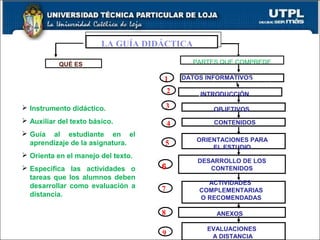
LA GUÍA DIDÁCTICA
PARTES QUE COMPREDE
DAT S INFODATOS INFORMATIVOSA IVOS
IINTRODUCCIÓN
OBJETIVOS
CONTENIDOS
ORIENTACIONES PARA
EL ESTUDIO
ACTIVIDADES
COMPLEMENTARIAS
O RECOMENDADAS
ANEXOS
EVALUACIONES
A DISTANCIA
1
2
3
4
5
QUÉ ES
ES LO QUE EL
PROFESOR EN EL
SISTEMA PRESENCIAL
 Instrumento didáctico.
 Auxiliar del texto básico.
 Guía al estudiante en el
aprendizaje de la asignatura.
 Orienta en el manejo del texto.
 Especifica las actividades o
tareas que los alumnos deben
desarrollar como evaluación a
distancia.
DESARROLLO DE LOS
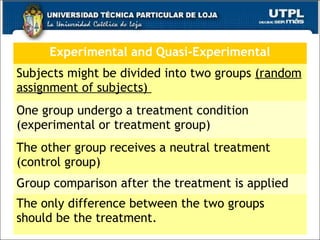
CONTENIDOS6
2
GENERAL OBJECTIVES
 Define basic concepts of Educational
Research.
 Identify the multiple research designs and
their characteristics.
CHAPTER 1
SCIENCE AND RESEARCH
5
What is Science?
 Webster's New Collegiate Dictionary “…
knowledge attained through study or
practice,"
 Wikipedia: Science refers to any
systematic knowledge or practice. In its
more usual restricted sense, science
refers to a system of acquiring
knowledge based on scientific method,
as well as to the organized body of
knowledge gained through such
research. 6
What is research?
 Creswell (2008) “Research is a process
of steps used to collect and analyze
information to increase our
understanding of a topic or issue.”
 Anderson (1998) “Research in education
is a disciplined attempt to address
questions or to solve problems through
the collection and analysis of primary
data…”
Why is Educational Research
important?
 Education needs improvement.
 Educators face a lot of problems.
 Research: Problem-solving activity
 Develops results that help to
answer questions.
 Answers help to do things better.
 Educators become more efficient.
How to Research
 Identify a research problem (a problem or
issue in education that needs to be solved)
 Review the literature (locate valuable
information related to the topic)
 Specify a purpose for research (the
objective or intent of your research)
 Collect data (means to gather information from the
sample)
 Analyze and interpret the data (analyze the
information gathered )
 Write the Report 9
Sources of Knowledge
 Authority (experience of monarchs, despots and clerics)
 Tradition (The passing down of customs of a culture
from generation to generation.)
 Expert opinion (Broad awareness and familiarity
with the subject matter)
 Personal experience (People’s experience)
 Reason common sense (Involves reasoning by
observing specific cases)
 Documentation (Usually government documents or
knowledge that society keeps stored)
10
Other sources
 Libraries (specialized library and become with
library)
 Books (provide summaries and general backgrounds)
 Periodicals (journals)(major inf. of prior
researches)
 Theses and dissertations (new areas of
research in the same field)
 Conferences (are indicator of what research is in
vogue.
 On-line data bases (technological tool a vast
amount of research inf.)
11
12
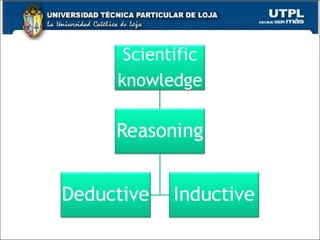
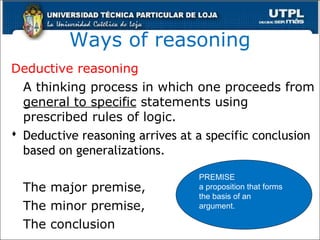
Ways of reasoning
Deductive reasoning
A thinking process in which one proceeds from
general to specific statements using
prescribed rules of logic.
 Deductive reasoning arrives at a specific conclusion
based on generalizations.
The major premise,
The minor premise,
The conclusion
PREMISE
a proposition that forms
the basis of an
argument.
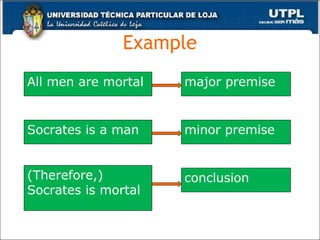
Example
14
All men are mortal
Socrates is a man
(Therefore,)
Socrates is mortal
conclusion
minor premise
major premise
Inductive reasoning
 Inductive reasoning takes events and
makes generalizations.
 In inductive reasoning a conclusion is
reached by observing examples and
generalizing from the examples to the
whole.
15
Examples
1. I always hang pictures on nails.
Therefore: All pictures hang from nails.
2. Many speeding tickets are given to
teenagers.
Therefore: All teenagers drive fast.
16
Summary
 In a good deductive argument, the premises
entail the conclusion. That is, if the
premises are all true, then the conclusion
has to be true.
 In a good inductive argument, the premises
make the conclusion probable. That is,
despite that the premises are true, the
conclusion is probably true.
17
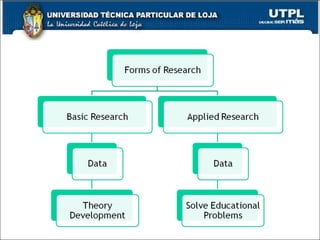
Forms of Research
 Basic Research
Basic research is concerned with
searching for knowledge, that is
fundamental and contributes to theory
formation.
Gay and Airasian (2003) Basic research
involves the process of collecting and
analyzing information to develop or
enhance a theory.
18
 Applied Research
This research is concerned with
knowledge which has immediate
applications.
Gay and Airasian (2003) Is conducted to
evaluate its usefulness in solving
practical educational problems.
19
20
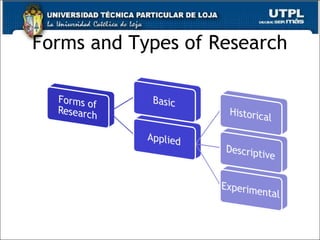
Forms and Types of Research
21
How can the researcher
influence the research?
 By having expectations for certain
outcomes.
 By making influenced interpretations
of observations.
22
The influence of the Researcher
 Selection of the topic
 Design of the experiment
 Interaction between the researcher
and experimental conditions
 Interpretation of the data
23
CHAPTER 2
Types of research and the
Scientific Method
24
Scientific Method
 Wikipedia. Scientific method refers to bodies of
techniques for investigating phenomena,
acquiring new knowledge, or correcting and
integrating previous knowledge. To be termed
scientific, a method of inquiry must be based on
gathering observable, empirical and measurable
evidence subject to specific principles of
reasoning.
 A scientific method consists of the collection of
data through observation and experimentation,
and the formulation and testing of hypotheses.25
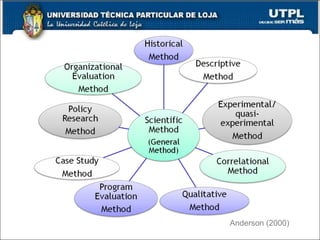
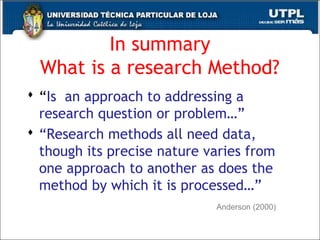
26Anderson (2000)
In summary
What is a research Method?
 “Is an approach to addressing a
research question or problem…”
 “Research methods all need data,
though its precise nature varies from
one approach to another as does the
method by which it is processed…”
27
Anderson (2000)
28
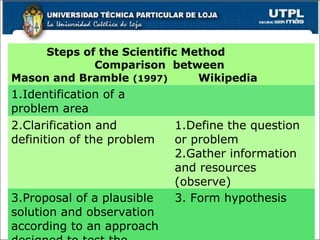
Steps of the Scientific Method
Comparison between
Mason and Bramble (1997) Wikipedia
1.Identification of a
problem area
2.Clarification and
definition of the problem
1.Define the question
or problem
2.Gather information
and resources
(observe)
3.Proposal of a plausible
solution and observation
according to an approach
3. Form hypothesis
29
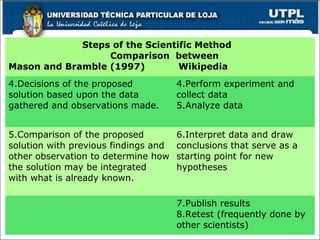
Steps of the Scientific Method
Comparison between
Mason and Bramble (1997) Wikipedia
4.Decisions of the proposed
solution based upon the data
gathered and observations made.
4.Perform experiment and
collect data
5.Analyze data
5.Comparison of the proposed
solution with previous findings and
other observation to determine how
the solution may be integrated
with what is already known.
6.Interpret data and draw
conclusions that serve as a
starting point for new
hypotheses
7.Publish results
8.Retest (frequently done by
other scientists)
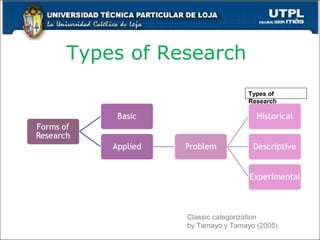
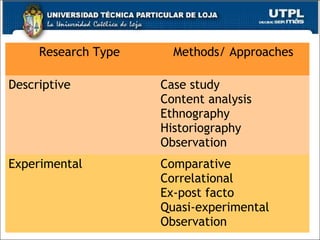
Types of Research
Classic categorization
by Tamayo y Tamayo (2005)
Types of
Research
31
Research Type Methods/ Approaches
Descriptive Case study
Content analysis
Ethnography
Historiography
Observation
Experimental Comparative
Correlational
Ex-post facto
Quasi-experimental
Observation
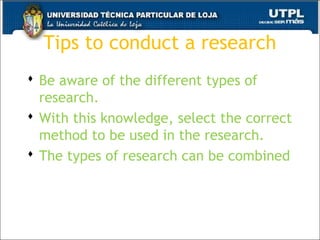
Tips to conduct a research
 Be aware of the different types of
research.
 With this knowledge, select the correct
method to be used in the research.
 The types of research can be combined
32
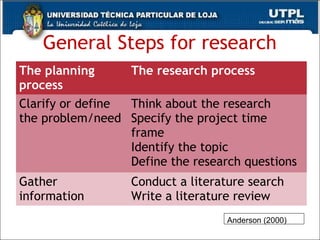
General Steps for research
33
The planning
process
The research process
Clarify or define
the problem/need
Think about the research
Specify the project time
frame
Identify the topic
Define the research questions
Gather
information
Conduct a literature search
Write a literature review
Anderson (2000)
34
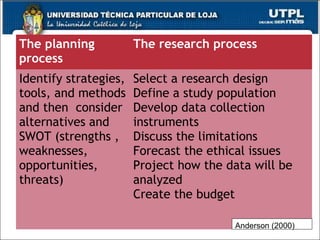
The planning
process
The research process
Identify strategies,
tools, and methods
and then consider
alternatives and
SWOT (strengths ,
weaknesses,
opportunities,
threats)
Select a research design
Define a study population
Develop data collection
instruments
Discuss the limitations
Forecast the ethical issues
Project how the data will be
analyzed
Create the budget
Anderson (2000)
35
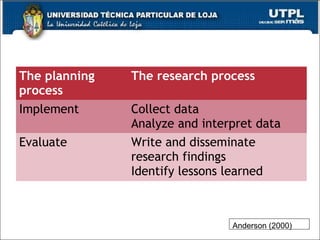
The planning
process
The research process
Implement Collect data
Analyze and interpret data
Evaluate Write and disseminate
research findings
Identify lessons learned
Anderson (2000)
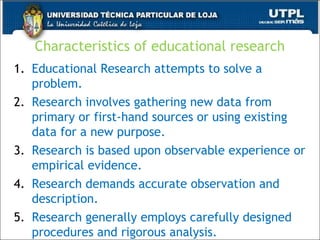
Characteristics of educational research
1. Educational Research attempts to solve a
problem.
2. Research involves gathering new data from
primary or first-hand sources or using existing
data for a new purpose.
3. Research is based upon observable experience or
empirical evidence.
4. Research demands accurate observation and
description.
5. Research generally employs carefully designed
procedures and rigorous analysis.
36
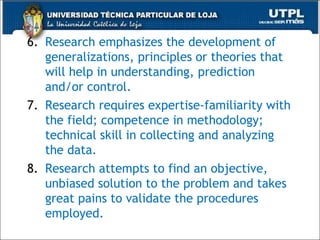
6. Research emphasizes the development of
generalizations, principles or theories that
will help in understanding, prediction
and/or control.
7. Research requires expertise-familiarity with
the field; competence in methodology;
technical skill in collecting and analyzing
the data.
8. Research attempts to find an objective,
unbiased solution to the problem and takes
great pains to validate the procedures
employed.
37
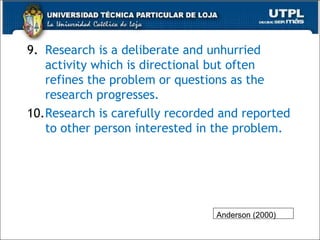
9. Research is a deliberate and unhurried
activity which is directional but often
refines the problem or questions as the
research progresses.
10.Research is carefully recorded and reported
to other person interested in the problem.
38
Anderson (2000)
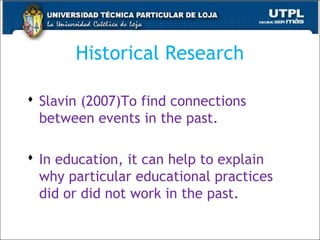
Historical Research
 Slavin (2007)To find connections
between events in the past.
 In education, it can help to explain
why particular educational practices
did or did not work in the past.
39
40
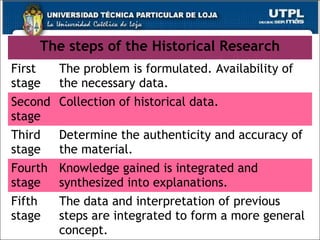
The steps of the Historical Research
First
stage
The problem is formulated. Availability of
the necessary data.
Second
stage
Collection of historical data.
Third
stage
Determine the authenticity and accuracy of
the material.
Fourth
stage
Knowledge gained is integrated and
synthesized into explanations.
Fifth
stage
The data and interpretation of previous
steps are integrated to form a more general
concept.
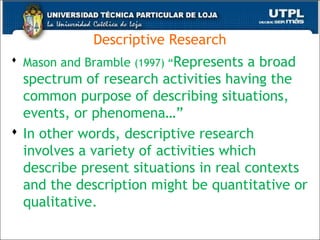
Descriptive Research
 Mason and Bramble (1997) “Represents a broad
spectrum of research activities having the
common purpose of describing situations,
events, or phenomena…”
 In other words, descriptive research
involves a variety of activities which
describe present situations in real contexts
and the description might be quantitative or
qualitative.
41
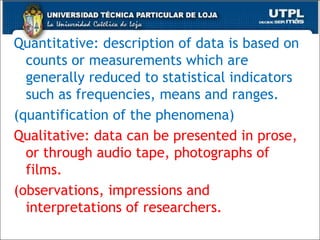
Quantitative: description of data is based on
counts or measurements which are
generally reduced to statistical indicators
such as frequencies, means and ranges.
(quantification of the phenomena)
Qualitative: data can be presented in prose,
or through audio tape, photographs of
films.
(observations, impressions and
interpretations of researchers.
42
Ex Post Facto Research
 “After the fact” referred to as causal
comparative.
 Investigations are conducted to search
for causes of things that have already
happened by comparing previously
established conditions.
 It is useful when the variables being
investigated cannot be controlled by the
experimenter. (could be a problem)
43
Experimental/Quasi-Experimental
 Involves systematic manipulation of
experimental conditions in which
extraneous influences are controlled or
eliminated.
 Experimental studies involve
comparing conditions under various
setting of the treatment
44
45
Experimental and Quasi-Experimental
Subjects might be divided into two groups (random
assignment of subjects)
One group undergo a treatment condition
(experimental or treatment group)
The other group receives a neutral treatment
(control group)
Group comparison after the treatment is applied
The only difference between the two groups
should be the treatment.
Assignment First Bimestre
OBJECTIVE PART
Activity 1
 True and false statements.
ESSAY PART
Activity 2
 Write two examples of deductive and two
examples inductive arguments and write the
concept of each one.
46
Activity 3
Find an article in a professional journal
that reports a research study, then
identify the steps of the scientific
method and write the correct
information under the name of the
corresponding step.
47
Activity 4
 Describe in your own words each type of
research. And give the title of a research
done according to each type and the source
from which you retrieved each one.
Historical Research
Descriptive Research
Experimental Research
Quasi-Experimental Research
48
Final Suggestions
 Work with a dictionary all the time.
 When you retrieve information from
the internet copy the name of the
source, so you can cite and avoid
plagiarism.
 Search any source in English or Spanish
that can contribute to understand the
topics of this subject.
49
QUESTIONS ???
50
51
52

Educational Resarch I, Primer Bim

  • 1.
    EDUCATIONAL RESEARCH I FIRSTBIMESTER ESCUELA: CIENCIAS DE LA EDUCACION MENCION: INGLES NOMBRES: Lcda. Alexandra Zuniga Ojeda PERIODO: ABRIL/AGOSTO 2009 1
  • 2.
  • 3.
    7 8 9 LA GUÍA DIDÁCTICA PARTESQUE COMPREDE DAT S INFODATOS INFORMATIVOSA IVOS IINTRODUCCIÓN OBJETIVOS CONTENIDOS ORIENTACIONES PARA EL ESTUDIO ACTIVIDADES COMPLEMENTARIAS O RECOMENDADAS ANEXOS EVALUACIONES A DISTANCIA 1 2 3 4 5 QUÉ ES ES LO QUE EL PROFESOR EN EL SISTEMA PRESENCIAL  Instrumento didáctico.  Auxiliar del texto básico.  Guía al estudiante en el aprendizaje de la asignatura.  Orienta en el manejo del texto.  Especifica las actividades o tareas que los alumnos deben desarrollar como evaluación a distancia. DESARROLLO DE LOS CONTENIDOS6 2
  • 4.
    GENERAL OBJECTIVES  Definebasic concepts of Educational Research.  Identify the multiple research designs and their characteristics.
  • 5.
  • 6.
    What is Science? Webster's New Collegiate Dictionary “… knowledge attained through study or practice,"  Wikipedia: Science refers to any systematic knowledge or practice. In its more usual restricted sense, science refers to a system of acquiring knowledge based on scientific method, as well as to the organized body of knowledge gained through such research. 6
  • 7.
    What is research? Creswell (2008) “Research is a process of steps used to collect and analyze information to increase our understanding of a topic or issue.”  Anderson (1998) “Research in education is a disciplined attempt to address questions or to solve problems through the collection and analysis of primary data…”
  • 8.
    Why is EducationalResearch important?  Education needs improvement.  Educators face a lot of problems.  Research: Problem-solving activity  Develops results that help to answer questions.  Answers help to do things better.  Educators become more efficient.
  • 9.
    How to Research Identify a research problem (a problem or issue in education that needs to be solved)  Review the literature (locate valuable information related to the topic)  Specify a purpose for research (the objective or intent of your research)  Collect data (means to gather information from the sample)  Analyze and interpret the data (analyze the information gathered )  Write the Report 9
  • 10.
    Sources of Knowledge Authority (experience of monarchs, despots and clerics)  Tradition (The passing down of customs of a culture from generation to generation.)  Expert opinion (Broad awareness and familiarity with the subject matter)  Personal experience (People’s experience)  Reason common sense (Involves reasoning by observing specific cases)  Documentation (Usually government documents or knowledge that society keeps stored) 10
  • 11.
    Other sources  Libraries(specialized library and become with library)  Books (provide summaries and general backgrounds)  Periodicals (journals)(major inf. of prior researches)  Theses and dissertations (new areas of research in the same field)  Conferences (are indicator of what research is in vogue.  On-line data bases (technological tool a vast amount of research inf.) 11
  • 12.
  • 13.
    Ways of reasoning Deductivereasoning A thinking process in which one proceeds from general to specific statements using prescribed rules of logic.  Deductive reasoning arrives at a specific conclusion based on generalizations. The major premise, The minor premise, The conclusion PREMISE a proposition that forms the basis of an argument.
  • 14.
    Example 14 All men aremortal Socrates is a man (Therefore,) Socrates is mortal conclusion minor premise major premise
  • 15.
    Inductive reasoning  Inductivereasoning takes events and makes generalizations.  In inductive reasoning a conclusion is reached by observing examples and generalizing from the examples to the whole. 15
  • 16.
    Examples 1. I alwayshang pictures on nails. Therefore: All pictures hang from nails. 2. Many speeding tickets are given to teenagers. Therefore: All teenagers drive fast. 16
  • 17.
    Summary  In agood deductive argument, the premises entail the conclusion. That is, if the premises are all true, then the conclusion has to be true.  In a good inductive argument, the premises make the conclusion probable. That is, despite that the premises are true, the conclusion is probably true. 17
  • 18.
    Forms of Research Basic Research Basic research is concerned with searching for knowledge, that is fundamental and contributes to theory formation. Gay and Airasian (2003) Basic research involves the process of collecting and analyzing information to develop or enhance a theory. 18
  • 19.
     Applied Research Thisresearch is concerned with knowledge which has immediate applications. Gay and Airasian (2003) Is conducted to evaluate its usefulness in solving practical educational problems. 19
  • 20.
  • 21.
    Forms and Typesof Research 21
  • 22.
    How can theresearcher influence the research?  By having expectations for certain outcomes.  By making influenced interpretations of observations. 22
  • 23.
    The influence ofthe Researcher  Selection of the topic  Design of the experiment  Interaction between the researcher and experimental conditions  Interpretation of the data 23
  • 24.
    CHAPTER 2 Types ofresearch and the Scientific Method 24
  • 25.
    Scientific Method  Wikipedia.Scientific method refers to bodies of techniques for investigating phenomena, acquiring new knowledge, or correcting and integrating previous knowledge. To be termed scientific, a method of inquiry must be based on gathering observable, empirical and measurable evidence subject to specific principles of reasoning.  A scientific method consists of the collection of data through observation and experimentation, and the formulation and testing of hypotheses.25
  • 26.
  • 27.
    In summary What isa research Method?  “Is an approach to addressing a research question or problem…”  “Research methods all need data, though its precise nature varies from one approach to another as does the method by which it is processed…” 27 Anderson (2000)
  • 28.
    28 Steps of theScientific Method Comparison between Mason and Bramble (1997) Wikipedia 1.Identification of a problem area 2.Clarification and definition of the problem 1.Define the question or problem 2.Gather information and resources (observe) 3.Proposal of a plausible solution and observation according to an approach 3. Form hypothesis
  • 29.
    29 Steps of theScientific Method Comparison between Mason and Bramble (1997) Wikipedia 4.Decisions of the proposed solution based upon the data gathered and observations made. 4.Perform experiment and collect data 5.Analyze data 5.Comparison of the proposed solution with previous findings and other observation to determine how the solution may be integrated with what is already known. 6.Interpret data and draw conclusions that serve as a starting point for new hypotheses 7.Publish results 8.Retest (frequently done by other scientists)
  • 30.
    Types of Research Classiccategorization by Tamayo y Tamayo (2005) Types of Research
  • 31.
    31 Research Type Methods/Approaches Descriptive Case study Content analysis Ethnography Historiography Observation Experimental Comparative Correlational Ex-post facto Quasi-experimental Observation
  • 32.
    Tips to conducta research  Be aware of the different types of research.  With this knowledge, select the correct method to be used in the research.  The types of research can be combined 32
  • 33.
    General Steps forresearch 33 The planning process The research process Clarify or define the problem/need Think about the research Specify the project time frame Identify the topic Define the research questions Gather information Conduct a literature search Write a literature review Anderson (2000)
  • 34.
    34 The planning process The researchprocess Identify strategies, tools, and methods and then consider alternatives and SWOT (strengths , weaknesses, opportunities, threats) Select a research design Define a study population Develop data collection instruments Discuss the limitations Forecast the ethical issues Project how the data will be analyzed Create the budget Anderson (2000)
  • 35.
    35 The planning process The researchprocess Implement Collect data Analyze and interpret data Evaluate Write and disseminate research findings Identify lessons learned Anderson (2000)
  • 36.
    Characteristics of educationalresearch 1. Educational Research attempts to solve a problem. 2. Research involves gathering new data from primary or first-hand sources or using existing data for a new purpose. 3. Research is based upon observable experience or empirical evidence. 4. Research demands accurate observation and description. 5. Research generally employs carefully designed procedures and rigorous analysis. 36
  • 37.
    6. Research emphasizesthe development of generalizations, principles or theories that will help in understanding, prediction and/or control. 7. Research requires expertise-familiarity with the field; competence in methodology; technical skill in collecting and analyzing the data. 8. Research attempts to find an objective, unbiased solution to the problem and takes great pains to validate the procedures employed. 37
  • 38.
    9. Research isa deliberate and unhurried activity which is directional but often refines the problem or questions as the research progresses. 10.Research is carefully recorded and reported to other person interested in the problem. 38 Anderson (2000)
  • 39.
    Historical Research  Slavin(2007)To find connections between events in the past.  In education, it can help to explain why particular educational practices did or did not work in the past. 39
  • 40.
    40 The steps ofthe Historical Research First stage The problem is formulated. Availability of the necessary data. Second stage Collection of historical data. Third stage Determine the authenticity and accuracy of the material. Fourth stage Knowledge gained is integrated and synthesized into explanations. Fifth stage The data and interpretation of previous steps are integrated to form a more general concept.
  • 41.
    Descriptive Research  Masonand Bramble (1997) “Represents a broad spectrum of research activities having the common purpose of describing situations, events, or phenomena…”  In other words, descriptive research involves a variety of activities which describe present situations in real contexts and the description might be quantitative or qualitative. 41
  • 42.
    Quantitative: description ofdata is based on counts or measurements which are generally reduced to statistical indicators such as frequencies, means and ranges. (quantification of the phenomena) Qualitative: data can be presented in prose, or through audio tape, photographs of films. (observations, impressions and interpretations of researchers. 42
  • 43.
    Ex Post FactoResearch  “After the fact” referred to as causal comparative.  Investigations are conducted to search for causes of things that have already happened by comparing previously established conditions.  It is useful when the variables being investigated cannot be controlled by the experimenter. (could be a problem) 43
  • 44.
    Experimental/Quasi-Experimental  Involves systematicmanipulation of experimental conditions in which extraneous influences are controlled or eliminated.  Experimental studies involve comparing conditions under various setting of the treatment 44
  • 45.
    45 Experimental and Quasi-Experimental Subjectsmight be divided into two groups (random assignment of subjects) One group undergo a treatment condition (experimental or treatment group) The other group receives a neutral treatment (control group) Group comparison after the treatment is applied The only difference between the two groups should be the treatment.
  • 46.
    Assignment First Bimestre OBJECTIVEPART Activity 1  True and false statements. ESSAY PART Activity 2  Write two examples of deductive and two examples inductive arguments and write the concept of each one. 46
  • 47.
    Activity 3 Find anarticle in a professional journal that reports a research study, then identify the steps of the scientific method and write the correct information under the name of the corresponding step. 47
  • 48.
    Activity 4  Describein your own words each type of research. And give the title of a research done according to each type and the source from which you retrieved each one. Historical Research Descriptive Research Experimental Research Quasi-Experimental Research 48
  • 49.
    Final Suggestions  Workwith a dictionary all the time.  When you retrieve information from the internet copy the name of the source, so you can cite and avoid plagiarism.  Search any source in English or Spanish that can contribute to understand the topics of this subject. 49
  • 50.
  • 51.
  • 52.

Editor's Notes

  • #3 Good evening dear students, I would like to welcome you to this videoconference of Educational Research I. My name is Alexandra Zuniga and I will be the tutor of this subject. This is Lic. Alba Vargas who is the tutor of Educational Research II; we both work as a team to organize the contents of these two subjects and provide you with knowledge which is presented from simple to complex. This knowledge will help you first to accomplish you thesis at the end of your program and in the future identify problems as teachers in your field. The contents of Educational Research I gives you an overall view of the process of research. First of all, basic concepts and definitions are presented; then, these concepts are related to the characteristics research.
  • #4 As you have checked the organization of your guide. This guide functions, at the same time, as a text. For this reason, this material is the main source to study, learn, and understand research. However, remember that you will find useful information through the EVA and If you want to broaden your knowledge, you are allow to search information in different sources like books in libraries, articles, and the internet. (Espanol)
  • #7 To engage in the process of science means to look, to seek, to understand or know, to guess and test guesses, to create order from chaos, and to develop concepts. Teachers are natural scientists. For instance: when a teacher asks “How will this new teaching technique work? Or How can I help my students to learn a specific tense?
  • #19 It is explanatory. basic research provides the foundation for further, sometimes applied research
  • #26 Procedures can differ from one field to another
  • #27 Various authors use different terms and groupings to come up with different methodologies. Researchers experts in one specific method The method that you choose will dictate the questions you address and the approaches you take
  • #28 Deal with. Many beginning researchers mix their methods without a good understanding of any of them. The best researchers are experts in the methodology they follow. Combination. The best way to do it is by learning various methods systematically and in depth. Then you will be able to select from among a wide repertoire and use them in different circumstances.
  • #42 This type of research may be done for a variety of reasons and with many different approaches Description may be quantitative or qualitative.