RESEARCH PROBLEM, PURPOSE,
OBJECTIVES, SIGNIFICANCE AND SCOPE.
Shakir Rahman
BScN, MScN, MSc Applied Psychology, PhD Nursing (Candidate)
University of Minnesota USA
Principal & Assistant Professor
Ayub International College of Nursing & AHS Peshawar
Visiting Faculty
Swabi College of Nursing & Health Sciences Swabi
Nowshera College of Nursing & Health Sciences Nowshera
OBJECTIVES
At the completion of this unit learners will be able to:
1. Identify the interest area of research
2. Discuss the problem statement and research purpose
3. Develop objectives of research
4. Elaborate on significance and scope of the research
5. Differentiate between significance and scope of the research
7/19/2023 3
RESEARCH PROPOSAL
• A research proposal describes what you will investigate, how
will you carry out your research, and why the research is essential
to be conducted.
• It should be noted that the proposal acts as an introduction of a
thesis/dissertation or a project report.
• The proposal helps the researcher to think practically and to be on
the right track during the research process.
• Almost all students who intend to write Bachelor’s, Master, or
Ph.D. thesis/dissertation or those who intend to apply for
scholarships or research grants, need to write a research proposal.
7/19/2023
4
ATTRIBUTES OF GOOD RESEARCH
PROPOSAL
• It is innovative and contains impressive research idea(s).
• The research questions and objectives are clear.
• The methodology and data sources are well known.
• The significance of the study is justified.
• The objectives of the study could be met within the timeline.
• The writing style is clear and concise, and there is no ambiguity.
• There is no contradiction in objectives, research questions, and
methodology.

• The budget and the proposal narrative are consistent.
7/19/2023 5
CONTENTS OF THE
THESIS/DISSERTATION PROPOSAL
• Title of Study
• Abstract
• Introduction
• Significance of the Study
• Research Questions
• Research Objectives
• Research Hypothesis
• Review of Literature
• Methodology
• Data Sources
• Tentative Table of Content of Thesis
• References
7/19/2023 6
TITLE OF STUDY
• It should be appealing and meaningful.
• It should not be a single word.
• It should be short and self-explanatory.
• It should reflect the study properly.
• It should not be a conclusion.
• It should not be contradictory to the methodology.
7/19/2023 7
ABSTRACT
• It motivates the reader to read the full text.
• It is a brief overview of the proposal, consisting of 100 to 300
words.
• It summarizes the essential elements of the research proposal.
• It may not cite the existing relevant literature.
• It may summarize the methods, results, and implications.
7/19/2023 8
INTRODUCTION
• It highlights the nature of the problem.
• It discusses the background of the problem.
• It explains the current situation of the problem.
• It discusses the significance of the study.
• It states the research question(s) and the research objectives of the
study.
• It mentions the limitations of the study (if any).
• It explains the structure of the study.
7/19/2023 9
IDENTIFY THE INTEREST AREA
OF RESEARCH
• Clinical Practice
• Nursing Education
• Community/ Public Health
• Literature Review
• Theories
• Research Priorities
• Peer Interaction
7/19/2023 10
CONT.….
• In 1997, The World Health Organization (WHO) established a list
of priorities for nursing research which includes:
• The effects of health system reforms
• The supply and demand of workplace
• Working conditions
• Care delegation
• The health- disease process in vulnerable population
• Ethics
• Cultural aspects of care
7/19/2023 11
CONT.….
• Home care
• Occupational health
• Infection control
7/19/2023 12
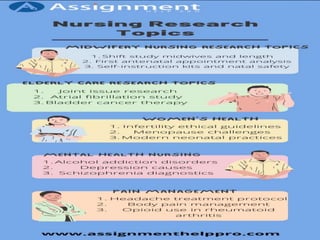
7/19/2023 13
PROBLEM STATEMENT
• A question raised for inquiry, consideration or solution
• Is an area of concern where there is a gap in knowledge base
needed for practice
• Is significant when it has the potential to generate or refine
knowledge or influencing nursing practice or both
• Identifies an area of concern for particular population
• Indicates the significances of the problem
• Provides a background for the problem
• Outlines the need for additional study in a problem statement
7/19/2023 14
RESEARCH PURPOSE
• Concise, clear statement of the specific goal or aim of the study
that is generated from the research problem
• The purpose is usually stated after the problem, because the
problem identifies the gap in knowledge in a selected area
• Usually indicates the type of study (quantitative, qualitative,
outcome, or intervention)
• Little is known the phenomenon
• Findings of previous studies are conflicting
• Few studies of this have been done
7/19/2023 15
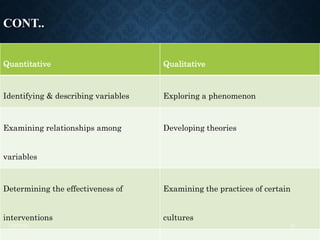
CONT..
Quantitative Qualitative
Identifying & describing variables Exploring a phenomenon
Examining relationships among
variables
Developing theories
Determining the effectiveness of
interventions
Examining the practices of certain
cultures
7/19/2023 16
EXAMINING THE FEASIBILITY OF A PROBLEM AND
PURPOSE
• Researcher interest/ expertise
• Money commitment
• Availability of Subjects/ Participants
• Availability of Facilities and Equipment
• Ethical Considerations
7/19/2023 17
OBJECTIVES OF THE STUDY
• What the researcher wants to get
• Is a clear, concise, declarative statement that is expressed in the
present tense
• To gain familiarity with a phenomenon or to achieve new insights
into it
• To portray accurately the characteristics of particular individual,
situation, or group
7/19/2023 18
CONT.….
• To determine the frequency with which something occurs or with
which it is associated with something else
• To test a hypothesis of a causal relations between variables
• The objectives should start with words such as:
• To determine
• To find out
• To Measure
• To explore
7/19/2023 19
DIFFERENCE BETWEEN PURPOSE AND
OBJECTIVES
• Purpose:
• To describe the effects of hypoglycemia on development in a
group of children with hyperinsulinism (HI)
• Objectives:
• To describe the frequency and extent of developmental delay in a
cohort of children with HI
• To identify associations between hypoglycemia history and
development outcome
7/19/2023 20
SCOPE OF THE STUDY
• Explains the extent to which the research area will be explored in
the work and specifies the parameters within the study will be
operating.
• Have to define what the study going to cover and what it is
focusing on.
7/19/2023 21
SIGNIFICANCE OF THE STUDY
• Importance of the study
• Contribution to and impact of the study on a research field
• The significance tells the reader how the findings affect the
topic/broad field.
• In other words, the significance is about how much the findings
matter.
7/19/2023 22
Unit 4. Research Problem, Purpose, Objectives, Significance and Scope..pptx

Unit 4. Research Problem, Purpose, Objectives, Significance and Scope..pptx

  • 2.
    RESEARCH PROBLEM, PURPOSE, OBJECTIVES,SIGNIFICANCE AND SCOPE. Shakir Rahman BScN, MScN, MSc Applied Psychology, PhD Nursing (Candidate) University of Minnesota USA Principal & Assistant Professor Ayub International College of Nursing & AHS Peshawar Visiting Faculty Swabi College of Nursing & Health Sciences Swabi Nowshera College of Nursing & Health Sciences Nowshera
  • 3.
    OBJECTIVES At the completionof this unit learners will be able to: 1. Identify the interest area of research 2. Discuss the problem statement and research purpose 3. Develop objectives of research 4. Elaborate on significance and scope of the research 5. Differentiate between significance and scope of the research 7/19/2023 3
  • 4.
    RESEARCH PROPOSAL • Aresearch proposal describes what you will investigate, how will you carry out your research, and why the research is essential to be conducted. • It should be noted that the proposal acts as an introduction of a thesis/dissertation or a project report. • The proposal helps the researcher to think practically and to be on the right track during the research process. • Almost all students who intend to write Bachelor’s, Master, or Ph.D. thesis/dissertation or those who intend to apply for scholarships or research grants, need to write a research proposal. 7/19/2023 4
  • 5.
    ATTRIBUTES OF GOODRESEARCH PROPOSAL • It is innovative and contains impressive research idea(s). • The research questions and objectives are clear. • The methodology and data sources are well known. • The significance of the study is justified. • The objectives of the study could be met within the timeline. • The writing style is clear and concise, and there is no ambiguity. • There is no contradiction in objectives, research questions, and methodology. • The budget and the proposal narrative are consistent. 7/19/2023 5

  • 6.
    CONTENTS OF THE THESIS/DISSERTATIONPROPOSAL • Title of Study • Abstract • Introduction • Significance of the Study • Research Questions • Research Objectives • Research Hypothesis • Review of Literature • Methodology • Data Sources • Tentative Table of Content of Thesis • References 7/19/2023 6
  • 7.
    TITLE OF STUDY •It should be appealing and meaningful. • It should not be a single word. • It should be short and self-explanatory. • It should reflect the study properly. • It should not be a conclusion. • It should not be contradictory to the methodology. 7/19/2023 7
  • 8.
    ABSTRACT • It motivatesthe reader to read the full text. • It is a brief overview of the proposal, consisting of 100 to 300 words. • It summarizes the essential elements of the research proposal. • It may not cite the existing relevant literature. • It may summarize the methods, results, and implications. 7/19/2023 8
  • 9.
    INTRODUCTION • It highlightsthe nature of the problem. • It discusses the background of the problem. • It explains the current situation of the problem. • It discusses the significance of the study. • It states the research question(s) and the research objectives of the study. • It mentions the limitations of the study (if any). • It explains the structure of the study. 7/19/2023 9
  • 10.
    IDENTIFY THE INTERESTAREA OF RESEARCH • Clinical Practice • Nursing Education • Community/ Public Health • Literature Review • Theories • Research Priorities • Peer Interaction 7/19/2023 10
  • 11.
    CONT.…. • In 1997,The World Health Organization (WHO) established a list of priorities for nursing research which includes: • The effects of health system reforms • The supply and demand of workplace • Working conditions • Care delegation • The health- disease process in vulnerable population • Ethics • Cultural aspects of care 7/19/2023 11
  • 12.
    CONT.…. • Home care •Occupational health • Infection control 7/19/2023 12
  • 13.
  • 14.
    PROBLEM STATEMENT • Aquestion raised for inquiry, consideration or solution • Is an area of concern where there is a gap in knowledge base needed for practice • Is significant when it has the potential to generate or refine knowledge or influencing nursing practice or both • Identifies an area of concern for particular population • Indicates the significances of the problem • Provides a background for the problem • Outlines the need for additional study in a problem statement 7/19/2023 14
  • 15.
    RESEARCH PURPOSE • Concise,clear statement of the specific goal or aim of the study that is generated from the research problem • The purpose is usually stated after the problem, because the problem identifies the gap in knowledge in a selected area • Usually indicates the type of study (quantitative, qualitative, outcome, or intervention) • Little is known the phenomenon • Findings of previous studies are conflicting • Few studies of this have been done 7/19/2023 15
  • 16.
    CONT.. Quantitative Qualitative Identifying &describing variables Exploring a phenomenon Examining relationships among variables Developing theories Determining the effectiveness of interventions Examining the practices of certain cultures 7/19/2023 16
  • 17.
    EXAMINING THE FEASIBILITYOF A PROBLEM AND PURPOSE • Researcher interest/ expertise • Money commitment • Availability of Subjects/ Participants • Availability of Facilities and Equipment • Ethical Considerations 7/19/2023 17
  • 18.
    OBJECTIVES OF THESTUDY • What the researcher wants to get • Is a clear, concise, declarative statement that is expressed in the present tense • To gain familiarity with a phenomenon or to achieve new insights into it • To portray accurately the characteristics of particular individual, situation, or group 7/19/2023 18
  • 19.
    CONT.…. • To determinethe frequency with which something occurs or with which it is associated with something else • To test a hypothesis of a causal relations between variables • The objectives should start with words such as: • To determine • To find out • To Measure • To explore 7/19/2023 19
  • 20.
    DIFFERENCE BETWEEN PURPOSEAND OBJECTIVES • Purpose: • To describe the effects of hypoglycemia on development in a group of children with hyperinsulinism (HI) • Objectives: • To describe the frequency and extent of developmental delay in a cohort of children with HI • To identify associations between hypoglycemia history and development outcome 7/19/2023 20
  • 21.
    SCOPE OF THESTUDY • Explains the extent to which the research area will be explored in the work and specifies the parameters within the study will be operating. • Have to define what the study going to cover and what it is focusing on. 7/19/2023 21
  • 22.
    SIGNIFICANCE OF THESTUDY • Importance of the study • Contribution to and impact of the study on a research field • The significance tells the reader how the findings affect the topic/broad field. • In other words, the significance is about how much the findings matter. 7/19/2023 22