Research is anORGANIZED and
SYSTEMATIC way of FINDING
ANSWERS to QUESTIONS.
RESEARCH
3.
A collection ofmethods and methodologies
that researchers apply systematically to
produce scientifically based knowledge about
the social world. (Neuman)
According to the American sociologist Earl
Robert Babbie, “research is a systematic
inquiry to describe, explain, predict, and
control the observed phenomenon. It involves
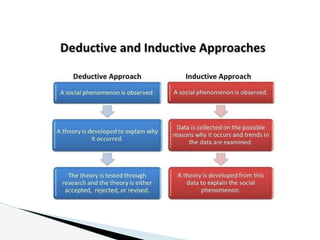
inductive and deductive methods.”
RESEARCH MEANING:
4.
1. Survey theexisting research.
2. Define the problems
3. Formulating hypothesis or suggested
method.
4. Collecting, organizing and evaluating data.
5. Making a conclusion.
6. Testing the conclusion to determine
whether they fit to formulate the
hypothesis.
7. Address the challenges.
OBJECTIVE OF RESEARCH
5.
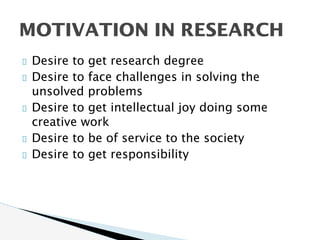
Desire to getresearch degree
Desire to face challenges in solving the
unsolved problems
Desire to get intellectual joy doing some
creative work
Desire to be of service to the society
Desire to get responsibility
MOTIVATION IN RESEARCH
6.
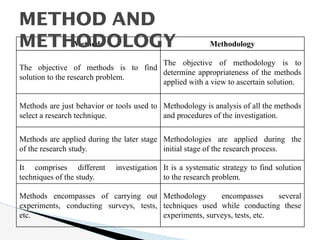
Methods Methodology
The objectiveof methods is to find
solution to the research problem.
The objective of methodology is to
determine appropriateness of the methods
applied with a view to ascertain solution.
Methods are just behavior or tools used to
select a research technique.
Methodology is analysis of all the methods
and procedures of the investigation.
Methods are applied during the later stage
of the research study.
Methodologies are applied during the
initial stage of the research process.
It comprises different investigation
techniques of the study.
It is a systematic strategy to find solution
to the research problem.
Methods encompasses of carrying out
experiments, conducting surveys, tests,
etc.
Methodology encompasses several
techniques used while conducting these
experiments, surveys, tests, etc.
METHOD AND
METHODOLOGY
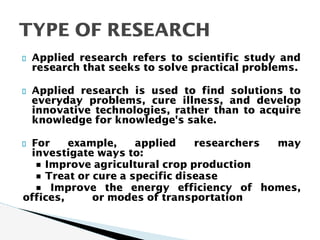
Applied research refersto scientific study and
research that seeks to solve practical problems.
Applied research is used to find solutions to
everyday problems, cure illness, and develop
innovative technologies, rather than to acquire
knowledge for knowledge's sake.
For example, applied researchers may
investigate ways to:
• Improve agricultural crop production
• Treat or cure a specific disease
• Improve the energy efficiency of homes,
offices, or modes of transportation
TYPE OF RESEARCH
10.
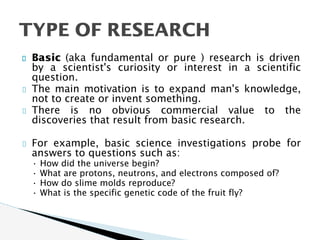
Basic (aka fundamentalor pure ) research is driven
by a scientist's curiosity or interest in a scientific
question.
The main motivation is to expand man's knowledge,
not to create or invent something.
There is no obvious commercial value to the
discoveries that result from basic research.
For example, basic science investigations probe for
answers to questions such as:
• How did the universe begin?
• What are protons, neutrons, and electrons composed of?
• How do slime molds reproduce?
• What is the specific genetic code of the fruit fly?
TYPE OF RESEARCH
11.
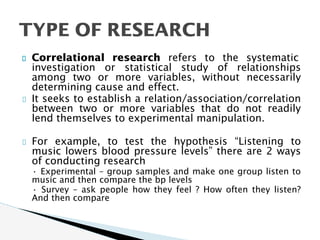
Correlational research refersto the systematic
investigation or statistical study of relationships
among two or more variables, without necessarily
determining cause and effect.
It seeks to establish a relation/association/correlation
between two or more variables that do not readily
lend themselves to experimental manipulation.
For example, to test the hypothesis “Listening to
music lowers blood pressure levels” there are 2 ways
of conducting research
• Experimental – group samples and make one group listen to
music and then compare the bp levels
• Survey – ask people how they feel ? How often they listen?
And then compare
TYPE OF RESEARCH
12.
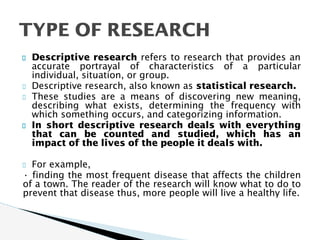
Descriptive research refersto research that provides an
accurate portrayal of characteristics of a particular
individual, situation, or group.
Descriptive research, also known as statistical research.
These studies are a means of discovering new meaning,
describing what exists, determining the frequency with
which something occurs, and categorizing information.
In short descriptive research deals with everything
that can be counted and studied, which has an
impact of the lives of the people it deals with.
For example,
• finding the most frequent disease that affects the children
of a town. The reader of the research will know what to do to
prevent that disease thus, more people will live a healthy life.
TYPE OF RESEARCH
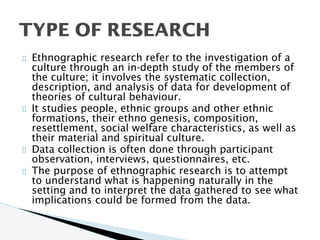
13.
Ethnographic research referto the investigation of a
culture through an in-depth study of the members of
the culture; it involves the systematic collection,
description, and analysis of data for development of
theories of cultural behaviour.
It studies people, ethnic groups and other ethnic
formations, their ethno genesis, composition,
resettlement, social welfare characteristics, as well as
their material and spiritual culture.
Data collection is often done through participant
observation, interviews, questionnaires, etc.
The purpose of ethnographic research is to attempt
to understand what is happening naturally in the
setting and to interpret the data gathered to see what
implications could be formed from the data.
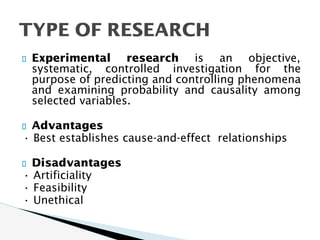
TYPE OF RESEARCH
14.
Experimental research isan objective,
systematic, controlled investigation for the
purpose of predicting and controlling phenomena
and examining probability and causality among
selected variables.
Advantages
• Best establishes cause-and-effect relationships
Disadvantages
• Artificiality
• Feasibility
• Unethical
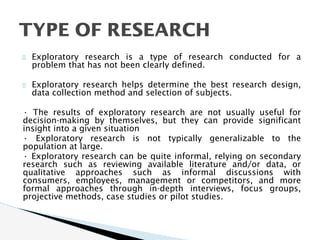
TYPE OF RESEARCH
15.
Exploratory research isa type of research conducted for a
problem that has not been clearly defined.
Exploratory research helps determine the best research design,
data collection method and selection of subjects.
• The results of exploratory research are not usually useful for
decision-making by themselves, but they can provide significant
insight into a given situation
• Exploratory research is not typically generalizable to the
population at large.
• Exploratory research can be quite informal, relying on secondary
research such as reviewing available literature and/or data, or
qualitative approaches such as informal discussions with
consumers, employees, management or competitors, and more
formal approaches through in-depth interviews, focus groups,
projective methods, case studies or pilot studies.
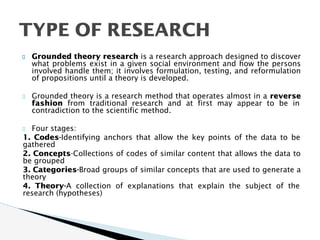
TYPE OF RESEARCH
16.
Grounded theory researchis a research approach designed to discover
what problems exist in a given social environment and how the persons
involved handle them; it involves formulation, testing, and reformulation
of propositions until a theory is developed.
Grounded theory is a research method that operates almost in a reverse
fashion from traditional research and at first may appear to be in
contradiction to the scientific method.
Four stages:
1. Codes-Identifying anchors that allow the key points of the data to be
gathered
2. Concepts-Collections of codes of similar content that allows the data to
be grouped
3. Categories-Broad groups of similar concepts that are used to generate a
theory
4. Theory-A collection of explanations that explain the subject of the
research (hypotheses)
TYPE OF RESEARCH
17.
Historical research isresearch involving analysis of events that
occurred in the remote or recent past
Application
• Historical research can show patterns that occurred in the past and over
time which can help us to see where we came from and what kinds of
solutions we have used in the past.
• Understanding this can add perspective on how we examine current
events and educational practices.
The steps involved in the conduct of historical research
Here are the five steps:
1. Identification of the research topic and formulation of the research
problem or question.
2. Data collection or literature review
3. Evaluation of materials
4. Data synthesis
5. Report preparation or preparation of the narrative exposition
TYPE OF RESEARCH
18.
Phenomenological research aninductive, descriptive
research approach developed from phenomenological
philosophy; its aim is to describe an experience as it is
actually lived by the person
• Phenomenology is concerned with the study of experience
from the perspective of the individual, “bracketing” takenfor-
granted assumptions and usual ways of perceiving.
• They are based in a paradigm of personal knowledge and
subjectivity, and emphasise the importance of personal
perspective and interpretation.
• As such they are powerful for understanding subjective
experience, gaining insights into peoples motivations and
actions, and cutting through the clutter of taken-forgranted
assumptions and conventional wisdom.
TYPE OF RESEARCH
20.
Classification of Researchby Purpose
- Basic v/s Applied research
- Research and development
- Evaluative research
Classification of Research by Method
- Historical research
- Descriptive research
- Experimental research
CLASSIFICATION OF
RESEARCH
Research Improves qualityof life – It has led man
to search for ways for improving processes and
means which man love and find interesting
Research improves instruction – Modern teacher
introduces innovations and integrates the 3Rs
(rational thinking, right conduct, and research) in all
subject areas in his teaching.
Research improves students’ achievement – The
students achievement could be improve if the
modern teacher keeps himself updated on issues and
trends about the modern methods and strategies in
teaching.
VALUES FOR RESEARCH
26.
Research improves teachers’competence
– research oriented teacher always conduct
research to improve his competence and
produce graduates who respond to the
socioeconomic development of the country
and can compete with other graduates of the
world.
Research satisfies man’s needs – modern
facilities that satisfy human being’s needs are
all products of research.
Research reduces the burden of work
VALUES FOR RESEARCH
27.
Research has deep-seatedpsychological
aspects – It challenges man to get rid of the
danger of stagnation. It is an open door to a
better tomorrow and it guides him in his efforts
to obtain good results which contribute to his
satisfaction and self-fulfilment.
Research improves the exportation of food
products – Some international research agencies
provide financial support for the researches in
the Philippines.
VALUES FOR RESEARCH
28.
Research responds tothe economic
recovery and austerity measures of the
country – Research outputs are converted to
income generating projects to train students
to earn while they learn.
Research trains graduates to become
responsive to the economic development of
the country and compete globally.
VALUES FOR RESEARCH