BBA V th Sem.Marketing Research
Topic: Measurement and Scaling
Techniques
Pooja Luniya- (Asst. Prof.)
G.D. Rungta College of Science & Technology
Measurement
Concept • Let us think….
▫ Bobby is 24 twice his younger brother
who is 12
▫ My attitude toward tide is (6-Good),
twice as compared to that of Sheena (3-
Average).
▫ Market rankings reveal that Tide is twice
better than Wheel
▫ Big Bazar is an economy store because
the prices in this store are half that of
any premium store
2
Pooja Luniya (Asst.Prof)
Scaling: concept
▫ Assigning numbers or other symbols to characteristics
of objects according to certain pre-specified rules.
▫ The measurement of physical properties is not a
complex deal, whereas measurement of psychological
properties requires a careful attention of a researcher.
3
Pooja Luniya (Asst.Prof)
Nominal scale:
• Nominal scale is simply a system of assigning
number symbols to events in order to label them.
• Example: assignment of numbers of basketball
players in order to identify them.
• Example: Gender: Male / Female
• Nominal data are, thus, counted data.
• One cannot usefully average the numbers on the
back of a group of football players and come up
with a meaningful value.
• Therefore, a frequency distribution table can be
prepared for the nominal scale variables and mode
of the distribution can be worked out
4
Pooja Luniya (Asst.Prof)
Ordinal Scale
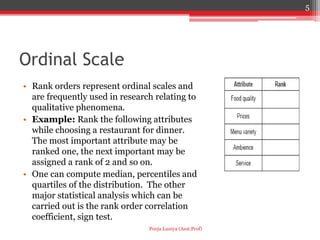
• Rank orders represent ordinal scales and
are frequently used in research relating to
qualitative phenomena.
• Example: Rank the following attributes
while choosing a restaurant for dinner.
The most important attribute may be
ranked one, the next important may be
assigned a rank of 2 and so on.
• One can compute median, percentiles and
quartiles of the distribution. The other
major statistical analysis which can be
carried out is the rank order correlation
coefficient, sign test.
5
Pooja Luniya (Asst.Prof)
Interval
• A scale in which the number are used to rate object and the intervals
are adjusted in terms of some rule that has been established as a
basis for making the units equal.
• The primary limitation of the interval scale is the lack of a true zero;
it does not have the capacity to measure the complete absence of a
trait or characteristic.
• Product moment correlation techniques are appropriate and the
generally used tests for statistical significance are the ‘t’ test and ‘F’
test.
6
Pooja Luniya (Asst.Prof)
Example: Interval Scale
The numbers on this scale can be added, subtracted,
multiplied or divided. One can compute arithmetic mean,
standard deviation, correlation coefficient and conduct a t-
test, Z-test, regression analysis and factor analysis.
7
Pooja Luniya (Asst.Prof)
Ratio Scale
• Ratio scales have an absolute or true zero of measurement.
• For example, the zero point on a centimetre scale indicates the complete
absence of length or height.
• With ratio scales involved one can make statements like “Jyoti’s” typing
performance was twice as good as that of “Reetu.” The ratio involved does
have significance and facilitates a kind of comparison which is not possible
in case of an interval scale.
• Measures of physical dimensions such as weight, height, distance, etc. are
examples. Generally, all statistical techniques are usable with ratio scales
8
Pooja Luniya (Asst.Prof)
Measurement
Data Types
9
Pooja Luniya (Asst.Prof)
5 9 6
Third
place
Second
place
First
place
8 9 7
5 3 2
10
Pooja Luniya (Asst.Prof)
11
Pooja Luniya (Asst.Prof)

Scaling

  • 1.
    BBA V thSem.Marketing Research Topic: Measurement and Scaling Techniques Pooja Luniya- (Asst. Prof.) G.D. Rungta College of Science & Technology
  • 2.
    Measurement Concept • Letus think…. ▫ Bobby is 24 twice his younger brother who is 12 ▫ My attitude toward tide is (6-Good), twice as compared to that of Sheena (3- Average). ▫ Market rankings reveal that Tide is twice better than Wheel ▫ Big Bazar is an economy store because the prices in this store are half that of any premium store 2 Pooja Luniya (Asst.Prof)
  • 3.
    Scaling: concept ▫ Assigningnumbers or other symbols to characteristics of objects according to certain pre-specified rules. ▫ The measurement of physical properties is not a complex deal, whereas measurement of psychological properties requires a careful attention of a researcher. 3 Pooja Luniya (Asst.Prof)
  • 4.
    Nominal scale: • Nominalscale is simply a system of assigning number symbols to events in order to label them. • Example: assignment of numbers of basketball players in order to identify them. • Example: Gender: Male / Female • Nominal data are, thus, counted data. • One cannot usefully average the numbers on the back of a group of football players and come up with a meaningful value. • Therefore, a frequency distribution table can be prepared for the nominal scale variables and mode of the distribution can be worked out 4 Pooja Luniya (Asst.Prof)
  • 5.
    Ordinal Scale • Rankorders represent ordinal scales and are frequently used in research relating to qualitative phenomena. • Example: Rank the following attributes while choosing a restaurant for dinner. The most important attribute may be ranked one, the next important may be assigned a rank of 2 and so on. • One can compute median, percentiles and quartiles of the distribution. The other major statistical analysis which can be carried out is the rank order correlation coefficient, sign test. 5 Pooja Luniya (Asst.Prof)
  • 6.
    Interval • A scalein which the number are used to rate object and the intervals are adjusted in terms of some rule that has been established as a basis for making the units equal. • The primary limitation of the interval scale is the lack of a true zero; it does not have the capacity to measure the complete absence of a trait or characteristic. • Product moment correlation techniques are appropriate and the generally used tests for statistical significance are the ‘t’ test and ‘F’ test. 6 Pooja Luniya (Asst.Prof)
  • 7.
    Example: Interval Scale Thenumbers on this scale can be added, subtracted, multiplied or divided. One can compute arithmetic mean, standard deviation, correlation coefficient and conduct a t- test, Z-test, regression analysis and factor analysis. 7 Pooja Luniya (Asst.Prof)
  • 8.
    Ratio Scale • Ratioscales have an absolute or true zero of measurement. • For example, the zero point on a centimetre scale indicates the complete absence of length or height. • With ratio scales involved one can make statements like “Jyoti’s” typing performance was twice as good as that of “Reetu.” The ratio involved does have significance and facilitates a kind of comparison which is not possible in case of an interval scale. • Measures of physical dimensions such as weight, height, distance, etc. are examples. Generally, all statistical techniques are usable with ratio scales 8 Pooja Luniya (Asst.Prof)
  • 9.
  • 10.
    5 9 6 Third place Second place First place 89 7 5 3 2 10 Pooja Luniya (Asst.Prof)
  • 11.