Consumer Behaviour
By Neha Soni
Asst Professor
What is Consumer Behaviour?
Those activities directly involved in
obtaining , consuming and disposing
of products and services, including
the decision processes that precede
and follow these actions
Concepts drawn from various
other disciplines
• Psychology
• Sociology
• Anthropology
• Economics
• Marketing
Perspectives
• Logical Positivism
1. Understanding and predicting consumer
behaviour
2. Cause and effect relationships that govern
persuasion and/or education
• Post Modern – to understand consumption
behaviour without any attempt to
influence it
Why is this important?
• Out of 11000 products launched by 77
companies, only 56% are present five years
later – Kuczmaski & Associates
• Only 8% of new product concepts offered
by 112 leading companies reached the
market. Out of this 83% failed to reach
marketing objectives – Group EFO Ltd., Marketing
News, Feb 1, 1993, Pg 2
“MEET THE NEW
CONSUMER
and smile when you do because
she is your boss. It may not be
the person you thought you
knew. Instead of choosing from
what you have to offer, she tells
you what she wants. You figure it
out how to give it to her.”
-Fortune Editor
A new product must satisfy
consumer needs, not the needs
and expectations of management.
Understanding and adapting to
consumer motivation and behaviour
is not an option – it becomes a
necessity for competitive survival
Consumer sovereignty presents a
formidable challenge but skilful
marketing can affect both motivation
and behaviour if the product or
service offered is designed to meet
consumer needs and expectations
A sales success occurs because demand
either exists already or is latent and
awaiting activation by the right marketing
offering
Dominant forces shaping Consumer
Research
• Factors that move an economy from
Production-driven to Market-driven
• Level of sophistication with which human
behaviour is understood in psychology and
other behavioural sciences
All managers must become astute
analysts of Consumer motivation
and Behaviour
Three foundations for marketing decisions
• Experience
• Intuition
• Research
Enhancing Consumer Value-added
Marketers have to constantly innovate after
understanding their consumers to strip out
costs permanently by focusing on what
adds value for the customer and
eliminating what doesn’t.
Variables involved in
understanding consumer
behaviour
• Stimulus – ads, products, hungerpangs
• Response – physical/mental reaction to the
stimulus
• Intervening variables – mood, knowledge,
attitude, values, situations, etc.
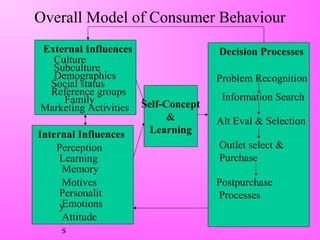
Overall Model of Consumer Behaviour
Self-Concept
&
Learning
Decision ProcessesExternal Influences
Internal Influences
Culture
Subculture
Demographics
Social status
Reference groups
Family
Marketing Activities
Perception
Learning
Memory
Motives
Personalit
yEmotions
Attitude
s
Problem Recognition
Information Search
Alt Eval & Selection
Outlet select &
Purchase
Postpurchase
Processes

Ppt on consumer behavior by neha soni

  • 1.
    Consumer Behaviour By NehaSoni Asst Professor
  • 2.
    What is ConsumerBehaviour? Those activities directly involved in obtaining , consuming and disposing of products and services, including the decision processes that precede and follow these actions
  • 3.
    Concepts drawn fromvarious other disciplines • Psychology • Sociology • Anthropology • Economics • Marketing
  • 4.
    Perspectives • Logical Positivism 1.Understanding and predicting consumer behaviour 2. Cause and effect relationships that govern persuasion and/or education • Post Modern – to understand consumption behaviour without any attempt to influence it
  • 5.
    Why is thisimportant? • Out of 11000 products launched by 77 companies, only 56% are present five years later – Kuczmaski & Associates • Only 8% of new product concepts offered by 112 leading companies reached the market. Out of this 83% failed to reach marketing objectives – Group EFO Ltd., Marketing News, Feb 1, 1993, Pg 2
  • 6.
    “MEET THE NEW CONSUMER andsmile when you do because she is your boss. It may not be the person you thought you knew. Instead of choosing from what you have to offer, she tells you what she wants. You figure it out how to give it to her.” -Fortune Editor
  • 7.
    A new productmust satisfy consumer needs, not the needs and expectations of management. Understanding and adapting to consumer motivation and behaviour is not an option – it becomes a necessity for competitive survival
  • 8.
    Consumer sovereignty presentsa formidable challenge but skilful marketing can affect both motivation and behaviour if the product or service offered is designed to meet consumer needs and expectations A sales success occurs because demand either exists already or is latent and awaiting activation by the right marketing offering
  • 9.
    Dominant forces shapingConsumer Research • Factors that move an economy from Production-driven to Market-driven • Level of sophistication with which human behaviour is understood in psychology and other behavioural sciences
  • 10.
    All managers mustbecome astute analysts of Consumer motivation and Behaviour Three foundations for marketing decisions • Experience • Intuition • Research
  • 11.
    Enhancing Consumer Value-added Marketershave to constantly innovate after understanding their consumers to strip out costs permanently by focusing on what adds value for the customer and eliminating what doesn’t.
  • 12.
    Variables involved in understandingconsumer behaviour • Stimulus – ads, products, hungerpangs • Response – physical/mental reaction to the stimulus • Intervening variables – mood, knowledge, attitude, values, situations, etc.
  • 13.
    Overall Model ofConsumer Behaviour Self-Concept & Learning Decision ProcessesExternal Influences Internal Influences Culture Subculture Demographics Social status Reference groups Family Marketing Activities Perception Learning Memory Motives Personalit yEmotions Attitude s Problem Recognition Information Search Alt Eval & Selection Outlet select & Purchase Postpurchase Processes