RESEARCH DESIGN Dr. Archana
Sarkar
3-2
RESEARCH DESIGN:
DEFINITION
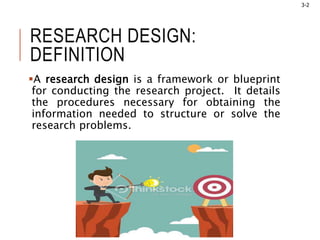
A research design is a framework or blueprint
for conducting the research project. It details
the procedures necessary for obtaining the
information needed to structure or solve the
research problems.
3-3
COMPONENTS OF A
RESEARCH DESIGN
Define the information needed
Design the exploratory, descriptive, and/or
causal phases of the research
Specify the measurement and scaling
procedures
Construct and pretest a questionnaire
(interviewing form) or an appropriate form for
data collection
Specify the sampling process and sample size
Develop a plan of data analysis
3-4
CLASSIFICATION OF
RESEARCH DESIGN
3-5
EXPLORATORY & CONCLUSIVE RESEARCH
DIFFERENCES
Objective:
Character-
istics:
Findings
/Results:
Outcome:
To provide insights and
understanding.
Information needed is defined
only loosely. Research process
is flexible and unstructured.
Sample is small and non-
representative. Analysis of
primary data is qualitative.
Tentative.
Generally followed by further
exploratory or conclusive
research.
To test specific hypotheses and
examine relationships.
Information needed is clearly
defined. Research process is
formal and structured. Sample is
large and representative. Data
analysis is quantitative.
Conclusive.
Findings used as input into
decision making.
Exploratory Conclusive
3-6
Objective:
Characteristics:
Methods:
A COMPARISON OF BASIC RESEARCH
DESIGNS
Discovery of ideas
and insights
Flexible, versatile
Often the front
end of total
research design
Expert surveys
Pilot surveys
Secondary data
Qualitative
research
Describe market
characteristics or
functions
Marked by the prior
formulation of
specific hypotheses
Preplanned and
structured design
Secondary data
Surveys
Panels
Observation and
other data
Determine cause
and effect
relationships
Manipulation of
one or more
independent
variables
Control of other
mediating
variables
Experiments
Exploratory Descriptive Causal
3-7
USES OF EXPLORATORY
RESEARCH
Formulate a problem or define a
problem more precisely
Identify alternative courses of action
Develop hypotheses
Isolate key variables and relationships
for further examination
Gain insights for developing an
approach to the problem
Establish priorities for further research
3-8
METHODS OF EXPLORATORY
RESEARCH
Survey of experts
Pilot surveys
Secondary data analyzed in a
qualitative way
Qualitative research
3-9
USE OF DESCRIPTIVE
RESEARCH
To describe the characteristics of
relevant groups, such as consumers,
salespeople, organizations, or market
areas.
To estimate the percentage of units in a
specified population exhibiting a certain
behavior.
To determine the perceptions of
product characteristics.
To determine the degree to which
3-10
METHODS OF DESCRIPTIVE
RESEARCH
Secondary data analyzed in a
quantitative as opposed to a
qualitative manner
Surveys
Panels
Observational and other data
3-11
CROSS-SECTIONAL DESIGNS
Involve the collection of information from any
given sample of population elements only once.
In single cross-sectional designs, there is only
one sample of respondents and information is
obtained from this sample only once.
In multiple cross-sectional designs, there are two
or more samples of respondents, and information
from each sample is obtained only once. Often,
information from different samples is obtained at
different times.
Cohort analysis consists of a series of surveys
conducted at appropriate time intervals, where
the cohort serves as the basic unit of analysis. A
3-12
The most important feature of a cross-sectional
study is that it can compare different samples at
one given point in time.
For example, a researcher wants to understand
the relationship between joggers and level of
cholesterol, he/she might want to choose two
age groups of daily joggers, one group is below
30 but more than 20 and the other, above 30 but
below 40 and compare these to cholesterol levels
amongst non-joggers in the same age categories.
The researcher at this point in time can create
subsets for gender, but cannot consider past
cholesterol levels as this would be outside the
3-13
However, there is one downside to cross-
sectional study, this type of study is not able to
provide a definitive relation between cause and
effect relation (a cause and effect relationship is
one where one action (cause) makes another
event happen (effect), for example, without an
alarm, you might oversleep.)
This is majorly because cross-sectional study
offers a snapshot of a single moment in time,
this study doesn’t consider what happens before
or after. Therefore in this example stated above
it is difficult to know if the daily joggers had low
cholesterol levels before taking up jogging or if
the activity helped them to reduce cholesterol
levels that were previously high.
3-14
CONSUMPTION OF VARIOUS SOFT DRINKS
BY VARIOUS AGE COHORTS
8-19
20-29
30-39
40-49
50+
Age 1960 1969 1979
1950
52.9
45.2
33.9
23.2
18.1
62.6
60.7
46.6
40.8
28.8
C1
73.2
76.0
67.7
58.6
50.0
C2
81.0
75.8
71.4
67.8
51.9
C3
C8
C7
C6
C5
C4
C1: cohort born prior to 1900
C2: cohort born 1901-10
C3: cohort born 1911-20
C4: cohort born 1921-30
C5: cohort born 1931-40
C6: cohort born 1940-49
C7: cohort born 1950-59
C8: cohort born 1960-69
Percentage consuming on a typical day
3-15
LONGITUDINAL DESIGNS
A fixed sample (or samples) of
population elements is
measured repeatedly on the
same variables
A longitudinal design differs
from a cross-sectional design
in that the sample or samples
remain the same over time
3-16
The benefit of conducting longitudinal study is
that researchers can make notes of the
changes, make observations and detect any
changes in the characteristics of their
participants.
Continuing with the example, in longitudinal
study a researcher wishes to look at the
changes in cholesterol level in women above
the age of 30 but below 40 years who have
jogged regularly over the last 10 years. In
longitudinal study setup, it would be possible
to account for cholesterol levels at the start of
the jogging regime, therefore longitudinal
3-17
3-18
DIFFERENCES BETWEEN CROSS-
SECTIONAL STUDY AND
LONGITUDINAL STUDY
Cross-sectional study Longitudinal study
Cross-sectional studies are quick to
conduct as compared to longitudinal
studies.
Longitudinal studies may vary from a
few years to even decades.
A cross-sectional study is conducted at
a given point in time.
A longitudinal study requires a
researcher to revisit participants of the
study at proper intervals.
Cross-sectional study is conducted with
different samples.
Longitudinal study is conducted with
the same sample over the years.
Cross-sectional studies cannot pin
down cause-and-effect relationship.
Longitudinal study can justify cause-
and-effect relationship.
Multiple variables can be studied at a
single point in time.
Only one variable is considered to
conduct the study.
Cross-sectional study is comparatively
cheaper.
Since the study goes on for years
longitudinal study tends to get
expensive.
3-19
USES OF CASUAL RESEARCH
To understand which variables are
the cause (independent variables)
and which variables are the effect
(dependent variables) of a
phenomenon
To determine the nature of the
relationship between the causal
variables and the effect to be
predicted
3-20
CITICORP BANKS ON
EXPLORATORY, DESCRIPTIVE,
AND CAUSAL RESEARCH
Marketing Research at Citicorp is typical in that it is
used to measure consumer awareness of products,
monitor their satisfaction and attitudes associated
with the product, track product usage and diagnose
problems as they occur. To accomplish these tasks
Citicorp makes extensive use of exploratory,
descriptive, and causal research. Often it is
advantageous to offer special financial packages to
specific groups of customers. In this case, a financial
package is being designed for senior citizens.
The following seven-step process was taken by
marketing research to help in the design.
3-21
CITICORP BANKS ON
EXPLORATORY, DESCRIPTIVE,
AND CAUSAL RESEARCH
1) A taskforce was created to better define the market
parameters to include all the needs of the many Citicorp
branches. A final decision was made to include Americans 55
years of age or older, retired, and in the upper half of the
financial strata of that market.
3-22
CITICORP BANKS ON
EXPLORATORY, DESCRIPTIVE,
AND CAUSAL RESEARCH
2) Exploratory research in the form of secondary data
analysis of the mature or older market was then
performed and a study of competitive products
was conducted. Exploratory qualitative research
involving focus groups was also carried out in
order to determine the needs and desires of the
market and the level of satisfaction with the
current products.
In the case of senior citizens, a great
deal of diversity was found in the
market. This was determined to be
due to such factors as affluence,
relative age, and the absence or
3-23
CITICORP BANKS ON
EXPLORATORY, DESCRIPTIVE,
AND CAUSAL RESEARCH
3) The next stage of research was brainstorming. This involved
the formation of many different financial packages aimed at
the target market. In this case, a total of 10 ideas were
generated.
3-24
CITICORP BANKS ON
EXPLORATORY, DESCRIPTIVE,
AND CAUSAL RESEARCH
4) The feasibility of the 10 ideas generated in step 3 was then
tested. The ideas were tested on the basis of whether they
were possible in relation to the business. The following list
of questions was used as a series of hurdles that the ideas
had to pass to continue on to the next step.
Can the idea be explained in a manner that the target market
will easily understand?
Does the idea fit into the overall strategy of Citicorp?
3-25
CITICORP BANKS ON
EXPLORATORY, DESCRIPTIVE,
AND CAUSAL RESEARCH
Is there an available description of a specific target
market for the proposed product?
Does the research conducted so far indicate a potential
match for target market needs, and is the idea perceived
to have appeal to this market?
Is there a feasible outline of the tactics and strategies for
implementing the program?
Have the financial impact and cost of the program been
thoroughly evaluated and determined to be in line with
company practices?
In this study, only one idea generated from the
brainstorming session made it past all the listed hurdles
and on to step 5.
3-26
CITICORP BANKS ON
EXPLORATORY, DESCRIPTIVE,
AND CAUSAL RESEARCH
5) A creative work-plan was then generated. This plan
was to emphasize the competitive advantage of the
proposed product as well as better delineate the
specific features of the product.
6) The previous exploratory research was now followed
up with descriptive research in the form of mall
intercept surveys of people in the target market
range. The survey showed that the list of special
features was too long and it was decided to drop the
features more commonly offered by competitors.
3-27
CITICORP BANKS ON
EXPLORATORY, DESCRIPTIVE,
AND CAUSAL RESEARCH
7) Finally, the product was test marketed in six of the Citicorp
branches within the target market. Test marketing is a form
of causal research. Given successful test marketing results,
the product is introduced nationally.

Research Design.ppt

  • 1.
    RESEARCH DESIGN Dr.Archana Sarkar
  • 2.
    3-2 RESEARCH DESIGN: DEFINITION A researchdesign is a framework or blueprint for conducting the research project. It details the procedures necessary for obtaining the information needed to structure or solve the research problems.
  • 3.
    3-3 COMPONENTS OF A RESEARCHDESIGN Define the information needed Design the exploratory, descriptive, and/or causal phases of the research Specify the measurement and scaling procedures Construct and pretest a questionnaire (interviewing form) or an appropriate form for data collection Specify the sampling process and sample size Develop a plan of data analysis
  • 4.
  • 5.
    3-5 EXPLORATORY & CONCLUSIVERESEARCH DIFFERENCES Objective: Character- istics: Findings /Results: Outcome: To provide insights and understanding. Information needed is defined only loosely. Research process is flexible and unstructured. Sample is small and non- representative. Analysis of primary data is qualitative. Tentative. Generally followed by further exploratory or conclusive research. To test specific hypotheses and examine relationships. Information needed is clearly defined. Research process is formal and structured. Sample is large and representative. Data analysis is quantitative. Conclusive. Findings used as input into decision making. Exploratory Conclusive
  • 6.
    3-6 Objective: Characteristics: Methods: A COMPARISON OFBASIC RESEARCH DESIGNS Discovery of ideas and insights Flexible, versatile Often the front end of total research design Expert surveys Pilot surveys Secondary data Qualitative research Describe market characteristics or functions Marked by the prior formulation of specific hypotheses Preplanned and structured design Secondary data Surveys Panels Observation and other data Determine cause and effect relationships Manipulation of one or more independent variables Control of other mediating variables Experiments Exploratory Descriptive Causal
  • 7.
    3-7 USES OF EXPLORATORY RESEARCH Formulatea problem or define a problem more precisely Identify alternative courses of action Develop hypotheses Isolate key variables and relationships for further examination Gain insights for developing an approach to the problem Establish priorities for further research
  • 8.
    3-8 METHODS OF EXPLORATORY RESEARCH Surveyof experts Pilot surveys Secondary data analyzed in a qualitative way Qualitative research
  • 9.
    3-9 USE OF DESCRIPTIVE RESEARCH Todescribe the characteristics of relevant groups, such as consumers, salespeople, organizations, or market areas. To estimate the percentage of units in a specified population exhibiting a certain behavior. To determine the perceptions of product characteristics. To determine the degree to which
  • 10.
    3-10 METHODS OF DESCRIPTIVE RESEARCH Secondarydata analyzed in a quantitative as opposed to a qualitative manner Surveys Panels Observational and other data
  • 11.
    3-11 CROSS-SECTIONAL DESIGNS Involve thecollection of information from any given sample of population elements only once. In single cross-sectional designs, there is only one sample of respondents and information is obtained from this sample only once. In multiple cross-sectional designs, there are two or more samples of respondents, and information from each sample is obtained only once. Often, information from different samples is obtained at different times. Cohort analysis consists of a series of surveys conducted at appropriate time intervals, where the cohort serves as the basic unit of analysis. A
  • 12.
    3-12 The most importantfeature of a cross-sectional study is that it can compare different samples at one given point in time. For example, a researcher wants to understand the relationship between joggers and level of cholesterol, he/she might want to choose two age groups of daily joggers, one group is below 30 but more than 20 and the other, above 30 but below 40 and compare these to cholesterol levels amongst non-joggers in the same age categories. The researcher at this point in time can create subsets for gender, but cannot consider past cholesterol levels as this would be outside the
  • 13.
    3-13 However, there isone downside to cross- sectional study, this type of study is not able to provide a definitive relation between cause and effect relation (a cause and effect relationship is one where one action (cause) makes another event happen (effect), for example, without an alarm, you might oversleep.) This is majorly because cross-sectional study offers a snapshot of a single moment in time, this study doesn’t consider what happens before or after. Therefore in this example stated above it is difficult to know if the daily joggers had low cholesterol levels before taking up jogging or if the activity helped them to reduce cholesterol levels that were previously high.
  • 14.
    3-14 CONSUMPTION OF VARIOUSSOFT DRINKS BY VARIOUS AGE COHORTS 8-19 20-29 30-39 40-49 50+ Age 1960 1969 1979 1950 52.9 45.2 33.9 23.2 18.1 62.6 60.7 46.6 40.8 28.8 C1 73.2 76.0 67.7 58.6 50.0 C2 81.0 75.8 71.4 67.8 51.9 C3 C8 C7 C6 C5 C4 C1: cohort born prior to 1900 C2: cohort born 1901-10 C3: cohort born 1911-20 C4: cohort born 1921-30 C5: cohort born 1931-40 C6: cohort born 1940-49 C7: cohort born 1950-59 C8: cohort born 1960-69 Percentage consuming on a typical day
  • 15.
    3-15 LONGITUDINAL DESIGNS A fixedsample (or samples) of population elements is measured repeatedly on the same variables A longitudinal design differs from a cross-sectional design in that the sample or samples remain the same over time
  • 16.
    3-16 The benefit ofconducting longitudinal study is that researchers can make notes of the changes, make observations and detect any changes in the characteristics of their participants. Continuing with the example, in longitudinal study a researcher wishes to look at the changes in cholesterol level in women above the age of 30 but below 40 years who have jogged regularly over the last 10 years. In longitudinal study setup, it would be possible to account for cholesterol levels at the start of the jogging regime, therefore longitudinal
  • 17.
  • 18.
    3-18 DIFFERENCES BETWEEN CROSS- SECTIONALSTUDY AND LONGITUDINAL STUDY Cross-sectional study Longitudinal study Cross-sectional studies are quick to conduct as compared to longitudinal studies. Longitudinal studies may vary from a few years to even decades. A cross-sectional study is conducted at a given point in time. A longitudinal study requires a researcher to revisit participants of the study at proper intervals. Cross-sectional study is conducted with different samples. Longitudinal study is conducted with the same sample over the years. Cross-sectional studies cannot pin down cause-and-effect relationship. Longitudinal study can justify cause- and-effect relationship. Multiple variables can be studied at a single point in time. Only one variable is considered to conduct the study. Cross-sectional study is comparatively cheaper. Since the study goes on for years longitudinal study tends to get expensive.
  • 19.
    3-19 USES OF CASUALRESEARCH To understand which variables are the cause (independent variables) and which variables are the effect (dependent variables) of a phenomenon To determine the nature of the relationship between the causal variables and the effect to be predicted
  • 20.
    3-20 CITICORP BANKS ON EXPLORATORY,DESCRIPTIVE, AND CAUSAL RESEARCH Marketing Research at Citicorp is typical in that it is used to measure consumer awareness of products, monitor their satisfaction and attitudes associated with the product, track product usage and diagnose problems as they occur. To accomplish these tasks Citicorp makes extensive use of exploratory, descriptive, and causal research. Often it is advantageous to offer special financial packages to specific groups of customers. In this case, a financial package is being designed for senior citizens. The following seven-step process was taken by marketing research to help in the design.
  • 21.
    3-21 CITICORP BANKS ON EXPLORATORY,DESCRIPTIVE, AND CAUSAL RESEARCH 1) A taskforce was created to better define the market parameters to include all the needs of the many Citicorp branches. A final decision was made to include Americans 55 years of age or older, retired, and in the upper half of the financial strata of that market.
  • 22.
    3-22 CITICORP BANKS ON EXPLORATORY,DESCRIPTIVE, AND CAUSAL RESEARCH 2) Exploratory research in the form of secondary data analysis of the mature or older market was then performed and a study of competitive products was conducted. Exploratory qualitative research involving focus groups was also carried out in order to determine the needs and desires of the market and the level of satisfaction with the current products. In the case of senior citizens, a great deal of diversity was found in the market. This was determined to be due to such factors as affluence, relative age, and the absence or
  • 23.
    3-23 CITICORP BANKS ON EXPLORATORY,DESCRIPTIVE, AND CAUSAL RESEARCH 3) The next stage of research was brainstorming. This involved the formation of many different financial packages aimed at the target market. In this case, a total of 10 ideas were generated.
  • 24.
    3-24 CITICORP BANKS ON EXPLORATORY,DESCRIPTIVE, AND CAUSAL RESEARCH 4) The feasibility of the 10 ideas generated in step 3 was then tested. The ideas were tested on the basis of whether they were possible in relation to the business. The following list of questions was used as a series of hurdles that the ideas had to pass to continue on to the next step. Can the idea be explained in a manner that the target market will easily understand? Does the idea fit into the overall strategy of Citicorp?
  • 25.
    3-25 CITICORP BANKS ON EXPLORATORY,DESCRIPTIVE, AND CAUSAL RESEARCH Is there an available description of a specific target market for the proposed product? Does the research conducted so far indicate a potential match for target market needs, and is the idea perceived to have appeal to this market? Is there a feasible outline of the tactics and strategies for implementing the program? Have the financial impact and cost of the program been thoroughly evaluated and determined to be in line with company practices? In this study, only one idea generated from the brainstorming session made it past all the listed hurdles and on to step 5.
  • 26.
    3-26 CITICORP BANKS ON EXPLORATORY,DESCRIPTIVE, AND CAUSAL RESEARCH 5) A creative work-plan was then generated. This plan was to emphasize the competitive advantage of the proposed product as well as better delineate the specific features of the product. 6) The previous exploratory research was now followed up with descriptive research in the form of mall intercept surveys of people in the target market range. The survey showed that the list of special features was too long and it was decided to drop the features more commonly offered by competitors.
  • 27.
    3-27 CITICORP BANKS ON EXPLORATORY,DESCRIPTIVE, AND CAUSAL RESEARCH 7) Finally, the product was test marketed in six of the Citicorp branches within the target market. Test marketing is a form of causal research. Given successful test marketing results, the product is introduced nationally.