Pooja Luniya- G.D Rungta College of science & Technology, Bhilai.
(Asst. Prof.)
BBA V th Sem. Marketing Research
Topic: Data Collection Methods
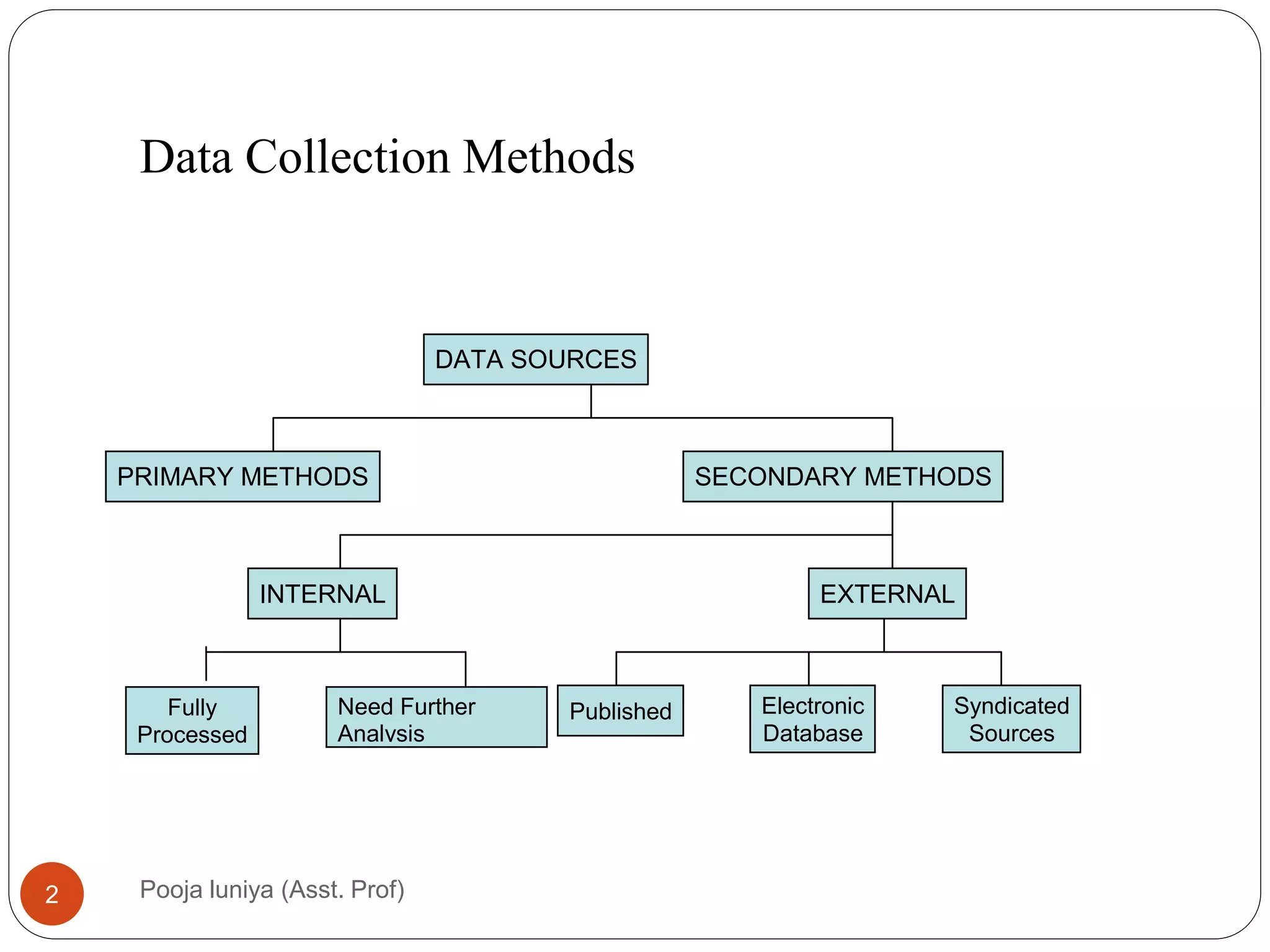
Data Collection Methods
DATA SOURCES
SECONDARY METHODSPRIMARY METHODS
INTERNAL EXTERNAL
Fully
Processed
Need Further
Analysis
Syndicated
Sources
Electronic
Database
Published
2 Pooja luniya (Asst. Prof)
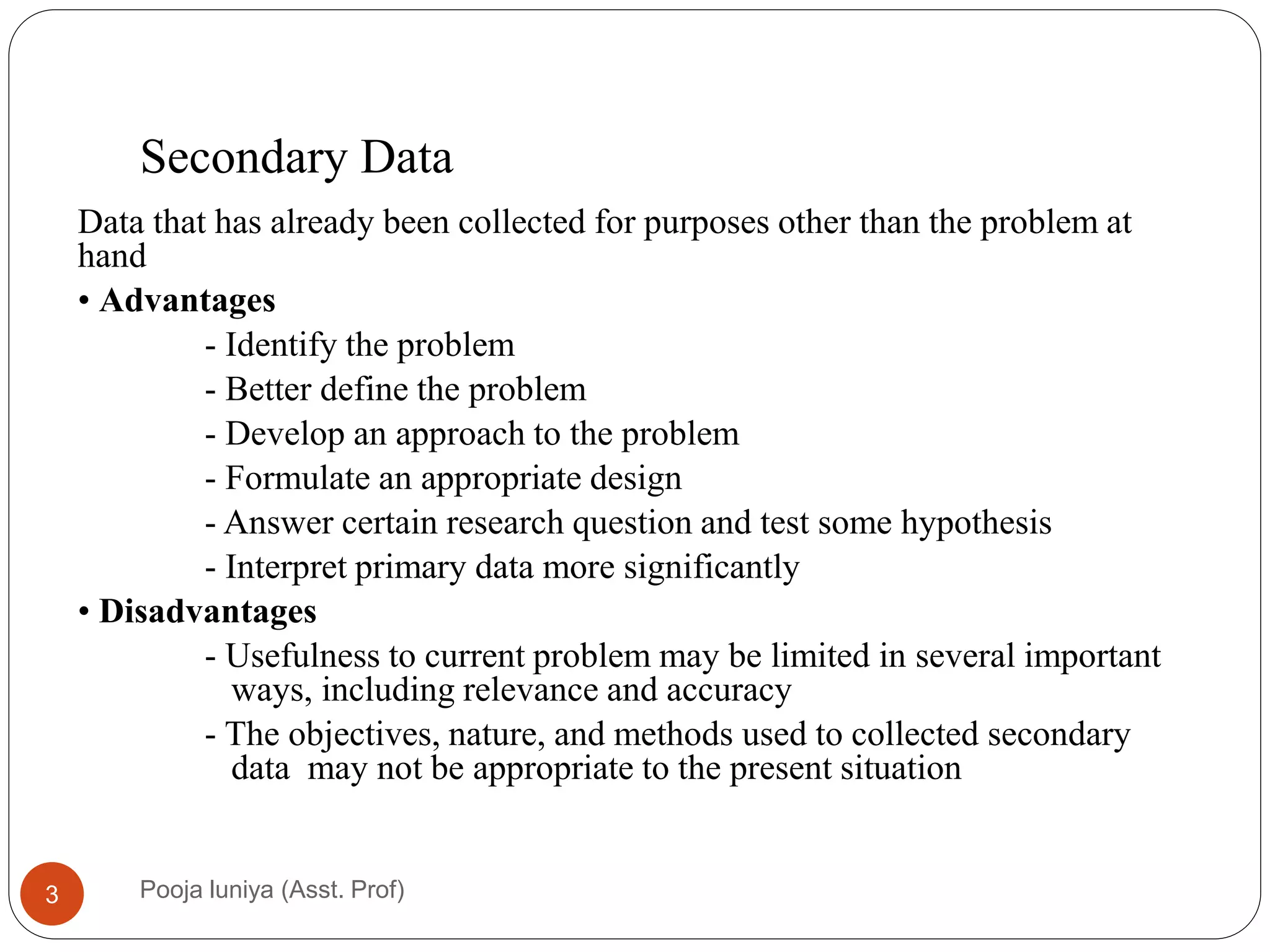
Secondary Data
Data that has already been collected for purposes other than the problem at
hand
• Advantages
- Identify the problem
- Better define the problem
- Develop an approach to the problem
- Formulate an appropriate design
- Answer certain research question and test some hypothesis
- Interpret primary data more significantly
• Disadvantages
- Usefulness to current problem may be limited in several important
ways, including relevance and accuracy
- The objectives, nature, and methods used to collected secondary
data may not be appropriate to the present situation
3 Pooja luniya (Asst. Prof)
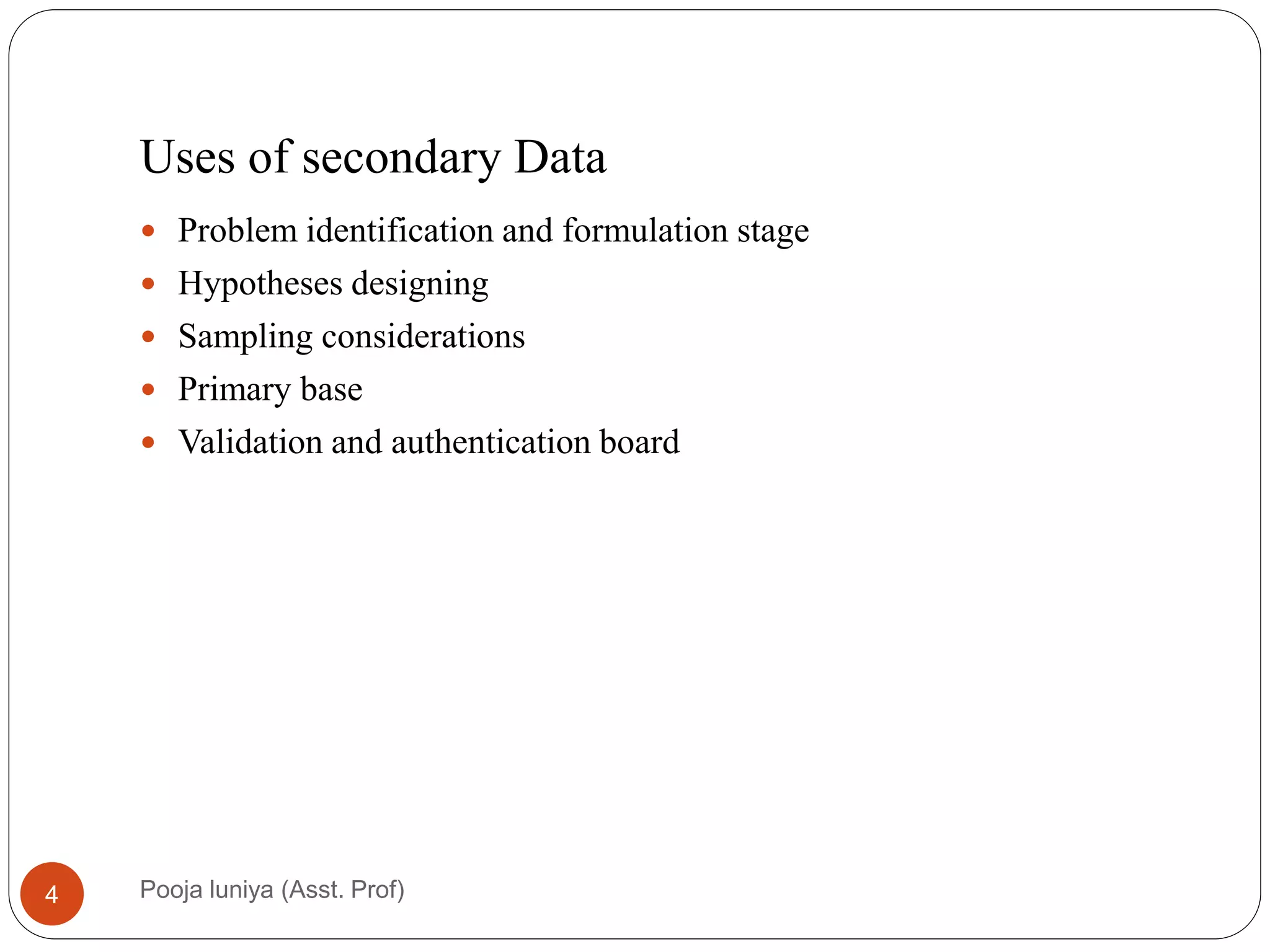
Uses of secondary Data
 Problem identification and formulation stage
 Hypotheses designing
 Sampling considerations
 Primary base
 Validation and authentication board
4 Pooja luniya (Asst. Prof)
Internal & External Data sources
INTERNAL
 Company records
 Employee records
 Sales data
 Other sources
EXTERNAL
 Published data
 Government Sources
 Other Sources
5 Pooja luniya (Asst. Prof)
Primary Data
It is originated by the researcher for the specific purpose of addressing the problem at hand
Can be qualitative or quantitative in nature
Advantages
- It is pertinent to the problem at hand
- It is useful to get to a conclusive decision
Disadvantages
- Costly to obtain
- Time required to collect primary data is very large
- Difficult to get true responses from the respondents
- Largely based on the perception of the researcher
Methods
 Surveys and Experiments
 Interviews and Observation Studies
 Other Methods –Warranty Cards, Distributor audits, pantry audits, consumer panels, using
mechanical devices, through projective techniques, depth interviews, content analysis
6 Pooja luniya (Asst. Prof)
Survey Methods
Basics
• Collection of data through
questionnaires and schedule14
• Very popular and widely used
method of gathering data
• Particularly used with quantitative
research
• Questionnaire is sent to
respondents by mail, e-mail, or
posted on Internet with
invitation to respondents for filling
the questionnaire
• Very widely employed in various
economic and business surveys
7 Pooja luniya (Asst. Prof)
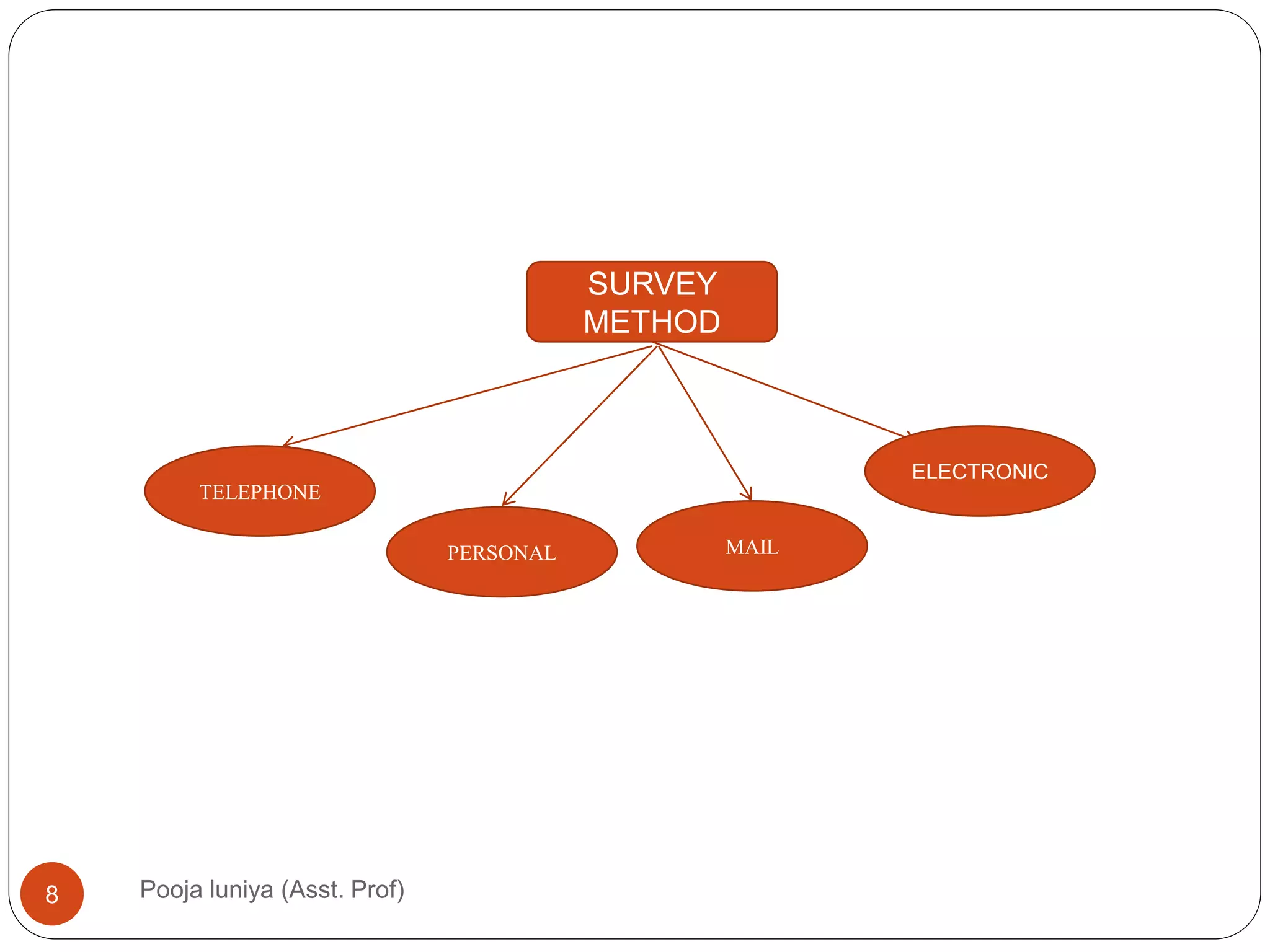
SURVEY
METHOD
TELEPHONE
PERSONAL MAIL
ELECTRONIC
8 Pooja luniya (Asst. Prof)
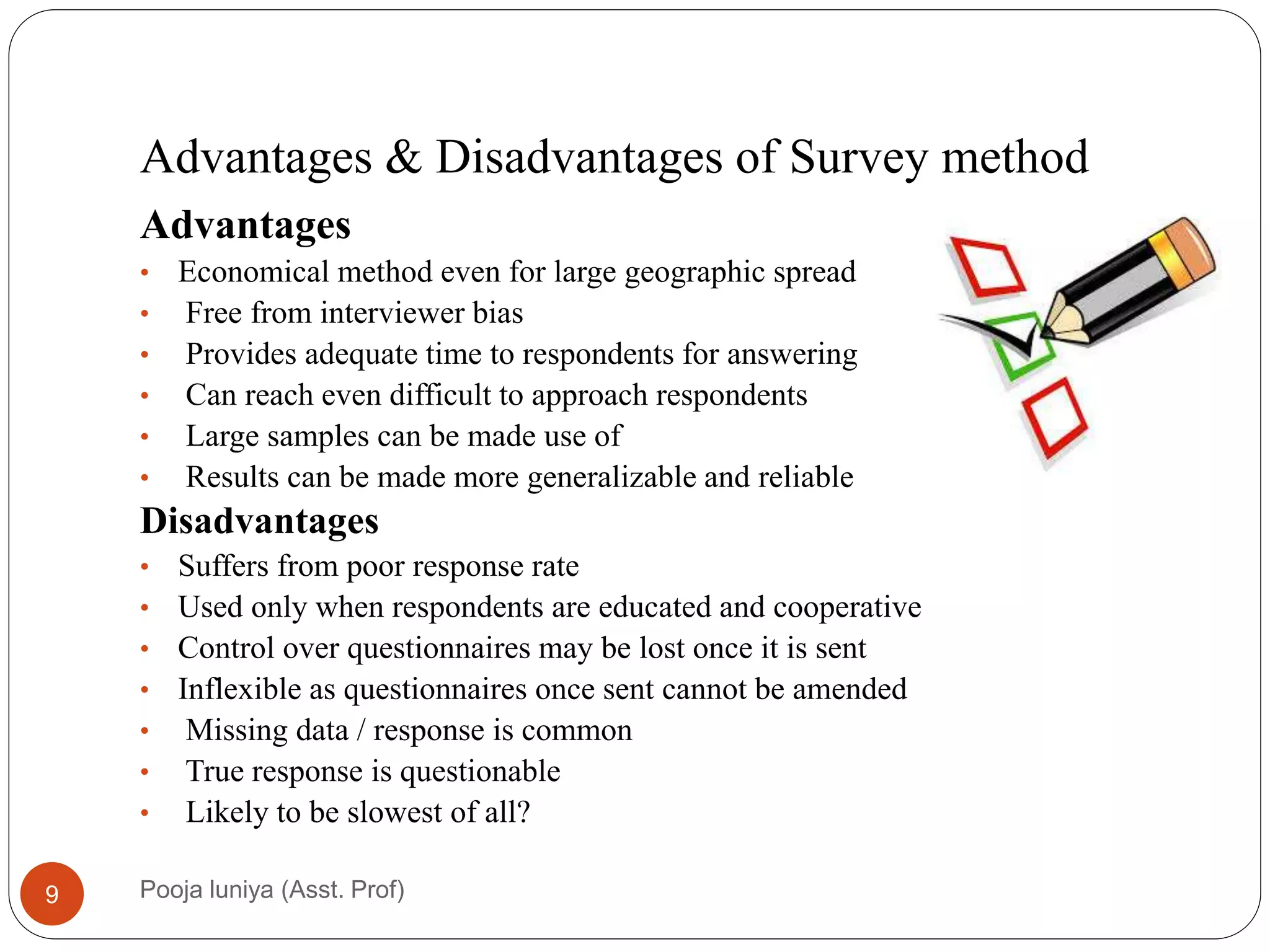
Advantages & Disadvantages of Survey method
Advantages
• Economical method even for large geographic spread
• Free from interviewer bias
• Provides adequate time to respondents for answering
• Can reach even difficult to approach respondents
• Large samples can be made use of
• Results can be made more generalizable and reliable
Disadvantages
• Suffers from poor response rate
• Used only when respondents are educated and cooperative
• Control over questionnaires may be lost once it is sent
• Inflexible as questionnaires once sent cannot be amended
• Missing data / response is common
• True response is questionable
• Likely to be slowest of all?
9 Pooja luniya (Asst. Prof)
Survey Methods
Schedules
 Schedules are filled in by the enumerators21
 Specially appointed for the purpose rather than by the respondents
 Enumerators may guide the respondents to fill the questionnaires
 Very useful in extensive enquiries and can lead to fairly reliable results
 Usually adopted by governmental agencies or by some big organizations
 E.g., Population Census surveys
Questionnaires
 This is the simplest and most often used method of primary data
collection.
 There is a pre-determined set of questions in a sequential format.
 Is designed to suit the respondent’s understanding and language command.
 Can be conducted to collect useful data from a large population in a short
duration of time
10 Pooja luniya (Asst. Prof)
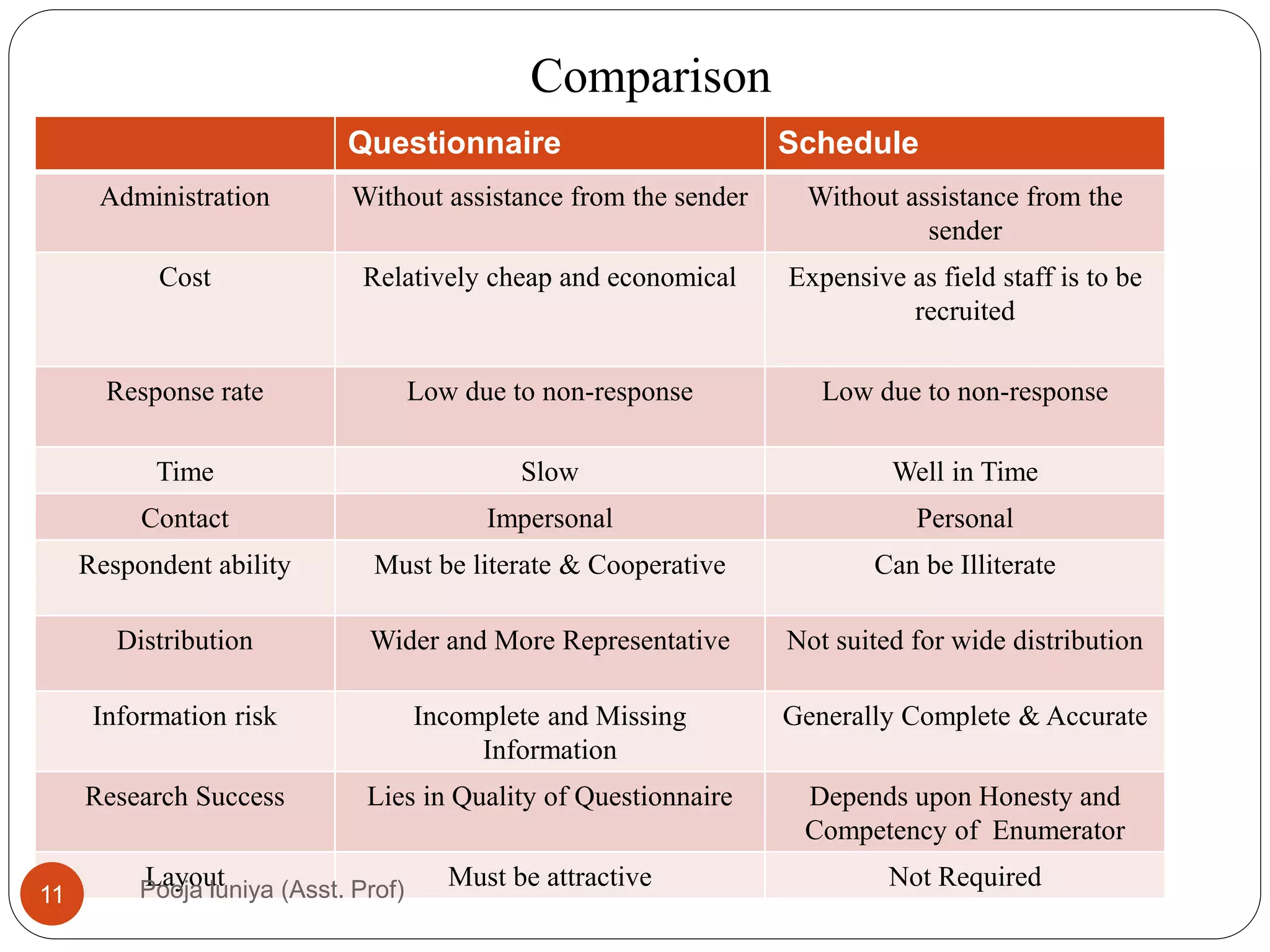
Comparison
Questionnaire Schedule
Administration Without assistance from the sender Without assistance from the
sender
Cost Relatively cheap and economical Expensive as field staff is to be
recruited
Response rate Low due to non-response Low due to non-response
Time Slow Well in Time
Contact Impersonal Personal
Respondent ability Must be literate & Cooperative Can be Illiterate
Distribution Wider and More Representative Not suited for wide distribution
Information risk Incomplete and Missing
Information
Generally Complete & Accurate
Research Success Lies in Quality of Questionnaire Depends upon Honesty and
Competency of Enumerator
Layout Must be attractive Not Required
11 Pooja luniya (Asst. Prof)
Questions or Doubts…????
12 Pooja luniya (Asst. Prof)

Data collection methods

  • 1.
    Pooja Luniya- G.DRungta College of science & Technology, Bhilai. (Asst. Prof.) BBA V th Sem. Marketing Research Topic: Data Collection Methods
  • 2.
    Data Collection Methods DATASOURCES SECONDARY METHODSPRIMARY METHODS INTERNAL EXTERNAL Fully Processed Need Further Analysis Syndicated Sources Electronic Database Published 2 Pooja luniya (Asst. Prof)
  • 3.
    Secondary Data Data thathas already been collected for purposes other than the problem at hand • Advantages - Identify the problem - Better define the problem - Develop an approach to the problem - Formulate an appropriate design - Answer certain research question and test some hypothesis - Interpret primary data more significantly • Disadvantages - Usefulness to current problem may be limited in several important ways, including relevance and accuracy - The objectives, nature, and methods used to collected secondary data may not be appropriate to the present situation 3 Pooja luniya (Asst. Prof)
  • 4.
    Uses of secondaryData  Problem identification and formulation stage  Hypotheses designing  Sampling considerations  Primary base  Validation and authentication board 4 Pooja luniya (Asst. Prof)
  • 5.
    Internal & ExternalData sources INTERNAL  Company records  Employee records  Sales data  Other sources EXTERNAL  Published data  Government Sources  Other Sources 5 Pooja luniya (Asst. Prof)
  • 6.
    Primary Data It isoriginated by the researcher for the specific purpose of addressing the problem at hand Can be qualitative or quantitative in nature Advantages - It is pertinent to the problem at hand - It is useful to get to a conclusive decision Disadvantages - Costly to obtain - Time required to collect primary data is very large - Difficult to get true responses from the respondents - Largely based on the perception of the researcher Methods  Surveys and Experiments  Interviews and Observation Studies  Other Methods –Warranty Cards, Distributor audits, pantry audits, consumer panels, using mechanical devices, through projective techniques, depth interviews, content analysis 6 Pooja luniya (Asst. Prof)
  • 7.
    Survey Methods Basics • Collectionof data through questionnaires and schedule14 • Very popular and widely used method of gathering data • Particularly used with quantitative research • Questionnaire is sent to respondents by mail, e-mail, or posted on Internet with invitation to respondents for filling the questionnaire • Very widely employed in various economic and business surveys 7 Pooja luniya (Asst. Prof)
  • 8.
  • 9.
    Advantages & Disadvantagesof Survey method Advantages • Economical method even for large geographic spread • Free from interviewer bias • Provides adequate time to respondents for answering • Can reach even difficult to approach respondents • Large samples can be made use of • Results can be made more generalizable and reliable Disadvantages • Suffers from poor response rate • Used only when respondents are educated and cooperative • Control over questionnaires may be lost once it is sent • Inflexible as questionnaires once sent cannot be amended • Missing data / response is common • True response is questionable • Likely to be slowest of all? 9 Pooja luniya (Asst. Prof)
  • 10.
    Survey Methods Schedules  Schedulesare filled in by the enumerators21  Specially appointed for the purpose rather than by the respondents  Enumerators may guide the respondents to fill the questionnaires  Very useful in extensive enquiries and can lead to fairly reliable results  Usually adopted by governmental agencies or by some big organizations  E.g., Population Census surveys Questionnaires  This is the simplest and most often used method of primary data collection.  There is a pre-determined set of questions in a sequential format.  Is designed to suit the respondent’s understanding and language command.  Can be conducted to collect useful data from a large population in a short duration of time 10 Pooja luniya (Asst. Prof)
  • 11.
    Comparison Questionnaire Schedule Administration Withoutassistance from the sender Without assistance from the sender Cost Relatively cheap and economical Expensive as field staff is to be recruited Response rate Low due to non-response Low due to non-response Time Slow Well in Time Contact Impersonal Personal Respondent ability Must be literate & Cooperative Can be Illiterate Distribution Wider and More Representative Not suited for wide distribution Information risk Incomplete and Missing Information Generally Complete & Accurate Research Success Lies in Quality of Questionnaire Depends upon Honesty and Competency of Enumerator Layout Must be attractive Not Required 11 Pooja luniya (Asst. Prof)
  • 12.
    Questions or Doubts…???? 12Pooja luniya (Asst. Prof)