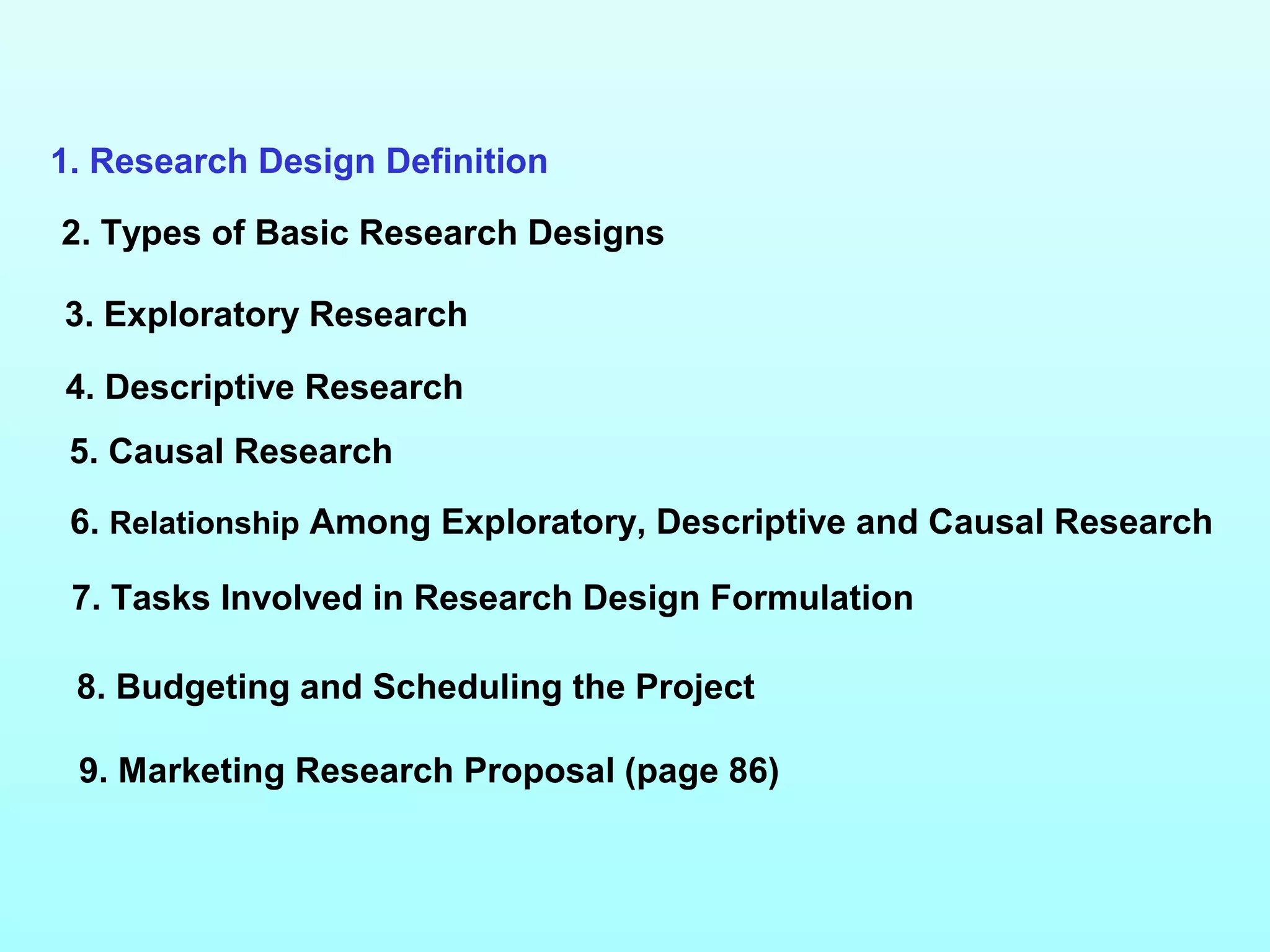
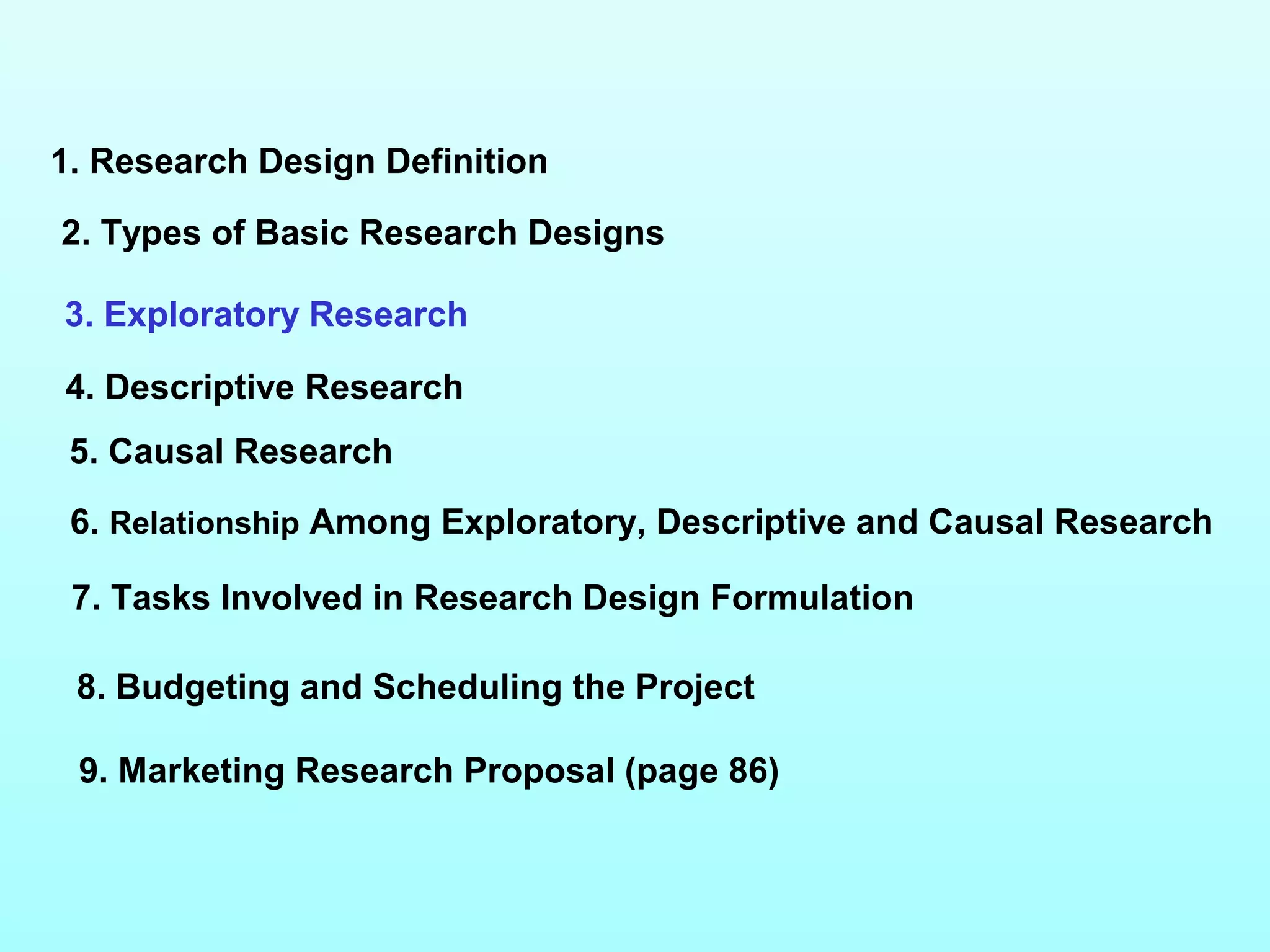
1. Research Design Definition
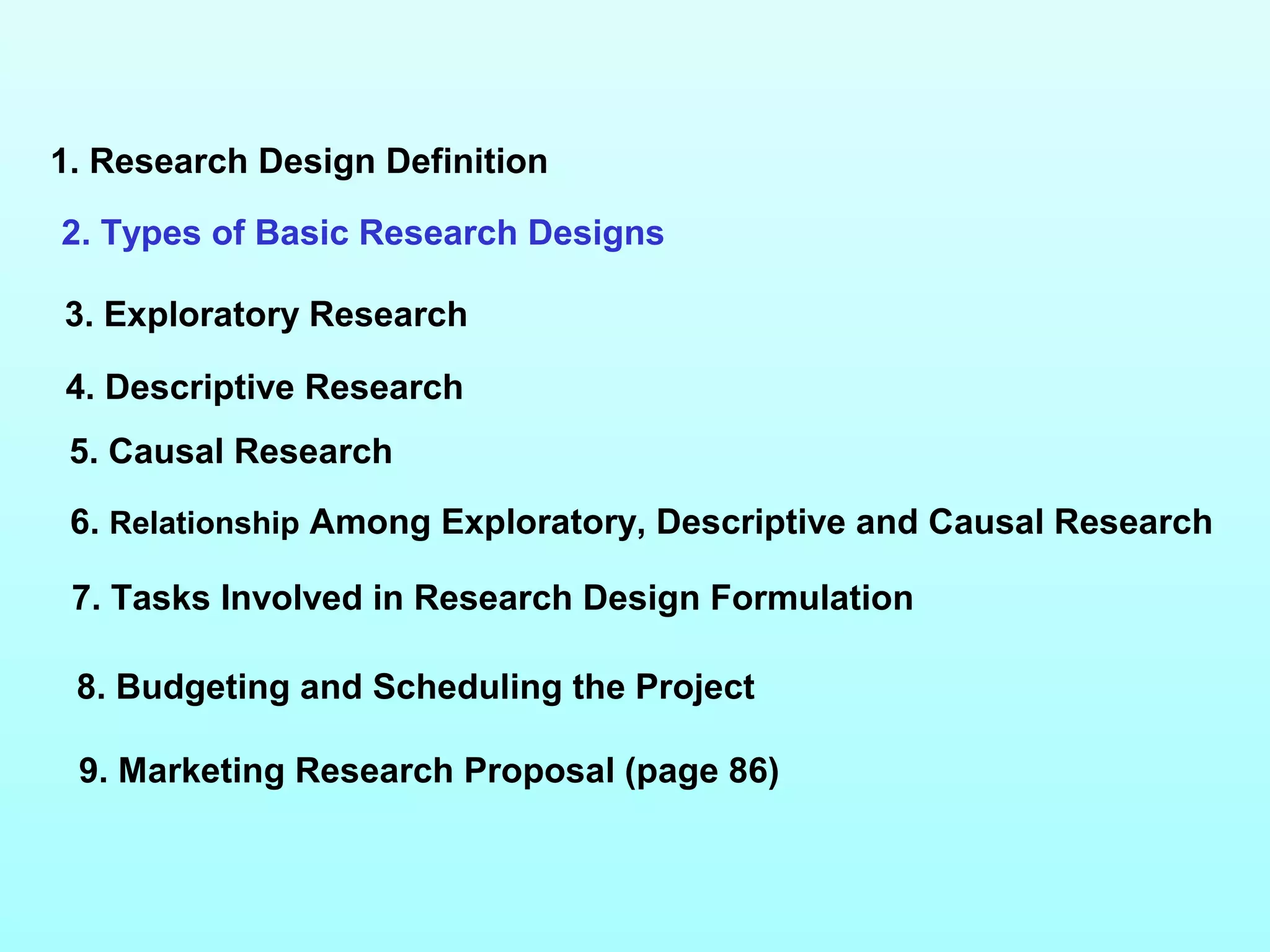
2. Types of Basic Research Designs
3. Exploratory Research
4. Descriptive Research
5. Causal Research
6. Relationship Among Exploratory, Descriptive and Causal Research
7. Tasks Involved in Research Design Formulation
9. Marketing Research Proposal (page 86)
8. Budgeting and Scheduling the Project
1. Research Design: Definition
• A research design is a framework or
blueprint for conducting the marketing
research project. It details the procedures
necessary for obtaining the information
needed to structure or solve marketing
research problems.
Components of a Research Design
• Define the information needed (Chapter 2)
• Design the exploratory, descriptive, and/or causal
phases of the research (Chapters 3 - 7)
• Specify the measurement and scaling procedures
(Chapters 8 and 9)
• Construct and pretest a questionnaire (interviewing
form) or an appropriate form for data collection
(Chapter 10)
• Specify the sampling process and sample size
(Chapters 11 and 12)
• Develop a plan of data analysis (Chapter 14)
1. Research Design Definition
2. Types of Basic Research Designs
3. Exploratory Research
4. Descriptive Research
5. Causal Research
6. Relationship Among Exploratory, Descriptive and Causal Research
7. Tasks Involved in Research Design Formulation
9. Marketing Research Proposal (page 86)
8. Budgeting and Scheduling the Project
Research Design
Exploratory Research
Design
Causal Research
Conclusive Research
Design
Cross-Sectional
Design
Descriptive
Research
Longitudinal
Design
Figure 3.4. A Classification of Market Research Designs
1. Research Design Definition
2. Types of Basic Research Designs
3. Exploratory Research
4. Descriptive Research
5. Causal Research
6. Relationship Among Exploratory, Descriptive and Causal Research
7. Tasks Involved in Research Design Formulation
9. Marketing Research Proposal (page 86)
8. Budgeting and Scheduling the Project
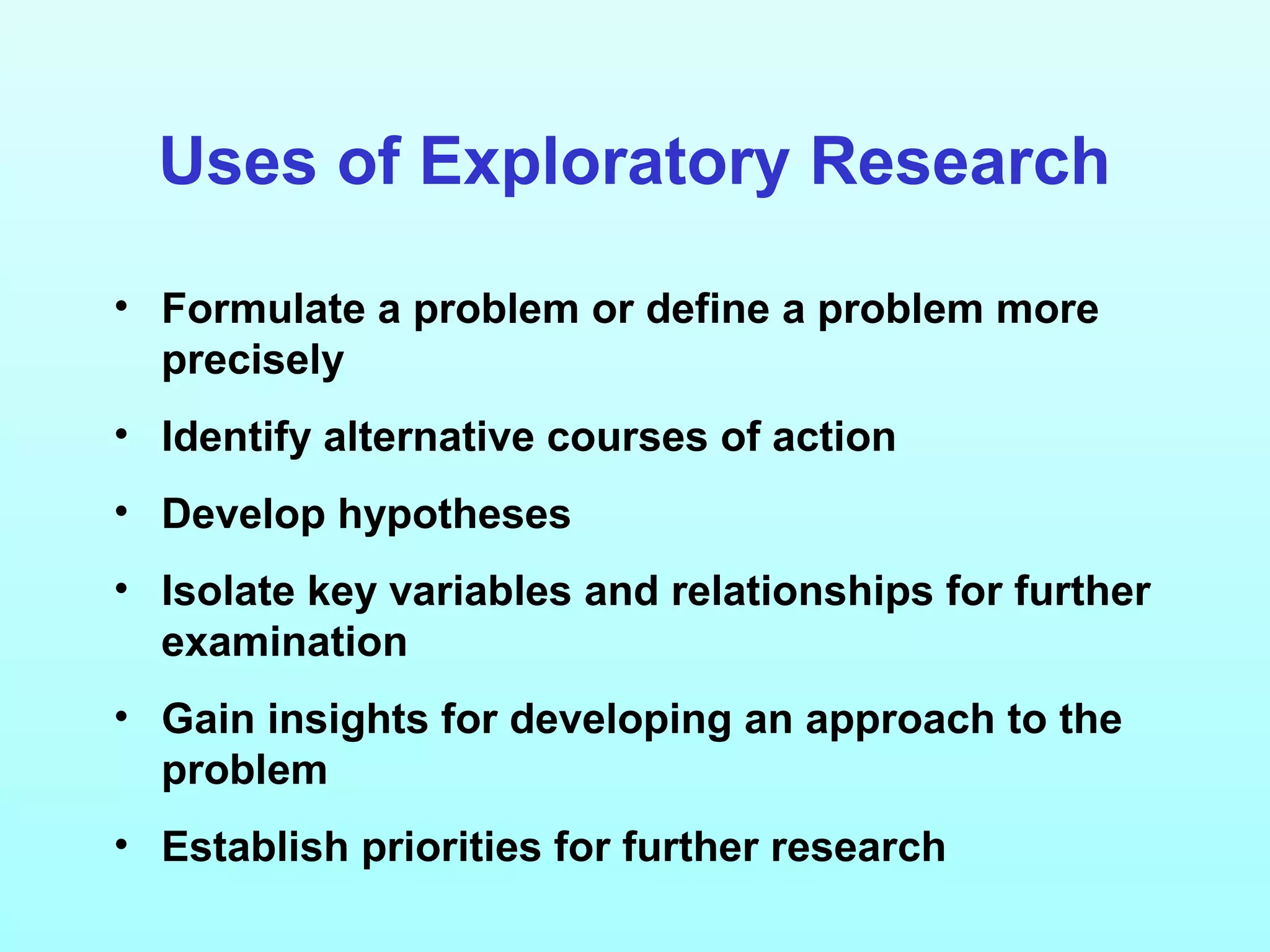
Uses of Exploratory Research
• Formulate a problem or define a problem more
precisely
• Identify alternative courses of action
• Develop hypotheses
• Isolate key variables and relationships for further
examination
• Gain insights for developing an approach to the
problem
• Establish priorities for further research
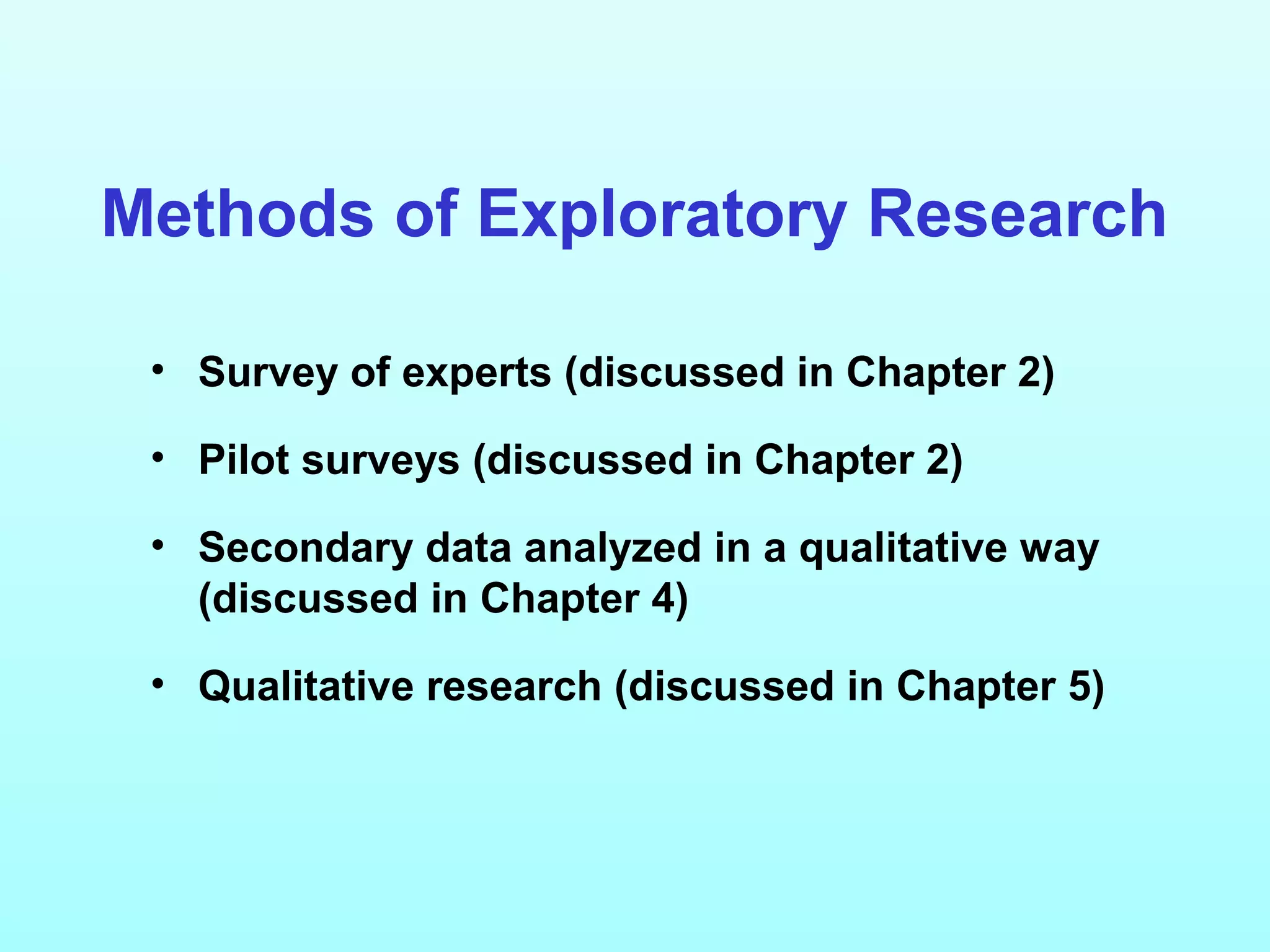
Methods of Exploratory Research
• Survey of experts (discussed in Chapter 2)
• Pilot surveys (discussed in Chapter 2)
• Secondary data analyzed in a qualitative way
(discussed in Chapter 4)
• Qualitative research (discussed in Chapter 5)
1. Research Design Definition
2. Types of Basic Research Designs
3. Exploratory Research
4. Descriptive Research
5. Causal Research
6. Relationship Among Exploratory, Descriptive and Causal Research
7. Tasks Involved in Research Design Formulation
9. Marketing Research Proposal (page 86)
8. Budgeting and Scheduling the Project
Use of Descriptive Research
• To describe the characteristics of relevant
groups, such as consumers, salespeople,
organizations, or market areas.
• To estimate the percentage of units in a specified
population exhibiting a certain behavior
• To determine the perceptions of product
characteristics
• To determine the degree to which marketing
variables are associated
• To make specific predictions
Methods of Descriptive Research
• Secondary data analyzed in a quantitative as
opposed to a qualitative manner (discussed
in Chapter 4)
• Surveys (Chapter 6)
• Panels (Chapters 4 and 6)
• Observational and other data (Chapter 6)
Figure 3.5. Major Types of Descriptive Studies
Descriptive
Studies
Consumer
Perception
And Behavior
Studies
• Image
• Product Usage
• Advertising
• Pricing
Market
Characteristic
Studies
•Distribution
•Competitive
Analysis
• Market Potential
• Market Share
• Sales Analysis
Sales Studies
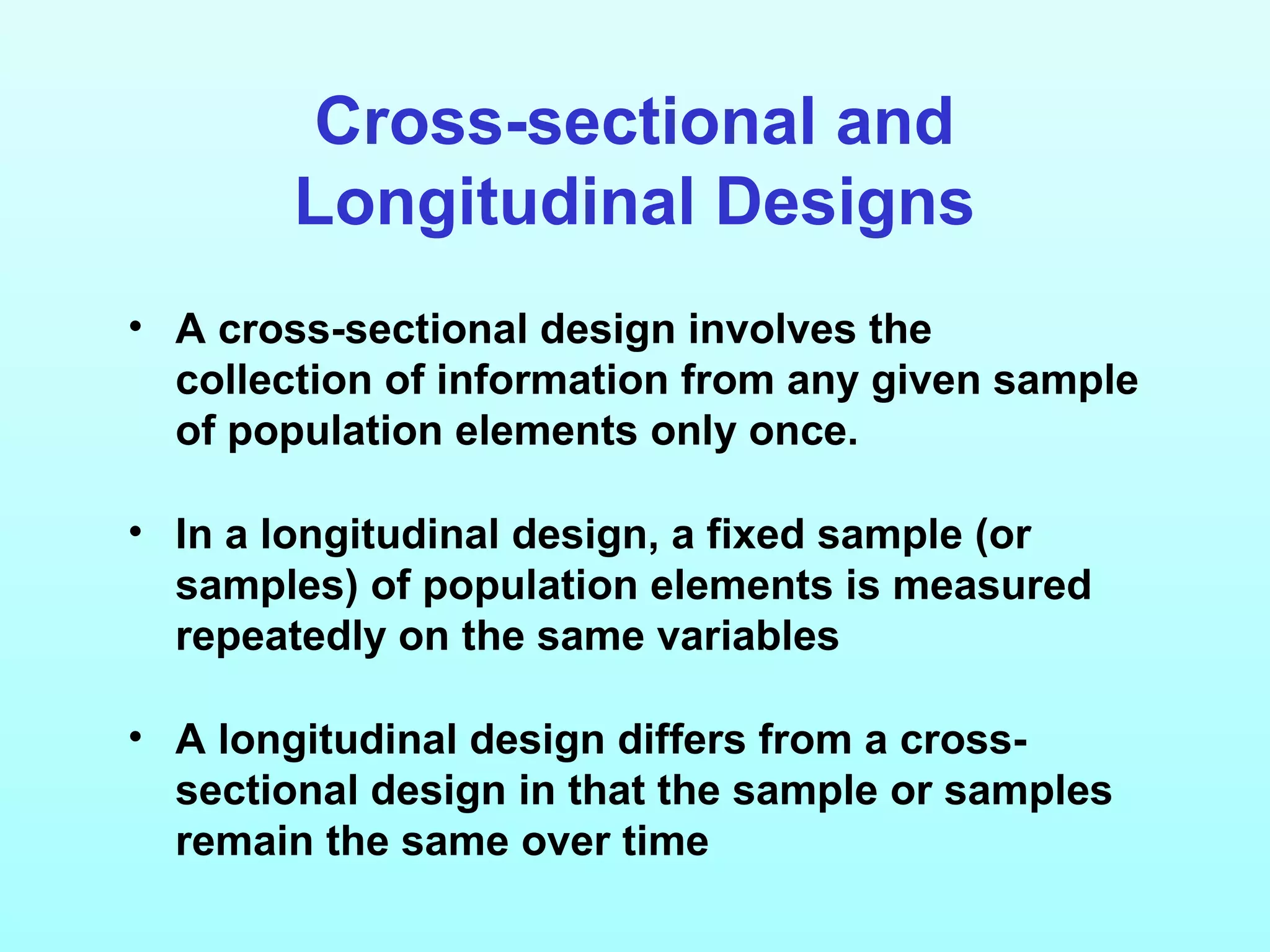
Cross-sectional and
Longitudinal Designs
• A cross-sectional design involves the
collection of information from any given sample
of population elements only once.
• In a longitudinal design, a fixed sample (or
samples) of population elements is measured
repeatedly on the same variables
• A longitudinal design differs from a cross-
sectional design in that the sample or samples
remain the same over time
Sample
Surveyed
at T1
Sample
Surveyed
at T1
Same
Sample
also
Surveyed
at T2
T1 T2
Cross
Sectional
Design
Longitudinal
Design
Time
Figure 3.6. Cross Sectional vs. Longitudinal Designs
1. Research Design Definition
2. Types of Basic Research Designs
3. Exploratory Research
4. Descriptive Research
5. Causal Research
6. Relationship Among Exploratory, Descriptive and Causal Research
7. Tasks Involved in Research Design Formulation
9. Marketing Research Proposal (page 86)
8. Budgeting and Scheduling the Project
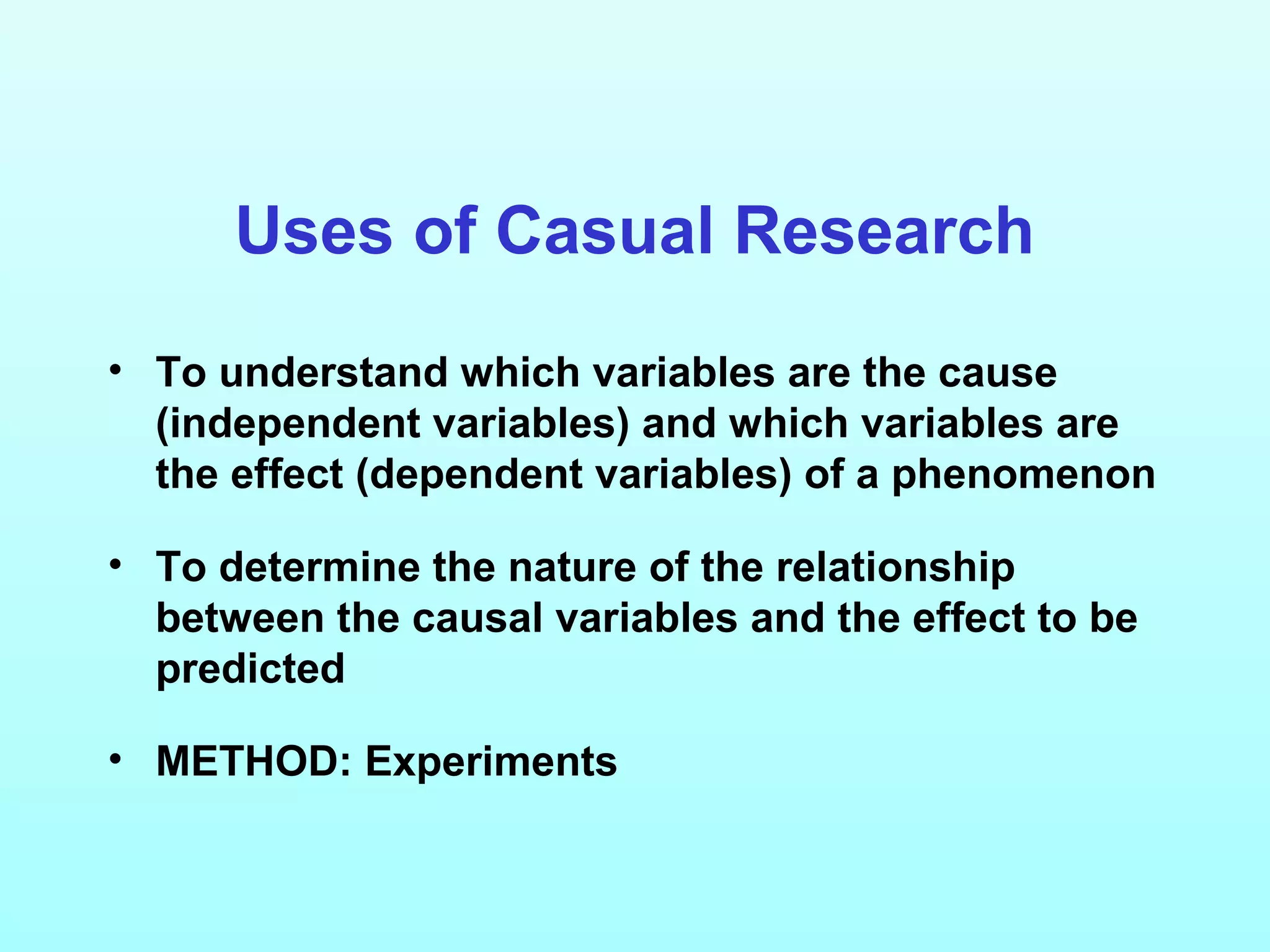
Uses of Casual Research
• To understand which variables are the cause
(independent variables) and which variables are
the effect (dependent variables) of a phenomenon
• To determine the nature of the relationship
between the causal variables and the effect to be
predicted
• METHOD: Experiments
1. Research Design Definition
2. Types of Basic Research Designs
3. Exploratory Research
4. Descriptive Research
5. Causal Research
6. Relationship Among Exploratory, Descriptive and Causal Research
7. Tasks Involved in Research Design Formulation
9. Marketing Research Proposal (page 86)
8. Budgeting and Scheduling the Project
1. Research Design Definition
2. Types of Basic Research Designs
3. Exploratory Research
4. Descriptive Research
5. Causal Research
6. Relationship Among Exploratory, Descriptive and Causal Research
7. Tasks Involved in Research Design Formulation
9. Marketing Research Proposal (page 86)
8. Budgeting and Scheduling the Project
Exploratory
Research
•Secondary Data
Analysis
•Focus Groups
Conclusive
Research
•Descriptive/Causa
l
Conclusive
Research
•Descriptive/Causa
l
Exploratory
Research
•Secondary Data
Analysis
•Focus Groups
Conclusive
Research
•Descriptive/Causa
l
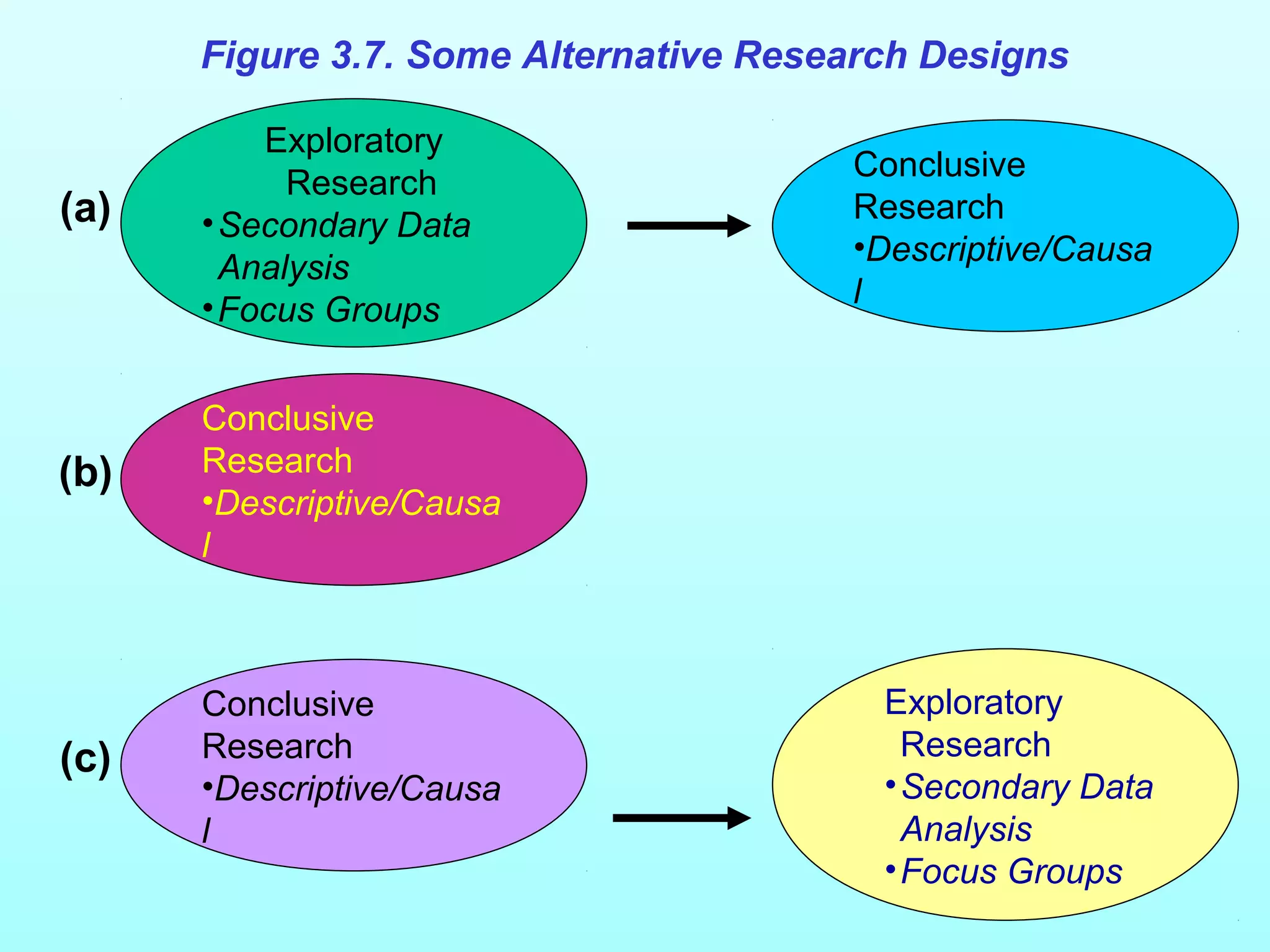
Figure 3.7. Some Alternative Research Designs
(a)
(b)
(c)
1. Research Design Definition
2. Types of Basic Research Designs
3. Exploratory Research
4. Descriptive Research
5. Causal Research
6. Relationship Among Exploratory, Descriptive and Causal Research
7. Tasks Involved in Research Design Formulation
9. Marketing Research Proposal (page 86)
8. Budgeting and Scheduling the Project
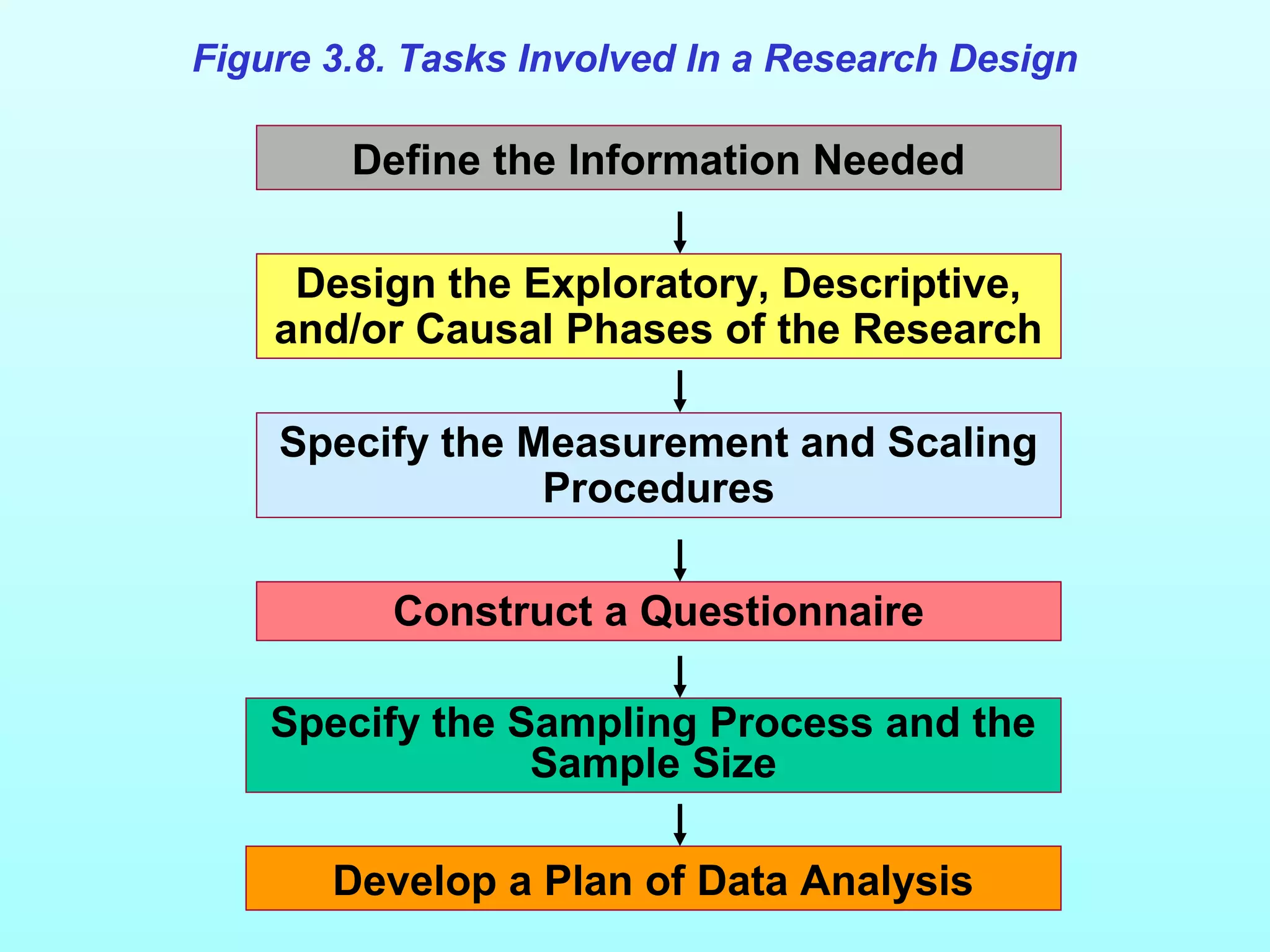
Define the Information Needed
Design the Exploratory, Descriptive,
and/or Causal Phases of the Research
Specify the Measurement and Scaling
Procedures
Construct a Questionnaire
Specify the Sampling Process and the
Sample Size
Develop a Plan of Data Analysis
Figure 3.8. Tasks Involved In a Research Design
1. Research Design Definition
2. Types of Basic Research Designs
3. Exploratory Research
4. Descriptive Research
5. Causal Research
6. Relationship Among Exploratory, Descriptive and Causal Research
7. Tasks Involved in Research Design Formulation
9. Marketing Research Proposal (page 86)
8. Budgeting and Scheduling the Project

RESEARCH DESIGN

  • 2.
    1. Research DesignDefinition 2. Types of Basic Research Designs 3. Exploratory Research 4. Descriptive Research 5. Causal Research 6. Relationship Among Exploratory, Descriptive and Causal Research 7. Tasks Involved in Research Design Formulation 9. Marketing Research Proposal (page 86) 8. Budgeting and Scheduling the Project
  • 3.
    1. Research Design:Definition • A research design is a framework or blueprint for conducting the marketing research project. It details the procedures necessary for obtaining the information needed to structure or solve marketing research problems.
  • 4.
    Components of aResearch Design • Define the information needed (Chapter 2) • Design the exploratory, descriptive, and/or causal phases of the research (Chapters 3 - 7) • Specify the measurement and scaling procedures (Chapters 8 and 9) • Construct and pretest a questionnaire (interviewing form) or an appropriate form for data collection (Chapter 10) • Specify the sampling process and sample size (Chapters 11 and 12) • Develop a plan of data analysis (Chapter 14)
  • 5.
    1. Research DesignDefinition 2. Types of Basic Research Designs 3. Exploratory Research 4. Descriptive Research 5. Causal Research 6. Relationship Among Exploratory, Descriptive and Causal Research 7. Tasks Involved in Research Design Formulation 9. Marketing Research Proposal (page 86) 8. Budgeting and Scheduling the Project
  • 6.
    Research Design Exploratory Research Design CausalResearch Conclusive Research Design Cross-Sectional Design Descriptive Research Longitudinal Design Figure 3.4. A Classification of Market Research Designs
  • 11.
    1. Research DesignDefinition 2. Types of Basic Research Designs 3. Exploratory Research 4. Descriptive Research 5. Causal Research 6. Relationship Among Exploratory, Descriptive and Causal Research 7. Tasks Involved in Research Design Formulation 9. Marketing Research Proposal (page 86) 8. Budgeting and Scheduling the Project
  • 12.
    Uses of ExploratoryResearch • Formulate a problem or define a problem more precisely • Identify alternative courses of action • Develop hypotheses • Isolate key variables and relationships for further examination • Gain insights for developing an approach to the problem • Establish priorities for further research
  • 13.
    Methods of ExploratoryResearch • Survey of experts (discussed in Chapter 2) • Pilot surveys (discussed in Chapter 2) • Secondary data analyzed in a qualitative way (discussed in Chapter 4) • Qualitative research (discussed in Chapter 5)
  • 14.
    1. Research DesignDefinition 2. Types of Basic Research Designs 3. Exploratory Research 4. Descriptive Research 5. Causal Research 6. Relationship Among Exploratory, Descriptive and Causal Research 7. Tasks Involved in Research Design Formulation 9. Marketing Research Proposal (page 86) 8. Budgeting and Scheduling the Project
  • 15.
    Use of DescriptiveResearch • To describe the characteristics of relevant groups, such as consumers, salespeople, organizations, or market areas. • To estimate the percentage of units in a specified population exhibiting a certain behavior • To determine the perceptions of product characteristics • To determine the degree to which marketing variables are associated • To make specific predictions
  • 16.
    Methods of DescriptiveResearch • Secondary data analyzed in a quantitative as opposed to a qualitative manner (discussed in Chapter 4) • Surveys (Chapter 6) • Panels (Chapters 4 and 6) • Observational and other data (Chapter 6)
  • 17.
    Figure 3.5. MajorTypes of Descriptive Studies Descriptive Studies Consumer Perception And Behavior Studies • Image • Product Usage • Advertising • Pricing Market Characteristic Studies •Distribution •Competitive Analysis • Market Potential • Market Share • Sales Analysis Sales Studies
  • 18.
    Cross-sectional and Longitudinal Designs •A cross-sectional design involves the collection of information from any given sample of population elements only once. • In a longitudinal design, a fixed sample (or samples) of population elements is measured repeatedly on the same variables • A longitudinal design differs from a cross- sectional design in that the sample or samples remain the same over time
  • 19.
    Sample Surveyed at T1 Sample Surveyed at T1 Same Sample also Surveyed atT2 T1 T2 Cross Sectional Design Longitudinal Design Time Figure 3.6. Cross Sectional vs. Longitudinal Designs
  • 21.
    1. Research DesignDefinition 2. Types of Basic Research Designs 3. Exploratory Research 4. Descriptive Research 5. Causal Research 6. Relationship Among Exploratory, Descriptive and Causal Research 7. Tasks Involved in Research Design Formulation 9. Marketing Research Proposal (page 86) 8. Budgeting and Scheduling the Project
  • 22.
    Uses of CasualResearch • To understand which variables are the cause (independent variables) and which variables are the effect (dependent variables) of a phenomenon • To determine the nature of the relationship between the causal variables and the effect to be predicted • METHOD: Experiments
  • 23.
    1. Research DesignDefinition 2. Types of Basic Research Designs 3. Exploratory Research 4. Descriptive Research 5. Causal Research 6. Relationship Among Exploratory, Descriptive and Causal Research 7. Tasks Involved in Research Design Formulation 9. Marketing Research Proposal (page 86) 8. Budgeting and Scheduling the Project
  • 24.
    1. Research DesignDefinition 2. Types of Basic Research Designs 3. Exploratory Research 4. Descriptive Research 5. Causal Research 6. Relationship Among Exploratory, Descriptive and Causal Research 7. Tasks Involved in Research Design Formulation 9. Marketing Research Proposal (page 86) 8. Budgeting and Scheduling the Project
  • 25.
    Exploratory Research •Secondary Data Analysis •Focus Groups Conclusive Research •Descriptive/Causa l Conclusive Research •Descriptive/Causa l Exploratory Research •SecondaryData Analysis •Focus Groups Conclusive Research •Descriptive/Causa l Figure 3.7. Some Alternative Research Designs (a) (b) (c)
  • 26.
    1. Research DesignDefinition 2. Types of Basic Research Designs 3. Exploratory Research 4. Descriptive Research 5. Causal Research 6. Relationship Among Exploratory, Descriptive and Causal Research 7. Tasks Involved in Research Design Formulation 9. Marketing Research Proposal (page 86) 8. Budgeting and Scheduling the Project
  • 27.
    Define the InformationNeeded Design the Exploratory, Descriptive, and/or Causal Phases of the Research Specify the Measurement and Scaling Procedures Construct a Questionnaire Specify the Sampling Process and the Sample Size Develop a Plan of Data Analysis Figure 3.8. Tasks Involved In a Research Design
  • 28.
    1. Research DesignDefinition 2. Types of Basic Research Designs 3. Exploratory Research 4. Descriptive Research 5. Causal Research 6. Relationship Among Exploratory, Descriptive and Causal Research 7. Tasks Involved in Research Design Formulation 9. Marketing Research Proposal (page 86) 8. Budgeting and Scheduling the Project