BBA Vth Sem.
Marketing Research : Attitude Measurement
and Scaling Techniques
Pooja Luniya
(Asst. Prof.) GD. Rungta College of Science & Technology.
Attitude and its Components
• Attitude is the predisposition of the Individual to evaluate some
symbol or object or aspect of his world in a favorable manner.
Components of Attitude:
• Cognitive component: Respondent is aware about a given
object
• Affective component: Indicates liking and preferences for an
object
• Behavioral Component: Intention or action component
2
Pooja Luniya (Asst.Prof)
Scaling
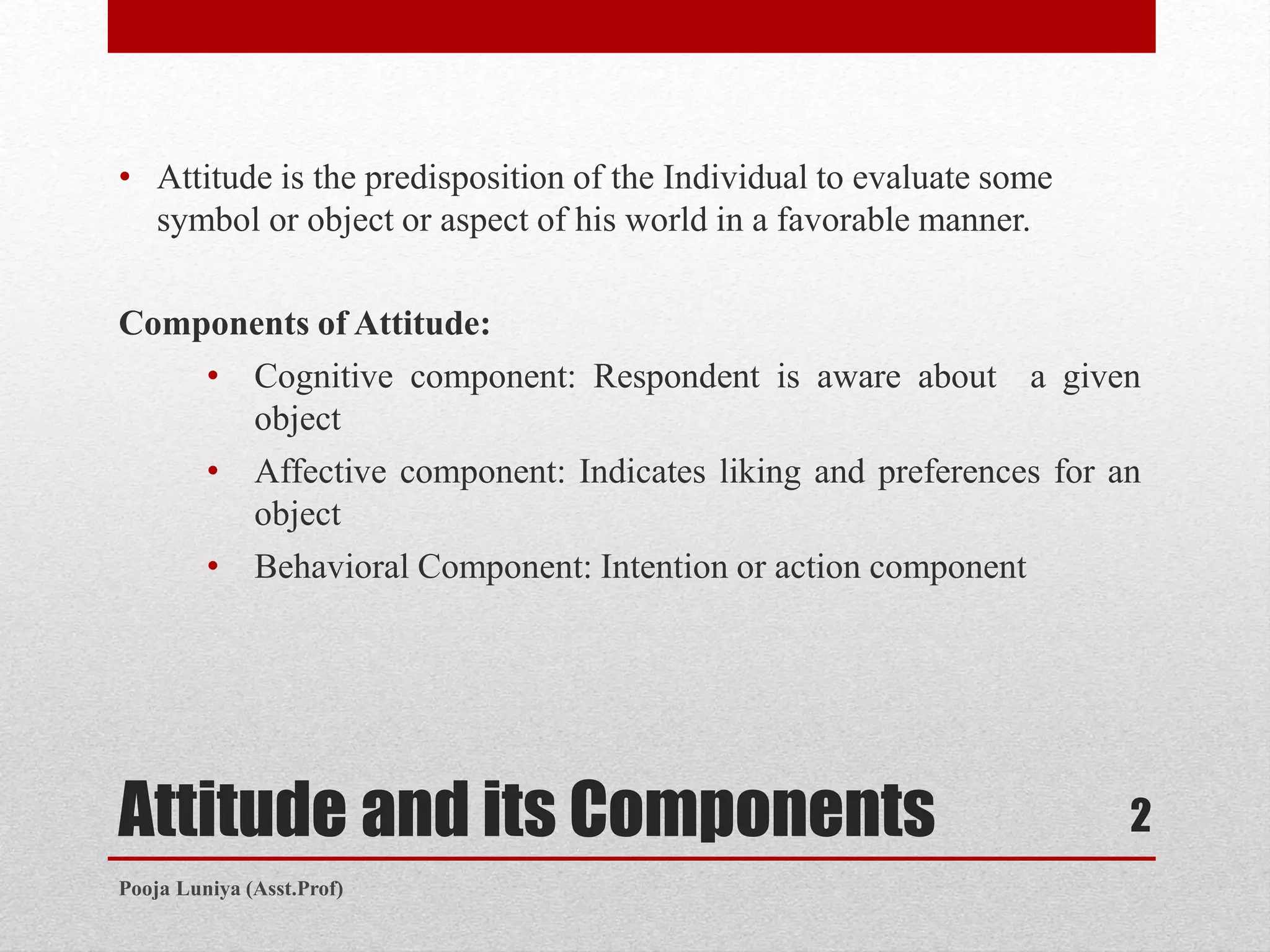
• Scaling describes the procedures of assigning numbers to various
degrees of opinion, attitude and other concepts.
• It consists of the highest point (in terms of some characteristic e.g.,
preference, favourableness, etc.) and the lowest point along with
several intermediate points between these two extreme points.
3
Pooja Luniya (Asst.Prof)
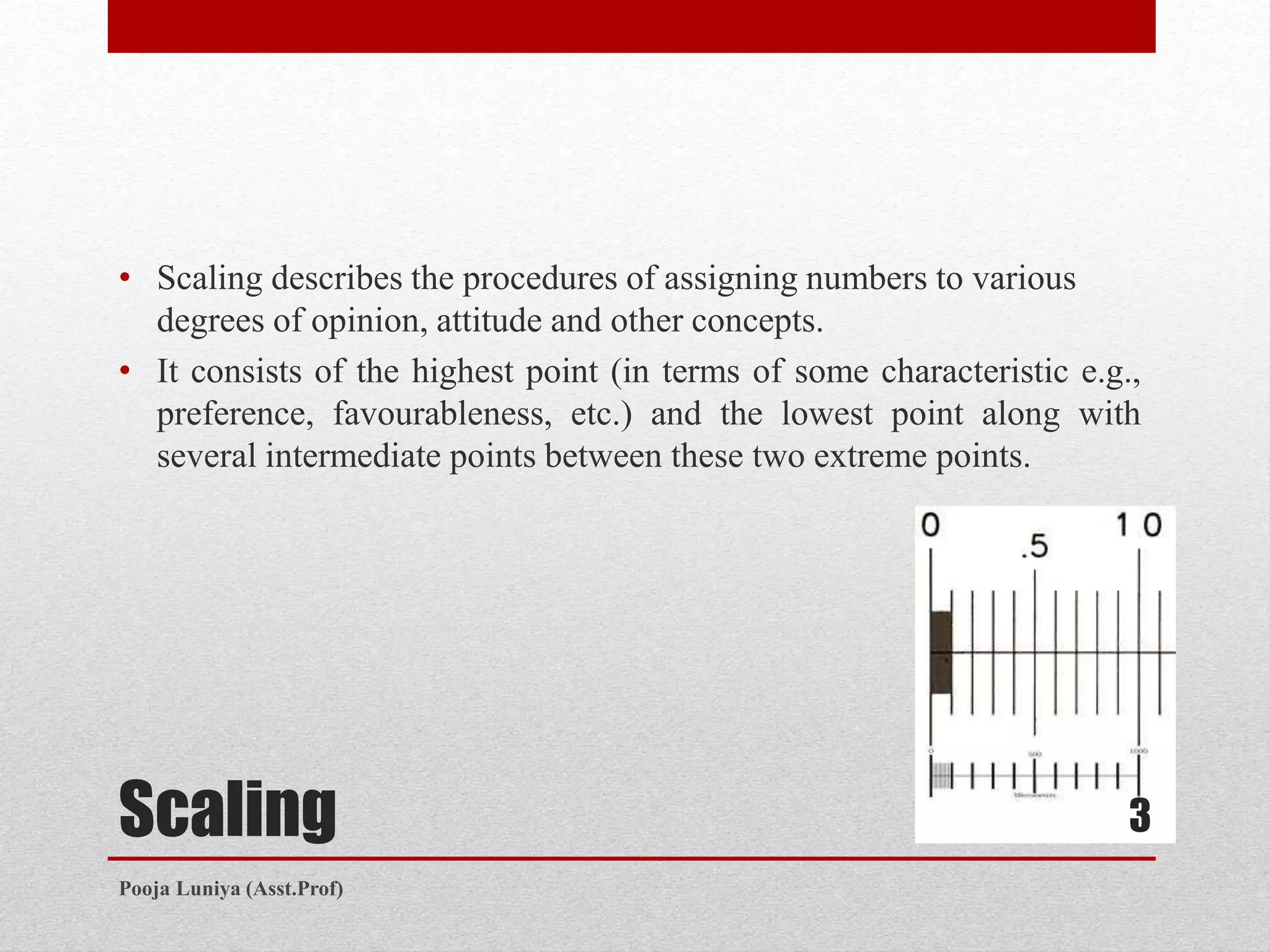
Important Scaling Techniques 4
Pooja Luniya (Asst.Prof)
Paired Comparison Scale
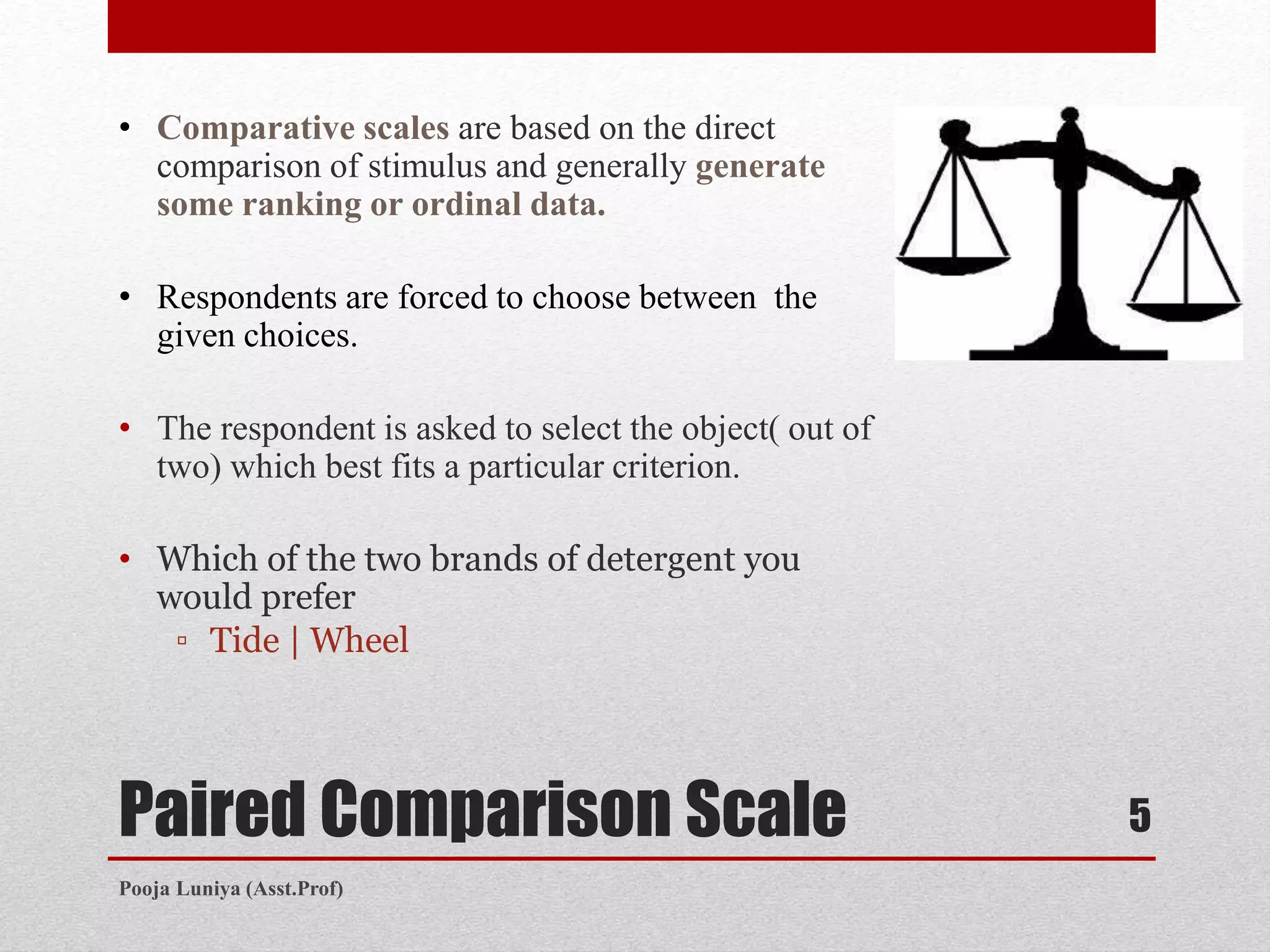
• Comparative scales are based on the direct
comparison of stimulus and generally generate
some ranking or ordinal data.
• Respondents are forced to choose between the
given choices.
• The respondent is asked to select the object( out of
two) which best fits a particular criterion.
• Which of the two brands of detergent you
would prefer
▫ Tide | Wheel
5
Pooja Luniya (Asst.Prof)
Constant Sum Scale
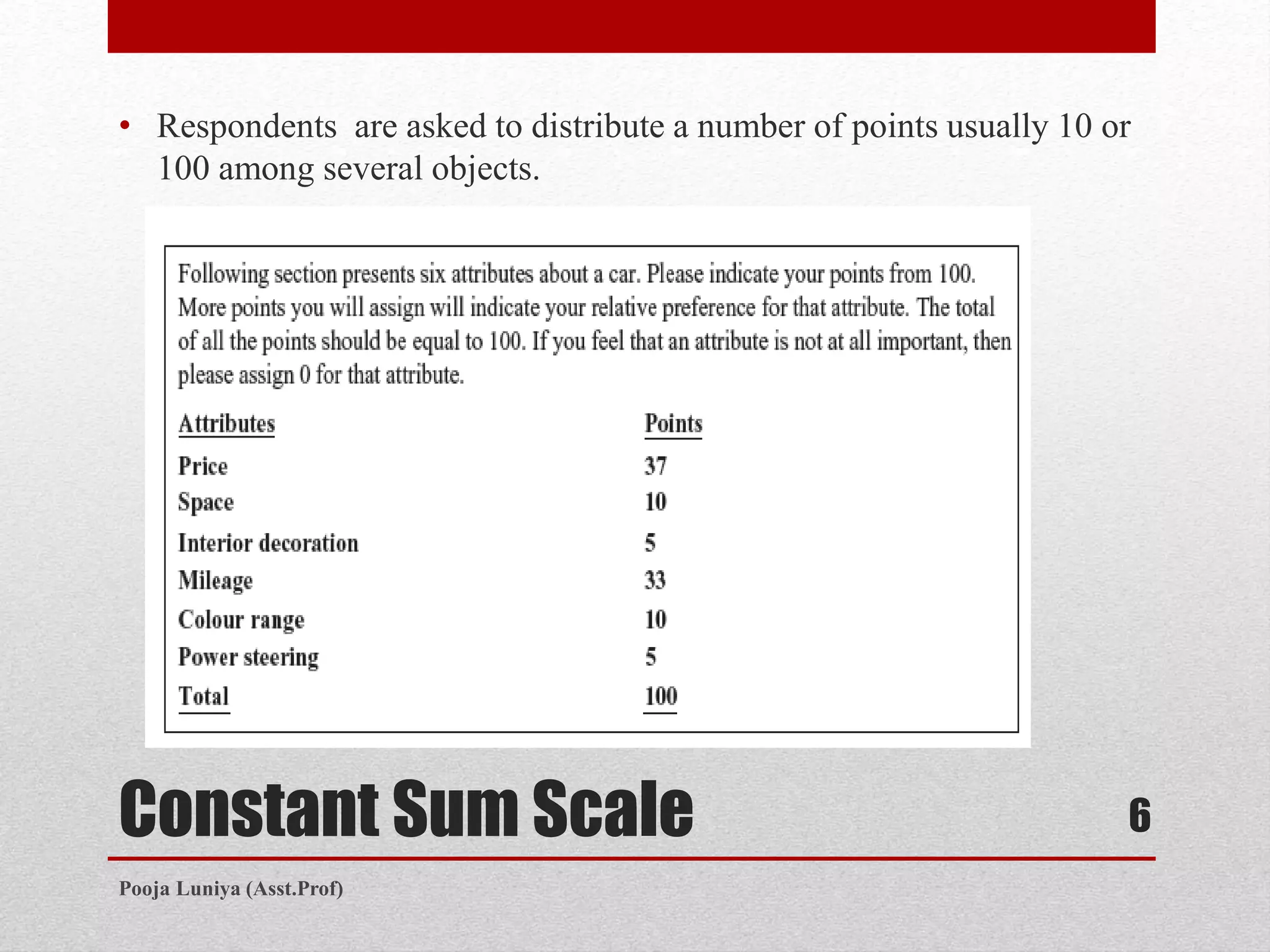
• Respondents are asked to distribute a number of points usually 10 or
100 among several objects.
6
Pooja Luniya (Asst.Prof)
Rank Order Scale
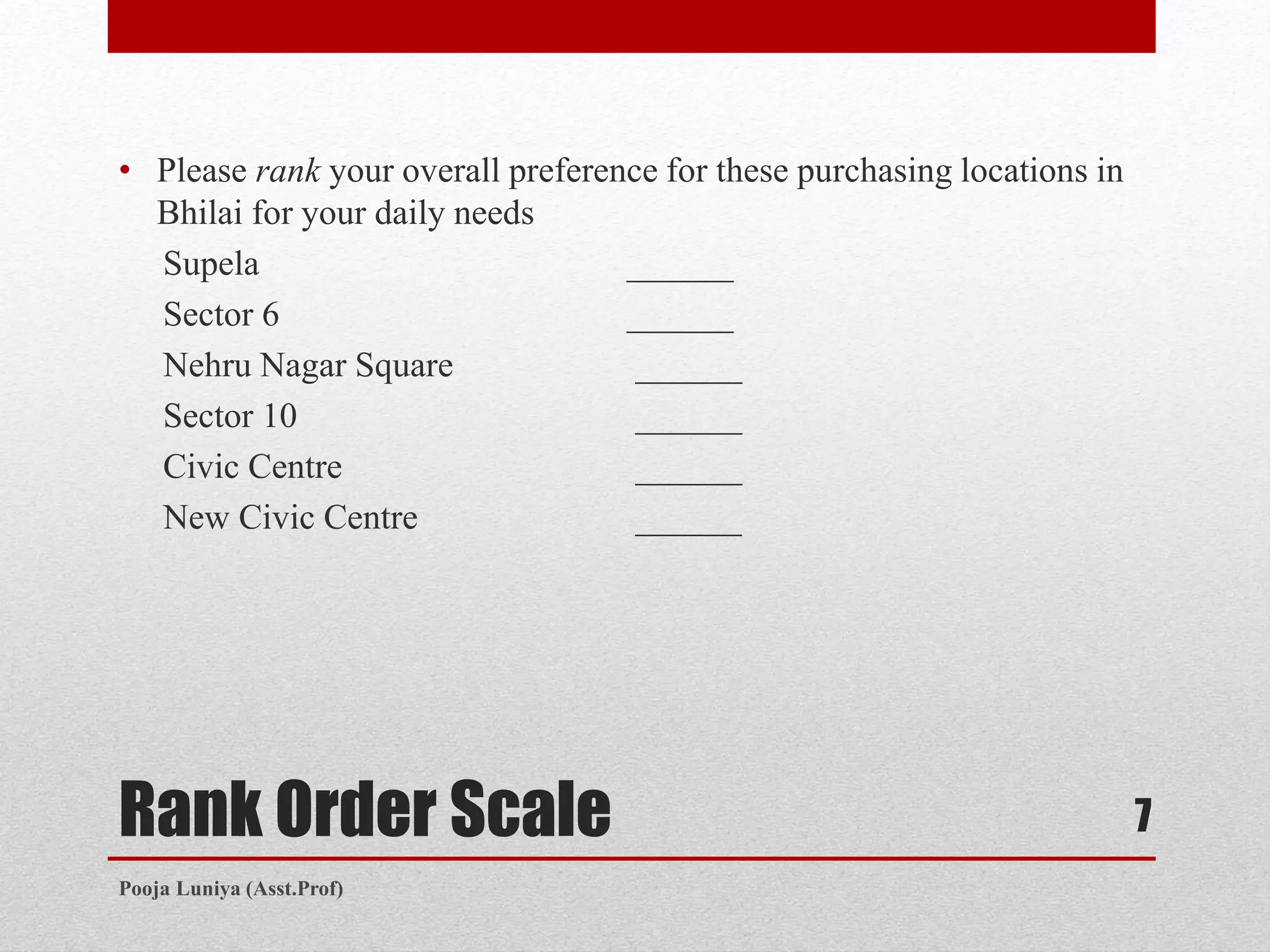
• Please rank your overall preference for these purchasing locations in
Bhilai for your daily needs
Supela ______
Sector 6 ______
Nehru Nagar Square ______
Sector 10 ______
Civic Centre ______
New Civic Centre ______
7
Pooja Luniya (Asst.Prof)
Q-Sort Scale
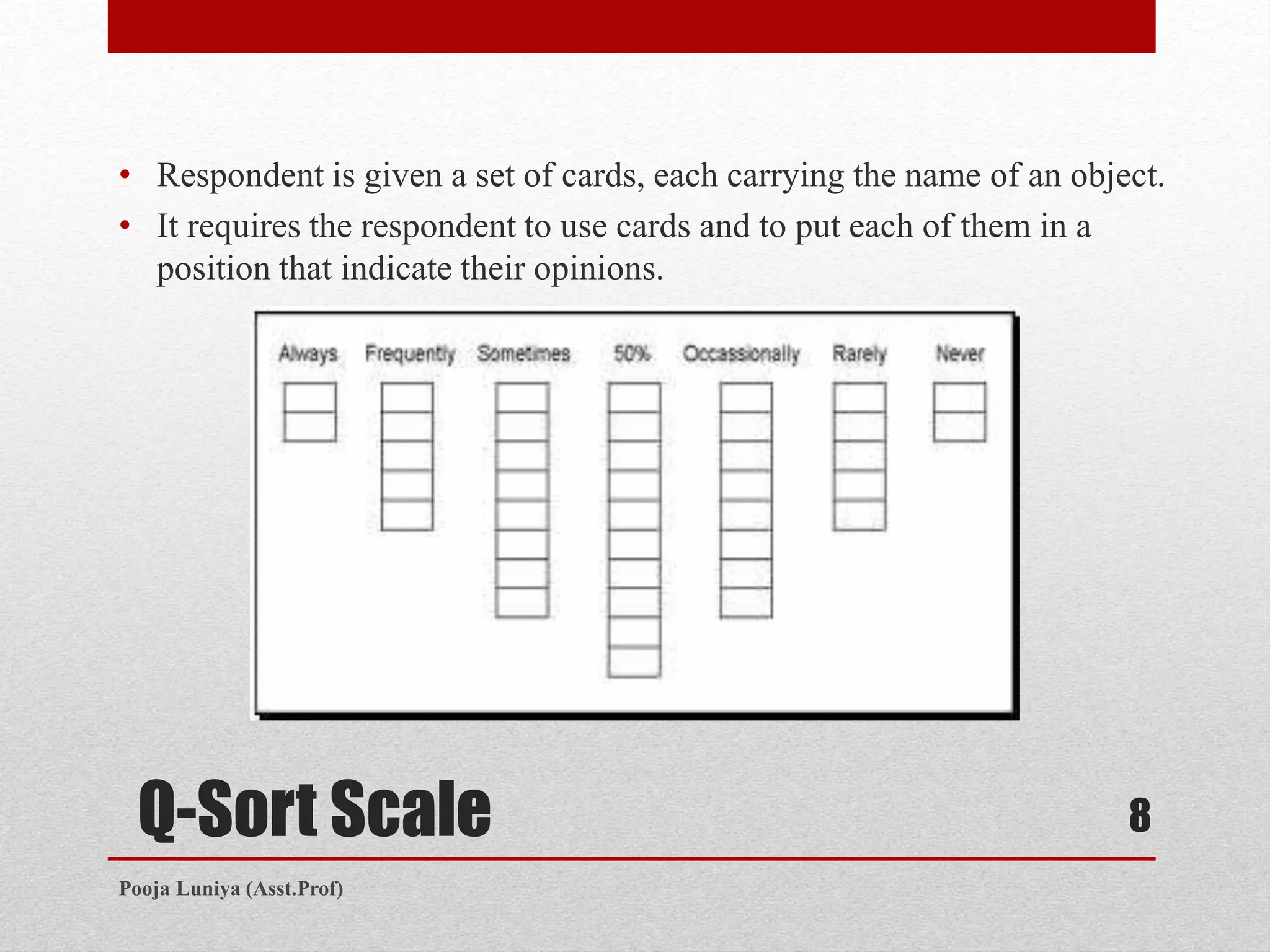
• Respondent is given a set of cards, each carrying the name of an object.
• It requires the respondent to use cards and to put each of them in a
position that indicate their opinions.
Cheap
Good
Smell
Good
Qlty
Easily
Availble
Conve-
nient
1 2 3 4 5
8
Pooja Luniya (Asst.Prof)
Non comparative scale
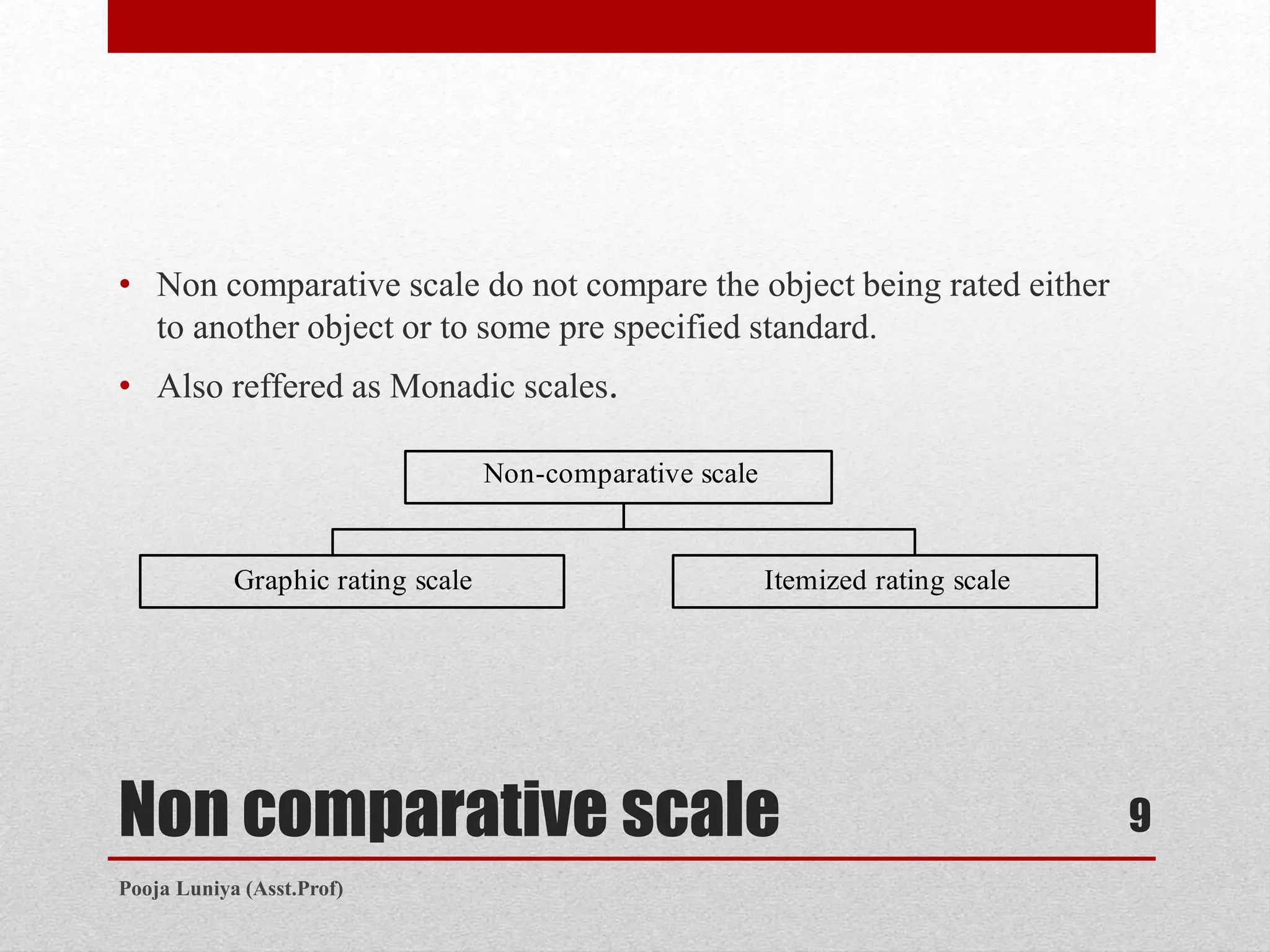
• Non comparative scale do not compare the object being rated either
to another object or to some pre specified standard.
• Also reffered as Monadic scales.
Non-comparative scale
Graphic rating scale Itemized rating scale
9
Pooja Luniya (Asst.Prof)
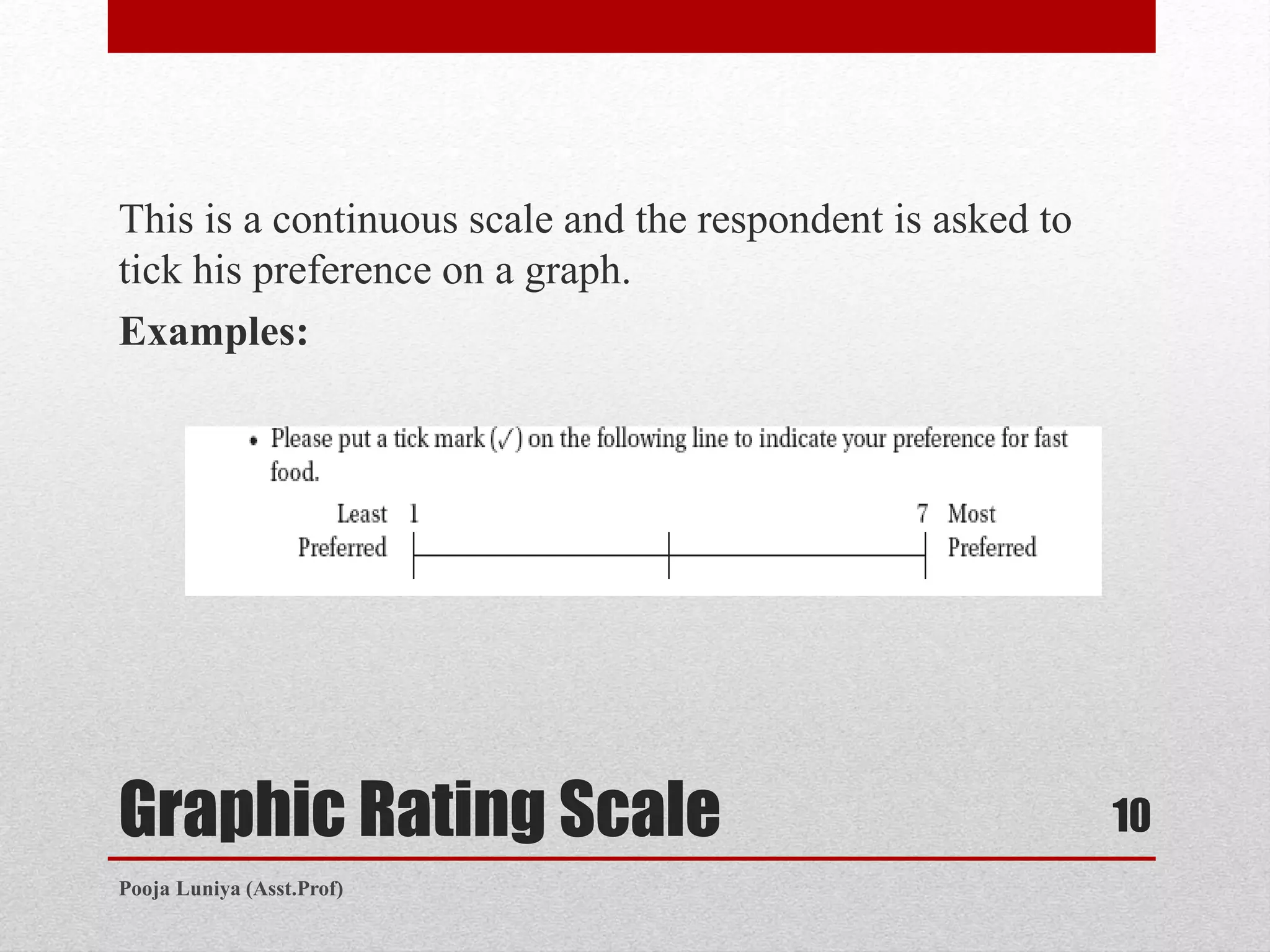
Graphic Rating Scale
This is a continuous scale and the respondent is asked to
tick his preference on a graph.
Examples:
10
Pooja Luniya (Asst.Prof)
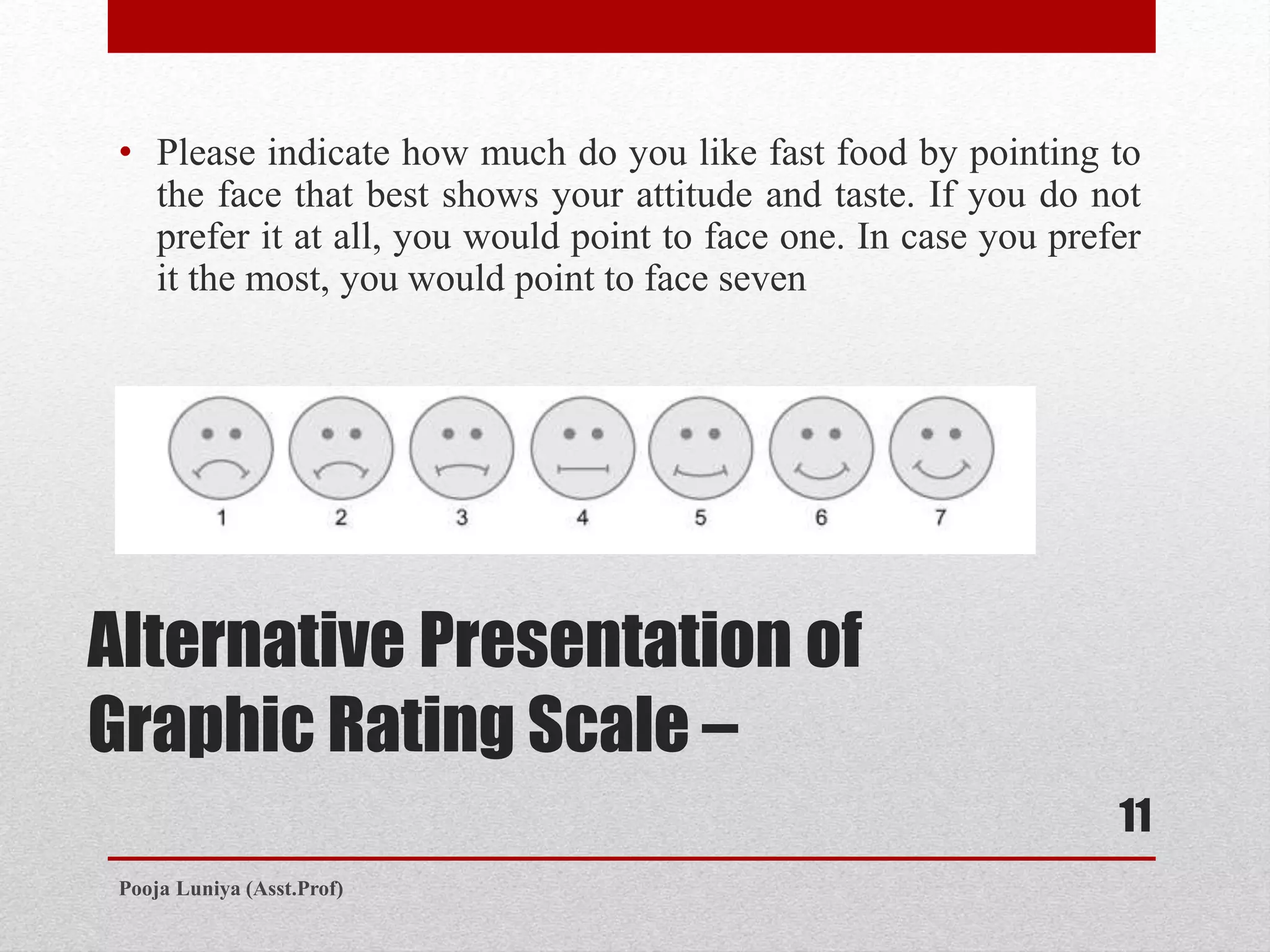
Alternative Presentation of
Graphic Rating Scale –
• Please indicate how much do you like fast food by pointing to
the face that best shows your attitude and taste. If you do not
prefer it at all, you would point to face one. In case you prefer
it the most, you would point to face seven
11
Pooja Luniya (Asst.Prof)
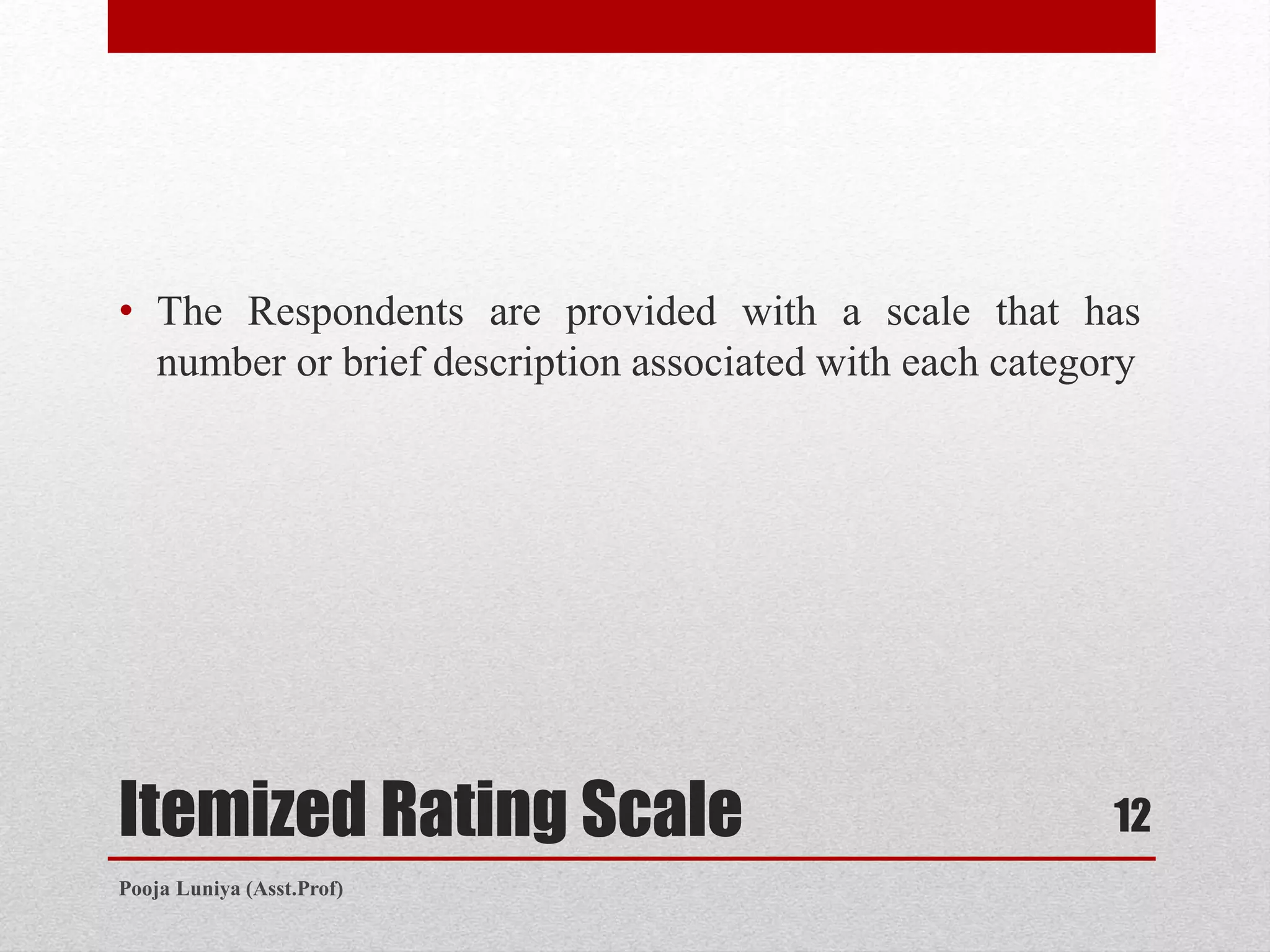
Itemized Rating Scale
• The Respondents are provided with a scale that has
number or brief description associated with each category
12
Pooja Luniya (Asst.Prof)
Likert Scaling
 The respondents are given a certain number of items (statements) on
which they are asked to express their degree of agreement/disagreement.
 This is also called a summated scale because the scores on individual
items can be added together to produce a total score for the respondent.
 An assumption of the Likert scale is that each of the items (statements)
measures some aspect of a single common factor, otherwise the scores on
the items cannot legitimately be summed up.
 In a typical research study, there are generally 25 to 30 items on a Likert
scale.
13
Pooja Luniya (Asst.Prof)
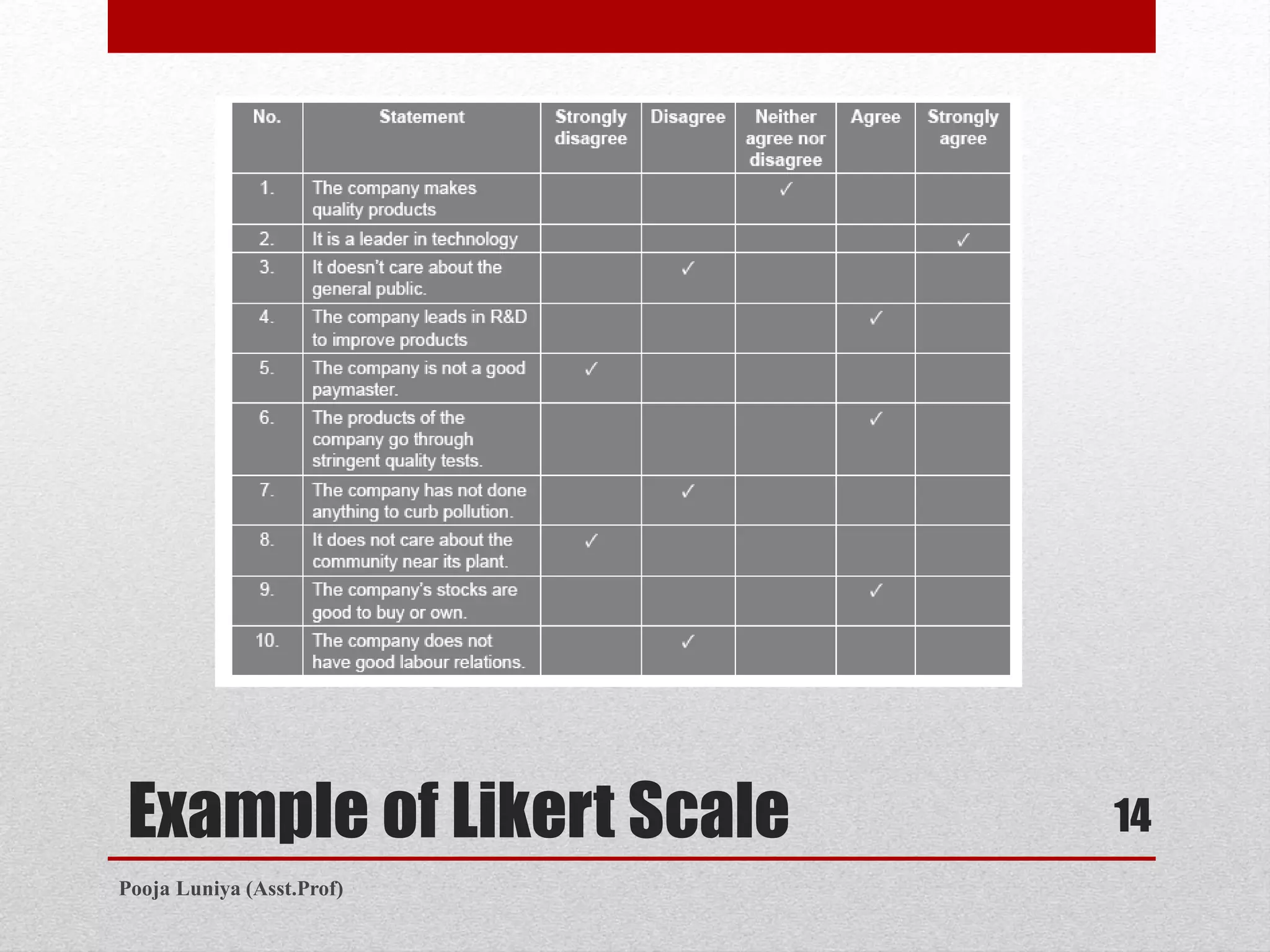
Example of Likert Scale 14
Pooja Luniya (Asst.Prof)
Semantic Differential Scale
 Here the respondent is required to rate each attitude or object
on a number of five-or seven-point rating scales.
 This scale is bounded at each end by bipolar adjectives or
phrases.
 The difference between Likert and Semantic differential scale
is that in Likert scale, a number of statements (items) are
presented to the respondents to express their degree of
agreement/disagreement. However, in the semantic
differential scale, bipolar adjectives or phrases are used.
15
Pooja Luniya (Asst.Prof)
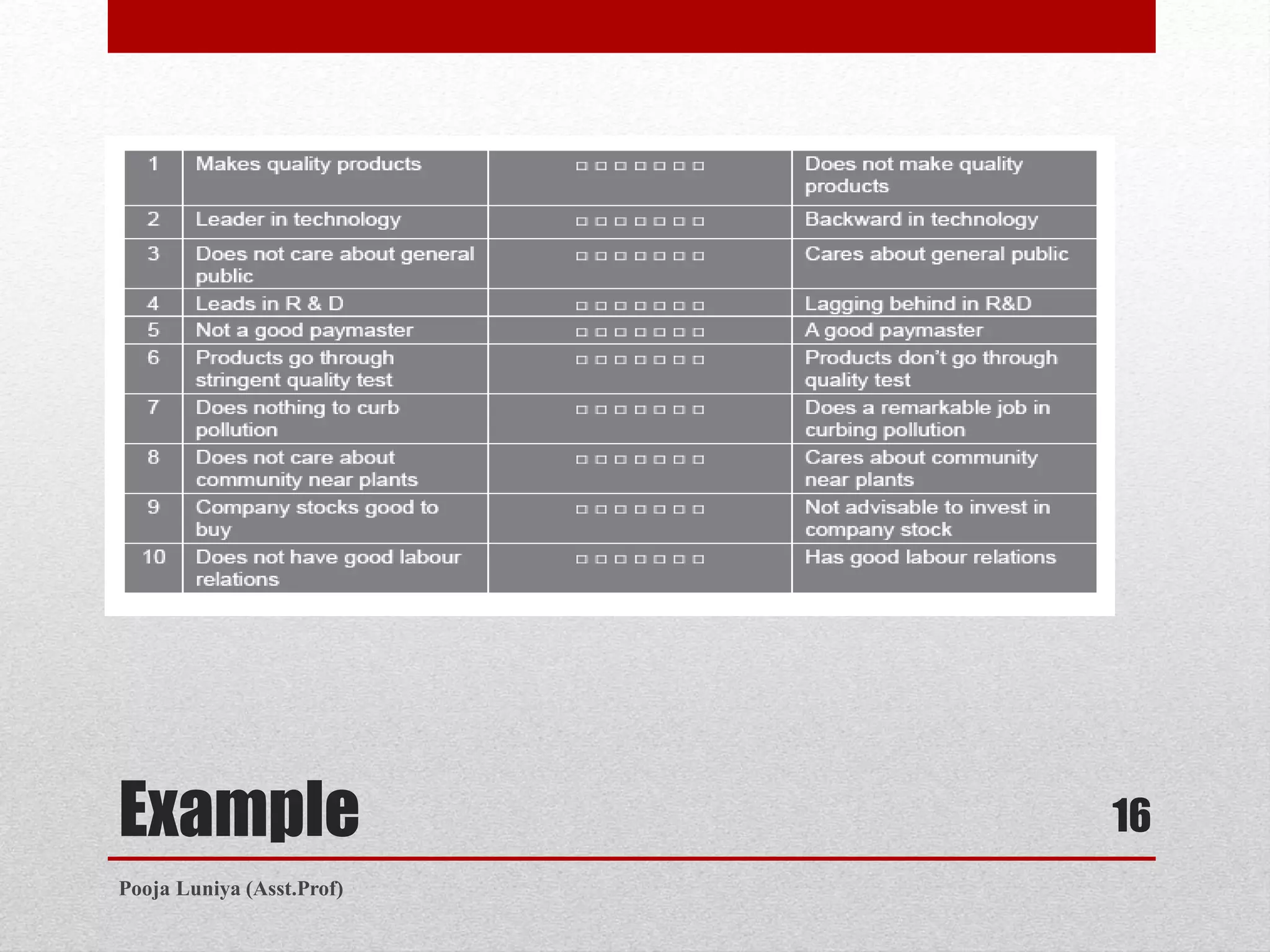
Example 16
Pooja Luniya (Asst.Prof)
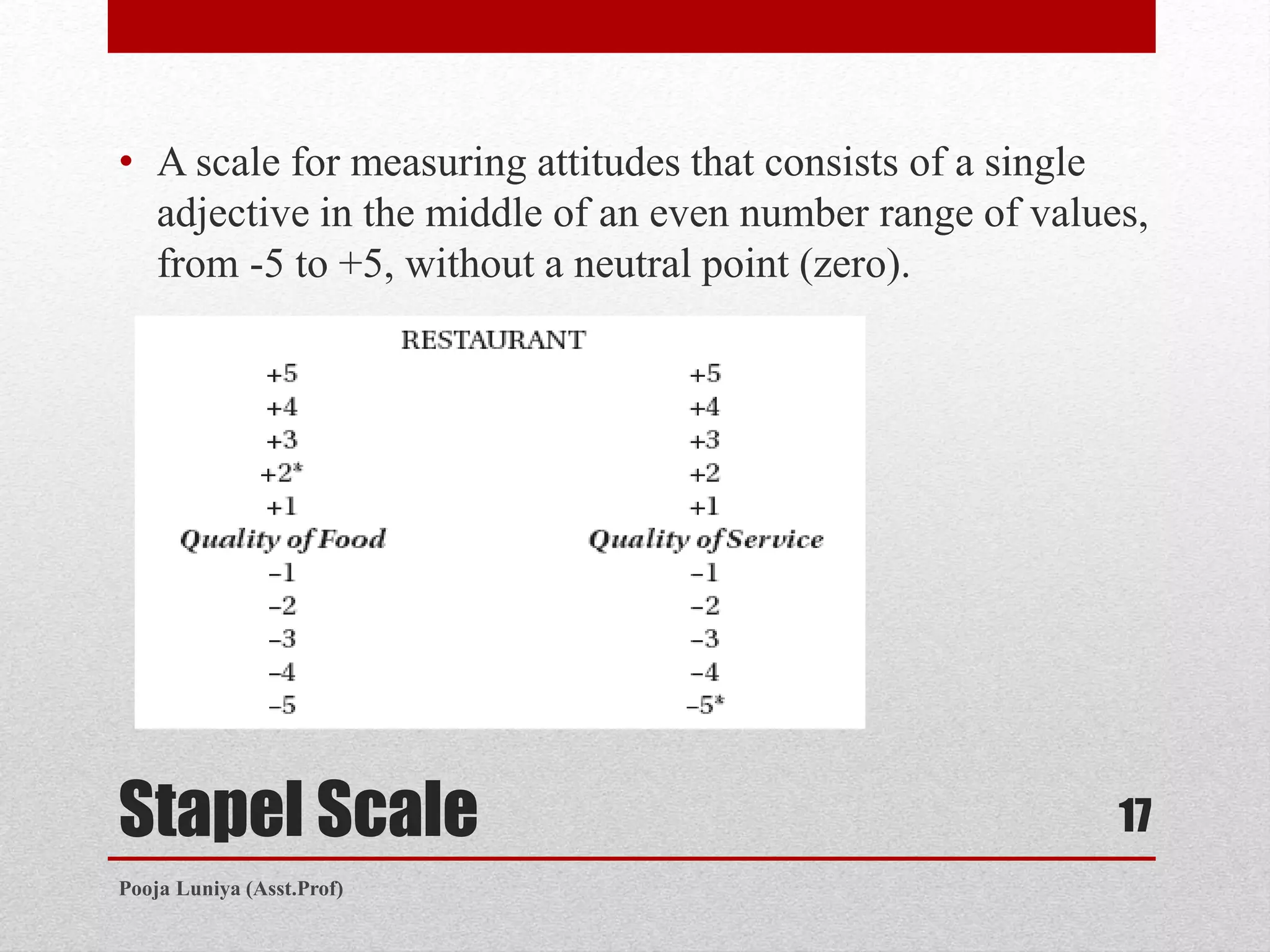
Stapel Scale
• A scale for measuring attitudes that consists of a single
adjective in the middle of an even number range of values,
from -5 to +5, without a neutral point (zero).
17
Pooja Luniya (Asst.Prof)
18
Pooja Luniya (Asst.Prof)

Scaling techniques

  • 1.
    BBA Vth Sem. MarketingResearch : Attitude Measurement and Scaling Techniques Pooja Luniya (Asst. Prof.) GD. Rungta College of Science & Technology.
  • 2.
    Attitude and itsComponents • Attitude is the predisposition of the Individual to evaluate some symbol or object or aspect of his world in a favorable manner. Components of Attitude: • Cognitive component: Respondent is aware about a given object • Affective component: Indicates liking and preferences for an object • Behavioral Component: Intention or action component 2 Pooja Luniya (Asst.Prof)
  • 3.
    Scaling • Scaling describesthe procedures of assigning numbers to various degrees of opinion, attitude and other concepts. • It consists of the highest point (in terms of some characteristic e.g., preference, favourableness, etc.) and the lowest point along with several intermediate points between these two extreme points. 3 Pooja Luniya (Asst.Prof)
  • 4.
    Important Scaling Techniques4 Pooja Luniya (Asst.Prof)
  • 5.
    Paired Comparison Scale •Comparative scales are based on the direct comparison of stimulus and generally generate some ranking or ordinal data. • Respondents are forced to choose between the given choices. • The respondent is asked to select the object( out of two) which best fits a particular criterion. • Which of the two brands of detergent you would prefer ▫ Tide | Wheel 5 Pooja Luniya (Asst.Prof)
  • 6.
    Constant Sum Scale •Respondents are asked to distribute a number of points usually 10 or 100 among several objects. 6 Pooja Luniya (Asst.Prof)
  • 7.
    Rank Order Scale •Please rank your overall preference for these purchasing locations in Bhilai for your daily needs Supela ______ Sector 6 ______ Nehru Nagar Square ______ Sector 10 ______ Civic Centre ______ New Civic Centre ______ 7 Pooja Luniya (Asst.Prof)
  • 8.
    Q-Sort Scale • Respondentis given a set of cards, each carrying the name of an object. • It requires the respondent to use cards and to put each of them in a position that indicate their opinions. Cheap Good Smell Good Qlty Easily Availble Conve- nient 1 2 3 4 5 8 Pooja Luniya (Asst.Prof)
  • 9.
    Non comparative scale •Non comparative scale do not compare the object being rated either to another object or to some pre specified standard. • Also reffered as Monadic scales. Non-comparative scale Graphic rating scale Itemized rating scale 9 Pooja Luniya (Asst.Prof)
  • 10.
    Graphic Rating Scale Thisis a continuous scale and the respondent is asked to tick his preference on a graph. Examples: 10 Pooja Luniya (Asst.Prof)
  • 11.
    Alternative Presentation of GraphicRating Scale – • Please indicate how much do you like fast food by pointing to the face that best shows your attitude and taste. If you do not prefer it at all, you would point to face one. In case you prefer it the most, you would point to face seven 11 Pooja Luniya (Asst.Prof)
  • 12.
    Itemized Rating Scale •The Respondents are provided with a scale that has number or brief description associated with each category 12 Pooja Luniya (Asst.Prof)
  • 13.
    Likert Scaling  Therespondents are given a certain number of items (statements) on which they are asked to express their degree of agreement/disagreement.  This is also called a summated scale because the scores on individual items can be added together to produce a total score for the respondent.  An assumption of the Likert scale is that each of the items (statements) measures some aspect of a single common factor, otherwise the scores on the items cannot legitimately be summed up.  In a typical research study, there are generally 25 to 30 items on a Likert scale. 13 Pooja Luniya (Asst.Prof)
  • 14.
    Example of LikertScale 14 Pooja Luniya (Asst.Prof)
  • 15.
    Semantic Differential Scale Here the respondent is required to rate each attitude or object on a number of five-or seven-point rating scales.  This scale is bounded at each end by bipolar adjectives or phrases.  The difference between Likert and Semantic differential scale is that in Likert scale, a number of statements (items) are presented to the respondents to express their degree of agreement/disagreement. However, in the semantic differential scale, bipolar adjectives or phrases are used. 15 Pooja Luniya (Asst.Prof)
  • 16.
  • 17.
    Stapel Scale • Ascale for measuring attitudes that consists of a single adjective in the middle of an even number range of values, from -5 to +5, without a neutral point (zero). 17 Pooja Luniya (Asst.Prof)
  • 18.