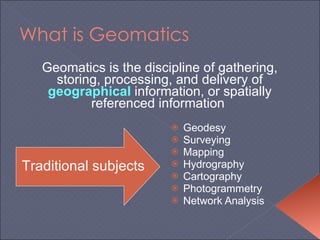
What is Geomatics Geomatics is the discipline of gathering, storing, processing, and delivery of  geographical  information, or spatially referenced information  Geodesy  Surveying  Mapping  Hydrography Cartography  Photogrammetry  Network Analysis Traditional subjects
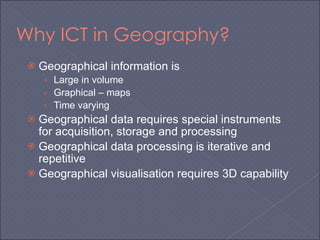
Why ICT in Geography? Geographical information is Large in volume Graphical – maps Time varying Geographical data requires special instruments for acquisition, storage and processing Geographical data processing is iterative and repetitive Geographical visualisation requires 3D capability
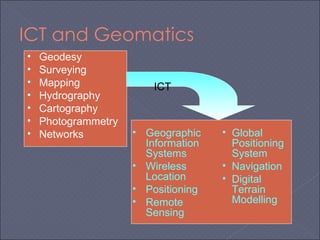
ICT and Geomatics Geodesy  Surveying  Mapping  Hydrography Cartography  Photogrammetry  Networks Geographic Information Systems Wireless Location Positioning  Remote Sensing Global Positioning System  Navigation Digital Terrain Modelling  ICT
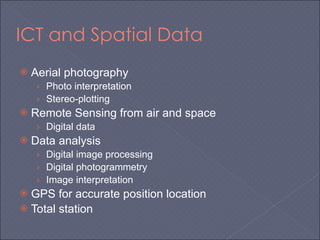
ICT and Spatial Data Aerial photography  Photo interpretation Stereo-plotting Remote Sensing from air and space Digital data Data analysis Digital image processing Digital photogrammetry Image interpretation GPS for accurate position location Total station
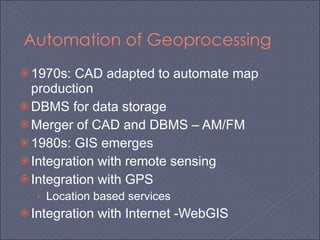
Automation of Geoprocessing 1970s: CAD adapted to automate map production DBMS for data storage Merger of CAD and DBMS – AM/FM 1980s: GIS emerges Integration with remote sensing Integration with GPS Location based services Integration with Internet -WebGIS
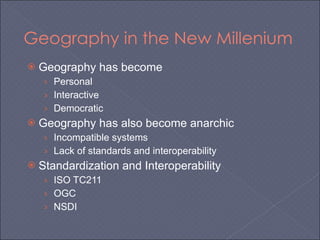
Geography in the New Millenium Geography has become  Personal Interactive Democratic Geography has also become anarchic Incompatible systems Lack of standards and interoperability Standardization and Interoperability ISO TC211 OGC NSDI
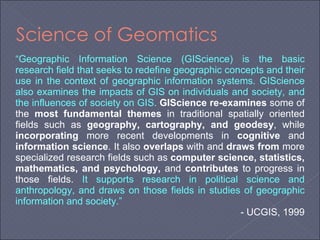
Science of Geomatics “ Geographic Information Science (GIScience) is the basic research field that seeks to redefine geographic concepts and their use in the context of geographic information systems. GIScience also examines the impacts of GIS on individuals and society, and the influences of society on GIS.   GIScience   re-examines  some of the  most fundamental themes  in traditional spatially oriented fields such as  geography, cartography, and geodesy , while  incorporating  more recent developments in  cognitive  and  information science . It also  overlaps  with and  draws from  more specialized research fields such as  computer science, statistics, mathematics, and psychology,  and  contributes  to progress in those fields.  It supports research in political science and anthropology, and draws on those fields in studies of geographic information and society.”   - UCGIS, 1999
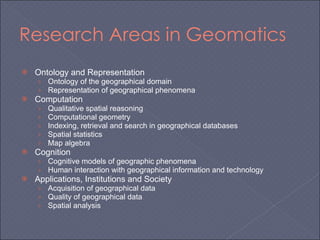
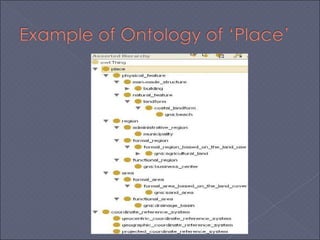
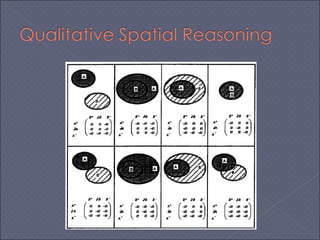
Research Areas in Geomatics Ontology and Representation Ontology of the geographical domain Representation of geographical phenomena Computation Qualitative spatial reasoning Computational geometry Indexing, retrieval and search in geographical databases Spatial statistics Map algebra Cognition Cognitive models of geographic phenomena Human interaction with geographical information and technology Applications, Institutions and Society Acquisition of geographical data Quality of geographical data Spatial analysis
 
 
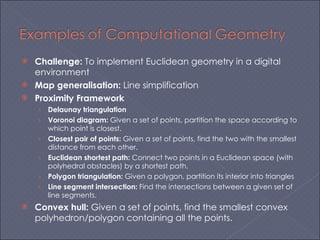
Challenge:  To implement Euclidean geometry in a digital environment Map generalisation:  Line simplification Proximity Framework Delaunay triangulation Voronoi diagram:  Given a set of points, partition the space according to which point is closest. Closest pair of points:  Given a set of points, find the two with the smallest distance from each other. Euclidean shortest path:  Connect two points in a Euclidean space (with polyhedral obstacles) by a shortest path. Polygon triangulation:  Given a polygon, partition its interior into triangles Line segment intersection:  Find the intersections between a given set of line segments. Convex hull:  Given a set of points, find the smallest convex polyhedron/polygon containing all the points.
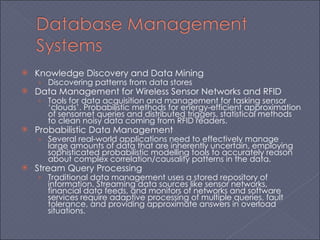
Knowledge Discovery and Data Mining Discovering patterns from data stores Data Management for Wireless Sensor Networks and RFID Tools for data acquisition and management for tasking sensor ‘clouds’. Probabilistic methods for energy-efficient approximation of sensornet queries and distributed triggers, statistical methods to clean noisy data coming from RFID readers.  Probabilistic Data Management Several real-world applications need to effectively manage large amounts of data that are inherently uncertain, employing sophisticated probabilistic modelling tools to accurately reason about complex correlation/causality patterns in the data.  Stream Query Processing Traditional data management uses a stored repository of information. Streaming data sources like sensor networks, financial data feeds, and monitors of networks and software services require adaptive processing of multiple queries, fault tolerance, and providing approximate answers in overload situations.
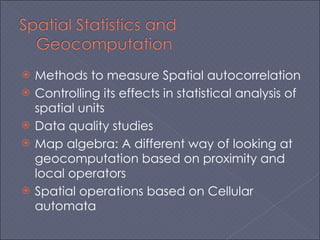
Methods to measure Spatial autocorrelation Controlling its effects in statistical analysis of spatial units Data quality studies Map algebra: A different way of looking at geocomputation based on proximity and local operators Spatial operations based on Cellular automata
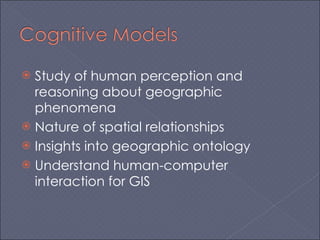
Study of human perception and reasoning about geographic phenomena Nature of spatial relationships Insights into geographic ontology Understand human-computer interaction for GIS
Computer Aided Design and Modelling: Rendering: Image based rendering. Vision realistic rendering. Computational photography and video. Visualization: Scientific and information visualization. Virtual environments, tele-immersive environments Animation: Motion capture analysis and synthesis. Physically based simulation.  Context-aware computing: Activity analysis, Smart Spaces, Location-aware systems, Privacy technologies. Perceptual Interfaces: Vision-based interfaces, speech and discourse interfaces. Collaboration and Learning: Geographically distributed tele-immersive collaboration. Optometry and Human Vision Simulation: Medical imaging, virtual environments for surgical simulation
Parallel computing Languages and numerical algorithms for parallel computers Automatic Performance Tuning Automatic generation of optimized implementations of computational and communication kernels, tuned for particular architectures and work loads. Mesh generation Automatic generation of triangulated meshes to represent physical and computational domains. Matrix computations Numerical algorithms and software for fast and accurate numerical linear algebra. Floating point Extended precision arithmetic. Reliable floating point standards. Architectural and run time implications of floating point standards. Programming language implications of floating point standards. Animation Computer Algebra Methods for symbolic mathematical computation.
Cryptology Privacy Social implications of security Sensor web security Security, programming languages, and software engineering Human interfaces and security Identity and integrity Network security Research Centers
For more information: A. R. Dasgupta Distinguished Professor, Bhaskaracharya Institute for Space Applications and Geoinformatics, Gandhinagar 382007 Email: arup@ ieee.org Fax: +91-(79)-23213091 Phone: +91-98253-29382 Thank You

Research Areas In Geomatics

  • 1.
  • 2.
    What is GeomaticsGeomatics is the discipline of gathering, storing, processing, and delivery of geographical information, or spatially referenced information Geodesy Surveying Mapping Hydrography Cartography Photogrammetry Network Analysis Traditional subjects
  • 3.
    Why ICT inGeography? Geographical information is Large in volume Graphical – maps Time varying Geographical data requires special instruments for acquisition, storage and processing Geographical data processing is iterative and repetitive Geographical visualisation requires 3D capability
  • 4.
    ICT and GeomaticsGeodesy Surveying Mapping Hydrography Cartography Photogrammetry Networks Geographic Information Systems Wireless Location Positioning Remote Sensing Global Positioning System Navigation Digital Terrain Modelling ICT
  • 5.
    ICT and SpatialData Aerial photography Photo interpretation Stereo-plotting Remote Sensing from air and space Digital data Data analysis Digital image processing Digital photogrammetry Image interpretation GPS for accurate position location Total station
  • 6.
    Automation of Geoprocessing1970s: CAD adapted to automate map production DBMS for data storage Merger of CAD and DBMS – AM/FM 1980s: GIS emerges Integration with remote sensing Integration with GPS Location based services Integration with Internet -WebGIS
  • 7.
    Geography in theNew Millenium Geography has become Personal Interactive Democratic Geography has also become anarchic Incompatible systems Lack of standards and interoperability Standardization and Interoperability ISO TC211 OGC NSDI
  • 8.
    Science of Geomatics“ Geographic Information Science (GIScience) is the basic research field that seeks to redefine geographic concepts and their use in the context of geographic information systems. GIScience also examines the impacts of GIS on individuals and society, and the influences of society on GIS. GIScience re-examines some of the most fundamental themes in traditional spatially oriented fields such as geography, cartography, and geodesy , while incorporating more recent developments in cognitive and information science . It also overlaps with and draws from more specialized research fields such as computer science, statistics, mathematics, and psychology, and contributes to progress in those fields. It supports research in political science and anthropology, and draws on those fields in studies of geographic information and society.” - UCGIS, 1999
  • 9.
    Research Areas inGeomatics Ontology and Representation Ontology of the geographical domain Representation of geographical phenomena Computation Qualitative spatial reasoning Computational geometry Indexing, retrieval and search in geographical databases Spatial statistics Map algebra Cognition Cognitive models of geographic phenomena Human interaction with geographical information and technology Applications, Institutions and Society Acquisition of geographical data Quality of geographical data Spatial analysis
  • 10.
  • 11.
  • 12.
    Challenge: Toimplement Euclidean geometry in a digital environment Map generalisation: Line simplification Proximity Framework Delaunay triangulation Voronoi diagram: Given a set of points, partition the space according to which point is closest. Closest pair of points: Given a set of points, find the two with the smallest distance from each other. Euclidean shortest path: Connect two points in a Euclidean space (with polyhedral obstacles) by a shortest path. Polygon triangulation: Given a polygon, partition its interior into triangles Line segment intersection: Find the intersections between a given set of line segments. Convex hull: Given a set of points, find the smallest convex polyhedron/polygon containing all the points.
  • 13.
    Knowledge Discovery andData Mining Discovering patterns from data stores Data Management for Wireless Sensor Networks and RFID Tools for data acquisition and management for tasking sensor ‘clouds’. Probabilistic methods for energy-efficient approximation of sensornet queries and distributed triggers, statistical methods to clean noisy data coming from RFID readers. Probabilistic Data Management Several real-world applications need to effectively manage large amounts of data that are inherently uncertain, employing sophisticated probabilistic modelling tools to accurately reason about complex correlation/causality patterns in the data. Stream Query Processing Traditional data management uses a stored repository of information. Streaming data sources like sensor networks, financial data feeds, and monitors of networks and software services require adaptive processing of multiple queries, fault tolerance, and providing approximate answers in overload situations.
  • 14.
    Methods to measureSpatial autocorrelation Controlling its effects in statistical analysis of spatial units Data quality studies Map algebra: A different way of looking at geocomputation based on proximity and local operators Spatial operations based on Cellular automata
  • 15.
    Study of humanperception and reasoning about geographic phenomena Nature of spatial relationships Insights into geographic ontology Understand human-computer interaction for GIS
  • 16.
    Computer Aided Designand Modelling: Rendering: Image based rendering. Vision realistic rendering. Computational photography and video. Visualization: Scientific and information visualization. Virtual environments, tele-immersive environments Animation: Motion capture analysis and synthesis. Physically based simulation. Context-aware computing: Activity analysis, Smart Spaces, Location-aware systems, Privacy technologies. Perceptual Interfaces: Vision-based interfaces, speech and discourse interfaces. Collaboration and Learning: Geographically distributed tele-immersive collaboration. Optometry and Human Vision Simulation: Medical imaging, virtual environments for surgical simulation
  • 17.
    Parallel computing Languagesand numerical algorithms for parallel computers Automatic Performance Tuning Automatic generation of optimized implementations of computational and communication kernels, tuned for particular architectures and work loads. Mesh generation Automatic generation of triangulated meshes to represent physical and computational domains. Matrix computations Numerical algorithms and software for fast and accurate numerical linear algebra. Floating point Extended precision arithmetic. Reliable floating point standards. Architectural and run time implications of floating point standards. Programming language implications of floating point standards. Animation Computer Algebra Methods for symbolic mathematical computation.
  • 18.
    Cryptology Privacy Socialimplications of security Sensor web security Security, programming languages, and software engineering Human interfaces and security Identity and integrity Network security Research Centers
  • 19.
    For more information:A. R. Dasgupta Distinguished Professor, Bhaskaracharya Institute for Space Applications and Geoinformatics, Gandhinagar 382007 Email: arup@ ieee.org Fax: +91-(79)-23213091 Phone: +91-98253-29382 Thank You