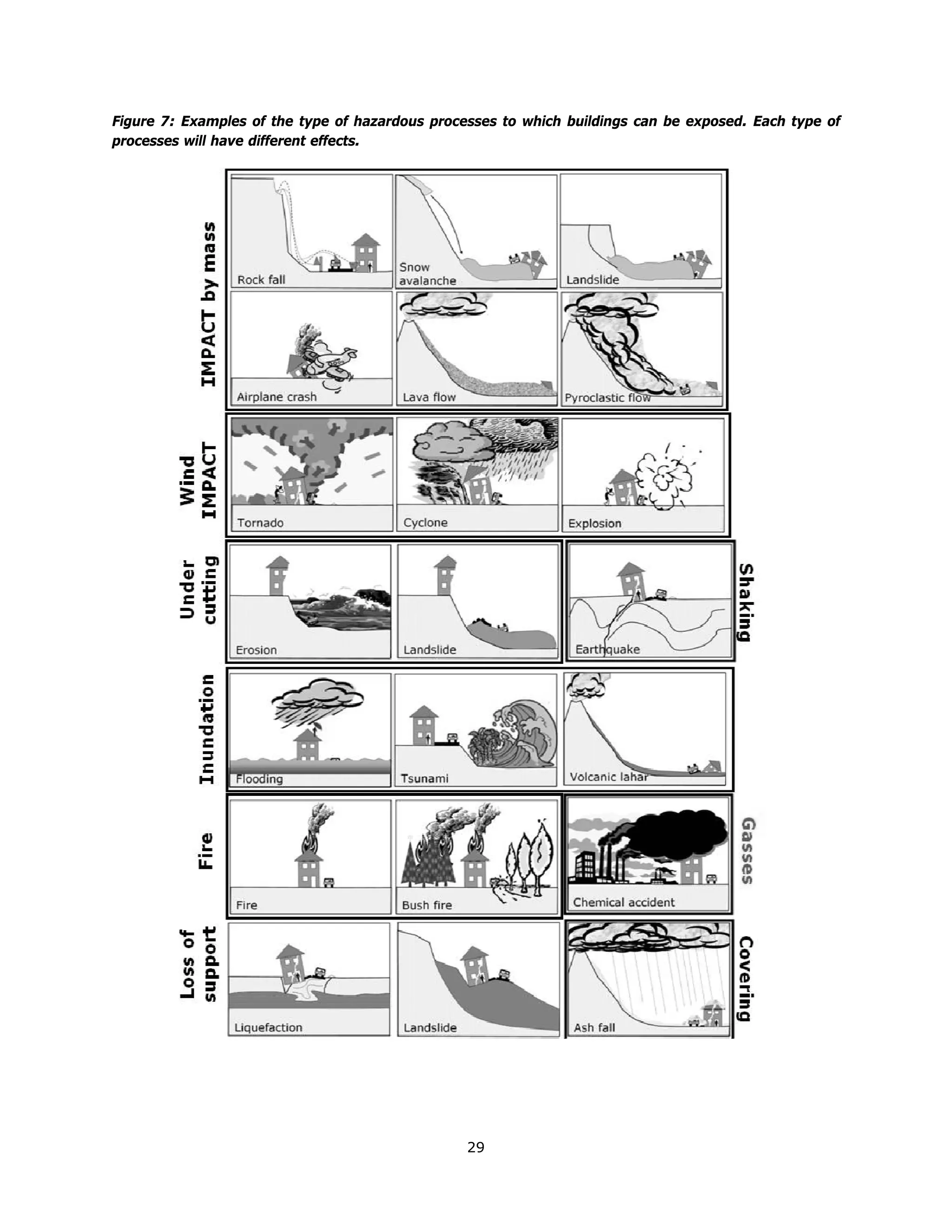
Remote Sensing and GIS for Natural Hazards 
             Assessment and Disaster Risk Management 

                                        Cees J. Van Westen
        Faculty of Geo-Information Science and Earth Observation (ITC), University of Twente
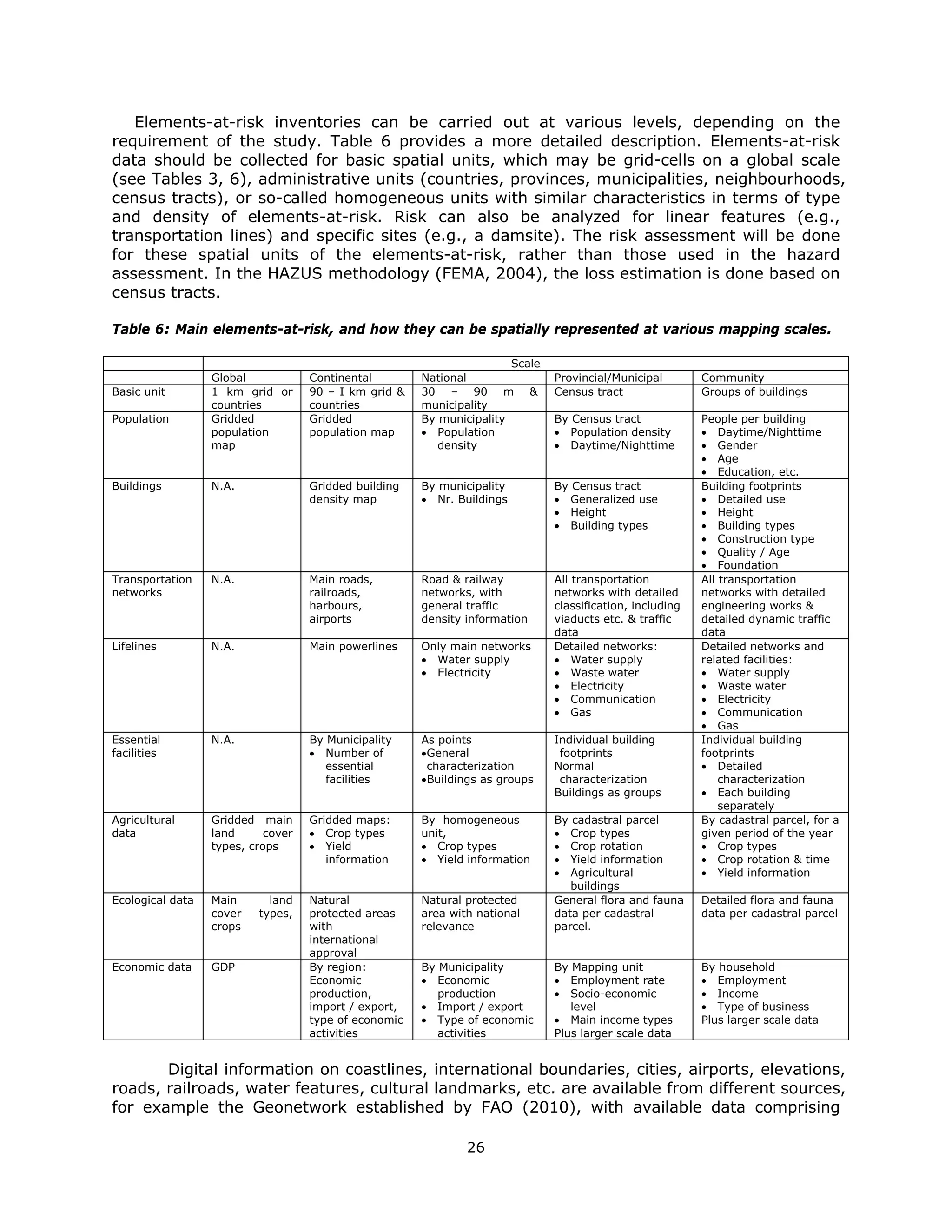
                                        Hengelosestraat 90
                                7500 AA Enschede, The Netherlands
                             Tel: +31534874263, Fax: +31534874336
                                       E-mail: westen@itc.nl

                                                Keywords:
  Community-based Disaster Risk Management, Cyclones, Drought, Damage Assessment, Earthquakes,
Elements at Risk, Flooding, Forest Fires, Geographic Information Systems, Hazard Assessment, Landslides,
    Mobile-GIS, Multi-Hazards, Remote Sensing, Spatial Data, Risk Assessment, Risk Management,
                                         Vulnerability Assessment.

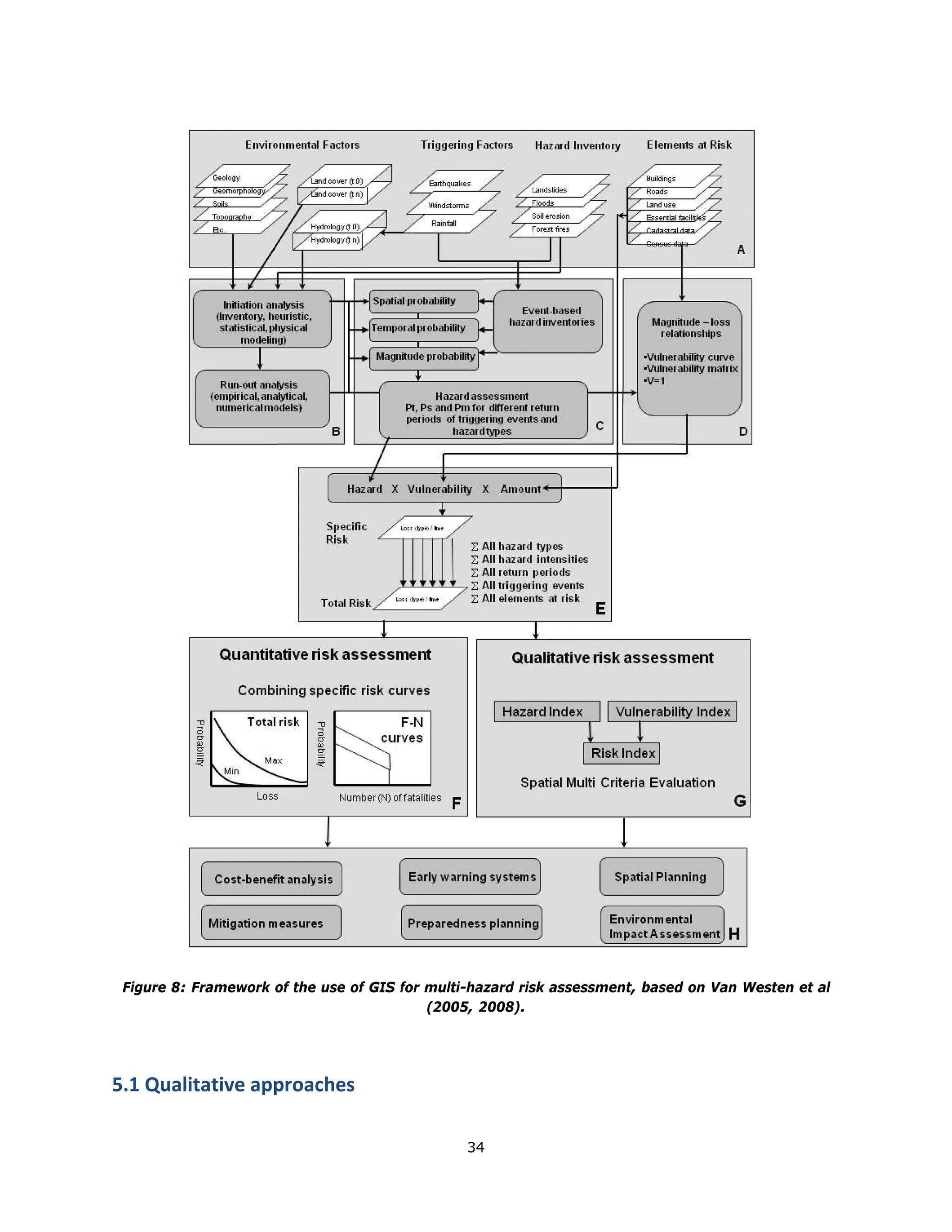
Abstract

The world has experienced an increasing impact of disasters in the past decades. Many regions are
exposed to natural hazards, each with unique characteristics. The main causes for this increase can be
attributed to a higher frequency of extreme hydro-meteorological events, most probably related to
climate change, and to an increase in vulnerable population. To reduce disaster losses, more efforts
should be applied towards Disaster Risk Management, with a focus on hazard assessment, elements-at-
risk mapping, vulnerability and risk assessment, all of which have an important spatial component. Multi-
hazard assessment involves the assessment of relationships between different hazards and especially for
concatenated or cascading hazards. The use of earth observation (EO) products and geographic
information systems (GIS) has become an integrated approach in disaster-risk management. Hazard
and risk assessments are carried out at multiple scales, ranging from global to a community level. These
levels have their own objectives and spatial data requirements for hazard inventories, environmental data,
triggering or causal factors, and elements-at-risk. This chapter provides an overview of various forms of
spatial data, and examines the approaches used for hazard and risk assessment. Specifically, hazard
examples include earthquakes, windstorms, drought, floods, volcanic eruptions, landslides and forest fires.
Several approaches are also treated that have been developed to generate elements-at-risk databases
with emphasis on population and building information, as these are the most used categories for loss
estimation. Furthermore, vulnerability approaches are discussed, with emphasis on the methods used to
define physical vulnerability of buildings and population, and indicator-based approaches used for a
holistic approach, also incorporating social, economic and environmental vulnerability, and capacity.
Finally, multi-hazard risk approaches and spatial risk visualization are addressed. Multi-hazard risk
assessment is a complicated procedure, which requires spatial data on many different aspects and a
multi-disciplinary approach. Within this procedure, geographers and in particular geomorphologists can
play a key-role, as they are able to integrate the spatial information coming from the various disciplines.
The research challenge for geomorphologists is to focus on the integrated modeling of multi-hazards
sharing the same triggering event or occurring as cascading hazards.  

     
1. Introduction  
Disasters are headline news almost every day. Most happen in far-away places, and are rapidly
forgotten. Others keep the attention of the world media for a longer period of time. The events
that receive maximum media attention are those that hit instantaneously and cause
widespread losses and human suffering, such as earthquakes, tsunamis, hurricanes and
floods. Recent examples are the Indian Ocean tsunami (2004), the earthquakes in Pakistan

                                                    1 
 
(2005), Indonesia (2006), China (2008), Haiti (2010) and Japan (2011) and the hurricanes
in the Caribbean and the USA (2005, 2008). On the other hand, there are many serious
geomorphologic hazards that have a slow onset, such as the recent drought in the Horn of
Africa (2011), soil erosion, land degradation, desertification, glacial retreat, sea-level rise,
loss of biodiversity etc. These processes and related events may cause local, regional, and
global impacts in the long run, but receive generally less attention.
        Disasters are defined by the United Nations International Strategy for Disaster Risk
Reduction (UN-ISDR, 2004) as “a serious disruption of the functioning of a community or a
society causing widespread human, material, economic or environmental losses which exceed
the ability of the affected community or society to cope using its own resources”. Although the
term “natural disasters” in its’ strict sense is not correct, as disasters are a consequence of
the interaction between hazards and vulnerable societies, the term is used extensively in
the literature and also in daily use.
        A hazard is defined as “a potentially damaging physical event, phenomenon or human
activity that may cause the loss of life or injury, property damage, social and economic
disruption or environmental degradation”. This event has a probability of occurrence within
a specified period of time and within a given area, and has a given intensity (UN-ISDR,
2004). Hazards can be single, sequential or combined in their origin and effects. Each
hazard is characterised by its location, area affected (size or magnitude), intensity, speed of
onset, duration and frequency. Hazards can be classified in several ways. A possible
subdivision is between natural, human-induced and human-made hazards. Natural hazards
are natural processes or phenomena in the Earth's system (lithosphere, hydrosphere,
biosphere or atmosphere) that may constitute a damaging event (e.g., earthquakes, volcanic
eruptions, hurricanes). A subdivision of natural hazards relates to the main controlling
factors of the hazards leading to a disaster. They may be hydro-meteorological (including
floods and wave surges, storms, droughts and related disasters such as extreme
temperatures and forest/scrub fires, landslides and snow avalanches), geophysical hazards
(resulting from anomalies in the Earth’s surface or subsurface, such as earthquakes,
tsunamis and volcanic eruptions), or biological hazards (related to epidemics and insect
infestations). Human-induced hazards are those resulting from modifications of natural
processes in the Earth's system caused by human activities which accelerate/aggravate the
damage potential (e.g., land degradation, landslides, forest fires). Human-made hazards
originate from technological or industrial accidents, dangerous procedures, infrastructure
failures or certain human activities, which may cause the loss of life or injury, property damage,
social and economic disruption or environmental degradation (e.g., industrial pollution, nuclear
activities and radioactivity, toxic wastes, dam failures; transport, industrial or technological
accidents such as explosions, fires and oil spills).
        The aim of a hazard assessment is to identify the various types of hazards that may
threaten a territory, and to partition the landscape in zones which are characterized by
different expected intensities and frequencies of hazardous processes. In a hazard
assessment several aspects should be evaluated: the triggering event, the areas where
hazards are likely to initiate, the areas where the hazards are likely to spread, the expected
intensity of the hazard and its associated frequency or probability of occurrence. Hazards
may impact vulnerable societies, and may result in physical and other types of damage to
so called “elements-at-risk”. With certain exceptions (e.g. ash clouds affecting air-traffic or
oilspills affecting marine flora and fauna) these impacted elements-at-risk are mostly
located on the earth’s surface. Therefore, the relationship between the hazard events and
surface processes, landforms or materials is a key component to study. Geomorphology
therefore plays a key role in hazard and risk analysis. Geomorphology is the science of
landforms and surface materials and of the processes that have formed or reshaped them.
Geomorphologists investigate the evolution of landscapes, and study the history and the
dynamics of landforms and the processes responsible for creating or modifying them,
through a combination of field observations, physical experiments and numerical modelling.

                                                2 
 
These processes that have shaped the Earth’s surface can be potentially dangerous if they
exceed a certain threshold, e.g. they may result in instability and erosion on slopes, flooding
in river- or coastal areas.
       The study of the endogenic (volcanic eruptions or earthquakes) or exogenic (extreme
meteorological) triggering events causing hazardous processes may be outside of the scope
of geomorphology, as this is the domain of seismologists, volcanologists, meteorologists etc.
Nevertheless, geomorphologists contribute to the reconstruction of the frequency, extent
and intensity of past events, by studying their imprints on landforms and surface materials.
Geomorphologists play a key role in the analysis of how these triggering events result in
hazardous processes on the earth surface. They are specialized in analyzing the possible
spatial extent of future hazardous processes related to a set of environmental factors
(geomorphology, topography, geology, soils, land cover etc.). Examples of this are the
study of potential landslide areas, or the analysis of the effects of surface materials and
landforms in the amplification of seismic waves or liquefaction. Geomorphologists are also
good in modelling the extent of the spreading of hazardous processes over the topography
(e.g. lahar flows, landslide runout, flood extent), based on Digital Elevation Models.
       The study of hazards and risks has a very important spatial component. Certain types
of hazards are restricted to certain geographical regions. Earthquakes occur along active
tectonic-plate margins, and volcanos occur along subduction zones (e.g., around the
margins of the Pacific plate, so-called “Ring of Fire”). Tsunamis occur in the neighborhood of
active-plate margins, but their effects can be felt at considerable distances from their origin,
as the waves can travel long distances. Tropical cyclones (in North America called
“hurricanes” and in Asia called “typhoons”) occur in particular coastal zones. Landslides
occur in hilly and mountainous regions. In the analysis of hazard and risk geo-information
science and earth observation plays an increasingly important role. Remote Sensing is
nowadays an essential tool in monitoring changes in the earth’s surface, oceans and
atmosphere, and is increasingly used as the basis for early warning for hazardous events.
Remote sensing provides the input for thematic information used in hazard modeling, like
topography, lithology, and land cover.
       The use of spatio-temporal data and geographic information technologies have now
become part of an integrated approach to disaster risk management. New GIS algorithms
and analysis/modelling techniques are revolutionising the potential capacity to analyse
hazards, vulnerability and risks. Information technology systems are used for storage,
situation analysis, modelling, and visualization (Twigg, 2004). Disaster-risk management
benefits greatly from the use of geospatial technologies because spatial and temporal
variation can be accounted for, and new methodologies can be developed and fully explored.
One of the key advantages of using GIS-based tools for the risk decision-making process is
the possibility to use ‘what if’ analysis by varying parameters and generating alternative
scenarios in a spatial context (Longley et al., 2005). Earlier publications on this topic can be
found in Wadge et al. (1993), Coppock (1995), Emani (1996), and Kaiser et al. (2003).
       The objective of this chapter is to give an overview of the application of geo-
information science and earth observation in the analysis of hazards and risk. The chapter
starts with a background section discussing disaster trends, and the framework for disaster
risk management. Subsequent sections discuss the use of GIS and remote sensing in the
generation of inventories of past hazardous events, the modelling of hazards, the
generation of elements-at risk databases and the integration of these data in the modeling
of potential losses.


                                               3 
 
2. Background 
Table 1 provides a summary of the various terms that are relevant in the context of this
chapter, relating to disasters, disaster risk and its various components (UN-ISDR,2004). It
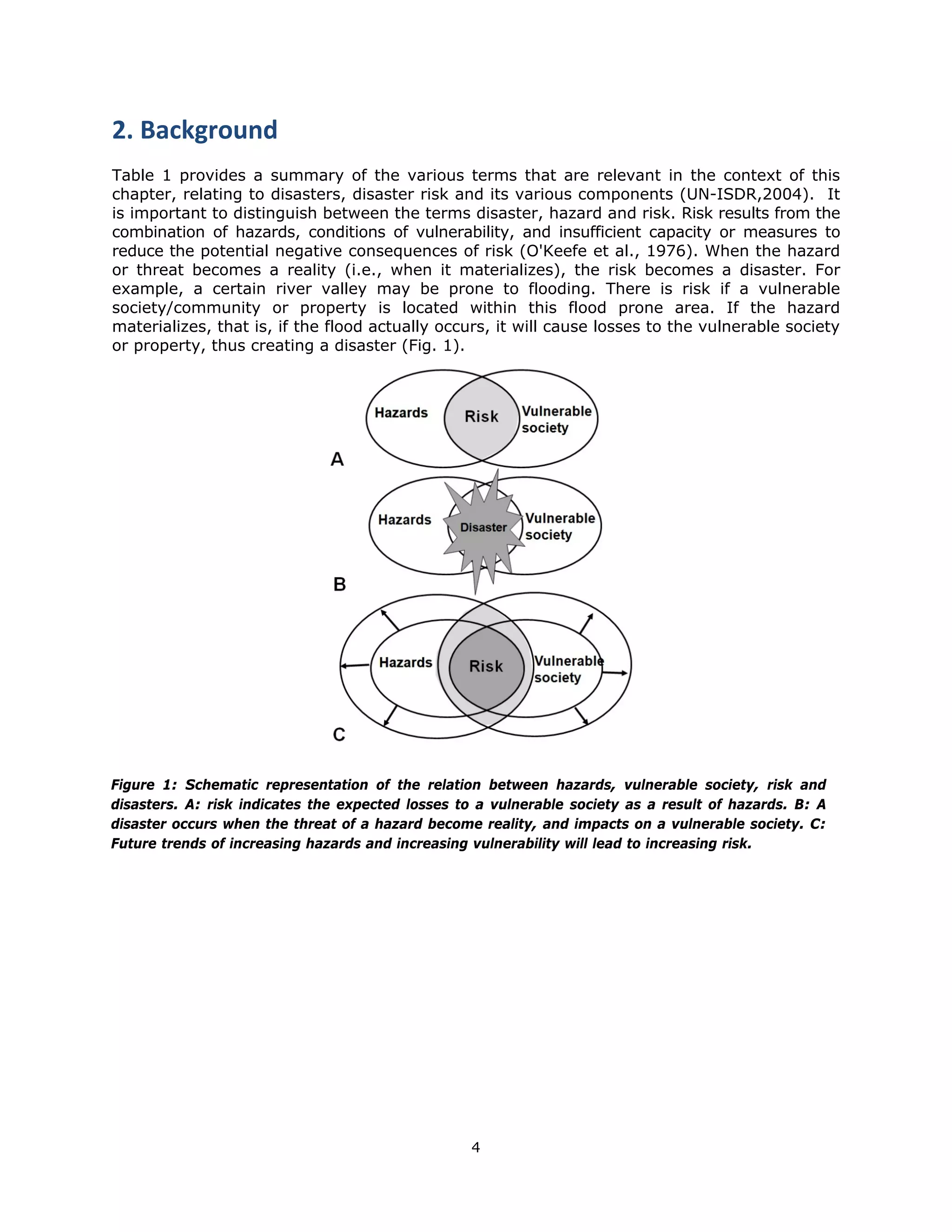
is important to distinguish between the terms disaster, hazard and risk. Risk results from the
combination of hazards, conditions of vulnerability, and insufficient capacity or measures to
reduce the potential negative consequences of risk (O'Keefe et al., 1976). When the hazard
or threat becomes a reality (i.e., when it materializes), the risk becomes a disaster. For
example, a certain river valley may be prone to flooding. There is risk if a vulnerable
society/community or property is located within this flood prone area. If the hazard
materializes, that is, if the flood actually occurs, it will cause losses to the vulnerable society
or property, thus creating a disaster (Fig. 1).


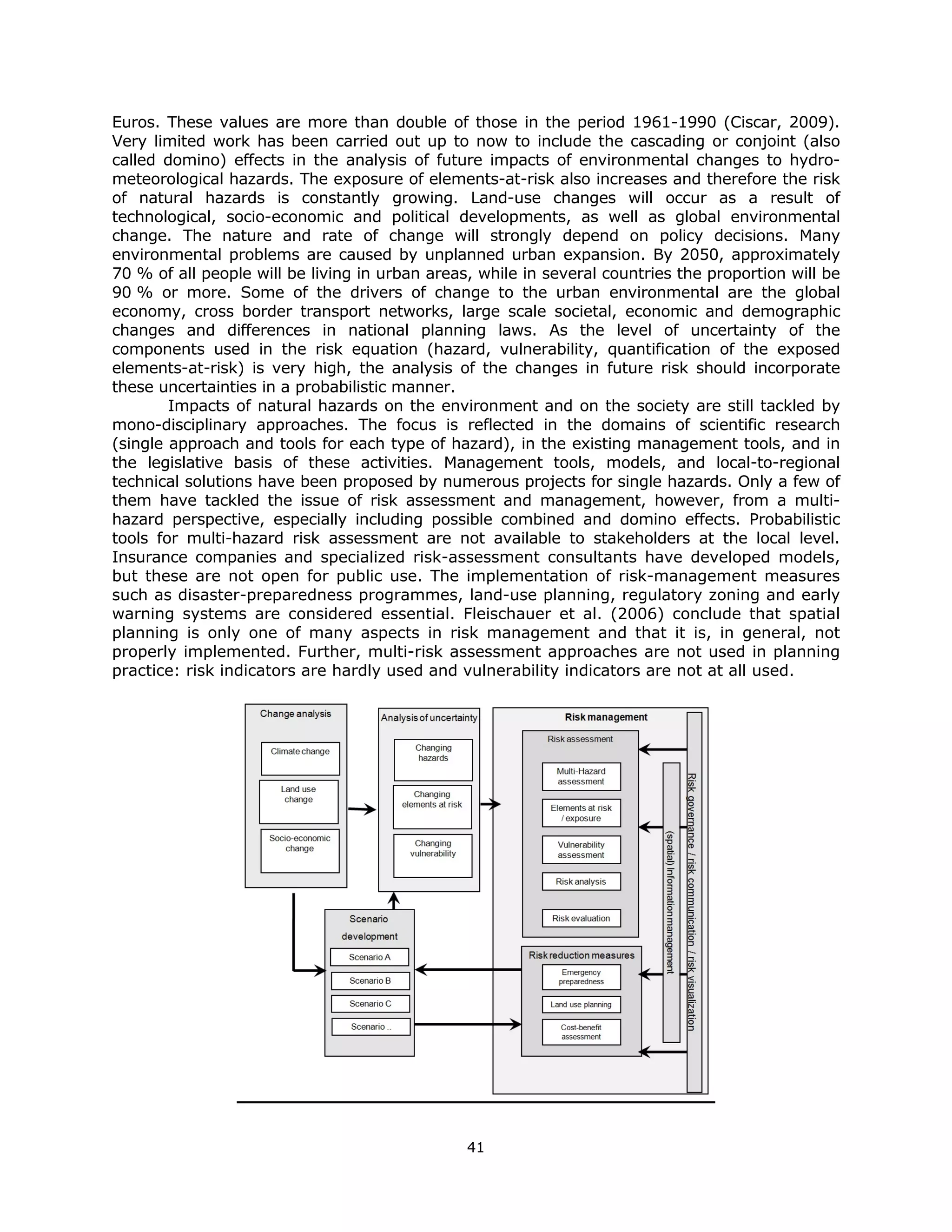
Figure 1: Schematic representation of the relation between hazards, vulnerable society, risk and
disasters. A: risk indicates the expected losses to a vulnerable society as a result of hazards. B: A
disaster occurs when the threat of a hazard become reality, and impacts on a vulnerable society. C:
Future trends of increasing hazards and increasing vulnerability will lead to increasing risk.


                                                  4 
 
Table 1: Summary of definitions related to disasters, hazards and vulnerability. Based on UN-ISDR
                                                   (2004).

    Term               Definition
    Disaster           A serious disruption of the functioning of a community or a society causing widespread
                       human, material, economic or environmental losses which exceed the ability of the affected
                       community or society to cope using its own resources.
    Natural hazard     A potentially damaging physical event, phenomenon or human activity that may cause loss
                       of life or injury, property damage, social and economic disruption or environmental
                       degradation. This event has a probability of occurrence within a specified period of time and
                       within a given area, and has a given intensity.
    Elements-at-risk   Population, properties, economic activities, including public services, or any other defined
                       values exposed to hazards in a given area. Also referred to as “assets”. The amount of
                       elements-at-risk can be quantified either in numbers (of buildings, people etc.), in monetary
                       value (replacement costs, market costs etc), area or perception (importance of elements-at-
                       risk).
    Exposure           Exposure indicates the degree to which the elements-at-risk are exposed to a particular
                       hazard. The spatial interaction between the elements-at-risk and the hazard footprints are
                       depicted in a GIS by simple map overlaying of the hazard map with the elements-at-risk
                       map.
    Vulnerability      The conditions determined by physical, social, economic and environmental factors or
                       processes, which increase the susceptibility of a community to the impact of hazards. Can be
                       subdivided in physical, social, economical and environmental vulnerability.
    Capacity           The positive managerial capabilities of individuals, households and communities to confront
                       the threat of disasters (e.g., through awareness raising, early warning and preparedness
                       planning).
    Consequence        The expected losses in a given area as a result of a given hazard scenario.
    Risk               The probability of harmful consequences, or expected losses (deaths, injuries, property,
                       livelihoods, economic activity disrupted or environment damaged) resulting from interactions
                       between (natural, human-induced or man-made) hazards and vulnerable conditions in a
                       given area and time period.


2.1 Trends in disaster statistics 
       Data on disaster occurrences, their effect upon people, and their cost to countries are
very important for disaster-risk management. There are now a number of organizations that
collect information on disasters, at different scales and with different objectives.
    Since 1988 the Centre for Research on the Epidemiology of Disasters (CRED) has been
     maintaining an Emergency Events Database (EM-DAT, 2009). Disasters have to fulfill
     certain criteria in order to be included in the EM-DAT database: they have to cause at
     least 10 casualties, 100 or more should be affected, it should result in a declaration of
     emergency, or it should lead to a call for external assistance.
    Data on disaster impacts are also collected by reinsurance companies. For instance, the
     MunichRe database for natural catastrophes (NatCatSERVICE) includes more than
     28,000 entries on material and human-loss events worldwide (MunichRe, 2010). A
     similar disaster-event database (SIGMA) is maintained by SwissRe. These data,
     however, are not publicly available.
    The Asian Disaster Reduction Center (ADRC) has initiated a new disaster database,
     called Glidenumber (2010). The specific feature of this database is that each disaster
     receives a unique identifier and a number of relevant attributes.
    At a local level, disaster data have been collected by an initiative of NGOs, called LaRed,
     initially in Latin America, but later on expanding also to other regions. They generated a
     tool called DesInventar (2010), which allows local authorities, communities and NGO’s
     to collect disaster information. Recently, the DesInventar database has become
     available online.


                                                           5 
 
    There are also many disaster databases collected at the national level, or that are
     related to a specific type of hazard. The Global Risk Identification Program (GRIP) and
     the Centre for research in Epidemiology of Disasters (CRED) have initiated a service,
     called DisDAT, which brings together all publicly available disaster databases from
     different countries (GRIP, 2010). It contains 60 registered disaster databases, of which
     13 are global.
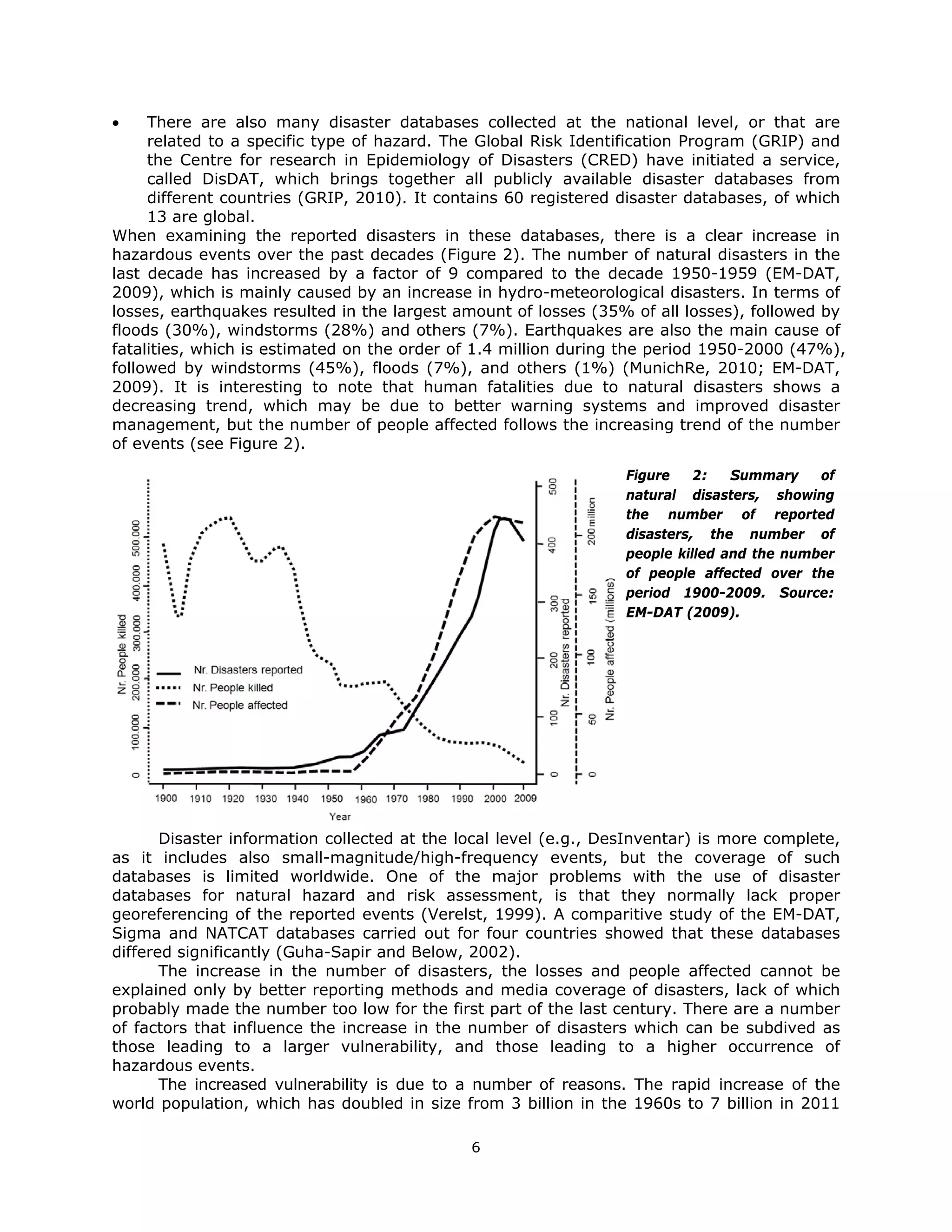
When examining the reported disasters in these databases, there is a clear increase in
hazardous events over the past decades (Figure 2). The number of natural disasters in the
last decade has increased by a factor of 9 compared to the decade 1950-1959 (EM-DAT,
2009), which is mainly caused by an increase in hydro-meteorological disasters. In terms of
losses, earthquakes resulted in the largest amount of losses (35% of all losses), followed by
floods (30%), windstorms (28%) and others (7%). Earthquakes are also the main cause of
fatalities, which is estimated on the order of 1.4 million during the period 1950-2000 (47%),
followed by windstorms (45%), floods (7%), and others (1%) (MunichRe, 2010; EM-DAT,
2009). It is interesting to note that human fatalities due to natural disasters shows a
decreasing trend, which may be due to better warning systems and improved disaster
management, but the number of people affected follows the increasing trend of the number
of events (see Figure 2).

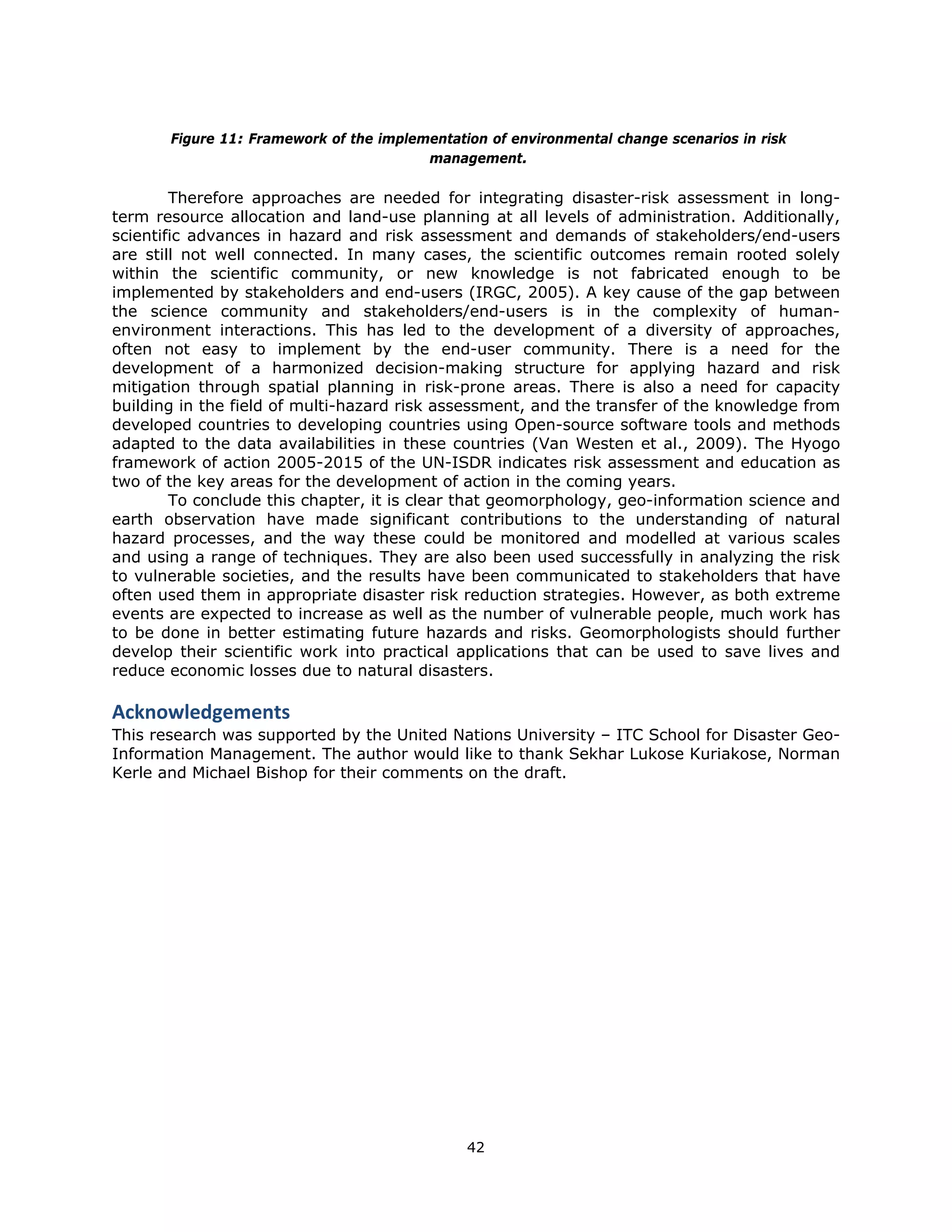
                                                                  Figure    2:   Summary    of
                                                                  natural disasters, showing
                                                                  the number of reported
                                                                  disasters, the number of
                                                                  people killed and the number
                                                                  of people affected over the
                                                                  period 1900-2009. Source:
                                                                  EM-DAT (2009).


       Disaster information collected at the local level (e.g., DesInventar) is more complete,
as it includes also small-magnitude/high-frequency events, but the coverage of such
databases is limited worldwide. One of the major problems with the use of disaster
databases for natural hazard and risk assessment, is that they normally lack proper
georeferencing of the reported events (Verelst, 1999). A comparitive study of the EM-DAT,
Sigma and NATCAT databases carried out for four countries showed that these databases
differed significantly (Guha-Sapir and Below, 2002).
       The increase in the number of disasters, the losses and people affected cannot be
explained only by better reporting methods and media coverage of disasters, lack of which
probably made the number too low for the first part of the last century. There are a number
of factors that influence the increase in the number of disasters which can be subdived as
those leading to a larger vulnerability, and those leading to a higher occurrence of
hazardous events.
       The increased vulnerability is due to a number of reasons. The rapid increase of the
world population, which has doubled in size from 3 billion in the 1960s to 7 billion in 2011

                                              6 
 
(World Bank, 2011). Depending on the expected growth rates, world population is estimated
to be between 7.9 and 11.0 billion by the year 2050 (UNPD, 2010a). The increase in
disaster impact, however, is higher than the increase in population, which indicates that
there are other important factors involved that increase the overall vulnerability of the world
population. One of the main factors is the large urbanization rate. According to UN figures
(UNPD, 2010b), the worldwide urbanization percentage has increased from 29% in 1950 to
50% in 2010, and is expected to rise to 69% in 2050. Another factor related to the
population growth is that areas become settled, that were previously avoided due to their
susceptibility to natural hazards. Many of the largest cities in the world, the so-called
“Megacities” are located in hazardous regions, either in coastal zones, or in seismically
active regions (Smith and Petley, 2008; Kraas, 2008).
       The increasing impact of natural disasters is also related with the development of
highly sensitive technologies, and the growing susceptibility of modern industrial societies to
breakdowns in their infrastructure. Data from MunichRe (2010) show that the economic
losses have increased by a factor of 8 over the past 50 years, and insured losses by a factor
of 15. There is a rapid increase in the insured losses, which are mainly related to losses
occurring in developed countries. Windstorms clearly dominate the category of insured
losses (US $90 billion), followed by earthquakes (US $ 25 billion). Insured losses to flooding
are remarkably less (US $ 10 billion), due to the fact that they are most severe in
developing countries with lower insurance coverage (MunichRe, 2010).
       It is not only the increased exposure of the population to hazards, however, that can
explain the increase in natural disasters. The frequency of destructive events related to
atmospheric extremes (such as floods, drought, cyclones, and landslides) is also increasing
(EM-DAT, 2009). During the last 10 years a total of 3,750 windstorms and floods were
recorded, accounting for two-thirds of all events. The number of catastrophes due to
earthquakes and volcanic activity (about 100 per year) has remained constant (MunichRe,
2010). Although the time-span is still not long enough to indicate it with certainty, these data
suggest that climate change is related to the increased occurrence of natural disasters.
       There is an inverse relationship between the level of development and loss of human
lives in the case of disasters. About 85 percent of the disaster related casualties occur in less
developed countries, where more than 4.7 billion people live. The greater loss of lives is due to
the lower quality of buildings, lack of building codes or lack of enforcement, construction of
buildings in hazardous areas due to lack of land-use planning, lower awareness and disaster
preparedness, less accurate or missing early-warning systems, lack of evacuation planning,
lack of facilities for search-and-rescues and medical attention. Although 65% of the overall
losses occur in high-income countries (with GNI US$ >12,000 per capita) (World Bank, 2010),
and only 3% in low-income countries (GNI US$ < 1000 per capita), the effect in the latter
group is devastating, as they may represent as much as 100% of their Gross National Income
(UN-ISDR, 2009). Economic losses in absolute terms (billions of dollars) show an increase with
the level of development, as the absolute value of elements-at-risk that might be damaged
during a disaster increases with increasing level of development. In relative terms, however,
the trend is reverse, showing a decrease in the losses expressed as percentage of GDP with
increasing level of development (MunichRe, 2010).

2.2 Disaster Risk‐Management framework 
Disaster-Risk Management (DRM) is defined as “the systematic process of using administrative
decisions, organization, operational skills and capacities to implement policies, strategies and
coping capacities of the society and communities to lessen the impacts of natural hazards and
related environmental and technological disasters”. This comprises all forms of activities,
including structural and non-structural measures to avoid (prevention) or to limit (mitigation
and preparedness) adverse effects of hazards (UN-ISDR, 2004). Disaster-risk management is
aimed at disaster-risk reduction, which refers to the conceptual framework of elements


                                               7 
 
considered with the possibilities to minimize vulnerabilities and disaster risks within the broad
context of sustainable development (UN-ISDR, 2004).
       The past decades have witnessed a shift in focus from disaster recovery and response to
risk management and mitigation. This change was also from an approach that focused
primarily on the hazard as the main causal factor for risk, and the reduction of the risk by
physical-protection measures, to a focus on vulnerability of communities and ways to reduce
those through preparedness and early warning. Later more focus was given to the
strengthening of the capacity of local communities and the development of community-based
coping strategies (Blaikie et al., 1994; Lavel, 2000, Pelling, 2003). The Yokohama conference
in 1994 put into perspective the socio-economic aspects as a component of effective disaster
prevention. It was recognized that social factors, such as cultural tradition, religious values,
economic standing, and trust in political accountability are essential in the determination of
societal vulnerability. In order to reduce societal vulnerability, and therewith decrease the
consequences of natural disasters, these factors need to be addressed (Hillhorst, 2004). The
ability to address socio-economic factors requires knowledge and understanding of local
conditions, which can, in most cases, only be provided by local participants.
       The decade from 1990 to 2000 was declared by the United Nations as the International
Decade for Natural Disaster Reduction (IDNDR). As the impact of disasters increased
dramatically during this decade the international community decided to continue this effort
after 2000 in the form of an International Strategy for Disaster Reduction (ISDR). The ISDR
stressed the need to move from a top-down management of disasters and a cycle that focuses
on reconstruction and preparedness, towards a more comprehensive approach that tries to
avoid or mitigate the risk before disasters occur, and at the same time fosters more awareness,
public commitment, knowledge sharing and partnerships to implement various risk reduction
strategies at all levels (UN-ISDR, 2005b).
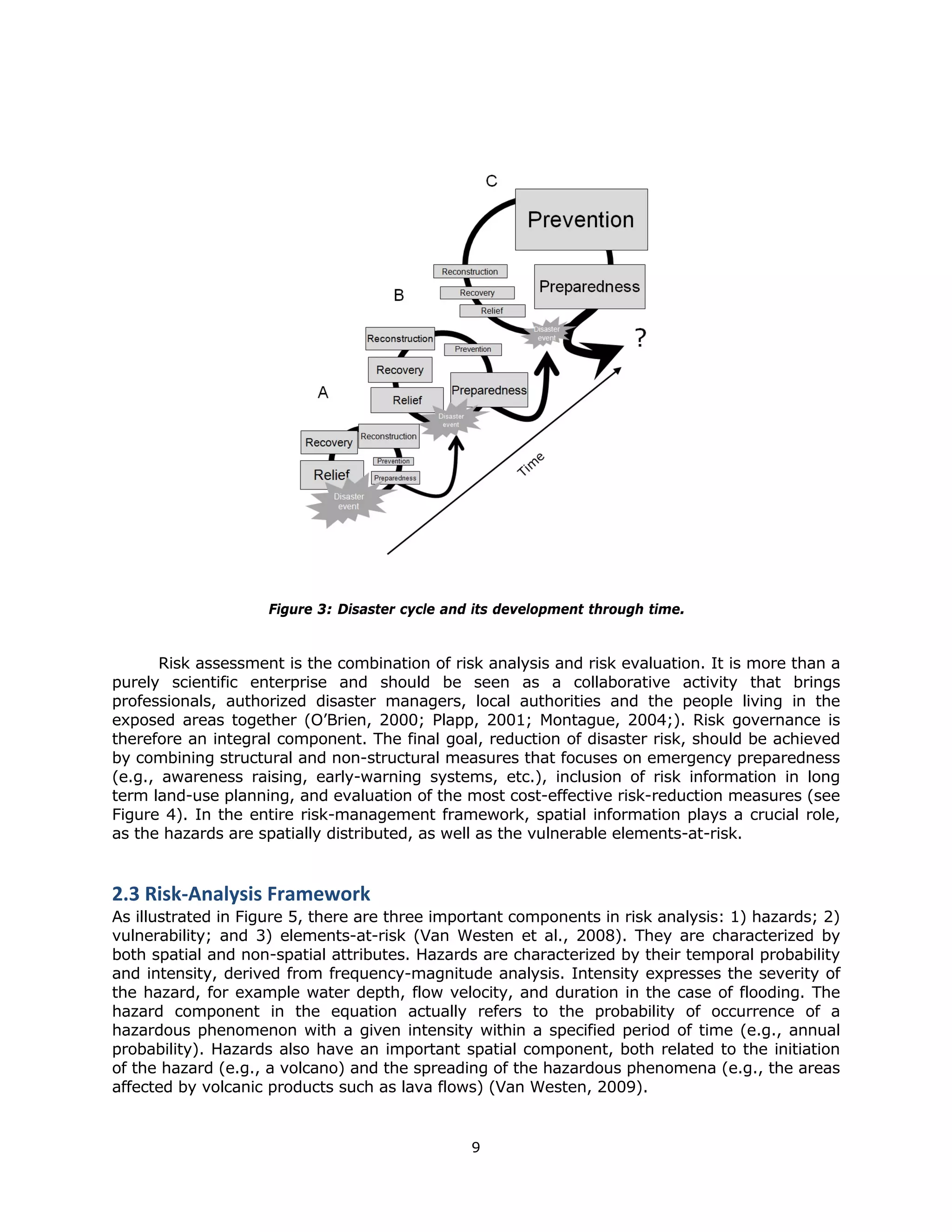
       This more positive concept has been referred to as the “risk-management cycle”, or
better “spiral”, in which learning from a disaster can stimulate adaptation and modification in
development planning, rather than a simple reconstruction of pre-existing social and physical
conditions. This is illustrated in Figure 3, by showing the disaster cycle and various
components (relief, recovery, reconstruction, prevention and preparedness), and how these
changed through time. Initially (Figure 3A) most emphasis was given to disaster relief,
recovery and reconstruction, thereby getting into a cycle where the next disaster was going to
cause the same effects or worse. Later on (Figure 3B) more attention was given to disaster
preparedness by developing warning systems and disaster awareness programs. Eventually
(Figure 3C) the efforts are focusing on disaster prevention and preparedness, thus enlarging
the time between individual disasters, and reducing their effects, requiring less emphasis in
relief, recovery and reconstruction. The eventual aim of disaster-risk management is to
enlarge this cycle, and only reach the response phase for extreme events with very low
frequency.
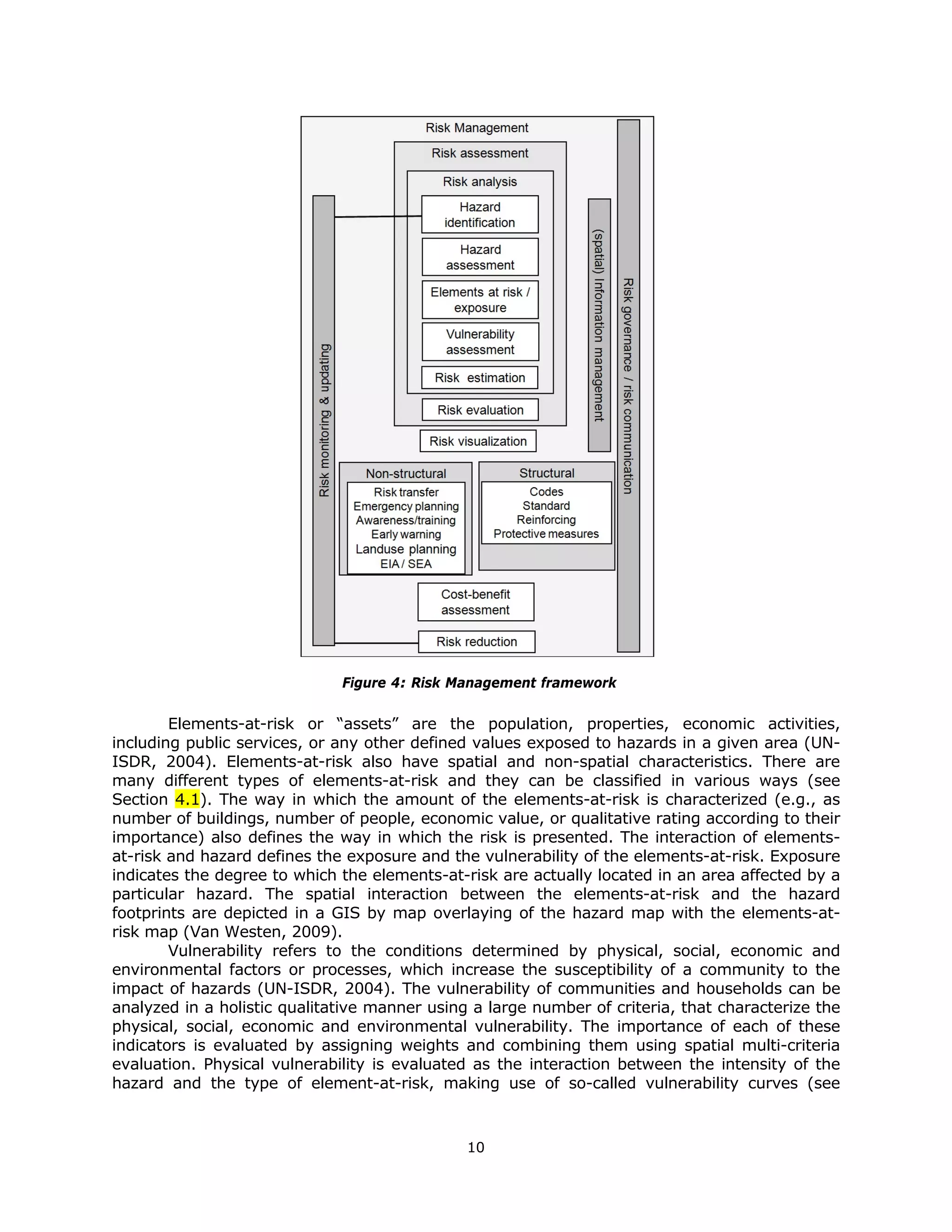
       Disaster prevention is achieved through risk management. Figure 4 presents the general
risk-management framework which is composed of a risk-assessment block and a block in
which risk-reduction strategies are defined. A summary of the terminology used in risk
management is given in Table 2. Central in the procedure is risk analysis, in which the
available information is used to estimate the risk to individuals or populations, property or the
environment, from various hazards. Risk analysis generally contains the following steps: 1)
hazard identification; 2) hazard assessment; 3) elements-at-risk/exposure analysis; 4)
vulnerability assessment and 5) risk estimation. Risk evaluation is the stage at which values
and judgments enter the decision process, explicitly or implicitly, by including consideration of
the importance of the estimated risks and the associated social, environmental, and economic
consequences, in order to identify a range of alternatives for reducing the risks (UN-ISDR,
2004).


                                               8 
 
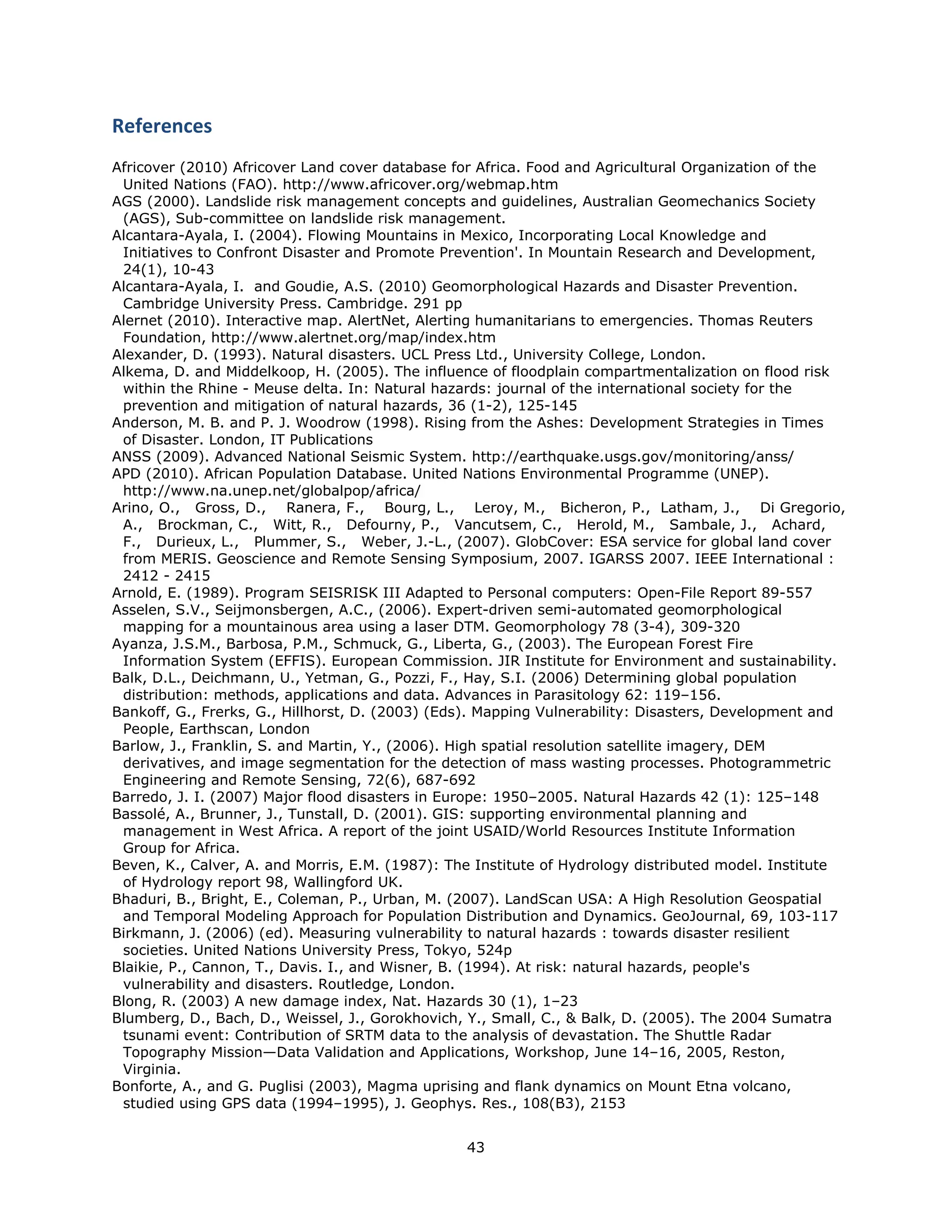
Figure 3: Disaster cycle and its development through time.


       Risk assessment is the combination of risk analysis and risk evaluation. It is more than a
purely scientific enterprise and should be seen as a collaborative activity that brings
professionals, authorized disaster managers, local authorities and the people living in the
exposed areas together (O’Brien, 2000; Plapp, 2001; Montague, 2004;). Risk governance is
therefore an integral component. The final goal, reduction of disaster risk, should be achieved
by combining structural and non-structural measures that focuses on emergency preparedness
(e.g., awareness raising, early-warning systems, etc.), inclusion of risk information in long
term land-use planning, and evaluation of the most cost-effective risk-reduction measures (see
Figure 4). In the entire risk-management framework, spatial information plays a crucial role,
as the hazards are spatially distributed, as well as the vulnerable elements-at-risk.


2.3 Risk‐Analysis Framework 
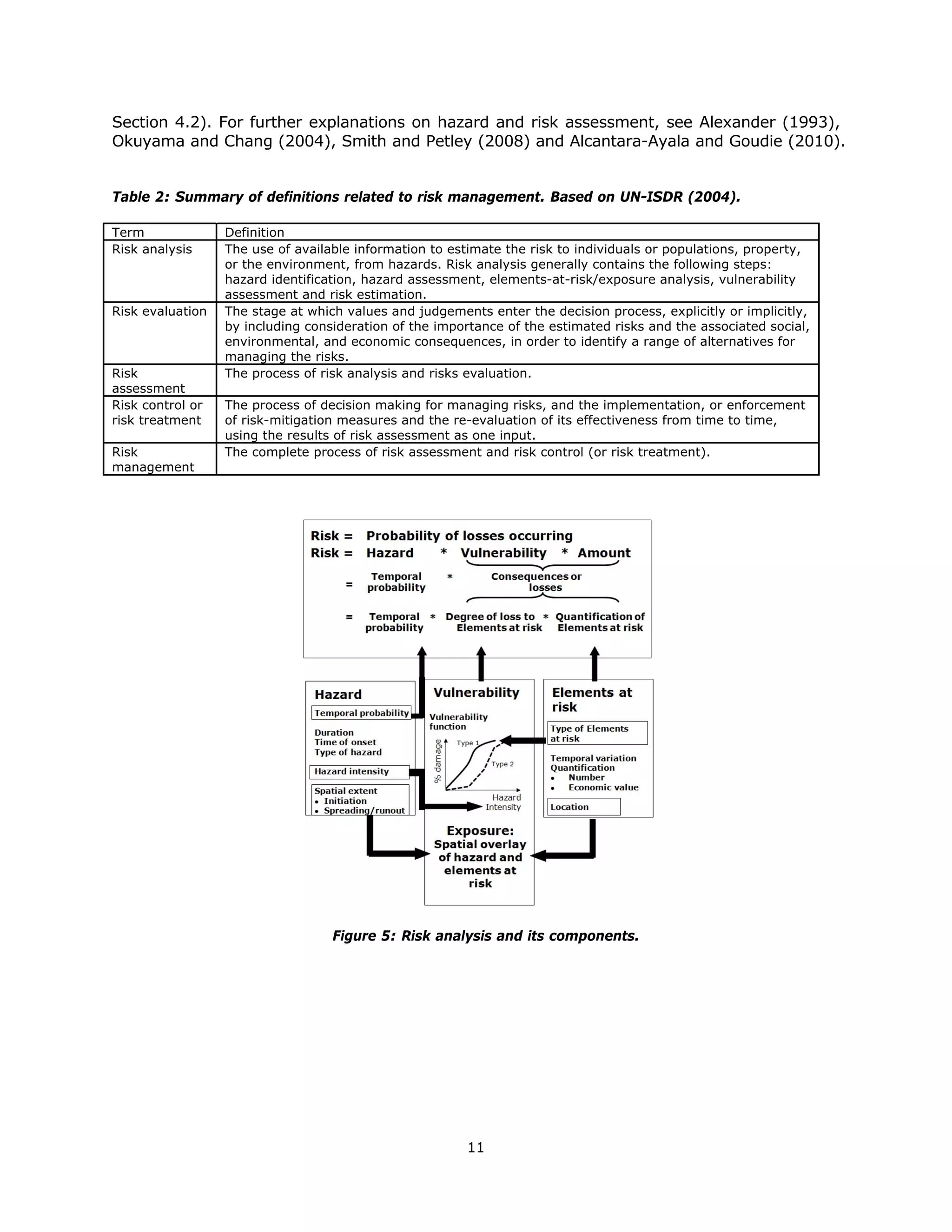
As illustrated in Figure 5, there are three important components in risk analysis: 1) hazards; 2)
vulnerability; and 3) elements-at-risk (Van Westen et al., 2008). They are characterized by
both spatial and non-spatial attributes. Hazards are characterized by their temporal probability
and intensity, derived from frequency-magnitude analysis. Intensity expresses the severity of
the hazard, for example water depth, flow velocity, and duration in the case of flooding. The
hazard component in the equation actually refers to the probability of occurrence of a
hazardous phenomenon with a given intensity within a specified period of time (e.g., annual
probability). Hazards also have an important spatial component, both related to the initiation
of the hazard (e.g., a volcano) and the spreading of the hazardous phenomena (e.g., the areas
affected by volcanic products such as lava flows) (Van Westen, 2009).


                                                9 
 
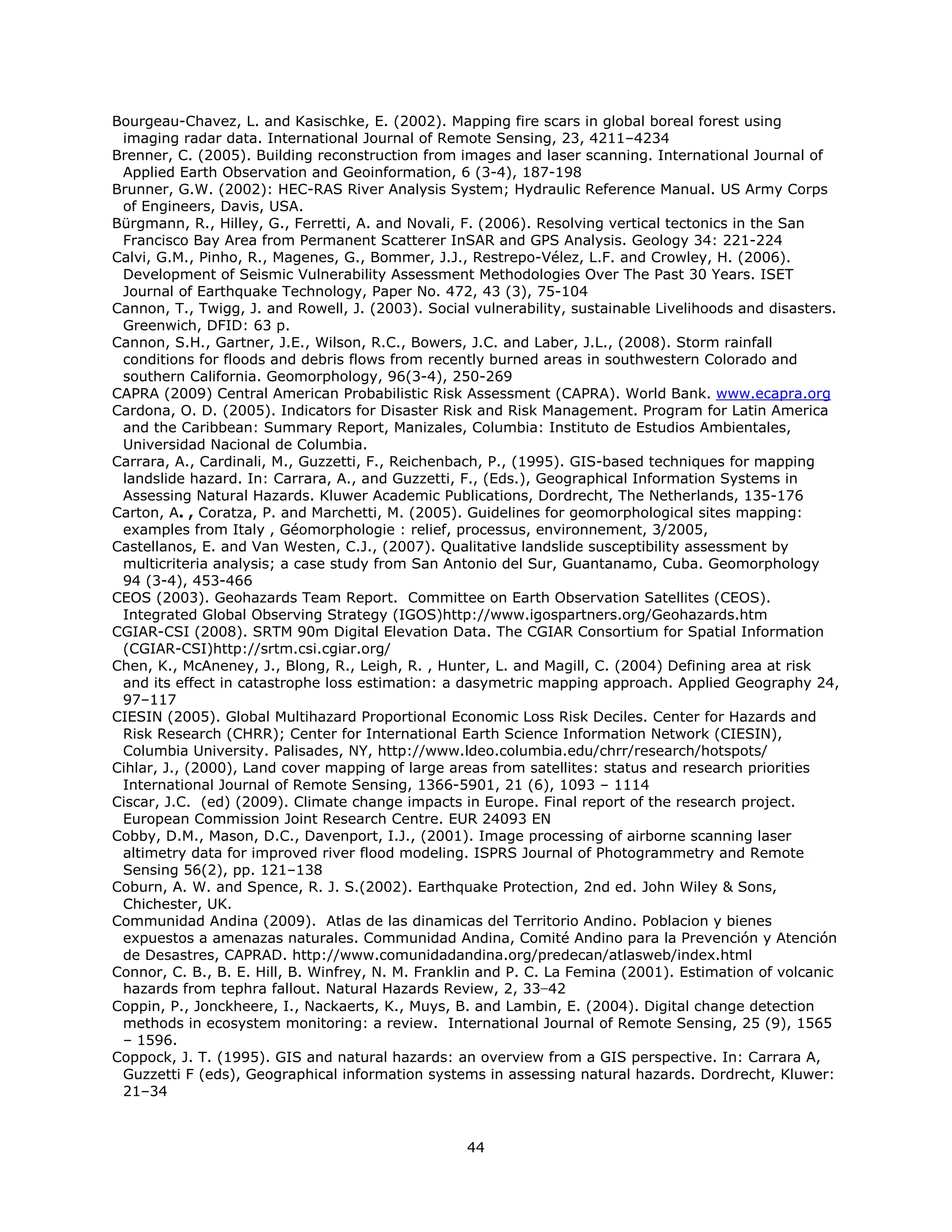
Figure 4: Risk Management framework

        Elements-at-risk or “assets” are the population, properties, economic activities,
including public services, or any other defined values exposed to hazards in a given area (UN-
ISDR, 2004). Elements-at-risk also have spatial and non-spatial characteristics. There are
many different types of elements-at-risk and they can be classified in various ways (see
Section 4.1). The way in which the amount of the elements-at-risk is characterized (e.g., as
number of buildings, number of people, economic value, or qualitative rating according to their
importance) also defines the way in which the risk is presented. The interaction of elements-
at-risk and hazard defines the exposure and the vulnerability of the elements-at-risk. Exposure
indicates the degree to which the elements-at-risk are actually located in an area affected by a
particular hazard. The spatial interaction between the elements-at-risk and the hazard
footprints are depicted in a GIS by map overlaying of the hazard map with the elements-at-
risk map (Van Westen, 2009).
        Vulnerability refers to the conditions determined by physical, social, economic and
environmental factors or processes, which increase the susceptibility of a community to the
impact of hazards (UN-ISDR, 2004). The vulnerability of communities and households can be
analyzed in a holistic qualitative manner using a large number of criteria, that characterize the
physical, social, economic and environmental vulnerability. The importance of each of these
indicators is evaluated by assigning weights and combining them using spatial multi-criteria
evaluation. Physical vulnerability is evaluated as the interaction between the intensity of the
hazard and the type of element-at-risk, making use of so-called vulnerability curves (see


                                               10 
 
Section 4.2). For further explanations on hazard and risk assessment, see Alexander (1993),
Okuyama and Chang (2004), Smith and Petley (2008) and Alcantara-Ayala and Goudie (2010).


Table 2: Summary of definitions related to risk management. Based on UN-ISDR (2004).

Term              Definition
Risk analysis     The use of available information to estimate the risk to individuals or populations, property,
                  or the environment, from hazards. Risk analysis generally contains the following steps:
                  hazard identification, hazard assessment, elements-at-risk/exposure analysis, vulnerability
                  assessment and risk estimation.
Risk evaluation   The stage at which values and judgements enter the decision process, explicitly or implicitly,
                  by including consideration of the importance of the estimated risks and the associated social,
                  environmental, and economic consequences, in order to identify a range of alternatives for
                  managing the risks.
Risk              The process of risk analysis and risks evaluation.
assessment
Risk control or   The process of decision making for managing risks, and the implementation, or enforcement
risk treatment    of risk-mitigation measures and the re-evaluation of its effectiveness from time to time,
                  using the results of risk assessment as one input.
Risk              The complete process of risk assessment and risk control (or risk treatment).
management


                                   Figure 5: Risk analysis and its components.


                                                        11 
 
3. Hazard Assessment
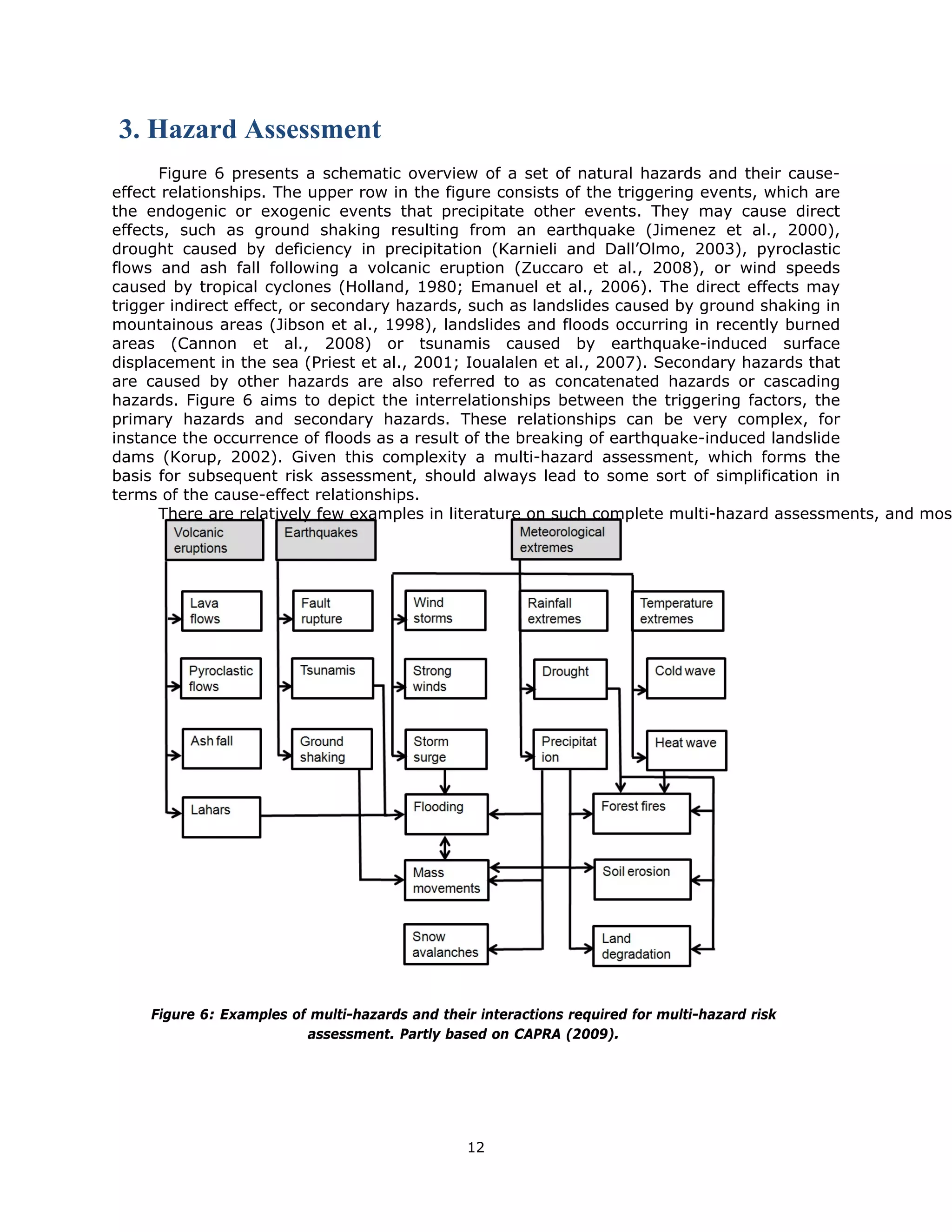
      Figure 6 presents a schematic overview of a set of natural hazards and their cause-
effect relationships. The upper row in the figure consists of the triggering events, which are
the endogenic or exogenic events that precipitate other events. They may cause direct
effects, such as ground shaking resulting from an earthquake (Jimenez et al., 2000),
drought caused by deficiency in precipitation (Karnieli and Dall’Olmo, 2003), pyroclastic
flows and ash fall following a volcanic eruption (Zuccaro et al., 2008), or wind speeds
caused by tropical cyclones (Holland, 1980; Emanuel et al., 2006). The direct effects may
trigger indirect effect, or secondary hazards, such as landslides caused by ground shaking in
mountainous areas (Jibson et al., 1998), landslides and floods occurring in recently burned
areas (Cannon et al., 2008) or tsunamis caused by earthquake-induced surface
displacement in the sea (Priest et al., 2001; Ioualalen et al., 2007). Secondary hazards that
are caused by other hazards are also referred to as concatenated hazards or cascading
hazards. Figure 6 aims to depict the interrelationships between the triggering factors, the
primary hazards and secondary hazards. These relationships can be very complex, for
instance the occurrence of floods as a result of the breaking of earthquake-induced landslide
dams (Korup, 2002). Given this complexity a multi-hazard assessment, which forms the
basis for subsequent risk assessment, should always lead to some sort of simplification in
terms of the cause-effect relationships.
      There are relatively few examples in literature on such complete multi-hazard assessments, and mos


      Figure 6: Examples of multi-hazards and their interactions required for multi-hazard risk
                           assessment. Partly based on CAPRA (2009).


                                                  12 
 
3.1 Scale and Hazard Assessment 
Hazard assessment using GIS can be carried out at different geographical scales. Although
it is possible to use a range of spatial resolutions of the input data for GIS analysis
(computational scale), in practice the geographic scale determines the size of the study area
that is analyzed. This in turn restricts the scale of the input data and the resolution of the
data used in the computations. The geographical scale also determines the scale of
representation of the end products (cartographic scale). There are a number of factors that
play a role in deciding what scale of hazard and risk assessment should be selected (Fell et
al., 2008, Van Westen et al., 2008). These are related first of all to the aim of the hazard
assessment, the type of hazard, and the operational scale at which these hazard processes
are triggered and manifest themselves. They also relate to the size and characteristics of
the study area, the available data and resources, and the required accuracy. Table 3
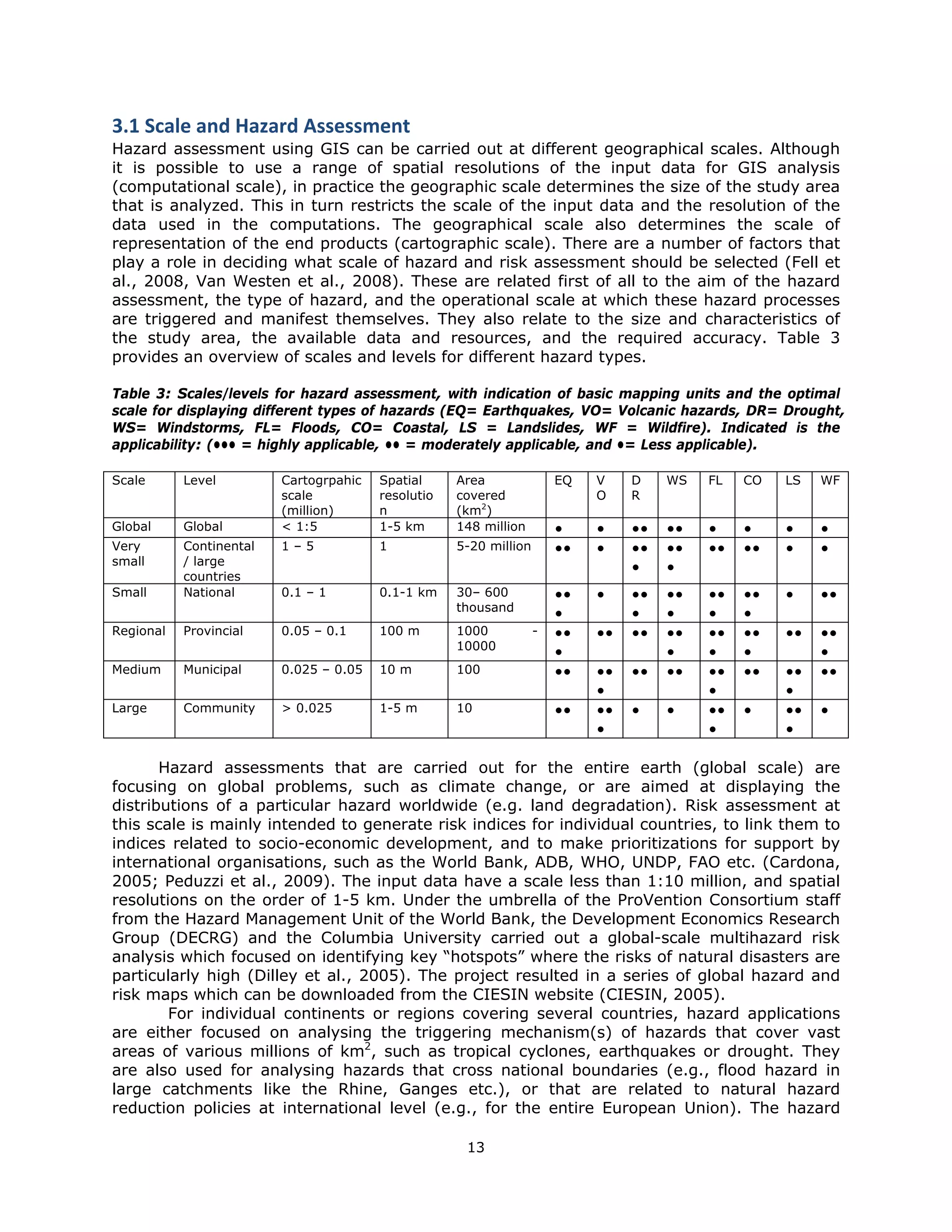
provides an overview of scales and levels for different hazard types.

Table 3: Scales/levels for hazard assessment, with indication of basic mapping units and the optimal
scale for displaying different types of hazards (EQ= Earthquakes, VO= Volcanic hazards, DR= Drought,
WS= Windstorms, FL= Floods, CO= Coastal, LS = Landslides, WF = Wildfire). Indicated is the
applicability: (••• = highly applicable, •• = moderately applicable, and •= Less applicable).

Scale      Level         Cartogrpahic   Spatial     Area               EQ   V    D    WS   FL   CO   LS   WF
                         scale          resolutio   covered                 O    R
                         (million)      n           (km2)
Global     Global        < 1:5          1-5 km      148 million        •    •    ••   ••   •    •    •    •
Very       Continental   1–5            1           5-20 million       ••   •    ••   ••   ••   ••   •    •
small      / large
                                                                                 •    •
           countries
Small      National      0.1 – 1        0.1-1 km    30– 600            ••   •    ••   ••   ••   ••   •    ••
                                                    thousand
                                                                       •         •    •    •    •
Regional   Provincial    0.05 – 0.1     100 m       1000           -   ••   ••   ••   ••   ••   ••   ••   ••
                                                    10000
                                                                       •              •    •    •         •
Medium     Municipal     0.025 – 0.05   10 m        100                ••   ••   ••   ••   ••   ••   ••   ••
                                                                            •              •         •
Large      Community     > 0.025        1-5 m       10                 ••   ••   •    •    ••   •    ••   •
                                                                            •              •         •

       Hazard assessments that are carried out for the entire earth (global scale) are
focusing on global problems, such as climate change, or are aimed at displaying the
distributions of a particular hazard worldwide (e.g. land degradation). Risk assessment at
this scale is mainly intended to generate risk indices for individual countries, to link them to
indices related to socio-economic development, and to make prioritizations for support by
international organisations, such as the World Bank, ADB, WHO, UNDP, FAO etc. (Cardona,
2005; Peduzzi et al., 2009). The input data have a scale less than 1:10 million, and spatial
resolutions on the order of 1-5 km. Under the umbrella of the ProVention Consortium staff
from the Hazard Management Unit of the World Bank, the Development Economics Research
Group (DECRG) and the Columbia University carried out a global-scale multihazard risk
analysis which focused on identifying key “hotspots” where the risks of natural disasters are
particularly high (Dilley et al., 2005). The project resulted in a series of global hazard and
risk maps which can be downloaded from the CIESIN website (CIESIN, 2005).
        For individual continents or regions covering several countries, hazard applications
are either focused on analysing the triggering mechanism(s) of hazards that cover vast
areas of various millions of km2, such as tropical cyclones, earthquakes or drought. They
are also used for analysing hazards that cross national boundaries (e.g., flood hazard in
large catchments like the Rhine, Ganges etc.), or that are related to natural hazard
reduction policies at international level (e.g., for the entire European Union). The hazard

                                                     13 
 
maps are generated using standardized methodologies, and are aimed both at risk
assessment, early warning (De Roo et al., 2007) and post-disaster damage assessment.
The areas that are evaluated vary in size, as some countries like China, India or the USA
are as large as continents like Europe, under one administrative setup. The scale of the
input maps can range between 1:100.000 and 1:5 million, and spatial resolutions may vary
from 90 meters to 1 km, depending on the application.
        Hazard and risk assessment at the national scale covers areas ranging from tens to
several hundred thousand km2, depending on the size of the country. Hazard assessment is
carried out at a national scale for national planning purposes, implementation of national
disaster-risk reduction policies, early-warning systems, disaster preparedness and insurance.
The applications in planning become more concrete when zooming in on larger scales such
as the provincial level. For instance, hazard and risk assessment become an integral
component of regional development plans and Environmental Impact Assessments for
infrastructure developments. At municipal level, hazard and risk assessment are carried out
as a basis for land-use zoning, and for the design of non-structural risk-reduction measures.
At a community level, hazard and risk assessment are carried out in participation with local
communities and local authorities, as a means to obtain commitment for disaster-risk
reduction programmes.

3.2 Spatial Data for Hazard Assessment
The assessment of multi-hazards and the subsequent risk assessment is a very data
intensive procedure. The availability of certain types of spatio-temporal data can be one of
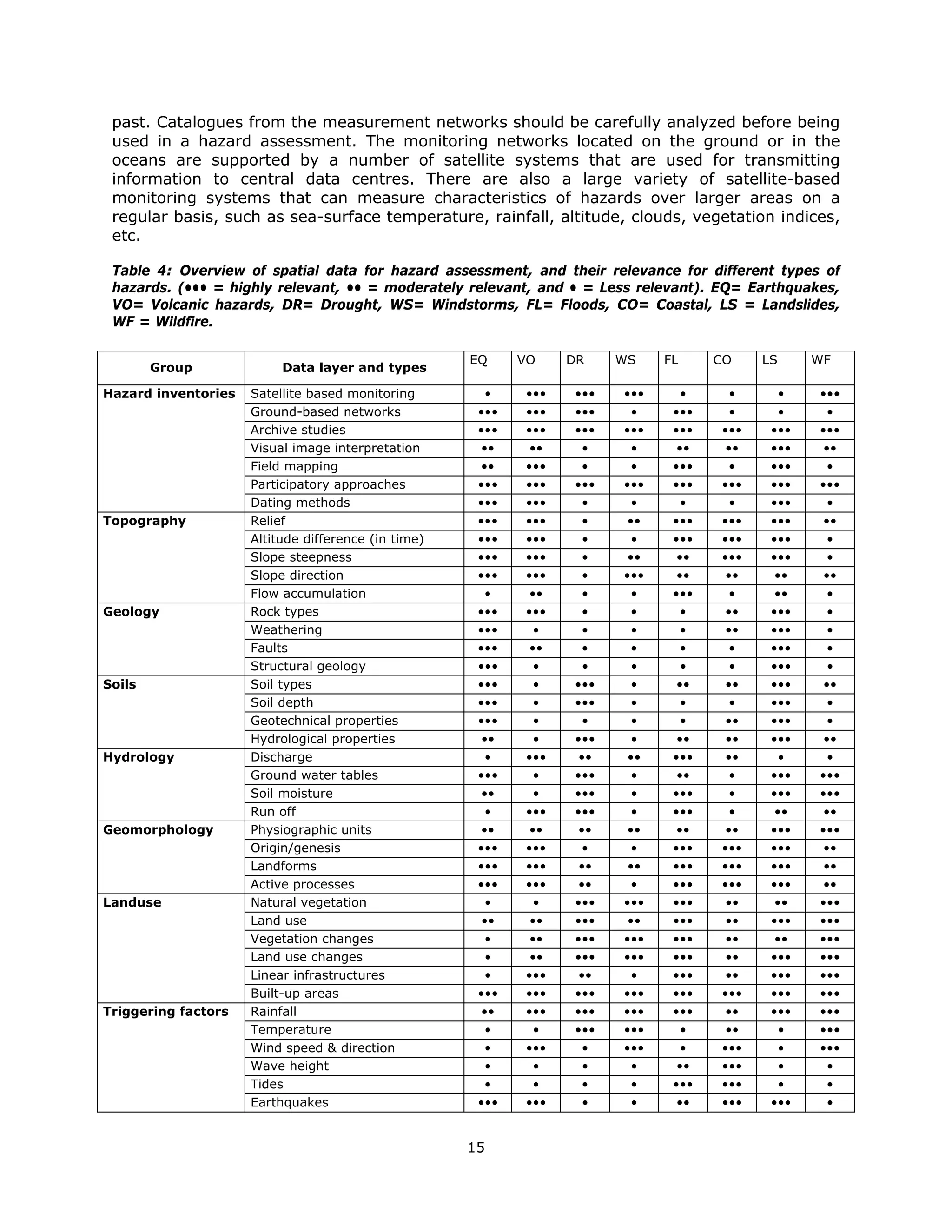
the main limitations for carrying out specific types of analysis. Table 4 gives a schematic
overview of the main GIS data layers required for hazard and risk assessment, for different
hazard types. These can be subdivided into three groups: 1) hazard inventory data; 2)
environmental factors; and 3) triggering factors.

3.2.1 Hazard Inventories and Triggering Events 
The hazard-inventory data are by far the most important, as they should give insight into
the distribution of past hazardous phenomena, their types, mechanisms, causal factors,
frequency of occurrence, intensities and the damage that has been caused.
The most straightforward way of generating hazard inventories is through direct
measurements of the phenomena. These measurements can be collected by networks of
stations (e.g., earthquake strong-motion data, flood-discharge stations, meteorological
stations, coastal-tide gauging stations, or wave-measurement buoys). Seismic networks
have been formed globally (NERIES, 2009; ANSS, 2009; GSN, 2009), and the data is
managed centrally, for instance by the United States Geological Survey (USGS) using web-
mapping applications. In the US, a similar network has been established for recording
stream-discharge data for nearly 10,000 sites in a central database linked with a web-
mapping service (NWIS, 2010). Although a tsunami warning system has been operational in
the Pacific Ocean for a number of decades, the 2004 Indian Ocean tsunami has urged the
international community to implement such systems worldwide. For these monitoring
networks, the spatial coverage is important so that potentially hazardous areas are
monitored. The density of observations required for the monitoring networks differs strongly
for various hazard types. This is more problematic for flood-discharge stations, as each
potential hazardous river needs to be monitored, whereas for seismic stations, the required
density can be much less. Also the spacing between the individual stations is of importance
given the variability of the measured characteristics (e.g., rainfall measurements vary
strongly over mountainous regions). The period for which measurements are available, and
the continuity of the measurements also play an important role, as often the period for
which measurements are available is not sufficiently large to capture major events from the

                                            14 
 
past. Catalogues from the measurement networks should be carefully analyzed before being
 used in a hazard assessment. The monitoring networks located on the ground or in the
 oceans are supported by a number of satellite systems that are used for transmitting
 information to central data centres. There are also a large variety of satellite-based
 monitoring systems that can measure characteristics of hazards over larger areas on a
 regular basis, such as sea-surface temperature, rainfall, altitude, clouds, vegetation indices,
 etc.

 Table 4: Overview of spatial data for hazard assessment, and their relevance for different types of
 hazards. (••• = highly relevant, •• = moderately relevant, and • = Less relevant). EQ= Earthquakes,
 VO= Volcanic hazards, DR= Drought, WS= Windstorms, FL= Floods, CO= Coastal, LS = Landslides,
 WF = Wildfire.

                                                     EQ     VO    DR    WS    FL     CO    LS     WF
        Group             Data layer and types

Hazard inventories   Satellite based monitoring         •   •••   •••   •••      •     •      •   •••
                     Ground-based networks            •••   •••   •••     •    •••     •     •      •
                     Archive studies                  •••   •••   •••   •••    •••   •••    •••   •••
                     Visual image interpretation       ••    ••     •     •     ••    ••    •••    ••
                     Field mapping                    ••    •••    •     •     •••    •     •••    •
                     Participatory approaches         •••   •••   •••   •••    •••   •••    •••   •••
                     Dating methods                   •••   •••    •     •       •     •    •••     •
Topography           Relief                           •••   •••    •     ••    •••   •••    •••    ••
                     Altitude difference (in time)    •••   •••     •     •    •••   •••    •••     •
                     Slope steepness                  •••   •••     •    ••     ••   •••    •••     •
                     Slope direction                  •••   •••    •    •••     ••    ••     ••    ••
                     Flow accumulation                 •     ••    •     •     •••    •      ••    •
Geology              Rock types                       •••   •••    •     •      •     ••    •••    •
                     Weathering                       •••     •    •     •      •     ••    •••     •
                     Faults                           •••    ••    •     •      •     •     •••    •
                     Structural geology               •••     •     •     •      •     •    •••     •
Soils                Soil types                       •••     •   •••    •      ••    ••    •••    ••
                     Soil depth                       •••     •   •••    •       •     •    •••     •
                     Geotechnical properties          •••     •     •     •      •    ••    •••     •
                     Hydrological properties           ••     •   •••     •     ••    ••    •••    ••
Hydrology            Discharge                          •   •••    ••    ••    •••    ••      •     •
                     Ground water tables              •••     •   •••     •     ••     •    •••   •••
                     Soil moisture                     ••     •   •••     •    •••     •    •••   •••
                     Run off                            •   •••   •••     •    •••     •     ••    ••
Geomorphology        Physiographic units               ••    ••    ••    ••     ••    ••    •••   •••
                     Origin/genesis                   •••   •••    •     •     •••   •••    •••    ••
                     Landforms                        •••   •••    ••    ••    •••   •••    •••    ••
                     Active processes                 •••   •••    ••    •     •••   •••    •••    ••
Landuse              Natural vegetation                 •     •   •••   •••    •••    ••     ••   •••
                     Land use                          ••    ••   •••    ••    •••    ••    •••   •••
                     Vegetation changes                 •    ••   •••   •••    •••    ••     ••   •••
                     Land use changes                   •    ••   •••   •••    •••    ••    •••   •••
                     Linear infrastructures             •   •••    ••     •    •••    ••    •••   •••
                     Built-up areas                   •••   •••   •••   •••    •••   •••    •••   •••
Triggering factors   Rainfall                          ••   •••   •••   •••    •••    ••    •••   •••
                     Temperature                        •     •   •••   •••      •    ••      •   •••
                     Wind speed & direction             •   •••     •   •••      •   •••     •    •••
                     Wave height                        •     •     •     •     ••   •••      •     •
                     Tides                             •      •    •     •     •••   •••     •     •
                     Earthquakes                      •••   •••     •     •     ••   •••    •••     •


                                                     15 
  
Volcanic eruptions             •    •••    •     •••    ••   •••    •••   •••
 
   For larger areas, if no data are available from meteorological stations, general rainfall
estimates from satellite imagery can be used, such as from the Tropical Rainfall Measuring
Mission (TRMM) Multi-satellite Precipitation Analysis (TMPA), which is used to issue landslide
and flood warnings based on a threshold value derived from earlier published intensity-
duration-frequency relationships for different countries (Hong et al., 2007b). As another
example, GEONETCast is a global network of satellite-based data dissemination systems
providing environmental data to a world-wide user community. Products include
meteorological satellites (Meteosat, GOES, FengYun), and vegetation monitoring using
SPOT-Vegetation data. This information is made available to many users, with low cost
receiving station and open-source software (Mannaerts et al., 2009). Another example is
the Sentinel Asia programme which is an initiative supported by JAXA and the APRSAF
(Asia-Pacific Regional Space Agency Forum) to share disaster information in the Asia-Pacific
region on the Digital Asia (Web-GIS) platform and to make the best use of earth
observation satellites data for disaster management in the Asia-Pacific region (Sentinel Asia,
2010).
        An important initiative that is focused on the provision of space-based information
for disaster response is the international charter “Space and Major Disasters” (Disaster
Charter, 2010). A number of organizations and programmes are involved in rapid mapping
activities after major disasters, such as UNOSAT (2010), DLR-ZKI (2010), SERTIT (2010),
GDACS (2010) and Dartmouth Flood Observatory (2010). In Europe the Global Monitoring
for Environment and Security (GMES) initiative of the European Commission and the
European Space Agency (ESA) is actively supporting the use of satellite technology in
disaster management, with projects such as PREVIEW (Prevention, Information and Early
Warning pre-operational services to support the management of risks), LIMES (Land and
Sea Integrated Monitoring for Environment and Security), GMOSS (Global Monitoring for
Security and Stability), SAFER (Services and Applications For Emergency Response), and G-
MOSAIC (GMES services for Management of Operations, Situation Awareness and
Intelligence for regional Crises) (GMES, 2010). The United Nations Platform for Space-based
Information for Disaster Management and Emergency Response (UN-SPIDER, 2010) has
been established by the UN to ensure that all countries have access to and develop the
capacity to use space-based information to support the disaster management cycle. They
are working on a space application matrix that will provide the satellite-based approaches
for each type of hazard and each phase of the disaster management cycle. Overviews on
the use of space-based information in hazard inventory assessment can be found in CEOS
(2003), Tralli et al. (2005), IGOS (2007) and Joyce et al. (2009).
   For a number of hazards, satellite-based information is the major source for generating
hazard inventories, and hazard monitoring (e.g., tropical cyclones, forest fires, and drought).
For others it supports ground-based measurements (e.g., earthquakes, volcanic eruptions,
coastal hazards). There are hazard types that cannot be recorded by a network of
measurement stations, as these do not have specific measurable characteristics (such as
landslides, forest fires and snow avalanches). There are also many areas where recorded
information is not available. Thus the identification of hazardous phenomena may require
techniques such as automatic classification or expert visual interpretation of remotely
sensed data.
   Automatic classification methods make use of reflectance variations in different parts of
the electromagnetic spectrum, and by active microwave and LiDAR sensors. For instance for
flooding, Earth-observation satellites can be used in mapping historical events and
sequential inundation phases, including duration, depth of inundation, and direction of
current (Smith, 1997). Geomorphological information can be obtained using optical
(LANDSAT, SPOT, IRS, ASTER) and microwave (ERS, RADARSAT, ENVISAT, PALSAR) data
(Marcus and Fonstad, 2008). The use of optical satellite data is often hampered by the

                                             16 
 
presence of clouds, and hazard mapping is also hampered in areas with vegetation cover.
Synthetic Aperture Radar (SAR) is therefore a better tool for mapping hazard events, such
as floods (Schumann et al., 2007).
   Mapping of forest fires with satellite information is done by mapping the fires themselves
using thermal sensors (Giglio and Kendall, 2001), or through the mapping of burnt areas
( e.g., using MODIS or AVHRR which have a high temporal resolution (Trigg et al., 2005), or
with SAR (Bourgeau-Chavez and Kasischke, 2002)).
    For visual interpretation of hazard phenomena that cannot be automatically obtained
from satellite images (such as landslides) and for geomorphological interpretation of hilly
and mountainous areas, stereoscopic imagery with a high to very high resolution is required
(Metternicht et al., 2005). Very high resolution imagery (QuickBird, IKONOS, WorldView,
GeoEye, SPOT-5, Resourcesat, Cartosat, Formosat and ALOS-PRISM) have become the best
option now for visual mapping from satellite images, and the number of operational sensors
with similar characteristics is growing year by year, as more countries are launching earth
observation satellites with stereo capabilities and spatial resolution of 3 meters or better.
The high costs may still be a limitation for obtaining these very high resolution images for
particular study areas, especially for multiple dates after the occurrence of main triggering
events such as tropical storms or cyclones. Automatic classification of landslides using
digital airphotos and very high resolution satellite images has been applied successfully by
Hervas et al., (2003), Barlow et al. (2006) and Martha et al. (2010).
    Hazard inventory databases should contain information for extended periods of time so
that magnitude/frequency relationships can be analyzed. This requires the inclusion of both
high frequency/low magnitude events for estimating hazards with a high probability of
occurrence, but should also contain sufficient low frequency/high magnitude events to
evaluate the hazard for extreme events as well. Therefore, apart from measuring, observing
and mapping recent hazard events, it is of large importance to carry out extensive archive
studies. For example, one of the most comprehensive projects for landslide and flood
inventory mapping has been the AVI project in Italy (Guzzetti et al., 1994). Another
example is from China where an analysis was made on extreme precipitation events based
on datasets derived from Chinese historical documents over eastern China for the past 1500
years (Zheng et al., 2006). Hazard inventories can also be produced using participatory
mapping and participatory GIS (PGIS). Participatory GIS involves communities in the
production of spatial data and spatial decision-making. Local people could interpret the
outputs from a GIS or contribute to it, for example by integrating participatory mapping of
hazardous events to modify or update information in a GIS. Capturing local knowledge and
combining it with other spatial information is a central objective. This process may assist
communities to look at their environment and explore alternative scenarios based on
understanding of their own goals, constraints and preferences (McCall, 2003; Peters Guarin
et al., 2005).
   The techniques described above are intended to support the generation of hazard
inventory databases. Such databases may have a very large degree of uncertainty, which
can be related to the incompleteness of historical information with respect to the exact
location, time of occurrence, and type of hazard. Table 5 lists a number of sources for global
hazard inventories that have been used in the PREVIEW project (Peduzzi et al., 2009)
 
3.2.2 Environmental Factors  
The environmental factors are a collection of GIS data layers that are expected to have an
effect on the occurrence of the hazardous phenomena, and can be utilized as causal factors
in the prediction of future events (given numerous assumptions). The list of environmental
factors in Table 4 is not exhaustive, and it is important to select those factors that are
related to a specific type of hazard in each particular environment. They represent, however,
an example of data types related to topography, geology, soils, hydrology, geomorphology

                                             17 
 
and land use. The basic data can be subdivided into those that are more or less static, and
those that are dynamic and need to be updated regularly. Examples of static data sets are
related to geology, soil types, geomorphology and topography. The time frame for the
updating of dynamic data may range from hours to days (e.g., meteorological data and its
effect on hydrology), to months and years for land-cover and land-use data. Land-use
information should be evaluated with care, as this is both an environmental factor, which
determines the occurrence of new events (such as forest fires, landslides and soil erosion),
as well as an element-at-risk, which may be affected by the hazards. Table 4 provides an
indication on the relevance of these factors for hazard assessment for different types of
hazards (Van Westen, 2009).

Table 5: Global data sources for inventory of hazardous events, and hazard assessment used in the
PREVIEW project (UNEP/DEWA/GRID, 2010)
Hazard type        Historic events                            Hazards
Cyclones           UNEP/GRID-Europe, based on various raw     UNEP/GRID-Europe
                   data sources
Cyclones storm     UNEP/GRID-Europe, based on Cyclones -      UNEP/GRID-Europe
surges:            winds data
Droughts           UNEP/GRID-Europe based on Climate          International Research Institute for Climate
                   Research Unit (CRU) precipitation data     Prediction (IRI), Columbia University
Earthquakes        United States Geological Survey (USGS)     UNEP/GRID-Europe, USGS, and GSHAP
                   ShakeMap Atlas                             (Global Seismic Hazard Assessment
                                                              Project)
Fires              European Space Agency (ESA-ESRIN) and      IONA Fire Atlas
                   World Fires Atlas Program (ATSR).
Floods             Dartmouth Flood Observatory (DFO).         UNEP/GRID-Europe
Tsunamis           National Geophysical Data Center (NGDC)    Norwegian Geotechnical Institute (NGI),
                   Tsunami database, NOAA
Volcanoes          Smithsonian Institution Volcanoes of the
                   world
Landslides         Not available                              Hotspots project, International Centre for
                                                              Geohazards (ICG/NGI)


        As topography is one of the major factors in most types of hazard analysis, the
generation of a Digital Elevation Model (DEM) and geomorphometric analysis plays a critical
role. Elevation data can be obtained through a variety of techniques, such as digitizing
contours from existing topographic maps, topographic levelling, EDM (Electronic Distance
Measurement), differential Global Positioning Systems (GPS) measurements, digital
photogrammetry, Interferometric Synthetic Aperture Radar (InSAR), and Light Detection
and Ranging (LiDAR). Data source selection depends upon a variety of factors that include
data availability, price and application. Many topographic parameters can be produced from
DEMs using fairly simple GIS operations. For more details regarding digital terrain modeling
and geomorphometry, see the digital terrain modelling and geomorphometry chapters in
this volume.
        The main sources for global DEMs used in hazard and risk analysis are GTOPO30
(USGS, 1997; Hastings and Dunbar, 1998), and Shuttle Radar Topographic Mission (SRTM)
(Farr and Kobrick, 2000). The relatively low vertical accuracy of SRTM data (Falorni et al.,
2005) doesn’t make it suitable for large scale hazard assessments. However it is extensively
used for many small scale applications in areas where other sources of DEM are not
available, such as in tsunami hazard assessment (Blumberg et al., 2005). ASTER derived
DEMs are also frequently used in hazard assessments for (parts of) countries, in the
absence of more detailed data (Fujisada et al., 2005). For smaller areas the best option is to
derived DEMs from very high resolution images (e.g. Quickbird, IKONOS, ALOS PRISM,
Cartosat)
        Synthetic Aperture Radar Interferometry (InSAR) can be used for the generation of
Digital Elevation Models, but in practice it is mostly used for detecting changes in


                                                   18 
 
topographic heights, related to different hazardous geological processes, such as land
subsidence, slow moving landslides, tectonic motions, ice movement and volcanic activity
(Massonnet & Feigl, 1998; Ferretti et al. 2001; Hilley et al. 2004; Salvi et al. 2004;
Bürgmann et al. 2006). Multi-temporal InSAR analyses using techniques such as the
Permanent Scatterers (PSInSAR; Ferretti et al. 2001) can be used to measure displacement
of permanent scatterers such as buildings with millimetre accuracy, and allow the
reconstruction of the deformation history (Farina et al. 2008).
        For detailed measurement of displacements networks of Differential Global
Positioning Systems (DGPS) at fixed points are used extensively, e.g. for mapping strain
rates and tectonic plate movements (Vigni et al., 2005), volcanic movements (Bonforte and
Puglisi (2003), and landslides (Gili et al, 2000).
        More detailed DEMs derived using LiDAR are used extensively for geomorphologic
mapping and terrain classification (Asselen and Seijmonsbergen, 2006). Airborne LIDAR
data can be applied to glacial hazards (Favey et al., 2002) coastal hazards (Miller et al.,
2008), flood modelling (Cobby et al., 2001; French, 2003), and landslide hazard assessment
(Haugerud et al., 2003). Multi-temporal LIDAR can also be used to model the changes and
quantify rates of active fluvial processes, for instance river bank erosion (Thoma et al.,
2005).
        Derivatives from DEMs can be used in heuristic hazard analysis at small scales (e.g.
hillshading images for display as backdrop image, physiographic classification, internal relief,
drainage density), in statistical analysis at regional scales (e.g. altitude zones, slope
gradient, slope direction, contributing area, plan curvature, profile curvature, slope length),
in physically-based modelling at local scales (local drain direction, flow path, slope gradient)
and in spread modelling (detailed slope morphology, flow path)  (Moore et al., 2001). The
use of slope gradient maps in hazard assessment is greatly affected by the resolution of the
DEM (Zhou and Liu, 2004). As a general rule of thumb the use of slope gradient maps is not
advisable for small scale studies (Van Westen et al., 2008), although some have used 1 km
resolution DEMs to calculate slope angle distribution (Hong and Adler, 2007a). In larger
scale studies slope maps, and other DEM derivatives such as aspect, slope length, slope
shape etc. can be used as input factors for heuristic or statistical analysis. In local and site
investigation scale hazard assessment, DEMs are used in slope hydrology modelling and
slope maps are used for physically-based modelling (Kuriakose et al., 2009a).
        Geological maps represent a standard information component in the hazard
assessment of many hazard types (seismic, volcanic, landslides, soil erosion). A geological
map of the world (CGMW) was developed in 2009 with maps at scale 1:5 million and 1:25
million. OneGeology is an international initiative of the geological surveys of the world,
launched in 2007 as a contribution to the International Year of Planet Earth, with the aim to
create a web-based geological map of the world (OneGeology, 2010). Digital geological
maps of chronostratigraphy, lithostratigraphy, faults, tectonic lineaments, tectonic units and
other themes are available on-line with scales ranging from 1:250,000 (for certain countries)
to 1:50 million. For individual countries, geological information is often digitally available at
much larger scales. For example, through the web-portal of the USGS, scanned geological
maps, as well as GIS data can be downloaded (USGS, 2010). The subdivision of geological
formations into meaningful units for hazard assessment is often problematic at small scales
of analysis. In detailed hazard studies, specific engineering geological maps are collected
and rock types are characterized using field tests and laboratory measurements. For
detailed analysis, 3-D geological maps have also been used, although the amount of outcrop
and borehole information collected will make it difficult to use this information on a scale
smaller than 1:5000, and its use is restricted mostly to a site investigation level (e.g., Xie et
al., 2003). Apart from lithological information, structural information is very important for
hazard assessment (e.g., earthquakes, landslides, volcanic eruptions). At medium and large
scales, attempts have been made to generate maps indicating dip direction and dip amount,


                                              19 
 
based on field measurements, but the success of this depends very strongly on the amount
of measurements and the complexity of the geological structure (Günther, 2003).
        Soil information is also required for hazard assessment. This includes soil types, with
associated geotechnical and hydrological properties, and soil sequences, with depth
information. These data layers are essential components for any physically-based modelling
approach (e.g., for earthquake amplification studies, landslides and soil erosion). Pedologic
soil maps usually portray soil classes based on the upper soil horizons, with rather
complicated legends, and are relevant for soil erosion, drought and forest-fire hazard
assessment. Engineering soil maps describe all loose materials on top of the bedrock, and
portray classes according to geotechnical characteristics. They are based on outcrops,
borehole information and geophysical studies. The soil depth is very difficult to map over
large areas, as it may significantly vary over a relatively small area. Soil thickness can be
modelled using an interpolation technique which incorporates factors such as land use and
slope (Kuriakose et al., 2009b). Digital soil information is available worldwide from the FAO
Digital Soil map of the World Information (FAO, 1981), and include soil-type classification,
clay mineralogy, soil depth, soil-moisture capacity, bulk density, soil compaction, etc. This
product is not based on satellite information directly, but is based primarily on ground
surveys and national databases.
        Geomorphological maps are made at various scales to show land units based on their
shape, material, processes and genesis (e.g., Klimaszewski, 1982). There is no generally
accepted legend for geomorphological maps, and there may be a large variation in contents
based on the experience of the geomorphologist. An Applied Geomorphological Mapping
Working Group has been formed as part of the International Association of
Geomomorphologists (IAG) to set guidelines for geomorphological mapping and develop a
digital atlas of geomorphological maps. Detailed geomorphological maps contain a wealth of
information, but require extensive field mapping, and are very difficult to convert into digital
format (Gustavson et al., 2006). Unfortunately, traditional geomorphological mapping
seems to have nearly disappeared with the developments of digital techniques, and
relatively few publications on hazard and risk still focus on it (Carton et al., 2005;
Castellanos and Van Westen, 2007), or replace it by using morphometric information. An
important new field within geomorphology is the quantitative analysis of the topography,
called geomorphometry or digital terrain analysis, which combines elements of the earth
sciences, engineering, mathematics, statistics and computer science (Pike, 2000; Drăguţ
and Blaschke, 2006). Part of the work focuses on the segmentation of the topography into
land-surface objects or geomorphological land units based on morphometric characteristics
at multiple scales (Giles and Franklin, 1998; Miliaresis, 2001), and on the extraction of
landform elements (Carrara et al., 1995). Digital geomorphological maps are available only
for some parts of the world, for example for Germany (GMK, 2010), Austria
(Geomorphology.at, 2010) and New Zealand (GNS, 2010).
        Land cover can be considered as a static factor in some hazard studies, although
most types of hazard assessments actually focus on the detection of land-cover changes in
relation to hazard phenomena. Changes in land cover and land use resulting from human
activities, such as deforestation, forest logging, road construction, fire, drought and
cultivation on steep slopes can have an important impact on hazards. An example is the
evaluation of the effect of logging and deforestation on landslides (e.g., Furbish and Rice,
1983). Land use maps are made on a routine basis from medium resolution satellite
imagery such as LANDSAT, SPOT, ASTER, IRS1-D etc. Another source for land-cover data
with higher temporal and lower spatial resolution are MODIS (Moderate Resolution Imaging
Spectroradiometer) (Friedl et al. 2002), MERIS (Medium Resolution Imaging Spectrometer),
NOAA-AVHRR, Global Imager (GLI), and SPOT-Vegetation imagery with varying resolutions
(250 m - 1 km) which are used on a routine basis for monitoring the global distribution of
land-cover types (e.g. 10-day basis) (Cihlar, 2000). Algorithms for bi-temporal change
detection (between two images) and temporal-trajectory analysis (between a whole series

                                              20 
 
of images covering a certain period) for land-cover change detection are reviewed by
Coppin et al. (2004). Seasonal and inter-annual variations in land cover that may be caused
by natural disasters, and land-use changes can be detected using high temporal frequency
satellite data.
        Several initiatives have produced global land-cover maps for different time periods.
For example, the CORINE Land Cover 2000 dataset (CLC2000) has been produced using
remotely sensed imagery to produce a land-cover database at a scale of 1:100,000, a
positional accuracy of 150m and a minimum mapping unit of 25ha in Europe and a
resolution of 1 km globally. A more recent map is the ESA Globcover global land-cover
map based on MERIS fine resolution (300 m) mode data acquired between mid 2005 and
mid 2006 (Arino et al., 2007). For individual continents, more detailed land-cover
information is available (e.g., the Africover (2010) database for Africa).
        Hazard and risk assessments require a multitude of data from different sources.
Therefore, it is important to have a strategy for data availability. Important information
concerns include data quality, metadata and multi-user databases. Many project-specific
data sets can be used for various purposes (e.g., for resource management was well as risk
assessment). This requires that the potential users know what data exist, and have ready
access to them. Spatial-risk information requires the use of a Spatial Data Infrastructure,
where through the internet, basic GIS data can be shared among different technical and
scientific organizations involved in hazard and risk assessment. A spatial data infrastructure
is the foundation or basic framework (e.g., a system or organizational scheme) with policies,
resources and structures to make spatial information available to decision makers when
they need it, where they need it, and in a form where they can use it (almost) immediately.
The website where the data is actually exchanged is called a clearinghouse. A good example
of that is the European ORCHESTRA project (ORCHESTRA, 2009), which designed and
implemented the specifications for a service oriented spatial data infrastructure for
improved interoperability among risk management authorities in Europe. In the framework
of the CAPRA project of the World Bank (CAPRA, 2009), the GeoNode was developed as an
open-source platform that facilitates the creation, sharing and collaborative use of
geospatial data for risk assessment (GeoNode, 2010). Examples of initiatives that focus on
spatial-data infrastructure for disaster relief are Reliefweb (2010), Alernet (2010),
HEWSweb (2010), and GDACS (2010).


3.3 Hazard Assessment Examples 
As indicated in Table 3, hazard assessment is carried out at various scales, and the methods
for hazard assessment are determined by the type of hazard and by the availability of input
data (See table 4). This section will discuss the main approaches for hazard assessment
used at the various geographic scales indicated in Table 3.
 
3.3.1 Global Hazard Assessment
It is evident from Table 3 that there are hazardous events that encompass large areas such
as windstorms, drought, earthquakes, and tsunamis. Therefore, the hazard assessments
must utilize a global or international mapping scale. For instance, the Global Seismic Hazard
Mapping Project (GSHAP, 1999), a demonstration project of the UN/International Decade of
Natural Disaster Reduction, was conducted in the 1992-1998 period with the goal of
improving global standards in seismic-hazard assessment. The GSHAP produced regional
seismic-hazard maps for most parts of the world, that display the global seismic hazard as
peak ground acceleration (PGA) with a 10% chance of exceedance in 50 years,
corresponding to a return period of 475 years. The procedure involved the identification of
seismo-tectonic zones in which earthquake characteristics were analyzed from historic


                                             21 
 
earthquake databases. For each point, seismic hazard is then analyzed using modules, such
as SEISRISK (Arnold, 1989).
        For windstorms international databases exist for tropical cyclones, in different parts
of the world. For the North Atlantic region for example, the HURDAT database (Jarvinen et
al., 1984) contains all historic Hurricane tracks. Windstorm-hazard models generate a set of
stochastic events based on historical and modelled windstorm tracks, with parameters on
intensity, size and shape. For each simulated track, data is calculated for wind velocity
together with associated levels of storm surge, and rainfall intensities using empirical
relations (Mouton and Nordbeck, 2003). Areas that may inundate due to tidal changes are
mapped using a DEM in coastal zones (Lavelle et al., 2003). Drought-hazard assessment at
an international level is carried out using monthly average precipitation data (e.g., the
Weighted Anomaly of Standardized Precipitation (WASP) developed by the International
Research Institute for Climate and Society (IRI), computed on a 2.5° x 2.5° grid (Lyon and
Barnston, 2005)).
        For other hazards, such as floods and landslides, information at international levels is
too general for the estimation of hazards, as the hazard events are too localized, and
require more detailed information. Nadim et al. (2006, 2009) made an attempt to generate
a global landslide-hazard map, making use of general spatial data sets with global coverage,
such as an SRTM-derived DEM with 1 km spatial resolution, the geological map of the world
at 1:25 million scale, a soil-moisture index, monthly precipitation data, and the Global
Seismic Hazard Mapping Programme (GSHAP) results. Given the poor resolution of the data
as compared to the specific conditions in which landslides occur, however, the results are
only a general indication of landslide susceptibility. Hong et al. (2007a) present a qualitative
method for a global landslide-susceptibility map using GIS-based map overlay techniques,
combining several layers of different parameters (e.g., elevation, slope, land use, etc.).
Recently, an attempt to provide global scale landslide early warnings in near real time using
stochastic models combining a global landslide database, TMPA rainfall estimates, SRTM
DEM and MODIS land-cover products was conducted at Columbia University, the success of
which was mainly limited by the lack of completeness of the landslide database and the
quality of the rainfall estimates from TRMM (Tropical Rainfall Measuring Mission) Multi-
satellite Precipitation Analysis (TMPA) (Kirschbaum et al., 2009). Global flood-hazard studies
are difficult to carry out, as the DEMs available at global scale are generally not of sufficient
detail for flood modelling applications. One example of an approach used for flood-hazard
mapping over very large areas is based on an inventory of past flood events (e.g., from
Dartmouth Flood Observatory), coupled with a very simple flood model based on the
HYDRO1k Elevation Derivative Database (USGS, 1996; Verdin and Greenlee, 1996).
HYDRO1k is a geographic database developed to provide comprehensive and consistent
global coverage of topographically-derived data sets, including streams, drainage basins
and ancillary layers derived from the USGS 30 arc-second DEM of the world.
        At the global scale, few approaches have been carried out for multi-hazard
assessment, which aims at providing general indicators or risk indices for countries, or for
parts of countries, mainly for comparison of risk levels between countries. Dilley et al. (2005)
have developed a methodology for global hazard and risk assessment for the main hazard
types of hazards in Table 3. Peduzzi et al. (2009) present a model designed for the United
Nations Development Programme as a component of the Disaster Risk Index (DRI), which
aims at monitoring the evolution of risk. Four hazards (droughts, floods, cyclones and
earthquakes) were modelled using GIS based on the datasets shown in Table 5.

3.3.2 (Inter)National Hazard Assessment 
Hazard assessment is often carried out for individual continents or countries, as they are
related to the same administrative area, and controlled by national or international
governments (e.g. EU, USA, China). The methodology for hazard and risk assessment is


                                              22 
 
standardized and mostly follows established guidelines that are requested by governments
(e.g., the European Floods Directive). The applications at (inter)national level are more
refined than those carried out globally, and require higher-resolution data. For example, the
European Flood Directive (EFD) indicated that preliminary flood-risk assessments in Europe
should be completed by 2011, flood hazard and risk maps should be available by 2013, and
flood-management plans should be completed by 2015 (EFD, 2007). In order to accomplish
these goals, standardized methods, datasets and GIS-based tools are used for the
assessment and monitoring of flood risk for the whole of Europe. Flood-hazard maps are
generated based on DEMs with a resolution ranging between 100 m and 1 km. The hazard
factor is estimated by using hydrological modeling (e.g., LISFLOOD) at different scales and
for many return periods (Barredo, 2007; van der Knijff et al., 2010). Modelling of extreme
precipitation and resulting river discharge is calculated in real time, and flood forecasts are
made for the whole of Europe. In the USA, the Federal Emergency Management Agency
(FEMA) has established a national flood-hazard mapping project with the Federal Insurance
and Mitigation Administration’s Hazard Mapping Division, through their national Flood
Insurance Program (FEMA, 2010).
        Similar initiatives in Europe are in the field of forest fires. The European Forest Fire
Information System (EFFIS) makes a rapid assessment of the burned areas through a series
of daily images from the MODIS instruments on board of TERRA and AQUA satellites, and
displays fires with burned area of approximately 40 ha or larger from a web-GIS (Ayanza et
al., 2003). A third example that is implemented at both the European level as well as
globally is the MARSOP-3 project on Crop Yield Forecasting, carried out by the Joint
Research Centre (JRC) of the EC, with other partners. This system includes the
management of a meteorological database, an agro-meteorological model and database,
low-resolution satellite information, statistical analyses of data and crop-yield forecasting
and publishing of bulletins containing analysis, forecasts and thematic maps on crop-yield
expectations using a Web-GIS application (Reidsma et al., 2009). An overview on the use of
satellite data for drought monitoring and hazard assessment can be found in Henricksen and
Durkin (1986), Peters et al. (2002) and White and Walcott (2009).  The aforementioned
software tools are used for early warning as well as for hazard assessment for the whole of
Europe.
        In the USA a GIS-based tool for earthquake hazard assessment, ShakeMaps, was
developed by the USGS in cooperation with regional seismic-network operators. ShakeMaps
provides near-real-time maps of ground motion and shaking intensity after important
earthquakes. It can also be used to generate hazard maps using scenario earthquakes
(Wald et al., 1999). Later a methodology was developed for modelling of seismic site
conditions using topographic slope as a proxy, using the SRTM30 database, which provided
the average shear-velocity down to 30 m. (Wald et al., 2004). Initiatives to incorporate
open-source software in seismic-hazard assessment have been taken by OpenSHA (2010)
and by the Global Earthquake Model (GEM, 2010), an international initiative to develop
uniform and open standards and platforms for calculating earthquake risk worldwide. The
GEM brings together all major players in the earthquake risk assessment field, including
partners from the insurance sector, international organisations, public organisations and
research centres from all over the world.
        In terms of landslide-hazard assessment, this scale is still too general to be able to
map individual landslide phenomena. The analysis of landslide hazards at this scale is still
done by weighting a number of input maps (e.g., Malet et al., 2009; Castellanos and Van
Westen, 2007).

3.3.3 Provincial and Municipal Level 
At local and municipal scales, spatial information is often of sufficient quality to run more
sophisticated models, which can be either empirical (e.g. statistical) or deterministic


                                              23 
 
(physically-based). A flood-hazard assessment example follows. The first step is to transform
catchment characteristics like topography, relief and land cover, complemented with
hydrological boundary conditions into estimates of the discharge at various locations along the
river downstream. This can be done with (distributed) 1-dimensional models. These kinds of
models are very useful to assess the response of the river to extreme events and to changes in
the topography and land cover. Typical models to do this are HEC-HMS and HEC-RAS of the US
Army Corps of Engineers, MIKE-SHE (Refsgaard and Storm, 1995), IHDM (Beven et al., 1987),
LISFLOOD (De Roo et al., 2000), and HEC-RAS (Brunner, 2002). They require the
characterization of the terrain through a series of cross-sections perpendicular to the direction
of flow for which the average water depth and flow-velocity are calculated. This type of
modelling is often applied for catchment analysis, and the underlying assumption is that all
flow is parallel to a predefined river-network. In near-flat terrain with complex topography, it
cannot be assumed that all flow will be parallel to the main river. Also in urban environments
and in areas with a dominant presence of man-made structures, models are required that
calculate flow in both X- and Y-direction. Such models, like SOBEK (Stelling, et al., 1998;
Hesselink et al., 2003), Telemac 2D (Hervouet and Van Haren, 1996) and MIKE21 can also be
applied in the case of diverging flow at a dike breach. They require high-quality DEMs, which
ideally are generated using LiDAR data (Dal Cin et al., 2005; Alkema and Middelkoop, 2005).
The flood modelling is usually carried out at a municipal to provincial scale, for a selected
stretch of the river. These models provide information on how fast the water will flow and how
it propagates through the area. It is very suitable to assess the effects of the surface
topography, like embanked roads and different land-cover types on the flood behaviour
(Stelling et al., 1998).
        Also for landslide-hazard assessment, the provincial and municipal scales offer much
more possibilities, as sufficient information can be collected on hazard inventories, and the
factors that control the location of landslides (Dai et al.,, 2002). They differentiate between
statistical methods and physically-based models. Guzetti et al. (2005) provides an overview
of the various statistical methods that can be applied, focusing on the use of multi-variate
statistical methods, in which landslide inventories for different periods are used in
combination with environmental factors for predicting landslide activity within slope units
that are defined from a DEM. Van Asch et al. (2007) provide an overview of the physically-
based modelling approaches. Most of the physically-based landslide models make use of the
infinite-slope model and are therefore only applicable to modelling shallow landslides. They
can be subdivided into static models that do not include a time component, and dynamic
models, which use the output of one time step as input for the next time step. Physically-
based models for shallow landslides account for the transient groundwater response of the
slopes to rainfall and or the effect of earthquake acceleration (van Beek and van Asch,
2004).
        The provincial and municipal scales are also the most appropriate for volcanic hazard
assessment, as a lot of this work depends on the determination of the eruptive history on the
basis of geological investigation and age dating (Tilling, 1989). Given different volcanic
eruption scenarios, several modelling techniques can be carried out for the various volcanic
hazards (ash fall, lava flow, pyroclastic flow, lahars). Most of these hazard-assessment
methods require some sort of spread modelling, where the volcanic products are distributed
over the terrain away from the vent. This requires the use of dynamic models (Zuccaro et al.,
2008). The evaluation of volcanic hazards from tephra fallout is determined by volcanic ash
volumes, eruption height, and wind information (Connor et al., 2001). Remote sensing also
plays an important role in volcanic-hazard assessment (e.g., Kerle and Oppenheimer, 2002)

3.3.4 Community Level 
Approaches based on local knowledge and experiences may be useful in developing
countries, where detailed information required for conventional model-based risk analyses


                                               24 
 
facilitated by GIS is often not available. For instance, historical records on river discharges
and rainfall are often missing, whereas knowledge about hazardous events is generally
available within the local communities (Ferrier and Haque, 2003). There is a vast quantity of
undocumented local knowledge on disaster occurrences in the field, which usually remains
untapped because of the lack of funding, a format to systematically collect it, and a low
commitment to do so (Hordijk and Baud, 2006). Anderson and Woodrow (1989) state that
much of the information needed for risk assessment and mitigation can be obtained from
local people who usually already know what the situation is, but do not always have the
skills for understanding and organizing what they know. Several organizations, such as the
International Federation of Red Cross and Red Crescent Societies (IFRC), have developed
community-based assessment instruments for analyzing disaster situations at the
grassroots level, and for improving the community’s expertise in identifying and articulating
its needs and reducing its vulnerabilities. Some examples of these community-based
methods are named “Capacity and Vulnerability Assessment (CVA)”, “Hazards, Vulnerability
and Capacity Assessment (HVCA)”, and “Damage, Needs and Capacity Assessment methods
(DNCA)” (Provention Consortium, 2010). These methods aim at eliciting tacit local
knowledge within communities on historic disaster events, the perception of hazards,
characterization of elements-at-risk, identifying the main factors of vulnerability, coping
mechanisms, and disaster reduction scenarios. The application of such collaborative
approaches is not common in many developing countries, and decision-making about risk is
often done in a top-down approach by local authorities where specialists diagnose problems,
formulate alternatives and determine options without a meaningful consultation with
communities (UN-ESCAP, 2003). Hazard specialists often consider that community
participation is difficult to achieve, and the information is perceived unscientific, not always
easy to retrieve, difficult to be expressed in quantitative terms or to be converted into
spatial formats (Peters and Guarin, 2008).
         The integration of geo-information systems and local-community knowledge relevant
to hazards, vulnerability and risk modelling is still in an initial stage (Maskrey, 1998; Ferrier
and Haque, 2003; Zerger and Smith, 2003). Very often the sketches, paper maps, historical
profiles and other results obtained through participatory mapping, are not kept after a risk
project has finished, leading to a loss of valuable information. As Cannon et al. (2003)
advise, these products need to be converted from raw data into useful spatial information
that allows the community and other participants to develop analytical processes for risk
analysis and exploration of management alternatives. Several authors have shown that local
communities are indeed the primary sources of information for flood depths, time of
occurrence, severity measured in terms of damage, and the like (Whitehouse, 2001;
Alcantara-Ayala, 2004; Rautela, 2005). Systematic collection of data from significant events
using public participation can provide a very useful component for the development of data-
sets to be used as input for risk studies at community level, and as a basis for risk
management and community planning (Ireland, 2001). Information from local communities
can also be useful in calibrating and verifying risk and disaster scenarios (Bassolé et al.,
2001; Peters and Guarin, 2008).

4. Elements‐At‐Risk and Vulnerability 
 
The next step in risk assessment, after analyzing the hazard, is to evaluate the elements-at-
risk. There are many different types of elements-at-risk and they can be classified in various
ways. In this section several types of elements-at-risk and their data sources are evaluated,
followed by a discussion on how these are used in vulnerability assessment.
 
4.1 Elements‐At‐Risk Information 

                                               25 
 
Elements-at-risk inventories can be carried out at various levels, depending on the
requirement of the study. Table 6 provides a more detailed description. Elements-at-risk
data should be collected for basic spatial units, which may be grid-cells on a global scale
(see Tables 3, 6), administrative units (countries, provinces, municipalities, neighbourhoods,
census tracts), or so-called homogeneous units with similar characteristics in terms of type
and density of elements-at-risk. Risk can also be analyzed for linear features (e.g.,
transportation lines) and specific sites (e.g., a damsite). The risk assessment will be done
for these spatial units of the elements-at-risk, rather than those used in the hazard
assessment. In the HAZUS methodology (FEMA, 2004), the loss estimation is done based on
census tracts.

Table 6: Main elements-at-risk, and how they can be spatially represented at various mapping scales.

                                                                       Scale
                  Global            Continental        National                Provincial/Municipal        Community
Basic unit        1 km grid or      90 – I km grid &   30 – 90 m &             Census tract                Groups of buildings
                  countries         countries          municipality
Population        Gridded           Gridded            By municipality         By Census tract             People per building
                  population        population map      Population             Population density         Daytime/Nighttime
                  map                                     density               Daytime/Nighttime          Gender
                                                                                                            Age
                                                                                                            Education, etc.
Buildings         N.A.              Gridded building   By municipality         By Census tract             Building footprints
                                    density map         Nr. Buildings          Generalized use            Detailed use
                                                                                Height                     Height
                                                                                Building types             Building types
                                                                                                            Construction type
                                                                                                            Quality / Age
                                                                                                            Foundation
Transportation    N.A.              Main roads,        Road & railway          All transportation          All transportation
networks                            railroads,         networks, with          networks with detailed      networks with detailed
                                    harbours,          general traffic         classification, including   engineering works &
                                    airports           density information     viaducts etc. & traffic     detailed dynamic traffic
                                                                               data                        data
Lifelines         N.A.              Main powerlines    Only main networks      Detailed networks:          Detailed networks and
                                                        Water supply           Water supply              related facilities:
                                                        Electricity            Waste water                Water supply
                                                                                Electricity                Waste water
                                                                                Communication              Electricity
                                                                                Gas                        Communication
                                                                                                            Gas
Essential         N.A.              By Municipality    As points               Individual building         Individual building
facilities                           Number of        General                 footprints                 footprints
                                       essential        characterization       Normal                       Detailed
                                       facilities      Buildings as groups     characterization               characterization
                                                                               Buildings as groups          Each building
                                                                                                               separately
Agricultural      Gridded main      Gridded maps:      By homogeneous          By cadastral parcel         By cadastral parcel, for a
data              land      cover    Crop types       unit,                    Crop types                given period of the year
                  types, crops       Yield             Crop types             Crop rotation              Crop types
                                       information      Yield information      Yield information          Crop rotation & time
                                                                                Agricultural               Yield information
                                                                                  buildings
Ecological data   Main      land    Natural            Natural protected       General flora and fauna     Detailed flora and fauna
                  cover   types,    protected areas    area with national      data per cadastral          data per cadastral parcel
                  crops             with               relevance               parcel.
                                    international
                                    approval
Economic data     GDP               By region:         By Municipality         By Mapping unit             By household
                                    Economic            Economic               Employment rate            Employment
                                    production,           production            Socio-economic             Income
                                    import / export,    Import / export          level                     Type of business
                                    type of economic    Type of economic       Main income types         Plus larger scale data
                                    activities            activities           Plus larger scale data


       Digital information on coastlines, international boundaries, cities, airports, elevations,
roads, railroads, water features, cultural landmarks, etc. are available from different sources,
for example the Geonetwork established by FAO (2010), with available data comprising

                                                               26 
 
base layers (e.g., boundaries, roads, rivers), thematic layers (e.g., protected areas), or a
backdrop image (e.g., World Forest 2000).
      One of the most important spatial attributes of the mapping units for an elements-at-risk
inventory is land use. The land use determines to a large extend the type of buildings that can
be expected in the unit, the economic activities that are carried out, and the density of the
population in different periods of the day. Land-cover and land-use maps are prepared by
image classification at small scales or through visual interpretation at larger scales. Ebert et al.
(2009) have developed a method using Object-Oriented Image classification method for the
automatic characterization of land-use types in urban areas.

4.1.1 Collaborative Mapping and Mobile GIS 
        Elements-at-risk information is collected from a wide variety of sources. There are
also many areas in the world for which no detailed digital data is available on elements-at-
risk. In such situations, data should be digitized from analogue maps, or in case these also
don’t exist, be mapped in the field, for instance using mobile GIS. With the use of mobile
GIS, it is possible to directly collect the spatial information, based on a high-resolution image
that can be uploaded into a palmtop computer or smart phone, and link it with attribute
information that is collected in the field. Some of the most used tools for mobile GIS in urban
elements-at-risk mapping are ArcPad (Montoya, 2003) and Cybertracker (McCall, 2008).
        Several initiatives have been established for collaborative mapping of topographic
features, also referred to as “crowdsourcing”. For example, OpenStreetMap is a free editable
map of the whole world, which is made using collaborative mapping by volunteers. It allows
users to collect, view, edit and use geographical data in a collaborative way from anywhere
on Earth (OpenStreetMap, 2010). Another crowdsourcing example is “Ushahidi” (Ushahidi,
2010), which means "testimony" in Swahili, which was initially developed to map reports of
violence in Kenya in 2008, and which has been used later in many disaster events to rapidly
collect and visualize spatial information. Other applications that are specifically directed to
post-disaster relief coordination are “Sahana” (Sahana, 2010) and “Virtual Disaster Viewer”
(Virtual Disaster Viewer, 2009). Sahana is a free web-based Disaster Management system,
developed after the Indian Ocean tsunami, as a collaboration tool that addresses the
common coordination problems during a disaster. The Virtual Disaster Viewer is a crowd-
sourcing tool for collaborative disaster impact and damage assessment, which has proven to
be effective after the Haiti earthquake in 2010. Hundreds of earthquake and remote-sensing
experts were assigned specific areas (tiles) of the affected areas to review and provide their
assessment by comparing before and after high-resolution satellite images, that became
available on Google Earth immediately after the disaster, and which served as the basis for
the collaborative mapping. Such collaborative-mapping applications might become a very
important tool in the future.

4.1.2 Population Data 
       People are the most important elements-at-risk, with a static and dynamic component.
The static component relates to the number of inhabitants per mapping unit, and their
characteristics, whereas the dynamic component refers to their activity patterns, and their
distribution in space and time. Population distribution can be expressed as either the absolute
number of people per mapping unit, or as population density. The way population data is
collected and represented in a risk assessment depends on the scale of analysis (see Table 3)
and the availability of information (Rhind, 1991).
       Census data are the obvious source for demographic data. They are used as benchmark
data for studying population changes, and are key input for making projections concerning
population, households, labour force and employment. Census data is costly to collect, and
updating of population information is carried out on average every 10 years. Census data is
aggregated to census tracts, and normally data at an individual household level is confidential.

                                                27 
 
This is also the reason why risk assessment is normally carried out at the census tract level
(FEMA, 2004). Census tracts are divisions of land that are designed to contain 2500-8000
inhabitants with relatively homogeneous population characteristics, economic status and living
conditions. Census data may also contain other relevant characteristics that are used in risk
assessment, such as information on age, gender, income, education and migration.
       For larger areas, census data may be aggregated into larger administrative units. For
large parts of the world, however, census data are not available, outdated, or unreliable.
Therefore, other approaches have been used to model population distribution with remote
sensing and GIS, based on a number of factors, such as land cover, roads, slopes, and night-
time illumination. The use of remote sensing data in combination with other data to
redistribute population information over smaller areas based on general population data for
large administrative units is also referred to as “dasymetric mapping” (Balk et al., 2006).
Global population data is available from the LandScan Global Population Database (Bhaduri
et al., 2007; LandScan, 2010) that provides the average population over 24 hours, in a 1
km resolution grid. The Global Rural-Urban Mapping Project (GRUMP) is another example of
modelling human populations in a common geo-referenced framework (GRUMP, 2004), as is
the African Population Database (APD, 2010). Higher-resolution population databases have
also been developed for specific areas, especially in low-income countries where limited
information is available and there is a need to generate population information using
satellite data. Tatem et al. (2007) made a comparison between semi-automated population
distribution mapping for several countries in East Africa, based on 30 m LANDSAT ETM data,
and concluded that these produced more accurate results than existing products at a cost of
$0.01 per km2.
       For risk assessment at municipal or community level, population is required at a high
spatial resolution, for every census tract or even for each building. In the absence of census
data static population information can be derived directly using high resolution satellite
imagery (e.g. Harvey, 2002) or through a building footprint map, where the land use type and
the floorspace are used to estimate the number of people present in a particular building (Chen
et al., 2004; Lwin and Murayama, 2009).

4.1.3 Building Data 
After population, buildings are the second most important group of elements-at-risk. They
house the population, and the behaviour of a building under a hazard event determines
whether the people in the building might be injured or killed. In order to assess the potential
losses and degree of damage of buildings, it is important to analyze the type of negative
effects that the event might have on the building exposed to it, and the characteristics of the
building. The negative effects of hazardous events on buildings can be classified into a number
of groups, depending on the type of hazard (Blong, 2003; Hollenstein, 2005). Figure 7 depicts
a schematic overview of the various hazard processes that may occur and that have a different
effect on buildings. For instance, a building may be impacted by a mass, and the damaging
effects would be determined by the volume of the mass, speed of impact, and the medium, ,
such as rocks, soil, debris, snow, water, or air. Buildings are also affected by undercutting
(erosion or landslides), shaking (earthquakes), inundation, fires, loss of support (subsidence),
gasses, or loading (e.g., volcanic ashes). In each of these situations, particular building
characteristics are important for evaluating the damaging effects, such as structural type,
construction materials, application of building code, age, maintenance, roof type, height, floor
space, volume, shape, proximity to other buildings, proximity to hazard source, proximity to
vegetation, and openings (FEMA, 2004; Jones et al., 2005; Grünthal et al, 2006; Douglas,
2007).


                                              28 
 
Figure 7: Examples of the type of hazardous processes to which buildings can be exposed. Each type of
processes will have different effects.


                                                 29 
 
For risk maps that express losses in economic terms, an estimation of building costs is
also required. Several sources of information can be used, such as data on house prices from
real-estate agencies, information from cadastres that indicate the value used as the basis for
taxation, engineering societies that calculate the replacement costs, or insurance companies
(Grünthal et al., 2006). It is often difficult to get hold of the building values used by the
cadastres, whereas it is easier to use the values from real estate agencies. Samples are taken
from each type of building in the various land-use classes. In some countries building societies
produce a monthly index that permits an update of property prices. Cost estimation can be
carried out by using the replacement value or the market value. Apart from building costs,
content costs are also very relevant, especially for those hazards that have less structural
damage such as flooding.
       Building information can be obtained in several ways. Ideally data is available on the
number and types of buildings per mapping unit, or even in the form of building-footprint maps.
If such data are not available, building-footprints maps can be generated using screen
digitizing from high-resolution images (Van Westen et al., 2002). Automated building mapping
has also been carried out using high-resolution satellite images (Fraser et al., 2002), InSAR
(Stilla et al., 2003), and specifically using LiDAR (Priestnall et al., 200; Brenner, 2005; Oude
Elberink and Vosselman, 2009). LiDAR data also allows the extraction of other relevant
features, and the calculation of shapes, building height, and volumes which are needed in risk
assessment.

4.2 Vulnerability 
Vulnerability is the most complicated component of risk assessment, as indicated in Figure 5,
because the concept of vulnerability has a wide range of interpretations. The concept
originated from the social sciences in response to the pure hazard-oriented perception of
disaster risk in the 1970s. Since that time, different disciplines have developed their own
concepts. Multiple definitions and different conceptual frameworks of vulnerability exist (e.g.,
Blaikie et al., 1994; Pelling, 2003). An overview of the approaches is given by Birkmann
(2006). The definition of vulnerability, used in Table 1, indicates that vulnerability is multi-
dimensional (physical, social, economic, environmental, institutional, and human factors
define vulnerability), dynamic (it changes over time), scale-dependent (it can be expressed
at different scales from individuals to countries), and site-specific (each location might need
its own approach) (Bankoff et al., 2003). Risk-assessment methods can be differentiated
based upon quantitative and qualitative approaches. Figure 8 presents a framework for
multi-hazard risk assessment that will be subsequently explained. It is important to note
that quantitative methods focus mostly on physical vulnerability, whereas qualitative
methods also incorporate the other definitional aspects.
        Physical vulnerability is the potential for physical impact on the built environment
and population. It is defined as the degree of loss to a given element-at-risk or set of
elements-at-risk resulting from the occurrence of a natural phenomenon of a given
magnitude, and expressed on a scale from 0 (no damage) to 1 (total damage). As can be
seen from Figures 3 and 7 that vulnerability is related to the characteristics of the elements-
at-risk, and to the hazard intensity. Physical vulnerability as such is therefore not a spatial
component, but is determined by the spatial overlay of exposed elements-at-risk and
hazard footprints (Van Westen et al., 2009). Economic vulnerability is defined as the
potential impact of hazards on economic assets and processes (i.e., business interruption,
secondary effects such as increased poverty and job loss). Social vulnerability is the
potential impact of events on groups within the society (such as the poor, single parent
households, pregnant or lactating women, the handicapped, children, and elderly), and it
considers public awareness of risk, ability of groups to self-cope with catastrophes, and the
status of institutional structures designed to help them cope. Environmental vulnerability


                                              30 
 
evaluates the potential impacts of events on the environment (flora, fauna, ecosystems,
biodiversity) (Birkmann, 2006).
         Vulnerability can be expressed or presented in various ways (Calvi et al., 2006).
Vulnerability indices are based on indicators of vulnerability and are mostly used for holistic
vulnerability, capacity and resilience assessment. Vulnerability tables show the relation
between hazard intensity and degree of damage in the form of a table. Vulnerability curves
display the relation between hazard intensity and degree of damage for a group of
elements-at-risk (e.g., a certain building type) ranging from 0 to 1. Different types of
elements-at-risk will show different levels of damage given the same intensity of hazard
(see Figure 3). Vulnerability curves can be relative curves (showing the percentage of
property value damaged) or absolute (show the absolute amount of damage). Fragility
curves provide the probability for a particular group of element at risk to be in or exceeding
a certain damage state (e.g., complete destruction, extensive damage, moderate damage,
and slight damage) under a given hazard intensity (FEMA, 2004). A damage probability
matrix (DPM) indicates the probability that a given structural typology will be in a given
damage state for a given intensity.
         Measuring physical vulnerability is a complicated process, and can be done using either
empirical or analytical methods (Lang, 2002). Empirical methods are either based on damage
data from historical hazard events, or on expert opinion. For events that are relatively frequent
and widespread, it is possible to collect information on the degree of physical damage to
buildings or infrastructure after the event has occurred (e.g., Reese et al., 2007). This method
is particularly suited for flooding and for earthquakes, which normally affect many buildings
that are of the same type, and allow generating large enough samples in order to make a
correlation between the hazard intensity (e.g., modified Mercalli intensity, ground acceleration,
water depth, etc.) and the degree of damage. The result is either a DPM or a vulnerability
curve. In many situations expert opinion will be the most feasible option for obtaining
vulnerability information, either because there is no prior damage information and not enough
funding to apply analytical methods, or because building classifications used elsewhere do not
reflect the local building stock (Douglas, 2007). This method involves the consultation of a
group of experts on vulnerability to give their opinion (e.g., on the percentage damage they
expect for the different structural types with different intensities of hazard).
         Analytical methods are used to study the behaviour of buildings and structures based
on engineering design criteria, analyzing the seismic load to derive the likelihood of failure,
using physical modelling tests (e.g., shake tables or wind tunnels), as well as computer
simulation techniques. Analytical methods are able to model the relation between the intensity
of the hazard and the level of damage of objects. However, they require detailed numerical
input data. For instance, in the case of earthquake vulnerability analysis of buildings, it is
important to have geotechnical reports to establish the value of the effective peak acceleration
coefficient, the value of the effective peak velocity-related acceleration coefficient, and the soil-
profile type. Spectral acceleration should also be obtained. One of the common tests is using a
shake table. This is a device for shaking structural models or building components with a wide
range of simulated ground motions, including reproductions of recorded earthquakes time-
histories (Calvi et al., 2006).
         Most of the work on the measurement of physical vulnerability is done for earthquakes,
floods and windstorms (FEMA, 2004). Even though flood vulnerability has been defined in a
rather detailed manner (Moel et al., 2009), there are still many uncertainties involved. For
volcanic hazards much progress in defining vulnerability has been made in recent years
(Spence et al., 2004, 2005). For mass movement, less work has been done on defining
vulnerability (Glade, 2003), partly due to the large variation in mass movement processes,
the difficulty in expressing landslide intensity versus the degree of damage, and limited
amount of landslide-damage data. Some approaches exist for single landslide types such as
debris flows (e.g., Fuchs et al., 2007), but an integrated methodology is still lacking.
Hollenstein (2005) developed an approach for multi-hazard vulnerability assessment by

                                                 31 
 
defining hazards with a common set of parameters (e.g., acceleration, pressure, and
temperature change) and fragility functions, that are defined in terms of these common
parameters so that they are applicable to all risks.
       Population vulnerability can be subdivided into direct physical population vulnerability
(injury, casualties, and homelessness) and indirect social vulnerability and capacity. Physical
population vulnerability is mostly carried out after a building-vulnerability study by analyzing
the effect of the building damage on the population inside, using different injury severity
classes. Empirical relations exist for different types of hazards, although most information is
available for earthquakes (Coburn and Spence, 2002; FEMA, 2004). For volcanic hazards, such
relations were made among others by Spence et al. (2005), for landslides by Glade et al.
(2005), for drought by Wilhite (2000) and for flooding and windstorms by FEMA (2004).
      The methods described above aim at quantifying physical vulnerability to natural hazards,
and mostly follow an engineering approach that is restricted to quantifying the physical effects
of disasters on buildings, other infrastructure, and secondary effects of these related to
casualties and economic losses. Other approaches also exist that look at vulnerability in a
holistic way, and try to incorporate all the components of vulnerability using an indicator
approach (qualitative).

5. Multi‐Hazard Risk Assessment 
A framework of multi-hazard risk assessment is presented in Figure 8 that identifies various
components. The first component (A) represents the input data, which can be subdivided in
datasets required for generating susceptibility maps, triggering factors, multi-temporal
inventories and elements-at-risk (treated in section 3.2). The second component (B)
focuses on susceptibility assessment, and is divided into two parts. The first one dealing
with the modelling of areas where the hazard may initiate (e.g., earthquakes, landslide
initiation, hydrological modelling, soil erosion, volcanic eruptions), which can make use of a
variety of different methods (inventory based, heuristic, statistical, physically-based
models). The resulting maps form the input as source areas in the modelling of potential
spreading of the phenomena (e.g. spreading of volcanic deposits, landslide run-out, flood
extent modelling, seismic amplification, forest fire spreading).
         The third component (C) deals with hazard assessment, which heavily depends on
the availability of magnitude-frequency information. The susceptibility maps together with
the magnitude-frequency relations of the triggering events are used to determine three
components that are needed for the hazard assessment: 1) the spatial probability
(indicating the probability that a given area will be affected by the hazard of a given
intensity); 2) the temporal probability (indicating the probability of the event to happen in
time); and 3) the magnitude probability (indicating the probability that the hazard event will
have a given magnitude) (Corominas and Moya, 2008).
         The fourth section (D) focuses on vulnerability assessment and indicates the various
types of vulnerability assessment approaches that can be used. Section E in Figure 8 gives
the concept of risk assessment which integrates the hazard, vulnerability and amount of
elements-at-risk. The specific risk is calculated for many different situations, related to
hazard type, hazard intensity, return period of the triggering event, and type of element at
risk. The integration of hazard, vulnerability and risk can be done in two ways: quantitative
or qualitative.
         Component F present the quantitative risk approach in which the results are shown
in risk curves plotting the expected losses against the probability of occurrence for each
hazard type individually, and expressing also the uncertainty, by generating two loss curves
expressing the minimum and maximum losses for each return period of triggering events,
or associated annual probability. The individual risks curves can be integrated into total risk
curves for a particular area and the population loss can be expressed as F-N curves. The


                                              32 
 
risk curves can be made for different basic units, e.g. administrative units such as individual
slopes, road sections, census tracts, settlements, municipalities, regions or provinces.
Component G deals with methods for qualitative risk assessment, which are mostly based
on integrating a hazard index, and a vulnerability index, using Spatial Multi Criteria
Evaluation. The last component (H) deals with the use of risk information in various stages
of Disaster Risk Management.
        Hazards will impact different types of elements-at-risk, and it is therefore important
to calculate the risk for different sectors/environments (e.g., housing, agriculture,
transportation, education, health, tourism, protected areas, forests, wetlands, etc.). Risk
assessment should involve the relevant stakeholders (i.e., individuals, businesses,
organizations, and authorities). The methodology for conducting risk assessments can be
broadly classified into qualitative and quantitative approaches.


                                              33 
 
Figure 8: Framework of the use of GIS for multi-hazard risk assessment, based on Van Westen et al
                                              (2005, 2008).


5.1 Qualitative approaches 

                                                   34 
 
Qualitative methods for risk assessment are useful as an initial screening process to identify
hazards and risks. They are also used when the assumed level of risk does not justify the time
and effort of collecting the vast amount of data needed for a quantitative risk assessment, and
where the possibility of obtaining numerical data is limited.
         The simplest form of qualitative-risk analysis is to combine hazard maps with elements-
at-risk maps in GIS, using a simple-risk matrix in which the classes are qualitatively defined
(AGS, 2000). This method is widely applied, mostly at (inter)national or provincial scales
where the quantitative variables are not available or they need to be generalized. Qualitative
approaches consider a number of factors that have an influence on the risk. The approaches
are mostly based on the development of so-called risk indices, and on the use of spatial multi-
criteria evaluation. One of the first attempts to develop global-risk indicators was done through
the Hotspots project (Dilley et al., 2005). In a report for the Inter-American Development Bank,
Cardona (2005) proposed different sets of complex indicators for benchmarking countries in
different periods (e.g., from 1980 to 2000) and to make cross-national comparisons. Four
components or composite indicators reflect the principal elements that represent vulnerability
and show the advances of different countries in risk management: 1) Disaster Deficit Index
(DDI); 2) Local Disaster Index (LDI); 3) Prevalent Vulnerability Index (PVI); and 4) Risk
Management Index (RMI). Each composite index is generated on the basis of a number of
indicators. For instance, the DDI can be considered as an indicator of a country’s economic
vulnerability to disaster. The method has been applied thus far only in Latin America and the
Caribbean. Peduzzi et al. (2005, 2009) have developed global indicators, not on the basis of
administrative units, but based on gridded maps. The Disaster Risk Index (DRI) (UN-ISDR,
2005b) combines both the total number and the percentage of killed people per country in
large- and medium-scale disasters associated with droughts, floods, cyclones and earthquakes
based on data from 1980 to 2000. In the DRI, countries are indexed for each hazard type
according to their degree of physical exposure, their degree of relative vulnerability, and their
degree of risk.
       At local scales, risk indices are also used, often in combination with spatial multi-criteria
evaluation (SMCE). Castellanos and Van Westen (2007) present an example of the use of
SMCE for the generation of a landslide-risk index for the country of Cuba, generated by
combining a hazard index and a vulnerability index. The hazard index is computed using
indicator maps related to event triggering factors (earthquakes and rainfall) and environmental
factors. The vulnerability index was made using five key indicators including housing condition
and transportation (physical-vulnerability indicators), population (social-vulnerability indicator),
production (economic-vulnerability indicator) and protected areas (environmental-vulnerability
indicator). The indicators were based on polygons related to political-administrative areas,
which are mostly at municipal level. Each indicator was processed, analysed and standardized
according to its contribution to hazard and vulnerability. The indicators were weighted using
direct, pair-wise comparison and rank-ordering weighting methods, and weights were
combined to obtain the final landslide risk-index map. The results were analysed per
physiographic region and administrative units at provincial and municipal levels. Another
example at the local level is presented by Villagrán de León (2006), that incorporates 3
dimensions of vulnerability, the scale/level (from human being to national level), the various
sectors of society, and 6 components of vulnerability. The method uses matrices to calculate a
vulnerability index, which was grouped in qualitative classes (high, medium and low).

5.2 Quantitative approaches 
Quantitative approaches aim at expressing the risk in quantitative terms either as
probabilities, or expected losses. They can be deterministic (scenario-based) or probabilistic
(taking into account the effect of all possible scenarios and uncertainties). Quantitative Risk
Assessment (QRA) follows an engineering approach and focus on the evaluation of the
direct physical losses resulting directly from the impact of the hazard (e.g. flooded buildings,


                                                35 
 
collapsed buildings). Some also analyze indirect losses due to loss of function (e.g.,
disruption of transport, business losses, or clean up costs). The focus is on tangible losses
that have a monetary (replacement) value. Disasters also cause a large amount of
intangible losses for example, lives and injuries, cultural heritage, environmental quality,
and biodiversity. Quantitative risk assessment aims at quantifying the risk according to the
equation given in Figure 8. There are several approaches, which differ in the way to calculate
the hazard or to calculate vulnerability and consequences. For a number of different hazard
scenarios, the consequences are plotted against the temporal probability of occurrence of the
hazard events in a graph. Through these points a curve is fitted, the so-called risk curve, and
the area below the curve presents the total risk. This procedure is carried out for all individual
hazard types, and care should be taken to evaluate interrelations between hazards. Since the
risk is normalized into annual risk, it is then possible to evaluate the multi-hazard risk, and use
the risk curves as the basis for disaster-risk reduction. The (epistemic and aleatory)
uncertainties are incorporated in the modelling and used to calculate Exceedance Probability
Curves, Average Annual Losses (AAL) and Probable Maximum Losses (PML).
       Loss estimation has been carried out initially from the early days of insurance, and has
evolved to computer-based catastrophe modelling since the late 1980’s using advanced
information technology and GIS (Grossi et al., 2005). Since the end of the 1980’s, risk-
modelling firms such as AIR Worldwide, Risk Management Solutions (RMS), EQECAT and
others have lead the industry of probabilistic-risk modelling. A range of proprietary integrated
numerical models were developed for simulating catastrophic hazards, accounting for different
types of hazards. For instance EQECAT developed a system (WORLDCATenterprise) that
includes 181 natural-hazard models from 95 countries (EQECAT, 2010). These software tools
are proprietary, however, and were used for the insurance market.
       Publicly available tools were developed by the scientific community for disaster-risk
management. One of the earliest publicly available software methods for loss estimation was
RADIUS (Risk Assessment Tools for Diagnosis of Urban Areas against Seismic Disasters). The
very simple tool enabled users to perform an aggregated loss estimation using a gridded mesh,
and estimate the number of damaged buildings, length of damaged lifelines, and the number
of casualties and injured people (RADIUS, 1999). The best publicly-available software tool for
loss estimation to-date is HAZUS (which stands for “Hazards U.S.”) developed by the FEMA
together with the National Institute of Building Sciences (NIBS). The goal of FEMA was to
create a methodology that was the standard national-loss methodology for assessing losses
from natural hazards (FEMA, 2004). The first version of HAZUS was released in 1997 with a
seismic loss estimation focus, and was extended to multi-hazard losses in 2004, incorporating
also losses from floods and windstorms. HAZUS was developed as a software tool under
ArcView and later ArcGIS. Although the HAZUS methodology has been very well documented,
the tool was primarily developed for the US, and all data formats, building types, fragility
curves and empirical relationships cannot be exported easily to other countries.
         Several other countries have adapted the HAZUS methodology to their own situation
(e.g., in Taiwan (Yeh et al., 2006) and Bangladesh (Sarkar et al., 2010)). The HAZUS
methodology has also been the basis for the development of several other open-source
software tools for loss estimation. One is called SELENA (SEimic Loss EstimatioN using a
logic tree Approach), and was developed by the International Centre for Geohazards (ICG),
NORSAR (Norway) and the University of Alicante (Molina et al., 2010). Whereas most of the
above mentioned GIS-based loss-estimation tools focus on seismic hazard, the Central
American Probabilistic Risk Assessment Initiative (CAPRA, 2009) has a true multi-hazard risk
focus. The aim of CAPRA is to develop a system that utilizes GIS, Web-GIS and catastrophe
models in an open platform for disaster risk assessment, which allows users from the Central
American countries to analyze the risk in their areas, and be able to make informed decisions
on disaster-risk reduction. The methodology focuses on the development and use of
probabilistic hazard-assessment modules, for earthquakes, hurricanes, extreme rainfall, and
volcanic hazards, and the hazards triggered by them, such as flooding, windstorms, landslides

                                               36 
 
and tsunamis. These are based on event databases with historical and simulated events. This
information is combined with elements-at-risk data focusing on buildings and population. For
the classes of elements-at-risk, vulnerability data can be generated using a vulnerability
module. The main product of CAPRA is a software tool, called CAPRA-SIG, which combines the
hazard scenarios, elements-at-risk and vulnerability data to calculate Loss-Exceedance Curves.
      In New Zealand, a comparable effort includes the RiskScape methodology for multi-
hazard risk assessment (Reese et al., 2007; Schmidt et al., 2010). Another example of
multi-hazard risk assessment is the Cities project in Australia, which is coordinated by
Geoscience Australia. Studies have been made for six cities of which the Perth study is the
latest (Durham, 2003; Jones et al., 2005). Also in Europe several project have developed
multi-hazard loss estimations systems, such as the ARMAGEDOM system in France (Sedan
and Mirgon, 2003) and in Germany (Grünthal et al, 2006).
        The aforementioned systems focus on the assessment of losses prior to events, while
other systems aim at providing fast assessments of damage directly after the occurrence of
major events. For instance the PAGER (Prompt Assessment of Global Earthquakes for
Response) system, developed by the USGS is an automated system that rapidly assesses
earthquake impacts by comparing the population exposed to each level of shaking intensity
with models of economic and fatality losses based on past earthquakes in each country or
region of the world (PAGER, 2010).

5.3 Spatial Risk Visualization  
Risk management cannot take place without proper risk governance. Risk governance has
been promoted in the ISDR, Hyogo framework for action to: “Promote and improve dialogue
and cooperation among scientific communities and practitioners working on disaster-risk
reduction, and encourage partnerships among stakeholders, including those working on the
socio-economic dimensions of disaster-risk reduction" (UN-ISDR, 2005a). Governance
depends on the level of political commitment and strong institutions. Good governance is
identified in the ISDR Framework for disaster reduction as a key area for the success of
effective and sustained disaster-risk reduction (IRGC, 2005). One of the important
processes in risk governance is risk communication, which is the interactive exchange of
information about risks among risk assessors, managers, news media, interested groups
and the general public. An important component of that is the visualization of risk. Since
risk is a spatially varying phenomenon, GIS technology is now the standard approach for
the production and presentation of risk information. Risk can be presented in the form of
statistical information per administrative unit, such as a Risk Index value resulting from
qualitative risk assessment, the Probable Maximum Loss (PML) or Average Annual Loss
(AAL), Loss-Exceedance curve for economic risk, or F-N curves for societal population risk.
Risk can also be visualized in map form, that shows the spatial variation of risk.
        The type of risk (qualitative/quantitative, direct/indirect, societal risk/individual risk
etc.) and the visualization technique used depends on the stakeholder to which the risk
information is communicated. Table 7 gives an overview of the relation between
stakeholders and the type of risk visualization.
        Internet-based GIS systems have been developed in which all the individual layers
are separated (multi-tier approach) thus allowing many clients to access and visualize the
geo-data at the same time.


                                               37 
 
Table 7: Relationship between stakeholders in risk management and risk visualization options.

Stakeholder               Purpose                                     Type of risk visualization
General public            General information on risks over large     Basic WebGIS applications in which they can
                          areas                                       overlay the location of major hazard types with
                                                                      high-resolution imagery or topographic maps.
                          Awareness raising                           Animations (what if scenarios)
                          Community-based DRR projects                Simple maps of the neighborhood with risk
                                                                      class, buildings, evacuation routes, and other
                                                                      features.
Businesses                Investment policies, and location           General information about hazards and risks in
                          planning                                    both graphical and map format.
Technical staff of        Land use regulation / zoning                Map with simple legend including construction
(local) authorities                                                   restricted, construction allowed, further
                                                                      investigation required.
                          Building codes                              Maps indicating the types of building allowed
                                                                      (building type, number of floors).
                          Spatial planning                            Hazard maps, with simple legends related to
                                                                      probabilities and possible consequences.
                          Environmental Impact Assessment             Maps and possible loss figures for future
                                                                      scenarios.
                          Disaster preparedness                       Real time simple and concise Web-based
                                                                      information in both map and graphical forms.
Decision makers / local   Decision making on risk reduction           Statistical information, loss-exceedance curves,
authorities               measures                                    F-N curves, maps.
                          Investments                                 Economic losses, projected economic losses for
                                                                      future scenarios.
                          Strategic Environmental Assessment          General statistical information for
                                                                      administrative units.
NGO’s                     Influence political decisions in favor of   This can vary from simple maps to Web-based
                          environment and sustainable                 applications, depending on the objectives of
                          development                                 the NGO.
Scientists / technical    Hazard information exchange to public       WebGIS applications where they can access the
staff of hazard data      and other agencies                          basic information.
producers                 Exchange of basic information for           Spatial Data Infrastructure / Clearinghouse for
                          hazard and risk assessment                  exchanging information.
Insurance industry        Development of insurance policy             Loss-Exceedance Curves of economic losses, F-
                                                                      N curves.
Media                     Risk communication to public                Animations of hazard phenomena that clearly
                                                                      illustrate the problems.


       A WebGIS is a special GIS tool that uses the Internet as a means to access and
transmit remote data, conduct analysis, and present GIS results. WebGIS applications for
risk visualization have been developed for different purposes. At the global level, the
PREVIEW Global Risk Data Platform is the result of efforts of UNEP, UNISDR, UNDP and
World Bank, to share spatial data and information on global risk from natural hazards
through the internet. Users can visualise, download or extract data on past hazardous
events, human and economical hazard exposure, and risk from natural hazards on a
platform compliant with OGC Web Services (OWS). It covers tropical cyclones and related
storm surges, drought, earthquakes, biomass fires, floods, landslides, tsunamis and volcanic
eruptions (see Figure 9). The collection of data is made via a wide range of partners
(UNEP/DEWA/GRID, 2010).


                                                          38 
 
Figure 9: Global Risk Data Platform, PREVIEW
    (UNEP/DEWA/GRID, 2010).


              Figure 9: Global Risk Data Platform, PREVIEW (UNEP/DEWA/GRID, 2010).


        An example of risk visualization at the international level is the multi-hazard risk
atlas for the Andean region (Communidad Andina, 2009), that is available in paper atlas and
Web-based versions. This atlas provides a comprehensive overview of the elements-at-risk
in the region (population, production, and infrastructure), the hazard phenomena
(earthquakes, tsunami, volcanic eruptions, landslides, flooding, cold waves and drought)
and the risks in a very well designed manner. Examples of different approaches for
visualizing flood hazard and risk maps from 19 European countries, USA and Japan are
presented in EXCIMAP (2007). Many countries are also developing their own Web-based risk
maps. For example the CEDIM Risk Explorer Germany is a web-based map viewer that
interactively presents the results of the CEDIM project "Riskmap Germany" (Müller et al.,
2006). A more complicated Web-GIS system has been developed in the Netherlands, which
can be accessed by the general public as part of the national risk communication strategy. A
secured section of the same system can be accessed by professionals involved in risk
management, allowing them to get more detailed information required for emergency
response planning. National-scale risk mapping in the Netherlands was carried out after the
occurrence of major technical and flood disasters in the last decades. The Web-GIS
application (see Figure 10) shows information on natural hazards (flooding, natural fires and
earthquakes), technological hazards (transportation accidents, hazardous substances,
nuclear) and vulnerable objects (Risicokaart, 2008). The flood-prone areas are defined by
more than 1 meter flooding depth with a frequency larger than 1/4000 per year.


                                                   39 
 
Figure 10: The national risk atlas of the Netherlands is publicly available on the internet
                                        (www.risicokaart.nl).


6. Conclusions 
This chapter provided a framework for understanding hazards assessment and disaster-risk
management. Spatial data requirements and techniques for multi-hazard risk assessment
have been addressed. It should be emphasized that data collection, analysis/modelling, and
information production, as part of this process is a complex task, because risk is a dynamic
concept and has many facets. This is illustrated in Figure 11. It is evident that the world
undergoes rapid changes in terms of population growth, urbanization, economic development
and socio-political structures. Furthermore, there is convincing evidence that greenhouse gas
forcing may be causing changes in the earth’s climate that are expected to lead to an increase
in hazardous events due to a hydro-meteorological trigger (IPCC, 2007).
        The difficulty in predicting the magnitude of these changes and the frequency of
occurrence of extreme events, reiterates the need for a thorough change in our adaptation
management of hydro-meteorological risks (EEA, 2004). According to recent European studies,
the projected impact of flooding in Europe will increase dramatically in the coming decades. By
2080 it is estimated that between 250,000 and 400,000 people will be affected each year by
flooding, and the total annual expected flood damage will range between 7.7 and 15 billion


                                                  40 
 
Euros. These values are more than double of those in the period 1961-1990 (Ciscar, 2009).
Very limited work has been carried out up to now to include the cascading or conjoint (also
called domino) effects in the analysis of future impacts of environmental changes to hydro-
meteorological hazards. The exposure of elements-at-risk also increases and therefore the risk
of natural hazards is constantly growing. Land-use changes will occur as a result of
technological, socio-economic and political developments, as well as global environmental
change. The nature and rate of change will strongly depend on policy decisions. Many
environmental problems are caused by unplanned urban expansion. By 2050, approximately
70 % of all people will be living in urban areas, while in several countries the proportion will be
90 % or more. Some of the drivers of change to the urban environmental are the global
economy, cross border transport networks, large scale societal, economic and demographic
changes and differences in national planning laws. As the level of uncertainty of the
components used in the risk equation (hazard, vulnerability, quantification of the exposed
elements-at-risk) is very high, the analysis of the changes in future risk should incorporate
these uncertainties in a probabilistic manner.
        Impacts of natural hazards on the environment and on the society are still tackled by
mono-disciplinary approaches. The focus is reflected in the domains of scientific research
(single approach and tools for each type of hazard), in the existing management tools, and in
the legislative basis of these activities. Management tools, models, and local-to-regional
technical solutions have been proposed by numerous projects for single hazards. Only a few of
them have tackled the issue of risk assessment and management, however, from a multi-
hazard perspective, especially including possible combined and domino effects. Probabilistic
tools for multi-hazard risk assessment are not available to stakeholders at the local level.
Insurance companies and specialized risk-assessment consultants have developed models,
but these are not open for public use. The implementation of risk-management measures
such as disaster-preparedness programmes, land-use planning, regulatory zoning and early
warning systems are considered essential. Fleischauer et al. (2006) conclude that spatial
planning is only one of many aspects in risk management and that it is, in general, not
properly implemented. Further, multi-risk assessment approaches are not used in planning
practice: risk indicators are hardly used and vulnerability indicators are not at all used.


                                                41 
 
Figure 11: Framework of the implementation of environmental change scenarios in risk
                                         management.

        Therefore approaches are needed for integrating disaster-risk assessment in long-
term resource allocation and land-use planning at all levels of administration. Additionally,
scientific advances in hazard and risk assessment and demands of stakeholders/end-users
are still not well connected. In many cases, the scientific outcomes remain rooted solely
within the scientific community, or new knowledge is not fabricated enough to be
implemented by stakeholders and end-users (IRGC, 2005). A key cause of the gap between
the science community and stakeholders/end-users is in the complexity of human-
environment interactions. This has led to the development of a diversity of approaches,
often not easy to implement by the end-user community. There is a need for the
development of a harmonized decision-making structure for applying hazard and risk
mitigation through spatial planning in risk-prone areas. There is also a need for capacity
building in the field of multi-hazard risk assessment, and the transfer of the knowledge from
developed countries to developing countries using Open-source software tools and methods
adapted to the data availabilities in these countries (Van Westen et al., 2009). The Hyogo
framework of action 2005-2015 of the UN-ISDR indicates risk assessment and education as
two of the key areas for the development of action in the coming years.
        To conclude this chapter, it is clear that geomorphology, geo-information science and
earth observation have made significant contributions to the understanding of natural
hazard processes, and the way these could be monitored and modelled at various scales
and using a range of techniques. They are also been used successfully in analyzing the risk
to vulnerable societies, and the results have been communicated to stakeholders that have
often used them in appropriate disaster risk reduction strategies. However, as both extreme
events are expected to increase as well as the number of vulnerable people, much work has
to be done in better estimating future hazards and risks. Geomorphologists should further
develop their scientific work into practical applications that can be used to save lives and
reduce economic losses due to natural disasters.

Acknowledgements 
This research was supported by the United Nations University – ITC School for Disaster Geo-
Information Management. The author would like to thank Sekhar Lukose Kuriakose, Norman
Kerle and Michael Bishop for their comments on the draft.                              


                                               42 
 
References 
Africover (2010) Africover Land cover database for Africa. Food and Agricultural Organization of the
 United Nations (FAO). http://www.africover.org/webmap.htm
AGS (2000). Landslide risk management concepts and guidelines, Australian Geomechanics Society
 (AGS), Sub-committee on landslide risk management.
Alcantara-Ayala, I. (2004). Flowing Mountains in Mexico, Incorporating Local Knowledge and
 Initiatives to Confront Disaster and Promote Prevention'. In Mountain Research and Development,
 24(1), 10-43
Alcantara-Ayala, I. and Goudie, A.S. (2010) Geomorphological Hazards and Disaster Prevention.
 Cambridge University Press. Cambridge. 291 pp
Alernet (2010). Interactive map. AlertNet, Alerting humanitarians to emergencies. Thomas Reuters
 Foundation, http://www.alertnet.org/map/index.htm
Alexander, D. (1993). Natural disasters. UCL Press Ltd., University College, London.
Alkema, D. and Middelkoop, H. (2005). The influence of floodplain compartmentalization on flood risk
 within the Rhine - Meuse delta. In: Natural hazards: journal of the international society for the
 prevention and mitigation of natural hazards, 36 (1-2), 125-145
Anderson, M. B. and P. J. Woodrow (1998). Rising from the Ashes: Development Strategies in Times
 of Disaster. London, IT Publications
ANSS (2009). Advanced National Seismic System. http://earthquake.usgs.gov/monitoring/anss/
APD (2010). African Population Database. United Nations Environmental Programme (UNEP).
 http://www.na.unep.net/globalpop/africa/
Arino, O., Gross, D., Ranera, F., Bourg, L., Leroy, M., Bicheron, P., Latham, J., Di Gregorio,
 A., Brockman, C., Witt, R., Defourny, P., Vancutsem, C., Herold, M., Sambale, J., Achard,
 F., Durieux, L., Plummer, S., Weber, J.-L., (2007). GlobCover: ESA service for global land cover
 from MERIS. Geoscience and Remote Sensing Symposium, 2007. IGARSS 2007. IEEE International :
 2412 - 2415
Arnold, E. (1989). Program SEISRISK III Adapted to Personal computers: Open-File Report 89-557
Asselen, S.V., Seijmonsbergen, A.C., (2006). Expert-driven semi-automated geomorphological
 mapping for a mountainous area using a laser DTM. Geomorphology 78 (3-4), 309-320
Ayanza, J.S.M., Barbosa, P.M., Schmuck, G., Liberta, G., (2003). The European Forest Fire
 Information System (EFFIS). European Commission. JIR Institute for Environment and sustainability.
Balk, D.L., Deichmann, U., Yetman, G., Pozzi, F., Hay, S.I. (2006) Determining global population
 distribution: methods, applications and data. Advances in Parasitology 62: 119–156.
Bankoff, G., Frerks, G., Hillhorst, D. (2003) (Eds). Mapping Vulnerability: Disasters, Development and
 People, Earthscan, London
Barlow, J., Franklin, S. and Martin, Y., (2006). High spatial resolution satellite imagery, DEM
 derivatives, and image segmentation for the detection of mass wasting processes. Photogrammetric
 Engineering and Remote Sensing, 72(6), 687-692
Barredo, J. I. (2007) Major flood disasters in Europe: 1950–2005. Natural Hazards 42 (1): 125–148
Bassolé, A., Brunner, J., Tunstall, D. (2001). GIS: supporting environmental planning and
 management in West Africa. A report of the joint USAID/World Resources Institute Information
 Group for Africa.
Beven, K., Calver, A. and Morris, E.M. (1987): The Institute of Hydrology distributed model. Institute
 of Hydrology report 98, Wallingford UK.
Bhaduri, B., Bright, E., Coleman, P., Urban, M. (2007). LandScan USA: A High Resolution Geospatial
 and Temporal Modeling Approach for Population Distribution and Dynamics. GeoJournal, 69, 103-117
Birkmann, J. (2006) (ed). Measuring vulnerability to natural hazards : towards disaster resilient
 societies. United Nations University Press, Tokyo, 524p
Blaikie, P., Cannon, T., Davis. I., and Wisner, B. (1994). At risk: natural hazards, people's
 vulnerability and disasters. Routledge, London.
Blong, R. (2003) A new damage index, Nat. Hazards 30 (1), 1–23
Blumberg, D., Bach, D., Weissel, J., Gorokhovich, Y., Small, C., & Balk, D. (2005). The 2004 Sumatra
 tsunami event: Contribution of SRTM data to the analysis of devastation. The Shuttle Radar
 Topography Mission—Data Validation and Applications, Workshop, June 14–16, 2005, Reston,
 Virginia.
Bonforte, A., and G. Puglisi (2003), Magma uprising and flank dynamics on Mount Etna volcano,
 studied using GPS data (1994–1995), J. Geophys. Res., 108(B3), 2153


                                                 43 
 
Bourgeau-Chavez, L. and Kasischke, E. (2002). Mapping fire scars in global boreal forest using
 imaging radar data. International Journal of Remote Sensing, 23, 4211–4234
Brenner, C. (2005). Building reconstruction from images and laser scanning. International Journal of
 Applied Earth Observation and Geoinformation, 6 (3-4), 187-198
Brunner, G.W. (2002): HEC-RAS River Analysis System; Hydraulic Reference Manual. US Army Corps
 of Engineers, Davis, USA.
Bürgmann, R., Hilley, G., Ferretti, A. and Novali, F. (2006). Resolving vertical tectonics in the San
 Francisco Bay Area from Permanent Scatterer InSAR and GPS Analysis. Geology 34: 221-224
Calvi, G.M., Pinho, R., Magenes, G., Bommer, J.J., Restrepo-Vélez, L.F. and Crowley, H. (2006).
 Development of Seismic Vulnerability Assessment Methodologies Over The Past 30 Years. ISET
 Journal of Earthquake Technology, Paper No. 472, 43 (3), 75-104
Cannon, T., Twigg, J. and Rowell, J. (2003). Social vulnerability, sustainable Livelihoods and disasters.
 Greenwich, DFID: 63 p.
Cannon, S.H., Gartner, J.E., Wilson, R.C., Bowers, J.C. and Laber, J.L., (2008). Storm rainfall
 conditions for floods and debris flows from recently burned areas in southwestern Colorado and
 southern California. Geomorphology, 96(3-4), 250-269
CAPRA (2009) Central American Probabilistic Risk Assessment (CAPRA). World Bank. www.ecapra.org
Cardona, O. D. (2005). Indicators for Disaster Risk and Risk Management. Program for Latin America
 and the Caribbean: Summary Report, Manizales, Columbia: Instituto de Estudios Ambientales,
 Universidad Nacional de Columbia.
Carrara, A., Cardinali, M., Guzzetti, F., Reichenbach, P., (1995). GIS-based techniques for mapping
 landslide hazard. In: Carrara, A., and Guzzetti, F., (Eds.), Geographical Information Systems in
 Assessing Natural Hazards. Kluwer Academic Publications, Dordrecht, The Netherlands, 135-176
Carton, A. , Coratza, P. and Marchetti, M. (2005). Guidelines for geomorphological sites mapping:
 examples from Italy , Géomorphologie : relief, processus, environnement, 3/2005,
Castellanos, E. and Van Westen, C.J., (2007). Qualitative landslide susceptibility assessment by
 multicriteria analysis; a case study from San Antonio del Sur, Guantanamo, Cuba. Geomorphology
 94 (3-4), 453-466
CEOS (2003). Geohazards Team Report. Committee on Earth Observation Satellites (CEOS).
 Integrated Global Observing Strategy (IGOS)http://www.igospartners.org/Geohazards.htm
CGIAR-CSI (2008). SRTM 90m Digital Elevation Data. The CGIAR Consortium for Spatial Information
 (CGIAR-CSI)http://srtm.csi.cgiar.org/
Chen, K., McAneney, J., Blong, R., Leigh, R. , Hunter, L. and Magill, C. (2004) Defining area at risk
 and its effect in catastrophe loss estimation: a dasymetric mapping approach. Applied Geography 24,
 97–117
CIESIN (2005). Global Multihazard Proportional Economic Loss Risk Deciles. Center for Hazards and
 Risk Research (CHRR); Center for International Earth Science Information Network (CIESIN),
 Columbia University. Palisades, NY, http://www.ldeo.columbia.edu/chrr/research/hotspots/
Cihlar, J., (2000), Land cover mapping of large areas from satellites: status and research priorities
 International Journal of Remote Sensing, 1366-5901, 21 (6), 1093 – 1114
Ciscar, J.C. (ed) (2009). Climate change impacts in Europe. Final report of the research project.
 European Commission Joint Research Centre. EUR 24093 EN
Cobby, D.M., Mason, D.C., Davenport, I.J., (2001). Image processing of airborne scanning laser
 altimetry data for improved river flood modeling. ISPRS Journal of Photogrammetry and Remote
 Sensing 56(2), pp. 121–138
Coburn, A. W. and Spence, R. J. S.(2002). Earthquake Protection, 2nd ed. John Wiley & Sons,
 Chichester, UK.
Communidad Andina (2009). Atlas de las dinamicas del Territorio Andino. Poblacion y bienes
 expuestos a amenazas naturales. Communidad Andina, Comité Andino para la Prevención y Atención
 de Desastres, CAPRAD. http://www.comunidadandina.org/predecan/atlasweb/index.html
Connor, C. B., B. E. Hill, B. Winfrey, N. M. Franklin and P. C. La Femina (2001). Estimation of volcanic
 hazards from tephra fallout. Natural Hazards Review, 2, 33−42
Coppin, P., Jonckheere, I., Nackaerts, K., Muys, B. and Lambin, E. (2004). Digital change detection
 methods in ecosystem monitoring: a review. International Journal of Remote Sensing, 25 (9), 1565
 – 1596.
Coppock, J. T. (1995). GIS and natural hazards: an overview from a GIS perspective. In: Carrara A,
 Guzzetti F (eds), Geographical information systems in assessing natural hazards. Dordrecht, Kluwer:
 21–34


                                                   44 
 
Corominas, J. and Moya, J. (2008). A review of assessing landslide frequency for hazard zoning
 purposes. Engineering geology 102, 193-213
Dai, F.C., Lee, C.F., Ngai, Y.Y., (2002). Landslide risk assessment and management: an overview.
 Engineering Geology 64, 65–87
Dal Cin, C., Moens, L., Dierickx, P., Bastin, G., and Zech, Y., (2005). An integrated approach for
 realtime floodmap forecasting on the Belgian Meuse river. Natural Hazards 36 (1–2), 237–256
Dartmouth Flood Observatory (2010). Space based measurement of surface water.
 http://floodobservatory.colorado.edu/
DCW (1992) Digital Chart of the World. Penn State University, USA.
 http://www.maproom.psu.edu/dcw/
De Roo, A.P.J., Wesseling, C.G. and Van Deursen, W.P.A. (2000). Physically based river basin
 modelling within a GIS: the LISFLOOD model. Hydrological Processes 14, 1981-1992
De Roo, A., Barredo, J., Lavalle, C., Bodis, K. and Bonk, R. (2007). Potential Flood Hazard and Risk
 Mapping at Pan-European Scale. Digital Terrain Modelling. Lecture Notes in Geoinformation and
 Cartography, 2007, 183-202
DesInventar (2010). Inventory system of the effects of disasters. http://online.desinventar.org
Dilley, M., Chen, R.S., Deichmann, U., Lerner-Lam, A.L., Arnold, M., Agwe, J., Buys, P., Kjekstad, O.,
 Lyon, B. and Yetman, G. (2005). Natural Disaster Hotspots: A Global Risk Analysis. The World Bank,
 Hazard Management Unit, Washington, D.C. Disaster Risk Management Series No. 5, 132 pp.
Disaster Charter (2010). The International Charter on Space and Major Disasters.
 http://www.disasterscharter.org/home
DLR-ZKI (2010). Center for Satellite Based Crisis Information (ZKI) , German Remote Sensing Data
 Center (DFD) of DLR. http://www.zki.dlr.de/mission
Douglas, J. (2007). Physical vulnerability modelling in natural hazard risk assessment. Nat. Hazards
 Earth Syst. Sci., 7, 283–288
Drăguţ L and Blaschke T, (2006). Automated classification of landform elements using object-based
 image analysis. Geomorphology, 81(3-4), 330-344
Durham, K. (2003). Treating the Risks in Cairns. Natural Hazards, 30 (2), 251-261
Ebert, A., Kerle, N. and Stein, A. (2009) Urban social vulnerability assessment with physical proxies
 and spatial metrics derived from air- and spaceborne imagery and GIS data. In: Natural hazards,
 48 (2), 275-294
EEA (2004), "Mapping the impacts of recent natural disasters and technological accidents in Europe",
 Environmental Issue Report No. 35, European Environment Agency (EEA), Copenhagen, Denmark.
EFD (2007). European Floods Directive. European Commission.
 http://ec.europa.eu/environment/water/flood_risk/index.htm
EM-DAT (2009). The OFDA/CRED International Disaster Database, Université Catholique de
 Louvain,Brussels, Belgium. http://www.emdat.be
Emani, S. (1996). Applications in hazard assessment and management. Explorations in Geographic
 Information Systems Technology, Vol. 6. Worcester (USA), United Nations Institute for Training and
 Research (UNITAR)
Emanuel, K., Ravela, S., Vivant, E., and Risi, C. (2006) A statistical deterministic approach to
 hurricane risk assessment. Bull. Am. Met. Soc. 87, 299–314
EXCIMAP (2007). Atlas of flood maps. European Commission.
 http://ec.europa.eu/environment/water/flood_risk/flood_atlas/
EQECAT (2010). WORLDCATenterprise™ , EQECAT’s catastrophe risk modeling software platform.
 http://www.eqecat.com
Falorni, G., Teles, V., Vivoni, E. R., Bras, R. L. & Amaratunga, K. S. (2005). Analysis and
 characterization of the vertical accuracy of digital elevation models from the shuttle radar
 topography mission. Jounal of Geophysical Research, 110
FAO (1981). Soil Map of the World, United Nations Food and Agriculture Organization, Vols. 1-10
 (1:5M scale maps and accompanying texts). UNESCO, Paris
FAO (2010). Geonetwork. Food and Agriculture Organisation of the United Nationa (FAO).
 http://www.fao.org/geonetwork/srv/en/main.home
Farina, P., Casagli, N., & Ferretti, A. (2008). Radar-interpretation of InSAR measurements for
 landslide investigations in civil protection practices. Proc. 1st North American Landslide Conference,
 Vail, Colorado. 272-283
Farr, T. G., and M. Kobrick (2000). Shuttle Radar Topography Mission produces a wealth of data, EOS
 Trans. 81, 583-585


                                                  45 
 
Favey, E.,Wehr, A., Geiger, A., Kahle, H.-G., (2002). Some examples of European activities in
  airborne laser techniques and an application in glaciology. Journal of Geodynamics 34, 347–355
Fell, R., Corominas, J., Bonnard, C., Cascini, L., Leroi, E., Savage, W.Z., (2008). Guidelines for
  landslide susceptibility, hazard and risk zoning for land use planning. Engineering Geology, 102, 85-
  98
FEMA (2004). HAZUS-MH. FEMA’s Methodology for Estimating Potential Losses from Disasters. US
  Federal Emergency Management Agency. http://www.fema.gov/plan/prevent/hazus/index.shtm
FEMA (2010). National Flood Insurance Programme. US Federal Ergency Management Agency.
  http://www.fema.gov/business/nfip/
Ferretti, A., Prati, C. and Rocca, F. (2001). Permanent Scatterers in SAR interferometry. IEEE Trans.
  Geosci. Remote Sens. 39(1), 8-20.
Ferrier, N., and Haque, C.E. (2003) Hazards Risk Assessment Methodology for Emergency Managers:
  A Standardized Framework for Application. Natural Hazards, 28 (2-3), 271-290
Fleischhauer, M., Greiving, S. And Wanczura, S. (Eds.) (2006): Natural Hazards and Spatial Planning
  in Europe. Dortmund 2006. 206 pp.
Fraser, C.S., Baltsavias, E., Gruñe, A., (2002). Processing of IKONOS imagery for submetre 3D
  positioning and building extraction, ISPRS Journal of Photogrammetry and Remote Sensing 56 (3),
  177-194
French., J.R. (2003). Airborne LiDAR in support of geomorphological and hydraulic modeling. Earth
  Surface Processes and Landforms vol. 28 (3).
Friedl, M.A., McIver, D.K., Hodges, J.C.F., Zhang, X.Y., Muchoney, D., Strahler, A.H., Woodcock, C.E.,
  Gopal S., Schneider A, Cooper A, Baccini A, Gao F, Schaaf C (2002) Global land cover mapping from
  MODIS: algorithms and early results. Remote Sens Environ 83(1–2):287–302
Fuchs, S., Heiss, K., Hübl, J. (2007). Towards an empirical vulnerability function for use in debris flow
  risk assessment. Natural Hazards and Earth System Sciences, 7, 495-506
Fujisada, H., Bailey, G.B., Kelly, G.G., Hara, S., Abrams, M.J., (2005). ASTER DEM performance. IEEE
  Transactions on Geoscience and Remote Sensing 43 (12), 2707-2714
Furbish, D.J., Rice, R.M.,(1983). Predicting landslides related to clearcut logging, Northwestern
  California, USA. Mountain Research and Development 3, 253-259
GDACS (2010). Global Disaster Alert and Coordination System. Joint Research Centre of the European
  Commission, and United Nations Office for Coordination of Humanitarian Affairs.
  http://www.gdacs.org/
GEM (2010). Global Earthquake Model. http://www.globalquakemodel.org/
Geomorphology.at (2010) Geomorphological WebGIS applications in Austria.
  http://www.geomorphology.at/
GeoNode (2010). GeoNode. Initiative of OpenGeo and the World Bank. http://www.geonode.org/
Giglio, L. and Kendall, J.D. (2001). Application of the Dozier retrieval to wildfire characterization: a
  sensitivity analysis. Remote Sensing of Environment, 77, 34–49
Giles, P.T., Franklin, S.E., (1998). An automated approach to the classification of the slope units using
  digital data. Geomorphology 21, 251-264
Gili, J.A., Corominas,L. and Rius, J. (2000). Using Global Positioning System techniques in landslide
  monitoring, Engineering Geology, 55 (3), 167-192
Glade T. (2003): Vulnerability assessment in landslide risk analysis.- Die Erde, 134, 121-138
Glade, T., Anderson, M., Crozier, M.J., (2005). Landslide Hazard and Risk. John Wiley & Sons, Ltd.,
  Chichester, England, 802 pp
Glidenumber (2010). Disaster database. ADRC. See www.glidenumber.net
GMES (2010). Global Monitoring for Environment and Security. European Commission.
  http://www.gmes.info/
GMK (2010). Geomorphologische Karten im Netz. Bonn University. http://gidimap.giub.uni-
  bonn.de/gmk.digital/webgis_en.htm
GNS (2010). Central South Island Glacial Geomorphology. Institute of Geological and Nuclear Sciences.
  http://maps.gns.cri.nz/website/csigg/
GRIP (2010). DISDAT the disaster data collection initiative portal. Global Risk Identification Program
  (GRIP). http://www.gripweb.org/
Grossi, P., Kunreuther, H. and Patel, C.C. (2005), Catastrophe Modeling: A New Approach to Managing
  Risk. New York, Springer.
GRUMP (2004). Center for International Earth Science Information Network (CIESIN), Columbia
  University. Global Rural-Urban Mapping Project (GRUMP): Palisades, NY: CIESIN, Columbia
  University. http://sedac.ciesin.columbia.edu/gpw

                                                  46 
 
Grünthal, G., Thieken, A.H., Schwarz, J., Radtke, K.S., Smolka, A. and Merz, B. (2006) Comparative
 Risk Assessments for the City of Cologne – Storms, Floods, Earthquakes. Natural Hazards, 38 (1-2),
 21-44
GSHAP (1999). The Global Seismic Hazard Assessment Project. International Lithosphere Program
 (ILP) with the support of the International Council of Scientific Unions (ICSU).
 http://www.seismo.ethz.ch/static/GSHAP/
GSN (2009). Global Seismographic Network. http://earthquake.usgs.gov/monitoring/gsn/
Guha-Sapir, D. and Below, R. (2002). The quality and accuracy of disaster data: a comparative
 analyses of three global data sets, technical document. The ProVention Consortium and the Disaster
 Management Facility, The World Bank, WHO Centre for Research on the Epidemiology of Disasters,
 University of Louvain School of Medicine.
Günther, A., (2003). SLOPEMAP: programs for automated mapping of geometrical and kinematical
 properties of hard rock hill slopes. Computers and Geoscience 865-875
Gustavsson, M., Kolstrup, E., Seijmonsbergen, A.C., (2006). A new symbol and GIS based detailed
 geomorphological mapping system: renewal of a scientific discipline for understanding landscape
 development. Geomorphology 77, 90-111
Guzzetti, F., Cardinali, M., Reichenbach, P., (1994). The AVI project: a bibliographical and archive
 inventory of landslides and floods in Italy. Environmental Management 18 (4), 623-633
Guzzetti, F., Reichenbach, P., Cardinali, M., Galli, M., Ardizzone, F., (2005). Probabilistic landslide
 hazard assessment at the basin scale. Geomorphology 72, 272-299
Harvey, J.T., (2002). Estimating census district populations from satellite imagery: Some approaches
 and limitations, International Journal of Remote Sensing, 23,2071–2095
Hastings, D.A. and Dunbar, P.K., (1998). Development and assessment of the global land 1 km base
 elevation digital elevation model (GLOBE). International Archives of Photogrammetry and Remote
 Sensing 32 (4), 218-221
Haugerud, R.A., Harding, D.J., Johnson, S.Y., Harless, J.L.,Weaver, C.S., Sherrod, B.L., (2003). High-
 resolution LiDAR topography of the Puget Lowland, Washington - a bonanza for earth science. GSA
 Today 13, 4–10.
Henricksen, B. L. and Durkin, J. W. (1986) Growing period and drought early warning in Africa using
 satellite data, International Journal of Remote Sensing, 7: 11, 1583 — 1608
Hervas, J., Barredo, J.I., Rosin, P.L., Pasuto, A., Mantovani, F., Silvano, S., (2003). Monitoring
 landslides from optical remotely sensed imagery: the case history of Tessina landslide, Italy.
 Geomorphology 54, 63-75.
Hervouet, J.M. and Van Haren, L. (1996): Recent advances in numerical methods for fluid flows. In:
 Anderson, M.G., Walling, D.E. and Bates, P.D. (Eds) Floodplain Processes. John Wiley & Sons Ltd.
 England, 183 – 214
Hesselink, A.W., Stelling, G.S., Kwadijk, J.C.J. and Middelkoop, H. (2003): Inundation of a Dutch
 river polder, sensitivity analysis of a physically based inundation model using historic data. Water
 Resources Research, 39 (9), art. no. 1234
HEWSweb (2010). Humanitarian Early Warning Service. Inter Agency Standing Committee, World
 Food Programme. http://www.hewsweb.org
Hilhorst D. (2004). Unlocking domains of disaster response. In G. Bankoff, G. Frerks and D. Hilhorst
 (eds) Mapping Vulnerability: Disasters, Development and People, Earthscan Publications, London,
 52–66
Hilley, G.E., Burgmann, R., Ferretti, A., Novali, F. and Rocca, F. (2004). Dynamics of slow-moving
 landslides from Permanent Scatterer analysis. Science 304 (5679), 1952-1955
Holland, G. J. (1980). An analytic model of the wind and pressure profiles in hurricanes, Mon. Weather
 Rev., 108, 1212–1218.
Hollenstein, K. (2005). Reconsidering the risk assessment concept: Standardizing the impact
 description as a building block for vulnerability assessment, Nat. Hazards Earth Syst. Sci., 5, 301–
 307
Hong, Y., Adler, R., and Huffman, G. (2007a). Use of satellite remote sensing data in the mapping of
 global landslide susceptibility. Natural Hazards, 43, 245-256
Hong, Y., Adler, R.F., Negri, A., and Huffman, G.J., (2007b). Flood and Landslide Applications of Near
 Real-time Satellite Rainfall Estimation, Natural Hazards 43 (2), 285-294
Hordijk, M.A. and Baud, I.S.A. (2006). The role of research and knowledge generation in collective
 action and urban governance: How can researchers act as catalysts?' to Habitat International.
 Habitat International 30, 668-689


                                                  47 
 
IGOS (2007). Geohazards Earth Observation Requirements. Integrated Global Observing Strategy
  (IGOS). Geohazards initiative. BRGM/RP 55719-FR. http://igosg.brgm.fr/documents.asp
Ioualalen, M., Asavanant, J., Kaewbanjak, N., Grilli, S.T., Kirby, J.T., and Watts, P. (2007). Modeling
  the 26 December 2004 Indian Ocean tsunami: Case study of impact in Thailand. Journal of
  Geophysical Research, 112, c07024, 21 pp
IPPC (2007). Impacts, Adaptation and Vulnerability. Intergovernmental Panel on Climate Change,
  Fourth Assessment Report, Working Group II. http://www.ipcc.ch/ipccreports/ar4-wg2.htm
Ireland, D. (2001). Disaster Risk Management from a Remote Shire's Perspective. Centre for Disasters
  Studies, JCU. Australia. 57 p.
IRGC, (2005). Risk Governance: Towards an Integrative Approach. International Risk Governance
  Council, White Paper 1 Geneva, http://www.irgc.org/Publications.html
Jarvinen, B.R., Neumann, C.J., and Davis, M.A.S. (1984) A tropical cyclone data tape for the North
  Atlantic basin, 1886-1983, contents, limitations and uses. NOAA Tech Memo, NWS NHC 22, Miami,
  Florida
Jones, T., Middelmann, M. and Corby, N. (2005). Natural Hazard Risk in Perth, Western Australia. The
  Cities Project, Geoscience Australia. http://www.ga.gov.au/hazards/reports/perth/
Joyce, K.E., Belliss, S.E., Samsonov, S.V., McNeill, S.J. and Glassey, P.J. (2009), A review of the
  status of satellite remote sensing and image processing techniques for mapping natural hazards and
  disasters. Progress in Physical Geography, 33 ( 2), 183-207
Jibson, R.W., Harp, E.L. and Michael, J.A., (1998), A Method for Producing Digital Probabilistic Seismic
  Landslide Hazard Maps: An Example from the Los Angeles, California, Area, U.S. Geological Survey
  Open File Report 98-113,16.
Jimenez, M.J., Garcia-Fernandez, M., Zonno, G. and Cella, F. (2000). Mapping soil effects in Barcelona,
  Spain, through an integrated GIS environment, Soil Dynamics and Earthquake Engineering, 19 (4),
  289-301
Kaiser, R., Spiegel, P. B., Henderson, A. K. and Gerber, M. L. (2003). The application of Geographic
  Information Systems and Global Positioning Systems in humanitarian emergencies: lessons learned,
  programme implications and future research. Disasters 27: 127–140
Karnieli, A. and Dall’Olmo, G. (2003). Remote sensing monitoring of desertification, phenology, and
  droughts. Management of Environmental Quality, 14 (1), 22 – 38
Kerle, N. and Oppenheimer, C. (2002) Satellite remote sensing as a tool in lahar disaster
  management. Disasters 26, 140–160
Kirschbaum, D.B., Adler, R., Hong, Y., and Lerner-Lam, A. (2009). Evaluation of a preliminary
  satellite-based landslide hazard algorithm using global landslide inventories. Natural Hazards and
  Earth System Sciences, 9, 673-686
Klimaszewski, M., (1982). Detailed geomorphological maps. ITC Journal 3, 265-271.
Korup, O., (2002). Recent research on landslide dams-a literature review with special attention to New
  Zealand. Progress in Physical Geography, 26, 206-235
Kraas, F (2008). Megacities as Global Risk Areas. Urban Ecology 2008, V, 583-596
Kuriakose, S.L., van Beek, L.P.H and Van Westen, C.J. (2009a). Parameterizing a physically based
  shallow landslide model in a data poor region. Earth Surface Processes and Landforms, 34(6): 867-
  881.
Kuriakose, S.L., Devkota,S., Rossiter,D.G. and Jetten,V.G. (2009b). Prediction of soil depth using
  environmental variables in an anthropogenic landscape, a case study in the Western Ghats of Kerala,
  India. Catena, 79(1), 27-38.
Lang, K. (2002). Seismic Vulnerability of Existing Buildings, IBK Report No. 273, Swiss Federal
  Institute of Technology (ETH), Zurich, Switzerland
LandScan (2010). LandScanTM Global Population Database. Oak Ridge, TN: Oak Ridge National
  Laboratory. http://www.ornl.gov/landscan/
Lavell, A. (2000). An approach to concepts and definitions in risk management terminology and
  practice. ERD-UNDP, Geneva. 32 pp.
Lavelle, F., Vickery, P. J., Schauer, B., Twisdale, L. A., Laatsch, E. (20043). HAZUS-MH Hurricane
  Model, Proceedings, 11th International Conference on Wind Engineering, Texas Tech University, June
  2003, 1015-1022
Longley, M.F. Goodchild, D.J. Maguire and D.W. Rhind. (2005). Geographical Information Systems:
  Principles, Techniques, Management and Applications. John Wiley & Sons, Hoboken, NJ.
Lwin, K. and Murayama, Y. (2009). A GIS Approach to Estimation of Building Population for Micro-
  spatial Analysis. Transactions in GIS, 13, 401-414


                                                  48 
 
Lyon, B., and A. G. Barnston, (2005). ENSO and the Spatial Extent of Interannual Precipitation
 Extremes in Tropical Land Areas. Journal of Climate, 18, 5095-5109
Malet, J.-P., Thiery, Y., Puissant, A., Hervás, J., Günther, A., Grandjean, G., (2009). Landslide
 susceptibility mapping at 1:1M scale over France: exploratory results with a heuristic model. In:
 Malet, J.-P., Remaître, A., Boogard, T. (Eds), Proc. International Conference on Landslide Processes:
 from Geomorphologic Mapping to Dynamic Modelling, 6 -7 February 2009, Strasbourg, France. CERG
 Editions, Strasbourg, pp. 315-320.
Mannaerts, C.M., Maathuis, B.H.P., Molenaar, M. and Lemmens, R.L.G. (2009) The ITC GEONETCast
 toolbox : a geo capacity building component for education and training in global earth observation
 and geo information provision to society. In: IGARSS 2009 : Proceedings of the 2009 IEEE
 international geoscience and remote sensing symposium : Earth observation, origins and applications,
 July 12-17, 2009, Cape Town, South Africa, 385 - 388.
Marcus, W.A. and Fonstad, M.A. (2008). Optical remote mapping of rivers at sub-meter resolutions
 and watershed extents,” Earth Surf. Process. Landf., 33 (1), 4–24
Martha, T.R., Kerle, N., Jetten, V., Van Westen, C.J. and Kumar, K.V. (2010) Characterising spectral,
 spatial and morphometric properties of landslides for semi - automatic detection using object -
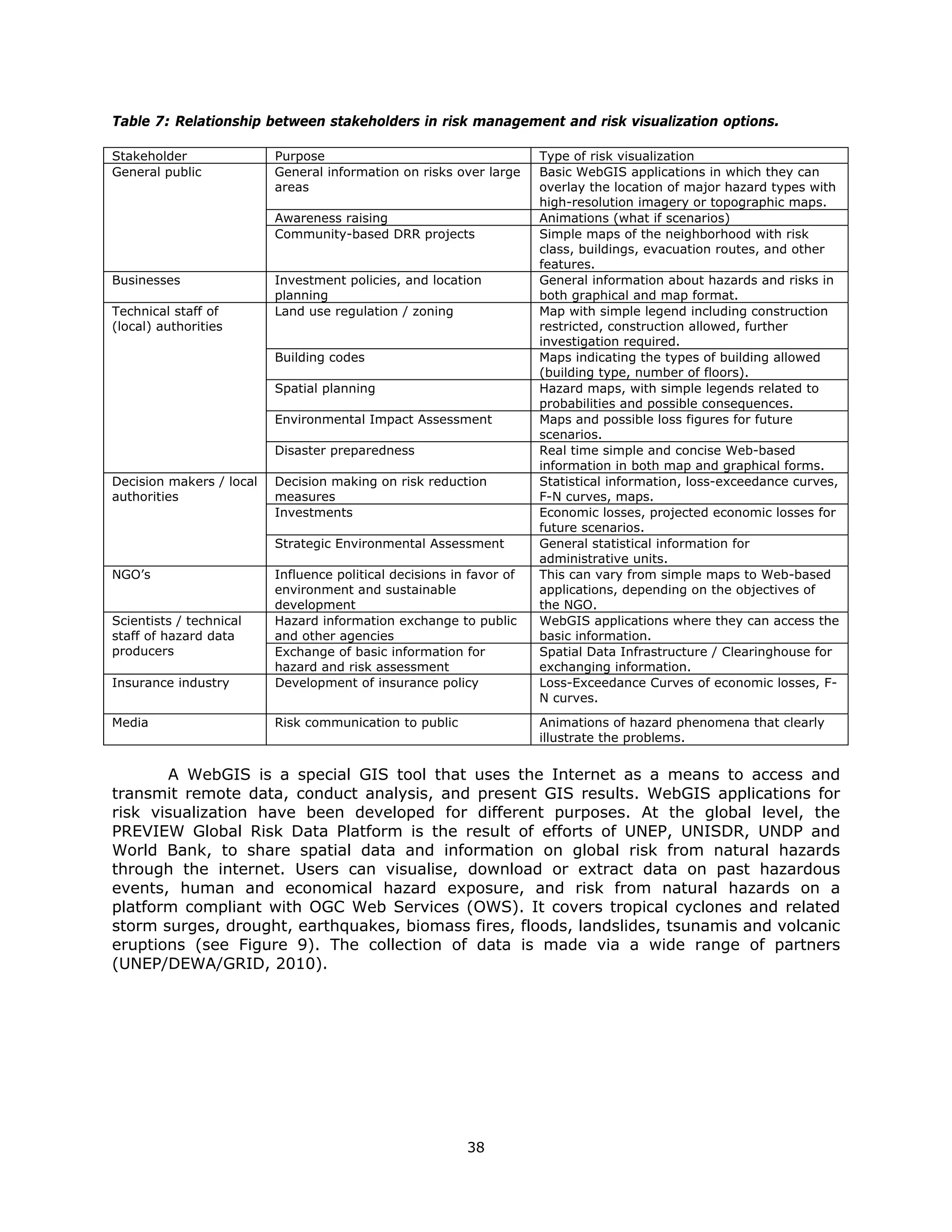
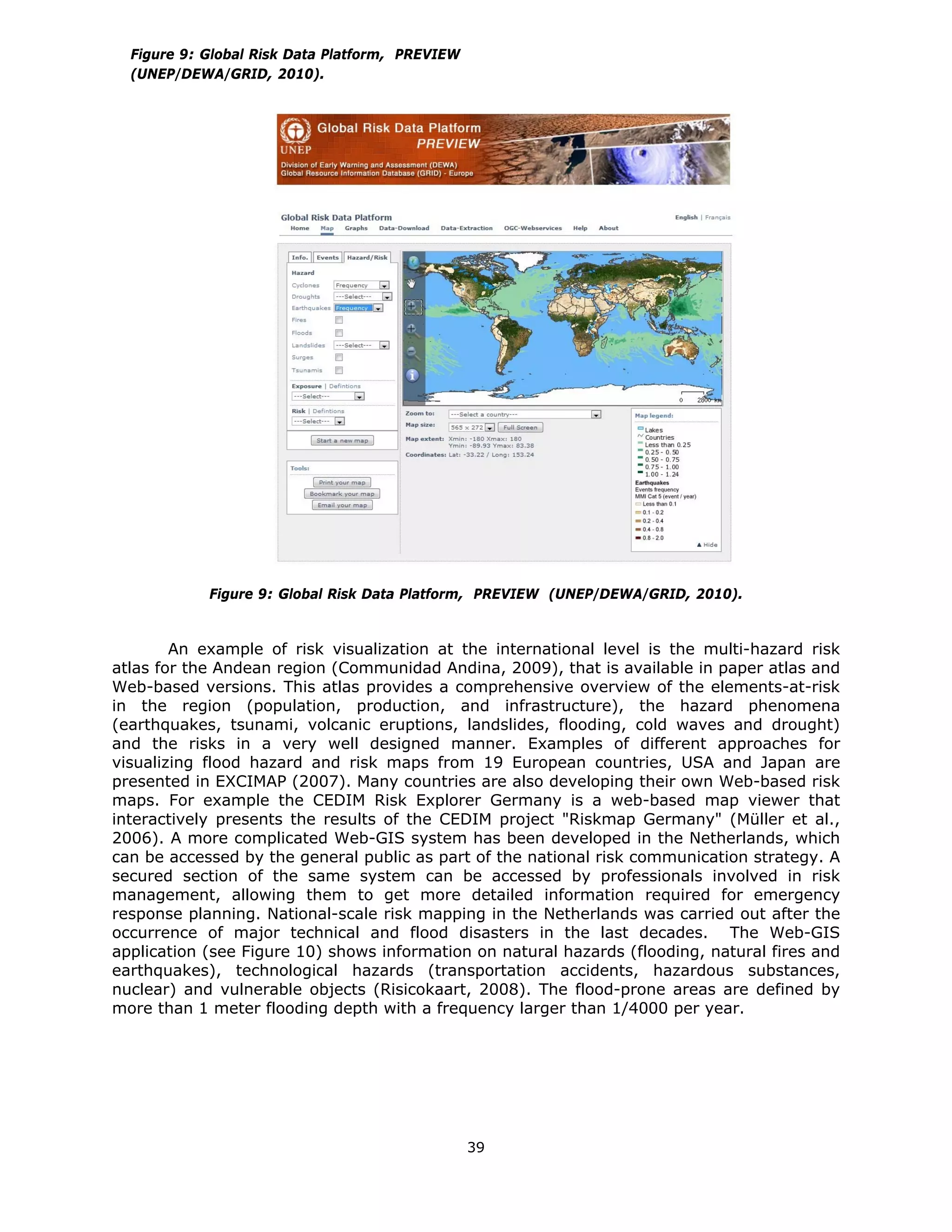
 oriented methods. Geomorphology, 116 (1-2), 24-36
Maskrey, A. (1998). Navegando entre brumas. La aplicación de los sistemas de información geográfica
 al análisis del riesgo en América Latina. ITDG-Peru. LA RED.
Massonnet, D. and Feigl, K.L. (1998). Radar interferometry and its application to changes in the
 Earth’s surface. Rev. Geophys. 36: 441-500
McCall, M.K. (2003). Seeking good governance in participatory-GIS. Habitat International, 27, 549-
 573
McCall, M.K. (2008). Participatory Mapping and Participatory GIS (PGIS) for CRA, Community DRR and
 Hazard Assessment. Provention Consortium.
 http://www.proventionconsortium.org/themes/default/pdfs/CRA/PGIS_Sept08.pdf
Metternicht, G., Hurni, L., Gogu, R., (2005). Remote sensing of landslides: An analysis of the potential
 contribution to geo-spatial systems for hazard assessment in mountainous environments. Remote
 Sensing of Environment 98 (23), 284-303
Miller, P., Mills, J., Edwards, S., Bryan, P., Marsh, S., Mitchell, H., Hobb, P., (2008). A robust surface
 matching technique for coastal geohazard assessment and management. ISPRS Journal of
 Photogrammetry & Remote Sensing, 63, 529–542
Miliaresis, G.C., (2001). Geomorphometric mapping of Zagros Ranges at regional scale. Computers &
 Geosciences, 27, 775-786
Moel, H de, van Alphen, J. and Aerts, J. C. J. H. (2009) Flood maps in Europe – methods, availability
 and use. Nat. Hazards Earth Syst. Sci., 9, 289–301
Molina, S., Lang, D.H. and Lindholm, C.D. (2010). SELENA – An open-source tool for seismic risk and
 loss assessment using a logic tree computation procedure. Computers & Geosciences, 36 (3), 257-
 269
Montague, P. (2004). Reducing the harms associated with risk assessments. Environmental Impact
 Assessment Review, 24, 733-748.
Montoya, L. (2003) Geo-data acquisition through mobile GIS and digital video: an urban disaster
 management perspective. Environmental Modelling & software, 18 (10), 869-876
Moore, I.D., Grayson, R.B., Ladson, A.R., (2001). Digital terrain modelling: a review of hydrological,
 geomorphological, and biological applications. Hydrological Processes 5 (1), 3-30
Mouton, F., Nordbeck, O. (2003), Cyclone database manager : a tool for converting point data from
 cyclone observations into tracks and wind speed profiles in a GIS, University of Geneva,
    http://www.grid.unep.ch/activities/earlywarning/download/cylconesmodeling.pdf
Müller, M., Vorogushyn, S., Maier, P., Thieken, A.H., Petrow, T. , Kron,A., Büchele, B. and Wächter, J.
 (2006) CEDIM Risk Explorer - a map server solution in the project "Risk Map Germany" Natural
 Hazards and Earth System Sciences, 6, 711-720
MunichRe (2010) NATCATSERVICE. Downloadcenter for statistics on natural catastrophes. Münchener
 Rückversicherungs-Gesellschaft, Geo Risks Research, Munich, Germany.
 http://www.munichre.com/en/reinsurance/business/non-life/georisks/natcatservice/default.aspx
Nadim, F., Kjekstad, O., Peduzzi, P., Herold, C. and Jaedicke, C. (2006). Global landslide and
 avalanche hotspots. Landslides, Vol. 3, No. 2, 159-174
Nadim, F., Kjekstad, O., (2009). Assessment of Global High-Risk Landslide Disaster Hotspots. In:
 Sassa, K., Canuti, P. (Eds.), Landslides - Diaster Risk Reduction. Springer, 213-221
NERIES (2009). Network of Research Infrastructures for European Seismology. http://neries.knmi.nl

                                                   49 
 
NWIS (2010). National Water Information system. United States Geological Survey.
  http://nwis.waterdata.usgs.gov/nwis
O'Brien, M. (2000). Making better Environmental Decisions; An Alternative to Risk Assessment., MIT
  Press, Cambridge, Massachusets, USA.
O'Keefe, P., Westgate, K. and Wisner, B. (1976). Taking the naturalness out of natural disasters.
  Nature 260, 566-567
Okuyama, Y., and Chang, S.E. (eds) (2004). Modeling spatial and economic impacts of disasters.
  Springer, Advances in spatial science. 329 pp
OneGeology (2010). OneGeology Portal with worldwide geological data. http://portal.onegeology.org/
OpenSHA (2010). OpenSHA open source platform. Southern California Earthuake Center (SCEC) at the
  University of Southern California (USC) and the United States Geological Survey (USGS).
  http://www.opensha.org/
OpenStreetMap (2010). Open Street Map. http://www.openstreetmap.org/
ORCHESTRA (2009). Reference Model–ORCHESTRA Architecture (RM-OA). EC ORCHESTRA project.
  http://www.eu-orchestra.org/documents.shtml
Oude Elberink, S. and vossleman, G. (2009). Building Reconstruction by Target Based Graph Matching
  on Incomplete Laser Data: Analysis and Limitations. Sensors 2009, 9, 6101-6118
PAGER (2010). PAGER - Prompt Assessment of Global Earthquakes for Response. United States
  Geological Survey. http://earthquake.usgs.gov/earthquakes/pager/
Peduzzi, P., Dao, H., and Herold, C. (2005), Mapping Disastrous Natural Hazards Using Global
  Datasets, Natural Hazards, 35(2), 265–289
Peduzzi, P., Dao, H., Herold, C. and Mouton, F. (2009). Assessing global exposure and vulnerability
  towards natural hazards: the Disaster Risk Index. Nat. Hazards Earth Syst. Sci., 9, 1149–1159
Pelling, M. (2003). The Vulnerability of Cities. Natural disasters and Social Resilience. Earthscan
  Publications, London, 256p
Peters, A.J., Walter Shea, E.A., JI, L., Vliia,A., Hayes, M. and Svoboda, M.D. (2002) Drought
  Monitoring with NDVI-Based Standardized Vegetation Index. Photogrammetric Engineering & Remote
  Sensing, 68 (1), 71-75
Peters Guarin, G.; Van Westen, C.J.; and Montoya, A.L. (2005) Community-based flood risk
  assessment using GIS for the town of San Sebastian, Guatemala. J. of Human Security and
  Development 1, 29-49.
Peters Guarin, G., (2008) Integrating local knowledge into GIS based flood risk assessment, Naga city,
  The Philippines. Wageningen, Enschede, Wageningen University, ITC, 2008. ITC Dissertation 157,
  352 p.
Pelling, M. (2003). The Vulnerability of Cities: Natural Disaster and Social Resilience, Earthscan,
  London.
Pike, R.J., (2000). Geomorphometry - diversity in quantitative surface analysis. Progress in Physical
  Geography 24 (1), 1-20.
Plapp, T. (2001). Understanding risk perception from natural hazards. In: RISK 21 - Coping with Risks
  due to Natural Hazards in the 21st Century - Amman, Dannenmann & Vulliet (eds). Taylor & Francis
  Group, London, 101-108.
Priest, G., A. Baptista, E. Myers III, and R. Kamphaus (2001). Tsunami hazard assessment in Oregon.
  ITS 2001 Proceedings, NTHMP Review Session, R-3, 55–65
Priestnall, G., Jaafar, J., Duncan, A., (2000). Extracting urban features from LiDAR digital surface
  models. Computers, Environment and Urban Systems, 24 (2), 65-78
Provention Consortium (2010). Community Risk Assessment methodologies and case studies.
  http://www.proventionconsortium.org/?pageid=43
RADIUS (1999). RADIUS method (Risk Assessment Tools for Diagnosis of Urban Areas against Seismic
  Disasters). http://www.geohaz.org/news/images/publications/RADIUS_RiskAssessment.pdf
Rautela, P. (2005). Indigenous Technical Knowledge Inputs for Effective Disaster Management in the
  Fragile Himalayan Ecosystem. In Disaster Prevention and Management, 14(2), 233-241
Reese, S., Cousins, W. J. , Power, W.L. , Palmer, N.G. , Tejakusuma, I.G. , and Nugrahadi, S. (2007)
  Tsunami vulnerability of buildings and people in South Java – field observations after the July 2006
  Java tsunami. Nat. Hazards Earth Syst. Sci., 7, 573–589
Reese, S., Bell, R.G., and King, A.B. (2007). RiskScape: a new tool for comparing risk from natural
  hazards. Water & Atmosphere, 15 (3), 24-25
Refsgaard, J.C. and Storm, B. (1995). MIKE-SHE In: V.J. Singh (Ed) Computer models in watershed
  hydrology. Water Resources Publications.


                                                 50 
 
Reidsma,P. , Ewert, F., Boogaard, H. and Van Diepen, K. (2009). Regional crop modelling in Europe:
  The impact of climatic conditions and farm characteristics on maize yields. Agricultural Systems,
  100 (1-3), 51-60
Reliefweb (2010). ReliefWeb, serving the needs of the humanitarian relief community.
  http://www.reliefweb.int
Rhind, D.W., (1991). Counting the people: The role of GIS. In: Maguire, D. J., Goodchild, M.F., and
  Rhind, D. W. (eds) Geographical Information Systems: Volume 1, Principles and Applications. London,
  Longman: 127–137
Risicokaart, (2008). National hazard and risk map of the Netherlands. Landelijke Beheer Organisatie
  Risicokaart , Interprovinciaal Overleg (IPO). http:// www.risicokaart.nl
Sahana (2010). Sahana Free and Open Source Disaster Management System.
  http://sahanafoundation.org/
Salvi, S., Atzori, S., Tolomei, C., Allievi, J., Ferretti, A., Rocca, F., Prati, C., Stramondo, S. and Feuillet,
  N. (2004). Inflation rate of the Colli Albani volcanic complex retrieved by the permanent scatterers
  SAR interferometry technique. Geophys. Res. Lett. 31(21).
Sarker, J.K., Ansary, M.A., Rahman, M.S. and Safiullah, M.M. (2010). Seismic hazard assessment for
  Mymensingh, Bangladesh. Environ Earth Sci. 60, 643–653
Schmidt, J., Matcham, I., Reese, S., King, A., Bell, R., Henderson, R., Smart, G., Cousins, J., Smith,
  W., Heron, D. (2010). Quantitative multi-risk analysis for natural hazards: a framework for multi-risk
  modeling. Natural Hazards, in press.
Schumann,G., Matgen,P., Pappenberger,F., Hostache, R., Puech,C., Hoffmann, L. and Pfister, L.
  (2007). High-resolution 3-D flood information from radar for effective flood hazard management,”
  IEEE Trans. Geosci. Remote Sens., 45 (6), 1715–1725
Sedan, O. and Mirgon, C. (2003). Application ARMAGEDOM Notice utilisateur,BRGM open file
  BRGM/RP-52759-FR.
Sentinel Asia (2010). Sentinel Asia initiative for space-based information and disaster management in
  the Asia-Pacific region. Web site: http://dmss.tksc.jaxa.jp/sentinel/
SERTIT (2010). SErvice Régional de Traitement d'Image et de Télédétection. University of Strasbourg.
  http://sertit.u-strasbg.fr/
Smith, L.C. (1997). Satellite remote sensing of river inundation area, stage, and discharge: a review.
  Hydrological Processes, 11, 1427-1439
Smith, K. and Petley, D.N. (2008). Environmental hazards. Assessing risk and reducing disaster.
  Taylor & Francis, London.
Spence, R.J.S., Baxter, P.J., and Zuccaro, G. (2004): Building vulnerability and human casualty
  estimation for a pyroclastic flow: a model and its application to Vesuvius, J. Volcanol., 133, 321– 343
Spence, R.J.S. , Kelman, I., Calogero, E., Toyos, G., Baxter, P.J. and Komorowski, J.C (2005).
  Modelling expected physical impacts and human casualties from explosive volcanic eruptions. Natural
  Hazards and Earth System Sciences, 5, 1003–1015
Stelling, G.S., Kernkamp, H.W.J. and Laguzzi, M.M. (1998): Delft Flooding System, a powerful tool for
  inundation assessment based upon a positive flow simulation. In Babovic and Larsen (Eds) Hydro-
  informatics 1998; Balkema; Rotterdam the Netherlands. 449-456
Stilla, U., Soergel, U., Thoennessen, U., (2003). Potential and limits of InSAR data for building
  reconstruction in built-up areas. ISPRS Journal of Photogrammetry and Remote Sensing 58 (1-2),
  113-123
Tatem, A.J., Noor, A.M., von Hagen, C., Di Gregorio, A., and Hay, S.I., (2007) High Resolution
  Population Maps for Low Income Nations: Combining Land Cover and Census in East Africa. PLoS
  ONE 2(12): e1298. doi:10.1371/journal.pone.0001298
Thoma, D.P., Gupta, S.C., Bauer, M.E., and Kirchoff, C.E., (2005). Airborne laser scanning for
  riverbank erosion assessment. Remote Sensing of Environment 95, 493-501.
Tilling, R. I. (1989). Volcanic Hazards, Amer. Geophys. Union, Washington DC, 123 pp.
Tralli, D.M., Blom, R.G., Zlotnicki, V., Donnellan, A. and Evans, D.L. (2005). Satellite remote sensing
  of earthquake, volcano, flood, landslide and coastal inundation hazards. ISPRS Journal of
  Photogrammetry and Remote Sensing 59, 185–198
Trigg, S.N., Roy, D.P., and Flasse, S. (2005). An in situ study of the effects of surface anisotropy on
  the remote sensing of burned savannah. International Journal of Remote Sensing 26, 4869–4876
Twigg, J. (2004). Disaster Risk Reduction: mitigation and preparedness in development and
  emergency programming. Good Practice Review no.9. London: Overseas Development Institute,
  Humanitarian Practice Network.


                                                      51 
 
UNEP/DEWA/GRID (2010). PREVIEW Global Risk Data Platform. United Nations Environment
 Programme, Global Resource Information Database, Europe, Geneva.
 http://www.grid.unep.ch/activities/earlywarning/preview/index.php
UN-ESCAP (2003). Guidelines on Participatory Planning and Management for Flood Mitigation and
 Preparedness, United Nations- Economic and Social Commission for Asia and the Pacific (ESCAP).
 Water Resources Series No. 82. UN. New York.
UN-ISDR, 2004. Terminology of disaster risk reduction. United Nationas, International Strategy for
 Disaster Reduction, Geneva, Switzerland http://www.unisdr.org/eng/library/lib-terminology-
 eng%20home.htm
UN-ISDR (2005a). Hyogo framework for Action 2005-2015. Building the Resilience of Nations and
 Communities to Disasters. United Nations, International Strategy for Disaster Reduction, Geneva,
 Switzerland. http://www.unisdr.org/eng/hfa/hfa.htm
UN-ISDR (2005b). Reducing Disaster Risk: A Challenge for Development. United Nations,
 International Strategy for Disaster Reduction, Geneva, Switzerland
 http://www.undp.org/bcpr/disred/rdr.htm
UN-ISDR (2009). Economic damages: share of GDP, by natural disaster and country. United Nations,
 International Strategy for Disaster Reduction, Geneva, Switzerland. http://www.unisdr.org/disaster-
 statistics/top50.htm
UNPD (2010a). World Population Prospects: the 2008 Revision. United Nations Population Division.
 United Nations, Department of Economic and Social Affairs, New York,
 http://esa.un.org/unpd/wpp2008/index.htm.
UNPD (2010b). World Urbanization Prospects:the 2009 Revision. United Nations Population Division.
 United Nations, Department of Economic and Social Affairs, New York,
 http://esa.un.org/unpd/wup/index.htm
UNOSAT (2010). Institute for Training and Research (UNITAR) Operational Satellite Applications
 Programme. http://unosat.web.cern.ch/unosat/
UN-SPIDER (2010). United Nations Platform for Space-based Information for Disaster Management
 and Emergency Response - UN-SPIDER. http://www.un-spider.org/
USGS (1996). HYDRO1k Elevation Derivative Database. U.S. Geological Survey, Sioux Falls, South
 Dakota, USA. http://eros.usgs.gov/#/Find_Data/Products_and_Data_Available/gtopo30/hydro
USGS (1997). GTOPO30. Global 30-Arc-Second Elevation Data Set. U.S. Geological Survey, Sioux Falls,
 South Dakota, USA. http://gcmd.nasa.gov/records/GCMD_GTOPO30.html
USGS (2010). National Geological Map Database (NGMB). United States Geological Survey.
 http://ngmdb.usgs.gov/
Ushahidi (2010). Ushahidi http://www.ushahidi.com/
Van Asch, T. W. J., Malet, J. P., van Beek, L. P. H. and Amittrano, D. (2007) Techniques, issues and
 advances in numerical modelling of landslide hazard. Bulletin de la Societé Geologique de France.
 178, 65–88
Van Beek, L.P.H., and van Asch, T.W.J. (2004). Regional assessment of the effects of land-use change
 and landslide hazard by means of physically based modeling. Natural Hazards, 30(3), 289-304
Van der Knijff, J.M., Younis, J. and De Roo, A.P.J. (2010) LISFLOOD: a GIS-based distributed model
 for river-basin scale water balance and flood simulation. International Journal of Geographical
 Information Science, 24 (2), 189-212
Van Westen, C. J., Montoya, L., and Boerboom, L. (2002). Multi-Hazard Risk Assessment using GIS in
 urban areas: A case study for the city of Turrialba, Costa-Rica, In: Proc. Regional workshop on Best
 Practise in Disaster Mitigation, Bali, 120–136
Van Westen, C.J., Van Asch, T.W.J., Soeters, R., (2005). Landslide hazard and risk zonation; why is it
 still so difficult? Bulletin of Engineering geology and the Environment 65 (2), 167-184
Van Westen, C.J., Castellanos Abella, E.A. and Sekhar, L.K. (2008) Spatial data for landslide
 susceptibility, hazards and vulnerability assessment : an overview. In: Engineering geology, 102 (3-
 4), 112-131
Van Westen, C.J. (ed) (2009). Distance Education course on the use of spatial information in Multi-
 hazard risk assessment. http://www.itc.nl/Pub/study/Courses/C11-AES-DE-01
Verdin, K.L., and Greenlee, S.K., (1996). Development of continental scale digital elevation models
 and extraction of hydrographic features. In: Proceedings, Third International Conference/Workshop
 on Integrating GIS and Environmental Modeling, Santa Fe, New Mexico, January 21-26, 1996.
 National Center for Geographic Information and Analysis, Santa Barbara, California
Verelst, L. (1999). Recommendations for Geo-referencing EM-DAT Data Base, Consultancy Report
 prepared for the Asia FIVIMS Project and the CRED, Rome.

                                                 52 
 
Vigni, C. et al., (2005). Insight into the 2004 Sumatra–Andaman earthquake from GPS measurements
 in southeast Asia. Nature, 436, 201-206
Villagrán de Leon, J. C. (2006). Vulnerability: A Conceptual and Methodological Review. UNU-EHS.
 UNU. No 4/2006.
Virtual Disaster Viewer (2009). Virtual disaster viewer. ImageCat. http://virtualdisasterviewer.com
Wadge, G., Wislocki, A. P., Pearson, E. J. (1993). Spatial analysis in GIS for natural hazard
 assessment. In Goodchild M F, Parks B O, Steyaert L T (eds) Environmental Modeling with GIS. New
 York, Oxford University Press: 332–338
Wald, D.J., Quitoriano, V., Heaton, T.H., Kanamori, H., Scrivner, C.W., and Worden, B.C., (1999).
 TriNet "ShakeMaps": Rapid generation of peak ground-motion and intensity maps for earthquakes in
 southern California: Earthquake Spectra, 15 (3), 537-556
Wald, D. J., P. S. Earle, and V. Quitoriano (2004). Topographic Slope as a Proxy for Seismic Site
 Correction and Amplification, EOS. Trans. AGU, 85(47), F1424
White, D.H., and Walcott J.J. (2009) The role of seasonal indices in monitoring and assessing
 agricultural and other droughts: a review. Crop and Pasture Science 60, 599–616
Whitehouse, G. (2001). Community involvement in flood and floodplain management: the Australian
 Scene. Best practice guidelines for floodplain management in Australia. Draft report. Canberra. 17 p
Wilhite, D.A. (2000), Drought: A Global Assessment, Natural Hazards and Disasters Series, Routledge
 Publishers, U.K
World Bank (2011). Population data. http://data.worldbank.org/indicator/SP.POP.TOTL
Xie, M., Tetsuro, E., Zhou, G., Mitani, Y., (2003). Geographic Information Systems based three-
 dimensional critical slope stability analysis and landslide hazard assessment. Journal of Geotechnical
 and Geoenvironmental Engineering 129 (12), 1109-1118
Yeh, C.H., Loh, C.H. and Tsai, K.C. (2006). Overview of Taiwan Earthquake Loss Estimation System,
 Natural Hazards, 37 (1-2), 23–37
Zerger, A. and Smith, D. (2003). Impediments to using GIS for real-time disaster support. Computers,
 Environmental and Urban Systems, 27, 123-141
Zheng, J., Wang, W.C., Ge, Q. , Man, Z., and Zhang, P. (2006). Precipitation Variability and Extreme
 Events in Eastern China during the Past 1500 Years. Terr. Atmos. Ocean. Sci., 17 (3), 579-592
Zhou, Q., Liu, X., (2004). Analysis of errors of derived slope and aspect related to DEM data
 properties. Computers & Geosciences 30 (4), 369-378
Zuccaro, G., Cacace, F., Spence, R., Baxter, P., (2008), Impact of explosive eruption scenarios at
 Vesuvius, Journal of Volcanological and Geothermal Research, 178 (3), 416-453


                                                  53 
 
Biography 
                              Dr.  Cees  Van  Westen  is  associated  professor  in  the  Department  of  Earth 
                              Systems  Analysis  of  the  Faculty  of  Geo‐Information  Science  and  Earth 
                              Observation (ITC), University of Twente, the Netherlands. He obtained his MSc 
                              in Physical Geography from the University of Amsterdam (1988) and his PhD 
                              in  Engineering  Geology  from  the  Technical  University  of  Delft  (1993),  with 
                              emphasis on Geographic Information Systems for Landslide Hazard Zonation. 
                              Since 2005 he is Director of the United Nations University ‐ ITC School on Geo‐
                              information  for  Disaster  Risk  Management.  He  received  the  ITC  research 
                              award in 1993 and the Richard Wolters Prize of the International Association 
                              of Engineering geology (IAEG) in 1996. He is specialized on topics related with 
the use of spatial information for landslide hazard and risk assessment, Participatory GIS for flood risk 
assessment,  volcanic  hazard  assessment,  seismic  hazard  and  risk  assessment,  technological  risk 
assessment, and multi‐hazard risk assessment. Most of his research is in the field of landslides, dealing 
with  topics  such  as:  generation  of  event‐based  landslide  inventories  using  remote  sensing,  historical 
records  and  field  mapping;  combination  of  heuristic  and  statistical  models  for  landslide  susceptibility 
analysis; dynamic modeling of landslide initiation; landslide run out analysis, and different approaches 
for  landslides  risk  assessment.  He  has  published  over  45  papers  in  ISI  journals,  10  book  chapters,  and 
numerous papers in conference proceedings. He has been involved in many projects funded by the EU 
(FP6, FP7), World Bank, ADB, Dutch government, US‐AID, etc. He is currently project coordinator of the 
CHANGES project, an EU FP7 Marie Curie International Training Network.  


                                                         54 


Glossary: 
 
AAL: Average Annual Loss, or Expected Annual Loss (EAL) is the long term loss rate which can
 be obtained by summing the product of each discrete loss state with its annual frequency of
 occurrence over all loss states.
ADPC: the Asian Disaster Preparedness Center (ADPC) is a non-profit organization from
 Bangkok, supporting the advancement of safer communities and sustainable development,
 through implementing programs and projects that reduce the impact of disasters upon
 countries and communities in Asia and the Pacific.
ADRC: the Asian Disaster Reduction Center in Kobe, Japan with a mission to enhance
 disaster resilience of the member countries, to build safe communities, and to create a
 society where sustainable development is possible.
AEP: Annual Exceedance Probability is the estimated probability that an event of specified
 magnitude will be exceeded in any year.
ALOS: Advanced Land Observing Satellite is a land observing satellite launched in January
 2006 by Japan Aerospace Exploration Agency (JAXA).
APRSAF: Asia-Pacific Regional Space Agency Forum was established in 1993 to enhance
 space activities in the Asia-Pacific region.
ArcPad: GIS software developed by ESRI for use on Mobile-GIS devices
ArcGIS: GIS software by ESRI
ASTER: Advanced Spaceborne Thermal Emission and Reflection Radiometer is a Japanese
 sensor which is one of five remote sensing devices on board the Terra satellite launched
 by NASA in 1999. ASTER provides high-resolution images of the Earth in 15 different
 bands of the electromagnetic spectrum, ranging from visible to thermal infrared light.
AVHRR: Advanced Very High Resolution Radiometer is a space-borne sensor on the
 National Oceanic and Atmospheric Administration (NOAA) family of polar orbiting
 platforms.
Capacity: the positive managerial capabilities of individuals, households and communities
 to confront the threat of disasters (e.g. through awareness raising, early warning and
 preparedness planning).
CAPRA: Central American Probabilistic Risk Assessment, initiative developed by the
 Worldbank.
Cartosat: a stereoscopic Earth observation satellite in a sun-synchronous orbit. The satellite
    was built, launched and maintained by the Indian Space Research Organisation (ISRO)
CLC: CORINE Land Cover. See CORINE
Consequence: The expected losses in a given area as a result of a given hazard scenario.
CORINE: the Corine Land Cover project is a joint initiative of the EU Commission and EU
 Environment Agency which developed a available database now including orthorectified
 Landsat 7 ETM satellite images of the European territory, Land Cover and Changes
 definition maps.
CRED: the Centre for Research on the Epidemiology of Disasters, of the Université
 catholique de Louvain, Belgium, specializes in the fields of international disaster and
 conflict health studies, with research and training activities linking relief, rehabilitation and
 development, and maintains the EM-DAT database.
CVA: the Capacity and Vulnerability Assessment is used as a diagnostic tool to understand
 problems and their underlying causes, related to the vulnerability and capacity of local
 communities to natural hazards.
DEM: a Digital Elevation Model is a digital model or 3-D representation of a terrain's surface
 created from terrain elevation data.
DGPS: a Differential Global Positioning System is an enhancement to Global Positioning
 System that uses a network of fixed, ground-based reference stations to broadcast the

                                               55 
 
difference between the positions indicated by the satellite systems and the known fixed
  positions.
Disaster: a serious disruption of the functioning of a community or a society causing
  widespread human, material, economic or environmental losses which exceed the ability
  of the affected community or society to cope using its own resources.
DNCA: Damage, Needs and Capacity Assessment involves a participatory analysis of the
  disaster event focussing on the damages caused, the immediate needs and priorities of
  the affected community, and of the remaining capacities people use to cope with the
  adverse effects.
DRI: Disaster Risk Index produced a model of factors influencing levels of human losses
  from natural hazards at the global scale, by the United Nations Development Programme
DSM: a Digital Surface Model is a digital model or 3-D representation of the earth's surface
  and includes all objects on it.
DRM: Disaster Risk Management is the systematic process of using administrative directives,
  organizations, and operational skills and capacities to implement strategies, policies and
  improved coping capacities in order to lessen the adverse impacts of hazards and the
  possibility of disaster.
DRR: Disaster Risk Reduction is the concept and practice of reducing disaster risks through
  systematic efforts to analyse and manage the causal factors of disasters, including through
  reduced exposure to hazards, lessened vulnerability of people and property, wise
  management of land and the environment, and improved preparedness for adverse events
DTM: Digital Terrain Model a digital model or 3-D representation of the bare ground surface
  without any objects like plants and buildings
EDM: Electronic Distance Measurement is an electronic theodolite integrated with an
  electronic distance meter to read slope distances from the instrument to a particular point
EFD: European Flood Directive requires EU Member States to engage their government
  departments, agencies and other bodies to draw up a Preliminary Flood Risk Assessment.
EFFIS: the European Forest Fire Information System supports the services in charge of the
  protection of forests against fires in the EU countries and provides the European Commission
  services and the European Parliament with updated and reliable information on wildland fires
  in Europe.
EIA: an environmental impact assessment is an assessment of the possible positive or
  negative impacts that a proposed project may have on the environment, together
  consisting of the natural, social and economic aspects.
Elements-at-risk: Population, properties, economic activities, including public services, or
  any other defined values exposed to hazards in a given area. Also referred to as “assets”.
  The amount of elements-at-risk can be quantified either in numbers (of buildings, people
  etc.), in monetary value (replacement costs, market costs etc), area or perception
  (importance of elements-at-risk).
EM-DAT: Emergency Events Database, the international database on natural hazards,
  maintained by CRED.
ENVISAT: polar orbiting spacecraft operated by the European Space Agency possessing
  several instruments used to monitor the earth's environment. Parameters measured
  include ozone concentration, aerosols, surface stress for earthquake potential, sea level
  heights, and fires.
EO: Earth observation is the gathering of information about planet Earth’s physical, chemical
  and biological systems, using remote sensing. It is used to monitor and assess the status of,
  and changes in, the natural environment and the built environment.
ERS: European radar satellite, developed and maintained by the European Space Agency
  (ESA).
ESRI: the world’s largest GIS company that develops geographic information systems (GIS)
  solutions that function as an integral component in nearly every type of organization.


                                              56 
 
ETOPO:    topographic  dataset from the NOAA NGDC, of topography and bathymetry for the
 entire Earth's surface.
EWS: Early Warning System is the set of capacities needed to generate and disseminate
 timely and meaningful warning information to enable individuals, communities and
 organizations threatened by a hazard to prepare and to act appropriately and in sufficient
 time to reduce the possibility of harm or loss.
Exposure: exposure indicates the degree to which the elements-at-risk are exposed to a
 particular hazard. The spatial interaction between the elements-at-risk and the hazard
 footprints are depicted in a GIS by simple map overlaying of the hazard map with the
 elements-at-risk map.
FEMA: Federal Emergency Management Agency, the national organisation for disaster risk
 management in the USA.
Formosat: earth observation satellite operated by the National Space Organization (NSPO)
 of the Republic of Taiwan.
Frequency : a measure of likelihood expressed as the number of occurrences of an event
 in a given time.
GeoEye: a commercial satellite imagery company based in Dulles, Virginia, USA.
GDACS: Global Disaster Alert and Coordination System, by Joint Research Center (JRC) of the
    European Commission.
GEM: the Global Earthquake Model is a public-private partnership initiated in 2006 by the
 Global Science Forum of the OECD to develop global, open-source risk assessment software
 and tools.
Geological hazard: a geological process or phenomenon that may cause loss of life, injury or
 other health impacts, property damage, loss of livelihoods and services, social and economic
 disruption, or environmental damage
GIS: a geographic information system, or geospatial information system is a system designed
 to capture, store, manipulate, analyze, manage and present all types of geographically
 referenced data.
GMES: Global Monitoring for Environment and Security initiative of the European Commission
 and the European Space Agency (ESA)
G-MOSAIC: GMES services for Management of Operations, Situation Awareness and
 Intelligence for regional Crises
GMOSS: Global Monitoring for Security and Stability is a project in the aeronautics and space
 priority of the EU 6th to integrate Europe’s civil security research and to develop and maintain
 an effective capacity for global monitoring using satellite earth observation.
GRUMP: Global Rural-Urban Mapping Project is a project for generation of a gridded model
 with a grid cell resolution of 30 arc-seconds for global population distribution developed by
 the Socioeconomic Data and Applications Center (SEDAC).
GPS: Global Positioning Systems is a space-based global navigation satellite system (GNSS)
 that provides location and time information in all weather, anywhere on or near the Earth,
 where there is an unobstructed line of sight to four or more GPS satellites.
GSHAP: the Global Seismic Hazard Assessment Project was launched in 1992 by the
 International Lithosphere Program (ILP) with the support of the International Council of
 Scientific Unions (ICSU), and produced small scale standardized seismic hazard maps for
 all seismic regions of the world.
Hazard: A dangerous phenomenon, substance, human activity or condition that may cause
 loss of life, injury or other health impacts, property damage, loss of livelihoods and
 services, social and economic disruption, or environmental damage
Hazard zoning: the subdivision of the terrain in zones that are characterized by the
 temporal probability of occurrence of hazardous events of a particular size and volume,
 within a given period of time.


                                               57 
 
HAZUS: Hazards U.S. loss estimation software developed by the Federal Emergency
  Management Agency (FEMA) together with the National Institute of Building Sciences
  (NIBS).
HVCA: Hazards, Vulnerability and Capacity Assessment is a method that involves a
  participatory analysis of historical hazard trends and present threats undertaken at the
  level of the community (hazard assessment). It is combined with an understanding of the
  underlying reasons why hazards become disasters (vulnerability assessment) and of the
  available resources an affected community uses to cope (capacity assessment).
Hydrometeorological hazard: process or phenomenon of atmospheric, hydrological or
  oceanographic nature that may cause loss of life, injury or other health impacts, property
  damage, loss of livelihoods and services, social and economic disruption, or environmental
  damage
ICG: International Centre for Geohazards, Norway.
IFRC: International Federation of Red Cross and Red Crescent Societies
IKONOS: a commercial earth observation satellite, and was the first to collect publicly
  available high-resolution imagery at 1- and 4-meter resolution. It offers multispectral
  (MS) and panchromatic (PAN) imagery.
ILWIS: the Integrated Land and Water Information System is an Open-source combined GIS
  and image processing software developed by ITC, and maintained by 53North.
InSAR: Interferometric SAR is a radar technique used in geodesy and remote sensing. This
  geodetic method uses two or more synthetic aperture radar (SAR) images to generate maps
  of surface deformation or digital elevation, using differences in the phase of the waves
  returning to the satellite.
IRS: Indian Remote Sensing satellites are a series of Earth Observation satellites, built,
  launched and maintained by Indian Space Research Organisation. The IRS series provides
  many remote sensing services to India.
ITC: the Faculty of Geo-Information Science and Observation of the University of Twente is
  an organization that provides international postgraduate education, research and project
  services in the field of geo-information science and earth observation using remote
  sensing and GIS, located in Enschede, the Netherlands.
LANDSAT: the longest running enterprise for acquisition of imagery of Earth from space.
  The first Landsat satellite was launched in 1972; the most recent, Landsat 7, was
  launched on April 15, 1999. Landsat 7 data has eight spectral bands with spatial
  resolutions ranging from 15 to 60 meters; the temporal resolution is 16 days
LiDAR: Light Detection And Ranging is an optical remote sensing technology that can
  measure the distance to, or other properties of a target by illuminating the target with
  light, often using pulses from a laser
LIMES: Land and Sea Integrated Monitoring for Environment and Security is is an
  Integrated Project co-funded by the European Commission within the 6th Framework
  Programme – Aeronautics&Space/GMES Security.
MARSOP: MARS Crop Yield Forecasting System (MCYFS) carried out by AGRI4CAST and
  FOODSEC actions within the Institute for the Protection and the Security of the Citizen (EU
  JRC).
MERIS: Medium Resolution Imaging Spectrometer is is one of the main instruments on
  board the European Space Agency (ESA)'s Envisat platform, to observe the color of the
  ocean, both in the open ocean and in coastal zones.
Mobile-GIS: a GIS that is running on a mobile, hand held device, which is linked to a GPD
  for collecting spatial and attribute data in digital format directly in the field.
MODIS: Moderate Resolution Imaging Spectroradiometer is a sensor launched into Earth
  orbit by NASA in 1999 on board the Terra (EOS AM) Satellite, and in 2002 on board the
  Aqua (EOS PM) satellite, designed to provide measurements in large-scale global
  dynamics including changes in Earth's cloud cover, radiation budget and processes
  occurring in the oceans, on land, and in the lower atmosphere.

                                             58 
 
Natural hazard: A potentially damaging physical event, phenomenon or human activity
 that may cause loss of life or injury, property damage, social and economic disruption or
 environmental degradation. This event has a probability of occurrence within a specified
 period of time and within a given area, and has a given intensity.
NDVI: Normalized Differential Vegetation Index is is a simple numerical indicator that can
 be used to analyze remote sensing measurements, typically but not necessarily from a
 space platform, and assess whether the target being observed contains live green
 vegetation or not.
NOAA: National Oceanic and Atmospheric Administration, USA
OneGeology: is an international initiative of the geological surveys of the world, launched
 in 2007 as a contribution to the International Year of Planet Earth, with the aim to create
 a web-based geological map of the world.
ORCHESTRA: One of the European Union’s major research and innovation projects for risk
 management, to help national and local governments predict and react to natural
 disasters by joining up national and local information systems and applications.
OSM: OpenStreetMap (OSM) is a collaborative project to create a free editable map of the
 world. The maps are created using data from portable GPS devices, aerial photography,
 other free sources or simply from local knowledge.
PAGER: Prompt Assessment of Global Earthquakes for Response, a tool for the rapid
 assessment of peoples exposed after an earthquake, developed by the USGS.
PALSAR: Phased Array type L-band Synthetic Aperture Radar sensor on board of the
 Advanced Land Observing Satellite (ALOS) developed by the National Space Development
 Agency of Japan (NASDA
PGA: Peak Ground Acceleration is a measure of earthquake acceleration on the ground and
 an important input parameter for earthquake engineering.
PGIS: participatory GIS is encompassing participatory approaches to planning and spatial
 information and communication management using mobile GIS.
PML: Probable Maximum Loss is the anticipated value of the largest loss that could result from
 the destruction and the loss of use of property
Preparedness: the knowledge and capacities developed by governments, professional
 response and recovery organizations, communities and individuals to effectively anticipate,
 respond to, and recover from, the impacts of likely, imminent or current hazard events or
 conditions.
Prevention: The avoidance of adverse impacts of hazards and related disasters
PREVIEW: Prevention, Information and Early Warning pre-operational services to support
 the management of risks
PRISM: Panchromatic Remote-sensing Instrument for Stereo Mapping, on board of the
 Advanced Land Observing Satellite (ALOS)
Probability: a measure of the degree of certainty. This measure has a value between zero
 (impossibility) and 1.0 (certainty). It is an estimate of the likelihood of the magnitude of
 the uncertain quantity, or the likelihood of the occurrence of the uncertain future event.
PSInSAR: Permanent Scatterers Radar Interferometry is a relatively recent development
 from conventional InSAR, and relies on studying pixels which remain coherent over a
 sequence of interferograms.
Qualitative risk analysis: an analysis which uses word form, descriptive or numeric rating
 scales to describe the magnitude of potential consequences and the likelihood that those
 consequences will occur.
Quantitative risk analysis: an analysis based on numerical values of the probability,
 vulnerability and consequences, and resulting in a numerical value of the risk.
QuickBird: a high-resolution commercial earth observation satellite, owned by DigitalGlobe
 and launched in 2001.
RADARSAT: The RADARSAT constellation is a pair of Canadian Remote Sensing satellites.
 The constellation consists of RADARSAT-1, launched 1995, RADARSAT-2, launched 2007

                                             59 
 
RADIUS: Risk Assessment Tools for Diagnosis of Urban Areas against Seismic Disasters
Remote sensing: the acquisition of information about an object or phenomenon, without
 making physical contact with the object. In modern usage, the term generally refers to
 the use of aerial sensor technologies to detect and classify objects on Earth (both on the
 surface, and in the atmosphere and oceans) by means of propagated signals (e.g.
 electromagnetic radiation emitted from aircraft or satellites).
Resilience: the ability of a system, community or society exposed to hazards to resist,
 absorb, accommodate to and recover from the effects of a hazard in a timely and efficient
 manner, including through the preservation and restoration of its essential basic
 structures and functions
Resourcesat: the Indian Remote Sensing (IRS) P6 satellite operated by ISRO and includes
 the two remote sensing instruments known as LISS-III and AWiFS
Response: the provision of emergency services and public assistance during or
 immediately after a disaster in order to save lives, reduce health impacts, ensure public
 safety and meet the basic subsistence needs of the people affected.
Risk: the probability of harmful consequences, or expected losses (deaths, injuries,
 property, livelihoods, economic activity disrupted or environment damaged) resulting from
 interactions between (natural, human-induced or man-made) hazards and vulnerable
 conditions in a given area and time period.
Risk analysis: the use of available information to estimate the risk to individuals or
 populations, property, or the environment, from hazards. Risk analysis generally contains
 the following steps: hazard identification, hazard assessment, elements-at-risk/exposure
 analysis, vulnerability assessment and risk estimation.
Risk assessment: the process of risk analysis and risks evaluation.
Risk control or risk treatment: the process of decision making for managing risks, and
 the implementation, or enforcement of risk-mitigation measures and the re-evaluation of
 its effectiveness from time to time, using the results of risk assessment as one input.
Risk evaluation: the stage at which values and judgements enter the decision process,
 explicitly or implicitly, by including consideration of the importance of the estimated risks
 and the associated social, environmental, and economic consequences, in order to identify
 a range of alternatives for managing the risks.
Risk management: the complete process of risk assessment and risk control (or risk
 treatment).
Risk perception: the way how people/communities/authorities judge the severity of the
 risk, based on their personal situation, social, political, cultural and religious background,
 economic level, their level of awareness, the information they have received regarding the
 risk, and the way they rate the risk in relation with other problems.
RiskScape: New Zealand software and methodology for multi-hazard risk assessment
Risk transfer: the process of formally or informally shifting the financial consequences of
 particular risks from one party to another whereby a household, community, enterprise or
 state authority will obtain resources from the other party after a disaster occurs, in
 exchange for ongoing or compensatory social or financial benefits provided to that other
 party.
SAFER: Services and Applications For Emergency Response, an EU GMES Emergency
 Response Service, with the aim to provide space-based products in support of European
 decision-makers facing natural and technological disasters.
SAR: Synthetic Aperture Radar is a form of radar whose defining characteristic is its use of
 relative motion between an antenna and its target region to provide distinctive long-term
 coherent-signal variations that are exploited to obtain finer spatial resolution than is
 possible with conventional beam-scanning means. It originated as an advanced form of
 side-looking airborne radar (SLAR).
SDI: Spatial Data Infrastructure is a framework of spatial data, metadata, users and tools
 that are interactively connected in order to use spatial data in an efficient and flexible way

                                              60 
 
SELENA: SEimic Loss EstimatioN using a logic tree Approach, an open risk assessment
 package consisting of the two separate software tools SELENA (Seismic Loss Estimation
 using a Logic Tree Approach) and RISe (Risk Illustrator for SELENA), developed by the
 University of Alicante, NOSAR and ICG.
ShakeMaps: a GIS-based tool for earthquake hazard assessment, developed by the USGS
 in cooperation with regional seismic-network operators. ShakeMaps provides near-real-
 time maps of ground motion and shaking intensity after important earthquakes.
SPOT: Satellite Pour l'Observation de la Terre, a high-resolution, optical imaging Earth
 observation satellite system from France.
SMCE: Spatial Multi Criteria Evaluation, a tool for decision-aid and a mathematical tool
 allowing the comparison of different alternatives or scenarios according to many criteria,
 often conflicting, in order to guide the decision maker towards a judicious choice.
Societal risk: the risk of multiple fatalities or injuries in society as a whole: one where
 society would have to carry the burden of a landslide causing a number of deaths, injuries,
 financial, environmental, and other losses.
SRTM : Shuttle Radar Topography Mission (SRTM), an international research effort that
 obtained digital elevation models on a near-global scale from 56° S to 60° N, to generate
 a high-resolution digital topographic database of the Earth.
Technological hazard: a hazard originating from technological or industrial conditions,
 including accidents, dangerous procedures, infrastructure failures or specific human
 activities, that may cause loss of life, injury, illness or other health impacts, property
 damage, loss of livelihoods and services, social and economic disruption, or environmental
 damage
TMPA : TRMM Multi-satellite Precipitation Analysis.
TRMM: Tropical Rainfall Measuring Mission, a joint NASA and JAXA mission to monitor and
 study tropical rainfall from satellite imagery.
UN-ISDR : United Nations International Strategy for Disaster Risk Reduction
USGS: United States Geological Survey.
Ushahidi: free open-source software for co-ordinating citizen reports on a national crisis
UN-SPIDER: United Nations Platform for Space-based Information for Disaster
 Management and Emergency Response.
VDV: Virtual Disaster Viewer, a crowdsourcing tool for disaster damage assessment
 developed by ImageCat.
Vulnerability: the conditions determined by physical, social, economic and environmental
 factors or processes, which increase the susceptibility of a community to the impact of
 hazards. Can be subdivided in physical, social, economical and environmental vulnerability.
WASP: Weighted Anomaly of Standardized Precipitation gives an estimate of the relative
 deficit or surplus of precipitation for different time intervals ranging from 1- to 6-months.
Web-GIS: is the process of designing, implementing, generating and delivering maps on
 the World Wide Web with an emphasis on analysis, processing of project specific geodata
 and exploratory aspects.
WorldView: commercial high resolution panchromatic satellite owned by DigitalGlobe.
 WorldView-2 provides commercially available panchromatic imagery of .5 m resolution,
 and eight-band multispectral imagery with 1.8 m (5 ft 11 in) resolution.


                                             61 
 

Remote Sensing and GIS for Natural Hazards Assessment and Disaster Risk Management

  • 1.
    Remote Sensing and GIS for Natural Hazards  Assessment and Disaster Risk Management  Cees J. Van Westen Faculty of Geo-Information Science and Earth Observation (ITC), University of Twente Hengelosestraat 90 7500 AA Enschede, The Netherlands Tel: +31534874263, Fax: +31534874336 E-mail: westen@itc.nl Keywords: Community-based Disaster Risk Management, Cyclones, Drought, Damage Assessment, Earthquakes, Elements at Risk, Flooding, Forest Fires, Geographic Information Systems, Hazard Assessment, Landslides, Mobile-GIS, Multi-Hazards, Remote Sensing, Spatial Data, Risk Assessment, Risk Management, Vulnerability Assessment. Abstract The world has experienced an increasing impact of disasters in the past decades. Many regions are exposed to natural hazards, each with unique characteristics. The main causes for this increase can be attributed to a higher frequency of extreme hydro-meteorological events, most probably related to climate change, and to an increase in vulnerable population. To reduce disaster losses, more efforts should be applied towards Disaster Risk Management, with a focus on hazard assessment, elements-at- risk mapping, vulnerability and risk assessment, all of which have an important spatial component. Multi- hazard assessment involves the assessment of relationships between different hazards and especially for concatenated or cascading hazards. The use of earth observation (EO) products and geographic information systems (GIS) has become an integrated approach in disaster-risk management. Hazard and risk assessments are carried out at multiple scales, ranging from global to a community level. These levels have their own objectives and spatial data requirements for hazard inventories, environmental data, triggering or causal factors, and elements-at-risk. This chapter provides an overview of various forms of spatial data, and examines the approaches used for hazard and risk assessment. Specifically, hazard examples include earthquakes, windstorms, drought, floods, volcanic eruptions, landslides and forest fires. Several approaches are also treated that have been developed to generate elements-at-risk databases with emphasis on population and building information, as these are the most used categories for loss estimation. Furthermore, vulnerability approaches are discussed, with emphasis on the methods used to define physical vulnerability of buildings and population, and indicator-based approaches used for a holistic approach, also incorporating social, economic and environmental vulnerability, and capacity. Finally, multi-hazard risk approaches and spatial risk visualization are addressed. Multi-hazard risk assessment is a complicated procedure, which requires spatial data on many different aspects and a multi-disciplinary approach. Within this procedure, geographers and in particular geomorphologists can play a key-role, as they are able to integrate the spatial information coming from the various disciplines. The research challenge for geomorphologists is to focus on the integrated modeling of multi-hazards sharing the same triggering event or occurring as cascading hazards.     1. Introduction   Disasters are headline news almost every day. Most happen in far-away places, and are rapidly forgotten. Others keep the attention of the world media for a longer period of time. The events that receive maximum media attention are those that hit instantaneously and cause widespread losses and human suffering, such as earthquakes, tsunamis, hurricanes and floods. Recent examples are the Indian Ocean tsunami (2004), the earthquakes in Pakistan 1   
  • 2.
    (2005), Indonesia (2006),China (2008), Haiti (2010) and Japan (2011) and the hurricanes in the Caribbean and the USA (2005, 2008). On the other hand, there are many serious geomorphologic hazards that have a slow onset, such as the recent drought in the Horn of Africa (2011), soil erosion, land degradation, desertification, glacial retreat, sea-level rise, loss of biodiversity etc. These processes and related events may cause local, regional, and global impacts in the long run, but receive generally less attention. Disasters are defined by the United Nations International Strategy for Disaster Risk Reduction (UN-ISDR, 2004) as “a serious disruption of the functioning of a community or a society causing widespread human, material, economic or environmental losses which exceed the ability of the affected community or society to cope using its own resources”. Although the term “natural disasters” in its’ strict sense is not correct, as disasters are a consequence of the interaction between hazards and vulnerable societies, the term is used extensively in the literature and also in daily use. A hazard is defined as “a potentially damaging physical event, phenomenon or human activity that may cause the loss of life or injury, property damage, social and economic disruption or environmental degradation”. This event has a probability of occurrence within a specified period of time and within a given area, and has a given intensity (UN-ISDR, 2004). Hazards can be single, sequential or combined in their origin and effects. Each hazard is characterised by its location, area affected (size or magnitude), intensity, speed of onset, duration and frequency. Hazards can be classified in several ways. A possible subdivision is between natural, human-induced and human-made hazards. Natural hazards are natural processes or phenomena in the Earth's system (lithosphere, hydrosphere, biosphere or atmosphere) that may constitute a damaging event (e.g., earthquakes, volcanic eruptions, hurricanes). A subdivision of natural hazards relates to the main controlling factors of the hazards leading to a disaster. They may be hydro-meteorological (including floods and wave surges, storms, droughts and related disasters such as extreme temperatures and forest/scrub fires, landslides and snow avalanches), geophysical hazards (resulting from anomalies in the Earth’s surface or subsurface, such as earthquakes, tsunamis and volcanic eruptions), or biological hazards (related to epidemics and insect infestations). Human-induced hazards are those resulting from modifications of natural processes in the Earth's system caused by human activities which accelerate/aggravate the damage potential (e.g., land degradation, landslides, forest fires). Human-made hazards originate from technological or industrial accidents, dangerous procedures, infrastructure failures or certain human activities, which may cause the loss of life or injury, property damage, social and economic disruption or environmental degradation (e.g., industrial pollution, nuclear activities and radioactivity, toxic wastes, dam failures; transport, industrial or technological accidents such as explosions, fires and oil spills). The aim of a hazard assessment is to identify the various types of hazards that may threaten a territory, and to partition the landscape in zones which are characterized by different expected intensities and frequencies of hazardous processes. In a hazard assessment several aspects should be evaluated: the triggering event, the areas where hazards are likely to initiate, the areas where the hazards are likely to spread, the expected intensity of the hazard and its associated frequency or probability of occurrence. Hazards may impact vulnerable societies, and may result in physical and other types of damage to so called “elements-at-risk”. With certain exceptions (e.g. ash clouds affecting air-traffic or oilspills affecting marine flora and fauna) these impacted elements-at-risk are mostly located on the earth’s surface. Therefore, the relationship between the hazard events and surface processes, landforms or materials is a key component to study. Geomorphology therefore plays a key role in hazard and risk analysis. Geomorphology is the science of landforms and surface materials and of the processes that have formed or reshaped them. Geomorphologists investigate the evolution of landscapes, and study the history and the dynamics of landforms and the processes responsible for creating or modifying them, through a combination of field observations, physical experiments and numerical modelling. 2   
  • 3.
    These processes thathave shaped the Earth’s surface can be potentially dangerous if they exceed a certain threshold, e.g. they may result in instability and erosion on slopes, flooding in river- or coastal areas. The study of the endogenic (volcanic eruptions or earthquakes) or exogenic (extreme meteorological) triggering events causing hazardous processes may be outside of the scope of geomorphology, as this is the domain of seismologists, volcanologists, meteorologists etc. Nevertheless, geomorphologists contribute to the reconstruction of the frequency, extent and intensity of past events, by studying their imprints on landforms and surface materials. Geomorphologists play a key role in the analysis of how these triggering events result in hazardous processes on the earth surface. They are specialized in analyzing the possible spatial extent of future hazardous processes related to a set of environmental factors (geomorphology, topography, geology, soils, land cover etc.). Examples of this are the study of potential landslide areas, or the analysis of the effects of surface materials and landforms in the amplification of seismic waves or liquefaction. Geomorphologists are also good in modelling the extent of the spreading of hazardous processes over the topography (e.g. lahar flows, landslide runout, flood extent), based on Digital Elevation Models. The study of hazards and risks has a very important spatial component. Certain types of hazards are restricted to certain geographical regions. Earthquakes occur along active tectonic-plate margins, and volcanos occur along subduction zones (e.g., around the margins of the Pacific plate, so-called “Ring of Fire”). Tsunamis occur in the neighborhood of active-plate margins, but their effects can be felt at considerable distances from their origin, as the waves can travel long distances. Tropical cyclones (in North America called “hurricanes” and in Asia called “typhoons”) occur in particular coastal zones. Landslides occur in hilly and mountainous regions. In the analysis of hazard and risk geo-information science and earth observation plays an increasingly important role. Remote Sensing is nowadays an essential tool in monitoring changes in the earth’s surface, oceans and atmosphere, and is increasingly used as the basis for early warning for hazardous events. Remote sensing provides the input for thematic information used in hazard modeling, like topography, lithology, and land cover. The use of spatio-temporal data and geographic information technologies have now become part of an integrated approach to disaster risk management. New GIS algorithms and analysis/modelling techniques are revolutionising the potential capacity to analyse hazards, vulnerability and risks. Information technology systems are used for storage, situation analysis, modelling, and visualization (Twigg, 2004). Disaster-risk management benefits greatly from the use of geospatial technologies because spatial and temporal variation can be accounted for, and new methodologies can be developed and fully explored. One of the key advantages of using GIS-based tools for the risk decision-making process is the possibility to use ‘what if’ analysis by varying parameters and generating alternative scenarios in a spatial context (Longley et al., 2005). Earlier publications on this topic can be found in Wadge et al. (1993), Coppock (1995), Emani (1996), and Kaiser et al. (2003). The objective of this chapter is to give an overview of the application of geo- information science and earth observation in the analysis of hazards and risk. The chapter starts with a background section discussing disaster trends, and the framework for disaster risk management. Subsequent sections discuss the use of GIS and remote sensing in the generation of inventories of past hazardous events, the modelling of hazards, the generation of elements-at risk databases and the integration of these data in the modeling of potential losses.   3   
  • 4.
    2. Background  Table 1 providesa summary of the various terms that are relevant in the context of this chapter, relating to disasters, disaster risk and its various components (UN-ISDR,2004). It is important to distinguish between the terms disaster, hazard and risk. Risk results from the combination of hazards, conditions of vulnerability, and insufficient capacity or measures to reduce the potential negative consequences of risk (O'Keefe et al., 1976). When the hazard or threat becomes a reality (i.e., when it materializes), the risk becomes a disaster. For example, a certain river valley may be prone to flooding. There is risk if a vulnerable society/community or property is located within this flood prone area. If the hazard materializes, that is, if the flood actually occurs, it will cause losses to the vulnerable society or property, thus creating a disaster (Fig. 1). Figure 1: Schematic representation of the relation between hazards, vulnerable society, risk and disasters. A: risk indicates the expected losses to a vulnerable society as a result of hazards. B: A disaster occurs when the threat of a hazard become reality, and impacts on a vulnerable society. C: Future trends of increasing hazards and increasing vulnerability will lead to increasing risk. 4   
  • 5.
    Table 1: Summaryof definitions related to disasters, hazards and vulnerability. Based on UN-ISDR (2004). Term Definition Disaster A serious disruption of the functioning of a community or a society causing widespread human, material, economic or environmental losses which exceed the ability of the affected community or society to cope using its own resources. Natural hazard A potentially damaging physical event, phenomenon or human activity that may cause loss of life or injury, property damage, social and economic disruption or environmental degradation. This event has a probability of occurrence within a specified period of time and within a given area, and has a given intensity. Elements-at-risk Population, properties, economic activities, including public services, or any other defined values exposed to hazards in a given area. Also referred to as “assets”. The amount of elements-at-risk can be quantified either in numbers (of buildings, people etc.), in monetary value (replacement costs, market costs etc), area or perception (importance of elements-at- risk). Exposure Exposure indicates the degree to which the elements-at-risk are exposed to a particular hazard. The spatial interaction between the elements-at-risk and the hazard footprints are depicted in a GIS by simple map overlaying of the hazard map with the elements-at-risk map. Vulnerability The conditions determined by physical, social, economic and environmental factors or processes, which increase the susceptibility of a community to the impact of hazards. Can be subdivided in physical, social, economical and environmental vulnerability. Capacity The positive managerial capabilities of individuals, households and communities to confront the threat of disasters (e.g., through awareness raising, early warning and preparedness planning). Consequence The expected losses in a given area as a result of a given hazard scenario. Risk The probability of harmful consequences, or expected losses (deaths, injuries, property, livelihoods, economic activity disrupted or environment damaged) resulting from interactions between (natural, human-induced or man-made) hazards and vulnerable conditions in a given area and time period. 2.1 Trends in disaster statistics  Data on disaster occurrences, their effect upon people, and their cost to countries are very important for disaster-risk management. There are now a number of organizations that collect information on disasters, at different scales and with different objectives.  Since 1988 the Centre for Research on the Epidemiology of Disasters (CRED) has been maintaining an Emergency Events Database (EM-DAT, 2009). Disasters have to fulfill certain criteria in order to be included in the EM-DAT database: they have to cause at least 10 casualties, 100 or more should be affected, it should result in a declaration of emergency, or it should lead to a call for external assistance.  Data on disaster impacts are also collected by reinsurance companies. For instance, the MunichRe database for natural catastrophes (NatCatSERVICE) includes more than 28,000 entries on material and human-loss events worldwide (MunichRe, 2010). A similar disaster-event database (SIGMA) is maintained by SwissRe. These data, however, are not publicly available.  The Asian Disaster Reduction Center (ADRC) has initiated a new disaster database, called Glidenumber (2010). The specific feature of this database is that each disaster receives a unique identifier and a number of relevant attributes.  At a local level, disaster data have been collected by an initiative of NGOs, called LaRed, initially in Latin America, but later on expanding also to other regions. They generated a tool called DesInventar (2010), which allows local authorities, communities and NGO’s to collect disaster information. Recently, the DesInventar database has become available online. 5   
  • 6.
    There are also many disaster databases collected at the national level, or that are related to a specific type of hazard. The Global Risk Identification Program (GRIP) and the Centre for research in Epidemiology of Disasters (CRED) have initiated a service, called DisDAT, which brings together all publicly available disaster databases from different countries (GRIP, 2010). It contains 60 registered disaster databases, of which 13 are global. When examining the reported disasters in these databases, there is a clear increase in hazardous events over the past decades (Figure 2). The number of natural disasters in the last decade has increased by a factor of 9 compared to the decade 1950-1959 (EM-DAT, 2009), which is mainly caused by an increase in hydro-meteorological disasters. In terms of losses, earthquakes resulted in the largest amount of losses (35% of all losses), followed by floods (30%), windstorms (28%) and others (7%). Earthquakes are also the main cause of fatalities, which is estimated on the order of 1.4 million during the period 1950-2000 (47%), followed by windstorms (45%), floods (7%), and others (1%) (MunichRe, 2010; EM-DAT, 2009). It is interesting to note that human fatalities due to natural disasters shows a decreasing trend, which may be due to better warning systems and improved disaster management, but the number of people affected follows the increasing trend of the number of events (see Figure 2). Figure 2: Summary of natural disasters, showing the number of reported disasters, the number of people killed and the number of people affected over the period 1900-2009. Source: EM-DAT (2009). Disaster information collected at the local level (e.g., DesInventar) is more complete, as it includes also small-magnitude/high-frequency events, but the coverage of such databases is limited worldwide. One of the major problems with the use of disaster databases for natural hazard and risk assessment, is that they normally lack proper georeferencing of the reported events (Verelst, 1999). A comparitive study of the EM-DAT, Sigma and NATCAT databases carried out for four countries showed that these databases differed significantly (Guha-Sapir and Below, 2002). The increase in the number of disasters, the losses and people affected cannot be explained only by better reporting methods and media coverage of disasters, lack of which probably made the number too low for the first part of the last century. There are a number of factors that influence the increase in the number of disasters which can be subdived as those leading to a larger vulnerability, and those leading to a higher occurrence of hazardous events. The increased vulnerability is due to a number of reasons. The rapid increase of the world population, which has doubled in size from 3 billion in the 1960s to 7 billion in 2011 6   
  • 7.
    (World Bank, 2011).Depending on the expected growth rates, world population is estimated to be between 7.9 and 11.0 billion by the year 2050 (UNPD, 2010a). The increase in disaster impact, however, is higher than the increase in population, which indicates that there are other important factors involved that increase the overall vulnerability of the world population. One of the main factors is the large urbanization rate. According to UN figures (UNPD, 2010b), the worldwide urbanization percentage has increased from 29% in 1950 to 50% in 2010, and is expected to rise to 69% in 2050. Another factor related to the population growth is that areas become settled, that were previously avoided due to their susceptibility to natural hazards. Many of the largest cities in the world, the so-called “Megacities” are located in hazardous regions, either in coastal zones, or in seismically active regions (Smith and Petley, 2008; Kraas, 2008). The increasing impact of natural disasters is also related with the development of highly sensitive technologies, and the growing susceptibility of modern industrial societies to breakdowns in their infrastructure. Data from MunichRe (2010) show that the economic losses have increased by a factor of 8 over the past 50 years, and insured losses by a factor of 15. There is a rapid increase in the insured losses, which are mainly related to losses occurring in developed countries. Windstorms clearly dominate the category of insured losses (US $90 billion), followed by earthquakes (US $ 25 billion). Insured losses to flooding are remarkably less (US $ 10 billion), due to the fact that they are most severe in developing countries with lower insurance coverage (MunichRe, 2010). It is not only the increased exposure of the population to hazards, however, that can explain the increase in natural disasters. The frequency of destructive events related to atmospheric extremes (such as floods, drought, cyclones, and landslides) is also increasing (EM-DAT, 2009). During the last 10 years a total of 3,750 windstorms and floods were recorded, accounting for two-thirds of all events. The number of catastrophes due to earthquakes and volcanic activity (about 100 per year) has remained constant (MunichRe, 2010). Although the time-span is still not long enough to indicate it with certainty, these data suggest that climate change is related to the increased occurrence of natural disasters. There is an inverse relationship between the level of development and loss of human lives in the case of disasters. About 85 percent of the disaster related casualties occur in less developed countries, where more than 4.7 billion people live. The greater loss of lives is due to the lower quality of buildings, lack of building codes or lack of enforcement, construction of buildings in hazardous areas due to lack of land-use planning, lower awareness and disaster preparedness, less accurate or missing early-warning systems, lack of evacuation planning, lack of facilities for search-and-rescues and medical attention. Although 65% of the overall losses occur in high-income countries (with GNI US$ >12,000 per capita) (World Bank, 2010), and only 3% in low-income countries (GNI US$ < 1000 per capita), the effect in the latter group is devastating, as they may represent as much as 100% of their Gross National Income (UN-ISDR, 2009). Economic losses in absolute terms (billions of dollars) show an increase with the level of development, as the absolute value of elements-at-risk that might be damaged during a disaster increases with increasing level of development. In relative terms, however, the trend is reverse, showing a decrease in the losses expressed as percentage of GDP with increasing level of development (MunichRe, 2010). 2.2 Disaster Risk‐Management framework  Disaster-Risk Management (DRM) is defined as “the systematic process of using administrative decisions, organization, operational skills and capacities to implement policies, strategies and coping capacities of the society and communities to lessen the impacts of natural hazards and related environmental and technological disasters”. This comprises all forms of activities, including structural and non-structural measures to avoid (prevention) or to limit (mitigation and preparedness) adverse effects of hazards (UN-ISDR, 2004). Disaster-risk management is aimed at disaster-risk reduction, which refers to the conceptual framework of elements 7   
  • 8.
    considered with thepossibilities to minimize vulnerabilities and disaster risks within the broad context of sustainable development (UN-ISDR, 2004). The past decades have witnessed a shift in focus from disaster recovery and response to risk management and mitigation. This change was also from an approach that focused primarily on the hazard as the main causal factor for risk, and the reduction of the risk by physical-protection measures, to a focus on vulnerability of communities and ways to reduce those through preparedness and early warning. Later more focus was given to the strengthening of the capacity of local communities and the development of community-based coping strategies (Blaikie et al., 1994; Lavel, 2000, Pelling, 2003). The Yokohama conference in 1994 put into perspective the socio-economic aspects as a component of effective disaster prevention. It was recognized that social factors, such as cultural tradition, religious values, economic standing, and trust in political accountability are essential in the determination of societal vulnerability. In order to reduce societal vulnerability, and therewith decrease the consequences of natural disasters, these factors need to be addressed (Hillhorst, 2004). The ability to address socio-economic factors requires knowledge and understanding of local conditions, which can, in most cases, only be provided by local participants. The decade from 1990 to 2000 was declared by the United Nations as the International Decade for Natural Disaster Reduction (IDNDR). As the impact of disasters increased dramatically during this decade the international community decided to continue this effort after 2000 in the form of an International Strategy for Disaster Reduction (ISDR). The ISDR stressed the need to move from a top-down management of disasters and a cycle that focuses on reconstruction and preparedness, towards a more comprehensive approach that tries to avoid or mitigate the risk before disasters occur, and at the same time fosters more awareness, public commitment, knowledge sharing and partnerships to implement various risk reduction strategies at all levels (UN-ISDR, 2005b). This more positive concept has been referred to as the “risk-management cycle”, or better “spiral”, in which learning from a disaster can stimulate adaptation and modification in development planning, rather than a simple reconstruction of pre-existing social and physical conditions. This is illustrated in Figure 3, by showing the disaster cycle and various components (relief, recovery, reconstruction, prevention and preparedness), and how these changed through time. Initially (Figure 3A) most emphasis was given to disaster relief, recovery and reconstruction, thereby getting into a cycle where the next disaster was going to cause the same effects or worse. Later on (Figure 3B) more attention was given to disaster preparedness by developing warning systems and disaster awareness programs. Eventually (Figure 3C) the efforts are focusing on disaster prevention and preparedness, thus enlarging the time between individual disasters, and reducing their effects, requiring less emphasis in relief, recovery and reconstruction. The eventual aim of disaster-risk management is to enlarge this cycle, and only reach the response phase for extreme events with very low frequency. Disaster prevention is achieved through risk management. Figure 4 presents the general risk-management framework which is composed of a risk-assessment block and a block in which risk-reduction strategies are defined. A summary of the terminology used in risk management is given in Table 2. Central in the procedure is risk analysis, in which the available information is used to estimate the risk to individuals or populations, property or the environment, from various hazards. Risk analysis generally contains the following steps: 1) hazard identification; 2) hazard assessment; 3) elements-at-risk/exposure analysis; 4) vulnerability assessment and 5) risk estimation. Risk evaluation is the stage at which values and judgments enter the decision process, explicitly or implicitly, by including consideration of the importance of the estimated risks and the associated social, environmental, and economic consequences, in order to identify a range of alternatives for reducing the risks (UN-ISDR, 2004). 8   
  • 9.
    Figure 3: Disastercycle and its development through time. Risk assessment is the combination of risk analysis and risk evaluation. It is more than a purely scientific enterprise and should be seen as a collaborative activity that brings professionals, authorized disaster managers, local authorities and the people living in the exposed areas together (O’Brien, 2000; Plapp, 2001; Montague, 2004;). Risk governance is therefore an integral component. The final goal, reduction of disaster risk, should be achieved by combining structural and non-structural measures that focuses on emergency preparedness (e.g., awareness raising, early-warning systems, etc.), inclusion of risk information in long term land-use planning, and evaluation of the most cost-effective risk-reduction measures (see Figure 4). In the entire risk-management framework, spatial information plays a crucial role, as the hazards are spatially distributed, as well as the vulnerable elements-at-risk. 2.3 Risk‐Analysis Framework  As illustrated in Figure 5, there are three important components in risk analysis: 1) hazards; 2) vulnerability; and 3) elements-at-risk (Van Westen et al., 2008). They are characterized by both spatial and non-spatial attributes. Hazards are characterized by their temporal probability and intensity, derived from frequency-magnitude analysis. Intensity expresses the severity of the hazard, for example water depth, flow velocity, and duration in the case of flooding. The hazard component in the equation actually refers to the probability of occurrence of a hazardous phenomenon with a given intensity within a specified period of time (e.g., annual probability). Hazards also have an important spatial component, both related to the initiation of the hazard (e.g., a volcano) and the spreading of the hazardous phenomena (e.g., the areas affected by volcanic products such as lava flows) (Van Westen, 2009). 9   
  • 10.
    Figure 4: RiskManagement framework Elements-at-risk or “assets” are the population, properties, economic activities, including public services, or any other defined values exposed to hazards in a given area (UN- ISDR, 2004). Elements-at-risk also have spatial and non-spatial characteristics. There are many different types of elements-at-risk and they can be classified in various ways (see Section 4.1). The way in which the amount of the elements-at-risk is characterized (e.g., as number of buildings, number of people, economic value, or qualitative rating according to their importance) also defines the way in which the risk is presented. The interaction of elements- at-risk and hazard defines the exposure and the vulnerability of the elements-at-risk. Exposure indicates the degree to which the elements-at-risk are actually located in an area affected by a particular hazard. The spatial interaction between the elements-at-risk and the hazard footprints are depicted in a GIS by map overlaying of the hazard map with the elements-at- risk map (Van Westen, 2009). Vulnerability refers to the conditions determined by physical, social, economic and environmental factors or processes, which increase the susceptibility of a community to the impact of hazards (UN-ISDR, 2004). The vulnerability of communities and households can be analyzed in a holistic qualitative manner using a large number of criteria, that characterize the physical, social, economic and environmental vulnerability. The importance of each of these indicators is evaluated by assigning weights and combining them using spatial multi-criteria evaluation. Physical vulnerability is evaluated as the interaction between the intensity of the hazard and the type of element-at-risk, making use of so-called vulnerability curves (see 10   
  • 11.
    Section 4.2). Forfurther explanations on hazard and risk assessment, see Alexander (1993), Okuyama and Chang (2004), Smith and Petley (2008) and Alcantara-Ayala and Goudie (2010). Table 2: Summary of definitions related to risk management. Based on UN-ISDR (2004). Term Definition Risk analysis The use of available information to estimate the risk to individuals or populations, property, or the environment, from hazards. Risk analysis generally contains the following steps: hazard identification, hazard assessment, elements-at-risk/exposure analysis, vulnerability assessment and risk estimation. Risk evaluation The stage at which values and judgements enter the decision process, explicitly or implicitly, by including consideration of the importance of the estimated risks and the associated social, environmental, and economic consequences, in order to identify a range of alternatives for managing the risks. Risk The process of risk analysis and risks evaluation. assessment Risk control or The process of decision making for managing risks, and the implementation, or enforcement risk treatment of risk-mitigation measures and the re-evaluation of its effectiveness from time to time, using the results of risk assessment as one input. Risk The complete process of risk assessment and risk control (or risk treatment). management     Figure 5: Risk analysis and its components. 11   
  • 12.
    3. Hazard Assessment Figure 6 presents a schematic overview of a set of natural hazards and their cause- effect relationships. The upper row in the figure consists of the triggering events, which are the endogenic or exogenic events that precipitate other events. They may cause direct effects, such as ground shaking resulting from an earthquake (Jimenez et al., 2000), drought caused by deficiency in precipitation (Karnieli and Dall’Olmo, 2003), pyroclastic flows and ash fall following a volcanic eruption (Zuccaro et al., 2008), or wind speeds caused by tropical cyclones (Holland, 1980; Emanuel et al., 2006). The direct effects may trigger indirect effect, or secondary hazards, such as landslides caused by ground shaking in mountainous areas (Jibson et al., 1998), landslides and floods occurring in recently burned areas (Cannon et al., 2008) or tsunamis caused by earthquake-induced surface displacement in the sea (Priest et al., 2001; Ioualalen et al., 2007). Secondary hazards that are caused by other hazards are also referred to as concatenated hazards or cascading hazards. Figure 6 aims to depict the interrelationships between the triggering factors, the primary hazards and secondary hazards. These relationships can be very complex, for instance the occurrence of floods as a result of the breaking of earthquake-induced landslide dams (Korup, 2002). Given this complexity a multi-hazard assessment, which forms the basis for subsequent risk assessment, should always lead to some sort of simplification in terms of the cause-effect relationships. There are relatively few examples in literature on such complete multi-hazard assessments, and mos Figure 6: Examples of multi-hazards and their interactions required for multi-hazard risk assessment. Partly based on CAPRA (2009).     12   
  • 13.
    3.1 Scale and Hazard Assessment  Hazard assessment usingGIS can be carried out at different geographical scales. Although it is possible to use a range of spatial resolutions of the input data for GIS analysis (computational scale), in practice the geographic scale determines the size of the study area that is analyzed. This in turn restricts the scale of the input data and the resolution of the data used in the computations. The geographical scale also determines the scale of representation of the end products (cartographic scale). There are a number of factors that play a role in deciding what scale of hazard and risk assessment should be selected (Fell et al., 2008, Van Westen et al., 2008). These are related first of all to the aim of the hazard assessment, the type of hazard, and the operational scale at which these hazard processes are triggered and manifest themselves. They also relate to the size and characteristics of the study area, the available data and resources, and the required accuracy. Table 3 provides an overview of scales and levels for different hazard types. Table 3: Scales/levels for hazard assessment, with indication of basic mapping units and the optimal scale for displaying different types of hazards (EQ= Earthquakes, VO= Volcanic hazards, DR= Drought, WS= Windstorms, FL= Floods, CO= Coastal, LS = Landslides, WF = Wildfire). Indicated is the applicability: (••• = highly applicable, •• = moderately applicable, and •= Less applicable). Scale Level Cartogrpahic Spatial Area EQ V D WS FL CO LS WF scale resolutio covered O R (million) n (km2) Global Global < 1:5 1-5 km 148 million • • •• •• • • • • Very Continental 1–5 1 5-20 million •• • •• •• •• •• • • small / large • • countries Small National 0.1 – 1 0.1-1 km 30– 600 •• • •• •• •• •• • •• thousand • • • • • Regional Provincial 0.05 – 0.1 100 m 1000 - •• •• •• •• •• •• •• •• 10000 • • • • • Medium Municipal 0.025 – 0.05 10 m 100 •• •• •• •• •• •• •• •• • • • Large Community > 0.025 1-5 m 10 •• •• • • •• • •• • • • • Hazard assessments that are carried out for the entire earth (global scale) are focusing on global problems, such as climate change, or are aimed at displaying the distributions of a particular hazard worldwide (e.g. land degradation). Risk assessment at this scale is mainly intended to generate risk indices for individual countries, to link them to indices related to socio-economic development, and to make prioritizations for support by international organisations, such as the World Bank, ADB, WHO, UNDP, FAO etc. (Cardona, 2005; Peduzzi et al., 2009). The input data have a scale less than 1:10 million, and spatial resolutions on the order of 1-5 km. Under the umbrella of the ProVention Consortium staff from the Hazard Management Unit of the World Bank, the Development Economics Research Group (DECRG) and the Columbia University carried out a global-scale multihazard risk analysis which focused on identifying key “hotspots” where the risks of natural disasters are particularly high (Dilley et al., 2005). The project resulted in a series of global hazard and risk maps which can be downloaded from the CIESIN website (CIESIN, 2005). For individual continents or regions covering several countries, hazard applications are either focused on analysing the triggering mechanism(s) of hazards that cover vast areas of various millions of km2, such as tropical cyclones, earthquakes or drought. They are also used for analysing hazards that cross national boundaries (e.g., flood hazard in large catchments like the Rhine, Ganges etc.), or that are related to natural hazard reduction policies at international level (e.g., for the entire European Union). The hazard 13   
  • 14.
    maps are generatedusing standardized methodologies, and are aimed both at risk assessment, early warning (De Roo et al., 2007) and post-disaster damage assessment. The areas that are evaluated vary in size, as some countries like China, India or the USA are as large as continents like Europe, under one administrative setup. The scale of the input maps can range between 1:100.000 and 1:5 million, and spatial resolutions may vary from 90 meters to 1 km, depending on the application. Hazard and risk assessment at the national scale covers areas ranging from tens to several hundred thousand km2, depending on the size of the country. Hazard assessment is carried out at a national scale for national planning purposes, implementation of national disaster-risk reduction policies, early-warning systems, disaster preparedness and insurance. The applications in planning become more concrete when zooming in on larger scales such as the provincial level. For instance, hazard and risk assessment become an integral component of regional development plans and Environmental Impact Assessments for infrastructure developments. At municipal level, hazard and risk assessment are carried out as a basis for land-use zoning, and for the design of non-structural risk-reduction measures. At a community level, hazard and risk assessment are carried out in participation with local communities and local authorities, as a means to obtain commitment for disaster-risk reduction programmes. 3.2 Spatial Data for Hazard Assessment The assessment of multi-hazards and the subsequent risk assessment is a very data intensive procedure. The availability of certain types of spatio-temporal data can be one of the main limitations for carrying out specific types of analysis. Table 4 gives a schematic overview of the main GIS data layers required for hazard and risk assessment, for different hazard types. These can be subdivided into three groups: 1) hazard inventory data; 2) environmental factors; and 3) triggering factors. 3.2.1 Hazard Inventories and Triggering Events  The hazard-inventory data are by far the most important, as they should give insight into the distribution of past hazardous phenomena, their types, mechanisms, causal factors, frequency of occurrence, intensities and the damage that has been caused. The most straightforward way of generating hazard inventories is through direct measurements of the phenomena. These measurements can be collected by networks of stations (e.g., earthquake strong-motion data, flood-discharge stations, meteorological stations, coastal-tide gauging stations, or wave-measurement buoys). Seismic networks have been formed globally (NERIES, 2009; ANSS, 2009; GSN, 2009), and the data is managed centrally, for instance by the United States Geological Survey (USGS) using web- mapping applications. In the US, a similar network has been established for recording stream-discharge data for nearly 10,000 sites in a central database linked with a web- mapping service (NWIS, 2010). Although a tsunami warning system has been operational in the Pacific Ocean for a number of decades, the 2004 Indian Ocean tsunami has urged the international community to implement such systems worldwide. For these monitoring networks, the spatial coverage is important so that potentially hazardous areas are monitored. The density of observations required for the monitoring networks differs strongly for various hazard types. This is more problematic for flood-discharge stations, as each potential hazardous river needs to be monitored, whereas for seismic stations, the required density can be much less. Also the spacing between the individual stations is of importance given the variability of the measured characteristics (e.g., rainfall measurements vary strongly over mountainous regions). The period for which measurements are available, and the continuity of the measurements also play an important role, as often the period for which measurements are available is not sufficiently large to capture major events from the 14   
  • 15.
    past. Catalogues fromthe measurement networks should be carefully analyzed before being used in a hazard assessment. The monitoring networks located on the ground or in the oceans are supported by a number of satellite systems that are used for transmitting information to central data centres. There are also a large variety of satellite-based monitoring systems that can measure characteristics of hazards over larger areas on a regular basis, such as sea-surface temperature, rainfall, altitude, clouds, vegetation indices, etc. Table 4: Overview of spatial data for hazard assessment, and their relevance for different types of hazards. (••• = highly relevant, •• = moderately relevant, and • = Less relevant). EQ= Earthquakes, VO= Volcanic hazards, DR= Drought, WS= Windstorms, FL= Floods, CO= Coastal, LS = Landslides, WF = Wildfire. EQ VO DR WS FL CO LS WF Group Data layer and types Hazard inventories Satellite based monitoring • ••• ••• ••• • • • ••• Ground-based networks ••• ••• ••• • ••• • • • Archive studies ••• ••• ••• ••• ••• ••• ••• ••• Visual image interpretation •• •• • • •• •• ••• •• Field mapping •• ••• • • ••• • ••• • Participatory approaches ••• ••• ••• ••• ••• ••• ••• ••• Dating methods ••• ••• • • • • ••• • Topography Relief ••• ••• • •• ••• ••• ••• •• Altitude difference (in time) ••• ••• • • ••• ••• ••• • Slope steepness ••• ••• • •• •• ••• ••• • Slope direction ••• ••• • ••• •• •• •• •• Flow accumulation • •• • • ••• • •• • Geology Rock types ••• ••• • • • •• ••• • Weathering ••• • • • • •• ••• • Faults ••• •• • • • • ••• • Structural geology ••• • • • • • ••• • Soils Soil types ••• • ••• • •• •• ••• •• Soil depth ••• • ••• • • • ••• • Geotechnical properties ••• • • • • •• ••• • Hydrological properties •• • ••• • •• •• ••• •• Hydrology Discharge • ••• •• •• ••• •• • • Ground water tables ••• • ••• • •• • ••• ••• Soil moisture •• • ••• • ••• • ••• ••• Run off • ••• ••• • ••• • •• •• Geomorphology Physiographic units •• •• •• •• •• •• ••• ••• Origin/genesis ••• ••• • • ••• ••• ••• •• Landforms ••• ••• •• •• ••• ••• ••• •• Active processes ••• ••• •• • ••• ••• ••• •• Landuse Natural vegetation • • ••• ••• ••• •• •• ••• Land use •• •• ••• •• ••• •• ••• ••• Vegetation changes • •• ••• ••• ••• •• •• ••• Land use changes • •• ••• ••• ••• •• ••• ••• Linear infrastructures • ••• •• • ••• •• ••• ••• Built-up areas ••• ••• ••• ••• ••• ••• ••• ••• Triggering factors Rainfall •• ••• ••• ••• ••• •• ••• ••• Temperature • • ••• ••• • •• • ••• Wind speed & direction • ••• • ••• • ••• • ••• Wave height • • • • •• ••• • • Tides • • • • ••• ••• • • Earthquakes ••• ••• • • •• ••• ••• • 15   
  • 16.
    Volcanic eruptions • ••• • ••• •• ••• ••• •••   For larger areas, if no data are available from meteorological stations, general rainfall estimates from satellite imagery can be used, such as from the Tropical Rainfall Measuring Mission (TRMM) Multi-satellite Precipitation Analysis (TMPA), which is used to issue landslide and flood warnings based on a threshold value derived from earlier published intensity- duration-frequency relationships for different countries (Hong et al., 2007b). As another example, GEONETCast is a global network of satellite-based data dissemination systems providing environmental data to a world-wide user community. Products include meteorological satellites (Meteosat, GOES, FengYun), and vegetation monitoring using SPOT-Vegetation data. This information is made available to many users, with low cost receiving station and open-source software (Mannaerts et al., 2009). Another example is the Sentinel Asia programme which is an initiative supported by JAXA and the APRSAF (Asia-Pacific Regional Space Agency Forum) to share disaster information in the Asia-Pacific region on the Digital Asia (Web-GIS) platform and to make the best use of earth observation satellites data for disaster management in the Asia-Pacific region (Sentinel Asia, 2010). An important initiative that is focused on the provision of space-based information for disaster response is the international charter “Space and Major Disasters” (Disaster Charter, 2010). A number of organizations and programmes are involved in rapid mapping activities after major disasters, such as UNOSAT (2010), DLR-ZKI (2010), SERTIT (2010), GDACS (2010) and Dartmouth Flood Observatory (2010). In Europe the Global Monitoring for Environment and Security (GMES) initiative of the European Commission and the European Space Agency (ESA) is actively supporting the use of satellite technology in disaster management, with projects such as PREVIEW (Prevention, Information and Early Warning pre-operational services to support the management of risks), LIMES (Land and Sea Integrated Monitoring for Environment and Security), GMOSS (Global Monitoring for Security and Stability), SAFER (Services and Applications For Emergency Response), and G- MOSAIC (GMES services for Management of Operations, Situation Awareness and Intelligence for regional Crises) (GMES, 2010). The United Nations Platform for Space-based Information for Disaster Management and Emergency Response (UN-SPIDER, 2010) has been established by the UN to ensure that all countries have access to and develop the capacity to use space-based information to support the disaster management cycle. They are working on a space application matrix that will provide the satellite-based approaches for each type of hazard and each phase of the disaster management cycle. Overviews on the use of space-based information in hazard inventory assessment can be found in CEOS (2003), Tralli et al. (2005), IGOS (2007) and Joyce et al. (2009). For a number of hazards, satellite-based information is the major source for generating hazard inventories, and hazard monitoring (e.g., tropical cyclones, forest fires, and drought). For others it supports ground-based measurements (e.g., earthquakes, volcanic eruptions, coastal hazards). There are hazard types that cannot be recorded by a network of measurement stations, as these do not have specific measurable characteristics (such as landslides, forest fires and snow avalanches). There are also many areas where recorded information is not available. Thus the identification of hazardous phenomena may require techniques such as automatic classification or expert visual interpretation of remotely sensed data. Automatic classification methods make use of reflectance variations in different parts of the electromagnetic spectrum, and by active microwave and LiDAR sensors. For instance for flooding, Earth-observation satellites can be used in mapping historical events and sequential inundation phases, including duration, depth of inundation, and direction of current (Smith, 1997). Geomorphological information can be obtained using optical (LANDSAT, SPOT, IRS, ASTER) and microwave (ERS, RADARSAT, ENVISAT, PALSAR) data (Marcus and Fonstad, 2008). The use of optical satellite data is often hampered by the 16   
  • 17.
    presence of clouds,and hazard mapping is also hampered in areas with vegetation cover. Synthetic Aperture Radar (SAR) is therefore a better tool for mapping hazard events, such as floods (Schumann et al., 2007). Mapping of forest fires with satellite information is done by mapping the fires themselves using thermal sensors (Giglio and Kendall, 2001), or through the mapping of burnt areas ( e.g., using MODIS or AVHRR which have a high temporal resolution (Trigg et al., 2005), or with SAR (Bourgeau-Chavez and Kasischke, 2002)). For visual interpretation of hazard phenomena that cannot be automatically obtained from satellite images (such as landslides) and for geomorphological interpretation of hilly and mountainous areas, stereoscopic imagery with a high to very high resolution is required (Metternicht et al., 2005). Very high resolution imagery (QuickBird, IKONOS, WorldView, GeoEye, SPOT-5, Resourcesat, Cartosat, Formosat and ALOS-PRISM) have become the best option now for visual mapping from satellite images, and the number of operational sensors with similar characteristics is growing year by year, as more countries are launching earth observation satellites with stereo capabilities and spatial resolution of 3 meters or better. The high costs may still be a limitation for obtaining these very high resolution images for particular study areas, especially for multiple dates after the occurrence of main triggering events such as tropical storms or cyclones. Automatic classification of landslides using digital airphotos and very high resolution satellite images has been applied successfully by Hervas et al., (2003), Barlow et al. (2006) and Martha et al. (2010). Hazard inventory databases should contain information for extended periods of time so that magnitude/frequency relationships can be analyzed. This requires the inclusion of both high frequency/low magnitude events for estimating hazards with a high probability of occurrence, but should also contain sufficient low frequency/high magnitude events to evaluate the hazard for extreme events as well. Therefore, apart from measuring, observing and mapping recent hazard events, it is of large importance to carry out extensive archive studies. For example, one of the most comprehensive projects for landslide and flood inventory mapping has been the AVI project in Italy (Guzzetti et al., 1994). Another example is from China where an analysis was made on extreme precipitation events based on datasets derived from Chinese historical documents over eastern China for the past 1500 years (Zheng et al., 2006). Hazard inventories can also be produced using participatory mapping and participatory GIS (PGIS). Participatory GIS involves communities in the production of spatial data and spatial decision-making. Local people could interpret the outputs from a GIS or contribute to it, for example by integrating participatory mapping of hazardous events to modify or update information in a GIS. Capturing local knowledge and combining it with other spatial information is a central objective. This process may assist communities to look at their environment and explore alternative scenarios based on understanding of their own goals, constraints and preferences (McCall, 2003; Peters Guarin et al., 2005). The techniques described above are intended to support the generation of hazard inventory databases. Such databases may have a very large degree of uncertainty, which can be related to the incompleteness of historical information with respect to the exact location, time of occurrence, and type of hazard. Table 5 lists a number of sources for global hazard inventories that have been used in the PREVIEW project (Peduzzi et al., 2009)   3.2.2 Environmental Factors   The environmental factors are a collection of GIS data layers that are expected to have an effect on the occurrence of the hazardous phenomena, and can be utilized as causal factors in the prediction of future events (given numerous assumptions). The list of environmental factors in Table 4 is not exhaustive, and it is important to select those factors that are related to a specific type of hazard in each particular environment. They represent, however, an example of data types related to topography, geology, soils, hydrology, geomorphology 17   
  • 18.
    and land use.The basic data can be subdivided into those that are more or less static, and those that are dynamic and need to be updated regularly. Examples of static data sets are related to geology, soil types, geomorphology and topography. The time frame for the updating of dynamic data may range from hours to days (e.g., meteorological data and its effect on hydrology), to months and years for land-cover and land-use data. Land-use information should be evaluated with care, as this is both an environmental factor, which determines the occurrence of new events (such as forest fires, landslides and soil erosion), as well as an element-at-risk, which may be affected by the hazards. Table 4 provides an indication on the relevance of these factors for hazard assessment for different types of hazards (Van Westen, 2009). Table 5: Global data sources for inventory of hazardous events, and hazard assessment used in the PREVIEW project (UNEP/DEWA/GRID, 2010) Hazard type Historic events Hazards Cyclones UNEP/GRID-Europe, based on various raw UNEP/GRID-Europe data sources Cyclones storm UNEP/GRID-Europe, based on Cyclones - UNEP/GRID-Europe surges: winds data Droughts UNEP/GRID-Europe based on Climate International Research Institute for Climate Research Unit (CRU) precipitation data Prediction (IRI), Columbia University Earthquakes United States Geological Survey (USGS) UNEP/GRID-Europe, USGS, and GSHAP ShakeMap Atlas (Global Seismic Hazard Assessment Project) Fires European Space Agency (ESA-ESRIN) and IONA Fire Atlas World Fires Atlas Program (ATSR). Floods Dartmouth Flood Observatory (DFO). UNEP/GRID-Europe Tsunamis National Geophysical Data Center (NGDC) Norwegian Geotechnical Institute (NGI), Tsunami database, NOAA Volcanoes Smithsonian Institution Volcanoes of the world Landslides Not available Hotspots project, International Centre for Geohazards (ICG/NGI) As topography is one of the major factors in most types of hazard analysis, the generation of a Digital Elevation Model (DEM) and geomorphometric analysis plays a critical role. Elevation data can be obtained through a variety of techniques, such as digitizing contours from existing topographic maps, topographic levelling, EDM (Electronic Distance Measurement), differential Global Positioning Systems (GPS) measurements, digital photogrammetry, Interferometric Synthetic Aperture Radar (InSAR), and Light Detection and Ranging (LiDAR). Data source selection depends upon a variety of factors that include data availability, price and application. Many topographic parameters can be produced from DEMs using fairly simple GIS operations. For more details regarding digital terrain modeling and geomorphometry, see the digital terrain modelling and geomorphometry chapters in this volume. The main sources for global DEMs used in hazard and risk analysis are GTOPO30 (USGS, 1997; Hastings and Dunbar, 1998), and Shuttle Radar Topographic Mission (SRTM) (Farr and Kobrick, 2000). The relatively low vertical accuracy of SRTM data (Falorni et al., 2005) doesn’t make it suitable for large scale hazard assessments. However it is extensively used for many small scale applications in areas where other sources of DEM are not available, such as in tsunami hazard assessment (Blumberg et al., 2005). ASTER derived DEMs are also frequently used in hazard assessments for (parts of) countries, in the absence of more detailed data (Fujisada et al., 2005). For smaller areas the best option is to derived DEMs from very high resolution images (e.g. Quickbird, IKONOS, ALOS PRISM, Cartosat) Synthetic Aperture Radar Interferometry (InSAR) can be used for the generation of Digital Elevation Models, but in practice it is mostly used for detecting changes in 18   
  • 19.
    topographic heights, relatedto different hazardous geological processes, such as land subsidence, slow moving landslides, tectonic motions, ice movement and volcanic activity (Massonnet & Feigl, 1998; Ferretti et al. 2001; Hilley et al. 2004; Salvi et al. 2004; Bürgmann et al. 2006). Multi-temporal InSAR analyses using techniques such as the Permanent Scatterers (PSInSAR; Ferretti et al. 2001) can be used to measure displacement of permanent scatterers such as buildings with millimetre accuracy, and allow the reconstruction of the deformation history (Farina et al. 2008). For detailed measurement of displacements networks of Differential Global Positioning Systems (DGPS) at fixed points are used extensively, e.g. for mapping strain rates and tectonic plate movements (Vigni et al., 2005), volcanic movements (Bonforte and Puglisi (2003), and landslides (Gili et al, 2000). More detailed DEMs derived using LiDAR are used extensively for geomorphologic mapping and terrain classification (Asselen and Seijmonsbergen, 2006). Airborne LIDAR data can be applied to glacial hazards (Favey et al., 2002) coastal hazards (Miller et al., 2008), flood modelling (Cobby et al., 2001; French, 2003), and landslide hazard assessment (Haugerud et al., 2003). Multi-temporal LIDAR can also be used to model the changes and quantify rates of active fluvial processes, for instance river bank erosion (Thoma et al., 2005). Derivatives from DEMs can be used in heuristic hazard analysis at small scales (e.g. hillshading images for display as backdrop image, physiographic classification, internal relief, drainage density), in statistical analysis at regional scales (e.g. altitude zones, slope gradient, slope direction, contributing area, plan curvature, profile curvature, slope length), in physically-based modelling at local scales (local drain direction, flow path, slope gradient) and in spread modelling (detailed slope morphology, flow path)  (Moore et al., 2001). The use of slope gradient maps in hazard assessment is greatly affected by the resolution of the DEM (Zhou and Liu, 2004). As a general rule of thumb the use of slope gradient maps is not advisable for small scale studies (Van Westen et al., 2008), although some have used 1 km resolution DEMs to calculate slope angle distribution (Hong and Adler, 2007a). In larger scale studies slope maps, and other DEM derivatives such as aspect, slope length, slope shape etc. can be used as input factors for heuristic or statistical analysis. In local and site investigation scale hazard assessment, DEMs are used in slope hydrology modelling and slope maps are used for physically-based modelling (Kuriakose et al., 2009a). Geological maps represent a standard information component in the hazard assessment of many hazard types (seismic, volcanic, landslides, soil erosion). A geological map of the world (CGMW) was developed in 2009 with maps at scale 1:5 million and 1:25 million. OneGeology is an international initiative of the geological surveys of the world, launched in 2007 as a contribution to the International Year of Planet Earth, with the aim to create a web-based geological map of the world (OneGeology, 2010). Digital geological maps of chronostratigraphy, lithostratigraphy, faults, tectonic lineaments, tectonic units and other themes are available on-line with scales ranging from 1:250,000 (for certain countries) to 1:50 million. For individual countries, geological information is often digitally available at much larger scales. For example, through the web-portal of the USGS, scanned geological maps, as well as GIS data can be downloaded (USGS, 2010). The subdivision of geological formations into meaningful units for hazard assessment is often problematic at small scales of analysis. In detailed hazard studies, specific engineering geological maps are collected and rock types are characterized using field tests and laboratory measurements. For detailed analysis, 3-D geological maps have also been used, although the amount of outcrop and borehole information collected will make it difficult to use this information on a scale smaller than 1:5000, and its use is restricted mostly to a site investigation level (e.g., Xie et al., 2003). Apart from lithological information, structural information is very important for hazard assessment (e.g., earthquakes, landslides, volcanic eruptions). At medium and large scales, attempts have been made to generate maps indicating dip direction and dip amount, 19   
  • 20.
    based on fieldmeasurements, but the success of this depends very strongly on the amount of measurements and the complexity of the geological structure (Günther, 2003). Soil information is also required for hazard assessment. This includes soil types, with associated geotechnical and hydrological properties, and soil sequences, with depth information. These data layers are essential components for any physically-based modelling approach (e.g., for earthquake amplification studies, landslides and soil erosion). Pedologic soil maps usually portray soil classes based on the upper soil horizons, with rather complicated legends, and are relevant for soil erosion, drought and forest-fire hazard assessment. Engineering soil maps describe all loose materials on top of the bedrock, and portray classes according to geotechnical characteristics. They are based on outcrops, borehole information and geophysical studies. The soil depth is very difficult to map over large areas, as it may significantly vary over a relatively small area. Soil thickness can be modelled using an interpolation technique which incorporates factors such as land use and slope (Kuriakose et al., 2009b). Digital soil information is available worldwide from the FAO Digital Soil map of the World Information (FAO, 1981), and include soil-type classification, clay mineralogy, soil depth, soil-moisture capacity, bulk density, soil compaction, etc. This product is not based on satellite information directly, but is based primarily on ground surveys and national databases. Geomorphological maps are made at various scales to show land units based on their shape, material, processes and genesis (e.g., Klimaszewski, 1982). There is no generally accepted legend for geomorphological maps, and there may be a large variation in contents based on the experience of the geomorphologist. An Applied Geomorphological Mapping Working Group has been formed as part of the International Association of Geomomorphologists (IAG) to set guidelines for geomorphological mapping and develop a digital atlas of geomorphological maps. Detailed geomorphological maps contain a wealth of information, but require extensive field mapping, and are very difficult to convert into digital format (Gustavson et al., 2006). Unfortunately, traditional geomorphological mapping seems to have nearly disappeared with the developments of digital techniques, and relatively few publications on hazard and risk still focus on it (Carton et al., 2005; Castellanos and Van Westen, 2007), or replace it by using morphometric information. An important new field within geomorphology is the quantitative analysis of the topography, called geomorphometry or digital terrain analysis, which combines elements of the earth sciences, engineering, mathematics, statistics and computer science (Pike, 2000; Drăguţ and Blaschke, 2006). Part of the work focuses on the segmentation of the topography into land-surface objects or geomorphological land units based on morphometric characteristics at multiple scales (Giles and Franklin, 1998; Miliaresis, 2001), and on the extraction of landform elements (Carrara et al., 1995). Digital geomorphological maps are available only for some parts of the world, for example for Germany (GMK, 2010), Austria (Geomorphology.at, 2010) and New Zealand (GNS, 2010). Land cover can be considered as a static factor in some hazard studies, although most types of hazard assessments actually focus on the detection of land-cover changes in relation to hazard phenomena. Changes in land cover and land use resulting from human activities, such as deforestation, forest logging, road construction, fire, drought and cultivation on steep slopes can have an important impact on hazards. An example is the evaluation of the effect of logging and deforestation on landslides (e.g., Furbish and Rice, 1983). Land use maps are made on a routine basis from medium resolution satellite imagery such as LANDSAT, SPOT, ASTER, IRS1-D etc. Another source for land-cover data with higher temporal and lower spatial resolution are MODIS (Moderate Resolution Imaging Spectroradiometer) (Friedl et al. 2002), MERIS (Medium Resolution Imaging Spectrometer), NOAA-AVHRR, Global Imager (GLI), and SPOT-Vegetation imagery with varying resolutions (250 m - 1 km) which are used on a routine basis for monitoring the global distribution of land-cover types (e.g. 10-day basis) (Cihlar, 2000). Algorithms for bi-temporal change detection (between two images) and temporal-trajectory analysis (between a whole series 20   
  • 21.
    of images coveringa certain period) for land-cover change detection are reviewed by Coppin et al. (2004). Seasonal and inter-annual variations in land cover that may be caused by natural disasters, and land-use changes can be detected using high temporal frequency satellite data. Several initiatives have produced global land-cover maps for different time periods. For example, the CORINE Land Cover 2000 dataset (CLC2000) has been produced using remotely sensed imagery to produce a land-cover database at a scale of 1:100,000, a positional accuracy of 150m and a minimum mapping unit of 25ha in Europe and a resolution of 1 km globally. A more recent map is the ESA Globcover global land-cover map based on MERIS fine resolution (300 m) mode data acquired between mid 2005 and mid 2006 (Arino et al., 2007). For individual continents, more detailed land-cover information is available (e.g., the Africover (2010) database for Africa). Hazard and risk assessments require a multitude of data from different sources. Therefore, it is important to have a strategy for data availability. Important information concerns include data quality, metadata and multi-user databases. Many project-specific data sets can be used for various purposes (e.g., for resource management was well as risk assessment). This requires that the potential users know what data exist, and have ready access to them. Spatial-risk information requires the use of a Spatial Data Infrastructure, where through the internet, basic GIS data can be shared among different technical and scientific organizations involved in hazard and risk assessment. A spatial data infrastructure is the foundation or basic framework (e.g., a system or organizational scheme) with policies, resources and structures to make spatial information available to decision makers when they need it, where they need it, and in a form where they can use it (almost) immediately. The website where the data is actually exchanged is called a clearinghouse. A good example of that is the European ORCHESTRA project (ORCHESTRA, 2009), which designed and implemented the specifications for a service oriented spatial data infrastructure for improved interoperability among risk management authorities in Europe. In the framework of the CAPRA project of the World Bank (CAPRA, 2009), the GeoNode was developed as an open-source platform that facilitates the creation, sharing and collaborative use of geospatial data for risk assessment (GeoNode, 2010). Examples of initiatives that focus on spatial-data infrastructure for disaster relief are Reliefweb (2010), Alernet (2010), HEWSweb (2010), and GDACS (2010). 3.3 Hazard Assessment Examples  As indicated in Table 3, hazard assessment is carried out at various scales, and the methods for hazard assessment are determined by the type of hazard and by the availability of input data (See table 4). This section will discuss the main approaches for hazard assessment used at the various geographic scales indicated in Table 3.   3.3.1 Global Hazard Assessment It is evident from Table 3 that there are hazardous events that encompass large areas such as windstorms, drought, earthquakes, and tsunamis. Therefore, the hazard assessments must utilize a global or international mapping scale. For instance, the Global Seismic Hazard Mapping Project (GSHAP, 1999), a demonstration project of the UN/International Decade of Natural Disaster Reduction, was conducted in the 1992-1998 period with the goal of improving global standards in seismic-hazard assessment. The GSHAP produced regional seismic-hazard maps for most parts of the world, that display the global seismic hazard as peak ground acceleration (PGA) with a 10% chance of exceedance in 50 years, corresponding to a return period of 475 years. The procedure involved the identification of seismo-tectonic zones in which earthquake characteristics were analyzed from historic 21   
  • 22.
    earthquake databases. Foreach point, seismic hazard is then analyzed using modules, such as SEISRISK (Arnold, 1989). For windstorms international databases exist for tropical cyclones, in different parts of the world. For the North Atlantic region for example, the HURDAT database (Jarvinen et al., 1984) contains all historic Hurricane tracks. Windstorm-hazard models generate a set of stochastic events based on historical and modelled windstorm tracks, with parameters on intensity, size and shape. For each simulated track, data is calculated for wind velocity together with associated levels of storm surge, and rainfall intensities using empirical relations (Mouton and Nordbeck, 2003). Areas that may inundate due to tidal changes are mapped using a DEM in coastal zones (Lavelle et al., 2003). Drought-hazard assessment at an international level is carried out using monthly average precipitation data (e.g., the Weighted Anomaly of Standardized Precipitation (WASP) developed by the International Research Institute for Climate and Society (IRI), computed on a 2.5° x 2.5° grid (Lyon and Barnston, 2005)). For other hazards, such as floods and landslides, information at international levels is too general for the estimation of hazards, as the hazard events are too localized, and require more detailed information. Nadim et al. (2006, 2009) made an attempt to generate a global landslide-hazard map, making use of general spatial data sets with global coverage, such as an SRTM-derived DEM with 1 km spatial resolution, the geological map of the world at 1:25 million scale, a soil-moisture index, monthly precipitation data, and the Global Seismic Hazard Mapping Programme (GSHAP) results. Given the poor resolution of the data as compared to the specific conditions in which landslides occur, however, the results are only a general indication of landslide susceptibility. Hong et al. (2007a) present a qualitative method for a global landslide-susceptibility map using GIS-based map overlay techniques, combining several layers of different parameters (e.g., elevation, slope, land use, etc.). Recently, an attempt to provide global scale landslide early warnings in near real time using stochastic models combining a global landslide database, TMPA rainfall estimates, SRTM DEM and MODIS land-cover products was conducted at Columbia University, the success of which was mainly limited by the lack of completeness of the landslide database and the quality of the rainfall estimates from TRMM (Tropical Rainfall Measuring Mission) Multi- satellite Precipitation Analysis (TMPA) (Kirschbaum et al., 2009). Global flood-hazard studies are difficult to carry out, as the DEMs available at global scale are generally not of sufficient detail for flood modelling applications. One example of an approach used for flood-hazard mapping over very large areas is based on an inventory of past flood events (e.g., from Dartmouth Flood Observatory), coupled with a very simple flood model based on the HYDRO1k Elevation Derivative Database (USGS, 1996; Verdin and Greenlee, 1996). HYDRO1k is a geographic database developed to provide comprehensive and consistent global coverage of topographically-derived data sets, including streams, drainage basins and ancillary layers derived from the USGS 30 arc-second DEM of the world. At the global scale, few approaches have been carried out for multi-hazard assessment, which aims at providing general indicators or risk indices for countries, or for parts of countries, mainly for comparison of risk levels between countries. Dilley et al. (2005) have developed a methodology for global hazard and risk assessment for the main hazard types of hazards in Table 3. Peduzzi et al. (2009) present a model designed for the United Nations Development Programme as a component of the Disaster Risk Index (DRI), which aims at monitoring the evolution of risk. Four hazards (droughts, floods, cyclones and earthquakes) were modelled using GIS based on the datasets shown in Table 5. 3.3.2 (Inter)National Hazard Assessment  Hazard assessment is often carried out for individual continents or countries, as they are related to the same administrative area, and controlled by national or international governments (e.g. EU, USA, China). The methodology for hazard and risk assessment is 22   
  • 23.
    standardized and mostlyfollows established guidelines that are requested by governments (e.g., the European Floods Directive). The applications at (inter)national level are more refined than those carried out globally, and require higher-resolution data. For example, the European Flood Directive (EFD) indicated that preliminary flood-risk assessments in Europe should be completed by 2011, flood hazard and risk maps should be available by 2013, and flood-management plans should be completed by 2015 (EFD, 2007). In order to accomplish these goals, standardized methods, datasets and GIS-based tools are used for the assessment and monitoring of flood risk for the whole of Europe. Flood-hazard maps are generated based on DEMs with a resolution ranging between 100 m and 1 km. The hazard factor is estimated by using hydrological modeling (e.g., LISFLOOD) at different scales and for many return periods (Barredo, 2007; van der Knijff et al., 2010). Modelling of extreme precipitation and resulting river discharge is calculated in real time, and flood forecasts are made for the whole of Europe. In the USA, the Federal Emergency Management Agency (FEMA) has established a national flood-hazard mapping project with the Federal Insurance and Mitigation Administration’s Hazard Mapping Division, through their national Flood Insurance Program (FEMA, 2010). Similar initiatives in Europe are in the field of forest fires. The European Forest Fire Information System (EFFIS) makes a rapid assessment of the burned areas through a series of daily images from the MODIS instruments on board of TERRA and AQUA satellites, and displays fires with burned area of approximately 40 ha or larger from a web-GIS (Ayanza et al., 2003). A third example that is implemented at both the European level as well as globally is the MARSOP-3 project on Crop Yield Forecasting, carried out by the Joint Research Centre (JRC) of the EC, with other partners. This system includes the management of a meteorological database, an agro-meteorological model and database, low-resolution satellite information, statistical analyses of data and crop-yield forecasting and publishing of bulletins containing analysis, forecasts and thematic maps on crop-yield expectations using a Web-GIS application (Reidsma et al., 2009). An overview on the use of satellite data for drought monitoring and hazard assessment can be found in Henricksen and Durkin (1986), Peters et al. (2002) and White and Walcott (2009).  The aforementioned software tools are used for early warning as well as for hazard assessment for the whole of Europe. In the USA a GIS-based tool for earthquake hazard assessment, ShakeMaps, was developed by the USGS in cooperation with regional seismic-network operators. ShakeMaps provides near-real-time maps of ground motion and shaking intensity after important earthquakes. It can also be used to generate hazard maps using scenario earthquakes (Wald et al., 1999). Later a methodology was developed for modelling of seismic site conditions using topographic slope as a proxy, using the SRTM30 database, which provided the average shear-velocity down to 30 m. (Wald et al., 2004). Initiatives to incorporate open-source software in seismic-hazard assessment have been taken by OpenSHA (2010) and by the Global Earthquake Model (GEM, 2010), an international initiative to develop uniform and open standards and platforms for calculating earthquake risk worldwide. The GEM brings together all major players in the earthquake risk assessment field, including partners from the insurance sector, international organisations, public organisations and research centres from all over the world. In terms of landslide-hazard assessment, this scale is still too general to be able to map individual landslide phenomena. The analysis of landslide hazards at this scale is still done by weighting a number of input maps (e.g., Malet et al., 2009; Castellanos and Van Westen, 2007). 3.3.3 Provincial and Municipal Level  At local and municipal scales, spatial information is often of sufficient quality to run more sophisticated models, which can be either empirical (e.g. statistical) or deterministic 23   
  • 24.
    (physically-based). A flood-hazardassessment example follows. The first step is to transform catchment characteristics like topography, relief and land cover, complemented with hydrological boundary conditions into estimates of the discharge at various locations along the river downstream. This can be done with (distributed) 1-dimensional models. These kinds of models are very useful to assess the response of the river to extreme events and to changes in the topography and land cover. Typical models to do this are HEC-HMS and HEC-RAS of the US Army Corps of Engineers, MIKE-SHE (Refsgaard and Storm, 1995), IHDM (Beven et al., 1987), LISFLOOD (De Roo et al., 2000), and HEC-RAS (Brunner, 2002). They require the characterization of the terrain through a series of cross-sections perpendicular to the direction of flow for which the average water depth and flow-velocity are calculated. This type of modelling is often applied for catchment analysis, and the underlying assumption is that all flow is parallel to a predefined river-network. In near-flat terrain with complex topography, it cannot be assumed that all flow will be parallel to the main river. Also in urban environments and in areas with a dominant presence of man-made structures, models are required that calculate flow in both X- and Y-direction. Such models, like SOBEK (Stelling, et al., 1998; Hesselink et al., 2003), Telemac 2D (Hervouet and Van Haren, 1996) and MIKE21 can also be applied in the case of diverging flow at a dike breach. They require high-quality DEMs, which ideally are generated using LiDAR data (Dal Cin et al., 2005; Alkema and Middelkoop, 2005). The flood modelling is usually carried out at a municipal to provincial scale, for a selected stretch of the river. These models provide information on how fast the water will flow and how it propagates through the area. It is very suitable to assess the effects of the surface topography, like embanked roads and different land-cover types on the flood behaviour (Stelling et al., 1998). Also for landslide-hazard assessment, the provincial and municipal scales offer much more possibilities, as sufficient information can be collected on hazard inventories, and the factors that control the location of landslides (Dai et al.,, 2002). They differentiate between statistical methods and physically-based models. Guzetti et al. (2005) provides an overview of the various statistical methods that can be applied, focusing on the use of multi-variate statistical methods, in which landslide inventories for different periods are used in combination with environmental factors for predicting landslide activity within slope units that are defined from a DEM. Van Asch et al. (2007) provide an overview of the physically- based modelling approaches. Most of the physically-based landslide models make use of the infinite-slope model and are therefore only applicable to modelling shallow landslides. They can be subdivided into static models that do not include a time component, and dynamic models, which use the output of one time step as input for the next time step. Physically- based models for shallow landslides account for the transient groundwater response of the slopes to rainfall and or the effect of earthquake acceleration (van Beek and van Asch, 2004). The provincial and municipal scales are also the most appropriate for volcanic hazard assessment, as a lot of this work depends on the determination of the eruptive history on the basis of geological investigation and age dating (Tilling, 1989). Given different volcanic eruption scenarios, several modelling techniques can be carried out for the various volcanic hazards (ash fall, lava flow, pyroclastic flow, lahars). Most of these hazard-assessment methods require some sort of spread modelling, where the volcanic products are distributed over the terrain away from the vent. This requires the use of dynamic models (Zuccaro et al., 2008). The evaluation of volcanic hazards from tephra fallout is determined by volcanic ash volumes, eruption height, and wind information (Connor et al., 2001). Remote sensing also plays an important role in volcanic-hazard assessment (e.g., Kerle and Oppenheimer, 2002) 3.3.4 Community Level  Approaches based on local knowledge and experiences may be useful in developing countries, where detailed information required for conventional model-based risk analyses 24   
  • 25.
    facilitated by GISis often not available. For instance, historical records on river discharges and rainfall are often missing, whereas knowledge about hazardous events is generally available within the local communities (Ferrier and Haque, 2003). There is a vast quantity of undocumented local knowledge on disaster occurrences in the field, which usually remains untapped because of the lack of funding, a format to systematically collect it, and a low commitment to do so (Hordijk and Baud, 2006). Anderson and Woodrow (1989) state that much of the information needed for risk assessment and mitigation can be obtained from local people who usually already know what the situation is, but do not always have the skills for understanding and organizing what they know. Several organizations, such as the International Federation of Red Cross and Red Crescent Societies (IFRC), have developed community-based assessment instruments for analyzing disaster situations at the grassroots level, and for improving the community’s expertise in identifying and articulating its needs and reducing its vulnerabilities. Some examples of these community-based methods are named “Capacity and Vulnerability Assessment (CVA)”, “Hazards, Vulnerability and Capacity Assessment (HVCA)”, and “Damage, Needs and Capacity Assessment methods (DNCA)” (Provention Consortium, 2010). These methods aim at eliciting tacit local knowledge within communities on historic disaster events, the perception of hazards, characterization of elements-at-risk, identifying the main factors of vulnerability, coping mechanisms, and disaster reduction scenarios. The application of such collaborative approaches is not common in many developing countries, and decision-making about risk is often done in a top-down approach by local authorities where specialists diagnose problems, formulate alternatives and determine options without a meaningful consultation with communities (UN-ESCAP, 2003). Hazard specialists often consider that community participation is difficult to achieve, and the information is perceived unscientific, not always easy to retrieve, difficult to be expressed in quantitative terms or to be converted into spatial formats (Peters and Guarin, 2008). The integration of geo-information systems and local-community knowledge relevant to hazards, vulnerability and risk modelling is still in an initial stage (Maskrey, 1998; Ferrier and Haque, 2003; Zerger and Smith, 2003). Very often the sketches, paper maps, historical profiles and other results obtained through participatory mapping, are not kept after a risk project has finished, leading to a loss of valuable information. As Cannon et al. (2003) advise, these products need to be converted from raw data into useful spatial information that allows the community and other participants to develop analytical processes for risk analysis and exploration of management alternatives. Several authors have shown that local communities are indeed the primary sources of information for flood depths, time of occurrence, severity measured in terms of damage, and the like (Whitehouse, 2001; Alcantara-Ayala, 2004; Rautela, 2005). Systematic collection of data from significant events using public participation can provide a very useful component for the development of data- sets to be used as input for risk studies at community level, and as a basis for risk management and community planning (Ireland, 2001). Information from local communities can also be useful in calibrating and verifying risk and disaster scenarios (Bassolé et al., 2001; Peters and Guarin, 2008). 4. Elements‐At‐Risk and Vulnerability    The next step in risk assessment, after analyzing the hazard, is to evaluate the elements-at- risk. There are many different types of elements-at-risk and they can be classified in various ways. In this section several types of elements-at-risk and their data sources are evaluated, followed by a discussion on how these are used in vulnerability assessment.   4.1 Elements‐At‐Risk Information  25   
  • 26.
    Elements-at-risk inventories canbe carried out at various levels, depending on the requirement of the study. Table 6 provides a more detailed description. Elements-at-risk data should be collected for basic spatial units, which may be grid-cells on a global scale (see Tables 3, 6), administrative units (countries, provinces, municipalities, neighbourhoods, census tracts), or so-called homogeneous units with similar characteristics in terms of type and density of elements-at-risk. Risk can also be analyzed for linear features (e.g., transportation lines) and specific sites (e.g., a damsite). The risk assessment will be done for these spatial units of the elements-at-risk, rather than those used in the hazard assessment. In the HAZUS methodology (FEMA, 2004), the loss estimation is done based on census tracts. Table 6: Main elements-at-risk, and how they can be spatially represented at various mapping scales. Scale Global Continental National Provincial/Municipal Community Basic unit 1 km grid or 90 – I km grid & 30 – 90 m & Census tract Groups of buildings countries countries municipality Population Gridded Gridded By municipality By Census tract People per building population population map  Population  Population density  Daytime/Nighttime map density  Daytime/Nighttime  Gender  Age  Education, etc. Buildings N.A. Gridded building By municipality By Census tract Building footprints density map  Nr. Buildings  Generalized use  Detailed use  Height  Height  Building types  Building types  Construction type  Quality / Age  Foundation Transportation N.A. Main roads, Road & railway All transportation All transportation networks railroads, networks, with networks with detailed networks with detailed harbours, general traffic classification, including engineering works & airports density information viaducts etc. & traffic detailed dynamic traffic data data Lifelines N.A. Main powerlines Only main networks Detailed networks: Detailed networks and  Water supply  Water supply related facilities:  Electricity  Waste water  Water supply  Electricity  Waste water  Communication  Electricity  Gas  Communication  Gas Essential N.A. By Municipality As points Individual building Individual building facilities  Number of General footprints footprints essential characterization Normal  Detailed facilities Buildings as groups characterization characterization Buildings as groups  Each building separately Agricultural Gridded main Gridded maps: By homogeneous By cadastral parcel By cadastral parcel, for a data land cover  Crop types unit,  Crop types given period of the year types, crops  Yield  Crop types  Crop rotation  Crop types information  Yield information  Yield information  Crop rotation & time  Agricultural  Yield information buildings Ecological data Main land Natural Natural protected General flora and fauna Detailed flora and fauna cover types, protected areas area with national data per cadastral data per cadastral parcel crops with relevance parcel. international approval Economic data GDP By region: By Municipality By Mapping unit By household Economic  Economic  Employment rate  Employment production, production  Socio-economic  Income import / export,  Import / export level  Type of business type of economic  Type of economic  Main income types Plus larger scale data activities activities Plus larger scale data Digital information on coastlines, international boundaries, cities, airports, elevations, roads, railroads, water features, cultural landmarks, etc. are available from different sources, for example the Geonetwork established by FAO (2010), with available data comprising 26   
  • 27.
    base layers (e.g.,boundaries, roads, rivers), thematic layers (e.g., protected areas), or a backdrop image (e.g., World Forest 2000). One of the most important spatial attributes of the mapping units for an elements-at-risk inventory is land use. The land use determines to a large extend the type of buildings that can be expected in the unit, the economic activities that are carried out, and the density of the population in different periods of the day. Land-cover and land-use maps are prepared by image classification at small scales or through visual interpretation at larger scales. Ebert et al. (2009) have developed a method using Object-Oriented Image classification method for the automatic characterization of land-use types in urban areas. 4.1.1 Collaborative Mapping and Mobile GIS  Elements-at-risk information is collected from a wide variety of sources. There are also many areas in the world for which no detailed digital data is available on elements-at- risk. In such situations, data should be digitized from analogue maps, or in case these also don’t exist, be mapped in the field, for instance using mobile GIS. With the use of mobile GIS, it is possible to directly collect the spatial information, based on a high-resolution image that can be uploaded into a palmtop computer or smart phone, and link it with attribute information that is collected in the field. Some of the most used tools for mobile GIS in urban elements-at-risk mapping are ArcPad (Montoya, 2003) and Cybertracker (McCall, 2008). Several initiatives have been established for collaborative mapping of topographic features, also referred to as “crowdsourcing”. For example, OpenStreetMap is a free editable map of the whole world, which is made using collaborative mapping by volunteers. It allows users to collect, view, edit and use geographical data in a collaborative way from anywhere on Earth (OpenStreetMap, 2010). Another crowdsourcing example is “Ushahidi” (Ushahidi, 2010), which means "testimony" in Swahili, which was initially developed to map reports of violence in Kenya in 2008, and which has been used later in many disaster events to rapidly collect and visualize spatial information. Other applications that are specifically directed to post-disaster relief coordination are “Sahana” (Sahana, 2010) and “Virtual Disaster Viewer” (Virtual Disaster Viewer, 2009). Sahana is a free web-based Disaster Management system, developed after the Indian Ocean tsunami, as a collaboration tool that addresses the common coordination problems during a disaster. The Virtual Disaster Viewer is a crowd- sourcing tool for collaborative disaster impact and damage assessment, which has proven to be effective after the Haiti earthquake in 2010. Hundreds of earthquake and remote-sensing experts were assigned specific areas (tiles) of the affected areas to review and provide their assessment by comparing before and after high-resolution satellite images, that became available on Google Earth immediately after the disaster, and which served as the basis for the collaborative mapping. Such collaborative-mapping applications might become a very important tool in the future. 4.1.2 Population Data  People are the most important elements-at-risk, with a static and dynamic component. The static component relates to the number of inhabitants per mapping unit, and their characteristics, whereas the dynamic component refers to their activity patterns, and their distribution in space and time. Population distribution can be expressed as either the absolute number of people per mapping unit, or as population density. The way population data is collected and represented in a risk assessment depends on the scale of analysis (see Table 3) and the availability of information (Rhind, 1991). Census data are the obvious source for demographic data. They are used as benchmark data for studying population changes, and are key input for making projections concerning population, households, labour force and employment. Census data is costly to collect, and updating of population information is carried out on average every 10 years. Census data is aggregated to census tracts, and normally data at an individual household level is confidential. 27   
  • 28.
    This is alsothe reason why risk assessment is normally carried out at the census tract level (FEMA, 2004). Census tracts are divisions of land that are designed to contain 2500-8000 inhabitants with relatively homogeneous population characteristics, economic status and living conditions. Census data may also contain other relevant characteristics that are used in risk assessment, such as information on age, gender, income, education and migration. For larger areas, census data may be aggregated into larger administrative units. For large parts of the world, however, census data are not available, outdated, or unreliable. Therefore, other approaches have been used to model population distribution with remote sensing and GIS, based on a number of factors, such as land cover, roads, slopes, and night- time illumination. The use of remote sensing data in combination with other data to redistribute population information over smaller areas based on general population data for large administrative units is also referred to as “dasymetric mapping” (Balk et al., 2006). Global population data is available from the LandScan Global Population Database (Bhaduri et al., 2007; LandScan, 2010) that provides the average population over 24 hours, in a 1 km resolution grid. The Global Rural-Urban Mapping Project (GRUMP) is another example of modelling human populations in a common geo-referenced framework (GRUMP, 2004), as is the African Population Database (APD, 2010). Higher-resolution population databases have also been developed for specific areas, especially in low-income countries where limited information is available and there is a need to generate population information using satellite data. Tatem et al. (2007) made a comparison between semi-automated population distribution mapping for several countries in East Africa, based on 30 m LANDSAT ETM data, and concluded that these produced more accurate results than existing products at a cost of $0.01 per km2. For risk assessment at municipal or community level, population is required at a high spatial resolution, for every census tract or even for each building. In the absence of census data static population information can be derived directly using high resolution satellite imagery (e.g. Harvey, 2002) or through a building footprint map, where the land use type and the floorspace are used to estimate the number of people present in a particular building (Chen et al., 2004; Lwin and Murayama, 2009). 4.1.3 Building Data  After population, buildings are the second most important group of elements-at-risk. They house the population, and the behaviour of a building under a hazard event determines whether the people in the building might be injured or killed. In order to assess the potential losses and degree of damage of buildings, it is important to analyze the type of negative effects that the event might have on the building exposed to it, and the characteristics of the building. The negative effects of hazardous events on buildings can be classified into a number of groups, depending on the type of hazard (Blong, 2003; Hollenstein, 2005). Figure 7 depicts a schematic overview of the various hazard processes that may occur and that have a different effect on buildings. For instance, a building may be impacted by a mass, and the damaging effects would be determined by the volume of the mass, speed of impact, and the medium, , such as rocks, soil, debris, snow, water, or air. Buildings are also affected by undercutting (erosion or landslides), shaking (earthquakes), inundation, fires, loss of support (subsidence), gasses, or loading (e.g., volcanic ashes). In each of these situations, particular building characteristics are important for evaluating the damaging effects, such as structural type, construction materials, application of building code, age, maintenance, roof type, height, floor space, volume, shape, proximity to other buildings, proximity to hazard source, proximity to vegetation, and openings (FEMA, 2004; Jones et al., 2005; Grünthal et al, 2006; Douglas, 2007). 28   
  • 29.
    Figure 7: Examplesof the type of hazardous processes to which buildings can be exposed. Each type of processes will have different effects. 29   
  • 30.
    For risk mapsthat express losses in economic terms, an estimation of building costs is also required. Several sources of information can be used, such as data on house prices from real-estate agencies, information from cadastres that indicate the value used as the basis for taxation, engineering societies that calculate the replacement costs, or insurance companies (Grünthal et al., 2006). It is often difficult to get hold of the building values used by the cadastres, whereas it is easier to use the values from real estate agencies. Samples are taken from each type of building in the various land-use classes. In some countries building societies produce a monthly index that permits an update of property prices. Cost estimation can be carried out by using the replacement value or the market value. Apart from building costs, content costs are also very relevant, especially for those hazards that have less structural damage such as flooding. Building information can be obtained in several ways. Ideally data is available on the number and types of buildings per mapping unit, or even in the form of building-footprint maps. If such data are not available, building-footprints maps can be generated using screen digitizing from high-resolution images (Van Westen et al., 2002). Automated building mapping has also been carried out using high-resolution satellite images (Fraser et al., 2002), InSAR (Stilla et al., 2003), and specifically using LiDAR (Priestnall et al., 200; Brenner, 2005; Oude Elberink and Vosselman, 2009). LiDAR data also allows the extraction of other relevant features, and the calculation of shapes, building height, and volumes which are needed in risk assessment. 4.2 Vulnerability  Vulnerability is the most complicated component of risk assessment, as indicated in Figure 5, because the concept of vulnerability has a wide range of interpretations. The concept originated from the social sciences in response to the pure hazard-oriented perception of disaster risk in the 1970s. Since that time, different disciplines have developed their own concepts. Multiple definitions and different conceptual frameworks of vulnerability exist (e.g., Blaikie et al., 1994; Pelling, 2003). An overview of the approaches is given by Birkmann (2006). The definition of vulnerability, used in Table 1, indicates that vulnerability is multi- dimensional (physical, social, economic, environmental, institutional, and human factors define vulnerability), dynamic (it changes over time), scale-dependent (it can be expressed at different scales from individuals to countries), and site-specific (each location might need its own approach) (Bankoff et al., 2003). Risk-assessment methods can be differentiated based upon quantitative and qualitative approaches. Figure 8 presents a framework for multi-hazard risk assessment that will be subsequently explained. It is important to note that quantitative methods focus mostly on physical vulnerability, whereas qualitative methods also incorporate the other definitional aspects. Physical vulnerability is the potential for physical impact on the built environment and population. It is defined as the degree of loss to a given element-at-risk or set of elements-at-risk resulting from the occurrence of a natural phenomenon of a given magnitude, and expressed on a scale from 0 (no damage) to 1 (total damage). As can be seen from Figures 3 and 7 that vulnerability is related to the characteristics of the elements- at-risk, and to the hazard intensity. Physical vulnerability as such is therefore not a spatial component, but is determined by the spatial overlay of exposed elements-at-risk and hazard footprints (Van Westen et al., 2009). Economic vulnerability is defined as the potential impact of hazards on economic assets and processes (i.e., business interruption, secondary effects such as increased poverty and job loss). Social vulnerability is the potential impact of events on groups within the society (such as the poor, single parent households, pregnant or lactating women, the handicapped, children, and elderly), and it considers public awareness of risk, ability of groups to self-cope with catastrophes, and the status of institutional structures designed to help them cope. Environmental vulnerability 30   
  • 31.
    evaluates the potentialimpacts of events on the environment (flora, fauna, ecosystems, biodiversity) (Birkmann, 2006). Vulnerability can be expressed or presented in various ways (Calvi et al., 2006). Vulnerability indices are based on indicators of vulnerability and are mostly used for holistic vulnerability, capacity and resilience assessment. Vulnerability tables show the relation between hazard intensity and degree of damage in the form of a table. Vulnerability curves display the relation between hazard intensity and degree of damage for a group of elements-at-risk (e.g., a certain building type) ranging from 0 to 1. Different types of elements-at-risk will show different levels of damage given the same intensity of hazard (see Figure 3). Vulnerability curves can be relative curves (showing the percentage of property value damaged) or absolute (show the absolute amount of damage). Fragility curves provide the probability for a particular group of element at risk to be in or exceeding a certain damage state (e.g., complete destruction, extensive damage, moderate damage, and slight damage) under a given hazard intensity (FEMA, 2004). A damage probability matrix (DPM) indicates the probability that a given structural typology will be in a given damage state for a given intensity. Measuring physical vulnerability is a complicated process, and can be done using either empirical or analytical methods (Lang, 2002). Empirical methods are either based on damage data from historical hazard events, or on expert opinion. For events that are relatively frequent and widespread, it is possible to collect information on the degree of physical damage to buildings or infrastructure after the event has occurred (e.g., Reese et al., 2007). This method is particularly suited for flooding and for earthquakes, which normally affect many buildings that are of the same type, and allow generating large enough samples in order to make a correlation between the hazard intensity (e.g., modified Mercalli intensity, ground acceleration, water depth, etc.) and the degree of damage. The result is either a DPM or a vulnerability curve. In many situations expert opinion will be the most feasible option for obtaining vulnerability information, either because there is no prior damage information and not enough funding to apply analytical methods, or because building classifications used elsewhere do not reflect the local building stock (Douglas, 2007). This method involves the consultation of a group of experts on vulnerability to give their opinion (e.g., on the percentage damage they expect for the different structural types with different intensities of hazard). Analytical methods are used to study the behaviour of buildings and structures based on engineering design criteria, analyzing the seismic load to derive the likelihood of failure, using physical modelling tests (e.g., shake tables or wind tunnels), as well as computer simulation techniques. Analytical methods are able to model the relation between the intensity of the hazard and the level of damage of objects. However, they require detailed numerical input data. For instance, in the case of earthquake vulnerability analysis of buildings, it is important to have geotechnical reports to establish the value of the effective peak acceleration coefficient, the value of the effective peak velocity-related acceleration coefficient, and the soil- profile type. Spectral acceleration should also be obtained. One of the common tests is using a shake table. This is a device for shaking structural models or building components with a wide range of simulated ground motions, including reproductions of recorded earthquakes time- histories (Calvi et al., 2006). Most of the work on the measurement of physical vulnerability is done for earthquakes, floods and windstorms (FEMA, 2004). Even though flood vulnerability has been defined in a rather detailed manner (Moel et al., 2009), there are still many uncertainties involved. For volcanic hazards much progress in defining vulnerability has been made in recent years (Spence et al., 2004, 2005). For mass movement, less work has been done on defining vulnerability (Glade, 2003), partly due to the large variation in mass movement processes, the difficulty in expressing landslide intensity versus the degree of damage, and limited amount of landslide-damage data. Some approaches exist for single landslide types such as debris flows (e.g., Fuchs et al., 2007), but an integrated methodology is still lacking. Hollenstein (2005) developed an approach for multi-hazard vulnerability assessment by 31   
  • 32.
    defining hazards witha common set of parameters (e.g., acceleration, pressure, and temperature change) and fragility functions, that are defined in terms of these common parameters so that they are applicable to all risks. Population vulnerability can be subdivided into direct physical population vulnerability (injury, casualties, and homelessness) and indirect social vulnerability and capacity. Physical population vulnerability is mostly carried out after a building-vulnerability study by analyzing the effect of the building damage on the population inside, using different injury severity classes. Empirical relations exist for different types of hazards, although most information is available for earthquakes (Coburn and Spence, 2002; FEMA, 2004). For volcanic hazards, such relations were made among others by Spence et al. (2005), for landslides by Glade et al. (2005), for drought by Wilhite (2000) and for flooding and windstorms by FEMA (2004). The methods described above aim at quantifying physical vulnerability to natural hazards, and mostly follow an engineering approach that is restricted to quantifying the physical effects of disasters on buildings, other infrastructure, and secondary effects of these related to casualties and economic losses. Other approaches also exist that look at vulnerability in a holistic way, and try to incorporate all the components of vulnerability using an indicator approach (qualitative). 5. Multi‐Hazard Risk Assessment  A framework of multi-hazard risk assessment is presented in Figure 8 that identifies various components. The first component (A) represents the input data, which can be subdivided in datasets required for generating susceptibility maps, triggering factors, multi-temporal inventories and elements-at-risk (treated in section 3.2). The second component (B) focuses on susceptibility assessment, and is divided into two parts. The first one dealing with the modelling of areas where the hazard may initiate (e.g., earthquakes, landslide initiation, hydrological modelling, soil erosion, volcanic eruptions), which can make use of a variety of different methods (inventory based, heuristic, statistical, physically-based models). The resulting maps form the input as source areas in the modelling of potential spreading of the phenomena (e.g. spreading of volcanic deposits, landslide run-out, flood extent modelling, seismic amplification, forest fire spreading). The third component (C) deals with hazard assessment, which heavily depends on the availability of magnitude-frequency information. The susceptibility maps together with the magnitude-frequency relations of the triggering events are used to determine three components that are needed for the hazard assessment: 1) the spatial probability (indicating the probability that a given area will be affected by the hazard of a given intensity); 2) the temporal probability (indicating the probability of the event to happen in time); and 3) the magnitude probability (indicating the probability that the hazard event will have a given magnitude) (Corominas and Moya, 2008). The fourth section (D) focuses on vulnerability assessment and indicates the various types of vulnerability assessment approaches that can be used. Section E in Figure 8 gives the concept of risk assessment which integrates the hazard, vulnerability and amount of elements-at-risk. The specific risk is calculated for many different situations, related to hazard type, hazard intensity, return period of the triggering event, and type of element at risk. The integration of hazard, vulnerability and risk can be done in two ways: quantitative or qualitative. Component F present the quantitative risk approach in which the results are shown in risk curves plotting the expected losses against the probability of occurrence for each hazard type individually, and expressing also the uncertainty, by generating two loss curves expressing the minimum and maximum losses for each return period of triggering events, or associated annual probability. The individual risks curves can be integrated into total risk curves for a particular area and the population loss can be expressed as F-N curves. The 32   
  • 33.
    risk curves canbe made for different basic units, e.g. administrative units such as individual slopes, road sections, census tracts, settlements, municipalities, regions or provinces. Component G deals with methods for qualitative risk assessment, which are mostly based on integrating a hazard index, and a vulnerability index, using Spatial Multi Criteria Evaluation. The last component (H) deals with the use of risk information in various stages of Disaster Risk Management. Hazards will impact different types of elements-at-risk, and it is therefore important to calculate the risk for different sectors/environments (e.g., housing, agriculture, transportation, education, health, tourism, protected areas, forests, wetlands, etc.). Risk assessment should involve the relevant stakeholders (i.e., individuals, businesses, organizations, and authorities). The methodology for conducting risk assessments can be broadly classified into qualitative and quantitative approaches. 33   
  • 34.
    Figure 8: Frameworkof the use of GIS for multi-hazard risk assessment, based on Van Westen et al (2005, 2008). 5.1 Qualitative approaches  34   
  • 35.
    Qualitative methods forrisk assessment are useful as an initial screening process to identify hazards and risks. They are also used when the assumed level of risk does not justify the time and effort of collecting the vast amount of data needed for a quantitative risk assessment, and where the possibility of obtaining numerical data is limited. The simplest form of qualitative-risk analysis is to combine hazard maps with elements- at-risk maps in GIS, using a simple-risk matrix in which the classes are qualitatively defined (AGS, 2000). This method is widely applied, mostly at (inter)national or provincial scales where the quantitative variables are not available or they need to be generalized. Qualitative approaches consider a number of factors that have an influence on the risk. The approaches are mostly based on the development of so-called risk indices, and on the use of spatial multi- criteria evaluation. One of the first attempts to develop global-risk indicators was done through the Hotspots project (Dilley et al., 2005). In a report for the Inter-American Development Bank, Cardona (2005) proposed different sets of complex indicators for benchmarking countries in different periods (e.g., from 1980 to 2000) and to make cross-national comparisons. Four components or composite indicators reflect the principal elements that represent vulnerability and show the advances of different countries in risk management: 1) Disaster Deficit Index (DDI); 2) Local Disaster Index (LDI); 3) Prevalent Vulnerability Index (PVI); and 4) Risk Management Index (RMI). Each composite index is generated on the basis of a number of indicators. For instance, the DDI can be considered as an indicator of a country’s economic vulnerability to disaster. The method has been applied thus far only in Latin America and the Caribbean. Peduzzi et al. (2005, 2009) have developed global indicators, not on the basis of administrative units, but based on gridded maps. The Disaster Risk Index (DRI) (UN-ISDR, 2005b) combines both the total number and the percentage of killed people per country in large- and medium-scale disasters associated with droughts, floods, cyclones and earthquakes based on data from 1980 to 2000. In the DRI, countries are indexed for each hazard type according to their degree of physical exposure, their degree of relative vulnerability, and their degree of risk. At local scales, risk indices are also used, often in combination with spatial multi-criteria evaluation (SMCE). Castellanos and Van Westen (2007) present an example of the use of SMCE for the generation of a landslide-risk index for the country of Cuba, generated by combining a hazard index and a vulnerability index. The hazard index is computed using indicator maps related to event triggering factors (earthquakes and rainfall) and environmental factors. The vulnerability index was made using five key indicators including housing condition and transportation (physical-vulnerability indicators), population (social-vulnerability indicator), production (economic-vulnerability indicator) and protected areas (environmental-vulnerability indicator). The indicators were based on polygons related to political-administrative areas, which are mostly at municipal level. Each indicator was processed, analysed and standardized according to its contribution to hazard and vulnerability. The indicators were weighted using direct, pair-wise comparison and rank-ordering weighting methods, and weights were combined to obtain the final landslide risk-index map. The results were analysed per physiographic region and administrative units at provincial and municipal levels. Another example at the local level is presented by Villagrán de León (2006), that incorporates 3 dimensions of vulnerability, the scale/level (from human being to national level), the various sectors of society, and 6 components of vulnerability. The method uses matrices to calculate a vulnerability index, which was grouped in qualitative classes (high, medium and low). 5.2 Quantitative approaches  Quantitative approaches aim at expressing the risk in quantitative terms either as probabilities, or expected losses. They can be deterministic (scenario-based) or probabilistic (taking into account the effect of all possible scenarios and uncertainties). Quantitative Risk Assessment (QRA) follows an engineering approach and focus on the evaluation of the direct physical losses resulting directly from the impact of the hazard (e.g. flooded buildings, 35   
  • 36.
    collapsed buildings). Somealso analyze indirect losses due to loss of function (e.g., disruption of transport, business losses, or clean up costs). The focus is on tangible losses that have a monetary (replacement) value. Disasters also cause a large amount of intangible losses for example, lives and injuries, cultural heritage, environmental quality, and biodiversity. Quantitative risk assessment aims at quantifying the risk according to the equation given in Figure 8. There are several approaches, which differ in the way to calculate the hazard or to calculate vulnerability and consequences. For a number of different hazard scenarios, the consequences are plotted against the temporal probability of occurrence of the hazard events in a graph. Through these points a curve is fitted, the so-called risk curve, and the area below the curve presents the total risk. This procedure is carried out for all individual hazard types, and care should be taken to evaluate interrelations between hazards. Since the risk is normalized into annual risk, it is then possible to evaluate the multi-hazard risk, and use the risk curves as the basis for disaster-risk reduction. The (epistemic and aleatory) uncertainties are incorporated in the modelling and used to calculate Exceedance Probability Curves, Average Annual Losses (AAL) and Probable Maximum Losses (PML). Loss estimation has been carried out initially from the early days of insurance, and has evolved to computer-based catastrophe modelling since the late 1980’s using advanced information technology and GIS (Grossi et al., 2005). Since the end of the 1980’s, risk- modelling firms such as AIR Worldwide, Risk Management Solutions (RMS), EQECAT and others have lead the industry of probabilistic-risk modelling. A range of proprietary integrated numerical models were developed for simulating catastrophic hazards, accounting for different types of hazards. For instance EQECAT developed a system (WORLDCATenterprise) that includes 181 natural-hazard models from 95 countries (EQECAT, 2010). These software tools are proprietary, however, and were used for the insurance market. Publicly available tools were developed by the scientific community for disaster-risk management. One of the earliest publicly available software methods for loss estimation was RADIUS (Risk Assessment Tools for Diagnosis of Urban Areas against Seismic Disasters). The very simple tool enabled users to perform an aggregated loss estimation using a gridded mesh, and estimate the number of damaged buildings, length of damaged lifelines, and the number of casualties and injured people (RADIUS, 1999). The best publicly-available software tool for loss estimation to-date is HAZUS (which stands for “Hazards U.S.”) developed by the FEMA together with the National Institute of Building Sciences (NIBS). The goal of FEMA was to create a methodology that was the standard national-loss methodology for assessing losses from natural hazards (FEMA, 2004). The first version of HAZUS was released in 1997 with a seismic loss estimation focus, and was extended to multi-hazard losses in 2004, incorporating also losses from floods and windstorms. HAZUS was developed as a software tool under ArcView and later ArcGIS. Although the HAZUS methodology has been very well documented, the tool was primarily developed for the US, and all data formats, building types, fragility curves and empirical relationships cannot be exported easily to other countries. Several other countries have adapted the HAZUS methodology to their own situation (e.g., in Taiwan (Yeh et al., 2006) and Bangladesh (Sarkar et al., 2010)). The HAZUS methodology has also been the basis for the development of several other open-source software tools for loss estimation. One is called SELENA (SEimic Loss EstimatioN using a logic tree Approach), and was developed by the International Centre for Geohazards (ICG), NORSAR (Norway) and the University of Alicante (Molina et al., 2010). Whereas most of the above mentioned GIS-based loss-estimation tools focus on seismic hazard, the Central American Probabilistic Risk Assessment Initiative (CAPRA, 2009) has a true multi-hazard risk focus. The aim of CAPRA is to develop a system that utilizes GIS, Web-GIS and catastrophe models in an open platform for disaster risk assessment, which allows users from the Central American countries to analyze the risk in their areas, and be able to make informed decisions on disaster-risk reduction. The methodology focuses on the development and use of probabilistic hazard-assessment modules, for earthquakes, hurricanes, extreme rainfall, and volcanic hazards, and the hazards triggered by them, such as flooding, windstorms, landslides 36   
  • 37.
    and tsunamis. Theseare based on event databases with historical and simulated events. This information is combined with elements-at-risk data focusing on buildings and population. For the classes of elements-at-risk, vulnerability data can be generated using a vulnerability module. The main product of CAPRA is a software tool, called CAPRA-SIG, which combines the hazard scenarios, elements-at-risk and vulnerability data to calculate Loss-Exceedance Curves. In New Zealand, a comparable effort includes the RiskScape methodology for multi- hazard risk assessment (Reese et al., 2007; Schmidt et al., 2010). Another example of multi-hazard risk assessment is the Cities project in Australia, which is coordinated by Geoscience Australia. Studies have been made for six cities of which the Perth study is the latest (Durham, 2003; Jones et al., 2005). Also in Europe several project have developed multi-hazard loss estimations systems, such as the ARMAGEDOM system in France (Sedan and Mirgon, 2003) and in Germany (Grünthal et al, 2006). The aforementioned systems focus on the assessment of losses prior to events, while other systems aim at providing fast assessments of damage directly after the occurrence of major events. For instance the PAGER (Prompt Assessment of Global Earthquakes for Response) system, developed by the USGS is an automated system that rapidly assesses earthquake impacts by comparing the population exposed to each level of shaking intensity with models of economic and fatality losses based on past earthquakes in each country or region of the world (PAGER, 2010). 5.3 Spatial Risk Visualization   Risk management cannot take place without proper risk governance. Risk governance has been promoted in the ISDR, Hyogo framework for action to: “Promote and improve dialogue and cooperation among scientific communities and practitioners working on disaster-risk reduction, and encourage partnerships among stakeholders, including those working on the socio-economic dimensions of disaster-risk reduction" (UN-ISDR, 2005a). Governance depends on the level of political commitment and strong institutions. Good governance is identified in the ISDR Framework for disaster reduction as a key area for the success of effective and sustained disaster-risk reduction (IRGC, 2005). One of the important processes in risk governance is risk communication, which is the interactive exchange of information about risks among risk assessors, managers, news media, interested groups and the general public. An important component of that is the visualization of risk. Since risk is a spatially varying phenomenon, GIS technology is now the standard approach for the production and presentation of risk information. Risk can be presented in the form of statistical information per administrative unit, such as a Risk Index value resulting from qualitative risk assessment, the Probable Maximum Loss (PML) or Average Annual Loss (AAL), Loss-Exceedance curve for economic risk, or F-N curves for societal population risk. Risk can also be visualized in map form, that shows the spatial variation of risk. The type of risk (qualitative/quantitative, direct/indirect, societal risk/individual risk etc.) and the visualization technique used depends on the stakeholder to which the risk information is communicated. Table 7 gives an overview of the relation between stakeholders and the type of risk visualization. Internet-based GIS systems have been developed in which all the individual layers are separated (multi-tier approach) thus allowing many clients to access and visualize the geo-data at the same time. 37   
  • 38.
    Table 7: Relationshipbetween stakeholders in risk management and risk visualization options. Stakeholder Purpose Type of risk visualization General public General information on risks over large Basic WebGIS applications in which they can areas overlay the location of major hazard types with high-resolution imagery or topographic maps. Awareness raising Animations (what if scenarios) Community-based DRR projects Simple maps of the neighborhood with risk class, buildings, evacuation routes, and other features. Businesses Investment policies, and location General information about hazards and risks in planning both graphical and map format. Technical staff of Land use regulation / zoning Map with simple legend including construction (local) authorities restricted, construction allowed, further investigation required. Building codes Maps indicating the types of building allowed (building type, number of floors). Spatial planning Hazard maps, with simple legends related to probabilities and possible consequences. Environmental Impact Assessment Maps and possible loss figures for future scenarios. Disaster preparedness Real time simple and concise Web-based information in both map and graphical forms. Decision makers / local Decision making on risk reduction Statistical information, loss-exceedance curves, authorities measures F-N curves, maps. Investments Economic losses, projected economic losses for future scenarios. Strategic Environmental Assessment General statistical information for administrative units. NGO’s Influence political decisions in favor of This can vary from simple maps to Web-based environment and sustainable applications, depending on the objectives of development the NGO. Scientists / technical Hazard information exchange to public WebGIS applications where they can access the staff of hazard data and other agencies basic information. producers Exchange of basic information for Spatial Data Infrastructure / Clearinghouse for hazard and risk assessment exchanging information. Insurance industry Development of insurance policy Loss-Exceedance Curves of economic losses, F- N curves. Media Risk communication to public Animations of hazard phenomena that clearly illustrate the problems. A WebGIS is a special GIS tool that uses the Internet as a means to access and transmit remote data, conduct analysis, and present GIS results. WebGIS applications for risk visualization have been developed for different purposes. At the global level, the PREVIEW Global Risk Data Platform is the result of efforts of UNEP, UNISDR, UNDP and World Bank, to share spatial data and information on global risk from natural hazards through the internet. Users can visualise, download or extract data on past hazardous events, human and economical hazard exposure, and risk from natural hazards on a platform compliant with OGC Web Services (OWS). It covers tropical cyclones and related storm surges, drought, earthquakes, biomass fires, floods, landslides, tsunamis and volcanic eruptions (see Figure 9). The collection of data is made via a wide range of partners (UNEP/DEWA/GRID, 2010). 38   
  • 39.
    Figure 9: GlobalRisk Data Platform, PREVIEW (UNEP/DEWA/GRID, 2010). Figure 9: Global Risk Data Platform, PREVIEW (UNEP/DEWA/GRID, 2010). An example of risk visualization at the international level is the multi-hazard risk atlas for the Andean region (Communidad Andina, 2009), that is available in paper atlas and Web-based versions. This atlas provides a comprehensive overview of the elements-at-risk in the region (population, production, and infrastructure), the hazard phenomena (earthquakes, tsunami, volcanic eruptions, landslides, flooding, cold waves and drought) and the risks in a very well designed manner. Examples of different approaches for visualizing flood hazard and risk maps from 19 European countries, USA and Japan are presented in EXCIMAP (2007). Many countries are also developing their own Web-based risk maps. For example the CEDIM Risk Explorer Germany is a web-based map viewer that interactively presents the results of the CEDIM project "Riskmap Germany" (Müller et al., 2006). A more complicated Web-GIS system has been developed in the Netherlands, which can be accessed by the general public as part of the national risk communication strategy. A secured section of the same system can be accessed by professionals involved in risk management, allowing them to get more detailed information required for emergency response planning. National-scale risk mapping in the Netherlands was carried out after the occurrence of major technical and flood disasters in the last decades. The Web-GIS application (see Figure 10) shows information on natural hazards (flooding, natural fires and earthquakes), technological hazards (transportation accidents, hazardous substances, nuclear) and vulnerable objects (Risicokaart, 2008). The flood-prone areas are defined by more than 1 meter flooding depth with a frequency larger than 1/4000 per year. 39   
  • 40.
    Figure 10: Thenational risk atlas of the Netherlands is publicly available on the internet (www.risicokaart.nl). 6. Conclusions  This chapter provided a framework for understanding hazards assessment and disaster-risk management. Spatial data requirements and techniques for multi-hazard risk assessment have been addressed. It should be emphasized that data collection, analysis/modelling, and information production, as part of this process is a complex task, because risk is a dynamic concept and has many facets. This is illustrated in Figure 11. It is evident that the world undergoes rapid changes in terms of population growth, urbanization, economic development and socio-political structures. Furthermore, there is convincing evidence that greenhouse gas forcing may be causing changes in the earth’s climate that are expected to lead to an increase in hazardous events due to a hydro-meteorological trigger (IPCC, 2007). The difficulty in predicting the magnitude of these changes and the frequency of occurrence of extreme events, reiterates the need for a thorough change in our adaptation management of hydro-meteorological risks (EEA, 2004). According to recent European studies, the projected impact of flooding in Europe will increase dramatically in the coming decades. By 2080 it is estimated that between 250,000 and 400,000 people will be affected each year by flooding, and the total annual expected flood damage will range between 7.7 and 15 billion 40   
  • 41.
    Euros. These valuesare more than double of those in the period 1961-1990 (Ciscar, 2009). Very limited work has been carried out up to now to include the cascading or conjoint (also called domino) effects in the analysis of future impacts of environmental changes to hydro- meteorological hazards. The exposure of elements-at-risk also increases and therefore the risk of natural hazards is constantly growing. Land-use changes will occur as a result of technological, socio-economic and political developments, as well as global environmental change. The nature and rate of change will strongly depend on policy decisions. Many environmental problems are caused by unplanned urban expansion. By 2050, approximately 70 % of all people will be living in urban areas, while in several countries the proportion will be 90 % or more. Some of the drivers of change to the urban environmental are the global economy, cross border transport networks, large scale societal, economic and demographic changes and differences in national planning laws. As the level of uncertainty of the components used in the risk equation (hazard, vulnerability, quantification of the exposed elements-at-risk) is very high, the analysis of the changes in future risk should incorporate these uncertainties in a probabilistic manner. Impacts of natural hazards on the environment and on the society are still tackled by mono-disciplinary approaches. The focus is reflected in the domains of scientific research (single approach and tools for each type of hazard), in the existing management tools, and in the legislative basis of these activities. Management tools, models, and local-to-regional technical solutions have been proposed by numerous projects for single hazards. Only a few of them have tackled the issue of risk assessment and management, however, from a multi- hazard perspective, especially including possible combined and domino effects. Probabilistic tools for multi-hazard risk assessment are not available to stakeholders at the local level. Insurance companies and specialized risk-assessment consultants have developed models, but these are not open for public use. The implementation of risk-management measures such as disaster-preparedness programmes, land-use planning, regulatory zoning and early warning systems are considered essential. Fleischauer et al. (2006) conclude that spatial planning is only one of many aspects in risk management and that it is, in general, not properly implemented. Further, multi-risk assessment approaches are not used in planning practice: risk indicators are hardly used and vulnerability indicators are not at all used. 41   
  • 42.
    Figure 11: Frameworkof the implementation of environmental change scenarios in risk management. Therefore approaches are needed for integrating disaster-risk assessment in long- term resource allocation and land-use planning at all levels of administration. Additionally, scientific advances in hazard and risk assessment and demands of stakeholders/end-users are still not well connected. In many cases, the scientific outcomes remain rooted solely within the scientific community, or new knowledge is not fabricated enough to be implemented by stakeholders and end-users (IRGC, 2005). A key cause of the gap between the science community and stakeholders/end-users is in the complexity of human- environment interactions. This has led to the development of a diversity of approaches, often not easy to implement by the end-user community. There is a need for the development of a harmonized decision-making structure for applying hazard and risk mitigation through spatial planning in risk-prone areas. There is also a need for capacity building in the field of multi-hazard risk assessment, and the transfer of the knowledge from developed countries to developing countries using Open-source software tools and methods adapted to the data availabilities in these countries (Van Westen et al., 2009). The Hyogo framework of action 2005-2015 of the UN-ISDR indicates risk assessment and education as two of the key areas for the development of action in the coming years. To conclude this chapter, it is clear that geomorphology, geo-information science and earth observation have made significant contributions to the understanding of natural hazard processes, and the way these could be monitored and modelled at various scales and using a range of techniques. They are also been used successfully in analyzing the risk to vulnerable societies, and the results have been communicated to stakeholders that have often used them in appropriate disaster risk reduction strategies. However, as both extreme events are expected to increase as well as the number of vulnerable people, much work has to be done in better estimating future hazards and risks. Geomorphologists should further develop their scientific work into practical applications that can be used to save lives and reduce economic losses due to natural disasters. Acknowledgements  This research was supported by the United Nations University – ITC School for Disaster Geo- Information Management. The author would like to thank Sekhar Lukose Kuriakose, Norman Kerle and Michael Bishop for their comments on the draft.     42   
  • 43.
    References  Africover (2010) AfricoverLand cover database for Africa. Food and Agricultural Organization of the United Nations (FAO). http://www.africover.org/webmap.htm AGS (2000). Landslide risk management concepts and guidelines, Australian Geomechanics Society (AGS), Sub-committee on landslide risk management. Alcantara-Ayala, I. (2004). Flowing Mountains in Mexico, Incorporating Local Knowledge and Initiatives to Confront Disaster and Promote Prevention'. In Mountain Research and Development, 24(1), 10-43 Alcantara-Ayala, I. and Goudie, A.S. (2010) Geomorphological Hazards and Disaster Prevention. Cambridge University Press. Cambridge. 291 pp Alernet (2010). Interactive map. AlertNet, Alerting humanitarians to emergencies. Thomas Reuters Foundation, http://www.alertnet.org/map/index.htm Alexander, D. (1993). Natural disasters. UCL Press Ltd., University College, London. Alkema, D. and Middelkoop, H. (2005). The influence of floodplain compartmentalization on flood risk within the Rhine - Meuse delta. In: Natural hazards: journal of the international society for the prevention and mitigation of natural hazards, 36 (1-2), 125-145 Anderson, M. B. and P. J. Woodrow (1998). Rising from the Ashes: Development Strategies in Times of Disaster. London, IT Publications ANSS (2009). Advanced National Seismic System. http://earthquake.usgs.gov/monitoring/anss/ APD (2010). African Population Database. United Nations Environmental Programme (UNEP). http://www.na.unep.net/globalpop/africa/ Arino, O., Gross, D., Ranera, F., Bourg, L., Leroy, M., Bicheron, P., Latham, J., Di Gregorio, A., Brockman, C., Witt, R., Defourny, P., Vancutsem, C., Herold, M., Sambale, J., Achard, F., Durieux, L., Plummer, S., Weber, J.-L., (2007). GlobCover: ESA service for global land cover from MERIS. Geoscience and Remote Sensing Symposium, 2007. IGARSS 2007. IEEE International : 2412 - 2415 Arnold, E. (1989). Program SEISRISK III Adapted to Personal computers: Open-File Report 89-557 Asselen, S.V., Seijmonsbergen, A.C., (2006). Expert-driven semi-automated geomorphological mapping for a mountainous area using a laser DTM. Geomorphology 78 (3-4), 309-320 Ayanza, J.S.M., Barbosa, P.M., Schmuck, G., Liberta, G., (2003). The European Forest Fire Information System (EFFIS). European Commission. JIR Institute for Environment and sustainability. Balk, D.L., Deichmann, U., Yetman, G., Pozzi, F., Hay, S.I. (2006) Determining global population distribution: methods, applications and data. Advances in Parasitology 62: 119–156. Bankoff, G., Frerks, G., Hillhorst, D. (2003) (Eds). Mapping Vulnerability: Disasters, Development and People, Earthscan, London Barlow, J., Franklin, S. and Martin, Y., (2006). High spatial resolution satellite imagery, DEM derivatives, and image segmentation for the detection of mass wasting processes. Photogrammetric Engineering and Remote Sensing, 72(6), 687-692 Barredo, J. I. (2007) Major flood disasters in Europe: 1950–2005. Natural Hazards 42 (1): 125–148 Bassolé, A., Brunner, J., Tunstall, D. (2001). GIS: supporting environmental planning and management in West Africa. A report of the joint USAID/World Resources Institute Information Group for Africa. Beven, K., Calver, A. and Morris, E.M. (1987): The Institute of Hydrology distributed model. Institute of Hydrology report 98, Wallingford UK. Bhaduri, B., Bright, E., Coleman, P., Urban, M. (2007). LandScan USA: A High Resolution Geospatial and Temporal Modeling Approach for Population Distribution and Dynamics. GeoJournal, 69, 103-117 Birkmann, J. (2006) (ed). Measuring vulnerability to natural hazards : towards disaster resilient societies. United Nations University Press, Tokyo, 524p Blaikie, P., Cannon, T., Davis. I., and Wisner, B. (1994). At risk: natural hazards, people's vulnerability and disasters. Routledge, London. Blong, R. (2003) A new damage index, Nat. Hazards 30 (1), 1–23 Blumberg, D., Bach, D., Weissel, J., Gorokhovich, Y., Small, C., & Balk, D. (2005). The 2004 Sumatra tsunami event: Contribution of SRTM data to the analysis of devastation. The Shuttle Radar Topography Mission—Data Validation and Applications, Workshop, June 14–16, 2005, Reston, Virginia. Bonforte, A., and G. Puglisi (2003), Magma uprising and flank dynamics on Mount Etna volcano, studied using GPS data (1994–1995), J. Geophys. Res., 108(B3), 2153 43   
  • 44.
    Bourgeau-Chavez, L. andKasischke, E. (2002). Mapping fire scars in global boreal forest using imaging radar data. International Journal of Remote Sensing, 23, 4211–4234 Brenner, C. (2005). Building reconstruction from images and laser scanning. International Journal of Applied Earth Observation and Geoinformation, 6 (3-4), 187-198 Brunner, G.W. (2002): HEC-RAS River Analysis System; Hydraulic Reference Manual. US Army Corps of Engineers, Davis, USA. Bürgmann, R., Hilley, G., Ferretti, A. and Novali, F. (2006). Resolving vertical tectonics in the San Francisco Bay Area from Permanent Scatterer InSAR and GPS Analysis. Geology 34: 221-224 Calvi, G.M., Pinho, R., Magenes, G., Bommer, J.J., Restrepo-Vélez, L.F. and Crowley, H. (2006). Development of Seismic Vulnerability Assessment Methodologies Over The Past 30 Years. ISET Journal of Earthquake Technology, Paper No. 472, 43 (3), 75-104 Cannon, T., Twigg, J. and Rowell, J. (2003). Social vulnerability, sustainable Livelihoods and disasters. Greenwich, DFID: 63 p. Cannon, S.H., Gartner, J.E., Wilson, R.C., Bowers, J.C. and Laber, J.L., (2008). Storm rainfall conditions for floods and debris flows from recently burned areas in southwestern Colorado and southern California. Geomorphology, 96(3-4), 250-269 CAPRA (2009) Central American Probabilistic Risk Assessment (CAPRA). World Bank. www.ecapra.org Cardona, O. D. (2005). Indicators for Disaster Risk and Risk Management. Program for Latin America and the Caribbean: Summary Report, Manizales, Columbia: Instituto de Estudios Ambientales, Universidad Nacional de Columbia. Carrara, A., Cardinali, M., Guzzetti, F., Reichenbach, P., (1995). GIS-based techniques for mapping landslide hazard. In: Carrara, A., and Guzzetti, F., (Eds.), Geographical Information Systems in Assessing Natural Hazards. Kluwer Academic Publications, Dordrecht, The Netherlands, 135-176 Carton, A. , Coratza, P. and Marchetti, M. (2005). Guidelines for geomorphological sites mapping: examples from Italy , Géomorphologie : relief, processus, environnement, 3/2005, Castellanos, E. and Van Westen, C.J., (2007). Qualitative landslide susceptibility assessment by multicriteria analysis; a case study from San Antonio del Sur, Guantanamo, Cuba. Geomorphology 94 (3-4), 453-466 CEOS (2003). Geohazards Team Report. Committee on Earth Observation Satellites (CEOS). Integrated Global Observing Strategy (IGOS)http://www.igospartners.org/Geohazards.htm CGIAR-CSI (2008). SRTM 90m Digital Elevation Data. The CGIAR Consortium for Spatial Information (CGIAR-CSI)http://srtm.csi.cgiar.org/ Chen, K., McAneney, J., Blong, R., Leigh, R. , Hunter, L. and Magill, C. (2004) Defining area at risk and its effect in catastrophe loss estimation: a dasymetric mapping approach. Applied Geography 24, 97–117 CIESIN (2005). Global Multihazard Proportional Economic Loss Risk Deciles. Center for Hazards and Risk Research (CHRR); Center for International Earth Science Information Network (CIESIN), Columbia University. Palisades, NY, http://www.ldeo.columbia.edu/chrr/research/hotspots/ Cihlar, J., (2000), Land cover mapping of large areas from satellites: status and research priorities International Journal of Remote Sensing, 1366-5901, 21 (6), 1093 – 1114 Ciscar, J.C. (ed) (2009). Climate change impacts in Europe. Final report of the research project. European Commission Joint Research Centre. EUR 24093 EN Cobby, D.M., Mason, D.C., Davenport, I.J., (2001). Image processing of airborne scanning laser altimetry data for improved river flood modeling. ISPRS Journal of Photogrammetry and Remote Sensing 56(2), pp. 121–138 Coburn, A. W. and Spence, R. J. S.(2002). Earthquake Protection, 2nd ed. John Wiley & Sons, Chichester, UK. Communidad Andina (2009). Atlas de las dinamicas del Territorio Andino. Poblacion y bienes expuestos a amenazas naturales. Communidad Andina, Comité Andino para la Prevención y Atención de Desastres, CAPRAD. http://www.comunidadandina.org/predecan/atlasweb/index.html Connor, C. B., B. E. Hill, B. Winfrey, N. M. Franklin and P. C. La Femina (2001). Estimation of volcanic hazards from tephra fallout. Natural Hazards Review, 2, 33−42 Coppin, P., Jonckheere, I., Nackaerts, K., Muys, B. and Lambin, E. (2004). Digital change detection methods in ecosystem monitoring: a review. International Journal of Remote Sensing, 25 (9), 1565 – 1596. Coppock, J. T. (1995). GIS and natural hazards: an overview from a GIS perspective. In: Carrara A, Guzzetti F (eds), Geographical information systems in assessing natural hazards. Dordrecht, Kluwer: 21–34 44   
  • 45.
    Corominas, J. andMoya, J. (2008). A review of assessing landslide frequency for hazard zoning purposes. Engineering geology 102, 193-213 Dai, F.C., Lee, C.F., Ngai, Y.Y., (2002). Landslide risk assessment and management: an overview. Engineering Geology 64, 65–87 Dal Cin, C., Moens, L., Dierickx, P., Bastin, G., and Zech, Y., (2005). An integrated approach for realtime floodmap forecasting on the Belgian Meuse river. Natural Hazards 36 (1–2), 237–256 Dartmouth Flood Observatory (2010). Space based measurement of surface water. http://floodobservatory.colorado.edu/ DCW (1992) Digital Chart of the World. Penn State University, USA. http://www.maproom.psu.edu/dcw/ De Roo, A.P.J., Wesseling, C.G. and Van Deursen, W.P.A. (2000). Physically based river basin modelling within a GIS: the LISFLOOD model. Hydrological Processes 14, 1981-1992 De Roo, A., Barredo, J., Lavalle, C., Bodis, K. and Bonk, R. (2007). Potential Flood Hazard and Risk Mapping at Pan-European Scale. Digital Terrain Modelling. Lecture Notes in Geoinformation and Cartography, 2007, 183-202 DesInventar (2010). Inventory system of the effects of disasters. http://online.desinventar.org Dilley, M., Chen, R.S., Deichmann, U., Lerner-Lam, A.L., Arnold, M., Agwe, J., Buys, P., Kjekstad, O., Lyon, B. and Yetman, G. (2005). Natural Disaster Hotspots: A Global Risk Analysis. The World Bank, Hazard Management Unit, Washington, D.C. Disaster Risk Management Series No. 5, 132 pp. Disaster Charter (2010). The International Charter on Space and Major Disasters. http://www.disasterscharter.org/home DLR-ZKI (2010). Center for Satellite Based Crisis Information (ZKI) , German Remote Sensing Data Center (DFD) of DLR. http://www.zki.dlr.de/mission Douglas, J. (2007). Physical vulnerability modelling in natural hazard risk assessment. Nat. Hazards Earth Syst. Sci., 7, 283–288 Drăguţ L and Blaschke T, (2006). Automated classification of landform elements using object-based image analysis. Geomorphology, 81(3-4), 330-344 Durham, K. (2003). Treating the Risks in Cairns. Natural Hazards, 30 (2), 251-261 Ebert, A., Kerle, N. and Stein, A. (2009) Urban social vulnerability assessment with physical proxies and spatial metrics derived from air- and spaceborne imagery and GIS data. In: Natural hazards, 48 (2), 275-294 EEA (2004), "Mapping the impacts of recent natural disasters and technological accidents in Europe", Environmental Issue Report No. 35, European Environment Agency (EEA), Copenhagen, Denmark. EFD (2007). European Floods Directive. European Commission. http://ec.europa.eu/environment/water/flood_risk/index.htm EM-DAT (2009). The OFDA/CRED International Disaster Database, Université Catholique de Louvain,Brussels, Belgium. http://www.emdat.be Emani, S. (1996). Applications in hazard assessment and management. Explorations in Geographic Information Systems Technology, Vol. 6. Worcester (USA), United Nations Institute for Training and Research (UNITAR) Emanuel, K., Ravela, S., Vivant, E., and Risi, C. (2006) A statistical deterministic approach to hurricane risk assessment. Bull. Am. Met. Soc. 87, 299–314 EXCIMAP (2007). Atlas of flood maps. European Commission. http://ec.europa.eu/environment/water/flood_risk/flood_atlas/ EQECAT (2010). WORLDCATenterprise™ , EQECAT’s catastrophe risk modeling software platform. http://www.eqecat.com Falorni, G., Teles, V., Vivoni, E. R., Bras, R. L. & Amaratunga, K. S. (2005). Analysis and characterization of the vertical accuracy of digital elevation models from the shuttle radar topography mission. Jounal of Geophysical Research, 110 FAO (1981). Soil Map of the World, United Nations Food and Agriculture Organization, Vols. 1-10 (1:5M scale maps and accompanying texts). UNESCO, Paris FAO (2010). Geonetwork. Food and Agriculture Organisation of the United Nationa (FAO). http://www.fao.org/geonetwork/srv/en/main.home Farina, P., Casagli, N., & Ferretti, A. (2008). Radar-interpretation of InSAR measurements for landslide investigations in civil protection practices. Proc. 1st North American Landslide Conference, Vail, Colorado. 272-283 Farr, T. G., and M. Kobrick (2000). Shuttle Radar Topography Mission produces a wealth of data, EOS Trans. 81, 583-585 45   
  • 46.
    Favey, E.,Wehr, A.,Geiger, A., Kahle, H.-G., (2002). Some examples of European activities in airborne laser techniques and an application in glaciology. Journal of Geodynamics 34, 347–355 Fell, R., Corominas, J., Bonnard, C., Cascini, L., Leroi, E., Savage, W.Z., (2008). Guidelines for landslide susceptibility, hazard and risk zoning for land use planning. Engineering Geology, 102, 85- 98 FEMA (2004). HAZUS-MH. FEMA’s Methodology for Estimating Potential Losses from Disasters. US Federal Emergency Management Agency. http://www.fema.gov/plan/prevent/hazus/index.shtm FEMA (2010). National Flood Insurance Programme. US Federal Ergency Management Agency. http://www.fema.gov/business/nfip/ Ferretti, A., Prati, C. and Rocca, F. (2001). Permanent Scatterers in SAR interferometry. IEEE Trans. Geosci. Remote Sens. 39(1), 8-20. Ferrier, N., and Haque, C.E. (2003) Hazards Risk Assessment Methodology for Emergency Managers: A Standardized Framework for Application. Natural Hazards, 28 (2-3), 271-290 Fleischhauer, M., Greiving, S. And Wanczura, S. (Eds.) (2006): Natural Hazards and Spatial Planning in Europe. Dortmund 2006. 206 pp. Fraser, C.S., Baltsavias, E., Gruñe, A., (2002). Processing of IKONOS imagery for submetre 3D positioning and building extraction, ISPRS Journal of Photogrammetry and Remote Sensing 56 (3), 177-194 French., J.R. (2003). Airborne LiDAR in support of geomorphological and hydraulic modeling. Earth Surface Processes and Landforms vol. 28 (3). Friedl, M.A., McIver, D.K., Hodges, J.C.F., Zhang, X.Y., Muchoney, D., Strahler, A.H., Woodcock, C.E., Gopal S., Schneider A, Cooper A, Baccini A, Gao F, Schaaf C (2002) Global land cover mapping from MODIS: algorithms and early results. Remote Sens Environ 83(1–2):287–302 Fuchs, S., Heiss, K., Hübl, J. (2007). Towards an empirical vulnerability function for use in debris flow risk assessment. Natural Hazards and Earth System Sciences, 7, 495-506 Fujisada, H., Bailey, G.B., Kelly, G.G., Hara, S., Abrams, M.J., (2005). ASTER DEM performance. IEEE Transactions on Geoscience and Remote Sensing 43 (12), 2707-2714 Furbish, D.J., Rice, R.M.,(1983). Predicting landslides related to clearcut logging, Northwestern California, USA. Mountain Research and Development 3, 253-259 GDACS (2010). Global Disaster Alert and Coordination System. Joint Research Centre of the European Commission, and United Nations Office for Coordination of Humanitarian Affairs. http://www.gdacs.org/ GEM (2010). Global Earthquake Model. http://www.globalquakemodel.org/ Geomorphology.at (2010) Geomorphological WebGIS applications in Austria. http://www.geomorphology.at/ GeoNode (2010). GeoNode. Initiative of OpenGeo and the World Bank. http://www.geonode.org/ Giglio, L. and Kendall, J.D. (2001). Application of the Dozier retrieval to wildfire characterization: a sensitivity analysis. Remote Sensing of Environment, 77, 34–49 Giles, P.T., Franklin, S.E., (1998). An automated approach to the classification of the slope units using digital data. Geomorphology 21, 251-264 Gili, J.A., Corominas,L. and Rius, J. (2000). Using Global Positioning System techniques in landslide monitoring, Engineering Geology, 55 (3), 167-192 Glade T. (2003): Vulnerability assessment in landslide risk analysis.- Die Erde, 134, 121-138 Glade, T., Anderson, M., Crozier, M.J., (2005). Landslide Hazard and Risk. John Wiley & Sons, Ltd., Chichester, England, 802 pp Glidenumber (2010). Disaster database. ADRC. See www.glidenumber.net GMES (2010). Global Monitoring for Environment and Security. European Commission. http://www.gmes.info/ GMK (2010). Geomorphologische Karten im Netz. Bonn University. http://gidimap.giub.uni- bonn.de/gmk.digital/webgis_en.htm GNS (2010). Central South Island Glacial Geomorphology. Institute of Geological and Nuclear Sciences. http://maps.gns.cri.nz/website/csigg/ GRIP (2010). DISDAT the disaster data collection initiative portal. Global Risk Identification Program (GRIP). http://www.gripweb.org/ Grossi, P., Kunreuther, H. and Patel, C.C. (2005), Catastrophe Modeling: A New Approach to Managing Risk. New York, Springer. GRUMP (2004). Center for International Earth Science Information Network (CIESIN), Columbia University. Global Rural-Urban Mapping Project (GRUMP): Palisades, NY: CIESIN, Columbia University. http://sedac.ciesin.columbia.edu/gpw 46   
  • 47.
    Grünthal, G., Thieken,A.H., Schwarz, J., Radtke, K.S., Smolka, A. and Merz, B. (2006) Comparative Risk Assessments for the City of Cologne – Storms, Floods, Earthquakes. Natural Hazards, 38 (1-2), 21-44 GSHAP (1999). The Global Seismic Hazard Assessment Project. International Lithosphere Program (ILP) with the support of the International Council of Scientific Unions (ICSU). http://www.seismo.ethz.ch/static/GSHAP/ GSN (2009). Global Seismographic Network. http://earthquake.usgs.gov/monitoring/gsn/ Guha-Sapir, D. and Below, R. (2002). The quality and accuracy of disaster data: a comparative analyses of three global data sets, technical document. The ProVention Consortium and the Disaster Management Facility, The World Bank, WHO Centre for Research on the Epidemiology of Disasters, University of Louvain School of Medicine. Günther, A., (2003). SLOPEMAP: programs for automated mapping of geometrical and kinematical properties of hard rock hill slopes. Computers and Geoscience 865-875 Gustavsson, M., Kolstrup, E., Seijmonsbergen, A.C., (2006). A new symbol and GIS based detailed geomorphological mapping system: renewal of a scientific discipline for understanding landscape development. Geomorphology 77, 90-111 Guzzetti, F., Cardinali, M., Reichenbach, P., (1994). The AVI project: a bibliographical and archive inventory of landslides and floods in Italy. Environmental Management 18 (4), 623-633 Guzzetti, F., Reichenbach, P., Cardinali, M., Galli, M., Ardizzone, F., (2005). Probabilistic landslide hazard assessment at the basin scale. Geomorphology 72, 272-299 Harvey, J.T., (2002). Estimating census district populations from satellite imagery: Some approaches and limitations, International Journal of Remote Sensing, 23,2071–2095 Hastings, D.A. and Dunbar, P.K., (1998). Development and assessment of the global land 1 km base elevation digital elevation model (GLOBE). International Archives of Photogrammetry and Remote Sensing 32 (4), 218-221 Haugerud, R.A., Harding, D.J., Johnson, S.Y., Harless, J.L.,Weaver, C.S., Sherrod, B.L., (2003). High- resolution LiDAR topography of the Puget Lowland, Washington - a bonanza for earth science. GSA Today 13, 4–10. Henricksen, B. L. and Durkin, J. W. (1986) Growing period and drought early warning in Africa using satellite data, International Journal of Remote Sensing, 7: 11, 1583 — 1608 Hervas, J., Barredo, J.I., Rosin, P.L., Pasuto, A., Mantovani, F., Silvano, S., (2003). Monitoring landslides from optical remotely sensed imagery: the case history of Tessina landslide, Italy. Geomorphology 54, 63-75. Hervouet, J.M. and Van Haren, L. (1996): Recent advances in numerical methods for fluid flows. In: Anderson, M.G., Walling, D.E. and Bates, P.D. (Eds) Floodplain Processes. John Wiley & Sons Ltd. England, 183 – 214 Hesselink, A.W., Stelling, G.S., Kwadijk, J.C.J. and Middelkoop, H. (2003): Inundation of a Dutch river polder, sensitivity analysis of a physically based inundation model using historic data. Water Resources Research, 39 (9), art. no. 1234 HEWSweb (2010). Humanitarian Early Warning Service. Inter Agency Standing Committee, World Food Programme. http://www.hewsweb.org Hilhorst D. (2004). Unlocking domains of disaster response. In G. Bankoff, G. Frerks and D. Hilhorst (eds) Mapping Vulnerability: Disasters, Development and People, Earthscan Publications, London, 52–66 Hilley, G.E., Burgmann, R., Ferretti, A., Novali, F. and Rocca, F. (2004). Dynamics of slow-moving landslides from Permanent Scatterer analysis. Science 304 (5679), 1952-1955 Holland, G. J. (1980). An analytic model of the wind and pressure profiles in hurricanes, Mon. Weather Rev., 108, 1212–1218. Hollenstein, K. (2005). Reconsidering the risk assessment concept: Standardizing the impact description as a building block for vulnerability assessment, Nat. Hazards Earth Syst. Sci., 5, 301– 307 Hong, Y., Adler, R., and Huffman, G. (2007a). Use of satellite remote sensing data in the mapping of global landslide susceptibility. Natural Hazards, 43, 245-256 Hong, Y., Adler, R.F., Negri, A., and Huffman, G.J., (2007b). Flood and Landslide Applications of Near Real-time Satellite Rainfall Estimation, Natural Hazards 43 (2), 285-294 Hordijk, M.A. and Baud, I.S.A. (2006). The role of research and knowledge generation in collective action and urban governance: How can researchers act as catalysts?' to Habitat International. Habitat International 30, 668-689 47   
  • 48.
    IGOS (2007). GeohazardsEarth Observation Requirements. Integrated Global Observing Strategy (IGOS). Geohazards initiative. BRGM/RP 55719-FR. http://igosg.brgm.fr/documents.asp Ioualalen, M., Asavanant, J., Kaewbanjak, N., Grilli, S.T., Kirby, J.T., and Watts, P. (2007). Modeling the 26 December 2004 Indian Ocean tsunami: Case study of impact in Thailand. Journal of Geophysical Research, 112, c07024, 21 pp IPPC (2007). Impacts, Adaptation and Vulnerability. Intergovernmental Panel on Climate Change, Fourth Assessment Report, Working Group II. http://www.ipcc.ch/ipccreports/ar4-wg2.htm Ireland, D. (2001). Disaster Risk Management from a Remote Shire's Perspective. Centre for Disasters Studies, JCU. Australia. 57 p. IRGC, (2005). Risk Governance: Towards an Integrative Approach. International Risk Governance Council, White Paper 1 Geneva, http://www.irgc.org/Publications.html Jarvinen, B.R., Neumann, C.J., and Davis, M.A.S. (1984) A tropical cyclone data tape for the North Atlantic basin, 1886-1983, contents, limitations and uses. NOAA Tech Memo, NWS NHC 22, Miami, Florida Jones, T., Middelmann, M. and Corby, N. (2005). Natural Hazard Risk in Perth, Western Australia. The Cities Project, Geoscience Australia. http://www.ga.gov.au/hazards/reports/perth/ Joyce, K.E., Belliss, S.E., Samsonov, S.V., McNeill, S.J. and Glassey, P.J. (2009), A review of the status of satellite remote sensing and image processing techniques for mapping natural hazards and disasters. Progress in Physical Geography, 33 ( 2), 183-207 Jibson, R.W., Harp, E.L. and Michael, J.A., (1998), A Method for Producing Digital Probabilistic Seismic Landslide Hazard Maps: An Example from the Los Angeles, California, Area, U.S. Geological Survey Open File Report 98-113,16. Jimenez, M.J., Garcia-Fernandez, M., Zonno, G. and Cella, F. (2000). Mapping soil effects in Barcelona, Spain, through an integrated GIS environment, Soil Dynamics and Earthquake Engineering, 19 (4), 289-301 Kaiser, R., Spiegel, P. B., Henderson, A. K. and Gerber, M. L. (2003). The application of Geographic Information Systems and Global Positioning Systems in humanitarian emergencies: lessons learned, programme implications and future research. Disasters 27: 127–140 Karnieli, A. and Dall’Olmo, G. (2003). Remote sensing monitoring of desertification, phenology, and droughts. Management of Environmental Quality, 14 (1), 22 – 38 Kerle, N. and Oppenheimer, C. (2002) Satellite remote sensing as a tool in lahar disaster management. Disasters 26, 140–160 Kirschbaum, D.B., Adler, R., Hong, Y., and Lerner-Lam, A. (2009). Evaluation of a preliminary satellite-based landslide hazard algorithm using global landslide inventories. Natural Hazards and Earth System Sciences, 9, 673-686 Klimaszewski, M., (1982). Detailed geomorphological maps. ITC Journal 3, 265-271. Korup, O., (2002). Recent research on landslide dams-a literature review with special attention to New Zealand. Progress in Physical Geography, 26, 206-235 Kraas, F (2008). Megacities as Global Risk Areas. Urban Ecology 2008, V, 583-596 Kuriakose, S.L., van Beek, L.P.H and Van Westen, C.J. (2009a). Parameterizing a physically based shallow landslide model in a data poor region. Earth Surface Processes and Landforms, 34(6): 867- 881. Kuriakose, S.L., Devkota,S., Rossiter,D.G. and Jetten,V.G. (2009b). Prediction of soil depth using environmental variables in an anthropogenic landscape, a case study in the Western Ghats of Kerala, India. Catena, 79(1), 27-38. Lang, K. (2002). Seismic Vulnerability of Existing Buildings, IBK Report No. 273, Swiss Federal Institute of Technology (ETH), Zurich, Switzerland LandScan (2010). LandScanTM Global Population Database. Oak Ridge, TN: Oak Ridge National Laboratory. http://www.ornl.gov/landscan/ Lavell, A. (2000). An approach to concepts and definitions in risk management terminology and practice. ERD-UNDP, Geneva. 32 pp. Lavelle, F., Vickery, P. J., Schauer, B., Twisdale, L. A., Laatsch, E. (20043). HAZUS-MH Hurricane Model, Proceedings, 11th International Conference on Wind Engineering, Texas Tech University, June 2003, 1015-1022 Longley, M.F. Goodchild, D.J. Maguire and D.W. Rhind. (2005). Geographical Information Systems: Principles, Techniques, Management and Applications. John Wiley & Sons, Hoboken, NJ. Lwin, K. and Murayama, Y. (2009). A GIS Approach to Estimation of Building Population for Micro- spatial Analysis. Transactions in GIS, 13, 401-414 48   
  • 49.
    Lyon, B., andA. G. Barnston, (2005). ENSO and the Spatial Extent of Interannual Precipitation Extremes in Tropical Land Areas. Journal of Climate, 18, 5095-5109 Malet, J.-P., Thiery, Y., Puissant, A., Hervás, J., Günther, A., Grandjean, G., (2009). Landslide susceptibility mapping at 1:1M scale over France: exploratory results with a heuristic model. In: Malet, J.-P., Remaître, A., Boogard, T. (Eds), Proc. International Conference on Landslide Processes: from Geomorphologic Mapping to Dynamic Modelling, 6 -7 February 2009, Strasbourg, France. CERG Editions, Strasbourg, pp. 315-320. Mannaerts, C.M., Maathuis, B.H.P., Molenaar, M. and Lemmens, R.L.G. (2009) The ITC GEONETCast toolbox : a geo capacity building component for education and training in global earth observation and geo information provision to society. In: IGARSS 2009 : Proceedings of the 2009 IEEE international geoscience and remote sensing symposium : Earth observation, origins and applications, July 12-17, 2009, Cape Town, South Africa, 385 - 388. Marcus, W.A. and Fonstad, M.A. (2008). Optical remote mapping of rivers at sub-meter resolutions and watershed extents,” Earth Surf. Process. Landf., 33 (1), 4–24 Martha, T.R., Kerle, N., Jetten, V., Van Westen, C.J. and Kumar, K.V. (2010) Characterising spectral, spatial and morphometric properties of landslides for semi - automatic detection using object - oriented methods. Geomorphology, 116 (1-2), 24-36 Maskrey, A. (1998). Navegando entre brumas. La aplicación de los sistemas de información geográfica al análisis del riesgo en América Latina. ITDG-Peru. LA RED. Massonnet, D. and Feigl, K.L. (1998). Radar interferometry and its application to changes in the Earth’s surface. Rev. Geophys. 36: 441-500 McCall, M.K. (2003). Seeking good governance in participatory-GIS. Habitat International, 27, 549- 573 McCall, M.K. (2008). Participatory Mapping and Participatory GIS (PGIS) for CRA, Community DRR and Hazard Assessment. Provention Consortium. http://www.proventionconsortium.org/themes/default/pdfs/CRA/PGIS_Sept08.pdf Metternicht, G., Hurni, L., Gogu, R., (2005). Remote sensing of landslides: An analysis of the potential contribution to geo-spatial systems for hazard assessment in mountainous environments. Remote Sensing of Environment 98 (23), 284-303 Miller, P., Mills, J., Edwards, S., Bryan, P., Marsh, S., Mitchell, H., Hobb, P., (2008). A robust surface matching technique for coastal geohazard assessment and management. ISPRS Journal of Photogrammetry & Remote Sensing, 63, 529–542 Miliaresis, G.C., (2001). Geomorphometric mapping of Zagros Ranges at regional scale. Computers & Geosciences, 27, 775-786 Moel, H de, van Alphen, J. and Aerts, J. C. J. H. (2009) Flood maps in Europe – methods, availability and use. Nat. Hazards Earth Syst. Sci., 9, 289–301 Molina, S., Lang, D.H. and Lindholm, C.D. (2010). SELENA – An open-source tool for seismic risk and loss assessment using a logic tree computation procedure. Computers & Geosciences, 36 (3), 257- 269 Montague, P. (2004). Reducing the harms associated with risk assessments. Environmental Impact Assessment Review, 24, 733-748. Montoya, L. (2003) Geo-data acquisition through mobile GIS and digital video: an urban disaster management perspective. Environmental Modelling & software, 18 (10), 869-876 Moore, I.D., Grayson, R.B., Ladson, A.R., (2001). Digital terrain modelling: a review of hydrological, geomorphological, and biological applications. Hydrological Processes 5 (1), 3-30 Mouton, F., Nordbeck, O. (2003), Cyclone database manager : a tool for converting point data from cyclone observations into tracks and wind speed profiles in a GIS, University of Geneva, http://www.grid.unep.ch/activities/earlywarning/download/cylconesmodeling.pdf Müller, M., Vorogushyn, S., Maier, P., Thieken, A.H., Petrow, T. , Kron,A., Büchele, B. and Wächter, J. (2006) CEDIM Risk Explorer - a map server solution in the project "Risk Map Germany" Natural Hazards and Earth System Sciences, 6, 711-720 MunichRe (2010) NATCATSERVICE. Downloadcenter for statistics on natural catastrophes. Münchener Rückversicherungs-Gesellschaft, Geo Risks Research, Munich, Germany. http://www.munichre.com/en/reinsurance/business/non-life/georisks/natcatservice/default.aspx Nadim, F., Kjekstad, O., Peduzzi, P., Herold, C. and Jaedicke, C. (2006). Global landslide and avalanche hotspots. Landslides, Vol. 3, No. 2, 159-174 Nadim, F., Kjekstad, O., (2009). Assessment of Global High-Risk Landslide Disaster Hotspots. In: Sassa, K., Canuti, P. (Eds.), Landslides - Diaster Risk Reduction. Springer, 213-221 NERIES (2009). Network of Research Infrastructures for European Seismology. http://neries.knmi.nl 49   
  • 50.
    NWIS (2010). NationalWater Information system. United States Geological Survey. http://nwis.waterdata.usgs.gov/nwis O'Brien, M. (2000). Making better Environmental Decisions; An Alternative to Risk Assessment., MIT Press, Cambridge, Massachusets, USA. O'Keefe, P., Westgate, K. and Wisner, B. (1976). Taking the naturalness out of natural disasters. Nature 260, 566-567 Okuyama, Y., and Chang, S.E. (eds) (2004). Modeling spatial and economic impacts of disasters. Springer, Advances in spatial science. 329 pp OneGeology (2010). OneGeology Portal with worldwide geological data. http://portal.onegeology.org/ OpenSHA (2010). OpenSHA open source platform. Southern California Earthuake Center (SCEC) at the University of Southern California (USC) and the United States Geological Survey (USGS). http://www.opensha.org/ OpenStreetMap (2010). Open Street Map. http://www.openstreetmap.org/ ORCHESTRA (2009). Reference Model–ORCHESTRA Architecture (RM-OA). EC ORCHESTRA project. http://www.eu-orchestra.org/documents.shtml Oude Elberink, S. and vossleman, G. (2009). Building Reconstruction by Target Based Graph Matching on Incomplete Laser Data: Analysis and Limitations. Sensors 2009, 9, 6101-6118 PAGER (2010). PAGER - Prompt Assessment of Global Earthquakes for Response. United States Geological Survey. http://earthquake.usgs.gov/earthquakes/pager/ Peduzzi, P., Dao, H., and Herold, C. (2005), Mapping Disastrous Natural Hazards Using Global Datasets, Natural Hazards, 35(2), 265–289 Peduzzi, P., Dao, H., Herold, C. and Mouton, F. (2009). Assessing global exposure and vulnerability towards natural hazards: the Disaster Risk Index. Nat. Hazards Earth Syst. Sci., 9, 1149–1159 Pelling, M. (2003). The Vulnerability of Cities. Natural disasters and Social Resilience. Earthscan Publications, London, 256p Peters, A.J., Walter Shea, E.A., JI, L., Vliia,A., Hayes, M. and Svoboda, M.D. (2002) Drought Monitoring with NDVI-Based Standardized Vegetation Index. Photogrammetric Engineering & Remote Sensing, 68 (1), 71-75 Peters Guarin, G.; Van Westen, C.J.; and Montoya, A.L. (2005) Community-based flood risk assessment using GIS for the town of San Sebastian, Guatemala. J. of Human Security and Development 1, 29-49. Peters Guarin, G., (2008) Integrating local knowledge into GIS based flood risk assessment, Naga city, The Philippines. Wageningen, Enschede, Wageningen University, ITC, 2008. ITC Dissertation 157, 352 p. Pelling, M. (2003). The Vulnerability of Cities: Natural Disaster and Social Resilience, Earthscan, London. Pike, R.J., (2000). Geomorphometry - diversity in quantitative surface analysis. Progress in Physical Geography 24 (1), 1-20. Plapp, T. (2001). Understanding risk perception from natural hazards. In: RISK 21 - Coping with Risks due to Natural Hazards in the 21st Century - Amman, Dannenmann & Vulliet (eds). Taylor & Francis Group, London, 101-108. Priest, G., A. Baptista, E. Myers III, and R. Kamphaus (2001). Tsunami hazard assessment in Oregon. ITS 2001 Proceedings, NTHMP Review Session, R-3, 55–65 Priestnall, G., Jaafar, J., Duncan, A., (2000). Extracting urban features from LiDAR digital surface models. Computers, Environment and Urban Systems, 24 (2), 65-78 Provention Consortium (2010). Community Risk Assessment methodologies and case studies. http://www.proventionconsortium.org/?pageid=43 RADIUS (1999). RADIUS method (Risk Assessment Tools for Diagnosis of Urban Areas against Seismic Disasters). http://www.geohaz.org/news/images/publications/RADIUS_RiskAssessment.pdf Rautela, P. (2005). Indigenous Technical Knowledge Inputs for Effective Disaster Management in the Fragile Himalayan Ecosystem. In Disaster Prevention and Management, 14(2), 233-241 Reese, S., Cousins, W. J. , Power, W.L. , Palmer, N.G. , Tejakusuma, I.G. , and Nugrahadi, S. (2007) Tsunami vulnerability of buildings and people in South Java – field observations after the July 2006 Java tsunami. Nat. Hazards Earth Syst. Sci., 7, 573–589 Reese, S., Bell, R.G., and King, A.B. (2007). RiskScape: a new tool for comparing risk from natural hazards. Water & Atmosphere, 15 (3), 24-25 Refsgaard, J.C. and Storm, B. (1995). MIKE-SHE In: V.J. Singh (Ed) Computer models in watershed hydrology. Water Resources Publications. 50   
  • 51.
    Reidsma,P. , Ewert,F., Boogaard, H. and Van Diepen, K. (2009). Regional crop modelling in Europe: The impact of climatic conditions and farm characteristics on maize yields. Agricultural Systems, 100 (1-3), 51-60 Reliefweb (2010). ReliefWeb, serving the needs of the humanitarian relief community. http://www.reliefweb.int Rhind, D.W., (1991). Counting the people: The role of GIS. In: Maguire, D. J., Goodchild, M.F., and Rhind, D. W. (eds) Geographical Information Systems: Volume 1, Principles and Applications. London, Longman: 127–137 Risicokaart, (2008). National hazard and risk map of the Netherlands. Landelijke Beheer Organisatie Risicokaart , Interprovinciaal Overleg (IPO). http:// www.risicokaart.nl Sahana (2010). Sahana Free and Open Source Disaster Management System. http://sahanafoundation.org/ Salvi, S., Atzori, S., Tolomei, C., Allievi, J., Ferretti, A., Rocca, F., Prati, C., Stramondo, S. and Feuillet, N. (2004). Inflation rate of the Colli Albani volcanic complex retrieved by the permanent scatterers SAR interferometry technique. Geophys. Res. Lett. 31(21). Sarker, J.K., Ansary, M.A., Rahman, M.S. and Safiullah, M.M. (2010). Seismic hazard assessment for Mymensingh, Bangladesh. Environ Earth Sci. 60, 643–653 Schmidt, J., Matcham, I., Reese, S., King, A., Bell, R., Henderson, R., Smart, G., Cousins, J., Smith, W., Heron, D. (2010). Quantitative multi-risk analysis for natural hazards: a framework for multi-risk modeling. Natural Hazards, in press. Schumann,G., Matgen,P., Pappenberger,F., Hostache, R., Puech,C., Hoffmann, L. and Pfister, L. (2007). High-resolution 3-D flood information from radar for effective flood hazard management,” IEEE Trans. Geosci. Remote Sens., 45 (6), 1715–1725 Sedan, O. and Mirgon, C. (2003). Application ARMAGEDOM Notice utilisateur,BRGM open file BRGM/RP-52759-FR. Sentinel Asia (2010). Sentinel Asia initiative for space-based information and disaster management in the Asia-Pacific region. Web site: http://dmss.tksc.jaxa.jp/sentinel/ SERTIT (2010). SErvice Régional de Traitement d'Image et de Télédétection. University of Strasbourg. http://sertit.u-strasbg.fr/ Smith, L.C. (1997). Satellite remote sensing of river inundation area, stage, and discharge: a review. Hydrological Processes, 11, 1427-1439 Smith, K. and Petley, D.N. (2008). Environmental hazards. Assessing risk and reducing disaster. Taylor & Francis, London. Spence, R.J.S., Baxter, P.J., and Zuccaro, G. (2004): Building vulnerability and human casualty estimation for a pyroclastic flow: a model and its application to Vesuvius, J. Volcanol., 133, 321– 343 Spence, R.J.S. , Kelman, I., Calogero, E., Toyos, G., Baxter, P.J. and Komorowski, J.C (2005). Modelling expected physical impacts and human casualties from explosive volcanic eruptions. Natural Hazards and Earth System Sciences, 5, 1003–1015 Stelling, G.S., Kernkamp, H.W.J. and Laguzzi, M.M. (1998): Delft Flooding System, a powerful tool for inundation assessment based upon a positive flow simulation. In Babovic and Larsen (Eds) Hydro- informatics 1998; Balkema; Rotterdam the Netherlands. 449-456 Stilla, U., Soergel, U., Thoennessen, U., (2003). Potential and limits of InSAR data for building reconstruction in built-up areas. ISPRS Journal of Photogrammetry and Remote Sensing 58 (1-2), 113-123 Tatem, A.J., Noor, A.M., von Hagen, C., Di Gregorio, A., and Hay, S.I., (2007) High Resolution Population Maps for Low Income Nations: Combining Land Cover and Census in East Africa. PLoS ONE 2(12): e1298. doi:10.1371/journal.pone.0001298 Thoma, D.P., Gupta, S.C., Bauer, M.E., and Kirchoff, C.E., (2005). Airborne laser scanning for riverbank erosion assessment. Remote Sensing of Environment 95, 493-501. Tilling, R. I. (1989). Volcanic Hazards, Amer. Geophys. Union, Washington DC, 123 pp. Tralli, D.M., Blom, R.G., Zlotnicki, V., Donnellan, A. and Evans, D.L. (2005). Satellite remote sensing of earthquake, volcano, flood, landslide and coastal inundation hazards. ISPRS Journal of Photogrammetry and Remote Sensing 59, 185–198 Trigg, S.N., Roy, D.P., and Flasse, S. (2005). An in situ study of the effects of surface anisotropy on the remote sensing of burned savannah. International Journal of Remote Sensing 26, 4869–4876 Twigg, J. (2004). Disaster Risk Reduction: mitigation and preparedness in development and emergency programming. Good Practice Review no.9. London: Overseas Development Institute, Humanitarian Practice Network. 51   
  • 52.
    UNEP/DEWA/GRID (2010). PREVIEWGlobal Risk Data Platform. United Nations Environment Programme, Global Resource Information Database, Europe, Geneva. http://www.grid.unep.ch/activities/earlywarning/preview/index.php UN-ESCAP (2003). Guidelines on Participatory Planning and Management for Flood Mitigation and Preparedness, United Nations- Economic and Social Commission for Asia and the Pacific (ESCAP). Water Resources Series No. 82. UN. New York. UN-ISDR, 2004. Terminology of disaster risk reduction. United Nationas, International Strategy for Disaster Reduction, Geneva, Switzerland http://www.unisdr.org/eng/library/lib-terminology- eng%20home.htm UN-ISDR (2005a). Hyogo framework for Action 2005-2015. Building the Resilience of Nations and Communities to Disasters. United Nations, International Strategy for Disaster Reduction, Geneva, Switzerland. http://www.unisdr.org/eng/hfa/hfa.htm UN-ISDR (2005b). Reducing Disaster Risk: A Challenge for Development. United Nations, International Strategy for Disaster Reduction, Geneva, Switzerland http://www.undp.org/bcpr/disred/rdr.htm UN-ISDR (2009). Economic damages: share of GDP, by natural disaster and country. United Nations, International Strategy for Disaster Reduction, Geneva, Switzerland. http://www.unisdr.org/disaster- statistics/top50.htm UNPD (2010a). World Population Prospects: the 2008 Revision. United Nations Population Division. United Nations, Department of Economic and Social Affairs, New York, http://esa.un.org/unpd/wpp2008/index.htm. UNPD (2010b). World Urbanization Prospects:the 2009 Revision. United Nations Population Division. United Nations, Department of Economic and Social Affairs, New York, http://esa.un.org/unpd/wup/index.htm UNOSAT (2010). Institute for Training and Research (UNITAR) Operational Satellite Applications Programme. http://unosat.web.cern.ch/unosat/ UN-SPIDER (2010). United Nations Platform for Space-based Information for Disaster Management and Emergency Response - UN-SPIDER. http://www.un-spider.org/ USGS (1996). HYDRO1k Elevation Derivative Database. U.S. Geological Survey, Sioux Falls, South Dakota, USA. http://eros.usgs.gov/#/Find_Data/Products_and_Data_Available/gtopo30/hydro USGS (1997). GTOPO30. Global 30-Arc-Second Elevation Data Set. U.S. Geological Survey, Sioux Falls, South Dakota, USA. http://gcmd.nasa.gov/records/GCMD_GTOPO30.html USGS (2010). National Geological Map Database (NGMB). United States Geological Survey. http://ngmdb.usgs.gov/ Ushahidi (2010). Ushahidi http://www.ushahidi.com/ Van Asch, T. W. J., Malet, J. P., van Beek, L. P. H. and Amittrano, D. (2007) Techniques, issues and advances in numerical modelling of landslide hazard. Bulletin de la Societé Geologique de France. 178, 65–88 Van Beek, L.P.H., and van Asch, T.W.J. (2004). Regional assessment of the effects of land-use change and landslide hazard by means of physically based modeling. Natural Hazards, 30(3), 289-304 Van der Knijff, J.M., Younis, J. and De Roo, A.P.J. (2010) LISFLOOD: a GIS-based distributed model for river-basin scale water balance and flood simulation. International Journal of Geographical Information Science, 24 (2), 189-212 Van Westen, C. J., Montoya, L., and Boerboom, L. (2002). Multi-Hazard Risk Assessment using GIS in urban areas: A case study for the city of Turrialba, Costa-Rica, In: Proc. Regional workshop on Best Practise in Disaster Mitigation, Bali, 120–136 Van Westen, C.J., Van Asch, T.W.J., Soeters, R., (2005). Landslide hazard and risk zonation; why is it still so difficult? Bulletin of Engineering geology and the Environment 65 (2), 167-184 Van Westen, C.J., Castellanos Abella, E.A. and Sekhar, L.K. (2008) Spatial data for landslide susceptibility, hazards and vulnerability assessment : an overview. In: Engineering geology, 102 (3- 4), 112-131 Van Westen, C.J. (ed) (2009). Distance Education course on the use of spatial information in Multi- hazard risk assessment. http://www.itc.nl/Pub/study/Courses/C11-AES-DE-01 Verdin, K.L., and Greenlee, S.K., (1996). Development of continental scale digital elevation models and extraction of hydrographic features. In: Proceedings, Third International Conference/Workshop on Integrating GIS and Environmental Modeling, Santa Fe, New Mexico, January 21-26, 1996. National Center for Geographic Information and Analysis, Santa Barbara, California Verelst, L. (1999). Recommendations for Geo-referencing EM-DAT Data Base, Consultancy Report prepared for the Asia FIVIMS Project and the CRED, Rome. 52   
  • 53.
    Vigni, C. etal., (2005). Insight into the 2004 Sumatra–Andaman earthquake from GPS measurements in southeast Asia. Nature, 436, 201-206 Villagrán de Leon, J. C. (2006). Vulnerability: A Conceptual and Methodological Review. UNU-EHS. UNU. No 4/2006. Virtual Disaster Viewer (2009). Virtual disaster viewer. ImageCat. http://virtualdisasterviewer.com Wadge, G., Wislocki, A. P., Pearson, E. J. (1993). Spatial analysis in GIS for natural hazard assessment. In Goodchild M F, Parks B O, Steyaert L T (eds) Environmental Modeling with GIS. New York, Oxford University Press: 332–338 Wald, D.J., Quitoriano, V., Heaton, T.H., Kanamori, H., Scrivner, C.W., and Worden, B.C., (1999). TriNet "ShakeMaps": Rapid generation of peak ground-motion and intensity maps for earthquakes in southern California: Earthquake Spectra, 15 (3), 537-556 Wald, D. J., P. S. Earle, and V. Quitoriano (2004). Topographic Slope as a Proxy for Seismic Site Correction and Amplification, EOS. Trans. AGU, 85(47), F1424 White, D.H., and Walcott J.J. (2009) The role of seasonal indices in monitoring and assessing agricultural and other droughts: a review. Crop and Pasture Science 60, 599–616 Whitehouse, G. (2001). Community involvement in flood and floodplain management: the Australian Scene. Best practice guidelines for floodplain management in Australia. Draft report. Canberra. 17 p Wilhite, D.A. (2000), Drought: A Global Assessment, Natural Hazards and Disasters Series, Routledge Publishers, U.K World Bank (2011). Population data. http://data.worldbank.org/indicator/SP.POP.TOTL Xie, M., Tetsuro, E., Zhou, G., Mitani, Y., (2003). Geographic Information Systems based three- dimensional critical slope stability analysis and landslide hazard assessment. Journal of Geotechnical and Geoenvironmental Engineering 129 (12), 1109-1118 Yeh, C.H., Loh, C.H. and Tsai, K.C. (2006). Overview of Taiwan Earthquake Loss Estimation System, Natural Hazards, 37 (1-2), 23–37 Zerger, A. and Smith, D. (2003). Impediments to using GIS for real-time disaster support. Computers, Environmental and Urban Systems, 27, 123-141 Zheng, J., Wang, W.C., Ge, Q. , Man, Z., and Zhang, P. (2006). Precipitation Variability and Extreme Events in Eastern China during the Past 1500 Years. Terr. Atmos. Ocean. Sci., 17 (3), 579-592 Zhou, Q., Liu, X., (2004). Analysis of errors of derived slope and aspect related to DEM data properties. Computers & Geosciences 30 (4), 369-378 Zuccaro, G., Cacace, F., Spence, R., Baxter, P., (2008), Impact of explosive eruption scenarios at Vesuvius, Journal of Volcanological and Geothermal Research, 178 (3), 416-453     53   
  • 54.
    Biography  Dr.  Cees  Van  Westen  is  associated  professor  in  the  Department  of  Earth  Systems  Analysis  of  the  Faculty  of  Geo‐Information  Science  and  Earth  Observation (ITC), University of Twente, the Netherlands. He obtained his MSc  in Physical Geography from the University of Amsterdam (1988) and his PhD  in  Engineering  Geology  from  the  Technical  University  of  Delft  (1993),  with  emphasis on Geographic Information Systems for Landslide Hazard Zonation.  Since 2005 he is Director of the United Nations University ‐ ITC School on Geo‐ information  for  Disaster  Risk  Management.  He  received  the  ITC  research  award in 1993 and the Richard Wolters Prize of the International Association  of Engineering geology (IAEG) in 1996. He is specialized on topics related with  the use of spatial information for landslide hazard and risk assessment, Participatory GIS for flood risk  assessment,  volcanic  hazard  assessment,  seismic  hazard  and  risk  assessment,  technological  risk  assessment, and multi‐hazard risk assessment. Most of his research is in the field of landslides, dealing  with  topics  such  as:  generation  of  event‐based  landslide  inventories  using  remote  sensing,  historical  records  and  field  mapping;  combination  of  heuristic  and  statistical  models  for  landslide  susceptibility  analysis; dynamic modeling of landslide initiation; landslide run out analysis, and different approaches  for  landslides  risk  assessment.  He  has  published  over  45  papers  in  ISI  journals,  10  book  chapters,  and  numerous papers in conference proceedings. He has been involved in many projects funded by the EU  (FP6, FP7), World Bank, ADB, Dutch government, US‐AID, etc. He is currently project coordinator of the  CHANGES project, an EU FP7 Marie Curie International Training Network.         54   
  • 55.
      Glossary:    AAL: Average AnnualLoss, or Expected Annual Loss (EAL) is the long term loss rate which can be obtained by summing the product of each discrete loss state with its annual frequency of occurrence over all loss states. ADPC: the Asian Disaster Preparedness Center (ADPC) is a non-profit organization from Bangkok, supporting the advancement of safer communities and sustainable development, through implementing programs and projects that reduce the impact of disasters upon countries and communities in Asia and the Pacific. ADRC: the Asian Disaster Reduction Center in Kobe, Japan with a mission to enhance disaster resilience of the member countries, to build safe communities, and to create a society where sustainable development is possible. AEP: Annual Exceedance Probability is the estimated probability that an event of specified magnitude will be exceeded in any year. ALOS: Advanced Land Observing Satellite is a land observing satellite launched in January 2006 by Japan Aerospace Exploration Agency (JAXA). APRSAF: Asia-Pacific Regional Space Agency Forum was established in 1993 to enhance space activities in the Asia-Pacific region. ArcPad: GIS software developed by ESRI for use on Mobile-GIS devices ArcGIS: GIS software by ESRI ASTER: Advanced Spaceborne Thermal Emission and Reflection Radiometer is a Japanese sensor which is one of five remote sensing devices on board the Terra satellite launched by NASA in 1999. ASTER provides high-resolution images of the Earth in 15 different bands of the electromagnetic spectrum, ranging from visible to thermal infrared light. AVHRR: Advanced Very High Resolution Radiometer is a space-borne sensor on the National Oceanic and Atmospheric Administration (NOAA) family of polar orbiting platforms. Capacity: the positive managerial capabilities of individuals, households and communities to confront the threat of disasters (e.g. through awareness raising, early warning and preparedness planning). CAPRA: Central American Probabilistic Risk Assessment, initiative developed by the Worldbank. Cartosat: a stereoscopic Earth observation satellite in a sun-synchronous orbit. The satellite was built, launched and maintained by the Indian Space Research Organisation (ISRO) CLC: CORINE Land Cover. See CORINE Consequence: The expected losses in a given area as a result of a given hazard scenario. CORINE: the Corine Land Cover project is a joint initiative of the EU Commission and EU Environment Agency which developed a available database now including orthorectified Landsat 7 ETM satellite images of the European territory, Land Cover and Changes definition maps. CRED: the Centre for Research on the Epidemiology of Disasters, of the Université catholique de Louvain, Belgium, specializes in the fields of international disaster and conflict health studies, with research and training activities linking relief, rehabilitation and development, and maintains the EM-DAT database. CVA: the Capacity and Vulnerability Assessment is used as a diagnostic tool to understand problems and their underlying causes, related to the vulnerability and capacity of local communities to natural hazards. DEM: a Digital Elevation Model is a digital model or 3-D representation of a terrain's surface created from terrain elevation data. DGPS: a Differential Global Positioning System is an enhancement to Global Positioning System that uses a network of fixed, ground-based reference stations to broadcast the 55   
  • 56.
    difference between thepositions indicated by the satellite systems and the known fixed positions. Disaster: a serious disruption of the functioning of a community or a society causing widespread human, material, economic or environmental losses which exceed the ability of the affected community or society to cope using its own resources. DNCA: Damage, Needs and Capacity Assessment involves a participatory analysis of the disaster event focussing on the damages caused, the immediate needs and priorities of the affected community, and of the remaining capacities people use to cope with the adverse effects. DRI: Disaster Risk Index produced a model of factors influencing levels of human losses from natural hazards at the global scale, by the United Nations Development Programme DSM: a Digital Surface Model is a digital model or 3-D representation of the earth's surface and includes all objects on it. DRM: Disaster Risk Management is the systematic process of using administrative directives, organizations, and operational skills and capacities to implement strategies, policies and improved coping capacities in order to lessen the adverse impacts of hazards and the possibility of disaster. DRR: Disaster Risk Reduction is the concept and practice of reducing disaster risks through systematic efforts to analyse and manage the causal factors of disasters, including through reduced exposure to hazards, lessened vulnerability of people and property, wise management of land and the environment, and improved preparedness for adverse events DTM: Digital Terrain Model a digital model or 3-D representation of the bare ground surface without any objects like plants and buildings EDM: Electronic Distance Measurement is an electronic theodolite integrated with an electronic distance meter to read slope distances from the instrument to a particular point EFD: European Flood Directive requires EU Member States to engage their government departments, agencies and other bodies to draw up a Preliminary Flood Risk Assessment. EFFIS: the European Forest Fire Information System supports the services in charge of the protection of forests against fires in the EU countries and provides the European Commission services and the European Parliament with updated and reliable information on wildland fires in Europe. EIA: an environmental impact assessment is an assessment of the possible positive or negative impacts that a proposed project may have on the environment, together consisting of the natural, social and economic aspects. Elements-at-risk: Population, properties, economic activities, including public services, or any other defined values exposed to hazards in a given area. Also referred to as “assets”. The amount of elements-at-risk can be quantified either in numbers (of buildings, people etc.), in monetary value (replacement costs, market costs etc), area or perception (importance of elements-at-risk). EM-DAT: Emergency Events Database, the international database on natural hazards, maintained by CRED. ENVISAT: polar orbiting spacecraft operated by the European Space Agency possessing several instruments used to monitor the earth's environment. Parameters measured include ozone concentration, aerosols, surface stress for earthquake potential, sea level heights, and fires. EO: Earth observation is the gathering of information about planet Earth’s physical, chemical and biological systems, using remote sensing. It is used to monitor and assess the status of, and changes in, the natural environment and the built environment. ERS: European radar satellite, developed and maintained by the European Space Agency (ESA). ESRI: the world’s largest GIS company that develops geographic information systems (GIS) solutions that function as an integral component in nearly every type of organization. 56   
  • 57.
    ETOPO:    topographic dataset from the NOAA NGDC, of topography and bathymetry for the entire Earth's surface. EWS: Early Warning System is the set of capacities needed to generate and disseminate timely and meaningful warning information to enable individuals, communities and organizations threatened by a hazard to prepare and to act appropriately and in sufficient time to reduce the possibility of harm or loss. Exposure: exposure indicates the degree to which the elements-at-risk are exposed to a particular hazard. The spatial interaction between the elements-at-risk and the hazard footprints are depicted in a GIS by simple map overlaying of the hazard map with the elements-at-risk map. FEMA: Federal Emergency Management Agency, the national organisation for disaster risk management in the USA. Formosat: earth observation satellite operated by the National Space Organization (NSPO) of the Republic of Taiwan. Frequency : a measure of likelihood expressed as the number of occurrences of an event in a given time. GeoEye: a commercial satellite imagery company based in Dulles, Virginia, USA. GDACS: Global Disaster Alert and Coordination System, by Joint Research Center (JRC) of the European Commission. GEM: the Global Earthquake Model is a public-private partnership initiated in 2006 by the Global Science Forum of the OECD to develop global, open-source risk assessment software and tools. Geological hazard: a geological process or phenomenon that may cause loss of life, injury or other health impacts, property damage, loss of livelihoods and services, social and economic disruption, or environmental damage GIS: a geographic information system, or geospatial information system is a system designed to capture, store, manipulate, analyze, manage and present all types of geographically referenced data. GMES: Global Monitoring for Environment and Security initiative of the European Commission and the European Space Agency (ESA) G-MOSAIC: GMES services for Management of Operations, Situation Awareness and Intelligence for regional Crises GMOSS: Global Monitoring for Security and Stability is a project in the aeronautics and space priority of the EU 6th to integrate Europe’s civil security research and to develop and maintain an effective capacity for global monitoring using satellite earth observation. GRUMP: Global Rural-Urban Mapping Project is a project for generation of a gridded model with a grid cell resolution of 30 arc-seconds for global population distribution developed by the Socioeconomic Data and Applications Center (SEDAC). GPS: Global Positioning Systems is a space-based global navigation satellite system (GNSS) that provides location and time information in all weather, anywhere on or near the Earth, where there is an unobstructed line of sight to four or more GPS satellites. GSHAP: the Global Seismic Hazard Assessment Project was launched in 1992 by the International Lithosphere Program (ILP) with the support of the International Council of Scientific Unions (ICSU), and produced small scale standardized seismic hazard maps for all seismic regions of the world. Hazard: A dangerous phenomenon, substance, human activity or condition that may cause loss of life, injury or other health impacts, property damage, loss of livelihoods and services, social and economic disruption, or environmental damage Hazard zoning: the subdivision of the terrain in zones that are characterized by the temporal probability of occurrence of hazardous events of a particular size and volume, within a given period of time. 57   
  • 58.
    HAZUS: Hazards U.S.loss estimation software developed by the Federal Emergency Management Agency (FEMA) together with the National Institute of Building Sciences (NIBS). HVCA: Hazards, Vulnerability and Capacity Assessment is a method that involves a participatory analysis of historical hazard trends and present threats undertaken at the level of the community (hazard assessment). It is combined with an understanding of the underlying reasons why hazards become disasters (vulnerability assessment) and of the available resources an affected community uses to cope (capacity assessment). Hydrometeorological hazard: process or phenomenon of atmospheric, hydrological or oceanographic nature that may cause loss of life, injury or other health impacts, property damage, loss of livelihoods and services, social and economic disruption, or environmental damage ICG: International Centre for Geohazards, Norway. IFRC: International Federation of Red Cross and Red Crescent Societies IKONOS: a commercial earth observation satellite, and was the first to collect publicly available high-resolution imagery at 1- and 4-meter resolution. It offers multispectral (MS) and panchromatic (PAN) imagery. ILWIS: the Integrated Land and Water Information System is an Open-source combined GIS and image processing software developed by ITC, and maintained by 53North. InSAR: Interferometric SAR is a radar technique used in geodesy and remote sensing. This geodetic method uses two or more synthetic aperture radar (SAR) images to generate maps of surface deformation or digital elevation, using differences in the phase of the waves returning to the satellite. IRS: Indian Remote Sensing satellites are a series of Earth Observation satellites, built, launched and maintained by Indian Space Research Organisation. The IRS series provides many remote sensing services to India. ITC: the Faculty of Geo-Information Science and Observation of the University of Twente is an organization that provides international postgraduate education, research and project services in the field of geo-information science and earth observation using remote sensing and GIS, located in Enschede, the Netherlands. LANDSAT: the longest running enterprise for acquisition of imagery of Earth from space. The first Landsat satellite was launched in 1972; the most recent, Landsat 7, was launched on April 15, 1999. Landsat 7 data has eight spectral bands with spatial resolutions ranging from 15 to 60 meters; the temporal resolution is 16 days LiDAR: Light Detection And Ranging is an optical remote sensing technology that can measure the distance to, or other properties of a target by illuminating the target with light, often using pulses from a laser LIMES: Land and Sea Integrated Monitoring for Environment and Security is is an Integrated Project co-funded by the European Commission within the 6th Framework Programme – Aeronautics&Space/GMES Security. MARSOP: MARS Crop Yield Forecasting System (MCYFS) carried out by AGRI4CAST and FOODSEC actions within the Institute for the Protection and the Security of the Citizen (EU JRC). MERIS: Medium Resolution Imaging Spectrometer is is one of the main instruments on board the European Space Agency (ESA)'s Envisat platform, to observe the color of the ocean, both in the open ocean and in coastal zones. Mobile-GIS: a GIS that is running on a mobile, hand held device, which is linked to a GPD for collecting spatial and attribute data in digital format directly in the field. MODIS: Moderate Resolution Imaging Spectroradiometer is a sensor launched into Earth orbit by NASA in 1999 on board the Terra (EOS AM) Satellite, and in 2002 on board the Aqua (EOS PM) satellite, designed to provide measurements in large-scale global dynamics including changes in Earth's cloud cover, radiation budget and processes occurring in the oceans, on land, and in the lower atmosphere. 58   
  • 59.
    Natural hazard: Apotentially damaging physical event, phenomenon or human activity that may cause loss of life or injury, property damage, social and economic disruption or environmental degradation. This event has a probability of occurrence within a specified period of time and within a given area, and has a given intensity. NDVI: Normalized Differential Vegetation Index is is a simple numerical indicator that can be used to analyze remote sensing measurements, typically but not necessarily from a space platform, and assess whether the target being observed contains live green vegetation or not. NOAA: National Oceanic and Atmospheric Administration, USA OneGeology: is an international initiative of the geological surveys of the world, launched in 2007 as a contribution to the International Year of Planet Earth, with the aim to create a web-based geological map of the world. ORCHESTRA: One of the European Union’s major research and innovation projects for risk management, to help national and local governments predict and react to natural disasters by joining up national and local information systems and applications. OSM: OpenStreetMap (OSM) is a collaborative project to create a free editable map of the world. The maps are created using data from portable GPS devices, aerial photography, other free sources or simply from local knowledge. PAGER: Prompt Assessment of Global Earthquakes for Response, a tool for the rapid assessment of peoples exposed after an earthquake, developed by the USGS. PALSAR: Phased Array type L-band Synthetic Aperture Radar sensor on board of the Advanced Land Observing Satellite (ALOS) developed by the National Space Development Agency of Japan (NASDA PGA: Peak Ground Acceleration is a measure of earthquake acceleration on the ground and an important input parameter for earthquake engineering. PGIS: participatory GIS is encompassing participatory approaches to planning and spatial information and communication management using mobile GIS. PML: Probable Maximum Loss is the anticipated value of the largest loss that could result from the destruction and the loss of use of property Preparedness: the knowledge and capacities developed by governments, professional response and recovery organizations, communities and individuals to effectively anticipate, respond to, and recover from, the impacts of likely, imminent or current hazard events or conditions. Prevention: The avoidance of adverse impacts of hazards and related disasters PREVIEW: Prevention, Information and Early Warning pre-operational services to support the management of risks PRISM: Panchromatic Remote-sensing Instrument for Stereo Mapping, on board of the Advanced Land Observing Satellite (ALOS) Probability: a measure of the degree of certainty. This measure has a value between zero (impossibility) and 1.0 (certainty). It is an estimate of the likelihood of the magnitude of the uncertain quantity, or the likelihood of the occurrence of the uncertain future event. PSInSAR: Permanent Scatterers Radar Interferometry is a relatively recent development from conventional InSAR, and relies on studying pixels which remain coherent over a sequence of interferograms. Qualitative risk analysis: an analysis which uses word form, descriptive or numeric rating scales to describe the magnitude of potential consequences and the likelihood that those consequences will occur. Quantitative risk analysis: an analysis based on numerical values of the probability, vulnerability and consequences, and resulting in a numerical value of the risk. QuickBird: a high-resolution commercial earth observation satellite, owned by DigitalGlobe and launched in 2001. RADARSAT: The RADARSAT constellation is a pair of Canadian Remote Sensing satellites. The constellation consists of RADARSAT-1, launched 1995, RADARSAT-2, launched 2007 59   
  • 60.
    RADIUS: Risk AssessmentTools for Diagnosis of Urban Areas against Seismic Disasters Remote sensing: the acquisition of information about an object or phenomenon, without making physical contact with the object. In modern usage, the term generally refers to the use of aerial sensor technologies to detect and classify objects on Earth (both on the surface, and in the atmosphere and oceans) by means of propagated signals (e.g. electromagnetic radiation emitted from aircraft or satellites). Resilience: the ability of a system, community or society exposed to hazards to resist, absorb, accommodate to and recover from the effects of a hazard in a timely and efficient manner, including through the preservation and restoration of its essential basic structures and functions Resourcesat: the Indian Remote Sensing (IRS) P6 satellite operated by ISRO and includes the two remote sensing instruments known as LISS-III and AWiFS Response: the provision of emergency services and public assistance during or immediately after a disaster in order to save lives, reduce health impacts, ensure public safety and meet the basic subsistence needs of the people affected. Risk: the probability of harmful consequences, or expected losses (deaths, injuries, property, livelihoods, economic activity disrupted or environment damaged) resulting from interactions between (natural, human-induced or man-made) hazards and vulnerable conditions in a given area and time period. Risk analysis: the use of available information to estimate the risk to individuals or populations, property, or the environment, from hazards. Risk analysis generally contains the following steps: hazard identification, hazard assessment, elements-at-risk/exposure analysis, vulnerability assessment and risk estimation. Risk assessment: the process of risk analysis and risks evaluation. Risk control or risk treatment: the process of decision making for managing risks, and the implementation, or enforcement of risk-mitigation measures and the re-evaluation of its effectiveness from time to time, using the results of risk assessment as one input. Risk evaluation: the stage at which values and judgements enter the decision process, explicitly or implicitly, by including consideration of the importance of the estimated risks and the associated social, environmental, and economic consequences, in order to identify a range of alternatives for managing the risks. Risk management: the complete process of risk assessment and risk control (or risk treatment). Risk perception: the way how people/communities/authorities judge the severity of the risk, based on their personal situation, social, political, cultural and religious background, economic level, their level of awareness, the information they have received regarding the risk, and the way they rate the risk in relation with other problems. RiskScape: New Zealand software and methodology for multi-hazard risk assessment Risk transfer: the process of formally or informally shifting the financial consequences of particular risks from one party to another whereby a household, community, enterprise or state authority will obtain resources from the other party after a disaster occurs, in exchange for ongoing or compensatory social or financial benefits provided to that other party. SAFER: Services and Applications For Emergency Response, an EU GMES Emergency Response Service, with the aim to provide space-based products in support of European decision-makers facing natural and technological disasters. SAR: Synthetic Aperture Radar is a form of radar whose defining characteristic is its use of relative motion between an antenna and its target region to provide distinctive long-term coherent-signal variations that are exploited to obtain finer spatial resolution than is possible with conventional beam-scanning means. It originated as an advanced form of side-looking airborne radar (SLAR). SDI: Spatial Data Infrastructure is a framework of spatial data, metadata, users and tools that are interactively connected in order to use spatial data in an efficient and flexible way 60   
  • 61.
    SELENA: SEimic LossEstimatioN using a logic tree Approach, an open risk assessment package consisting of the two separate software tools SELENA (Seismic Loss Estimation using a Logic Tree Approach) and RISe (Risk Illustrator for SELENA), developed by the University of Alicante, NOSAR and ICG. ShakeMaps: a GIS-based tool for earthquake hazard assessment, developed by the USGS in cooperation with regional seismic-network operators. ShakeMaps provides near-real- time maps of ground motion and shaking intensity after important earthquakes. SPOT: Satellite Pour l'Observation de la Terre, a high-resolution, optical imaging Earth observation satellite system from France. SMCE: Spatial Multi Criteria Evaluation, a tool for decision-aid and a mathematical tool allowing the comparison of different alternatives or scenarios according to many criteria, often conflicting, in order to guide the decision maker towards a judicious choice. Societal risk: the risk of multiple fatalities or injuries in society as a whole: one where society would have to carry the burden of a landslide causing a number of deaths, injuries, financial, environmental, and other losses. SRTM : Shuttle Radar Topography Mission (SRTM), an international research effort that obtained digital elevation models on a near-global scale from 56° S to 60° N, to generate a high-resolution digital topographic database of the Earth. Technological hazard: a hazard originating from technological or industrial conditions, including accidents, dangerous procedures, infrastructure failures or specific human activities, that may cause loss of life, injury, illness or other health impacts, property damage, loss of livelihoods and services, social and economic disruption, or environmental damage TMPA : TRMM Multi-satellite Precipitation Analysis. TRMM: Tropical Rainfall Measuring Mission, a joint NASA and JAXA mission to monitor and study tropical rainfall from satellite imagery. UN-ISDR : United Nations International Strategy for Disaster Risk Reduction USGS: United States Geological Survey. Ushahidi: free open-source software for co-ordinating citizen reports on a national crisis UN-SPIDER: United Nations Platform for Space-based Information for Disaster Management and Emergency Response. VDV: Virtual Disaster Viewer, a crowdsourcing tool for disaster damage assessment developed by ImageCat. Vulnerability: the conditions determined by physical, social, economic and environmental factors or processes, which increase the susceptibility of a community to the impact of hazards. Can be subdivided in physical, social, economical and environmental vulnerability. WASP: Weighted Anomaly of Standardized Precipitation gives an estimate of the relative deficit or surplus of precipitation for different time intervals ranging from 1- to 6-months. Web-GIS: is the process of designing, implementing, generating and delivering maps on the World Wide Web with an emphasis on analysis, processing of project specific geodata and exploratory aspects. WorldView: commercial high resolution panchromatic satellite owned by DigitalGlobe. WorldView-2 provides commercially available panchromatic imagery of .5 m resolution, and eight-band multispectral imagery with 1.8 m (5 ft 11 in) resolution.   61