DAM
Prepared by
             Muneer Ahmed
Department of Water Resources Engineering
Dam is a structure built across a STREAM,
RIVER, or estuary to store water. A
RESERVOIR is created upstream of the dam
to supply water for human consumption,
IRRIGATION, or industrial use.
Dam is the central structure in a multipurpose scheme
aiming at the conservation of water resources.
Auxiliary works for a dam include spillways, gates, or
valves to control the discharge of surplus water, an
intake structure and means for permitting boats or
fishes to cross the dam.
A spillway is a section of a dam designed
to pass water from the upstream side of
a dam to the downstream side.
Types of spillway include:
primary spillway,
auxiliary spillway,
emergency spillway,
fuse plug spillway etc.
Spillways
Flood Control
Irrigation
Water Storage
Mine Tailings
Debris Control
Water diversion
Land reclamation
Electrical Generation
Navigation
Irrigation
Electrical Generation
Land reclamation
Water diversion
Significant considerations when building a dam
include:
 permeability of the surrounding rock or soil
•earthquake faults
•landslides and slope stability
•water table
•peak flood flow
•reservoir silting
•environmental impacts on river fisheries, forests
•impacts on human habitations
•compensation for land being flooded as well as
population resettlement
•removal of toxic materials and buildings from the
proposed reservoir area
Dam erosion
Dam failure
I.   By size

II. By use

III. By structure
Large dams
Major dams
Major dams of the columbia river ecoregion
Major dams on sindhu river , Pakistan
By use dams can be classified as:
       1.check dam
       2.detention dam
       3.diversionary dam
       4.dry dam
       5.saddle dam
       6.storage dam
       7.overflow dam
       8.wing dam
       9.cofferdam
A check dam
reduces flow
velocity and control
soil erosion.
Detention dams are constructed to minimize the
impact of flooding and to restrict the flow rate of a
particular channel.
A diversionary dam diverts all or a portion of
the flow of a river from its natural course.
A dry dam is designed to control flooding. It normally holds
back no water and allows the channel to flow freely, except
during periods of intense flow .
Saddle dam under construction


 A saddle dam is an auxiliary dam constructed to
 confine the reservoir created by a primary dam.
Storage dams are built to provide a reliable source of water
for short or long periods of time.
Storage dams
An overflow dam is designed to be over topped.
A weir is a type of small overflow dam that are often
used within a river channel .
A wing dam extends partway into a river and forces water into
a fast-moving center channel which reduces the rate of
sediment accumulation.
A cofferdam is a (usually temporary) barrier constructed
to exclude water from an area that is normally submerged.
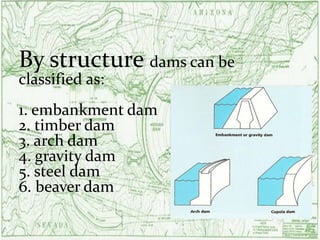
By structure dams can be
classified as:
1. embankment dam
2. timber dam
3. arch dam
4. gravity dam
5. steel dam
6. beaver dam
Embankment dams are made from compacted earth,
they rely on their weight to hold back the force of water.
The San Luis Dam,California is an embankment dam
A Timber crib dam, Michigan
Timber dams were widely used early due to ease and speed of
construction. Rarely built in modern times by humans because
of relatively short lifespan and limited height.
Timber dams
In the arch dam, stability is obtained by a
combination of arch and gravity action.
Single arch dam   Multiple arch dam
In a gravity dam, stability is secured by making it of such a
size and shape that it will resist overturning, sliding and
crushing at the toe.
The Gilboa dam,NY is a solid gravity dam
A steel dam is a type of dam which uses steel plating (at an
angle) and load bearing beams as the structure.
Beaver dams are created as a protection against predators,
such as coyotes, wolves and bears, and to provide easy access
to food during winter.
Garbage accumulated because of a dam
-> Kaptai Dam

-> Rubber dams
Location- on the Karnafuli river at Kaptai in Rangamati
district, 65 km upstream of Chittagong.
Length- 670.56m
Height- 45.7m high
Width- 45.7m (at foundation level)
           7.6m(at crest level)
The catchment area of the reservoir- 11,000 sq km

Since it is an earthen dam a 16-gated spillway (each 12.2m
by 11.3m) with discharge capacity of 625,000 cusec has been
constructed on the left side of the main dam.
Kaptai dam
Kaptai dam
Compared to concrete barrage and regulators rubber dams are cheaper and more flexible
and can be fully deflated during the flood season . Rubber dams can be as long as 100m
and used for irrigation , small-scale hydropower generation and rural water supply.
Rubber dams in BANGLADESH
Feature                              Bakkhali Dam          Eidgaon Dam


Length (m)                                            84                  52


Height (m)                                           3.5                   3


Maximum water retention depth (m)                      4                   3


Maximum overflow discharge (cumec)                   256                  80


Maximum flood flow (cumec)                          1073                 600


Length of concrete floor (m)                          40                 33.5


Protective works (m):


Upstream                                               9                   6


Downstream                                            13                   8


Volume of inflated dam (cu m)                       1200                 800


Weight of dam bag (ton)                               14                   7


Filling pump capacity (cu m/hr)                      150                 100


Filling/emptying time (hr)                           8.1                  8.1


Total cost (million Tk)                               36                  18
,
About hoover dam…
Official name- Hoover Dam
Impounds- Colorado River
Locale-     Nevada-Arizona United States
Length-     1244 ft (379 m)
Height-     726.4 ft (221 m)
Construction began- 1931
Opening date- 1936
Construction cost-       $49 million
Hoover dam
Hoover dam
Hoover dam
Aswan dam
Aswan dam
About Nurek dam…
Nurek dam
Glen canyon dam
Three Gorges Dam
Thank You

Dam

  • 1.
  • 2.
    Prepared by Muneer Ahmed Department of Water Resources Engineering
  • 3.
    Dam is astructure built across a STREAM, RIVER, or estuary to store water. A RESERVOIR is created upstream of the dam to supply water for human consumption, IRRIGATION, or industrial use.
  • 4.
    Dam is thecentral structure in a multipurpose scheme aiming at the conservation of water resources. Auxiliary works for a dam include spillways, gates, or valves to control the discharge of surplus water, an intake structure and means for permitting boats or fishes to cross the dam.
  • 5.
    A spillway isa section of a dam designed to pass water from the upstream side of a dam to the downstream side. Types of spillway include: primary spillway, auxiliary spillway, emergency spillway, fuse plug spillway etc.
  • 6.
  • 8.
    Flood Control Irrigation Water Storage MineTailings Debris Control Water diversion Land reclamation Electrical Generation Navigation
  • 9.
  • 10.
  • 11.
  • 12.
  • 13.
    Significant considerations whenbuilding a dam include: permeability of the surrounding rock or soil •earthquake faults •landslides and slope stability •water table •peak flood flow •reservoir silting •environmental impacts on river fisheries, forests •impacts on human habitations •compensation for land being flooded as well as population resettlement •removal of toxic materials and buildings from the proposed reservoir area
  • 14.
  • 15.
  • 16.
    I. By size II. By use III. By structure
  • 18.
  • 19.
  • 20.
    Major dams ofthe columbia river ecoregion
  • 21.
    Major dams onsindhu river , Pakistan
  • 22.
    By use damscan be classified as: 1.check dam 2.detention dam 3.diversionary dam 4.dry dam 5.saddle dam 6.storage dam 7.overflow dam 8.wing dam 9.cofferdam
  • 23.
    A check dam reducesflow velocity and control soil erosion.
  • 24.
    Detention dams areconstructed to minimize the impact of flooding and to restrict the flow rate of a particular channel.
  • 25.
    A diversionary damdiverts all or a portion of the flow of a river from its natural course.
  • 26.
    A dry damis designed to control flooding. It normally holds back no water and allows the channel to flow freely, except during periods of intense flow .
  • 27.
    Saddle dam underconstruction  A saddle dam is an auxiliary dam constructed to confine the reservoir created by a primary dam.
  • 28.
    Storage dams arebuilt to provide a reliable source of water for short or long periods of time.
  • 29.
  • 30.
    An overflow damis designed to be over topped.
  • 31.
    A weir isa type of small overflow dam that are often used within a river channel .
  • 32.
    A wing damextends partway into a river and forces water into a fast-moving center channel which reduces the rate of sediment accumulation.
  • 33.
    A cofferdam isa (usually temporary) barrier constructed to exclude water from an area that is normally submerged.
  • 34.
    By structure damscan be classified as: 1. embankment dam 2. timber dam 3. arch dam 4. gravity dam 5. steel dam 6. beaver dam
  • 35.
    Embankment dams aremade from compacted earth, they rely on their weight to hold back the force of water.
  • 36.
    The San LuisDam,California is an embankment dam
  • 37.
    A Timber cribdam, Michigan Timber dams were widely used early due to ease and speed of construction. Rarely built in modern times by humans because of relatively short lifespan and limited height.
  • 38.
  • 39.
    In the archdam, stability is obtained by a combination of arch and gravity action.
  • 40.
    Single arch dam Multiple arch dam
  • 41.
    In a gravitydam, stability is secured by making it of such a size and shape that it will resist overturning, sliding and crushing at the toe.
  • 42.
    The Gilboa dam,NYis a solid gravity dam
  • 43.
    A steel damis a type of dam which uses steel plating (at an angle) and load bearing beams as the structure.
  • 44.
    Beaver dams arecreated as a protection against predators, such as coyotes, wolves and bears, and to provide easy access to food during winter.
  • 47.
  • 48.
    -> Kaptai Dam ->Rubber dams
  • 49.
    Location- on theKarnafuli river at Kaptai in Rangamati district, 65 km upstream of Chittagong. Length- 670.56m Height- 45.7m high Width- 45.7m (at foundation level) 7.6m(at crest level) The catchment area of the reservoir- 11,000 sq km Since it is an earthen dam a 16-gated spillway (each 12.2m by 11.3m) with discharge capacity of 625,000 cusec has been constructed on the left side of the main dam.
  • 50.
  • 51.
  • 53.
    Compared to concretebarrage and regulators rubber dams are cheaper and more flexible and can be fully deflated during the flood season . Rubber dams can be as long as 100m and used for irrigation , small-scale hydropower generation and rural water supply.
  • 54.
    Rubber dams inBANGLADESH
  • 55.
    Feature Bakkhali Dam Eidgaon Dam Length (m) 84 52 Height (m) 3.5 3 Maximum water retention depth (m) 4 3 Maximum overflow discharge (cumec) 256 80 Maximum flood flow (cumec) 1073 600 Length of concrete floor (m) 40 33.5 Protective works (m): Upstream 9 6 Downstream 13 8 Volume of inflated dam (cu m) 1200 800 Weight of dam bag (ton) 14 7 Filling pump capacity (cu m/hr) 150 100 Filling/emptying time (hr) 8.1 8.1 Total cost (million Tk) 36 18
  • 56.
  • 57.
    About hoover dam… Officialname- Hoover Dam Impounds- Colorado River Locale- Nevada-Arizona United States Length- 1244 ft (379 m) Height- 726.4 ft (221 m) Construction began- 1931 Opening date- 1936 Construction cost- $49 million
  • 58.
  • 59.
  • 60.
  • 62.
  • 63.
  • 64.
  • 65.
  • 67.
  • 70.
  • 71.