Introduction to
GIS
Joey Li
joeylicc@gmail.com
@joeylicc
joeylicc.wordpress.com
What is GIS?
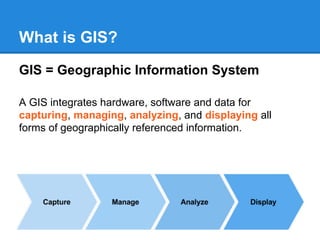
GIS = Geographic Information System
A GIS integrates hardware, software and data for
capturing, managing, analyzing, and displaying all
forms of geographically referenced information.
Data Representation
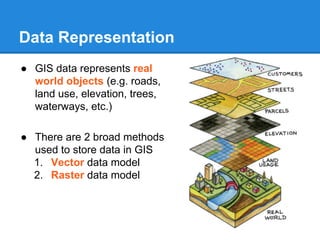
● GIS data represents real
world objects (e.g. roads,
land use, elevation, trees,
waterways, etc.)
● There are 2 broad methods
used to store data in GIS
1. Vector data model
2. Raster data model
Data Representation (Vector)
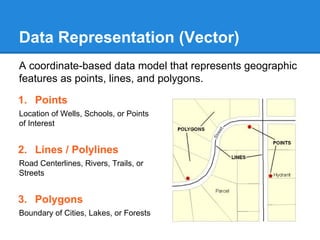
A coordinate-based data model that represents geographic
features as points, lines, and polygons.
1. Points
Location of Wells, Schools, or Points
of Interest

2. Lines / Polylines
Road Centerlines, Rivers, Trails, or
Streets

3. Polygons
Boundary of Cities, Lakes, or Forests
Data Representation (Raster)
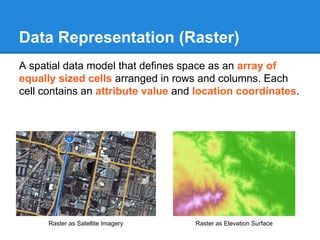
A spatial data model that defines space as an array of
equally sized cells arranged in rows and columns. Each
cell contains an attribute value and location coordinates.

Raster as Satellite Imagery

Raster as Elevation Surface
Common GIS Data Format
Vector Data Model
● Shapefile (.shp, .shx & .dbf)
● Geography Markup Language GML (.gml)
● Personal Geodatabase (.mdb)
● File Geodatabase (.gdb)
Raster Data Model
● Enhanced Compressed Wavelet ECW (.ecw)
● GeoTIFF = TIFF file with GeoReference (.tif)
● MultiResolution Seamless Image Database MrSID (.sid)
● JPEG2000 = JPEG file with GeoReference (.jpg)
Coordinate Systems
Geographic Coordinate Systems
● WGS84 (Latitude and Longitude) is the most
commonly used Geographic Coordinate System
● Hong Kong = 22° 16′ 42″ N, 114° 9′ 32″ E
Projected Coordinate Systems
● Project the earth 3D curved surface to a 2D flat surface
● Hong Kong 1980 Grid (HK80Grid) is the coordinate
system for Hong Kong GIS data
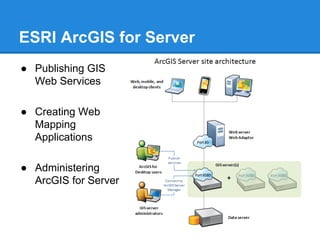
ESRI ArcGIS for Server
● Publishing GIS
Web Services
● Creating Web
Mapping
Applications
● Administering
ArcGIS for Server
Geodatabase (ArcSDE)
●
●
●
●
●

ArcSDE = Spatial Database Engine
Core component of ArcGIS for Server
Primary data storage model for ArcGIS
Centralized location to access and manage spatial data
Major Features
○ Versioning
○ Geodatabase Replication
○ Geodatabase Archiving
● Support Microsoft SQL Server, Oracle, etc.
ESRI ArcGIS for Desktop
ArcMap
● View, Edit and Query geospatial data, and Create
Maps
ArcCatalog
● Manage geospatial data
● Browse datasets, files, database or other sources
3 Takeaways
1. GIS data represents real world objects in layers
2. There are 2 major data model in GIS
a. Vector = Point, Line, Polygon
b. Raster = Cells with Values
3. Global Coordinate System = WGS84 (Sphere)
HK Coordinate System = HK80Grid (Flat)
--- End ---

Introduction to GIS

  • 1.
  • 2.
    What is GIS? GIS= Geographic Information System A GIS integrates hardware, software and data for capturing, managing, analyzing, and displaying all forms of geographically referenced information.
  • 3.
    Data Representation ● GISdata represents real world objects (e.g. roads, land use, elevation, trees, waterways, etc.) ● There are 2 broad methods used to store data in GIS 1. Vector data model 2. Raster data model
  • 4.
    Data Representation (Vector) Acoordinate-based data model that represents geographic features as points, lines, and polygons. 1. Points Location of Wells, Schools, or Points of Interest 2. Lines / Polylines Road Centerlines, Rivers, Trails, or Streets 3. Polygons Boundary of Cities, Lakes, or Forests
  • 5.
    Data Representation (Raster) Aspatial data model that defines space as an array of equally sized cells arranged in rows and columns. Each cell contains an attribute value and location coordinates. Raster as Satellite Imagery Raster as Elevation Surface
  • 6.
    Common GIS DataFormat Vector Data Model ● Shapefile (.shp, .shx & .dbf) ● Geography Markup Language GML (.gml) ● Personal Geodatabase (.mdb) ● File Geodatabase (.gdb) Raster Data Model ● Enhanced Compressed Wavelet ECW (.ecw) ● GeoTIFF = TIFF file with GeoReference (.tif) ● MultiResolution Seamless Image Database MrSID (.sid) ● JPEG2000 = JPEG file with GeoReference (.jpg)
  • 7.
    Coordinate Systems Geographic CoordinateSystems ● WGS84 (Latitude and Longitude) is the most commonly used Geographic Coordinate System ● Hong Kong = 22° 16′ 42″ N, 114° 9′ 32″ E Projected Coordinate Systems ● Project the earth 3D curved surface to a 2D flat surface ● Hong Kong 1980 Grid (HK80Grid) is the coordinate system for Hong Kong GIS data
  • 8.
    ESRI ArcGIS forServer ● Publishing GIS Web Services ● Creating Web Mapping Applications ● Administering ArcGIS for Server
  • 9.
    Geodatabase (ArcSDE) ● ● ● ● ● ArcSDE =Spatial Database Engine Core component of ArcGIS for Server Primary data storage model for ArcGIS Centralized location to access and manage spatial data Major Features ○ Versioning ○ Geodatabase Replication ○ Geodatabase Archiving ● Support Microsoft SQL Server, Oracle, etc.
  • 10.
    ESRI ArcGIS forDesktop ArcMap ● View, Edit and Query geospatial data, and Create Maps ArcCatalog ● Manage geospatial data ● Browse datasets, files, database or other sources
  • 11.
    3 Takeaways 1. GISdata represents real world objects in layers 2. There are 2 major data model in GIS a. Vector = Point, Line, Polygon b. Raster = Cells with Values 3. Global Coordinate System = WGS84 (Sphere) HK Coordinate System = HK80Grid (Flat)
  • 12.