Mohamed Ahmed Freeshah
Id: 2017176190005
Ph.D. Student, LIESMARS, Wuhan University
Gravity Satellites Case Study: Gravity Recovery and
Climate Experiment (GRACE)
Presented By
December,
2017
Contents
1
2
3
4
5
Introduction and Motivation
Types of Gravity Satellites
Comparison Missions
Conclusion
Case Study: GRACE
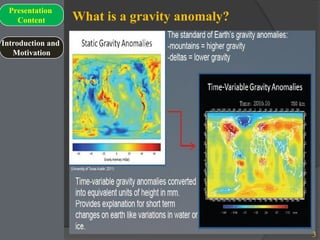
What is a gravity anomaly?
3
Introduction and
Motivation
Presentation
Content
The Earth's Gravity Field
4
Introduction and
Motivation
Presentation
Content
Depends on mass distribution of the Earth.
Any mass movements in, on or above the Earth
produce variations in the gravity field.
Comprises always a static part and a much smaller
time variable one (millimeters to centimeters, if
expressed in geoid heights).
(Peters. T, 2001)
(Jekeli. C, 2007)
Gravity Satellites (Basic Considerations)
5
Introduction and
Motivation
Presentation
Content
According to Newton’s law of gravitation
Fα (Mm)/r2
F=G M*m / r2
( Seeber, 2003)
Types of Gravity Satellites
6
Introduction and
Motivation
Types of Gravity
Satellites
Presentation
Content
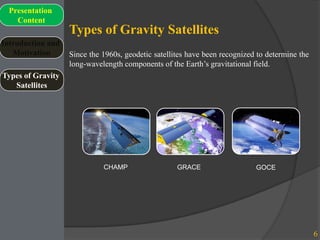
Since the 1960s, geodetic satellites have been recognized to determine the
long-wavelength components of the Earth’s gravitational field.
GRACECHAMP GOCE
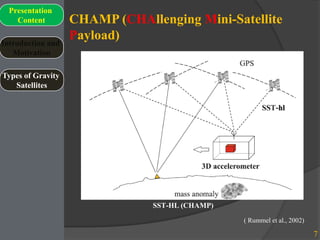
CHAMP (CHAllenging Mini-Satellite
Payload)
7
Introduction and
Motivation
Types of Gravity
Satellites
Presentation
Content
( Rummel et al., 2002)
SST-HL (CHAMP)
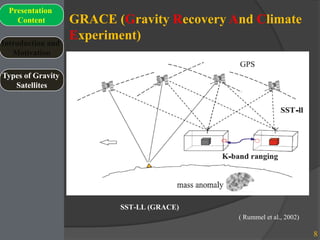
GRACE (Gravity Recovery And Climate
Experiment)
8
Introduction and
Motivation
Types of Gravity
Satellites
Presentation
Content
SST-LL (GRACE)
( Rummel et al., 2002)
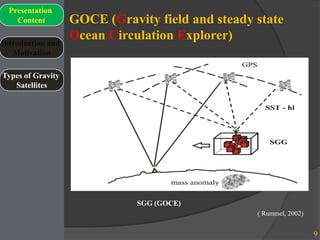
GOCE (Gravity field and steady state
Ocean Circulation Explorer)
9
Introduction and
Motivation
Types of Gravity
Satellites
Presentation
Content
( Rummel, 2002)
SGG (GOCE)
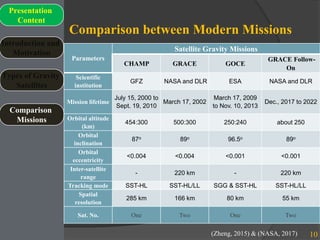
Comparison between Modern Missions
10
Introduction and
Motivation
Types of Gravity
Satellites
Presentation
Content
Comparison
Missions
Parameters
Satellite Gravity Missions
CHAMP GRACE GOCE
GRACE Follow-
On
Scientific
institution
GFZ NASA and DLR ESA NASA and DLR
Mission lifetime
July 15, 2000 to
Sept. 19, 2010
March 17, 2002
March 17, 2009
to Nov. 10, 2013
Dec., 2017 to 2022
Orbital altitude
(km)
454:300 500:300 250:240 about 250
Orbital
inclination
87o 89o 96.5o 89o
Orbital
eccentricity
<0.004 <0.004 <0.001 <0.001
Inter-satellite
range
- 220 km - 220 km
Tracking mode SST-HL SST-HL/LL SGG & SST-HL SST-HL/LL
Spatial
resolution
285 km 166 km 80 km 55 km
Sat. No. One Two One Two
(Zheng, 2015) & (NASA, 2017)
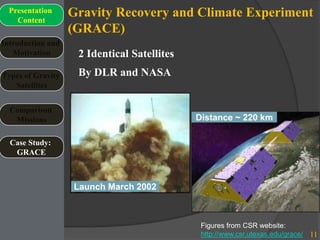
Gravity Recovery and Climate Experiment
(GRACE)
11
Introduction and
Motivation
Types of Gravity
Satellites
Presentation
Content
Comparison
Missions
Case Study:
GRACE
Figures from CSR website:
http://www.csr.utexas.edu/grace/
Distance ~ 220 km
Launch March 2002
2 Identical Satellites
By DLR and NASA
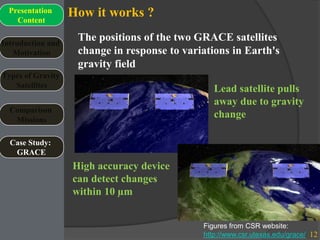
How it works ?
12
Introduction and
Motivation
Types of Gravity
Satellites
Presentation
Content
Comparison
Missions
Case Study:
GRACE
The positions of the two GRACE satellites
change in response to variations in Earth's
gravity field
Lead satellite pulls
away due to gravity
change
High accuracy device
can detect changes
within 10 µm
Figures from CSR website:
http://www.csr.utexas.edu/grace/
Why time-variable gravity?
13
Introduction and
Motivation
Types of Gravity
Satellites
Presentation
Content
Comparison
Missions
Case Study:
GRACE
Satellite gravity missions are a unique
observational system for monitoring mass
redistribution in the complete Earth system no
other sensors could do the same.
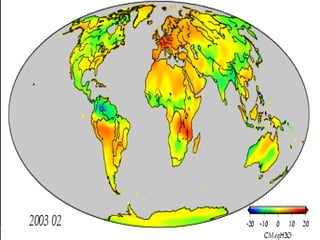
From gravity to water mass
 GRACE provides time varying global gravity
fields (~30 days)
 Observed monthly changes in gravity are
caused by monthly changes in mass
 Mass changes are mainly attributed to changes
in the distribution of water mass
Estimating Storage Changes
15
Introduction and
Motivation
Types of Gravity
Satellites
Presentation
Content
Comparison
Missions
Case Study:
GRACE
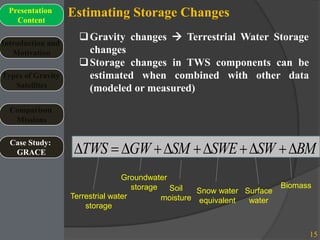
Gravity changes  Terrestrial Water Storage
changes
Storage changes in TWS components can be
estimated when combined with other data
(modeled or measured)
BMSWSWESMGWTWS 
Terrestrial water
storage
Groundwater
storage Soil
moisture
Snow water
equivalent
Surface
water
Biomass
Conclusions
16
Introduction and
Motivation
Types of Gravity
Satellites
Presentation
Content
Comparison
Missions
Case Study:
GRACE
Conclusion
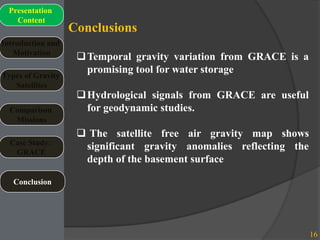
Temporal gravity variation from GRACE is a
promising tool for water storage
Hydrological signals from GRACE are useful
for geodynamic studies.
 The satellite free air gravity map shows
significant gravity anomalies reflecting the
depth of the basement surface
Major References
17
Introduction and
Motivation
Types of Gravity
Satellites
Presentation
Content
Comparison
Missions
Case Study:
GRACE
Conclusion
NASA ( www.nasa.gov )
International United States/German Team. (
http://www.csr.utexas.edu/grace)
Seeber, G .,2003: Satellite Geodesy - 2nd completely revised and
extended edition, Walter de Gruyter - Berlin - New York 2003, ISBN
3-11-017549-5
Wahr, J., & Molenaar, M. (1998). “Time Variability of the Earth's
Gravity Field: Hydrological and Oceanic Effects and their Possible
Detection Using GRACE“. Journal of Geophysical Research, 103,
30205-30229, DOI:10.1029/98JB02844.
Zahran,K. & Anderson,C. 2012. Estimation of water storage
change of Lake Nasser using satellite gravity and altimetry data.
Gravity satellites case study gravity recovery and climate experiment (grace)

Gravity satellites case study gravity recovery and climate experiment (grace)

  • 1.
    Mohamed Ahmed Freeshah Id:2017176190005 Ph.D. Student, LIESMARS, Wuhan University Gravity Satellites Case Study: Gravity Recovery and Climate Experiment (GRACE) Presented By December, 2017
  • 2.
    Contents 1 2 3 4 5 Introduction and Motivation Typesof Gravity Satellites Comparison Missions Conclusion Case Study: GRACE
  • 3.
    What is agravity anomaly? 3 Introduction and Motivation Presentation Content
  • 4.
    The Earth's GravityField 4 Introduction and Motivation Presentation Content Depends on mass distribution of the Earth. Any mass movements in, on or above the Earth produce variations in the gravity field. Comprises always a static part and a much smaller time variable one (millimeters to centimeters, if expressed in geoid heights). (Peters. T, 2001) (Jekeli. C, 2007)
  • 5.
    Gravity Satellites (BasicConsiderations) 5 Introduction and Motivation Presentation Content According to Newton’s law of gravitation Fα (Mm)/r2 F=G M*m / r2 ( Seeber, 2003)
  • 6.
    Types of GravitySatellites 6 Introduction and Motivation Types of Gravity Satellites Presentation Content Since the 1960s, geodetic satellites have been recognized to determine the long-wavelength components of the Earth’s gravitational field. GRACECHAMP GOCE
  • 7.
    CHAMP (CHAllenging Mini-Satellite Payload) 7 Introductionand Motivation Types of Gravity Satellites Presentation Content ( Rummel et al., 2002) SST-HL (CHAMP)
  • 8.
    GRACE (Gravity RecoveryAnd Climate Experiment) 8 Introduction and Motivation Types of Gravity Satellites Presentation Content SST-LL (GRACE) ( Rummel et al., 2002)
  • 9.
    GOCE (Gravity fieldand steady state Ocean Circulation Explorer) 9 Introduction and Motivation Types of Gravity Satellites Presentation Content ( Rummel, 2002) SGG (GOCE)
  • 10.
    Comparison between ModernMissions 10 Introduction and Motivation Types of Gravity Satellites Presentation Content Comparison Missions Parameters Satellite Gravity Missions CHAMP GRACE GOCE GRACE Follow- On Scientific institution GFZ NASA and DLR ESA NASA and DLR Mission lifetime July 15, 2000 to Sept. 19, 2010 March 17, 2002 March 17, 2009 to Nov. 10, 2013 Dec., 2017 to 2022 Orbital altitude (km) 454:300 500:300 250:240 about 250 Orbital inclination 87o 89o 96.5o 89o Orbital eccentricity <0.004 <0.004 <0.001 <0.001 Inter-satellite range - 220 km - 220 km Tracking mode SST-HL SST-HL/LL SGG & SST-HL SST-HL/LL Spatial resolution 285 km 166 km 80 km 55 km Sat. No. One Two One Two (Zheng, 2015) & (NASA, 2017)
  • 11.
    Gravity Recovery andClimate Experiment (GRACE) 11 Introduction and Motivation Types of Gravity Satellites Presentation Content Comparison Missions Case Study: GRACE Figures from CSR website: http://www.csr.utexas.edu/grace/ Distance ~ 220 km Launch March 2002 2 Identical Satellites By DLR and NASA
  • 12.
    How it works? 12 Introduction and Motivation Types of Gravity Satellites Presentation Content Comparison Missions Case Study: GRACE The positions of the two GRACE satellites change in response to variations in Earth's gravity field Lead satellite pulls away due to gravity change High accuracy device can detect changes within 10 µm Figures from CSR website: http://www.csr.utexas.edu/grace/
  • 13.
    Why time-variable gravity? 13 Introductionand Motivation Types of Gravity Satellites Presentation Content Comparison Missions Case Study: GRACE Satellite gravity missions are a unique observational system for monitoring mass redistribution in the complete Earth system no other sensors could do the same. From gravity to water mass  GRACE provides time varying global gravity fields (~30 days)  Observed monthly changes in gravity are caused by monthly changes in mass  Mass changes are mainly attributed to changes in the distribution of water mass
  • 15.
    Estimating Storage Changes 15 Introductionand Motivation Types of Gravity Satellites Presentation Content Comparison Missions Case Study: GRACE Gravity changes  Terrestrial Water Storage changes Storage changes in TWS components can be estimated when combined with other data (modeled or measured) BMSWSWESMGWTWS  Terrestrial water storage Groundwater storage Soil moisture Snow water equivalent Surface water Biomass
  • 16.
    Conclusions 16 Introduction and Motivation Types ofGravity Satellites Presentation Content Comparison Missions Case Study: GRACE Conclusion Temporal gravity variation from GRACE is a promising tool for water storage Hydrological signals from GRACE are useful for geodynamic studies.  The satellite free air gravity map shows significant gravity anomalies reflecting the depth of the basement surface
  • 17.
    Major References 17 Introduction and Motivation Typesof Gravity Satellites Presentation Content Comparison Missions Case Study: GRACE Conclusion NASA ( www.nasa.gov ) International United States/German Team. ( http://www.csr.utexas.edu/grace) Seeber, G .,2003: Satellite Geodesy - 2nd completely revised and extended edition, Walter de Gruyter - Berlin - New York 2003, ISBN 3-11-017549-5 Wahr, J., & Molenaar, M. (1998). “Time Variability of the Earth's Gravity Field: Hydrological and Oceanic Effects and their Possible Detection Using GRACE“. Journal of Geophysical Research, 103, 30205-30229, DOI:10.1029/98JB02844. Zahran,K. & Anderson,C. 2012. Estimation of water storage change of Lake Nasser using satellite gravity and altimetry data.