AMITY UNIVERSITY
RAJASTHAN
Comparative study of IPv4 and
IPv6 on Windows and Linux.
Objectives
 Introduction
 Internet Protocol
 IPv4
 IPv6
 Comparison of IPv4 and IPv6
 Related Work
 Conclusion
 Reference
Introduction
 IPv6 was introduced but yet it is not widely used.
 Research work has been pointed to many directions, specifically, on
how to migrate from IPv4 to IPv6.
 how should operating systems perform when using IPv6 as compared
to IPv4.
 This work provides a comparative performance evaluation between
IPv6 and IPv4 networks under Windows and Linux operating systems.
Cont.…..
 In this paper, Windows and Linux operating systems are configured
with IPv4 and IPv6.
 Performance related metrics like jitter, delay, throughput and CPU
usage are experientially measured on a test-bed implementation.
 The results show the network performance depends on type of
operating system not only on the version of IP.
 This work provides a comparative performance evaluation between
IPv6 and IPv4 under Windows and Linux Operating systems.
Internet protocol
 Internet Protocol (IP) is the principal set (or
communications protocol) of digital message formats.
 Internet protocol is the primary network protocol used
on the Internet, developed in the 1970s.
 Rules for exchanging messages between computers
across a single network or a series of interconnected
networks, using the Internet Protocol Suite.
 Messages are exchanged as datagrams, also known as
data packets.
IPv4 (Internet Protocol version 4)
 IPv4 uses a 32-bit address scheme
 Allowing for a total of 2^32 addresses
 The growth of the internet it is expected that the number of
unused IPv4 addresses will eventually run out because
every device (computers, smartphones and game consoles)
that connects to the Internet requires an address.
IPv6(Internet Protocol version 6)
 IPv6 is the Internet's next-generation protocol,
designed to replace the current Internet Protocol.
 IPv6 is a network layer protocol that enables data
communications over a packet switched network.
 Packet switching involves the sending and receiving of
data in packets between two nodes in a network.
 The working standard for the IPv6 protocol was
published by the Internet Engineering Task Force
(IETF) in 1998. col, IP Version 4.
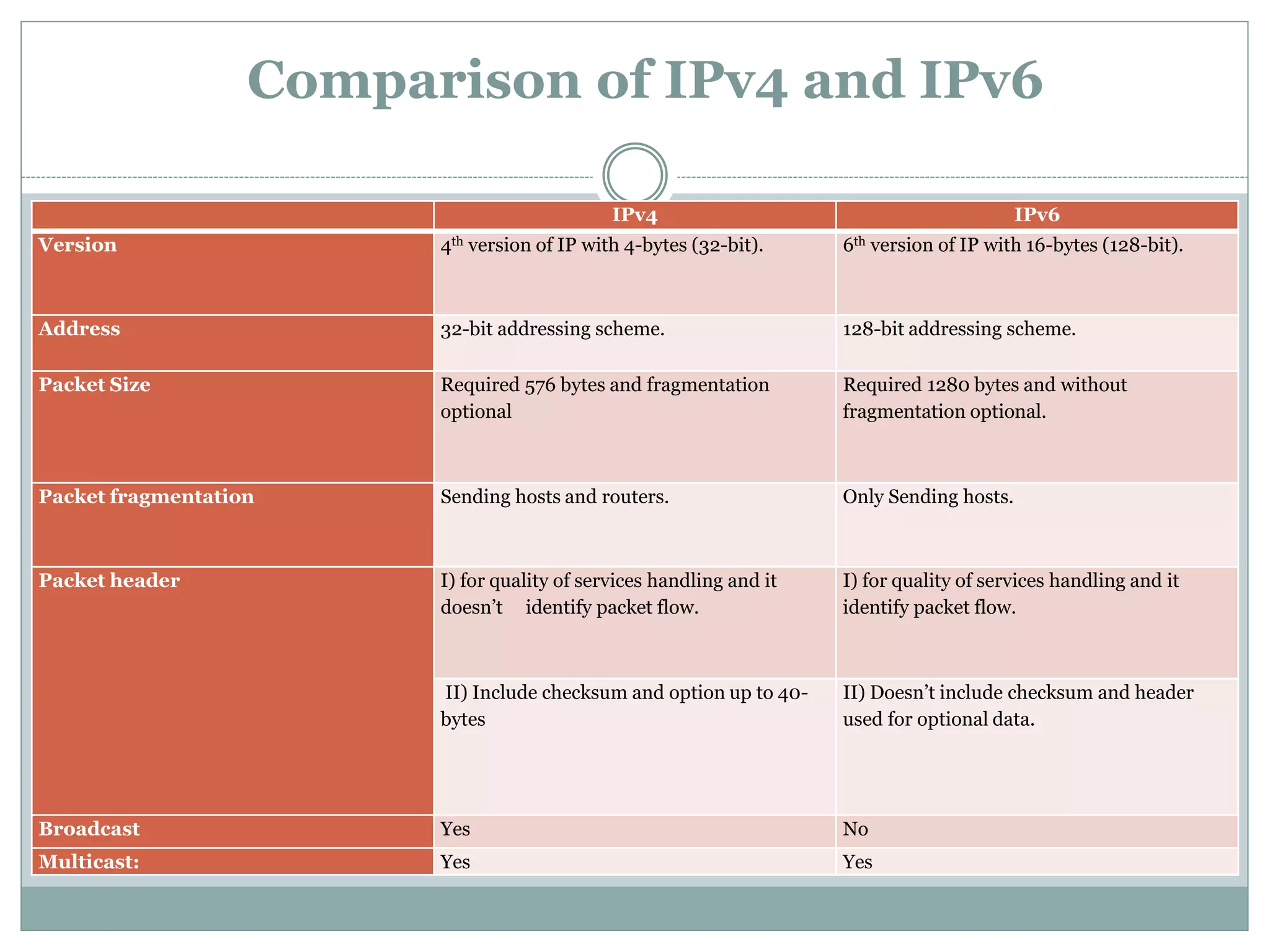
Comparison of IPv4 and IPv6
IPv4 IPv6
Version 4th version of IP with 4-bytes (32-bit). 6th version of IP with 16-bytes (128-bit).
Address 32-bit addressing scheme. 128-bit addressing scheme.
Packet Size Required 576 bytes and fragmentation
optional
Required 1280 bytes and without
fragmentation optional.
Packet fragmentation Sending hosts and routers. Only Sending hosts.
Packet header I) for quality of services handling and it
doesn’t identify packet flow.
I) for quality of services handling and it
identify packet flow.
II) Include checksum and option up to 40-
bytes
II) Doesn’t include checksum and header
used for optional data.
Broadcast Yes No
Multicast: Yes Yes
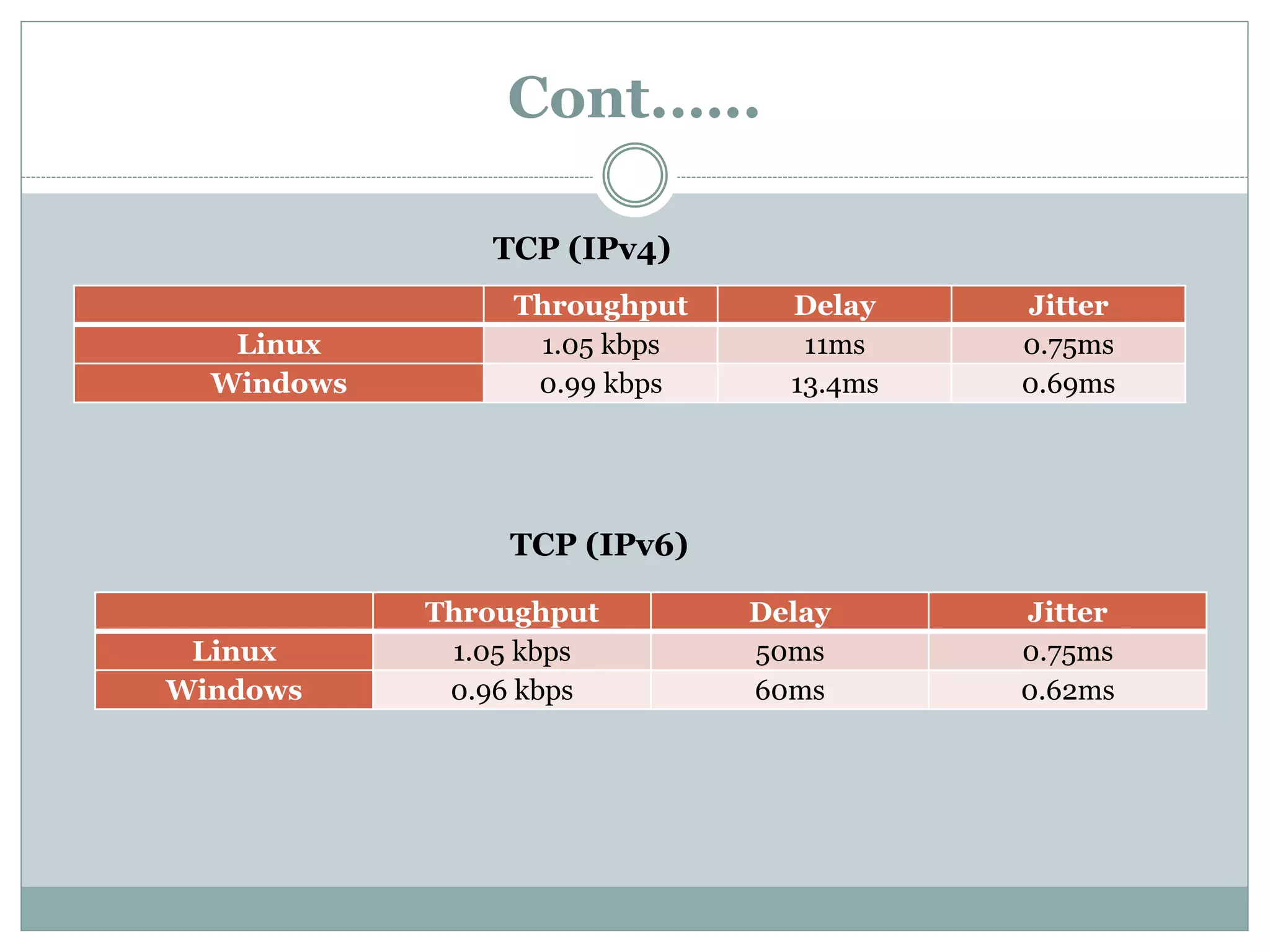
Cont.…..
Throughput Delay Jitter
Linux 1.05 kbps 11ms 0.75ms
Windows 0.99 kbps 13.4ms 0.69ms
TCP (IPv4)
Throughput Delay Jitter
Linux 1.05 kbps 50ms 0.75ms
Windows 0.96 kbps 60ms 0.62ms
TCP (IPv6)
Cont.…..
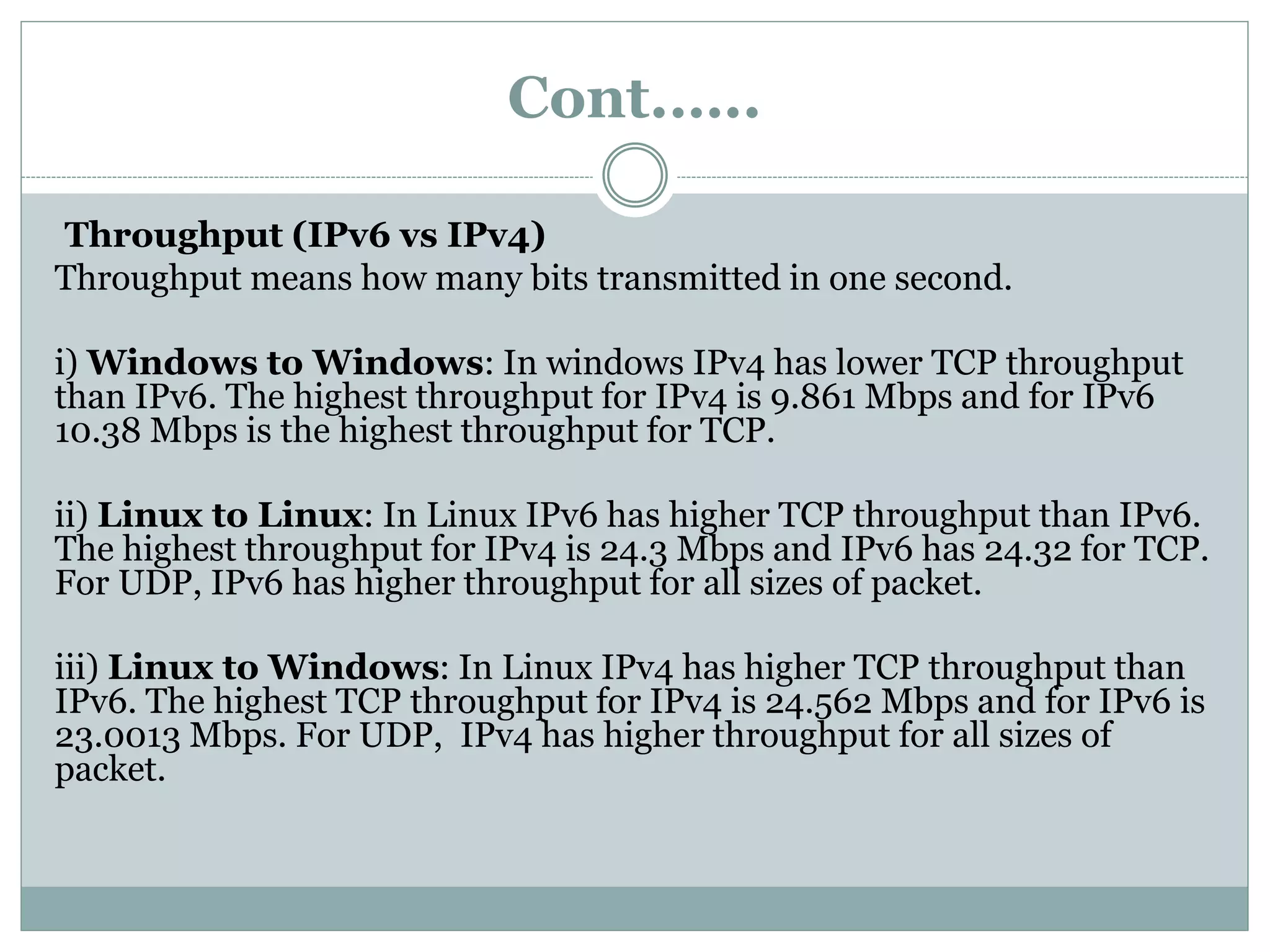
Throughput (IPv6 vs IPv4)
Throughput means how many bits transmitted in one second.
i) Windows to Windows: In windows IPv4 has lower TCP throughput
than IPv6. The highest throughput for IPv4 is 9.861 Mbps and for IPv6
10.38 Mbps is the highest throughput for TCP.
ii) Linux to Linux: In Linux IPv6 has higher TCP throughput than IPv6.
The highest throughput for IPv4 is 24.3 Mbps and IPv6 has 24.32 for TCP.
For UDP, IPv6 has higher throughput for all sizes of packet.
iii) Linux to Windows: In Linux IPv4 has higher TCP throughput than
IPv6. The highest TCP throughput for IPv4 is 24.562 Mbps and for IPv6 is
23.0013 Mbps. For UDP, IPv4 has higher throughput for all sizes of
packet.
Cont.…..
CPU Utilization (IPv4 vs IPv6)
CPU utilization is measure of CPU usage percentage. CPU utilization is
a metric that managed for efficient system performance. [5]
i) Windows to Windows: IPv4 has higher CPU Utilization, for all
packet sizes. CPU Utilization at packet size 640 bytes For IPv4 it is
20.577 % and for IPv6 it is 15.944 % at packet size 128 bytes.
ii) Linux to Linux: For all packet sizes, IPv6 has higher CPU
utilization than IPv4. CPU Utilization at packet size 128 bytes For IPv4
it is 7.04 % and for IPv6 it is 21.51 % at packet size 896 bytes.
iii) Linux to Windows: IPv6 has higher CPU Utilization than IPv4
for all packet sizes. CPU Utilization at packet size 128 bytes For IPv4 it
is 8.76% and for IPv6 it is 9.774 % at packet size 1152 bytes.
Related Work
Year-2009
Title - Performance Evaluation of IPv4 and IPv6 on Windows Vista and
Linux Ubuntu.
Author - Shaneel Narayan (Member IEEE), Peng Shang, Na Fan
 Internet Protocol (IP) v4 is the basic building block of the Internet and has
served well, but it has limitations that hinder its growth.
 The solution is IPv6, which addresses inherent problems of the earlier
version.
 However, due to the increased overhead in IPv6 and its interaction with
the operating system that hosts this communication protocol, there may
be network performance issues.
Year – 2009
Title - Network Performance Evaluation of Internet Protocols IPv4 and IPv6
on Operating Systems.
Author - Shaneel Narayan (Member IEEE), Peng Shang, Na Fan.
 Internet Protocol (IP) v4 is the standard for the design and interconnection
of networks today; however it has limitations that hinder its growth.
 IPv6 is the solution and it has two-fold advantage – it addresses inherent
problems in the earlier version protocol, and it offers new opportunities
that can enhance communication experiences of users beyond current
scope.
 Communication experiences of users beyond current scope. However, due
to the increased overhead in IPv6 and its interaction with the operating
system that hosts this communication protocol, there may be network
performance issues.
Related Work
Year – 2010
Title - IPv4-v6 Transition Mechanisms Network Performance Evaluation
on Operating Systems.
Author - Shaneel Narayan, Sotharith Tauch.
 Now the Internet spans the However transition to the new version has
been remarkably slow.
 In this paper two such mechanisms, namely configured tunnel and
IPv6 to Ipv 4 transition mechanism, have been empirically evaluated
for performance.
 Both mechanisms are implemented on windows and linux operating
systems.
Related Work
Year – 2013
Title - Performance Comparison of Wireless Networks over IPv6 and IPv4
Under Several Operating Systems.
Author - Hossam M.A. Fahmy, Salma A. Ghoneim2 .
 IPv6 was introduced but yet it is not widely used.
 How should operating systems perform when using IPv6 as compared
to IPv4
 This work provides a comparative performance evaluation between
IPv6 and IPv4 in wireless networks under Windows and Linux
platforms.
Related Work
Conclusion
 In this paper performance of IPv4 and IPv6 have been experientially
measured on Windows and Linux operating systems by measuring
throughput, jitter, delay and CPU usage performance metrics.
 For windows and Linux operating systems, IPv4 has higher bandwidth
“throughput”, and lower CPU utilization than IPv6.
 The advantage of IPv6 is, its ample address space and its increased
security.
 In this paper it is noticed that Linux has the highest CPU utilization on
IPv6 and the highest TCP throughput.
 On the other hand, sending packets from Linux to Windows has the
best throughput for UDP packets.The bandwidth utilization of IPv6 are
not superior to those of IPv4.
 For this case, we conclude that IPv4 results are richer than IPv6.
Bibliography
 Narayan, Shaneel, Peng Shang, and Na Fan. "Performance evaluation of IPv4 and IPv6
on windows vista and linux ubuntu." Networks Security, Wireless Communications and
Trusted Computing, 2009. NSWCTC'09. International Conference on. Vol. 1. IEEE,
2009.
 Narayan, Shaneel, Peng Shang, and Na Fan. "Network performance evaluation of internet
protocols ipv4 and ipv6 on operating systems." Wireless and Optical Communications
Networks, 2009. WOCN'09. IFIP International Conference on. IEEE, 2009.
 Narayan, Shaneel, and Sotharith Tauch. "IPv4-v6 transition mechanisms network
performance evaluation on operating systems." Computer Science and Information
Technology (ICCSIT), 2010 3rd IEEE International Conference on. Vol. 5. IEEE, 2010.
 Fahmy, Hossam, and Salma A. Ghoneim. "Performance comparison of wireless networks
over IPv6 and IPv4 under several operating systems." Electronics, Circuits, and Systems
(ICECS), 2013 IEEE 20th International Conference on. IEEE, 2013.
.
Bibliography
 Abed, Ghassan A., Mahamod Ismail, and Kasmiran Jumari. "A comparison and analysis
of congestion window for HS-TCP, Full-TCP, and TCP-Linux in long term evolution
system model." Open Systems (ICOS), 2011 IEEE Conference on. IEEE, 2011.
 Dinesh Goyal, Rajendra Singh, Dr. Naveen Hemrajani. "Comparative study of IPv4 &
IPv6 Point to Point Architecture on various OS platforms". IOSR Journal of Computer
Engineering (IOSR-JCE), 2013.
 Zeadally, Sherali, R. Wasseem, and Ioan Raicu. "Comparison of end-system IPv6 protocol
stacks." Communications, IEE Proceedings-. Vol. 151. No. 3. IET, 2004.
 Wang, Yi, Shaozhi Ye, and Xing Li. "Understanding current IPv6 performance: a
measurement study." Computers and Communications, 2005. ISCC 2005. Proceedings.
10th IEEE Symposium on. IEEE, 2005.
 Sailan, Modh Khairil, Rosilah Hassan, and Ahmed Patel. "A comparative review of IPv4
and IPv6 for research test bed." Electrical Engineering and Informatics, 2009. ICEEI'09.
International Conference on. Vol. 2. IEEE, 2009.
Thank You

Comparative study of IPv4 and IPv6 on Windows and Linux.

  • 1.
    AMITY UNIVERSITY RAJASTHAN Comparative studyof IPv4 and IPv6 on Windows and Linux.
  • 2.
    Objectives  Introduction  InternetProtocol  IPv4  IPv6  Comparison of IPv4 and IPv6  Related Work  Conclusion  Reference
  • 3.
    Introduction  IPv6 wasintroduced but yet it is not widely used.  Research work has been pointed to many directions, specifically, on how to migrate from IPv4 to IPv6.  how should operating systems perform when using IPv6 as compared to IPv4.  This work provides a comparative performance evaluation between IPv6 and IPv4 networks under Windows and Linux operating systems.
  • 4.
    Cont.…..  In thispaper, Windows and Linux operating systems are configured with IPv4 and IPv6.  Performance related metrics like jitter, delay, throughput and CPU usage are experientially measured on a test-bed implementation.  The results show the network performance depends on type of operating system not only on the version of IP.  This work provides a comparative performance evaluation between IPv6 and IPv4 under Windows and Linux Operating systems.
  • 5.
    Internet protocol  InternetProtocol (IP) is the principal set (or communications protocol) of digital message formats.  Internet protocol is the primary network protocol used on the Internet, developed in the 1970s.  Rules for exchanging messages between computers across a single network or a series of interconnected networks, using the Internet Protocol Suite.  Messages are exchanged as datagrams, also known as data packets.
  • 6.
    IPv4 (Internet Protocolversion 4)  IPv4 uses a 32-bit address scheme  Allowing for a total of 2^32 addresses  The growth of the internet it is expected that the number of unused IPv4 addresses will eventually run out because every device (computers, smartphones and game consoles) that connects to the Internet requires an address.
  • 7.
    IPv6(Internet Protocol version6)  IPv6 is the Internet's next-generation protocol, designed to replace the current Internet Protocol.  IPv6 is a network layer protocol that enables data communications over a packet switched network.  Packet switching involves the sending and receiving of data in packets between two nodes in a network.  The working standard for the IPv6 protocol was published by the Internet Engineering Task Force (IETF) in 1998. col, IP Version 4.
  • 8.
    Comparison of IPv4and IPv6 IPv4 IPv6 Version 4th version of IP with 4-bytes (32-bit). 6th version of IP with 16-bytes (128-bit). Address 32-bit addressing scheme. 128-bit addressing scheme. Packet Size Required 576 bytes and fragmentation optional Required 1280 bytes and without fragmentation optional. Packet fragmentation Sending hosts and routers. Only Sending hosts. Packet header I) for quality of services handling and it doesn’t identify packet flow. I) for quality of services handling and it identify packet flow. II) Include checksum and option up to 40- bytes II) Doesn’t include checksum and header used for optional data. Broadcast Yes No Multicast: Yes Yes
  • 9.
    Cont.….. Throughput Delay Jitter Linux1.05 kbps 11ms 0.75ms Windows 0.99 kbps 13.4ms 0.69ms TCP (IPv4) Throughput Delay Jitter Linux 1.05 kbps 50ms 0.75ms Windows 0.96 kbps 60ms 0.62ms TCP (IPv6)
  • 10.
    Cont.….. Throughput (IPv6 vsIPv4) Throughput means how many bits transmitted in one second. i) Windows to Windows: In windows IPv4 has lower TCP throughput than IPv6. The highest throughput for IPv4 is 9.861 Mbps and for IPv6 10.38 Mbps is the highest throughput for TCP. ii) Linux to Linux: In Linux IPv6 has higher TCP throughput than IPv6. The highest throughput for IPv4 is 24.3 Mbps and IPv6 has 24.32 for TCP. For UDP, IPv6 has higher throughput for all sizes of packet. iii) Linux to Windows: In Linux IPv4 has higher TCP throughput than IPv6. The highest TCP throughput for IPv4 is 24.562 Mbps and for IPv6 is 23.0013 Mbps. For UDP, IPv4 has higher throughput for all sizes of packet.
  • 11.
    Cont.….. CPU Utilization (IPv4vs IPv6) CPU utilization is measure of CPU usage percentage. CPU utilization is a metric that managed for efficient system performance. [5] i) Windows to Windows: IPv4 has higher CPU Utilization, for all packet sizes. CPU Utilization at packet size 640 bytes For IPv4 it is 20.577 % and for IPv6 it is 15.944 % at packet size 128 bytes. ii) Linux to Linux: For all packet sizes, IPv6 has higher CPU utilization than IPv4. CPU Utilization at packet size 128 bytes For IPv4 it is 7.04 % and for IPv6 it is 21.51 % at packet size 896 bytes. iii) Linux to Windows: IPv6 has higher CPU Utilization than IPv4 for all packet sizes. CPU Utilization at packet size 128 bytes For IPv4 it is 8.76% and for IPv6 it is 9.774 % at packet size 1152 bytes.
  • 12.
    Related Work Year-2009 Title -Performance Evaluation of IPv4 and IPv6 on Windows Vista and Linux Ubuntu. Author - Shaneel Narayan (Member IEEE), Peng Shang, Na Fan  Internet Protocol (IP) v4 is the basic building block of the Internet and has served well, but it has limitations that hinder its growth.  The solution is IPv6, which addresses inherent problems of the earlier version.  However, due to the increased overhead in IPv6 and its interaction with the operating system that hosts this communication protocol, there may be network performance issues.
  • 13.
    Year – 2009 Title- Network Performance Evaluation of Internet Protocols IPv4 and IPv6 on Operating Systems. Author - Shaneel Narayan (Member IEEE), Peng Shang, Na Fan.  Internet Protocol (IP) v4 is the standard for the design and interconnection of networks today; however it has limitations that hinder its growth.  IPv6 is the solution and it has two-fold advantage – it addresses inherent problems in the earlier version protocol, and it offers new opportunities that can enhance communication experiences of users beyond current scope.  Communication experiences of users beyond current scope. However, due to the increased overhead in IPv6 and its interaction with the operating system that hosts this communication protocol, there may be network performance issues. Related Work
  • 14.
    Year – 2010 Title- IPv4-v6 Transition Mechanisms Network Performance Evaluation on Operating Systems. Author - Shaneel Narayan, Sotharith Tauch.  Now the Internet spans the However transition to the new version has been remarkably slow.  In this paper two such mechanisms, namely configured tunnel and IPv6 to Ipv 4 transition mechanism, have been empirically evaluated for performance.  Both mechanisms are implemented on windows and linux operating systems. Related Work
  • 15.
    Year – 2013 Title- Performance Comparison of Wireless Networks over IPv6 and IPv4 Under Several Operating Systems. Author - Hossam M.A. Fahmy, Salma A. Ghoneim2 .  IPv6 was introduced but yet it is not widely used.  How should operating systems perform when using IPv6 as compared to IPv4  This work provides a comparative performance evaluation between IPv6 and IPv4 in wireless networks under Windows and Linux platforms. Related Work
  • 16.
    Conclusion  In thispaper performance of IPv4 and IPv6 have been experientially measured on Windows and Linux operating systems by measuring throughput, jitter, delay and CPU usage performance metrics.  For windows and Linux operating systems, IPv4 has higher bandwidth “throughput”, and lower CPU utilization than IPv6.  The advantage of IPv6 is, its ample address space and its increased security.  In this paper it is noticed that Linux has the highest CPU utilization on IPv6 and the highest TCP throughput.  On the other hand, sending packets from Linux to Windows has the best throughput for UDP packets.The bandwidth utilization of IPv6 are not superior to those of IPv4.  For this case, we conclude that IPv4 results are richer than IPv6.
  • 17.
    Bibliography  Narayan, Shaneel,Peng Shang, and Na Fan. "Performance evaluation of IPv4 and IPv6 on windows vista and linux ubuntu." Networks Security, Wireless Communications and Trusted Computing, 2009. NSWCTC'09. International Conference on. Vol. 1. IEEE, 2009.  Narayan, Shaneel, Peng Shang, and Na Fan. "Network performance evaluation of internet protocols ipv4 and ipv6 on operating systems." Wireless and Optical Communications Networks, 2009. WOCN'09. IFIP International Conference on. IEEE, 2009.  Narayan, Shaneel, and Sotharith Tauch. "IPv4-v6 transition mechanisms network performance evaluation on operating systems." Computer Science and Information Technology (ICCSIT), 2010 3rd IEEE International Conference on. Vol. 5. IEEE, 2010.  Fahmy, Hossam, and Salma A. Ghoneim. "Performance comparison of wireless networks over IPv6 and IPv4 under several operating systems." Electronics, Circuits, and Systems (ICECS), 2013 IEEE 20th International Conference on. IEEE, 2013. .
  • 18.
    Bibliography  Abed, GhassanA., Mahamod Ismail, and Kasmiran Jumari. "A comparison and analysis of congestion window for HS-TCP, Full-TCP, and TCP-Linux in long term evolution system model." Open Systems (ICOS), 2011 IEEE Conference on. IEEE, 2011.  Dinesh Goyal, Rajendra Singh, Dr. Naveen Hemrajani. "Comparative study of IPv4 & IPv6 Point to Point Architecture on various OS platforms". IOSR Journal of Computer Engineering (IOSR-JCE), 2013.  Zeadally, Sherali, R. Wasseem, and Ioan Raicu. "Comparison of end-system IPv6 protocol stacks." Communications, IEE Proceedings-. Vol. 151. No. 3. IET, 2004.  Wang, Yi, Shaozhi Ye, and Xing Li. "Understanding current IPv6 performance: a measurement study." Computers and Communications, 2005. ISCC 2005. Proceedings. 10th IEEE Symposium on. IEEE, 2005.  Sailan, Modh Khairil, Rosilah Hassan, and Ahmed Patel. "A comparative review of IPv4 and IPv6 for research test bed." Electrical Engineering and Informatics, 2009. ICEEI'09. International Conference on. Vol. 2. IEEE, 2009.
  • 19.