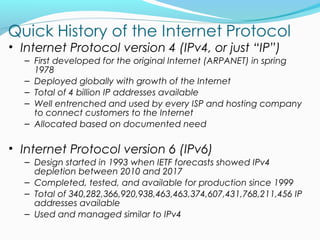
• Internet Protocol version 4 (IPv4, or just “IP”)
– First developed for the original Internet (ARPANET) in spring
1978
– Deployed globally with growth of the Internet
– Total of 4 billion IP addresses available
– Well entrenched and used by every ISP and hosting company
to connect customers to the Internet
– Allocated based on documented need
• Internet Protocol version 6 (IPv6)
– Design started in 1993 when IETF forecasts showed IPv4
depletion between 2010 and 2017
– Completed, tested, and available for production since 1999
– Total of 340,282,366,920,938,463,463,374,607,431,768,211,456 IP
addresses available
– Used and managed similar to IPv4
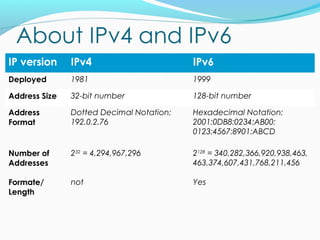
IP version IPv4 IPv6
Deployed 1981 1999
Address Size 32-bit number 128-bit number
Address
Format
Dotted Decimal Notation:
192.0.2.76
Hexadecimal Notation:
2001:0DB8:0234:AB00:
0123:4567:8901:ABCD
Number of
Addresses
232
= 4,294,967,296 2128
= 340,282,366,920,938,463,
463,374,607,431,768,211,456
Formate/
Length
not Yes
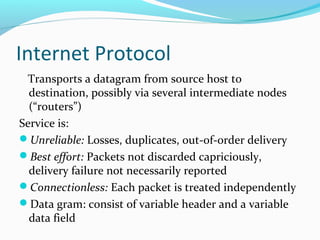
Internet Protocol
Transports a datagram from source host to
destination, possibly via several intermediate nodes
(“routers”)
Service is:
Unreliable: Losses, duplicates, out-of-order delivery
Best effort: Packets not discarded capriciously,
delivery failure not necessarily reported
Connectionless: Each packet is treated independently
Data gram: consist of variable header and a variable
data field
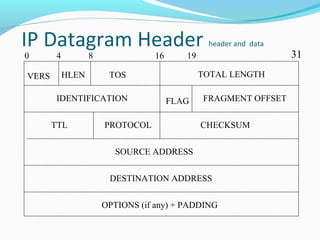
IP Datagram Header header and data
VERS HLEN TOS TOTAL LENGTH
IDENTIFICATION FLAG FRAGMENT OFFSET
TTL PROTOCOL CHECKSUM
SOURCE ADDRESS
DESTINATION ADDRESS
OPTIONS (if any) + PADDING
0 4 8 16 19 31
IPv6 availability
Generally available with (new) versions of most
operating systems.
BSD, Linux 2.2 Solaris 8
An option with Windows 2000/NT
Most routers can support IPV6
IP v6 - Version Number
IP v 1-3 defined and replaced
IP v4 - current version
IP v5 - streams protocol
IP v6 - replacement for IP v4
During development it was called IPng
Next Generation
Why Change IP?
Address space exhaustion
Two level addressing (network and host) wastes space
Network addresses used even if not connected to
Internet
Growth of networks and the Internet
Extended use of TCP/IP
Single address per host
Requirements for new types of service
Why Change IP?
Address space exhaustion
Two level addressing (network and host) wastes space
Network addresses used even if not connected to
Internet
Growth of networks and the Internet
Extended use of TCP/IP
Single address per host
Requirements for new types of service
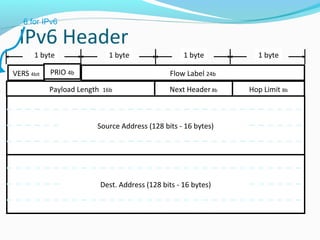
IPv6 Header
VERS 4bit PRIO 4b
Hop Limit 8b
Flow Label 24b
Payload Length 16b Next Header 8b
1 byte1 byte 1 byte 1 byte
6 for IPv6
Source Address (128 bits - 16 bytes)
Dest. Address (128 bits - 16 bytes)
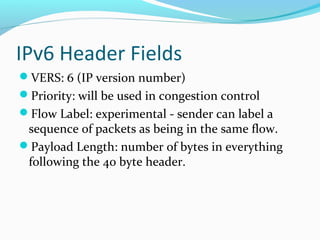
IPv6 Header Fields
VERS: 6 (IP version number)
Priority: will be used in congestion control
Flow Label: experimental - sender can label a
sequence of packets as being in the same flow.
Payload Length: number of bytes in everything
following the 40 byte header.
IPv6 Header Fields
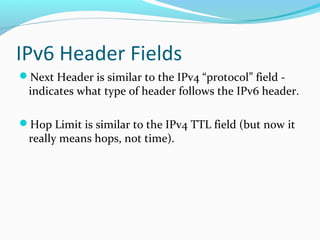
Next Header is similar to the IPv4 “protocol” field -
indicates what type of header follows the IPv6 header.
Hop Limit is similar to the IPv4 TTL field (but now it
really means hops, not time).
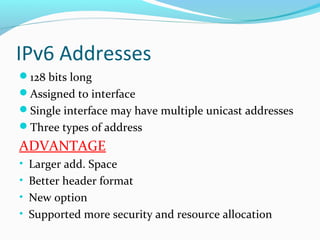
IPv6 Addresses
128 bits long
Assigned to interface
Single interface may have multiple unicast addresses
Three types of address
ADVANTAGE
• Larger add. Space
• Better header format
• New option
• Supported more security and resource allocation
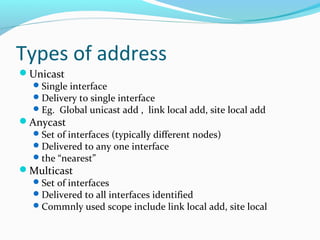
Types of address
Unicast
Single interface
Delivery to single interface
Eg. Global unicast add , link local add, site local add
Anycast
Set of interfaces (typically different nodes)
Delivered to any one interface
the “nearest”
Multicast
Set of interfaces
Delivered to all interfaces identified
Commnly used scope include link local add, site local
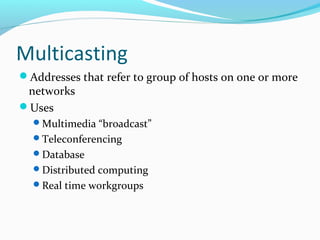
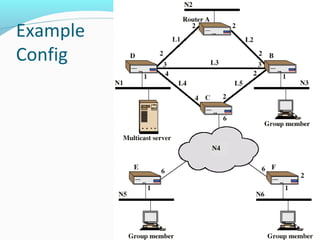
Multicasting
Addresses that refer to group of hosts on one or more
networks
Uses
Multimedia “broadcast”
Teleconferencing
Database
Distributed computing
Real time workgroups
Example
Config
20
Broadcast and Multiple Unicast
Broadcast a copy of packet to each network
Requires 13 copies of packet
Multiple Unicast
Send packet only to networks that have hosts in group
11 packets
IPv4-Mapped IPv6 Address
IPv4-Mapped addresses allow a host that support
both IPv4 and IPv6 to communicate with a host that
supports only IPv4.
The IPv6 address is based completely on the IPv4
address.
Works with DNS
An IPv6 application asks DNS for the address of a
host, but the host only has an IPv4 address.
DNS creates the IPv4-Mapped IPv6 address
automatically.
Kernel understands this is a special address and really
uses IPv4 communication.
IPv4-Compatible IPv6 Address
An IPv4 compatible address allows a host supporting
IPv6 to talk IPv6 even if the local router(s) don’t talk
IPv6.
IPv4 compatible addresses tell endpoint software to
create a tunnel by encapsulating the IPv6 packet in an
IPv4 packet.
Mobility Support in IPv6
Mobile computers are becoming commonplace.
Mobile IPv6 allows a node to move from one link to
another without changing the address.
Movement can be heterogeneous, i.e., node can move
from an Ethernet link to a cellular packet network.
Mobility support in IPv6 is more efficient than mobility
support in IPv4.
There are also proposals for supporting micro-mobility.
Auto-configuration in IPv6
Link-local prefix concatenated with 64-bit MAC address.
(Autonomous mode)
Prefix advertised by router concatenated with 64-bit
MAC address. (Semi-autonomous mode.)
DHCPng (for server modes)
Can provide a permanent address (stateless mode)
Provide an address from a group of addresses, and keep
track of this allocation (stateful mode)
Can provide additional network specific information.
Can register nodes in DNS.
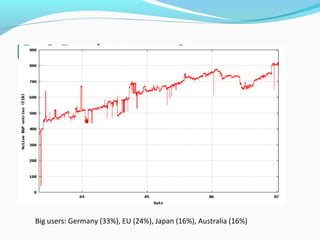
Big users: Germany (33%), EU (24%), Japan (16%), Australia (16%)
Ip4 vs ip6

Ip4 vs ip6

  • 2.
    • Internet Protocolversion 4 (IPv4, or just “IP”) – First developed for the original Internet (ARPANET) in spring 1978 – Deployed globally with growth of the Internet – Total of 4 billion IP addresses available – Well entrenched and used by every ISP and hosting company to connect customers to the Internet – Allocated based on documented need • Internet Protocol version 6 (IPv6) – Design started in 1993 when IETF forecasts showed IPv4 depletion between 2010 and 2017 – Completed, tested, and available for production since 1999 – Total of 340,282,366,920,938,463,463,374,607,431,768,211,456 IP addresses available – Used and managed similar to IPv4
  • 3.
    IP version IPv4IPv6 Deployed 1981 1999 Address Size 32-bit number 128-bit number Address Format Dotted Decimal Notation: 192.0.2.76 Hexadecimal Notation: 2001:0DB8:0234:AB00: 0123:4567:8901:ABCD Number of Addresses 232 = 4,294,967,296 2128 = 340,282,366,920,938,463, 463,374,607,431,768,211,456 Formate/ Length not Yes
  • 4.
    Internet Protocol Transports adatagram from source host to destination, possibly via several intermediate nodes (“routers”) Service is: Unreliable: Losses, duplicates, out-of-order delivery Best effort: Packets not discarded capriciously, delivery failure not necessarily reported Connectionless: Each packet is treated independently Data gram: consist of variable header and a variable data field
  • 5.
    IP Datagram Headerheader and data VERS HLEN TOS TOTAL LENGTH IDENTIFICATION FLAG FRAGMENT OFFSET TTL PROTOCOL CHECKSUM SOURCE ADDRESS DESTINATION ADDRESS OPTIONS (if any) + PADDING 0 4 8 16 19 31
  • 8.
    IPv6 availability Generally availablewith (new) versions of most operating systems. BSD, Linux 2.2 Solaris 8 An option with Windows 2000/NT Most routers can support IPV6
  • 9.
    IP v6 -Version Number IP v 1-3 defined and replaced IP v4 - current version IP v5 - streams protocol IP v6 - replacement for IP v4 During development it was called IPng Next Generation
  • 10.
    Why Change IP? Addressspace exhaustion Two level addressing (network and host) wastes space Network addresses used even if not connected to Internet Growth of networks and the Internet Extended use of TCP/IP Single address per host Requirements for new types of service
  • 11.
    Why Change IP? Addressspace exhaustion Two level addressing (network and host) wastes space Network addresses used even if not connected to Internet Growth of networks and the Internet Extended use of TCP/IP Single address per host Requirements for new types of service
  • 14.
    IPv6 Header VERS 4bitPRIO 4b Hop Limit 8b Flow Label 24b Payload Length 16b Next Header 8b 1 byte1 byte 1 byte 1 byte 6 for IPv6 Source Address (128 bits - 16 bytes) Dest. Address (128 bits - 16 bytes)
  • 15.
    IPv6 Header Fields VERS:6 (IP version number) Priority: will be used in congestion control Flow Label: experimental - sender can label a sequence of packets as being in the same flow. Payload Length: number of bytes in everything following the 40 byte header.
  • 16.
    IPv6 Header Fields NextHeader is similar to the IPv4 “protocol” field - indicates what type of header follows the IPv6 header. Hop Limit is similar to the IPv4 TTL field (but now it really means hops, not time).
  • 17.
    IPv6 Addresses 128 bitslong Assigned to interface Single interface may have multiple unicast addresses Three types of address ADVANTAGE • Larger add. Space • Better header format • New option • Supported more security and resource allocation
  • 18.
    Types of address Unicast Singleinterface Delivery to single interface Eg. Global unicast add , link local add, site local add Anycast Set of interfaces (typically different nodes) Delivered to any one interface the “nearest” Multicast Set of interfaces Delivered to all interfaces identified Commnly used scope include link local add, site local
  • 19.
    Multicasting Addresses that referto group of hosts on one or more networks Uses Multimedia “broadcast” Teleconferencing Database Distributed computing Real time workgroups
  • 20.
  • 21.
    Broadcast and MultipleUnicast Broadcast a copy of packet to each network Requires 13 copies of packet Multiple Unicast Send packet only to networks that have hosts in group 11 packets
  • 22.
    IPv4-Mapped IPv6 Address IPv4-Mappedaddresses allow a host that support both IPv4 and IPv6 to communicate with a host that supports only IPv4. The IPv6 address is based completely on the IPv4 address.
  • 23.
    Works with DNS AnIPv6 application asks DNS for the address of a host, but the host only has an IPv4 address. DNS creates the IPv4-Mapped IPv6 address automatically. Kernel understands this is a special address and really uses IPv4 communication.
  • 24.
    IPv4-Compatible IPv6 Address AnIPv4 compatible address allows a host supporting IPv6 to talk IPv6 even if the local router(s) don’t talk IPv6. IPv4 compatible addresses tell endpoint software to create a tunnel by encapsulating the IPv6 packet in an IPv4 packet.
  • 25.
    Mobility Support inIPv6 Mobile computers are becoming commonplace. Mobile IPv6 allows a node to move from one link to another without changing the address. Movement can be heterogeneous, i.e., node can move from an Ethernet link to a cellular packet network. Mobility support in IPv6 is more efficient than mobility support in IPv4. There are also proposals for supporting micro-mobility.
  • 26.
    Auto-configuration in IPv6 Link-localprefix concatenated with 64-bit MAC address. (Autonomous mode) Prefix advertised by router concatenated with 64-bit MAC address. (Semi-autonomous mode.) DHCPng (for server modes) Can provide a permanent address (stateless mode) Provide an address from a group of addresses, and keep track of this allocation (stateful mode) Can provide additional network specific information. Can register nodes in DNS.
  • 27.
    Big users: Germany(33%), EU (24%), Japan (16%), Australia (16%)

Editor's Notes

  • #3 IPv6 provides a much larger pool of IP addresses. IPv6 is not backwards compatible with IPv4. The much larger IPv6 numbering system is meant to one day completely replace IPv4, but this will take many years. In the meantime, much of the Internet will run IPv4 and IPv6 simultaneously. This is necessary to ensure all users, regardless of the protocol version they are using, will be able to interact with all content on the Internet.
  • #4 IPv4 address space has been used for decades to grow the Internet. When engineers deployed IPv4 in 1981, four billion IP addresses seemed like plenty. As the world caught on to the commercial possibilities of the Internet, though, engineers realized that the number of IP addresses simply wasn ’t enough for all the laptops, mobile devices, web servers, routers, and other devices coming online. The first allocation of IPv6 address space by a Regional Internet Registry (RIR) to a provider was made in April of 1999.