MENTAL HEALTH
( PSYCHIATRIC) NURSING
A Presentation on TRENDS
and ISSUES
Points for Discussion
A) Trends
 Introduction
 History
 Psychiatric Nursing In Globalization era
 Present scene
 Changes and Challenges
 Current trends
 Trends in the Role of a Psychiatric
Nurse
B) Issues
Legal Aspects
• Terminologies
• Types of laws
• Legal Issues
Ethical Aspects
• Principles
• Dilemmas
• Issues
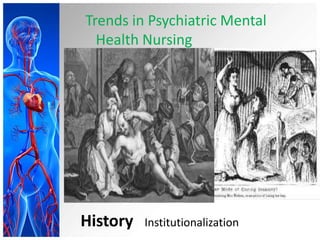
Trends in Psychiatric Mental
Health Nursing
History Institutionalization
In the Globalization
Era
De Institutionalization Psychotropic Drugs
How do we integrate with
Mental Health Community?
• Experience and Education
• Role and Functions
• Relationships with other
professions
- Leininger(1973)
Present Scene of Mental
Health
• 450 million people affected worldwide
• Mental problems common to all countries
• 1 in every 4 persons going for health
services has atleast one emotional
problems
• Mental problems of Clients with Chronic
disorders
• Unavailability of cost effective treatment
• Lack of recognition, awareness and action
Issues around Mental health
Nursing
• Hard to justify scientifically due to
the lack of Research results
• Less ready to face the free market
• Role differentiation based on
education and experience is
unclear.
• Become Psychiatric Nurse is not an
option for students!
Changes and Challenges
Demographic
changes
Social
changes
Economic
Changes
Technological
changes
Mental
health care
changes
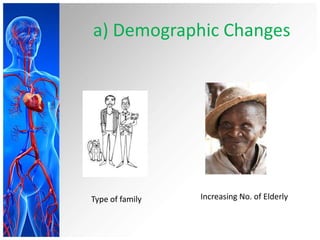
a) Demographic Changes
Type of family Increasing No. of Elderly
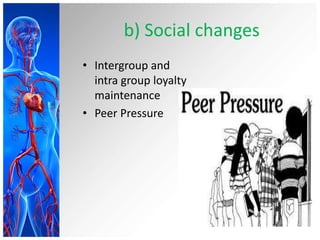
b) Social changes
• Intergroup and
intra group loyalty
maintenance
• Peer Pressure
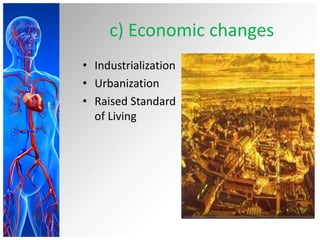
c) Economic changes
• Industrialization
• Urbanization
• Raised Standard
of Living
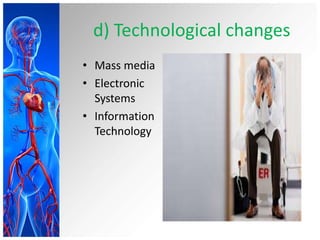
d) Technological changes
• Mass media
• Electronic
Systems
• Information
Technology
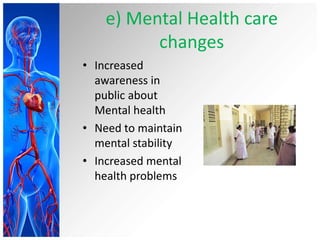
e) Mental Health care
changes
• Increased
awareness in
public about
Mental health
• Need to maintain
mental stability
• Increased mental
health problems
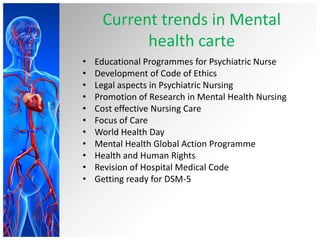
Current trends in Mental
health carte
• Educational Programmes for Psychiatric Nurse
• Development of Code of Ethics
• Legal aspects in Psychiatric Nursing
• Promotion of Research in Mental Health Nursing
• Cost effective Nursing Care
• Focus of Care
• World Health Day
• Mental Health Global Action Programme
• Health and Human Rights
• Revision of Hospital Medical Code
• Getting ready for DSM-5
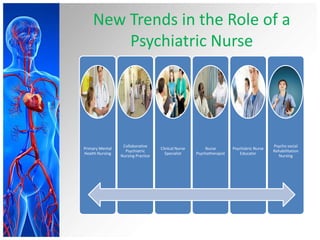
New Trends in the Role of a
Psychiatric Nurse
New Trends in the Role of a
Psychiatric Nurse
Primary Mental
Health Nursing
Collaborative
Psychiatric
Nursing Practice
Clinical Nurse
Specialist
Nurse
Psychotherapist
Psychiatric Nurse
Educator
Psycho social
Rehabilitation
Nursing
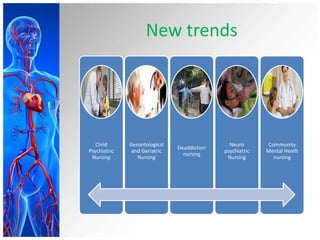
New trends
Child
Psychiatric
Nursing
Gerontological
and Geriatric
Nursing
Deaddiction
nursing
Neuro
psychiatric
Nursing
Community
Mental Heath
nursing
Issues in Psychiatric Mental
Health Nursing
Legal Aspects
Basic Terminologies
• Civil Law: Civil law defines the
rights and duties of the individuals
in relation to each other. Civil law
protects the private and property
rights of the individuals and
businesses.
I. Tort
• Intentional
• Unintentional
II. Contract
• Criminal Law: Criminal law defines
certain acts as offences against the
state and in doing so makes them
punishable. The criminal law is
enforced by or on behalf of the
State. Criminal law provides
protection from conduct deemed
injurious to the public welfare
• Statutory Law: A statutory law is a law
that has been enacted by legislative
body, such as country or city council, the
state legislature or the parliament. An
example statutory law such as the Indian
Nursing Council Act.
• Common Law: Common laws are
derived from decisions made in
previous cases. These laws apply to
a body of principles that evolve
from court decisions resolving
various controversies
• Right to Confidentiality is a basic one,
and especially so in psychiatry. Although
social attitudes are improving,
individuals have been discriminated
against in the past for no other reason
than for having a history of emotional
illness.
• Informed Consent is a client’s
permission granted to a physician to
perform therapeutic procedure, before
which information about the procedure
has been presented to the client with
adequate time given for consideration
about the pros and cons.
• Restraints generally refers to a set
of leather straps that are used to
restrain the extremities of an
individual whose behaviour is out
of control and who poses an
inherent risk to the physical safety
and psychological well-being of the
individual and staff.
• Seclusion is another type of
physical restraint in which the
client is confined alone in a room
from which he or she is unable to
leave.
• False Imprisonment is the
deliberate and unauthorized
confinement of a person within
fixed limits by the use of verbal or
physical means.
• Gravely Disabled is generally
defined as a condition in which an
individual, as a result of mental
illness, is in danger of serious
physical harm resulting from
inability to provide for basic needs,
such as food, clothing, shelter,
medical care and personal safety.
• Negligence: The omission (of a
person) to do something which a
reasonable person, guided by those
ordinary considerations which
ordinarily regulated human affairs,
would do or the doing of
something which a prudent and
reasonable person would not do.
• Malpractice:“The failure of one
rendering professional services to
exercise that degree of skill and
learning commonly applied under
all the circumstances in the
community by the average prudent
reputable member of the
profession with the result of injury,
loss or damage to the recipient of
those services or to those entitled
to rely upon them.”
• Libel: Written Defamation
• Slander: Oral defamation
• Invasion of Privacy: is a charge that
may result when a client is
searched without probable cause.
• Assault is an act that results in a
person’s genuine fear and
apprehension that he or she will be
touched without consent.
• Battery is the unconnected
touching of another person.
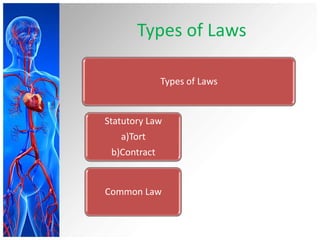
Types of Laws
Types of Laws
Statutory Law
a)Tort
b)Contract
Common Law
Legal Issues
• Right to Confidentiality is a basic
one, and especially so in psychiatry.
Although social attitudes are
improving, individuals have been
discriminated against in the past
for no other reason than for having
a history of emotional illness.
Informed Consent
• Informed Consent is a client’s
permission granted to a physician
to perform therapeutic procedure,
before which information about
the procedure has been presented
to the client with adequate time
given for consideration about the
pros and cons.
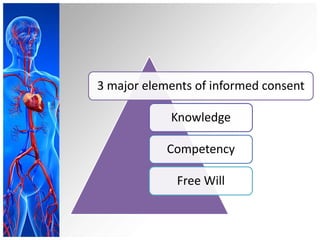
3 major elements of informed consent
Knowledge
Competency
Free Will
Restraints and Seclusion
• Restraints generally refers to a set of
leather straps that are used to restrain
the extremities of an individual whose
behaviour is out of control and who
poses an inherent risk to the physical
safety and psychological well-being of
the individual and staff.
“Talking down”- a less Restrictive measure
• Seclusion is another type of physical
restraint in which the client is confined
alone in a room from which he or she is
unable to leave.
 Orders re issued for R&S?
False Imprisonment
• False Imprisonment is the
deliberate and unauthorized
confinement of a person within
fixed limits by the use of verbal or
physical means.
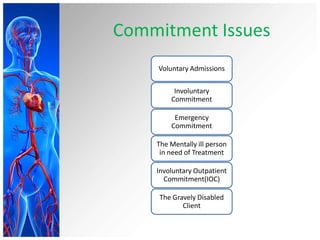
Commitment Issues
Voluntary Admissions
Involuntary
Commitment
Emergency
Commitment
The Mentally ill person
in need of Treatment
Involuntary Outpatient
Commitment(IOC)
The Gravely Disabled
Client
Malpractice and
Negligence
Malpractice is the failure of
one rendering
professional services to
exercise that degree of
skill and learning
commonly applied under
all the circumstances in
the community by the
average prudent
reputable member of the
profession with the
result of injury, loss or
damage to the recipient
of those cervices or to
those entitled to rely
upon them
Negligence is the omission
(of a person) to do
something which a
reasonable person,
guided by those ordinary
considerations which
ordinarily regulated
human affairs, would do
or the doing of
something which a
prudent and reasonable
person would not do.
Failure to prevent
Dangerous Client
behaviour
• “ Tarasoff Duty to warn”
An interesting Love story???!!!
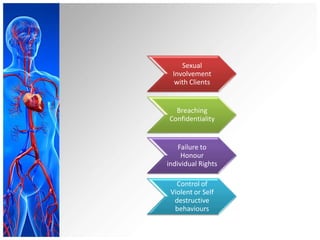
Sexual
Involvement
with Clients
Breaching
Confidentiality
Failure to
Honour
individual Rights
Control of
Violent or Self
destructive
behaviours
Law suits that occur in
Psychiatric Nursing
• Breach of Confidentiality
• Defamation of Character
Libel
Slander
• Invasion of Privacy
Assault
Battery
How to avoid Liability?
Practice within the scope of the nurse practice
act.
Observe the hospital’s and department’s policy
manuals.
Measure up to established practice standards.
Always put the client’s rights and welfare first.
Develop and maintain a good interpersonal
relationship with each client and his or her family.
Ethical Aspects
Ethical Principles
Autonomy
Beneficence
Fidelity
Justice
Non Malefience
Veracity
Ethical Dilemmas in Mental
Health
An ethical dilemma is a situation in
which ethical principles conflict or
when there is no one clear course
of action in a given situation.
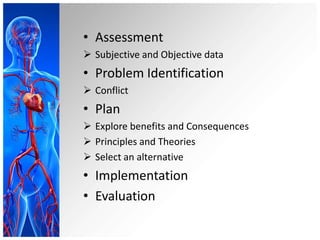
Ethical Decision Making
• Assessment
 Subjective and Objective data
• Problem Identification
 Conflict
• Plan
 Explore benefits and Consequences
 Principles and Theories
 Select an alternative
• Implementation
• Evaluation
Let’s Decide!
Should a client who is loud
and intrusive to other
clients on a hospital unit
be secluded from the
others?
When a therapeutic
relationship has ended, can a
health care professional nurse
ever have a social or intimate
relationship with someone he
or she met as a client?
Are clients who are
psychotic necessarily
incompetent or do they
still have the right to refuse
hospitalization and
medication?

Trends and issues in Psychiatric Mental Health Nursing- Pradeep

  • 1.
    MENTAL HEALTH ( PSYCHIATRIC)NURSING A Presentation on TRENDS and ISSUES
  • 2.
    Points for Discussion A)Trends  Introduction  History  Psychiatric Nursing In Globalization era  Present scene  Changes and Challenges  Current trends  Trends in the Role of a Psychiatric Nurse
  • 3.
    B) Issues Legal Aspects •Terminologies • Types of laws • Legal Issues Ethical Aspects • Principles • Dilemmas • Issues
  • 4.
    Trends in PsychiatricMental Health Nursing History Institutionalization
  • 5.
    In the Globalization Era DeInstitutionalization Psychotropic Drugs
  • 6.
    How do weintegrate with Mental Health Community? • Experience and Education • Role and Functions • Relationships with other professions - Leininger(1973)
  • 7.
    Present Scene ofMental Health • 450 million people affected worldwide • Mental problems common to all countries • 1 in every 4 persons going for health services has atleast one emotional problems • Mental problems of Clients with Chronic disorders • Unavailability of cost effective treatment • Lack of recognition, awareness and action
  • 8.
    Issues around Mentalhealth Nursing • Hard to justify scientifically due to the lack of Research results • Less ready to face the free market • Role differentiation based on education and experience is unclear. • Become Psychiatric Nurse is not an option for students!
  • 9.
  • 10.
    a) Demographic Changes Typeof family Increasing No. of Elderly
  • 11.
    b) Social changes •Intergroup and intra group loyalty maintenance • Peer Pressure
  • 12.
    c) Economic changes •Industrialization • Urbanization • Raised Standard of Living
  • 13.
    d) Technological changes •Mass media • Electronic Systems • Information Technology
  • 14.
    e) Mental Healthcare changes • Increased awareness in public about Mental health • Need to maintain mental stability • Increased mental health problems
  • 15.
    Current trends inMental health carte • Educational Programmes for Psychiatric Nurse • Development of Code of Ethics • Legal aspects in Psychiatric Nursing • Promotion of Research in Mental Health Nursing • Cost effective Nursing Care • Focus of Care • World Health Day • Mental Health Global Action Programme • Health and Human Rights • Revision of Hospital Medical Code • Getting ready for DSM-5
  • 16.
    New Trends inthe Role of a Psychiatric Nurse
  • 17.
    New Trends inthe Role of a Psychiatric Nurse Primary Mental Health Nursing Collaborative Psychiatric Nursing Practice Clinical Nurse Specialist Nurse Psychotherapist Psychiatric Nurse Educator Psycho social Rehabilitation Nursing
  • 18.
  • 19.
    Issues in PsychiatricMental Health Nursing
  • 20.
  • 21.
    Basic Terminologies • CivilLaw: Civil law defines the rights and duties of the individuals in relation to each other. Civil law protects the private and property rights of the individuals and businesses. I. Tort • Intentional • Unintentional II. Contract
  • 22.
    • Criminal Law:Criminal law defines certain acts as offences against the state and in doing so makes them punishable. The criminal law is enforced by or on behalf of the State. Criminal law provides protection from conduct deemed injurious to the public welfare
  • 23.
    • Statutory Law:A statutory law is a law that has been enacted by legislative body, such as country or city council, the state legislature or the parliament. An example statutory law such as the Indian Nursing Council Act. • Common Law: Common laws are derived from decisions made in previous cases. These laws apply to a body of principles that evolve from court decisions resolving various controversies
  • 24.
    • Right toConfidentiality is a basic one, and especially so in psychiatry. Although social attitudes are improving, individuals have been discriminated against in the past for no other reason than for having a history of emotional illness. • Informed Consent is a client’s permission granted to a physician to perform therapeutic procedure, before which information about the procedure has been presented to the client with adequate time given for consideration about the pros and cons.
  • 25.
    • Restraints generallyrefers to a set of leather straps that are used to restrain the extremities of an individual whose behaviour is out of control and who poses an inherent risk to the physical safety and psychological well-being of the individual and staff. • Seclusion is another type of physical restraint in which the client is confined alone in a room from which he or she is unable to leave.
  • 26.
    • False Imprisonmentis the deliberate and unauthorized confinement of a person within fixed limits by the use of verbal or physical means. • Gravely Disabled is generally defined as a condition in which an individual, as a result of mental illness, is in danger of serious physical harm resulting from inability to provide for basic needs, such as food, clothing, shelter, medical care and personal safety.
  • 27.
    • Negligence: Theomission (of a person) to do something which a reasonable person, guided by those ordinary considerations which ordinarily regulated human affairs, would do or the doing of something which a prudent and reasonable person would not do.
  • 28.
    • Malpractice:“The failureof one rendering professional services to exercise that degree of skill and learning commonly applied under all the circumstances in the community by the average prudent reputable member of the profession with the result of injury, loss or damage to the recipient of those services or to those entitled to rely upon them.”
  • 29.
    • Libel: WrittenDefamation • Slander: Oral defamation • Invasion of Privacy: is a charge that may result when a client is searched without probable cause. • Assault is an act that results in a person’s genuine fear and apprehension that he or she will be touched without consent. • Battery is the unconnected touching of another person.
  • 30.
    Types of Laws Typesof Laws Statutory Law a)Tort b)Contract Common Law
  • 31.
    Legal Issues • Rightto Confidentiality is a basic one, and especially so in psychiatry. Although social attitudes are improving, individuals have been discriminated against in the past for no other reason than for having a history of emotional illness.
  • 32.
    Informed Consent • InformedConsent is a client’s permission granted to a physician to perform therapeutic procedure, before which information about the procedure has been presented to the client with adequate time given for consideration about the pros and cons.
  • 33.
    3 major elementsof informed consent Knowledge Competency Free Will
  • 34.
    Restraints and Seclusion •Restraints generally refers to a set of leather straps that are used to restrain the extremities of an individual whose behaviour is out of control and who poses an inherent risk to the physical safety and psychological well-being of the individual and staff. “Talking down”- a less Restrictive measure • Seclusion is another type of physical restraint in which the client is confined alone in a room from which he or she is unable to leave.  Orders re issued for R&S?
  • 35.
    False Imprisonment • FalseImprisonment is the deliberate and unauthorized confinement of a person within fixed limits by the use of verbal or physical means.
  • 36.
    Commitment Issues Voluntary Admissions Involuntary Commitment Emergency Commitment TheMentally ill person in need of Treatment Involuntary Outpatient Commitment(IOC) The Gravely Disabled Client
  • 37.
    Malpractice and Negligence Malpractice isthe failure of one rendering professional services to exercise that degree of skill and learning commonly applied under all the circumstances in the community by the average prudent reputable member of the profession with the result of injury, loss or damage to the recipient of those cervices or to those entitled to rely upon them Negligence is the omission (of a person) to do something which a reasonable person, guided by those ordinary considerations which ordinarily regulated human affairs, would do or the doing of something which a prudent and reasonable person would not do.
  • 38.
    Failure to prevent DangerousClient behaviour • “ Tarasoff Duty to warn” An interesting Love story???!!!
  • 39.
  • 40.
    Law suits thatoccur in Psychiatric Nursing • Breach of Confidentiality • Defamation of Character Libel Slander • Invasion of Privacy Assault Battery
  • 41.
    How to avoidLiability? Practice within the scope of the nurse practice act. Observe the hospital’s and department’s policy manuals. Measure up to established practice standards. Always put the client’s rights and welfare first. Develop and maintain a good interpersonal relationship with each client and his or her family.
  • 42.
  • 43.
  • 44.
    Ethical Dilemmas inMental Health An ethical dilemma is a situation in which ethical principles conflict or when there is no one clear course of action in a given situation.
  • 45.
  • 46.
    • Assessment  Subjectiveand Objective data • Problem Identification  Conflict • Plan  Explore benefits and Consequences  Principles and Theories  Select an alternative • Implementation • Evaluation
  • 47.
  • 48.
    Should a clientwho is loud and intrusive to other clients on a hospital unit be secluded from the others?
  • 49.
    When a therapeutic relationshiphas ended, can a health care professional nurse ever have a social or intimate relationship with someone he or she met as a client?
  • 50.
    Are clients whoare psychotic necessarily incompetent or do they still have the right to refuse hospitalization and medication?