
IEEE Presentation
On
Compatibility between IPv4 and IPv6
To
GTU PG SCHOOL
By
ZALAK PATEL
160930361011
ITSNS
IP Network Addressing
• IP Addressing is Logical Addressing
• It works on Network Layer (Layer 3)
• Two Version of Addressing Scheme
• IP version 4 address size– 32 bit addressing
• IP version 6 address size– 128 bit addressing
•INTERNET  world’s largest public data
network, doubling in size every nine months
•IPv4, defines a 32-bit address - 232 (4,294,967,296)
IPv4 addresses available
•The first problem is concerned with the eventual
depletion of the IP address space.
•Traditional model of classful addressing does not
allow the address space to be used to its maximum
potential.
Internet Protocol (IP)
•What is Internet Protocol?
Internet Protocol is a set of technical rules that defines how
computers communicate over a network.
•What is IPv4?
IPv4 was the first version of Internet Protocol to be widely used,
and accounts for most of today’s Internet traffic.
There are just over 4 billion IPv4 addresses. While that is a lot of IP
addresses, it is not enough to last forever.
•What is IPv6?
IPv6 is a newer numbering system that provides a much larger
address pool than IPv4. It was deployed in 1999 and should meet
the world’s IP addressing needs well into the future.
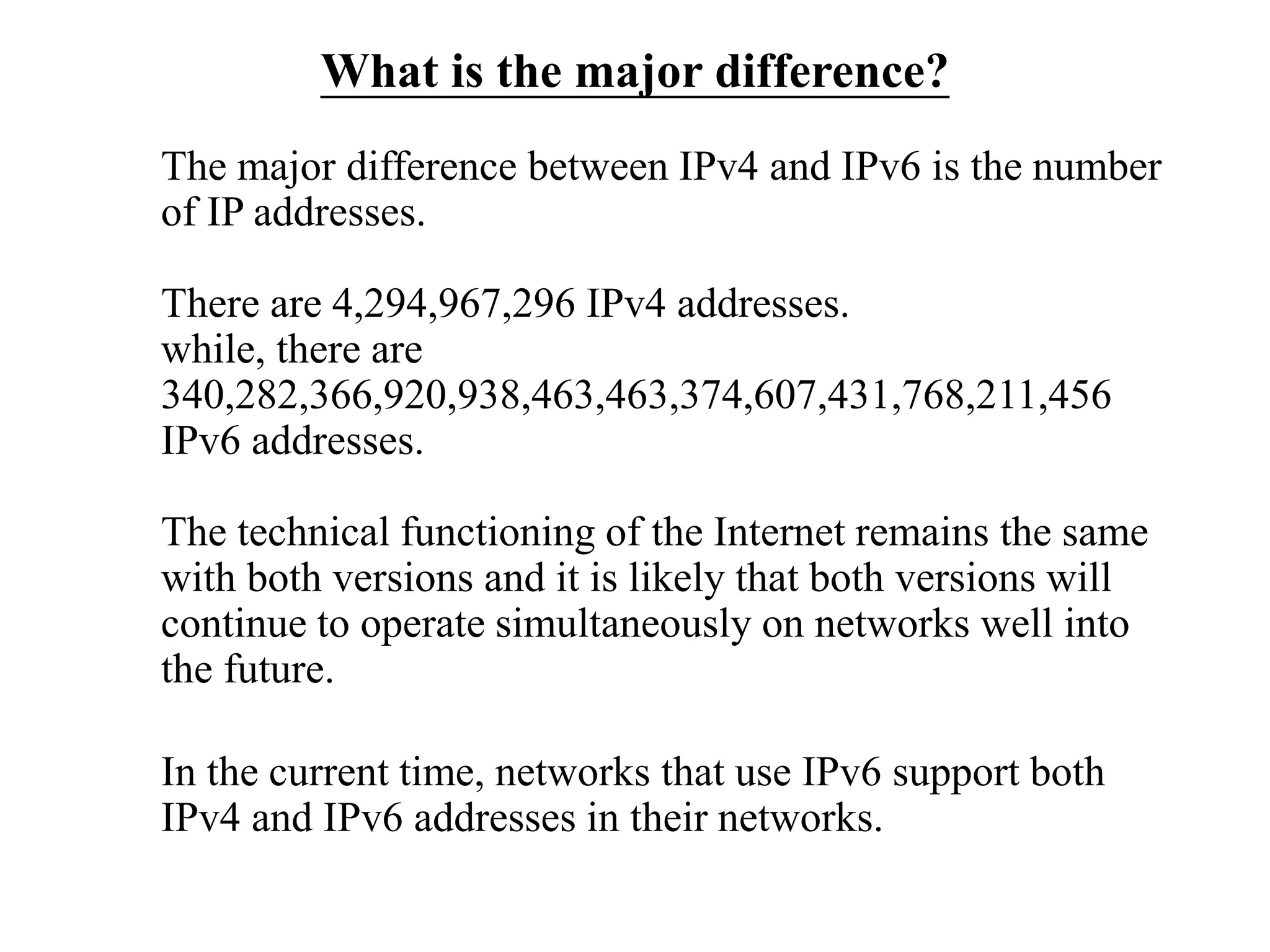
What is the major difference?
The major difference between IPv4 and IPv6 is the number
of IP addresses.
There are 4,294,967,296 IPv4 addresses.
while, there are
340,282,366,920,938,463,463,374,607,431,768,211,456
IPv6 addresses.
The technical functioning of the Internet remains the same
with both versions and it is likely that both versions will
continue to operate simultaneously on networks well into
the future.
In the current time, networks that use IPv6 support both
IPv4 and IPv6 addresses in their networks.
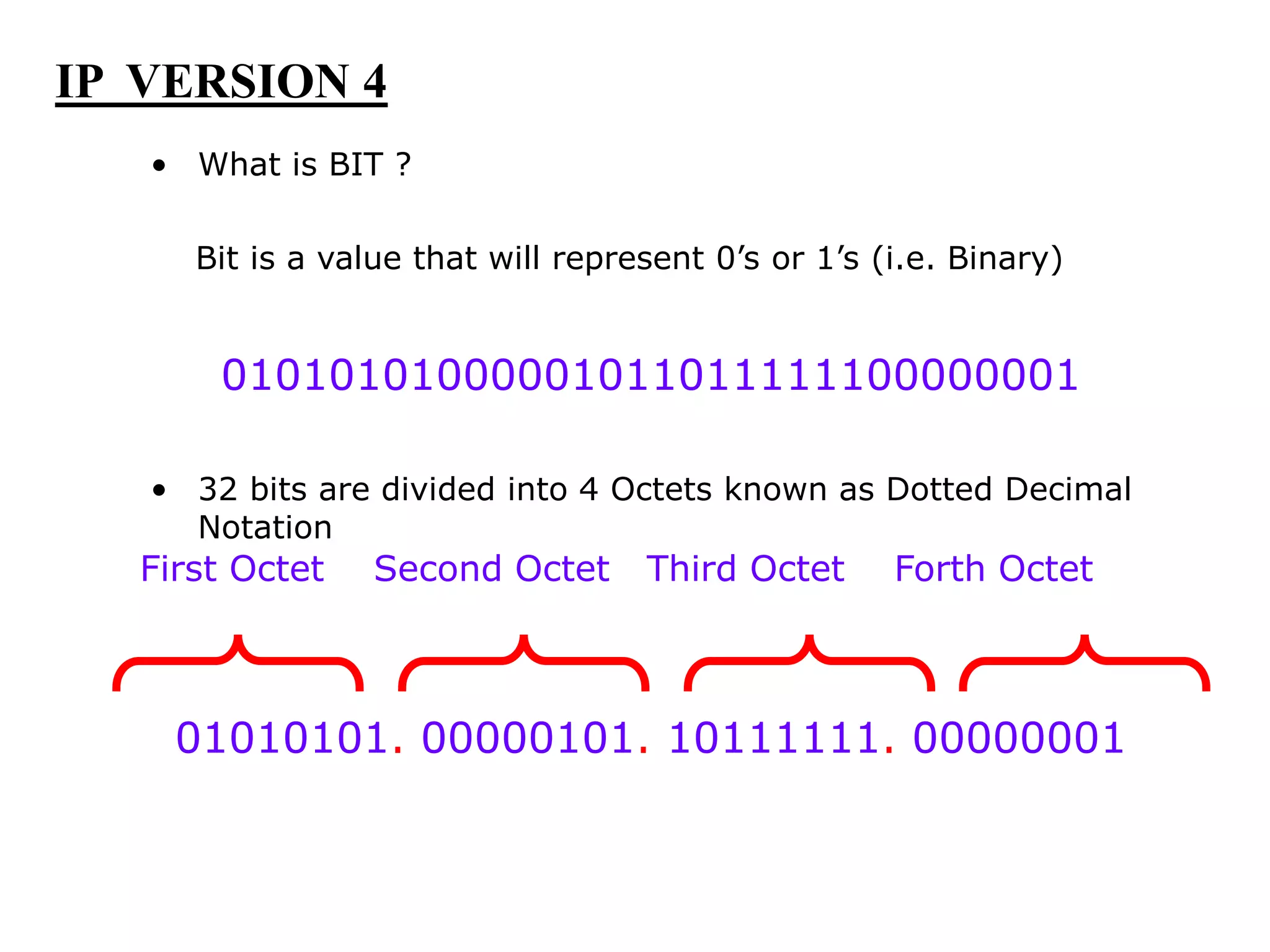
IP VERSION 4
• What is BIT ?
Bit is a value that will represent 0’s or 1’s (i.e. Binary)
01010101000001011011111100000001
• 32 bits are divided into 4 Octets known as Dotted Decimal
Notation
01010101. 00000101. 10111111. 00000001
First Octet Second Octet Third Octet Forth Octet
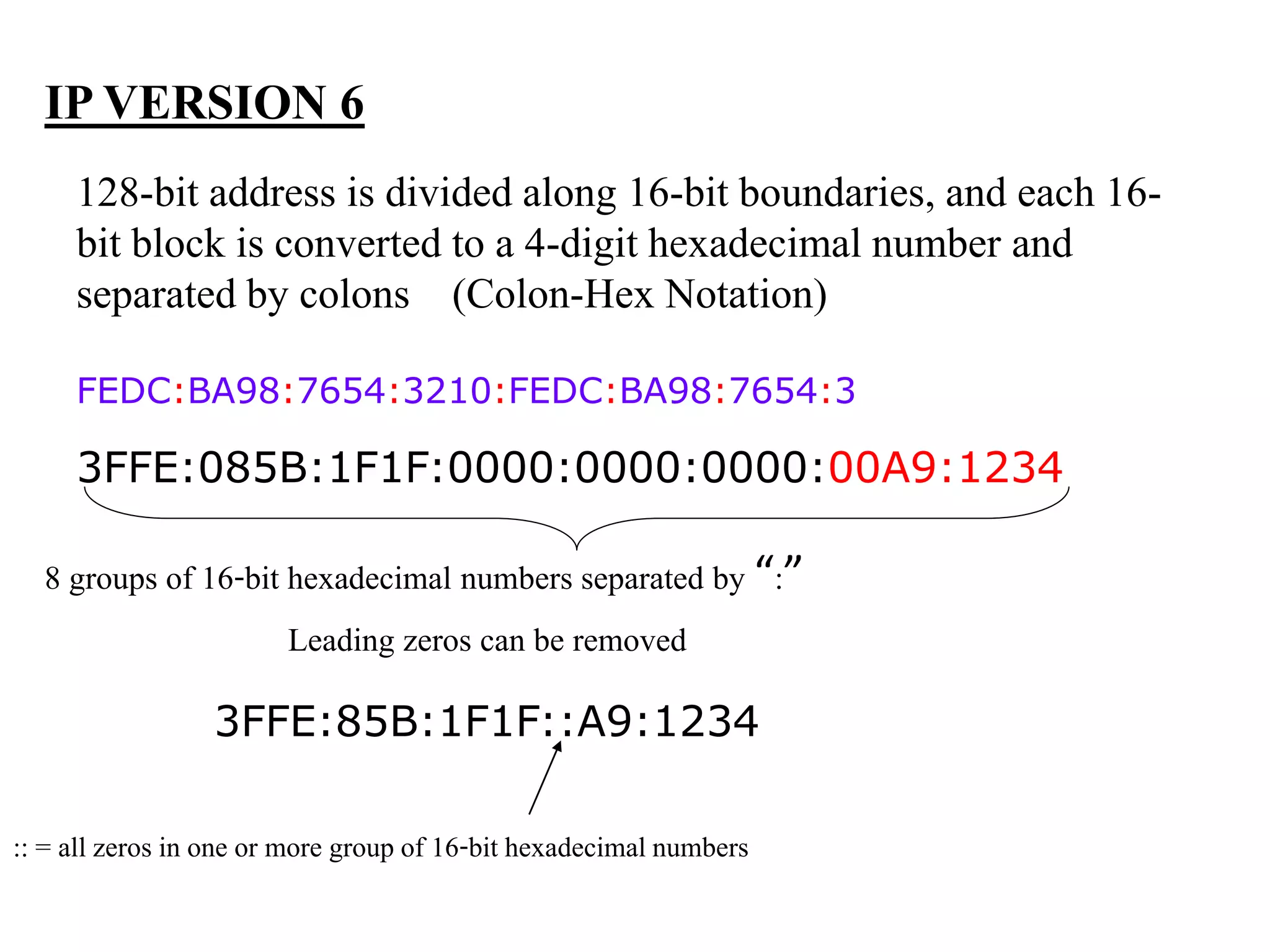
IP VERSION 6
128-bit address is divided along 16-bit boundaries, and each 16-
bit block is converted to a 4-digit hexadecimal number and
separated by colons (Colon-Hex Notation)
FEDC:BA98:7654:3210:FEDC:BA98:7654:3
3FFE:085B:1F1F:0000:0000:0000:00A9:1234
8 groups of 16-bit hexadecimal numbers separated by “:”
Leading zeros can be removed
3FFE:85B:1F1F::A9:1234
:: = all zeros in one or more group of 16-bit hexadecimal numbers
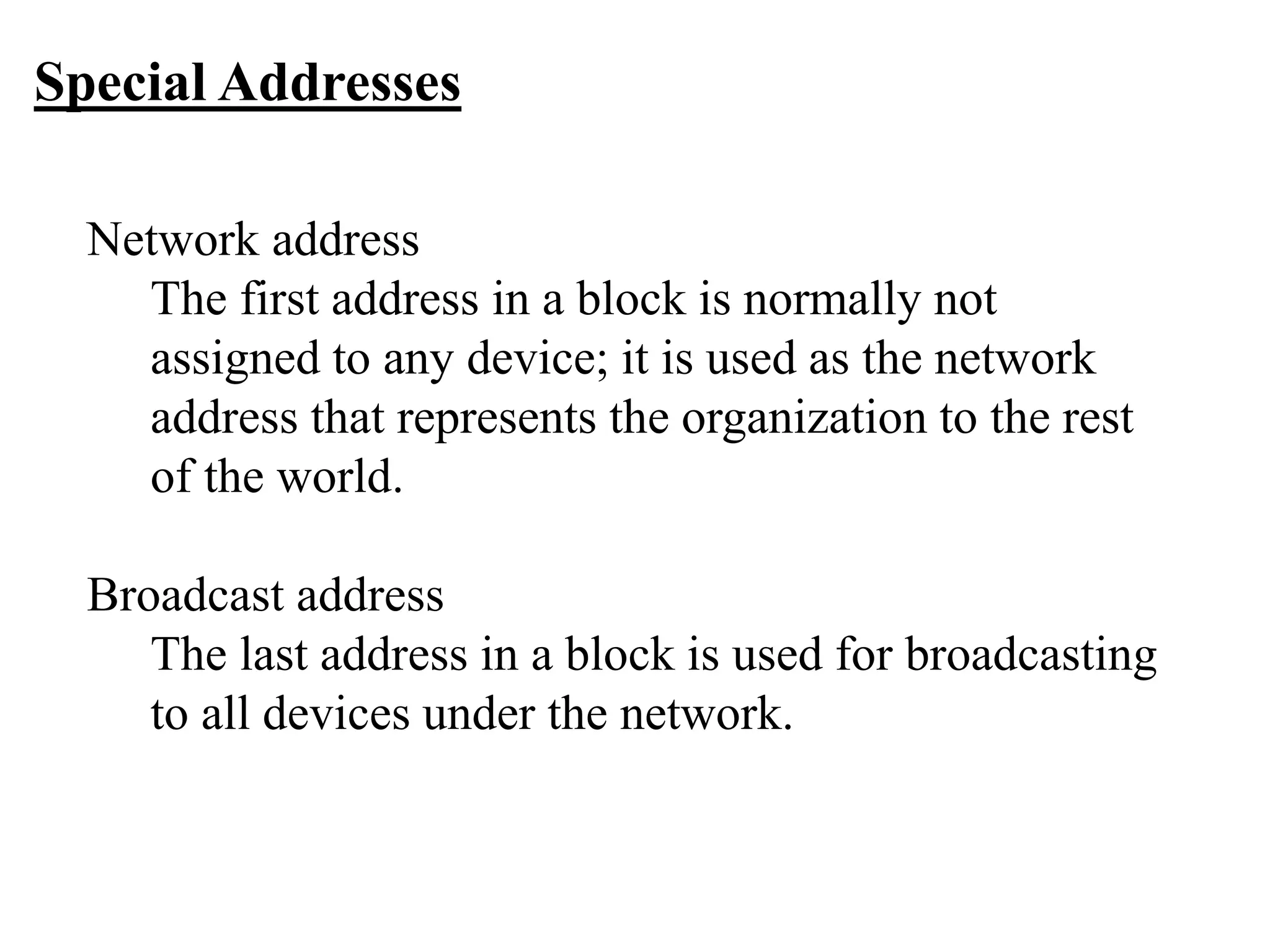
Special Addresses
Network address
The first address in a block is normally not
assigned to any device; it is used as the network
address that represents the organization to the rest
of the world.
Broadcast address
The last address in a block is used for broadcasting
to all devices under the network.
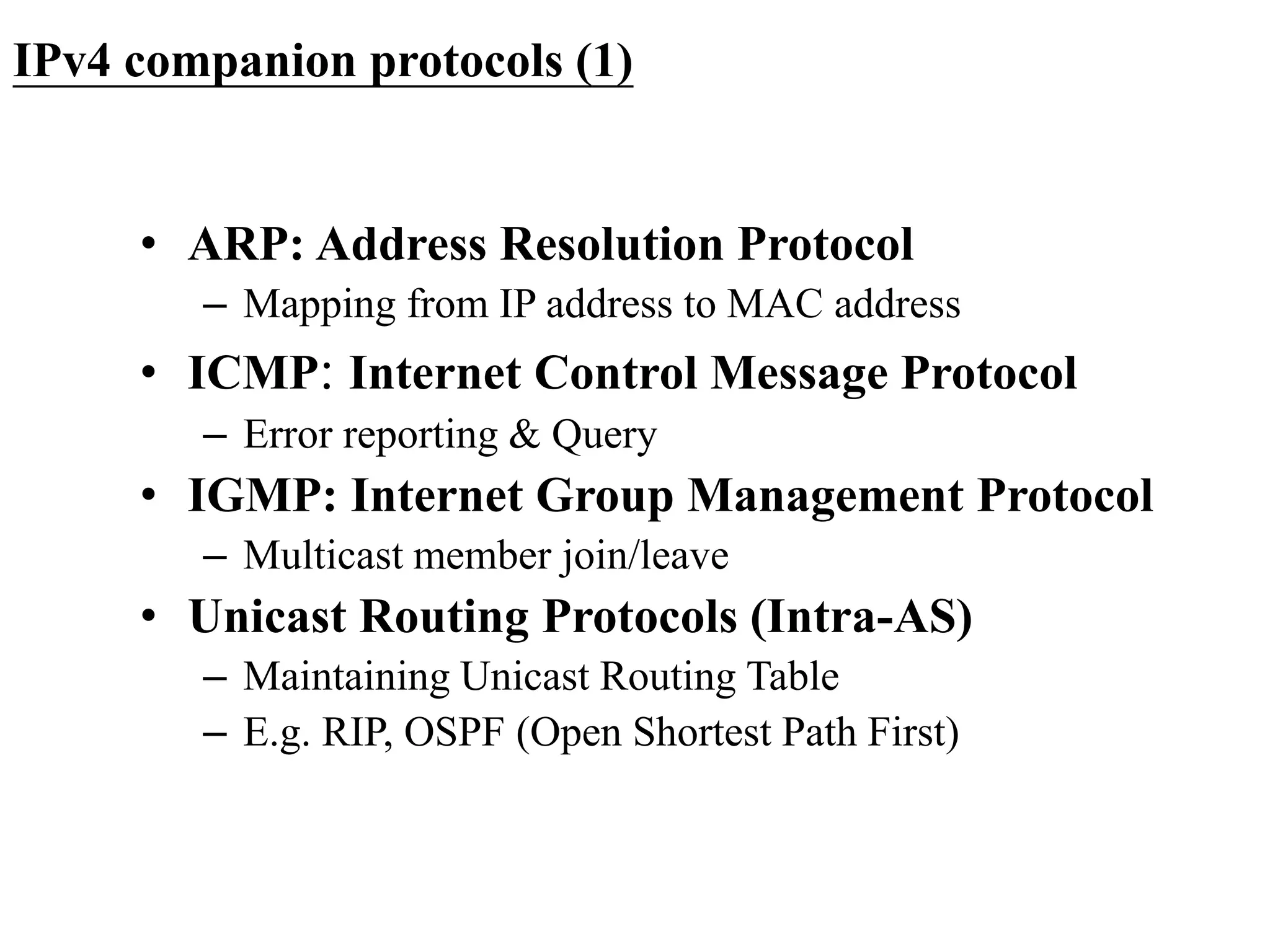
IPv4 companion protocols (1)
• ARP: Address Resolution Protocol
– Mapping from IP address to MAC address
• ICMP: Internet Control Message Protocol
– Error reporting & Query
• IGMP: Internet Group Management Protocol
– Multicast member join/leave
• Unicast Routing Protocols (Intra-AS)
– Maintaining Unicast Routing Table
– E.g. RIP, OSPF (Open Shortest Path First)
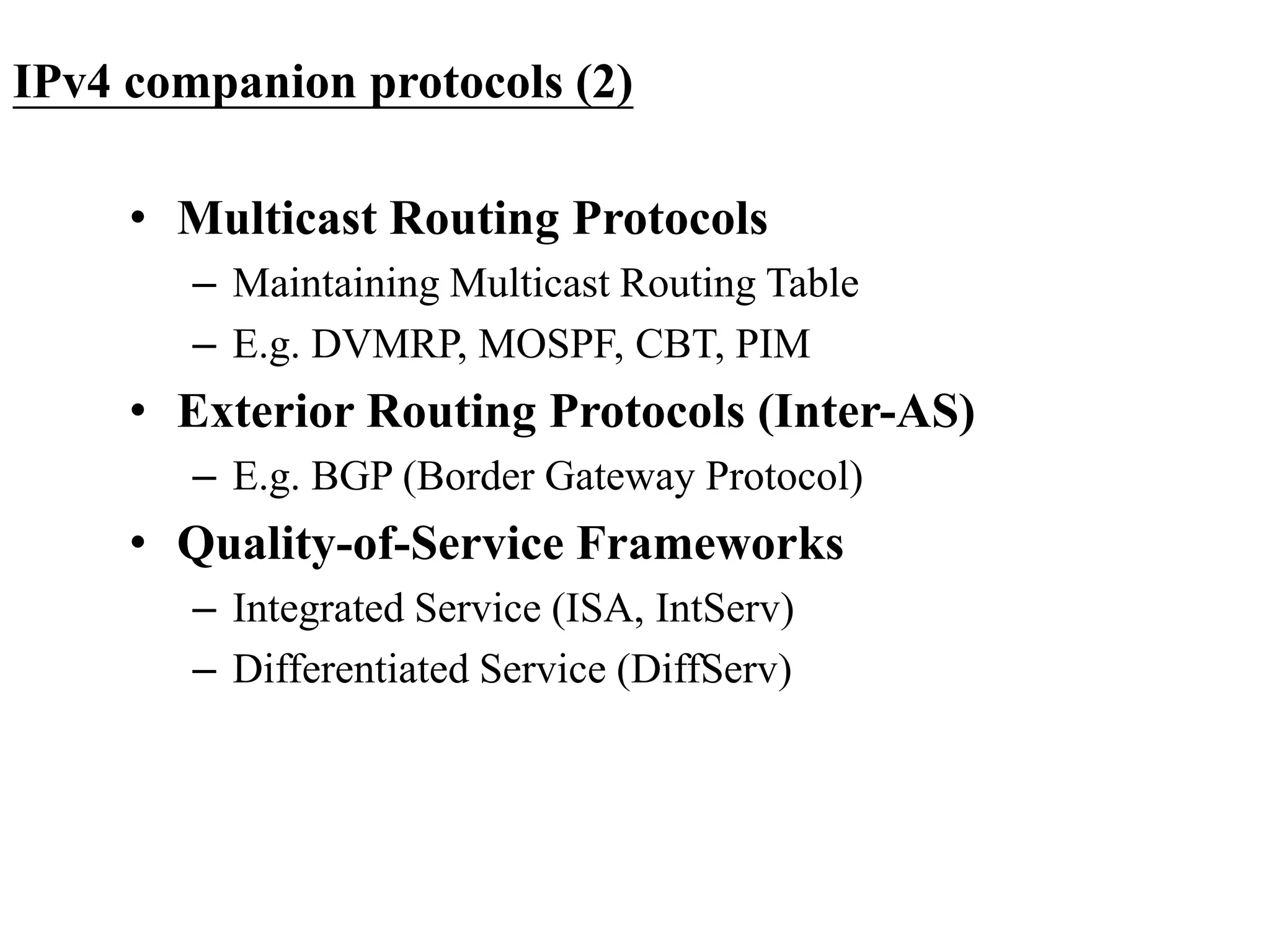
IPv4 companion protocols (2)
• Multicast Routing Protocols
– Maintaining Multicast Routing Table
– E.g. DVMRP, MOSPF, CBT, PIM
• Exterior Routing Protocols (Inter-AS)
– E.g. BGP (Border Gateway Protocol)
• Quality-of-Service Frameworks
– Integrated Service (ISA, IntServ)
– Differentiated Service (DiffServ)
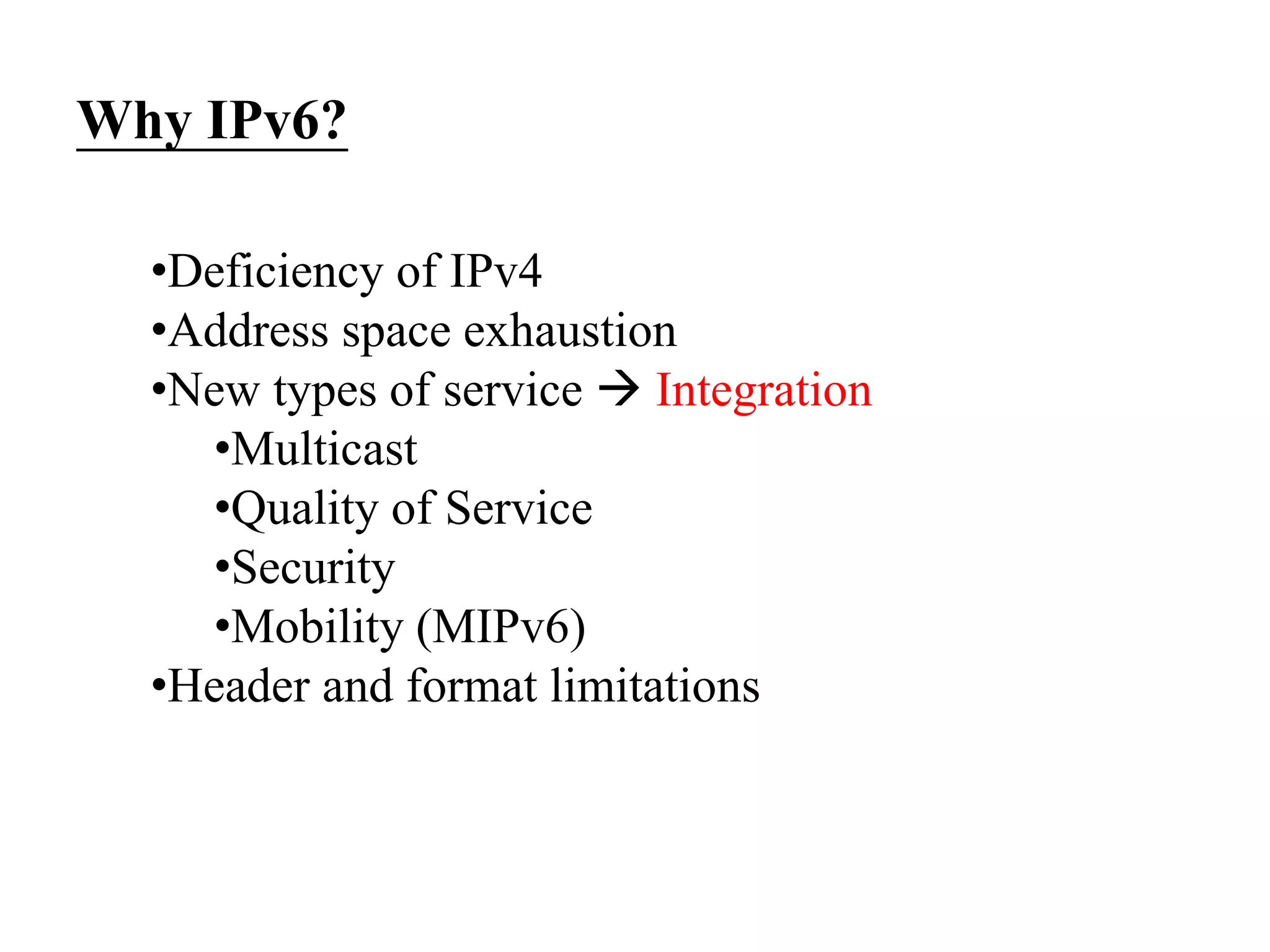
Why IPv6?
•Deficiency of IPv4
•Address space exhaustion
•New types of service  Integration
•Multicast
•Quality of Service
•Security
•Mobility (MIPv6)
•Header and format limitations
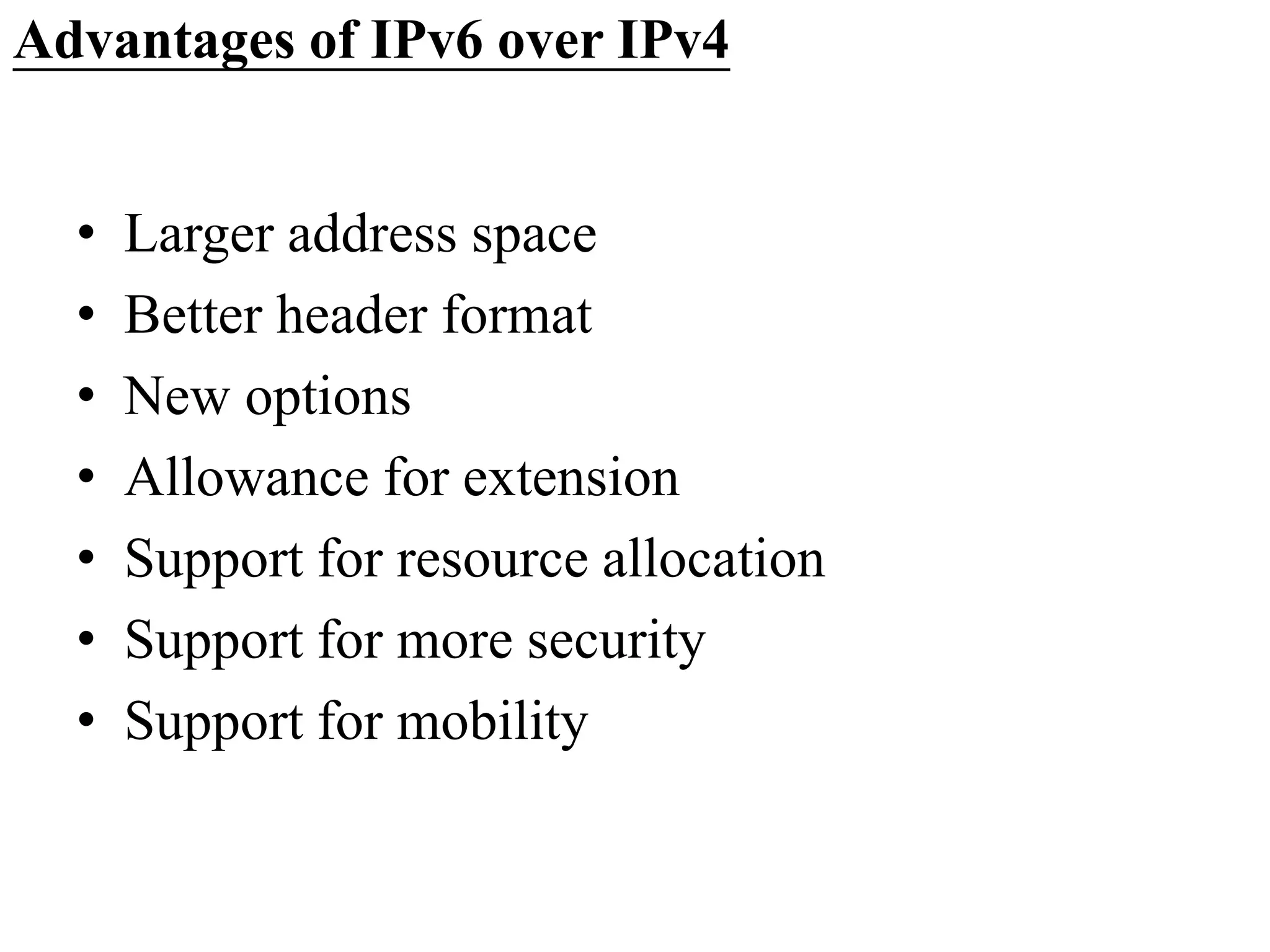
Advantages of IPv6 over IPv4
• Larger address space
• Better header format
• New options
• Allowance for extension
• Support for resource allocation
• Support for more security
• Support for mobility
A STUDY OF THE TECHNOLOGY TRANSITION
FROM IPv4 TO IPv6 FOR AN ISP
Abstract: The internet protocol IPv4 has met the demand
for years, but the number of addresses, while vast, is finite.
The solution to mitigate this problem was the development
of the new IPv6 protocol, which extends the address space
from 32-bits to 128-bits. IPv4 and IPv6 networks will
interoperate during the transition period, although the two
protocols structure is not compatible.
an ISP network and present three mechanisms that will
make the transition from IPv4 to IPv6 smoother:
Translation, Tunnel and Dual-Stack. Also, the
implementation of Dual-Stack for an ISP
Keywords: IPv4, IPv6, ISP, Transition, Translation, Tunnel,
Dual-Stack
• IPv4 network has grown far more than anyone had ever imagined
when the protocol was designed. As technology is developing new
services and Internet-enabled devices use more mobile connectivity
(2G, 3G and 4G), IPv4 is challenged with a series of problems, the most
demanding one being address exhaustion.
•There are not enough IPs available from ISPs (Internet Service
Provider) to meet the demand.
•The new IPv6 protocol is needed to satisfy the needs and it features
improved scalability and routing, simplified header that makes
forwarding packets more efficient, end-to-end connectivity because
there is no need for NAT (Network Address Translation), ease-of-
configuration because it supports stateful and stateless auto-
configuration, and information being stored in the start of the header is
useful for a router thus resulting in higher performance routing.
•The major flaw of IPv6 is that it is not compatible with IPv4, and to
use the new protocol changes are required in software and every
networked device. The majority of network services and applications
still use IPv4, therefore it will not be replaced for a long time. So, the
two network protocols will have to coexist.
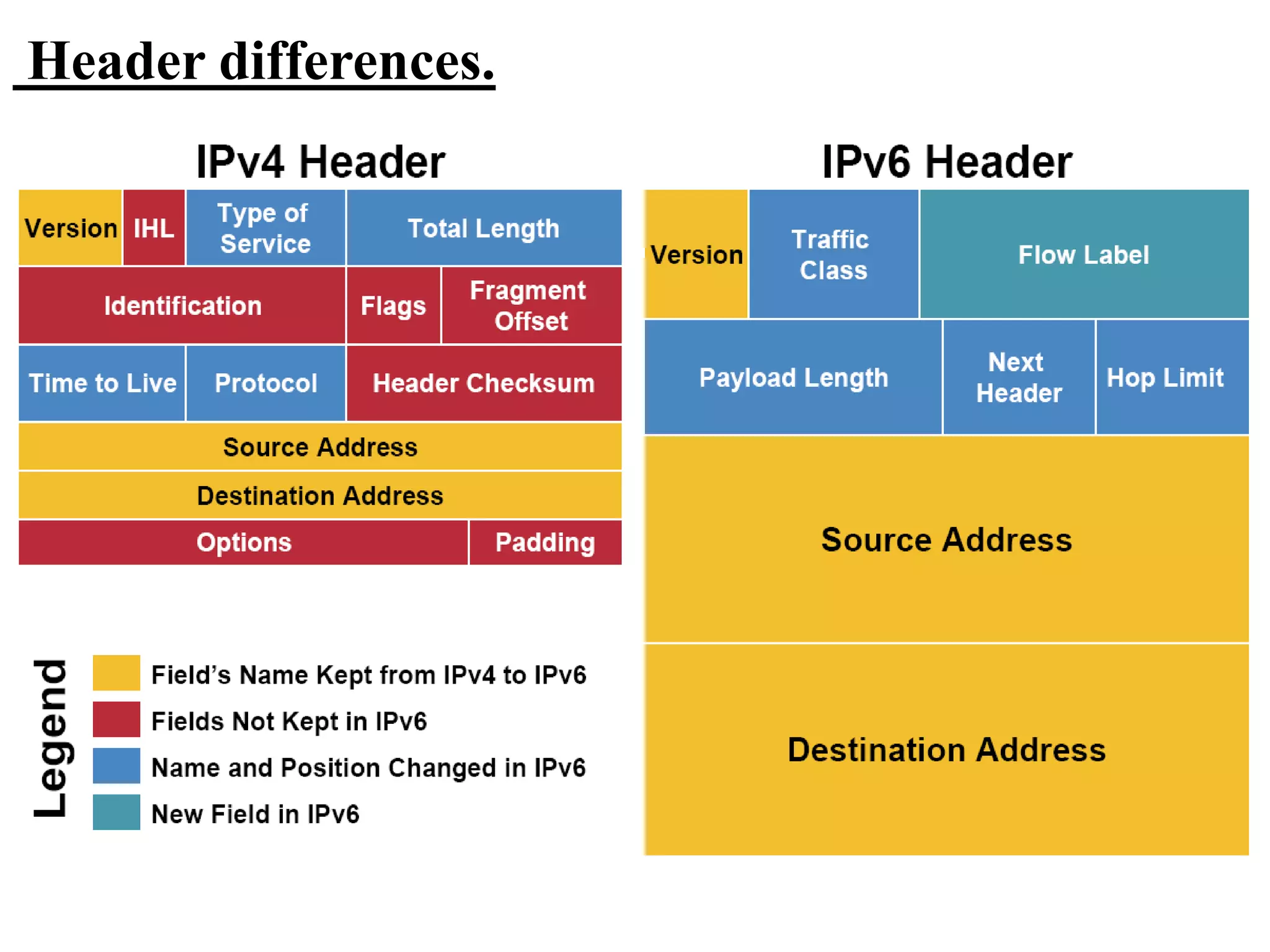
Header differences.
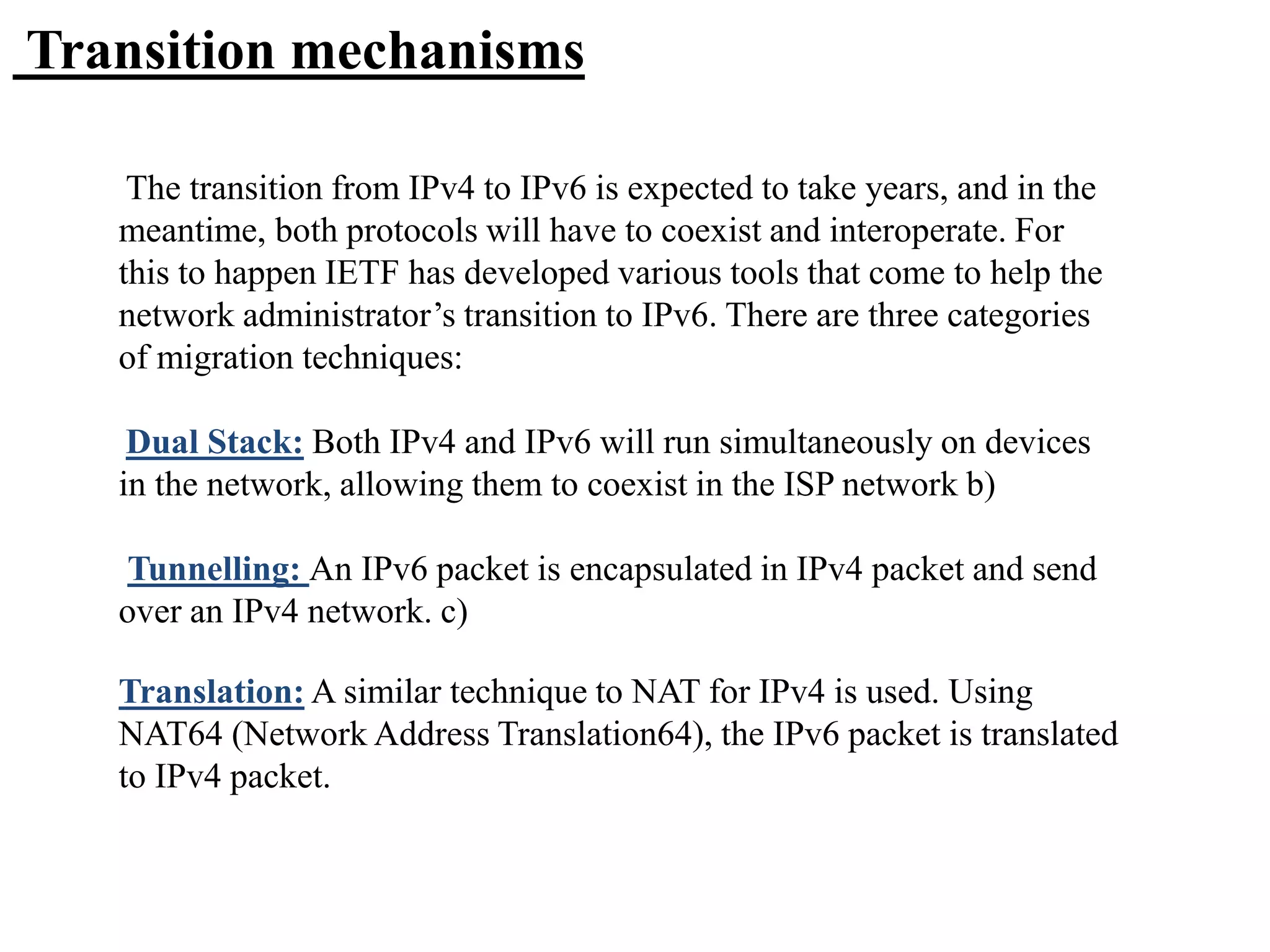
Transition mechanisms
The transition from IPv4 to IPv6 is expected to take years, and in the
meantime, both protocols will have to coexist and interoperate. For
this to happen IETF has developed various tools that come to help the
network administrator’s transition to IPv6. There are three categories
of migration techniques:
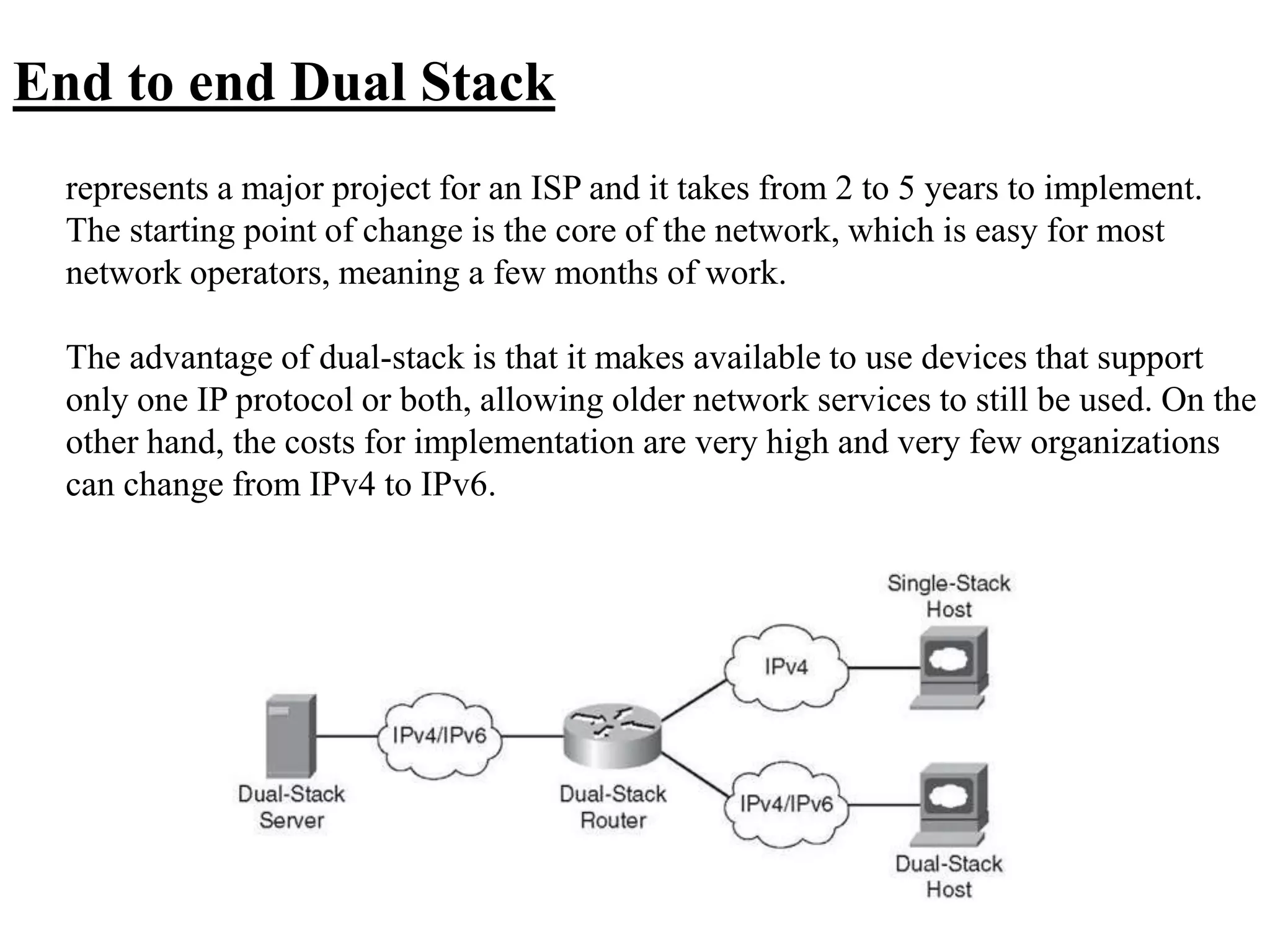
Dual Stack: Both IPv4 and IPv6 will run simultaneously on devices
in the network, allowing them to coexist in the ISP network b)
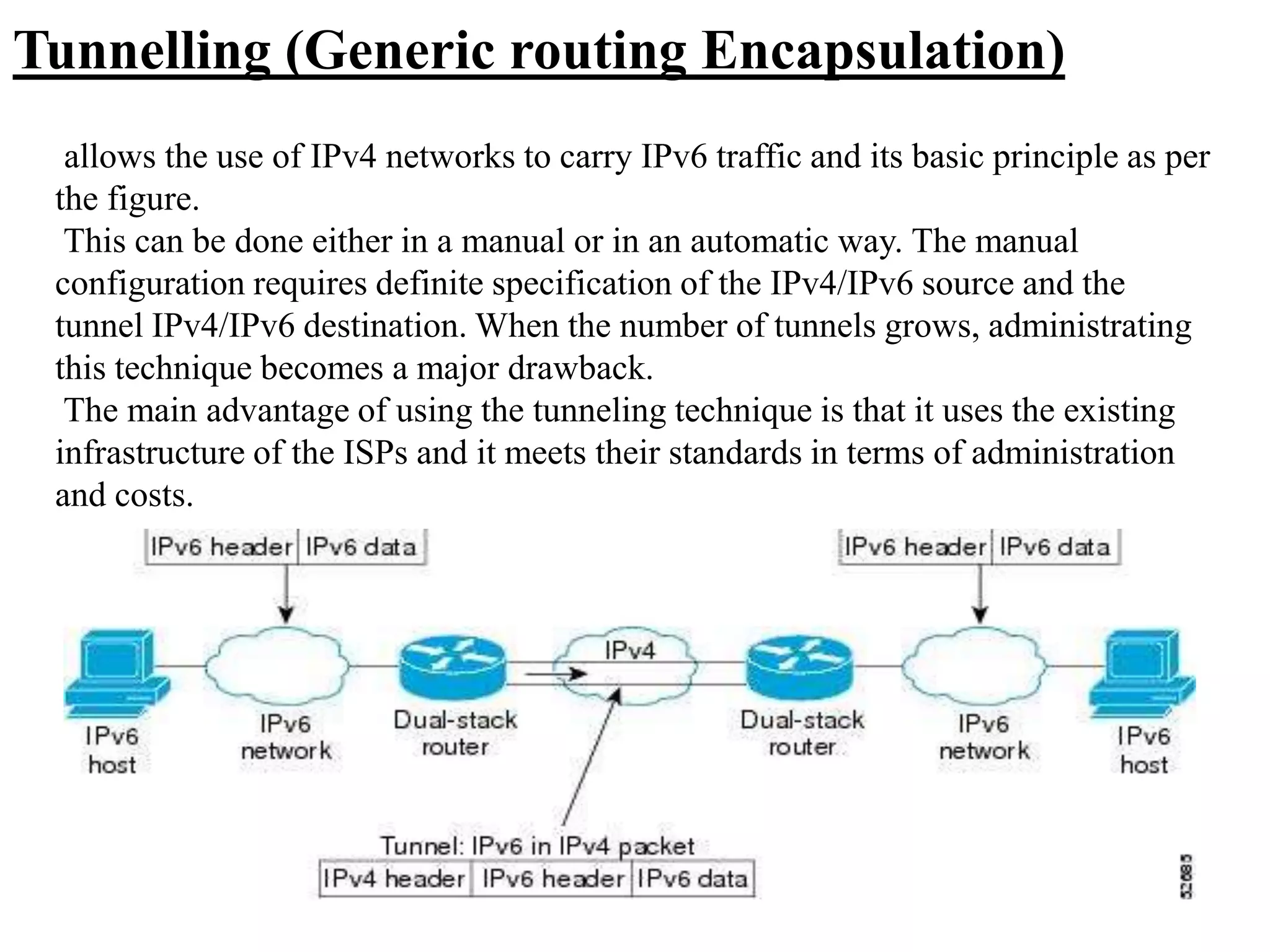
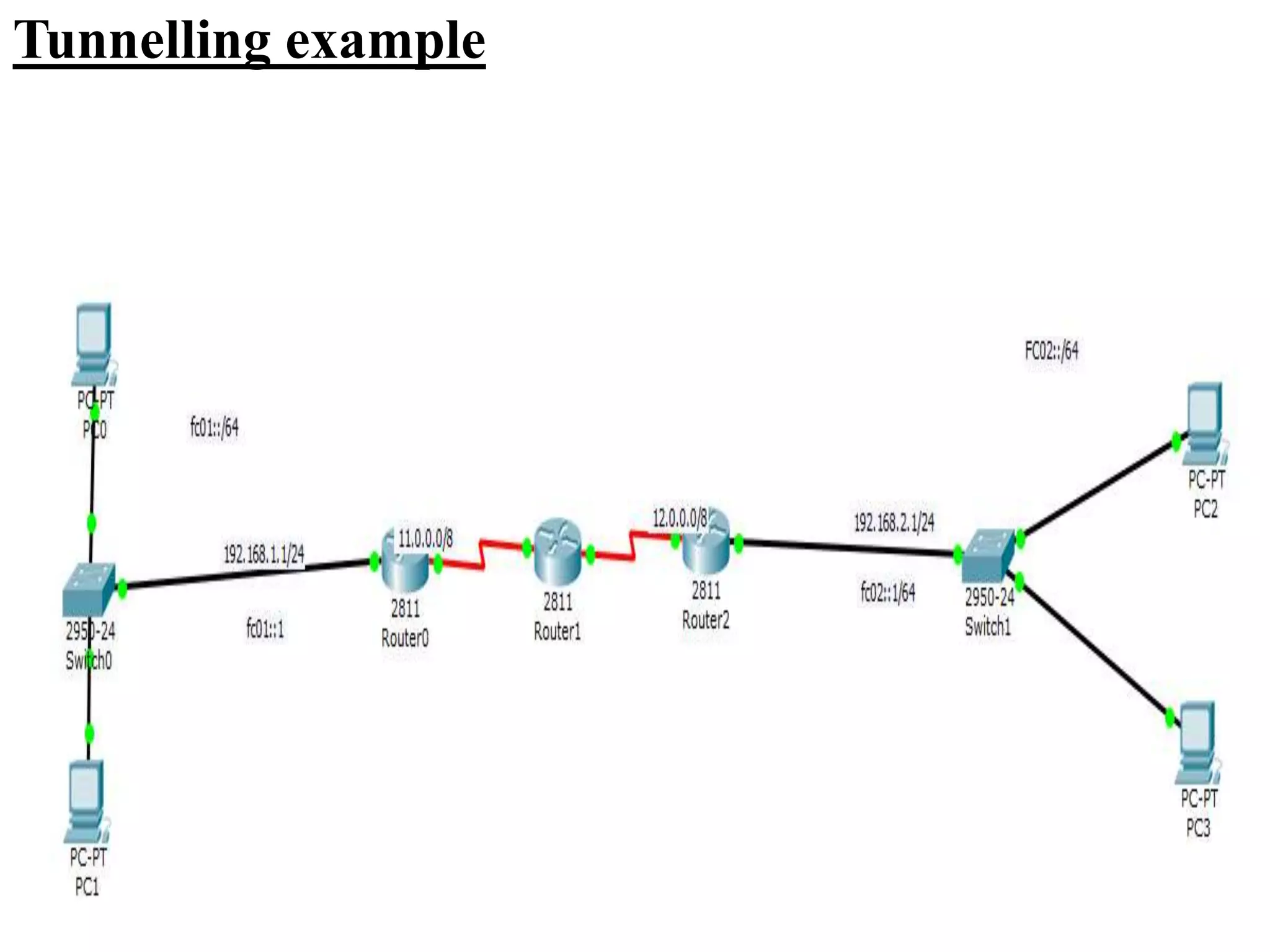
Tunnelling: An IPv6 packet is encapsulated in IPv4 packet and send
over an IPv4 network. c)
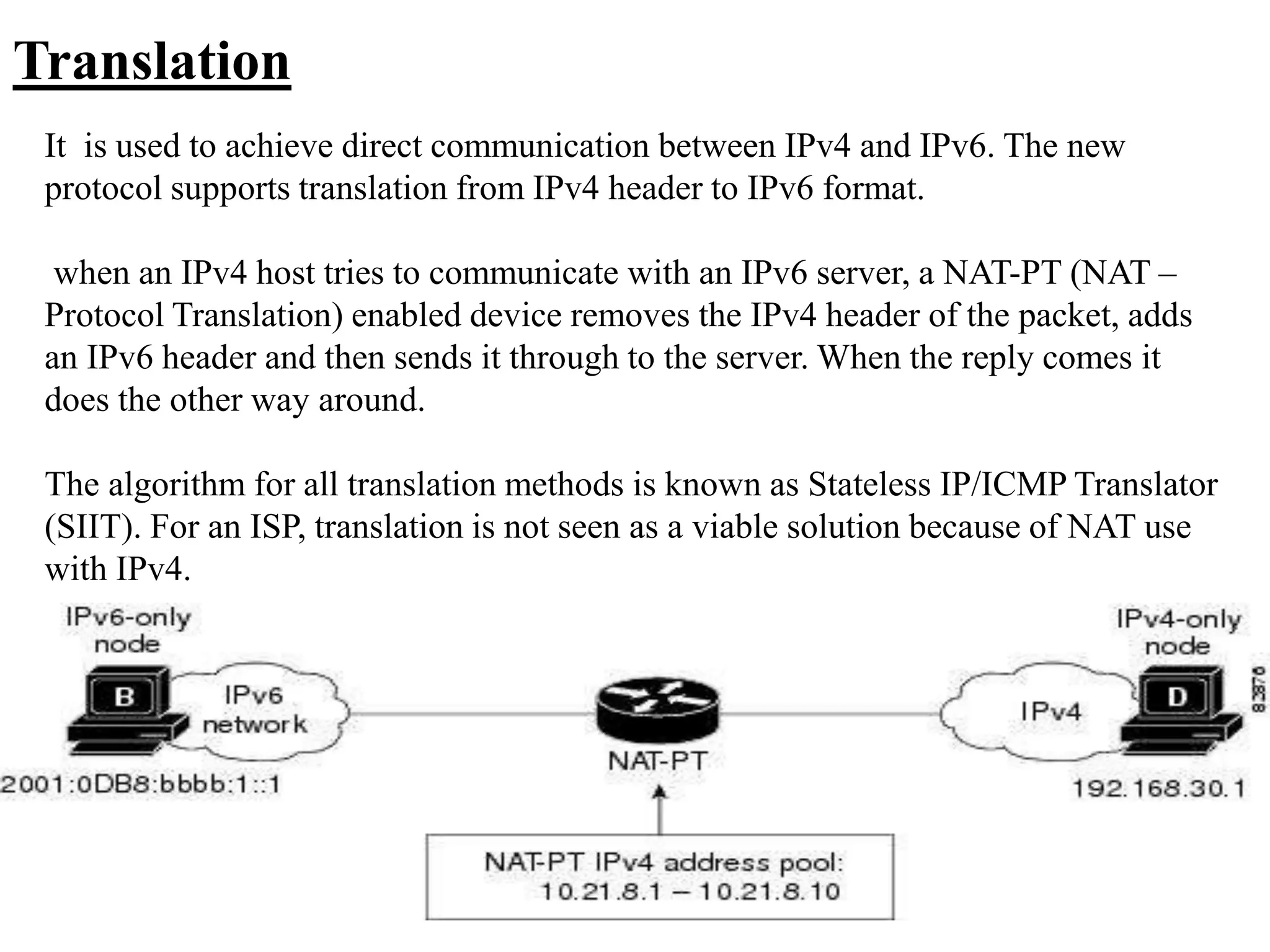
Translation: A similar technique to NAT for IPv4 is used. Using
NAT64 (Network Address Translation64), the IPv6 packet is translated
to IPv4 packet.
End to end Dual Stack
represents a major project for an ISP and it takes from 2 to 5 years to implement.
The starting point of change is the core of the network, which is easy for most
network operators, meaning a few months of work.
The advantage of dual-stack is that it makes available to use devices that support
only one IP protocol or both, allowing older network services to still be used. On the
other hand, the costs for implementation are very high and very few organizations
can change from IPv4 to IPv6.
Tunnelling (Generic routing Encapsulation)
allows the use of IPv4 networks to carry IPv6 traffic and its basic principle as per
the figure.
This can be done either in a manual or in an automatic way. The manual
configuration requires definite specification of the IPv4/IPv6 source and the
tunnel IPv4/IPv6 destination. When the number of tunnels grows, administrating
this technique becomes a major drawback.
The main advantage of using the tunneling technique is that it uses the existing
infrastructure of the ISPs and it meets their standards in terms of administration
and costs.
Translation
It is used to achieve direct communication between IPv4 and IPv6. The new
protocol supports translation from IPv4 header to IPv6 format.
when an IPv4 host tries to communicate with an IPv6 server, a NAT-PT (NAT –
Protocol Translation) enabled device removes the IPv4 header of the packet, adds
an IPv6 header and then sends it through to the server. When the reply comes it
does the other way around.
The algorithm for all translation methods is known as Stateless IP/ICMP Translator
(SIIT). For an ISP, translation is not seen as a viable solution because of NAT use
with IPv4.
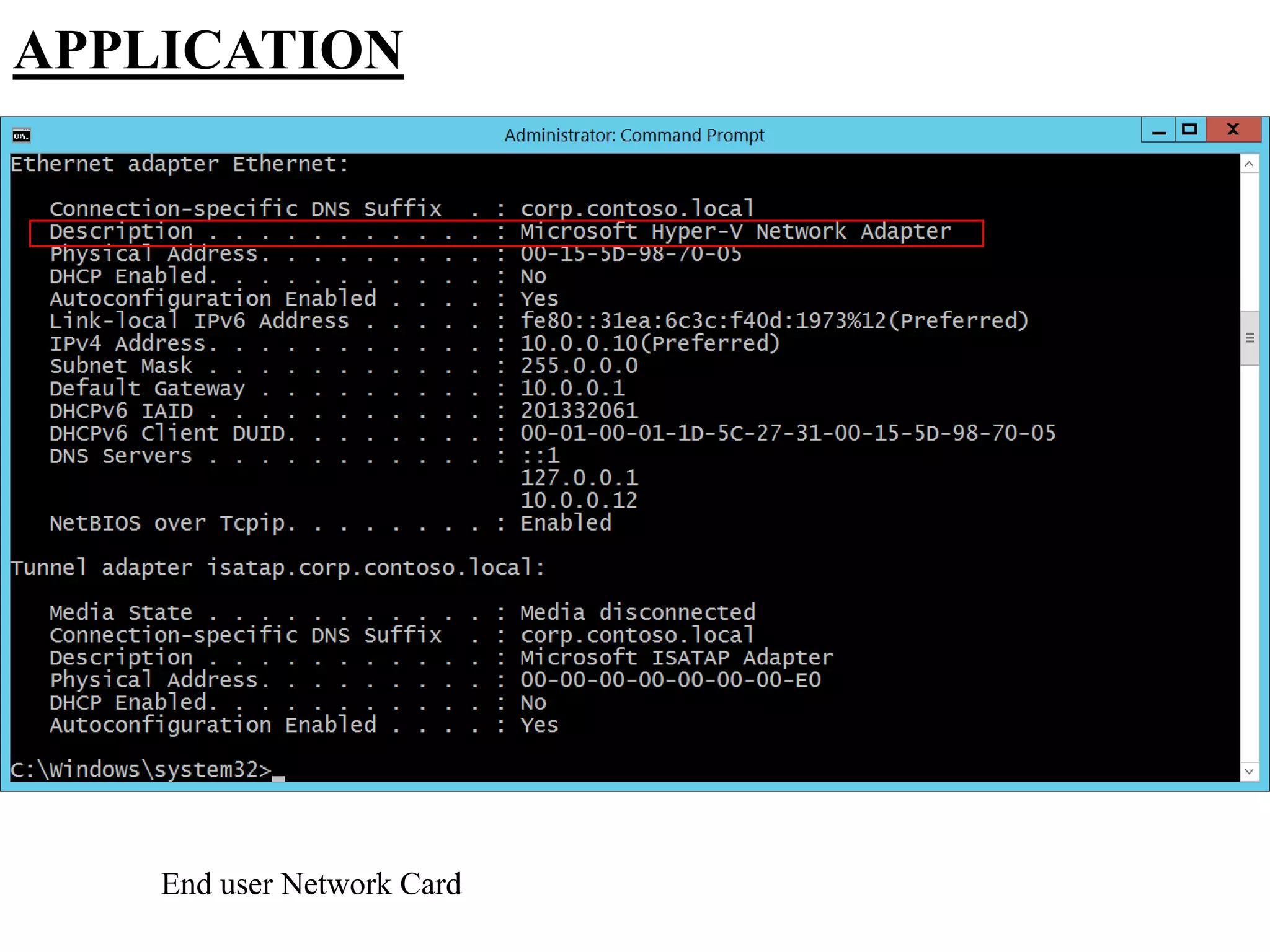
APPLICATION
End user Network Card
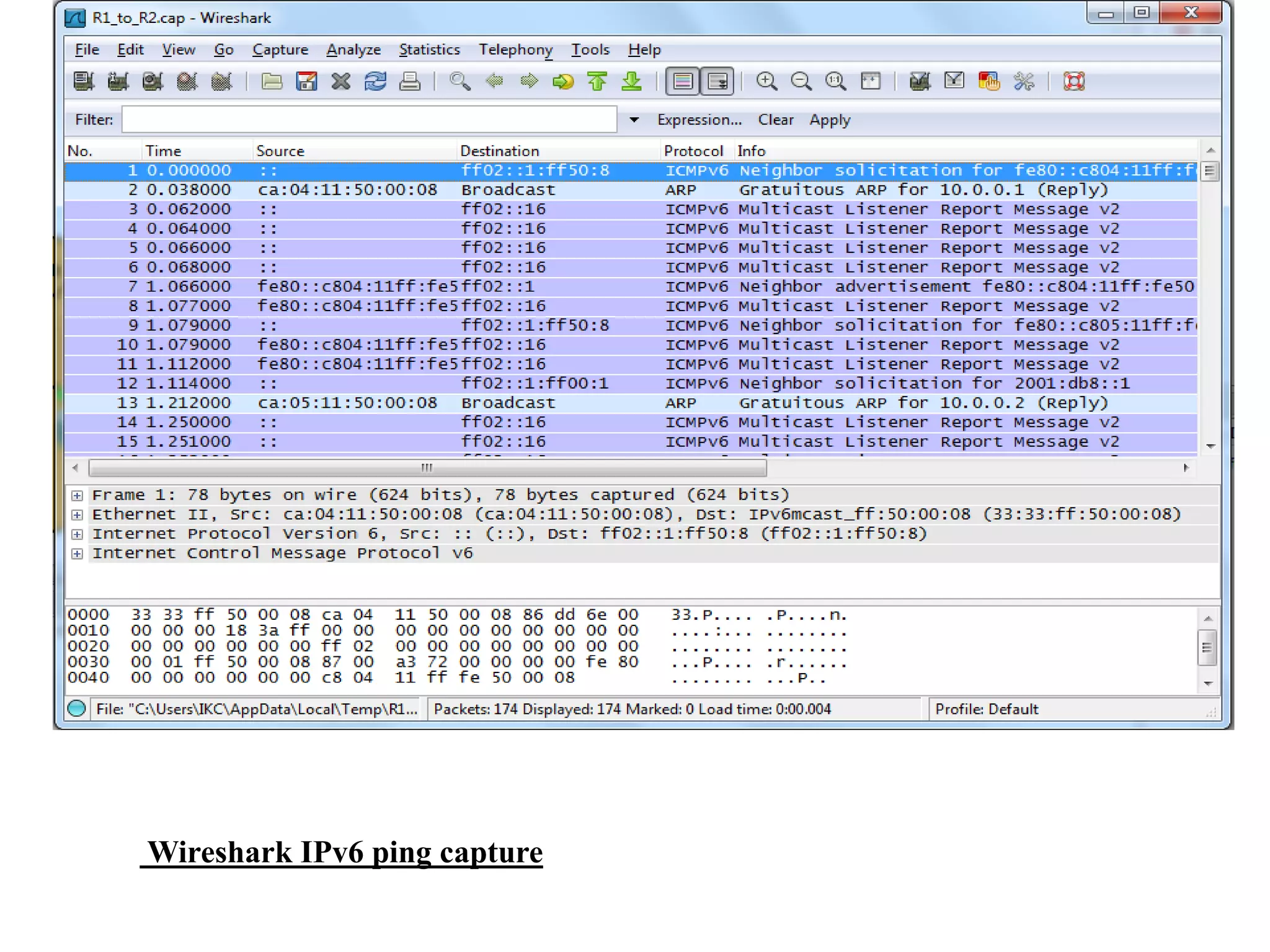
Wireshark IPv6 ping capture
Tunnelling example
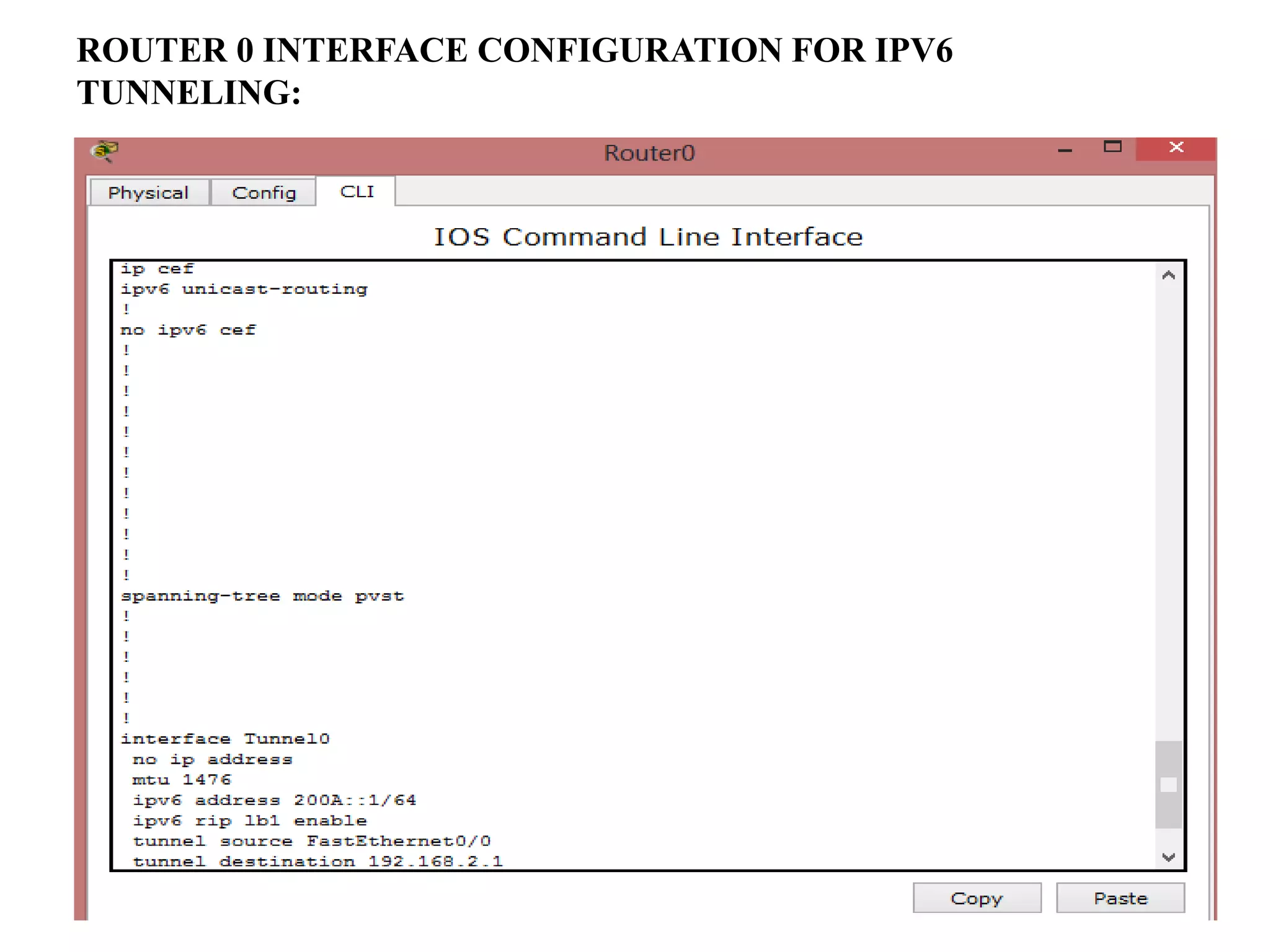
ROUTER 0 INTERFACE CONFIGURATION FOR IPV6
TUNNELING:
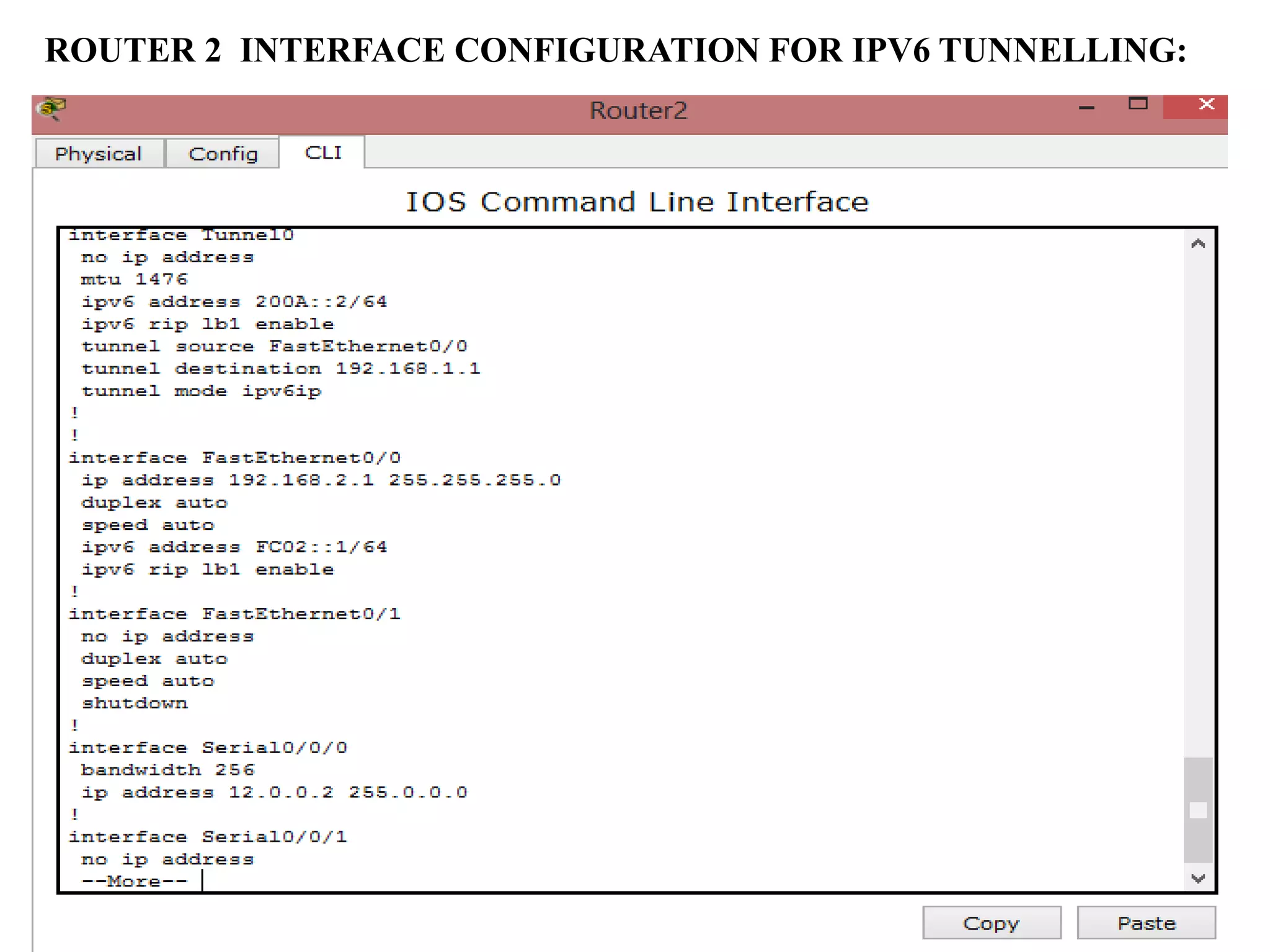
ROUTER 2 INTERFACE CONFIGURATION FOR IPV6 TUNNELLING:
Conclusion
•With IPv4 resources depleted, ISPs must enter the IPv6 era. Countries such as
China and India are already moving forward, changing their infrastructure to
support the new IP protocol.
• This fact determined ISPs from around the world to make the first steps
towards the feature-rich IPv6, but there is still a long way to go.
• Given the transition mechanisms we overlooked in this study, dual stack is the
viable solution for an ISP to migrate gradually to IPv6. It offers the possibility
for hosts to reach content in both networks because of its ability to run the two
protocols at the same time.
• Tunnelling is not the way to go for an ISP because the protocol overhead
increases the latency in the network. Another drawback would be the
administration of so many tunnels in an, already congested, service provider
network.
• We were able to test and debug on live equipment which gave us a better view
of a real implementation when the time comes.
REFERNCES:
• P. Wu, Y. Cui, J. Wu, J. Liu, C. Metz, Transition from IPv4 to IPv6: A
State-of-the-Art Survey, IEEE Communications Surveys & Tutorials, Vol.
15, no. 3, pp 1407 – 1424, 2012;
• Cisco Certified Network Associate Routing & Switching Introduction to
Networks, Chapter 8: IP addressing, 8.0.1.1 Introduction;
•Cisco Certified Network Associate Routing & Switching Introduction to
Networks, Chapter 8: IP addressing, 8.2.1.1 The Need for IPv6;
• J. Hatcher, Strategies for migrating from IPv4 to IPv6, 2012
Compatibility between IPv4 and IPv6

Compatibility between IPv4 and IPv6

  • 1.
    IEEE Presentation On Compatibility betweenIPv4 and IPv6 To GTU PG SCHOOL By ZALAK PATEL 160930361011 ITSNS
  • 2.
    IP Network Addressing •IP Addressing is Logical Addressing • It works on Network Layer (Layer 3) • Two Version of Addressing Scheme • IP version 4 address size– 32 bit addressing • IP version 6 address size– 128 bit addressing
  • 3.
    •INTERNET  world’slargest public data network, doubling in size every nine months •IPv4, defines a 32-bit address - 232 (4,294,967,296) IPv4 addresses available •The first problem is concerned with the eventual depletion of the IP address space. •Traditional model of classful addressing does not allow the address space to be used to its maximum potential.
  • 4.
    Internet Protocol (IP) •Whatis Internet Protocol? Internet Protocol is a set of technical rules that defines how computers communicate over a network. •What is IPv4? IPv4 was the first version of Internet Protocol to be widely used, and accounts for most of today’s Internet traffic. There are just over 4 billion IPv4 addresses. While that is a lot of IP addresses, it is not enough to last forever. •What is IPv6? IPv6 is a newer numbering system that provides a much larger address pool than IPv4. It was deployed in 1999 and should meet the world’s IP addressing needs well into the future.
  • 5.
    What is themajor difference? The major difference between IPv4 and IPv6 is the number of IP addresses. There are 4,294,967,296 IPv4 addresses. while, there are 340,282,366,920,938,463,463,374,607,431,768,211,456 IPv6 addresses. The technical functioning of the Internet remains the same with both versions and it is likely that both versions will continue to operate simultaneously on networks well into the future. In the current time, networks that use IPv6 support both IPv4 and IPv6 addresses in their networks.
  • 6.
    IP VERSION 4 •What is BIT ? Bit is a value that will represent 0’s or 1’s (i.e. Binary) 01010101000001011011111100000001 • 32 bits are divided into 4 Octets known as Dotted Decimal Notation 01010101. 00000101. 10111111. 00000001 First Octet Second Octet Third Octet Forth Octet
  • 7.
    IP VERSION 6 128-bitaddress is divided along 16-bit boundaries, and each 16- bit block is converted to a 4-digit hexadecimal number and separated by colons (Colon-Hex Notation) FEDC:BA98:7654:3210:FEDC:BA98:7654:3 3FFE:085B:1F1F:0000:0000:0000:00A9:1234 8 groups of 16-bit hexadecimal numbers separated by “:” Leading zeros can be removed 3FFE:85B:1F1F::A9:1234 :: = all zeros in one or more group of 16-bit hexadecimal numbers
  • 8.
    Special Addresses Network address Thefirst address in a block is normally not assigned to any device; it is used as the network address that represents the organization to the rest of the world. Broadcast address The last address in a block is used for broadcasting to all devices under the network.
  • 9.
    IPv4 companion protocols(1) • ARP: Address Resolution Protocol – Mapping from IP address to MAC address • ICMP: Internet Control Message Protocol – Error reporting & Query • IGMP: Internet Group Management Protocol – Multicast member join/leave • Unicast Routing Protocols (Intra-AS) – Maintaining Unicast Routing Table – E.g. RIP, OSPF (Open Shortest Path First)
  • 10.
    IPv4 companion protocols(2) • Multicast Routing Protocols – Maintaining Multicast Routing Table – E.g. DVMRP, MOSPF, CBT, PIM • Exterior Routing Protocols (Inter-AS) – E.g. BGP (Border Gateway Protocol) • Quality-of-Service Frameworks – Integrated Service (ISA, IntServ) – Differentiated Service (DiffServ)
  • 11.
    Why IPv6? •Deficiency ofIPv4 •Address space exhaustion •New types of service  Integration •Multicast •Quality of Service •Security •Mobility (MIPv6) •Header and format limitations
  • 12.
    Advantages of IPv6over IPv4 • Larger address space • Better header format • New options • Allowance for extension • Support for resource allocation • Support for more security • Support for mobility
  • 13.
    A STUDY OFTHE TECHNOLOGY TRANSITION FROM IPv4 TO IPv6 FOR AN ISP Abstract: The internet protocol IPv4 has met the demand for years, but the number of addresses, while vast, is finite. The solution to mitigate this problem was the development of the new IPv6 protocol, which extends the address space from 32-bits to 128-bits. IPv4 and IPv6 networks will interoperate during the transition period, although the two protocols structure is not compatible. an ISP network and present three mechanisms that will make the transition from IPv4 to IPv6 smoother: Translation, Tunnel and Dual-Stack. Also, the implementation of Dual-Stack for an ISP Keywords: IPv4, IPv6, ISP, Transition, Translation, Tunnel, Dual-Stack
  • 14.
    • IPv4 networkhas grown far more than anyone had ever imagined when the protocol was designed. As technology is developing new services and Internet-enabled devices use more mobile connectivity (2G, 3G and 4G), IPv4 is challenged with a series of problems, the most demanding one being address exhaustion. •There are not enough IPs available from ISPs (Internet Service Provider) to meet the demand. •The new IPv6 protocol is needed to satisfy the needs and it features improved scalability and routing, simplified header that makes forwarding packets more efficient, end-to-end connectivity because there is no need for NAT (Network Address Translation), ease-of- configuration because it supports stateful and stateless auto- configuration, and information being stored in the start of the header is useful for a router thus resulting in higher performance routing. •The major flaw of IPv6 is that it is not compatible with IPv4, and to use the new protocol changes are required in software and every networked device. The majority of network services and applications still use IPv4, therefore it will not be replaced for a long time. So, the two network protocols will have to coexist.
  • 15.
  • 16.
    Transition mechanisms The transitionfrom IPv4 to IPv6 is expected to take years, and in the meantime, both protocols will have to coexist and interoperate. For this to happen IETF has developed various tools that come to help the network administrator’s transition to IPv6. There are three categories of migration techniques: Dual Stack: Both IPv4 and IPv6 will run simultaneously on devices in the network, allowing them to coexist in the ISP network b) Tunnelling: An IPv6 packet is encapsulated in IPv4 packet and send over an IPv4 network. c) Translation: A similar technique to NAT for IPv4 is used. Using NAT64 (Network Address Translation64), the IPv6 packet is translated to IPv4 packet.
  • 17.
    End to endDual Stack represents a major project for an ISP and it takes from 2 to 5 years to implement. The starting point of change is the core of the network, which is easy for most network operators, meaning a few months of work. The advantage of dual-stack is that it makes available to use devices that support only one IP protocol or both, allowing older network services to still be used. On the other hand, the costs for implementation are very high and very few organizations can change from IPv4 to IPv6.
  • 18.
    Tunnelling (Generic routingEncapsulation) allows the use of IPv4 networks to carry IPv6 traffic and its basic principle as per the figure. This can be done either in a manual or in an automatic way. The manual configuration requires definite specification of the IPv4/IPv6 source and the tunnel IPv4/IPv6 destination. When the number of tunnels grows, administrating this technique becomes a major drawback. The main advantage of using the tunneling technique is that it uses the existing infrastructure of the ISPs and it meets their standards in terms of administration and costs.
  • 19.
    Translation It is usedto achieve direct communication between IPv4 and IPv6. The new protocol supports translation from IPv4 header to IPv6 format. when an IPv4 host tries to communicate with an IPv6 server, a NAT-PT (NAT – Protocol Translation) enabled device removes the IPv4 header of the packet, adds an IPv6 header and then sends it through to the server. When the reply comes it does the other way around. The algorithm for all translation methods is known as Stateless IP/ICMP Translator (SIIT). For an ISP, translation is not seen as a viable solution because of NAT use with IPv4.
  • 20.
  • 21.
  • 22.
  • 23.
    ROUTER 0 INTERFACECONFIGURATION FOR IPV6 TUNNELING:
  • 24.
    ROUTER 2 INTERFACECONFIGURATION FOR IPV6 TUNNELLING:
  • 25.
    Conclusion •With IPv4 resourcesdepleted, ISPs must enter the IPv6 era. Countries such as China and India are already moving forward, changing their infrastructure to support the new IP protocol. • This fact determined ISPs from around the world to make the first steps towards the feature-rich IPv6, but there is still a long way to go. • Given the transition mechanisms we overlooked in this study, dual stack is the viable solution for an ISP to migrate gradually to IPv6. It offers the possibility for hosts to reach content in both networks because of its ability to run the two protocols at the same time. • Tunnelling is not the way to go for an ISP because the protocol overhead increases the latency in the network. Another drawback would be the administration of so many tunnels in an, already congested, service provider network. • We were able to test and debug on live equipment which gave us a better view of a real implementation when the time comes.
  • 26.
    REFERNCES: • P. Wu,Y. Cui, J. Wu, J. Liu, C. Metz, Transition from IPv4 to IPv6: A State-of-the-Art Survey, IEEE Communications Surveys & Tutorials, Vol. 15, no. 3, pp 1407 – 1424, 2012; • Cisco Certified Network Associate Routing & Switching Introduction to Networks, Chapter 8: IP addressing, 8.0.1.1 Introduction; •Cisco Certified Network Associate Routing & Switching Introduction to Networks, Chapter 8: IP addressing, 8.2.1.1 The Need for IPv6; • J. Hatcher, Strategies for migrating from IPv4 to IPv6, 2012