Bacteriophages and
Prions
N. H. SHANKAR REDDY
Ph.D., Plant Pathology
Annamalai University
• Virus which infects bacteria is known as
‘bacteriophage’, the term bacteriophages means
‘bacteria-eater’
• Bacteriophage is individually discovered by
F.W. Twort (1915) and F. d’Herelle (1917), but the
term bacteriophage was coined by d’Herelle.
• Eg – T4 bacteriophage
• Head consists of ds DNA, how DNA is packed inside
the head is not known.
• The head is a shape of two halves of an icosahedrall
connected by a short hexagonal prism
• The tail is helical
• Exhibits binary symmetry (presence of two types of
symmetry in the protein coat)
• Tail is made up of cubical hallow tube surrounded by a
contractile sheath. One end is joined by head and
another end tail fibres (6)
Phages are ………
Lambda (λ) phages
• Discovered by Lederberg, 1950
• DNA is packed inside head similar to
that of T phages and tail is simple
• The head is icosahedral, tail is helical,
thus it shows dual or binary symmetry of
the protein coat
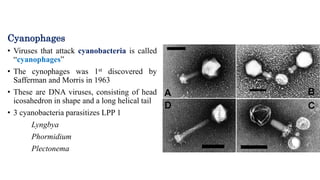
Cyanophages
• Viruses that attack cyanobacteria is called
“cyanophages”
• The cynophages was 1st discovered by
Safferman and Morris in 1963
• These are DNA viruses, consisting of head
icosahedron in shape and a long helical tail
• 3 cyanobacteria parasitizes LPP 1
Lyngbya
Phormidium
Plectonema
Life cycle
Lytic phage
Lysogenic phage
Lytic cycle
Step 1: Adsorption
• Attachment sites on the bacteriophage adsorb
to receptor sites on the host bacterium
• Most bacteriophages adsorb to the bacterial
cell wall, although some are able to adsorb to
flagella or pili.
• Specific strains of bacteriophages can only
adsorb to specific strain of host bacteria. This
is known as viral specificity.
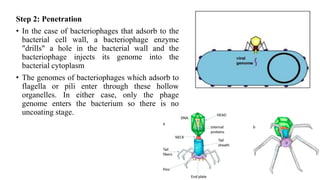
Step 2: Penetration
• In the case of bacteriophages that adsorb to the
bacterial cell wall, a bacteriophage enzyme
"drills" a hole in the bacterial wall and the
bacteriophage injects its genome into the
bacterial cytoplasm
• The genomes of bacteriophages which adsorb to
flagella or pili enter through these hollow
organelles. In either case, only the phage
genome enters the bacterium so there is no
uncoating stage.
Step 3: Replication
• Enzymes coded by the bacteriophage genome
shut down the bacterium's macromolecular
(protein, RNA, DNA) synthesis.
• The bacteriophage replicates its genome and uses
the bacterium's metabolic machinery to
synthesize bacteriophage enzymes and
bacteriophage structural components
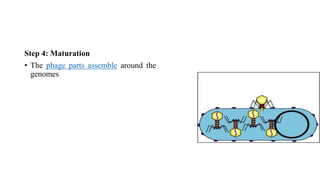
Step 4: Maturation
• The phage parts assemble around the
genomes
Step 5: Release
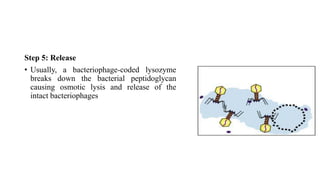
• Usually, a bacteriophage-coded lysozyme
breaks down the bacterial peptidoglycan
causing osmotic lysis and release of the
intact bacteriophages
Step 6: Reinfection
• From 50 to 200 bacteriophages may be
produced per infected bacterium.
Lysogenic phage
• This type of growth of life cycle was observed by Andrew Lwoff
• The phages that show lysogenic cycle is called temperate phages
• The bacteria which occurs is called as lysogenic strains
• The entire process is called “lysogency”
• In this, the phage becomes integrated with
the chromosome of the host cell and is
known as a prophage.
• This prophage is transmitted to progenies at
the time of cell division during reproduction
in bacteria.
• The bacteria carrying a prophage without
being lysed is called “lysogenic bacteria”.
Bacteriophages in plant disease control
• Stainer et al. (1967), reported that it will completely inhibited the tumour
induction by a highly virulent strain of Agrobacterium tumefaciens after 21hrs of
inoculation.
• A significant gall size reduction (43-72%) in tomato plants was obtained when
wounded plants are inoculated with phages three hours before the inoculation of
bacteria (Boyd et al., 1971).
Prions
• A prion is a small infectious particle composed of abnormally
folded protein and has a ability to transmit their misfolded
shaped onto normal variants of the same protein.
• Discovered by Stanley B. Prusiner
• No plant disease are reported to be caused by prions
• Prions sometime called as “slow viruses” because of their slow
effect
Animals Diseases
Sheep, Goat Scrapie
Cattle Mad cow disease (Bovine
spongisperm encephalopathy)
Deer and Mouse Chronic wasting disease
Human
Creutzfeldt -Jacob disease (CJD)
Kuru
Fatal familial insomnia
Video available at you tube
Channel – Geeky Researcher

Bacteriophages and prions

  • 1.
    Bacteriophages and Prions N. H.SHANKAR REDDY Ph.D., Plant Pathology Annamalai University
  • 2.
    • Virus whichinfects bacteria is known as ‘bacteriophage’, the term bacteriophages means ‘bacteria-eater’ • Bacteriophage is individually discovered by F.W. Twort (1915) and F. d’Herelle (1917), but the term bacteriophage was coined by d’Herelle. • Eg – T4 bacteriophage
  • 3.
    • Head consistsof ds DNA, how DNA is packed inside the head is not known. • The head is a shape of two halves of an icosahedrall connected by a short hexagonal prism • The tail is helical • Exhibits binary symmetry (presence of two types of symmetry in the protein coat) • Tail is made up of cubical hallow tube surrounded by a contractile sheath. One end is joined by head and another end tail fibres (6)
  • 4.
    Phages are ……… Lambda(λ) phages • Discovered by Lederberg, 1950 • DNA is packed inside head similar to that of T phages and tail is simple • The head is icosahedral, tail is helical, thus it shows dual or binary symmetry of the protein coat
  • 5.
    Cyanophages • Viruses thatattack cyanobacteria is called “cyanophages” • The cynophages was 1st discovered by Safferman and Morris in 1963 • These are DNA viruses, consisting of head icosahedron in shape and a long helical tail • 3 cyanobacteria parasitizes LPP 1 Lyngbya Phormidium Plectonema
  • 6.
  • 7.
    Lytic cycle Step 1:Adsorption • Attachment sites on the bacteriophage adsorb to receptor sites on the host bacterium • Most bacteriophages adsorb to the bacterial cell wall, although some are able to adsorb to flagella or pili. • Specific strains of bacteriophages can only adsorb to specific strain of host bacteria. This is known as viral specificity.
  • 8.
    Step 2: Penetration •In the case of bacteriophages that adsorb to the bacterial cell wall, a bacteriophage enzyme "drills" a hole in the bacterial wall and the bacteriophage injects its genome into the bacterial cytoplasm • The genomes of bacteriophages which adsorb to flagella or pili enter through these hollow organelles. In either case, only the phage genome enters the bacterium so there is no uncoating stage.
  • 9.
    Step 3: Replication •Enzymes coded by the bacteriophage genome shut down the bacterium's macromolecular (protein, RNA, DNA) synthesis. • The bacteriophage replicates its genome and uses the bacterium's metabolic machinery to synthesize bacteriophage enzymes and bacteriophage structural components
  • 10.
    Step 4: Maturation •The phage parts assemble around the genomes
  • 11.
    Step 5: Release •Usually, a bacteriophage-coded lysozyme breaks down the bacterial peptidoglycan causing osmotic lysis and release of the intact bacteriophages
  • 12.
    Step 6: Reinfection •From 50 to 200 bacteriophages may be produced per infected bacterium.
  • 13.
    Lysogenic phage • Thistype of growth of life cycle was observed by Andrew Lwoff • The phages that show lysogenic cycle is called temperate phages • The bacteria which occurs is called as lysogenic strains • The entire process is called “lysogency”
  • 14.
    • In this,the phage becomes integrated with the chromosome of the host cell and is known as a prophage. • This prophage is transmitted to progenies at the time of cell division during reproduction in bacteria. • The bacteria carrying a prophage without being lysed is called “lysogenic bacteria”.
  • 15.
    Bacteriophages in plantdisease control • Stainer et al. (1967), reported that it will completely inhibited the tumour induction by a highly virulent strain of Agrobacterium tumefaciens after 21hrs of inoculation. • A significant gall size reduction (43-72%) in tomato plants was obtained when wounded plants are inoculated with phages three hours before the inoculation of bacteria (Boyd et al., 1971).
  • 16.
    Prions • A prionis a small infectious particle composed of abnormally folded protein and has a ability to transmit their misfolded shaped onto normal variants of the same protein. • Discovered by Stanley B. Prusiner • No plant disease are reported to be caused by prions • Prions sometime called as “slow viruses” because of their slow effect
  • 17.
    Animals Diseases Sheep, GoatScrapie Cattle Mad cow disease (Bovine spongisperm encephalopathy) Deer and Mouse Chronic wasting disease Human Creutzfeldt -Jacob disease (CJD) Kuru Fatal familial insomnia
  • 18.
    Video available atyou tube Channel – Geeky Researcher