Set the Stage…
The Italian Renaissance
Transformation of Europe
 The roots of the Renaissance lie in events that
began in the Middle Ages
 In particular, the Crusades planted the seeds of
change that would transform Europe and move
it out of the Middle Ages
 The Crusades stimulated trade by
introducing Europeans to many desirable
products.
 This trade promoted frequent contacts with
the Byzantine and Muslim Empires.
Transformation of Europe
Economic Effects of the Crusades
Increased demand for Middle
Eastern products
Spices, linen, perfumes, food
products
Economic Effects of the Crusades
Stimulated the production of
goods to trade in Middle Eastern
markets
Wool (England), precious metals,
wine, wax
Economic Effects of the Crusades
 Encouraged the use of credit and banking
 Move money between
areas
 Local currency
exchange
 Letters of credit served to
expand the supply of money and
expedite trade.
Economic concepts of the Renaissance:
New economic institutions developed
during the Renaissance.
De Medici family in Italy supported
Economic Concepts Developed
The Roman
Catholic Church
ruled that usury
(charging interest
on loans) violated
Christian principles
Considered a sin
Economic Concepts
 The banks existed outside the church so
interest was charged
 Merchants charged interest on loans as a
means of making money
 Eventually caused
friction between the
church and merchants
Economic Concepts
This helped to secularize (less of
religious view, more of a worldly
view) northern Italy (where the
Renaissance first developed).
Economic Concepts
New accounting and bookkeeping
practices (use of Arabic numerals)
were introduced.
 After suffering through war and
plague, Europeans wanted to
enjoy life.
 Questioned the church’s belief in earthly suffering
 Questioned medieval society which blocked social
advancement
 Looked toward classical past for ideas
 Roman and Greek ideals
 Wealth accumulated from European trade
with the Middle East led to the rise of Italian
city-states. Wealthy merchants were active
civic leaders.
Northern Italy
Florence, Venice, and
Genoa
 Had access to trade routes
connecting Europe with Middle
Eastern markets
 Served as trading centers for
the distribution of goods to
northern Europe
 Were initially independent
city-states governed as
republics
Venice
Florence
Genoa
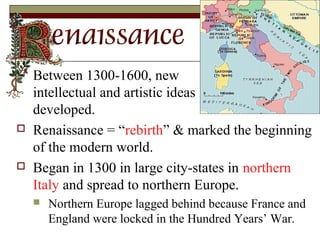
 Between 1300-1600, new
intellectual and artistic ideas
developed.
 Renaissance = “rebirth” & marked the beginning
of the modern world.
 Began in 1300 in large city-states in northern
Italy and spread to northern Europe.
 Northern Europe lagged behind because France and
England were locked in the Hundred Years’ War.
Renaissance Changes
Influence of classical ideas
 Humanism
 Focus on human potential and achievements
 Celebrated the individual
 Secular learning
 Most remained devoutly Catholic, but the spirit of
Renaissance was secular.
 Secular - relating to worldly as opposed to sacred
(religious) things
Influence of classical ideas
 Focus on secular education:
 “Renaissance Person” = Universal Man - ideal
individuals strove to master almost every area of study.
 Patrons of the arts
 A patron is someone of wealth who financially
supports an artist, philosopher, musician,
allowing that artist to dedicate his life to
perfecting his art.
 Revival of Greco-Roman ideals
 Revolutionizes Art – as Renaissance
advanced, artistic styles changed.
 Medieval art and literature focused on the Church
and salvation, while Renaissance art and literature
focused on individuals and worldly matters, along
with Christianity
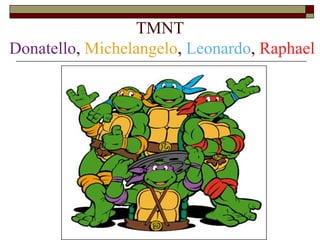
TMNT
Donatello, Michelangelo, Leonardo, Raphael
Donatello
 Made sculptures more
realistic by carving
natural postures and
expressions that
revealed personality.
 David – 1st
European
sculpture of a free-
standing nude since
ancient times.
David
Michelangelo
Buonarroti
 Painter (Sistene
Chapel), sculptor
(David), architect (St.
Peter’s Basilica), poet
 Portrayed the human
body in painting and
sculptures while
showing heroic
grandeur and human
potential. David
Michelangelo’s Achievements
Pieta
Creation of Adam
Sistene Chapel
Leonardo da Vinci
 Painter, sculptor, inventor and scientist
 Created notebooks with observations of how
things worked and inventions. 3500 pages
have been recovered.
 Interesting fact – Leonardo wrote backwards in
“mirror-writing” – only be read in a mirror.
 Only 17 of his paintings survived including well-
known works – Mona Lisa and The Last Supper.
Leonardo da Vinci Writings
Notebook of observations – Let’s analyze...
Leonardo da Vinci’s Achievements
Mona Lisa
Leonardo da Vinci’s Achievements
Last Supper
Da Vinci
 http://www.youtube.com/watch?v=Ef-
tYOd8xbg
Raphael
 Studied works of Michelangelo and Leonardo.
 Portrayed the Madonna and child as gentle and calm.
 Worked for Pope Julius II and created works for the
Pope’s private rooms in the Vatican.
 Died at age 37.
 Famous works
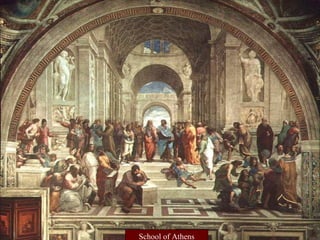
 School of Athens
 Madonna of the Goldfinch - shattered into
17 pieces when the house of its owner
collapsed in 1547
Madonna and the Goldfinch
School of Athens
Medieval Art v Renaissance Art
Medieval
 Two-dimensional,
image seems flat
 No semblance to
reality
 i.e.. Stained glass
 Jesus – divine, devoid
of emotion, inhuman
Renaissance
 Three-dimensional, use
of perspective
 Feels so real, you can
reach into the picture
 Jesus – human
 i.e. Cross = pain,
suffering, feelings of a
human being
Which is Medieval, which is
Renaissance, how can you tell?
Think!
Pair!
Share!
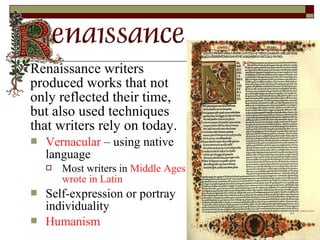
 Renaissance writers
produced works that not
only reflected their time,
but also used techniques
that writers rely on today.
 Vernacular – using native
language
 Most writers in Middle Ages
wrote in Latin
 Self-expression or portray
individuality
 Humanism
Renaissance Writers
 Writers promoted humanism
 Francesco Petrarch
 Wrote sonnets (love poems)
 Considered the “Father of Humanism”
 leader in humanist scholarship
 Niccolo Machiavelli
 The Prince
 Political guidebook: “The end justifies the means”
 An early modern treatise on government
 Supports absolute power of the ruler
 Advises that one should not only do good if possible,
but do evil when necessary
Northern Renaissance
 With the rise of trade, travel, and literacy, the Italian
Renaissance spread to northern Europe.
 Growing wealth in Northern Europe supported
Renaissance ideas
 Northern Renaissance: Renaissance ideals (humanism)
mingled with northern (England, France, Germany)
traditions.
 The art and literature of the Italian Renaissance
changed as people of different cultures adopted
Renaissance ideas.
 Religious and Secular subject
Northern Renaissance Writers
 Northern Renaissance writers also adopted
the ideal of humanism and merged ideas with
Christianity
 Desiderius Erasmus
 In Praise of Folly (1511) – poked fun at greedy
merchants, pompous priests and heartsick lovers.
 Although barbs were aimed at clergy, his work is strongly
Christian.
 Thomas More
 Utopia (1516) – Imaginary land inhabited by peaceful
people.
 William Shakespeare
Thomas More - Utopia
“Gold and silver, of which money is made, are
so treated…that no one values them more
highly than their true nature deserves. Who
does not see that they are far inferior to iron
in usefulness since without iron mortals
cannot live any more than without fire and
water?”
-Thomas More, Utopia
Northern Renaissance Writers
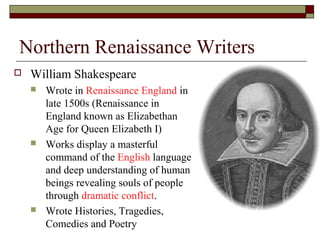
 William Shakespeare
 Wrote in Renaissance England in
late 1500s (Renaissance in
England known as Elizabethan
Age for Queen Elizabeth I)
 Works display a masterful
command of the English language
and deep understanding of human
beings revealing souls of people
through dramatic conflict.
 Wrote Histories, Tragedies,
Comedies and Poetry
Shakespeare’s Famous Works
 Henry VIII
 A Midsummer Night’s Dream
 Romeo and Juliet
 Hamlet
 Taming of the Shrew
 Julius Caesar
 All’s Well that Ends Well
Shakespeare in London/Hollywood
Printing Press
 A new invention that adapted Chinese technology
helped spread Renaissance ideas throughout Europe
 Block printing: similar to stamping today
 Moveable type: separate piece of type for each letter.
 Johann Gutenberg, a craftsman from Germany,
reinvented movable type printing around 1400.
 This method was practical for Europeans because their
languages have a very small number of letters in their
alphabets.
Printing Press
 Printing Press – a
machine that presses
paper against a tray
full of inked
moveable type.
 Gutenberg printed a
complete Bible
(Gutenberg Bible) in
1455. It was the first
full-size book printed
with moveable type.
Only 46 still exist.
Printing Press Significance
 Revolutionary impact on European Society!
 Production and sale of books
 Books were cheap enough for people to purchase.
 Books were written in vernacular (native)
languages.
 Advances learning and increases literacy.
 By 1500, presses in 250 cities had printed 9-10
million books.
 Dissemination (spread) of ideas

Renaissance Notes

  • 1.
    Set the Stage… TheItalian Renaissance
  • 2.
    Transformation of Europe The roots of the Renaissance lie in events that began in the Middle Ages  In particular, the Crusades planted the seeds of change that would transform Europe and move it out of the Middle Ages
  • 3.
     The Crusadesstimulated trade by introducing Europeans to many desirable products.  This trade promoted frequent contacts with the Byzantine and Muslim Empires. Transformation of Europe
  • 4.
    Economic Effects ofthe Crusades Increased demand for Middle Eastern products Spices, linen, perfumes, food products
  • 5.
    Economic Effects ofthe Crusades Stimulated the production of goods to trade in Middle Eastern markets Wool (England), precious metals, wine, wax
  • 6.
    Economic Effects ofthe Crusades  Encouraged the use of credit and banking  Move money between areas  Local currency exchange  Letters of credit served to expand the supply of money and expedite trade.
  • 7.
    Economic concepts ofthe Renaissance: New economic institutions developed during the Renaissance. De Medici family in Italy supported
  • 8.
    Economic Concepts Developed TheRoman Catholic Church ruled that usury (charging interest on loans) violated Christian principles Considered a sin
  • 9.
    Economic Concepts  Thebanks existed outside the church so interest was charged  Merchants charged interest on loans as a means of making money  Eventually caused friction between the church and merchants
  • 10.
    Economic Concepts This helpedto secularize (less of religious view, more of a worldly view) northern Italy (where the Renaissance first developed).
  • 11.
    Economic Concepts New accountingand bookkeeping practices (use of Arabic numerals) were introduced.
  • 13.
     After sufferingthrough war and plague, Europeans wanted to enjoy life.  Questioned the church’s belief in earthly suffering  Questioned medieval society which blocked social advancement  Looked toward classical past for ideas  Roman and Greek ideals
  • 14.
     Wealth accumulatedfrom European trade with the Middle East led to the rise of Italian city-states. Wealthy merchants were active civic leaders.
  • 15.
    Northern Italy Florence, Venice,and Genoa  Had access to trade routes connecting Europe with Middle Eastern markets  Served as trading centers for the distribution of goods to northern Europe  Were initially independent city-states governed as republics Venice Florence Genoa
  • 16.
     Between 1300-1600,new intellectual and artistic ideas developed.  Renaissance = “rebirth” & marked the beginning of the modern world.  Began in 1300 in large city-states in northern Italy and spread to northern Europe.  Northern Europe lagged behind because France and England were locked in the Hundred Years’ War.
  • 17.
  • 18.
    Influence of classicalideas  Humanism  Focus on human potential and achievements  Celebrated the individual  Secular learning  Most remained devoutly Catholic, but the spirit of Renaissance was secular.  Secular - relating to worldly as opposed to sacred (religious) things
  • 19.
    Influence of classicalideas  Focus on secular education:  “Renaissance Person” = Universal Man - ideal individuals strove to master almost every area of study.  Patrons of the arts  A patron is someone of wealth who financially supports an artist, philosopher, musician, allowing that artist to dedicate his life to perfecting his art.  Revival of Greco-Roman ideals
  • 20.
     Revolutionizes Art– as Renaissance advanced, artistic styles changed.  Medieval art and literature focused on the Church and salvation, while Renaissance art and literature focused on individuals and worldly matters, along with Christianity
  • 21.
  • 22.
    Donatello  Made sculpturesmore realistic by carving natural postures and expressions that revealed personality.  David – 1st European sculpture of a free- standing nude since ancient times. David
  • 23.
    Michelangelo Buonarroti  Painter (Sistene Chapel),sculptor (David), architect (St. Peter’s Basilica), poet  Portrayed the human body in painting and sculptures while showing heroic grandeur and human potential. David
  • 24.
  • 25.
    Leonardo da Vinci Painter, sculptor, inventor and scientist  Created notebooks with observations of how things worked and inventions. 3500 pages have been recovered.  Interesting fact – Leonardo wrote backwards in “mirror-writing” – only be read in a mirror.  Only 17 of his paintings survived including well- known works – Mona Lisa and The Last Supper.
  • 26.
    Leonardo da VinciWritings Notebook of observations – Let’s analyze...
  • 27.
    Leonardo da Vinci’sAchievements Mona Lisa
  • 28.
    Leonardo da Vinci’sAchievements Last Supper
  • 29.
  • 30.
    Raphael  Studied worksof Michelangelo and Leonardo.  Portrayed the Madonna and child as gentle and calm.  Worked for Pope Julius II and created works for the Pope’s private rooms in the Vatican.  Died at age 37.  Famous works  School of Athens  Madonna of the Goldfinch - shattered into 17 pieces when the house of its owner collapsed in 1547 Madonna and the Goldfinch
  • 31.
  • 32.
    Medieval Art vRenaissance Art Medieval  Two-dimensional, image seems flat  No semblance to reality  i.e.. Stained glass  Jesus – divine, devoid of emotion, inhuman Renaissance  Three-dimensional, use of perspective  Feels so real, you can reach into the picture  Jesus – human  i.e. Cross = pain, suffering, feelings of a human being
  • 33.
    Which is Medieval,which is Renaissance, how can you tell? Think! Pair! Share!
  • 34.
     Renaissance writers producedworks that not only reflected their time, but also used techniques that writers rely on today.  Vernacular – using native language  Most writers in Middle Ages wrote in Latin  Self-expression or portray individuality  Humanism
  • 35.
    Renaissance Writers  Writerspromoted humanism  Francesco Petrarch  Wrote sonnets (love poems)  Considered the “Father of Humanism”  leader in humanist scholarship  Niccolo Machiavelli  The Prince  Political guidebook: “The end justifies the means”  An early modern treatise on government  Supports absolute power of the ruler  Advises that one should not only do good if possible, but do evil when necessary
  • 36.
    Northern Renaissance  Withthe rise of trade, travel, and literacy, the Italian Renaissance spread to northern Europe.  Growing wealth in Northern Europe supported Renaissance ideas  Northern Renaissance: Renaissance ideals (humanism) mingled with northern (England, France, Germany) traditions.  The art and literature of the Italian Renaissance changed as people of different cultures adopted Renaissance ideas.  Religious and Secular subject
  • 37.
    Northern Renaissance Writers Northern Renaissance writers also adopted the ideal of humanism and merged ideas with Christianity  Desiderius Erasmus  In Praise of Folly (1511) – poked fun at greedy merchants, pompous priests and heartsick lovers.  Although barbs were aimed at clergy, his work is strongly Christian.  Thomas More  Utopia (1516) – Imaginary land inhabited by peaceful people.  William Shakespeare
  • 38.
    Thomas More -Utopia “Gold and silver, of which money is made, are so treated…that no one values them more highly than their true nature deserves. Who does not see that they are far inferior to iron in usefulness since without iron mortals cannot live any more than without fire and water?” -Thomas More, Utopia
  • 39.
    Northern Renaissance Writers William Shakespeare  Wrote in Renaissance England in late 1500s (Renaissance in England known as Elizabethan Age for Queen Elizabeth I)  Works display a masterful command of the English language and deep understanding of human beings revealing souls of people through dramatic conflict.  Wrote Histories, Tragedies, Comedies and Poetry
  • 40.
    Shakespeare’s Famous Works Henry VIII  A Midsummer Night’s Dream  Romeo and Juliet  Hamlet  Taming of the Shrew  Julius Caesar  All’s Well that Ends Well
  • 41.
  • 42.
    Printing Press  Anew invention that adapted Chinese technology helped spread Renaissance ideas throughout Europe  Block printing: similar to stamping today  Moveable type: separate piece of type for each letter.  Johann Gutenberg, a craftsman from Germany, reinvented movable type printing around 1400.  This method was practical for Europeans because their languages have a very small number of letters in their alphabets.
  • 43.
    Printing Press  PrintingPress – a machine that presses paper against a tray full of inked moveable type.  Gutenberg printed a complete Bible (Gutenberg Bible) in 1455. It was the first full-size book printed with moveable type. Only 46 still exist.
  • 44.
    Printing Press Significance Revolutionary impact on European Society!  Production and sale of books  Books were cheap enough for people to purchase.  Books were written in vernacular (native) languages.  Advances learning and increases literacy.  By 1500, presses in 250 cities had printed 9-10 million books.  Dissemination (spread) of ideas