LANGUAGE TESTING
RELIABILITY
GROUP5:
TITINROHAYATI (A1B211013)
ADE PERMATAS. (A1B211014)
RELIABILITY
Reliability is the consistency of a measure. A
measure is said to have a high reliability if it
produces similar results under consistent
conditions
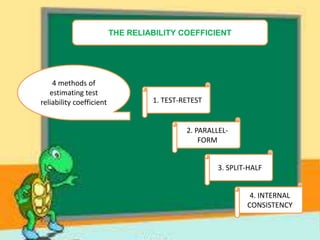
THE RELIABILITY COEFFICIENT
1. TEST-RETEST
2. PARALLEL-
FORM
3. SPLIT-HALF
4. INTERNAL
CONSISTENCY
4 methods of
estimating test
reliability coefficient
1. TEST-RETEST
It directly assesses the degree to which test
scores are consistent from one test
administration to the next.
2. PARALLEL-
FORM
The key to this method is the development
of alternate test forms that are equivalent
in terms of content, response processes
and statistical characteristics.
3. SPLIT-HALF
This method treats the two halves of a
measure as alternate forms
4. INTERNAL
CONSISTENCY
It assesses the consistency of results across
items within a test.
The goal of estimating reliability is to determine how
much of the variability in test scores is due to standard
errors of measurement and how much is due to
variability in true scores
Standard errors of
measurement is used to
estimate a band or interval
within which a person’s true
score would fall
A true score is the replicable
feature of the concept being
measured.
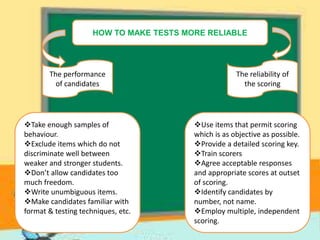
HOW TO MAKE TESTS MORE RELIABLE
The performance
of candidates
The reliability of
the scoring
Take enough samples of
behaviour.
Exclude items which do not
discriminate well between
weaker and stronger students.
Don’t allow candidates too
much freedom.
Write unumbiguous items.
Make candidates familiar with
format & testing techniques, etc.
Use items that permit scoring
which is as objective as possible.
Provide a detailed scoring key.
Train scorers
Agree acceptable responses
and appropriate scores at outset
of scoring.
Identify candidates by
number, not name.
Employ multiple, independent
scoring.
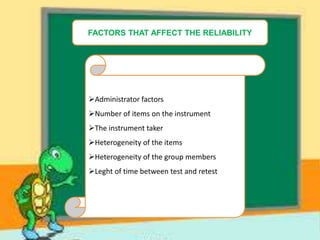
FACTORS THAT AFFECT THE RELIABILITY
Administrator factors
Number of items on the instrument
The instrument taker
Heterogeneity of the items
Heterogeneity of the group members
Leght of time between test and retest

RELIABILITY IN LANGUAGE TESTING-TITIN'S GROUP

  • 1.
  • 2.
    RELIABILITY Reliability is theconsistency of a measure. A measure is said to have a high reliability if it produces similar results under consistent conditions
  • 3.
    THE RELIABILITY COEFFICIENT 1.TEST-RETEST 2. PARALLEL- FORM 3. SPLIT-HALF 4. INTERNAL CONSISTENCY 4 methods of estimating test reliability coefficient
  • 4.
    1. TEST-RETEST It directlyassesses the degree to which test scores are consistent from one test administration to the next. 2. PARALLEL- FORM The key to this method is the development of alternate test forms that are equivalent in terms of content, response processes and statistical characteristics.
  • 5.
    3. SPLIT-HALF This methodtreats the two halves of a measure as alternate forms 4. INTERNAL CONSISTENCY It assesses the consistency of results across items within a test.
  • 6.
    The goal ofestimating reliability is to determine how much of the variability in test scores is due to standard errors of measurement and how much is due to variability in true scores Standard errors of measurement is used to estimate a band or interval within which a person’s true score would fall A true score is the replicable feature of the concept being measured.
  • 7.
    HOW TO MAKETESTS MORE RELIABLE The performance of candidates The reliability of the scoring Take enough samples of behaviour. Exclude items which do not discriminate well between weaker and stronger students. Don’t allow candidates too much freedom. Write unumbiguous items. Make candidates familiar with format & testing techniques, etc. Use items that permit scoring which is as objective as possible. Provide a detailed scoring key. Train scorers Agree acceptable responses and appropriate scores at outset of scoring. Identify candidates by number, not name. Employ multiple, independent scoring.
  • 8.
    FACTORS THAT AFFECTTHE RELIABILITY Administrator factors Number of items on the instrument The instrument taker Heterogeneity of the items Heterogeneity of the group members Leght of time between test and retest