RELIABILITY
By
Vartika Verma
B.el.ed 4
01
02
03
04
05
06
CONTENTS
TABLE OF
Conclusion
Introduction
What is Reliability
Types
Factors affecting
How to improve
INTRODUCTION
Reliability is the concept that any meaningful findings ought
to be repeatable.To reduce the likelihood of a malfunction and
maintain the validity and reliability of their data, scientists,
however, take measurements repeatedly.
What is
Reliability
Reliability is the consistency of your
measurement or the degree to which an
instrument measures the same way
each time it is used under the same
conditions with the same individuals.
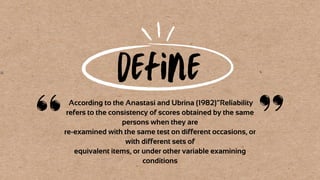
equivalent items, or under other variable examining
conditions
According to the Anastasi and Ubrina (1982)“Reliability
refers to the consistency of scores obtained by the same
persons when they are
re-examined with the same test on different occasions, or
with different sets of
define
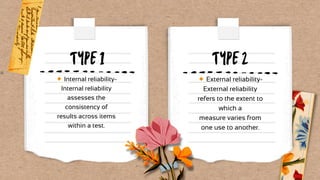
🔸External reliability-
External reliability
refers to the extent to
which a
measure varies from
one use to another.
🔸Internal reliability-
Internal reliability
assesses the
consistency of
results across items
within a test.
TYPE 1 TYPE 2
Split-Half Reliability : Split-Half Reliability is a useful
measure when
impractical or undesirable to assess reliability with two
tests or to have
two test administrations.
SPLIT HALF
Test –retest reliability – This type of Reliability is
estimated by the Pearson product -
moment coefficient of correlations between two
administrations of the same inventory.
TEST RETEST
Internal consistency reliability-Internal consistency
is a method
of reliability in which we judge how well the items
on a test that are proposed
to measure the same construct produce similar
results.
INTERNAL CONSISTENCY
Parallel-Forms Reliability :
 Use differently worded forms to measure the same
attribute.
 Questions or responses are reworded or their
order is changed.
 To produce two items that are similar but not
identical.
PARALLEL FORM
TEST RETEST
Estimation is based on the correlation between
scores of two or more administrations
of the same inventory.
❑ Most common form in surveys.
❑ Difference between days on both test is 14 days.
❑ Same respondents complete a survey at two
different points in time.
❑ Usually quantified with a correlation coefficient (r
value) value.
Parallel form
Parallel-Forms Reliability :
 Use differently worded forms to
measure the same attribute.
 Questions or responses are reworded
or their order is changed.
 To produce two items that are similar
but not identical.
SPLIT HALF
 The most commonly used way to do
this would be to assign odd numbered
items to one half of the test and even
numbered items to the other, this is
called, Odd-Even reliability.
 Find the Correlation between both
with the help of “Pearson”
r(Correlation )
formula.
 Applied to groups of items that
are thought to measure different
aspects of the same concept.
 It is a reflection of how well the
different items complement
each.
 Interpret like a correlation
coefficient (≥0.70 is good).
 If internal consistency is low:
i. You can add more items
ii. Re-examine existing items
for clarity
INTERNAL CONSISTENCY
If the reliability coefficient value is .90 and up then the result is
excellent. If it is between . 80 and .89 then good, .70 to .79 is
adequate and below .70 may have limited applicability.
79% 50%
90%
RELIABILITY COEFFICIENT VALUE
❖Length of the test.
❖Homogeneity of the Items.
❖Difficulty Value of the
Items.
❖Discrimination Value of
Items.
❖Test Instructions.
❖Selection of Items.
❖Reliability of the score.
❖Group Variability.
❖Environmental
Conditions.
❖Momentary
fluctuations.
❖Guessing and Chance
Error.
INTRINSIC FACTORS EXTRINSIC FACTORS
HOW TO IMPROVE
By carefully creating measuring directions that are
consistent from group to group, by using skilled and
motivated researchers, and by expanding the sample of
items used to increase equivalence.
Conclusions
The reliability of a measurement
instrument is the extent to which it
yields consistent, reproducible
estimates of what is assumed to
be an underlying true score.
CONCLUSION 1
The reliability of an instrument is not
necessarily re-examined in each study
using the instrument, but instrument
users have a responsibility for reviewing
the available information to determine
whether adequate reliability has already
been established for the instrument in
relation to their intended purpose.
CONCLUSION 2
References
PRENTICE HALL OF INDIA PRIVATE.
LTD.
BEST, J.W. & KAHN, J. V. (2007).
RESEARCH IN EDUCATION
(9THED.).NEW DELHI:
SURJEET PUBLICATION
 KARLINGER, F .N.
(1973).FOUNDATION OF
BEHAVIOURAL RESEARCH.
NEW DELHI:
VAKILS, FEFFER AND SIMONS
PRIVATE LTD.
 EDWARD, A. L. (1975).
TECHNIQUES OF ATTITUDE SCALE
CONSTRUCTION. BOMBAY:
Thank you

Reliability by Vartika Verma .pdf

  • 1.
  • 2.
    01 02 03 04 05 06 CONTENTS TABLE OF Conclusion Introduction What isReliability Types Factors affecting How to improve
  • 3.
    INTRODUCTION Reliability is theconcept that any meaningful findings ought to be repeatable.To reduce the likelihood of a malfunction and maintain the validity and reliability of their data, scientists, however, take measurements repeatedly.
  • 4.
    What is Reliability Reliability isthe consistency of your measurement or the degree to which an instrument measures the same way each time it is used under the same conditions with the same individuals.
  • 5.
    equivalent items, orunder other variable examining conditions According to the Anastasi and Ubrina (1982)“Reliability refers to the consistency of scores obtained by the same persons when they are re-examined with the same test on different occasions, or with different sets of define
  • 6.
    🔸External reliability- External reliability refersto the extent to which a measure varies from one use to another. 🔸Internal reliability- Internal reliability assesses the consistency of results across items within a test. TYPE 1 TYPE 2
  • 7.
    Split-Half Reliability :Split-Half Reliability is a useful measure when impractical or undesirable to assess reliability with two tests or to have two test administrations. SPLIT HALF Test –retest reliability – This type of Reliability is estimated by the Pearson product - moment coefficient of correlations between two administrations of the same inventory. TEST RETEST Internal consistency reliability-Internal consistency is a method of reliability in which we judge how well the items on a test that are proposed to measure the same construct produce similar results. INTERNAL CONSISTENCY Parallel-Forms Reliability :  Use differently worded forms to measure the same attribute.  Questions or responses are reworded or their order is changed.  To produce two items that are similar but not identical. PARALLEL FORM
  • 8.
    TEST RETEST Estimation isbased on the correlation between scores of two or more administrations of the same inventory. ❑ Most common form in surveys. ❑ Difference between days on both test is 14 days. ❑ Same respondents complete a survey at two different points in time. ❑ Usually quantified with a correlation coefficient (r value) value.
  • 9.
    Parallel form Parallel-Forms Reliability:  Use differently worded forms to measure the same attribute.  Questions or responses are reworded or their order is changed.  To produce two items that are similar but not identical.
  • 10.
    SPLIT HALF  Themost commonly used way to do this would be to assign odd numbered items to one half of the test and even numbered items to the other, this is called, Odd-Even reliability.  Find the Correlation between both with the help of “Pearson” r(Correlation ) formula.
  • 11.
     Applied togroups of items that are thought to measure different aspects of the same concept.  It is a reflection of how well the different items complement each.  Interpret like a correlation coefficient (≥0.70 is good).  If internal consistency is low: i. You can add more items ii. Re-examine existing items for clarity INTERNAL CONSISTENCY
  • 12.
    If the reliabilitycoefficient value is .90 and up then the result is excellent. If it is between . 80 and .89 then good, .70 to .79 is adequate and below .70 may have limited applicability. 79% 50% 90% RELIABILITY COEFFICIENT VALUE
  • 13.
    ❖Length of thetest. ❖Homogeneity of the Items. ❖Difficulty Value of the Items. ❖Discrimination Value of Items. ❖Test Instructions. ❖Selection of Items. ❖Reliability of the score. ❖Group Variability. ❖Environmental Conditions. ❖Momentary fluctuations. ❖Guessing and Chance Error. INTRINSIC FACTORS EXTRINSIC FACTORS
  • 14.
    HOW TO IMPROVE Bycarefully creating measuring directions that are consistent from group to group, by using skilled and motivated researchers, and by expanding the sample of items used to increase equivalence.
  • 15.
    Conclusions The reliability ofa measurement instrument is the extent to which it yields consistent, reproducible estimates of what is assumed to be an underlying true score. CONCLUSION 1 The reliability of an instrument is not necessarily re-examined in each study using the instrument, but instrument users have a responsibility for reviewing the available information to determine whether adequate reliability has already been established for the instrument in relation to their intended purpose. CONCLUSION 2
  • 16.
    References PRENTICE HALL OFINDIA PRIVATE. LTD. BEST, J.W. & KAHN, J. V. (2007). RESEARCH IN EDUCATION (9THED.).NEW DELHI: SURJEET PUBLICATION  KARLINGER, F .N. (1973).FOUNDATION OF BEHAVIOURAL RESEARCH. NEW DELHI: VAKILS, FEFFER AND SIMONS PRIVATE LTD.  EDWARD, A. L. (1975). TECHNIQUES OF ATTITUDE SCALE CONSTRUCTION. BOMBAY:
  • 17.