
1.2 RELEVANCE
Video of this presentation at…
YouTube Channel for VCE Accounting
© Michael Allison. Author’s permission required for external use.
1.2 RELEVANCE
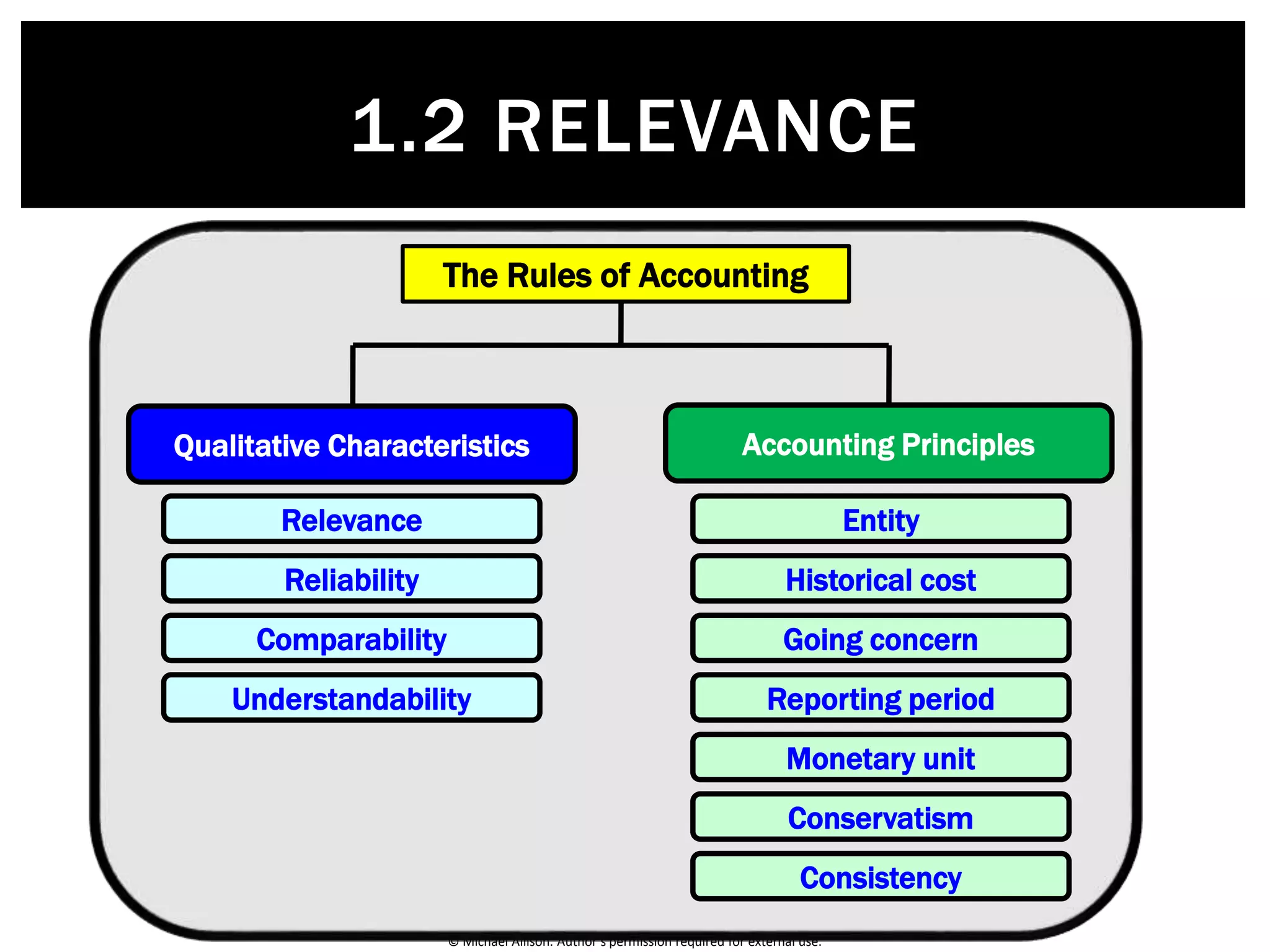
The Rules of Accounting
Relevance
Reliability
Comparability
Understandability
Entity
Historical cost
Going concern
Reporting period
Monetary unit
Conservatism
Consistency
Qualitative Characteristics Accounting Principles
© Michael Allison. Author’s permission required for external use.
Relevance
 Only information that is relevant should be included in the
firm’s accounting reports
 So what is relevant information?
1.2 RELEVANCE
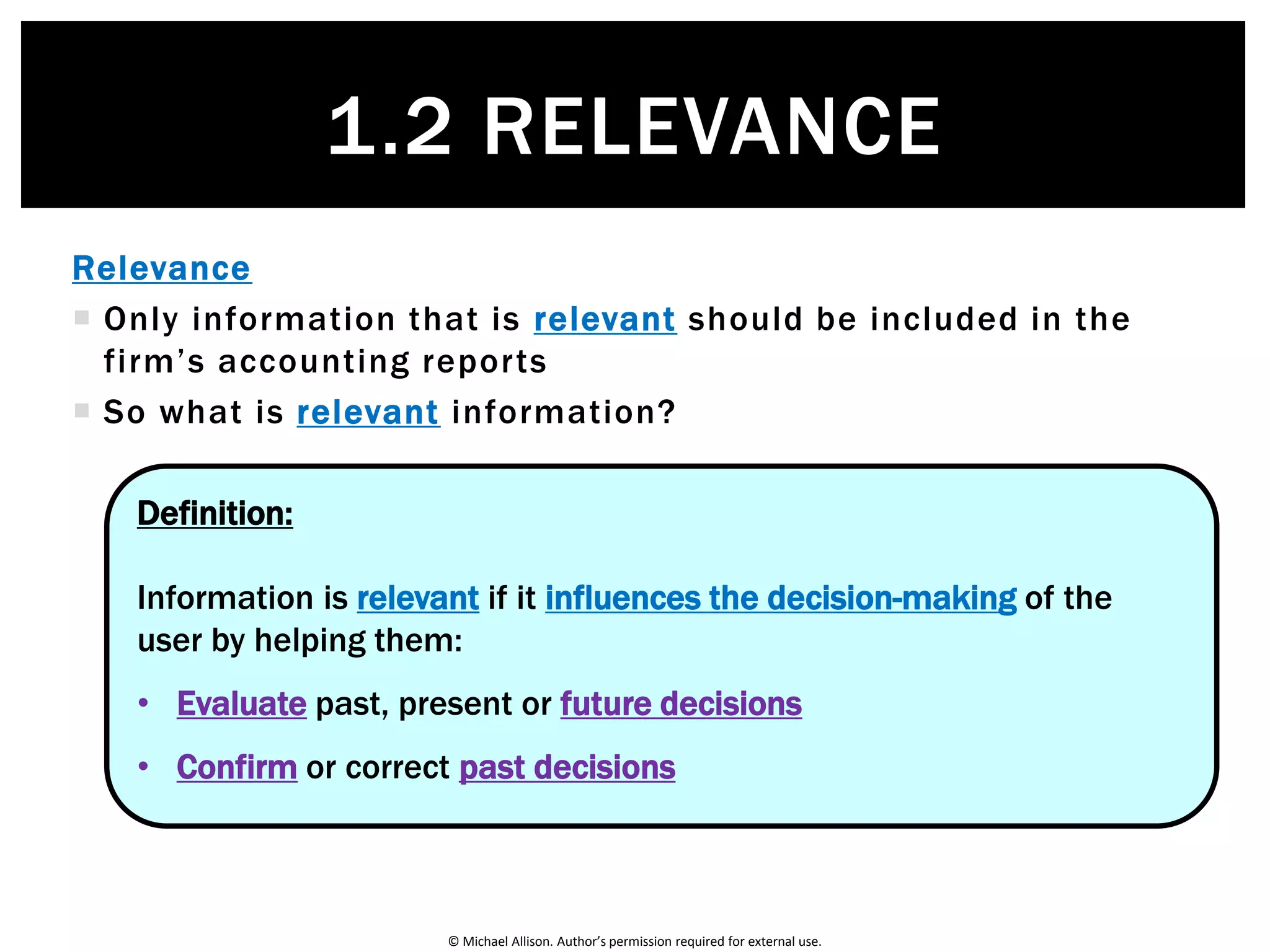
Definition:
Information is relevant if it influences the decision-making of the
user by helping them:
• Evaluate past, present or future decisions
• Confirm or correct past decisions
© Michael Allison. Author’s permission required for external use.
Relevance
 So how do we decide whether a particular item is relevant?
There are two tests…
1.2 RELEVANCE
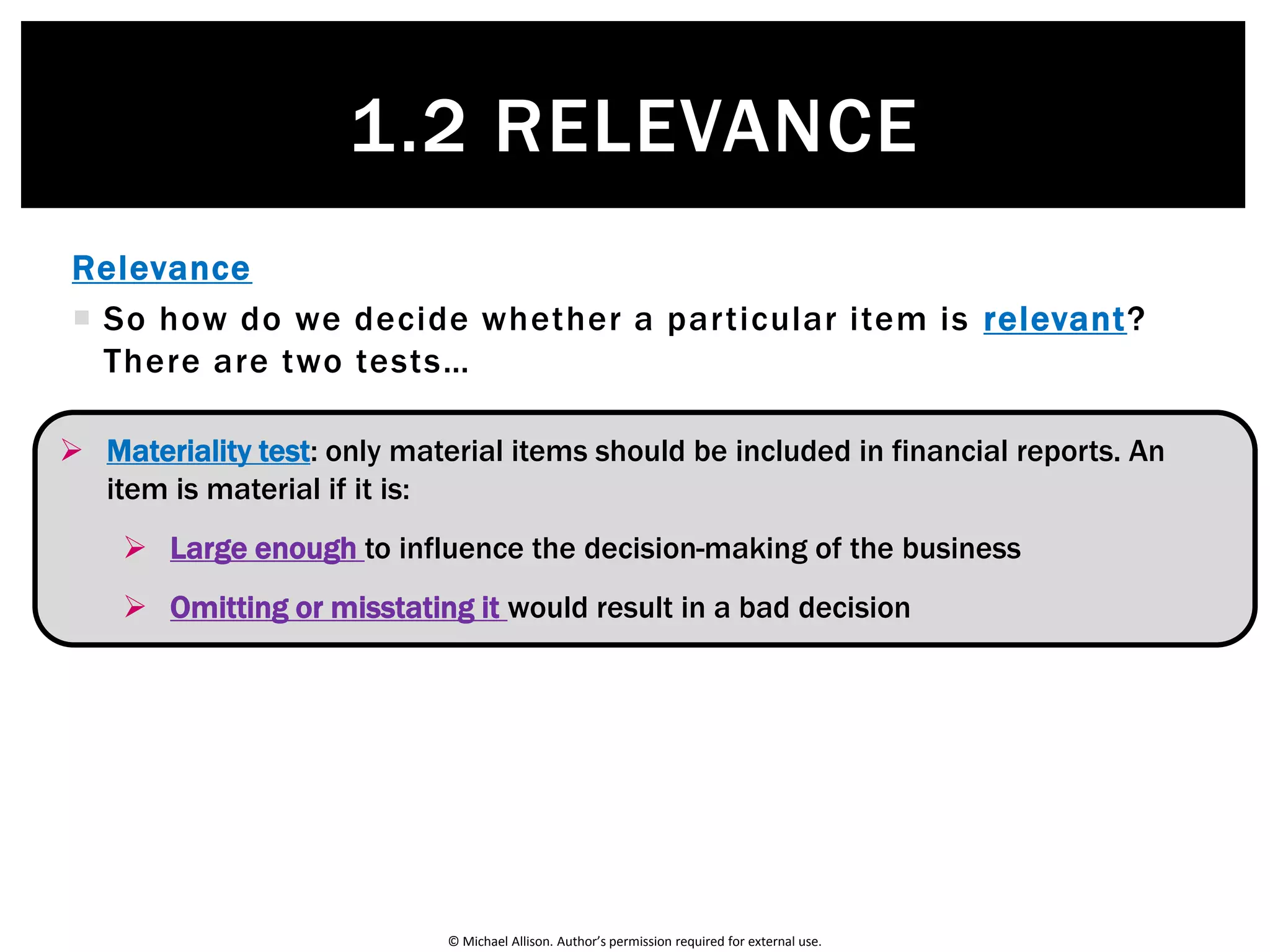
 Materiality test: only material items should be included in financial reports. An
item is material if it is:
 Large enough to influence the decision-making of the business
 Omitting or misstating it would result in a bad decision
© Michael Allison. Author’s permission required for external use.
Relevance
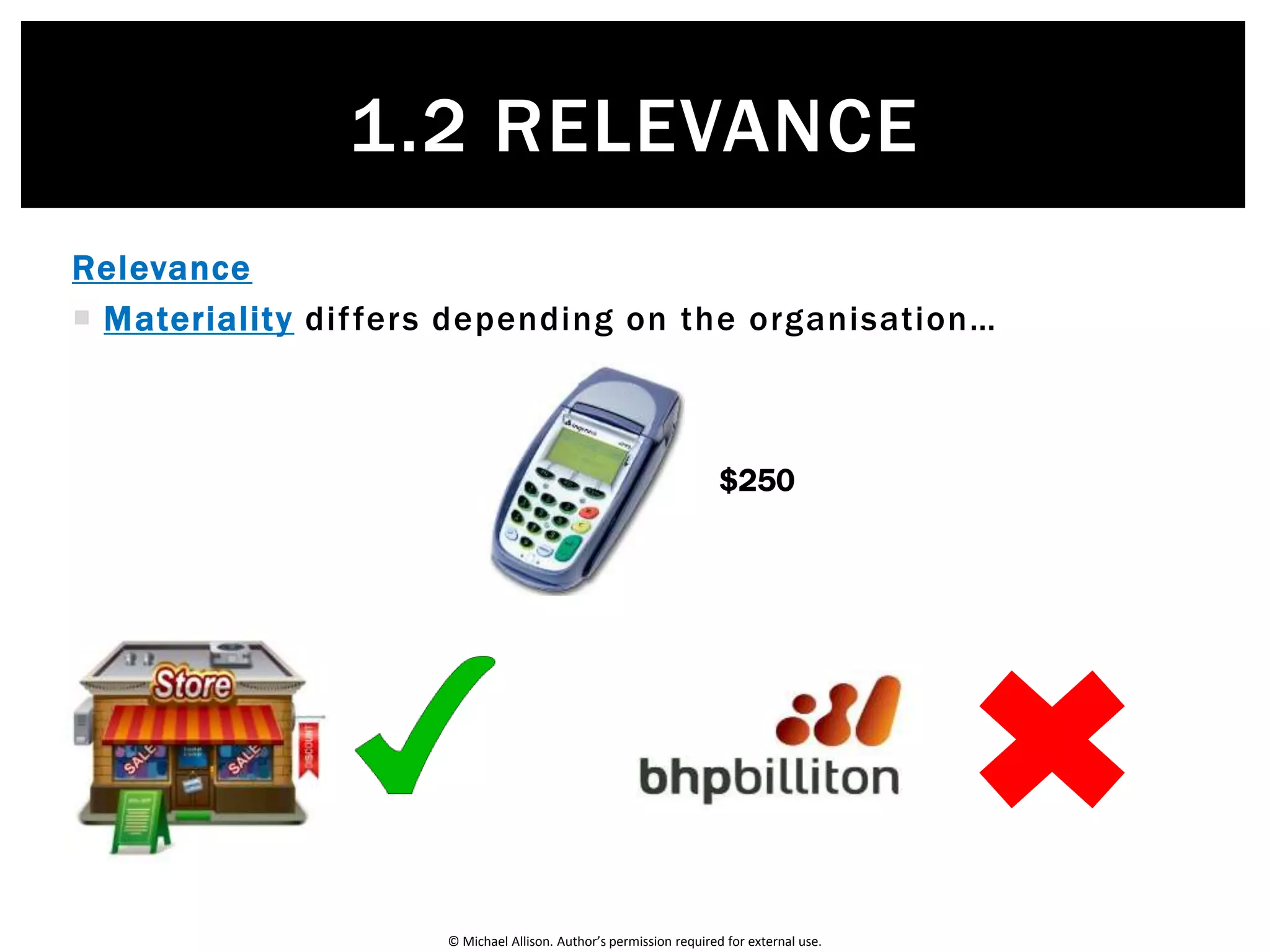
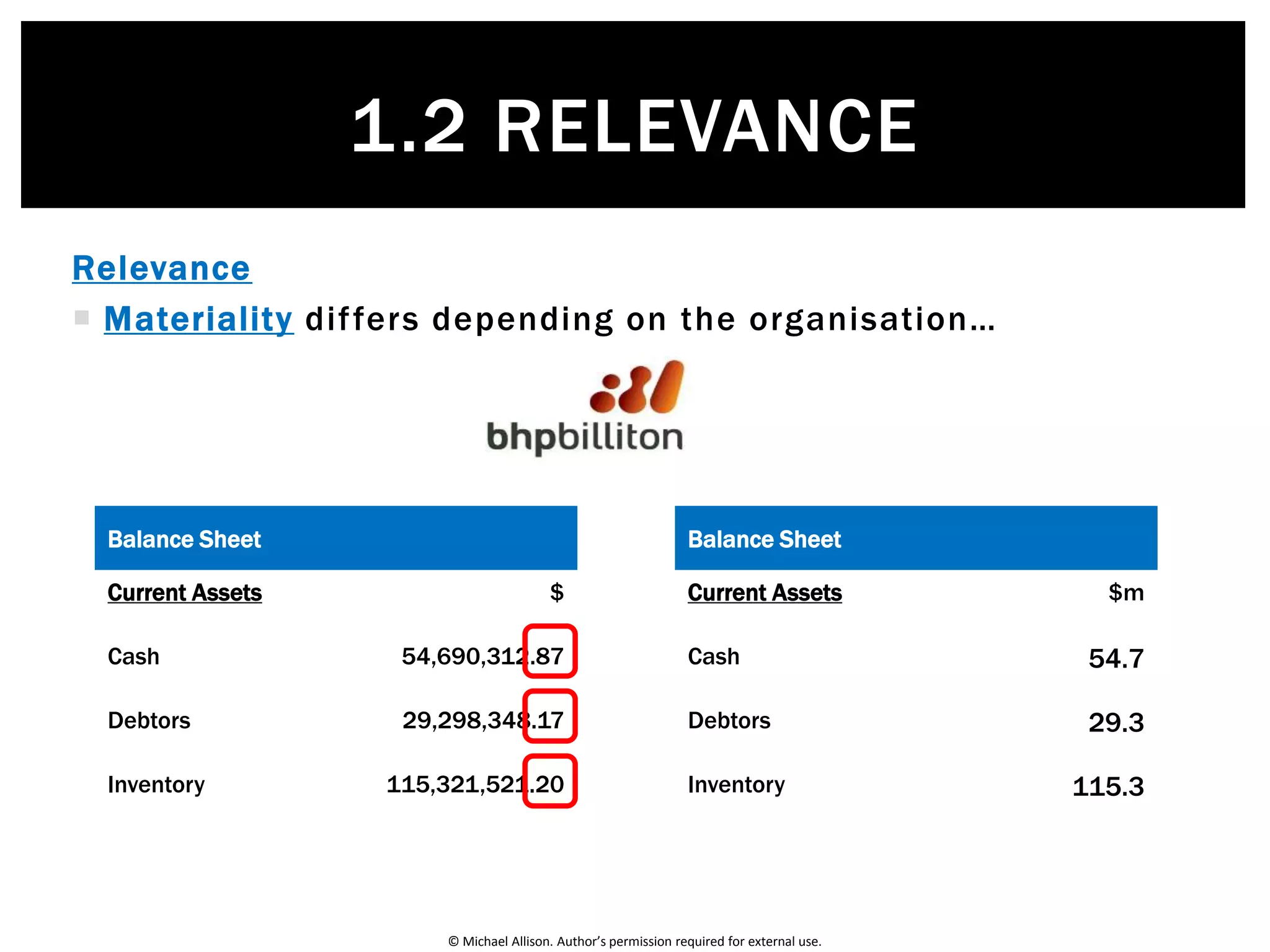
 Materiality differs depending on the organisation…
1.2 RELEVANCE
$250
© Michael Allison. Author’s permission required for external use.
Relevance
 Materiality differs depending on the organisation…
1.2 RELEVANCE
$50,000
© Michael Allison. Author’s permission required for external use.
Relevance
 Materiality differs depending on the organisation…
1.2 RELEVANCE
Balance Sheet
Current Assets $
Cash 54,690,312.87
Debtors 29,298,348.17
Inventory 115,321,521.20
Balance Sheet
Current Assets $
Cash 54,690,313
Debtors 29,298,348
Inventory 115,321,521
Balance Sheet
Current Assets $
Cash 54,690,313
Debtors 29,298,348
Inventory 115,321,521
Balance Sheet
Current Assets $
Cash 54,690,313
Debtors 29,298,348
Inventory 115,321,521
Balance Sheet
Current Assets $
Cash 54,690,313
Debtors 29,298,348
Inventory 115,321,521
Balance Sheet
Current Assets $000
Cash 54,690
Debtors 29,298
Inventory 115,321
Balance Sheet
Current Assets $000
Cash 54,690
Debtors 29,298
Inventory 115,321
Balance Sheet
Current Assets $000
Cash 54,690
Debtors 29,298
Inventory 115,321
Balance Sheet
Current Assets $m
Cash 54.7
Debtors 29.3
Inventory 115.3
Balance Sheet
Current Assets $m
Cash 54.7
Debtors 29.3
Inventory 115.3
Balance Sheet
Current Assets $m
Cash 54.7
Debtors 29.3
Inventory 115.3
Balance Sheet
Current Assets $m
Cash 54.7
Debtors 29.3
Inventory 115.3
© Michael Allison. Author’s permission required for external use.
Relevance
 So how do we decide whether a particular item is relevant?
There are two tests…
1.2 RELEVANCE
 Entity test: is this item relevant to the business itself?
 Is it a personal transaction of the owner?
 Is it a transaction for another business owned by the owner?
 Materiality test: only material items should be included in financial reports. An
item is material if it is:
 Large enough to influence the decision-making of the business
 Omitting or misstating it would result in a bad decision
© Michael Allison. Author’s permission required for external use.
$2,000,000
Relevance
 Entity example: Mary owns ABC Co
 Mary is personally wealthy and owns $2,000,000 in property
 She wants to expand the operations of ABC Co by applying for a $500,000 loan from
the bank
 To make ABC Co’s application look better, she lists her property as an Asset of the
business
1.2 RELEVANCE
Mary ABC Co.
Mary’s personal property is not a
Relevant asset for ABC Co and
should not impact its decision-
making – they are separate entities
© Michael Allison. Author’s permission required for external use.
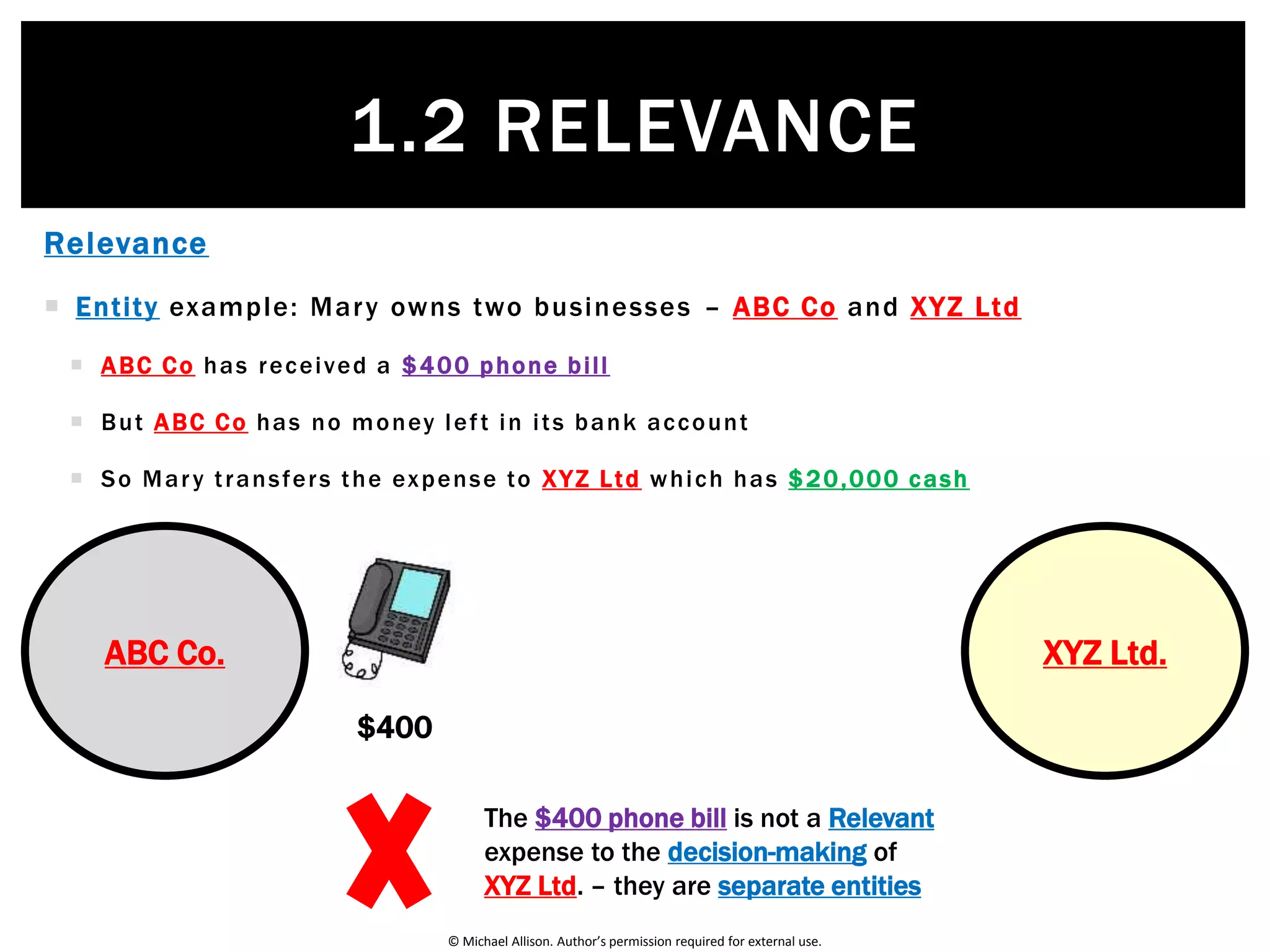
$400
Relevance
 Entity example: Mary owns two businesses – ABC Co and XYZ Ltd
 ABC Co has received a $400 phone bill
 But ABC Co has no money left in its bank account
 So Mary transfers the expense to XYZ Ltd which has $20,000 cash
1.2 RELEVANCE
ABC Co. XYZ Ltd.
The $400 phone bill is not a Relevant
expense to the decision-making of
XYZ Ltd. – they are separate entities
© Michael Allison. Author’s permission required for external use.
TASK
In-class Homework
Cambridge Revision
Question 1.5 – Relevance X
SQ23 X

1.2 Relevance

  • 1.
  • 2.
    Video of thispresentation at… YouTube Channel for VCE Accounting
  • 3.
    © Michael Allison.Author’s permission required for external use. 1.2 RELEVANCE The Rules of Accounting Relevance Reliability Comparability Understandability Entity Historical cost Going concern Reporting period Monetary unit Conservatism Consistency Qualitative Characteristics Accounting Principles
  • 4.
    © Michael Allison.Author’s permission required for external use. Relevance  Only information that is relevant should be included in the firm’s accounting reports  So what is relevant information? 1.2 RELEVANCE Definition: Information is relevant if it influences the decision-making of the user by helping them: • Evaluate past, present or future decisions • Confirm or correct past decisions
  • 5.
    © Michael Allison.Author’s permission required for external use. Relevance  So how do we decide whether a particular item is relevant? There are two tests… 1.2 RELEVANCE  Materiality test: only material items should be included in financial reports. An item is material if it is:  Large enough to influence the decision-making of the business  Omitting or misstating it would result in a bad decision
  • 6.
    © Michael Allison.Author’s permission required for external use. Relevance  Materiality differs depending on the organisation… 1.2 RELEVANCE $250
  • 7.
    © Michael Allison.Author’s permission required for external use. Relevance  Materiality differs depending on the organisation… 1.2 RELEVANCE $50,000
  • 8.
    © Michael Allison.Author’s permission required for external use. Relevance  Materiality differs depending on the organisation… 1.2 RELEVANCE Balance Sheet Current Assets $ Cash 54,690,312.87 Debtors 29,298,348.17 Inventory 115,321,521.20 Balance Sheet Current Assets $ Cash 54,690,313 Debtors 29,298,348 Inventory 115,321,521 Balance Sheet Current Assets $ Cash 54,690,313 Debtors 29,298,348 Inventory 115,321,521 Balance Sheet Current Assets $ Cash 54,690,313 Debtors 29,298,348 Inventory 115,321,521 Balance Sheet Current Assets $ Cash 54,690,313 Debtors 29,298,348 Inventory 115,321,521 Balance Sheet Current Assets $000 Cash 54,690 Debtors 29,298 Inventory 115,321 Balance Sheet Current Assets $000 Cash 54,690 Debtors 29,298 Inventory 115,321 Balance Sheet Current Assets $000 Cash 54,690 Debtors 29,298 Inventory 115,321 Balance Sheet Current Assets $m Cash 54.7 Debtors 29.3 Inventory 115.3 Balance Sheet Current Assets $m Cash 54.7 Debtors 29.3 Inventory 115.3 Balance Sheet Current Assets $m Cash 54.7 Debtors 29.3 Inventory 115.3 Balance Sheet Current Assets $m Cash 54.7 Debtors 29.3 Inventory 115.3
  • 9.
    © Michael Allison.Author’s permission required for external use. Relevance  So how do we decide whether a particular item is relevant? There are two tests… 1.2 RELEVANCE  Entity test: is this item relevant to the business itself?  Is it a personal transaction of the owner?  Is it a transaction for another business owned by the owner?  Materiality test: only material items should be included in financial reports. An item is material if it is:  Large enough to influence the decision-making of the business  Omitting or misstating it would result in a bad decision
  • 10.
    © Michael Allison.Author’s permission required for external use. $2,000,000 Relevance  Entity example: Mary owns ABC Co  Mary is personally wealthy and owns $2,000,000 in property  She wants to expand the operations of ABC Co by applying for a $500,000 loan from the bank  To make ABC Co’s application look better, she lists her property as an Asset of the business 1.2 RELEVANCE Mary ABC Co. Mary’s personal property is not a Relevant asset for ABC Co and should not impact its decision- making – they are separate entities
  • 11.
    © Michael Allison.Author’s permission required for external use. $400 Relevance  Entity example: Mary owns two businesses – ABC Co and XYZ Ltd  ABC Co has received a $400 phone bill  But ABC Co has no money left in its bank account  So Mary transfers the expense to XYZ Ltd which has $20,000 cash 1.2 RELEVANCE ABC Co. XYZ Ltd. The $400 phone bill is not a Relevant expense to the decision-making of XYZ Ltd. – they are separate entities
  • 12.
    © Michael Allison.Author’s permission required for external use. TASK In-class Homework Cambridge Revision Question 1.5 – Relevance X SQ23 X