Designing Assessment Tasks:
Extensive Listening
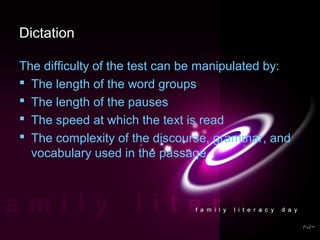
Dictation
The difficulty of the test can be manipulated by:
 The length of the word groups
 The length of the pauses
 The speed at which the text is read
 The complexity of the discourse, grammar, and
vocabulary used in the passage
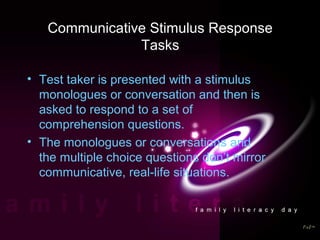
Communicative Stimulus Response
Tasks
• Test taker is presented with a stimulus
monologues or conversation and then is
asked to respond to a set of
comprehension questions.
• The monologues or conversations and
the multiple choice questions don’t mirror
communicative, real-life situations.
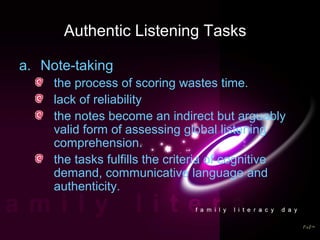
Authentic Listening Tasks
a. Note-taking
the process of scoring wastes time.
lack of reliability
the notes become an indirect but arguably
valid form of assessing global listening
comprehension.
the tasks fulfills the criteria of cognitive
demand, communicative language and
authenticity.
b. Editing
provides both a written and a spoken stimulus,
and requires test-taker to listen for
discrepancies.
Scoring achieves high reliability
Interpretative tasks
Extends the stimulus material to a longer
stretch of discourse and forces test-taker to
infer a response potential stimuli
c. Interpretative Tasks
It extends the stimulus material to a
longer stretch of discourse.
forces the test-taker to infer a response
potential stimuli.
test-taker are then directed to interpret
the stimulus.
d. Retelling
Test-taker listen to a story or news event and
retell it, or summarize it, either orally or in
writing.
Test-taker must identify the gist, main idea,
purpose, supporting points, and/or conclusion
to show full comprehension.
Reliability may suffer
time and effort are needed to read and
evaluate the response lower practicality.

Designing assessment tasks

  • 1.
  • 2.
    Dictation The difficulty ofthe test can be manipulated by:  The length of the word groups  The length of the pauses  The speed at which the text is read  The complexity of the discourse, grammar, and vocabulary used in the passage
  • 3.
    Communicative Stimulus Response Tasks •Test taker is presented with a stimulus monologues or conversation and then is asked to respond to a set of comprehension questions. • The monologues or conversations and the multiple choice questions don’t mirror communicative, real-life situations.
  • 4.
    Authentic Listening Tasks a.Note-taking the process of scoring wastes time. lack of reliability the notes become an indirect but arguably valid form of assessing global listening comprehension. the tasks fulfills the criteria of cognitive demand, communicative language and authenticity.
  • 5.
    b. Editing provides botha written and a spoken stimulus, and requires test-taker to listen for discrepancies. Scoring achieves high reliability Interpretative tasks Extends the stimulus material to a longer stretch of discourse and forces test-taker to infer a response potential stimuli
  • 6.
    c. Interpretative Tasks Itextends the stimulus material to a longer stretch of discourse. forces the test-taker to infer a response potential stimuli. test-taker are then directed to interpret the stimulus.
  • 7.
    d. Retelling Test-taker listento a story or news event and retell it, or summarize it, either orally or in writing. Test-taker must identify the gist, main idea, purpose, supporting points, and/or conclusion to show full comprehension. Reliability may suffer time and effort are needed to read and evaluate the response lower practicality.