Properties of Assessment
Methods
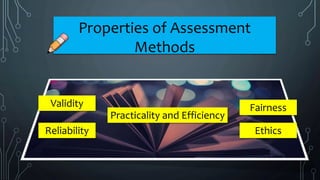
Validity
Reliability
Fairness
Practicality and Efficiency
Ethics
Properties of Assessment
Methods
Validity
Validity
Is the degree to which a test
measures what is supposed to
measure.
Validity
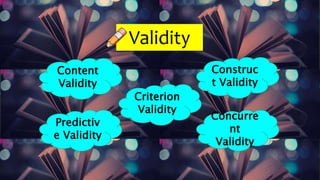
Content
Validity
Criterion
Validity
Predictiv
e Validity
Concurre
nt
Validity
Construc
t Validity
Content
ValidityPreditive
ValidityCriterion
ValidityConstruct
ValidityPreditive
Validity
Concurrent
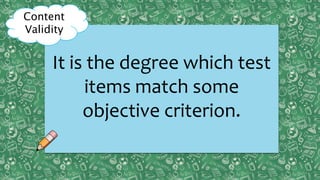
ValidityIt is the degree which test
items match some
objective criterion.
Content
Validity
Content
ValidityPreditive
ValidityCriterion
ValidityConstruct
ValidityPreditive
Validity
Concurrent
Validity
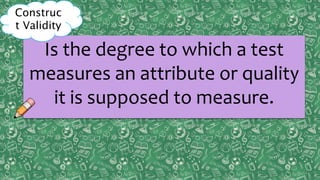
Is the degree to which a test
measures an attribute or quality
it is supposed to measure.
Construc
t Validity
Content
ValidityPreditive
ValidityCriterion
ValidityConstruct
ValidityPreditive
Validity
Concurrent
Validity
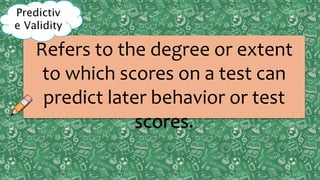
Refers to the degree or extent
to which scores on a test can
predict later behavior or test
scores.
Predictiv
e Validity
Content
ValidityPreditive
ValidityCriterion
ValidityConstruct
ValidityPreditive
Validity
Concurrent
Validity
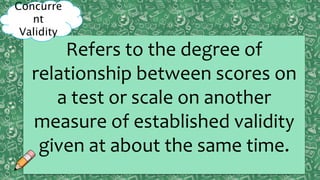
Refers to the degree of
relationship between scores on
a test or scale on another
measure of established validity
given at about the same time.
Concurre
nt
Validity
Content
ValidityPreditive
ValidityCriterion
ValidityConstruct
ValidityPreditive
Validity
Concurrent
Validity
It is when the test item is
judged against a specific
criterion.
Criterion
Validity
Reliability
Reliability
Is the degree to which an
assessment tool produces
stable and consistent results.
Reliability
Refers to the instrument’s
consistency and stability.
Reliability
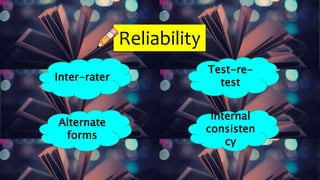
Inter-rater
Alternate
forms
Internal
consisten
cy
Test-re-
test
Used to assess the
degree to which different
raters or observers give
consistent estimates of the
same phenomenon.
Inter-
rater
Used to assess the
consistency of a measure
from one time to another.
Test-re-
test
Used to assess the
consistency of the results of
two tests constructed in the
same way from the same
way from the same content
Alternate
forms
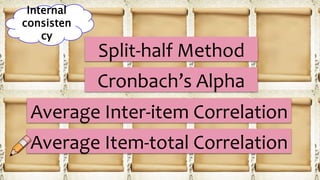
Split-half Method
Internal
consisten
cy
Cronbach’s Alpha
Average Inter-item Correlation
Average Item-total Correlation
Fairness
Fairness
Students need to know exactly
what the learning targets are
and what method of
assessment will be used.
Assessment has to be viewed as
an opportunity to learn rather
than an opportunity to weed
out poor and slow learners.
Fairness
Practicality
and
Efficiency
Practicality and Efficiency
 Teachers should be familiar
with the test.
 Number of items is not
complicated.
 Implementable
Ethics
Ethics
The term “ethics” refers to the
question of right and wrong.
Ethics
Webster Dictionary defines
ETHICAL as “conforming to the
standards of conduct of a given
profession or group.”
Thank You For Your
Cooperation! 

Properties of Assessment Method