WRITING TEST ITEMS
FOR
LITERATURE IN
ENGLISH
A Paper Presented at the Copperbelt LATAZ Conference Held From 3rd
– 4th February, 2015 at Kansenshi Secondary School.
Renny Kapembwa Saini
BA.ED (UNZA)
Examiner/Item-Writer
(E.C.Z - Literature in English)
WHAT IS ITEM WRITING?
 Item writing is often regarded as a process of
constructing and/or developing test questions.
 The key is to remember the end goal: that each
specific test item should focus on a piece of
knowledge (or skill, ability, trait) and differentiate
between candidates with high and low levels of
knowledge.
 Test item development therefore constitutes a
conscious process of formulating, reviewing, editing
and perfecting test items and questions.
 Because assessment is a critical component of
instruction, if properly used, it can aid in
accomplishing key curricular goals.
TOOLS FOR ITEM WRITING
 Teaching syllabus
 Examination syllabus
 Recent past question papers
 Test specification/grid
 The teaching syllabus outlines the content to be covered
in a subject. The Examination syllabus on the other
hand outlines the rubric or set of directions to be
followed when setting the test such as maximum marks
allowed, whether essay type, short answers, multiple
choice, etc., total marks allocated to each response or to
a question and time allowed for each paper.
 Recent past question papers are intended to guide the
setter on the expected quality or standard. Recent past
papers also serve as reference to a setter to guide
him/her to avoid repeating questions that had appeared
in recent examinations. Test specification or grid on the
other hand is intended to balance the test so that the
test covers a broad spectrum of levels of skills and not
just one level.
CONSTRUCTING TEST ITEMS
A good test calls for a knowledgeable and skillful item-
writer.
A good test also should have; VALIDITY, RELIABILITY
and DISCRIMINATION.
- Validity.
A good test should posses validity. The test should
measure and predict accurately what it is supposed
measure, and nothing else. If for example a test is to
measure achievement, it should do only that.
- Reliability.
A test cannot be valid unless it is reliable. If a test gives
different results when it is administered a second time,
then the test is not reliable. The assumption is that a
good test should be consistent. It should give consistent
results.
- Discrimination
Examination results show the differences in
performance of the students that take the
examination. The examination results show the
achievement of each student in respect of the skills
and subject areas that were learnt and examined.
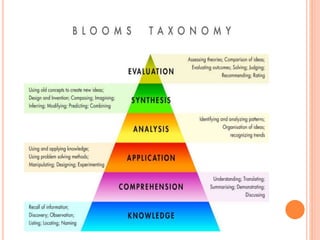
BLOOMS TAXONOMY
 Bloom's taxonomy refers to a classification of
the different objectives that educators set for
students (learning objectives).
 It divides educational objectives into three
"domains": cognitive, affective, and psychomotor
(sometimes loosely described as "knowing/head",
"feeling/heart" and "doing/hands" respectively).
 Within the domains, learning at the higher
levels is dependent on having attained prerequisite
knowledge and skills at lower levels.
 The goal of Bloom's taxonomy is to motivate
educators to focus on all three domains, creating a
more holistic form of education.
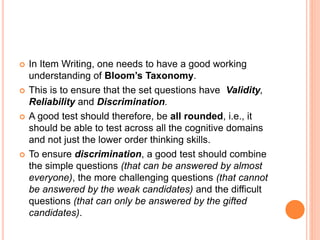
 In Item Writing, one needs to have a good working
understanding of Bloom’s Taxonomy.
 This is to ensure that the set questions have Validity,
Reliability and Discrimination.
 A good test should therefore, be all rounded, i.e., it
should be able to test across all the cognitive domains
and not just the lower order thinking skills.
 To ensure discrimination, a good test should combine
the simple questions (that can be answered by almost
everyone), the more challenging questions (that cannot
be answered by the weak candidates) and the difficult
questions (that can only be answered by the gifted
candidates).
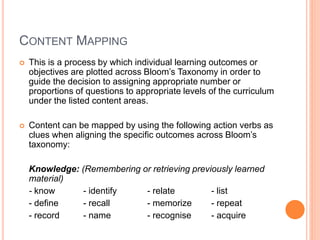
CONTENT MAPPING
 This is a process by which individual learning outcomes or
objectives are plotted across Bloom’s Taxonomy in order to
guide the decision to assigning appropriate number or
proportions of questions to appropriate levels of the curriculum
under the listed content areas.
 Content can be mapped by using the following action verbs as
clues when aligning the specific outcomes across Bloom’s
taxonomy:
Knowledge: (Remembering or retrieving previously learned
material)
- know - identify - relate - list
- define - recall - memorize - repeat
- record - name - recognise - acquire
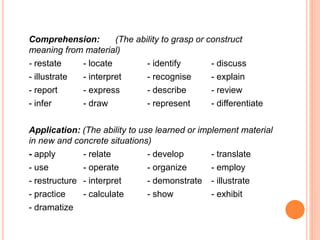
Comprehension: (The ability to grasp or construct
meaning from material)
- restate - locate - identify - discuss
- illustrate - interpret - recognise - explain
- report - express - describe - review
- infer - draw - represent - differentiate
Application: (The ability to use learned or implement material
in new and concrete situations)
- apply - relate - develop - translate
- use - operate - organize - employ
- restructure - interpret - demonstrate - illustrate
- practice - calculate - show - exhibit
- dramatize
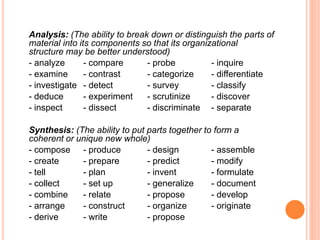
Analysis: (The ability to break down or distinguish the parts of
material into its components so that its organizational
structure may be better understood)
- analyze - compare - probe - inquire
- examine - contrast - categorize - differentiate
- investigate - detect - survey - classify
- deduce - experiment - scrutinize - discover
- inspect - dissect - discriminate - separate
Synthesis: (The ability to put parts together to form a
coherent or unique new whole)
- compose - produce - design - assemble
- create - prepare - predict - modify
- tell - plan - invent - formulate
- collect - set up - generalize - document
- combine - relate - propose - develop
- arrange - construct - organize - originate
- derive - write - propose
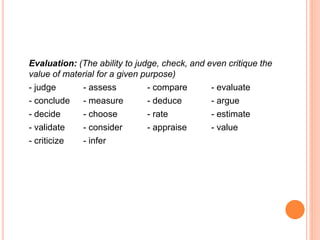
Evaluation: (The ability to judge, check, and even critique the
value of material for a given purpose)
- judge - assess - compare - evaluate
- conclude - measure - deduce - argue
- decide - choose - rate - estimate
- validate - consider - appraise - value
- criticize - infer
TABLE OF SPECIFICATIONS FOR
LITERATURE IN ENGLISH (OLD SYLLABUS)
 As earlier alluded to, a Table of Specifications
is a grid that specifies the total marks for a given
test item/question and how the marks are broken
down according to blooms taxonomy.
 This is in order to balance the test so that the
test covers a broad spectrum of levels of skills and
not just one level.
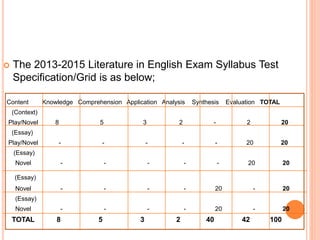
 The 2013-2015 Literature in English Exam Syllabus Test
Specification/Grid is as below;
Content Knowledge Comprehension Application Analysis Synthesis Evaluation TOTAL
(Context)
Play/Novel 8 5 3 2 - 2 20
(Essay)
Play/Novel - - - - - 20 20
(Essay)
Novel - - - - - 20 20
(Essay)
Novel - - - - 20 - 20
(Essay)
Novel - - - - 20 - 20
TOTAL 8 5 3 2 40 42 100
THE IMPORTANCE OF TEST SPECIFICATIONS
 The consistency of yearly examinations can be
guaranteed by specifying in advance the distribution of
questions over a number of aspects.
 The table of specification can guarantee consistency
and comparability.
 For instance, one should not pass an exam simply
because they wrote in one given year, and not the other.
 Similarly, one should not pass a test simply because it
was prepared by such and such a teacher, and not the
other.
 In short, the table of specifications sets the standard.
TYPES OF QUESTIONS IN LITERATURE.
 Context Questions.
 Essay Questions.
WHAT ARE CONTEXT QUESTIONS?
 Context questions are those based on an excerpt
or extract from the text of study. Unlike for
comprehension questions in English Language,
candidates attempting context questions in
Literature are expected to draw their answers from
their extended knowledge of a given text, and
NOT necessarily or directly from the given excerpt.
AN EXCERPT FROM
SOYINKA: KONGI’S HARVEST
DENDE: I got no co-operation at all
From the blacksmith. It was the best
I found in the blacksmith’s foundry.
DANLOLA: Some soup-pot foundry. Find me
Such another ladle and I’ll
Shove it up your mother’s fundaments.
DAODU: [storms in] stops short as he sees signs of activity.]:
I was told you would not take part in today’s
procession.
DANLOLA: The ostrich also sports plumes but I’ve yet to see
That wise bird.
Leave the ground.
DAODU: But all this preparation…
DANLOLA: When the dog hides a bone does he not
Throw up sand? A little sand in the eye
Of His Immortality will not deceive
His clever Organising Secretary. We need to
Burry him in shovelfulls.
[re-enter Dende]
You horse manure. Is this a trip
To gather mangoes for the hawker’s tray?
Tell me, did I ask for a basket fit
To support your father’s goiter? I thought
I specially designed a copper salver.
DENDE: The smith had done nothing at all about it.
DANLOLA: The smith! The Smith! All I hear
Is some furnace blower called
The smith!
DAODU: [sharply, to Dende.] Send for the smith.
EXAMPLES OF QUESTIONS BASED ON THE
EXCERPT
(i) What is Dende referring to when he says, “It was the best I found in the blacksmith’s
foundry?” Mention the many ways that Danlola describes it.
(ii) Just before Dende says he “got no co-operation from the blacksmith,” what does Danlola
complain of and what is happening at the palace?
(iii) In response to Daodu’s statement, explain what Danlola means in the figure of speech
he uses by saying “The ostrich also… ground.”
ESSAY QUESTIONS
 Essay questions fall under the subject question type.
 Subjective or essay items allow the learners freedom to
organize and present an original answer.
 According to (Stalnaker: 1951, p.495), “an essay
question is a test item which requires a response
composed by the examinee or pupil, usually in the form
of one or more sentences of a nature that no single
response or pattern of responses can be listed as
correct, and the accuracy and quality of which can be
judged subjectively only by one skilled or well informed
in the subject.”
 Therefore, we can say that there are no specified right
answers to essay type questions.
PURPOSES FOR USING SUBJECTIVE
QUESTIONS
 There are two major purposes for using essay questions that
addresses different learning outcomes.
(i) To assess the pupils’ understanding of the subject matter
content. (as in literature)
(ii) To assess the pupils’ writing abilities. (as in language)
 These two purposes are so different in nature that it is best to
treat them separately. Therefore, an essay item should meet
the following criteria:
 Requires pupils to compose rather than select their
response.
 Elicits pupil responses that must comprise more than one
or two sentences.
 The accuracy and the quality of pupils’ responses to
essays must be judged subjectively by a
competent specialist in the subject such as a
trained teacher.
 This is important because the nature of essay
questions is such that only competent teachers in
the subject can judge to what degree pupil
responses to the essay question are complete,
accurate, correct and free from extraneous
information.
 Ineffective essay items allow pupils to generalize in
their responses without being specific and
thoughtful about the content matter.
 Effective essay questions, on the other hand, elicit
depth of thought from pupils that can only be
judged or marked by someone with appropriate
experience and expertise in the subject matter.
 Thus, content expertise is essential for both writing
and grading of essay questions.
ABILITIES MEASURED BY ESSAY TEST ITEMS
• In addition, essay questions can be used to measure attainment of a
variety of objectives. Listed below are 14 types of abilities that can be
measured by essay items:
– Comparisons between two or more things
– The development and defense of an opinion
– Questions of cause and effect
– Explanation of meanings
– Summarizing of information in a designated area
– Analysis
– Knowledge of relationships
– Illustrations of rules, principles, procedures and applications
– Application of rules, laws and principles to new situations
– Criticism of the adequacy, relevance or correctness of a concept,
idea or information
– Reorganization of facts
– Formulating solutions to problems
– Discriminations between objects, concepts or events
– Inferential thinking.
• Essay questions provide an effective way of assessing complex
learning outcomes that cannot be assessed by objective
questions.
• They are an effective way to measure higher order cognitive
objectives such as analysis, synthesis and evaluation.
• They are unique in measuring pupils’ ability to select content,
organize and integrate it and then present it in logical prose.
• They have an effect on pupils’ learning. Pupils do not memorize
facts but try to get a broad understanding of complex ideas and
to see relationships. Essays also allow pupils to present their
answers to a question by allowing them to arrive at their own
conclusions.
• Essay questions also allow teachers to gain insights into pupils’
way of viewing and solving problems. With such insights,
teachers are able to detect problems pupils may have with their
reasoning process and help them overcome them.
DOES THE USE OF ESSAY QUESTIONS
ELIMINATES GUESSING?
 Although this problem of guess work is higher in
objective questions, it still exists in subjective
questions as well.
 The type of guessing which is popular in essay
responses is “bluffing” or “waffling”.
 Some pupils are adept at using various forms of
bluffing such as vagueness, generalizations,
padding (irrelevant information) ambiguities,
tautology, etc.
 Examiners and teachers should be wary of such
“pedestrian” type of answers to avoid giving credit
where it is not due.
CONSTRUCTION OF ESSAY QUESTIONS
Is it true that Essay questions are easy to
construct?
 It is true to a large extent that essay items are
easier to construct as compared to objective items.
 However, this should not be taken for granted
because for any teacher to construct any good test
item, time and effort must be invested.
 Essay questions that are constructed hastily without
much thought and review usually perform poorly.
 Since few essay questions can be given regularly on any test, each item must
be a good item. And because most subjective questions are designed to
measure higher - level cognitive skills, we must be sure that the item does, in
fact, tap these skills.
 To accomplish these goals, certain guidelines should be followed when
preparing essay items:
(i) Define the intended learning outcome to be
assessed by the item.
Knowing the intended outcome or goal is crucial for designing essay questions.
If the outcome to be assessed is not clear, it is likely that the question will
assess for some skill, ability other than the one intended.
(ii) Define the task and shape the problem clearly
Essay questions have two variable elements - the degree to which the task is
structured and focused.
Remember essay questions pose a problem; so ensure to clearly state it so that
it can elicit a solution from the pupils by giving them a task which needs to be
performed in a stipulated time.
 In composing essay questions, one must avoid over-
generalised or leading questions. The latter clearly
paves way to a particular answer.
 It is important to consider the directive verbs. These
are verbs that best describe the desired ability to be
assessed.
 The term ‘directive verb” refers to verbs that are
thoughtfully and carefully selected to provide pupils with
clear instructions and directions for their responses.
 Therefore, a task should consist of a directive verb and
the object of that verb.
 Below is a diagram indicating some examples of
directive verbs that teachers can utilize when preparing
essay questions.
 From the diagram above, the intersection is a clear
indication that some verbs can subjective or
objective or both.
- Avoid Complexity in Essay Questions
Use language that is simple for Grade 12s so
that all the candidates understand the question
in order to give appropriate responses.
Example: Literature -2011in ‘Things Fall Apart’
Discuss the theme existentialism vis-à-vis
Okonkwo.
• Even though subjective items demand less time to
prepare than objective items, a great deal of
thought and care should go into the writing or
preparation of an essay item.
• Writing good essay items takes a lot of practice. It
is unrealistic to think that you will write very good
ones at first but with time and practice makes
perfect. Experience will teach to think through each
item that you write.
• It will also teach you to try to imagine all the
possible things that pupils or examinees might think
about as they respond to your item.
THE END

Item writing in literature

  • 1.
    WRITING TEST ITEMS FOR LITERATUREIN ENGLISH A Paper Presented at the Copperbelt LATAZ Conference Held From 3rd – 4th February, 2015 at Kansenshi Secondary School. Renny Kapembwa Saini BA.ED (UNZA) Examiner/Item-Writer (E.C.Z - Literature in English)
  • 2.
    WHAT IS ITEMWRITING?  Item writing is often regarded as a process of constructing and/or developing test questions.  The key is to remember the end goal: that each specific test item should focus on a piece of knowledge (or skill, ability, trait) and differentiate between candidates with high and low levels of knowledge.  Test item development therefore constitutes a conscious process of formulating, reviewing, editing and perfecting test items and questions.  Because assessment is a critical component of instruction, if properly used, it can aid in accomplishing key curricular goals.
  • 3.
    TOOLS FOR ITEMWRITING  Teaching syllabus  Examination syllabus  Recent past question papers  Test specification/grid
  • 4.
     The teachingsyllabus outlines the content to be covered in a subject. The Examination syllabus on the other hand outlines the rubric or set of directions to be followed when setting the test such as maximum marks allowed, whether essay type, short answers, multiple choice, etc., total marks allocated to each response or to a question and time allowed for each paper.  Recent past question papers are intended to guide the setter on the expected quality or standard. Recent past papers also serve as reference to a setter to guide him/her to avoid repeating questions that had appeared in recent examinations. Test specification or grid on the other hand is intended to balance the test so that the test covers a broad spectrum of levels of skills and not just one level.
  • 5.
    CONSTRUCTING TEST ITEMS Agood test calls for a knowledgeable and skillful item- writer. A good test also should have; VALIDITY, RELIABILITY and DISCRIMINATION. - Validity. A good test should posses validity. The test should measure and predict accurately what it is supposed measure, and nothing else. If for example a test is to measure achievement, it should do only that. - Reliability. A test cannot be valid unless it is reliable. If a test gives different results when it is administered a second time, then the test is not reliable. The assumption is that a good test should be consistent. It should give consistent results.
  • 6.
    - Discrimination Examination resultsshow the differences in performance of the students that take the examination. The examination results show the achievement of each student in respect of the skills and subject areas that were learnt and examined.
  • 7.
    BLOOMS TAXONOMY  Bloom'staxonomy refers to a classification of the different objectives that educators set for students (learning objectives).  It divides educational objectives into three "domains": cognitive, affective, and psychomotor (sometimes loosely described as "knowing/head", "feeling/heart" and "doing/hands" respectively).  Within the domains, learning at the higher levels is dependent on having attained prerequisite knowledge and skills at lower levels.  The goal of Bloom's taxonomy is to motivate educators to focus on all three domains, creating a more holistic form of education.
  • 9.
     In ItemWriting, one needs to have a good working understanding of Bloom’s Taxonomy.  This is to ensure that the set questions have Validity, Reliability and Discrimination.  A good test should therefore, be all rounded, i.e., it should be able to test across all the cognitive domains and not just the lower order thinking skills.  To ensure discrimination, a good test should combine the simple questions (that can be answered by almost everyone), the more challenging questions (that cannot be answered by the weak candidates) and the difficult questions (that can only be answered by the gifted candidates).
  • 10.
    CONTENT MAPPING  Thisis a process by which individual learning outcomes or objectives are plotted across Bloom’s Taxonomy in order to guide the decision to assigning appropriate number or proportions of questions to appropriate levels of the curriculum under the listed content areas.  Content can be mapped by using the following action verbs as clues when aligning the specific outcomes across Bloom’s taxonomy: Knowledge: (Remembering or retrieving previously learned material) - know - identify - relate - list - define - recall - memorize - repeat - record - name - recognise - acquire
  • 11.
    Comprehension: (The abilityto grasp or construct meaning from material) - restate - locate - identify - discuss - illustrate - interpret - recognise - explain - report - express - describe - review - infer - draw - represent - differentiate Application: (The ability to use learned or implement material in new and concrete situations) - apply - relate - develop - translate - use - operate - organize - employ - restructure - interpret - demonstrate - illustrate - practice - calculate - show - exhibit - dramatize
  • 12.
    Analysis: (The abilityto break down or distinguish the parts of material into its components so that its organizational structure may be better understood) - analyze - compare - probe - inquire - examine - contrast - categorize - differentiate - investigate - detect - survey - classify - deduce - experiment - scrutinize - discover - inspect - dissect - discriminate - separate Synthesis: (The ability to put parts together to form a coherent or unique new whole) - compose - produce - design - assemble - create - prepare - predict - modify - tell - plan - invent - formulate - collect - set up - generalize - document - combine - relate - propose - develop - arrange - construct - organize - originate - derive - write - propose
  • 13.
    Evaluation: (The abilityto judge, check, and even critique the value of material for a given purpose) - judge - assess - compare - evaluate - conclude - measure - deduce - argue - decide - choose - rate - estimate - validate - consider - appraise - value - criticize - infer
  • 14.
    TABLE OF SPECIFICATIONSFOR LITERATURE IN ENGLISH (OLD SYLLABUS)  As earlier alluded to, a Table of Specifications is a grid that specifies the total marks for a given test item/question and how the marks are broken down according to blooms taxonomy.  This is in order to balance the test so that the test covers a broad spectrum of levels of skills and not just one level.
  • 15.
     The 2013-2015Literature in English Exam Syllabus Test Specification/Grid is as below; Content Knowledge Comprehension Application Analysis Synthesis Evaluation TOTAL (Context) Play/Novel 8 5 3 2 - 2 20 (Essay) Play/Novel - - - - - 20 20 (Essay) Novel - - - - - 20 20 (Essay) Novel - - - - 20 - 20 (Essay) Novel - - - - 20 - 20 TOTAL 8 5 3 2 40 42 100
  • 16.
    THE IMPORTANCE OFTEST SPECIFICATIONS  The consistency of yearly examinations can be guaranteed by specifying in advance the distribution of questions over a number of aspects.  The table of specification can guarantee consistency and comparability.  For instance, one should not pass an exam simply because they wrote in one given year, and not the other.  Similarly, one should not pass a test simply because it was prepared by such and such a teacher, and not the other.  In short, the table of specifications sets the standard.
  • 17.
    TYPES OF QUESTIONSIN LITERATURE.  Context Questions.  Essay Questions.
  • 18.
    WHAT ARE CONTEXTQUESTIONS?  Context questions are those based on an excerpt or extract from the text of study. Unlike for comprehension questions in English Language, candidates attempting context questions in Literature are expected to draw their answers from their extended knowledge of a given text, and NOT necessarily or directly from the given excerpt.
  • 19.
    AN EXCERPT FROM SOYINKA:KONGI’S HARVEST DENDE: I got no co-operation at all From the blacksmith. It was the best I found in the blacksmith’s foundry. DANLOLA: Some soup-pot foundry. Find me Such another ladle and I’ll Shove it up your mother’s fundaments. DAODU: [storms in] stops short as he sees signs of activity.]: I was told you would not take part in today’s procession. DANLOLA: The ostrich also sports plumes but I’ve yet to see That wise bird. Leave the ground. DAODU: But all this preparation…
  • 20.
    DANLOLA: When thedog hides a bone does he not Throw up sand? A little sand in the eye Of His Immortality will not deceive His clever Organising Secretary. We need to Burry him in shovelfulls. [re-enter Dende] You horse manure. Is this a trip To gather mangoes for the hawker’s tray? Tell me, did I ask for a basket fit To support your father’s goiter? I thought I specially designed a copper salver. DENDE: The smith had done nothing at all about it. DANLOLA: The smith! The Smith! All I hear Is some furnace blower called The smith! DAODU: [sharply, to Dende.] Send for the smith.
  • 21.
    EXAMPLES OF QUESTIONSBASED ON THE EXCERPT (i) What is Dende referring to when he says, “It was the best I found in the blacksmith’s foundry?” Mention the many ways that Danlola describes it. (ii) Just before Dende says he “got no co-operation from the blacksmith,” what does Danlola complain of and what is happening at the palace? (iii) In response to Daodu’s statement, explain what Danlola means in the figure of speech he uses by saying “The ostrich also… ground.”
  • 22.
    ESSAY QUESTIONS  Essayquestions fall under the subject question type.  Subjective or essay items allow the learners freedom to organize and present an original answer.  According to (Stalnaker: 1951, p.495), “an essay question is a test item which requires a response composed by the examinee or pupil, usually in the form of one or more sentences of a nature that no single response or pattern of responses can be listed as correct, and the accuracy and quality of which can be judged subjectively only by one skilled or well informed in the subject.”  Therefore, we can say that there are no specified right answers to essay type questions.
  • 23.
    PURPOSES FOR USINGSUBJECTIVE QUESTIONS  There are two major purposes for using essay questions that addresses different learning outcomes. (i) To assess the pupils’ understanding of the subject matter content. (as in literature) (ii) To assess the pupils’ writing abilities. (as in language)  These two purposes are so different in nature that it is best to treat them separately. Therefore, an essay item should meet the following criteria:  Requires pupils to compose rather than select their response.  Elicits pupil responses that must comprise more than one or two sentences.
  • 24.
     The accuracyand the quality of pupils’ responses to essays must be judged subjectively by a competent specialist in the subject such as a trained teacher.  This is important because the nature of essay questions is such that only competent teachers in the subject can judge to what degree pupil responses to the essay question are complete, accurate, correct and free from extraneous information.
  • 25.
     Ineffective essayitems allow pupils to generalize in their responses without being specific and thoughtful about the content matter.  Effective essay questions, on the other hand, elicit depth of thought from pupils that can only be judged or marked by someone with appropriate experience and expertise in the subject matter.  Thus, content expertise is essential for both writing and grading of essay questions.
  • 26.
    ABILITIES MEASURED BYESSAY TEST ITEMS • In addition, essay questions can be used to measure attainment of a variety of objectives. Listed below are 14 types of abilities that can be measured by essay items: – Comparisons between two or more things – The development and defense of an opinion – Questions of cause and effect – Explanation of meanings – Summarizing of information in a designated area – Analysis – Knowledge of relationships – Illustrations of rules, principles, procedures and applications – Application of rules, laws and principles to new situations – Criticism of the adequacy, relevance or correctness of a concept, idea or information – Reorganization of facts – Formulating solutions to problems – Discriminations between objects, concepts or events – Inferential thinking.
  • 27.
    • Essay questionsprovide an effective way of assessing complex learning outcomes that cannot be assessed by objective questions. • They are an effective way to measure higher order cognitive objectives such as analysis, synthesis and evaluation. • They are unique in measuring pupils’ ability to select content, organize and integrate it and then present it in logical prose. • They have an effect on pupils’ learning. Pupils do not memorize facts but try to get a broad understanding of complex ideas and to see relationships. Essays also allow pupils to present their answers to a question by allowing them to arrive at their own conclusions. • Essay questions also allow teachers to gain insights into pupils’ way of viewing and solving problems. With such insights, teachers are able to detect problems pupils may have with their reasoning process and help them overcome them.
  • 28.
    DOES THE USEOF ESSAY QUESTIONS ELIMINATES GUESSING?  Although this problem of guess work is higher in objective questions, it still exists in subjective questions as well.  The type of guessing which is popular in essay responses is “bluffing” or “waffling”.  Some pupils are adept at using various forms of bluffing such as vagueness, generalizations, padding (irrelevant information) ambiguities, tautology, etc.  Examiners and teachers should be wary of such “pedestrian” type of answers to avoid giving credit where it is not due.
  • 29.
    CONSTRUCTION OF ESSAYQUESTIONS Is it true that Essay questions are easy to construct?  It is true to a large extent that essay items are easier to construct as compared to objective items.  However, this should not be taken for granted because for any teacher to construct any good test item, time and effort must be invested.  Essay questions that are constructed hastily without much thought and review usually perform poorly.
  • 30.
     Since fewessay questions can be given regularly on any test, each item must be a good item. And because most subjective questions are designed to measure higher - level cognitive skills, we must be sure that the item does, in fact, tap these skills.  To accomplish these goals, certain guidelines should be followed when preparing essay items: (i) Define the intended learning outcome to be assessed by the item. Knowing the intended outcome or goal is crucial for designing essay questions. If the outcome to be assessed is not clear, it is likely that the question will assess for some skill, ability other than the one intended. (ii) Define the task and shape the problem clearly Essay questions have two variable elements - the degree to which the task is structured and focused. Remember essay questions pose a problem; so ensure to clearly state it so that it can elicit a solution from the pupils by giving them a task which needs to be performed in a stipulated time.
  • 31.
     In composingessay questions, one must avoid over- generalised or leading questions. The latter clearly paves way to a particular answer.  It is important to consider the directive verbs. These are verbs that best describe the desired ability to be assessed.  The term ‘directive verb” refers to verbs that are thoughtfully and carefully selected to provide pupils with clear instructions and directions for their responses.  Therefore, a task should consist of a directive verb and the object of that verb.  Below is a diagram indicating some examples of directive verbs that teachers can utilize when preparing essay questions.
  • 33.
     From thediagram above, the intersection is a clear indication that some verbs can subjective or objective or both. - Avoid Complexity in Essay Questions Use language that is simple for Grade 12s so that all the candidates understand the question in order to give appropriate responses. Example: Literature -2011in ‘Things Fall Apart’ Discuss the theme existentialism vis-à-vis Okonkwo.
  • 34.
    • Even thoughsubjective items demand less time to prepare than objective items, a great deal of thought and care should go into the writing or preparation of an essay item. • Writing good essay items takes a lot of practice. It is unrealistic to think that you will write very good ones at first but with time and practice makes perfect. Experience will teach to think through each item that you write. • It will also teach you to try to imagine all the possible things that pupils or examinees might think about as they respond to your item.
  • 35.