Design Pattern
“A case study: Designing a document editor”
Dr. Himanshu Hora
SRMS College of Engineering & Technology
Bareilly (UP) INDIA
1
Contents
• Introduction to Lexi features
• Design problems
• Spelling Checking & Hyphenation
• Solution: Encapsulate Traversal
• Conclusion
2
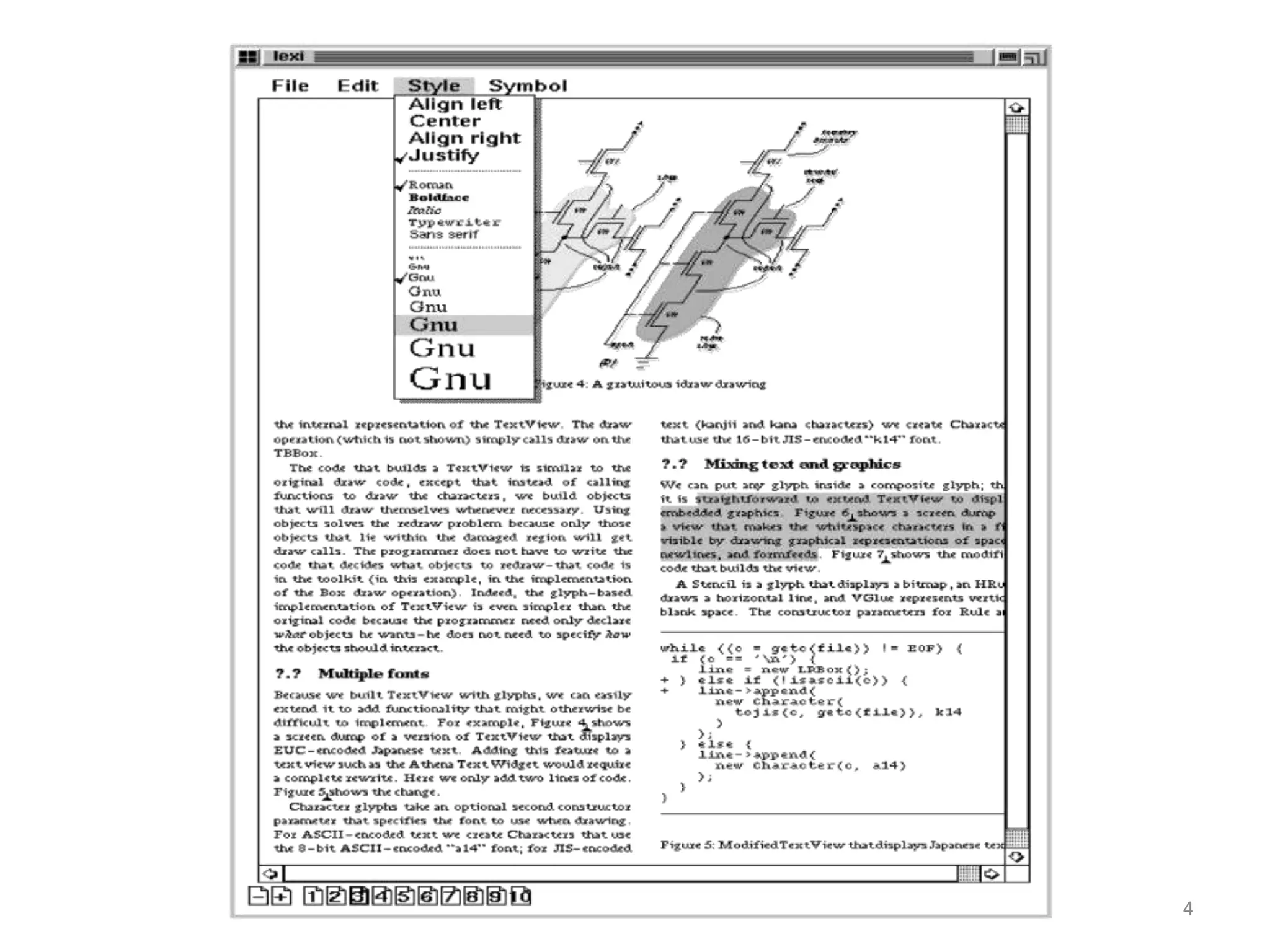
Introduction to Lexi Features
• WYSIWYG Document Editor
• Mix text and graphics in a variety of styles
• Pull-down Menus
• Scrollbars
• Icons for jumping to a particular page
3
4
Design Problems
1. Document Structure
2. Formatting
3. Embellishing the user interface
4. Supporting multiple look-and-feel standards
5. Supporting multiple window systems
6. User Operations
5
Document Structure
• Goals:
–present document’s visual aspects
–drawing, hit detection, alignment
–support physical structure
(e.g., lines, columns)
• Constraints/forces:
–treat text & graphics uniformly
–no distinction between one & many
6
• Some constraints:
– we should treat text and graphics uniformly
– our implementation shouldn’t have to
distinguish between single elements and
groups of elements in the internal
representation
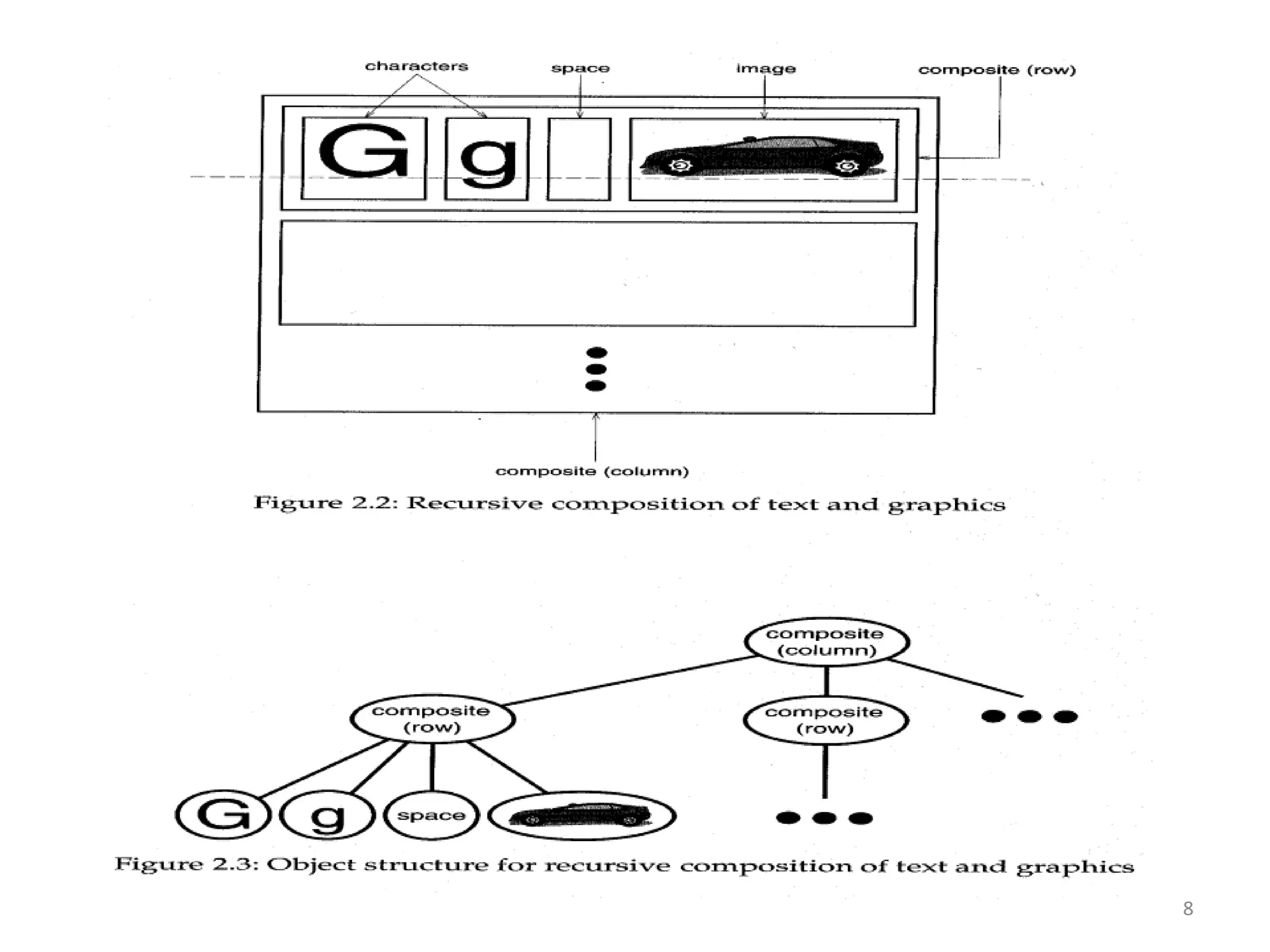
• Recursive Composition:
– a common way to represent hierarchically
structured information
7
8
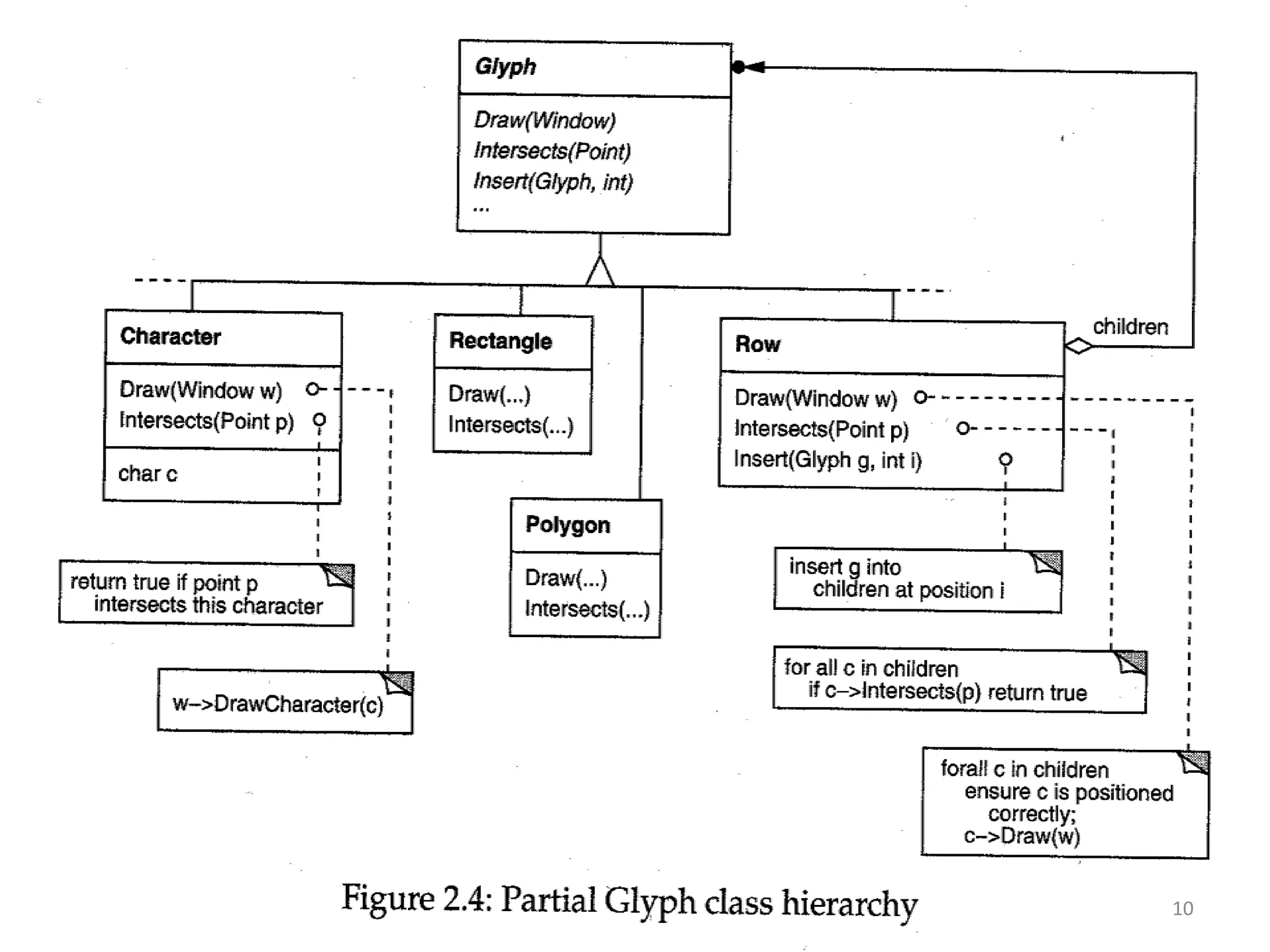
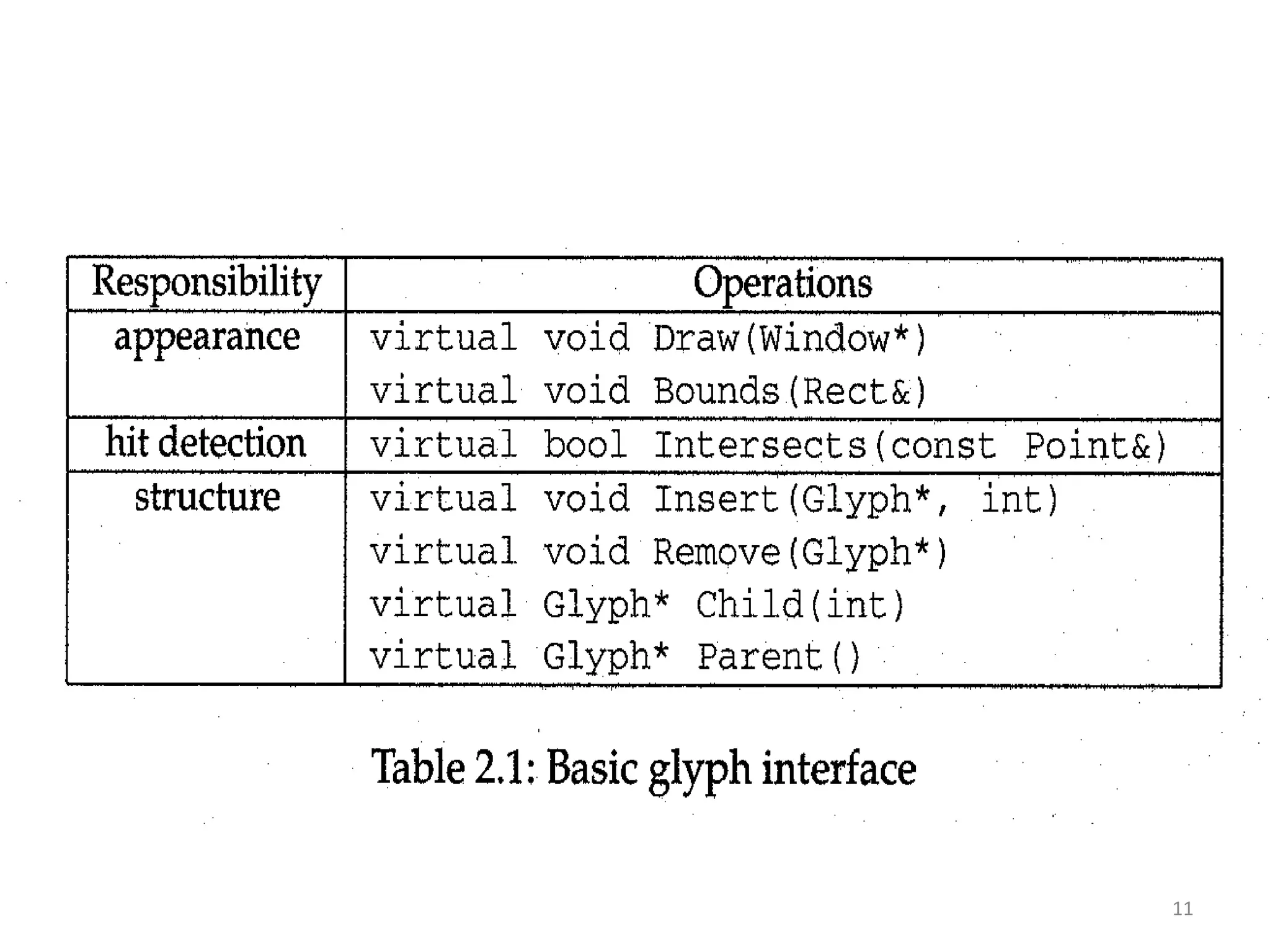
• Glyphs:
– an abstract class for all objects that can appear
in a document structure
– three basic responsibilities, they know
• how to draw themselves, what space they
occupy, and their children and parent
• Composite Pattern:
– captures the essence of recursive composition
in object-oriented terms
9
10
11
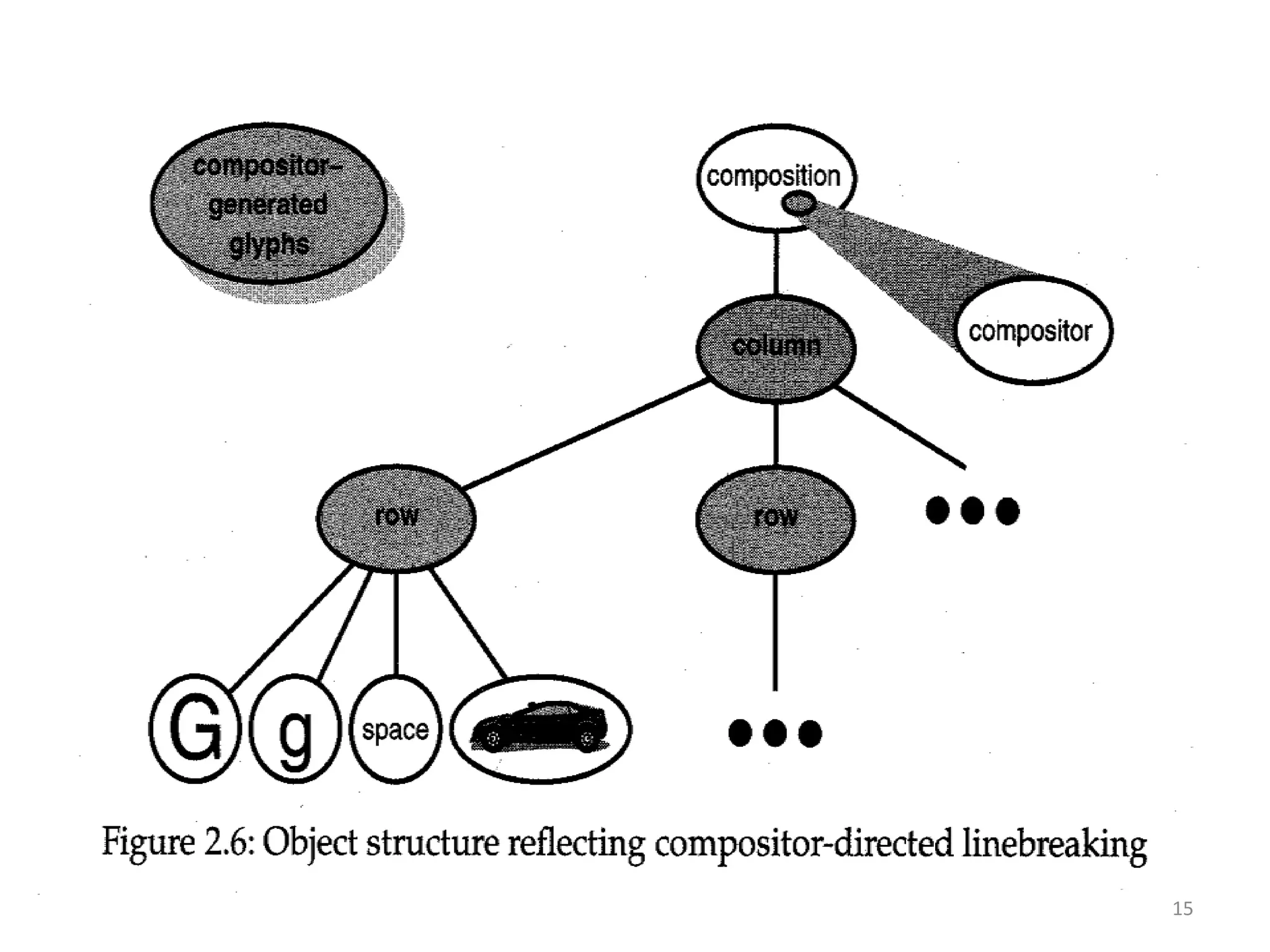
Formatting
• A structure that corresponds to a properly formatted
document
• Representation and formatting are distinct
– the ability to capture the document’s physical structure doesn’t
tell us how to arrive at a particular structure
• “Formatting” mean breaking a collection of glyphs in to
lines
• Encapsulating the formatting algorithm
– keep formatting algorithms completely independent
of the document structure
– make it is easy to change the formatting algorithm
– We’ll define a separate class hierarchy for objects that
encapsulate formatting algorithm
12
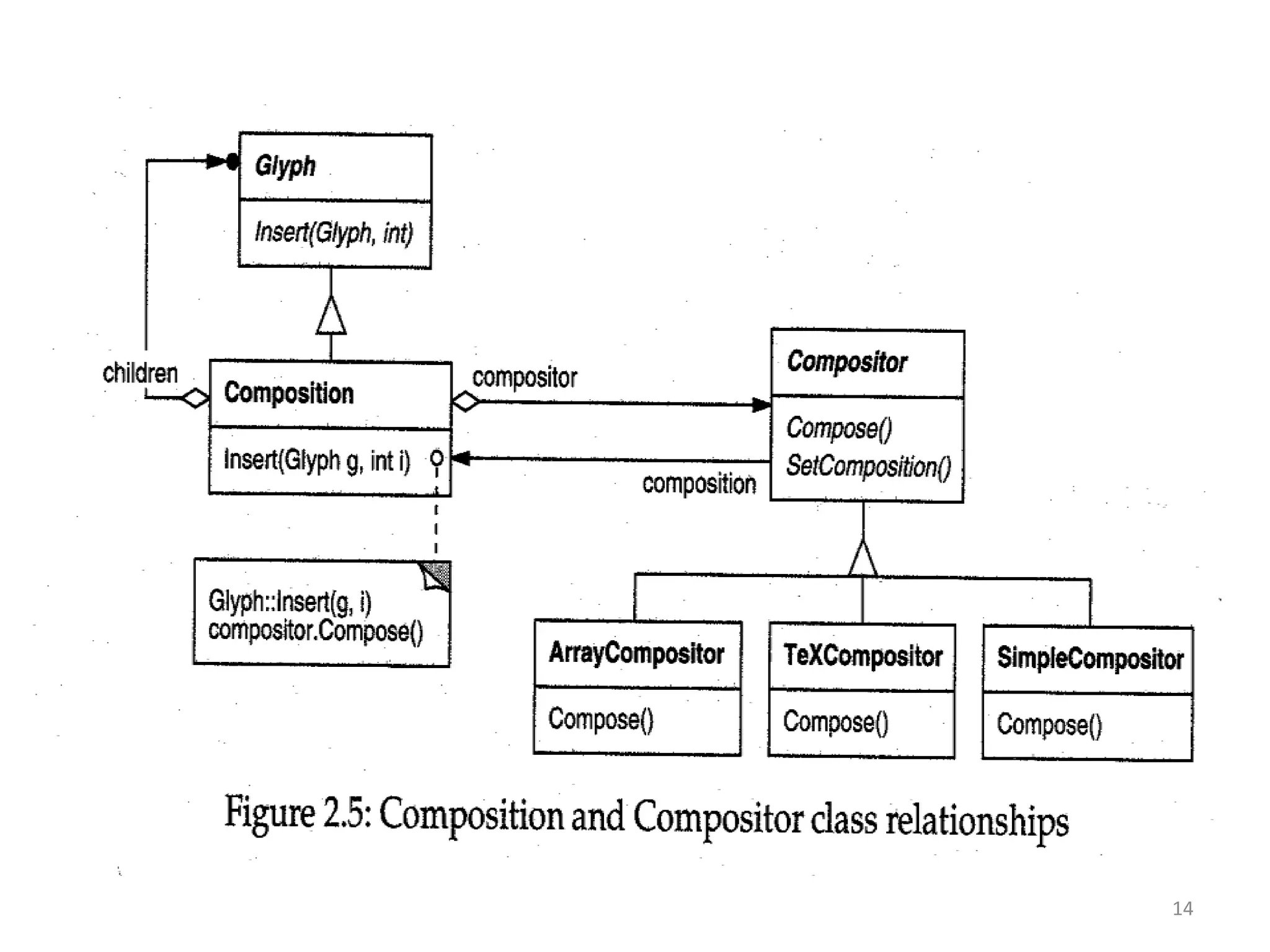
• Compositor and Composition:
– We’ll define a Compositor class for objects
that can encapsulate a formatting algorithm
– The glyphs Compositor formats are the
children of a special Glyph subclass called
Composition
– When the composition needs formatting, it
calls its compositor’s Compose operation
– Each Compositor subclass can implement a
different line breaking algorithm
• 13
14
15
Embellishing the User Interface
• Considering adds a border around the text
editing area and scrollbars that let the user view
the different parts of the page here
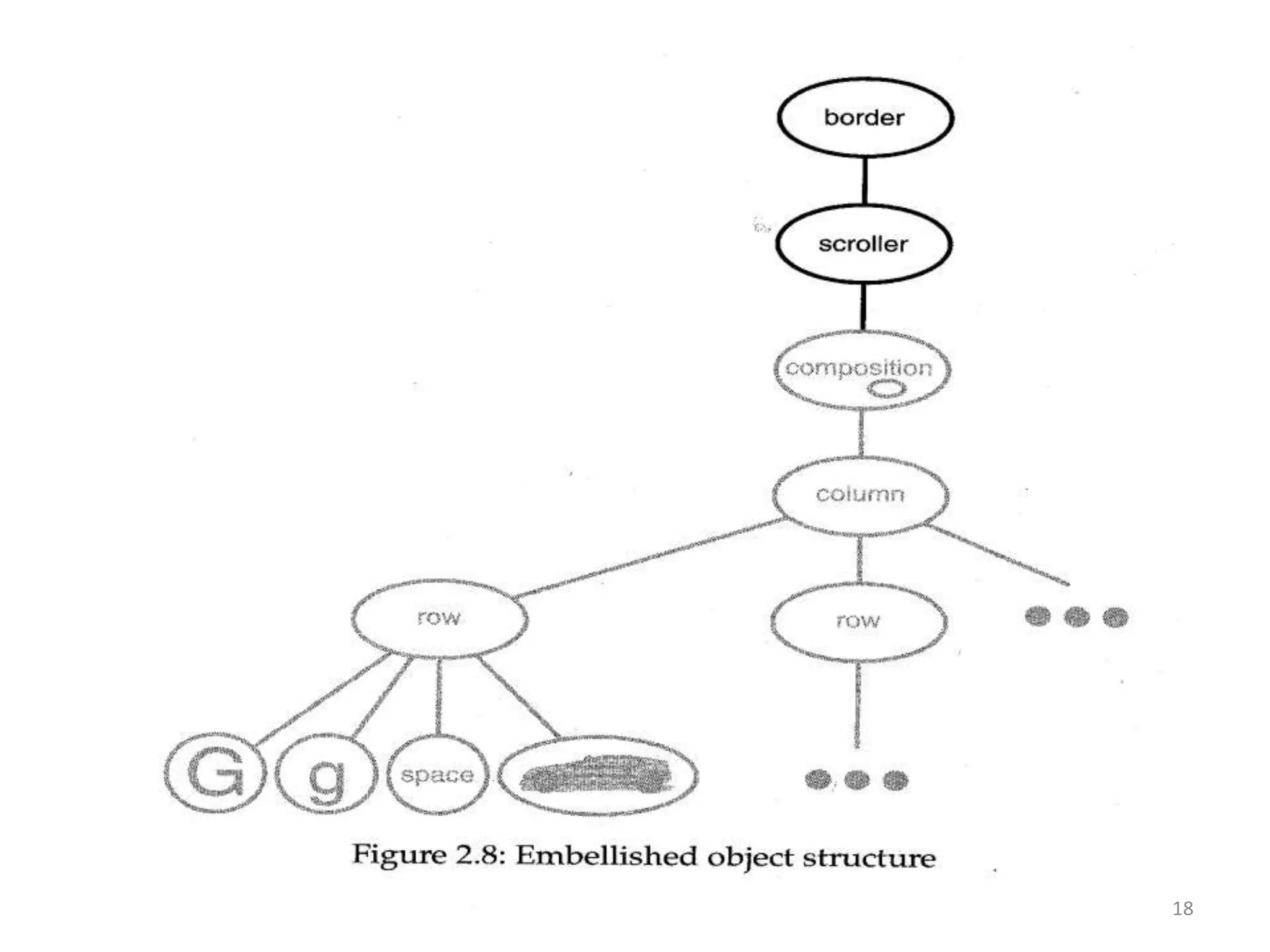
• Transparent Enclosure
– object composition
• Border and Scroller should be a subclass of Glyph
– two notions
• single-child (single-component) composition
• compatible interfaces
16
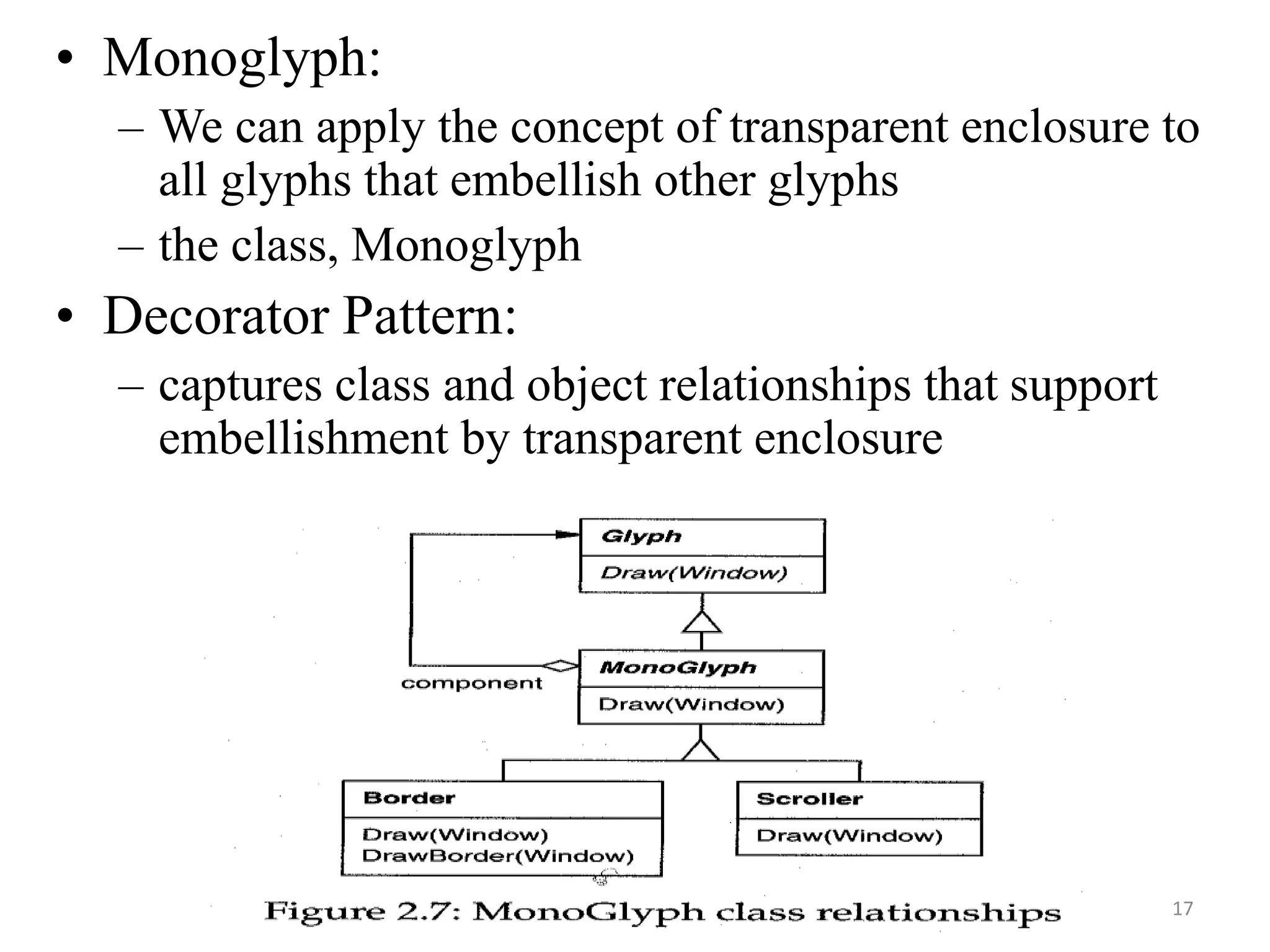
• Monoglyph:
– We can apply the concept of transparent enclosure to
all glyphs that embellish other glyphs
– the class, Monoglyph
• Decorator Pattern:
– captures class and object relationships that support
embellishment by transparent enclosure
17
18
Supporting Multiple
Look-and-Feel Standards
• Design to support the look-and-feel changing at
run-time
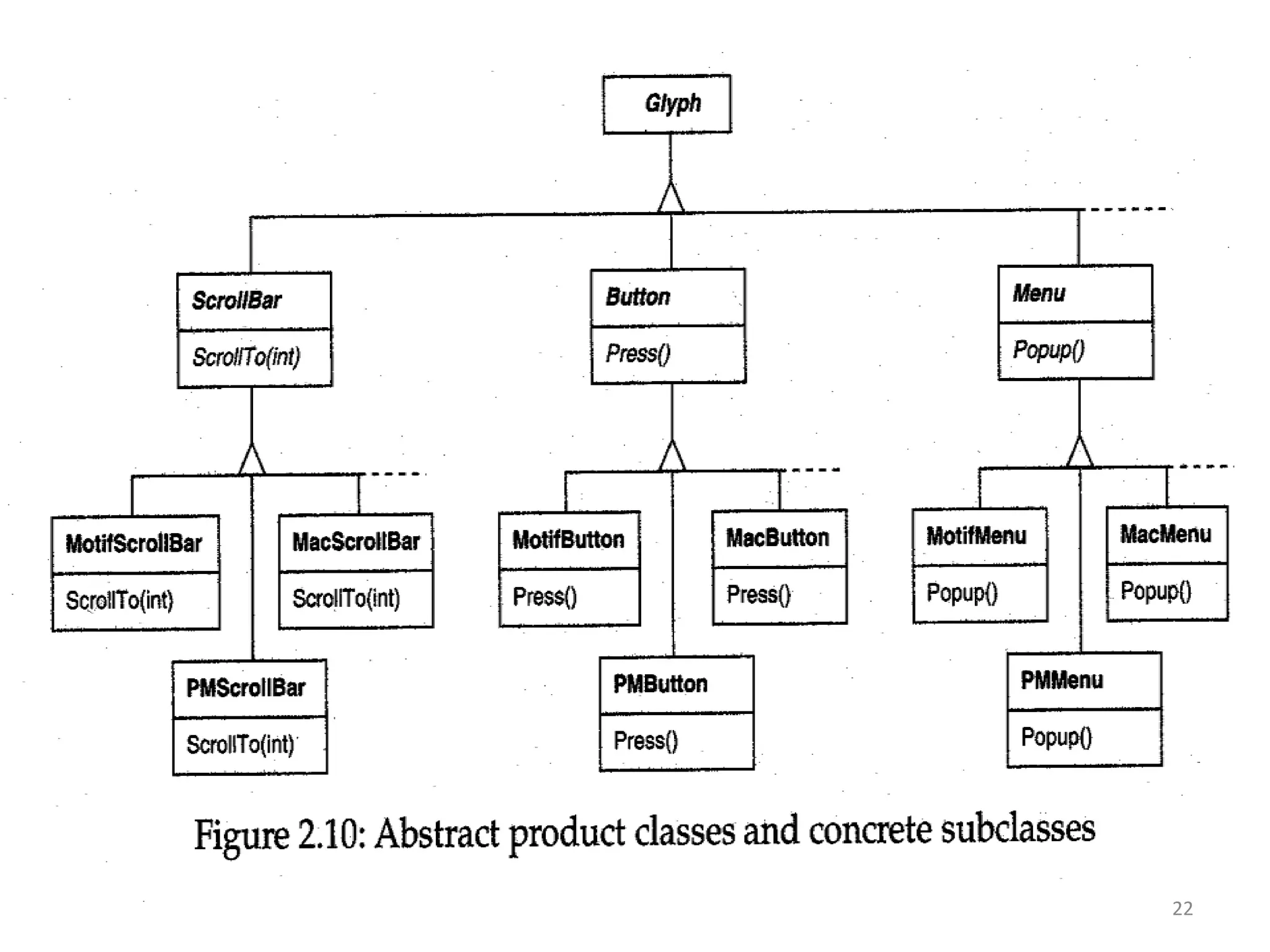
• Abstracting Object Creation:
– widgets
– two sets of widget glyph classes for this purpose
– Lexi needs a way to determine the look-and-feel
standard being targeted
– We must avoid making explicit constructor calls
– We must also be able to replace an entire widget set
easily
– We can achieve both by abstracting the process of
object creation
19
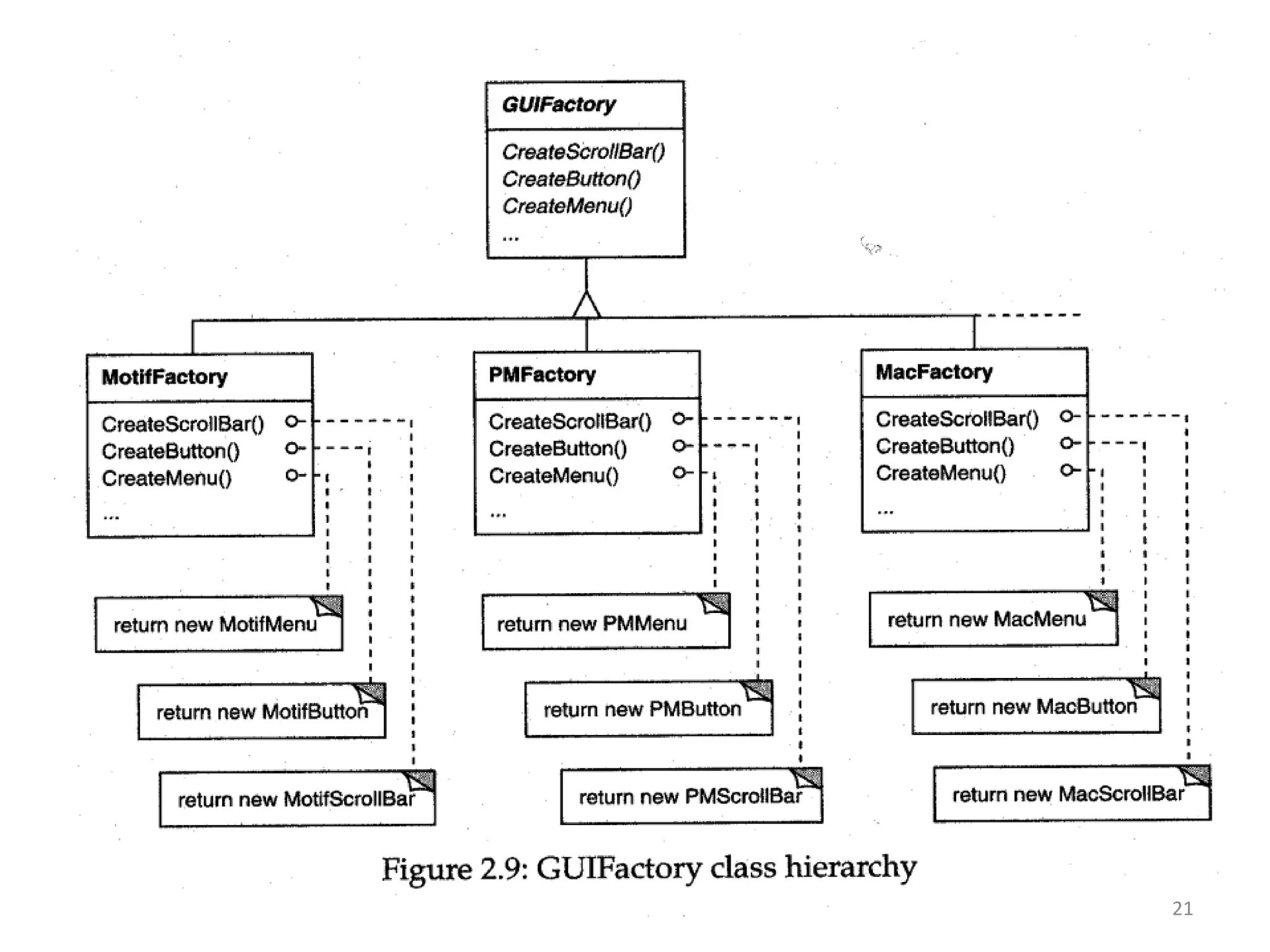
• Factories and Product Classes
– Factories create product objects
– The example
• Abstract Factory Pattern
– capture how to create families of related product
objects without instantiating classes directly
20
21
22
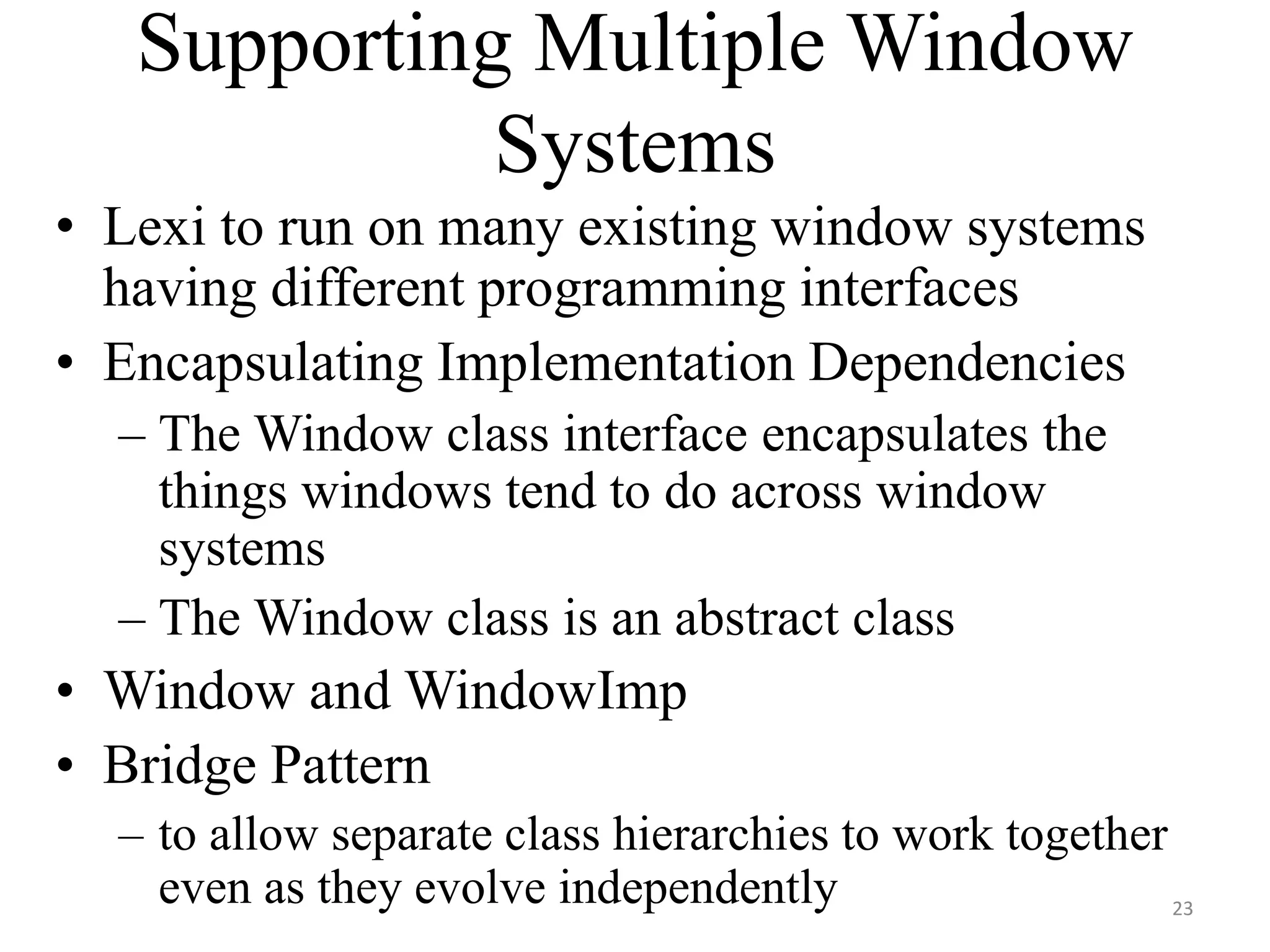
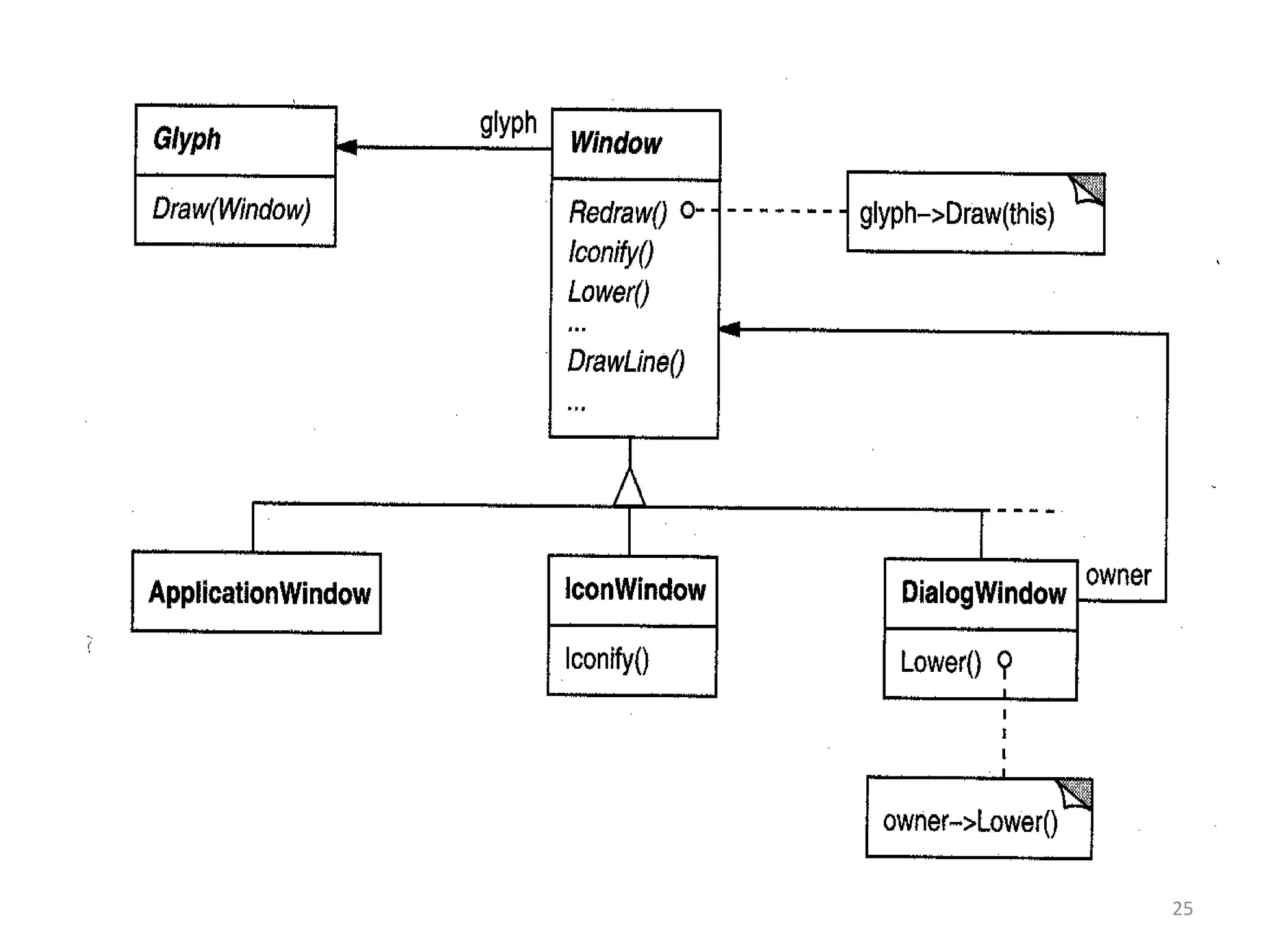
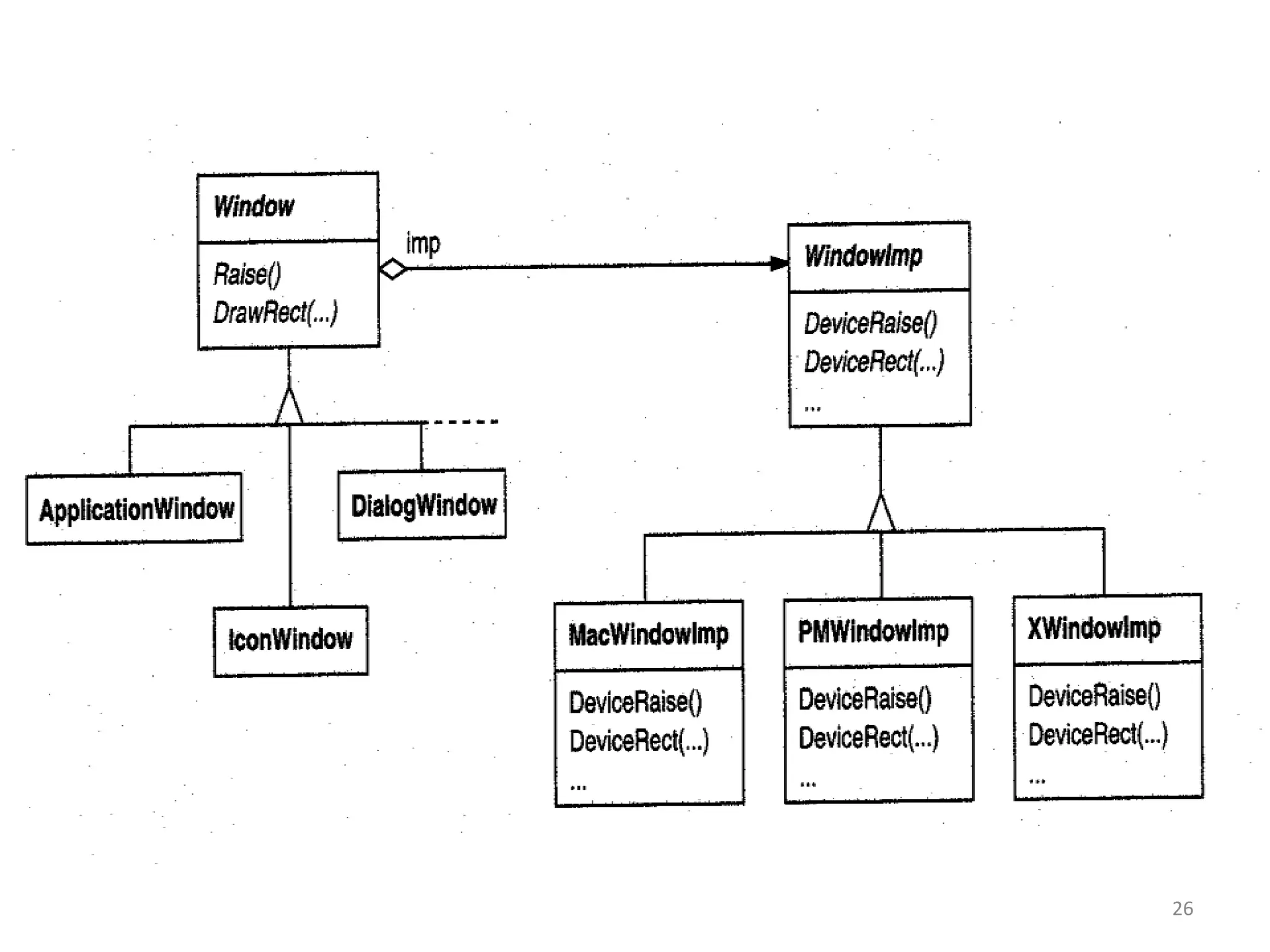
Supporting Multiple Window
Systems
• Lexi to run on many existing window systems
having different programming interfaces
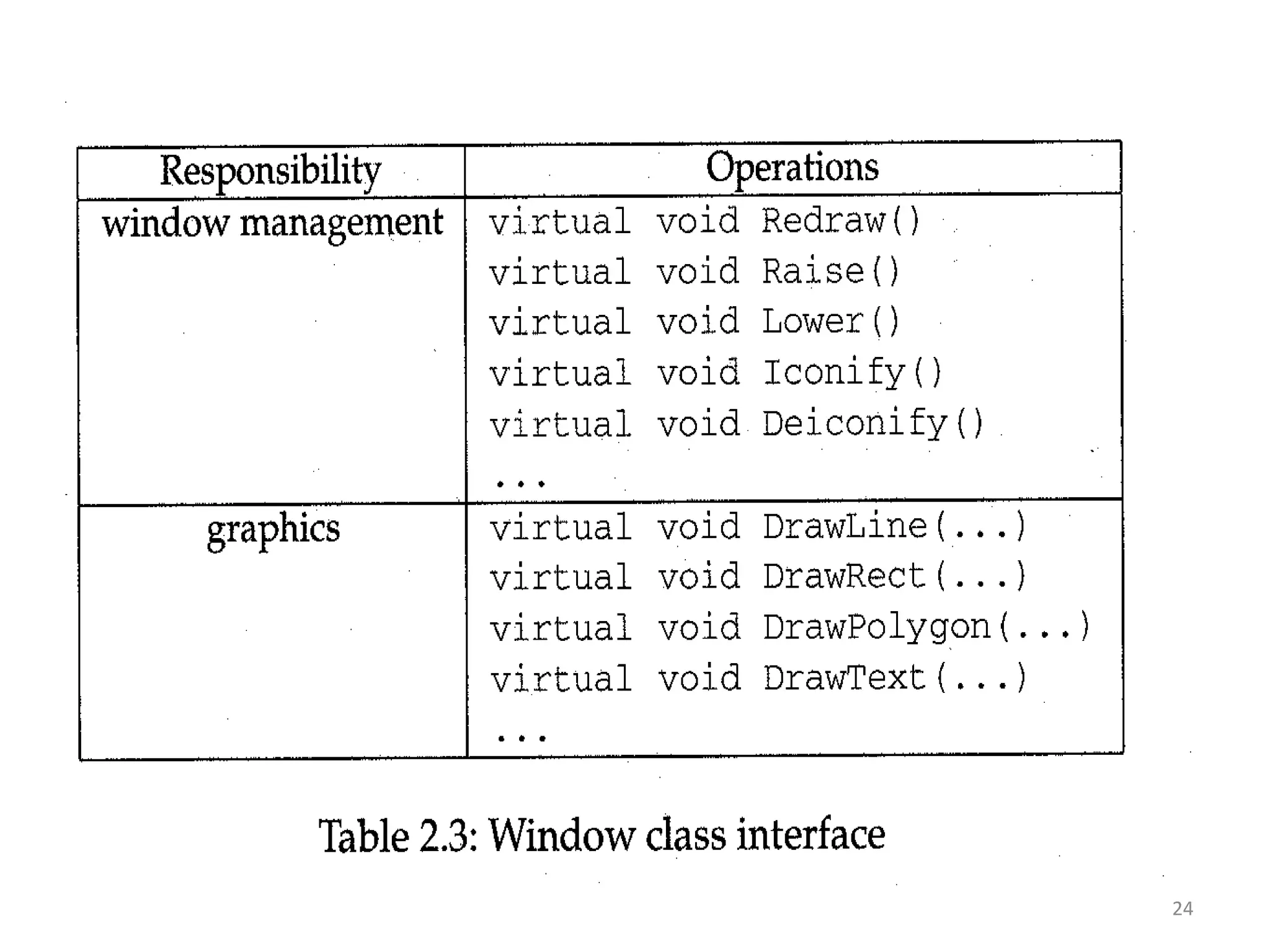
• Encapsulating Implementation Dependencies
– The Window class interface encapsulates the
things windows tend to do across window
systems
– The Window class is an abstract class
• Window and WindowImp
• Bridge Pattern
– to allow separate class hierarchies to work together
even as they evolve independently 23
24
25
26
User Operations
• Requirements:
– Lexi provides different user interfaces for the operations it
supported
– These operations are implemented in many different classes
– Lexi supports undo and redo
• The challenge is to come up with a simple and
extensible mechanism that satisfies all of these
needs
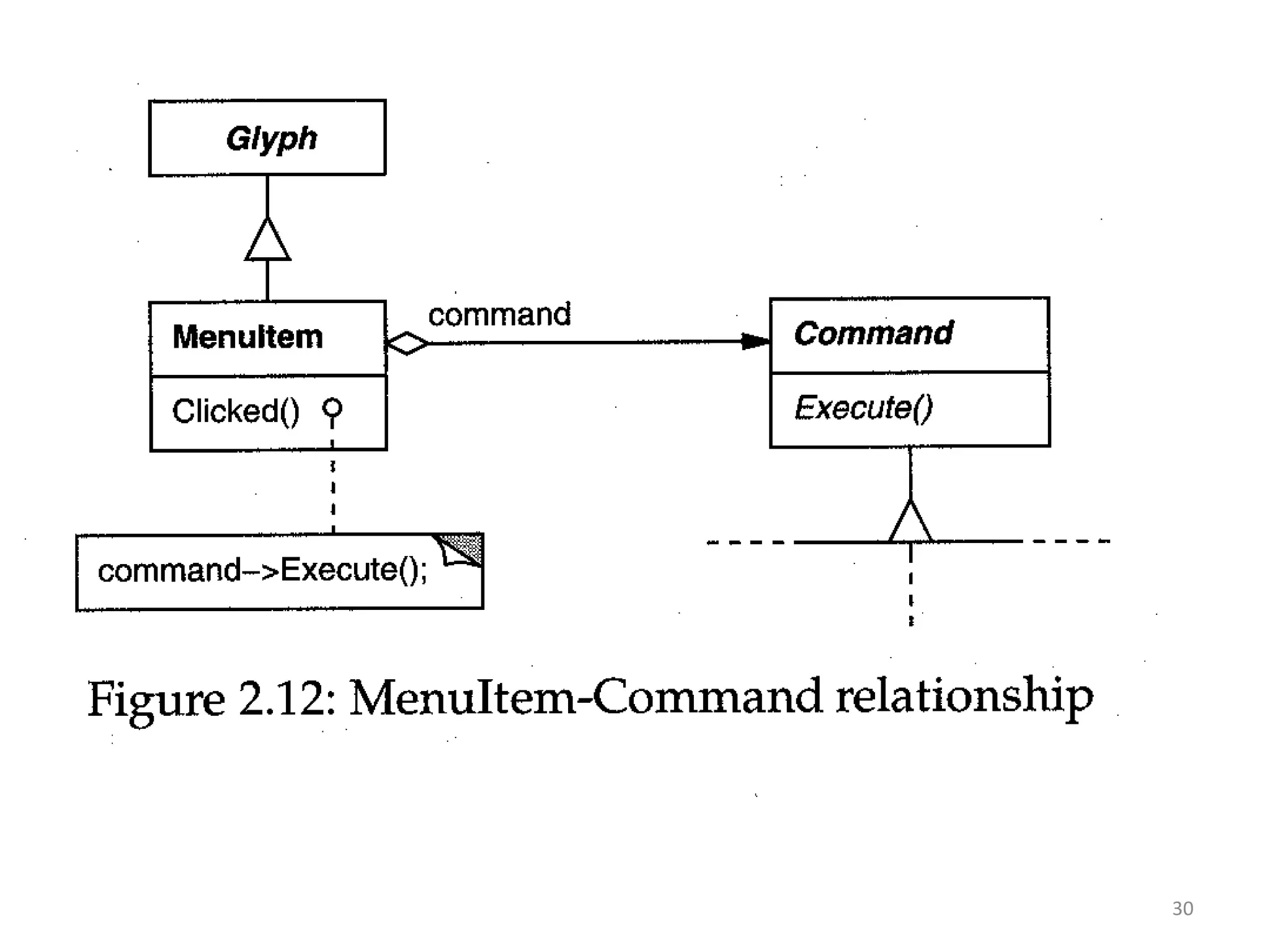
• Encapsulating a Request:
– We could parameterize MenuItem with a function to call, but
that’s not a complete solution
– We should parameterize MenuItems with an object, not a
function
27
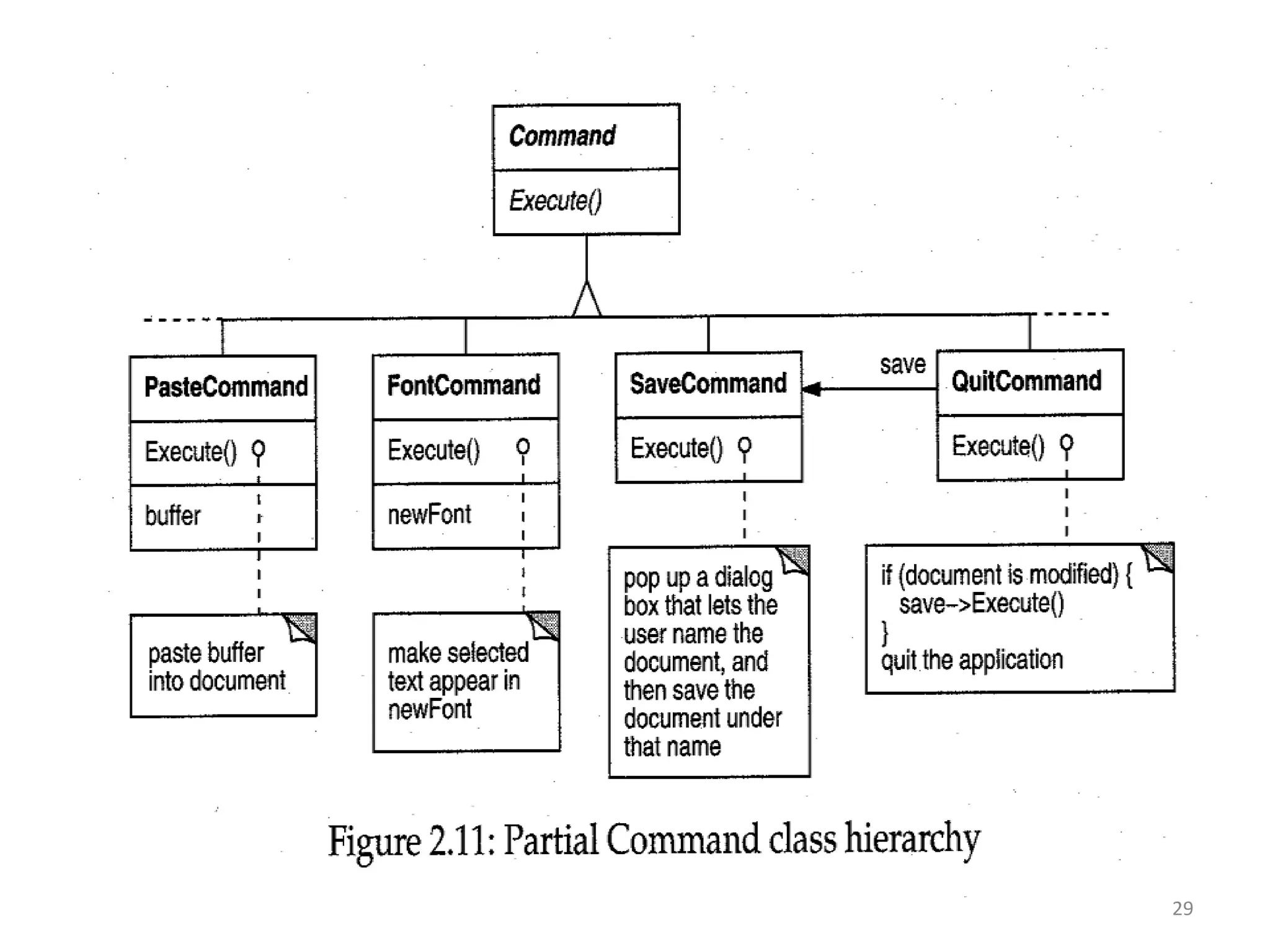
• Command Class and Subclasses:
– The Command abstract class consists of a single abstract
operation called “Execute”
– MenuItem can store a Command object that encapsulates a
request
– When a user choose a particular menu item, the MenuItem
simply calls Execute on its Command object to carry out
the request
28
29
30
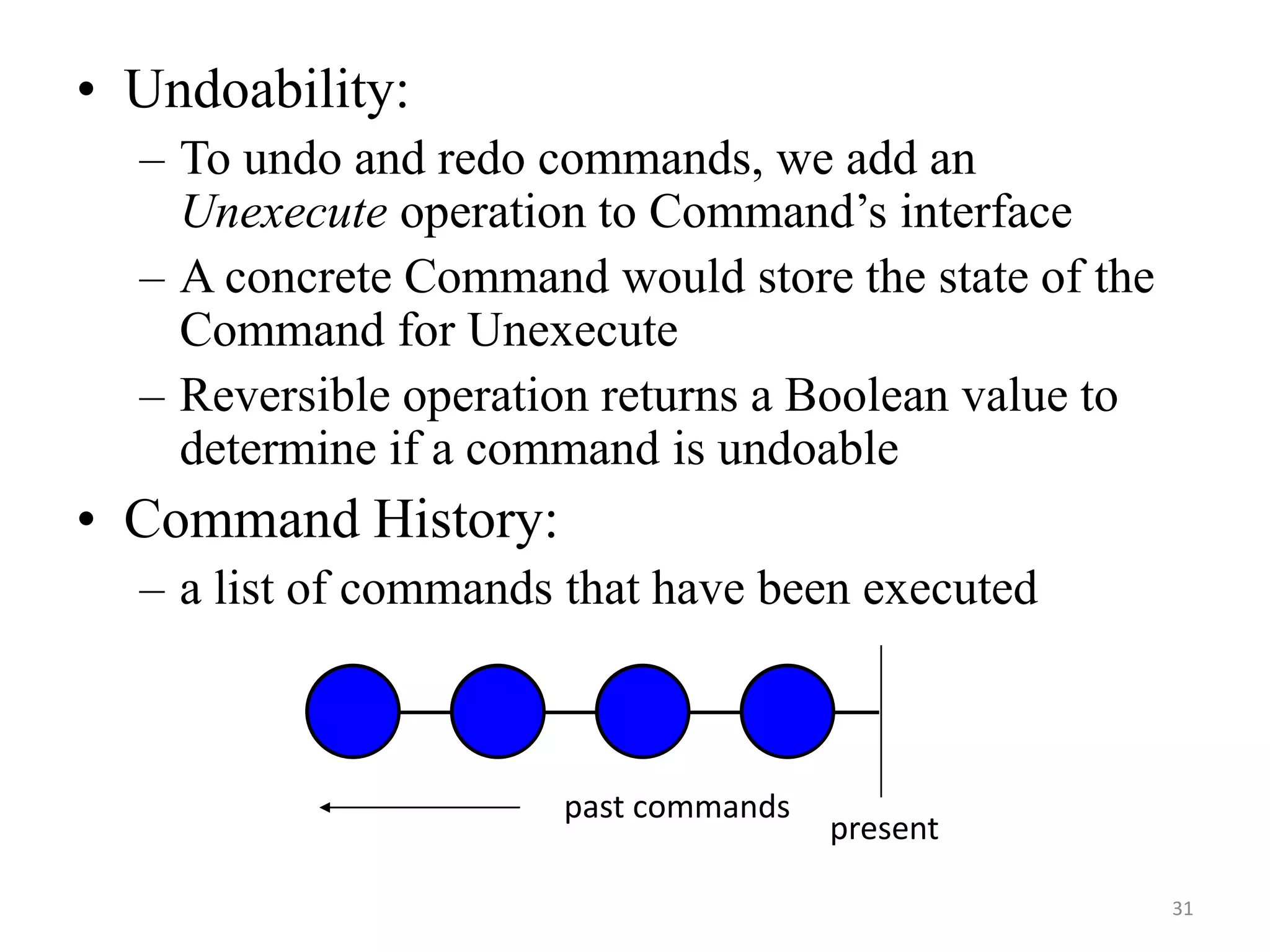
• Undoability:
– To undo and redo commands, we add an
Unexecute operation to Command’s interface
– A concrete Command would store the state of the
Command for Unexecute
– Reversible operation returns a Boolean value to
determine if a command is undoable
• Command History:
– a list of commands that have been executed
present
past commands
31
Spelling Checking &
Hyphenation
• Goals:
– analyze text for spelling errors
– introduce potential hyphenation sites
• Constraints/forces:
– support multiple algorithms
– don’t tightly couple algorithms with document
structure
32
Solution: Encapsulate Traversal
• Iterator
– encapsulates a traversal algorithm without exposing
representation details to callers
– uses Glyph’s child enumeration operation
– This is an example of a “preorder iterator”
• Intent
– access elements of a container without exposing its representation
• Applicability
– require multiple traversal algorithms over a container
– require a uniform traversal interface over different containers
– when container classes & traversal algorithm must vary independently
33
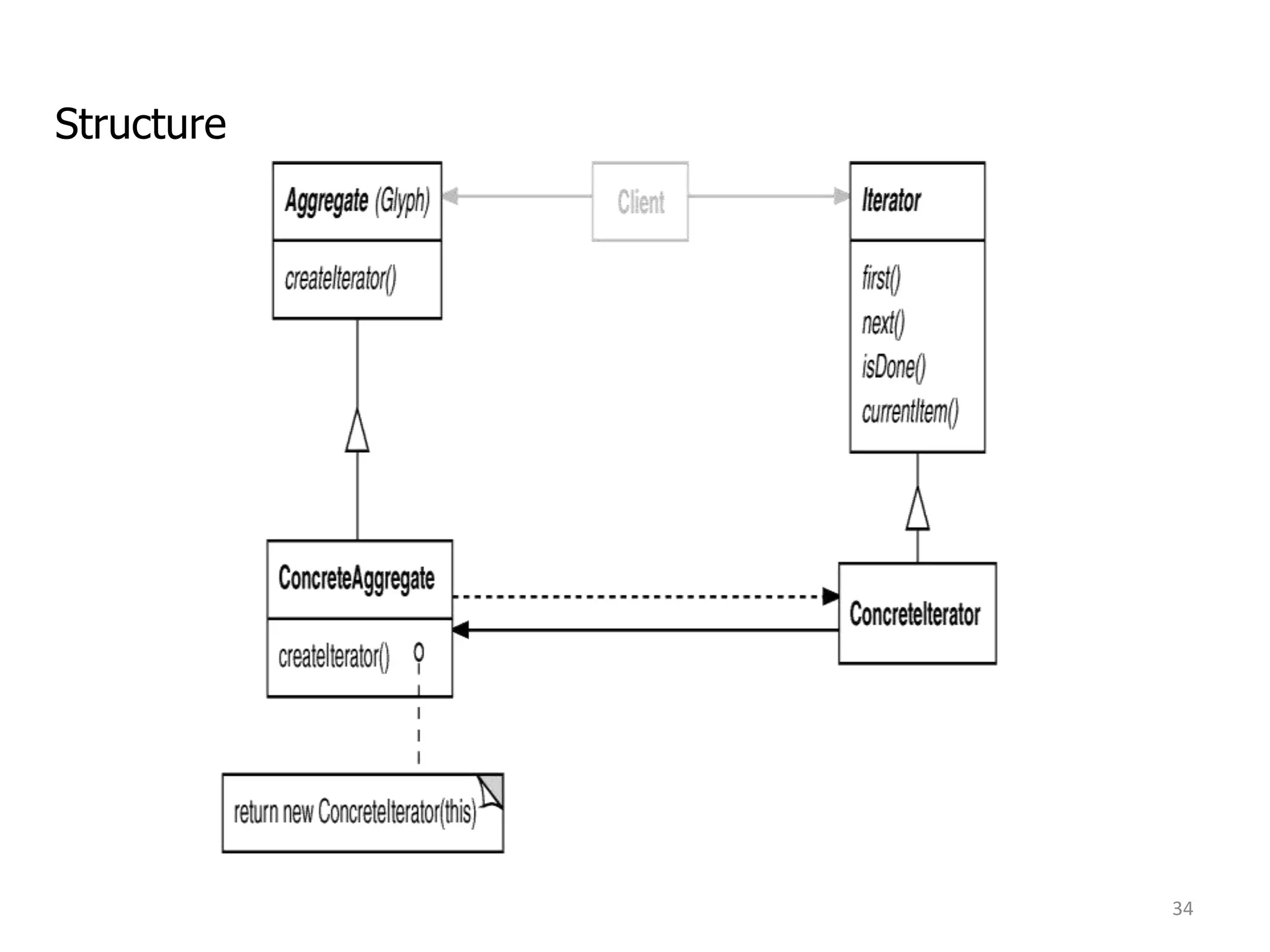
Structure
34
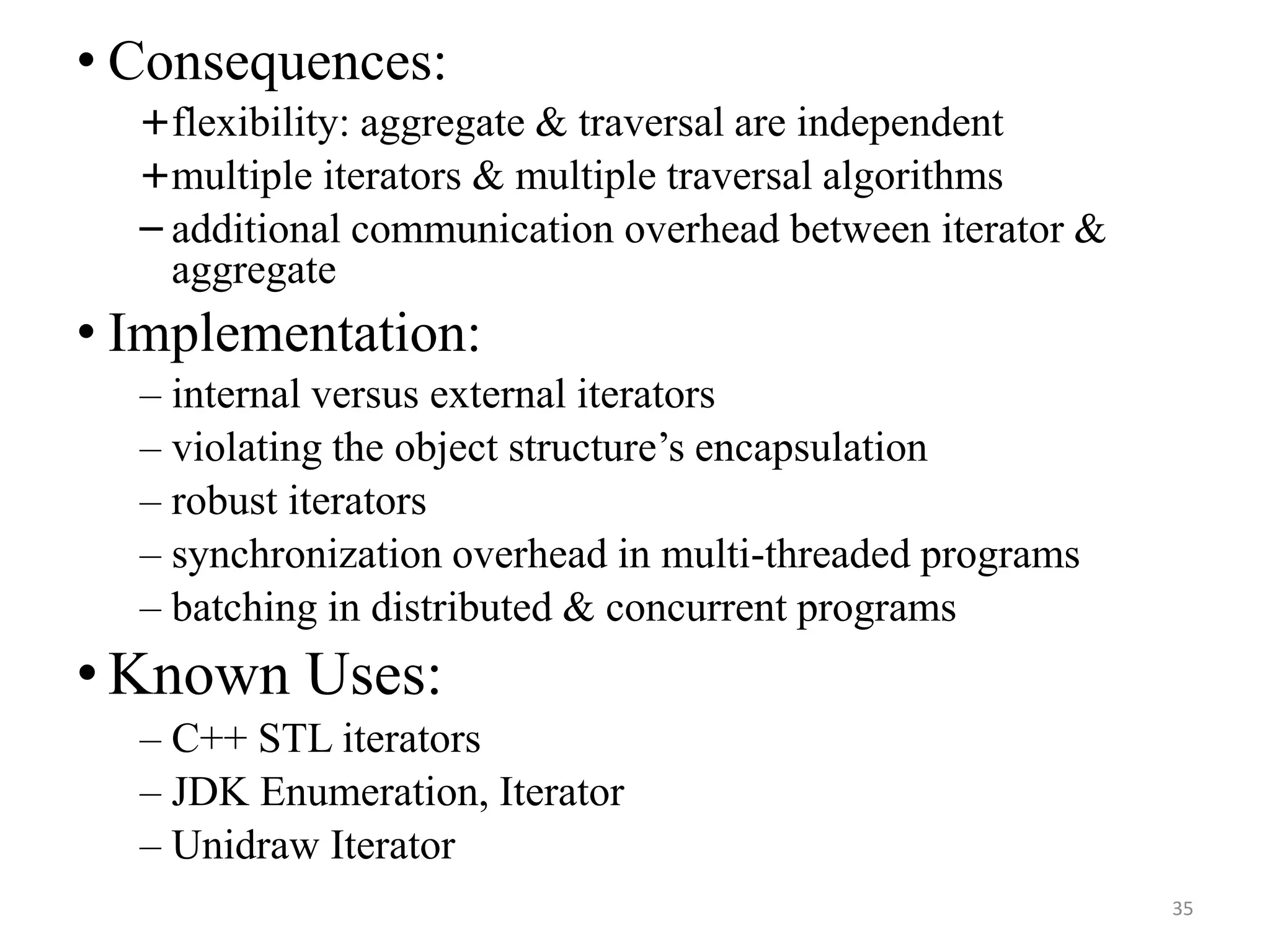
• Consequences:
+flexibility: aggregate & traversal are independent
+multiple iterators & multiple traversal algorithms
– additional communication overhead between iterator &
aggregate
• Implementation:
– internal versus external iterators
– violating the object structure’s encapsulation
– robust iterators
– synchronization overhead in multi-threaded programs
– batching in distributed & concurrent programs
• Known Uses:
– C++ STL iterators
– JDK Enumeration, Iterator
– Unidraw Iterator
35
Conclusion
• design reuse
• uniform design vocabulary
• understanding, restructuring, & team
communication
• provides the basis for automation
• a “new” way to think about design
36
37
Dr. Himanshu Hora
SRMS College of Engineering & Technology
Bareilly (UP) INDIA

Design Pattern

  • 1.
    Design Pattern “A casestudy: Designing a document editor” Dr. Himanshu Hora SRMS College of Engineering & Technology Bareilly (UP) INDIA 1
  • 2.
    Contents • Introduction toLexi features • Design problems • Spelling Checking & Hyphenation • Solution: Encapsulate Traversal • Conclusion 2
  • 3.
    Introduction to LexiFeatures • WYSIWYG Document Editor • Mix text and graphics in a variety of styles • Pull-down Menus • Scrollbars • Icons for jumping to a particular page 3
  • 4.
  • 5.
    Design Problems 1. DocumentStructure 2. Formatting 3. Embellishing the user interface 4. Supporting multiple look-and-feel standards 5. Supporting multiple window systems 6. User Operations 5
  • 6.
    Document Structure • Goals: –presentdocument’s visual aspects –drawing, hit detection, alignment –support physical structure (e.g., lines, columns) • Constraints/forces: –treat text & graphics uniformly –no distinction between one & many 6
  • 7.
    • Some constraints: –we should treat text and graphics uniformly – our implementation shouldn’t have to distinguish between single elements and groups of elements in the internal representation • Recursive Composition: – a common way to represent hierarchically structured information 7
  • 8.
  • 9.
    • Glyphs: – anabstract class for all objects that can appear in a document structure – three basic responsibilities, they know • how to draw themselves, what space they occupy, and their children and parent • Composite Pattern: – captures the essence of recursive composition in object-oriented terms 9
  • 10.
  • 11.
  • 12.
    Formatting • A structurethat corresponds to a properly formatted document • Representation and formatting are distinct – the ability to capture the document’s physical structure doesn’t tell us how to arrive at a particular structure • “Formatting” mean breaking a collection of glyphs in to lines • Encapsulating the formatting algorithm – keep formatting algorithms completely independent of the document structure – make it is easy to change the formatting algorithm – We’ll define a separate class hierarchy for objects that encapsulate formatting algorithm 12
  • 13.
    • Compositor andComposition: – We’ll define a Compositor class for objects that can encapsulate a formatting algorithm – The glyphs Compositor formats are the children of a special Glyph subclass called Composition – When the composition needs formatting, it calls its compositor’s Compose operation – Each Compositor subclass can implement a different line breaking algorithm • 13
  • 14.
  • 15.
  • 16.
    Embellishing the UserInterface • Considering adds a border around the text editing area and scrollbars that let the user view the different parts of the page here • Transparent Enclosure – object composition • Border and Scroller should be a subclass of Glyph – two notions • single-child (single-component) composition • compatible interfaces 16
  • 17.
    • Monoglyph: – Wecan apply the concept of transparent enclosure to all glyphs that embellish other glyphs – the class, Monoglyph • Decorator Pattern: – captures class and object relationships that support embellishment by transparent enclosure 17
  • 18.
  • 19.
    Supporting Multiple Look-and-Feel Standards •Design to support the look-and-feel changing at run-time • Abstracting Object Creation: – widgets – two sets of widget glyph classes for this purpose – Lexi needs a way to determine the look-and-feel standard being targeted – We must avoid making explicit constructor calls – We must also be able to replace an entire widget set easily – We can achieve both by abstracting the process of object creation 19
  • 20.
    • Factories andProduct Classes – Factories create product objects – The example • Abstract Factory Pattern – capture how to create families of related product objects without instantiating classes directly 20
  • 21.
  • 22.
  • 23.
    Supporting Multiple Window Systems •Lexi to run on many existing window systems having different programming interfaces • Encapsulating Implementation Dependencies – The Window class interface encapsulates the things windows tend to do across window systems – The Window class is an abstract class • Window and WindowImp • Bridge Pattern – to allow separate class hierarchies to work together even as they evolve independently 23
  • 24.
  • 25.
  • 26.
  • 27.
    User Operations • Requirements: –Lexi provides different user interfaces for the operations it supported – These operations are implemented in many different classes – Lexi supports undo and redo • The challenge is to come up with a simple and extensible mechanism that satisfies all of these needs • Encapsulating a Request: – We could parameterize MenuItem with a function to call, but that’s not a complete solution – We should parameterize MenuItems with an object, not a function 27
  • 28.
    • Command Classand Subclasses: – The Command abstract class consists of a single abstract operation called “Execute” – MenuItem can store a Command object that encapsulates a request – When a user choose a particular menu item, the MenuItem simply calls Execute on its Command object to carry out the request 28
  • 29.
  • 30.
  • 31.
    • Undoability: – Toundo and redo commands, we add an Unexecute operation to Command’s interface – A concrete Command would store the state of the Command for Unexecute – Reversible operation returns a Boolean value to determine if a command is undoable • Command History: – a list of commands that have been executed present past commands 31
  • 32.
    Spelling Checking & Hyphenation •Goals: – analyze text for spelling errors – introduce potential hyphenation sites • Constraints/forces: – support multiple algorithms – don’t tightly couple algorithms with document structure 32
  • 33.
    Solution: Encapsulate Traversal •Iterator – encapsulates a traversal algorithm without exposing representation details to callers – uses Glyph’s child enumeration operation – This is an example of a “preorder iterator” • Intent – access elements of a container without exposing its representation • Applicability – require multiple traversal algorithms over a container – require a uniform traversal interface over different containers – when container classes & traversal algorithm must vary independently 33
  • 34.
  • 35.
    • Consequences: +flexibility: aggregate& traversal are independent +multiple iterators & multiple traversal algorithms – additional communication overhead between iterator & aggregate • Implementation: – internal versus external iterators – violating the object structure’s encapsulation – robust iterators – synchronization overhead in multi-threaded programs – batching in distributed & concurrent programs • Known Uses: – C++ STL iterators – JDK Enumeration, Iterator – Unidraw Iterator 35
  • 36.
    Conclusion • design reuse •uniform design vocabulary • understanding, restructuring, & team communication • provides the basis for automation • a “new” way to think about design 36
  • 37.
    37 Dr. Himanshu Hora SRMSCollege of Engineering & Technology Bareilly (UP) INDIA