Software Engineering: 23
Software Reliability
Prof Neeraj Bhargava
Vaibhav Khanna
Department of Computer Science
School of Engineering and Systems Sciences
Maharshi Dayanand Saraswati University Ajmer
Notion of Reliability
• Aims at fault-free performance of software
systems
• Software reliability goes hand-in-hand with
software verification
– Input: collection of software test results
– Goal: assess the validity of the software system
• Targets safety-critical software
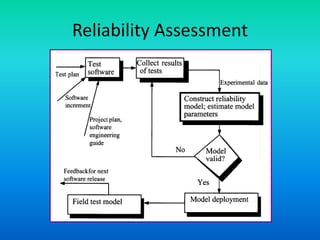
Reliability Assessment
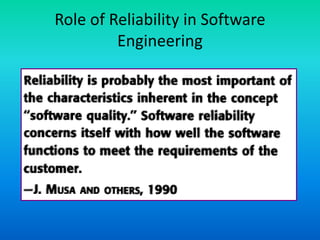
Role of Reliability in Software
Engineering
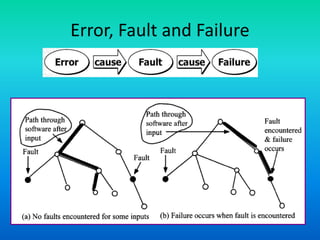
Error, Fault and Failure
• Error: human action that results in software
containing a fault
• Fault: a cause for an internal error (failure)
• Failure: any observable divergence of software
behavior in execution from user needs
• Failure intensity: the number of failures per time
unit
Error, Fault and Failure
More Basic Notions
• Failure: any observable divergence of software
behavior in execution from user needs
• Failure intensity: the number of failures per natural
or time unit. Failure intensity is a way of expressing
reliability.
• Availability: The probability that at a given time that
a system or a capability of a system functions
satisfactorily in a specified environment.
• If you are given an average downtime per failure, then
availability implies a kind of reliability.
Classical Definition of Reliability
• Software Reliability is the probability that a system
will operate without failure under given
environmental conditions for a specified period of
time.
• We express reliability on a scale from 0 to 1:
– highly reliable system will have a reliability measure close
to 1, and
– unreliable system will have a measure close to 0.
• Reliability is measured over execution time so that
it more accurately reflects system usage.
• GOAL: reliability must be quantified so that we can compare
software systems
Characters of Software Reliability
• Failures are primarily due to design faults.
– Repairs are made by modifying the design to make it robust
against conditions that can trigger a failure.
• There is no wear-out phenomena.
– Software errors occur without warning.
– “Old” code can exhibit an increasing failure rate as a function of
errors induced while making upgrades.
– External environment conditions do not affect software reliability.
– Internal environmental conditions, such as insufficient memory or
inappropriate clock speeds do affect software reliability.
• Reliability is not time dependent.
– Failures occur when the logic path that contains an error is
executed.
– Reliability growth is observed as errors are detected and
corrected.
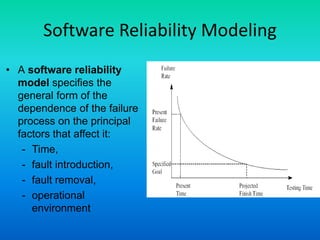
Software Reliability Modeling
• A software reliability
model specifies the
general form of the
dependence of the failure
process on the principal
factors that affect it:
- Time,
- fault introduction,
- fault removal,
- operational
environment
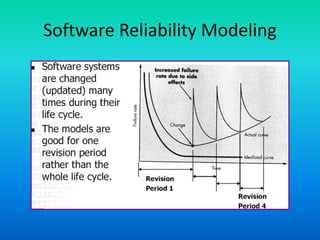
Software Reliability Modeling
Assignment
• Explain the concept of software reliability and
its importance.
• Thank You

Software engineering 23 software reliability

  • 1.
    Software Engineering: 23 SoftwareReliability Prof Neeraj Bhargava Vaibhav Khanna Department of Computer Science School of Engineering and Systems Sciences Maharshi Dayanand Saraswati University Ajmer
  • 2.
    Notion of Reliability •Aims at fault-free performance of software systems • Software reliability goes hand-in-hand with software verification – Input: collection of software test results – Goal: assess the validity of the software system • Targets safety-critical software
  • 3.
  • 4.
    Role of Reliabilityin Software Engineering
  • 5.
    Error, Fault andFailure • Error: human action that results in software containing a fault • Fault: a cause for an internal error (failure) • Failure: any observable divergence of software behavior in execution from user needs • Failure intensity: the number of failures per time unit
  • 6.
  • 7.
    More Basic Notions •Failure: any observable divergence of software behavior in execution from user needs • Failure intensity: the number of failures per natural or time unit. Failure intensity is a way of expressing reliability. • Availability: The probability that at a given time that a system or a capability of a system functions satisfactorily in a specified environment. • If you are given an average downtime per failure, then availability implies a kind of reliability.
  • 8.
    Classical Definition ofReliability • Software Reliability is the probability that a system will operate without failure under given environmental conditions for a specified period of time. • We express reliability on a scale from 0 to 1: – highly reliable system will have a reliability measure close to 1, and – unreliable system will have a measure close to 0. • Reliability is measured over execution time so that it more accurately reflects system usage. • GOAL: reliability must be quantified so that we can compare software systems
  • 9.
    Characters of SoftwareReliability • Failures are primarily due to design faults. – Repairs are made by modifying the design to make it robust against conditions that can trigger a failure. • There is no wear-out phenomena. – Software errors occur without warning. – “Old” code can exhibit an increasing failure rate as a function of errors induced while making upgrades. – External environment conditions do not affect software reliability. – Internal environmental conditions, such as insufficient memory or inappropriate clock speeds do affect software reliability. • Reliability is not time dependent. – Failures occur when the logic path that contains an error is executed. – Reliability growth is observed as errors are detected and corrected.
  • 10.
    Software Reliability Modeling •A software reliability model specifies the general form of the dependence of the failure process on the principal factors that affect it: - Time, - fault introduction, - fault removal, - operational environment
  • 11.
  • 12.
    Assignment • Explain theconcept of software reliability and its importance. • Thank You