Subgradient methods for huge-scale optimization
problems
Yurii Nesterov, CORE/INMA (UCL)
November 10, 2014 (Yandex, Moscow)
Yu. Nesterov Subgradient methods for huge-scale problems 1/22
Outline
1 Problems sizes
2 Sparse Optimization problems
3 Sparse updates for linear operators
4 Fast updates in computational trees
5 Simple subgradient methods
6 Application examples
7 Computational experiments: Google problem
Yu. Nesterov Subgradient methods for huge-scale problems 2/22
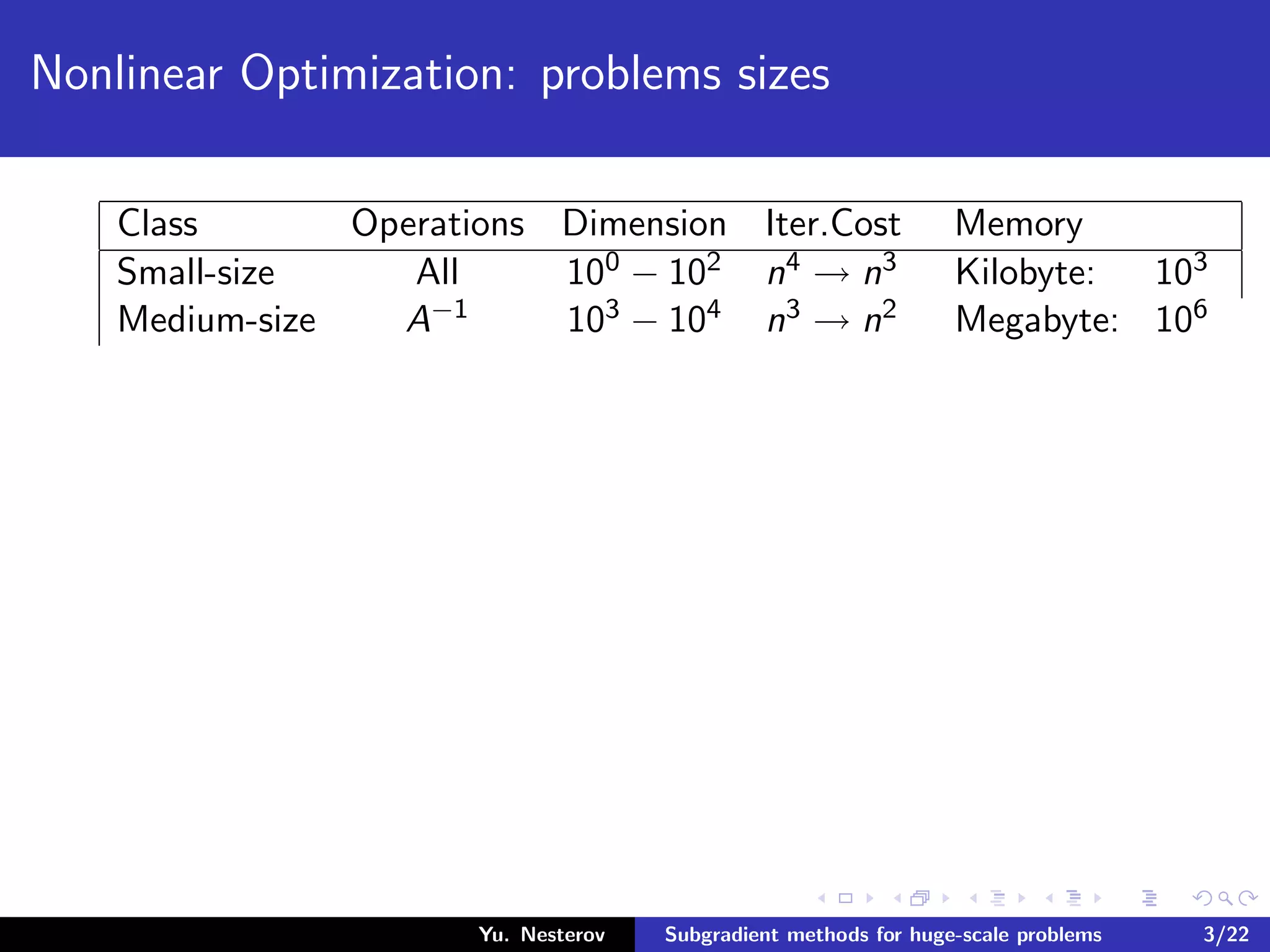
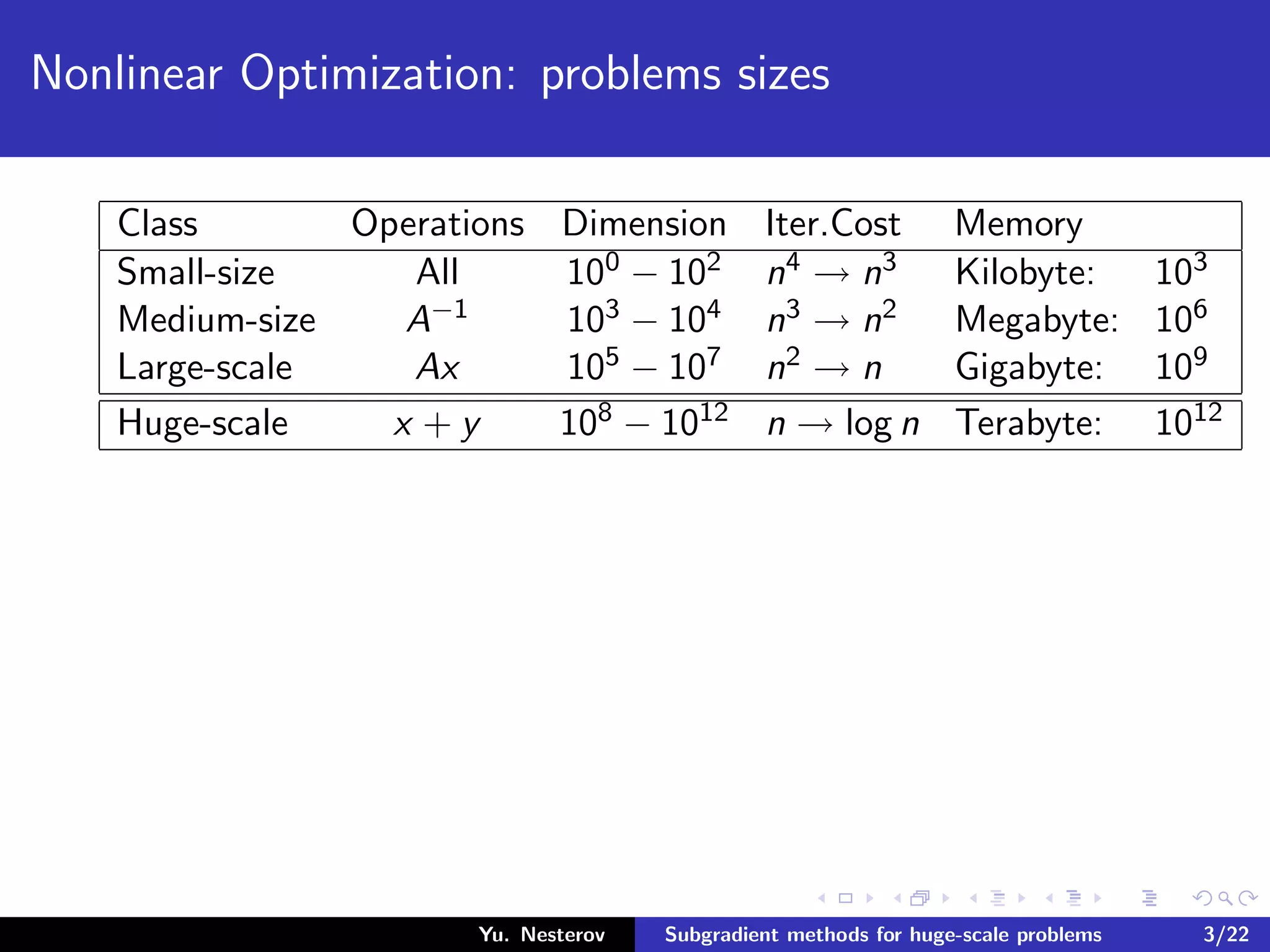
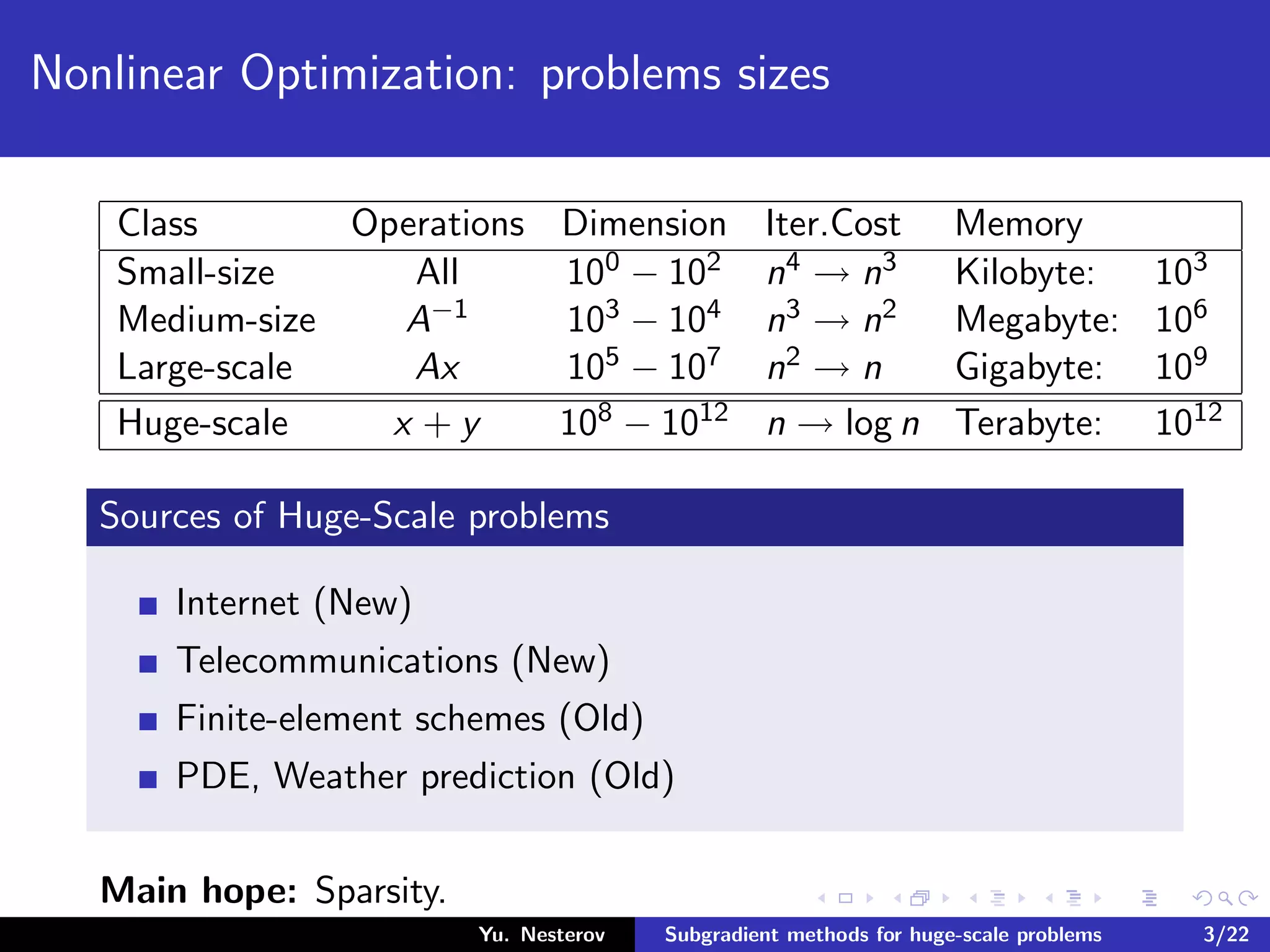
Nonlinear Optimization: problems sizes
Class Operations Dimension Iter.Cost Memory
Small-size All 100 − 102 n4 → n3 Kilobyte: 103
Medium-size A−1 103 − 104 n3 → n2 Megabyte: 106
Yu. Nesterov Subgradient methods for huge-scale problems 3/22
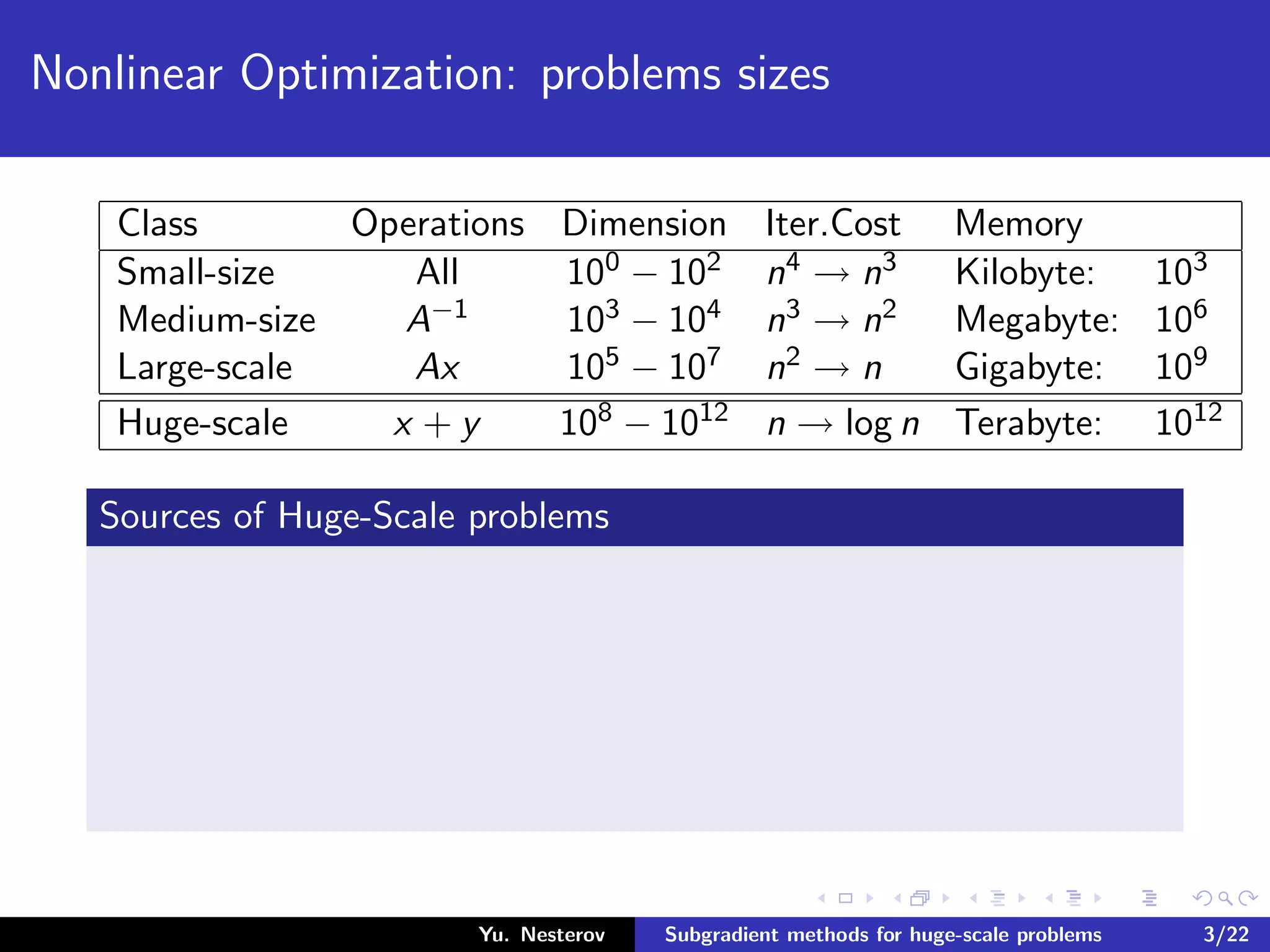
Nonlinear Optimization: problems sizes
Class Operations Dimension Iter.Cost Memory
Small-size All 100 − 102 n4 → n3 Kilobyte: 103
Medium-size A−1 103 − 104 n3 → n2 Megabyte: 106
Large-scale Ax 105 − 107 n2 → n Gigabyte: 109
Yu. Nesterov Subgradient methods for huge-scale problems 3/22
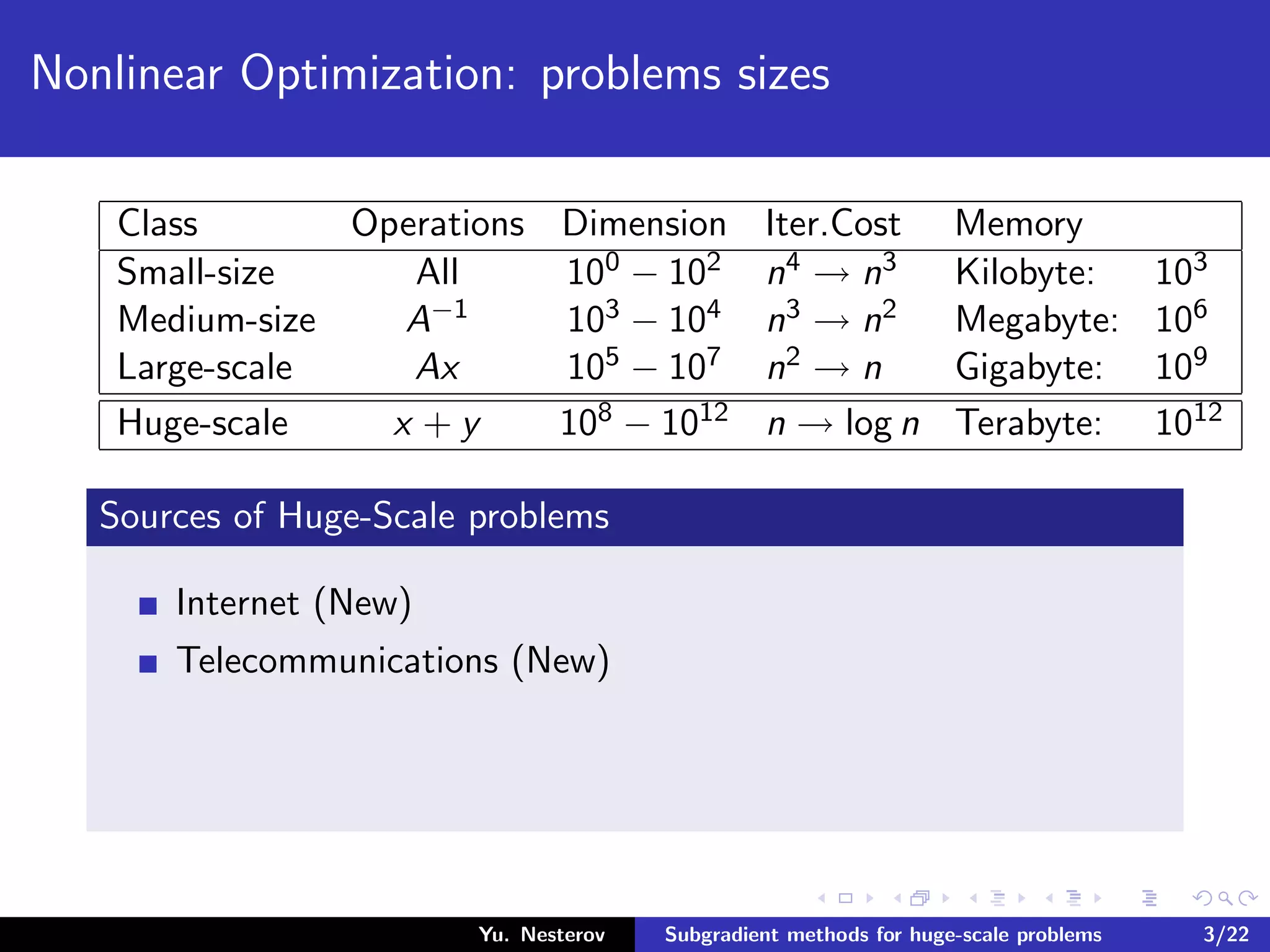
Nonlinear Optimization: problems sizes
Class Operations Dimension Iter.Cost Memory
Small-size All 100 − 102 n4 → n3 Kilobyte: 103
Medium-size A−1 103 − 104 n3 → n2 Megabyte: 106
Large-scale Ax 105 − 107 n2 → n Gigabyte: 109
Huge-scale x + y 108 − 1012 n → log n Terabyte: 1012
Yu. Nesterov Subgradient methods for huge-scale problems 3/22
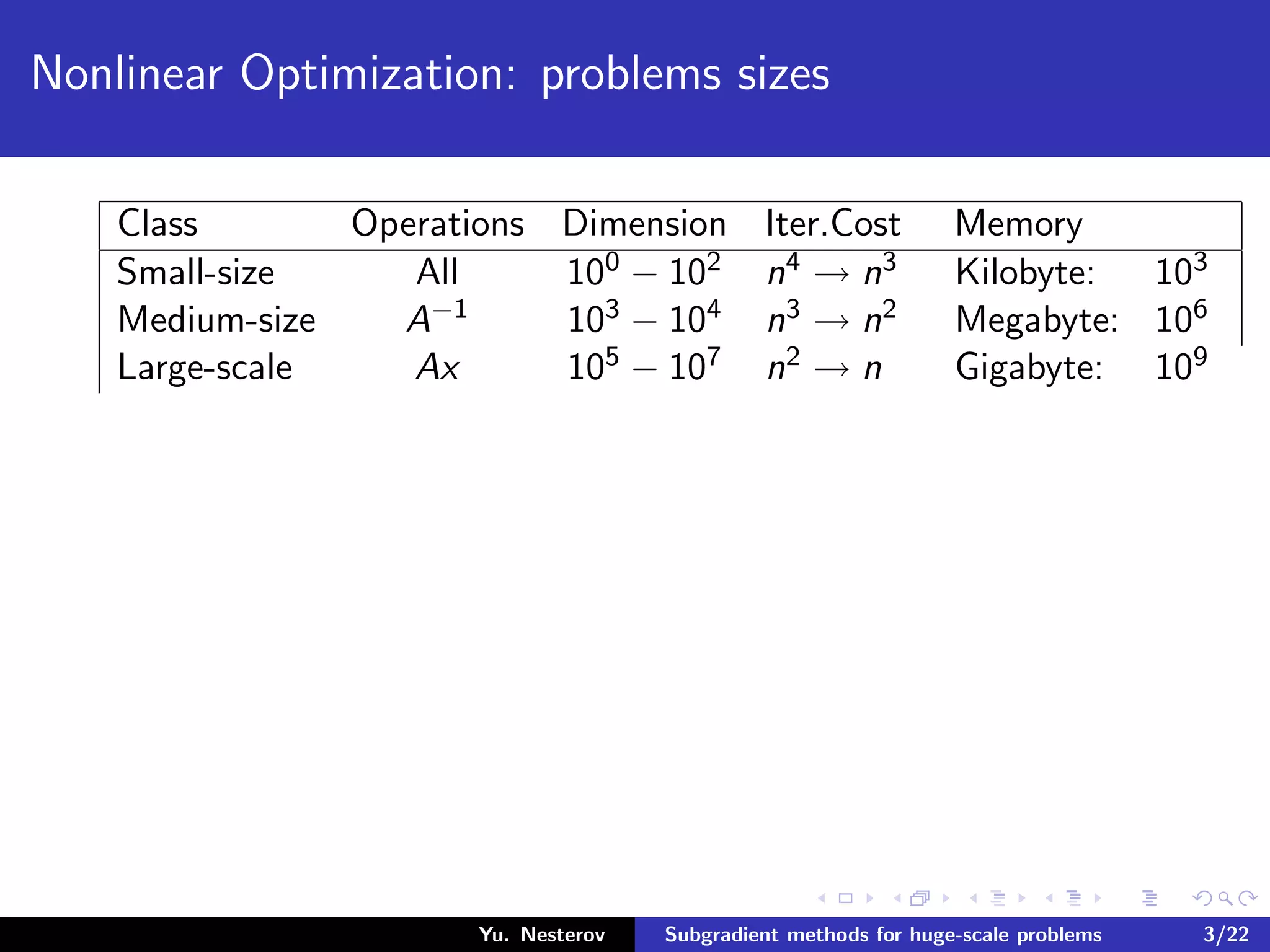
Nonlinear Optimization: problems sizes
Class Operations Dimension Iter.Cost Memory
Small-size All 100 − 102 n4 → n3 Kilobyte: 103
Medium-size A−1 103 − 104 n3 → n2 Megabyte: 106
Large-scale Ax 105 − 107 n2 → n Gigabyte: 109
Huge-scale x + y 108 − 1012 n → log n Terabyte: 1012
Sources of Huge-Scale problems
Yu. Nesterov Subgradient methods for huge-scale problems 3/22
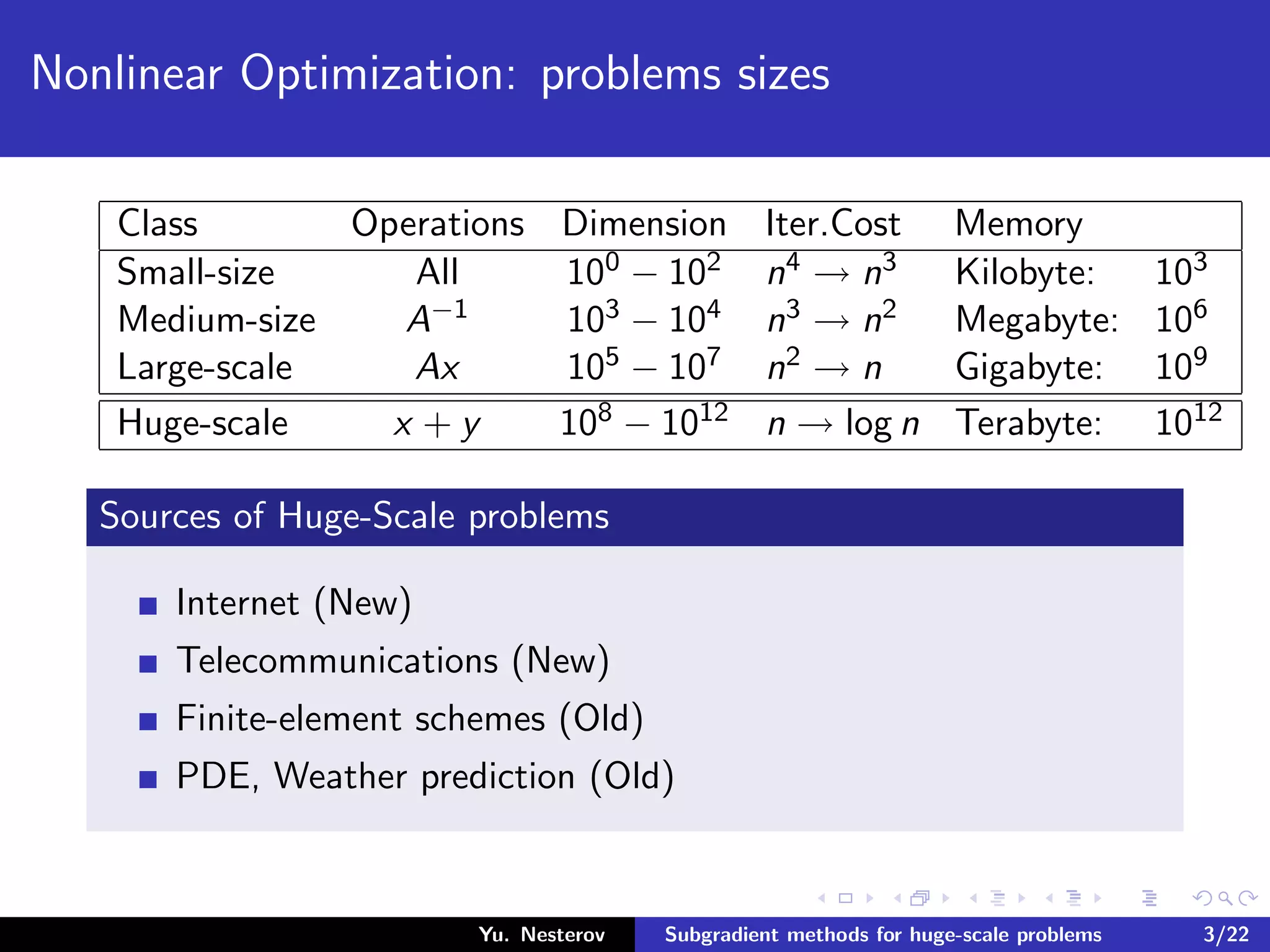
Nonlinear Optimization: problems sizes
Class Operations Dimension Iter.Cost Memory
Small-size All 100 − 102 n4 → n3 Kilobyte: 103
Medium-size A−1 103 − 104 n3 → n2 Megabyte: 106
Large-scale Ax 105 − 107 n2 → n Gigabyte: 109
Huge-scale x + y 108 − 1012 n → log n Terabyte: 1012
Sources of Huge-Scale problems
Internet (New)
Telecommunications (New)
Yu. Nesterov Subgradient methods for huge-scale problems 3/22
Nonlinear Optimization: problems sizes
Class Operations Dimension Iter.Cost Memory
Small-size All 100 − 102 n4 → n3 Kilobyte: 103
Medium-size A−1 103 − 104 n3 → n2 Megabyte: 106
Large-scale Ax 105 − 107 n2 → n Gigabyte: 109
Huge-scale x + y 108 − 1012 n → log n Terabyte: 1012
Sources of Huge-Scale problems
Internet (New)
Telecommunications (New)
Finite-element schemes (Old)
PDE, Weather prediction (Old)
Yu. Nesterov Subgradient methods for huge-scale problems 3/22
Nonlinear Optimization: problems sizes
Class Operations Dimension Iter.Cost Memory
Small-size All 100 − 102 n4 → n3 Kilobyte: 103
Medium-size A−1 103 − 104 n3 → n2 Megabyte: 106
Large-scale Ax 105 − 107 n2 → n Gigabyte: 109
Huge-scale x + y 108 − 1012 n → log n Terabyte: 1012
Sources of Huge-Scale problems
Internet (New)
Telecommunications (New)
Finite-element schemes (Old)
PDE, Weather prediction (Old)
Main hope: Sparsity.
Yu. Nesterov Subgradient methods for huge-scale problems 3/22
Sparse problems
Yu. Nesterov Subgradient methods for huge-scale problems 4/22
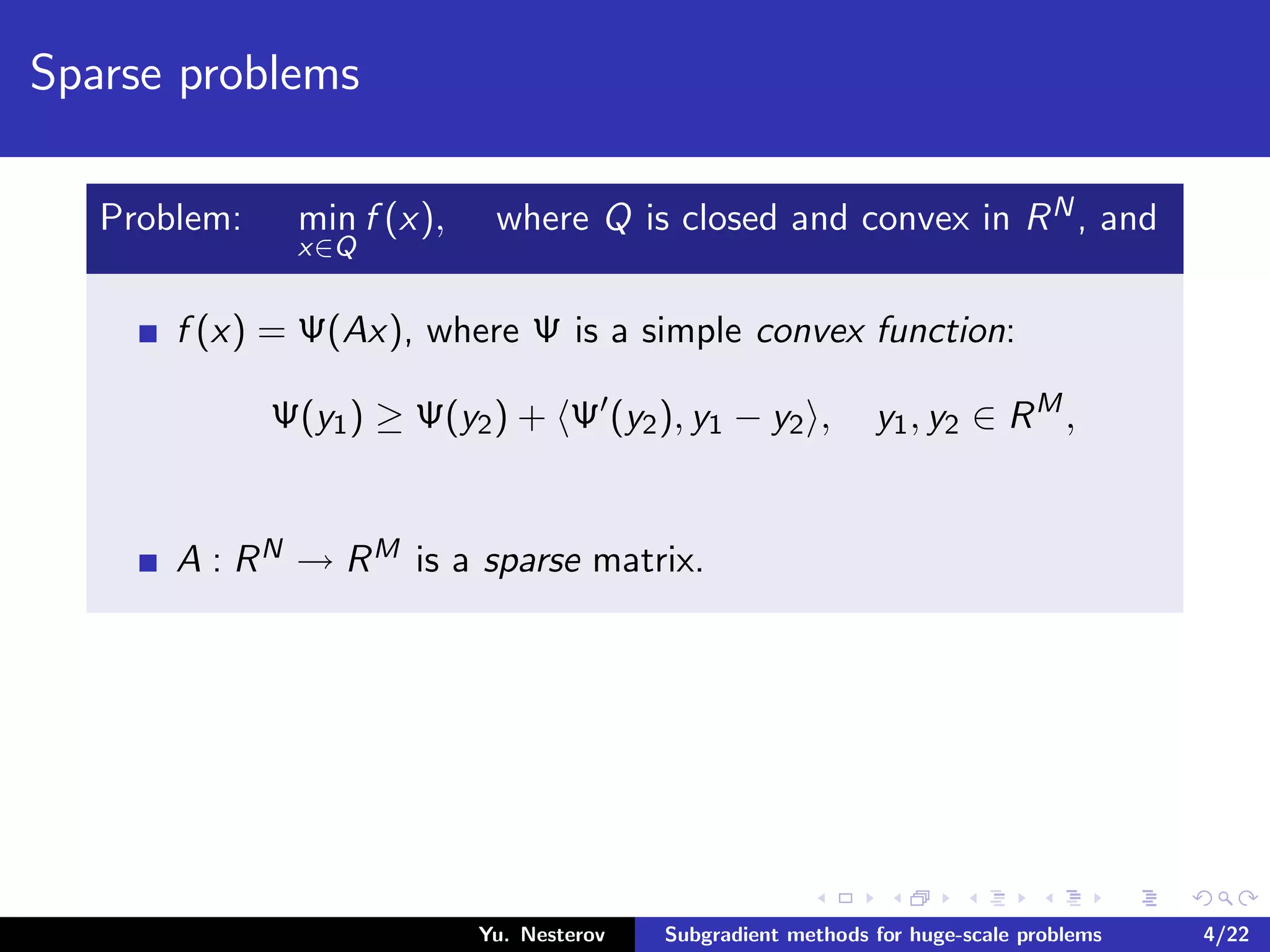
Sparse problems
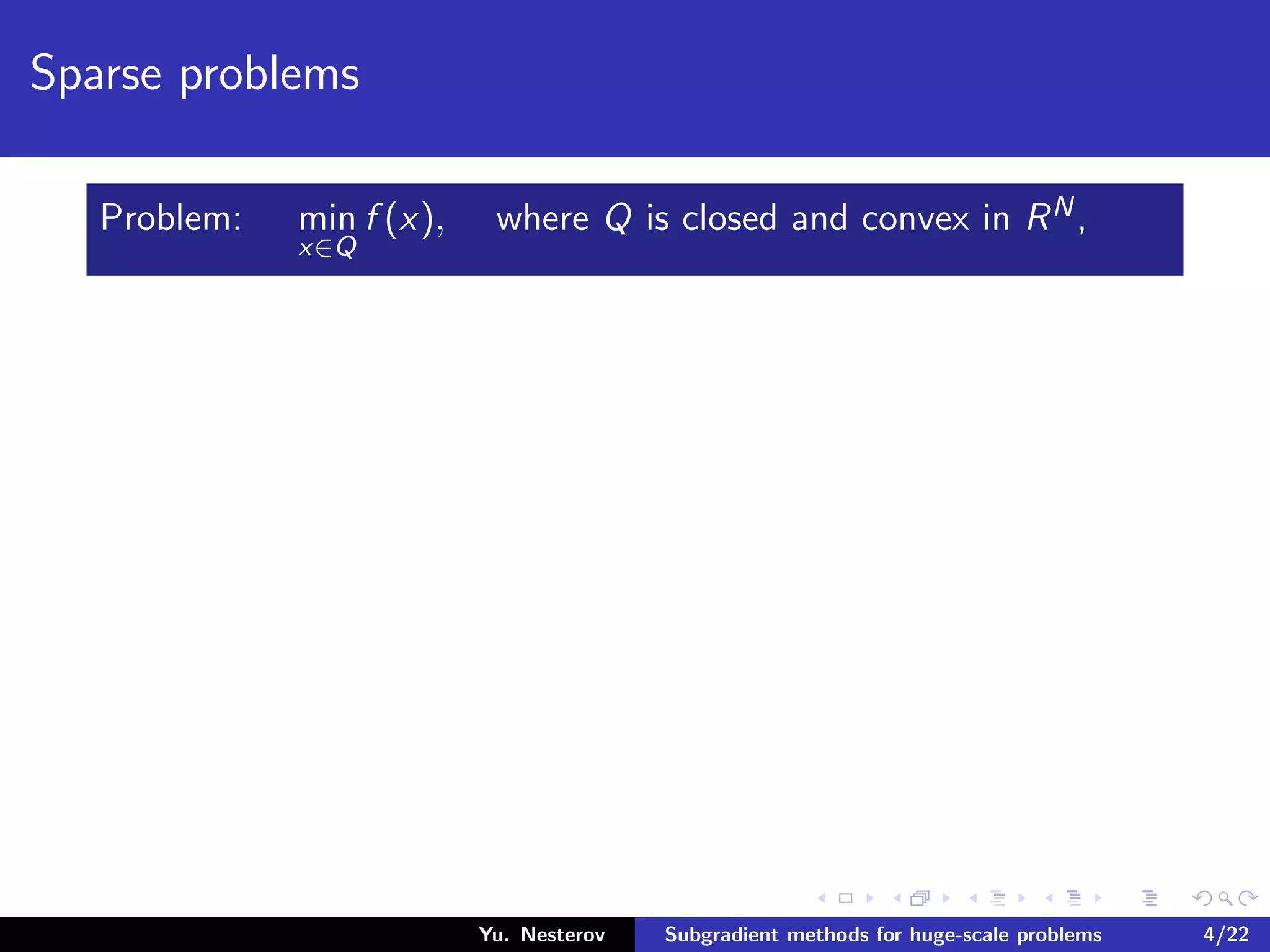
Problem: min
x∈Q
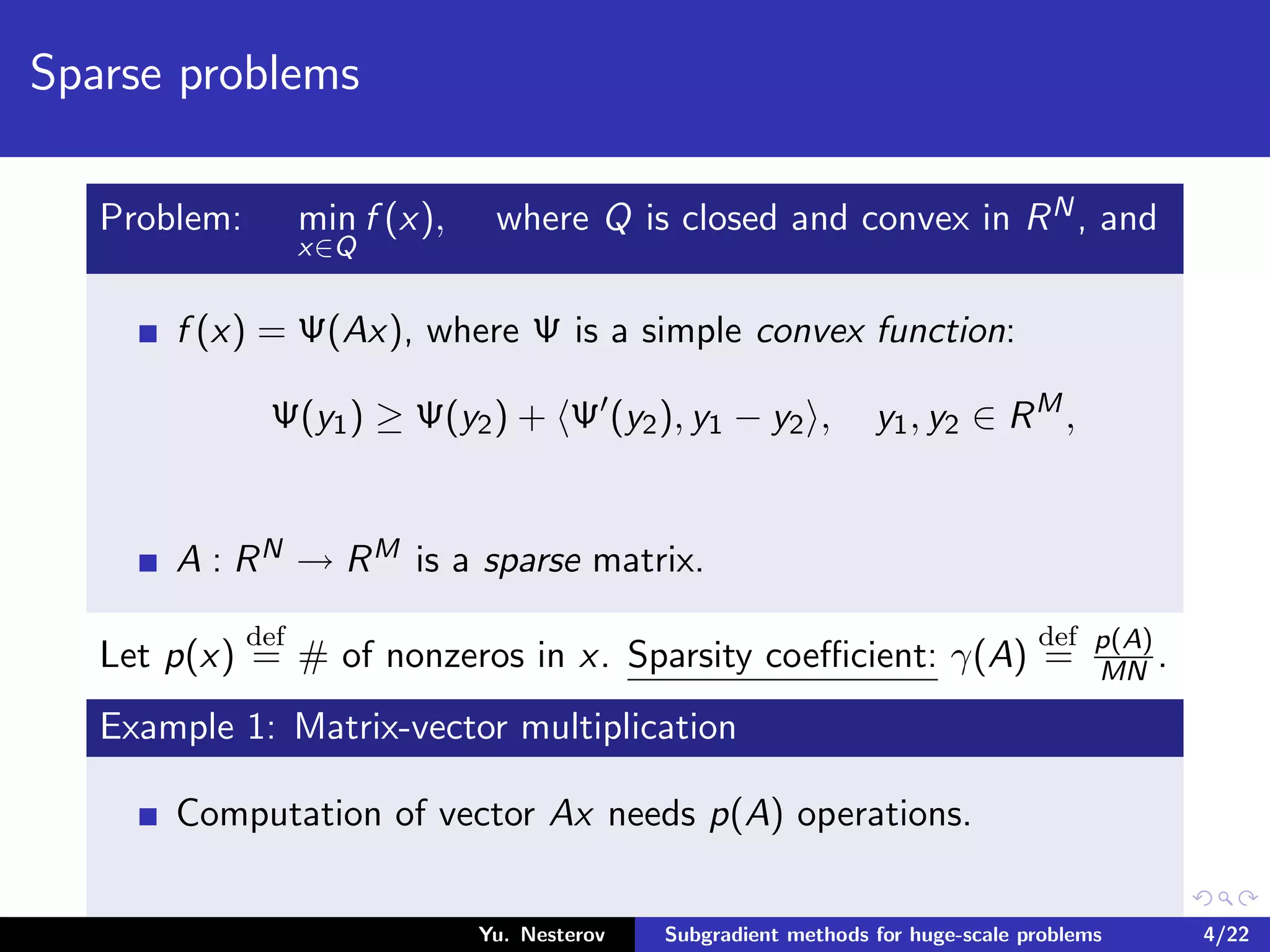
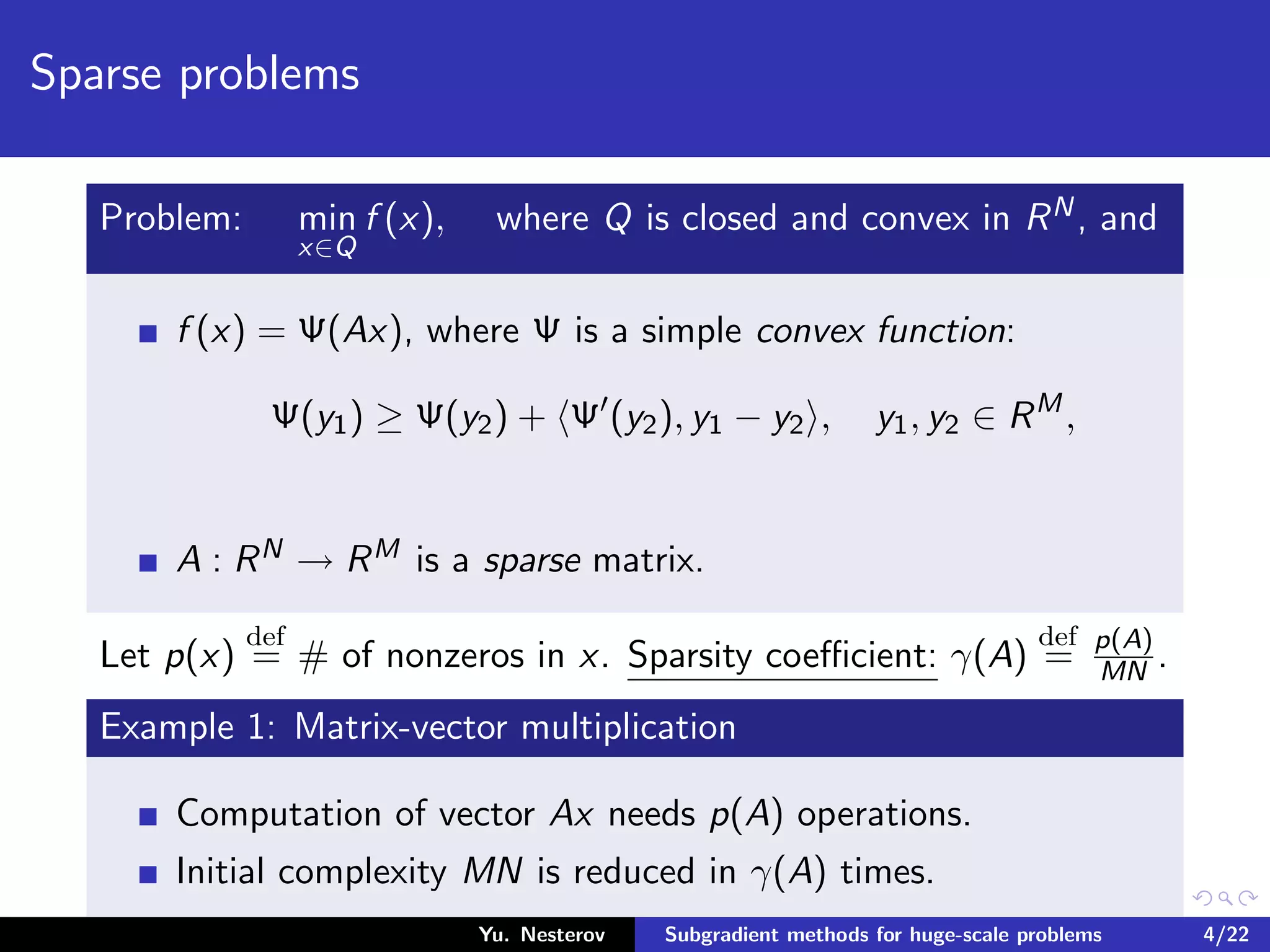
f (x), where Q is closed and convex in RN,
Yu. Nesterov Subgradient methods for huge-scale problems 4/22
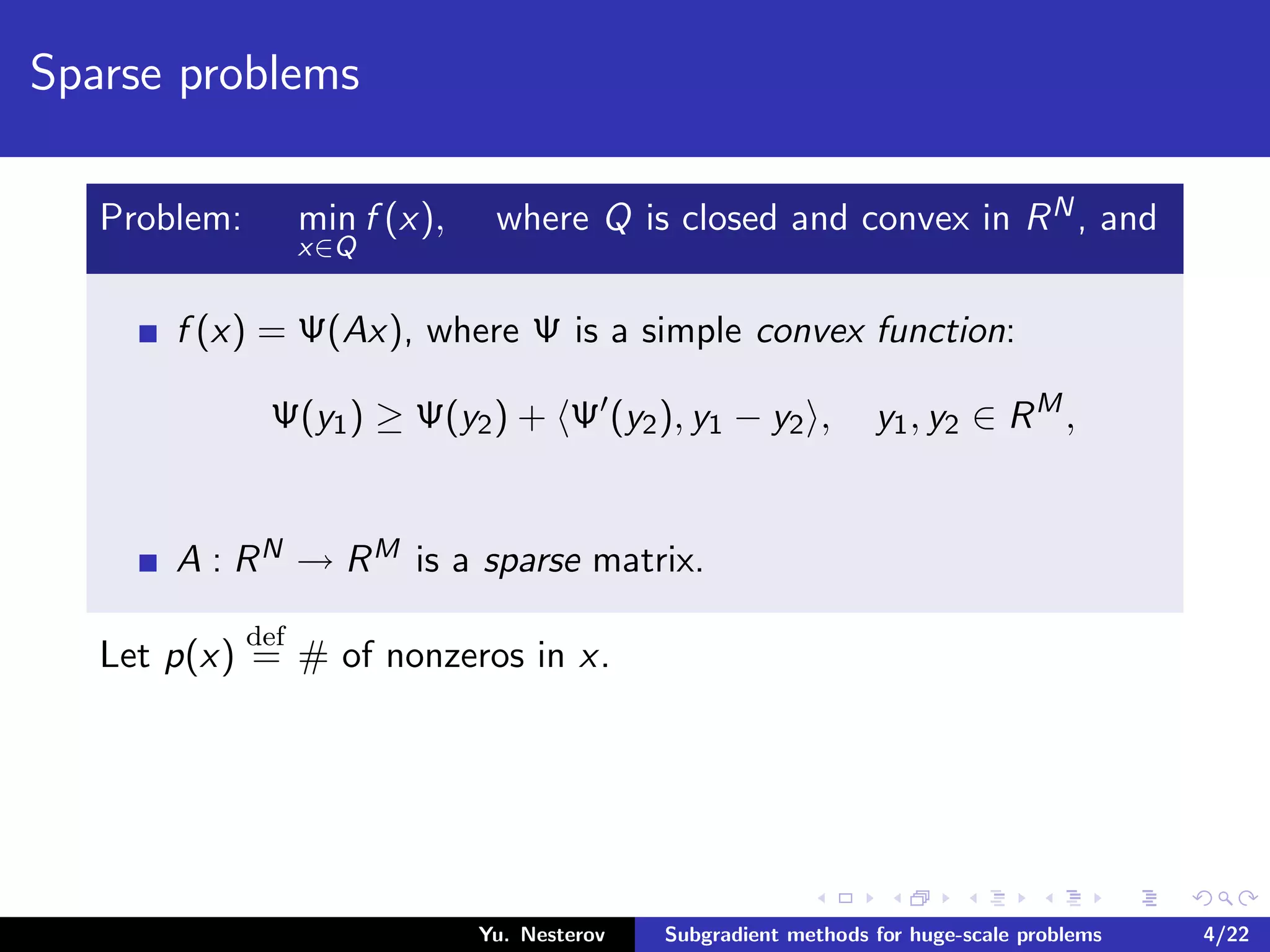
Sparse problems
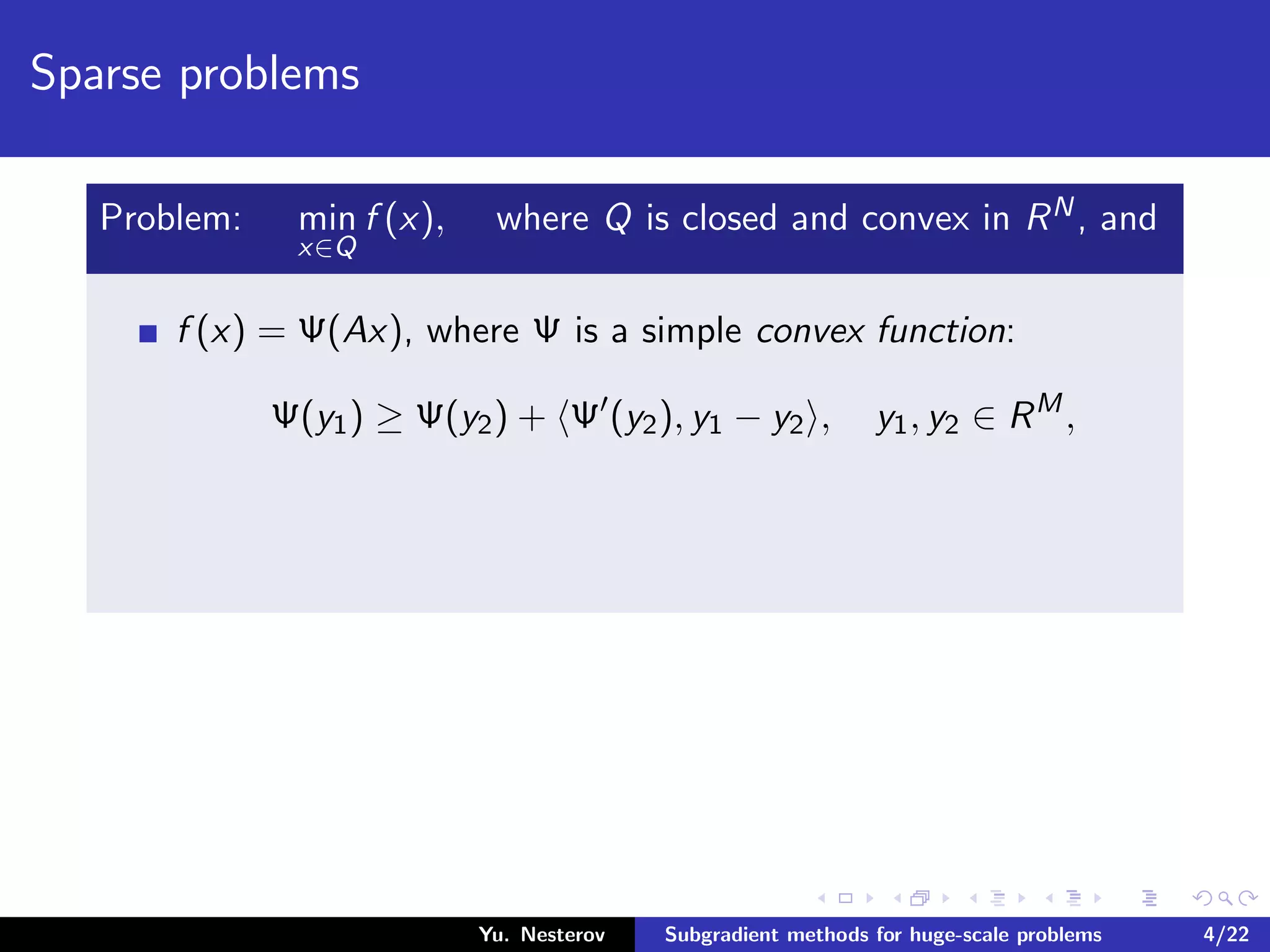
Problem: min
x∈Q
f (x), where Q is closed and convex in RN, and
f (x) = Ψ(Ax), where Ψ is a simple convex function:
Ψ(y1) ≥ Ψ(y2) + Ψ (y2), y1 − y2 , y1, y2 ∈ RM
,
Yu. Nesterov Subgradient methods for huge-scale problems 4/22
Sparse problems
Problem: min
x∈Q
f (x), where Q is closed and convex in RN, and
f (x) = Ψ(Ax), where Ψ is a simple convex function:
Ψ(y1) ≥ Ψ(y2) + Ψ (y2), y1 − y2 , y1, y2 ∈ RM
,
A : RN → RM is a sparse matrix.
Yu. Nesterov Subgradient methods for huge-scale problems 4/22
Sparse problems
Problem: min
x∈Q
f (x), where Q is closed and convex in RN, and
f (x) = Ψ(Ax), where Ψ is a simple convex function:
Ψ(y1) ≥ Ψ(y2) + Ψ (y2), y1 − y2 , y1, y2 ∈ RM
,
A : RN → RM is a sparse matrix.
Let p(x)
def
= # of nonzeros in x.
Yu. Nesterov Subgradient methods for huge-scale problems 4/22
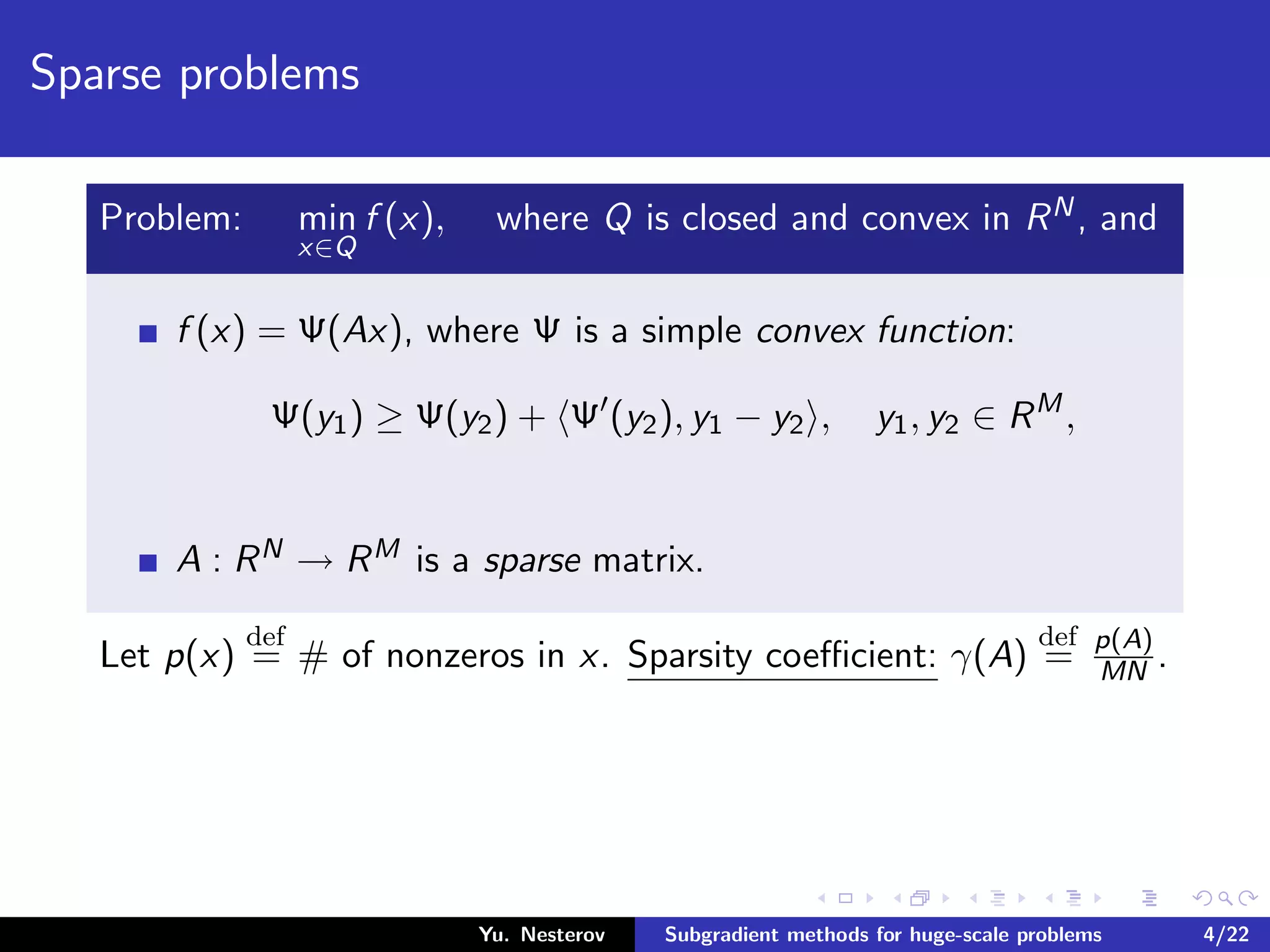
Sparse problems
Problem: min
x∈Q
f (x), where Q is closed and convex in RN, and
f (x) = Ψ(Ax), where Ψ is a simple convex function:
Ψ(y1) ≥ Ψ(y2) + Ψ (y2), y1 − y2 , y1, y2 ∈ RM
,
A : RN → RM is a sparse matrix.
Let p(x)
def
= # of nonzeros in x. Sparsity coefficient: γ(A)
def
= p(A)
MN .
Yu. Nesterov Subgradient methods for huge-scale problems 4/22
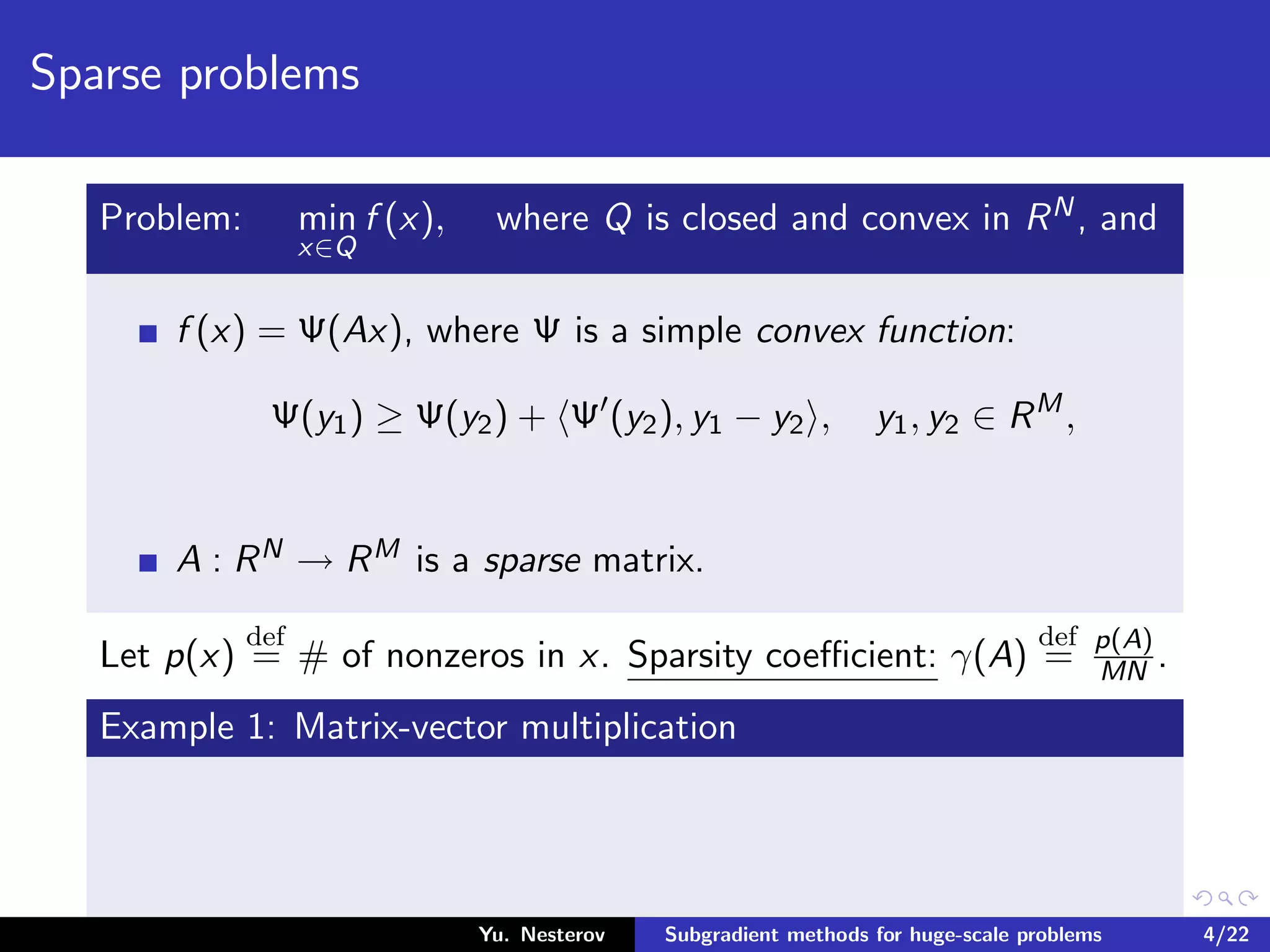
Sparse problems
Problem: min
x∈Q
f (x), where Q is closed and convex in RN, and
f (x) = Ψ(Ax), where Ψ is a simple convex function:
Ψ(y1) ≥ Ψ(y2) + Ψ (y2), y1 − y2 , y1, y2 ∈ RM
,
A : RN → RM is a sparse matrix.
Let p(x)
def
= # of nonzeros in x. Sparsity coefficient: γ(A)
def
= p(A)
MN .
Example 1: Matrix-vector multiplication
Yu. Nesterov Subgradient methods for huge-scale problems 4/22
Sparse problems
Problem: min
x∈Q
f (x), where Q is closed and convex in RN, and
f (x) = Ψ(Ax), where Ψ is a simple convex function:
Ψ(y1) ≥ Ψ(y2) + Ψ (y2), y1 − y2 , y1, y2 ∈ RM
,
A : RN → RM is a sparse matrix.
Let p(x)
def
= # of nonzeros in x. Sparsity coefficient: γ(A)
def
= p(A)
MN .
Example 1: Matrix-vector multiplication
Computation of vector Ax needs p(A) operations.
Yu. Nesterov Subgradient methods for huge-scale problems 4/22
Sparse problems
Problem: min
x∈Q
f (x), where Q is closed and convex in RN, and
f (x) = Ψ(Ax), where Ψ is a simple convex function:
Ψ(y1) ≥ Ψ(y2) + Ψ (y2), y1 − y2 , y1, y2 ∈ RM
,
A : RN → RM is a sparse matrix.
Let p(x)
def
= # of nonzeros in x. Sparsity coefficient: γ(A)
def
= p(A)
MN .
Example 1: Matrix-vector multiplication
Computation of vector Ax needs p(A) operations.
Initial complexity MN is reduced in γ(A) times.
Yu. Nesterov Subgradient methods for huge-scale problems 4/22
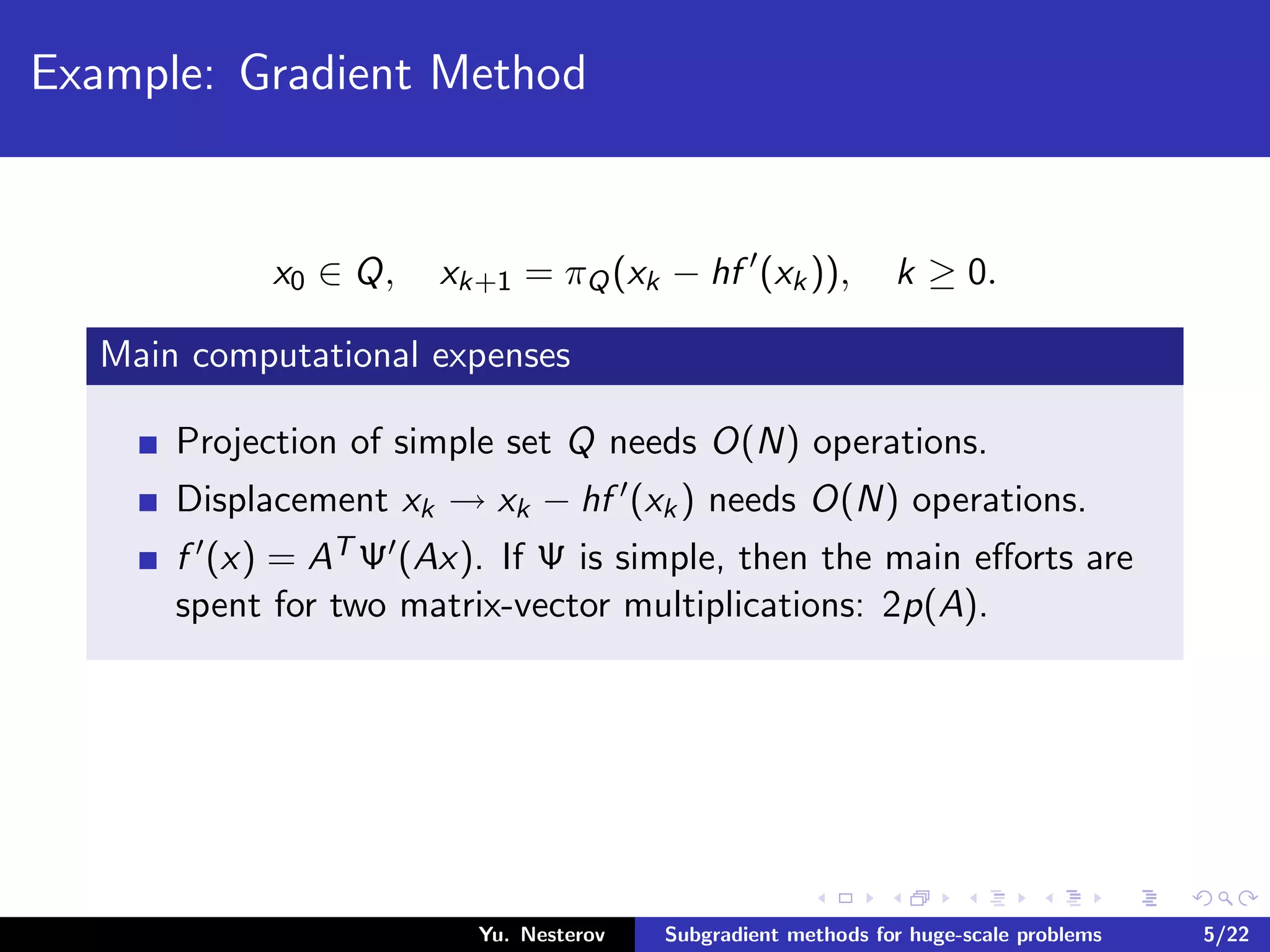
Example: Gradient Method
Yu. Nesterov Subgradient methods for huge-scale problems 5/22
Example: Gradient Method
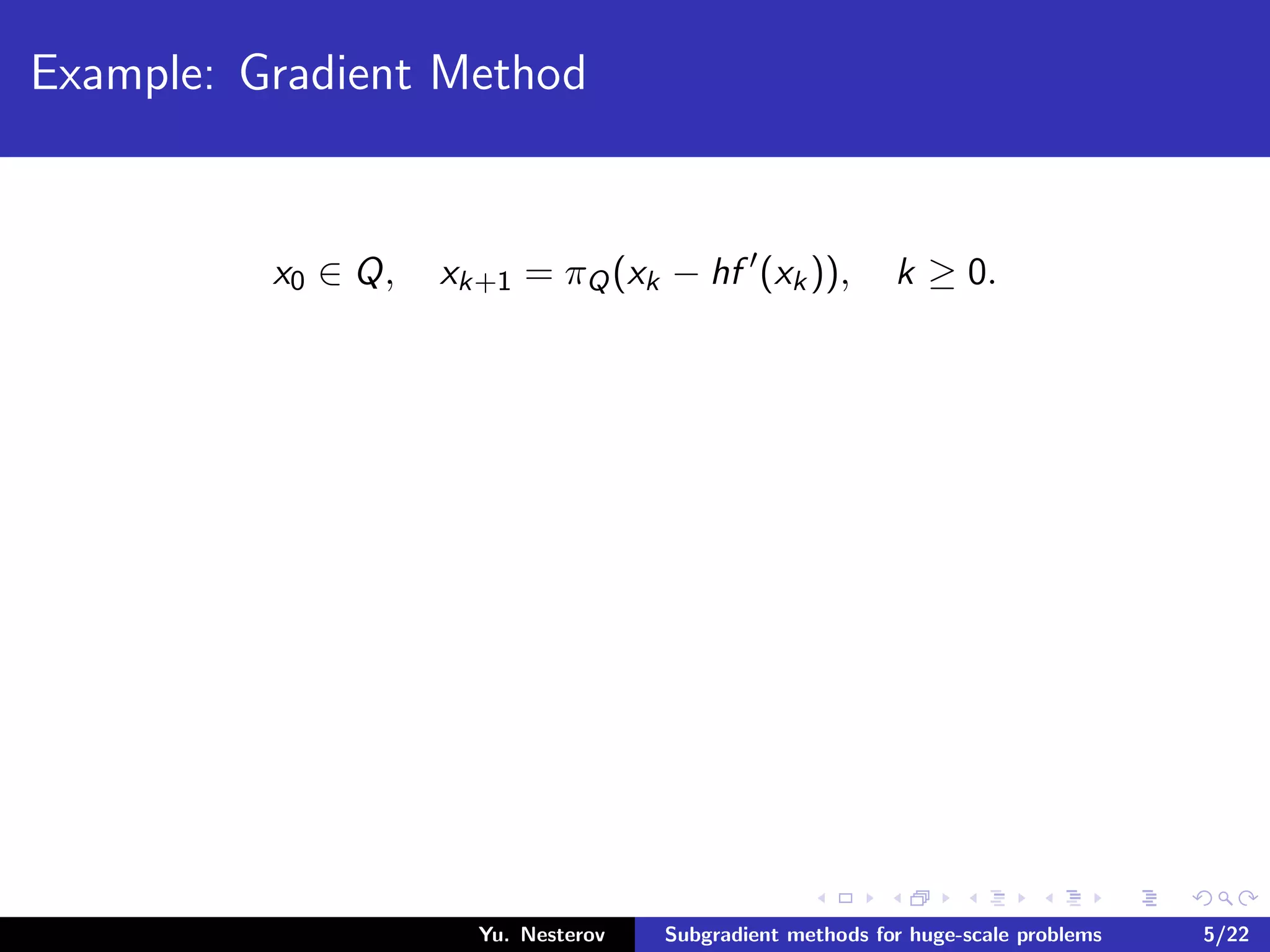
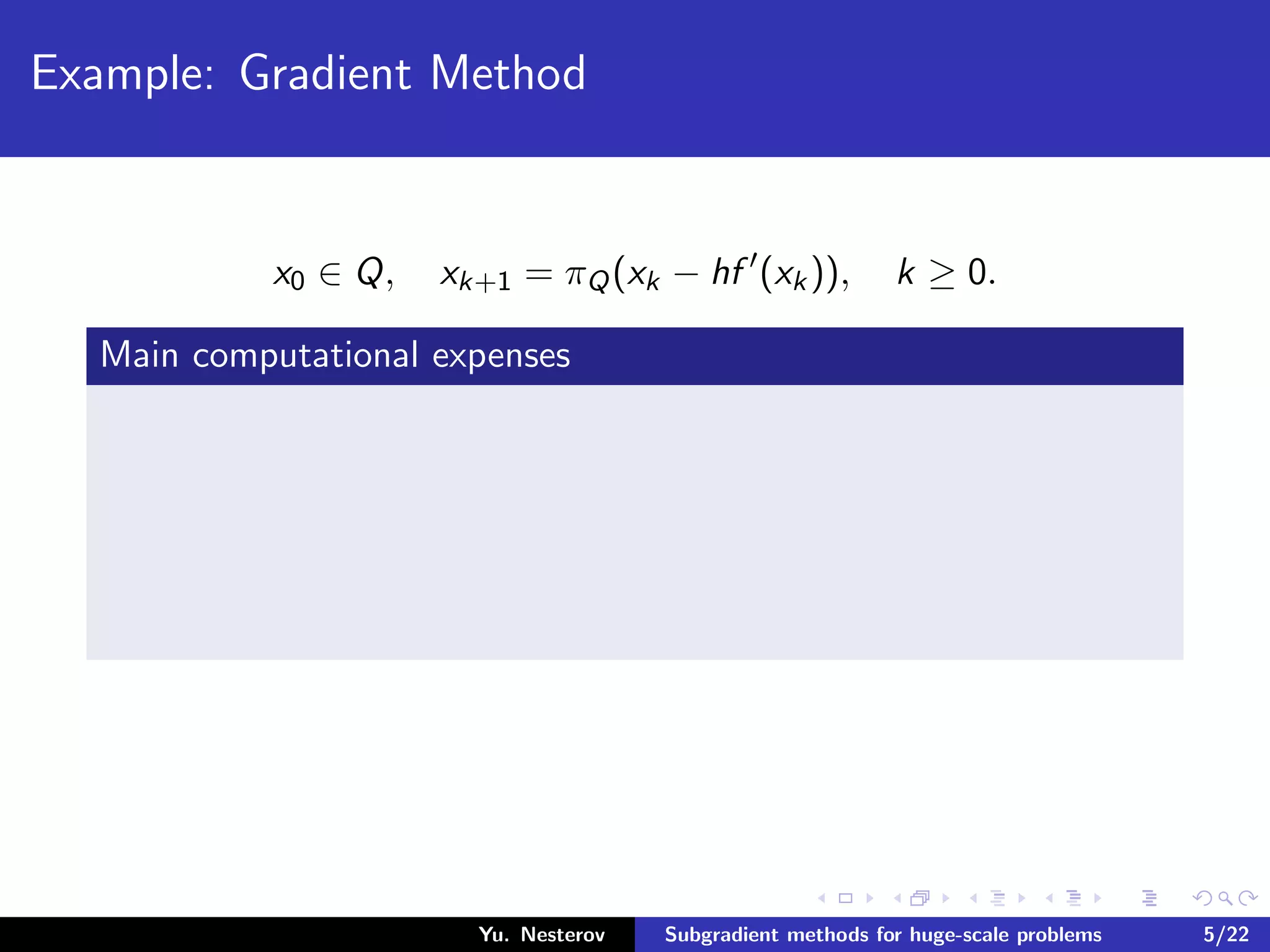
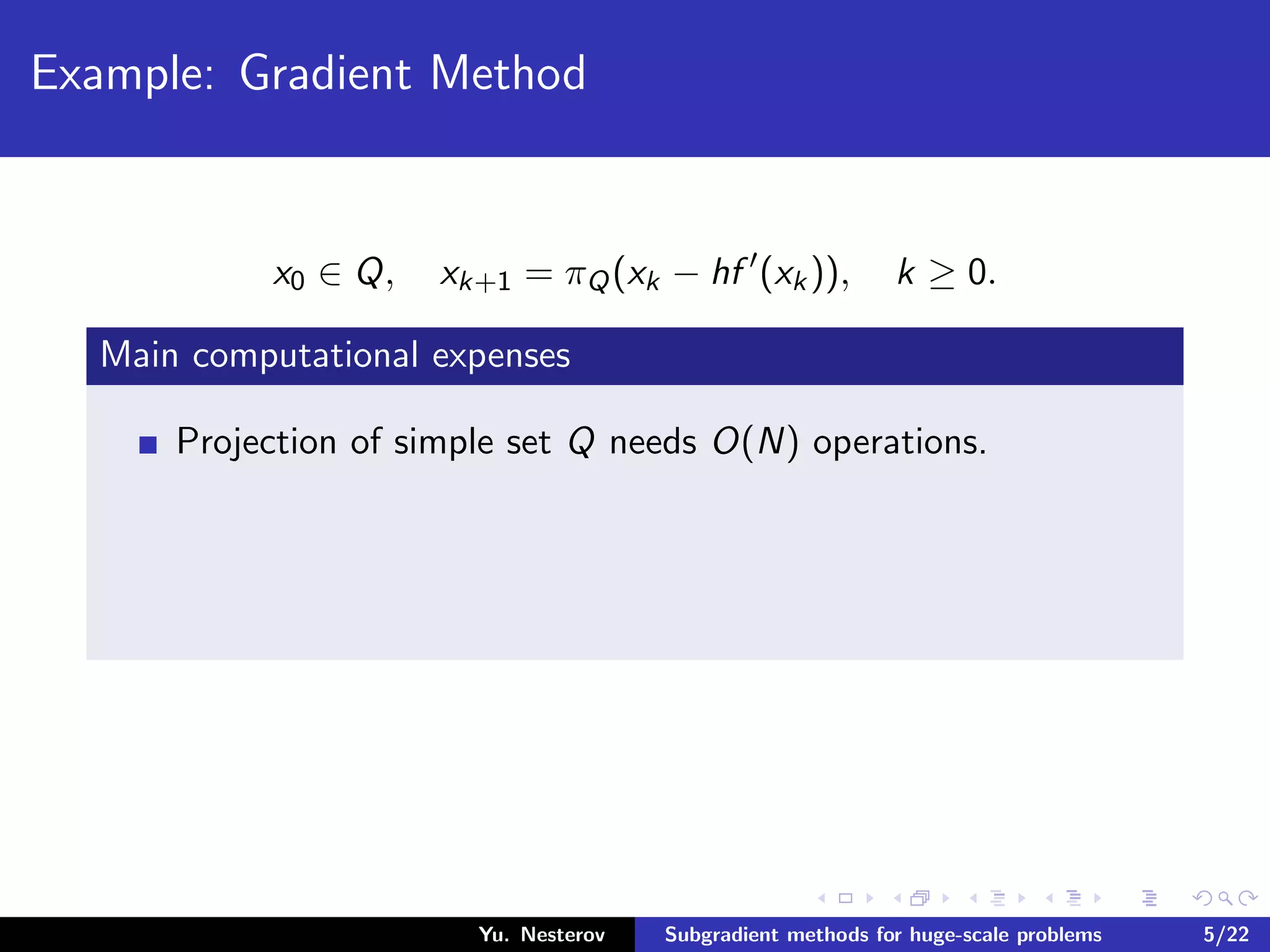
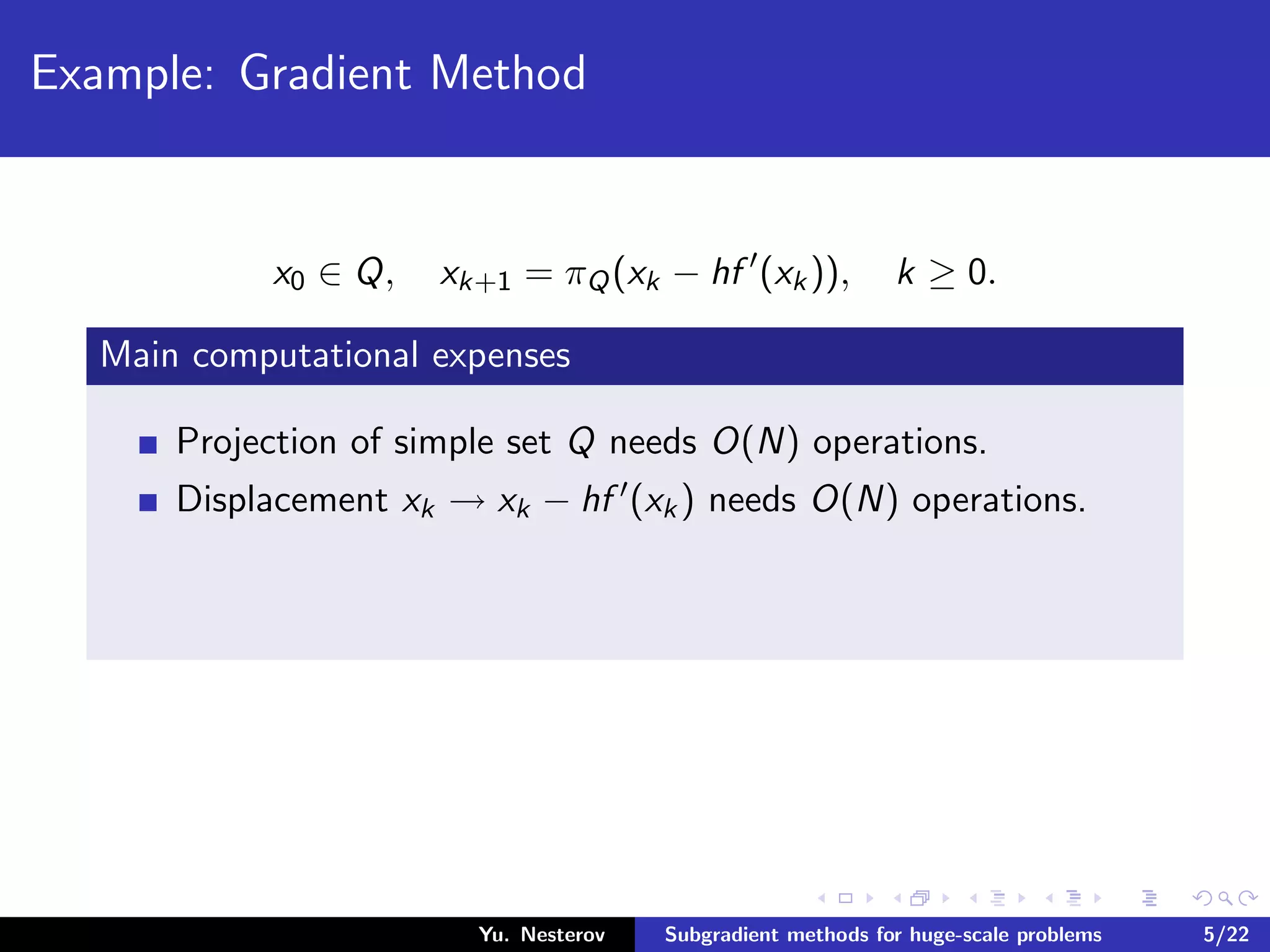
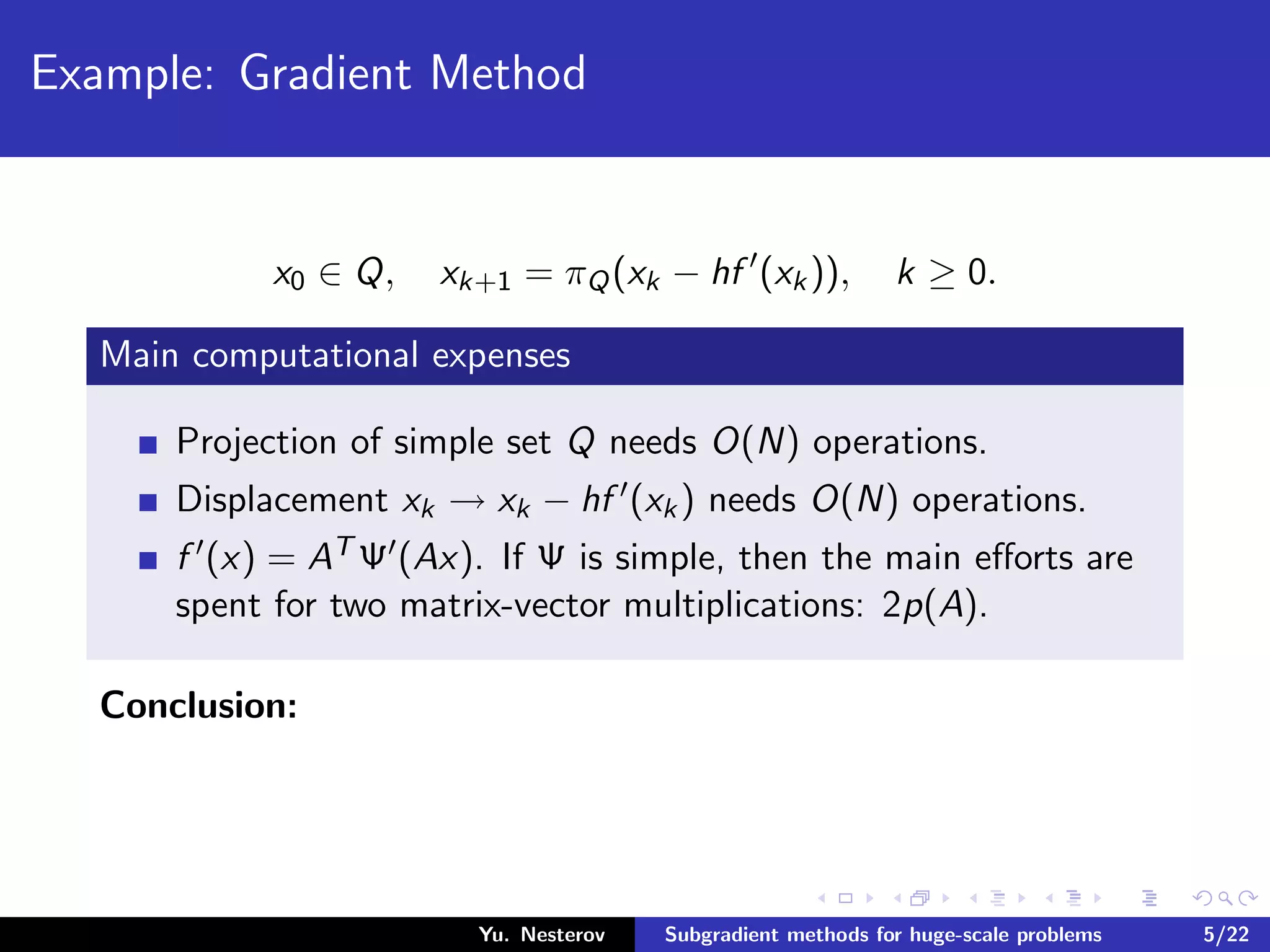
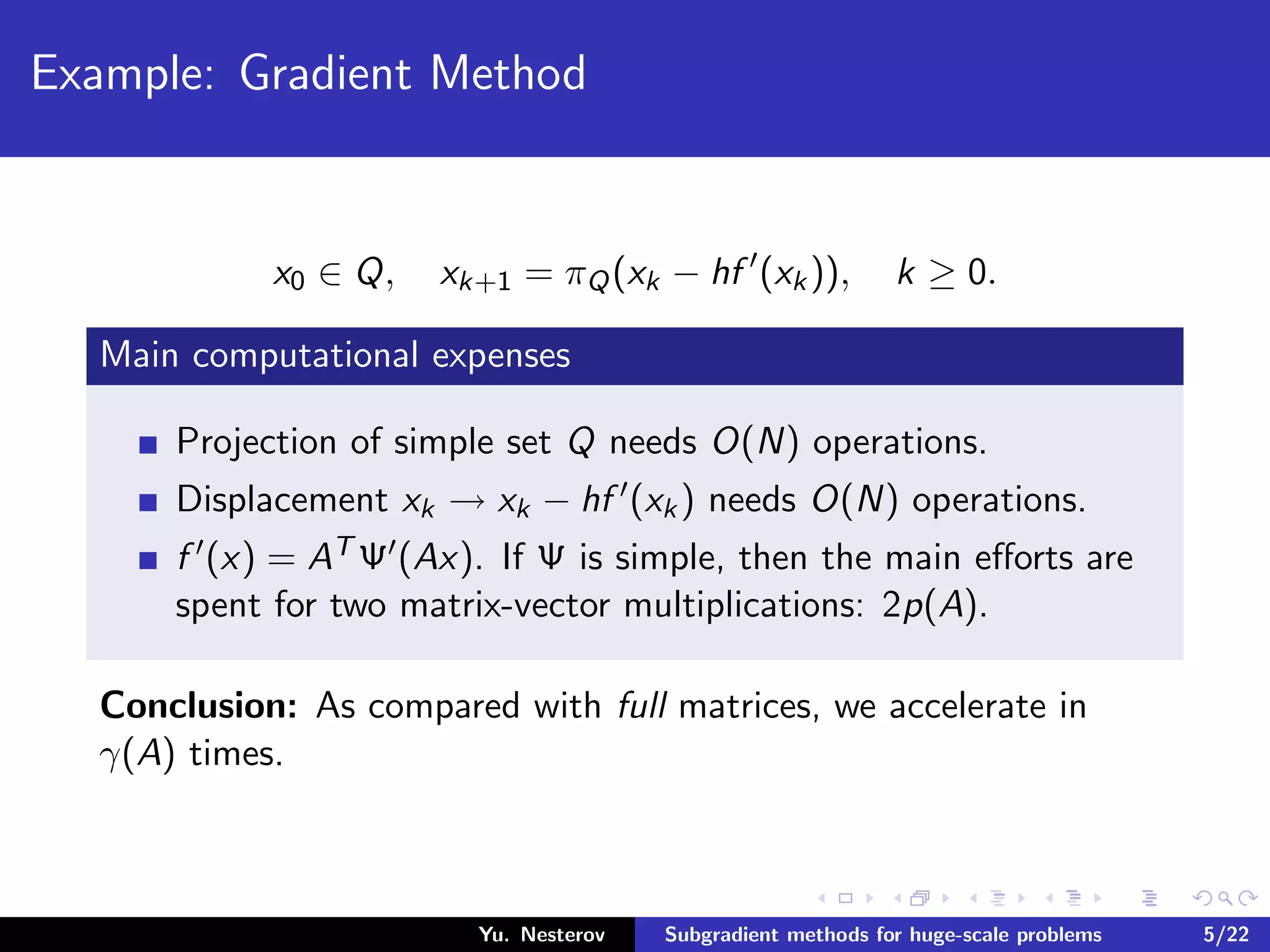
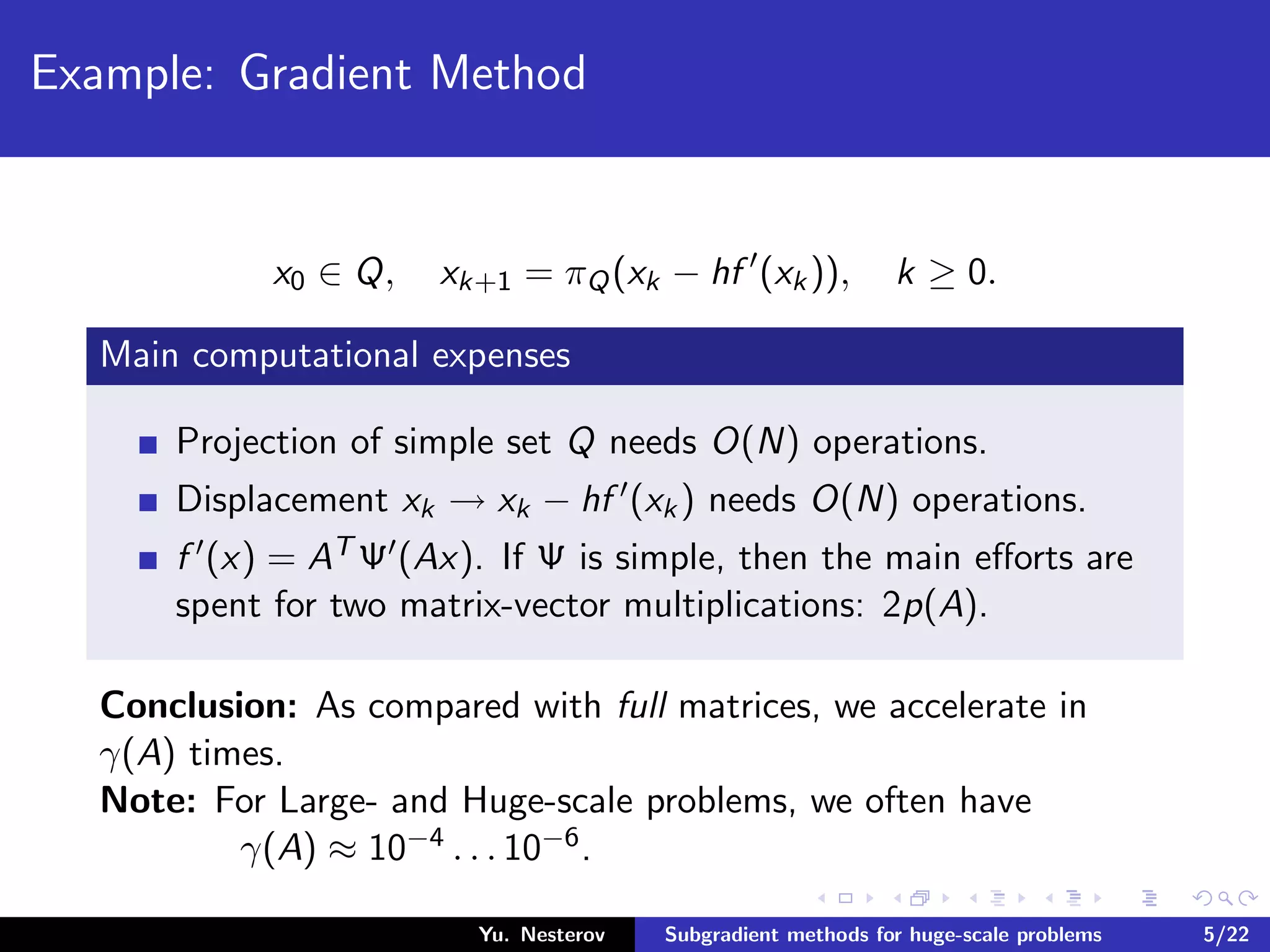
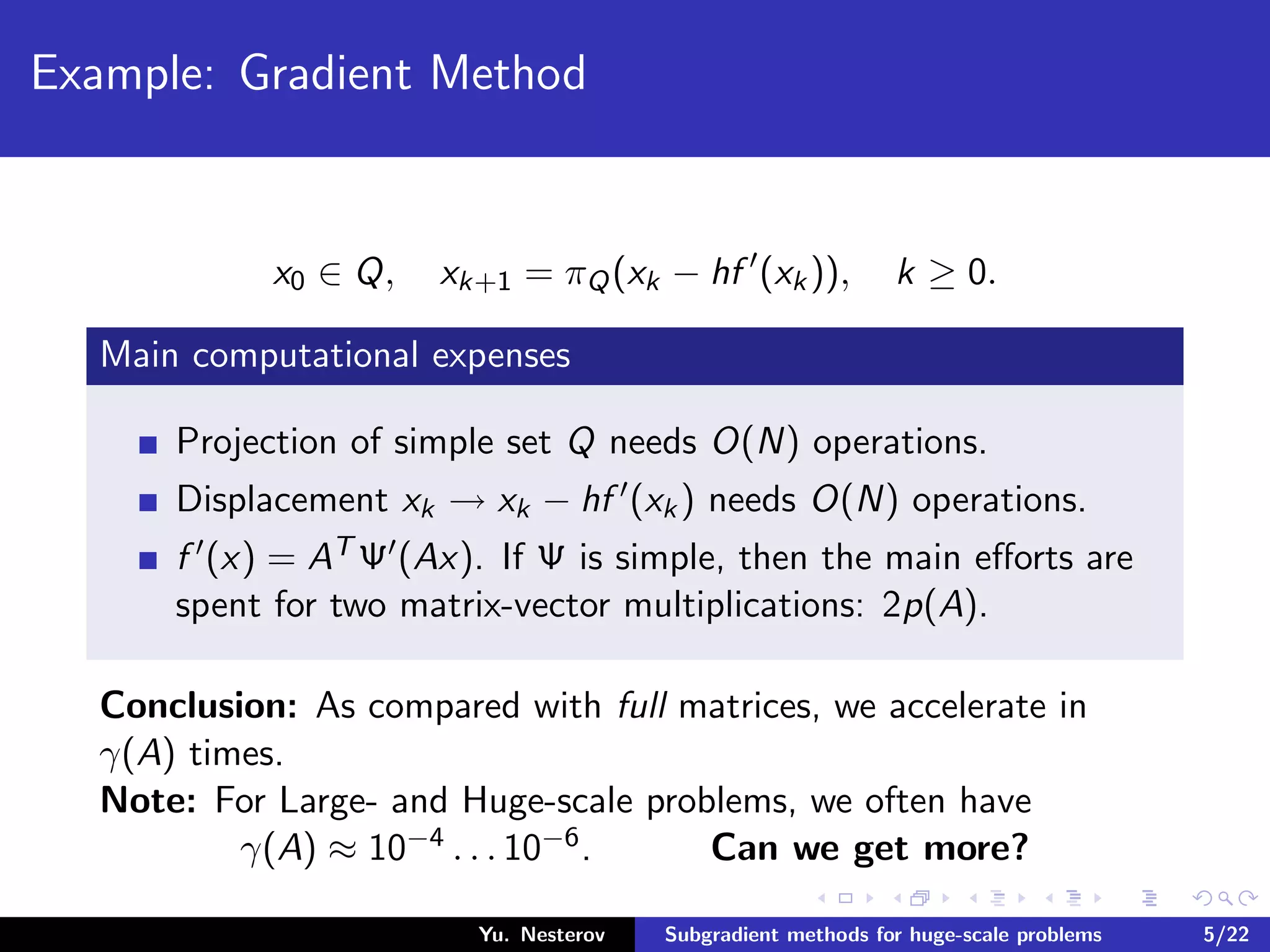
x0 ∈ Q, xk+1 = πQ(xk − hf (xk)), k ≥ 0.
Yu. Nesterov Subgradient methods for huge-scale problems 5/22
Example: Gradient Method
x0 ∈ Q, xk+1 = πQ(xk − hf (xk)), k ≥ 0.
Main computational expenses
Yu. Nesterov Subgradient methods for huge-scale problems 5/22
Example: Gradient Method
x0 ∈ Q, xk+1 = πQ(xk − hf (xk)), k ≥ 0.
Main computational expenses
Projection of simple set Q needs O(N) operations.
Yu. Nesterov Subgradient methods for huge-scale problems 5/22
Example: Gradient Method
x0 ∈ Q, xk+1 = πQ(xk − hf (xk)), k ≥ 0.
Main computational expenses
Projection of simple set Q needs O(N) operations.
Displacement xk → xk − hf (xk) needs O(N) operations.
Yu. Nesterov Subgradient methods for huge-scale problems 5/22
Example: Gradient Method
x0 ∈ Q, xk+1 = πQ(xk − hf (xk)), k ≥ 0.
Main computational expenses
Projection of simple set Q needs O(N) operations.
Displacement xk → xk − hf (xk) needs O(N) operations.
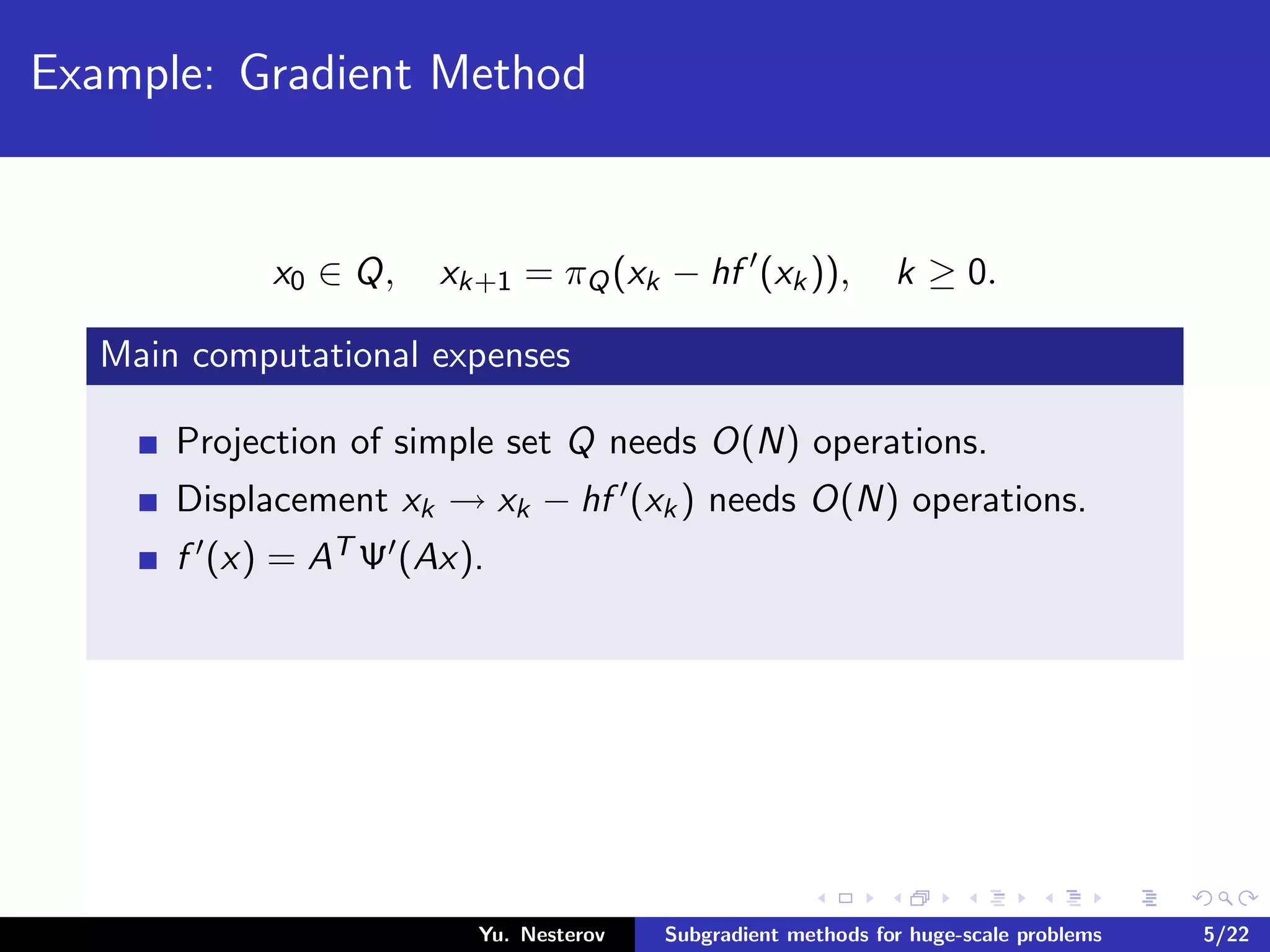
f (x) = AT Ψ (Ax).
Yu. Nesterov Subgradient methods for huge-scale problems 5/22
Example: Gradient Method
x0 ∈ Q, xk+1 = πQ(xk − hf (xk)), k ≥ 0.
Main computational expenses
Projection of simple set Q needs O(N) operations.
Displacement xk → xk − hf (xk) needs O(N) operations.
f (x) = AT Ψ (Ax). If Ψ is simple, then the main efforts are
spent for two matrix-vector multiplications: 2p(A).
Yu. Nesterov Subgradient methods for huge-scale problems 5/22
Example: Gradient Method
x0 ∈ Q, xk+1 = πQ(xk − hf (xk)), k ≥ 0.
Main computational expenses
Projection of simple set Q needs O(N) operations.
Displacement xk → xk − hf (xk) needs O(N) operations.
f (x) = AT Ψ (Ax). If Ψ is simple, then the main efforts are
spent for two matrix-vector multiplications: 2p(A).
Conclusion:
Yu. Nesterov Subgradient methods for huge-scale problems 5/22
Example: Gradient Method
x0 ∈ Q, xk+1 = πQ(xk − hf (xk)), k ≥ 0.
Main computational expenses
Projection of simple set Q needs O(N) operations.
Displacement xk → xk − hf (xk) needs O(N) operations.
f (x) = AT Ψ (Ax). If Ψ is simple, then the main efforts are
spent for two matrix-vector multiplications: 2p(A).
Conclusion: As compared with full matrices, we accelerate in
γ(A) times.
Yu. Nesterov Subgradient methods for huge-scale problems 5/22
Example: Gradient Method
x0 ∈ Q, xk+1 = πQ(xk − hf (xk)), k ≥ 0.
Main computational expenses
Projection of simple set Q needs O(N) operations.
Displacement xk → xk − hf (xk) needs O(N) operations.
f (x) = AT Ψ (Ax). If Ψ is simple, then the main efforts are
spent for two matrix-vector multiplications: 2p(A).
Conclusion: As compared with full matrices, we accelerate in
γ(A) times.
Note: For Large- and Huge-scale problems, we often have
γ(A) ≈ 10−4 . . . 10−6.
Yu. Nesterov Subgradient methods for huge-scale problems 5/22
Example: Gradient Method
x0 ∈ Q, xk+1 = πQ(xk − hf (xk)), k ≥ 0.
Main computational expenses
Projection of simple set Q needs O(N) operations.
Displacement xk → xk − hf (xk) needs O(N) operations.
f (x) = AT Ψ (Ax). If Ψ is simple, then the main efforts are
spent for two matrix-vector multiplications: 2p(A).
Conclusion: As compared with full matrices, we accelerate in
γ(A) times.
Note: For Large- and Huge-scale problems, we often have
γ(A) ≈ 10−4 . . . 10−6. Can we get more?
Yu. Nesterov Subgradient methods for huge-scale problems 5/22
Sparse updating strategy
Yu. Nesterov Subgradient methods for huge-scale problems 6/22
Sparse updating strategy
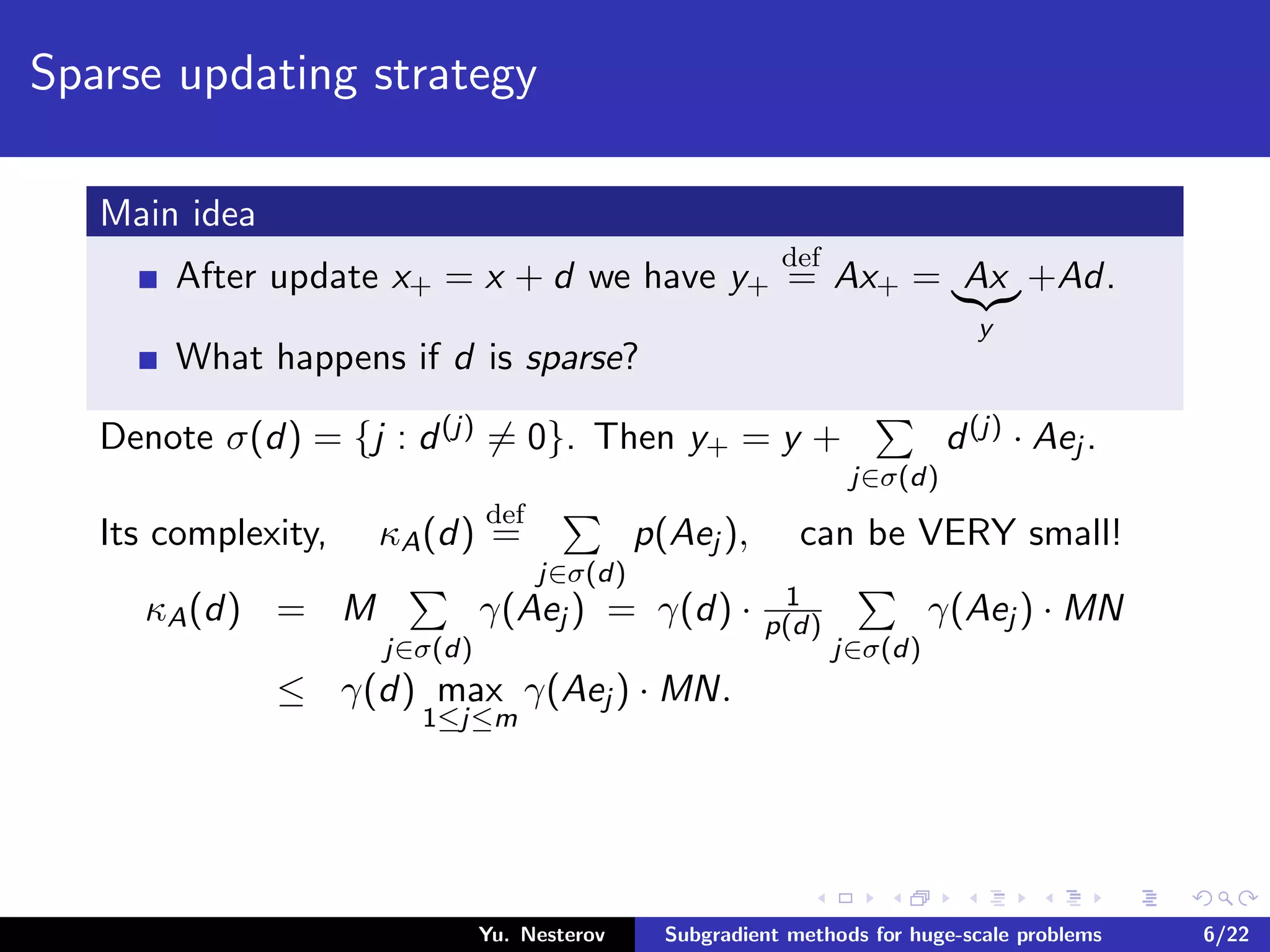
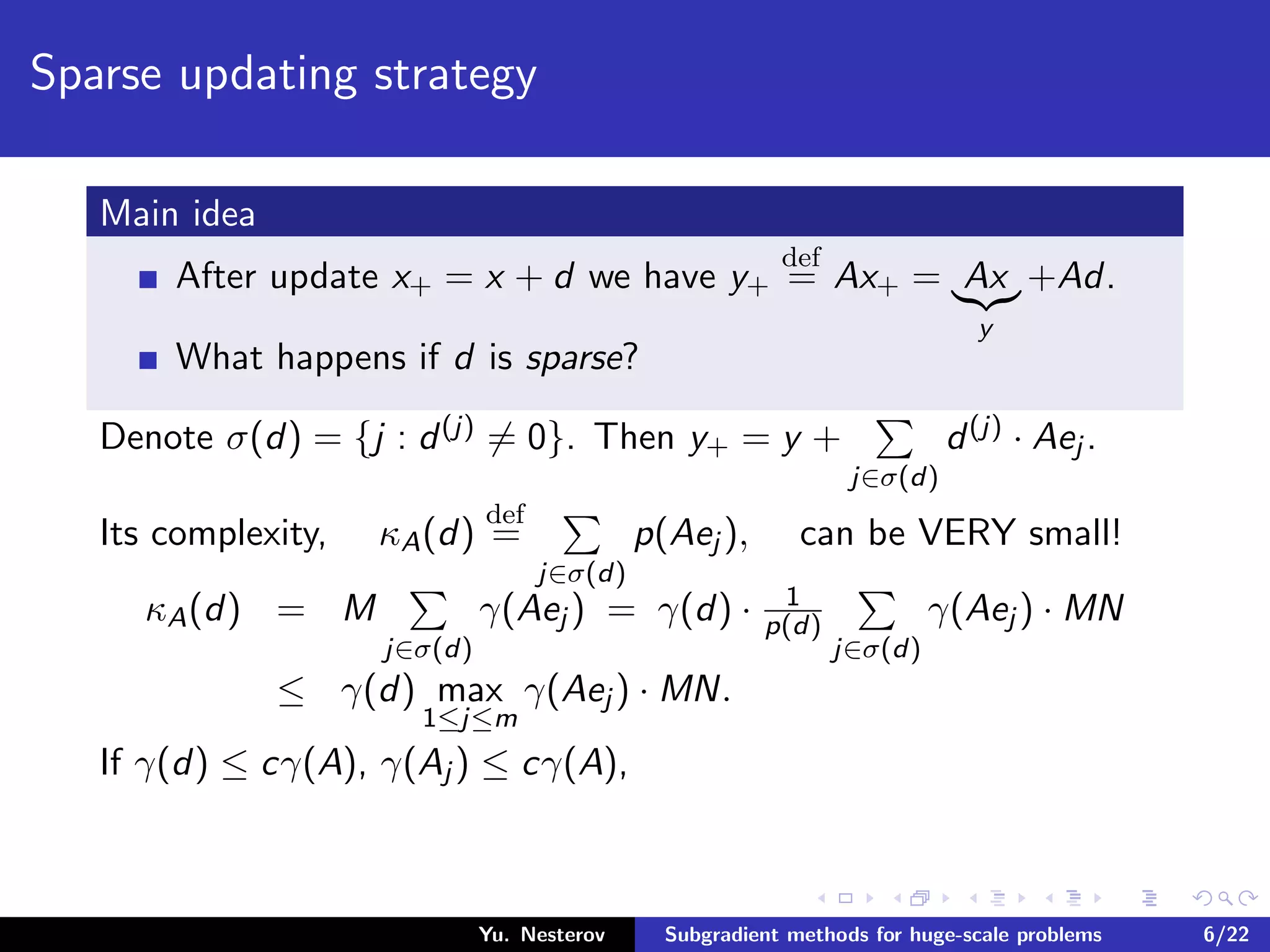
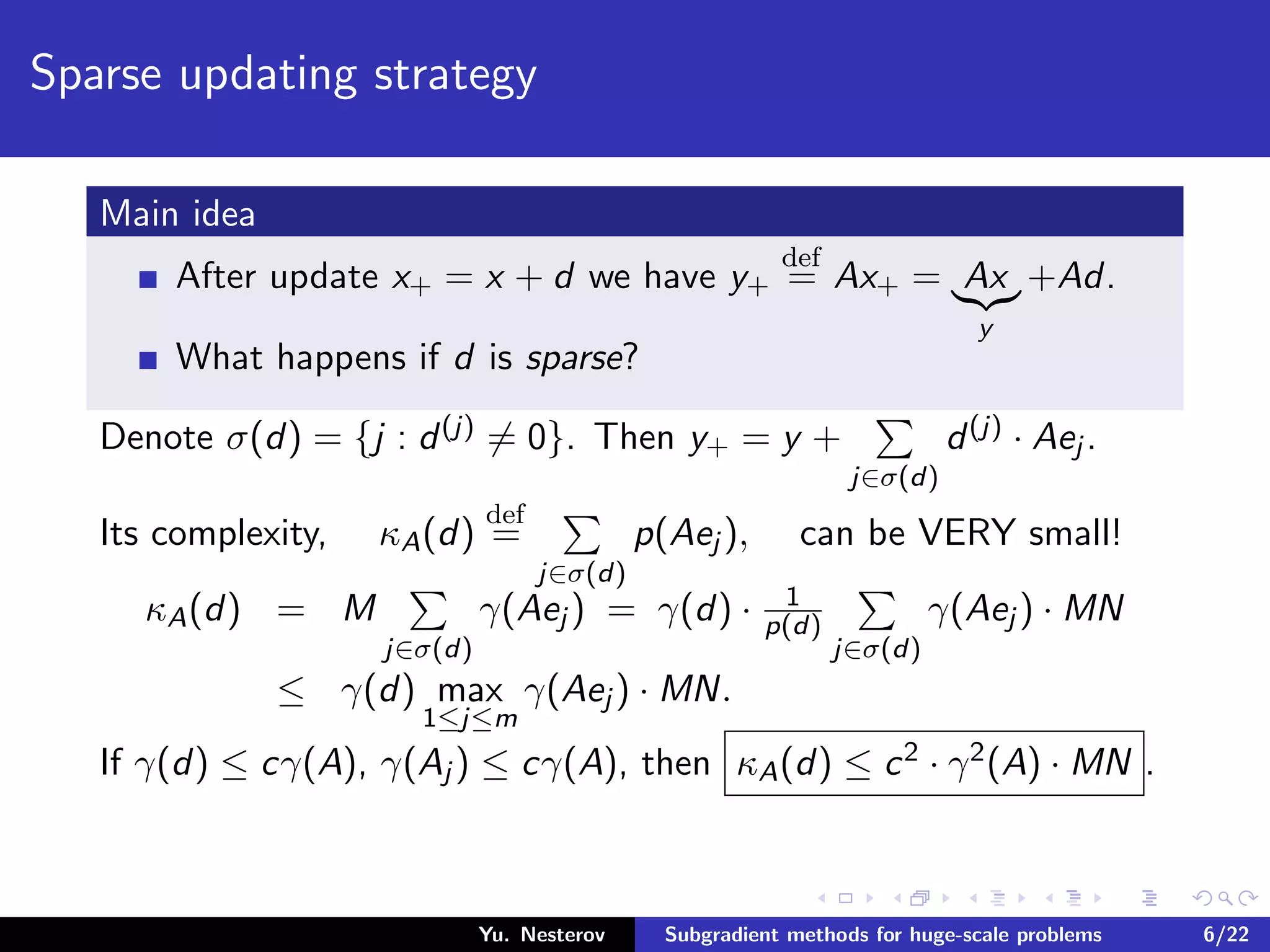
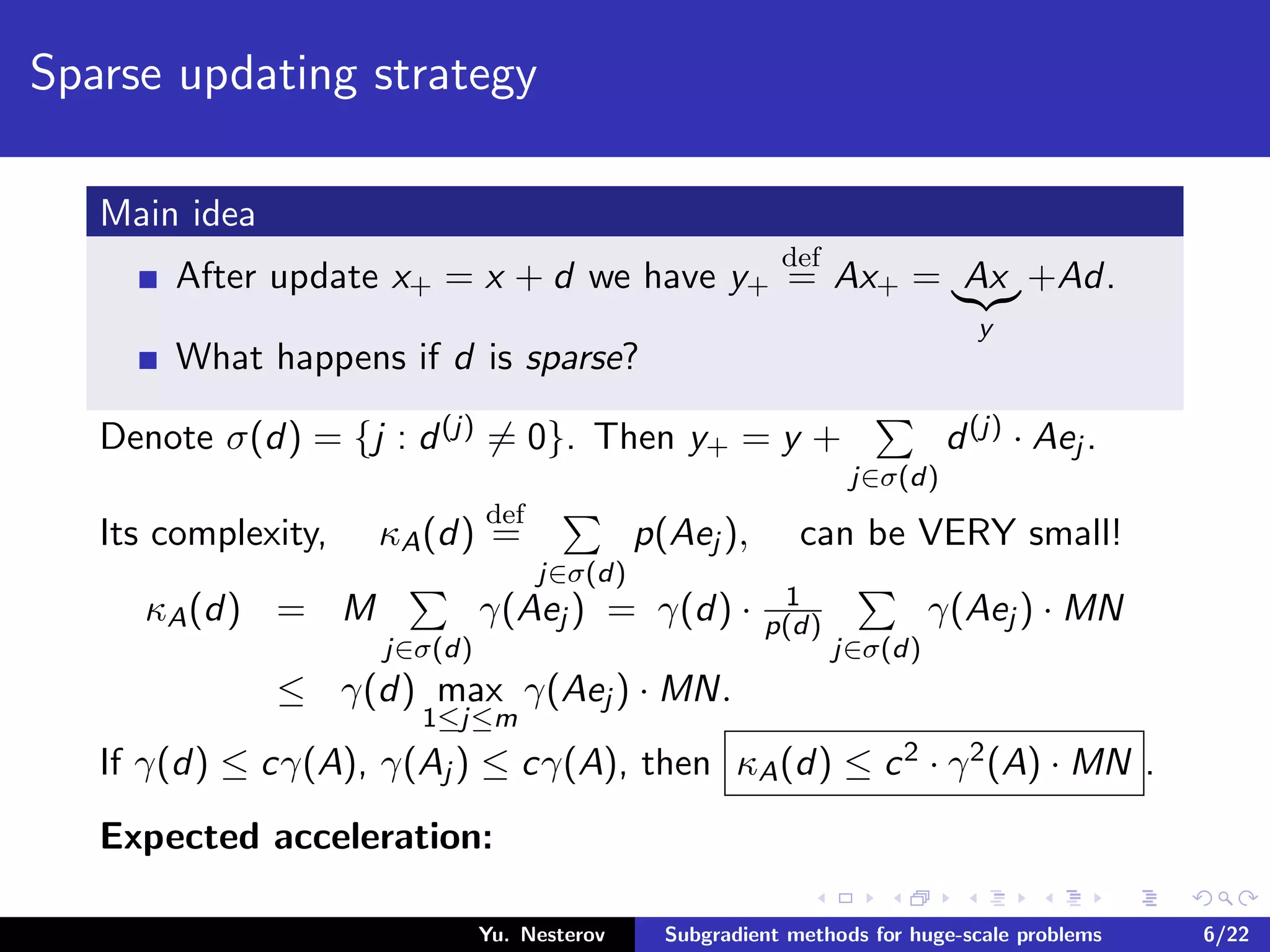
Main idea
Yu. Nesterov Subgradient methods for huge-scale problems 6/22
Sparse updating strategy
Main idea
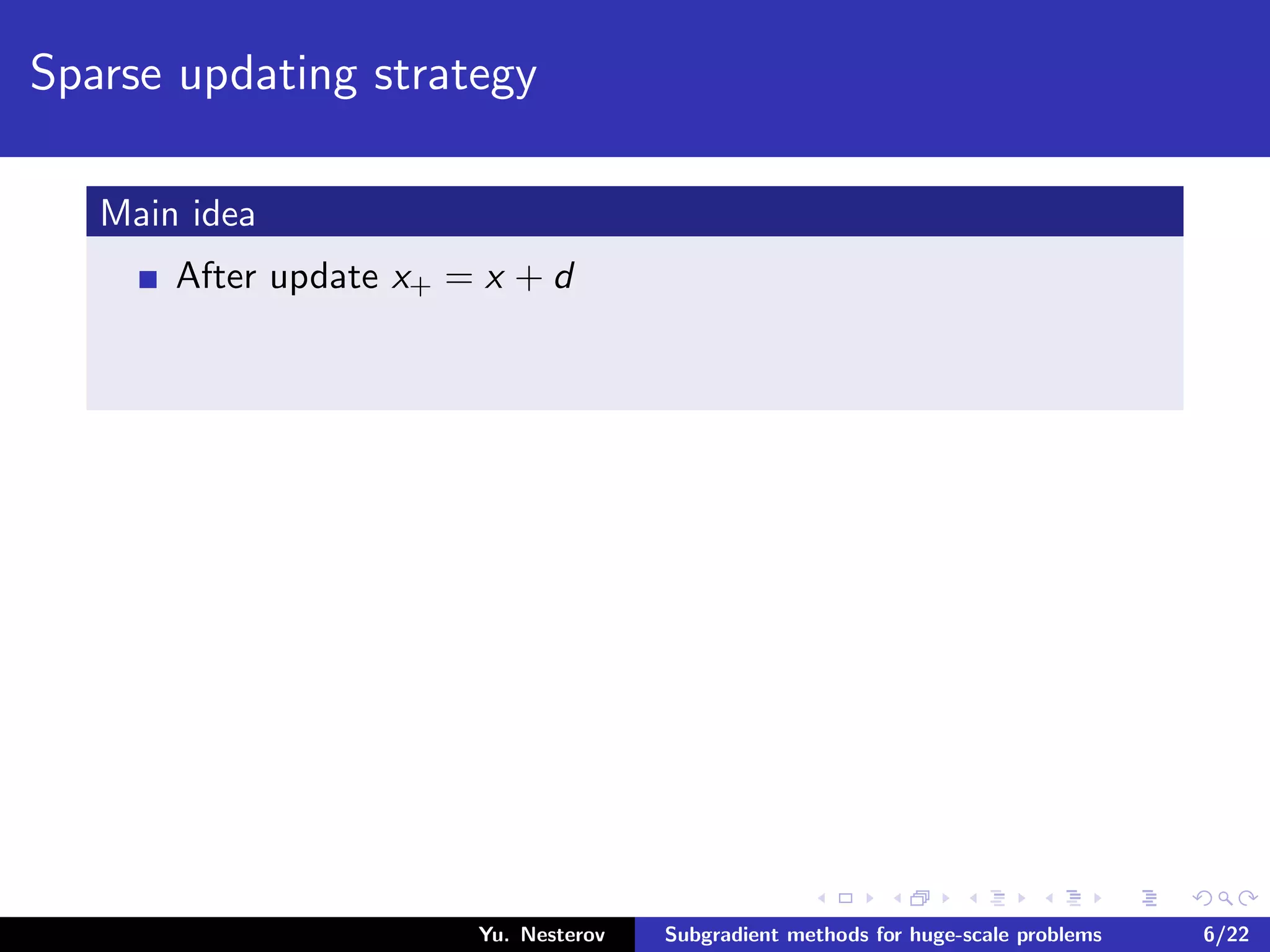
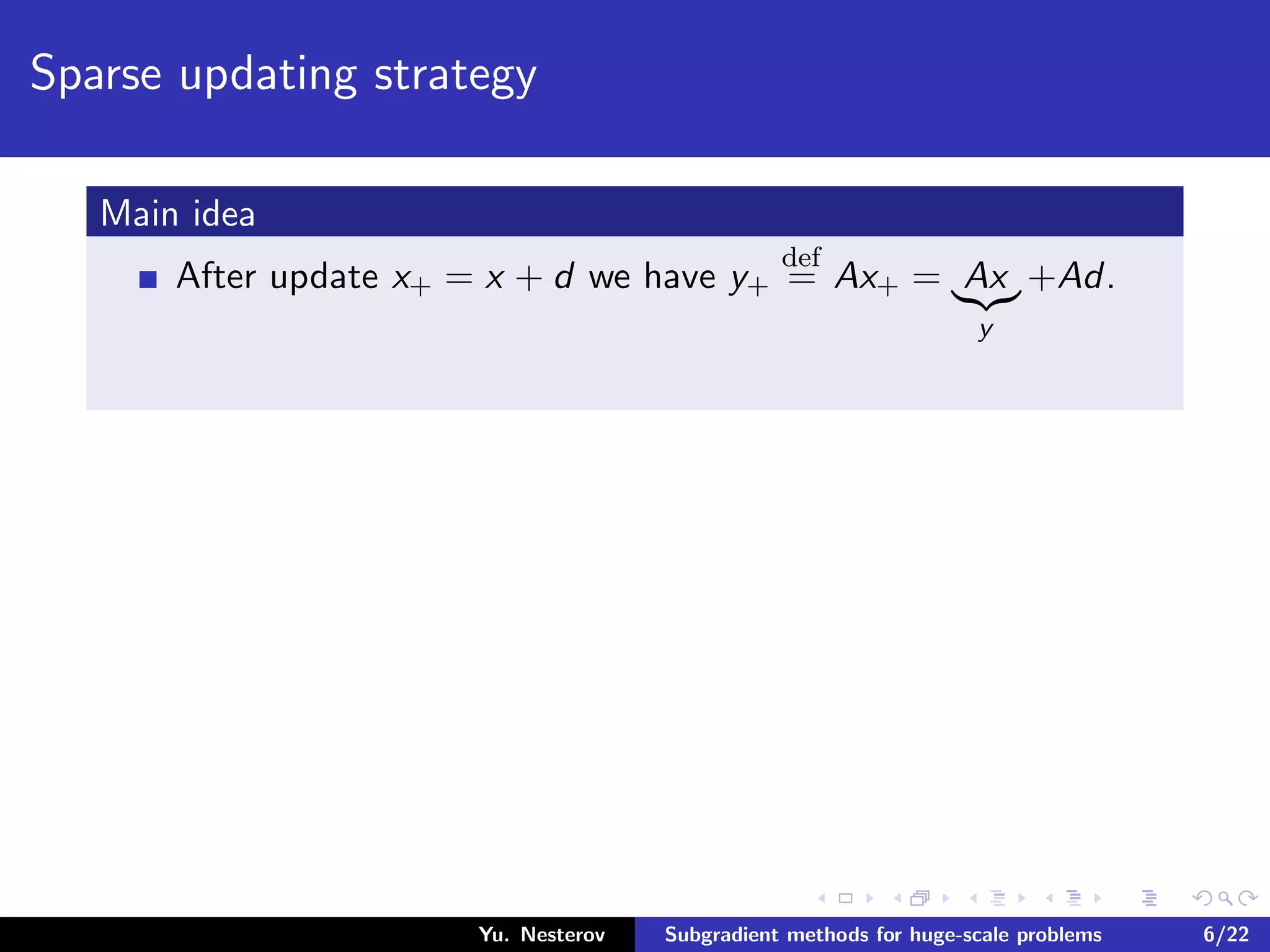
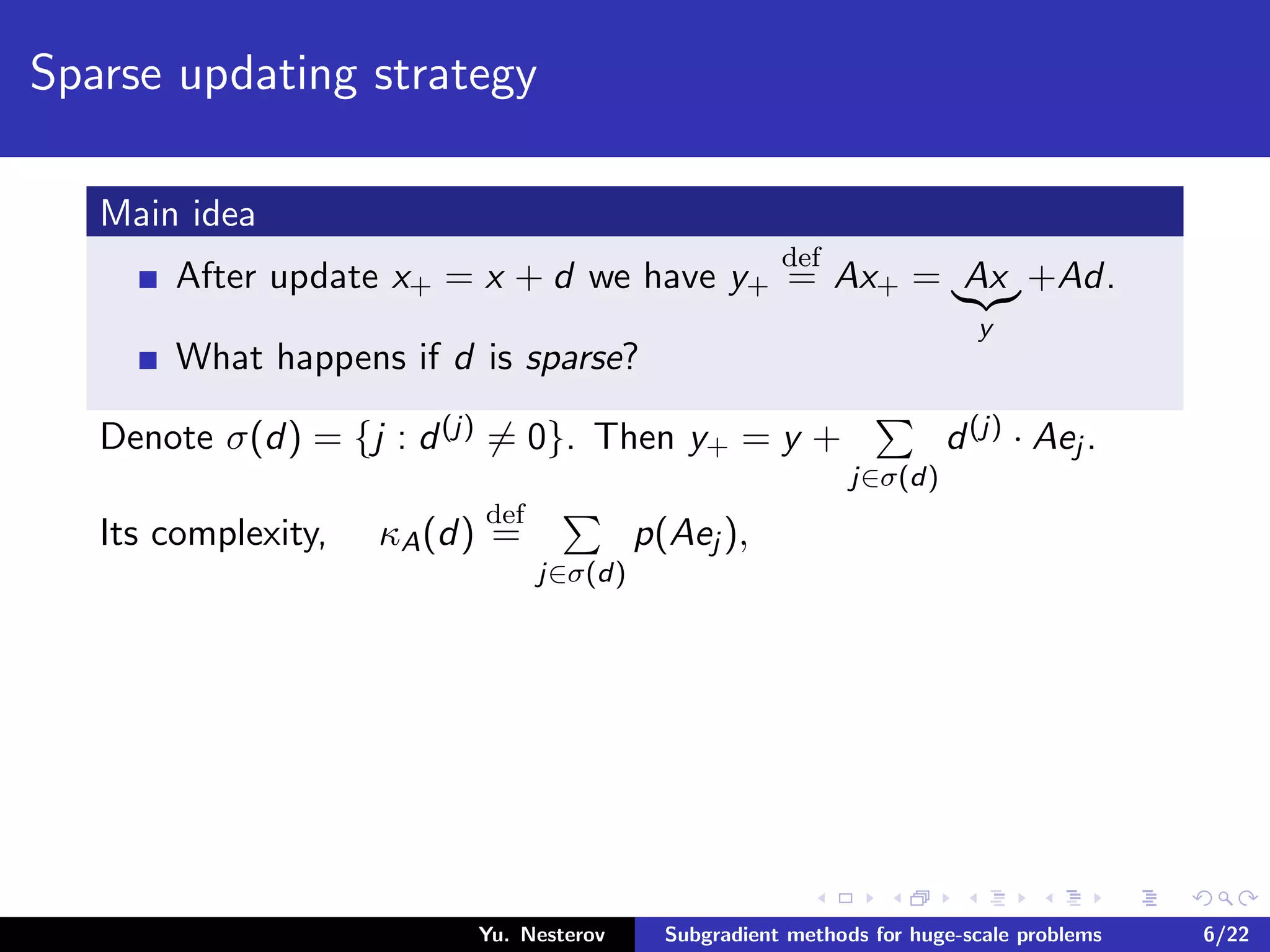
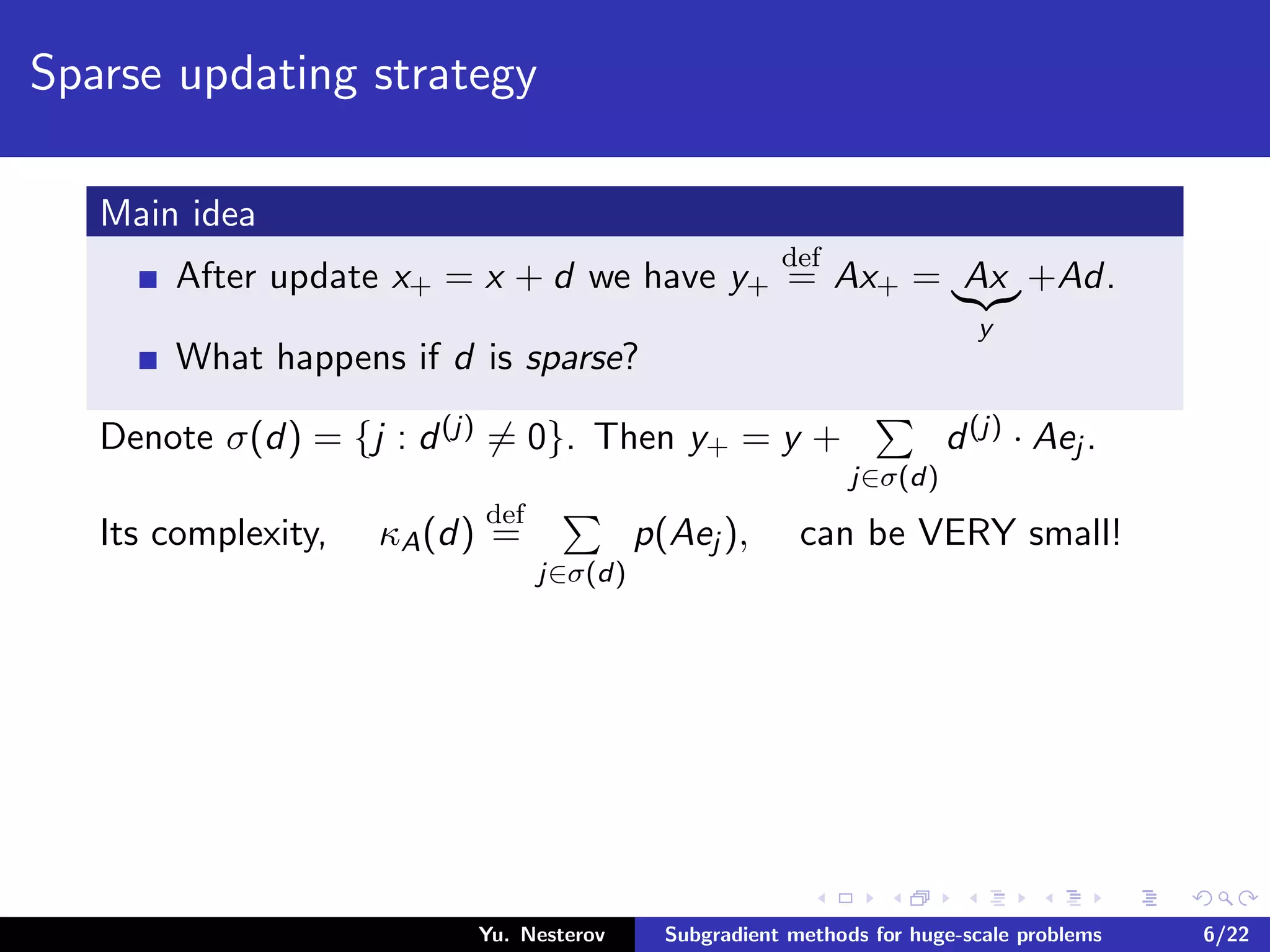
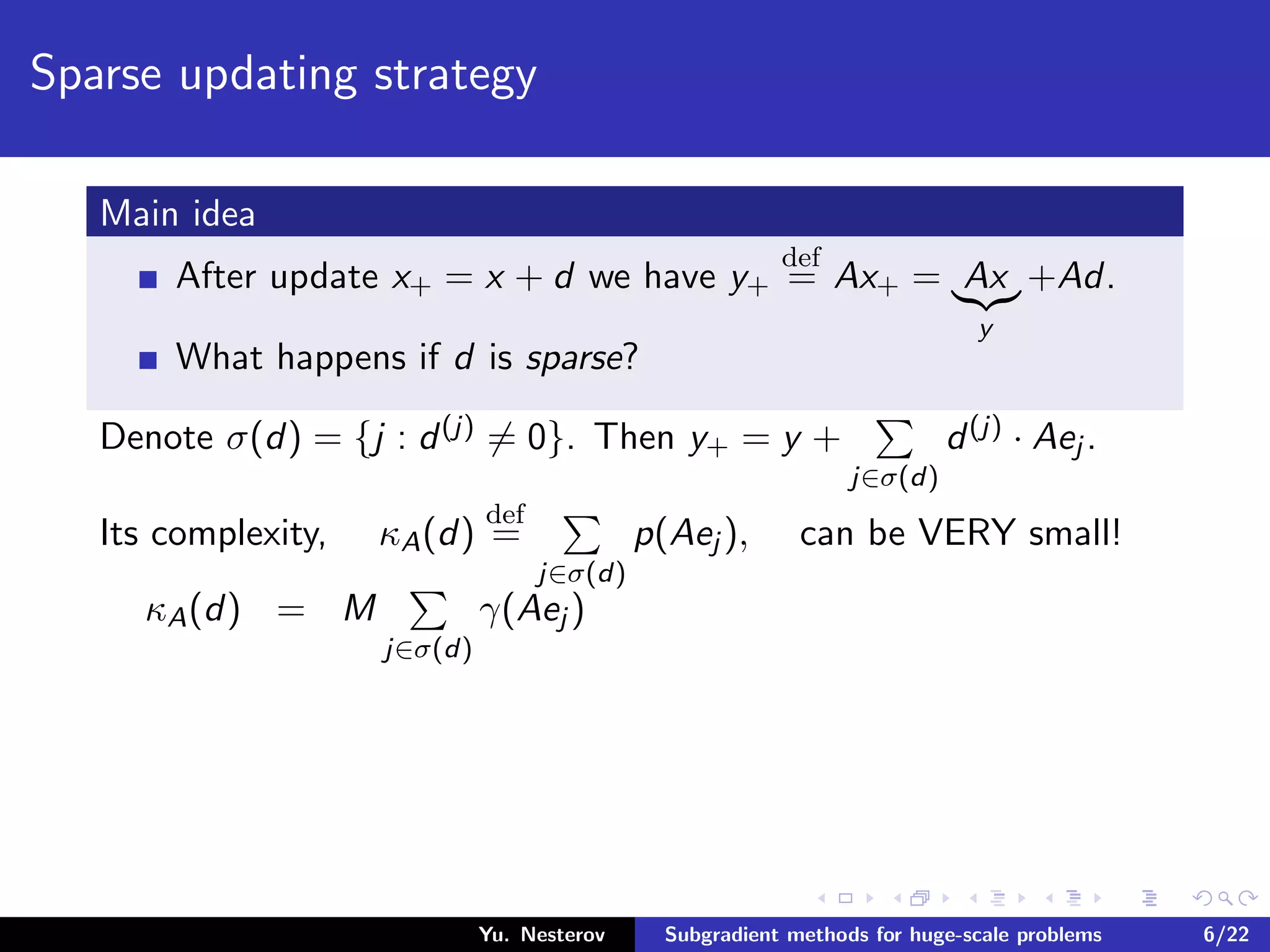
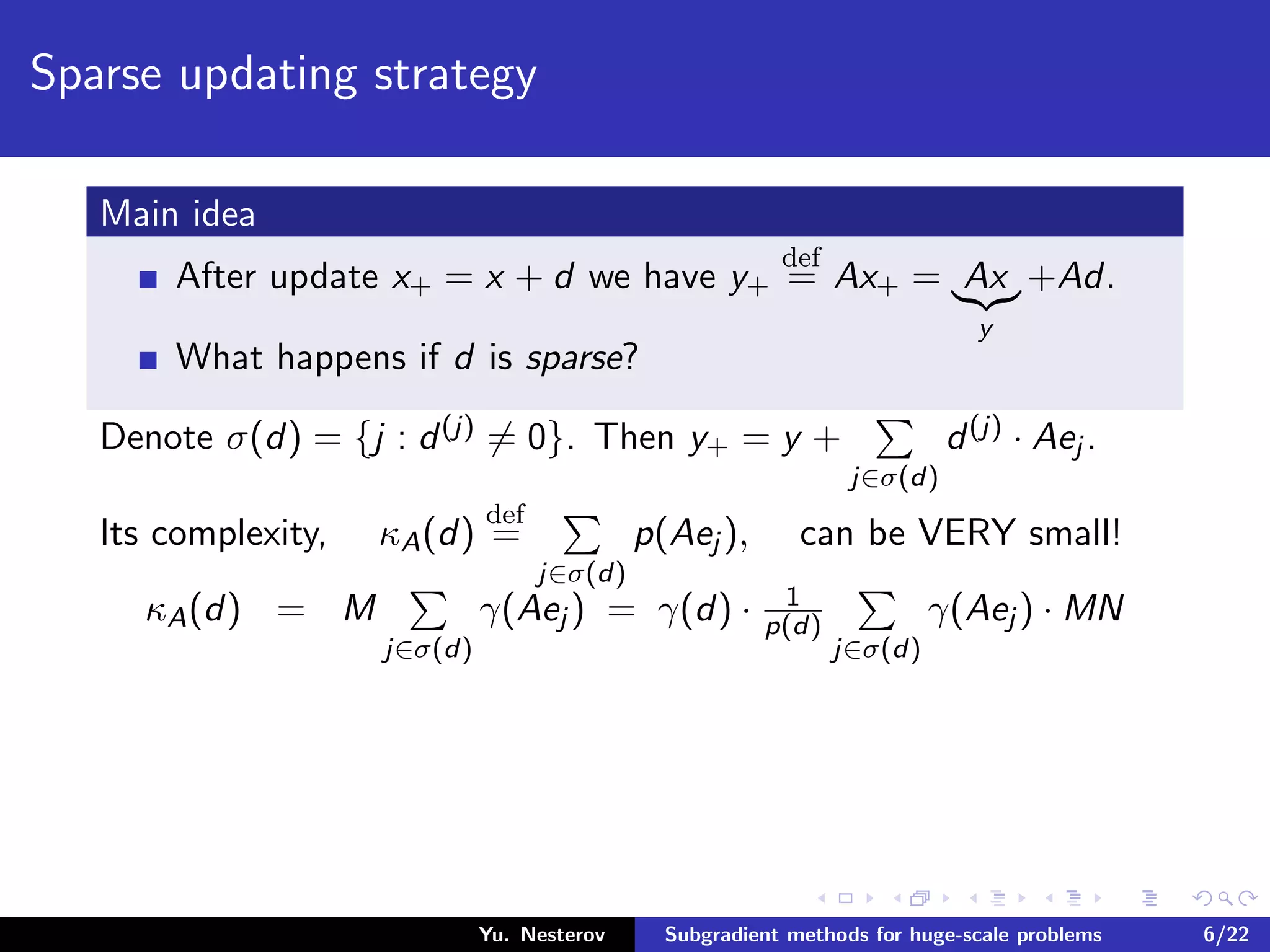
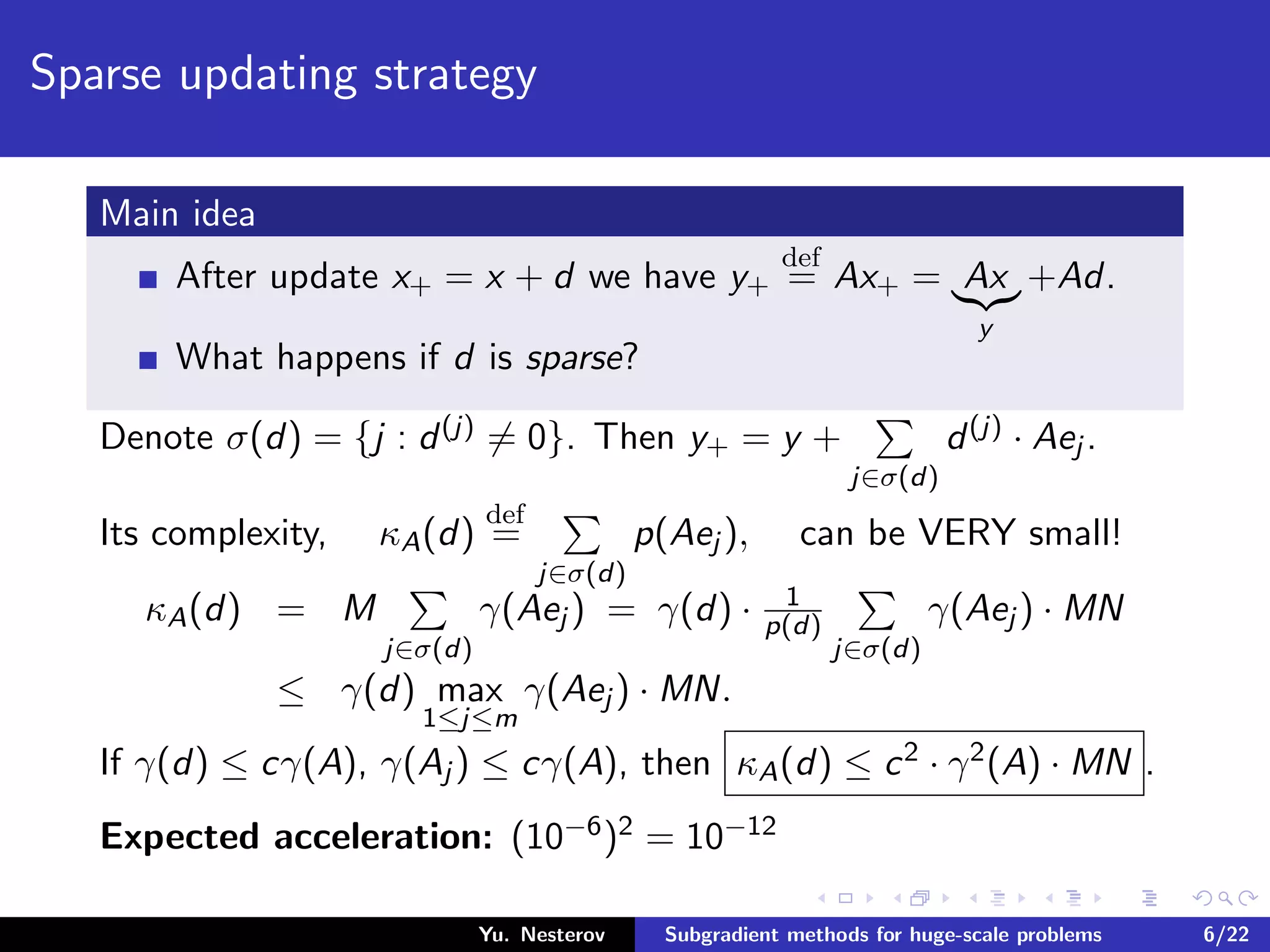
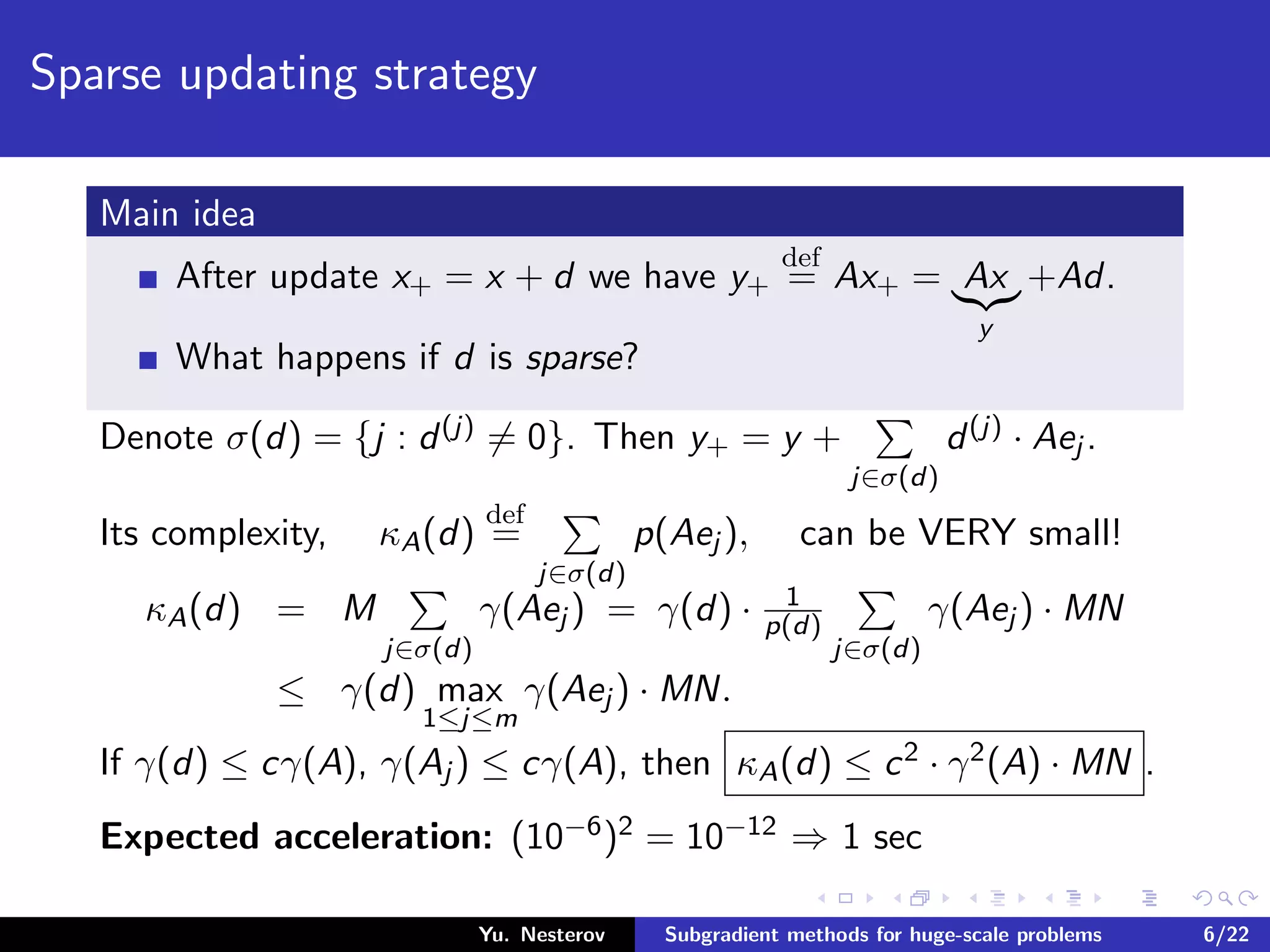
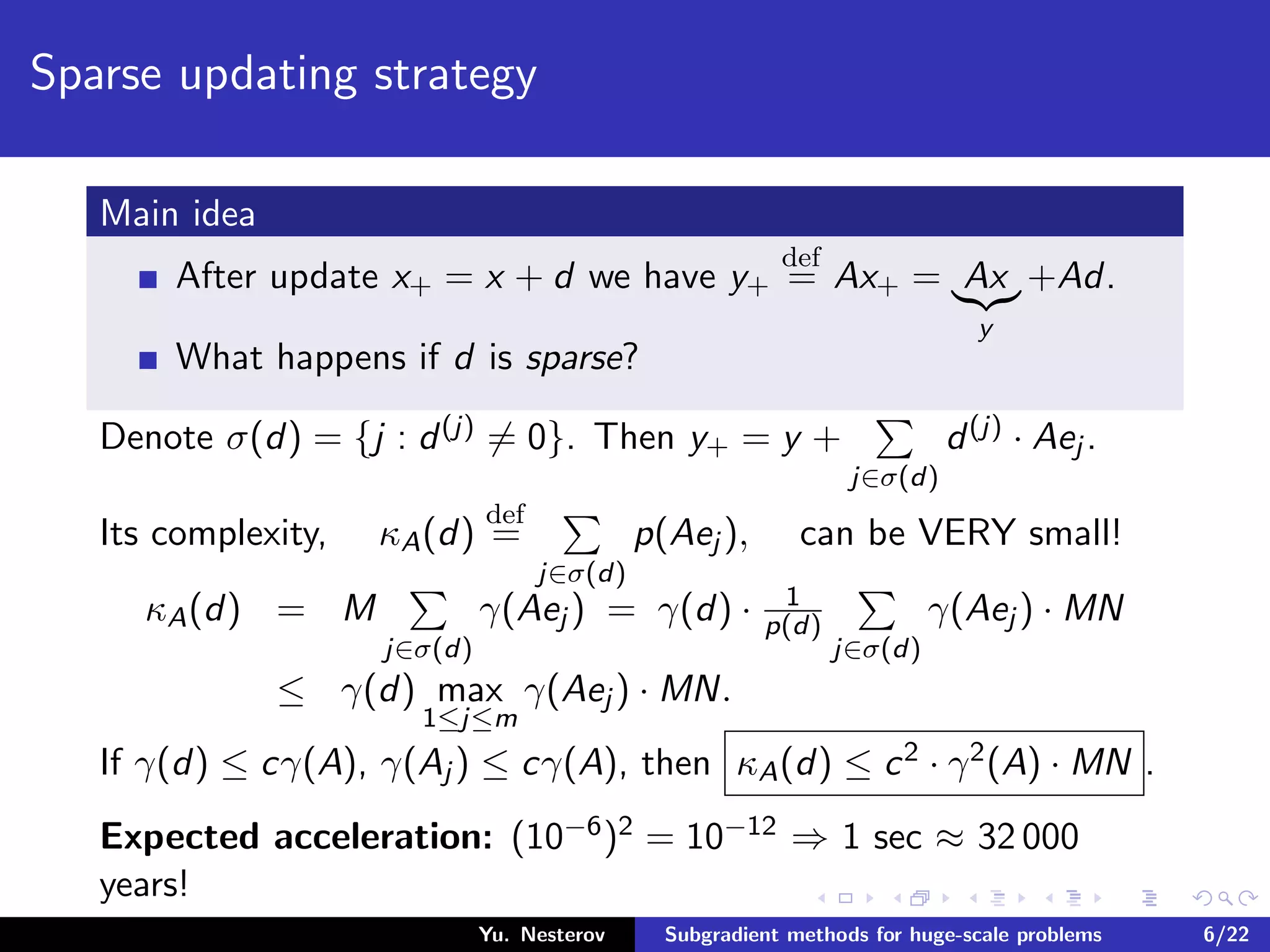
After update x+ = x + d
Yu. Nesterov Subgradient methods for huge-scale problems 6/22
Sparse updating strategy
Main idea
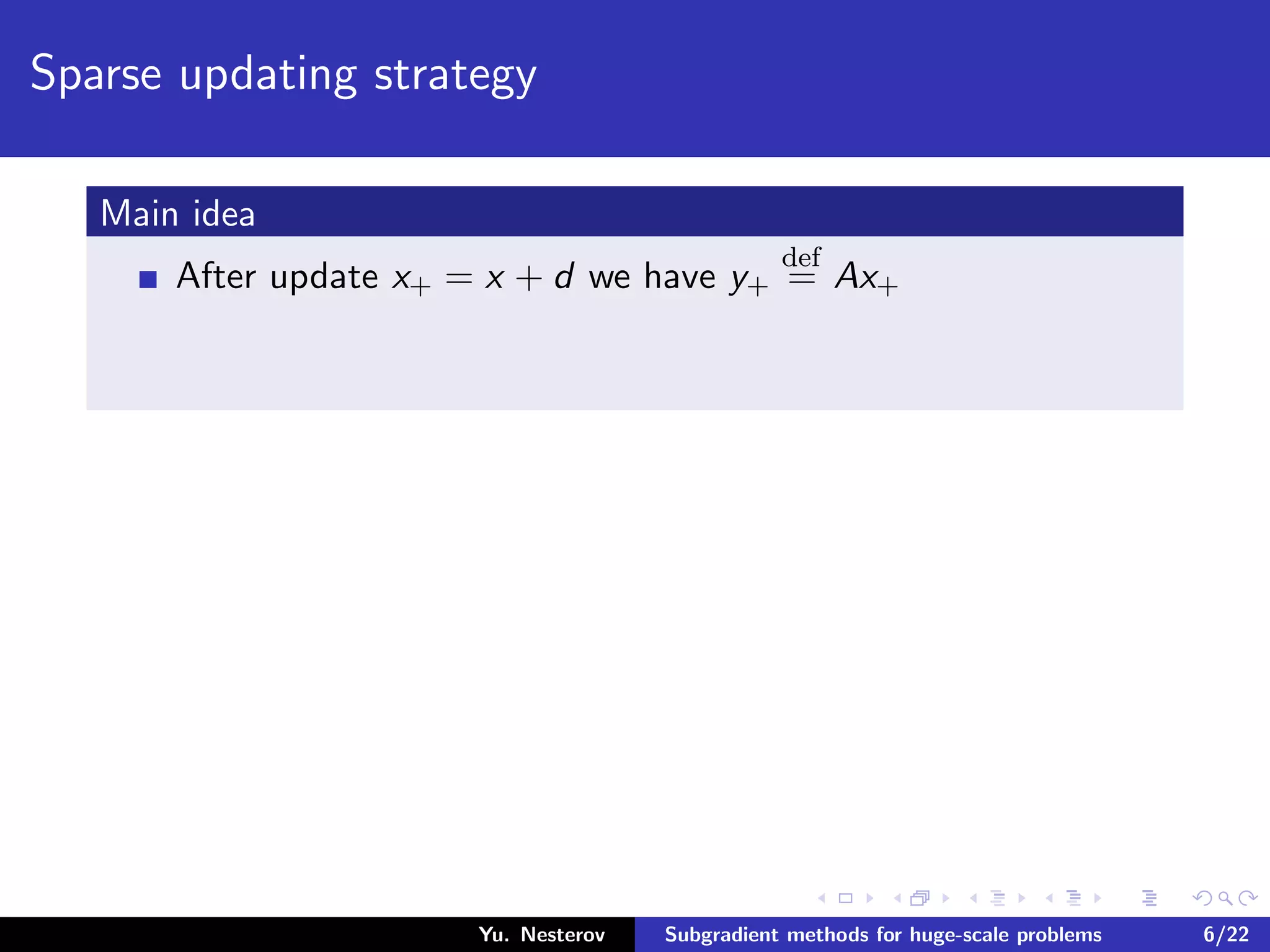
After update x+ = x + d we have y+
def
= Ax+
Yu. Nesterov Subgradient methods for huge-scale problems 6/22
Sparse updating strategy
Main idea
After update x+ = x + d we have y+
def
= Ax+ = Ax
y
+Ad.
Yu. Nesterov Subgradient methods for huge-scale problems 6/22
Sparse updating strategy
Main idea
After update x+ = x + d we have y+
def
= Ax+ = Ax
y
+Ad.
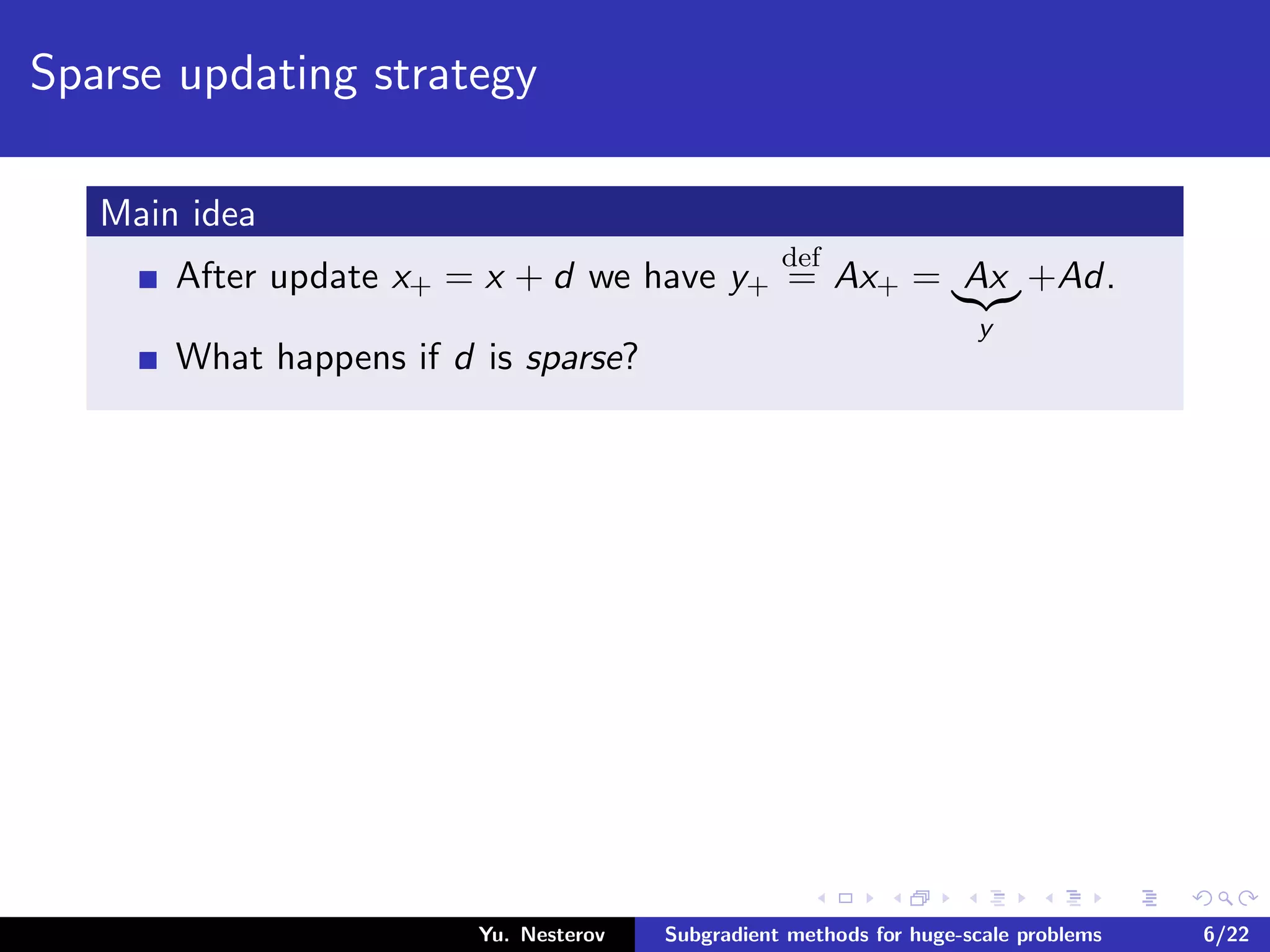
What happens if d is sparse?
Yu. Nesterov Subgradient methods for huge-scale problems 6/22
Sparse updating strategy
Main idea
After update x+ = x + d we have y+
def
= Ax+ = Ax
y
+Ad.
What happens if d is sparse?
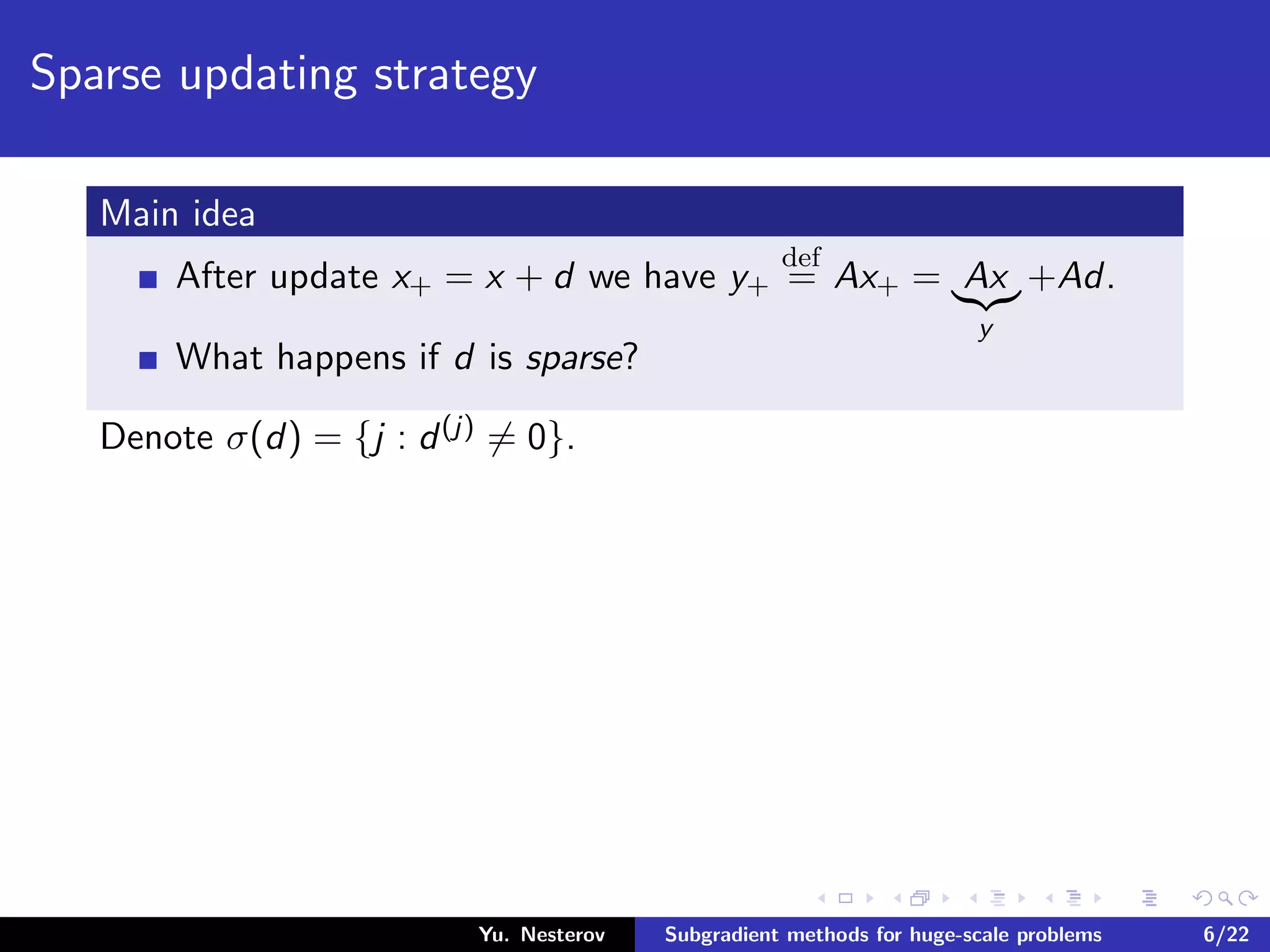
Denote σ(d) = {j : d(j) = 0}.
Yu. Nesterov Subgradient methods for huge-scale problems 6/22
Sparse updating strategy
Main idea
After update x+ = x + d we have y+
def
= Ax+ = Ax
y
+Ad.
What happens if d is sparse?
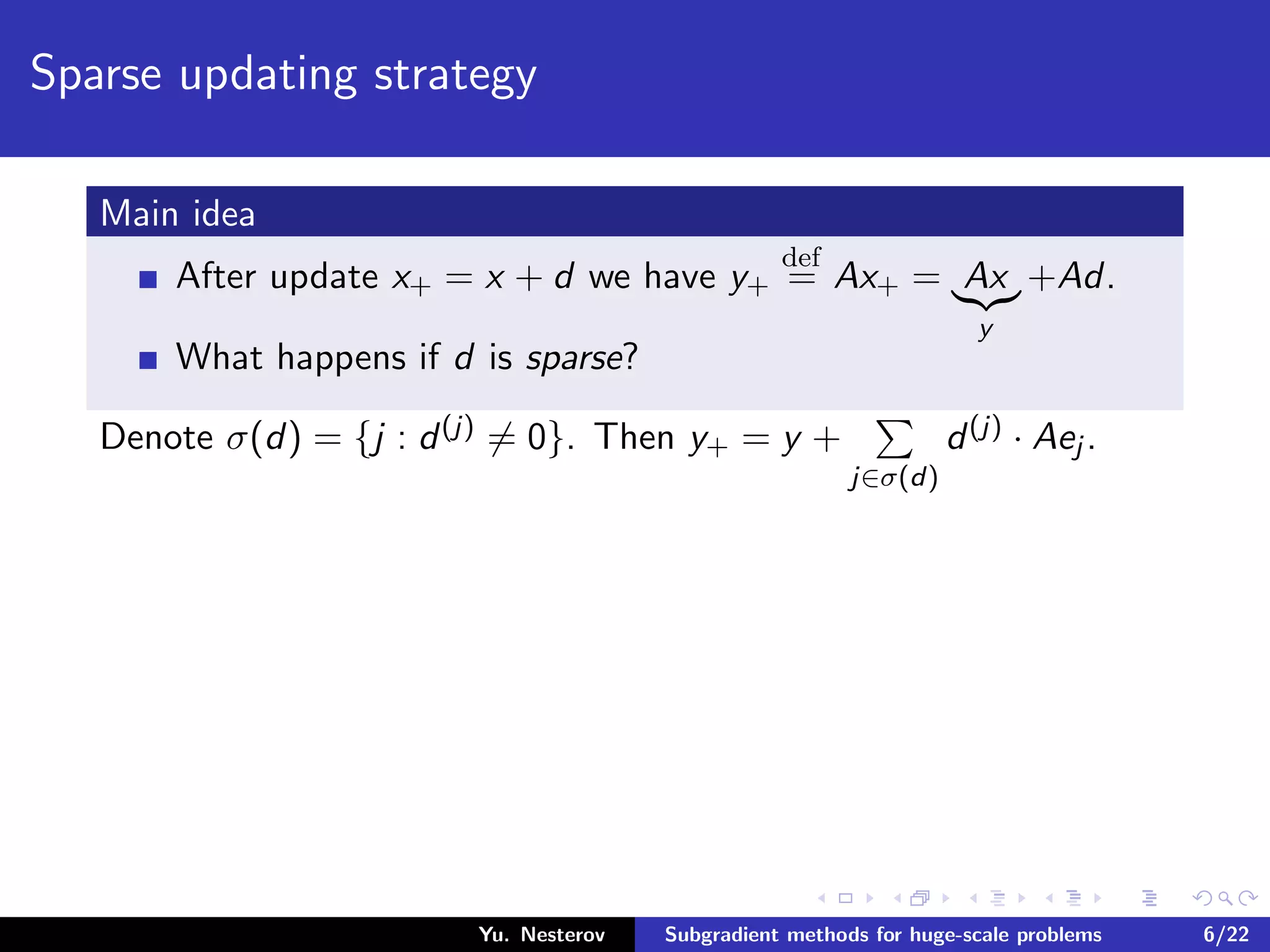
Denote σ(d) = {j : d(j) = 0}. Then y+ = y +
j∈σ(d)
d(j) · Aej .
Yu. Nesterov Subgradient methods for huge-scale problems 6/22
Sparse updating strategy
Main idea
After update x+ = x + d we have y+
def
= Ax+ = Ax
y
+Ad.
What happens if d is sparse?
Denote σ(d) = {j : d(j) = 0}. Then y+ = y +
j∈σ(d)
d(j) · Aej .
Its complexity, κA(d)
def
=
j∈σ(d)
p(Aej ),
Yu. Nesterov Subgradient methods for huge-scale problems 6/22
Sparse updating strategy
Main idea
After update x+ = x + d we have y+
def
= Ax+ = Ax
y
+Ad.
What happens if d is sparse?
Denote σ(d) = {j : d(j) = 0}. Then y+ = y +
j∈σ(d)
d(j) · Aej .
Its complexity, κA(d)
def
=
j∈σ(d)
p(Aej ), can be VERY small!
Yu. Nesterov Subgradient methods for huge-scale problems 6/22
Sparse updating strategy
Main idea
After update x+ = x + d we have y+
def
= Ax+ = Ax
y
+Ad.
What happens if d is sparse?
Denote σ(d) = {j : d(j) = 0}. Then y+ = y +
j∈σ(d)
d(j) · Aej .
Its complexity, κA(d)
def
=
j∈σ(d)
p(Aej ), can be VERY small!
κA(d) = M
j∈σ(d)
γ(Aej )
Yu. Nesterov Subgradient methods for huge-scale problems 6/22
Sparse updating strategy
Main idea
After update x+ = x + d we have y+
def
= Ax+ = Ax
y
+Ad.
What happens if d is sparse?
Denote σ(d) = {j : d(j) = 0}. Then y+ = y +
j∈σ(d)
d(j) · Aej .
Its complexity, κA(d)
def
=
j∈σ(d)
p(Aej ), can be VERY small!
κA(d) = M
j∈σ(d)
γ(Aej ) = γ(d) · 1
p(d)
j∈σ(d)
γ(Aej ) · MN
Yu. Nesterov Subgradient methods for huge-scale problems 6/22
Sparse updating strategy
Main idea
After update x+ = x + d we have y+
def
= Ax+ = Ax
y
+Ad.
What happens if d is sparse?
Denote σ(d) = {j : d(j) = 0}. Then y+ = y +
j∈σ(d)
d(j) · Aej .
Its complexity, κA(d)
def
=
j∈σ(d)
p(Aej ), can be VERY small!
κA(d) = M
j∈σ(d)
γ(Aej ) = γ(d) · 1
p(d)
j∈σ(d)
γ(Aej ) · MN
≤ γ(d) max
1≤j≤m
γ(Aej ) · MN.
Yu. Nesterov Subgradient methods for huge-scale problems 6/22
Sparse updating strategy
Main idea
After update x+ = x + d we have y+
def
= Ax+ = Ax
y
+Ad.
What happens if d is sparse?
Denote σ(d) = {j : d(j) = 0}. Then y+ = y +
j∈σ(d)
d(j) · Aej .
Its complexity, κA(d)
def
=
j∈σ(d)
p(Aej ), can be VERY small!
κA(d) = M
j∈σ(d)
γ(Aej ) = γ(d) · 1
p(d)
j∈σ(d)
γ(Aej ) · MN
≤ γ(d) max
1≤j≤m
γ(Aej ) · MN.
If γ(d) ≤ cγ(A), γ(Aj ) ≤ cγ(A),
Yu. Nesterov Subgradient methods for huge-scale problems 6/22
Sparse updating strategy
Main idea
After update x+ = x + d we have y+
def
= Ax+ = Ax
y
+Ad.
What happens if d is sparse?
Denote σ(d) = {j : d(j) = 0}. Then y+ = y +
j∈σ(d)
d(j) · Aej .
Its complexity, κA(d)
def
=
j∈σ(d)
p(Aej ), can be VERY small!
κA(d) = M
j∈σ(d)
γ(Aej ) = γ(d) · 1
p(d)
j∈σ(d)
γ(Aej ) · MN
≤ γ(d) max
1≤j≤m
γ(Aej ) · MN.
If γ(d) ≤ cγ(A), γ(Aj ) ≤ cγ(A), then κA(d) ≤ c2 · γ2(A) · MN .
Yu. Nesterov Subgradient methods for huge-scale problems 6/22
Sparse updating strategy
Main idea
After update x+ = x + d we have y+
def
= Ax+ = Ax
y
+Ad.
What happens if d is sparse?
Denote σ(d) = {j : d(j) = 0}. Then y+ = y +
j∈σ(d)
d(j) · Aej .
Its complexity, κA(d)
def
=
j∈σ(d)
p(Aej ), can be VERY small!
κA(d) = M
j∈σ(d)
γ(Aej ) = γ(d) · 1
p(d)
j∈σ(d)
γ(Aej ) · MN
≤ γ(d) max
1≤j≤m
γ(Aej ) · MN.
If γ(d) ≤ cγ(A), γ(Aj ) ≤ cγ(A), then κA(d) ≤ c2 · γ2(A) · MN .
Expected acceleration:
Yu. Nesterov Subgradient methods for huge-scale problems 6/22
Sparse updating strategy
Main idea
After update x+ = x + d we have y+
def
= Ax+ = Ax
y
+Ad.
What happens if d is sparse?
Denote σ(d) = {j : d(j) = 0}. Then y+ = y +
j∈σ(d)
d(j) · Aej .
Its complexity, κA(d)
def
=
j∈σ(d)
p(Aej ), can be VERY small!
κA(d) = M
j∈σ(d)
γ(Aej ) = γ(d) · 1
p(d)
j∈σ(d)
γ(Aej ) · MN
≤ γ(d) max
1≤j≤m
γ(Aej ) · MN.
If γ(d) ≤ cγ(A), γ(Aj ) ≤ cγ(A), then κA(d) ≤ c2 · γ2(A) · MN .
Expected acceleration: (10−6)2 = 10−12
Yu. Nesterov Subgradient methods for huge-scale problems 6/22
Sparse updating strategy
Main idea
After update x+ = x + d we have y+
def
= Ax+ = Ax
y
+Ad.
What happens if d is sparse?
Denote σ(d) = {j : d(j) = 0}. Then y+ = y +
j∈σ(d)
d(j) · Aej .
Its complexity, κA(d)
def
=
j∈σ(d)
p(Aej ), can be VERY small!
κA(d) = M
j∈σ(d)
γ(Aej ) = γ(d) · 1
p(d)
j∈σ(d)
γ(Aej ) · MN
≤ γ(d) max
1≤j≤m
γ(Aej ) · MN.
If γ(d) ≤ cγ(A), γ(Aj ) ≤ cγ(A), then κA(d) ≤ c2 · γ2(A) · MN .
Expected acceleration: (10−6)2 = 10−12 ⇒ 1 sec
Yu. Nesterov Subgradient methods for huge-scale problems 6/22
Sparse updating strategy
Main idea
After update x+ = x + d we have y+
def
= Ax+ = Ax
y
+Ad.
What happens if d is sparse?
Denote σ(d) = {j : d(j) = 0}. Then y+ = y +
j∈σ(d)
d(j) · Aej .
Its complexity, κA(d)
def
=
j∈σ(d)
p(Aej ), can be VERY small!
κA(d) = M
j∈σ(d)
γ(Aej ) = γ(d) · 1
p(d)
j∈σ(d)
γ(Aej ) · MN
≤ γ(d) max
1≤j≤m
γ(Aej ) · MN.
If γ(d) ≤ cγ(A), γ(Aj ) ≤ cγ(A), then κA(d) ≤ c2 · γ2(A) · MN .
Expected acceleration: (10−6)2 = 10−12 ⇒ 1 sec ≈ 32 000
years!
Yu. Nesterov Subgradient methods for huge-scale problems 6/22
When it can work?
Yu. Nesterov Subgradient methods for huge-scale problems 7/22
When it can work?
Simple methods:
Yu. Nesterov Subgradient methods for huge-scale problems 7/22
When it can work?
Simple methods: No full-vector operations!
Yu. Nesterov Subgradient methods for huge-scale problems 7/22
When it can work?
Simple methods: No full-vector operations! (Is it possible?)
Yu. Nesterov Subgradient methods for huge-scale problems 7/22
When it can work?
Simple methods: No full-vector operations! (Is it possible?)
Simple problems:
Yu. Nesterov Subgradient methods for huge-scale problems 7/22
When it can work?
Simple methods: No full-vector operations! (Is it possible?)
Simple problems: Functions with sparse gradients.
Yu. Nesterov Subgradient methods for huge-scale problems 7/22
When it can work?
Simple methods: No full-vector operations! (Is it possible?)
Simple problems: Functions with sparse gradients.
Let us try:
Yu. Nesterov Subgradient methods for huge-scale problems 7/22
When it can work?
Simple methods: No full-vector operations! (Is it possible?)
Simple problems: Functions with sparse gradients.
Let us try:
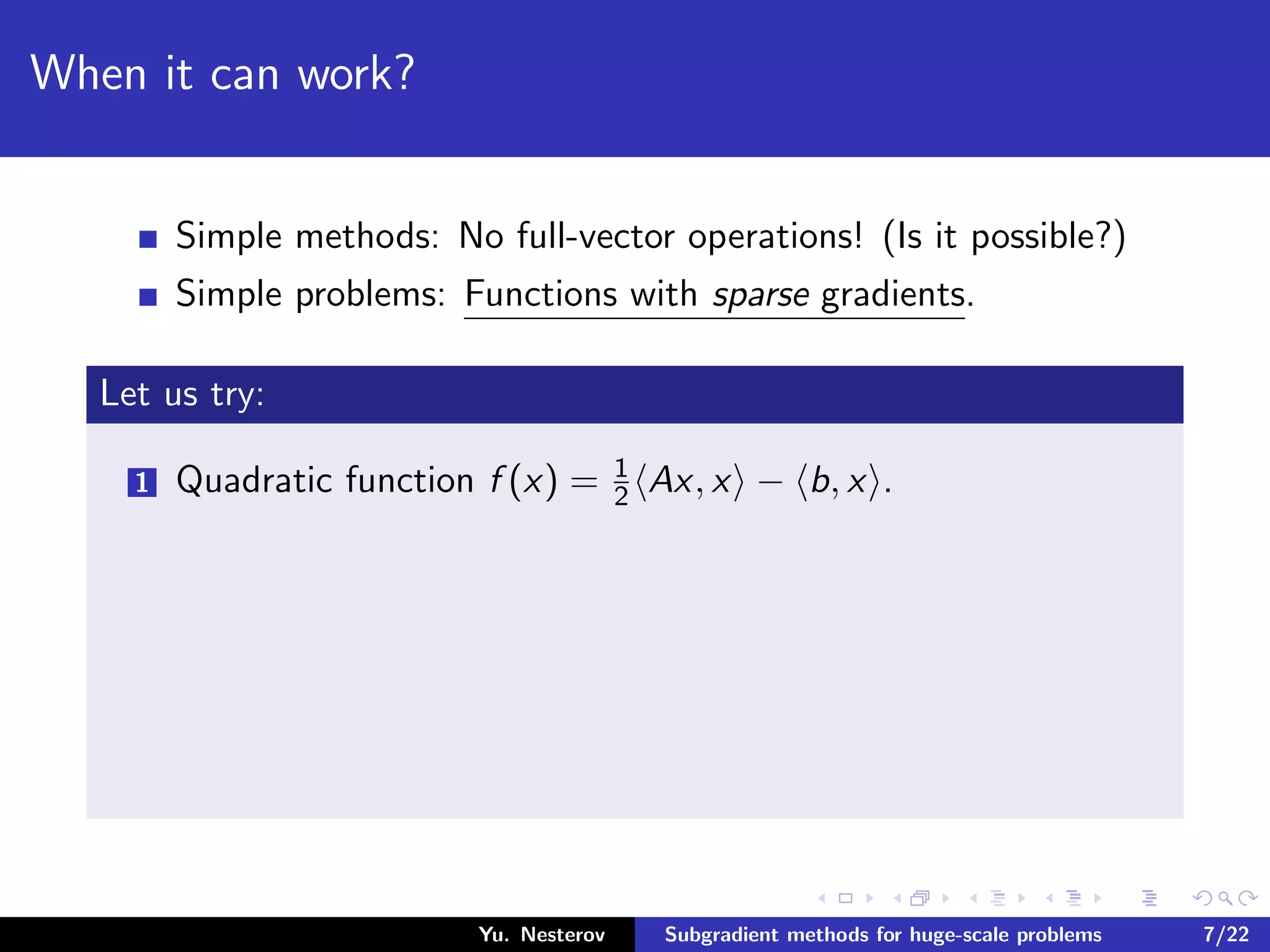
1 Quadratic function f (x) = 1
2 Ax, x − b, x .
Yu. Nesterov Subgradient methods for huge-scale problems 7/22
When it can work?
Simple methods: No full-vector operations! (Is it possible?)
Simple problems: Functions with sparse gradients.
Let us try:
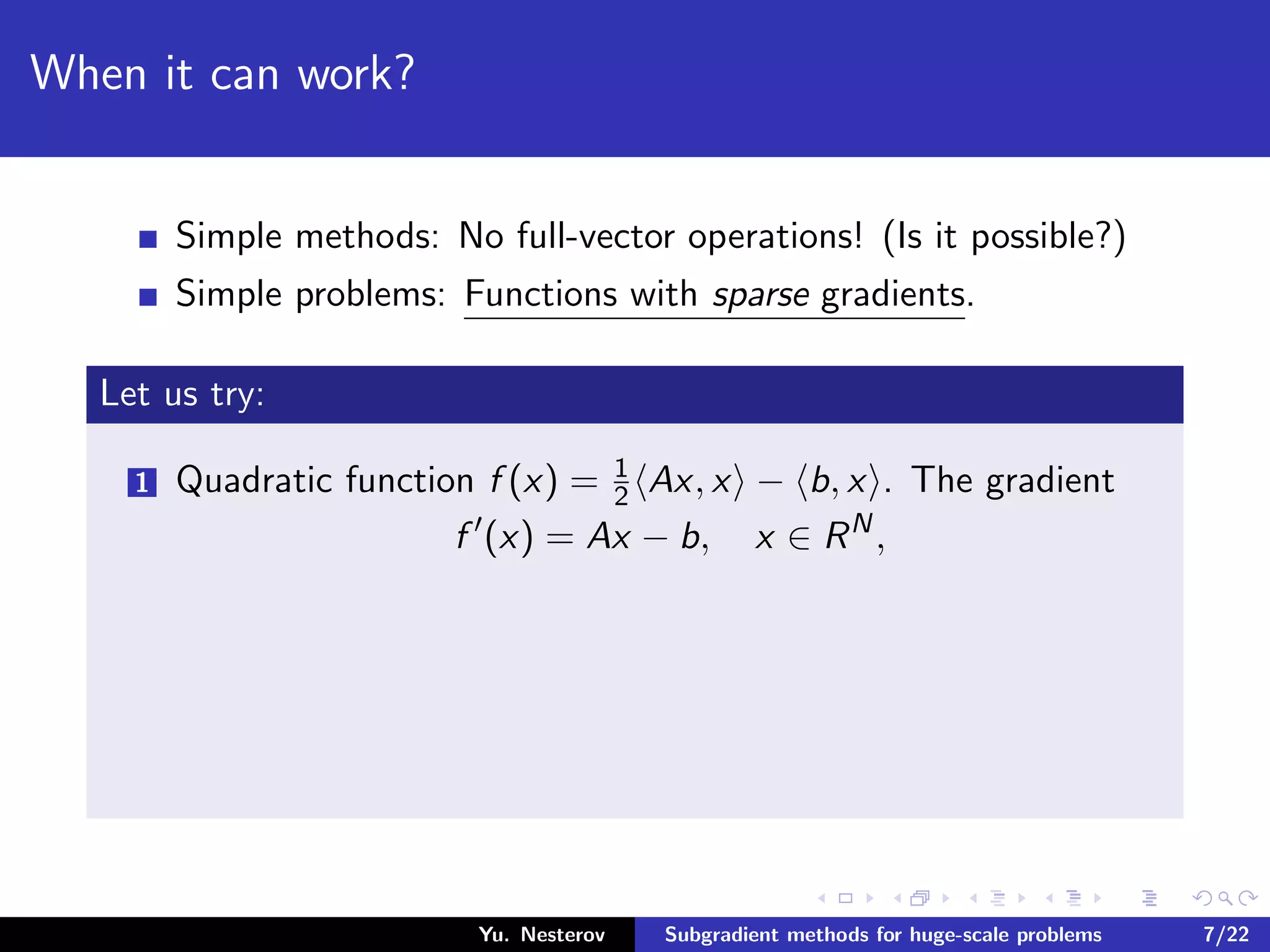
1 Quadratic function f (x) = 1
2 Ax, x − b, x . The gradient
f (x) = Ax − b, x ∈ RN
,
Yu. Nesterov Subgradient methods for huge-scale problems 7/22
When it can work?
Simple methods: No full-vector operations! (Is it possible?)
Simple problems: Functions with sparse gradients.
Let us try:
1 Quadratic function f (x) = 1
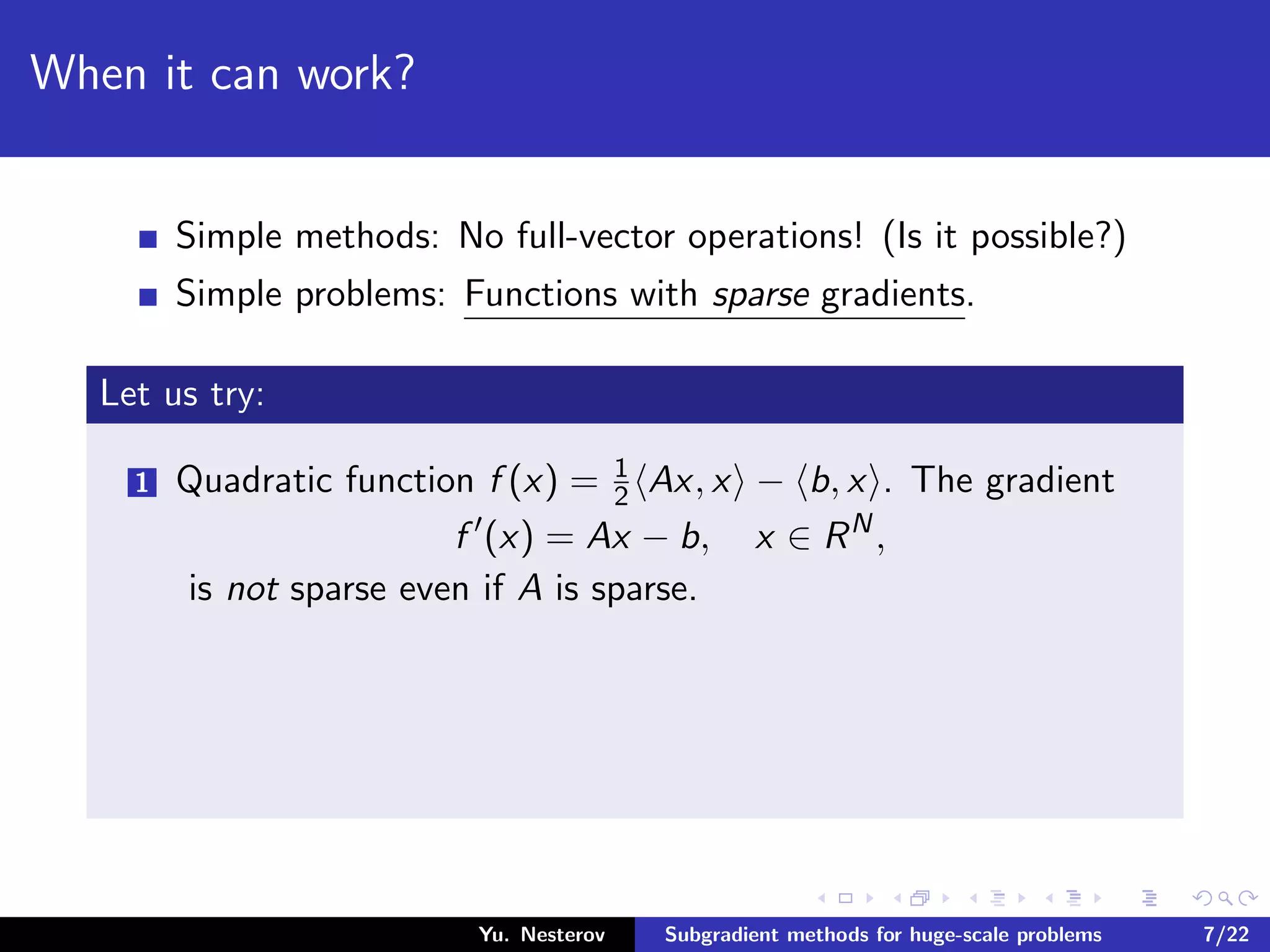
2 Ax, x − b, x . The gradient
f (x) = Ax − b, x ∈ RN
,
is not sparse even if A is sparse.
Yu. Nesterov Subgradient methods for huge-scale problems 7/22
When it can work?
Simple methods: No full-vector operations! (Is it possible?)
Simple problems: Functions with sparse gradients.
Let us try:
1 Quadratic function f (x) = 1
2 Ax, x − b, x . The gradient
f (x) = Ax − b, x ∈ RN
,
is not sparse even if A is sparse.
2 Piece-wise linear function g(x) = max
1≤i≤m
[ ai , x − b(i)].
Yu. Nesterov Subgradient methods for huge-scale problems 7/22
When it can work?
Simple methods: No full-vector operations! (Is it possible?)
Simple problems: Functions with sparse gradients.
Let us try:
1 Quadratic function f (x) = 1
2 Ax, x − b, x . The gradient
f (x) = Ax − b, x ∈ RN
,
is not sparse even if A is sparse.
2 Piece-wise linear function g(x) = max
1≤i≤m
[ ai , x − b(i)]. Its
subgradient f (x) = ai(x), i(x) : f (x) = ai(x), x − b(i(x)),
Yu. Nesterov Subgradient methods for huge-scale problems 7/22
When it can work?
Simple methods: No full-vector operations! (Is it possible?)
Simple problems: Functions with sparse gradients.
Let us try:
1 Quadratic function f (x) = 1
2 Ax, x − b, x . The gradient
f (x) = Ax − b, x ∈ RN
,
is not sparse even if A is sparse.
2 Piece-wise linear function g(x) = max
1≤i≤m
[ ai , x − b(i)]. Its
subgradient f (x) = ai(x), i(x) : f (x) = ai(x), x − b(i(x)),
can be sparse is ai is sparse!
Yu. Nesterov Subgradient methods for huge-scale problems 7/22
When it can work?
Simple methods: No full-vector operations! (Is it possible?)
Simple problems: Functions with sparse gradients.
Let us try:
1 Quadratic function f (x) = 1
2 Ax, x − b, x . The gradient
f (x) = Ax − b, x ∈ RN
,
is not sparse even if A is sparse.
2 Piece-wise linear function g(x) = max
1≤i≤m
[ ai , x − b(i)]. Its
subgradient f (x) = ai(x), i(x) : f (x) = ai(x), x − b(i(x)),
can be sparse is ai is sparse!
But:
Yu. Nesterov Subgradient methods for huge-scale problems 7/22
When it can work?
Simple methods: No full-vector operations! (Is it possible?)
Simple problems: Functions with sparse gradients.
Let us try:
1 Quadratic function f (x) = 1
2 Ax, x − b, x . The gradient
f (x) = Ax − b, x ∈ RN
,
is not sparse even if A is sparse.
2 Piece-wise linear function g(x) = max
1≤i≤m
[ ai , x − b(i)]. Its
subgradient f (x) = ai(x), i(x) : f (x) = ai(x), x − b(i(x)),
can be sparse is ai is sparse!
But: We need a fast procedure for updating max-type operations.
Yu. Nesterov Subgradient methods for huge-scale problems 7/22
Fast updates in short computational trees
Yu. Nesterov Subgradient methods for huge-scale problems 8/22
Fast updates in short computational trees
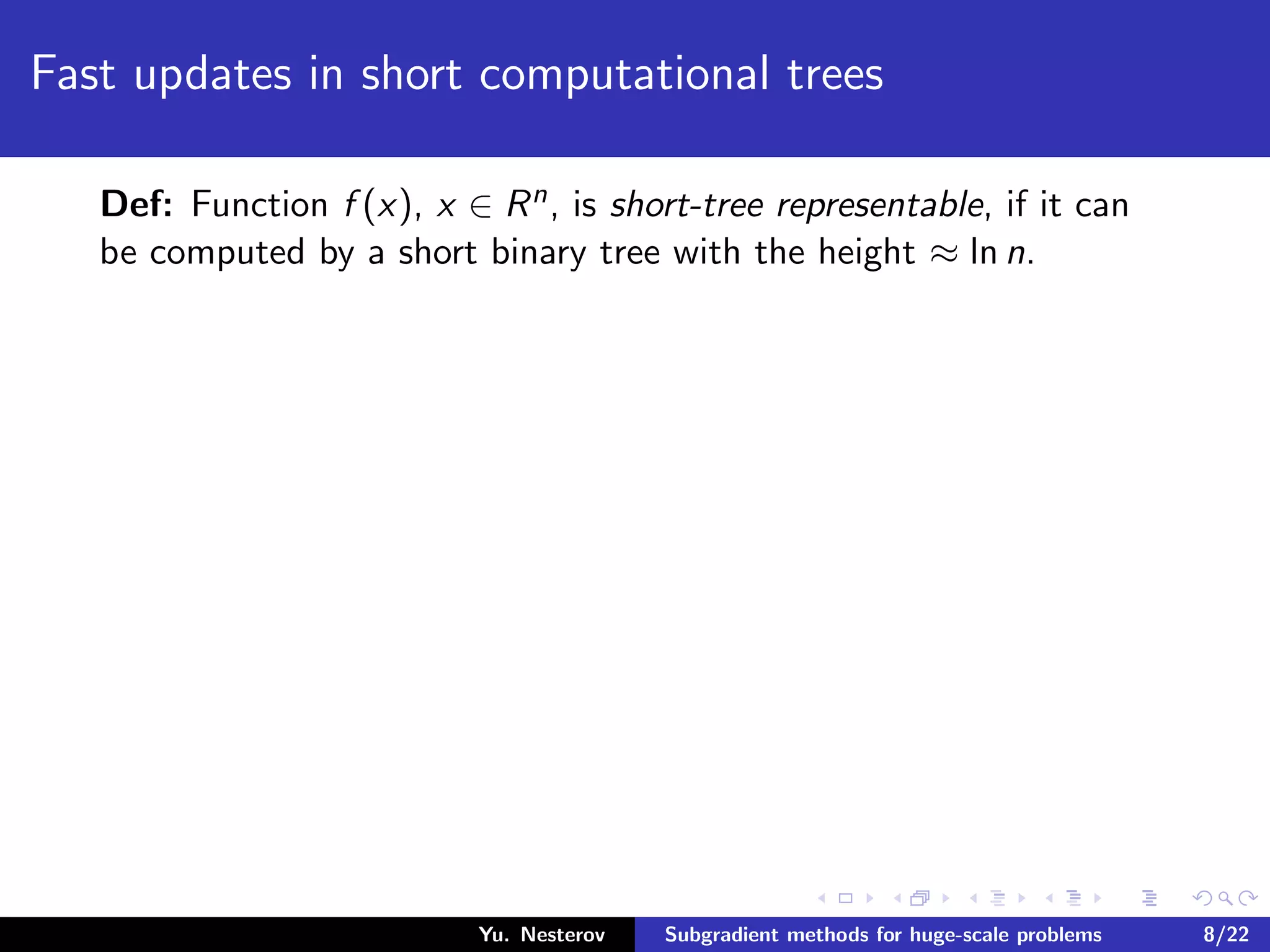
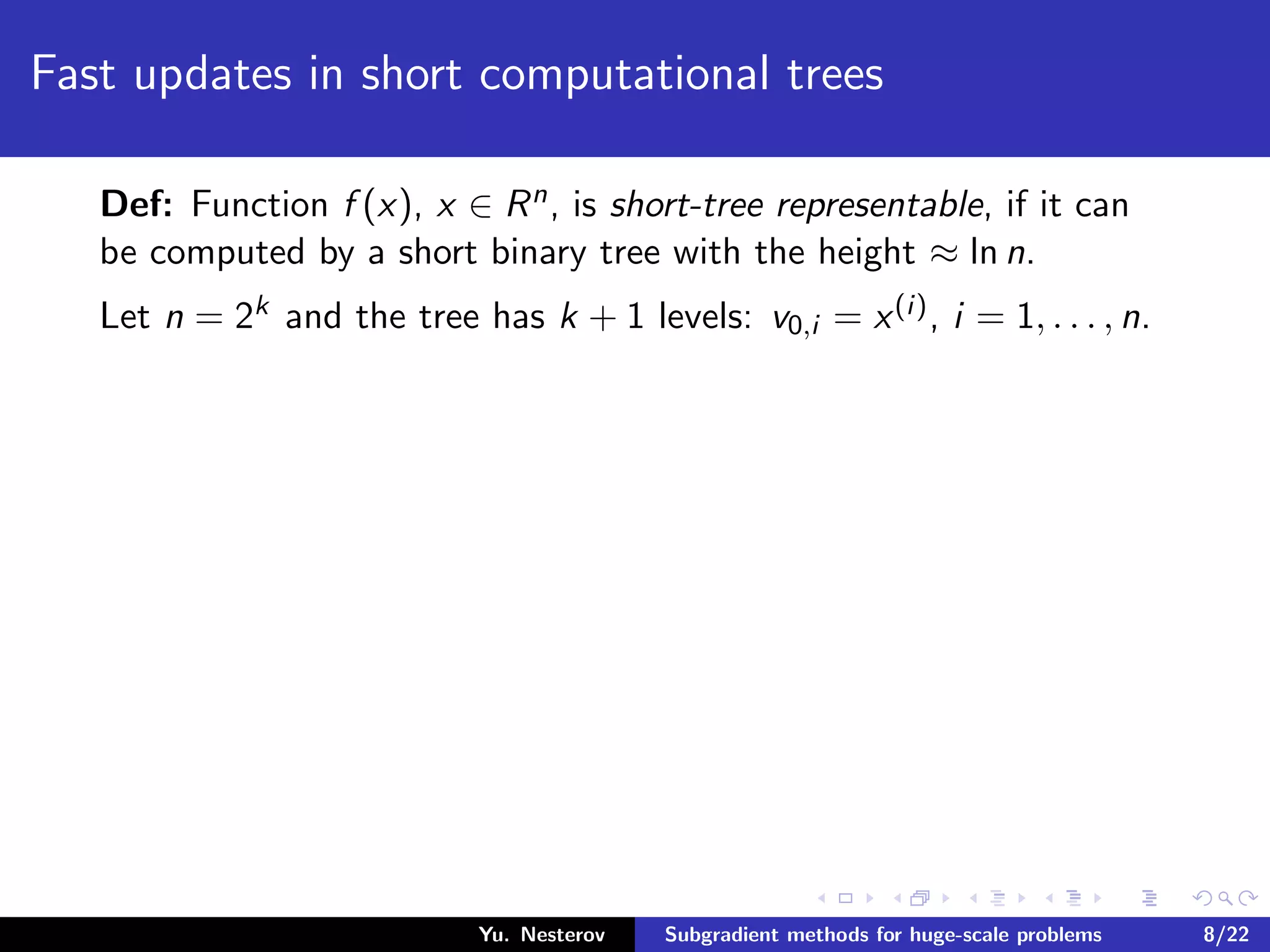
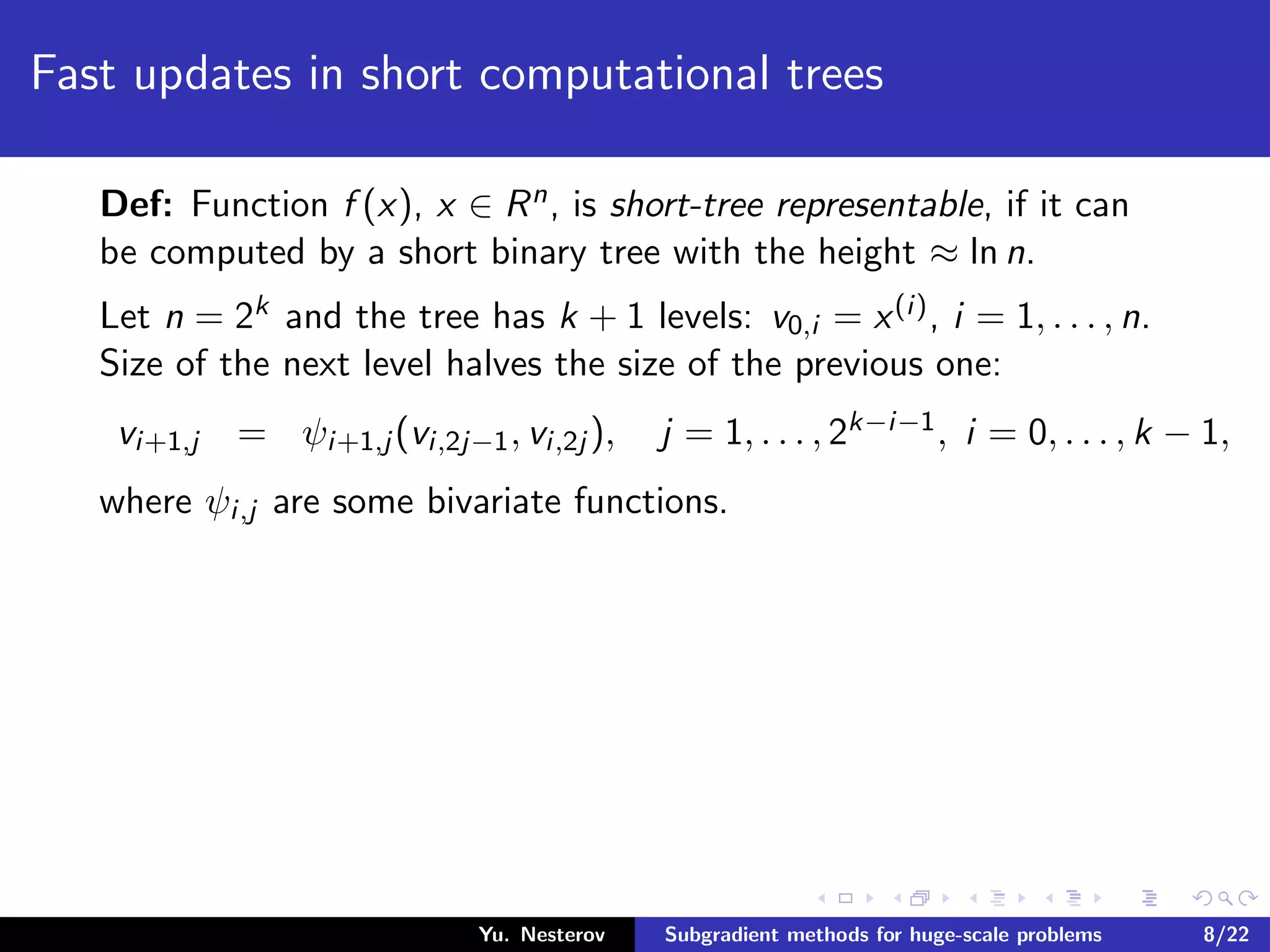
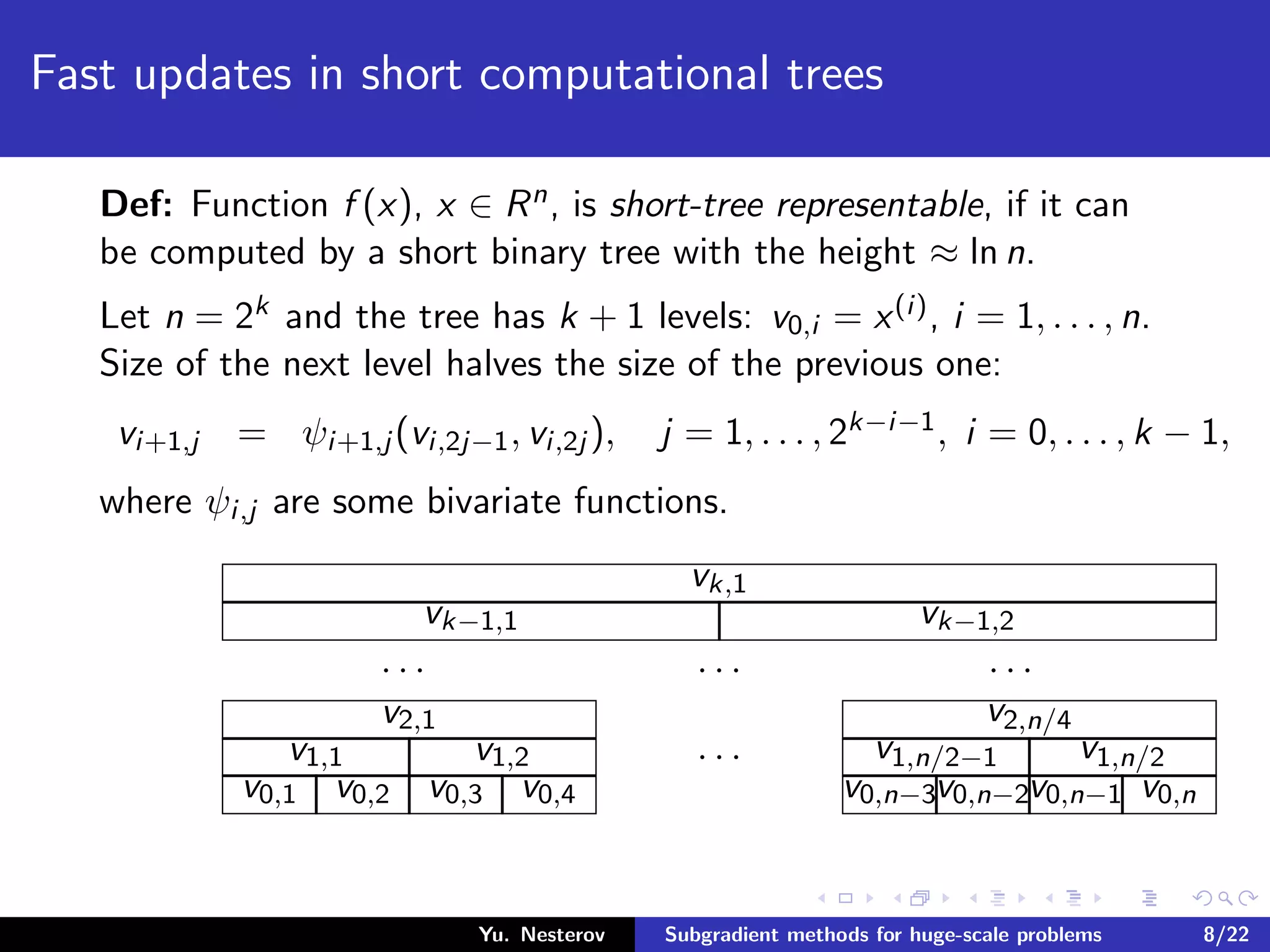
Def: Function f (x), x ∈ Rn, is short-tree representable, if it can
be computed by a short binary tree with the height ≈ ln n.
Yu. Nesterov Subgradient methods for huge-scale problems 8/22
Fast updates in short computational trees
Def: Function f (x), x ∈ Rn, is short-tree representable, if it can
be computed by a short binary tree with the height ≈ ln n.
Let n = 2k and the tree has k + 1 levels: v0,i = x(i), i = 1, . . . , n.
Yu. Nesterov Subgradient methods for huge-scale problems 8/22
Fast updates in short computational trees
Def: Function f (x), x ∈ Rn, is short-tree representable, if it can
be computed by a short binary tree with the height ≈ ln n.
Let n = 2k and the tree has k + 1 levels: v0,i = x(i), i = 1, . . . , n.
Size of the next level halves the size of the previous one:
vi+1,j = ψi+1,j (vi,2j−1, vi,2j ), j = 1, . . . , 2k−i−1, i = 0, . . . , k − 1,
where ψi,j are some bivariate functions.
Yu. Nesterov Subgradient methods for huge-scale problems 8/22
Fast updates in short computational trees
Def: Function f (x), x ∈ Rn, is short-tree representable, if it can
be computed by a short binary tree with the height ≈ ln n.
Let n = 2k and the tree has k + 1 levels: v0,i = x(i), i = 1, . . . , n.
Size of the next level halves the size of the previous one:
vi+1,j = ψi+1,j (vi,2j−1, vi,2j ), j = 1, . . . , 2k−i−1, i = 0, . . . , k − 1,
where ψi,j are some bivariate functions.
v2,1
v1,1 v1,2
v0,1 v0,2 v0,3 v0,4
v2,n/4
v1,n/2−1 v1,n/2
v0,n−3v0,n−2v0,n−1 v0,n
. . . . . . . . .
. . .
vk−1,1 vk−1,2
vk,1
Yu. Nesterov Subgradient methods for huge-scale problems 8/22
Main advantages
Yu. Nesterov Subgradient methods for huge-scale problems 9/22
Main advantages
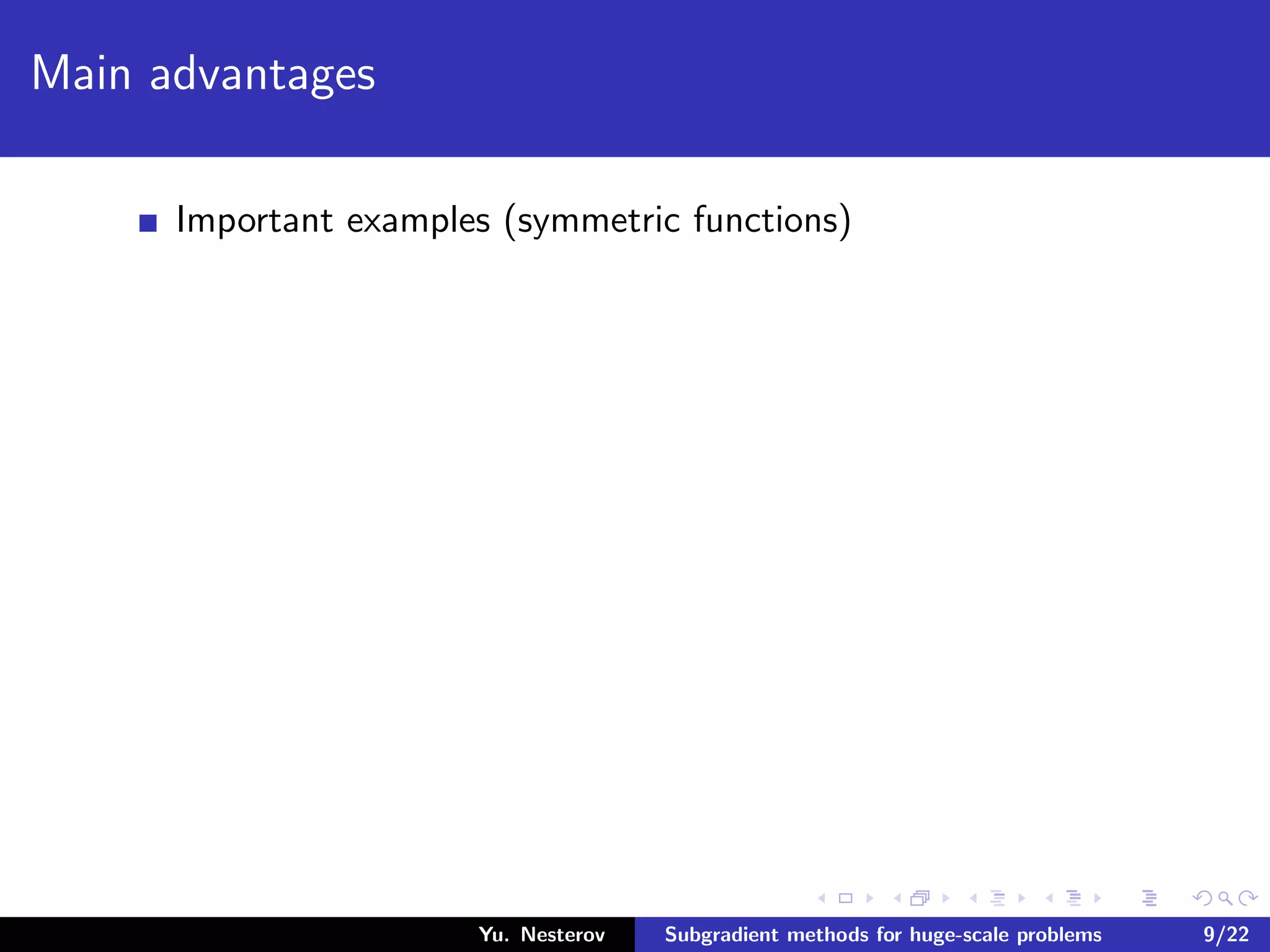
Important examples (symmetric functions)
Yu. Nesterov Subgradient methods for huge-scale problems 9/22
Main advantages
Important examples (symmetric functions)
f (x) = x p, p ≥ 1, ψi,j (t1, t2) ≡ [ |t1|p + |t2|p ]1/p
,
Yu. Nesterov Subgradient methods for huge-scale problems 9/22
Main advantages
Important examples (symmetric functions)
f (x) = x p, p ≥ 1, ψi,j (t1, t2) ≡ [ |t1|p + |t2|p ]1/p
,
f (x) = ln
n
i=1
ex(i)
, ψi,j (t1, t2) ≡ ln (et1 + et2 ) ,
Yu. Nesterov Subgradient methods for huge-scale problems 9/22
Main advantages
Important examples (symmetric functions)
f (x) = x p, p ≥ 1, ψi,j (t1, t2) ≡ [ |t1|p + |t2|p ]1/p
,
f (x) = ln
n
i=1
ex(i)
, ψi,j (t1, t2) ≡ ln (et1 + et2 ) ,
f (x) = max
1≤i≤n
x(i), ψi,j (t1, t2) ≡ max {t1, t2} .
Yu. Nesterov Subgradient methods for huge-scale problems 9/22
Main advantages
Important examples (symmetric functions)
f (x) = x p, p ≥ 1, ψi,j (t1, t2) ≡ [ |t1|p + |t2|p ]1/p
,
f (x) = ln
n
i=1
ex(i)
, ψi,j (t1, t2) ≡ ln (et1 + et2 ) ,
f (x) = max
1≤i≤n
x(i), ψi,j (t1, t2) ≡ max {t1, t2} .
The binary tree requires only n − 1 auxiliary cells.
Yu. Nesterov Subgradient methods for huge-scale problems 9/22
Main advantages
Important examples (symmetric functions)
f (x) = x p, p ≥ 1, ψi,j (t1, t2) ≡ [ |t1|p + |t2|p ]1/p
,
f (x) = ln
n
i=1
ex(i)
, ψi,j (t1, t2) ≡ ln (et1 + et2 ) ,
f (x) = max
1≤i≤n
x(i), ψi,j (t1, t2) ≡ max {t1, t2} .
The binary tree requires only n − 1 auxiliary cells.
Its value needs n − 1 applications of ψi,j (·, ·) ( ≡ operations).
Yu. Nesterov Subgradient methods for huge-scale problems 9/22
Main advantages
Important examples (symmetric functions)
f (x) = x p, p ≥ 1, ψi,j (t1, t2) ≡ [ |t1|p + |t2|p ]1/p
,
f (x) = ln
n
i=1
ex(i)
, ψi,j (t1, t2) ≡ ln (et1 + et2 ) ,
f (x) = max
1≤i≤n
x(i), ψi,j (t1, t2) ≡ max {t1, t2} .
The binary tree requires only n − 1 auxiliary cells.
Its value needs n − 1 applications of ψi,j (·, ·) ( ≡ operations).
If x+ differs from x in one entry only, then for re-computing
f (x+) we need only k ≡ log2 n operations.
Yu. Nesterov Subgradient methods for huge-scale problems 9/22
Main advantages
Important examples (symmetric functions)
f (x) = x p, p ≥ 1, ψi,j (t1, t2) ≡ [ |t1|p + |t2|p ]1/p
,
f (x) = ln
n
i=1
ex(i)
, ψi,j (t1, t2) ≡ ln (et1 + et2 ) ,
f (x) = max
1≤i≤n
x(i), ψi,j (t1, t2) ≡ max {t1, t2} .
The binary tree requires only n − 1 auxiliary cells.
Its value needs n − 1 applications of ψi,j (·, ·) ( ≡ operations).
If x+ differs from x in one entry only, then for re-computing
f (x+) we need only k ≡ log2 n operations.
Thus, we can have pure subgradient minimization schemes with
Yu. Nesterov Subgradient methods for huge-scale problems 9/22
Main advantages
Important examples (symmetric functions)
f (x) = x p, p ≥ 1, ψi,j (t1, t2) ≡ [ |t1|p + |t2|p ]1/p
,
f (x) = ln
n
i=1
ex(i)
, ψi,j (t1, t2) ≡ ln (et1 + et2 ) ,
f (x) = max
1≤i≤n
x(i), ψi,j (t1, t2) ≡ max {t1, t2} .
The binary tree requires only n − 1 auxiliary cells.
Its value needs n − 1 applications of ψi,j (·, ·) ( ≡ operations).
If x+ differs from x in one entry only, then for re-computing
f (x+) we need only k ≡ log2 n operations.
Thus, we can have pure subgradient minimization schemes with
Sublinear Iteration Cost
.
Yu. Nesterov Subgradient methods for huge-scale problems 9/22
Simple subgradient methods
Yu. Nesterov Subgradient methods for huge-scale problems 10/22
Simple subgradient methods
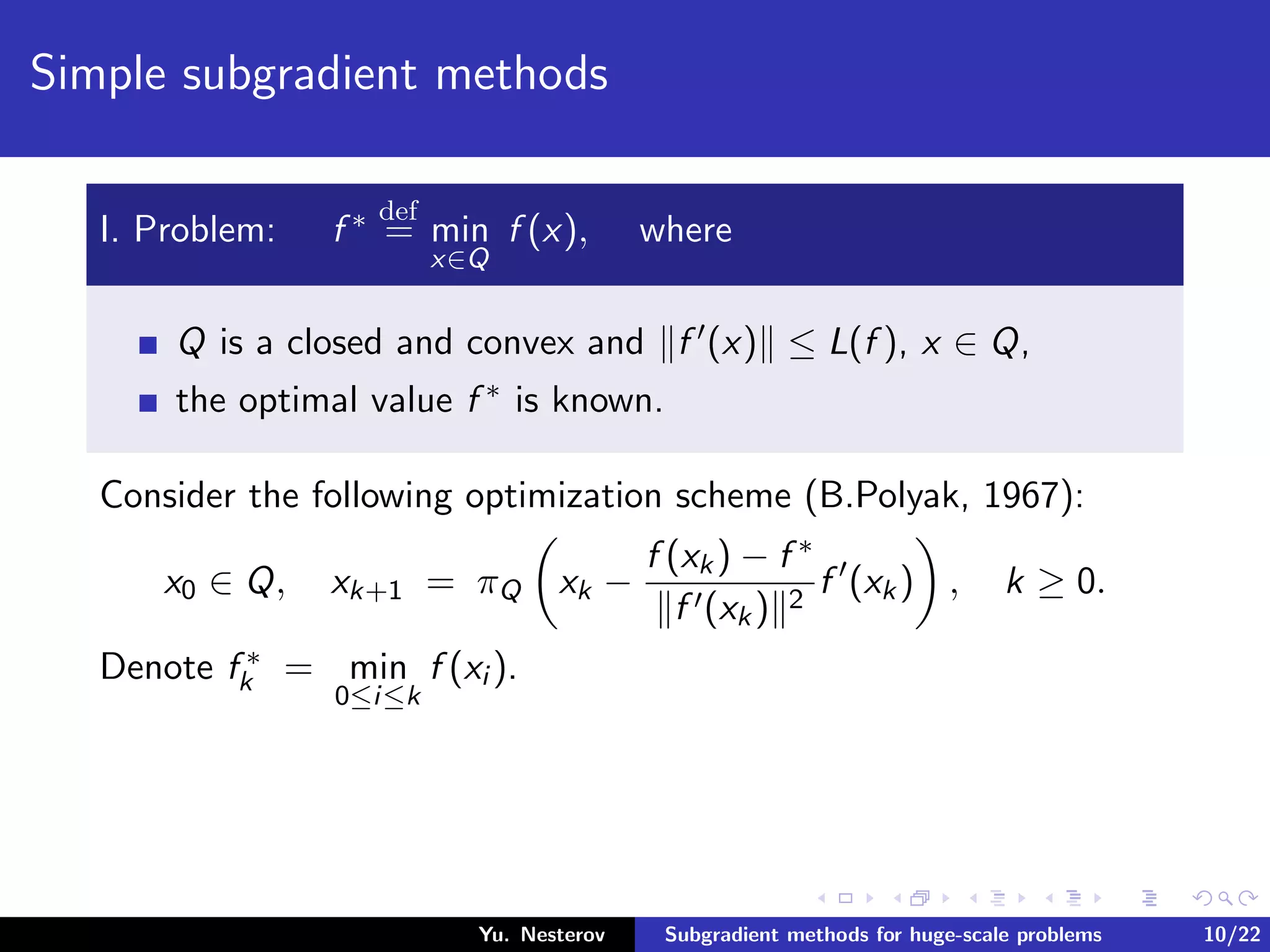
I. Problem: f ∗ def
= min
x∈Q
f (x), where
Yu. Nesterov Subgradient methods for huge-scale problems 10/22
Simple subgradient methods
I. Problem: f ∗ def
= min
x∈Q
f (x), where
Q is a closed and convex and f (x) ≤ L(f ), x ∈ Q,
Yu. Nesterov Subgradient methods for huge-scale problems 10/22
Simple subgradient methods
I. Problem: f ∗ def
= min
x∈Q
f (x), where
Q is a closed and convex and f (x) ≤ L(f ), x ∈ Q,
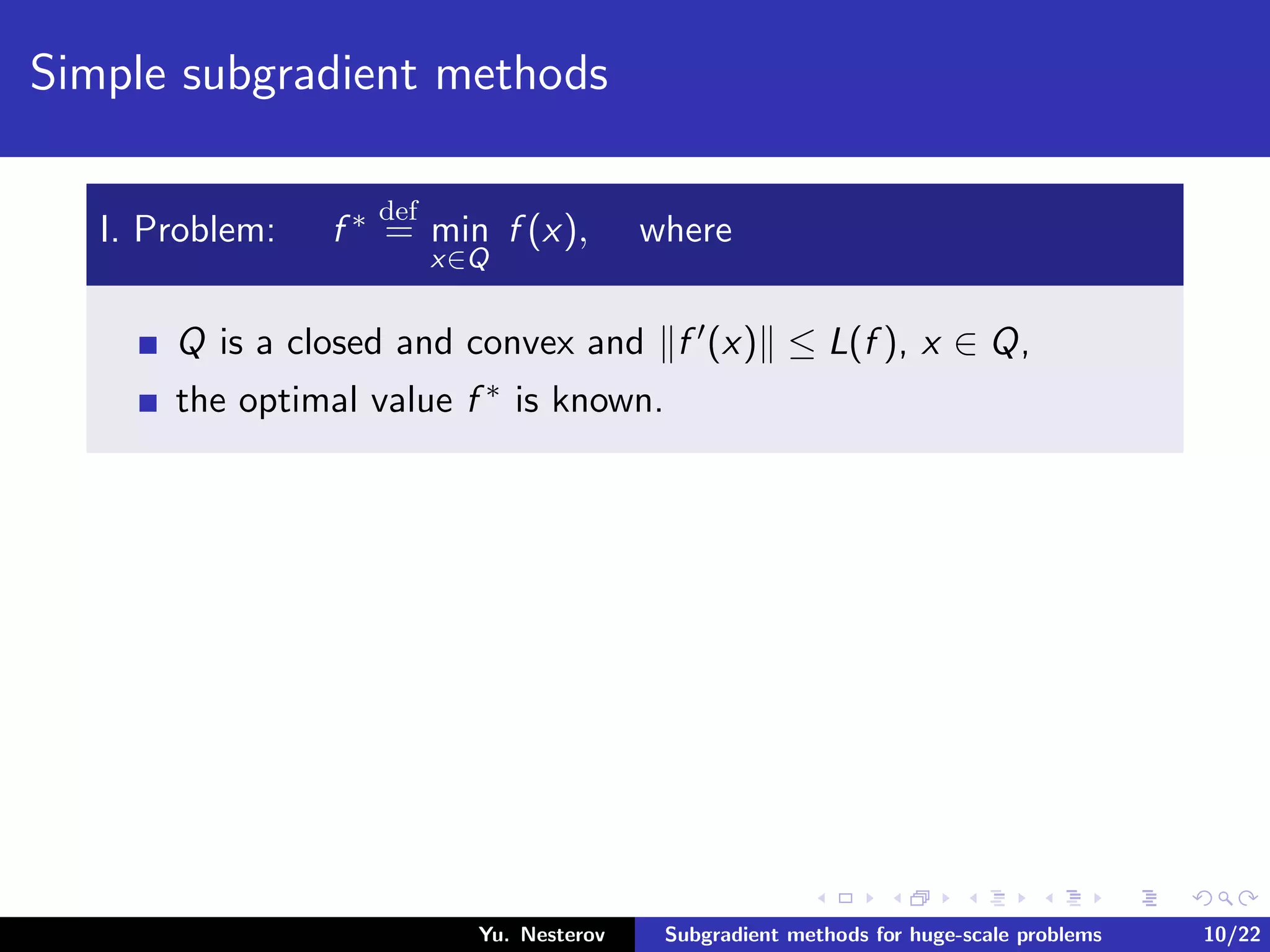
the optimal value f ∗ is known.
Yu. Nesterov Subgradient methods for huge-scale problems 10/22
Simple subgradient methods
I. Problem: f ∗ def
= min
x∈Q
f (x), where
Q is a closed and convex and f (x) ≤ L(f ), x ∈ Q,
the optimal value f ∗ is known.
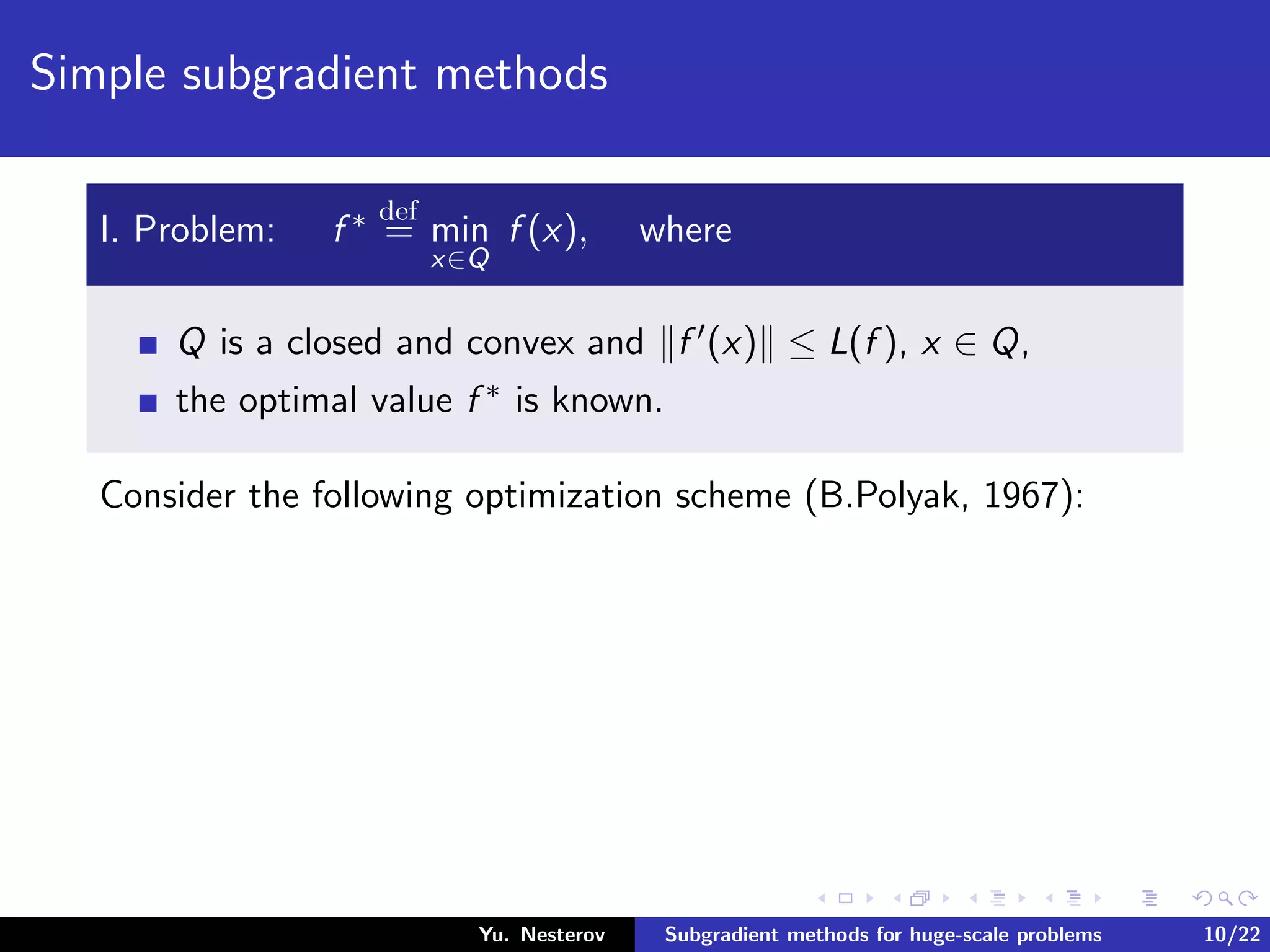
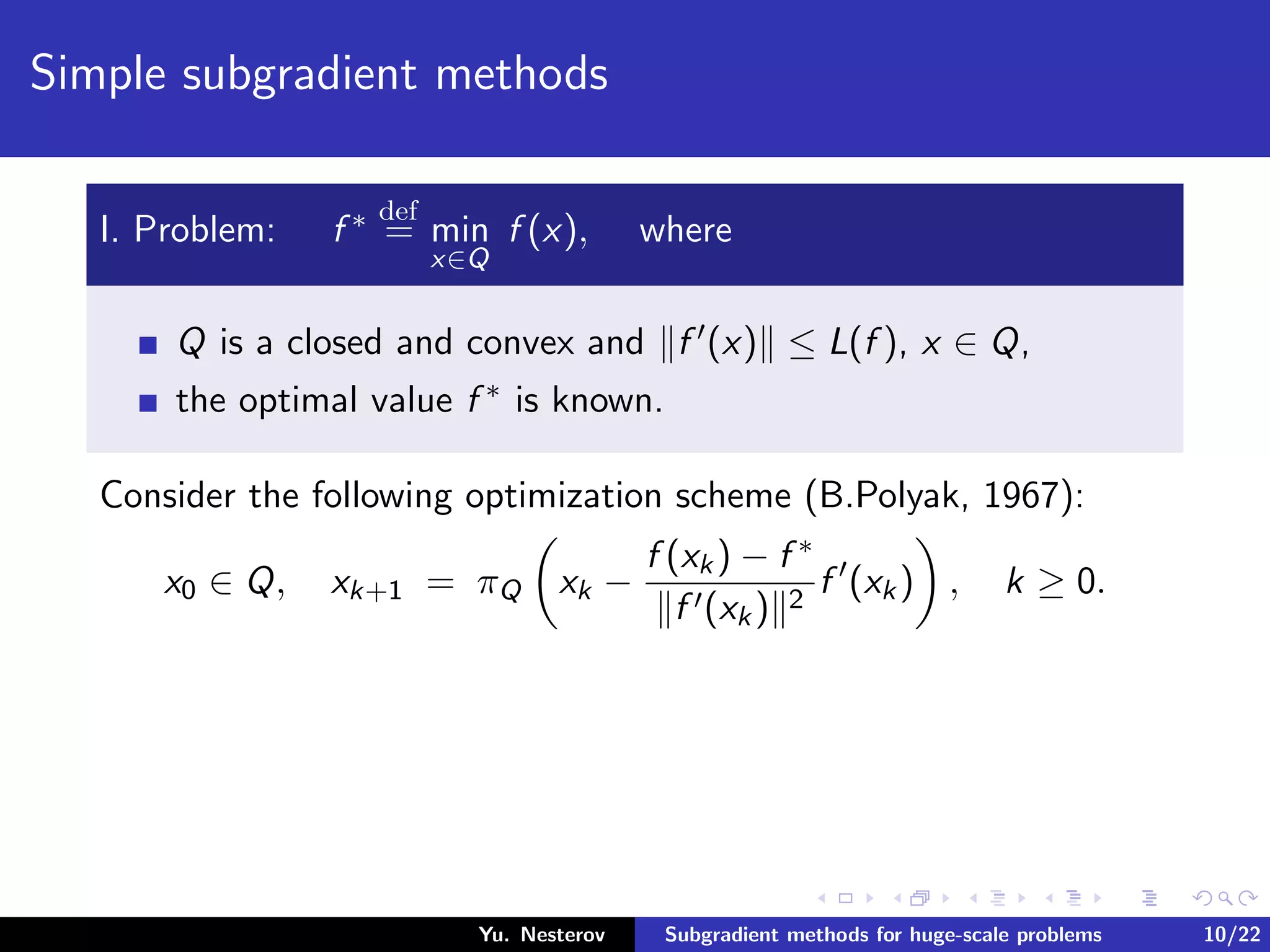
Consider the following optimization scheme (B.Polyak, 1967):
Yu. Nesterov Subgradient methods for huge-scale problems 10/22
Simple subgradient methods
I. Problem: f ∗ def
= min
x∈Q
f (x), where
Q is a closed and convex and f (x) ≤ L(f ), x ∈ Q,
the optimal value f ∗ is known.
Consider the following optimization scheme (B.Polyak, 1967):
x0 ∈ Q, xk+1 = πQ xk −
f (xk) − f ∗
f (xk) 2
f (xk) , k ≥ 0.
Yu. Nesterov Subgradient methods for huge-scale problems 10/22
Simple subgradient methods
I. Problem: f ∗ def
= min
x∈Q
f (x), where
Q is a closed and convex and f (x) ≤ L(f ), x ∈ Q,
the optimal value f ∗ is known.
Consider the following optimization scheme (B.Polyak, 1967):
x0 ∈ Q, xk+1 = πQ xk −
f (xk) − f ∗
f (xk) 2
f (xk) , k ≥ 0.
Denote f ∗
k = min
0≤i≤k
f (xi ).
Yu. Nesterov Subgradient methods for huge-scale problems 10/22
Simple subgradient methods
I. Problem: f ∗ def
= min
x∈Q
f (x), where
Q is a closed and convex and f (x) ≤ L(f ), x ∈ Q,
the optimal value f ∗ is known.
Consider the following optimization scheme (B.Polyak, 1967):
x0 ∈ Q, xk+1 = πQ xk −
f (xk) − f ∗
f (xk) 2
f (xk) , k ≥ 0.
Denote f ∗
k = min
0≤i≤k
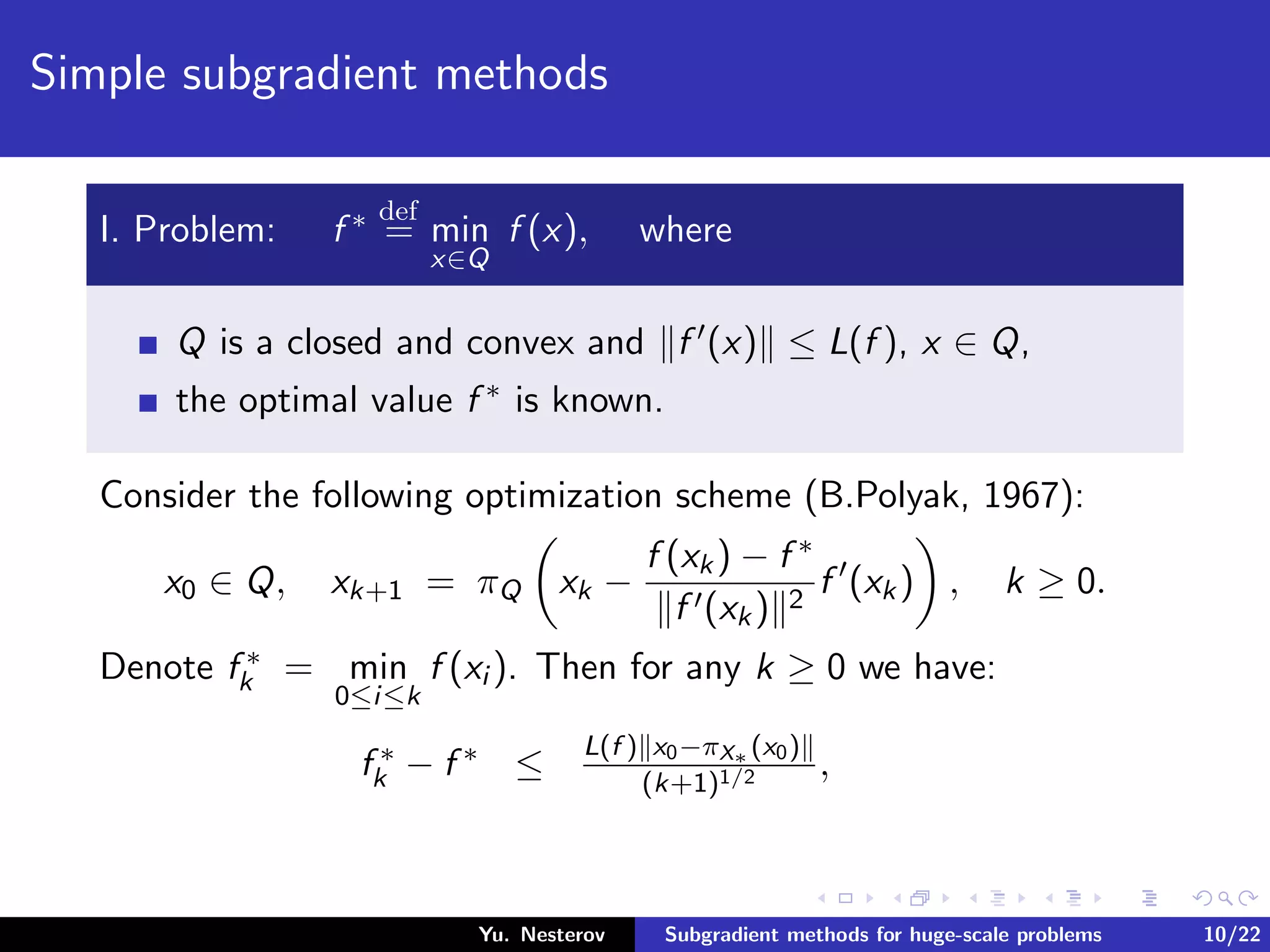
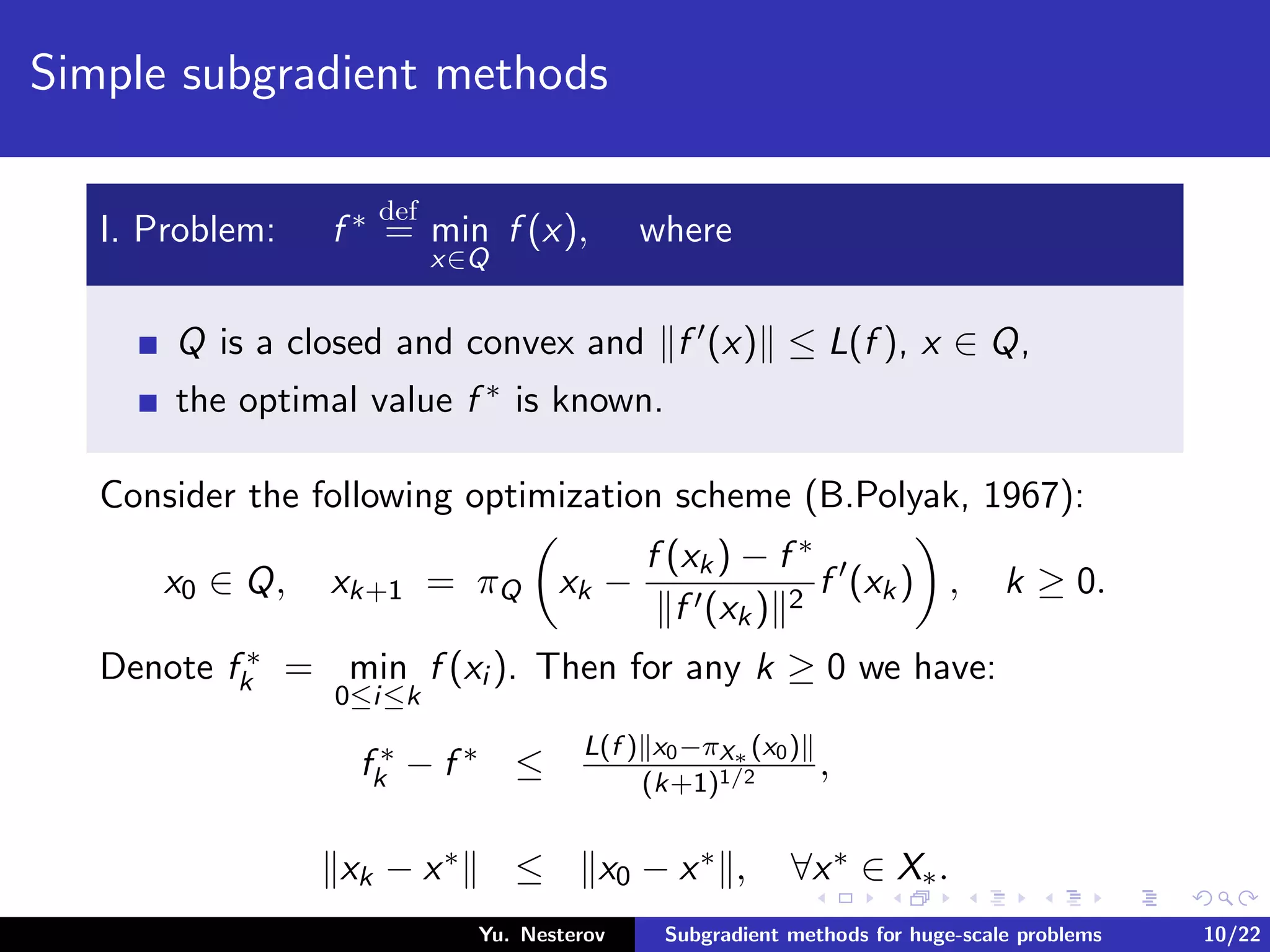
f (xi ). Then for any k ≥ 0 we have:
f ∗
k − f ∗ ≤
L(f ) x0−πX∗ (x0)
(k+1)1/2 ,
Yu. Nesterov Subgradient methods for huge-scale problems 10/22
Simple subgradient methods
I. Problem: f ∗ def
= min
x∈Q
f (x), where
Q is a closed and convex and f (x) ≤ L(f ), x ∈ Q,
the optimal value f ∗ is known.
Consider the following optimization scheme (B.Polyak, 1967):
x0 ∈ Q, xk+1 = πQ xk −
f (xk) − f ∗
f (xk) 2
f (xk) , k ≥ 0.
Denote f ∗
k = min
0≤i≤k
f (xi ). Then for any k ≥ 0 we have:
f ∗
k − f ∗ ≤
L(f ) x0−πX∗ (x0)
(k+1)1/2 ,
xk − x∗ ≤ x0 − x∗ , ∀x∗ ∈ X∗.
Yu. Nesterov Subgradient methods for huge-scale problems 10/22
Proof:
Yu. Nesterov Subgradient methods for huge-scale problems 11/22
Proof:
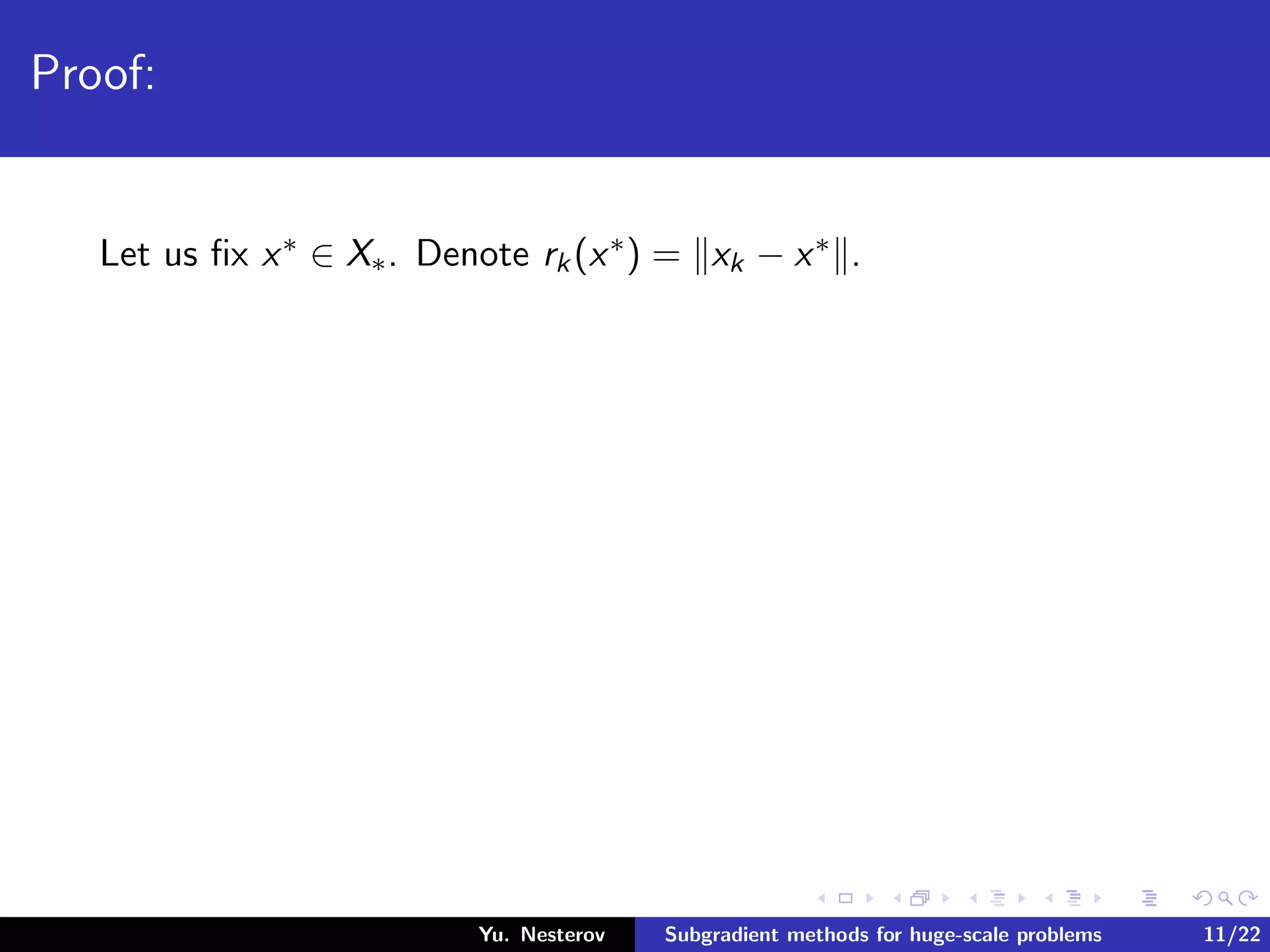
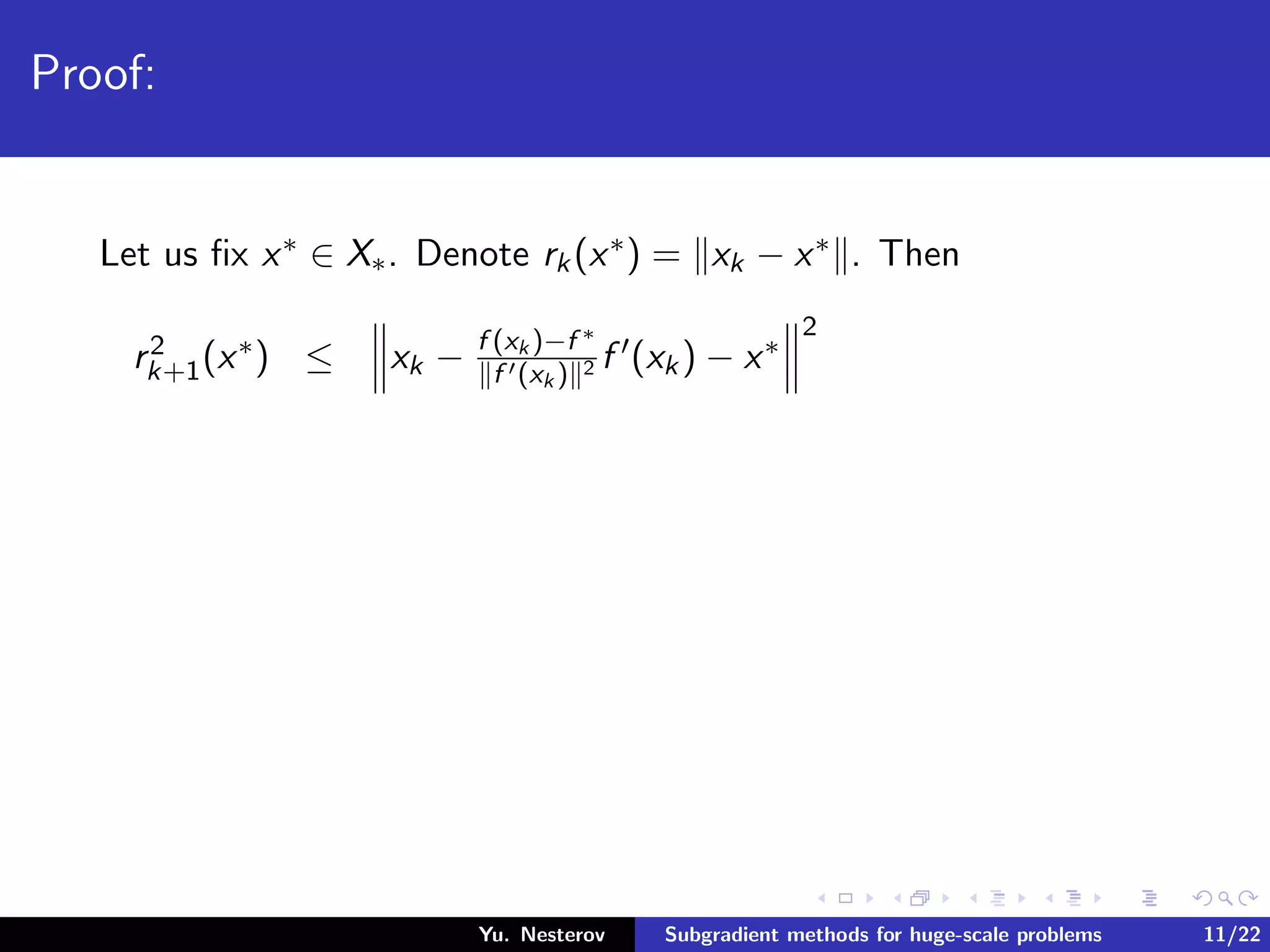
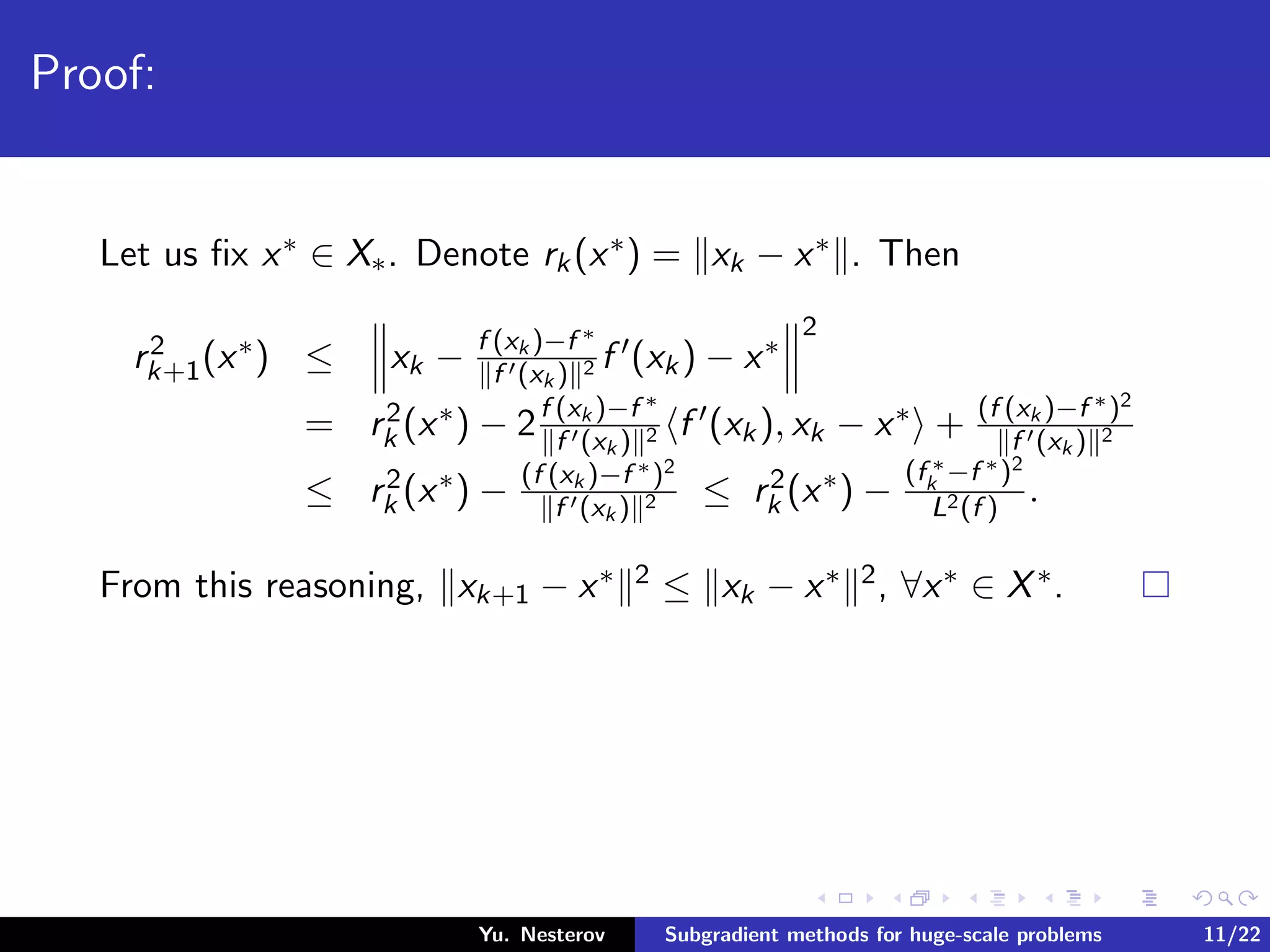
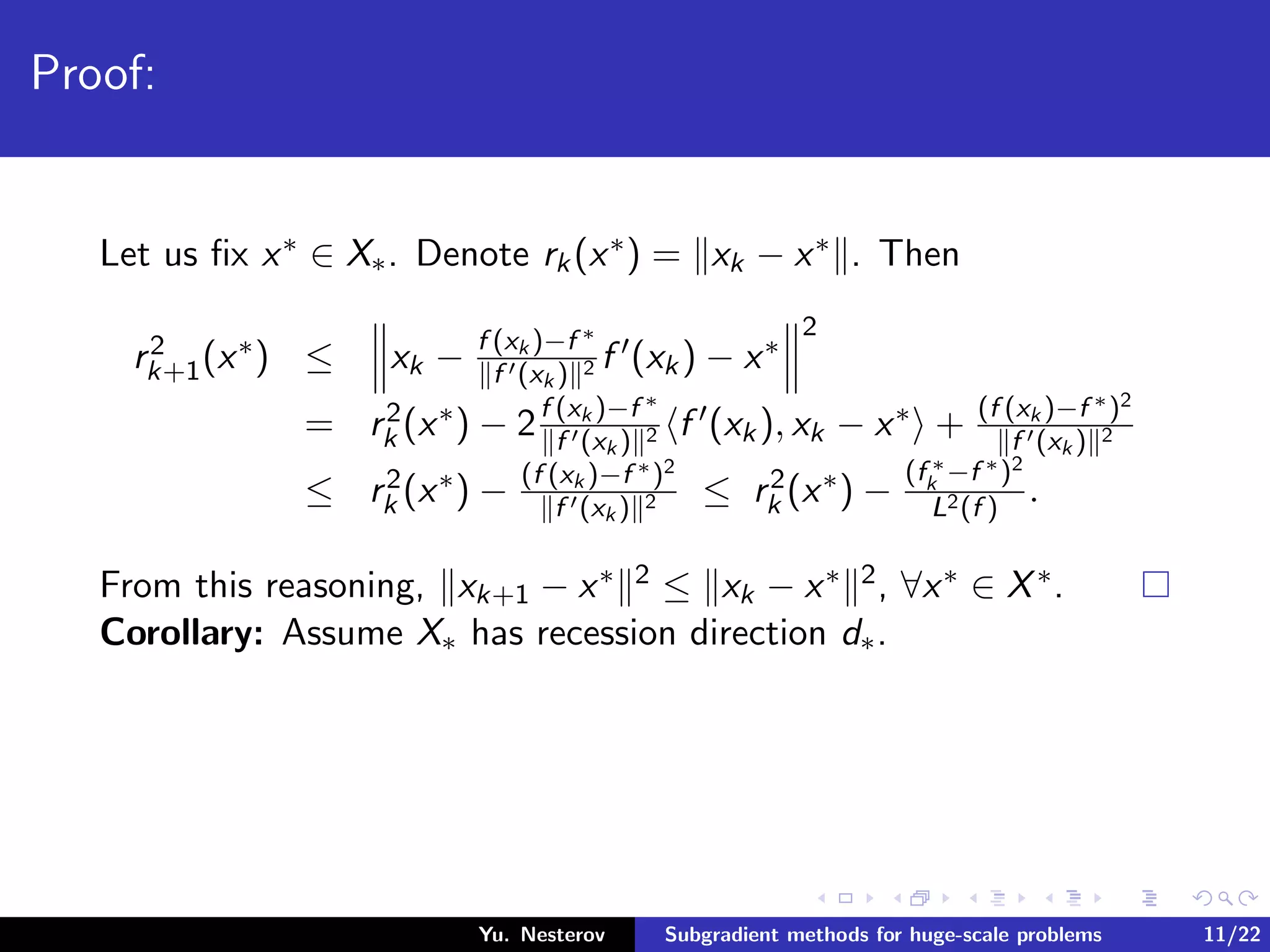
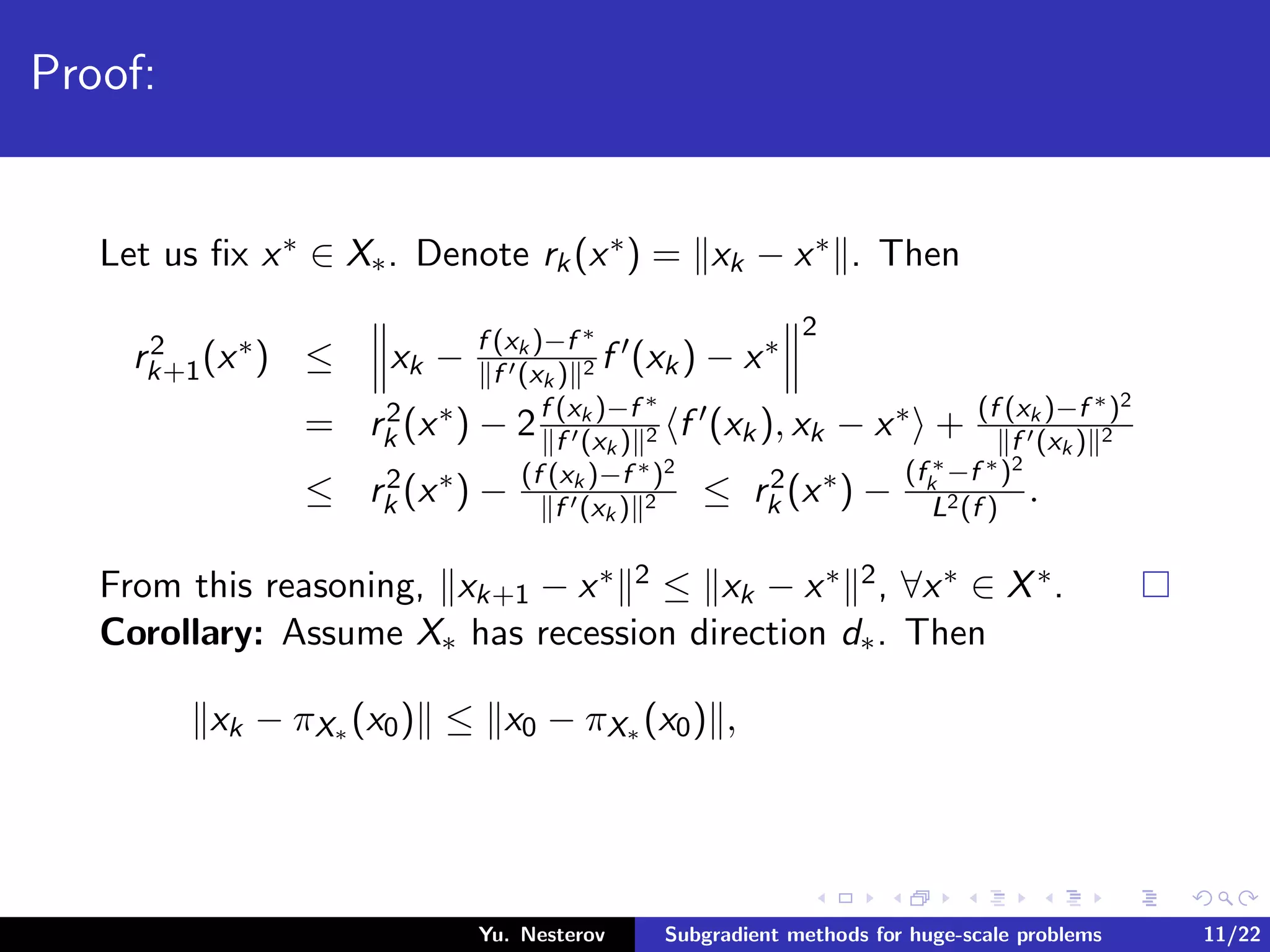
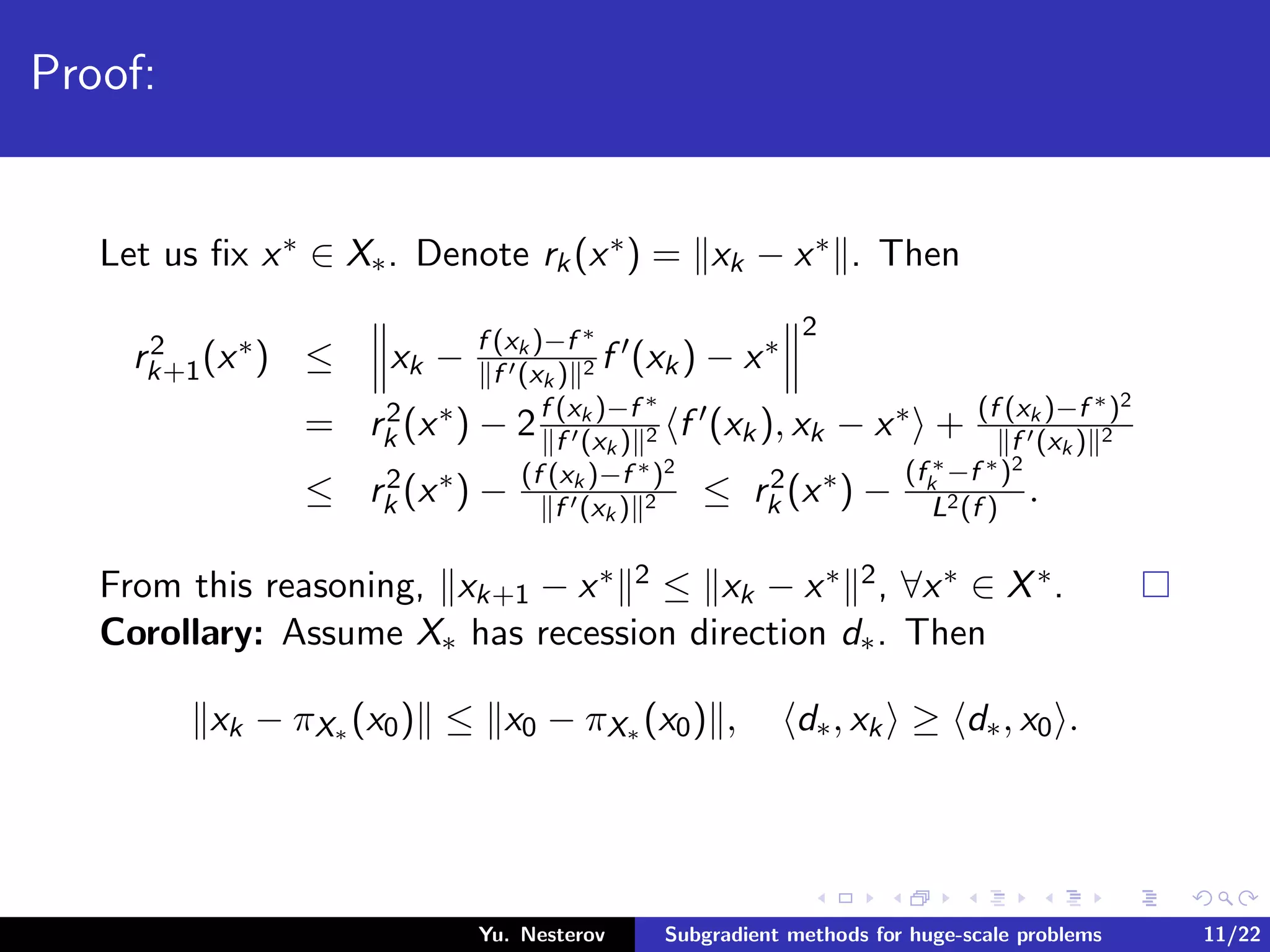
Let us fix x∗ ∈ X∗. Denote rk(x∗) = xk − x∗ .
Yu. Nesterov Subgradient methods for huge-scale problems 11/22
Proof:
Let us fix x∗ ∈ X∗. Denote rk(x∗) = xk − x∗ . Then
r2
k+1(x∗) ≤ xk − f (xk )−f ∗
f (xk ) 2 f (xk) − x∗
2
Yu. Nesterov Subgradient methods for huge-scale problems 11/22
Proof:
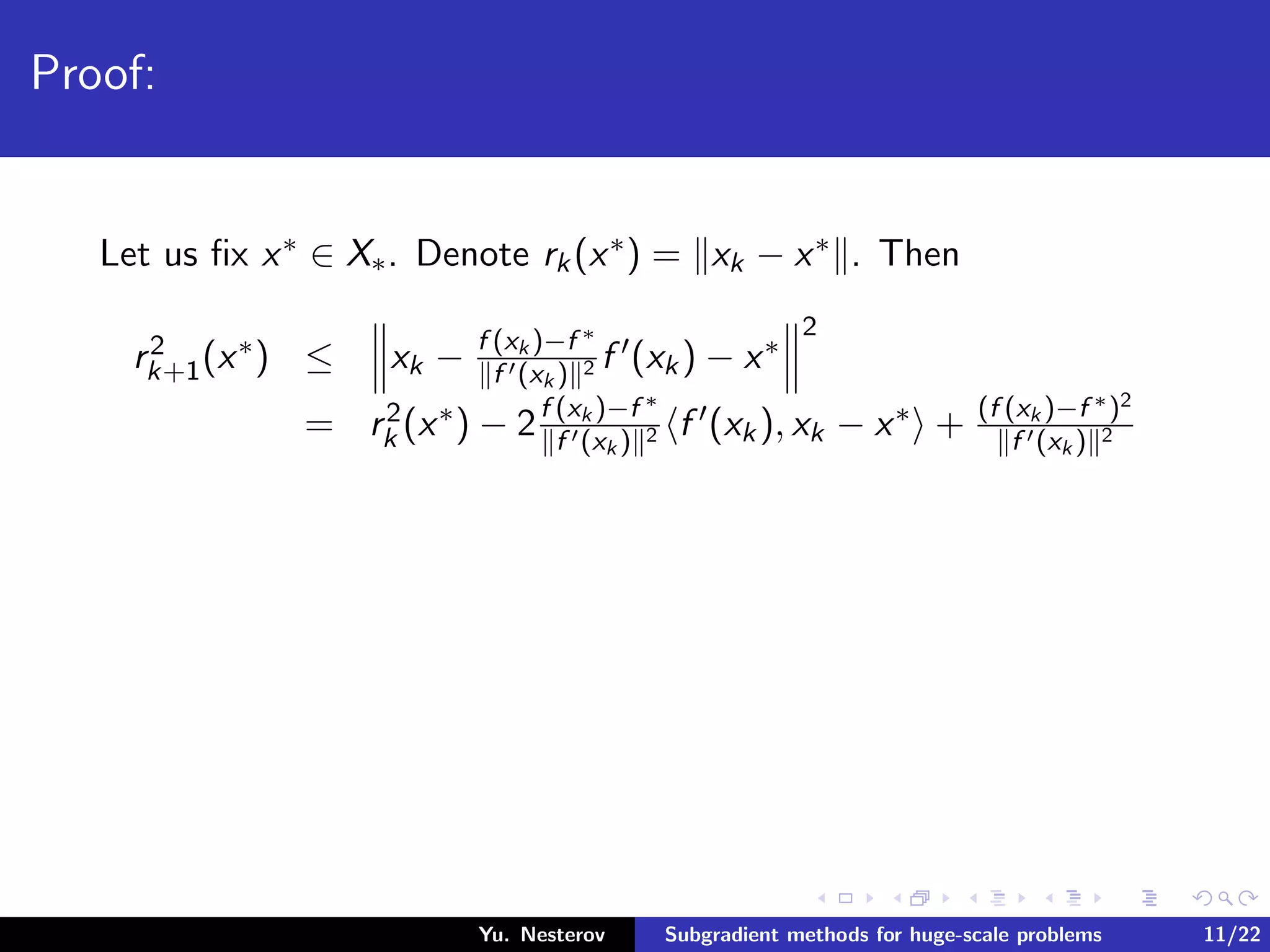
Let us fix x∗ ∈ X∗. Denote rk(x∗) = xk − x∗ . Then
r2
k+1(x∗) ≤ xk − f (xk )−f ∗
f (xk ) 2 f (xk) − x∗
2
= r2
k (x∗) − 2f (xk )−f ∗
f (xk ) 2 f (xk), xk − x∗ + (f (xk )−f ∗)2
f (xk ) 2
Yu. Nesterov Subgradient methods for huge-scale problems 11/22
Proof:
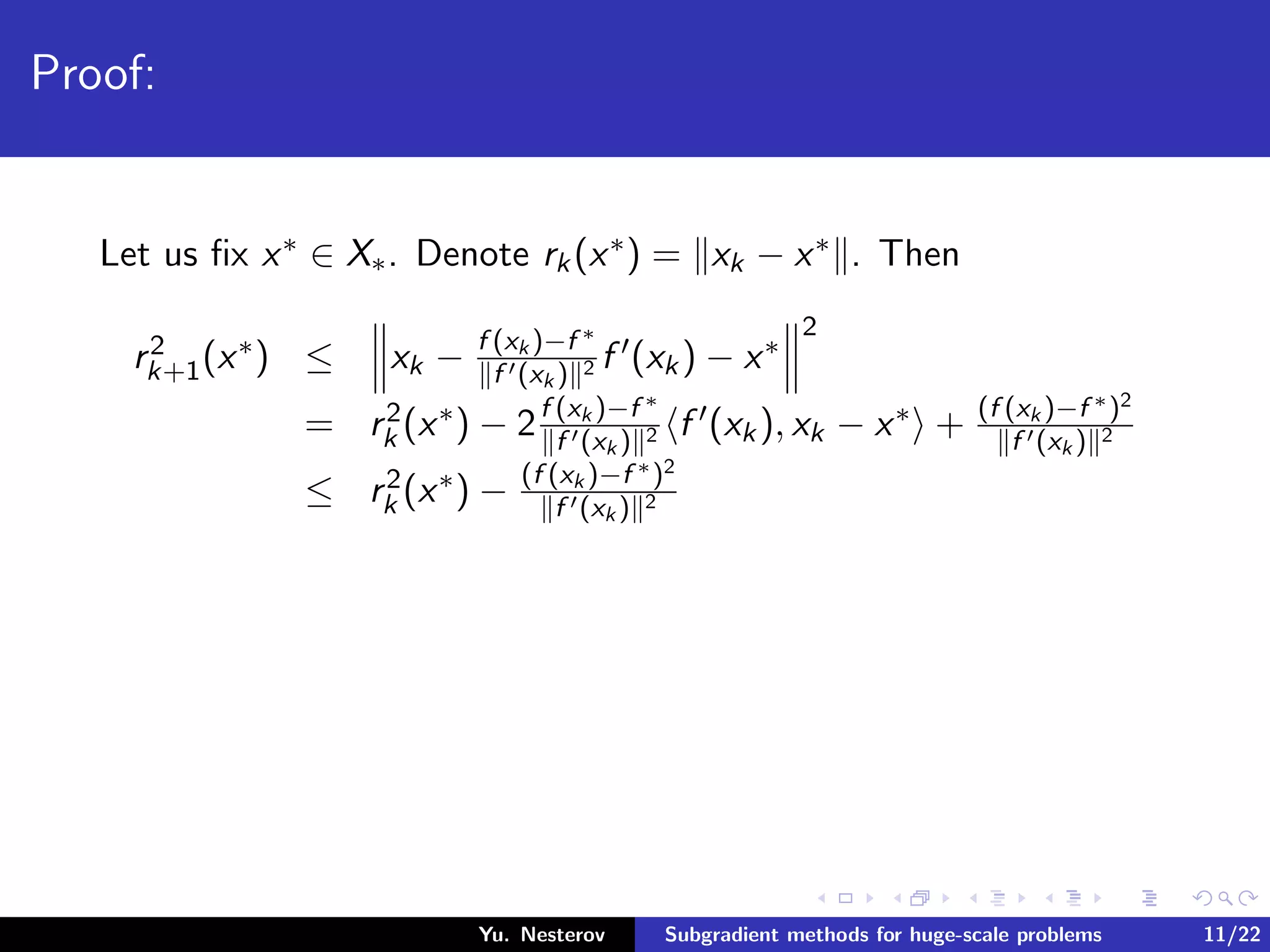
Let us fix x∗ ∈ X∗. Denote rk(x∗) = xk − x∗ . Then
r2
k+1(x∗) ≤ xk − f (xk )−f ∗
f (xk ) 2 f (xk) − x∗
2
= r2
k (x∗) − 2f (xk )−f ∗
f (xk ) 2 f (xk), xk − x∗ + (f (xk )−f ∗)2
f (xk ) 2
≤ r2
k (x∗) − (f (xk )−f ∗)2
f (xk ) 2
Yu. Nesterov Subgradient methods for huge-scale problems 11/22
Proof:
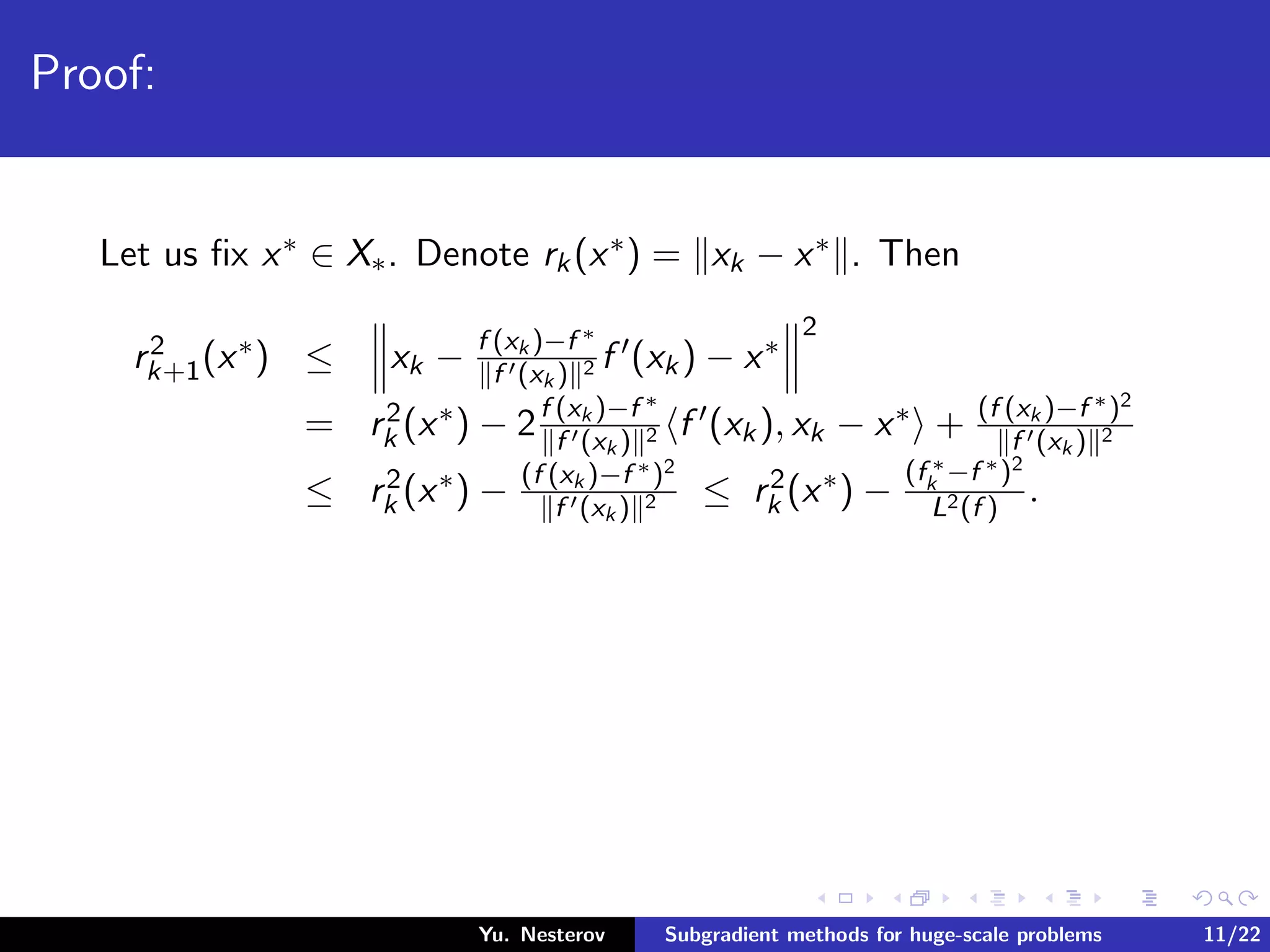
Let us fix x∗ ∈ X∗. Denote rk(x∗) = xk − x∗ . Then
r2
k+1(x∗) ≤ xk − f (xk )−f ∗
f (xk ) 2 f (xk) − x∗
2
= r2
k (x∗) − 2f (xk )−f ∗
f (xk ) 2 f (xk), xk − x∗ + (f (xk )−f ∗)2
f (xk ) 2
≤ r2
k (x∗) − (f (xk )−f ∗)2
f (xk ) 2 ≤ r2
k (x∗) −
(f ∗
k −f ∗)2
L2(f )
.
Yu. Nesterov Subgradient methods for huge-scale problems 11/22
Proof:
Let us fix x∗ ∈ X∗. Denote rk(x∗) = xk − x∗ . Then
r2
k+1(x∗) ≤ xk − f (xk )−f ∗
f (xk ) 2 f (xk) − x∗
2
= r2
k (x∗) − 2f (xk )−f ∗
f (xk ) 2 f (xk), xk − x∗ + (f (xk )−f ∗)2
f (xk ) 2
≤ r2
k (x∗) − (f (xk )−f ∗)2
f (xk ) 2 ≤ r2
k (x∗) −
(f ∗
k −f ∗)2
L2(f )
.
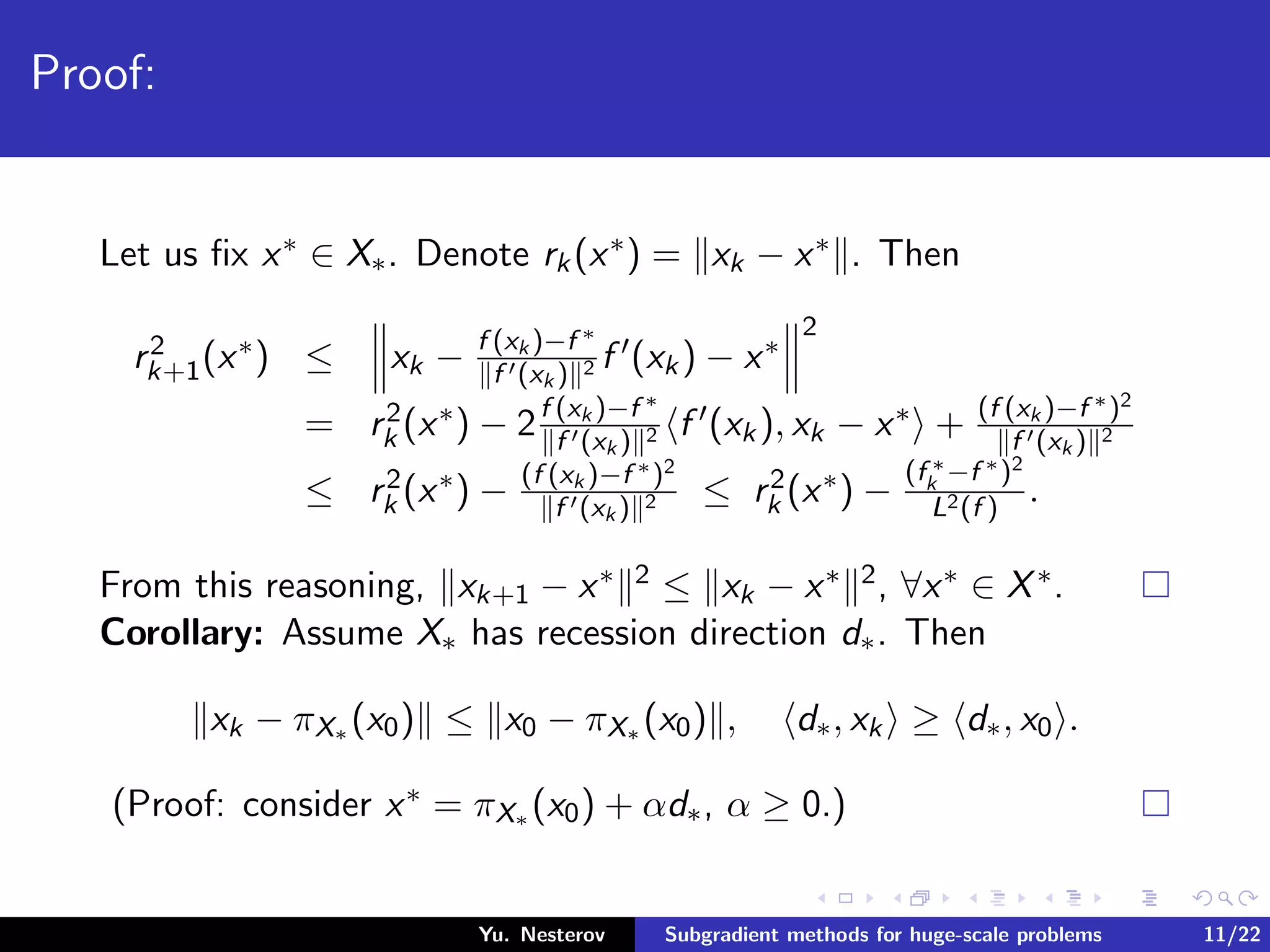
From this reasoning, xk+1 − x∗ 2 ≤ xk − x∗ 2, ∀x∗ ∈ X∗.
Yu. Nesterov Subgradient methods for huge-scale problems 11/22
Proof:
Let us fix x∗ ∈ X∗. Denote rk(x∗) = xk − x∗ . Then
r2
k+1(x∗) ≤ xk − f (xk )−f ∗
f (xk ) 2 f (xk) − x∗
2
= r2
k (x∗) − 2f (xk )−f ∗
f (xk ) 2 f (xk), xk − x∗ + (f (xk )−f ∗)2
f (xk ) 2
≤ r2
k (x∗) − (f (xk )−f ∗)2
f (xk ) 2 ≤ r2
k (x∗) −
(f ∗
k −f ∗)2
L2(f )
.
From this reasoning, xk+1 − x∗ 2 ≤ xk − x∗ 2, ∀x∗ ∈ X∗.
Corollary: Assume X∗ has recession direction d∗.
Yu. Nesterov Subgradient methods for huge-scale problems 11/22
Proof:
Let us fix x∗ ∈ X∗. Denote rk(x∗) = xk − x∗ . Then
r2
k+1(x∗) ≤ xk − f (xk )−f ∗
f (xk ) 2 f (xk) − x∗
2
= r2
k (x∗) − 2f (xk )−f ∗
f (xk ) 2 f (xk), xk − x∗ + (f (xk )−f ∗)2
f (xk ) 2
≤ r2
k (x∗) − (f (xk )−f ∗)2
f (xk ) 2 ≤ r2
k (x∗) −
(f ∗
k −f ∗)2
L2(f )
.
From this reasoning, xk+1 − x∗ 2 ≤ xk − x∗ 2, ∀x∗ ∈ X∗.
Corollary: Assume X∗ has recession direction d∗. Then
xk − πX∗ (x0) ≤ x0 − πX∗ (x0) ,
Yu. Nesterov Subgradient methods for huge-scale problems 11/22
Proof:
Let us fix x∗ ∈ X∗. Denote rk(x∗) = xk − x∗ . Then
r2
k+1(x∗) ≤ xk − f (xk )−f ∗
f (xk ) 2 f (xk) − x∗
2
= r2
k (x∗) − 2f (xk )−f ∗
f (xk ) 2 f (xk), xk − x∗ + (f (xk )−f ∗)2
f (xk ) 2
≤ r2
k (x∗) − (f (xk )−f ∗)2
f (xk ) 2 ≤ r2
k (x∗) −
(f ∗
k −f ∗)2
L2(f )
.
From this reasoning, xk+1 − x∗ 2 ≤ xk − x∗ 2, ∀x∗ ∈ X∗.
Corollary: Assume X∗ has recession direction d∗. Then
xk − πX∗ (x0) ≤ x0 − πX∗ (x0) , d∗, xk ≥ d∗, x0 .
Yu. Nesterov Subgradient methods for huge-scale problems 11/22
Proof:
Let us fix x∗ ∈ X∗. Denote rk(x∗) = xk − x∗ . Then
r2
k+1(x∗) ≤ xk − f (xk )−f ∗
f (xk ) 2 f (xk) − x∗
2
= r2
k (x∗) − 2f (xk )−f ∗
f (xk ) 2 f (xk), xk − x∗ + (f (xk )−f ∗)2
f (xk ) 2
≤ r2
k (x∗) − (f (xk )−f ∗)2
f (xk ) 2 ≤ r2
k (x∗) −
(f ∗
k −f ∗)2
L2(f )
.
From this reasoning, xk+1 − x∗ 2 ≤ xk − x∗ 2, ∀x∗ ∈ X∗.
Corollary: Assume X∗ has recession direction d∗. Then
xk − πX∗ (x0) ≤ x0 − πX∗ (x0) , d∗, xk ≥ d∗, x0 .
(Proof: consider x∗ = πX∗ (x0) + αd∗, α ≥ 0.)
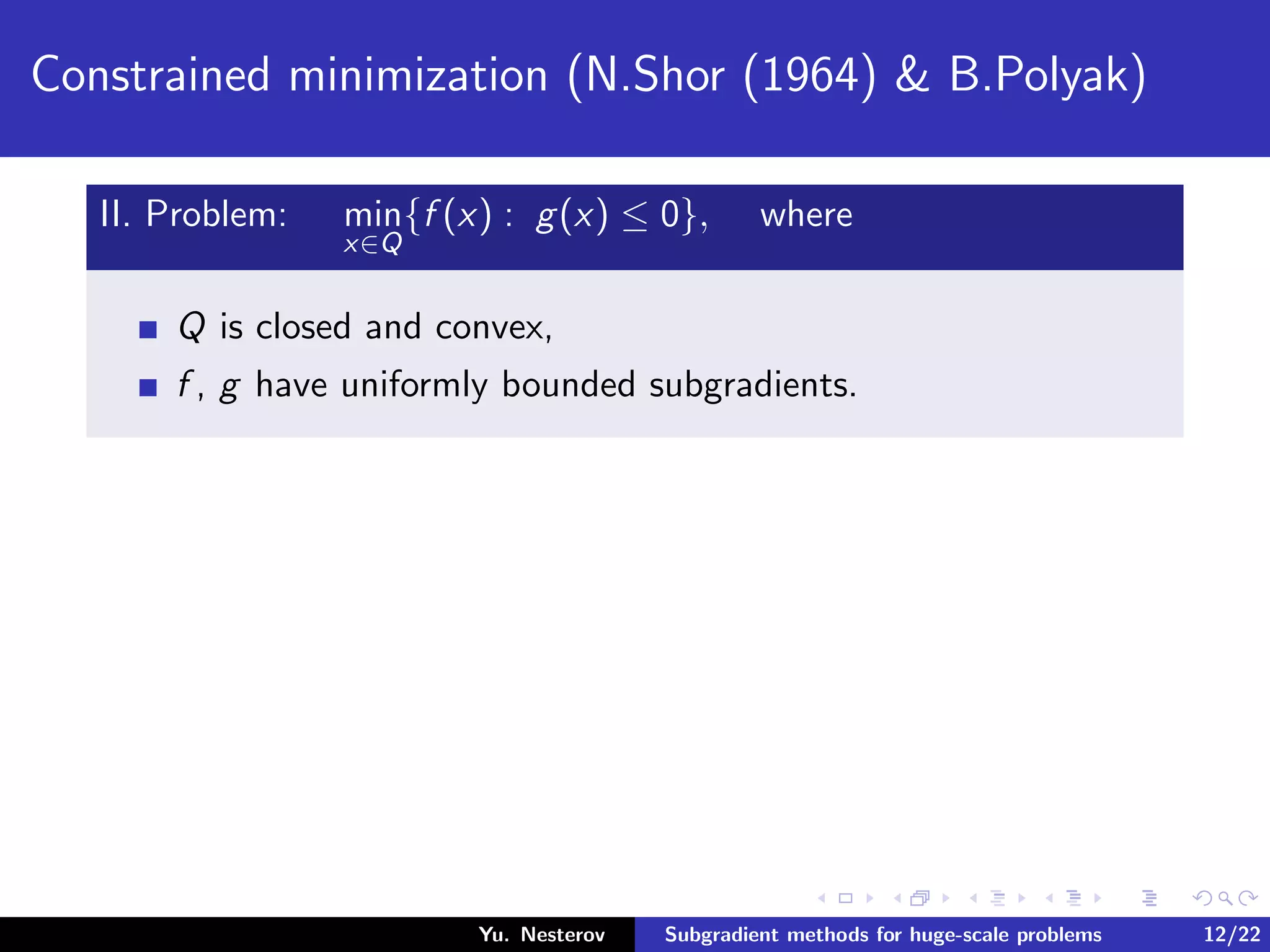
Yu. Nesterov Subgradient methods for huge-scale problems 11/22
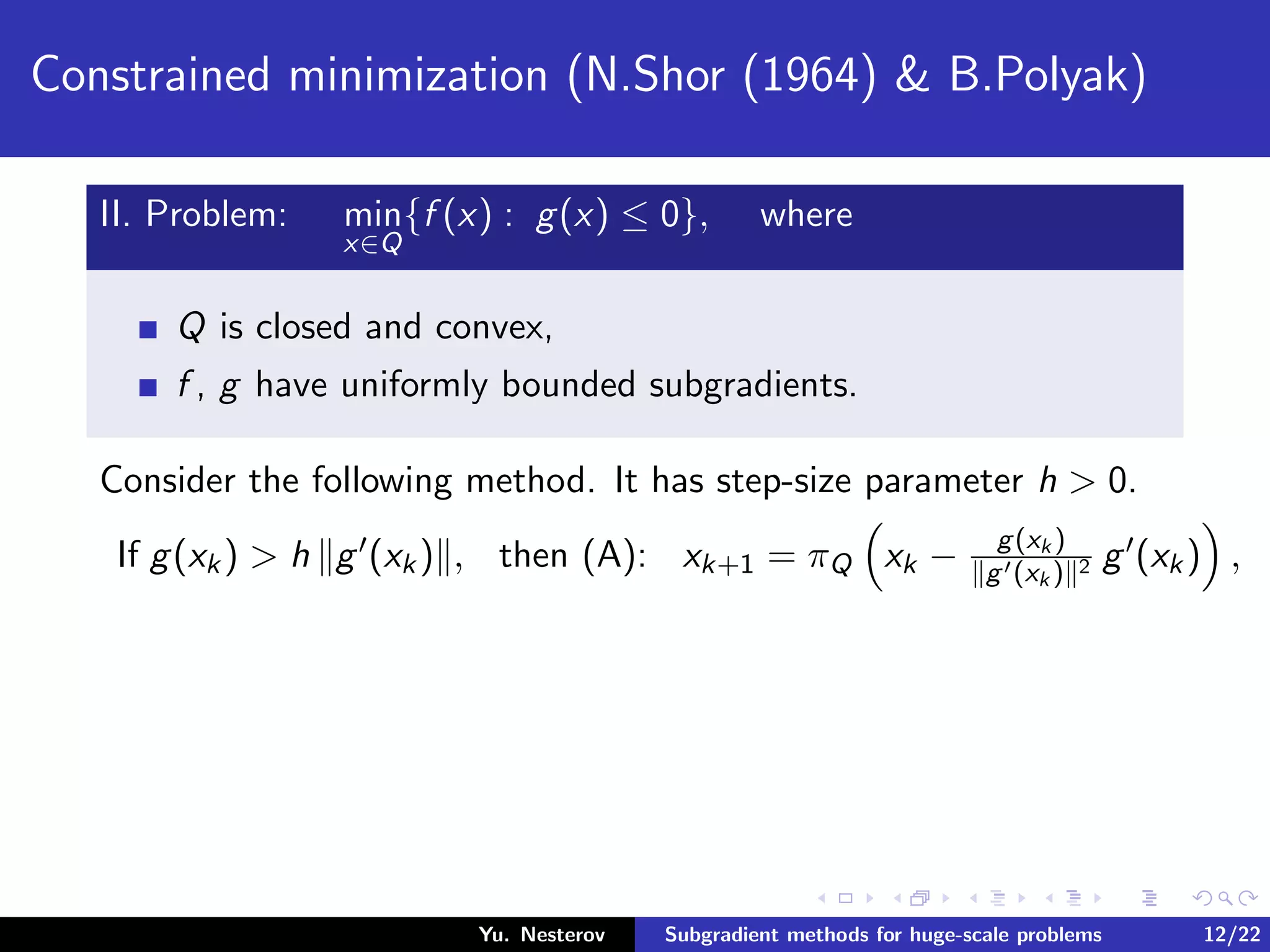
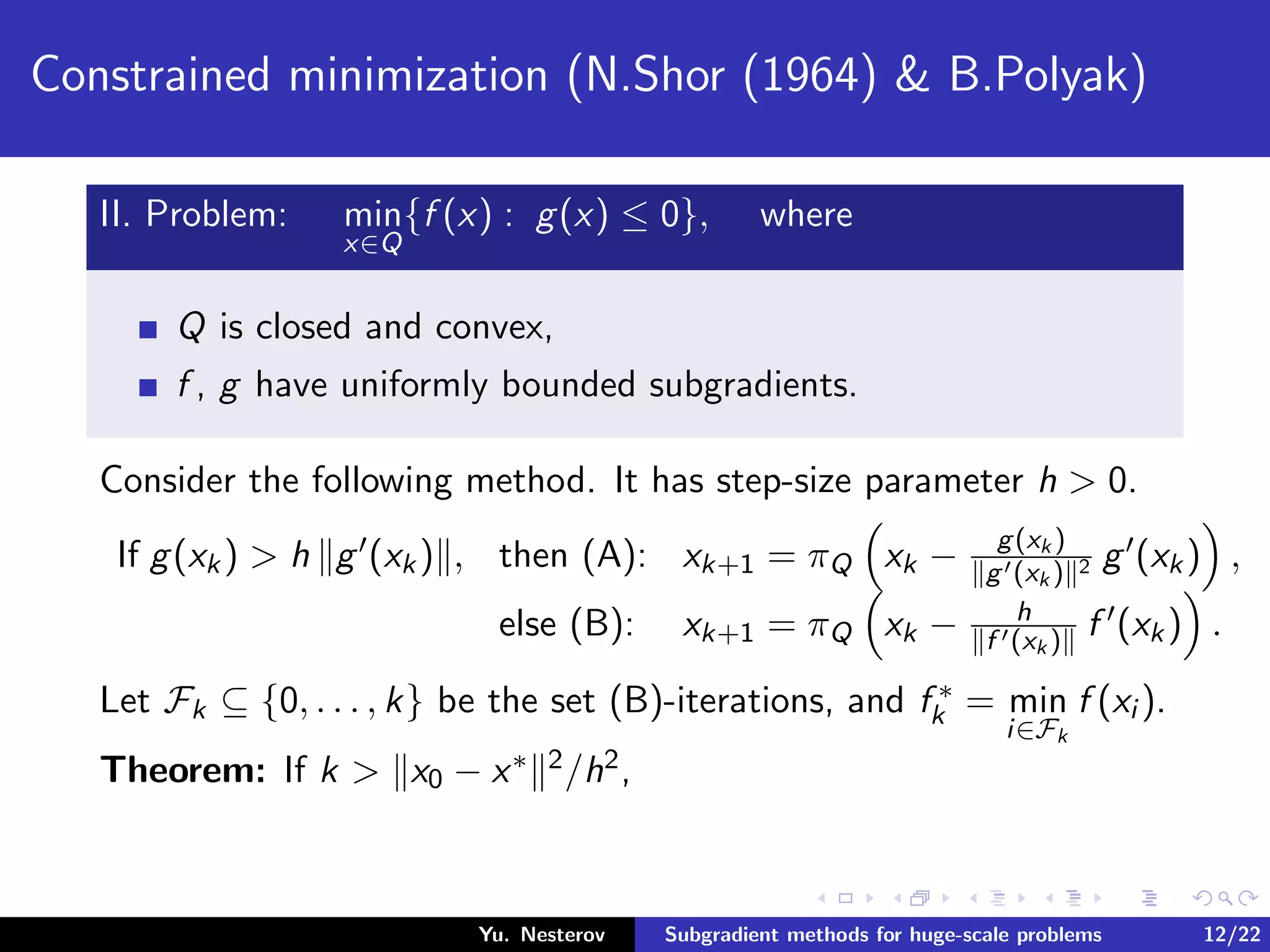
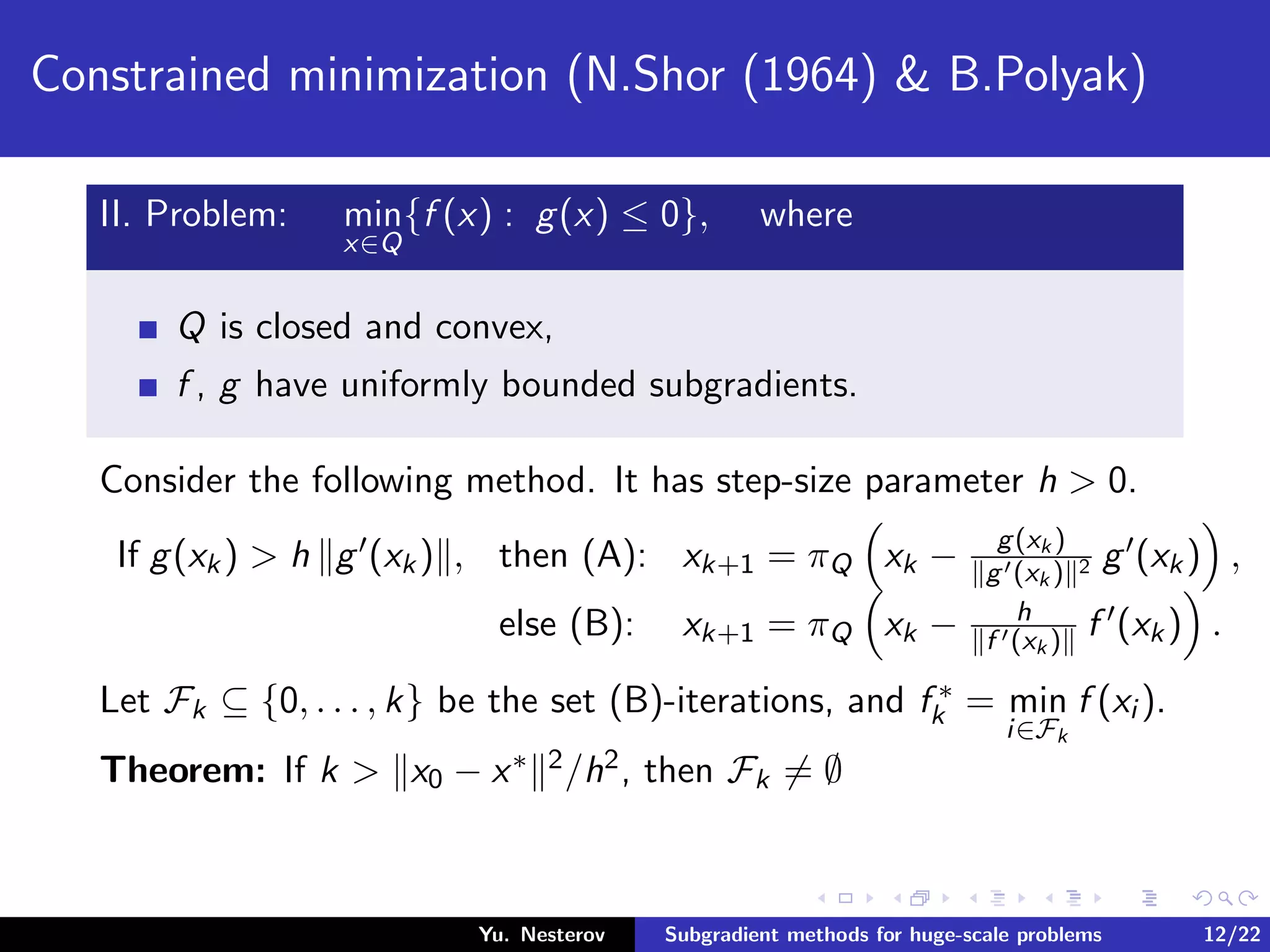
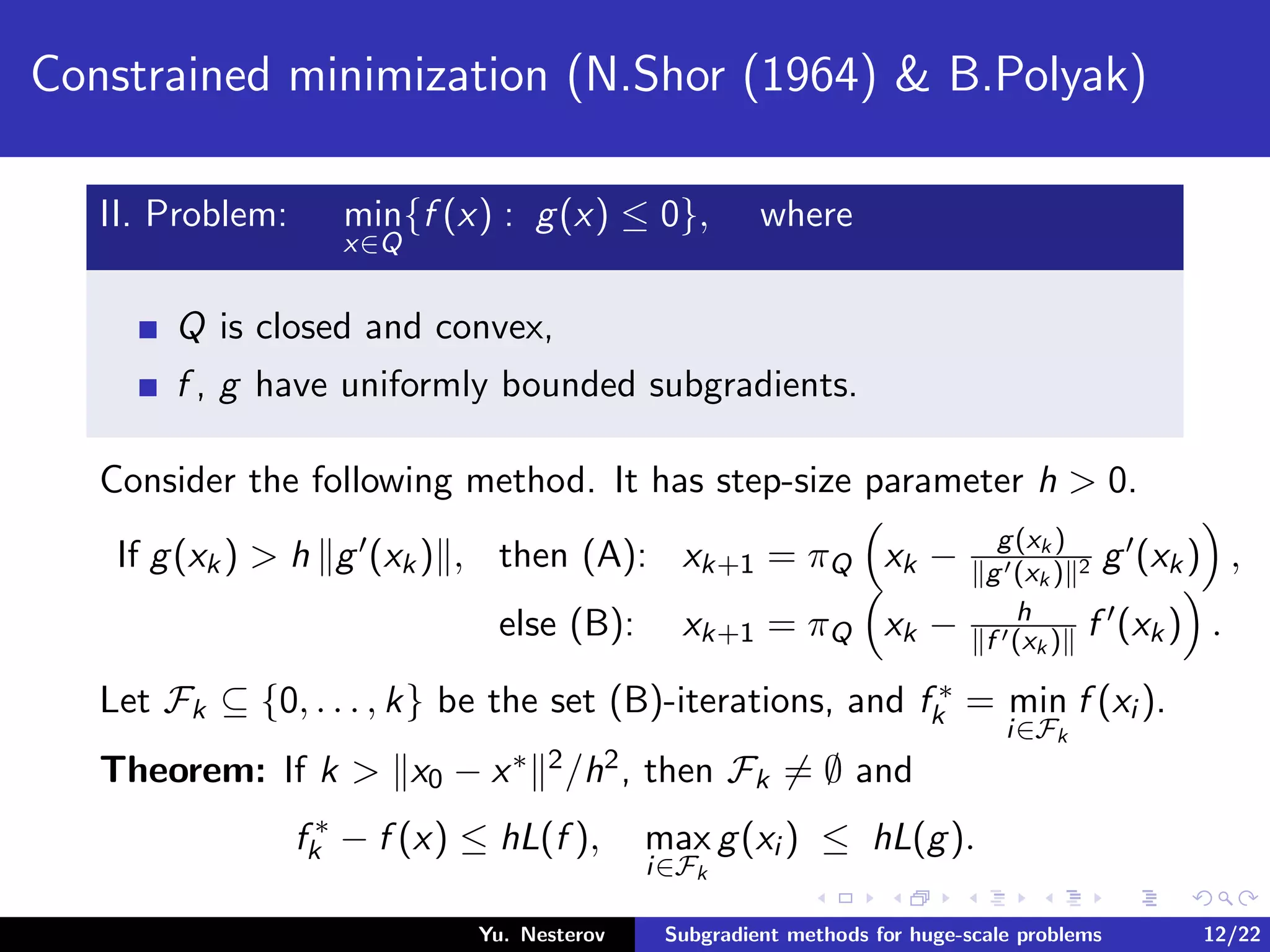
Constrained minimization (N.Shor (1964) & B.Polyak)
Yu. Nesterov Subgradient methods for huge-scale problems 12/22
Constrained minimization (N.Shor (1964) & B.Polyak)
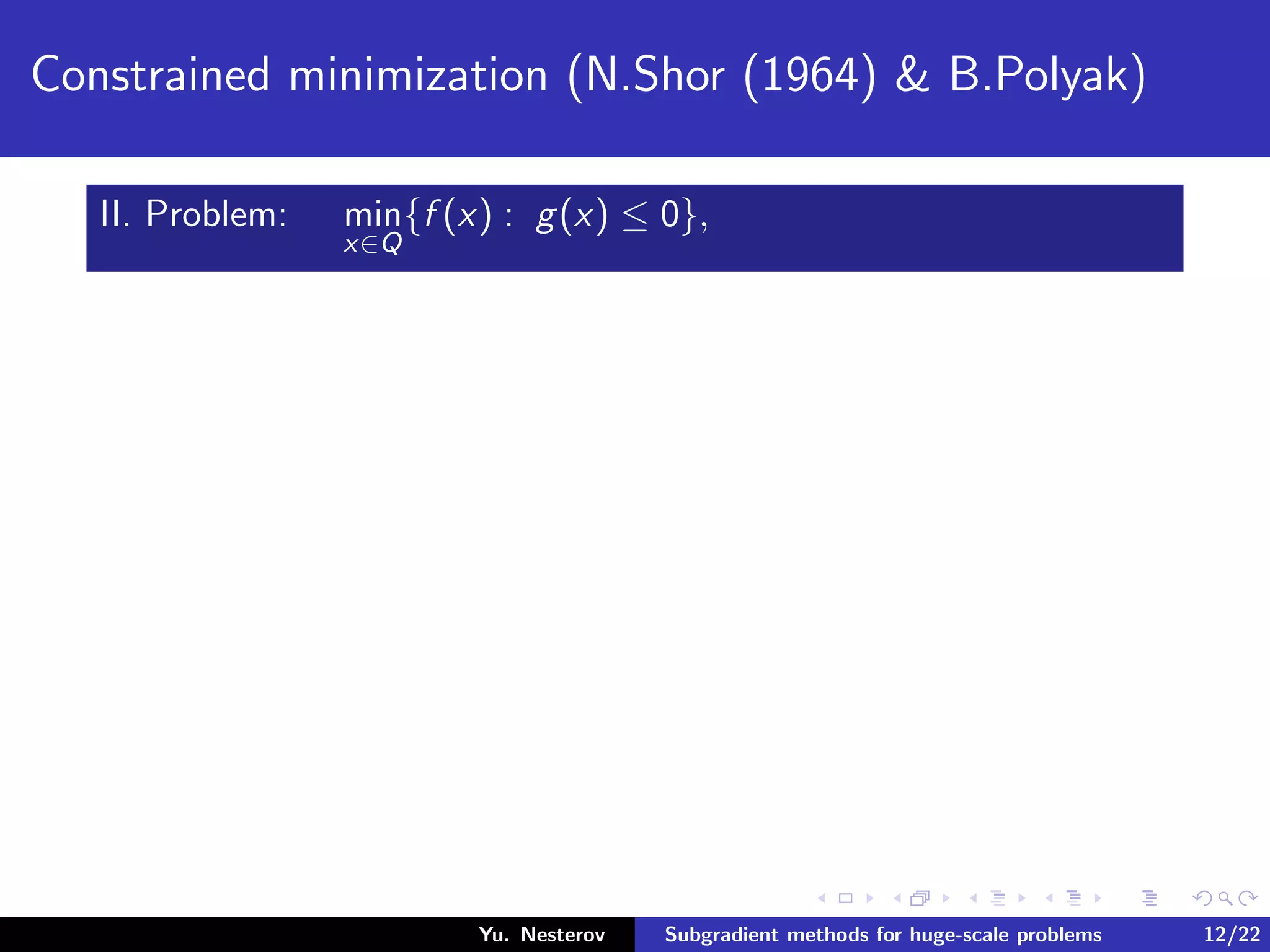
II. Problem: min
x∈Q
{f (x) : g(x) ≤ 0},
Yu. Nesterov Subgradient methods for huge-scale problems 12/22
Constrained minimization (N.Shor (1964) & B.Polyak)
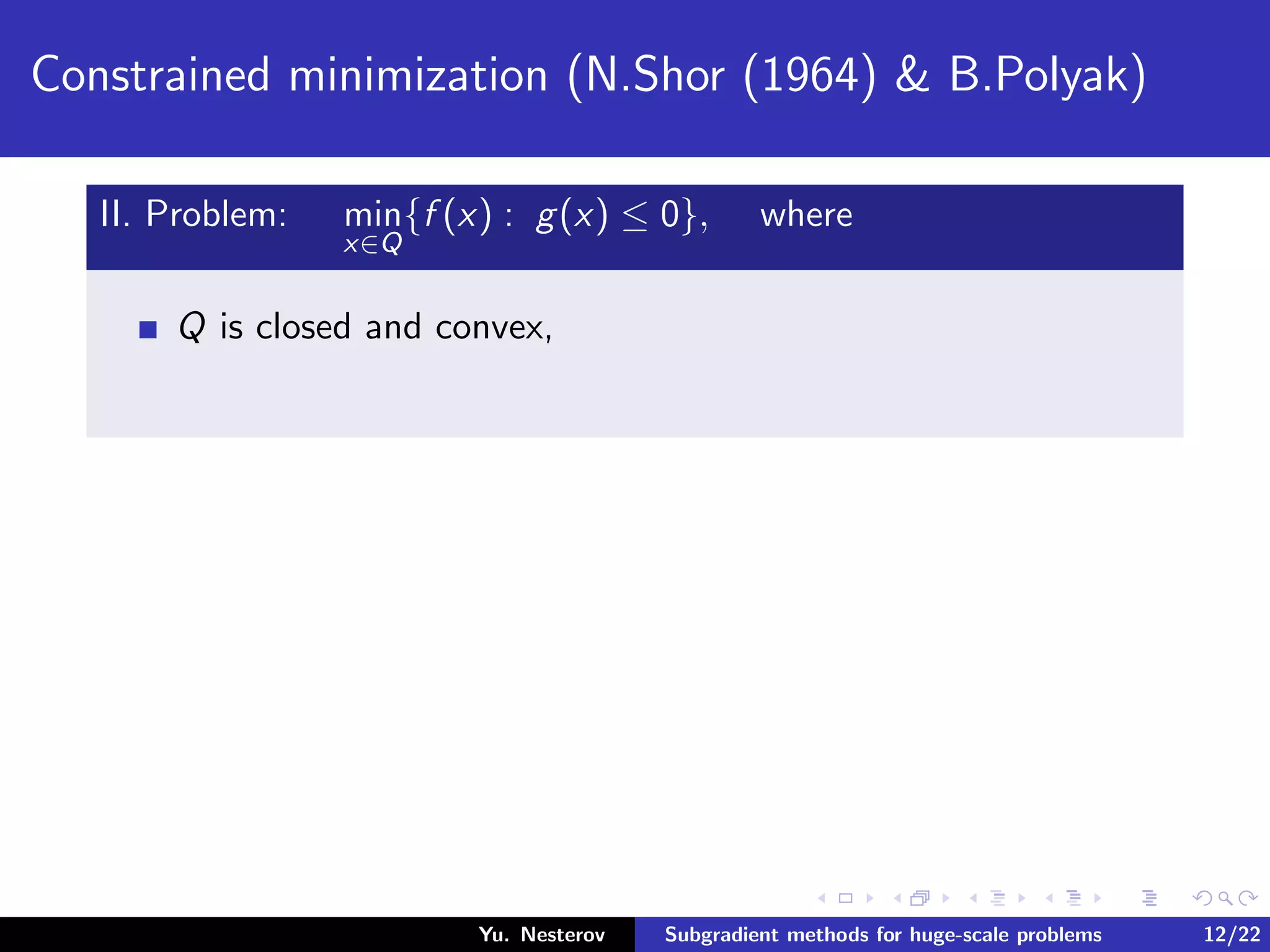
II. Problem: min
x∈Q
{f (x) : g(x) ≤ 0}, where
Q is closed and convex,
Yu. Nesterov Subgradient methods for huge-scale problems 12/22
Constrained minimization (N.Shor (1964) & B.Polyak)
II. Problem: min
x∈Q
{f (x) : g(x) ≤ 0}, where
Q is closed and convex,
f , g have uniformly bounded subgradients.
Yu. Nesterov Subgradient methods for huge-scale problems 12/22
Constrained minimization (N.Shor (1964) & B.Polyak)
II. Problem: min
x∈Q
{f (x) : g(x) ≤ 0}, where
Q is closed and convex,
f , g have uniformly bounded subgradients.
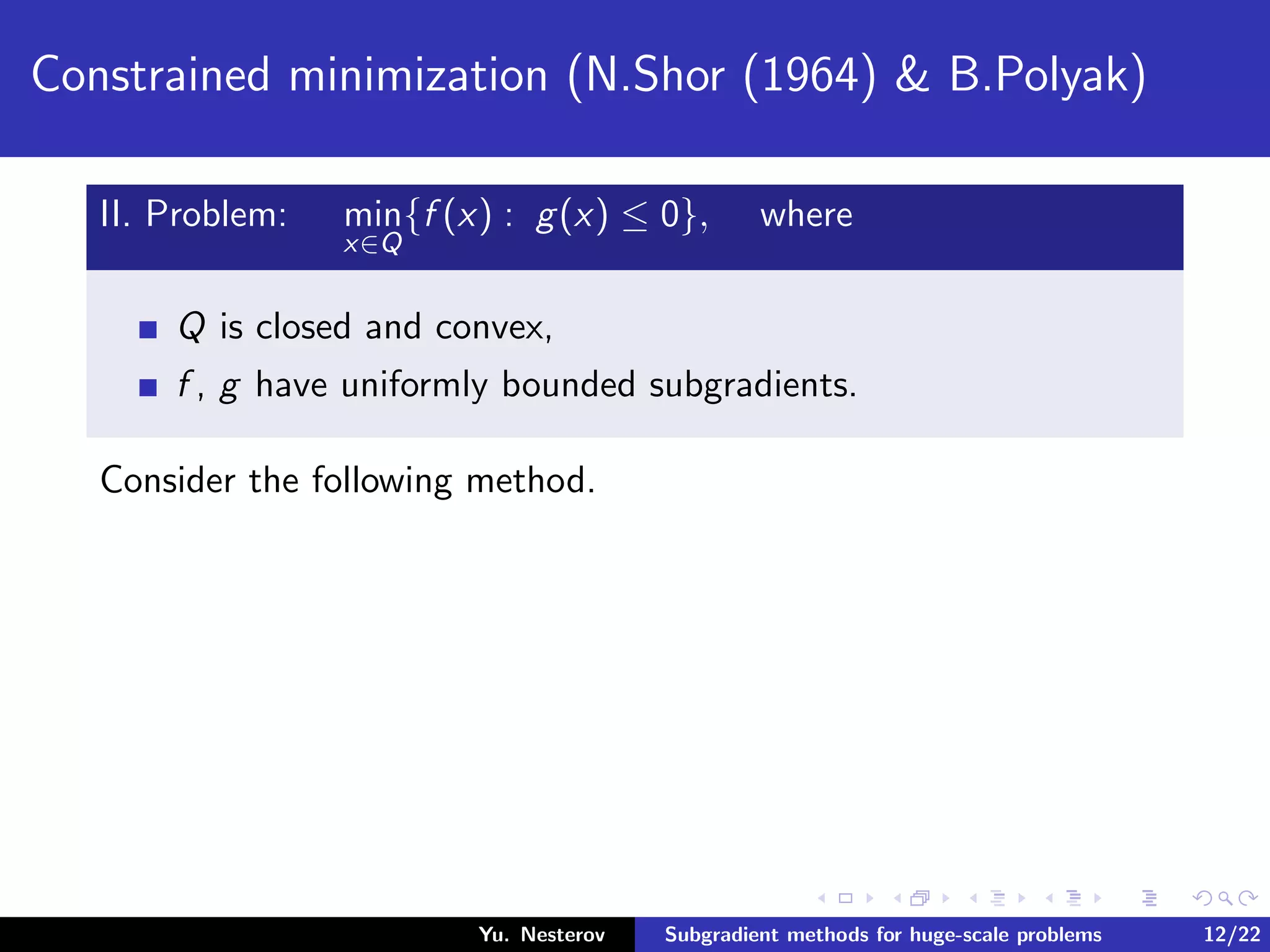
Consider the following method.
Yu. Nesterov Subgradient methods for huge-scale problems 12/22
Constrained minimization (N.Shor (1964) & B.Polyak)
II. Problem: min
x∈Q
{f (x) : g(x) ≤ 0}, where
Q is closed and convex,
f , g have uniformly bounded subgradients.
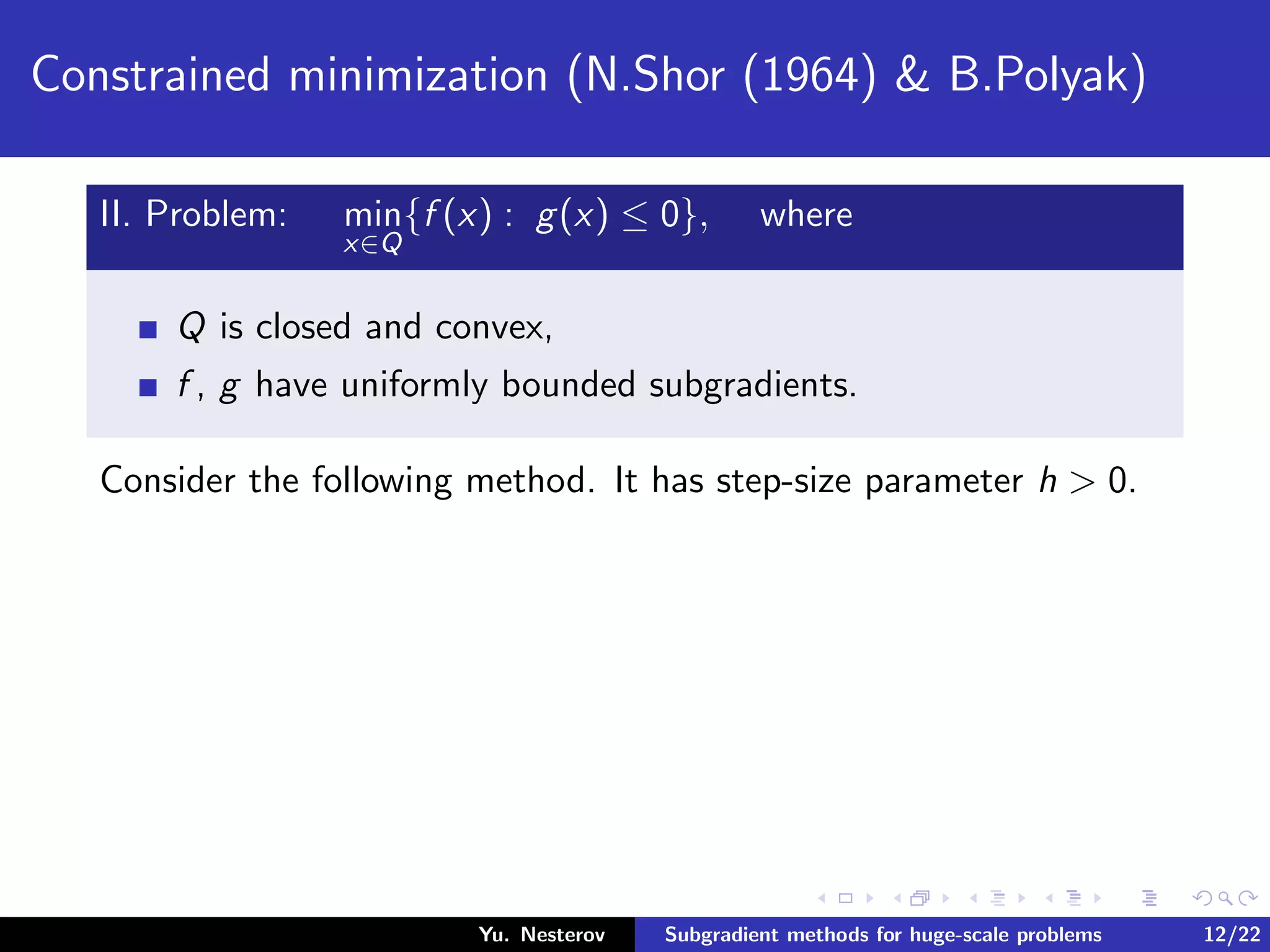
Consider the following method. It has step-size parameter h > 0.
Yu. Nesterov Subgradient methods for huge-scale problems 12/22
Constrained minimization (N.Shor (1964) & B.Polyak)
II. Problem: min
x∈Q
{f (x) : g(x) ≤ 0}, where
Q is closed and convex,
f , g have uniformly bounded subgradients.
Consider the following method. It has step-size parameter h > 0.
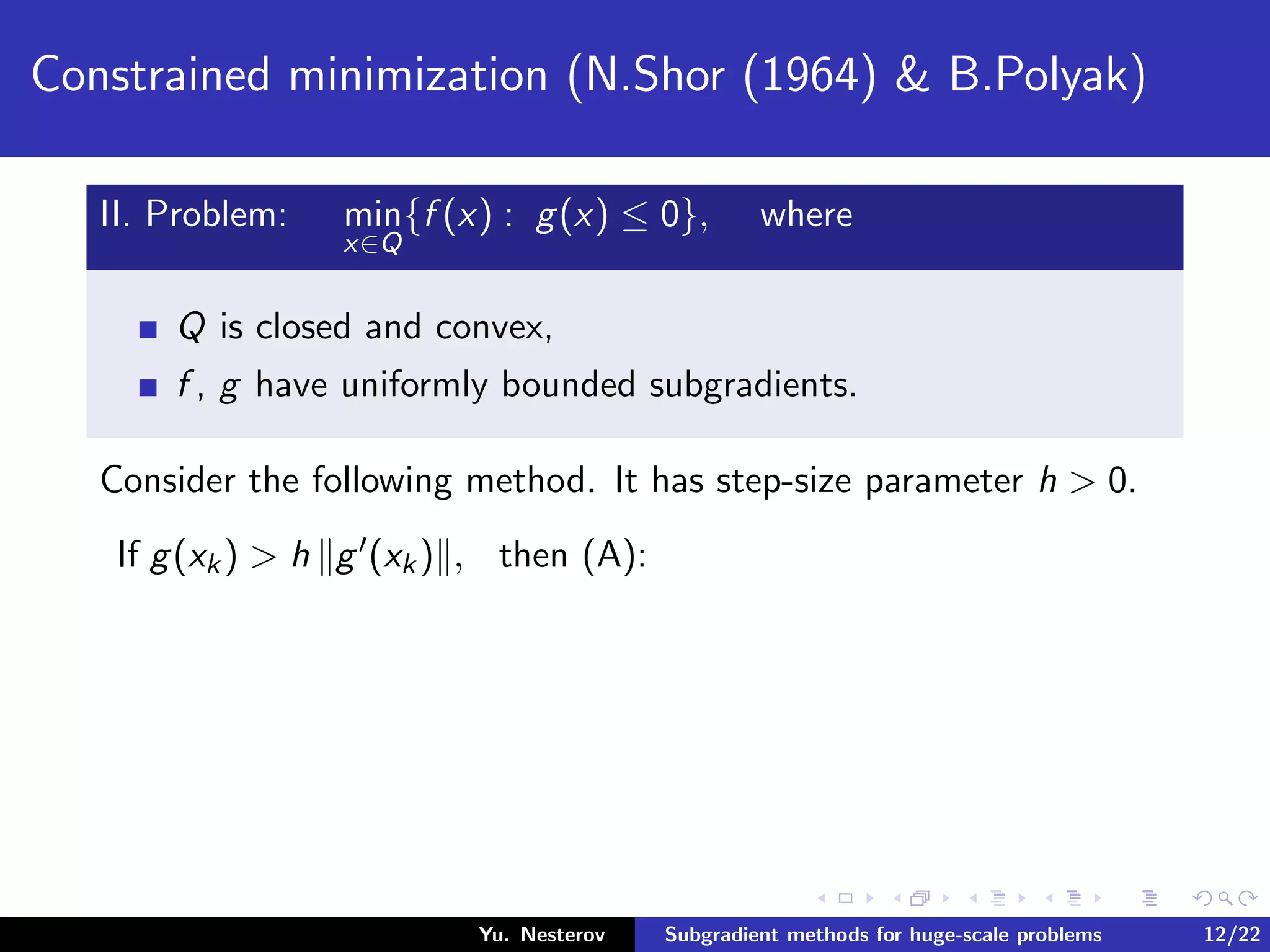
If g(xk) > h g (xk) , then (A):
Yu. Nesterov Subgradient methods for huge-scale problems 12/22
Constrained minimization (N.Shor (1964) & B.Polyak)
II. Problem: min
x∈Q
{f (x) : g(x) ≤ 0}, where
Q is closed and convex,
f , g have uniformly bounded subgradients.
Consider the following method. It has step-size parameter h > 0.
If g(xk) > h g (xk) , then (A): xk+1 = πQ xk − g(xk )
g (xk ) 2 g (xk) ,
Yu. Nesterov Subgradient methods for huge-scale problems 12/22
Constrained minimization (N.Shor (1964) & B.Polyak)
II. Problem: min
x∈Q
{f (x) : g(x) ≤ 0}, where
Q is closed and convex,
f , g have uniformly bounded subgradients.
Consider the following method. It has step-size parameter h > 0.
If g(xk) > h g (xk) , then (A): xk+1 = πQ xk − g(xk )
g (xk ) 2 g (xk) ,
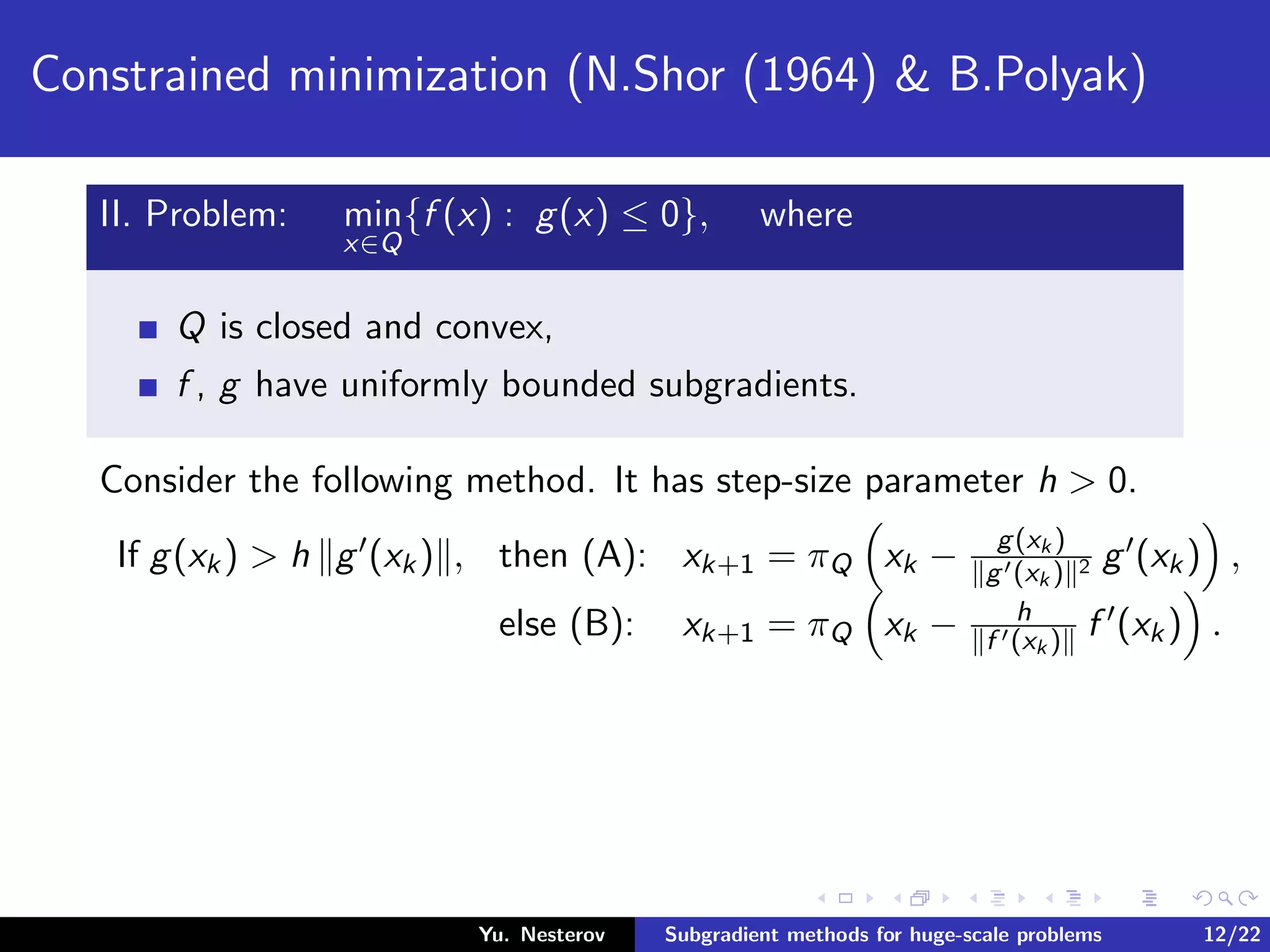
else (B): xk+1 = πQ xk − h
f (xk ) f (xk) .
Yu. Nesterov Subgradient methods for huge-scale problems 12/22
Constrained minimization (N.Shor (1964) & B.Polyak)
II. Problem: min
x∈Q
{f (x) : g(x) ≤ 0}, where
Q is closed and convex,
f , g have uniformly bounded subgradients.
Consider the following method. It has step-size parameter h > 0.
If g(xk) > h g (xk) , then (A): xk+1 = πQ xk − g(xk )
g (xk ) 2 g (xk) ,
else (B): xk+1 = πQ xk − h
f (xk ) f (xk) .
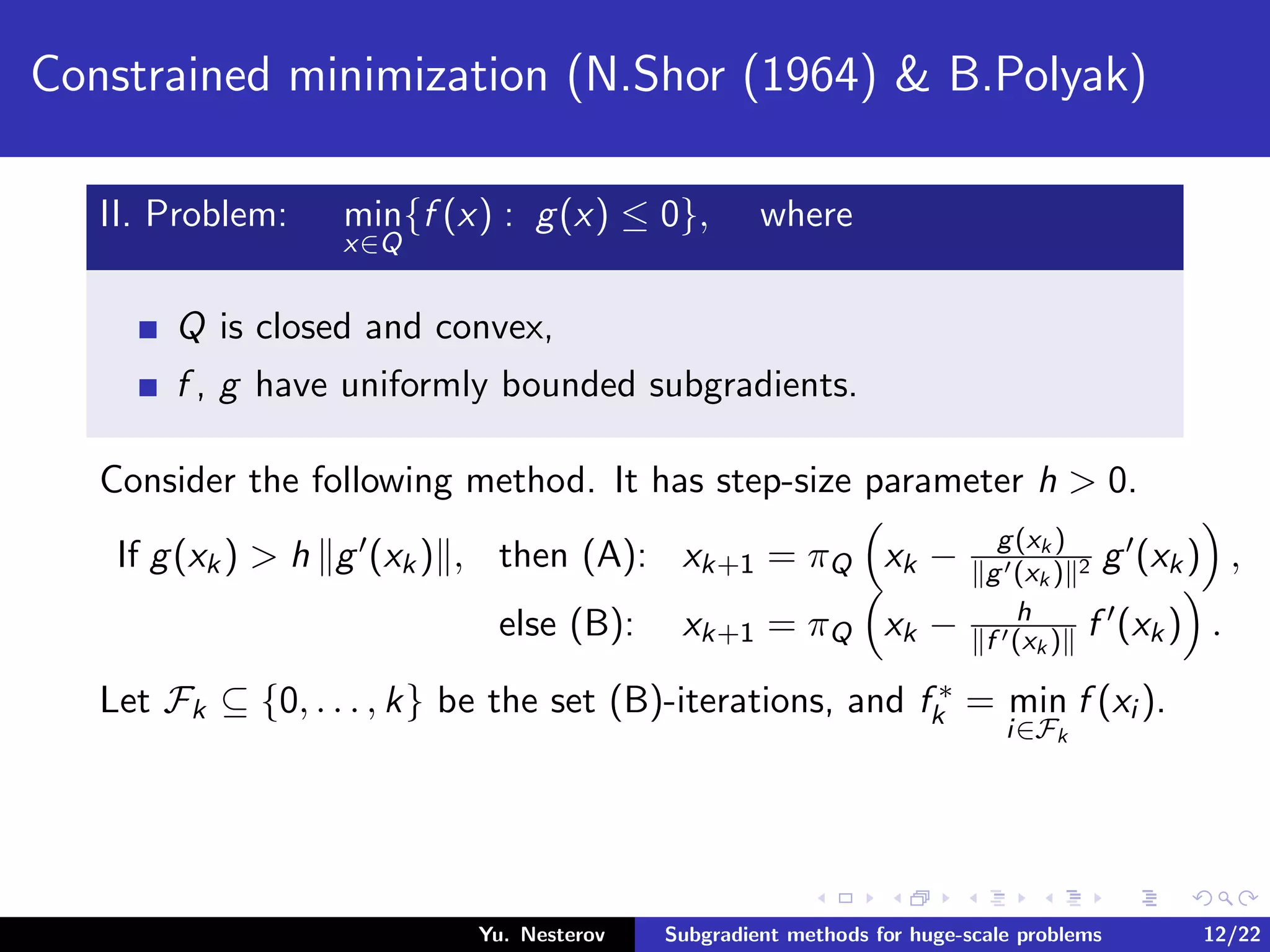
Let Fk ⊆ {0, . . . , k} be the set (B)-iterations, and f ∗
k = min
i∈Fk
f (xi ).
Yu. Nesterov Subgradient methods for huge-scale problems 12/22
Constrained minimization (N.Shor (1964) & B.Polyak)
II. Problem: min
x∈Q
{f (x) : g(x) ≤ 0}, where
Q is closed and convex,
f , g have uniformly bounded subgradients.
Consider the following method. It has step-size parameter h > 0.
If g(xk) > h g (xk) , then (A): xk+1 = πQ xk − g(xk )
g (xk ) 2 g (xk) ,
else (B): xk+1 = πQ xk − h
f (xk ) f (xk) .
Let Fk ⊆ {0, . . . , k} be the set (B)-iterations, and f ∗
k = min
i∈Fk
f (xi ).
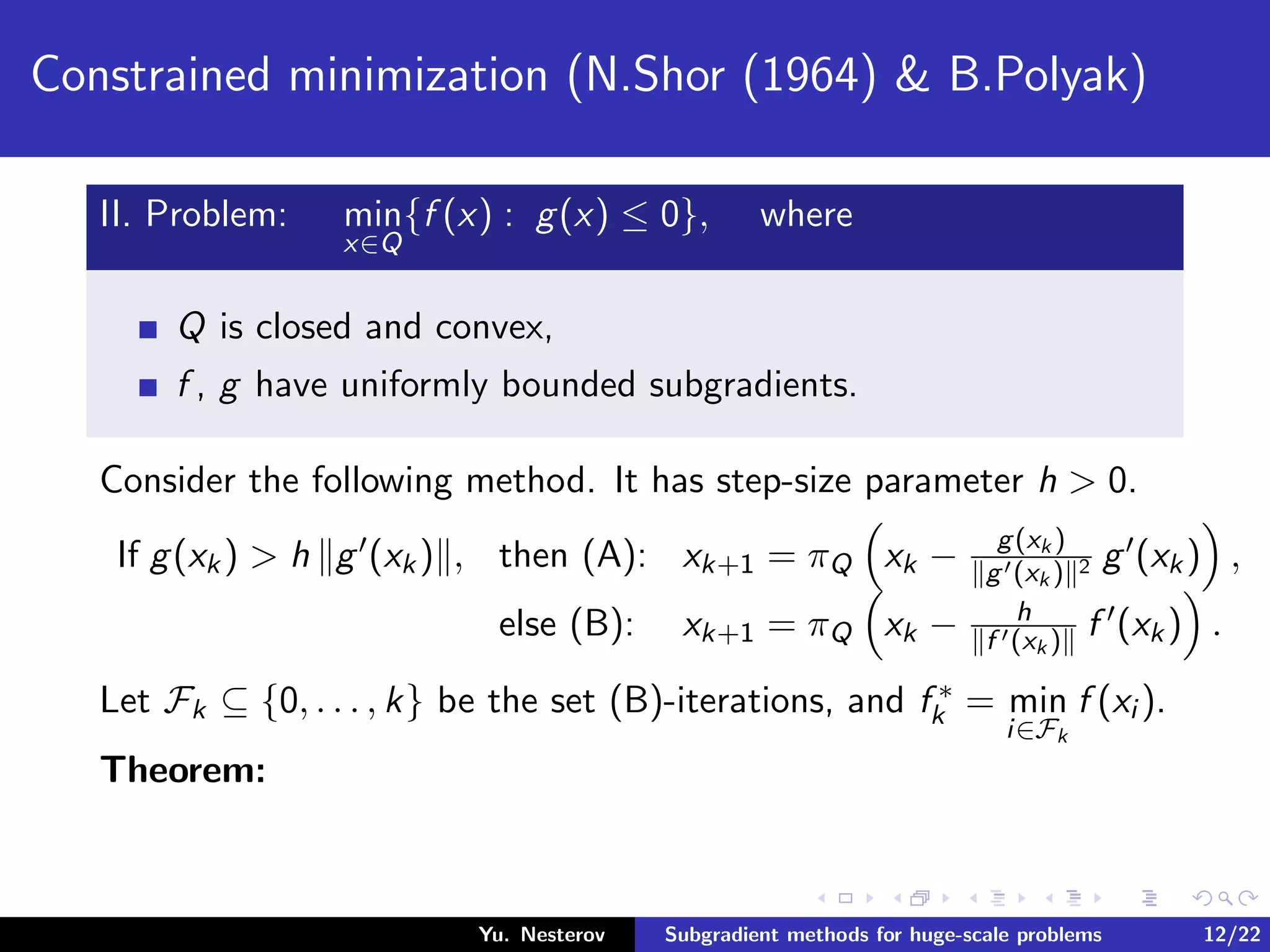
Theorem:
Yu. Nesterov Subgradient methods for huge-scale problems 12/22
Constrained minimization (N.Shor (1964) & B.Polyak)
II. Problem: min
x∈Q
{f (x) : g(x) ≤ 0}, where
Q is closed and convex,
f , g have uniformly bounded subgradients.
Consider the following method. It has step-size parameter h > 0.
If g(xk) > h g (xk) , then (A): xk+1 = πQ xk − g(xk )
g (xk ) 2 g (xk) ,
else (B): xk+1 = πQ xk − h
f (xk ) f (xk) .
Let Fk ⊆ {0, . . . , k} be the set (B)-iterations, and f ∗
k = min
i∈Fk
f (xi ).
Theorem: If k > x0 − x∗ 2/h2,
Yu. Nesterov Subgradient methods for huge-scale problems 12/22
Constrained minimization (N.Shor (1964) & B.Polyak)
II. Problem: min
x∈Q
{f (x) : g(x) ≤ 0}, where
Q is closed and convex,
f , g have uniformly bounded subgradients.
Consider the following method. It has step-size parameter h > 0.
If g(xk) > h g (xk) , then (A): xk+1 = πQ xk − g(xk )
g (xk ) 2 g (xk) ,
else (B): xk+1 = πQ xk − h
f (xk ) f (xk) .
Let Fk ⊆ {0, . . . , k} be the set (B)-iterations, and f ∗
k = min
i∈Fk
f (xi ).
Theorem: If k > x0 − x∗ 2/h2, then Fk = ∅
Yu. Nesterov Subgradient methods for huge-scale problems 12/22
Constrained minimization (N.Shor (1964) & B.Polyak)
II. Problem: min
x∈Q
{f (x) : g(x) ≤ 0}, where
Q is closed and convex,
f , g have uniformly bounded subgradients.
Consider the following method. It has step-size parameter h > 0.
If g(xk) > h g (xk) , then (A): xk+1 = πQ xk − g(xk )
g (xk ) 2 g (xk) ,
else (B): xk+1 = πQ xk − h
f (xk ) f (xk) .
Let Fk ⊆ {0, . . . , k} be the set (B)-iterations, and f ∗
k = min
i∈Fk
f (xi ).
Theorem: If k > x0 − x∗ 2/h2, then Fk = ∅ and
f ∗
k − f (x) ≤ hL(f ), max
i∈Fk
g(xi ) ≤ hL(g).
Yu. Nesterov Subgradient methods for huge-scale problems 12/22
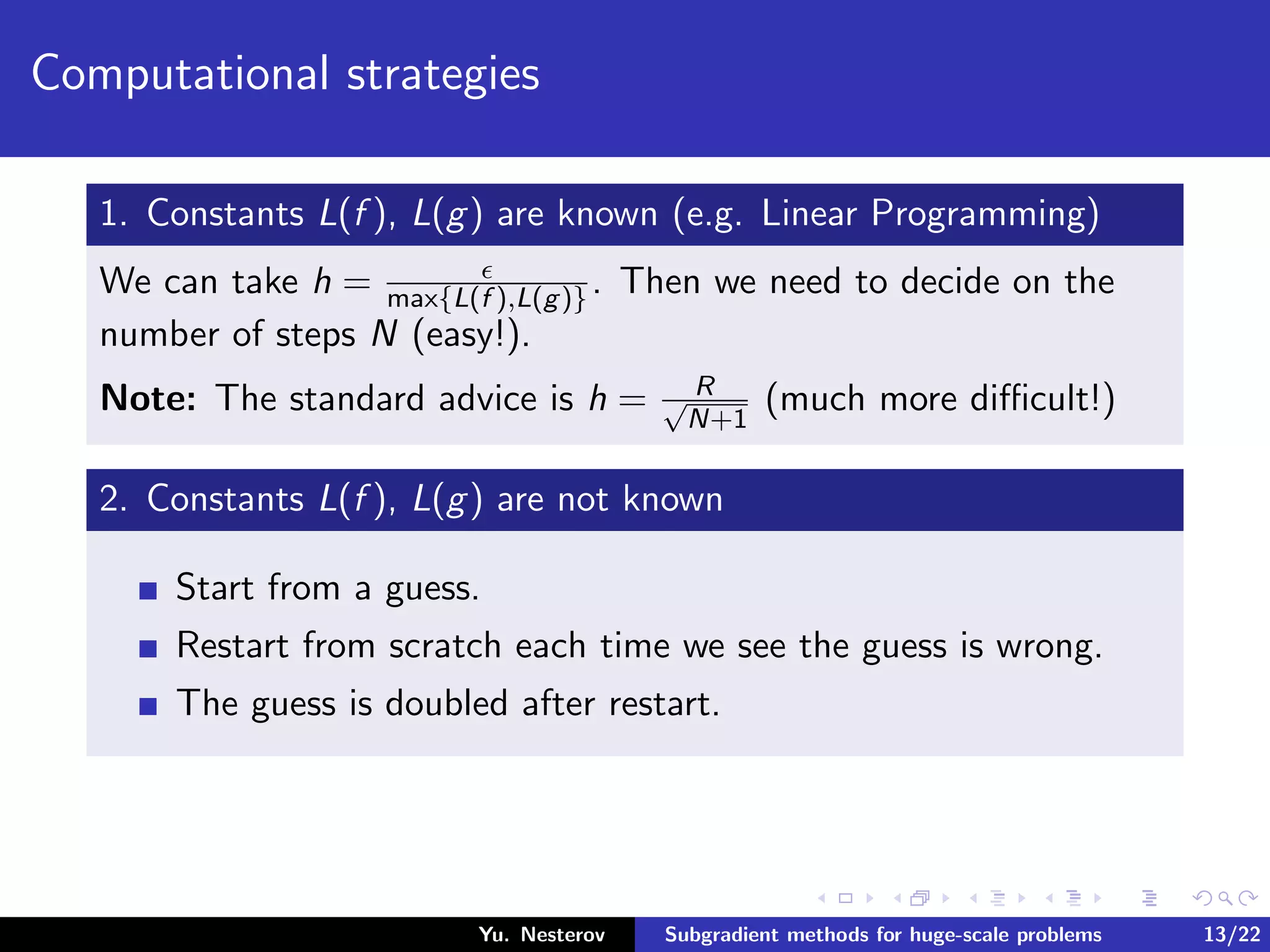
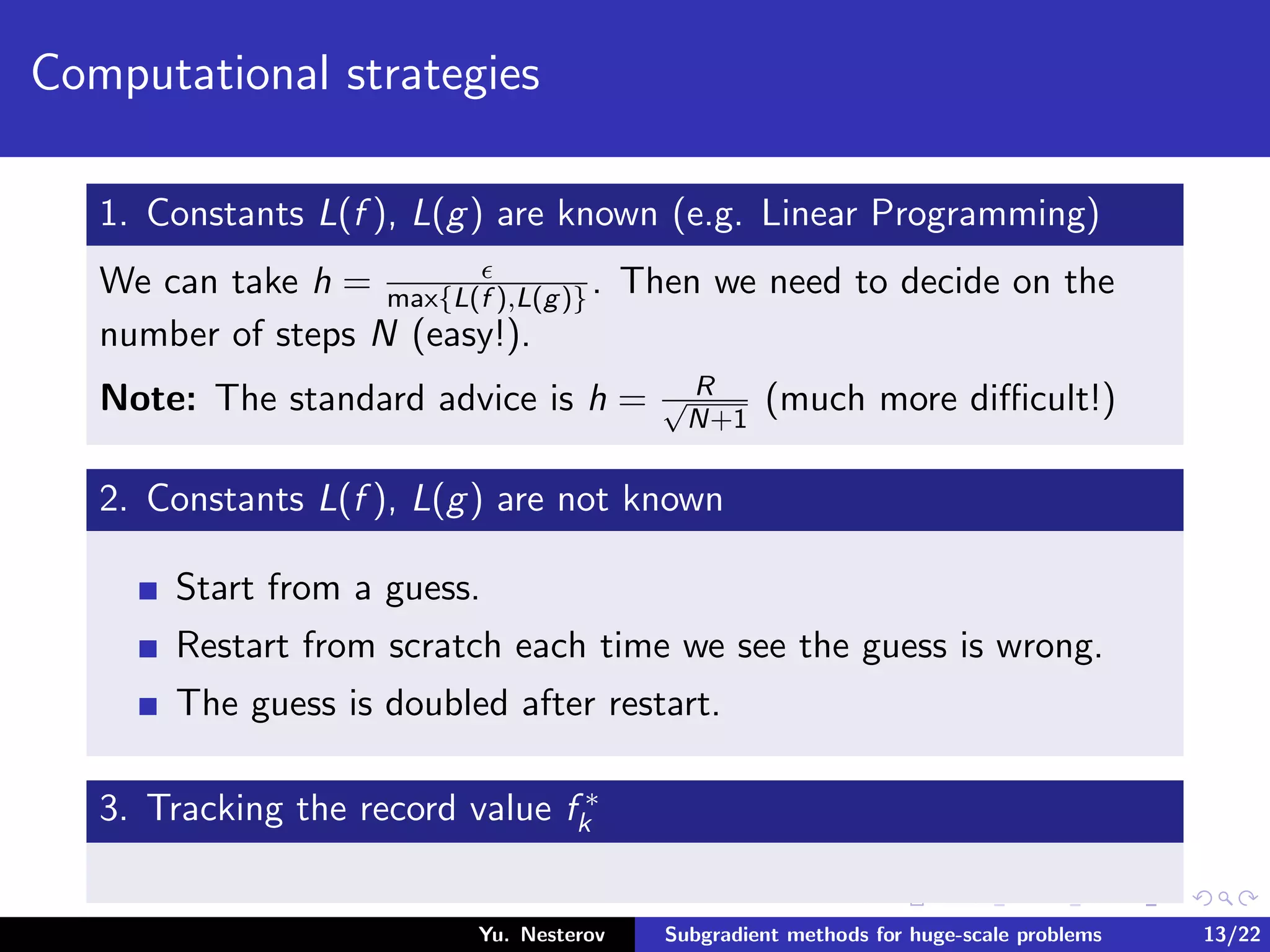
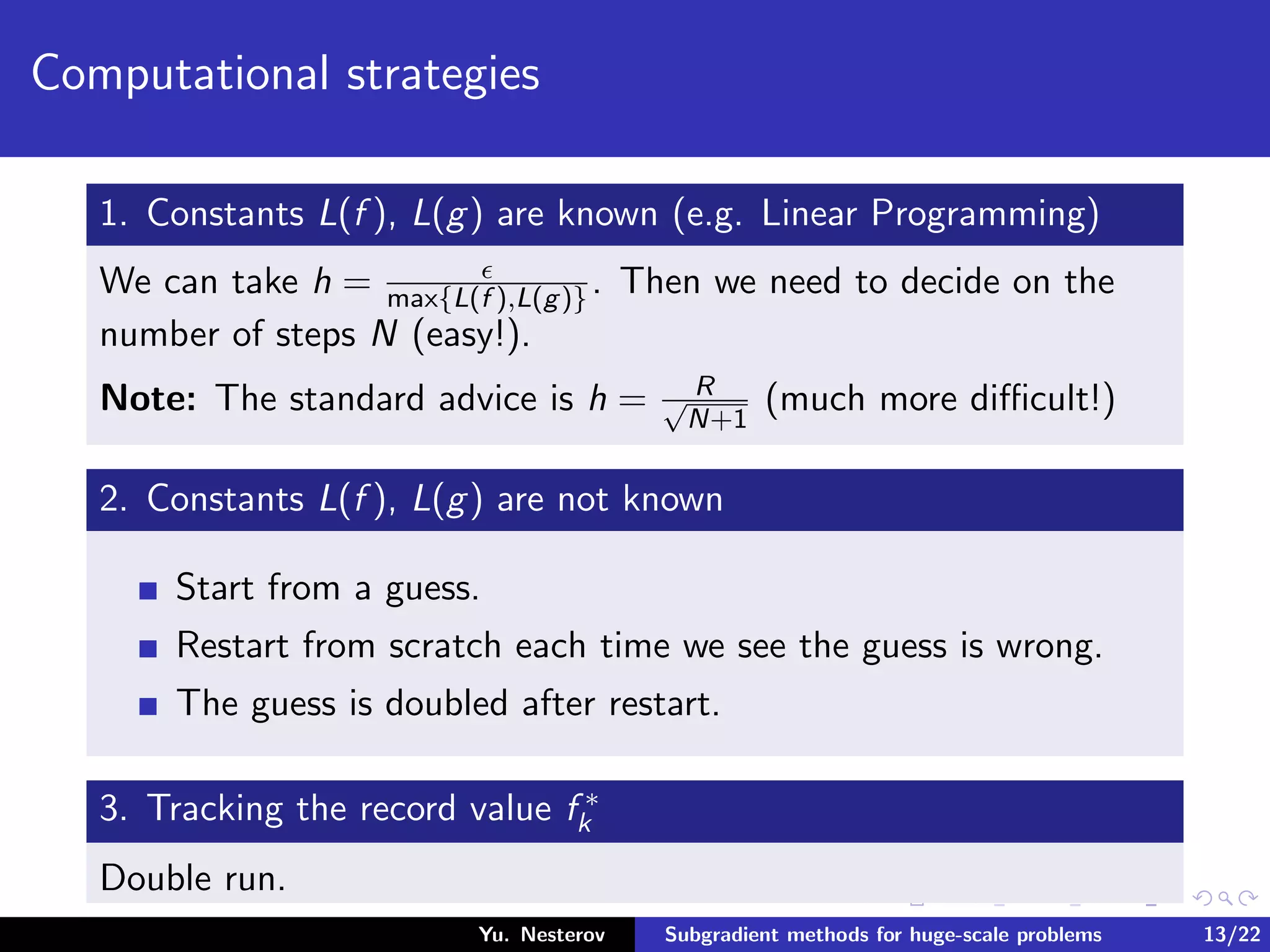
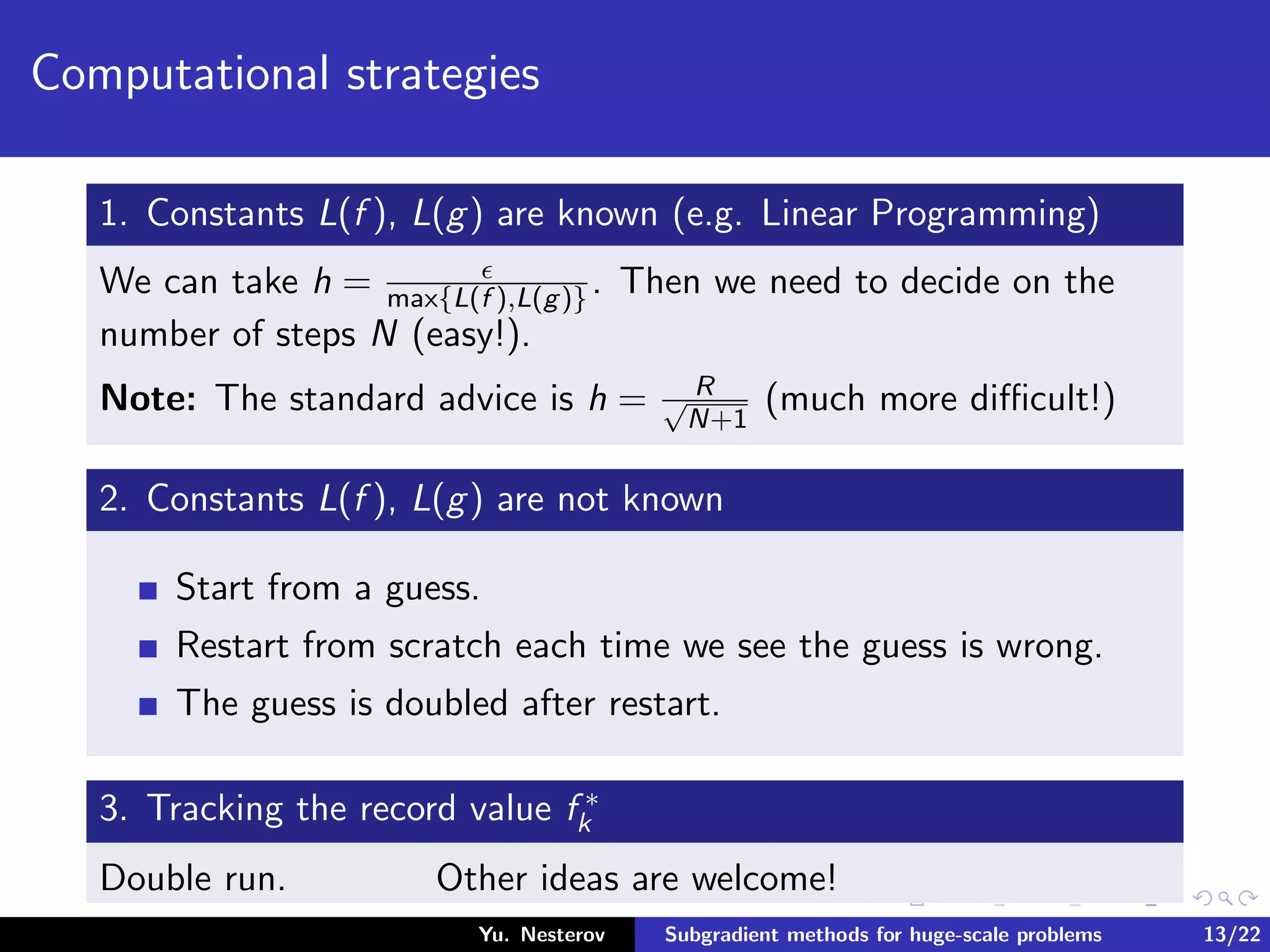
Computational strategies
Yu. Nesterov Subgradient methods for huge-scale problems 13/22
Computational strategies
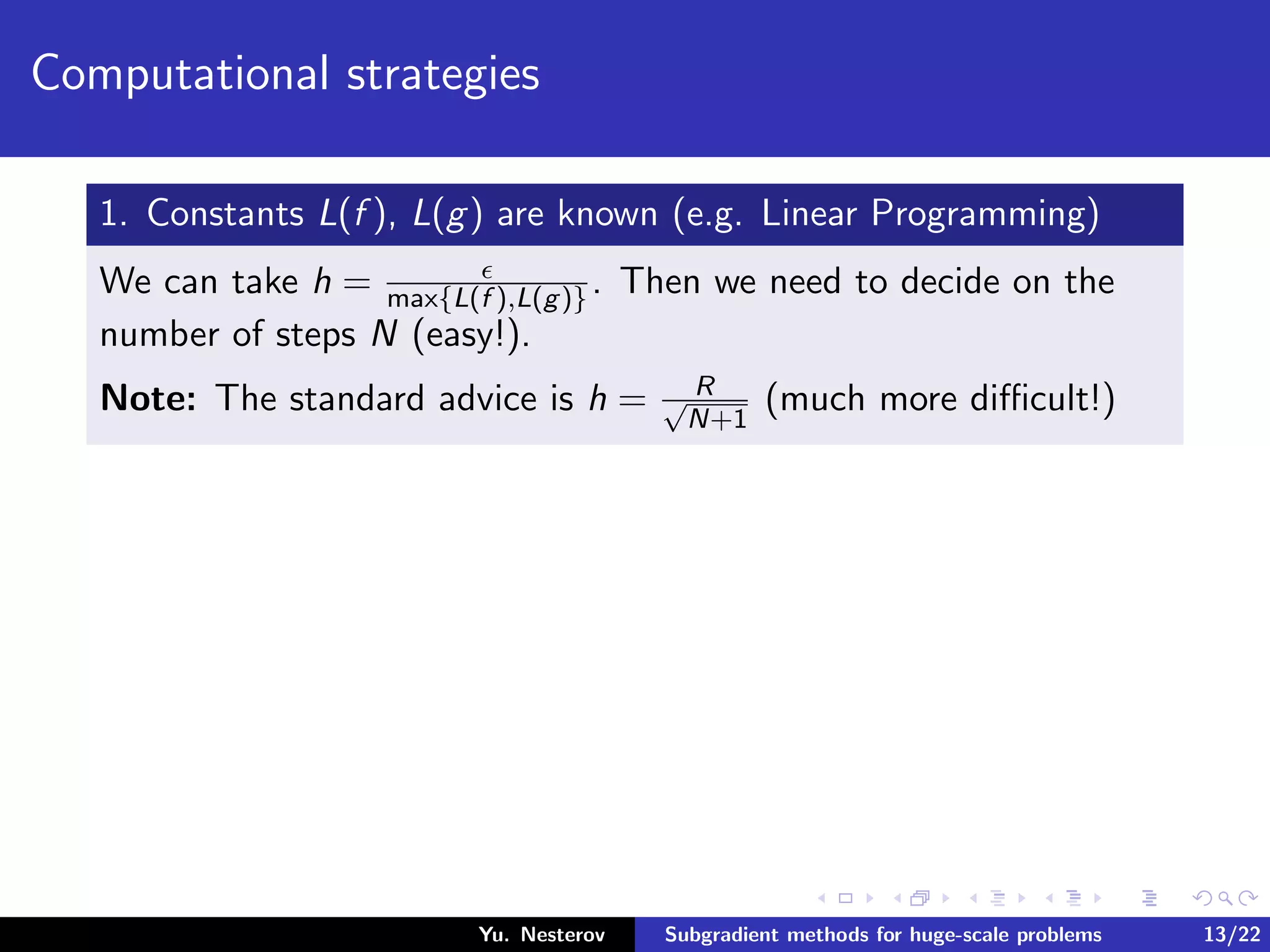
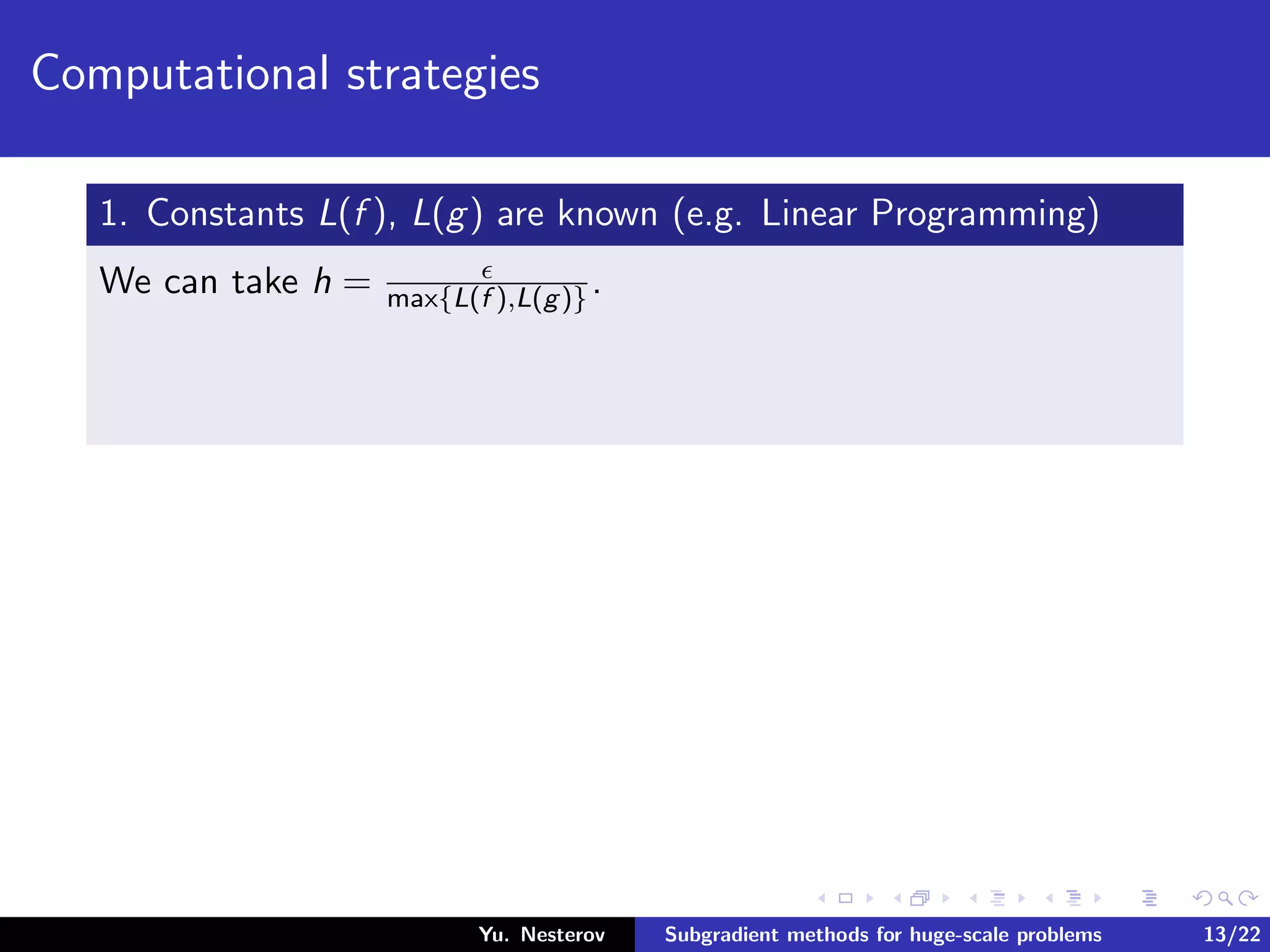
1. Constants L(f ), L(g) are known
Yu. Nesterov Subgradient methods for huge-scale problems 13/22
Computational strategies
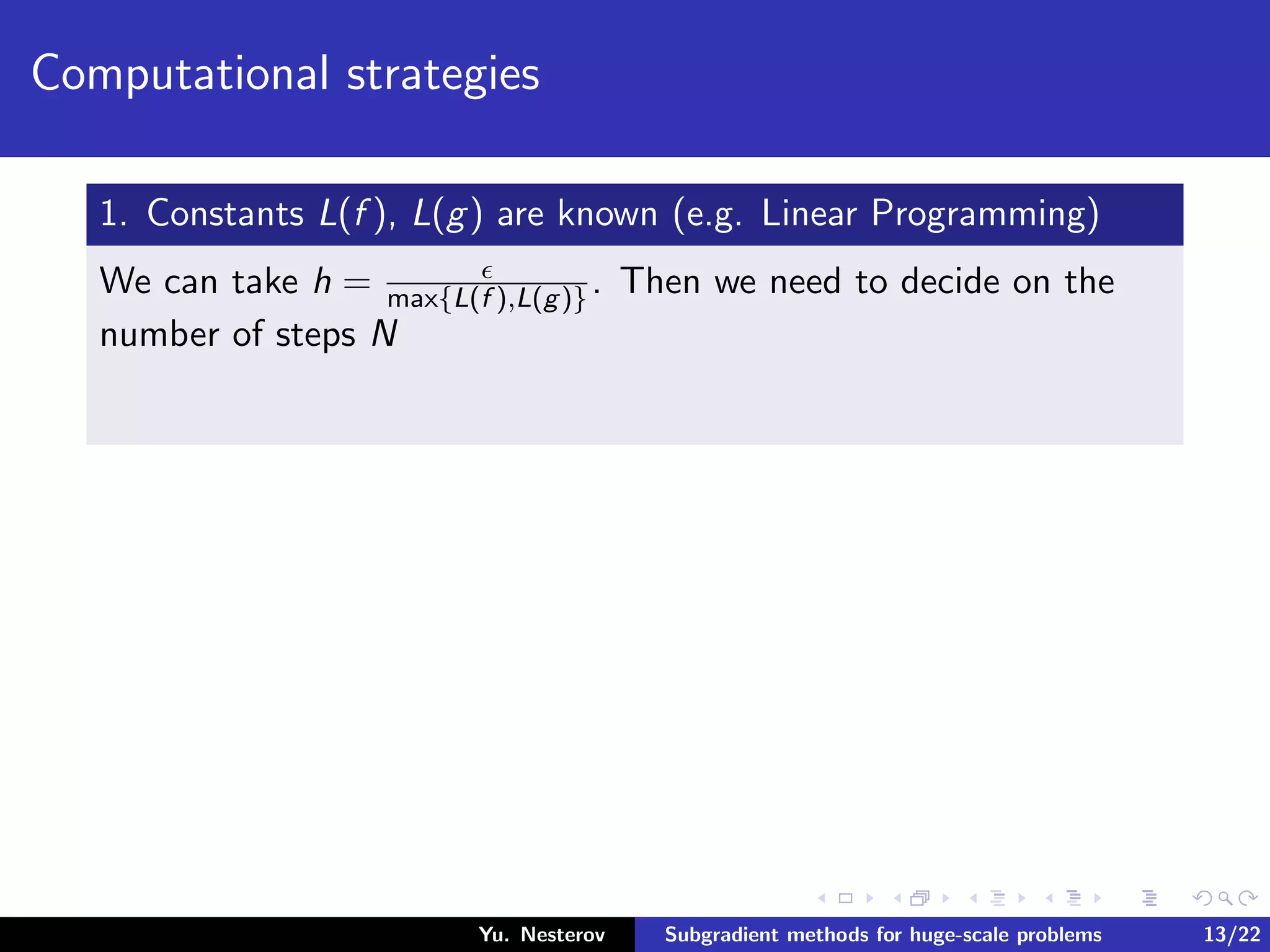
1. Constants L(f ), L(g) are known (e.g. Linear Programming)
Yu. Nesterov Subgradient methods for huge-scale problems 13/22
Computational strategies
1. Constants L(f ), L(g) are known (e.g. Linear Programming)
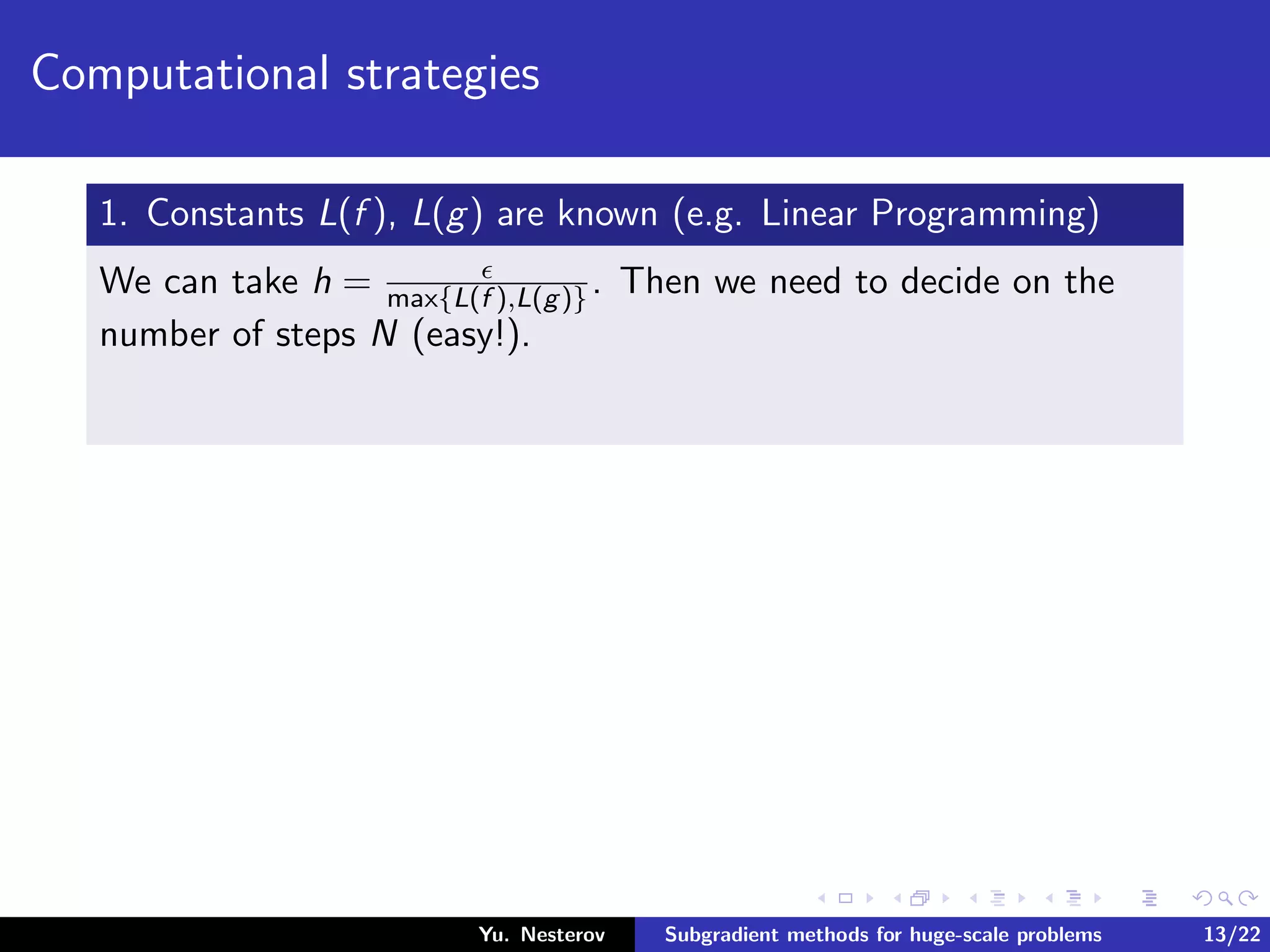
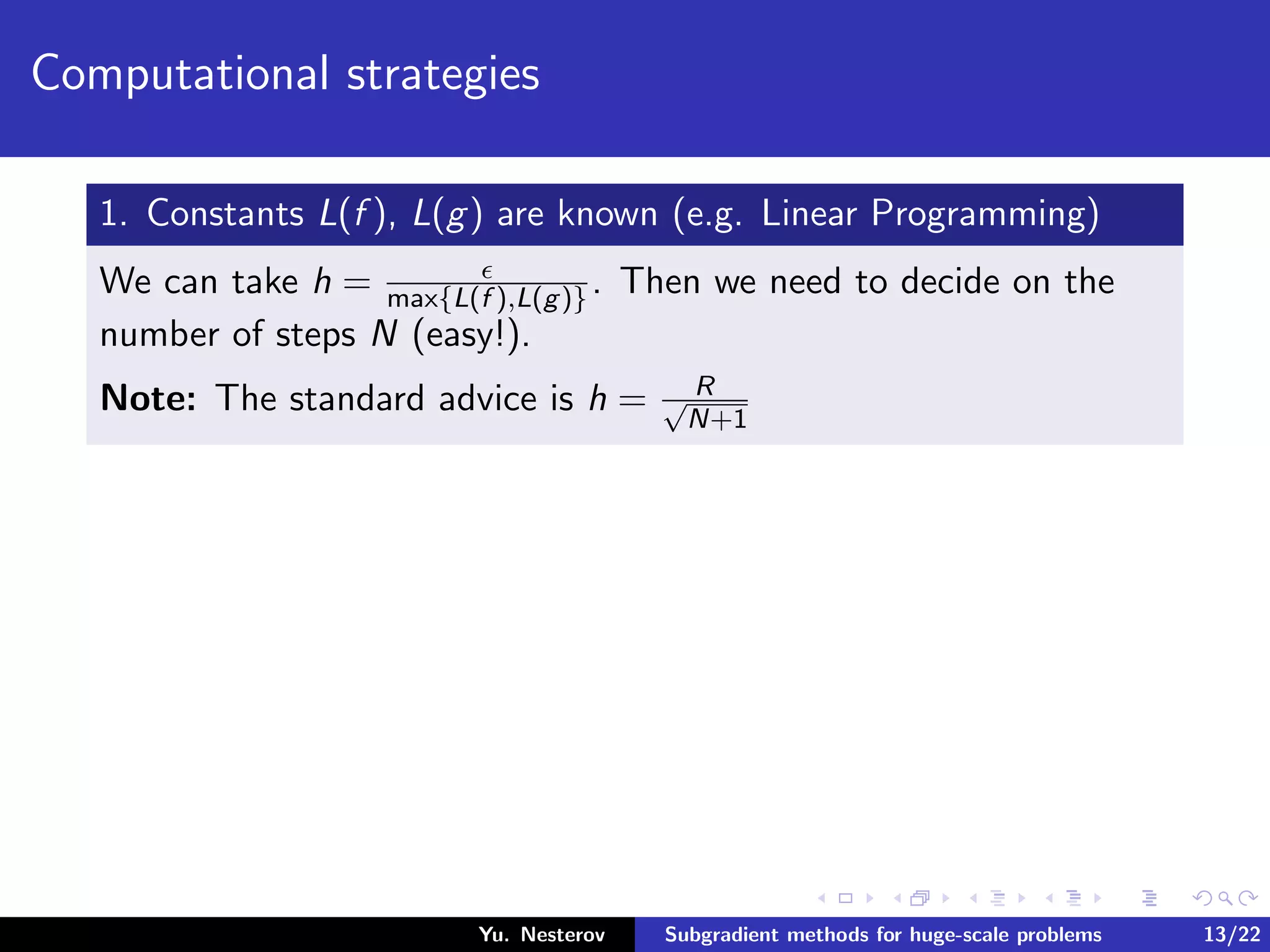
We can take h = max{L(f ),L(g)}.
Yu. Nesterov Subgradient methods for huge-scale problems 13/22
Computational strategies
1. Constants L(f ), L(g) are known (e.g. Linear Programming)
We can take h = max{L(f ),L(g)}. Then we need to decide on the
number of steps N
Yu. Nesterov Subgradient methods for huge-scale problems 13/22
Computational strategies
1. Constants L(f ), L(g) are known (e.g. Linear Programming)
We can take h = max{L(f ),L(g)}. Then we need to decide on the
number of steps N (easy!).
Yu. Nesterov Subgradient methods for huge-scale problems 13/22
Computational strategies
1. Constants L(f ), L(g) are known (e.g. Linear Programming)
We can take h = max{L(f ),L(g)}. Then we need to decide on the
number of steps N (easy!).
Note: The standard advice is h = R√
N+1
Yu. Nesterov Subgradient methods for huge-scale problems 13/22
Computational strategies
1. Constants L(f ), L(g) are known (e.g. Linear Programming)
We can take h = max{L(f ),L(g)}. Then we need to decide on the
number of steps N (easy!).
Note: The standard advice is h = R√
N+1
(much more difficult!)
Yu. Nesterov Subgradient methods for huge-scale problems 13/22
Computational strategies
1. Constants L(f ), L(g) are known (e.g. Linear Programming)
We can take h = max{L(f ),L(g)}. Then we need to decide on the
number of steps N (easy!).
Note: The standard advice is h = R√
N+1
(much more difficult!)
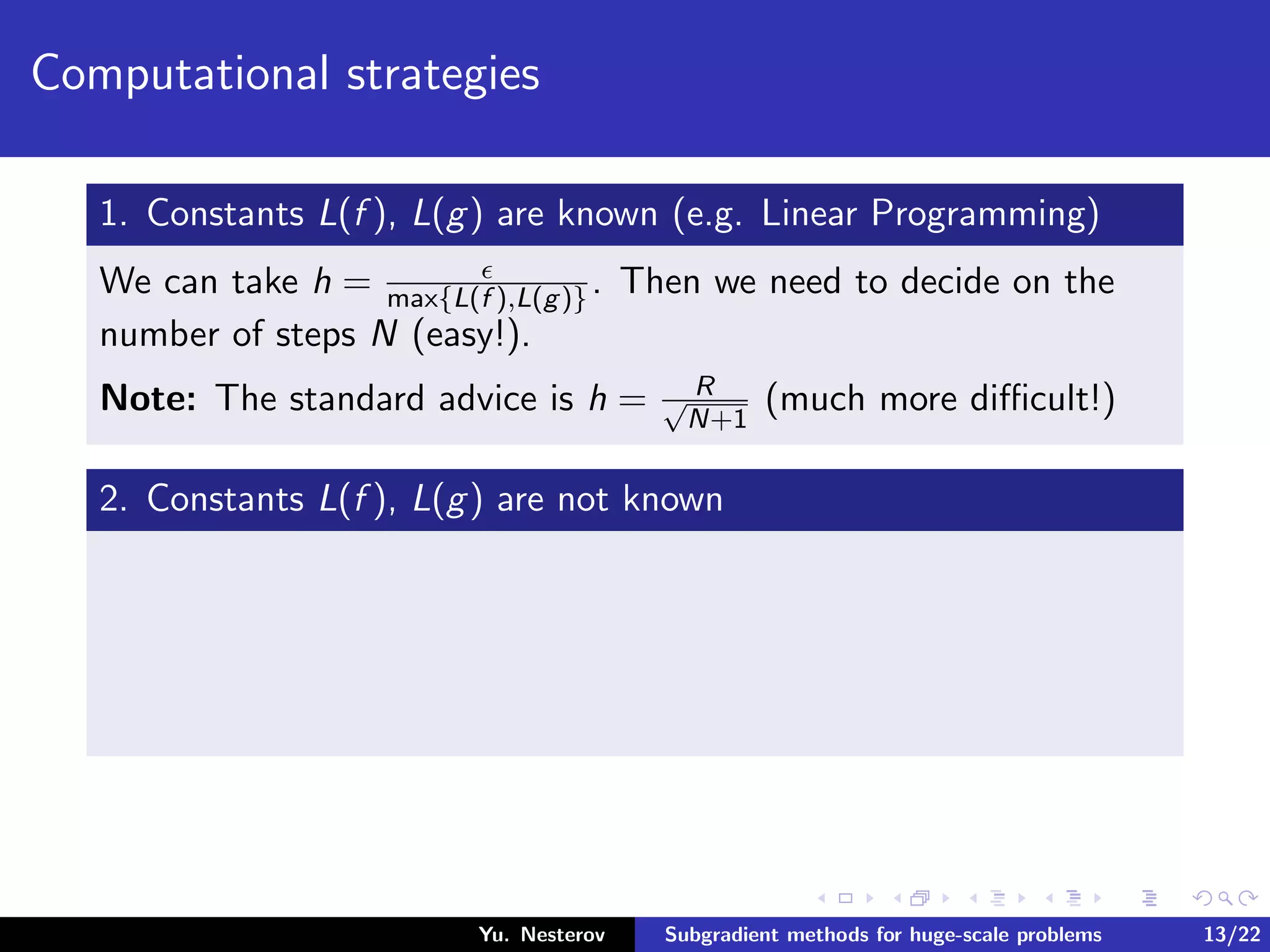
2. Constants L(f ), L(g) are not known
Yu. Nesterov Subgradient methods for huge-scale problems 13/22
Computational strategies
1. Constants L(f ), L(g) are known (e.g. Linear Programming)
We can take h = max{L(f ),L(g)}. Then we need to decide on the
number of steps N (easy!).
Note: The standard advice is h = R√
N+1
(much more difficult!)
2. Constants L(f ), L(g) are not known
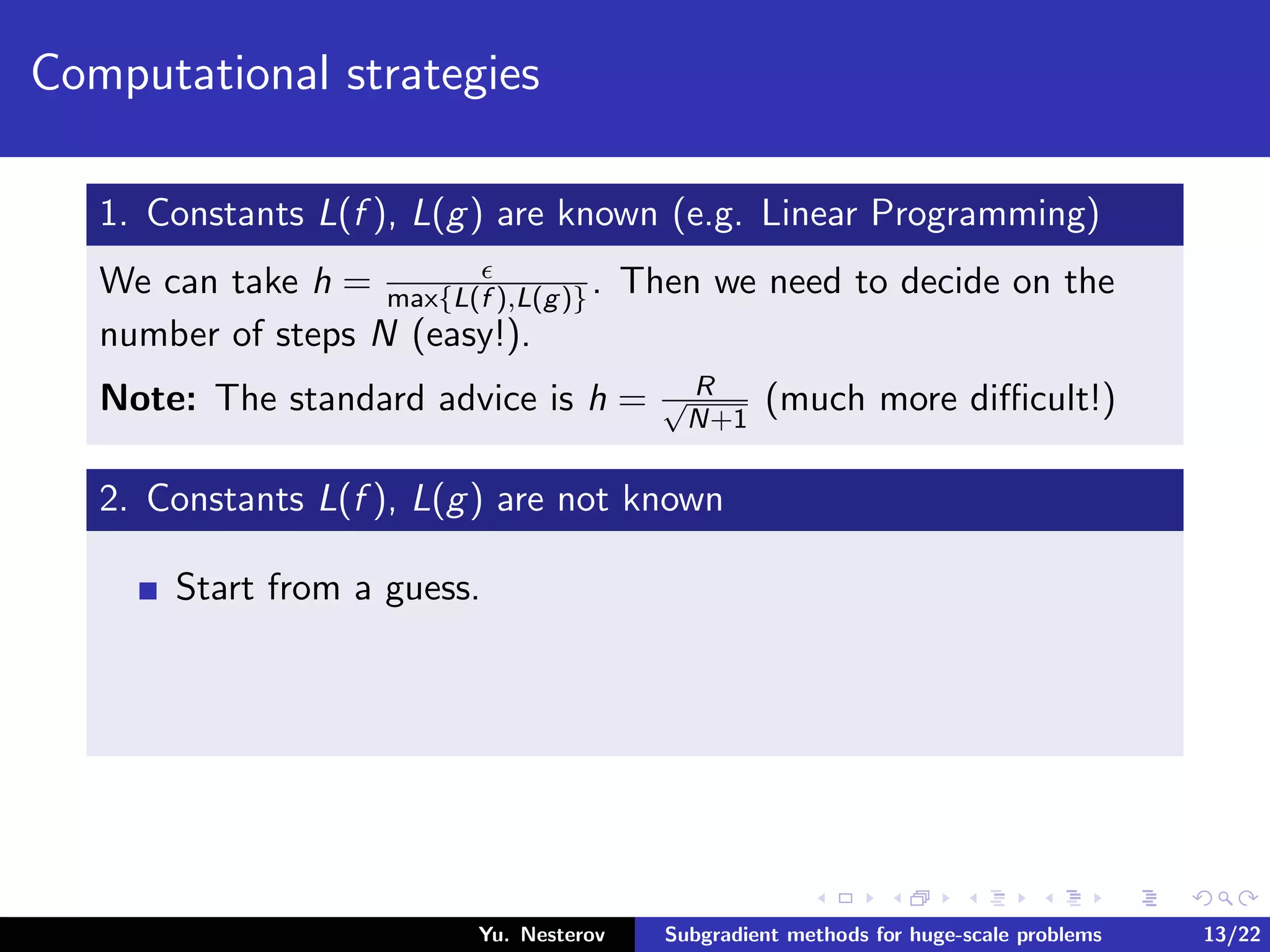
Start from a guess.
Yu. Nesterov Subgradient methods for huge-scale problems 13/22
Computational strategies
1. Constants L(f ), L(g) are known (e.g. Linear Programming)
We can take h = max{L(f ),L(g)}. Then we need to decide on the
number of steps N (easy!).
Note: The standard advice is h = R√
N+1
(much more difficult!)
2. Constants L(f ), L(g) are not known
Start from a guess.
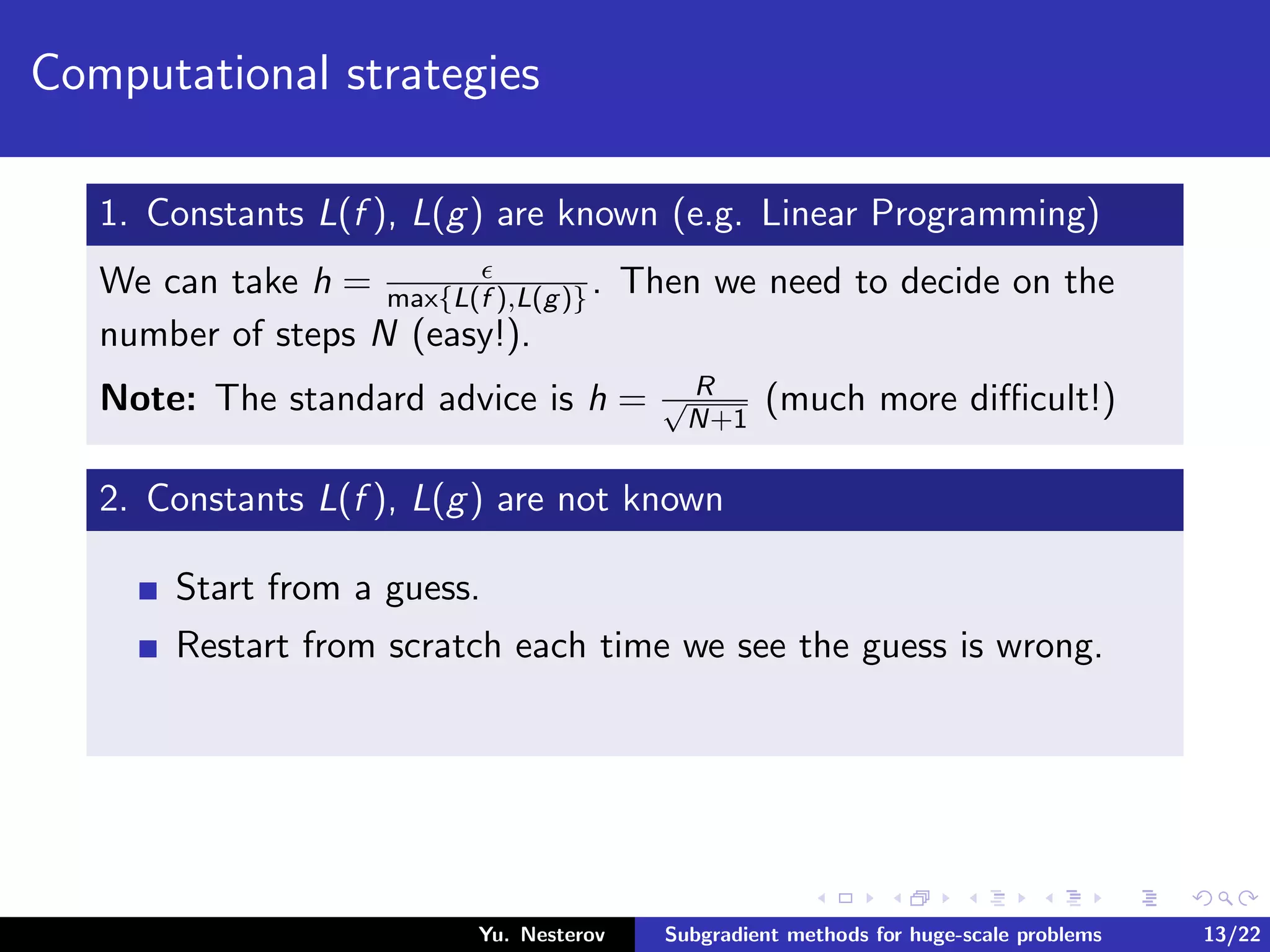
Restart from scratch each time we see the guess is wrong.
Yu. Nesterov Subgradient methods for huge-scale problems 13/22
Computational strategies
1. Constants L(f ), L(g) are known (e.g. Linear Programming)
We can take h = max{L(f ),L(g)}. Then we need to decide on the
number of steps N (easy!).
Note: The standard advice is h = R√
N+1
(much more difficult!)
2. Constants L(f ), L(g) are not known
Start from a guess.
Restart from scratch each time we see the guess is wrong.
The guess is doubled after restart.
Yu. Nesterov Subgradient methods for huge-scale problems 13/22
Computational strategies
1. Constants L(f ), L(g) are known (e.g. Linear Programming)
We can take h = max{L(f ),L(g)}. Then we need to decide on the
number of steps N (easy!).
Note: The standard advice is h = R√
N+1
(much more difficult!)
2. Constants L(f ), L(g) are not known
Start from a guess.
Restart from scratch each time we see the guess is wrong.
The guess is doubled after restart.
3. Tracking the record value f ∗
k
Yu. Nesterov Subgradient methods for huge-scale problems 13/22
Computational strategies
1. Constants L(f ), L(g) are known (e.g. Linear Programming)
We can take h = max{L(f ),L(g)}. Then we need to decide on the
number of steps N (easy!).
Note: The standard advice is h = R√
N+1
(much more difficult!)
2. Constants L(f ), L(g) are not known
Start from a guess.
Restart from scratch each time we see the guess is wrong.
The guess is doubled after restart.
3. Tracking the record value f ∗
k
Double run.
Yu. Nesterov Subgradient methods for huge-scale problems 13/22
Computational strategies
1. Constants L(f ), L(g) are known (e.g. Linear Programming)
We can take h = max{L(f ),L(g)}. Then we need to decide on the
number of steps N (easy!).
Note: The standard advice is h = R√
N+1
(much more difficult!)
2. Constants L(f ), L(g) are not known
Start from a guess.
Restart from scratch each time we see the guess is wrong.
The guess is doubled after restart.
3. Tracking the record value f ∗
k
Double run. Other ideas are welcome!
Yu. Nesterov Subgradient methods for huge-scale problems 13/22
Application examples
Yu. Nesterov Subgradient methods for huge-scale problems 14/22
Application examples
Observations:
Yu. Nesterov Subgradient methods for huge-scale problems 14/22
Application examples
Observations:
1 Very often, Large- and Huge- scale problems have repetitive
sparsity patterns and/or limited connectivity.
Yu. Nesterov Subgradient methods for huge-scale problems 14/22
Application examples
Observations:
1 Very often, Large- and Huge- scale problems have repetitive
sparsity patterns and/or limited connectivity.
Social networks.
Yu. Nesterov Subgradient methods for huge-scale problems 14/22
Application examples
Observations:
1 Very often, Large- and Huge- scale problems have repetitive
sparsity patterns and/or limited connectivity.
Social networks.
Mobile phone networks.
Yu. Nesterov Subgradient methods for huge-scale problems 14/22
Application examples
Observations:
1 Very often, Large- and Huge- scale problems have repetitive
sparsity patterns and/or limited connectivity.
Social networks.
Mobile phone networks.
Truss topology design (local bars).
Yu. Nesterov Subgradient methods for huge-scale problems 14/22
Application examples
Observations:
1 Very often, Large- and Huge- scale problems have repetitive
sparsity patterns and/or limited connectivity.
Social networks.
Mobile phone networks.
Truss topology design (local bars).
Finite elements models (2D: four neighbors, 3D: six neighbors).
Yu. Nesterov Subgradient methods for huge-scale problems 14/22
Application examples
Observations:
1 Very often, Large- and Huge- scale problems have repetitive
sparsity patterns and/or limited connectivity.
Social networks.
Mobile phone networks.
Truss topology design (local bars).
Finite elements models (2D: four neighbors, 3D: six neighbors).
2 For p-diagonal matrices κ(A) ≤ p2.
Yu. Nesterov Subgradient methods for huge-scale problems 14/22
Google problem
Yu. Nesterov Subgradient methods for huge-scale problems 15/22
Google problem
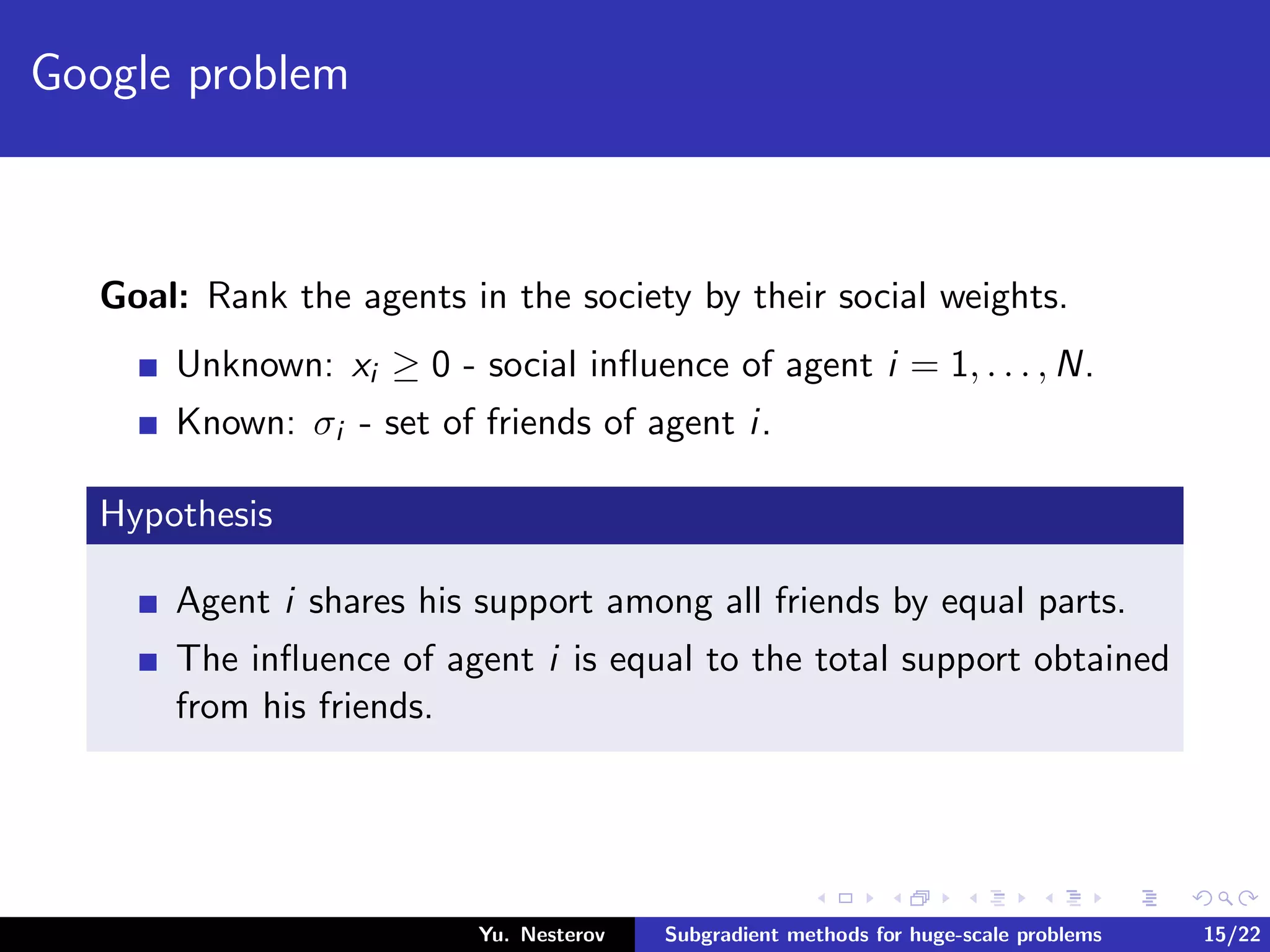
Goal: Rank the agents in the society by their social weights.
Yu. Nesterov Subgradient methods for huge-scale problems 15/22
Google problem
Goal: Rank the agents in the society by their social weights.
Unknown: xi ≥ 0 - social influence of agent i = 1, . . . , N.
Yu. Nesterov Subgradient methods for huge-scale problems 15/22
Google problem
Goal: Rank the agents in the society by their social weights.
Unknown: xi ≥ 0 - social influence of agent i = 1, . . . , N.
Known: σi - set of friends of agent i.
Yu. Nesterov Subgradient methods for huge-scale problems 15/22
Google problem
Goal: Rank the agents in the society by their social weights.
Unknown: xi ≥ 0 - social influence of agent i = 1, . . . , N.
Known: σi - set of friends of agent i.
Hypothesis
Yu. Nesterov Subgradient methods for huge-scale problems 15/22
Google problem
Goal: Rank the agents in the society by their social weights.
Unknown: xi ≥ 0 - social influence of agent i = 1, . . . , N.
Known: σi - set of friends of agent i.
Hypothesis
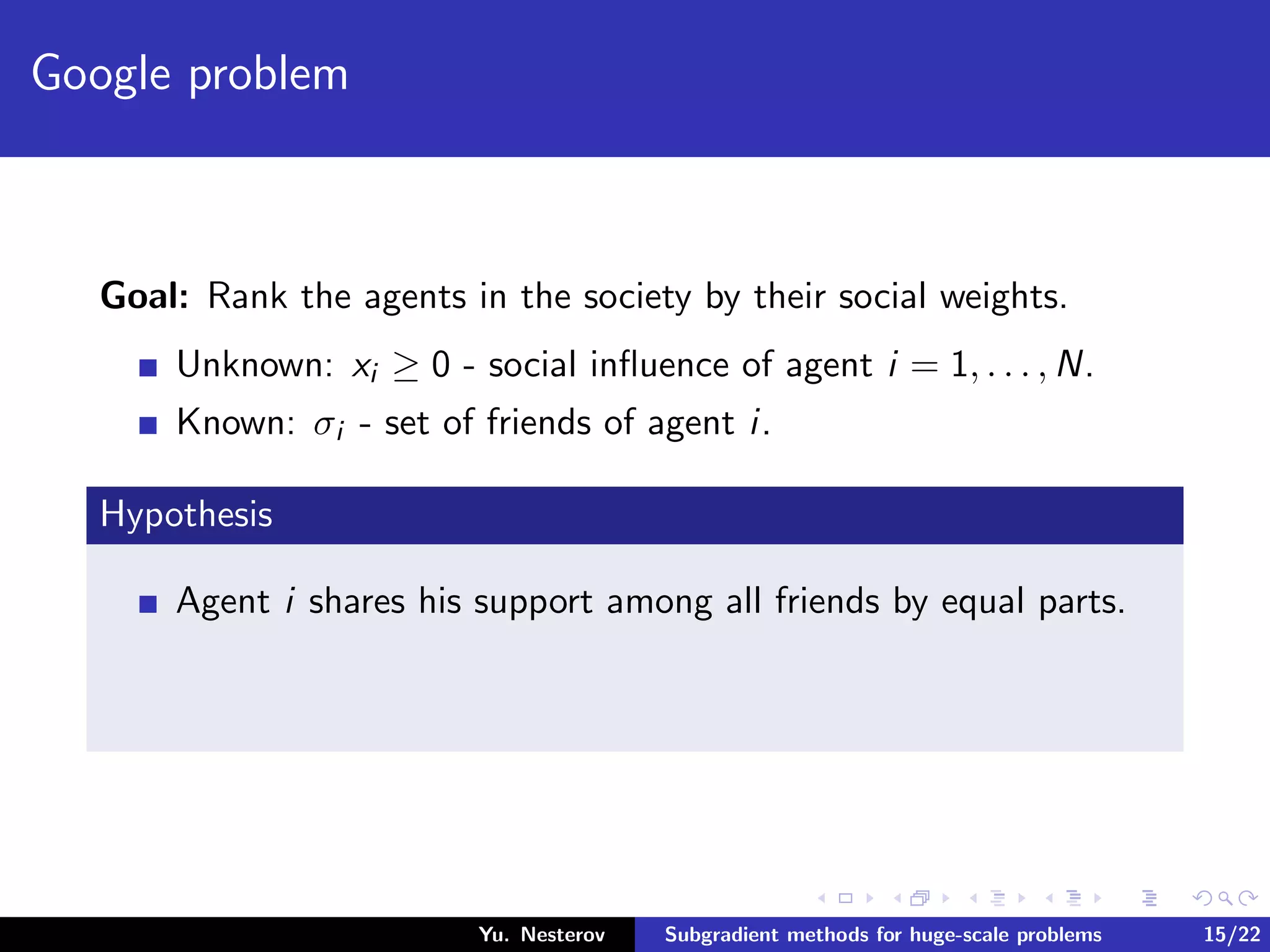
Agent i shares his support among all friends by equal parts.
Yu. Nesterov Subgradient methods for huge-scale problems 15/22
Google problem
Goal: Rank the agents in the society by their social weights.
Unknown: xi ≥ 0 - social influence of agent i = 1, . . . , N.
Known: σi - set of friends of agent i.
Hypothesis
Agent i shares his support among all friends by equal parts.
The influence of agent i is equal to the total support obtained
from his friends.
Yu. Nesterov Subgradient methods for huge-scale problems 15/22
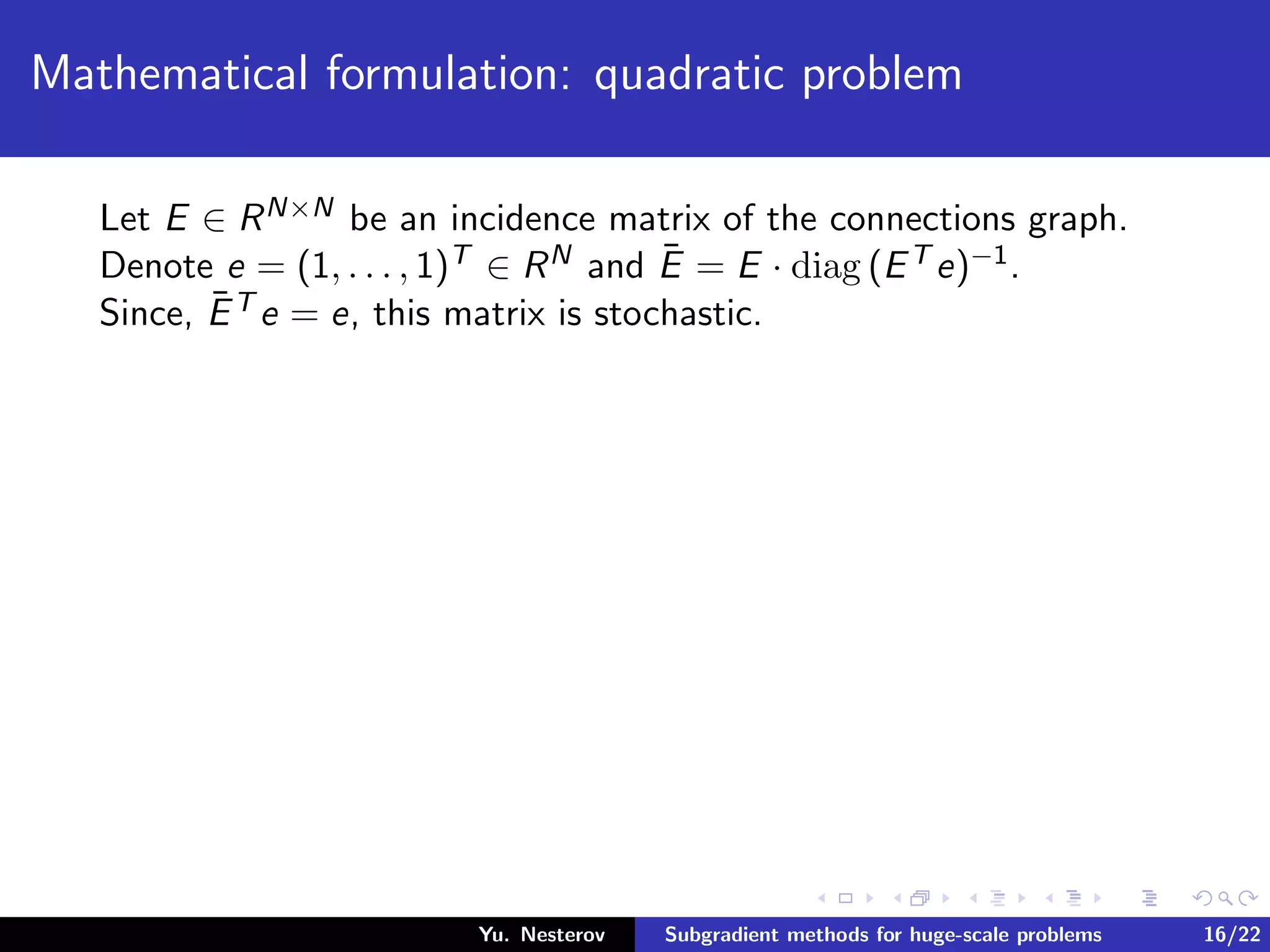
Mathematical formulation: quadratic problem
Yu. Nesterov Subgradient methods for huge-scale problems 16/22
Mathematical formulation: quadratic problem
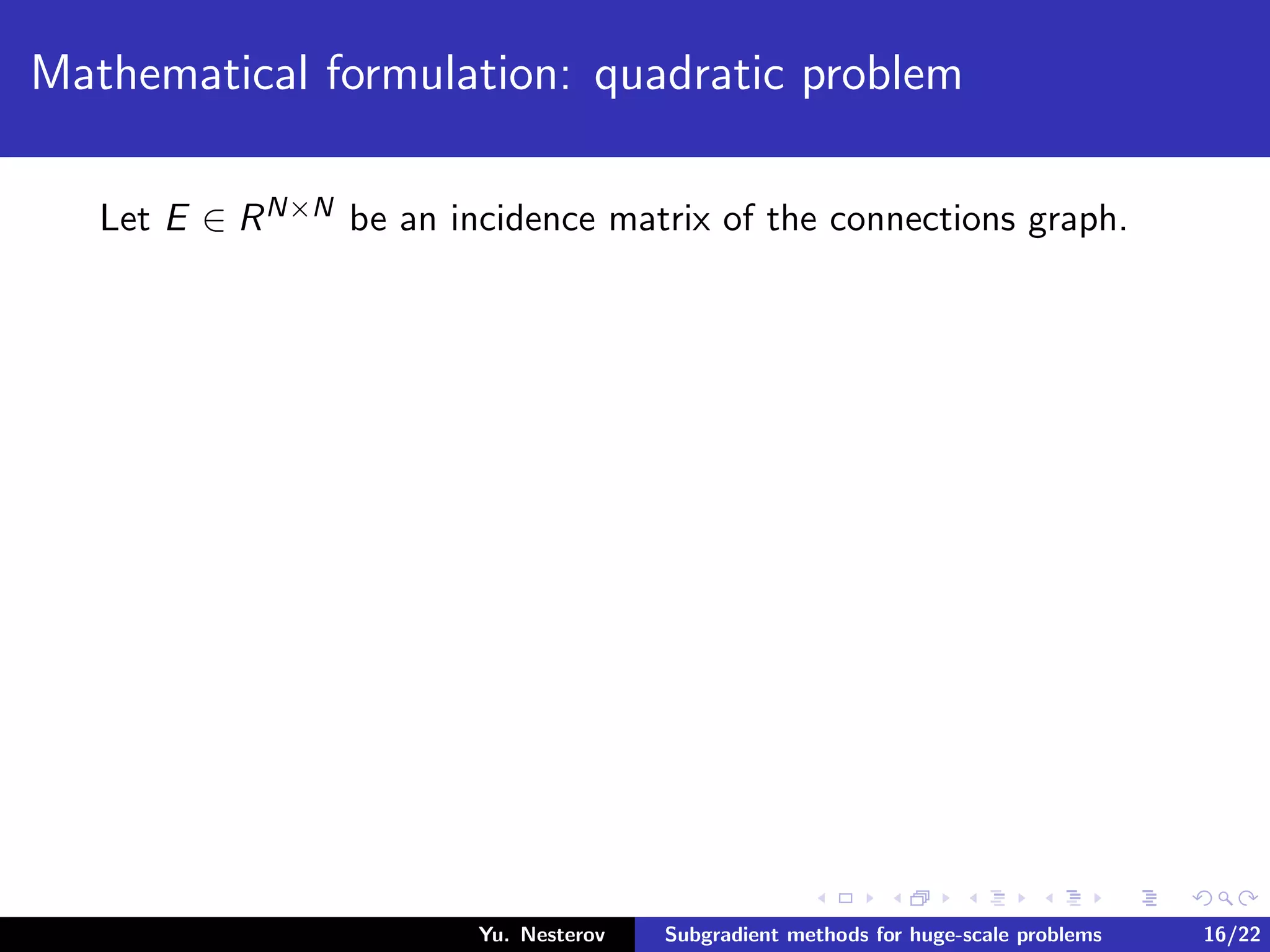
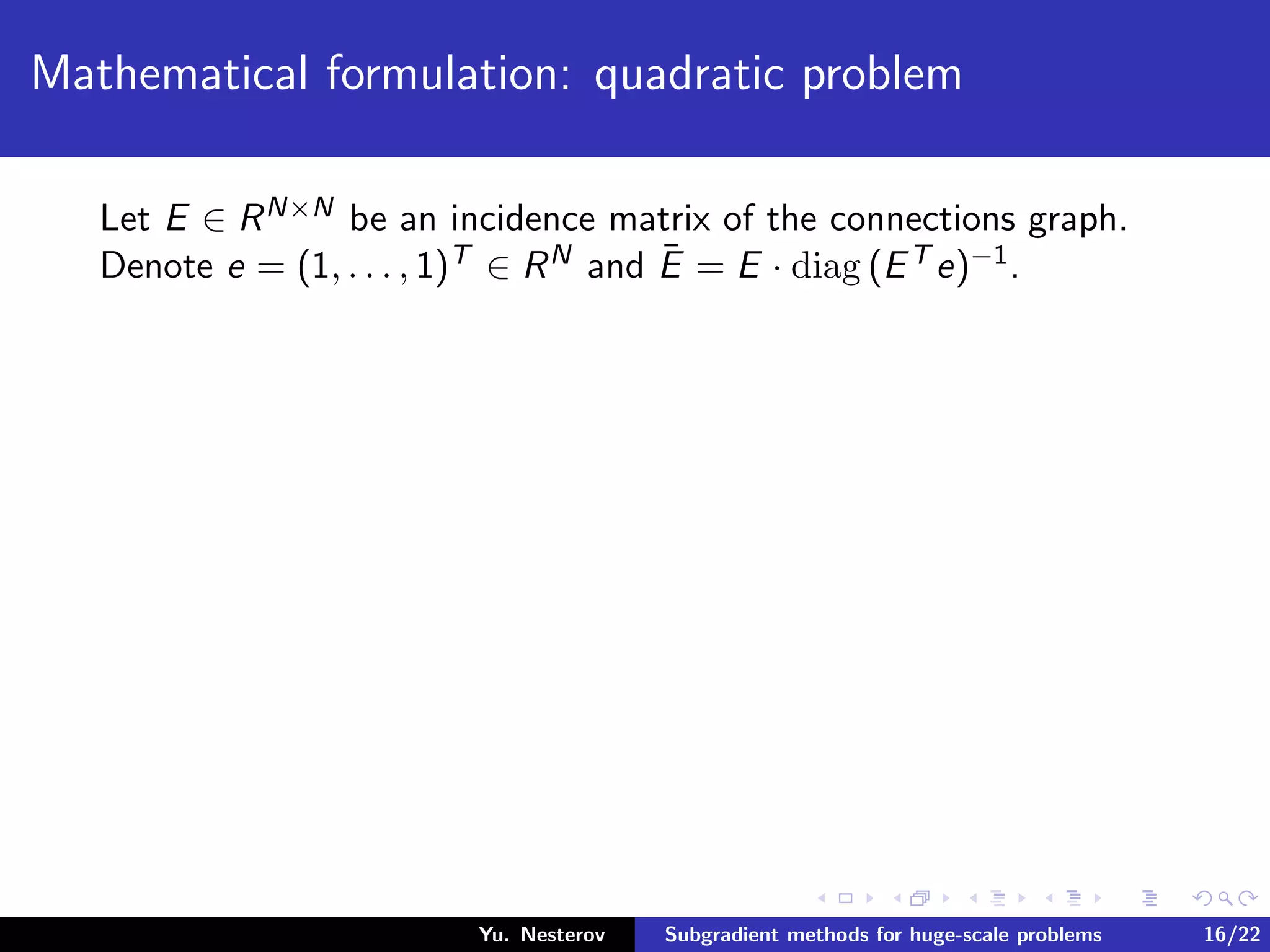
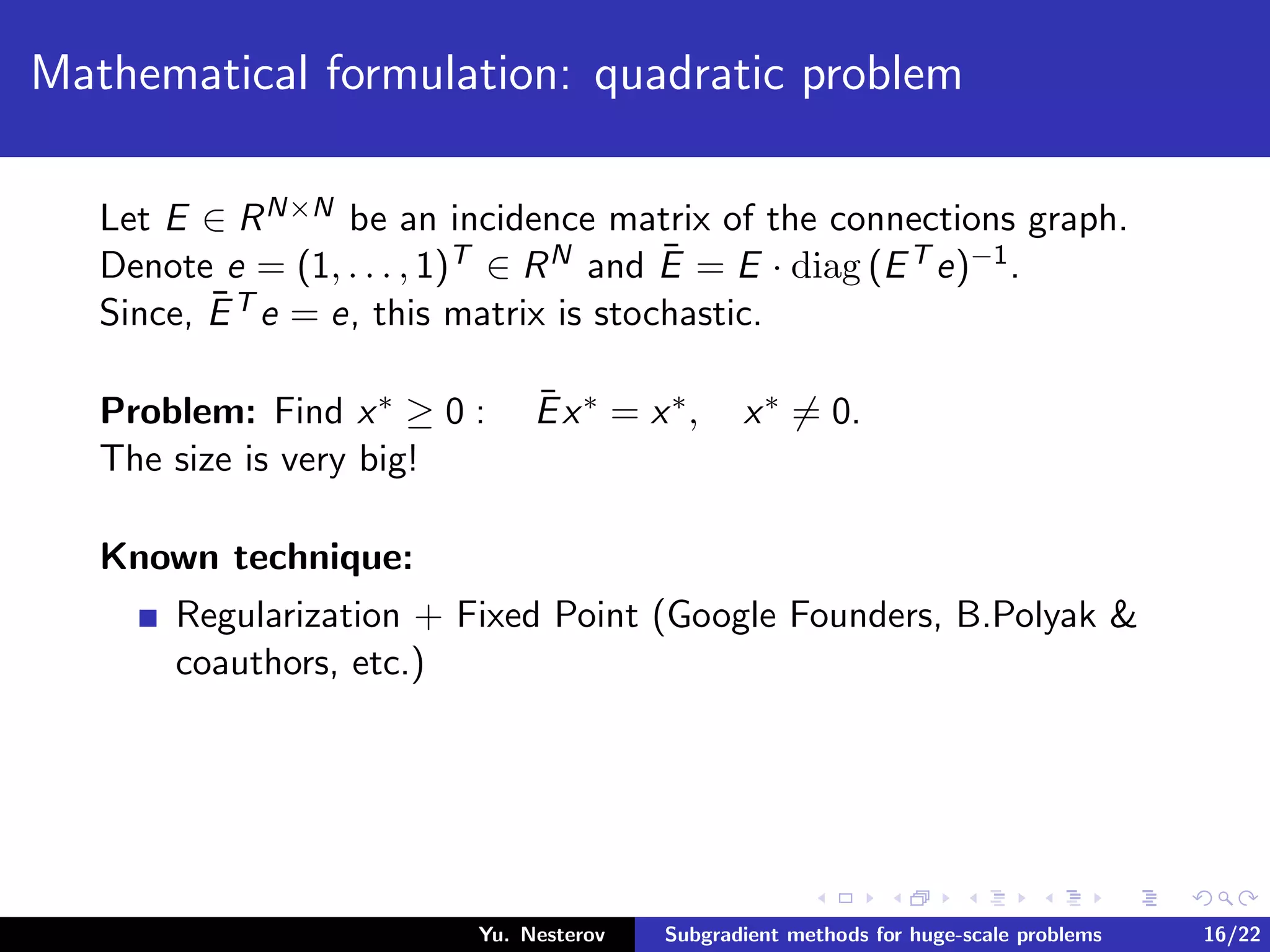
Let E ∈ RN×N be an incidence matrix of the connections graph.
Yu. Nesterov Subgradient methods for huge-scale problems 16/22
Mathematical formulation: quadratic problem
Let E ∈ RN×N be an incidence matrix of the connections graph.
Denote e = (1, . . . , 1)T ∈ RN and ¯E = E · diag (ET e)−1.
Yu. Nesterov Subgradient methods for huge-scale problems 16/22
Mathematical formulation: quadratic problem
Let E ∈ RN×N be an incidence matrix of the connections graph.
Denote e = (1, . . . , 1)T ∈ RN and ¯E = E · diag (ET e)−1.
Since, ¯ET e = e, this matrix is stochastic.
Yu. Nesterov Subgradient methods for huge-scale problems 16/22
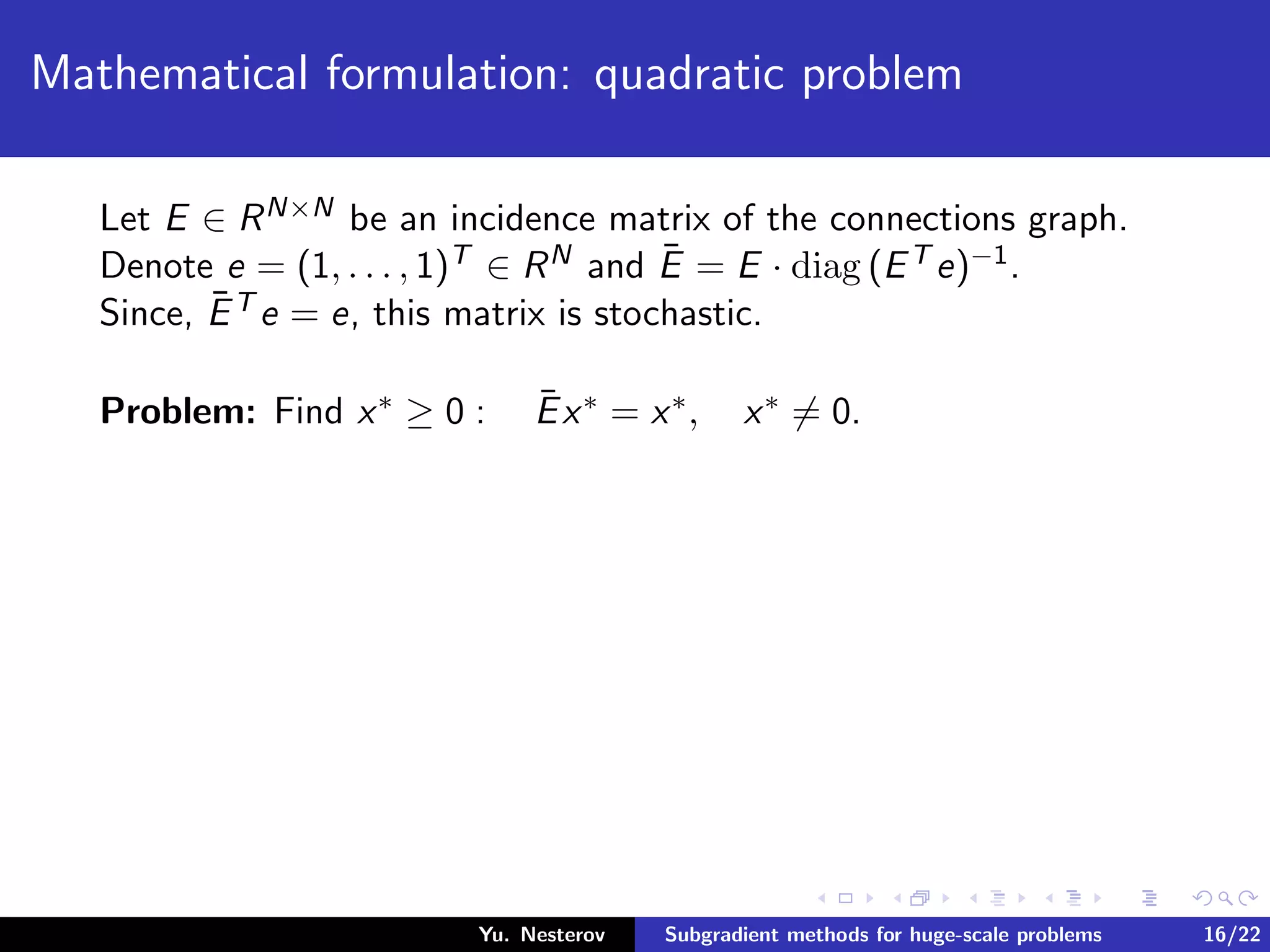
Mathematical formulation: quadratic problem
Let E ∈ RN×N be an incidence matrix of the connections graph.
Denote e = (1, . . . , 1)T ∈ RN and ¯E = E · diag (ET e)−1.
Since, ¯ET e = e, this matrix is stochastic.
Problem: Find x∗ ≥ 0 : ¯Ex∗ = x∗, x∗ = 0.
Yu. Nesterov Subgradient methods for huge-scale problems 16/22
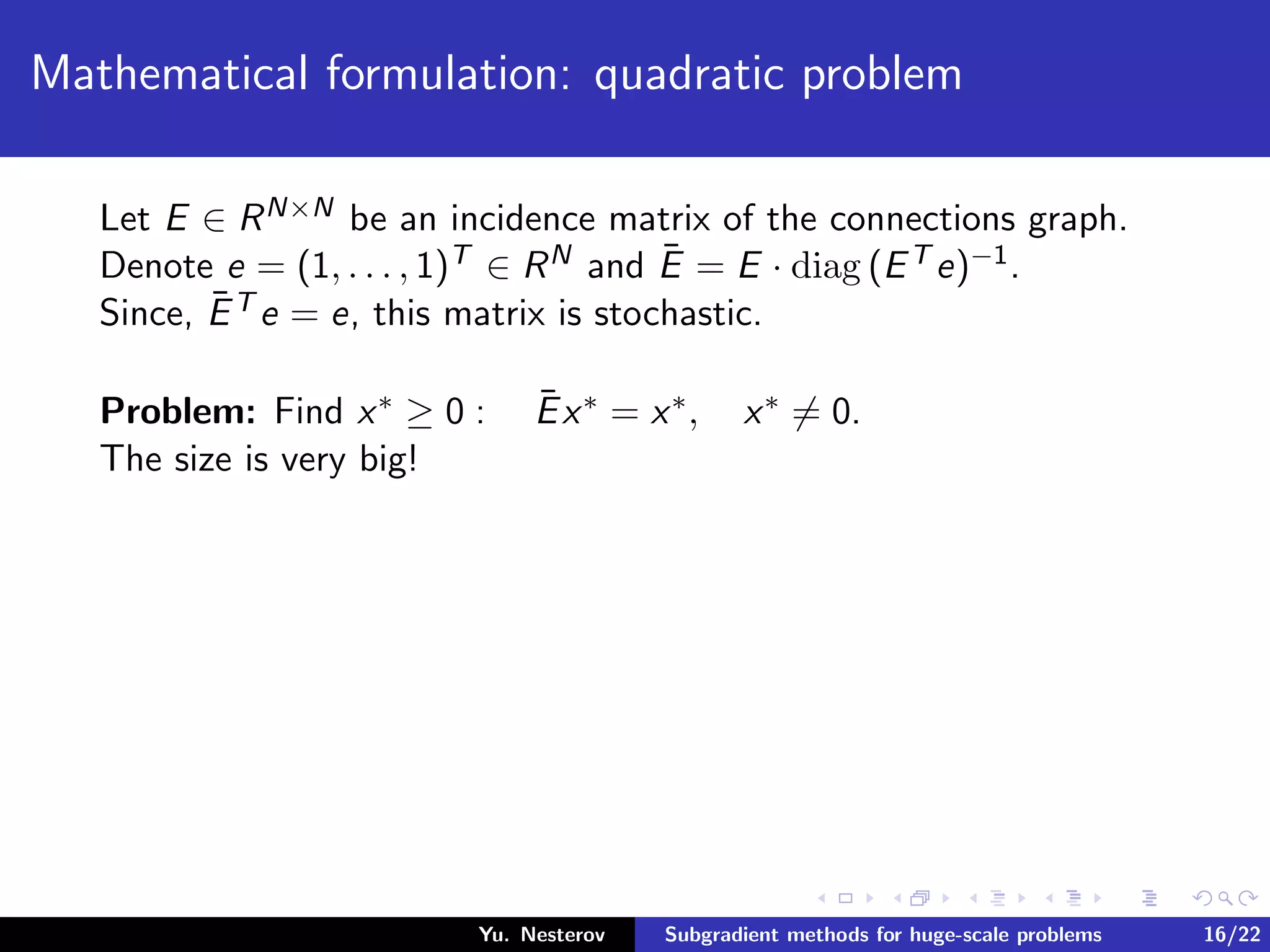
Mathematical formulation: quadratic problem
Let E ∈ RN×N be an incidence matrix of the connections graph.
Denote e = (1, . . . , 1)T ∈ RN and ¯E = E · diag (ET e)−1.
Since, ¯ET e = e, this matrix is stochastic.
Problem: Find x∗ ≥ 0 : ¯Ex∗ = x∗, x∗ = 0.
The size is very big!
Yu. Nesterov Subgradient methods for huge-scale problems 16/22
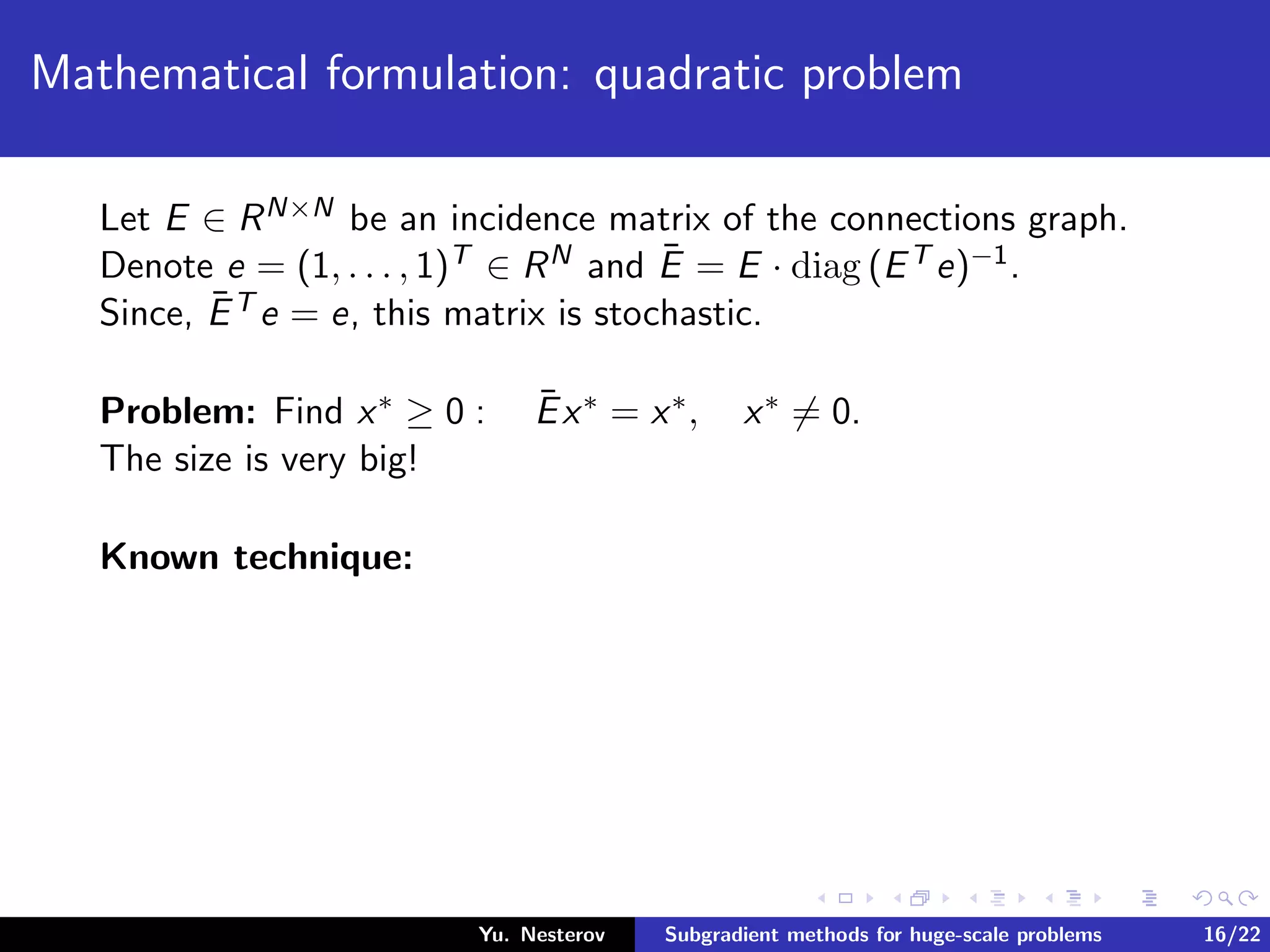
Mathematical formulation: quadratic problem
Let E ∈ RN×N be an incidence matrix of the connections graph.
Denote e = (1, . . . , 1)T ∈ RN and ¯E = E · diag (ET e)−1.
Since, ¯ET e = e, this matrix is stochastic.
Problem: Find x∗ ≥ 0 : ¯Ex∗ = x∗, x∗ = 0.
The size is very big!
Known technique:
Yu. Nesterov Subgradient methods for huge-scale problems 16/22
Mathematical formulation: quadratic problem
Let E ∈ RN×N be an incidence matrix of the connections graph.
Denote e = (1, . . . , 1)T ∈ RN and ¯E = E · diag (ET e)−1.
Since, ¯ET e = e, this matrix is stochastic.
Problem: Find x∗ ≥ 0 : ¯Ex∗ = x∗, x∗ = 0.
The size is very big!
Known technique:
Regularization + Fixed Point (Google Founders, B.Polyak &
coauthors, etc.)
Yu. Nesterov Subgradient methods for huge-scale problems 16/22
Mathematical formulation: quadratic problem
Let E ∈ RN×N be an incidence matrix of the connections graph.
Denote e = (1, . . . , 1)T ∈ RN and ¯E = E · diag (ET e)−1.
Since, ¯ET e = e, this matrix is stochastic.
Problem: Find x∗ ≥ 0 : ¯Ex∗ = x∗, x∗ = 0.
The size is very big!
Known technique:
Regularization + Fixed Point (Google Founders, B.Polyak &
coauthors, etc.)
N09: Solve it by random CD-method as applied to
1
2
¯Ex − x 2 + γ
2 [ e, x − 1]2, γ > 0.
Yu. Nesterov Subgradient methods for huge-scale problems 16/22
Mathematical formulation: quadratic problem
Let E ∈ RN×N be an incidence matrix of the connections graph.
Denote e = (1, . . . , 1)T ∈ RN and ¯E = E · diag (ET e)−1.
Since, ¯ET e = e, this matrix is stochastic.
Problem: Find x∗ ≥ 0 : ¯Ex∗ = x∗, x∗ = 0.
The size is very big!
Known technique:
Regularization + Fixed Point (Google Founders, B.Polyak &
coauthors, etc.)
N09: Solve it by random CD-method as applied to
1
2
¯Ex − x 2 + γ
2 [ e, x − 1]2, γ > 0.
Main drawback: No interpretation for the objective function!
Yu. Nesterov Subgradient methods for huge-scale problems 16/22
Nonsmooth formulation of Google Problem
Yu. Nesterov Subgradient methods for huge-scale problems 17/22
Nonsmooth formulation of Google Problem
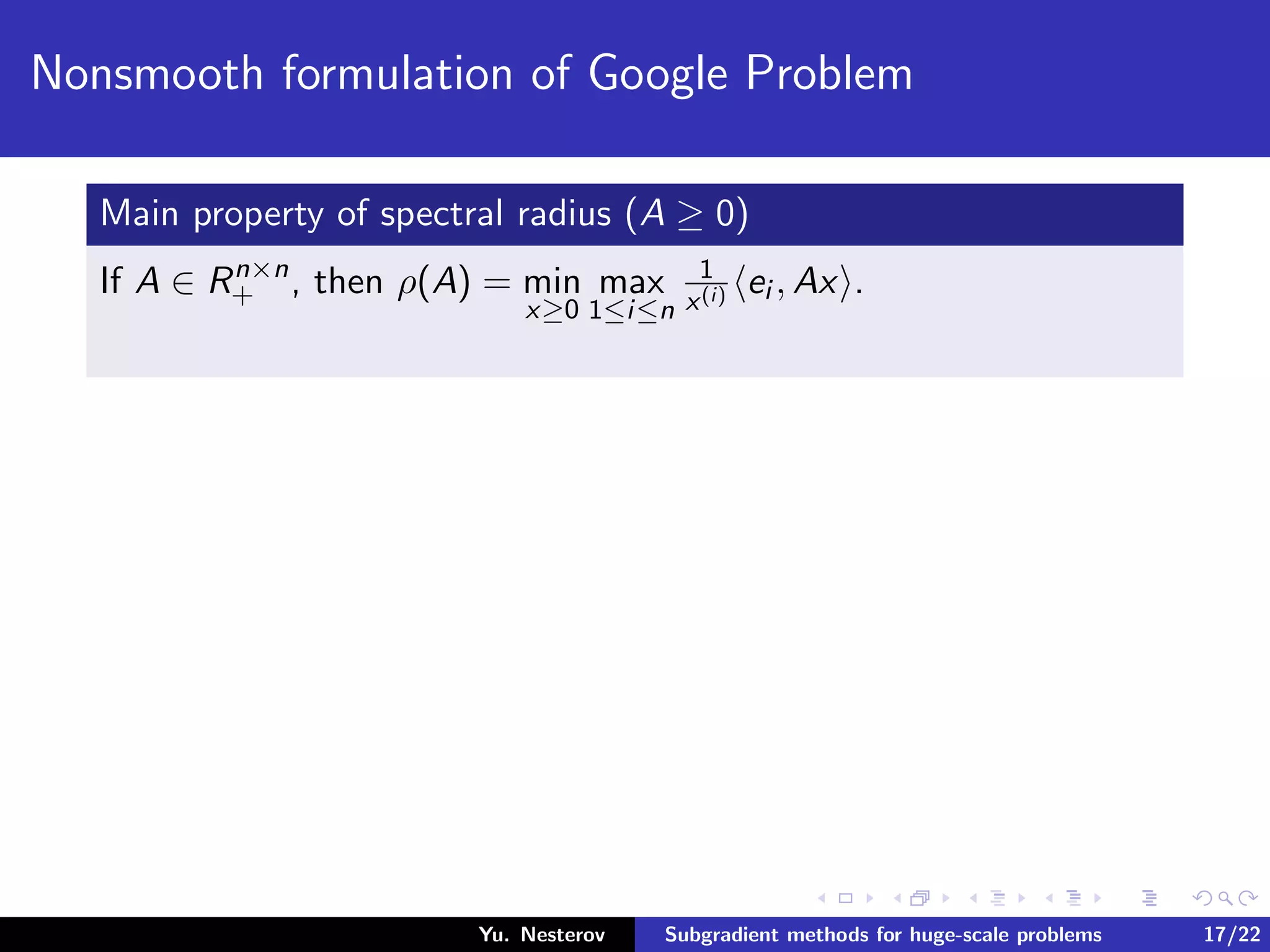
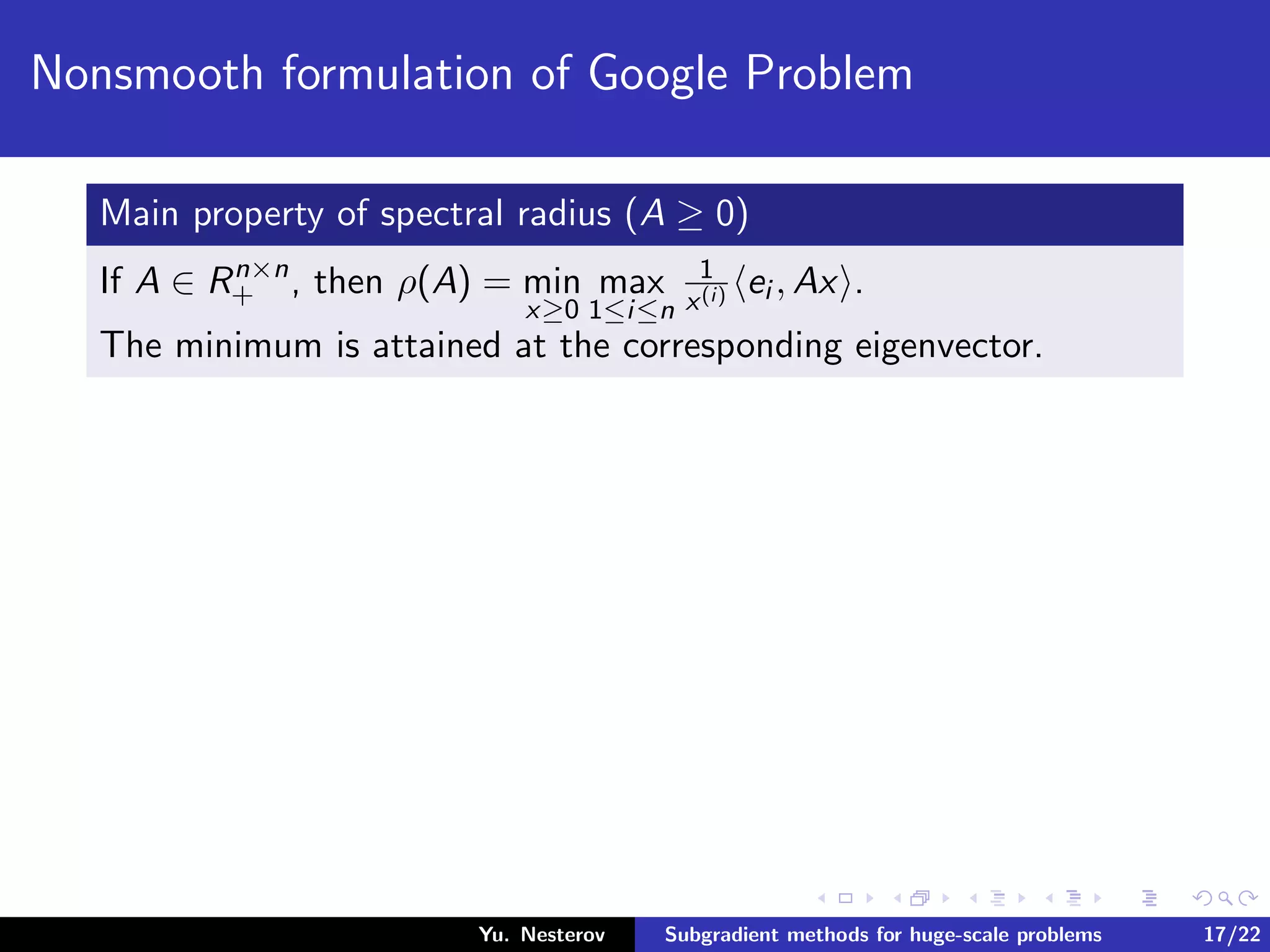
Main property of spectral radius (A ≥ 0)
If A ∈ Rn×n
+ , then ρ(A) = min
x≥0
max
1≤i≤n
1
x(i) ei , Ax .
Yu. Nesterov Subgradient methods for huge-scale problems 17/22
Nonsmooth formulation of Google Problem
Main property of spectral radius (A ≥ 0)
If A ∈ Rn×n
+ , then ρ(A) = min
x≥0
max
1≤i≤n
1
x(i) ei , Ax .
The minimum is attained at the corresponding eigenvector.
Yu. Nesterov Subgradient methods for huge-scale problems 17/22
Nonsmooth formulation of Google Problem
Main property of spectral radius (A ≥ 0)
If A ∈ Rn×n
+ , then ρ(A) = min
x≥0
max
1≤i≤n
1
x(i) ei , Ax .
The minimum is attained at the corresponding eigenvector.
Since ρ(¯E) = 1, our problem is as follows:
f (x)
def
= max
1≤i≤N
[ ei , ¯Ex − x(i)] → min
x≥0
.
Yu. Nesterov Subgradient methods for huge-scale problems 17/22
Nonsmooth formulation of Google Problem
Main property of spectral radius (A ≥ 0)
If A ∈ Rn×n
+ , then ρ(A) = min
x≥0
max
1≤i≤n
1
x(i) ei , Ax .
The minimum is attained at the corresponding eigenvector.
Since ρ(¯E) = 1, our problem is as follows:
f (x)
def
= max
1≤i≤N
[ ei , ¯Ex − x(i)] → min
x≥0
.
Interpretation: Increase self-confidence!
Yu. Nesterov Subgradient methods for huge-scale problems 17/22
Nonsmooth formulation of Google Problem
Main property of spectral radius (A ≥ 0)
If A ∈ Rn×n
+ , then ρ(A) = min
x≥0
max
1≤i≤n
1
x(i) ei , Ax .
The minimum is attained at the corresponding eigenvector.
Since ρ(¯E) = 1, our problem is as follows:
f (x)
def
= max
1≤i≤N
[ ei , ¯Ex − x(i)] → min
x≥0
.
Interpretation: Increase self-confidence!
Since f ∗ = 0, we can apply Polyak’s method with sparse updates.
Yu. Nesterov Subgradient methods for huge-scale problems 17/22
Nonsmooth formulation of Google Problem
Main property of spectral radius (A ≥ 0)
If A ∈ Rn×n
+ , then ρ(A) = min
x≥0
max
1≤i≤n
1
x(i) ei , Ax .
The minimum is attained at the corresponding eigenvector.
Since ρ(¯E) = 1, our problem is as follows:
f (x)
def
= max
1≤i≤N
[ ei , ¯Ex − x(i)] → min
x≥0
.
Interpretation: Increase self-confidence!
Since f ∗ = 0, we can apply Polyak’s method with sparse updates.
Additional features; the optimal set X∗ is a convex cone.
Yu. Nesterov Subgradient methods for huge-scale problems 17/22
Nonsmooth formulation of Google Problem
Main property of spectral radius (A ≥ 0)
If A ∈ Rn×n
+ , then ρ(A) = min
x≥0
max
1≤i≤n
1
x(i) ei , Ax .
The minimum is attained at the corresponding eigenvector.
Since ρ(¯E) = 1, our problem is as follows:
f (x)
def
= max
1≤i≤N
[ ei , ¯Ex − x(i)] → min
x≥0
.
Interpretation: Increase self-confidence!
Since f ∗ = 0, we can apply Polyak’s method with sparse updates.
Additional features; the optimal set X∗ is a convex cone.
If x0 = e, then the whole sequence is separated from zero:
Yu. Nesterov Subgradient methods for huge-scale problems 17/22
Nonsmooth formulation of Google Problem
Main property of spectral radius (A ≥ 0)
If A ∈ Rn×n
+ , then ρ(A) = min
x≥0
max
1≤i≤n
1
x(i) ei , Ax .
The minimum is attained at the corresponding eigenvector.
Since ρ(¯E) = 1, our problem is as follows:
f (x)
def
= max
1≤i≤N
[ ei , ¯Ex − x(i)] → min
x≥0
.
Interpretation: Increase self-confidence!
Since f ∗ = 0, we can apply Polyak’s method with sparse updates.
Additional features; the optimal set X∗ is a convex cone.
If x0 = e, then the whole sequence is separated from zero:
x∗, e
Yu. Nesterov Subgradient methods for huge-scale problems 17/22
Nonsmooth formulation of Google Problem
Main property of spectral radius (A ≥ 0)
If A ∈ Rn×n
+ , then ρ(A) = min
x≥0
max
1≤i≤n
1
x(i) ei , Ax .
The minimum is attained at the corresponding eigenvector.
Since ρ(¯E) = 1, our problem is as follows:
f (x)
def
= max
1≤i≤N
[ ei , ¯Ex − x(i)] → min
x≥0
.
Interpretation: Increase self-confidence!
Since f ∗ = 0, we can apply Polyak’s method with sparse updates.
Additional features; the optimal set X∗ is a convex cone.
If x0 = e, then the whole sequence is separated from zero:
x∗, e ≤ x∗, xk
Yu. Nesterov Subgradient methods for huge-scale problems 17/22
Nonsmooth formulation of Google Problem
Main property of spectral radius (A ≥ 0)
If A ∈ Rn×n
+ , then ρ(A) = min
x≥0
max
1≤i≤n
1
x(i) ei , Ax .
The minimum is attained at the corresponding eigenvector.
Since ρ(¯E) = 1, our problem is as follows:
f (x)
def
= max
1≤i≤N
[ ei , ¯Ex − x(i)] → min
x≥0
.
Interpretation: Increase self-confidence!
Since f ∗ = 0, we can apply Polyak’s method with sparse updates.
Additional features; the optimal set X∗ is a convex cone.
If x0 = e, then the whole sequence is separated from zero:
x∗, e ≤ x∗, xk ≤ x∗
1 · xk ∞
Yu. Nesterov Subgradient methods for huge-scale problems 17/22
Nonsmooth formulation of Google Problem
Main property of spectral radius (A ≥ 0)
If A ∈ Rn×n
+ , then ρ(A) = min
x≥0
max
1≤i≤n
1
x(i) ei , Ax .
The minimum is attained at the corresponding eigenvector.
Since ρ(¯E) = 1, our problem is as follows:
f (x)
def
= max
1≤i≤N
[ ei , ¯Ex − x(i)] → min
x≥0
.
Interpretation: Increase self-confidence!
Since f ∗ = 0, we can apply Polyak’s method with sparse updates.
Additional features; the optimal set X∗ is a convex cone.
If x0 = e, then the whole sequence is separated from zero:
x∗, e ≤ x∗, xk ≤ x∗
1 · xk ∞ = x∗, e · xk ∞.
Yu. Nesterov Subgradient methods for huge-scale problems 17/22
Nonsmooth formulation of Google Problem
Main property of spectral radius (A ≥ 0)
If A ∈ Rn×n
+ , then ρ(A) = min
x≥0
max
1≤i≤n
1
x(i) ei , Ax .
The minimum is attained at the corresponding eigenvector.
Since ρ(¯E) = 1, our problem is as follows:
f (x)
def
= max
1≤i≤N
[ ei , ¯Ex − x(i)] → min
x≥0
.
Interpretation: Increase self-confidence!
Since f ∗ = 0, we can apply Polyak’s method with sparse updates.
Additional features; the optimal set X∗ is a convex cone.
If x0 = e, then the whole sequence is separated from zero:
x∗, e ≤ x∗, xk ≤ x∗
1 · xk ∞ = x∗, e · xk ∞.
Goal: Find ¯x ≥ 0 such that ¯x ∞ ≥ 1 and f (¯x) ≤ .
Yu. Nesterov Subgradient methods for huge-scale problems 17/22
Nonsmooth formulation of Google Problem
Main property of spectral radius (A ≥ 0)
If A ∈ Rn×n
+ , then ρ(A) = min
x≥0
max
1≤i≤n
1
x(i) ei , Ax .
The minimum is attained at the corresponding eigenvector.
Since ρ(¯E) = 1, our problem is as follows:
f (x)
def
= max
1≤i≤N
[ ei , ¯Ex − x(i)] → min
x≥0
.
Interpretation: Increase self-confidence!
Since f ∗ = 0, we can apply Polyak’s method with sparse updates.
Additional features; the optimal set X∗ is a convex cone.
If x0 = e, then the whole sequence is separated from zero:
x∗, e ≤ x∗, xk ≤ x∗
1 · xk ∞ = x∗, e · xk ∞.
Goal: Find ¯x ≥ 0 such that ¯x ∞ ≥ 1 and f (¯x) ≤ .
(First condition is satisfied automatically.)
Yu. Nesterov Subgradient methods for huge-scale problems 17/22
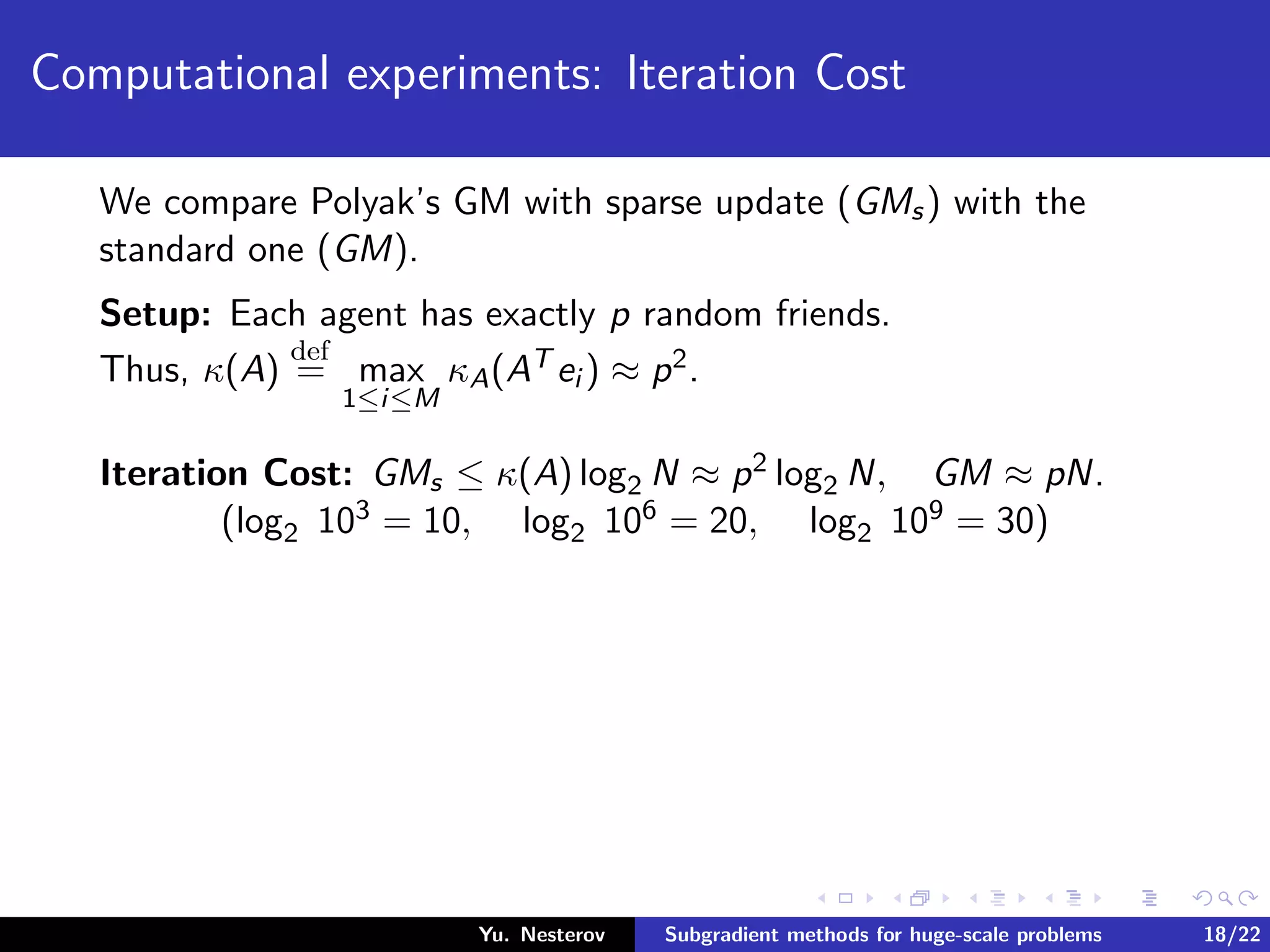
Computational experiments: Iteration Cost
Yu. Nesterov Subgradient methods for huge-scale problems 18/22
Computational experiments: Iteration Cost
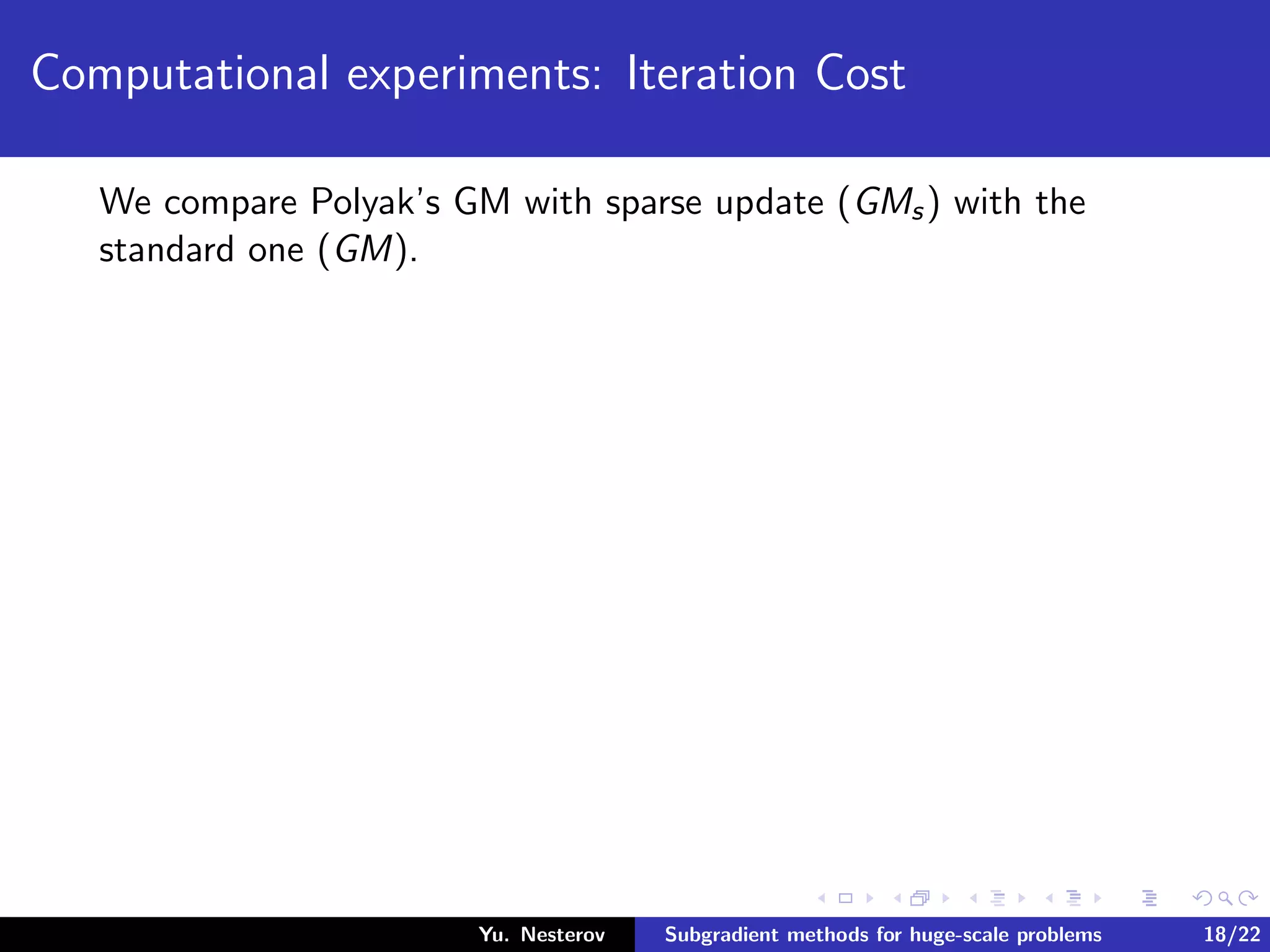
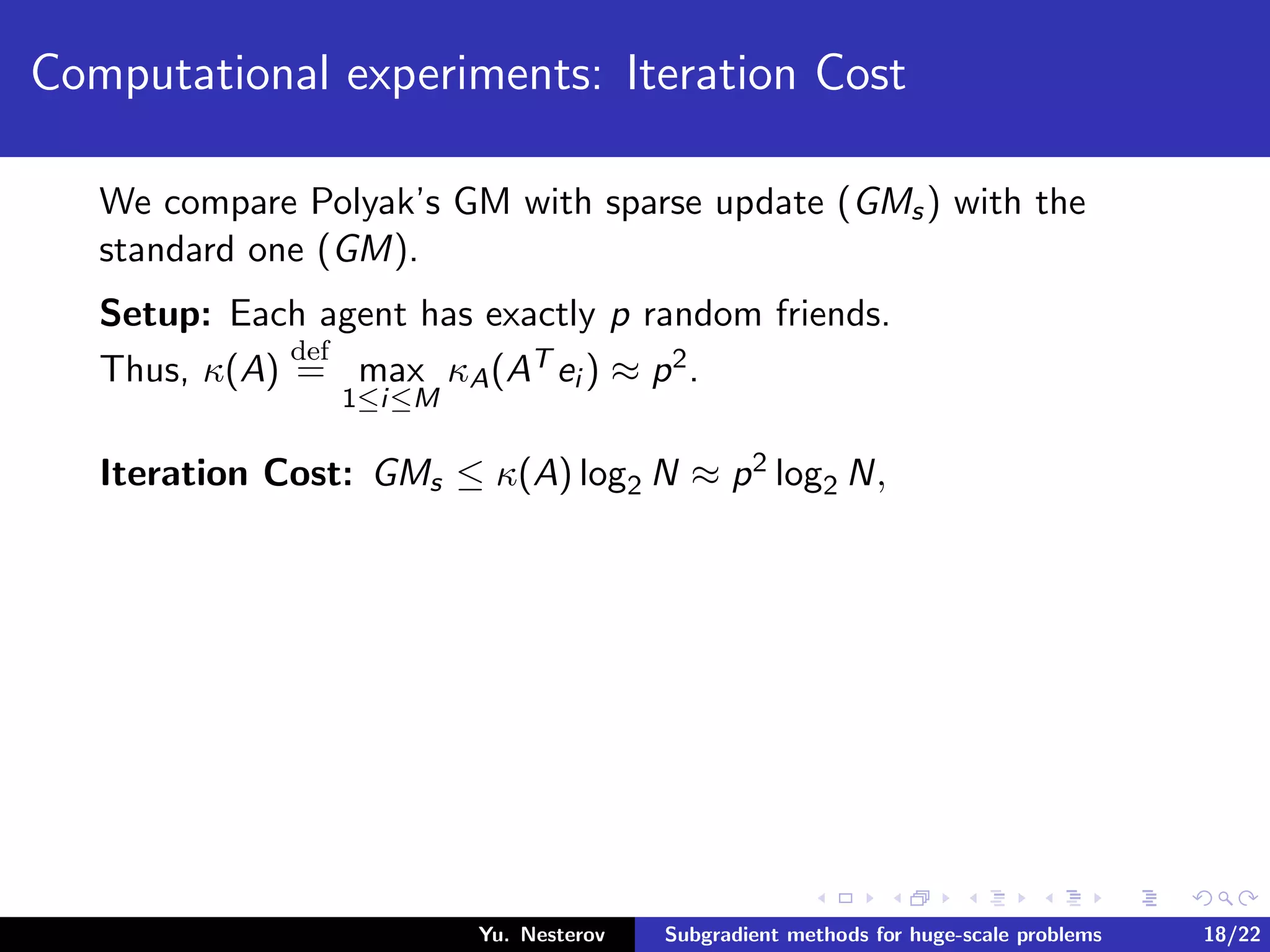
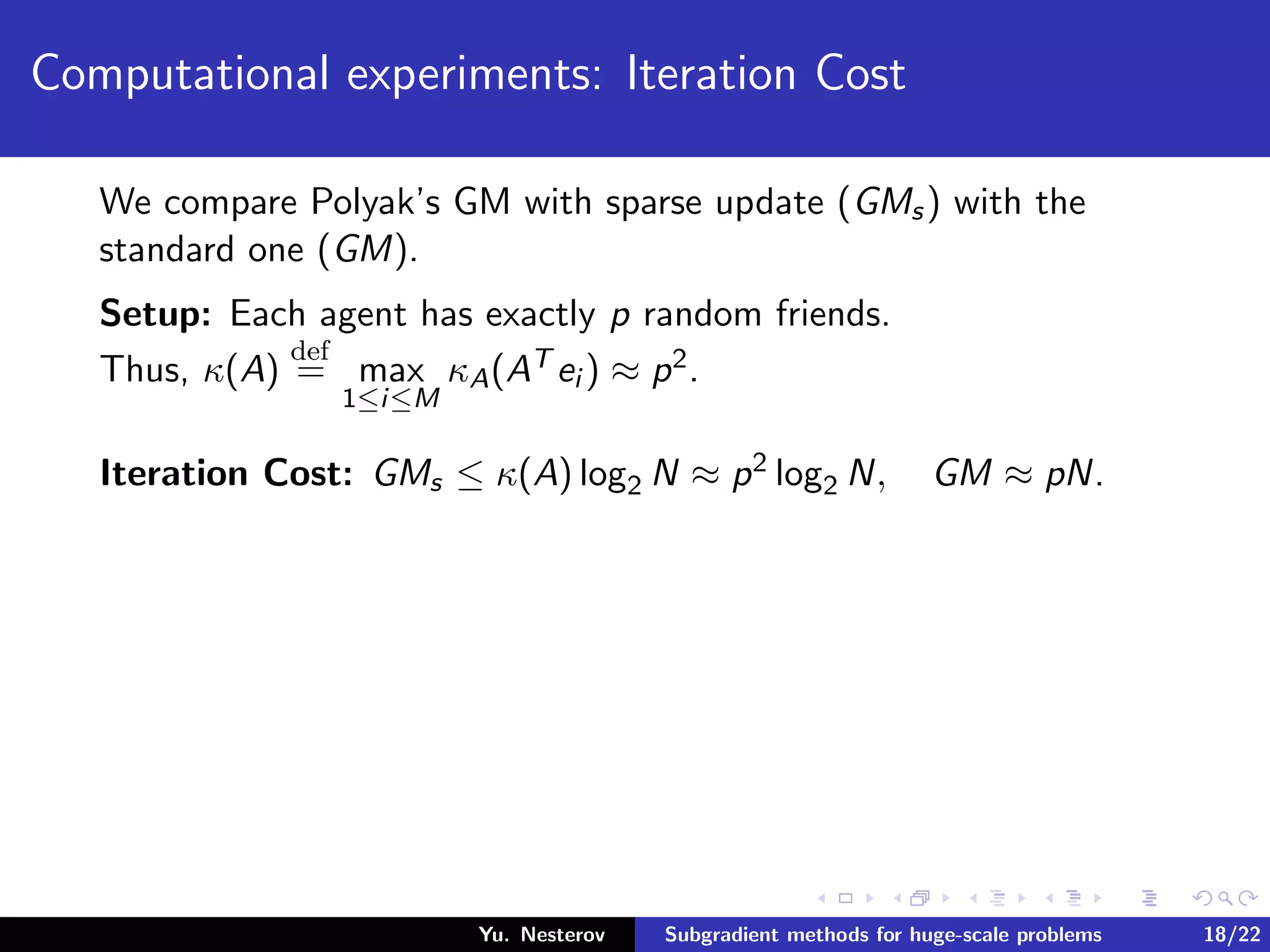
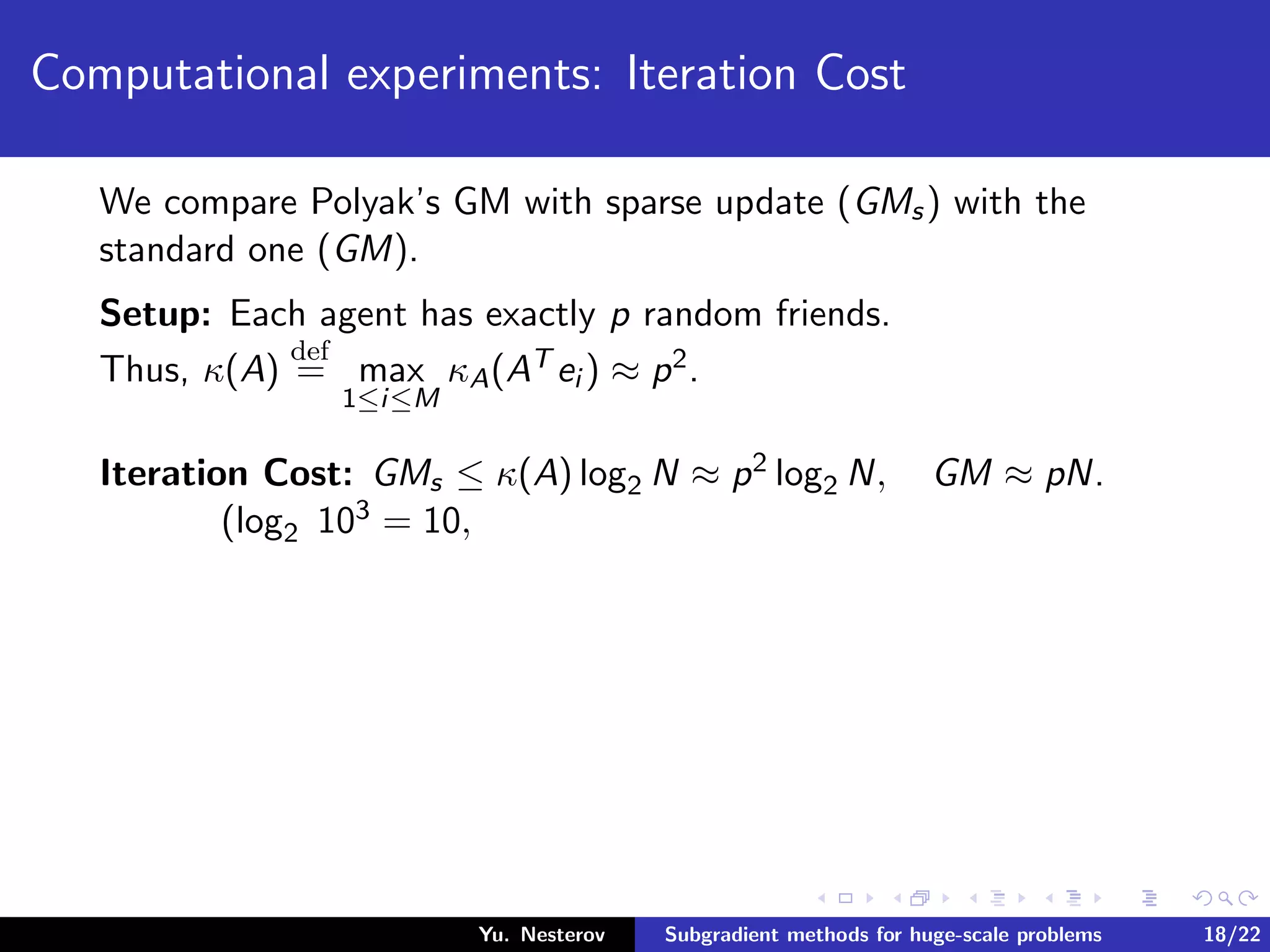
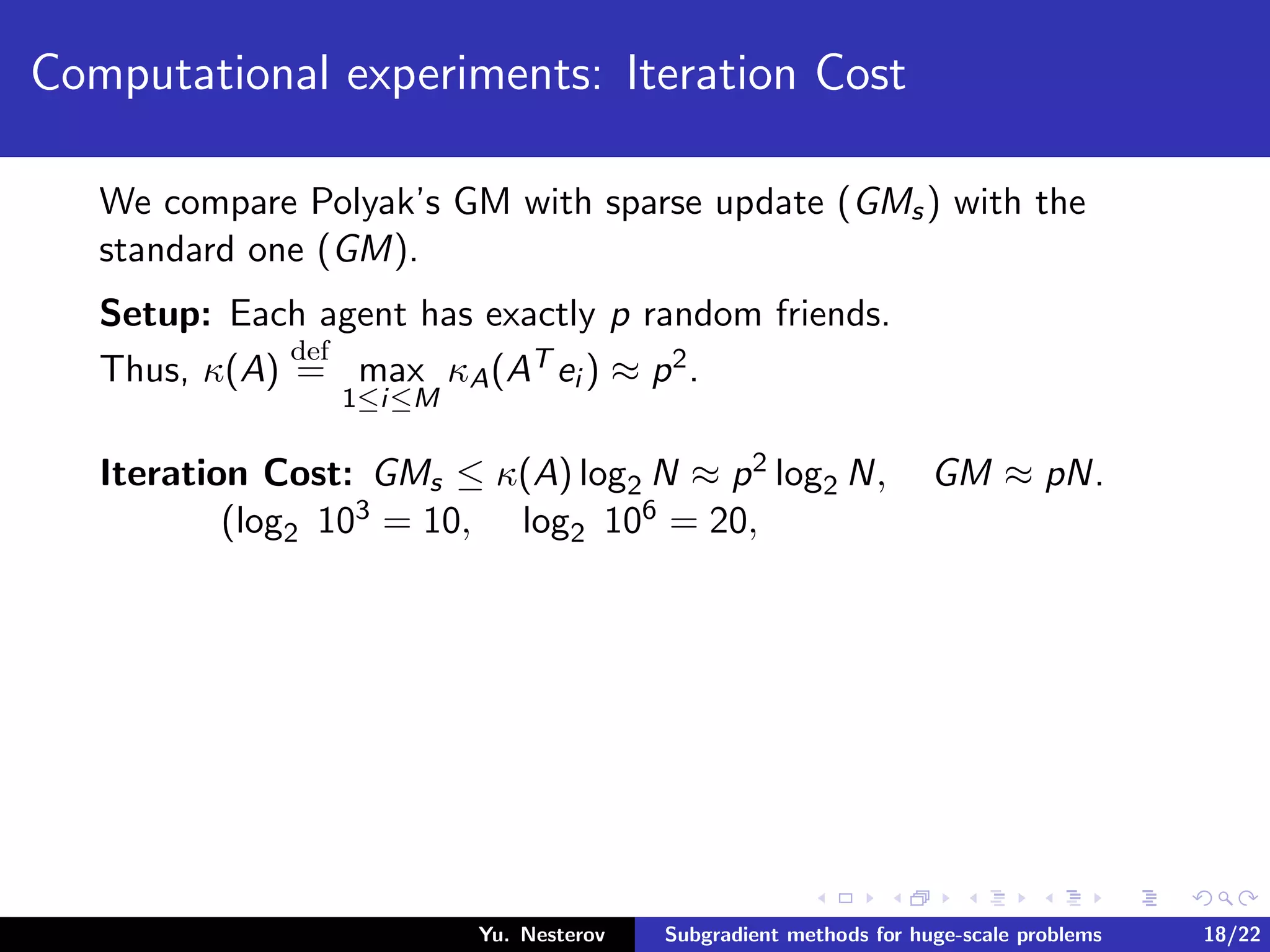
We compare Polyak’s GM with sparse update (GMs) with the
standard one (GM).
Yu. Nesterov Subgradient methods for huge-scale problems 18/22
Computational experiments: Iteration Cost
We compare Polyak’s GM with sparse update (GMs) with the
standard one (GM).
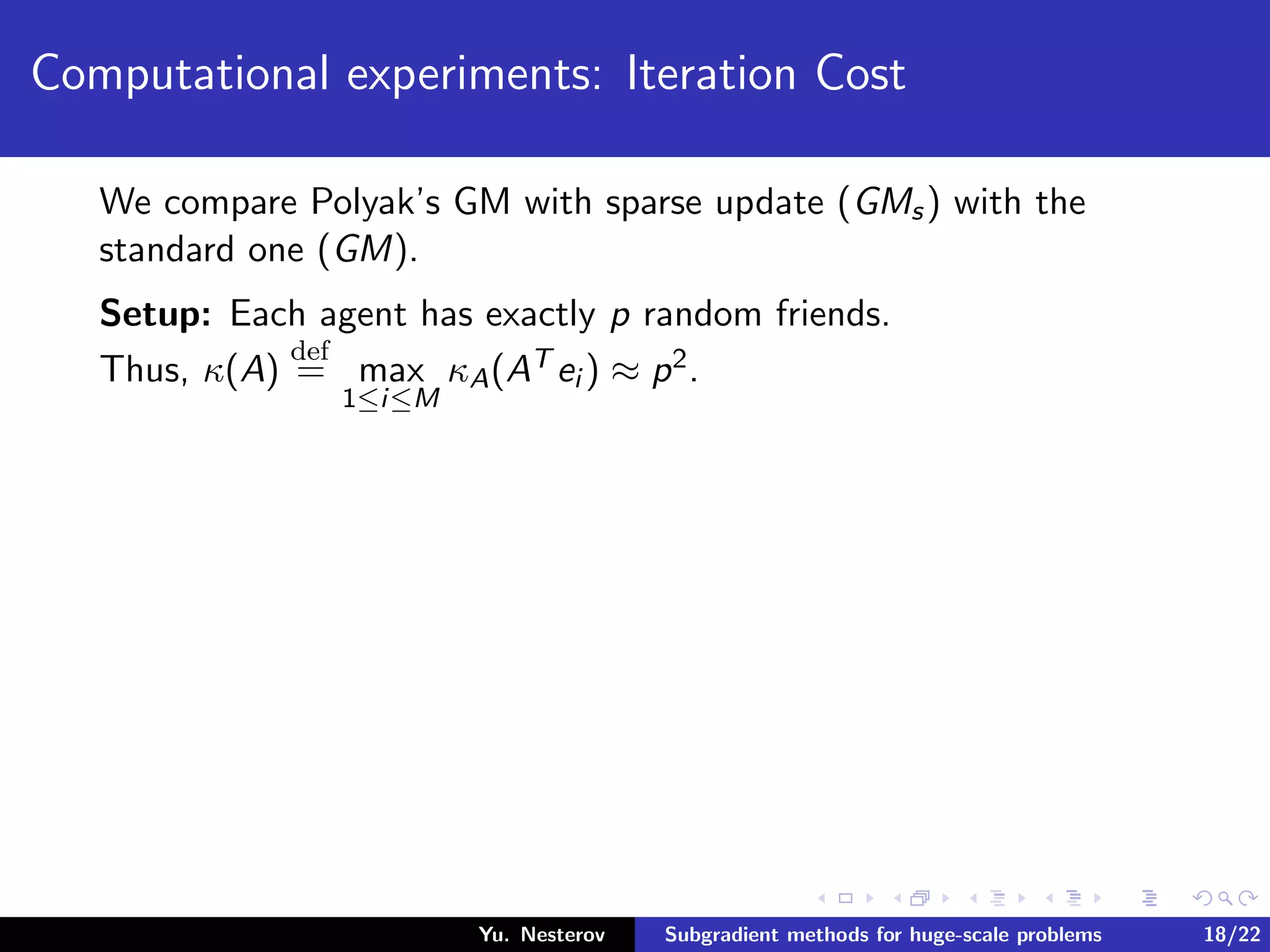
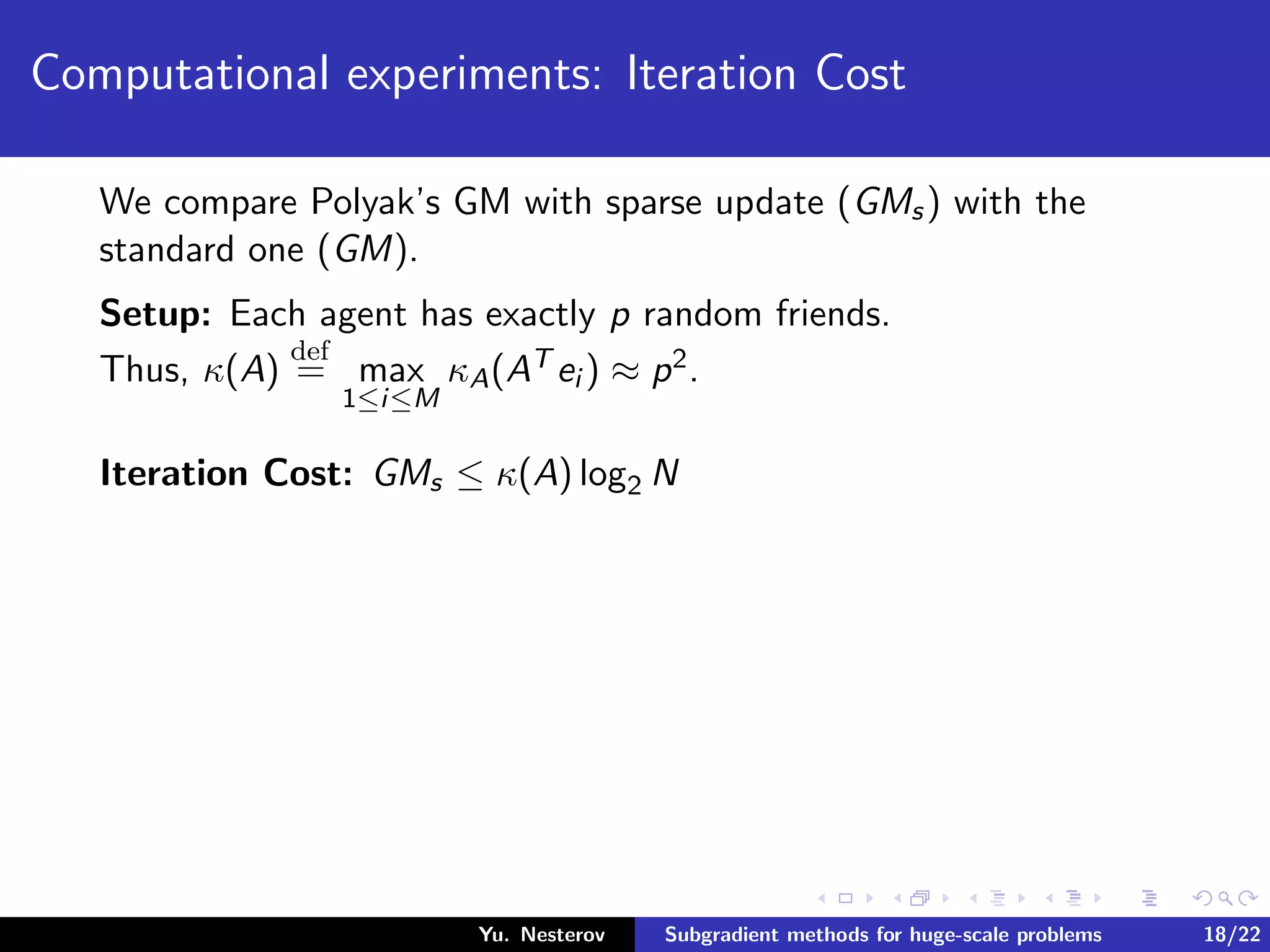
Setup: Each agent has exactly p random friends.
Thus, κ(A)
def
= max
1≤i≤M
κA(AT ei ) ≈ p2.
Yu. Nesterov Subgradient methods for huge-scale problems 18/22
Computational experiments: Iteration Cost
We compare Polyak’s GM with sparse update (GMs) with the
standard one (GM).
Setup: Each agent has exactly p random friends.
Thus, κ(A)
def
= max
1≤i≤M
κA(AT ei ) ≈ p2.
Iteration Cost: GMs ≤ κ(A) log2 N
Yu. Nesterov Subgradient methods for huge-scale problems 18/22
Computational experiments: Iteration Cost
We compare Polyak’s GM with sparse update (GMs) with the
standard one (GM).
Setup: Each agent has exactly p random friends.
Thus, κ(A)
def
= max
1≤i≤M
κA(AT ei ) ≈ p2.
Iteration Cost: GMs ≤ κ(A) log2 N ≈ p2 log2 N,
Yu. Nesterov Subgradient methods for huge-scale problems 18/22
Computational experiments: Iteration Cost
We compare Polyak’s GM with sparse update (GMs) with the
standard one (GM).
Setup: Each agent has exactly p random friends.
Thus, κ(A)
def
= max
1≤i≤M
κA(AT ei ) ≈ p2.
Iteration Cost: GMs ≤ κ(A) log2 N ≈ p2 log2 N, GM ≈ pN.
Yu. Nesterov Subgradient methods for huge-scale problems 18/22
Computational experiments: Iteration Cost
We compare Polyak’s GM with sparse update (GMs) with the
standard one (GM).
Setup: Each agent has exactly p random friends.
Thus, κ(A)
def
= max
1≤i≤M
κA(AT ei ) ≈ p2.
Iteration Cost: GMs ≤ κ(A) log2 N ≈ p2 log2 N, GM ≈ pN.
(log2 103 = 10,
Yu. Nesterov Subgradient methods for huge-scale problems 18/22
Computational experiments: Iteration Cost
We compare Polyak’s GM with sparse update (GMs) with the
standard one (GM).
Setup: Each agent has exactly p random friends.
Thus, κ(A)
def
= max
1≤i≤M
κA(AT ei ) ≈ p2.
Iteration Cost: GMs ≤ κ(A) log2 N ≈ p2 log2 N, GM ≈ pN.
(log2 103 = 10, log2 106 = 20,
Yu. Nesterov Subgradient methods for huge-scale problems 18/22
Computational experiments: Iteration Cost
We compare Polyak’s GM with sparse update (GMs) with the
standard one (GM).
Setup: Each agent has exactly p random friends.
Thus, κ(A)
def
= max
1≤i≤M
κA(AT ei ) ≈ p2.
Iteration Cost: GMs ≤ κ(A) log2 N ≈ p2 log2 N, GM ≈ pN.
(log2 103 = 10, log2 106 = 20, log2 109 = 30)
Yu. Nesterov Subgradient methods for huge-scale problems 18/22
Computational experiments: Iteration Cost
We compare Polyak’s GM with sparse update (GMs) with the
standard one (GM).
Setup: Each agent has exactly p random friends.
Thus, κ(A)
def
= max
1≤i≤M
κA(AT ei ) ≈ p2.
Iteration Cost: GMs ≤ κ(A) log2 N ≈ p2 log2 N, GM ≈ pN.
(log2 103 = 10, log2 106 = 20, log2 109 = 30)
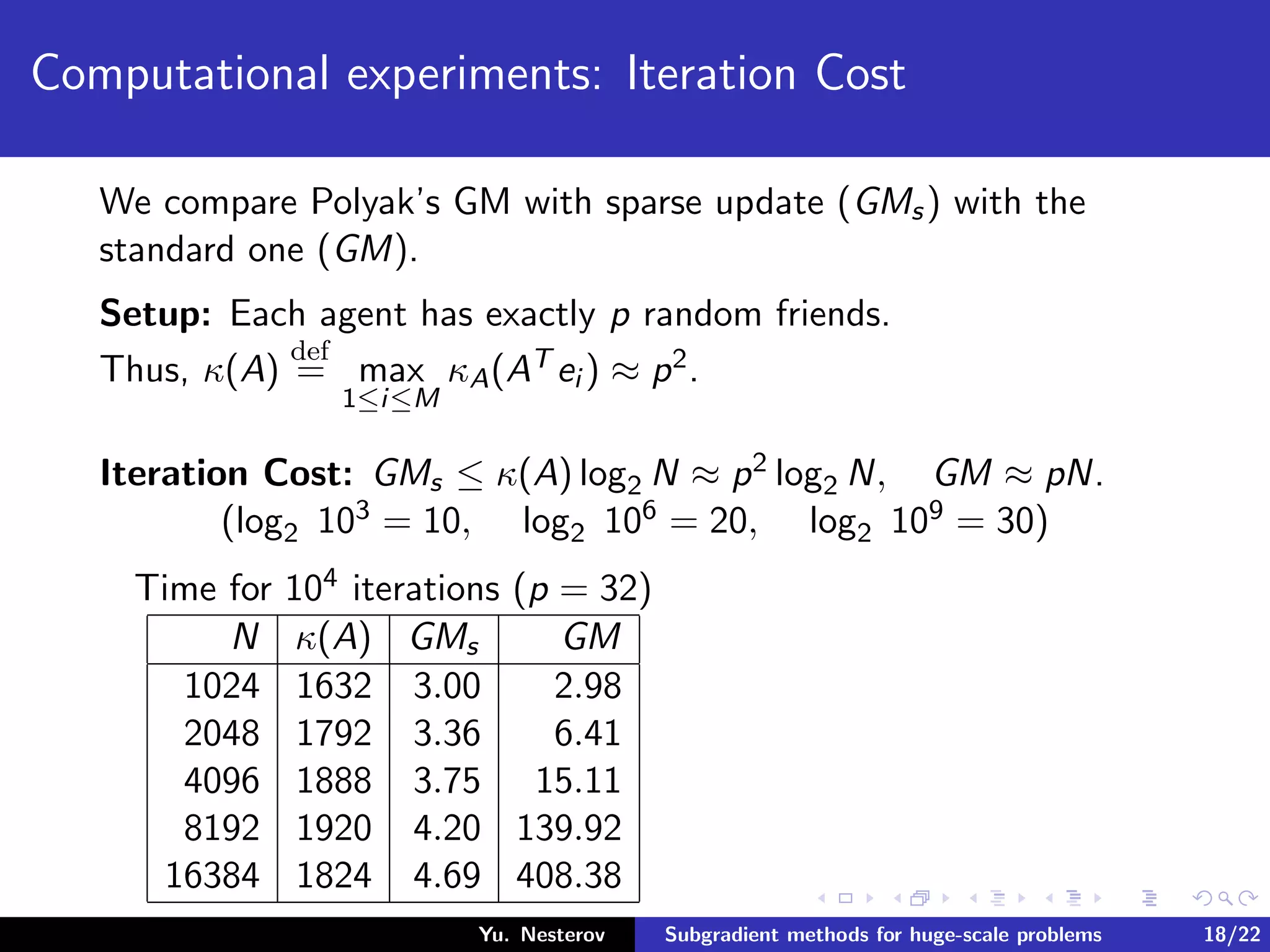
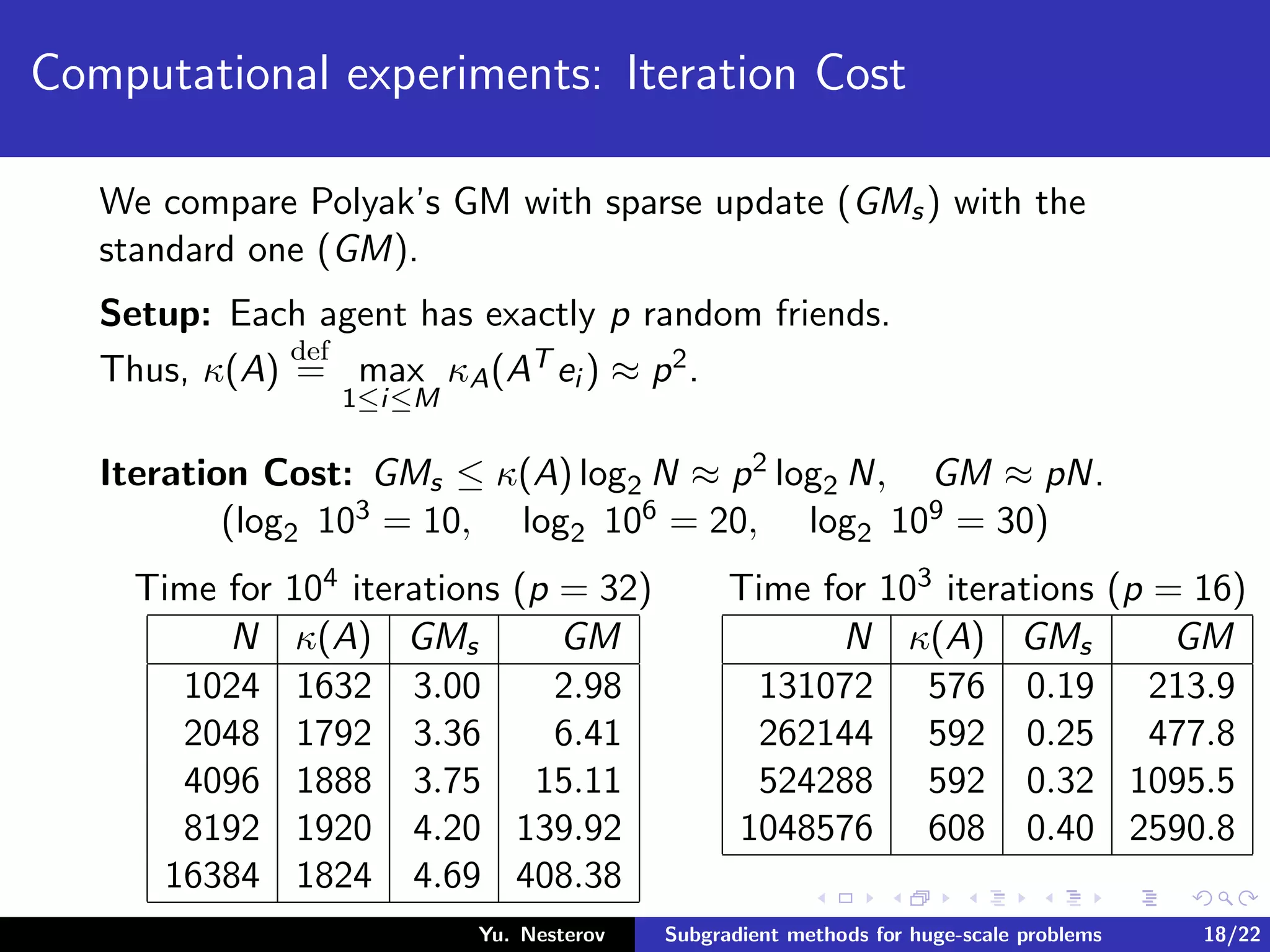
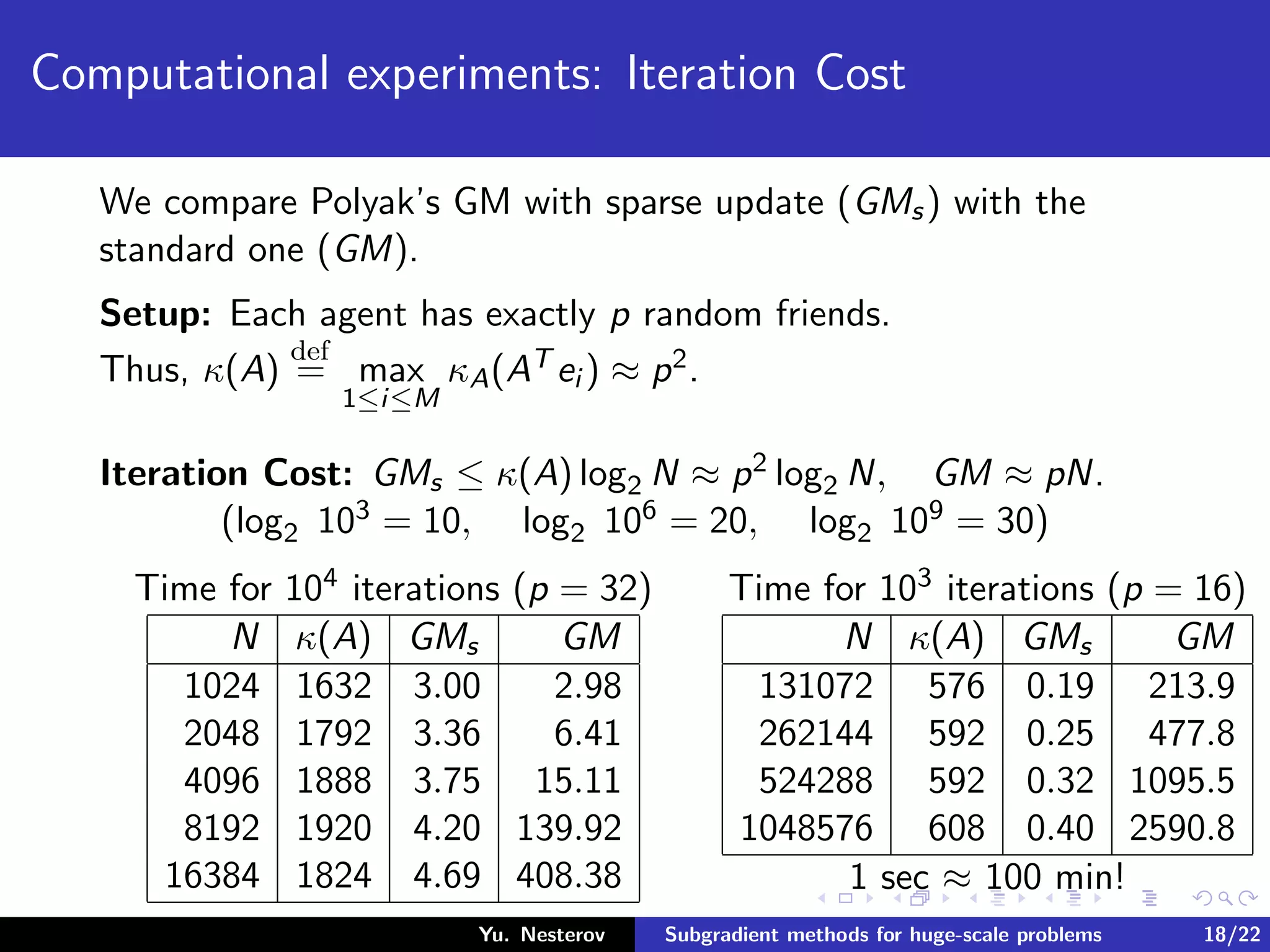
Time for 104 iterations (p = 32)
N κ(A) GMs GM
1024 1632 3.00 2.98
2048 1792 3.36 6.41
4096 1888 3.75 15.11
8192 1920 4.20 139.92
16384 1824 4.69 408.38
Yu. Nesterov Subgradient methods for huge-scale problems 18/22
Computational experiments: Iteration Cost
We compare Polyak’s GM with sparse update (GMs) with the
standard one (GM).
Setup: Each agent has exactly p random friends.
Thus, κ(A)
def
= max
1≤i≤M
κA(AT ei ) ≈ p2.
Iteration Cost: GMs ≤ κ(A) log2 N ≈ p2 log2 N, GM ≈ pN.
(log2 103 = 10, log2 106 = 20, log2 109 = 30)
Time for 104 iterations (p = 32)
N κ(A) GMs GM
1024 1632 3.00 2.98
2048 1792 3.36 6.41
4096 1888 3.75 15.11
8192 1920 4.20 139.92
16384 1824 4.69 408.38
Time for 103 iterations (p = 16)
N κ(A) GMs GM
131072 576 0.19 213.9
262144 592 0.25 477.8
524288 592 0.32 1095.5
1048576 608 0.40 2590.8
Yu. Nesterov Subgradient methods for huge-scale problems 18/22
Computational experiments: Iteration Cost
We compare Polyak’s GM with sparse update (GMs) with the
standard one (GM).
Setup: Each agent has exactly p random friends.
Thus, κ(A)
def
= max
1≤i≤M
κA(AT ei ) ≈ p2.
Iteration Cost: GMs ≤ κ(A) log2 N ≈ p2 log2 N, GM ≈ pN.
(log2 103 = 10, log2 106 = 20, log2 109 = 30)
Time for 104 iterations (p = 32)
N κ(A) GMs GM
1024 1632 3.00 2.98
2048 1792 3.36 6.41
4096 1888 3.75 15.11
8192 1920 4.20 139.92
16384 1824 4.69 408.38
Time for 103 iterations (p = 16)
N κ(A) GMs GM
131072 576 0.19 213.9
262144 592 0.25 477.8
524288 592 0.32 1095.5
1048576 608 0.40 2590.8
1 sec ≈ 100 min!
Yu. Nesterov Subgradient methods for huge-scale problems 18/22
Convergence of GMs: Medium Size
Yu. Nesterov Subgradient methods for huge-scale problems 19/22
Convergence of GMs: Medium Size
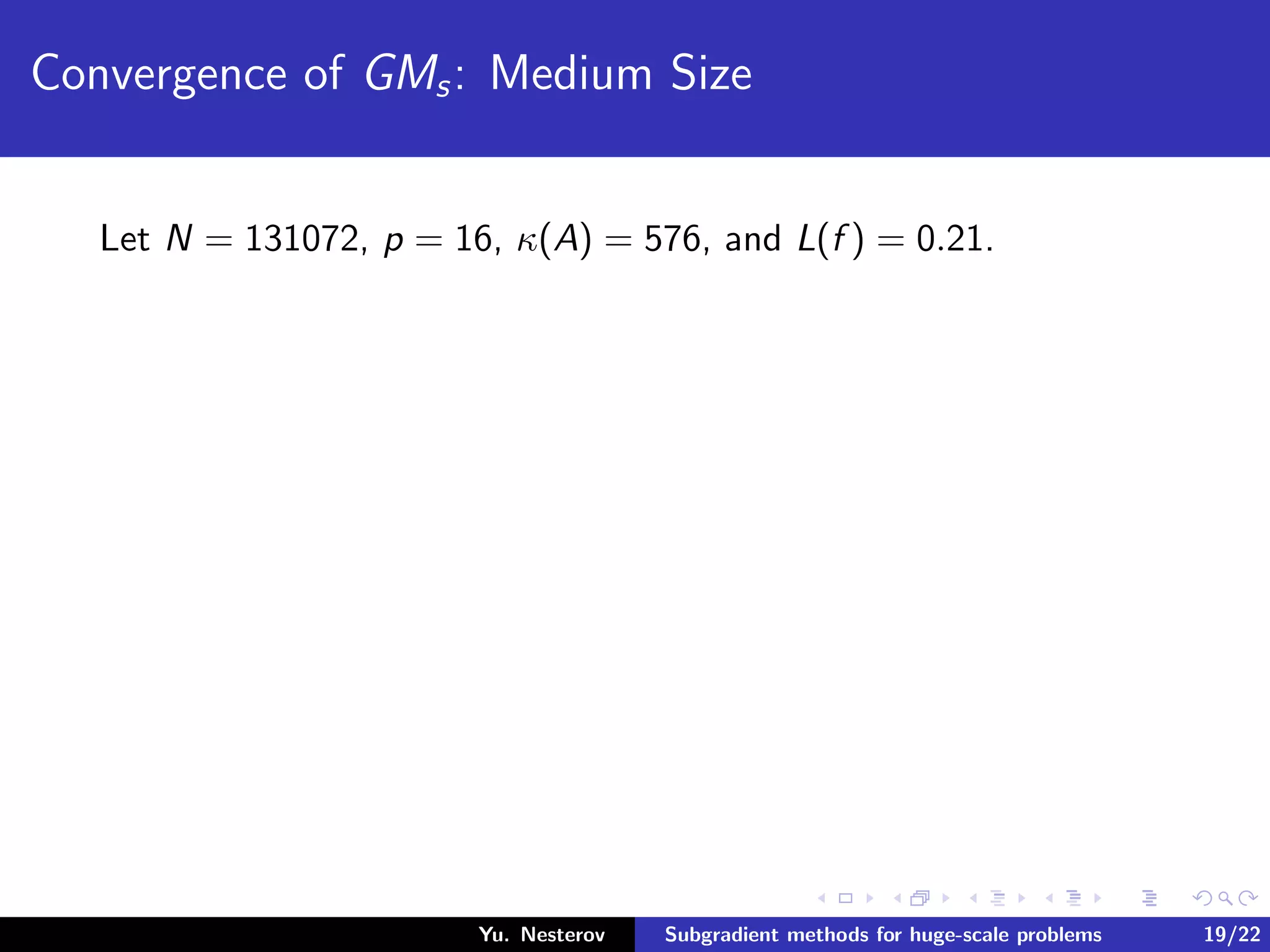
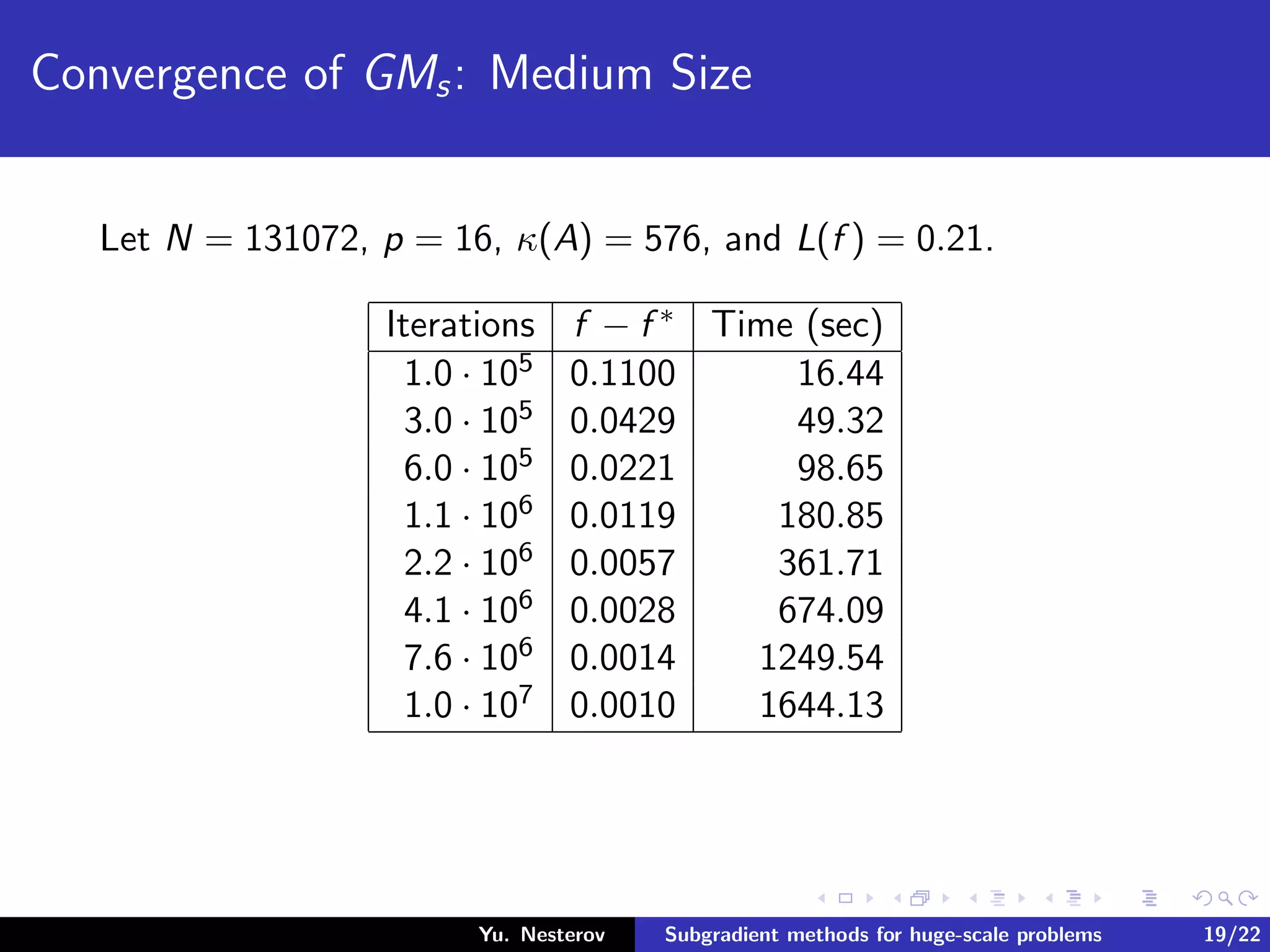
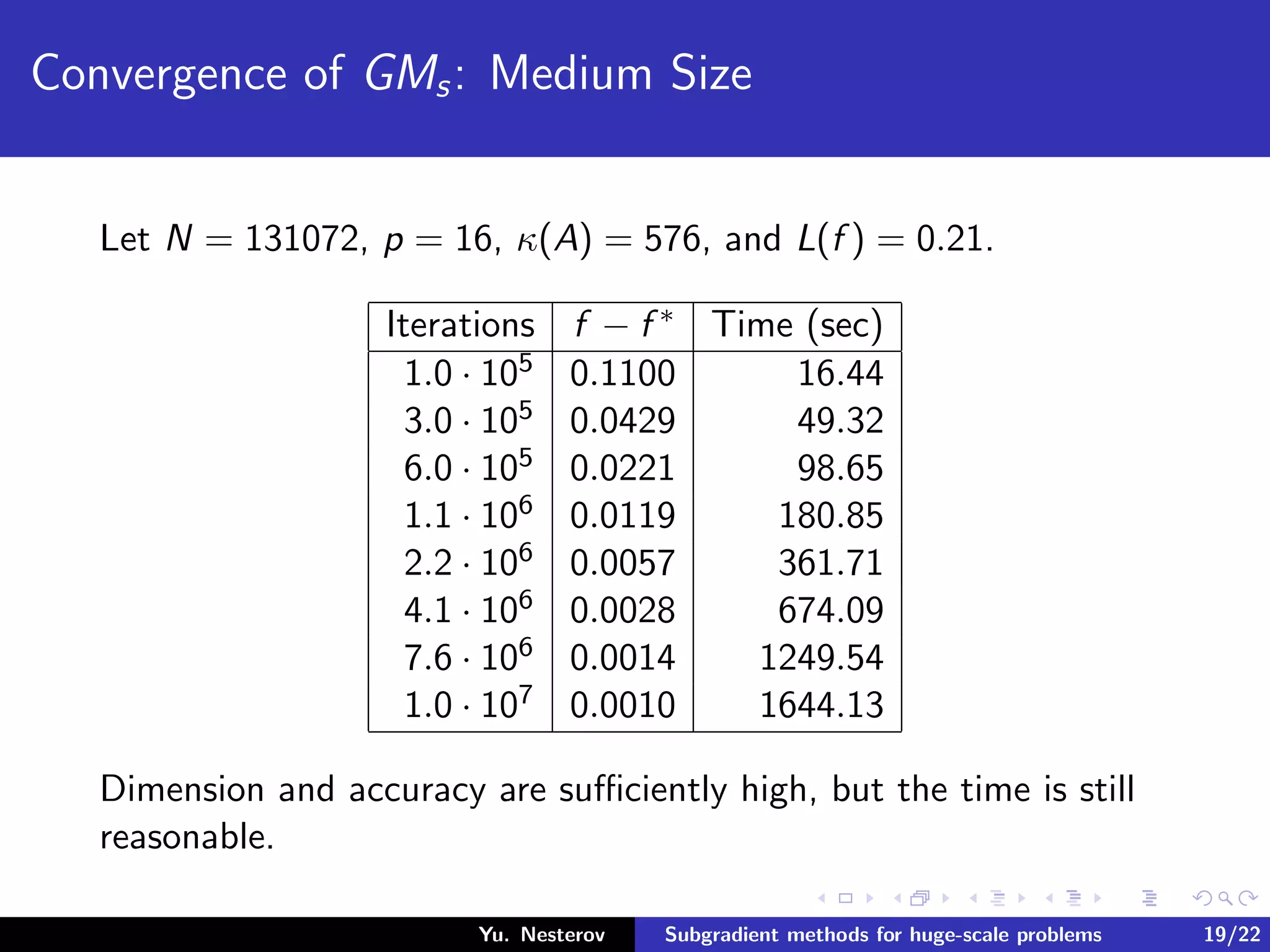
Let N = 131072, p = 16, κ(A) = 576, and L(f ) = 0.21.
Yu. Nesterov Subgradient methods for huge-scale problems 19/22
Convergence of GMs: Medium Size
Let N = 131072, p = 16, κ(A) = 576, and L(f ) = 0.21.
Iterations f − f ∗ Time (sec)
1.0 · 105 0.1100 16.44
3.0 · 105 0.0429 49.32
6.0 · 105 0.0221 98.65
1.1 · 106 0.0119 180.85
2.2 · 106 0.0057 361.71
4.1 · 106 0.0028 674.09
7.6 · 106 0.0014 1249.54
1.0 · 107 0.0010 1644.13
Yu. Nesterov Subgradient methods for huge-scale problems 19/22
Convergence of GMs: Medium Size
Let N = 131072, p = 16, κ(A) = 576, and L(f ) = 0.21.
Iterations f − f ∗ Time (sec)
1.0 · 105 0.1100 16.44
3.0 · 105 0.0429 49.32
6.0 · 105 0.0221 98.65
1.1 · 106 0.0119 180.85
2.2 · 106 0.0057 361.71
4.1 · 106 0.0028 674.09
7.6 · 106 0.0014 1249.54
1.0 · 107 0.0010 1644.13
Dimension and accuracy are sufficiently high, but the time is still
reasonable.
Yu. Nesterov Subgradient methods for huge-scale problems 19/22
Convergence of GMs: Large Scale
Yu. Nesterov Subgradient methods for huge-scale problems 20/22
Convergence of GMs: Large Scale
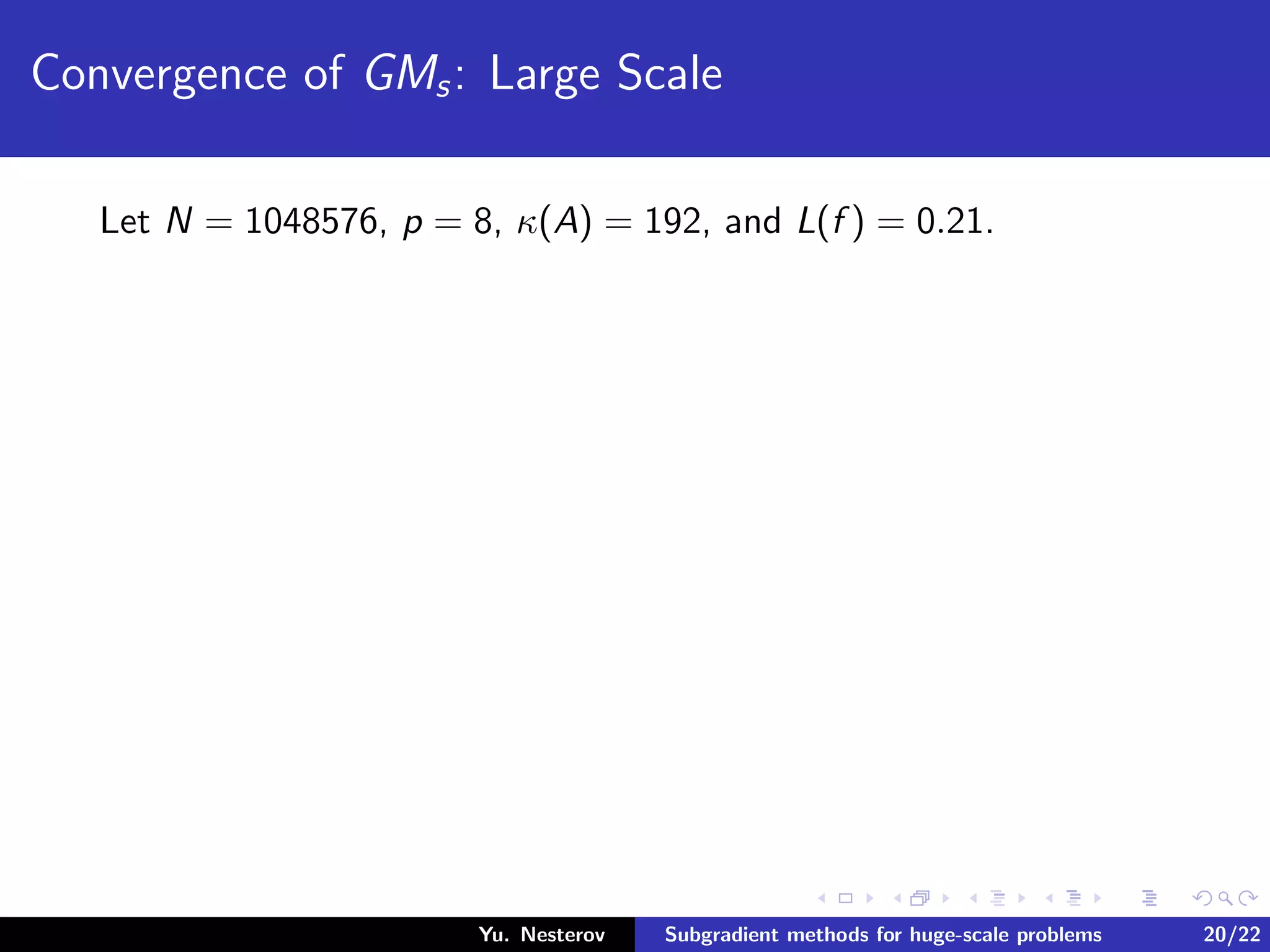
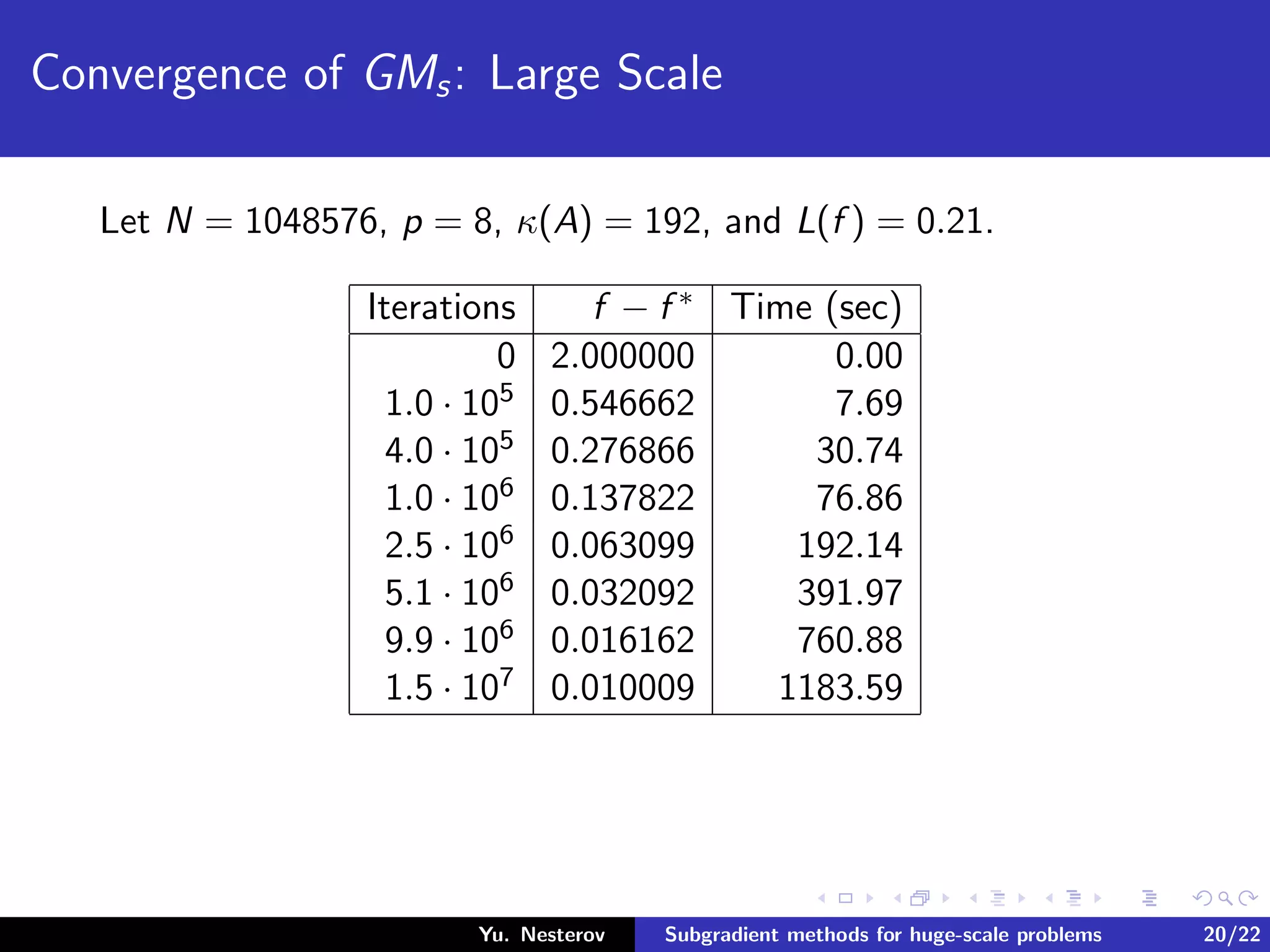
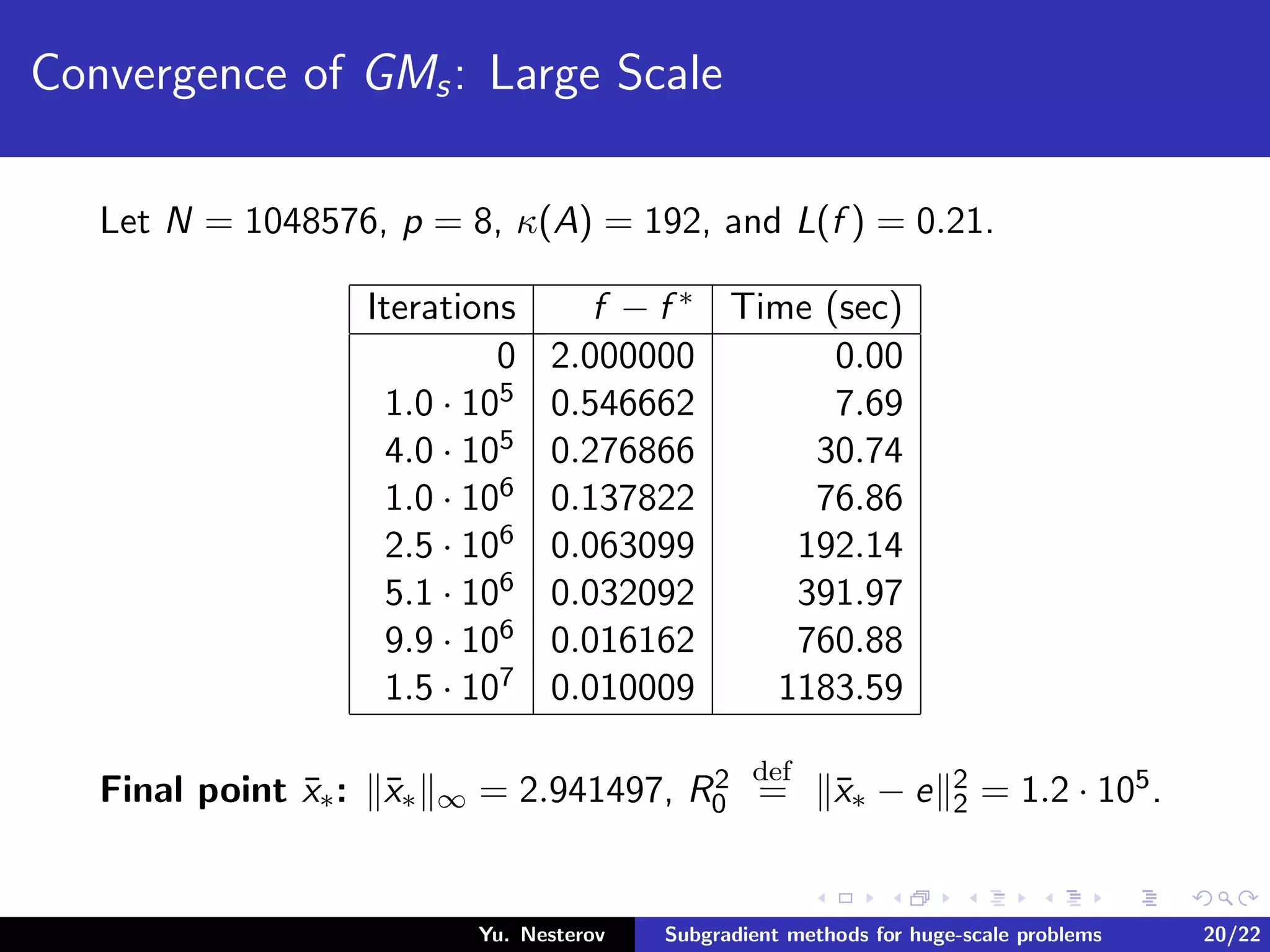
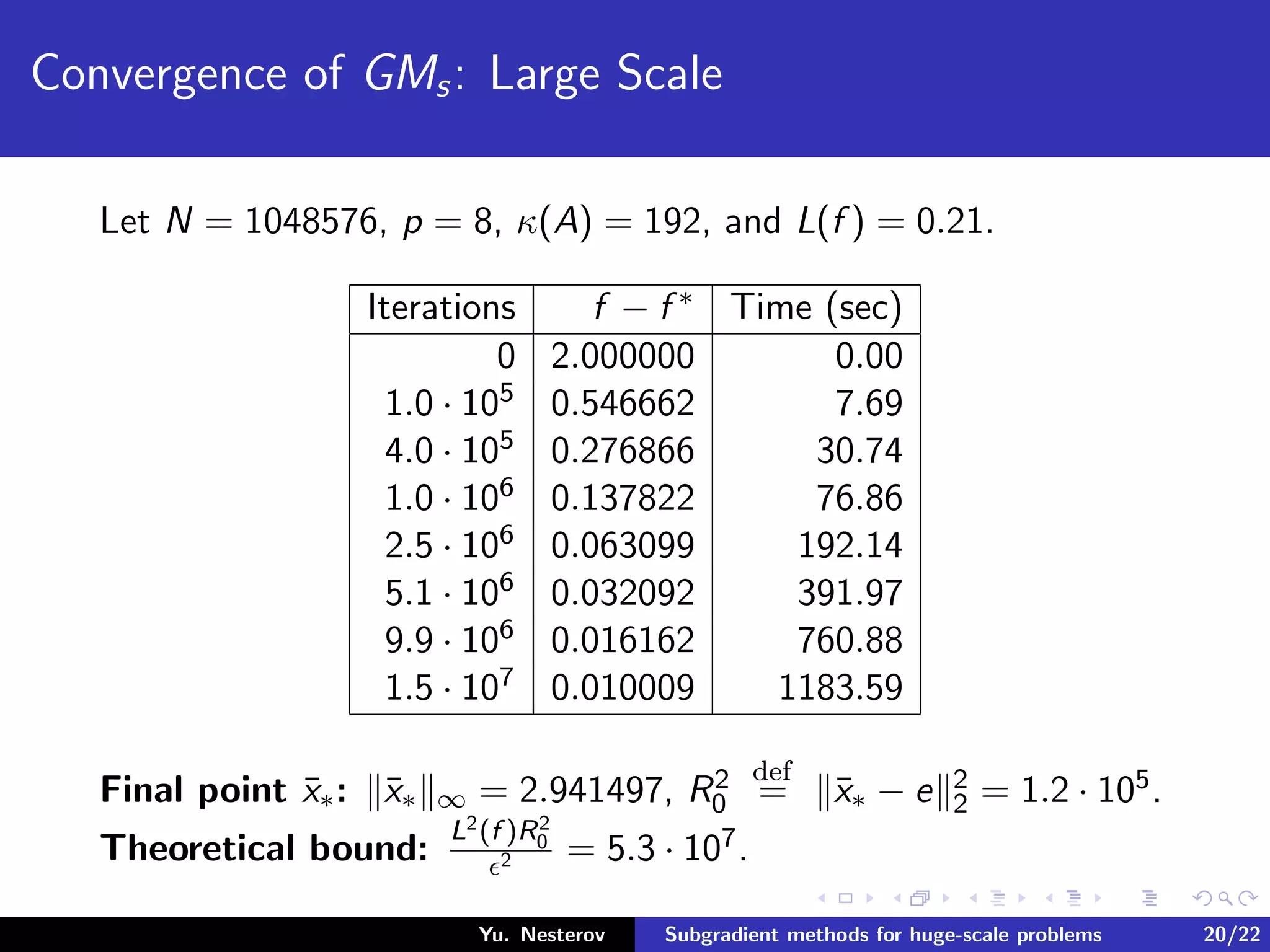
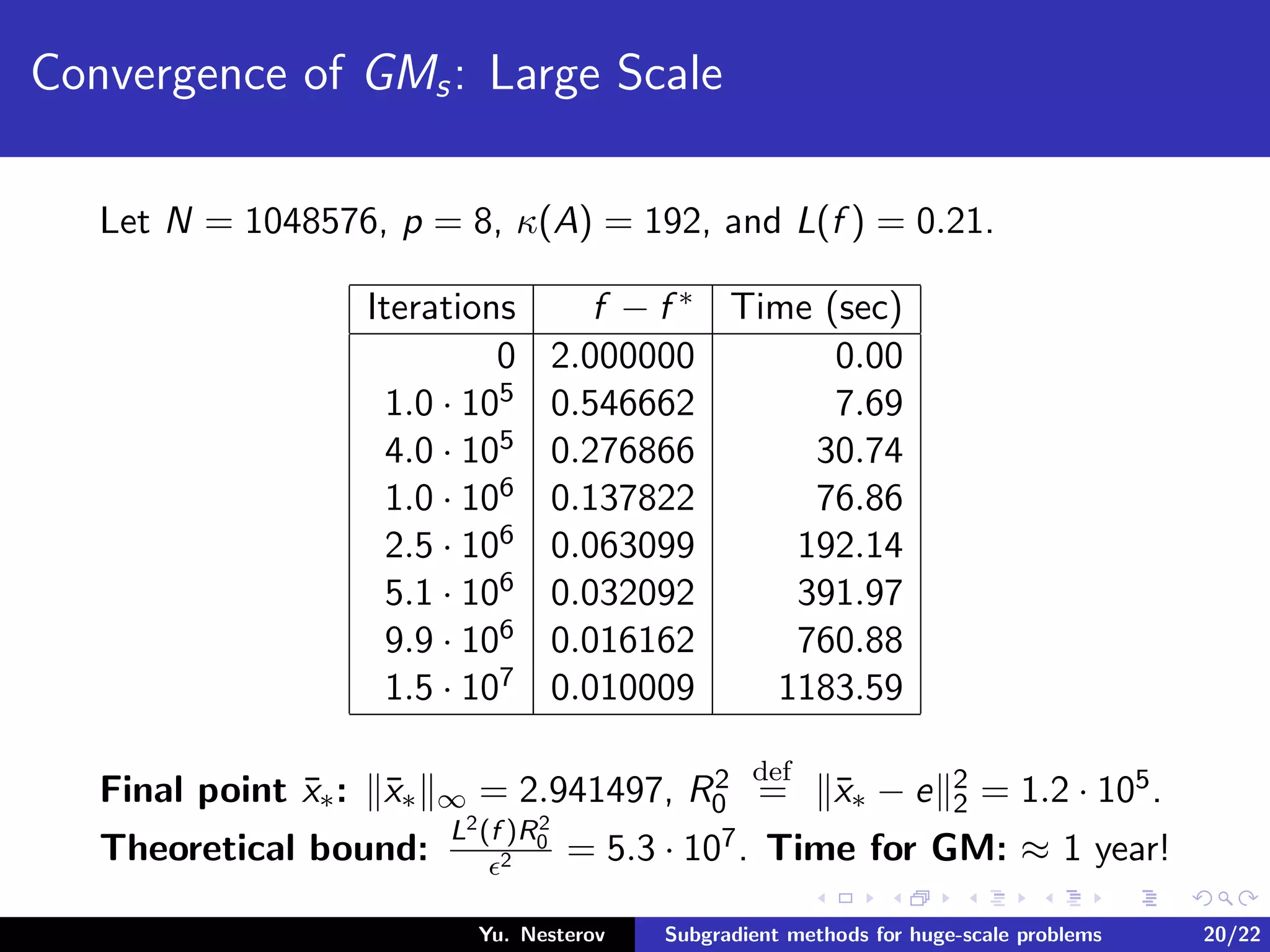
Let N = 1048576, p = 8, κ(A) = 192, and L(f ) = 0.21.
Yu. Nesterov Subgradient methods for huge-scale problems 20/22
Convergence of GMs: Large Scale
Let N = 1048576, p = 8, κ(A) = 192, and L(f ) = 0.21.
Iterations f − f ∗ Time (sec)
0 2.000000 0.00
1.0 · 105 0.546662 7.69
4.0 · 105 0.276866 30.74
1.0 · 106 0.137822 76.86
2.5 · 106 0.063099 192.14
5.1 · 106 0.032092 391.97
9.9 · 106 0.016162 760.88
1.5 · 107 0.010009 1183.59
Yu. Nesterov Subgradient methods for huge-scale problems 20/22
Convergence of GMs: Large Scale
Let N = 1048576, p = 8, κ(A) = 192, and L(f ) = 0.21.
Iterations f − f ∗ Time (sec)
0 2.000000 0.00
1.0 · 105 0.546662 7.69
4.0 · 105 0.276866 30.74
1.0 · 106 0.137822 76.86
2.5 · 106 0.063099 192.14
5.1 · 106 0.032092 391.97
9.9 · 106 0.016162 760.88
1.5 · 107 0.010009 1183.59
Final point ¯x∗: ¯x∗ ∞ = 2.941497, R2
0
def
= ¯x∗ − e 2
2 = 1.2 · 105.
Yu. Nesterov Subgradient methods for huge-scale problems 20/22
Convergence of GMs: Large Scale
Let N = 1048576, p = 8, κ(A) = 192, and L(f ) = 0.21.
Iterations f − f ∗ Time (sec)
0 2.000000 0.00
1.0 · 105 0.546662 7.69
4.0 · 105 0.276866 30.74
1.0 · 106 0.137822 76.86
2.5 · 106 0.063099 192.14
5.1 · 106 0.032092 391.97
9.9 · 106 0.016162 760.88
1.5 · 107 0.010009 1183.59
Final point ¯x∗: ¯x∗ ∞ = 2.941497, R2
0
def
= ¯x∗ − e 2
2 = 1.2 · 105.
Theoretical bound:
L2(f )R2
0
2 = 5.3 · 107.
Yu. Nesterov Subgradient methods for huge-scale problems 20/22
Convergence of GMs: Large Scale
Let N = 1048576, p = 8, κ(A) = 192, and L(f ) = 0.21.
Iterations f − f ∗ Time (sec)
0 2.000000 0.00
1.0 · 105 0.546662 7.69
4.0 · 105 0.276866 30.74
1.0 · 106 0.137822 76.86
2.5 · 106 0.063099 192.14
5.1 · 106 0.032092 391.97
9.9 · 106 0.016162 760.88
1.5 · 107 0.010009 1183.59
Final point ¯x∗: ¯x∗ ∞ = 2.941497, R2
0
def
= ¯x∗ − e 2
2 = 1.2 · 105.
Theoretical bound:
L2(f )R2
0
2 = 5.3 · 107. Time for GM: ≈ 1 year!
Yu. Nesterov Subgradient methods for huge-scale problems 20/22
Conclusion
Yu. Nesterov Subgradient methods for huge-scale problems 21/22
Conclusion
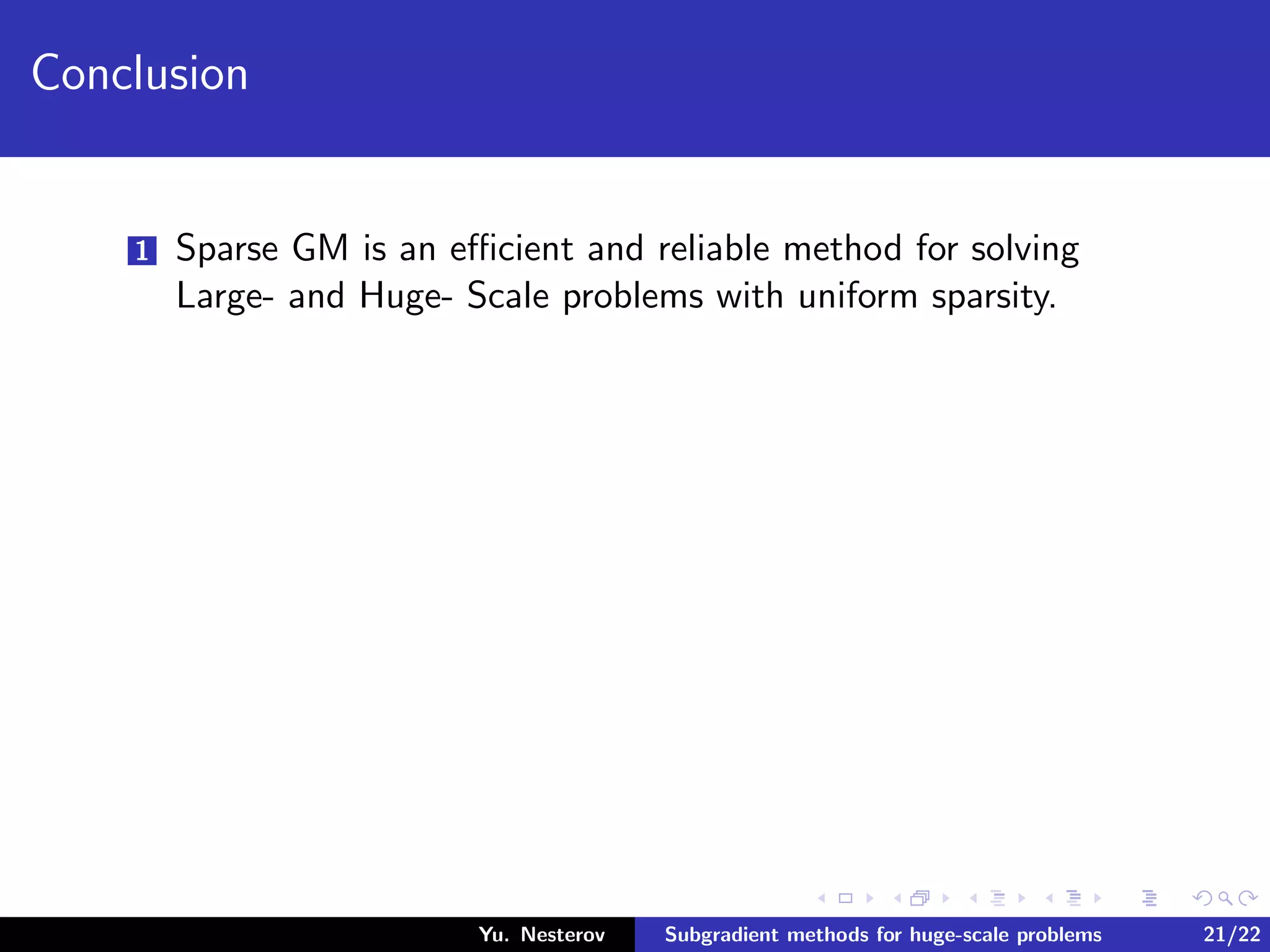
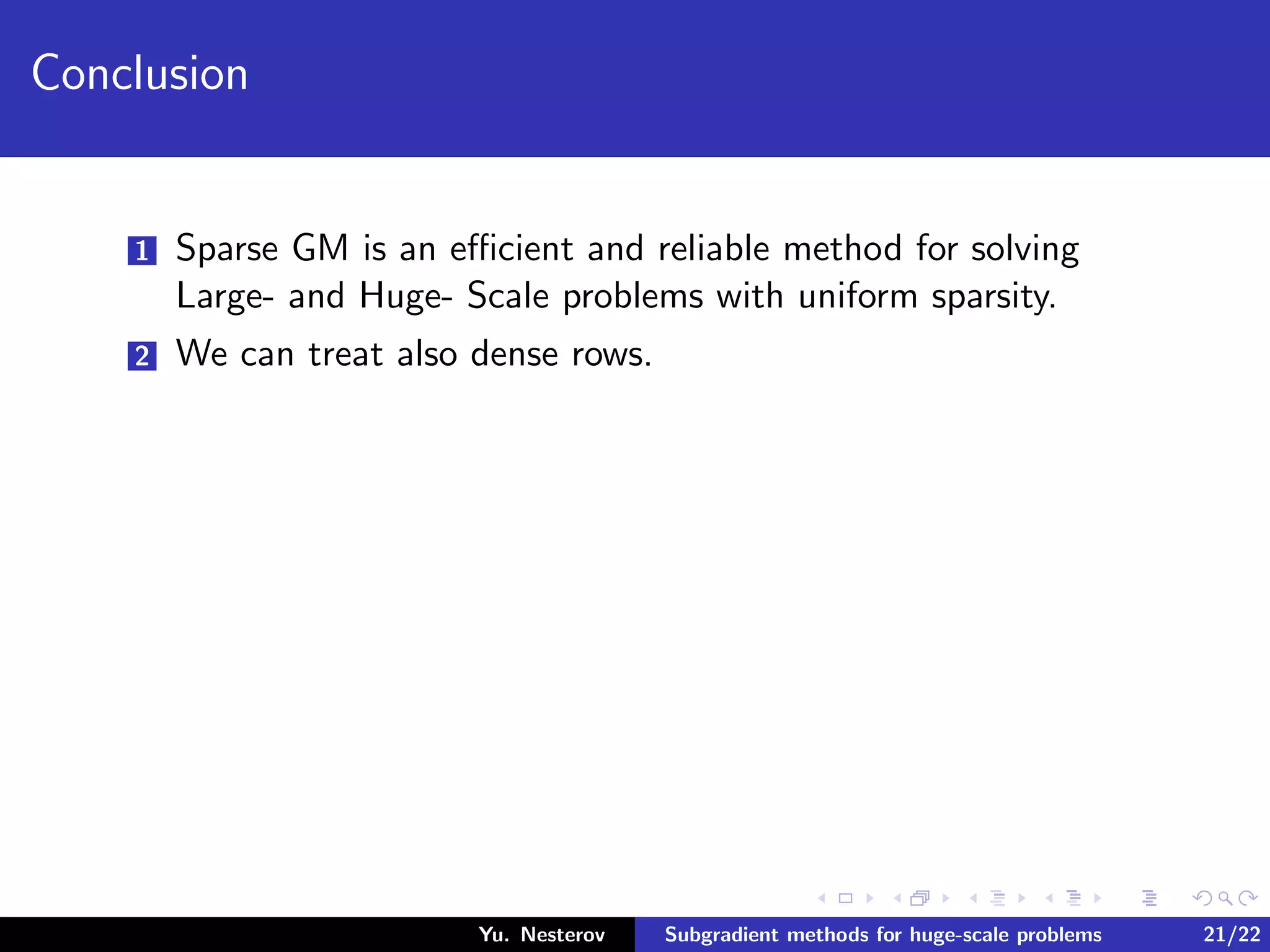
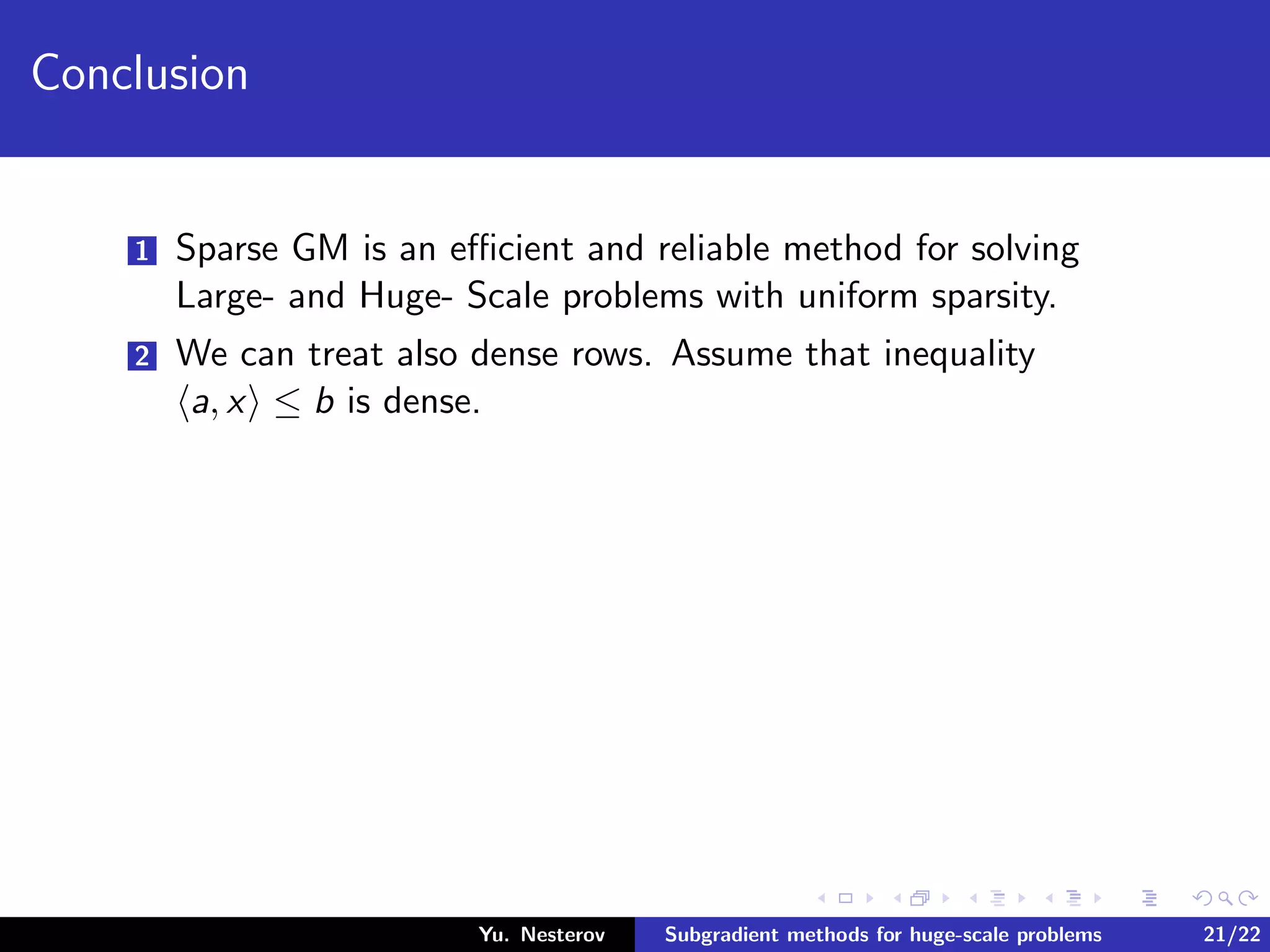
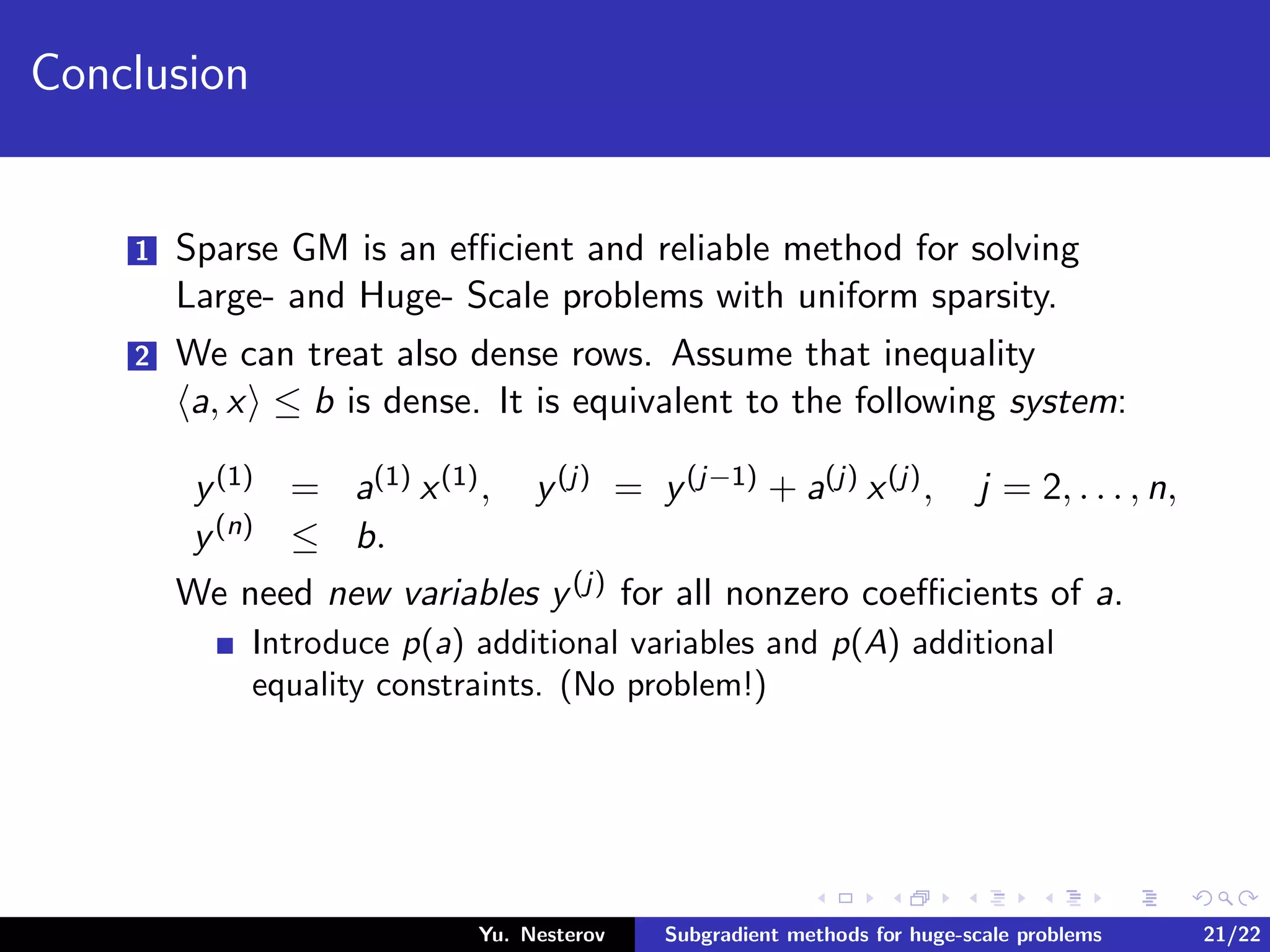
1 Sparse GM is an efficient and reliable method for solving
Large- and Huge- Scale problems with uniform sparsity.
Yu. Nesterov Subgradient methods for huge-scale problems 21/22
Conclusion
1 Sparse GM is an efficient and reliable method for solving
Large- and Huge- Scale problems with uniform sparsity.
2 We can treat also dense rows.
Yu. Nesterov Subgradient methods for huge-scale problems 21/22
Conclusion
1 Sparse GM is an efficient and reliable method for solving
Large- and Huge- Scale problems with uniform sparsity.
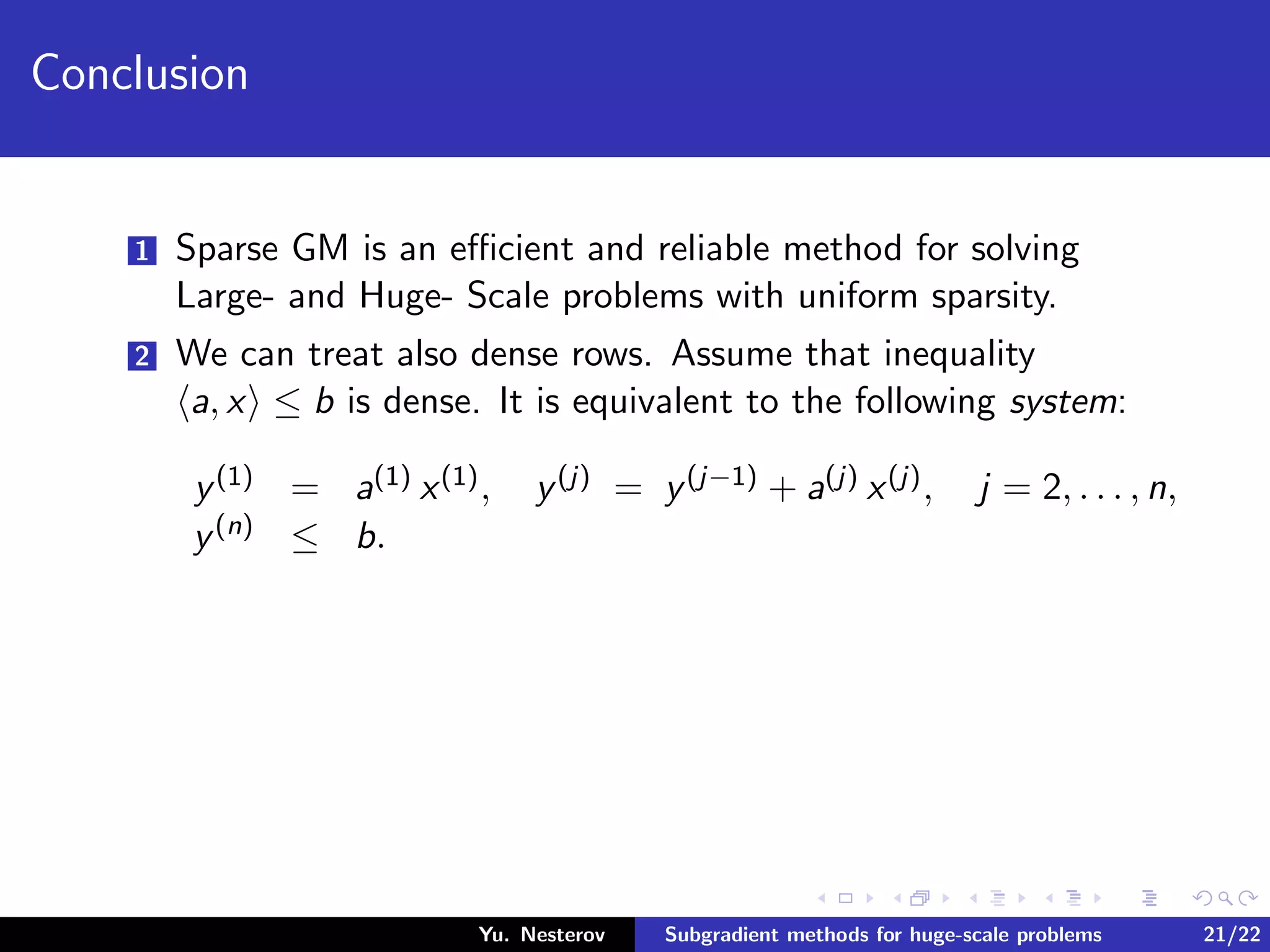
2 We can treat also dense rows. Assume that inequality
a, x ≤ b is dense.
Yu. Nesterov Subgradient methods for huge-scale problems 21/22
Conclusion
1 Sparse GM is an efficient and reliable method for solving
Large- and Huge- Scale problems with uniform sparsity.
2 We can treat also dense rows. Assume that inequality
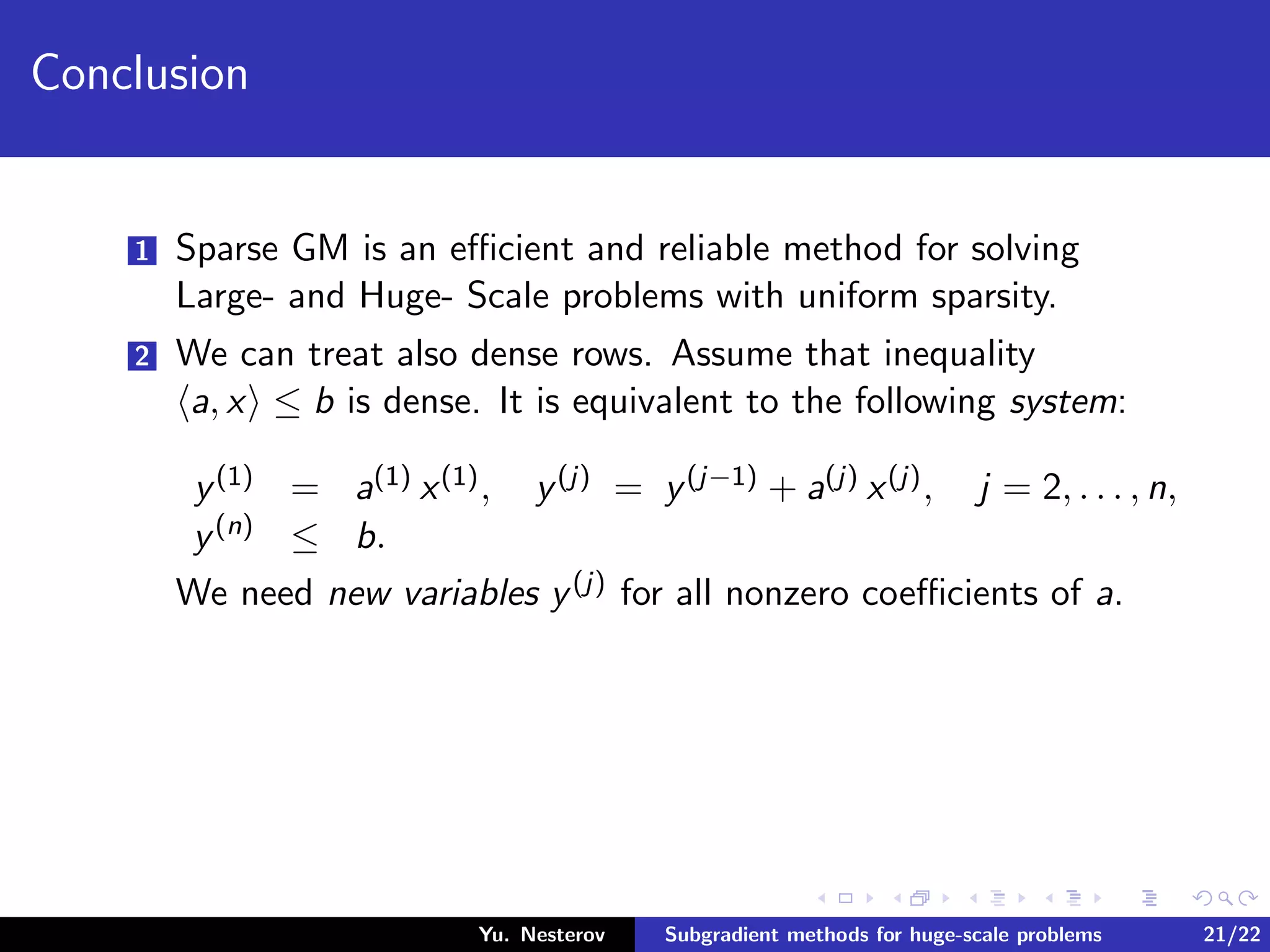
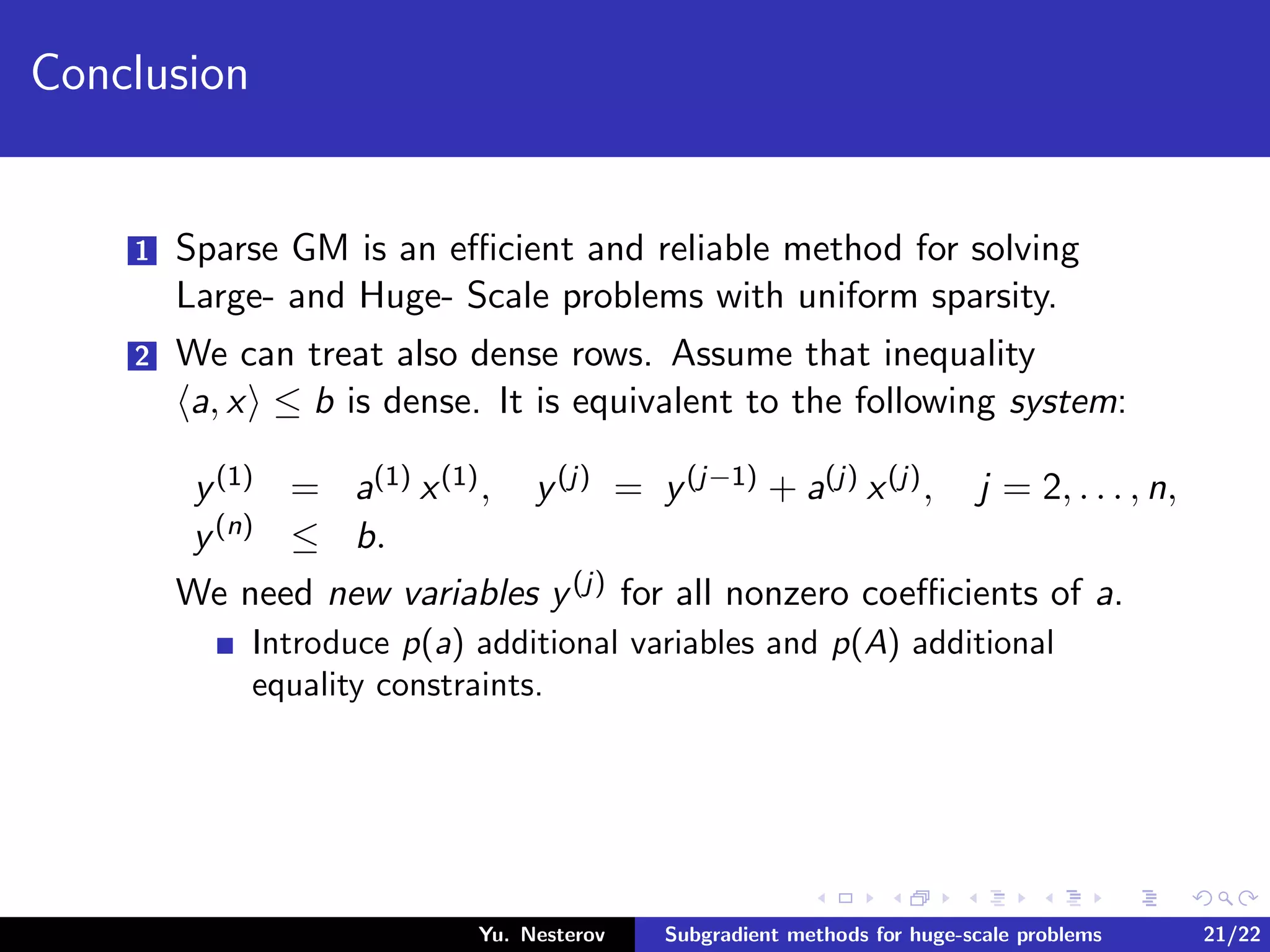
a, x ≤ b is dense. It is equivalent to the following system:
y(1) = a(1) x(1), y(j) = y(j−1) + a(j) x(j), j = 2, . . . , n,
y(n) ≤ b.
Yu. Nesterov Subgradient methods for huge-scale problems 21/22
Conclusion
1 Sparse GM is an efficient and reliable method for solving
Large- and Huge- Scale problems with uniform sparsity.
2 We can treat also dense rows. Assume that inequality
a, x ≤ b is dense. It is equivalent to the following system:
y(1) = a(1) x(1), y(j) = y(j−1) + a(j) x(j), j = 2, . . . , n,
y(n) ≤ b.
We need new variables y(j) for all nonzero coefficients of a.
Yu. Nesterov Subgradient methods for huge-scale problems 21/22
Conclusion
1 Sparse GM is an efficient and reliable method for solving
Large- and Huge- Scale problems with uniform sparsity.
2 We can treat also dense rows. Assume that inequality
a, x ≤ b is dense. It is equivalent to the following system:
y(1) = a(1) x(1), y(j) = y(j−1) + a(j) x(j), j = 2, . . . , n,
y(n) ≤ b.
We need new variables y(j) for all nonzero coefficients of a.
Introduce p(a) additional variables and p(A) additional
equality constraints.
Yu. Nesterov Subgradient methods for huge-scale problems 21/22
Conclusion
1 Sparse GM is an efficient and reliable method for solving
Large- and Huge- Scale problems with uniform sparsity.
2 We can treat also dense rows. Assume that inequality
a, x ≤ b is dense. It is equivalent to the following system:
y(1) = a(1) x(1), y(j) = y(j−1) + a(j) x(j), j = 2, . . . , n,
y(n) ≤ b.
We need new variables y(j) for all nonzero coefficients of a.
Introduce p(a) additional variables and p(A) additional
equality constraints. (No problem!)
Yu. Nesterov Subgradient methods for huge-scale problems 21/22
Conclusion
1 Sparse GM is an efficient and reliable method for solving
Large- and Huge- Scale problems with uniform sparsity.
2 We can treat also dense rows. Assume that inequality
a, x ≤ b is dense. It is equivalent to the following system:
y(1) = a(1) x(1), y(j) = y(j−1) + a(j) x(j), j = 2, . . . , n,
y(n) ≤ b.
We need new variables y(j) for all nonzero coefficients of a.
Introduce p(a) additional variables and p(A) additional
equality constraints. (No problem!)
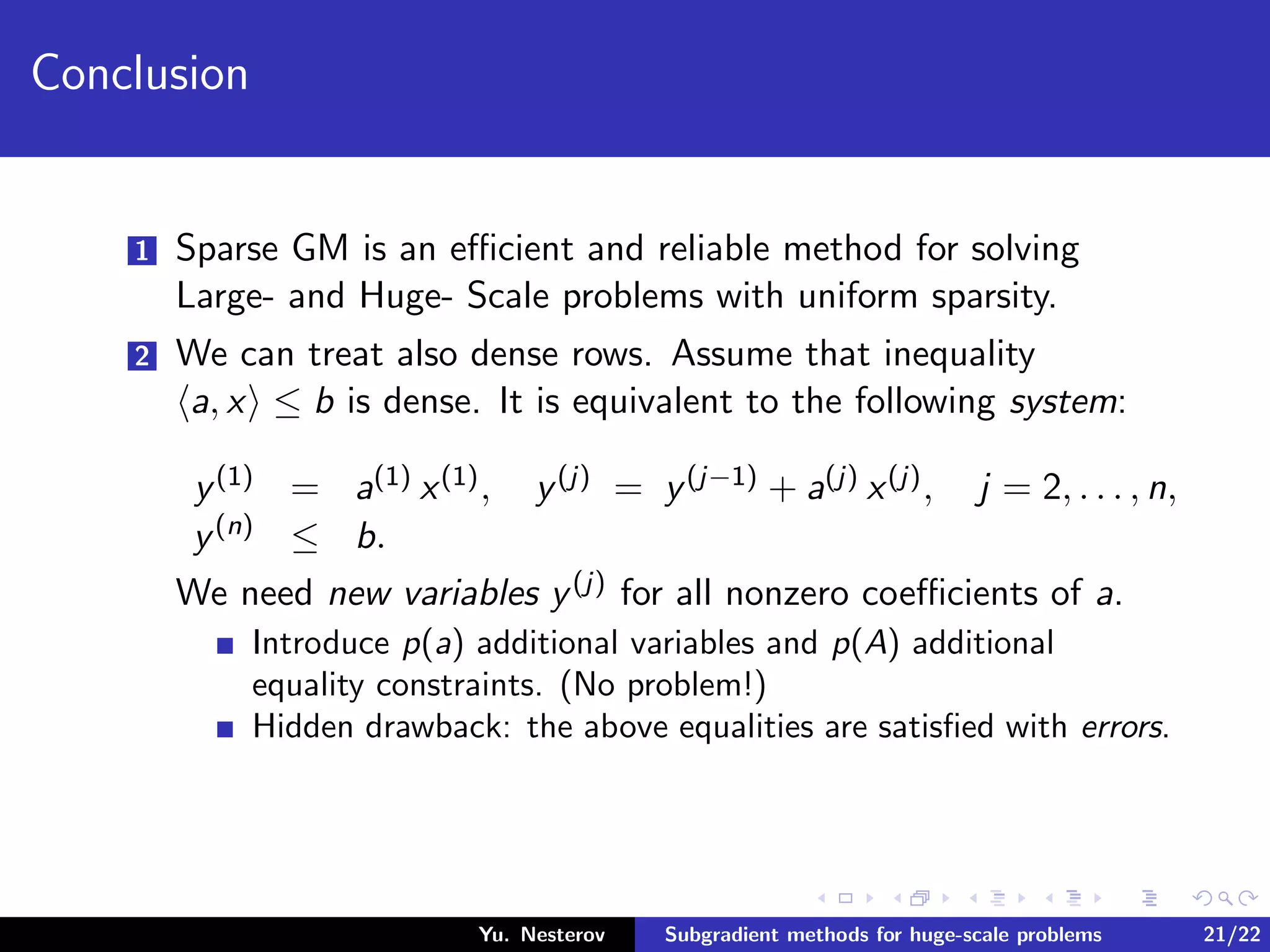
Hidden drawback: the above equalities are satisfied with errors.
Yu. Nesterov Subgradient methods for huge-scale problems 21/22
Conclusion
1 Sparse GM is an efficient and reliable method for solving
Large- and Huge- Scale problems with uniform sparsity.
2 We can treat also dense rows. Assume that inequality
a, x ≤ b is dense. It is equivalent to the following system:
y(1) = a(1) x(1), y(j) = y(j−1) + a(j) x(j), j = 2, . . . , n,
y(n) ≤ b.
We need new variables y(j) for all nonzero coefficients of a.
Introduce p(a) additional variables and p(A) additional
equality constraints. (No problem!)
Hidden drawback: the above equalities are satisfied with errors.
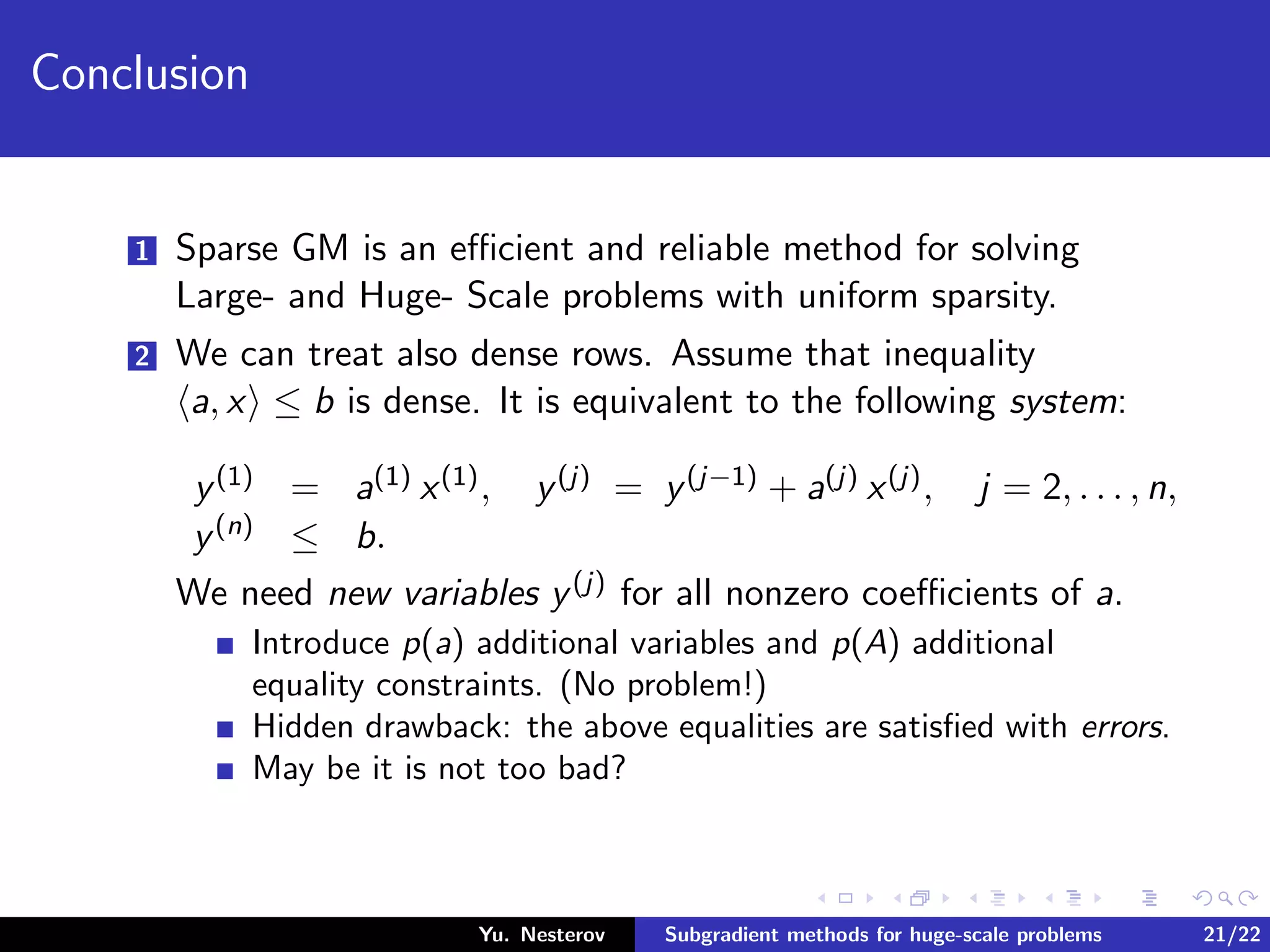
May be it is not too bad?
Yu. Nesterov Subgradient methods for huge-scale problems 21/22
Conclusion
1 Sparse GM is an efficient and reliable method for solving
Large- and Huge- Scale problems with uniform sparsity.
2 We can treat also dense rows. Assume that inequality
a, x ≤ b is dense. It is equivalent to the following system:
y(1) = a(1) x(1), y(j) = y(j−1) + a(j) x(j), j = 2, . . . , n,
y(n) ≤ b.
We need new variables y(j) for all nonzero coefficients of a.
Introduce p(a) additional variables and p(A) additional
equality constraints. (No problem!)
Hidden drawback: the above equalities are satisfied with errors.
May be it is not too bad?
3 Similar technique can be applied to dense columns.
Yu. Nesterov Subgradient methods for huge-scale problems 21/22
Thank you for your attention!
Yu. Nesterov Subgradient methods for huge-scale problems 22/22

Subgradient Methods for Huge-Scale Optimization Problems - Юрий Нестеров, Catholic University of Louvain, Belgium

  • 1.
    Subgradient methods forhuge-scale optimization problems Yurii Nesterov, CORE/INMA (UCL) November 10, 2014 (Yandex, Moscow) Yu. Nesterov Subgradient methods for huge-scale problems 1/22
  • 2.
    Outline 1 Problems sizes 2Sparse Optimization problems 3 Sparse updates for linear operators 4 Fast updates in computational trees 5 Simple subgradient methods 6 Application examples 7 Computational experiments: Google problem Yu. Nesterov Subgradient methods for huge-scale problems 2/22
  • 3.
    Nonlinear Optimization: problemssizes Class Operations Dimension Iter.Cost Memory Small-size All 100 − 102 n4 → n3 Kilobyte: 103 Medium-size A−1 103 − 104 n3 → n2 Megabyte: 106 Yu. Nesterov Subgradient methods for huge-scale problems 3/22
  • 4.
    Nonlinear Optimization: problemssizes Class Operations Dimension Iter.Cost Memory Small-size All 100 − 102 n4 → n3 Kilobyte: 103 Medium-size A−1 103 − 104 n3 → n2 Megabyte: 106 Large-scale Ax 105 − 107 n2 → n Gigabyte: 109 Yu. Nesterov Subgradient methods for huge-scale problems 3/22
  • 5.
    Nonlinear Optimization: problemssizes Class Operations Dimension Iter.Cost Memory Small-size All 100 − 102 n4 → n3 Kilobyte: 103 Medium-size A−1 103 − 104 n3 → n2 Megabyte: 106 Large-scale Ax 105 − 107 n2 → n Gigabyte: 109 Huge-scale x + y 108 − 1012 n → log n Terabyte: 1012 Yu. Nesterov Subgradient methods for huge-scale problems 3/22
  • 6.
    Nonlinear Optimization: problemssizes Class Operations Dimension Iter.Cost Memory Small-size All 100 − 102 n4 → n3 Kilobyte: 103 Medium-size A−1 103 − 104 n3 → n2 Megabyte: 106 Large-scale Ax 105 − 107 n2 → n Gigabyte: 109 Huge-scale x + y 108 − 1012 n → log n Terabyte: 1012 Sources of Huge-Scale problems Yu. Nesterov Subgradient methods for huge-scale problems 3/22
  • 7.
    Nonlinear Optimization: problemssizes Class Operations Dimension Iter.Cost Memory Small-size All 100 − 102 n4 → n3 Kilobyte: 103 Medium-size A−1 103 − 104 n3 → n2 Megabyte: 106 Large-scale Ax 105 − 107 n2 → n Gigabyte: 109 Huge-scale x + y 108 − 1012 n → log n Terabyte: 1012 Sources of Huge-Scale problems Internet (New) Telecommunications (New) Yu. Nesterov Subgradient methods for huge-scale problems 3/22
  • 8.
    Nonlinear Optimization: problemssizes Class Operations Dimension Iter.Cost Memory Small-size All 100 − 102 n4 → n3 Kilobyte: 103 Medium-size A−1 103 − 104 n3 → n2 Megabyte: 106 Large-scale Ax 105 − 107 n2 → n Gigabyte: 109 Huge-scale x + y 108 − 1012 n → log n Terabyte: 1012 Sources of Huge-Scale problems Internet (New) Telecommunications (New) Finite-element schemes (Old) PDE, Weather prediction (Old) Yu. Nesterov Subgradient methods for huge-scale problems 3/22
  • 9.
    Nonlinear Optimization: problemssizes Class Operations Dimension Iter.Cost Memory Small-size All 100 − 102 n4 → n3 Kilobyte: 103 Medium-size A−1 103 − 104 n3 → n2 Megabyte: 106 Large-scale Ax 105 − 107 n2 → n Gigabyte: 109 Huge-scale x + y 108 − 1012 n → log n Terabyte: 1012 Sources of Huge-Scale problems Internet (New) Telecommunications (New) Finite-element schemes (Old) PDE, Weather prediction (Old) Main hope: Sparsity. Yu. Nesterov Subgradient methods for huge-scale problems 3/22
  • 10.
    Sparse problems Yu. NesterovSubgradient methods for huge-scale problems 4/22
  • 11.
    Sparse problems Problem: min x∈Q f(x), where Q is closed and convex in RN, Yu. Nesterov Subgradient methods for huge-scale problems 4/22
  • 12.
    Sparse problems Problem: min x∈Q f(x), where Q is closed and convex in RN, and f (x) = Ψ(Ax), where Ψ is a simple convex function: Ψ(y1) ≥ Ψ(y2) + Ψ (y2), y1 − y2 , y1, y2 ∈ RM , Yu. Nesterov Subgradient methods for huge-scale problems 4/22
  • 13.
    Sparse problems Problem: min x∈Q f(x), where Q is closed and convex in RN, and f (x) = Ψ(Ax), where Ψ is a simple convex function: Ψ(y1) ≥ Ψ(y2) + Ψ (y2), y1 − y2 , y1, y2 ∈ RM , A : RN → RM is a sparse matrix. Yu. Nesterov Subgradient methods for huge-scale problems 4/22
  • 14.
    Sparse problems Problem: min x∈Q f(x), where Q is closed and convex in RN, and f (x) = Ψ(Ax), where Ψ is a simple convex function: Ψ(y1) ≥ Ψ(y2) + Ψ (y2), y1 − y2 , y1, y2 ∈ RM , A : RN → RM is a sparse matrix. Let p(x) def = # of nonzeros in x. Yu. Nesterov Subgradient methods for huge-scale problems 4/22
  • 15.
    Sparse problems Problem: min x∈Q f(x), where Q is closed and convex in RN, and f (x) = Ψ(Ax), where Ψ is a simple convex function: Ψ(y1) ≥ Ψ(y2) + Ψ (y2), y1 − y2 , y1, y2 ∈ RM , A : RN → RM is a sparse matrix. Let p(x) def = # of nonzeros in x. Sparsity coefficient: γ(A) def = p(A) MN . Yu. Nesterov Subgradient methods for huge-scale problems 4/22
  • 16.
    Sparse problems Problem: min x∈Q f(x), where Q is closed and convex in RN, and f (x) = Ψ(Ax), where Ψ is a simple convex function: Ψ(y1) ≥ Ψ(y2) + Ψ (y2), y1 − y2 , y1, y2 ∈ RM , A : RN → RM is a sparse matrix. Let p(x) def = # of nonzeros in x. Sparsity coefficient: γ(A) def = p(A) MN . Example 1: Matrix-vector multiplication Yu. Nesterov Subgradient methods for huge-scale problems 4/22
  • 17.
    Sparse problems Problem: min x∈Q f(x), where Q is closed and convex in RN, and f (x) = Ψ(Ax), where Ψ is a simple convex function: Ψ(y1) ≥ Ψ(y2) + Ψ (y2), y1 − y2 , y1, y2 ∈ RM , A : RN → RM is a sparse matrix. Let p(x) def = # of nonzeros in x. Sparsity coefficient: γ(A) def = p(A) MN . Example 1: Matrix-vector multiplication Computation of vector Ax needs p(A) operations. Yu. Nesterov Subgradient methods for huge-scale problems 4/22
  • 18.
    Sparse problems Problem: min x∈Q f(x), where Q is closed and convex in RN, and f (x) = Ψ(Ax), where Ψ is a simple convex function: Ψ(y1) ≥ Ψ(y2) + Ψ (y2), y1 − y2 , y1, y2 ∈ RM , A : RN → RM is a sparse matrix. Let p(x) def = # of nonzeros in x. Sparsity coefficient: γ(A) def = p(A) MN . Example 1: Matrix-vector multiplication Computation of vector Ax needs p(A) operations. Initial complexity MN is reduced in γ(A) times. Yu. Nesterov Subgradient methods for huge-scale problems 4/22
  • 19.
    Example: Gradient Method Yu.Nesterov Subgradient methods for huge-scale problems 5/22
  • 20.
    Example: Gradient Method x0∈ Q, xk+1 = πQ(xk − hf (xk)), k ≥ 0. Yu. Nesterov Subgradient methods for huge-scale problems 5/22
  • 21.
    Example: Gradient Method x0∈ Q, xk+1 = πQ(xk − hf (xk)), k ≥ 0. Main computational expenses Yu. Nesterov Subgradient methods for huge-scale problems 5/22
  • 22.
    Example: Gradient Method x0∈ Q, xk+1 = πQ(xk − hf (xk)), k ≥ 0. Main computational expenses Projection of simple set Q needs O(N) operations. Yu. Nesterov Subgradient methods for huge-scale problems 5/22
  • 23.
    Example: Gradient Method x0∈ Q, xk+1 = πQ(xk − hf (xk)), k ≥ 0. Main computational expenses Projection of simple set Q needs O(N) operations. Displacement xk → xk − hf (xk) needs O(N) operations. Yu. Nesterov Subgradient methods for huge-scale problems 5/22
  • 24.
    Example: Gradient Method x0∈ Q, xk+1 = πQ(xk − hf (xk)), k ≥ 0. Main computational expenses Projection of simple set Q needs O(N) operations. Displacement xk → xk − hf (xk) needs O(N) operations. f (x) = AT Ψ (Ax). Yu. Nesterov Subgradient methods for huge-scale problems 5/22
  • 25.
    Example: Gradient Method x0∈ Q, xk+1 = πQ(xk − hf (xk)), k ≥ 0. Main computational expenses Projection of simple set Q needs O(N) operations. Displacement xk → xk − hf (xk) needs O(N) operations. f (x) = AT Ψ (Ax). If Ψ is simple, then the main efforts are spent for two matrix-vector multiplications: 2p(A). Yu. Nesterov Subgradient methods for huge-scale problems 5/22
  • 26.
    Example: Gradient Method x0∈ Q, xk+1 = πQ(xk − hf (xk)), k ≥ 0. Main computational expenses Projection of simple set Q needs O(N) operations. Displacement xk → xk − hf (xk) needs O(N) operations. f (x) = AT Ψ (Ax). If Ψ is simple, then the main efforts are spent for two matrix-vector multiplications: 2p(A). Conclusion: Yu. Nesterov Subgradient methods for huge-scale problems 5/22
  • 27.
    Example: Gradient Method x0∈ Q, xk+1 = πQ(xk − hf (xk)), k ≥ 0. Main computational expenses Projection of simple set Q needs O(N) operations. Displacement xk → xk − hf (xk) needs O(N) operations. f (x) = AT Ψ (Ax). If Ψ is simple, then the main efforts are spent for two matrix-vector multiplications: 2p(A). Conclusion: As compared with full matrices, we accelerate in γ(A) times. Yu. Nesterov Subgradient methods for huge-scale problems 5/22
  • 28.
    Example: Gradient Method x0∈ Q, xk+1 = πQ(xk − hf (xk)), k ≥ 0. Main computational expenses Projection of simple set Q needs O(N) operations. Displacement xk → xk − hf (xk) needs O(N) operations. f (x) = AT Ψ (Ax). If Ψ is simple, then the main efforts are spent for two matrix-vector multiplications: 2p(A). Conclusion: As compared with full matrices, we accelerate in γ(A) times. Note: For Large- and Huge-scale problems, we often have γ(A) ≈ 10−4 . . . 10−6. Yu. Nesterov Subgradient methods for huge-scale problems 5/22
  • 29.
    Example: Gradient Method x0∈ Q, xk+1 = πQ(xk − hf (xk)), k ≥ 0. Main computational expenses Projection of simple set Q needs O(N) operations. Displacement xk → xk − hf (xk) needs O(N) operations. f (x) = AT Ψ (Ax). If Ψ is simple, then the main efforts are spent for two matrix-vector multiplications: 2p(A). Conclusion: As compared with full matrices, we accelerate in γ(A) times. Note: For Large- and Huge-scale problems, we often have γ(A) ≈ 10−4 . . . 10−6. Can we get more? Yu. Nesterov Subgradient methods for huge-scale problems 5/22
  • 30.
    Sparse updating strategy Yu.Nesterov Subgradient methods for huge-scale problems 6/22
  • 31.
    Sparse updating strategy Mainidea Yu. Nesterov Subgradient methods for huge-scale problems 6/22
  • 32.
    Sparse updating strategy Mainidea After update x+ = x + d Yu. Nesterov Subgradient methods for huge-scale problems 6/22
  • 33.
    Sparse updating strategy Mainidea After update x+ = x + d we have y+ def = Ax+ Yu. Nesterov Subgradient methods for huge-scale problems 6/22
  • 34.
    Sparse updating strategy Mainidea After update x+ = x + d we have y+ def = Ax+ = Ax y +Ad. Yu. Nesterov Subgradient methods for huge-scale problems 6/22
  • 35.
    Sparse updating strategy Mainidea After update x+ = x + d we have y+ def = Ax+ = Ax y +Ad. What happens if d is sparse? Yu. Nesterov Subgradient methods for huge-scale problems 6/22
  • 36.
    Sparse updating strategy Mainidea After update x+ = x + d we have y+ def = Ax+ = Ax y +Ad. What happens if d is sparse? Denote σ(d) = {j : d(j) = 0}. Yu. Nesterov Subgradient methods for huge-scale problems 6/22
  • 37.
    Sparse updating strategy Mainidea After update x+ = x + d we have y+ def = Ax+ = Ax y +Ad. What happens if d is sparse? Denote σ(d) = {j : d(j) = 0}. Then y+ = y + j∈σ(d) d(j) · Aej . Yu. Nesterov Subgradient methods for huge-scale problems 6/22
  • 38.
    Sparse updating strategy Mainidea After update x+ = x + d we have y+ def = Ax+ = Ax y +Ad. What happens if d is sparse? Denote σ(d) = {j : d(j) = 0}. Then y+ = y + j∈σ(d) d(j) · Aej . Its complexity, κA(d) def = j∈σ(d) p(Aej ), Yu. Nesterov Subgradient methods for huge-scale problems 6/22
  • 39.
    Sparse updating strategy Mainidea After update x+ = x + d we have y+ def = Ax+ = Ax y +Ad. What happens if d is sparse? Denote σ(d) = {j : d(j) = 0}. Then y+ = y + j∈σ(d) d(j) · Aej . Its complexity, κA(d) def = j∈σ(d) p(Aej ), can be VERY small! Yu. Nesterov Subgradient methods for huge-scale problems 6/22
  • 40.
    Sparse updating strategy Mainidea After update x+ = x + d we have y+ def = Ax+ = Ax y +Ad. What happens if d is sparse? Denote σ(d) = {j : d(j) = 0}. Then y+ = y + j∈σ(d) d(j) · Aej . Its complexity, κA(d) def = j∈σ(d) p(Aej ), can be VERY small! κA(d) = M j∈σ(d) γ(Aej ) Yu. Nesterov Subgradient methods for huge-scale problems 6/22
  • 41.
    Sparse updating strategy Mainidea After update x+ = x + d we have y+ def = Ax+ = Ax y +Ad. What happens if d is sparse? Denote σ(d) = {j : d(j) = 0}. Then y+ = y + j∈σ(d) d(j) · Aej . Its complexity, κA(d) def = j∈σ(d) p(Aej ), can be VERY small! κA(d) = M j∈σ(d) γ(Aej ) = γ(d) · 1 p(d) j∈σ(d) γ(Aej ) · MN Yu. Nesterov Subgradient methods for huge-scale problems 6/22
  • 42.
    Sparse updating strategy Mainidea After update x+ = x + d we have y+ def = Ax+ = Ax y +Ad. What happens if d is sparse? Denote σ(d) = {j : d(j) = 0}. Then y+ = y + j∈σ(d) d(j) · Aej . Its complexity, κA(d) def = j∈σ(d) p(Aej ), can be VERY small! κA(d) = M j∈σ(d) γ(Aej ) = γ(d) · 1 p(d) j∈σ(d) γ(Aej ) · MN ≤ γ(d) max 1≤j≤m γ(Aej ) · MN. Yu. Nesterov Subgradient methods for huge-scale problems 6/22
  • 43.
    Sparse updating strategy Mainidea After update x+ = x + d we have y+ def = Ax+ = Ax y +Ad. What happens if d is sparse? Denote σ(d) = {j : d(j) = 0}. Then y+ = y + j∈σ(d) d(j) · Aej . Its complexity, κA(d) def = j∈σ(d) p(Aej ), can be VERY small! κA(d) = M j∈σ(d) γ(Aej ) = γ(d) · 1 p(d) j∈σ(d) γ(Aej ) · MN ≤ γ(d) max 1≤j≤m γ(Aej ) · MN. If γ(d) ≤ cγ(A), γ(Aj ) ≤ cγ(A), Yu. Nesterov Subgradient methods for huge-scale problems 6/22
  • 44.
    Sparse updating strategy Mainidea After update x+ = x + d we have y+ def = Ax+ = Ax y +Ad. What happens if d is sparse? Denote σ(d) = {j : d(j) = 0}. Then y+ = y + j∈σ(d) d(j) · Aej . Its complexity, κA(d) def = j∈σ(d) p(Aej ), can be VERY small! κA(d) = M j∈σ(d) γ(Aej ) = γ(d) · 1 p(d) j∈σ(d) γ(Aej ) · MN ≤ γ(d) max 1≤j≤m γ(Aej ) · MN. If γ(d) ≤ cγ(A), γ(Aj ) ≤ cγ(A), then κA(d) ≤ c2 · γ2(A) · MN . Yu. Nesterov Subgradient methods for huge-scale problems 6/22
  • 45.
    Sparse updating strategy Mainidea After update x+ = x + d we have y+ def = Ax+ = Ax y +Ad. What happens if d is sparse? Denote σ(d) = {j : d(j) = 0}. Then y+ = y + j∈σ(d) d(j) · Aej . Its complexity, κA(d) def = j∈σ(d) p(Aej ), can be VERY small! κA(d) = M j∈σ(d) γ(Aej ) = γ(d) · 1 p(d) j∈σ(d) γ(Aej ) · MN ≤ γ(d) max 1≤j≤m γ(Aej ) · MN. If γ(d) ≤ cγ(A), γ(Aj ) ≤ cγ(A), then κA(d) ≤ c2 · γ2(A) · MN . Expected acceleration: Yu. Nesterov Subgradient methods for huge-scale problems 6/22
  • 46.
    Sparse updating strategy Mainidea After update x+ = x + d we have y+ def = Ax+ = Ax y +Ad. What happens if d is sparse? Denote σ(d) = {j : d(j) = 0}. Then y+ = y + j∈σ(d) d(j) · Aej . Its complexity, κA(d) def = j∈σ(d) p(Aej ), can be VERY small! κA(d) = M j∈σ(d) γ(Aej ) = γ(d) · 1 p(d) j∈σ(d) γ(Aej ) · MN ≤ γ(d) max 1≤j≤m γ(Aej ) · MN. If γ(d) ≤ cγ(A), γ(Aj ) ≤ cγ(A), then κA(d) ≤ c2 · γ2(A) · MN . Expected acceleration: (10−6)2 = 10−12 Yu. Nesterov Subgradient methods for huge-scale problems 6/22
  • 47.
    Sparse updating strategy Mainidea After update x+ = x + d we have y+ def = Ax+ = Ax y +Ad. What happens if d is sparse? Denote σ(d) = {j : d(j) = 0}. Then y+ = y + j∈σ(d) d(j) · Aej . Its complexity, κA(d) def = j∈σ(d) p(Aej ), can be VERY small! κA(d) = M j∈σ(d) γ(Aej ) = γ(d) · 1 p(d) j∈σ(d) γ(Aej ) · MN ≤ γ(d) max 1≤j≤m γ(Aej ) · MN. If γ(d) ≤ cγ(A), γ(Aj ) ≤ cγ(A), then κA(d) ≤ c2 · γ2(A) · MN . Expected acceleration: (10−6)2 = 10−12 ⇒ 1 sec Yu. Nesterov Subgradient methods for huge-scale problems 6/22
  • 48.
    Sparse updating strategy Mainidea After update x+ = x + d we have y+ def = Ax+ = Ax y +Ad. What happens if d is sparse? Denote σ(d) = {j : d(j) = 0}. Then y+ = y + j∈σ(d) d(j) · Aej . Its complexity, κA(d) def = j∈σ(d) p(Aej ), can be VERY small! κA(d) = M j∈σ(d) γ(Aej ) = γ(d) · 1 p(d) j∈σ(d) γ(Aej ) · MN ≤ γ(d) max 1≤j≤m γ(Aej ) · MN. If γ(d) ≤ cγ(A), γ(Aj ) ≤ cγ(A), then κA(d) ≤ c2 · γ2(A) · MN . Expected acceleration: (10−6)2 = 10−12 ⇒ 1 sec ≈ 32 000 years! Yu. Nesterov Subgradient methods for huge-scale problems 6/22
  • 49.
    When it canwork? Yu. Nesterov Subgradient methods for huge-scale problems 7/22
  • 50.
    When it canwork? Simple methods: Yu. Nesterov Subgradient methods for huge-scale problems 7/22
  • 51.
    When it canwork? Simple methods: No full-vector operations! Yu. Nesterov Subgradient methods for huge-scale problems 7/22
  • 52.
    When it canwork? Simple methods: No full-vector operations! (Is it possible?) Yu. Nesterov Subgradient methods for huge-scale problems 7/22
  • 53.
    When it canwork? Simple methods: No full-vector operations! (Is it possible?) Simple problems: Yu. Nesterov Subgradient methods for huge-scale problems 7/22
  • 54.
    When it canwork? Simple methods: No full-vector operations! (Is it possible?) Simple problems: Functions with sparse gradients. Yu. Nesterov Subgradient methods for huge-scale problems 7/22
  • 55.
    When it canwork? Simple methods: No full-vector operations! (Is it possible?) Simple problems: Functions with sparse gradients. Let us try: Yu. Nesterov Subgradient methods for huge-scale problems 7/22
  • 56.
    When it canwork? Simple methods: No full-vector operations! (Is it possible?) Simple problems: Functions with sparse gradients. Let us try: 1 Quadratic function f (x) = 1 2 Ax, x − b, x . Yu. Nesterov Subgradient methods for huge-scale problems 7/22
  • 57.
    When it canwork? Simple methods: No full-vector operations! (Is it possible?) Simple problems: Functions with sparse gradients. Let us try: 1 Quadratic function f (x) = 1 2 Ax, x − b, x . The gradient f (x) = Ax − b, x ∈ RN , Yu. Nesterov Subgradient methods for huge-scale problems 7/22
  • 58.
    When it canwork? Simple methods: No full-vector operations! (Is it possible?) Simple problems: Functions with sparse gradients. Let us try: 1 Quadratic function f (x) = 1 2 Ax, x − b, x . The gradient f (x) = Ax − b, x ∈ RN , is not sparse even if A is sparse. Yu. Nesterov Subgradient methods for huge-scale problems 7/22
  • 59.
    When it canwork? Simple methods: No full-vector operations! (Is it possible?) Simple problems: Functions with sparse gradients. Let us try: 1 Quadratic function f (x) = 1 2 Ax, x − b, x . The gradient f (x) = Ax − b, x ∈ RN , is not sparse even if A is sparse. 2 Piece-wise linear function g(x) = max 1≤i≤m [ ai , x − b(i)]. Yu. Nesterov Subgradient methods for huge-scale problems 7/22
  • 60.
    When it canwork? Simple methods: No full-vector operations! (Is it possible?) Simple problems: Functions with sparse gradients. Let us try: 1 Quadratic function f (x) = 1 2 Ax, x − b, x . The gradient f (x) = Ax − b, x ∈ RN , is not sparse even if A is sparse. 2 Piece-wise linear function g(x) = max 1≤i≤m [ ai , x − b(i)]. Its subgradient f (x) = ai(x), i(x) : f (x) = ai(x), x − b(i(x)), Yu. Nesterov Subgradient methods for huge-scale problems 7/22
  • 61.
    When it canwork? Simple methods: No full-vector operations! (Is it possible?) Simple problems: Functions with sparse gradients. Let us try: 1 Quadratic function f (x) = 1 2 Ax, x − b, x . The gradient f (x) = Ax − b, x ∈ RN , is not sparse even if A is sparse. 2 Piece-wise linear function g(x) = max 1≤i≤m [ ai , x − b(i)]. Its subgradient f (x) = ai(x), i(x) : f (x) = ai(x), x − b(i(x)), can be sparse is ai is sparse! Yu. Nesterov Subgradient methods for huge-scale problems 7/22
  • 62.
    When it canwork? Simple methods: No full-vector operations! (Is it possible?) Simple problems: Functions with sparse gradients. Let us try: 1 Quadratic function f (x) = 1 2 Ax, x − b, x . The gradient f (x) = Ax − b, x ∈ RN , is not sparse even if A is sparse. 2 Piece-wise linear function g(x) = max 1≤i≤m [ ai , x − b(i)]. Its subgradient f (x) = ai(x), i(x) : f (x) = ai(x), x − b(i(x)), can be sparse is ai is sparse! But: Yu. Nesterov Subgradient methods for huge-scale problems 7/22
  • 63.
    When it canwork? Simple methods: No full-vector operations! (Is it possible?) Simple problems: Functions with sparse gradients. Let us try: 1 Quadratic function f (x) = 1 2 Ax, x − b, x . The gradient f (x) = Ax − b, x ∈ RN , is not sparse even if A is sparse. 2 Piece-wise linear function g(x) = max 1≤i≤m [ ai , x − b(i)]. Its subgradient f (x) = ai(x), i(x) : f (x) = ai(x), x − b(i(x)), can be sparse is ai is sparse! But: We need a fast procedure for updating max-type operations. Yu. Nesterov Subgradient methods for huge-scale problems 7/22
  • 64.
    Fast updates inshort computational trees Yu. Nesterov Subgradient methods for huge-scale problems 8/22
  • 65.
    Fast updates inshort computational trees Def: Function f (x), x ∈ Rn, is short-tree representable, if it can be computed by a short binary tree with the height ≈ ln n. Yu. Nesterov Subgradient methods for huge-scale problems 8/22
  • 66.
    Fast updates inshort computational trees Def: Function f (x), x ∈ Rn, is short-tree representable, if it can be computed by a short binary tree with the height ≈ ln n. Let n = 2k and the tree has k + 1 levels: v0,i = x(i), i = 1, . . . , n. Yu. Nesterov Subgradient methods for huge-scale problems 8/22
  • 67.
    Fast updates inshort computational trees Def: Function f (x), x ∈ Rn, is short-tree representable, if it can be computed by a short binary tree with the height ≈ ln n. Let n = 2k and the tree has k + 1 levels: v0,i = x(i), i = 1, . . . , n. Size of the next level halves the size of the previous one: vi+1,j = ψi+1,j (vi,2j−1, vi,2j ), j = 1, . . . , 2k−i−1, i = 0, . . . , k − 1, where ψi,j are some bivariate functions. Yu. Nesterov Subgradient methods for huge-scale problems 8/22
  • 68.
    Fast updates inshort computational trees Def: Function f (x), x ∈ Rn, is short-tree representable, if it can be computed by a short binary tree with the height ≈ ln n. Let n = 2k and the tree has k + 1 levels: v0,i = x(i), i = 1, . . . , n. Size of the next level halves the size of the previous one: vi+1,j = ψi+1,j (vi,2j−1, vi,2j ), j = 1, . . . , 2k−i−1, i = 0, . . . , k − 1, where ψi,j are some bivariate functions. v2,1 v1,1 v1,2 v0,1 v0,2 v0,3 v0,4 v2,n/4 v1,n/2−1 v1,n/2 v0,n−3v0,n−2v0,n−1 v0,n . . . . . . . . . . . . vk−1,1 vk−1,2 vk,1 Yu. Nesterov Subgradient methods for huge-scale problems 8/22
  • 69.
    Main advantages Yu. NesterovSubgradient methods for huge-scale problems 9/22
  • 70.
    Main advantages Important examples(symmetric functions) Yu. Nesterov Subgradient methods for huge-scale problems 9/22
  • 71.
    Main advantages Important examples(symmetric functions) f (x) = x p, p ≥ 1, ψi,j (t1, t2) ≡ [ |t1|p + |t2|p ]1/p , Yu. Nesterov Subgradient methods for huge-scale problems 9/22
  • 72.
    Main advantages Important examples(symmetric functions) f (x) = x p, p ≥ 1, ψi,j (t1, t2) ≡ [ |t1|p + |t2|p ]1/p , f (x) = ln n i=1 ex(i) , ψi,j (t1, t2) ≡ ln (et1 + et2 ) , Yu. Nesterov Subgradient methods for huge-scale problems 9/22
  • 73.
    Main advantages Important examples(symmetric functions) f (x) = x p, p ≥ 1, ψi,j (t1, t2) ≡ [ |t1|p + |t2|p ]1/p , f (x) = ln n i=1 ex(i) , ψi,j (t1, t2) ≡ ln (et1 + et2 ) , f (x) = max 1≤i≤n x(i), ψi,j (t1, t2) ≡ max {t1, t2} . Yu. Nesterov Subgradient methods for huge-scale problems 9/22
  • 74.
    Main advantages Important examples(symmetric functions) f (x) = x p, p ≥ 1, ψi,j (t1, t2) ≡ [ |t1|p + |t2|p ]1/p , f (x) = ln n i=1 ex(i) , ψi,j (t1, t2) ≡ ln (et1 + et2 ) , f (x) = max 1≤i≤n x(i), ψi,j (t1, t2) ≡ max {t1, t2} . The binary tree requires only n − 1 auxiliary cells. Yu. Nesterov Subgradient methods for huge-scale problems 9/22
  • 75.
    Main advantages Important examples(symmetric functions) f (x) = x p, p ≥ 1, ψi,j (t1, t2) ≡ [ |t1|p + |t2|p ]1/p , f (x) = ln n i=1 ex(i) , ψi,j (t1, t2) ≡ ln (et1 + et2 ) , f (x) = max 1≤i≤n x(i), ψi,j (t1, t2) ≡ max {t1, t2} . The binary tree requires only n − 1 auxiliary cells. Its value needs n − 1 applications of ψi,j (·, ·) ( ≡ operations). Yu. Nesterov Subgradient methods for huge-scale problems 9/22
  • 76.
    Main advantages Important examples(symmetric functions) f (x) = x p, p ≥ 1, ψi,j (t1, t2) ≡ [ |t1|p + |t2|p ]1/p , f (x) = ln n i=1 ex(i) , ψi,j (t1, t2) ≡ ln (et1 + et2 ) , f (x) = max 1≤i≤n x(i), ψi,j (t1, t2) ≡ max {t1, t2} . The binary tree requires only n − 1 auxiliary cells. Its value needs n − 1 applications of ψi,j (·, ·) ( ≡ operations). If x+ differs from x in one entry only, then for re-computing f (x+) we need only k ≡ log2 n operations. Yu. Nesterov Subgradient methods for huge-scale problems 9/22
  • 77.
    Main advantages Important examples(symmetric functions) f (x) = x p, p ≥ 1, ψi,j (t1, t2) ≡ [ |t1|p + |t2|p ]1/p , f (x) = ln n i=1 ex(i) , ψi,j (t1, t2) ≡ ln (et1 + et2 ) , f (x) = max 1≤i≤n x(i), ψi,j (t1, t2) ≡ max {t1, t2} . The binary tree requires only n − 1 auxiliary cells. Its value needs n − 1 applications of ψi,j (·, ·) ( ≡ operations). If x+ differs from x in one entry only, then for re-computing f (x+) we need only k ≡ log2 n operations. Thus, we can have pure subgradient minimization schemes with Yu. Nesterov Subgradient methods for huge-scale problems 9/22
  • 78.
    Main advantages Important examples(symmetric functions) f (x) = x p, p ≥ 1, ψi,j (t1, t2) ≡ [ |t1|p + |t2|p ]1/p , f (x) = ln n i=1 ex(i) , ψi,j (t1, t2) ≡ ln (et1 + et2 ) , f (x) = max 1≤i≤n x(i), ψi,j (t1, t2) ≡ max {t1, t2} . The binary tree requires only n − 1 auxiliary cells. Its value needs n − 1 applications of ψi,j (·, ·) ( ≡ operations). If x+ differs from x in one entry only, then for re-computing f (x+) we need only k ≡ log2 n operations. Thus, we can have pure subgradient minimization schemes with Sublinear Iteration Cost . Yu. Nesterov Subgradient methods for huge-scale problems 9/22
  • 79.
    Simple subgradient methods Yu.Nesterov Subgradient methods for huge-scale problems 10/22
  • 80.
    Simple subgradient methods I.Problem: f ∗ def = min x∈Q f (x), where Yu. Nesterov Subgradient methods for huge-scale problems 10/22
  • 81.
    Simple subgradient methods I.Problem: f ∗ def = min x∈Q f (x), where Q is a closed and convex and f (x) ≤ L(f ), x ∈ Q, Yu. Nesterov Subgradient methods for huge-scale problems 10/22
  • 82.
    Simple subgradient methods I.Problem: f ∗ def = min x∈Q f (x), where Q is a closed and convex and f (x) ≤ L(f ), x ∈ Q, the optimal value f ∗ is known. Yu. Nesterov Subgradient methods for huge-scale problems 10/22
  • 83.
    Simple subgradient methods I.Problem: f ∗ def = min x∈Q f (x), where Q is a closed and convex and f (x) ≤ L(f ), x ∈ Q, the optimal value f ∗ is known. Consider the following optimization scheme (B.Polyak, 1967): Yu. Nesterov Subgradient methods for huge-scale problems 10/22
  • 84.
    Simple subgradient methods I.Problem: f ∗ def = min x∈Q f (x), where Q is a closed and convex and f (x) ≤ L(f ), x ∈ Q, the optimal value f ∗ is known. Consider the following optimization scheme (B.Polyak, 1967): x0 ∈ Q, xk+1 = πQ xk − f (xk) − f ∗ f (xk) 2 f (xk) , k ≥ 0. Yu. Nesterov Subgradient methods for huge-scale problems 10/22
  • 85.
    Simple subgradient methods I.Problem: f ∗ def = min x∈Q f (x), where Q is a closed and convex and f (x) ≤ L(f ), x ∈ Q, the optimal value f ∗ is known. Consider the following optimization scheme (B.Polyak, 1967): x0 ∈ Q, xk+1 = πQ xk − f (xk) − f ∗ f (xk) 2 f (xk) , k ≥ 0. Denote f ∗ k = min 0≤i≤k f (xi ). Yu. Nesterov Subgradient methods for huge-scale problems 10/22
  • 86.
    Simple subgradient methods I.Problem: f ∗ def = min x∈Q f (x), where Q is a closed and convex and f (x) ≤ L(f ), x ∈ Q, the optimal value f ∗ is known. Consider the following optimization scheme (B.Polyak, 1967): x0 ∈ Q, xk+1 = πQ xk − f (xk) − f ∗ f (xk) 2 f (xk) , k ≥ 0. Denote f ∗ k = min 0≤i≤k f (xi ). Then for any k ≥ 0 we have: f ∗ k − f ∗ ≤ L(f ) x0−πX∗ (x0) (k+1)1/2 , Yu. Nesterov Subgradient methods for huge-scale problems 10/22
  • 87.
    Simple subgradient methods I.Problem: f ∗ def = min x∈Q f (x), where Q is a closed and convex and f (x) ≤ L(f ), x ∈ Q, the optimal value f ∗ is known. Consider the following optimization scheme (B.Polyak, 1967): x0 ∈ Q, xk+1 = πQ xk − f (xk) − f ∗ f (xk) 2 f (xk) , k ≥ 0. Denote f ∗ k = min 0≤i≤k f (xi ). Then for any k ≥ 0 we have: f ∗ k − f ∗ ≤ L(f ) x0−πX∗ (x0) (k+1)1/2 , xk − x∗ ≤ x0 − x∗ , ∀x∗ ∈ X∗. Yu. Nesterov Subgradient methods for huge-scale problems 10/22
  • 88.
    Proof: Yu. Nesterov Subgradientmethods for huge-scale problems 11/22
  • 89.
    Proof: Let us fixx∗ ∈ X∗. Denote rk(x∗) = xk − x∗ . Yu. Nesterov Subgradient methods for huge-scale problems 11/22
  • 90.
    Proof: Let us fixx∗ ∈ X∗. Denote rk(x∗) = xk − x∗ . Then r2 k+1(x∗) ≤ xk − f (xk )−f ∗ f (xk ) 2 f (xk) − x∗ 2 Yu. Nesterov Subgradient methods for huge-scale problems 11/22
  • 91.
    Proof: Let us fixx∗ ∈ X∗. Denote rk(x∗) = xk − x∗ . Then r2 k+1(x∗) ≤ xk − f (xk )−f ∗ f (xk ) 2 f (xk) − x∗ 2 = r2 k (x∗) − 2f (xk )−f ∗ f (xk ) 2 f (xk), xk − x∗ + (f (xk )−f ∗)2 f (xk ) 2 Yu. Nesterov Subgradient methods for huge-scale problems 11/22
  • 92.
    Proof: Let us fixx∗ ∈ X∗. Denote rk(x∗) = xk − x∗ . Then r2 k+1(x∗) ≤ xk − f (xk )−f ∗ f (xk ) 2 f (xk) − x∗ 2 = r2 k (x∗) − 2f (xk )−f ∗ f (xk ) 2 f (xk), xk − x∗ + (f (xk )−f ∗)2 f (xk ) 2 ≤ r2 k (x∗) − (f (xk )−f ∗)2 f (xk ) 2 Yu. Nesterov Subgradient methods for huge-scale problems 11/22
  • 93.
    Proof: Let us fixx∗ ∈ X∗. Denote rk(x∗) = xk − x∗ . Then r2 k+1(x∗) ≤ xk − f (xk )−f ∗ f (xk ) 2 f (xk) − x∗ 2 = r2 k (x∗) − 2f (xk )−f ∗ f (xk ) 2 f (xk), xk − x∗ + (f (xk )−f ∗)2 f (xk ) 2 ≤ r2 k (x∗) − (f (xk )−f ∗)2 f (xk ) 2 ≤ r2 k (x∗) − (f ∗ k −f ∗)2 L2(f ) . Yu. Nesterov Subgradient methods for huge-scale problems 11/22
  • 94.
    Proof: Let us fixx∗ ∈ X∗. Denote rk(x∗) = xk − x∗ . Then r2 k+1(x∗) ≤ xk − f (xk )−f ∗ f (xk ) 2 f (xk) − x∗ 2 = r2 k (x∗) − 2f (xk )−f ∗ f (xk ) 2 f (xk), xk − x∗ + (f (xk )−f ∗)2 f (xk ) 2 ≤ r2 k (x∗) − (f (xk )−f ∗)2 f (xk ) 2 ≤ r2 k (x∗) − (f ∗ k −f ∗)2 L2(f ) . From this reasoning, xk+1 − x∗ 2 ≤ xk − x∗ 2, ∀x∗ ∈ X∗. Yu. Nesterov Subgradient methods for huge-scale problems 11/22
  • 95.
    Proof: Let us fixx∗ ∈ X∗. Denote rk(x∗) = xk − x∗ . Then r2 k+1(x∗) ≤ xk − f (xk )−f ∗ f (xk ) 2 f (xk) − x∗ 2 = r2 k (x∗) − 2f (xk )−f ∗ f (xk ) 2 f (xk), xk − x∗ + (f (xk )−f ∗)2 f (xk ) 2 ≤ r2 k (x∗) − (f (xk )−f ∗)2 f (xk ) 2 ≤ r2 k (x∗) − (f ∗ k −f ∗)2 L2(f ) . From this reasoning, xk+1 − x∗ 2 ≤ xk − x∗ 2, ∀x∗ ∈ X∗. Corollary: Assume X∗ has recession direction d∗. Yu. Nesterov Subgradient methods for huge-scale problems 11/22
  • 96.
    Proof: Let us fixx∗ ∈ X∗. Denote rk(x∗) = xk − x∗ . Then r2 k+1(x∗) ≤ xk − f (xk )−f ∗ f (xk ) 2 f (xk) − x∗ 2 = r2 k (x∗) − 2f (xk )−f ∗ f (xk ) 2 f (xk), xk − x∗ + (f (xk )−f ∗)2 f (xk ) 2 ≤ r2 k (x∗) − (f (xk )−f ∗)2 f (xk ) 2 ≤ r2 k (x∗) − (f ∗ k −f ∗)2 L2(f ) . From this reasoning, xk+1 − x∗ 2 ≤ xk − x∗ 2, ∀x∗ ∈ X∗. Corollary: Assume X∗ has recession direction d∗. Then xk − πX∗ (x0) ≤ x0 − πX∗ (x0) , Yu. Nesterov Subgradient methods for huge-scale problems 11/22
  • 97.
    Proof: Let us fixx∗ ∈ X∗. Denote rk(x∗) = xk − x∗ . Then r2 k+1(x∗) ≤ xk − f (xk )−f ∗ f (xk ) 2 f (xk) − x∗ 2 = r2 k (x∗) − 2f (xk )−f ∗ f (xk ) 2 f (xk), xk − x∗ + (f (xk )−f ∗)2 f (xk ) 2 ≤ r2 k (x∗) − (f (xk )−f ∗)2 f (xk ) 2 ≤ r2 k (x∗) − (f ∗ k −f ∗)2 L2(f ) . From this reasoning, xk+1 − x∗ 2 ≤ xk − x∗ 2, ∀x∗ ∈ X∗. Corollary: Assume X∗ has recession direction d∗. Then xk − πX∗ (x0) ≤ x0 − πX∗ (x0) , d∗, xk ≥ d∗, x0 . Yu. Nesterov Subgradient methods for huge-scale problems 11/22
  • 98.
    Proof: Let us fixx∗ ∈ X∗. Denote rk(x∗) = xk − x∗ . Then r2 k+1(x∗) ≤ xk − f (xk )−f ∗ f (xk ) 2 f (xk) − x∗ 2 = r2 k (x∗) − 2f (xk )−f ∗ f (xk ) 2 f (xk), xk − x∗ + (f (xk )−f ∗)2 f (xk ) 2 ≤ r2 k (x∗) − (f (xk )−f ∗)2 f (xk ) 2 ≤ r2 k (x∗) − (f ∗ k −f ∗)2 L2(f ) . From this reasoning, xk+1 − x∗ 2 ≤ xk − x∗ 2, ∀x∗ ∈ X∗. Corollary: Assume X∗ has recession direction d∗. Then xk − πX∗ (x0) ≤ x0 − πX∗ (x0) , d∗, xk ≥ d∗, x0 . (Proof: consider x∗ = πX∗ (x0) + αd∗, α ≥ 0.) Yu. Nesterov Subgradient methods for huge-scale problems 11/22
  • 99.
    Constrained minimization (N.Shor(1964) & B.Polyak) Yu. Nesterov Subgradient methods for huge-scale problems 12/22
  • 100.
    Constrained minimization (N.Shor(1964) & B.Polyak) II. Problem: min x∈Q {f (x) : g(x) ≤ 0}, Yu. Nesterov Subgradient methods for huge-scale problems 12/22
  • 101.
    Constrained minimization (N.Shor(1964) & B.Polyak) II. Problem: min x∈Q {f (x) : g(x) ≤ 0}, where Q is closed and convex, Yu. Nesterov Subgradient methods for huge-scale problems 12/22
  • 102.
    Constrained minimization (N.Shor(1964) & B.Polyak) II. Problem: min x∈Q {f (x) : g(x) ≤ 0}, where Q is closed and convex, f , g have uniformly bounded subgradients. Yu. Nesterov Subgradient methods for huge-scale problems 12/22
  • 103.
    Constrained minimization (N.Shor(1964) & B.Polyak) II. Problem: min x∈Q {f (x) : g(x) ≤ 0}, where Q is closed and convex, f , g have uniformly bounded subgradients. Consider the following method. Yu. Nesterov Subgradient methods for huge-scale problems 12/22
  • 104.
    Constrained minimization (N.Shor(1964) & B.Polyak) II. Problem: min x∈Q {f (x) : g(x) ≤ 0}, where Q is closed and convex, f , g have uniformly bounded subgradients. Consider the following method. It has step-size parameter h > 0. Yu. Nesterov Subgradient methods for huge-scale problems 12/22
  • 105.
    Constrained minimization (N.Shor(1964) & B.Polyak) II. Problem: min x∈Q {f (x) : g(x) ≤ 0}, where Q is closed and convex, f , g have uniformly bounded subgradients. Consider the following method. It has step-size parameter h > 0. If g(xk) > h g (xk) , then (A): Yu. Nesterov Subgradient methods for huge-scale problems 12/22
  • 106.
    Constrained minimization (N.Shor(1964) & B.Polyak) II. Problem: min x∈Q {f (x) : g(x) ≤ 0}, where Q is closed and convex, f , g have uniformly bounded subgradients. Consider the following method. It has step-size parameter h > 0. If g(xk) > h g (xk) , then (A): xk+1 = πQ xk − g(xk ) g (xk ) 2 g (xk) , Yu. Nesterov Subgradient methods for huge-scale problems 12/22
  • 107.
    Constrained minimization (N.Shor(1964) & B.Polyak) II. Problem: min x∈Q {f (x) : g(x) ≤ 0}, where Q is closed and convex, f , g have uniformly bounded subgradients. Consider the following method. It has step-size parameter h > 0. If g(xk) > h g (xk) , then (A): xk+1 = πQ xk − g(xk ) g (xk ) 2 g (xk) , else (B): xk+1 = πQ xk − h f (xk ) f (xk) . Yu. Nesterov Subgradient methods for huge-scale problems 12/22
  • 108.
    Constrained minimization (N.Shor(1964) & B.Polyak) II. Problem: min x∈Q {f (x) : g(x) ≤ 0}, where Q is closed and convex, f , g have uniformly bounded subgradients. Consider the following method. It has step-size parameter h > 0. If g(xk) > h g (xk) , then (A): xk+1 = πQ xk − g(xk ) g (xk ) 2 g (xk) , else (B): xk+1 = πQ xk − h f (xk ) f (xk) . Let Fk ⊆ {0, . . . , k} be the set (B)-iterations, and f ∗ k = min i∈Fk f (xi ). Yu. Nesterov Subgradient methods for huge-scale problems 12/22
  • 109.
    Constrained minimization (N.Shor(1964) & B.Polyak) II. Problem: min x∈Q {f (x) : g(x) ≤ 0}, where Q is closed and convex, f , g have uniformly bounded subgradients. Consider the following method. It has step-size parameter h > 0. If g(xk) > h g (xk) , then (A): xk+1 = πQ xk − g(xk ) g (xk ) 2 g (xk) , else (B): xk+1 = πQ xk − h f (xk ) f (xk) . Let Fk ⊆ {0, . . . , k} be the set (B)-iterations, and f ∗ k = min i∈Fk f (xi ). Theorem: Yu. Nesterov Subgradient methods for huge-scale problems 12/22
  • 110.
    Constrained minimization (N.Shor(1964) & B.Polyak) II. Problem: min x∈Q {f (x) : g(x) ≤ 0}, where Q is closed and convex, f , g have uniformly bounded subgradients. Consider the following method. It has step-size parameter h > 0. If g(xk) > h g (xk) , then (A): xk+1 = πQ xk − g(xk ) g (xk ) 2 g (xk) , else (B): xk+1 = πQ xk − h f (xk ) f (xk) . Let Fk ⊆ {0, . . . , k} be the set (B)-iterations, and f ∗ k = min i∈Fk f (xi ). Theorem: If k > x0 − x∗ 2/h2, Yu. Nesterov Subgradient methods for huge-scale problems 12/22
  • 111.
    Constrained minimization (N.Shor(1964) & B.Polyak) II. Problem: min x∈Q {f (x) : g(x) ≤ 0}, where Q is closed and convex, f , g have uniformly bounded subgradients. Consider the following method. It has step-size parameter h > 0. If g(xk) > h g (xk) , then (A): xk+1 = πQ xk − g(xk ) g (xk ) 2 g (xk) , else (B): xk+1 = πQ xk − h f (xk ) f (xk) . Let Fk ⊆ {0, . . . , k} be the set (B)-iterations, and f ∗ k = min i∈Fk f (xi ). Theorem: If k > x0 − x∗ 2/h2, then Fk = ∅ Yu. Nesterov Subgradient methods for huge-scale problems 12/22
  • 112.
    Constrained minimization (N.Shor(1964) & B.Polyak) II. Problem: min x∈Q {f (x) : g(x) ≤ 0}, where Q is closed and convex, f , g have uniformly bounded subgradients. Consider the following method. It has step-size parameter h > 0. If g(xk) > h g (xk) , then (A): xk+1 = πQ xk − g(xk ) g (xk ) 2 g (xk) , else (B): xk+1 = πQ xk − h f (xk ) f (xk) . Let Fk ⊆ {0, . . . , k} be the set (B)-iterations, and f ∗ k = min i∈Fk f (xi ). Theorem: If k > x0 − x∗ 2/h2, then Fk = ∅ and f ∗ k − f (x) ≤ hL(f ), max i∈Fk g(xi ) ≤ hL(g). Yu. Nesterov Subgradient methods for huge-scale problems 12/22
  • 113.
    Computational strategies Yu. NesterovSubgradient methods for huge-scale problems 13/22
  • 114.
    Computational strategies 1. ConstantsL(f ), L(g) are known Yu. Nesterov Subgradient methods for huge-scale problems 13/22
  • 115.
    Computational strategies 1. ConstantsL(f ), L(g) are known (e.g. Linear Programming) Yu. Nesterov Subgradient methods for huge-scale problems 13/22
  • 116.
    Computational strategies 1. ConstantsL(f ), L(g) are known (e.g. Linear Programming) We can take h = max{L(f ),L(g)}. Yu. Nesterov Subgradient methods for huge-scale problems 13/22
  • 117.
    Computational strategies 1. ConstantsL(f ), L(g) are known (e.g. Linear Programming) We can take h = max{L(f ),L(g)}. Then we need to decide on the number of steps N Yu. Nesterov Subgradient methods for huge-scale problems 13/22
  • 118.
    Computational strategies 1. ConstantsL(f ), L(g) are known (e.g. Linear Programming) We can take h = max{L(f ),L(g)}. Then we need to decide on the number of steps N (easy!). Yu. Nesterov Subgradient methods for huge-scale problems 13/22
  • 119.
    Computational strategies 1. ConstantsL(f ), L(g) are known (e.g. Linear Programming) We can take h = max{L(f ),L(g)}. Then we need to decide on the number of steps N (easy!). Note: The standard advice is h = R√ N+1 Yu. Nesterov Subgradient methods for huge-scale problems 13/22
  • 120.
    Computational strategies 1. ConstantsL(f ), L(g) are known (e.g. Linear Programming) We can take h = max{L(f ),L(g)}. Then we need to decide on the number of steps N (easy!). Note: The standard advice is h = R√ N+1 (much more difficult!) Yu. Nesterov Subgradient methods for huge-scale problems 13/22
  • 121.
    Computational strategies 1. ConstantsL(f ), L(g) are known (e.g. Linear Programming) We can take h = max{L(f ),L(g)}. Then we need to decide on the number of steps N (easy!). Note: The standard advice is h = R√ N+1 (much more difficult!) 2. Constants L(f ), L(g) are not known Yu. Nesterov Subgradient methods for huge-scale problems 13/22
  • 122.
    Computational strategies 1. ConstantsL(f ), L(g) are known (e.g. Linear Programming) We can take h = max{L(f ),L(g)}. Then we need to decide on the number of steps N (easy!). Note: The standard advice is h = R√ N+1 (much more difficult!) 2. Constants L(f ), L(g) are not known Start from a guess. Yu. Nesterov Subgradient methods for huge-scale problems 13/22
  • 123.
    Computational strategies 1. ConstantsL(f ), L(g) are known (e.g. Linear Programming) We can take h = max{L(f ),L(g)}. Then we need to decide on the number of steps N (easy!). Note: The standard advice is h = R√ N+1 (much more difficult!) 2. Constants L(f ), L(g) are not known Start from a guess. Restart from scratch each time we see the guess is wrong. Yu. Nesterov Subgradient methods for huge-scale problems 13/22
  • 124.
    Computational strategies 1. ConstantsL(f ), L(g) are known (e.g. Linear Programming) We can take h = max{L(f ),L(g)}. Then we need to decide on the number of steps N (easy!). Note: The standard advice is h = R√ N+1 (much more difficult!) 2. Constants L(f ), L(g) are not known Start from a guess. Restart from scratch each time we see the guess is wrong. The guess is doubled after restart. Yu. Nesterov Subgradient methods for huge-scale problems 13/22
  • 125.
    Computational strategies 1. ConstantsL(f ), L(g) are known (e.g. Linear Programming) We can take h = max{L(f ),L(g)}. Then we need to decide on the number of steps N (easy!). Note: The standard advice is h = R√ N+1 (much more difficult!) 2. Constants L(f ), L(g) are not known Start from a guess. Restart from scratch each time we see the guess is wrong. The guess is doubled after restart. 3. Tracking the record value f ∗ k Yu. Nesterov Subgradient methods for huge-scale problems 13/22
  • 126.
    Computational strategies 1. ConstantsL(f ), L(g) are known (e.g. Linear Programming) We can take h = max{L(f ),L(g)}. Then we need to decide on the number of steps N (easy!). Note: The standard advice is h = R√ N+1 (much more difficult!) 2. Constants L(f ), L(g) are not known Start from a guess. Restart from scratch each time we see the guess is wrong. The guess is doubled after restart. 3. Tracking the record value f ∗ k Double run. Yu. Nesterov Subgradient methods for huge-scale problems 13/22
  • 127.
    Computational strategies 1. ConstantsL(f ), L(g) are known (e.g. Linear Programming) We can take h = max{L(f ),L(g)}. Then we need to decide on the number of steps N (easy!). Note: The standard advice is h = R√ N+1 (much more difficult!) 2. Constants L(f ), L(g) are not known Start from a guess. Restart from scratch each time we see the guess is wrong. The guess is doubled after restart. 3. Tracking the record value f ∗ k Double run. Other ideas are welcome! Yu. Nesterov Subgradient methods for huge-scale problems 13/22
  • 128.
    Application examples Yu. NesterovSubgradient methods for huge-scale problems 14/22
  • 129.
    Application examples Observations: Yu. NesterovSubgradient methods for huge-scale problems 14/22
  • 130.
    Application examples Observations: 1 Veryoften, Large- and Huge- scale problems have repetitive sparsity patterns and/or limited connectivity. Yu. Nesterov Subgradient methods for huge-scale problems 14/22
  • 131.
    Application examples Observations: 1 Veryoften, Large- and Huge- scale problems have repetitive sparsity patterns and/or limited connectivity. Social networks. Yu. Nesterov Subgradient methods for huge-scale problems 14/22
  • 132.
    Application examples Observations: 1 Veryoften, Large- and Huge- scale problems have repetitive sparsity patterns and/or limited connectivity. Social networks. Mobile phone networks. Yu. Nesterov Subgradient methods for huge-scale problems 14/22
  • 133.
    Application examples Observations: 1 Veryoften, Large- and Huge- scale problems have repetitive sparsity patterns and/or limited connectivity. Social networks. Mobile phone networks. Truss topology design (local bars). Yu. Nesterov Subgradient methods for huge-scale problems 14/22
  • 134.
    Application examples Observations: 1 Veryoften, Large- and Huge- scale problems have repetitive sparsity patterns and/or limited connectivity. Social networks. Mobile phone networks. Truss topology design (local bars). Finite elements models (2D: four neighbors, 3D: six neighbors). Yu. Nesterov Subgradient methods for huge-scale problems 14/22
  • 135.
    Application examples Observations: 1 Veryoften, Large- and Huge- scale problems have repetitive sparsity patterns and/or limited connectivity. Social networks. Mobile phone networks. Truss topology design (local bars). Finite elements models (2D: four neighbors, 3D: six neighbors). 2 For p-diagonal matrices κ(A) ≤ p2. Yu. Nesterov Subgradient methods for huge-scale problems 14/22
  • 136.
    Google problem Yu. NesterovSubgradient methods for huge-scale problems 15/22
  • 137.
    Google problem Goal: Rankthe agents in the society by their social weights. Yu. Nesterov Subgradient methods for huge-scale problems 15/22
  • 138.
    Google problem Goal: Rankthe agents in the society by their social weights. Unknown: xi ≥ 0 - social influence of agent i = 1, . . . , N. Yu. Nesterov Subgradient methods for huge-scale problems 15/22
  • 139.
    Google problem Goal: Rankthe agents in the society by their social weights. Unknown: xi ≥ 0 - social influence of agent i = 1, . . . , N. Known: σi - set of friends of agent i. Yu. Nesterov Subgradient methods for huge-scale problems 15/22
  • 140.
    Google problem Goal: Rankthe agents in the society by their social weights. Unknown: xi ≥ 0 - social influence of agent i = 1, . . . , N. Known: σi - set of friends of agent i. Hypothesis Yu. Nesterov Subgradient methods for huge-scale problems 15/22
  • 141.
    Google problem Goal: Rankthe agents in the society by their social weights. Unknown: xi ≥ 0 - social influence of agent i = 1, . . . , N. Known: σi - set of friends of agent i. Hypothesis Agent i shares his support among all friends by equal parts. Yu. Nesterov Subgradient methods for huge-scale problems 15/22
  • 142.
    Google problem Goal: Rankthe agents in the society by their social weights. Unknown: xi ≥ 0 - social influence of agent i = 1, . . . , N. Known: σi - set of friends of agent i. Hypothesis Agent i shares his support among all friends by equal parts. The influence of agent i is equal to the total support obtained from his friends. Yu. Nesterov Subgradient methods for huge-scale problems 15/22
  • 143.
    Mathematical formulation: quadraticproblem Yu. Nesterov Subgradient methods for huge-scale problems 16/22
  • 144.
    Mathematical formulation: quadraticproblem Let E ∈ RN×N be an incidence matrix of the connections graph. Yu. Nesterov Subgradient methods for huge-scale problems 16/22
  • 145.
    Mathematical formulation: quadraticproblem Let E ∈ RN×N be an incidence matrix of the connections graph. Denote e = (1, . . . , 1)T ∈ RN and ¯E = E · diag (ET e)−1. Yu. Nesterov Subgradient methods for huge-scale problems 16/22
  • 146.
    Mathematical formulation: quadraticproblem Let E ∈ RN×N be an incidence matrix of the connections graph. Denote e = (1, . . . , 1)T ∈ RN and ¯E = E · diag (ET e)−1. Since, ¯ET e = e, this matrix is stochastic. Yu. Nesterov Subgradient methods for huge-scale problems 16/22
  • 147.
    Mathematical formulation: quadraticproblem Let E ∈ RN×N be an incidence matrix of the connections graph. Denote e = (1, . . . , 1)T ∈ RN and ¯E = E · diag (ET e)−1. Since, ¯ET e = e, this matrix is stochastic. Problem: Find x∗ ≥ 0 : ¯Ex∗ = x∗, x∗ = 0. Yu. Nesterov Subgradient methods for huge-scale problems 16/22
  • 148.
    Mathematical formulation: quadraticproblem Let E ∈ RN×N be an incidence matrix of the connections graph. Denote e = (1, . . . , 1)T ∈ RN and ¯E = E · diag (ET e)−1. Since, ¯ET e = e, this matrix is stochastic. Problem: Find x∗ ≥ 0 : ¯Ex∗ = x∗, x∗ = 0. The size is very big! Yu. Nesterov Subgradient methods for huge-scale problems 16/22
  • 149.
    Mathematical formulation: quadraticproblem Let E ∈ RN×N be an incidence matrix of the connections graph. Denote e = (1, . . . , 1)T ∈ RN and ¯E = E · diag (ET e)−1. Since, ¯ET e = e, this matrix is stochastic. Problem: Find x∗ ≥ 0 : ¯Ex∗ = x∗, x∗ = 0. The size is very big! Known technique: Yu. Nesterov Subgradient methods for huge-scale problems 16/22
  • 150.
    Mathematical formulation: quadraticproblem Let E ∈ RN×N be an incidence matrix of the connections graph. Denote e = (1, . . . , 1)T ∈ RN and ¯E = E · diag (ET e)−1. Since, ¯ET e = e, this matrix is stochastic. Problem: Find x∗ ≥ 0 : ¯Ex∗ = x∗, x∗ = 0. The size is very big! Known technique: Regularization + Fixed Point (Google Founders, B.Polyak & coauthors, etc.) Yu. Nesterov Subgradient methods for huge-scale problems 16/22
  • 151.
    Mathematical formulation: quadraticproblem Let E ∈ RN×N be an incidence matrix of the connections graph. Denote e = (1, . . . , 1)T ∈ RN and ¯E = E · diag (ET e)−1. Since, ¯ET e = e, this matrix is stochastic. Problem: Find x∗ ≥ 0 : ¯Ex∗ = x∗, x∗ = 0. The size is very big! Known technique: Regularization + Fixed Point (Google Founders, B.Polyak & coauthors, etc.) N09: Solve it by random CD-method as applied to 1 2 ¯Ex − x 2 + γ 2 [ e, x − 1]2, γ > 0. Yu. Nesterov Subgradient methods for huge-scale problems 16/22
  • 152.
    Mathematical formulation: quadraticproblem Let E ∈ RN×N be an incidence matrix of the connections graph. Denote e = (1, . . . , 1)T ∈ RN and ¯E = E · diag (ET e)−1. Since, ¯ET e = e, this matrix is stochastic. Problem: Find x∗ ≥ 0 : ¯Ex∗ = x∗, x∗ = 0. The size is very big! Known technique: Regularization + Fixed Point (Google Founders, B.Polyak & coauthors, etc.) N09: Solve it by random CD-method as applied to 1 2 ¯Ex − x 2 + γ 2 [ e, x − 1]2, γ > 0. Main drawback: No interpretation for the objective function! Yu. Nesterov Subgradient methods for huge-scale problems 16/22
  • 153.
    Nonsmooth formulation ofGoogle Problem Yu. Nesterov Subgradient methods for huge-scale problems 17/22
  • 154.
    Nonsmooth formulation ofGoogle Problem Main property of spectral radius (A ≥ 0) If A ∈ Rn×n + , then ρ(A) = min x≥0 max 1≤i≤n 1 x(i) ei , Ax . Yu. Nesterov Subgradient methods for huge-scale problems 17/22
  • 155.
    Nonsmooth formulation ofGoogle Problem Main property of spectral radius (A ≥ 0) If A ∈ Rn×n + , then ρ(A) = min x≥0 max 1≤i≤n 1 x(i) ei , Ax . The minimum is attained at the corresponding eigenvector. Yu. Nesterov Subgradient methods for huge-scale problems 17/22
  • 156.
    Nonsmooth formulation ofGoogle Problem Main property of spectral radius (A ≥ 0) If A ∈ Rn×n + , then ρ(A) = min x≥0 max 1≤i≤n 1 x(i) ei , Ax . The minimum is attained at the corresponding eigenvector. Since ρ(¯E) = 1, our problem is as follows: f (x) def = max 1≤i≤N [ ei , ¯Ex − x(i)] → min x≥0 . Yu. Nesterov Subgradient methods for huge-scale problems 17/22
  • 157.
    Nonsmooth formulation ofGoogle Problem Main property of spectral radius (A ≥ 0) If A ∈ Rn×n + , then ρ(A) = min x≥0 max 1≤i≤n 1 x(i) ei , Ax . The minimum is attained at the corresponding eigenvector. Since ρ(¯E) = 1, our problem is as follows: f (x) def = max 1≤i≤N [ ei , ¯Ex − x(i)] → min x≥0 . Interpretation: Increase self-confidence! Yu. Nesterov Subgradient methods for huge-scale problems 17/22
  • 158.
    Nonsmooth formulation ofGoogle Problem Main property of spectral radius (A ≥ 0) If A ∈ Rn×n + , then ρ(A) = min x≥0 max 1≤i≤n 1 x(i) ei , Ax . The minimum is attained at the corresponding eigenvector. Since ρ(¯E) = 1, our problem is as follows: f (x) def = max 1≤i≤N [ ei , ¯Ex − x(i)] → min x≥0 . Interpretation: Increase self-confidence! Since f ∗ = 0, we can apply Polyak’s method with sparse updates. Yu. Nesterov Subgradient methods for huge-scale problems 17/22
  • 159.
    Nonsmooth formulation ofGoogle Problem Main property of spectral radius (A ≥ 0) If A ∈ Rn×n + , then ρ(A) = min x≥0 max 1≤i≤n 1 x(i) ei , Ax . The minimum is attained at the corresponding eigenvector. Since ρ(¯E) = 1, our problem is as follows: f (x) def = max 1≤i≤N [ ei , ¯Ex − x(i)] → min x≥0 . Interpretation: Increase self-confidence! Since f ∗ = 0, we can apply Polyak’s method with sparse updates. Additional features; the optimal set X∗ is a convex cone. Yu. Nesterov Subgradient methods for huge-scale problems 17/22
  • 160.
    Nonsmooth formulation ofGoogle Problem Main property of spectral radius (A ≥ 0) If A ∈ Rn×n + , then ρ(A) = min x≥0 max 1≤i≤n 1 x(i) ei , Ax . The minimum is attained at the corresponding eigenvector. Since ρ(¯E) = 1, our problem is as follows: f (x) def = max 1≤i≤N [ ei , ¯Ex − x(i)] → min x≥0 . Interpretation: Increase self-confidence! Since f ∗ = 0, we can apply Polyak’s method with sparse updates. Additional features; the optimal set X∗ is a convex cone. If x0 = e, then the whole sequence is separated from zero: Yu. Nesterov Subgradient methods for huge-scale problems 17/22
  • 161.
    Nonsmooth formulation ofGoogle Problem Main property of spectral radius (A ≥ 0) If A ∈ Rn×n + , then ρ(A) = min x≥0 max 1≤i≤n 1 x(i) ei , Ax . The minimum is attained at the corresponding eigenvector. Since ρ(¯E) = 1, our problem is as follows: f (x) def = max 1≤i≤N [ ei , ¯Ex − x(i)] → min x≥0 . Interpretation: Increase self-confidence! Since f ∗ = 0, we can apply Polyak’s method with sparse updates. Additional features; the optimal set X∗ is a convex cone. If x0 = e, then the whole sequence is separated from zero: x∗, e Yu. Nesterov Subgradient methods for huge-scale problems 17/22
  • 162.
    Nonsmooth formulation ofGoogle Problem Main property of spectral radius (A ≥ 0) If A ∈ Rn×n + , then ρ(A) = min x≥0 max 1≤i≤n 1 x(i) ei , Ax . The minimum is attained at the corresponding eigenvector. Since ρ(¯E) = 1, our problem is as follows: f (x) def = max 1≤i≤N [ ei , ¯Ex − x(i)] → min x≥0 . Interpretation: Increase self-confidence! Since f ∗ = 0, we can apply Polyak’s method with sparse updates. Additional features; the optimal set X∗ is a convex cone. If x0 = e, then the whole sequence is separated from zero: x∗, e ≤ x∗, xk Yu. Nesterov Subgradient methods for huge-scale problems 17/22
  • 163.
    Nonsmooth formulation ofGoogle Problem Main property of spectral radius (A ≥ 0) If A ∈ Rn×n + , then ρ(A) = min x≥0 max 1≤i≤n 1 x(i) ei , Ax . The minimum is attained at the corresponding eigenvector. Since ρ(¯E) = 1, our problem is as follows: f (x) def = max 1≤i≤N [ ei , ¯Ex − x(i)] → min x≥0 . Interpretation: Increase self-confidence! Since f ∗ = 0, we can apply Polyak’s method with sparse updates. Additional features; the optimal set X∗ is a convex cone. If x0 = e, then the whole sequence is separated from zero: x∗, e ≤ x∗, xk ≤ x∗ 1 · xk ∞ Yu. Nesterov Subgradient methods for huge-scale problems 17/22
  • 164.
    Nonsmooth formulation ofGoogle Problem Main property of spectral radius (A ≥ 0) If A ∈ Rn×n + , then ρ(A) = min x≥0 max 1≤i≤n 1 x(i) ei , Ax . The minimum is attained at the corresponding eigenvector. Since ρ(¯E) = 1, our problem is as follows: f (x) def = max 1≤i≤N [ ei , ¯Ex − x(i)] → min x≥0 . Interpretation: Increase self-confidence! Since f ∗ = 0, we can apply Polyak’s method with sparse updates. Additional features; the optimal set X∗ is a convex cone. If x0 = e, then the whole sequence is separated from zero: x∗, e ≤ x∗, xk ≤ x∗ 1 · xk ∞ = x∗, e · xk ∞. Yu. Nesterov Subgradient methods for huge-scale problems 17/22
  • 165.
    Nonsmooth formulation ofGoogle Problem Main property of spectral radius (A ≥ 0) If A ∈ Rn×n + , then ρ(A) = min x≥0 max 1≤i≤n 1 x(i) ei , Ax . The minimum is attained at the corresponding eigenvector. Since ρ(¯E) = 1, our problem is as follows: f (x) def = max 1≤i≤N [ ei , ¯Ex − x(i)] → min x≥0 . Interpretation: Increase self-confidence! Since f ∗ = 0, we can apply Polyak’s method with sparse updates. Additional features; the optimal set X∗ is a convex cone. If x0 = e, then the whole sequence is separated from zero: x∗, e ≤ x∗, xk ≤ x∗ 1 · xk ∞ = x∗, e · xk ∞. Goal: Find ¯x ≥ 0 such that ¯x ∞ ≥ 1 and f (¯x) ≤ . Yu. Nesterov Subgradient methods for huge-scale problems 17/22
  • 166.
    Nonsmooth formulation ofGoogle Problem Main property of spectral radius (A ≥ 0) If A ∈ Rn×n + , then ρ(A) = min x≥0 max 1≤i≤n 1 x(i) ei , Ax . The minimum is attained at the corresponding eigenvector. Since ρ(¯E) = 1, our problem is as follows: f (x) def = max 1≤i≤N [ ei , ¯Ex − x(i)] → min x≥0 . Interpretation: Increase self-confidence! Since f ∗ = 0, we can apply Polyak’s method with sparse updates. Additional features; the optimal set X∗ is a convex cone. If x0 = e, then the whole sequence is separated from zero: x∗, e ≤ x∗, xk ≤ x∗ 1 · xk ∞ = x∗, e · xk ∞. Goal: Find ¯x ≥ 0 such that ¯x ∞ ≥ 1 and f (¯x) ≤ . (First condition is satisfied automatically.) Yu. Nesterov Subgradient methods for huge-scale problems 17/22
  • 167.
    Computational experiments: IterationCost Yu. Nesterov Subgradient methods for huge-scale problems 18/22
  • 168.
    Computational experiments: IterationCost We compare Polyak’s GM with sparse update (GMs) with the standard one (GM). Yu. Nesterov Subgradient methods for huge-scale problems 18/22
  • 169.
    Computational experiments: IterationCost We compare Polyak’s GM with sparse update (GMs) with the standard one (GM). Setup: Each agent has exactly p random friends. Thus, κ(A) def = max 1≤i≤M κA(AT ei ) ≈ p2. Yu. Nesterov Subgradient methods for huge-scale problems 18/22
  • 170.
    Computational experiments: IterationCost We compare Polyak’s GM with sparse update (GMs) with the standard one (GM). Setup: Each agent has exactly p random friends. Thus, κ(A) def = max 1≤i≤M κA(AT ei ) ≈ p2. Iteration Cost: GMs ≤ κ(A) log2 N Yu. Nesterov Subgradient methods for huge-scale problems 18/22
  • 171.
    Computational experiments: IterationCost We compare Polyak’s GM with sparse update (GMs) with the standard one (GM). Setup: Each agent has exactly p random friends. Thus, κ(A) def = max 1≤i≤M κA(AT ei ) ≈ p2. Iteration Cost: GMs ≤ κ(A) log2 N ≈ p2 log2 N, Yu. Nesterov Subgradient methods for huge-scale problems 18/22
  • 172.
    Computational experiments: IterationCost We compare Polyak’s GM with sparse update (GMs) with the standard one (GM). Setup: Each agent has exactly p random friends. Thus, κ(A) def = max 1≤i≤M κA(AT ei ) ≈ p2. Iteration Cost: GMs ≤ κ(A) log2 N ≈ p2 log2 N, GM ≈ pN. Yu. Nesterov Subgradient methods for huge-scale problems 18/22
  • 173.
    Computational experiments: IterationCost We compare Polyak’s GM with sparse update (GMs) with the standard one (GM). Setup: Each agent has exactly p random friends. Thus, κ(A) def = max 1≤i≤M κA(AT ei ) ≈ p2. Iteration Cost: GMs ≤ κ(A) log2 N ≈ p2 log2 N, GM ≈ pN. (log2 103 = 10, Yu. Nesterov Subgradient methods for huge-scale problems 18/22
  • 174.
    Computational experiments: IterationCost We compare Polyak’s GM with sparse update (GMs) with the standard one (GM). Setup: Each agent has exactly p random friends. Thus, κ(A) def = max 1≤i≤M κA(AT ei ) ≈ p2. Iteration Cost: GMs ≤ κ(A) log2 N ≈ p2 log2 N, GM ≈ pN. (log2 103 = 10, log2 106 = 20, Yu. Nesterov Subgradient methods for huge-scale problems 18/22
  • 175.
    Computational experiments: IterationCost We compare Polyak’s GM with sparse update (GMs) with the standard one (GM). Setup: Each agent has exactly p random friends. Thus, κ(A) def = max 1≤i≤M κA(AT ei ) ≈ p2. Iteration Cost: GMs ≤ κ(A) log2 N ≈ p2 log2 N, GM ≈ pN. (log2 103 = 10, log2 106 = 20, log2 109 = 30) Yu. Nesterov Subgradient methods for huge-scale problems 18/22
  • 176.
    Computational experiments: IterationCost We compare Polyak’s GM with sparse update (GMs) with the standard one (GM). Setup: Each agent has exactly p random friends. Thus, κ(A) def = max 1≤i≤M κA(AT ei ) ≈ p2. Iteration Cost: GMs ≤ κ(A) log2 N ≈ p2 log2 N, GM ≈ pN. (log2 103 = 10, log2 106 = 20, log2 109 = 30) Time for 104 iterations (p = 32) N κ(A) GMs GM 1024 1632 3.00 2.98 2048 1792 3.36 6.41 4096 1888 3.75 15.11 8192 1920 4.20 139.92 16384 1824 4.69 408.38 Yu. Nesterov Subgradient methods for huge-scale problems 18/22
  • 177.
    Computational experiments: IterationCost We compare Polyak’s GM with sparse update (GMs) with the standard one (GM). Setup: Each agent has exactly p random friends. Thus, κ(A) def = max 1≤i≤M κA(AT ei ) ≈ p2. Iteration Cost: GMs ≤ κ(A) log2 N ≈ p2 log2 N, GM ≈ pN. (log2 103 = 10, log2 106 = 20, log2 109 = 30) Time for 104 iterations (p = 32) N κ(A) GMs GM 1024 1632 3.00 2.98 2048 1792 3.36 6.41 4096 1888 3.75 15.11 8192 1920 4.20 139.92 16384 1824 4.69 408.38 Time for 103 iterations (p = 16) N κ(A) GMs GM 131072 576 0.19 213.9 262144 592 0.25 477.8 524288 592 0.32 1095.5 1048576 608 0.40 2590.8 Yu. Nesterov Subgradient methods for huge-scale problems 18/22
  • 178.
    Computational experiments: IterationCost We compare Polyak’s GM with sparse update (GMs) with the standard one (GM). Setup: Each agent has exactly p random friends. Thus, κ(A) def = max 1≤i≤M κA(AT ei ) ≈ p2. Iteration Cost: GMs ≤ κ(A) log2 N ≈ p2 log2 N, GM ≈ pN. (log2 103 = 10, log2 106 = 20, log2 109 = 30) Time for 104 iterations (p = 32) N κ(A) GMs GM 1024 1632 3.00 2.98 2048 1792 3.36 6.41 4096 1888 3.75 15.11 8192 1920 4.20 139.92 16384 1824 4.69 408.38 Time for 103 iterations (p = 16) N κ(A) GMs GM 131072 576 0.19 213.9 262144 592 0.25 477.8 524288 592 0.32 1095.5 1048576 608 0.40 2590.8 1 sec ≈ 100 min! Yu. Nesterov Subgradient methods for huge-scale problems 18/22
  • 179.
    Convergence of GMs:Medium Size Yu. Nesterov Subgradient methods for huge-scale problems 19/22
  • 180.
    Convergence of GMs:Medium Size Let N = 131072, p = 16, κ(A) = 576, and L(f ) = 0.21. Yu. Nesterov Subgradient methods for huge-scale problems 19/22
  • 181.
    Convergence of GMs:Medium Size Let N = 131072, p = 16, κ(A) = 576, and L(f ) = 0.21. Iterations f − f ∗ Time (sec) 1.0 · 105 0.1100 16.44 3.0 · 105 0.0429 49.32 6.0 · 105 0.0221 98.65 1.1 · 106 0.0119 180.85 2.2 · 106 0.0057 361.71 4.1 · 106 0.0028 674.09 7.6 · 106 0.0014 1249.54 1.0 · 107 0.0010 1644.13 Yu. Nesterov Subgradient methods for huge-scale problems 19/22
  • 182.
    Convergence of GMs:Medium Size Let N = 131072, p = 16, κ(A) = 576, and L(f ) = 0.21. Iterations f − f ∗ Time (sec) 1.0 · 105 0.1100 16.44 3.0 · 105 0.0429 49.32 6.0 · 105 0.0221 98.65 1.1 · 106 0.0119 180.85 2.2 · 106 0.0057 361.71 4.1 · 106 0.0028 674.09 7.6 · 106 0.0014 1249.54 1.0 · 107 0.0010 1644.13 Dimension and accuracy are sufficiently high, but the time is still reasonable. Yu. Nesterov Subgradient methods for huge-scale problems 19/22
  • 183.
    Convergence of GMs:Large Scale Yu. Nesterov Subgradient methods for huge-scale problems 20/22
  • 184.
    Convergence of GMs:Large Scale Let N = 1048576, p = 8, κ(A) = 192, and L(f ) = 0.21. Yu. Nesterov Subgradient methods for huge-scale problems 20/22
  • 185.
    Convergence of GMs:Large Scale Let N = 1048576, p = 8, κ(A) = 192, and L(f ) = 0.21. Iterations f − f ∗ Time (sec) 0 2.000000 0.00 1.0 · 105 0.546662 7.69 4.0 · 105 0.276866 30.74 1.0 · 106 0.137822 76.86 2.5 · 106 0.063099 192.14 5.1 · 106 0.032092 391.97 9.9 · 106 0.016162 760.88 1.5 · 107 0.010009 1183.59 Yu. Nesterov Subgradient methods for huge-scale problems 20/22
  • 186.
    Convergence of GMs:Large Scale Let N = 1048576, p = 8, κ(A) = 192, and L(f ) = 0.21. Iterations f − f ∗ Time (sec) 0 2.000000 0.00 1.0 · 105 0.546662 7.69 4.0 · 105 0.276866 30.74 1.0 · 106 0.137822 76.86 2.5 · 106 0.063099 192.14 5.1 · 106 0.032092 391.97 9.9 · 106 0.016162 760.88 1.5 · 107 0.010009 1183.59 Final point ¯x∗: ¯x∗ ∞ = 2.941497, R2 0 def = ¯x∗ − e 2 2 = 1.2 · 105. Yu. Nesterov Subgradient methods for huge-scale problems 20/22
  • 187.
    Convergence of GMs:Large Scale Let N = 1048576, p = 8, κ(A) = 192, and L(f ) = 0.21. Iterations f − f ∗ Time (sec) 0 2.000000 0.00 1.0 · 105 0.546662 7.69 4.0 · 105 0.276866 30.74 1.0 · 106 0.137822 76.86 2.5 · 106 0.063099 192.14 5.1 · 106 0.032092 391.97 9.9 · 106 0.016162 760.88 1.5 · 107 0.010009 1183.59 Final point ¯x∗: ¯x∗ ∞ = 2.941497, R2 0 def = ¯x∗ − e 2 2 = 1.2 · 105. Theoretical bound: L2(f )R2 0 2 = 5.3 · 107. Yu. Nesterov Subgradient methods for huge-scale problems 20/22
  • 188.
    Convergence of GMs:Large Scale Let N = 1048576, p = 8, κ(A) = 192, and L(f ) = 0.21. Iterations f − f ∗ Time (sec) 0 2.000000 0.00 1.0 · 105 0.546662 7.69 4.0 · 105 0.276866 30.74 1.0 · 106 0.137822 76.86 2.5 · 106 0.063099 192.14 5.1 · 106 0.032092 391.97 9.9 · 106 0.016162 760.88 1.5 · 107 0.010009 1183.59 Final point ¯x∗: ¯x∗ ∞ = 2.941497, R2 0 def = ¯x∗ − e 2 2 = 1.2 · 105. Theoretical bound: L2(f )R2 0 2 = 5.3 · 107. Time for GM: ≈ 1 year! Yu. Nesterov Subgradient methods for huge-scale problems 20/22
  • 189.
    Conclusion Yu. Nesterov Subgradientmethods for huge-scale problems 21/22
  • 190.
    Conclusion 1 Sparse GMis an efficient and reliable method for solving Large- and Huge- Scale problems with uniform sparsity. Yu. Nesterov Subgradient methods for huge-scale problems 21/22
  • 191.
    Conclusion 1 Sparse GMis an efficient and reliable method for solving Large- and Huge- Scale problems with uniform sparsity. 2 We can treat also dense rows. Yu. Nesterov Subgradient methods for huge-scale problems 21/22
  • 192.
    Conclusion 1 Sparse GMis an efficient and reliable method for solving Large- and Huge- Scale problems with uniform sparsity. 2 We can treat also dense rows. Assume that inequality a, x ≤ b is dense. Yu. Nesterov Subgradient methods for huge-scale problems 21/22
  • 193.
    Conclusion 1 Sparse GMis an efficient and reliable method for solving Large- and Huge- Scale problems with uniform sparsity. 2 We can treat also dense rows. Assume that inequality a, x ≤ b is dense. It is equivalent to the following system: y(1) = a(1) x(1), y(j) = y(j−1) + a(j) x(j), j = 2, . . . , n, y(n) ≤ b. Yu. Nesterov Subgradient methods for huge-scale problems 21/22
  • 194.
    Conclusion 1 Sparse GMis an efficient and reliable method for solving Large- and Huge- Scale problems with uniform sparsity. 2 We can treat also dense rows. Assume that inequality a, x ≤ b is dense. It is equivalent to the following system: y(1) = a(1) x(1), y(j) = y(j−1) + a(j) x(j), j = 2, . . . , n, y(n) ≤ b. We need new variables y(j) for all nonzero coefficients of a. Yu. Nesterov Subgradient methods for huge-scale problems 21/22
  • 195.
    Conclusion 1 Sparse GMis an efficient and reliable method for solving Large- and Huge- Scale problems with uniform sparsity. 2 We can treat also dense rows. Assume that inequality a, x ≤ b is dense. It is equivalent to the following system: y(1) = a(1) x(1), y(j) = y(j−1) + a(j) x(j), j = 2, . . . , n, y(n) ≤ b. We need new variables y(j) for all nonzero coefficients of a. Introduce p(a) additional variables and p(A) additional equality constraints. Yu. Nesterov Subgradient methods for huge-scale problems 21/22
  • 196.
    Conclusion 1 Sparse GMis an efficient and reliable method for solving Large- and Huge- Scale problems with uniform sparsity. 2 We can treat also dense rows. Assume that inequality a, x ≤ b is dense. It is equivalent to the following system: y(1) = a(1) x(1), y(j) = y(j−1) + a(j) x(j), j = 2, . . . , n, y(n) ≤ b. We need new variables y(j) for all nonzero coefficients of a. Introduce p(a) additional variables and p(A) additional equality constraints. (No problem!) Yu. Nesterov Subgradient methods for huge-scale problems 21/22
  • 197.
    Conclusion 1 Sparse GMis an efficient and reliable method for solving Large- and Huge- Scale problems with uniform sparsity. 2 We can treat also dense rows. Assume that inequality a, x ≤ b is dense. It is equivalent to the following system: y(1) = a(1) x(1), y(j) = y(j−1) + a(j) x(j), j = 2, . . . , n, y(n) ≤ b. We need new variables y(j) for all nonzero coefficients of a. Introduce p(a) additional variables and p(A) additional equality constraints. (No problem!) Hidden drawback: the above equalities are satisfied with errors. Yu. Nesterov Subgradient methods for huge-scale problems 21/22
  • 198.
    Conclusion 1 Sparse GMis an efficient and reliable method for solving Large- and Huge- Scale problems with uniform sparsity. 2 We can treat also dense rows. Assume that inequality a, x ≤ b is dense. It is equivalent to the following system: y(1) = a(1) x(1), y(j) = y(j−1) + a(j) x(j), j = 2, . . . , n, y(n) ≤ b. We need new variables y(j) for all nonzero coefficients of a. Introduce p(a) additional variables and p(A) additional equality constraints. (No problem!) Hidden drawback: the above equalities are satisfied with errors. May be it is not too bad? Yu. Nesterov Subgradient methods for huge-scale problems 21/22
  • 199.
    Conclusion 1 Sparse GMis an efficient and reliable method for solving Large- and Huge- Scale problems with uniform sparsity. 2 We can treat also dense rows. Assume that inequality a, x ≤ b is dense. It is equivalent to the following system: y(1) = a(1) x(1), y(j) = y(j−1) + a(j) x(j), j = 2, . . . , n, y(n) ≤ b. We need new variables y(j) for all nonzero coefficients of a. Introduce p(a) additional variables and p(A) additional equality constraints. (No problem!) Hidden drawback: the above equalities are satisfied with errors. May be it is not too bad? 3 Similar technique can be applied to dense columns. Yu. Nesterov Subgradient methods for huge-scale problems 21/22
  • 200.
    Thank you foryour attention! Yu. Nesterov Subgradient methods for huge-scale problems 22/22