Ordering geological events in time
Relative Geologic
Time
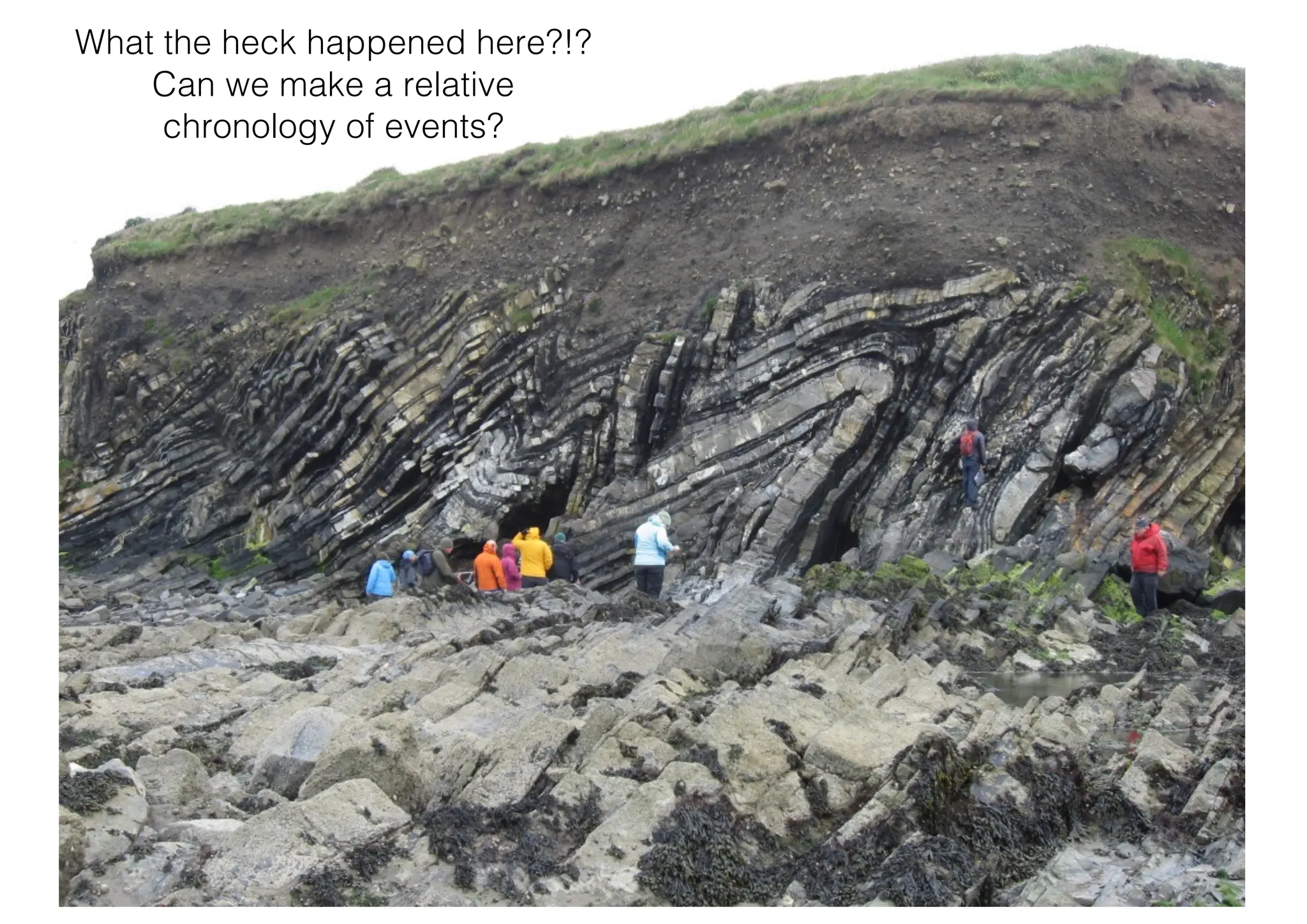
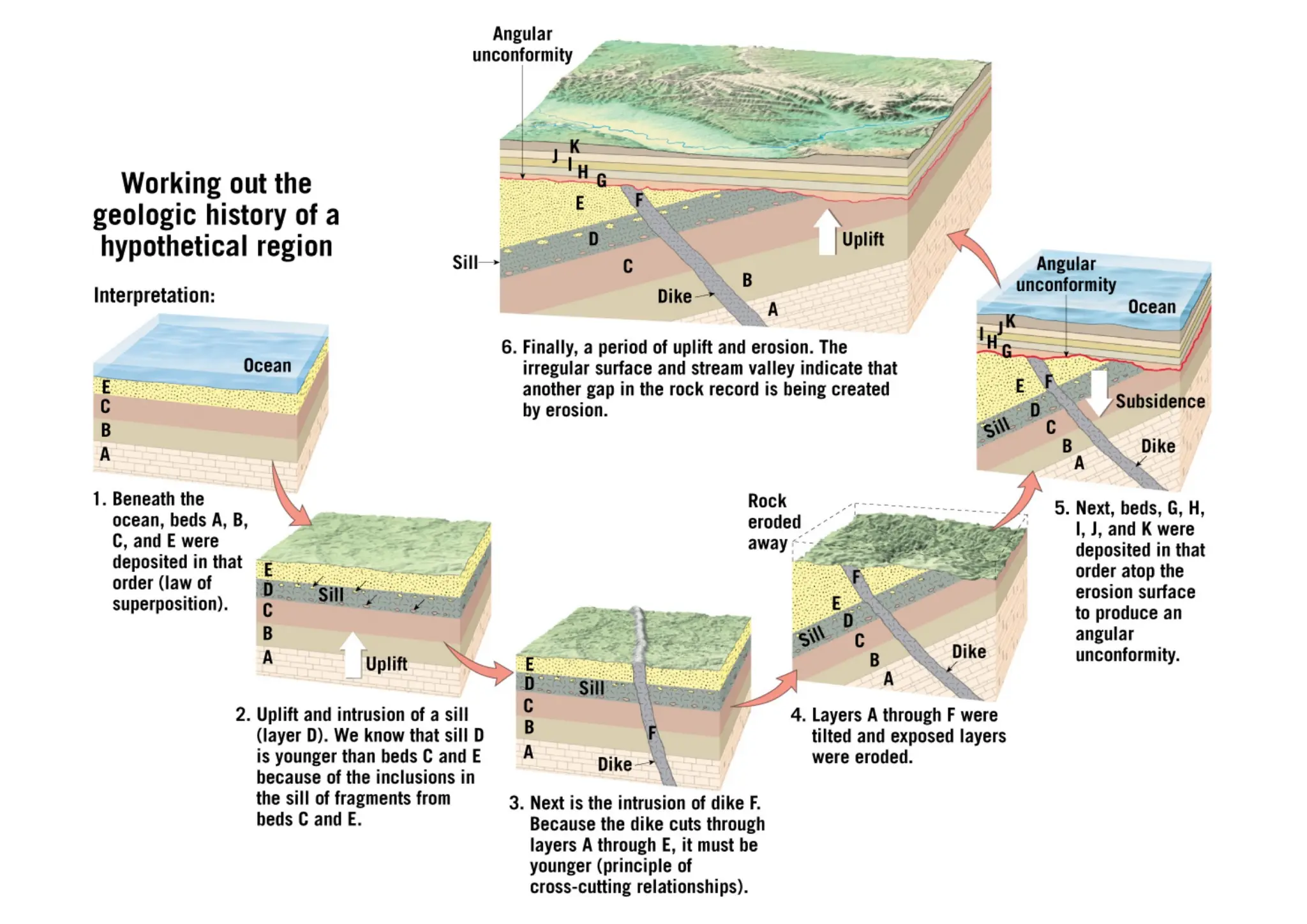
What the heck happened here?!?
Can we make a relative
chronology of events?
Steno’s Laws and Corollaries
Principles of Relative
Time in Geology
• Original Horizontality
• Lateral Continuity
• Superposition
• Cross-cutting Relations
• Included Fragments
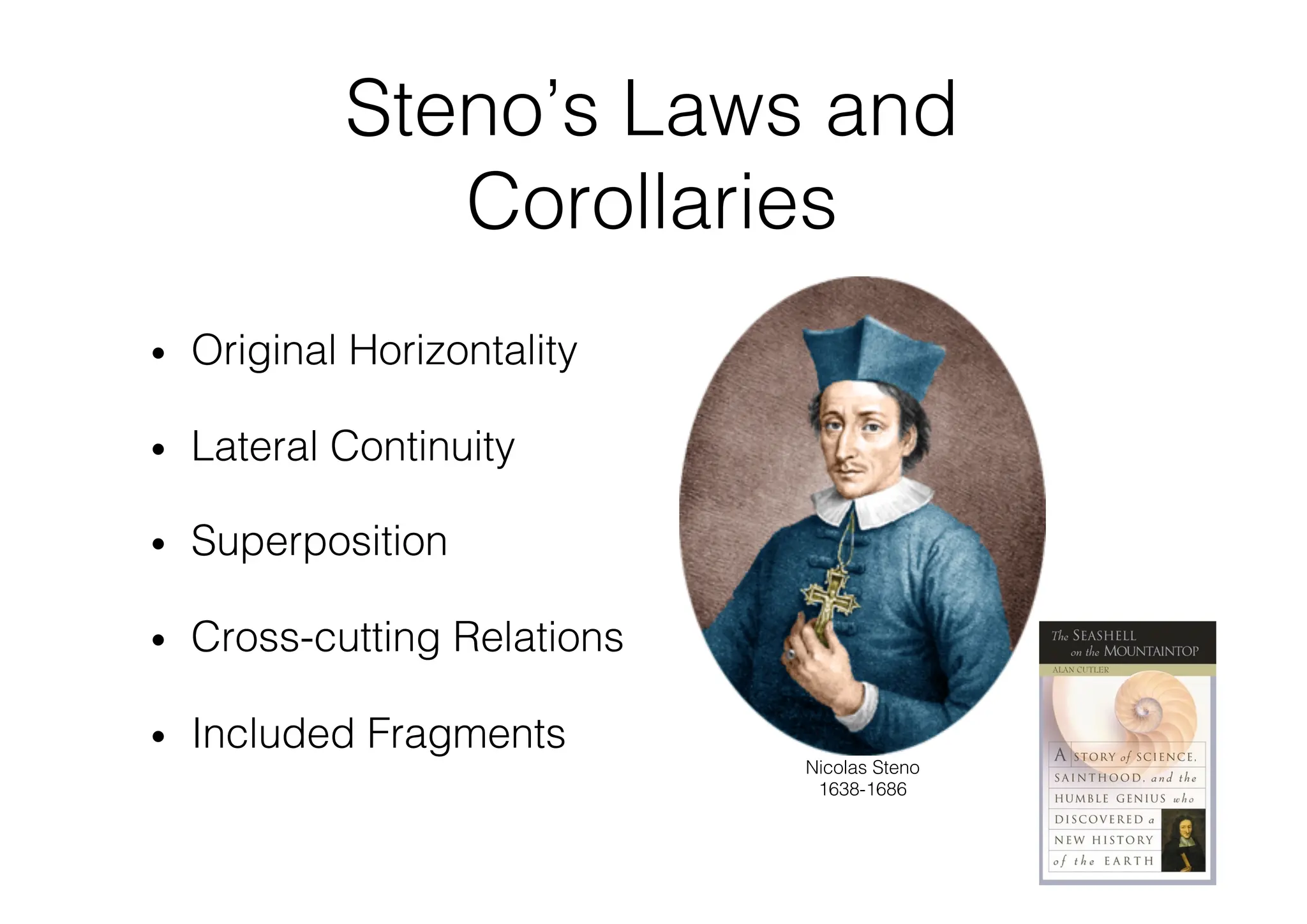
Steno’s Laws and
Corollaries
Nicolas Steno
1638-1686
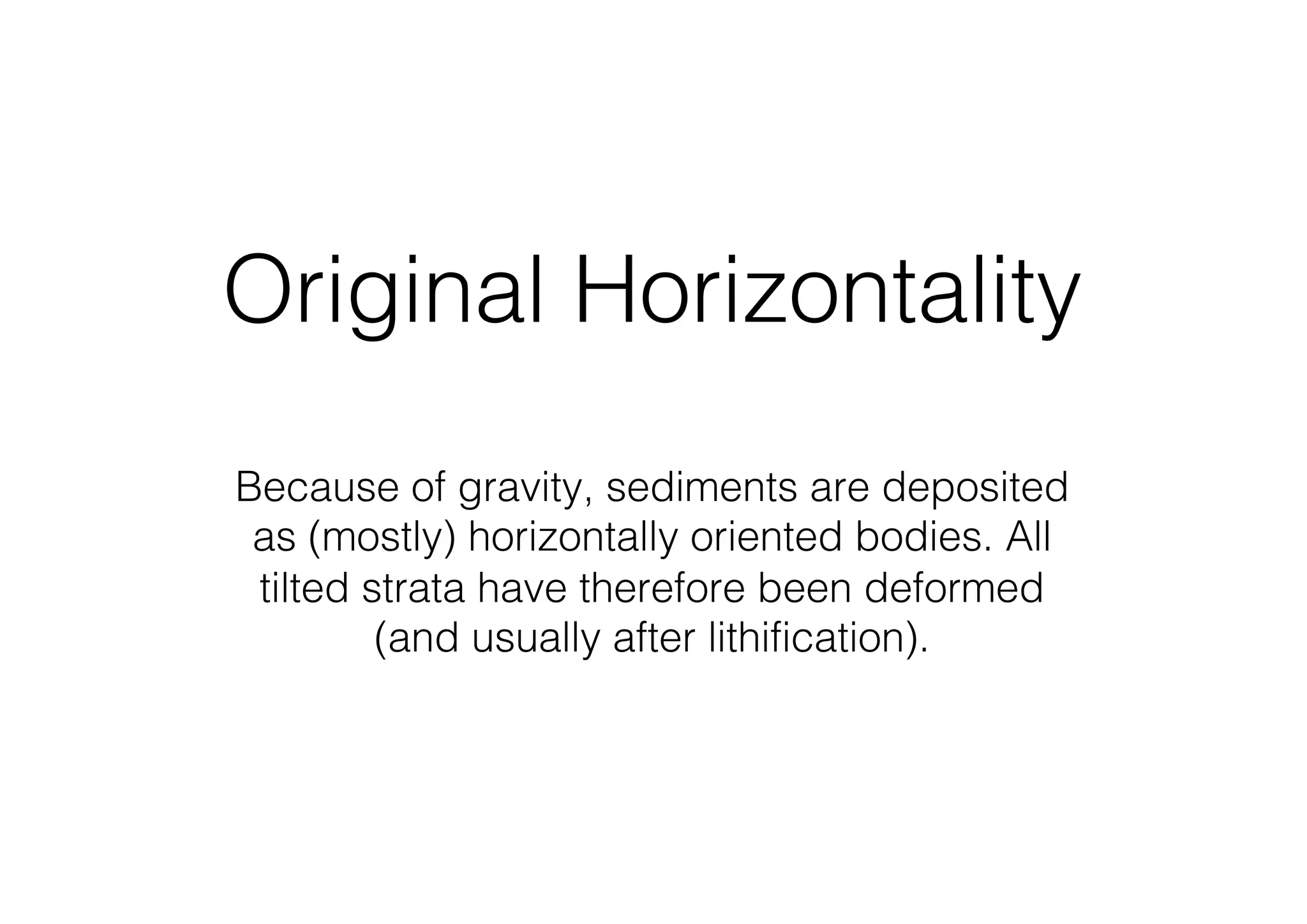
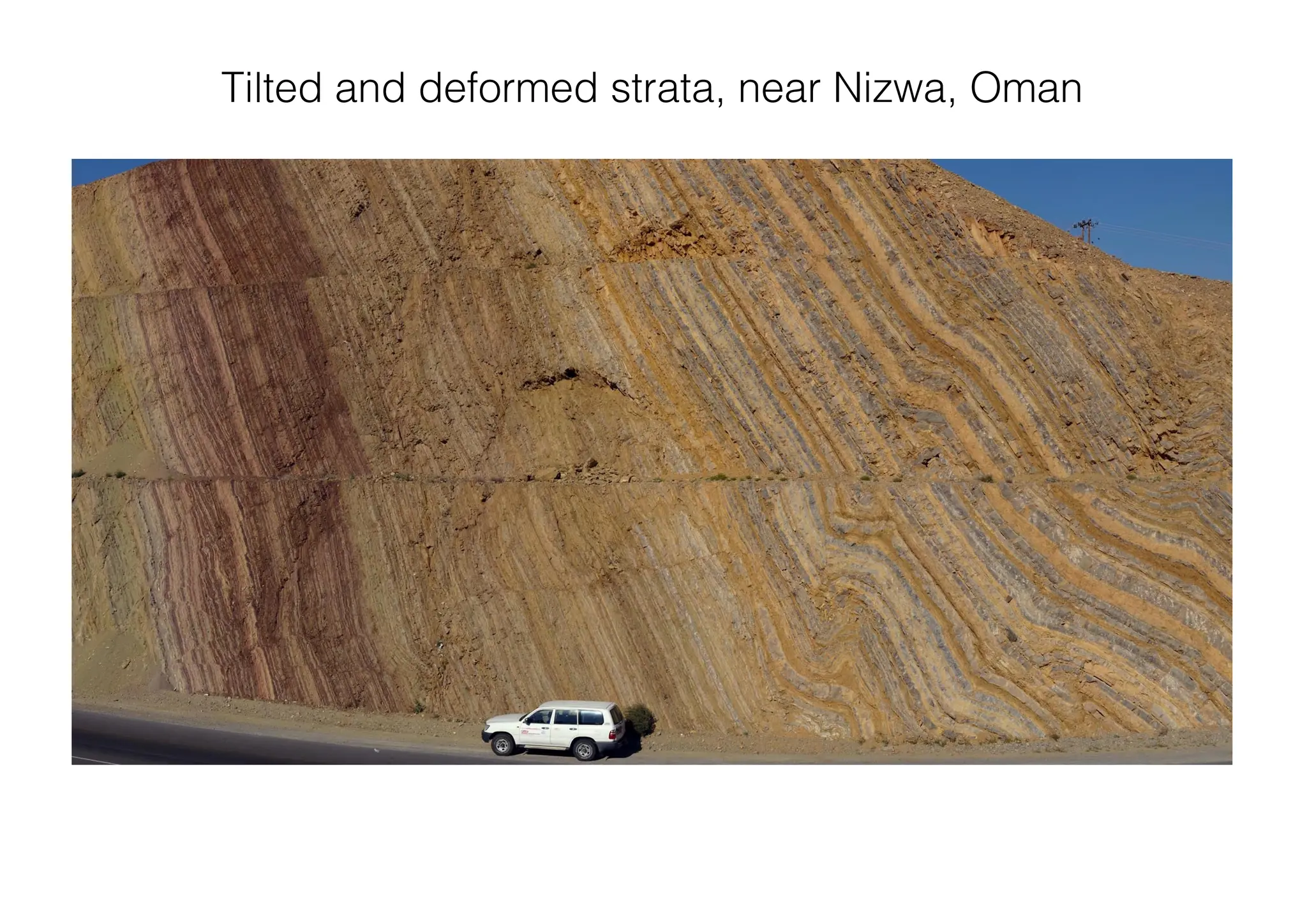
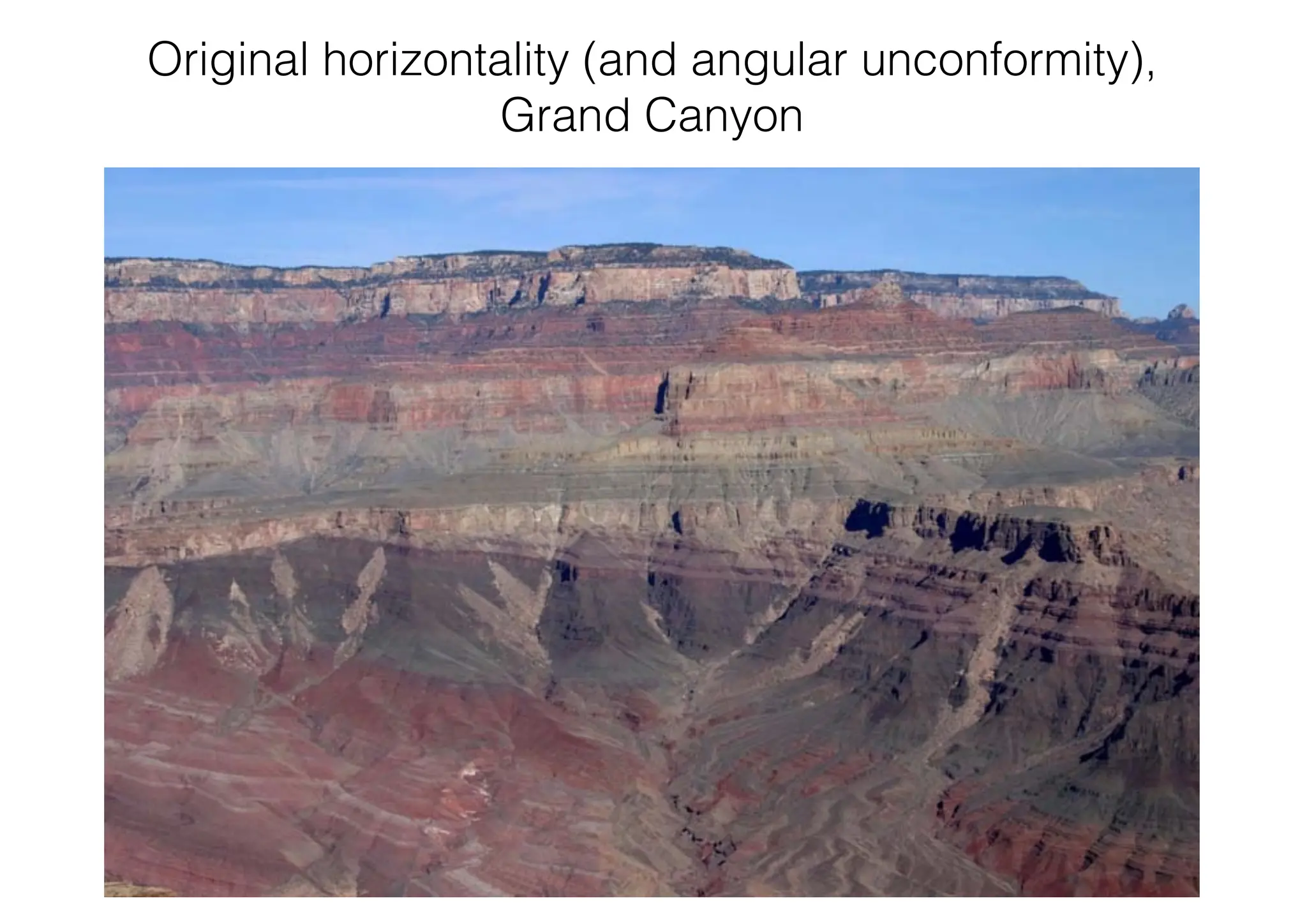
Original Horizontality
Because of gravity, sediments are deposited
as (mostly) horizontally oriented bodies. All
tilted strata have therefore been deformed
(and usually after lithification).
Tilted and deformed strata, near Nizwa, Oman
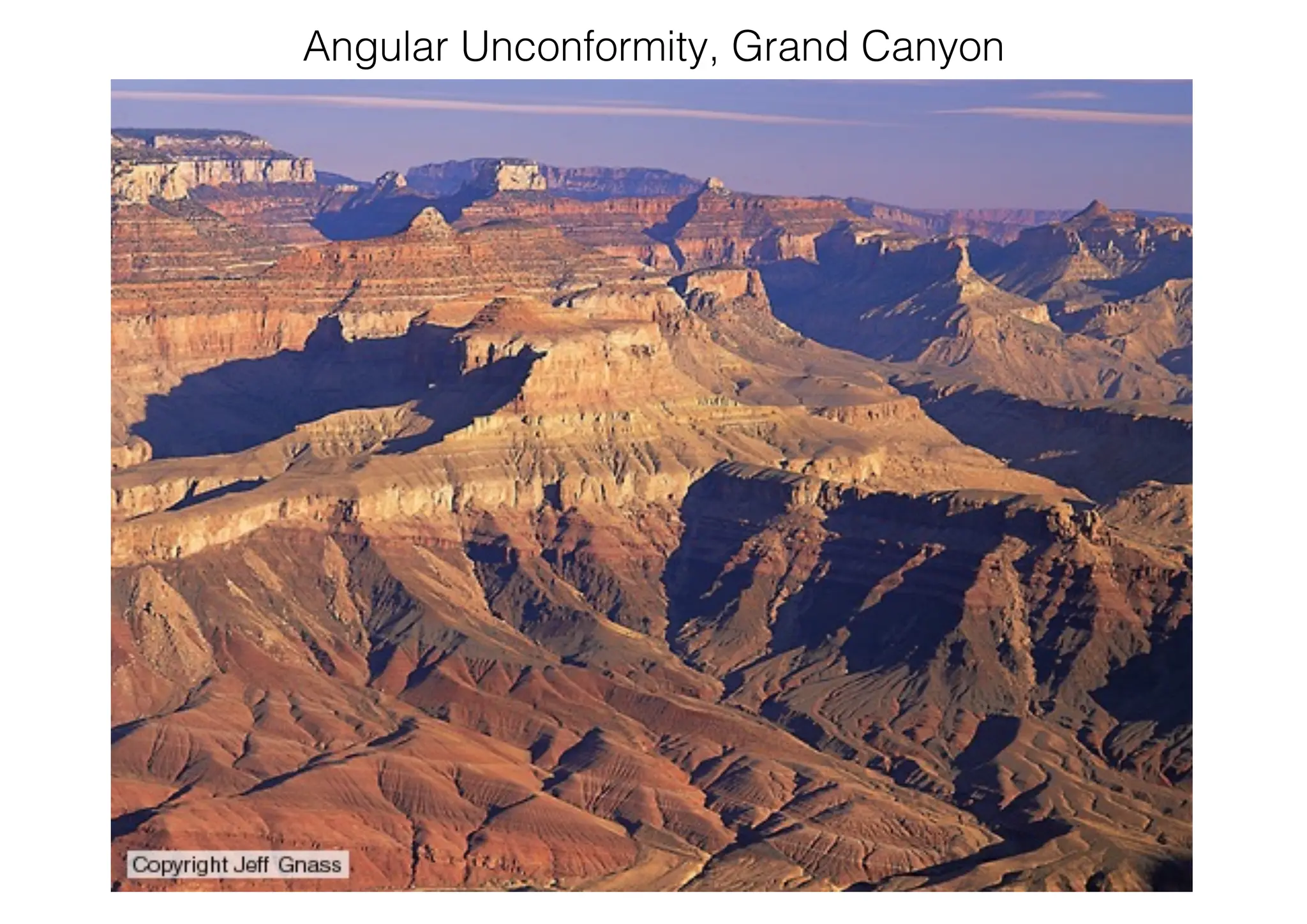
Original horizontality (and angular unconformity),
Grand Canyon
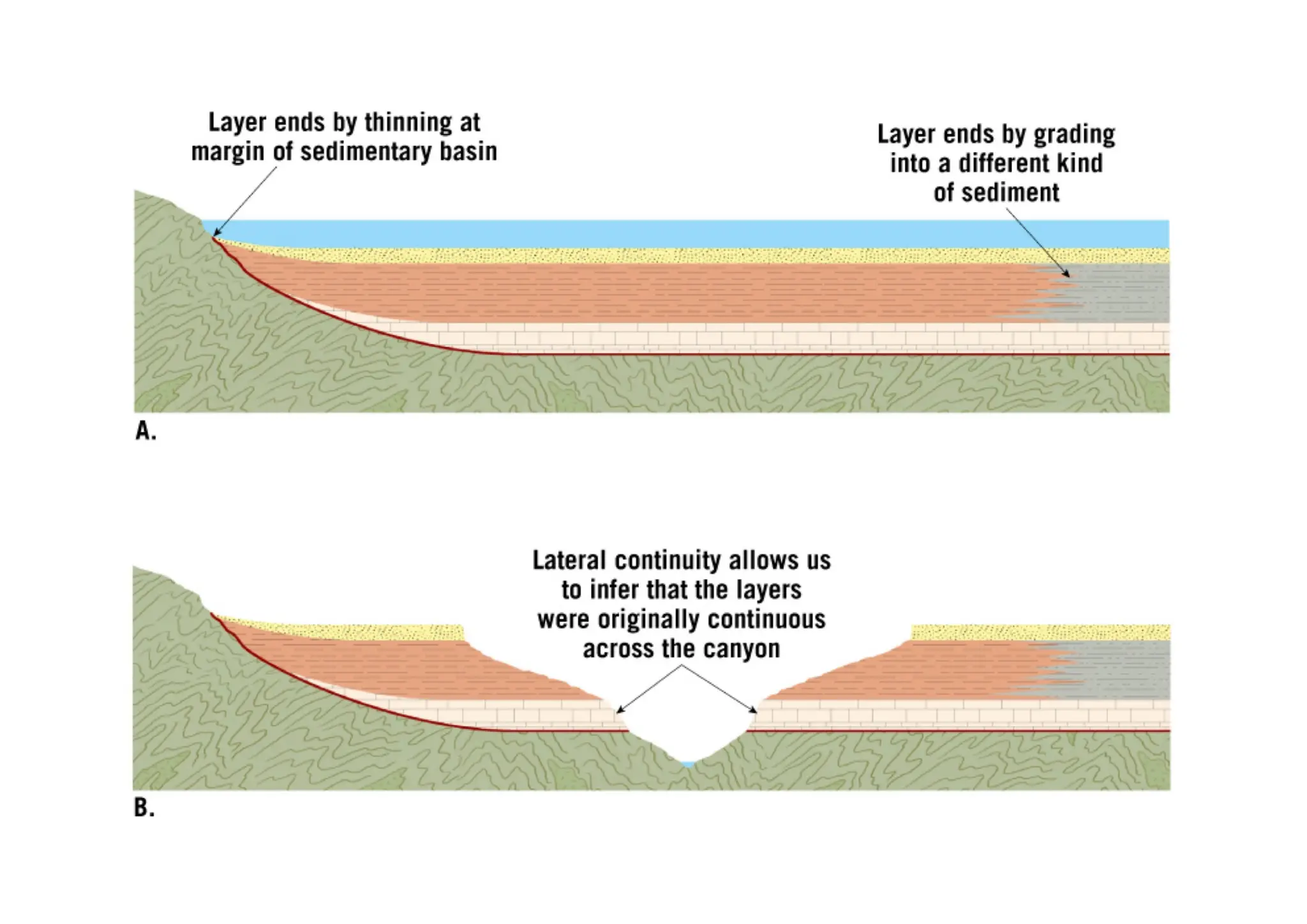
Lateral Continuity
Sediments are deposited generally as tabular
sheets that extend in all directions until they run into
a barrier or decrease laterally because of a lack of
sediment supply. Breaks in the lateral continuity
happen after deposition and lithification.
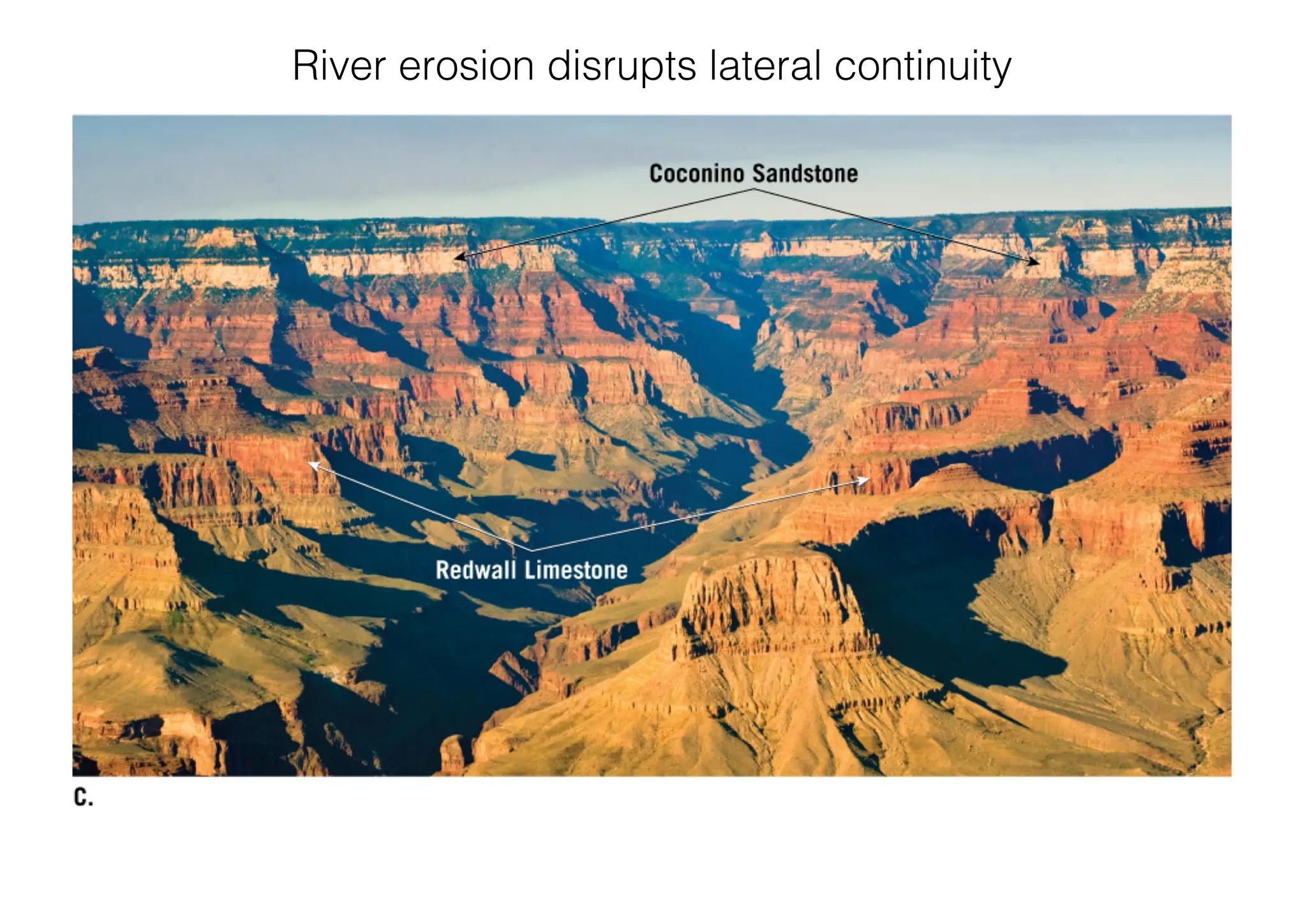
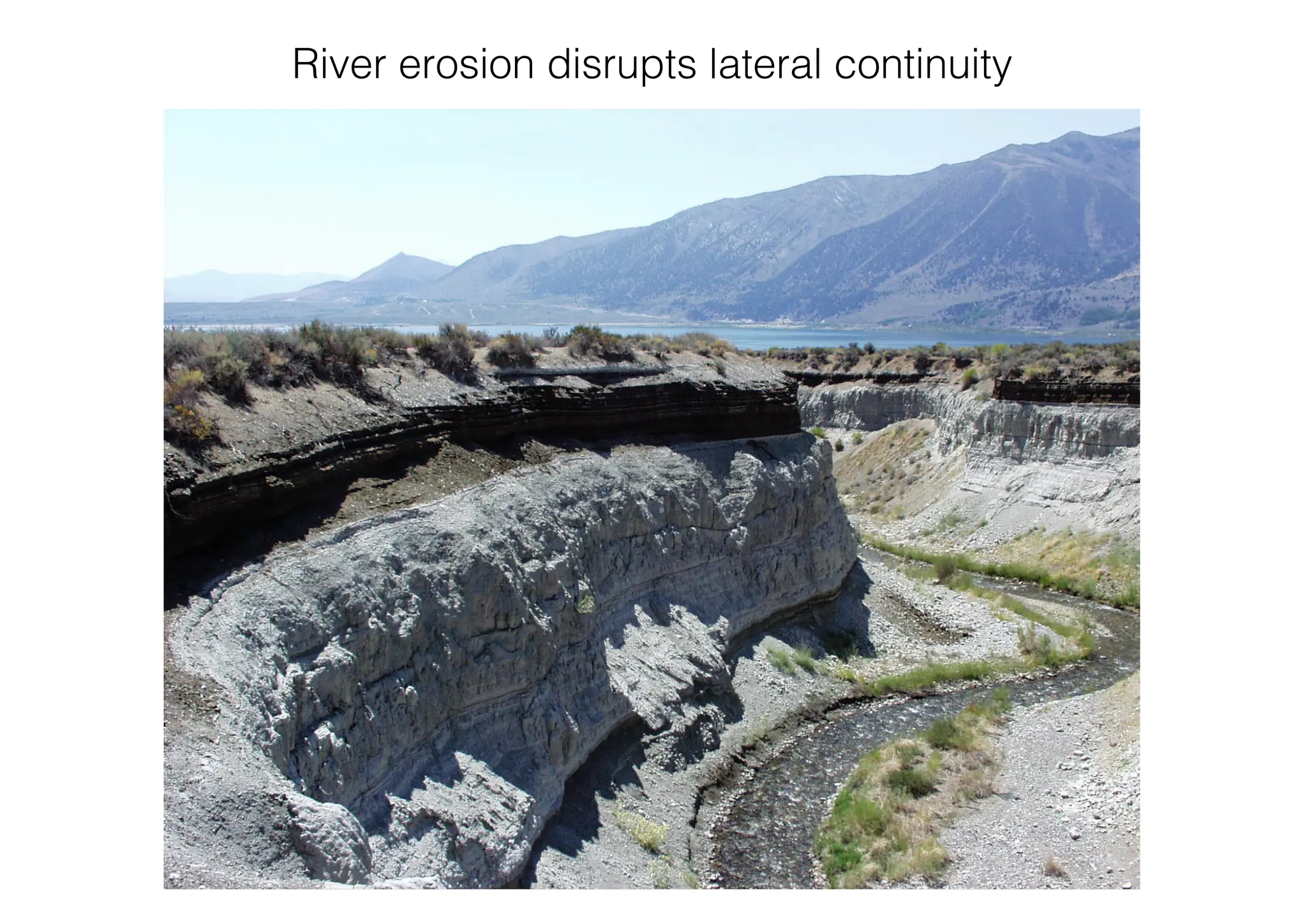
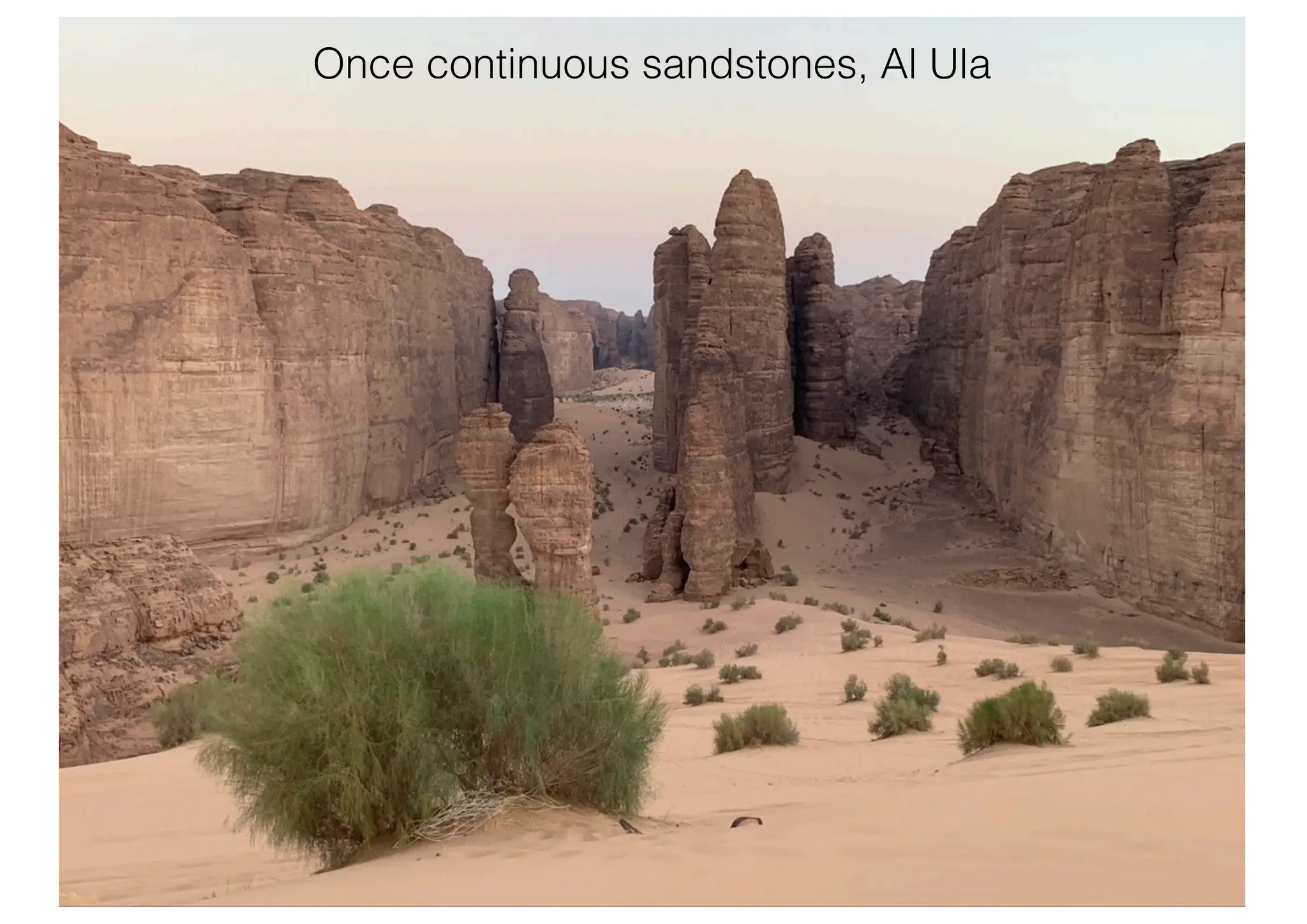
River erosion disrupts lateral continuity
Once continuous sandstones, Al Ula
Superposition
In a succession of sedimentary rocks that has not
been deformed, each rock unit is younger than the
unit below it, and older than the unit above it.
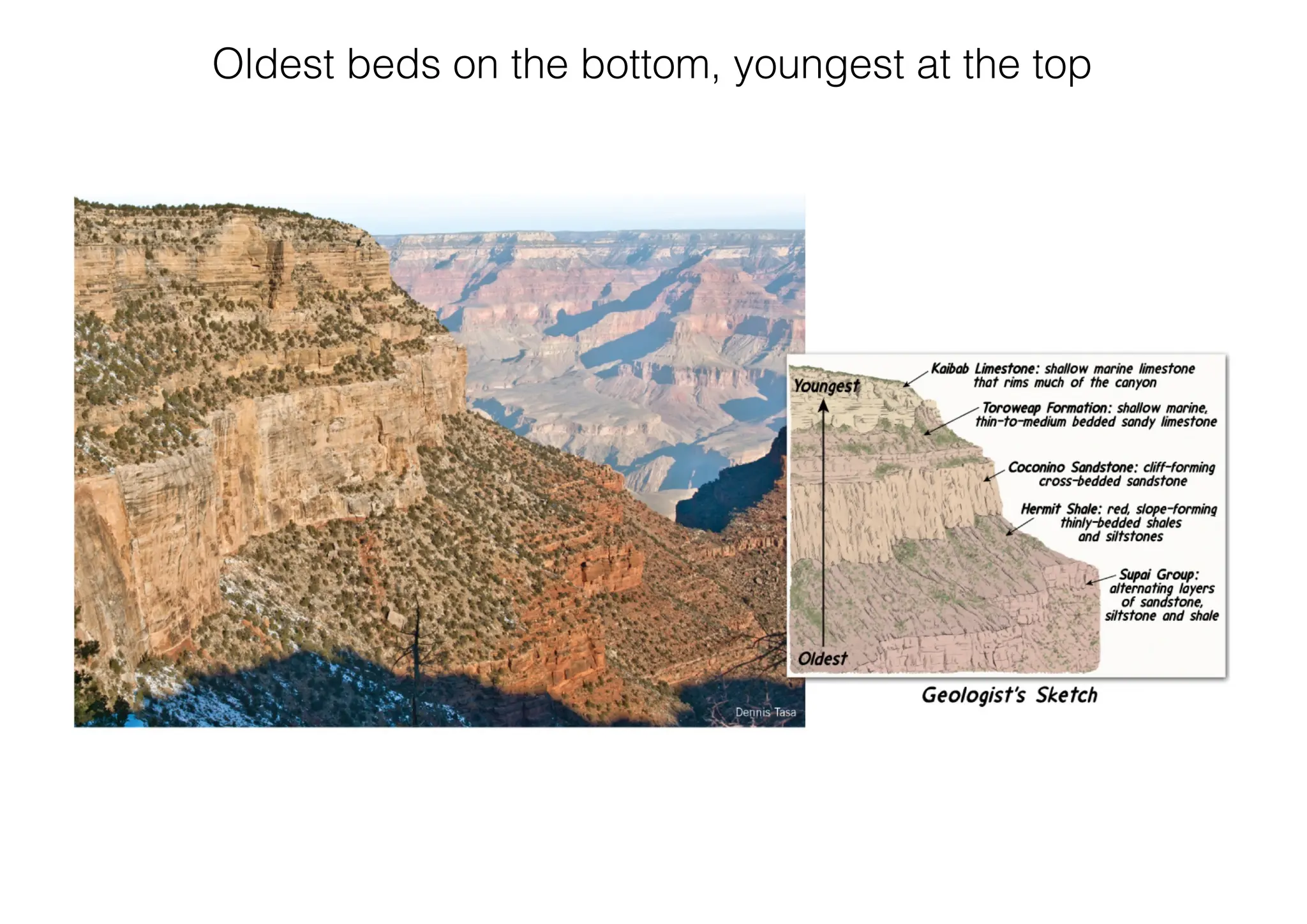
Oldest beds on the bottom, youngest at the top
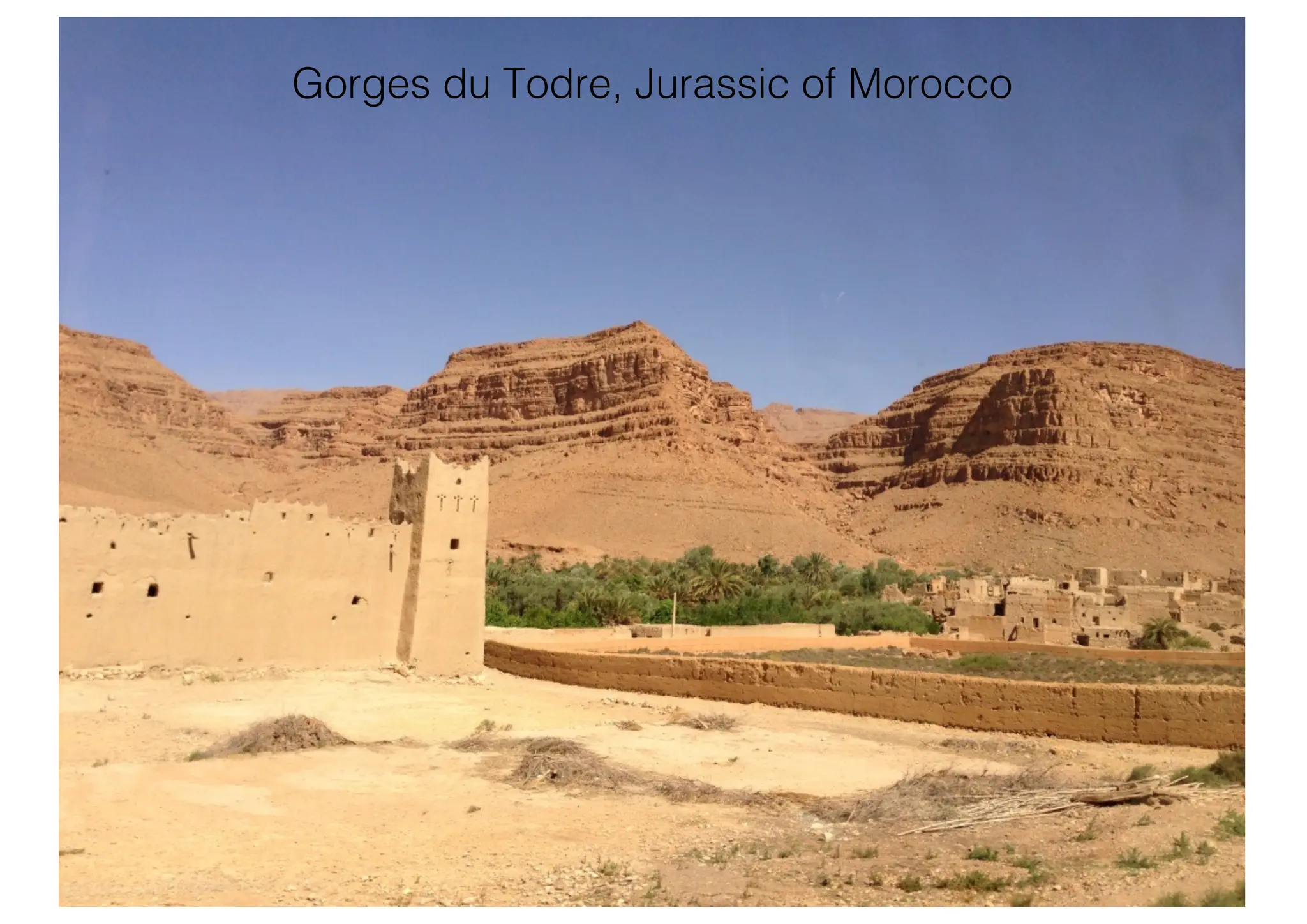
Gorges du Todre, Jurassic of Morocco
Cross-Cutting Relations
Fractures, faults, and intrusions that cut
across rock are necessarily younger than the
rock through which they cut
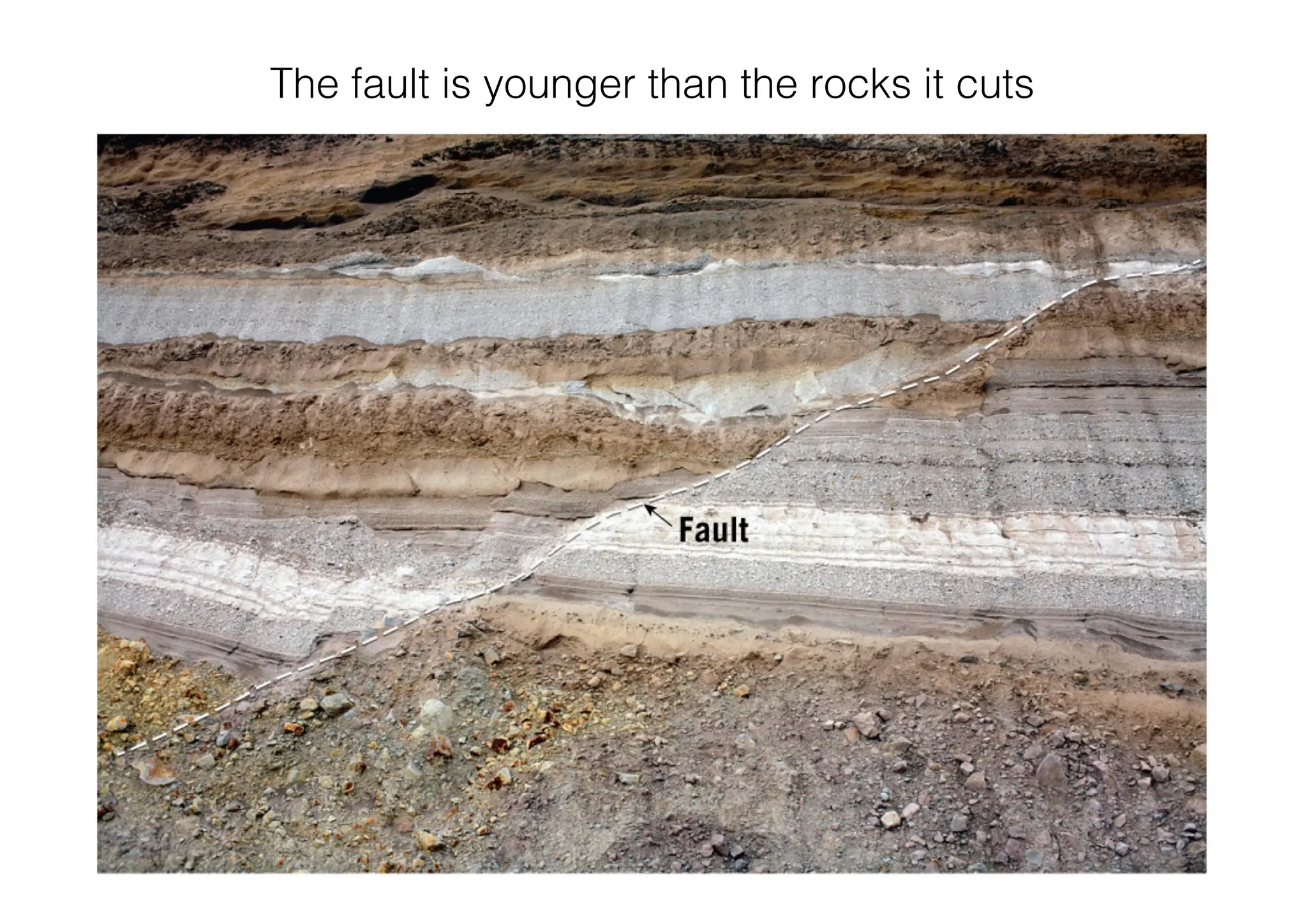
The fault is younger than the rocks it cuts
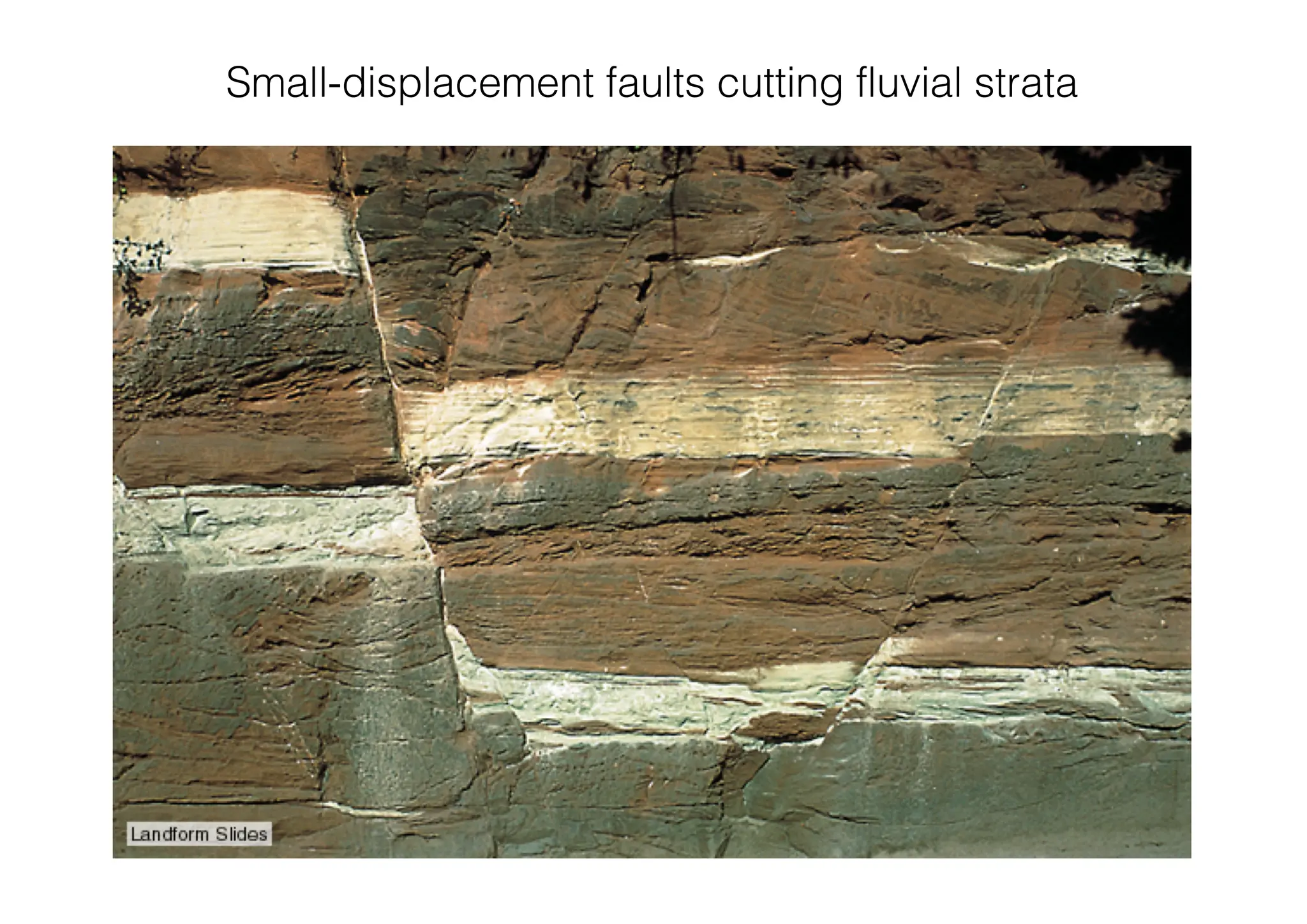
Small-displacement faults cutting fluvial strata
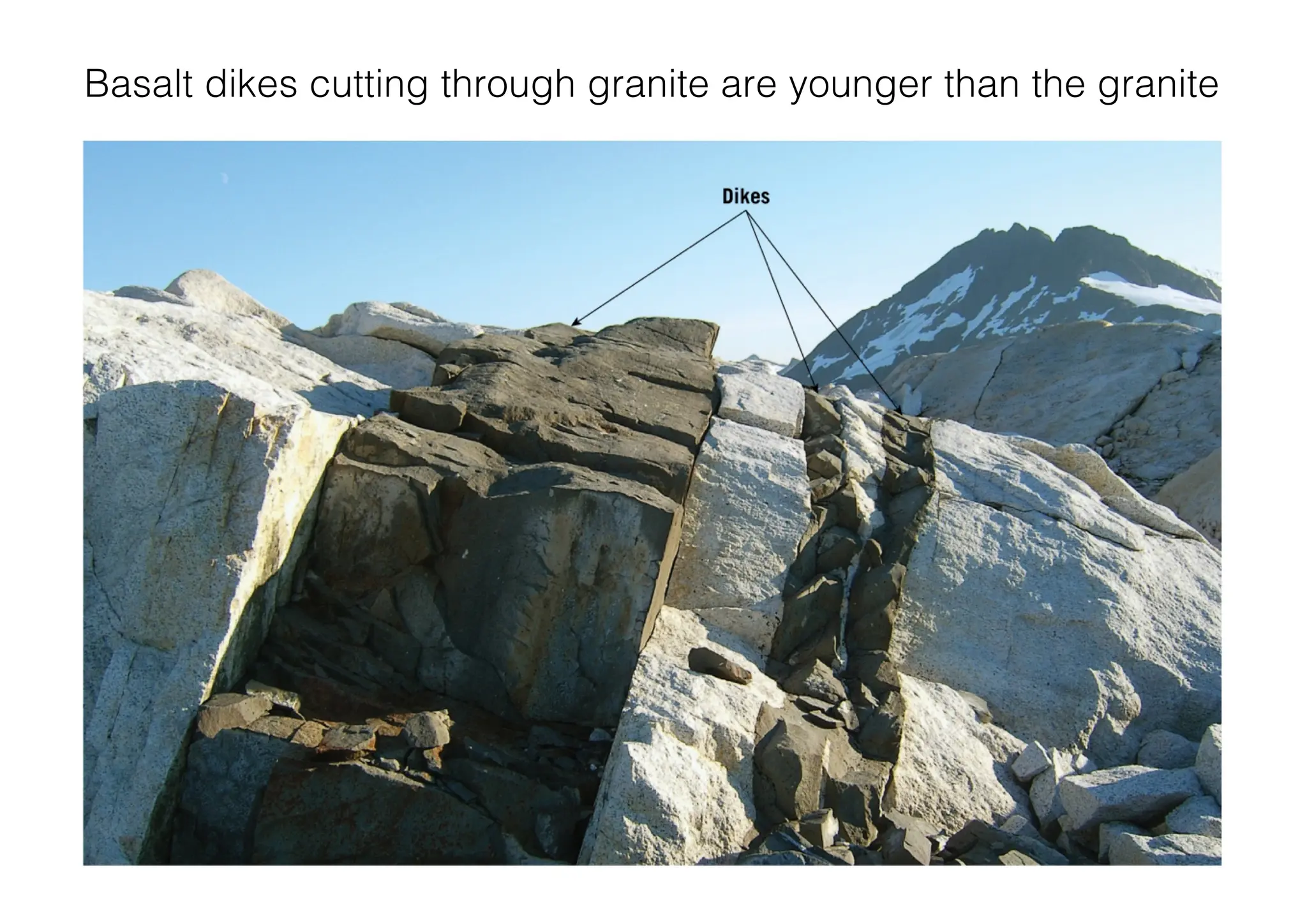
Basalt dikes cutting through granite are younger than the granite
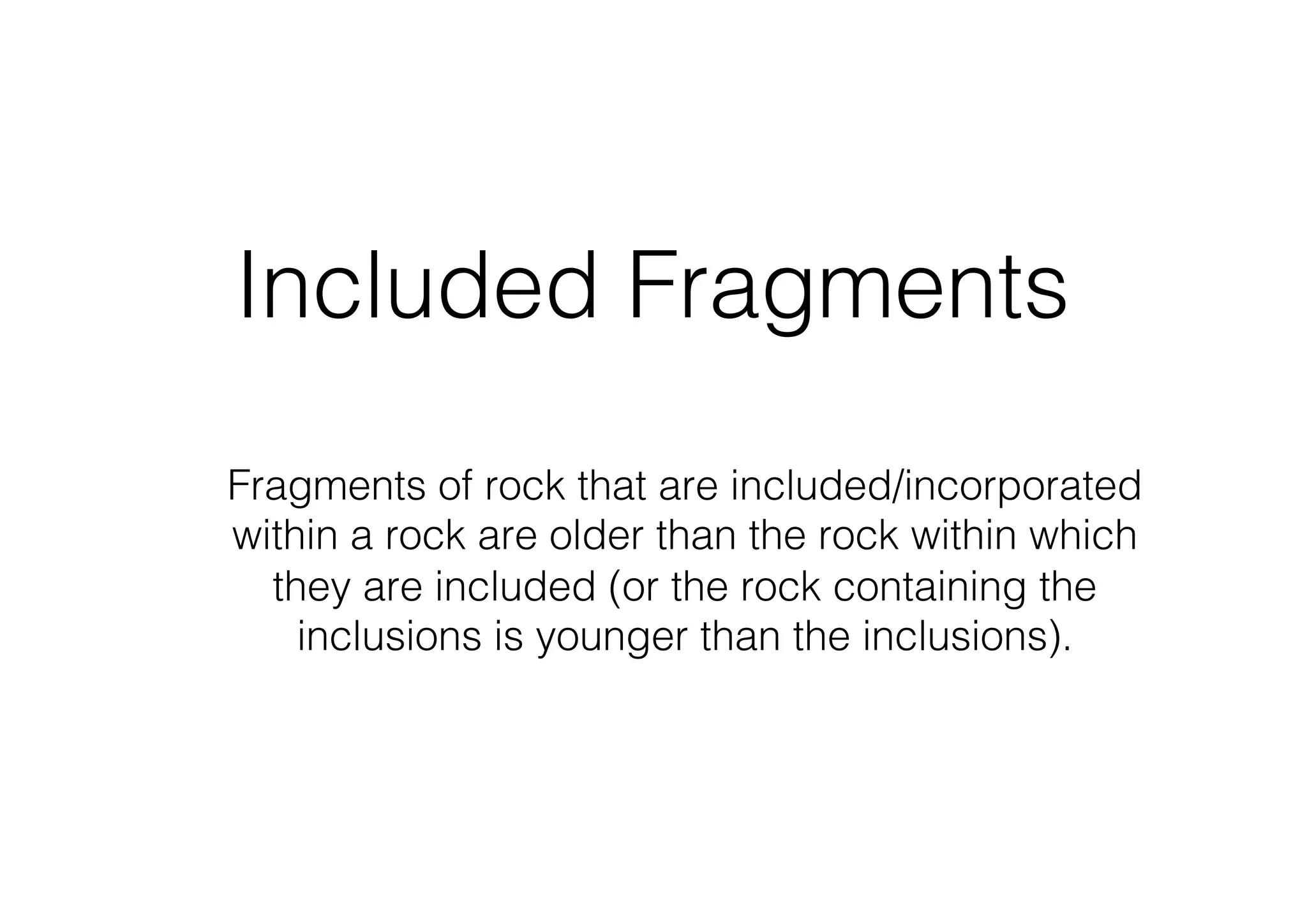
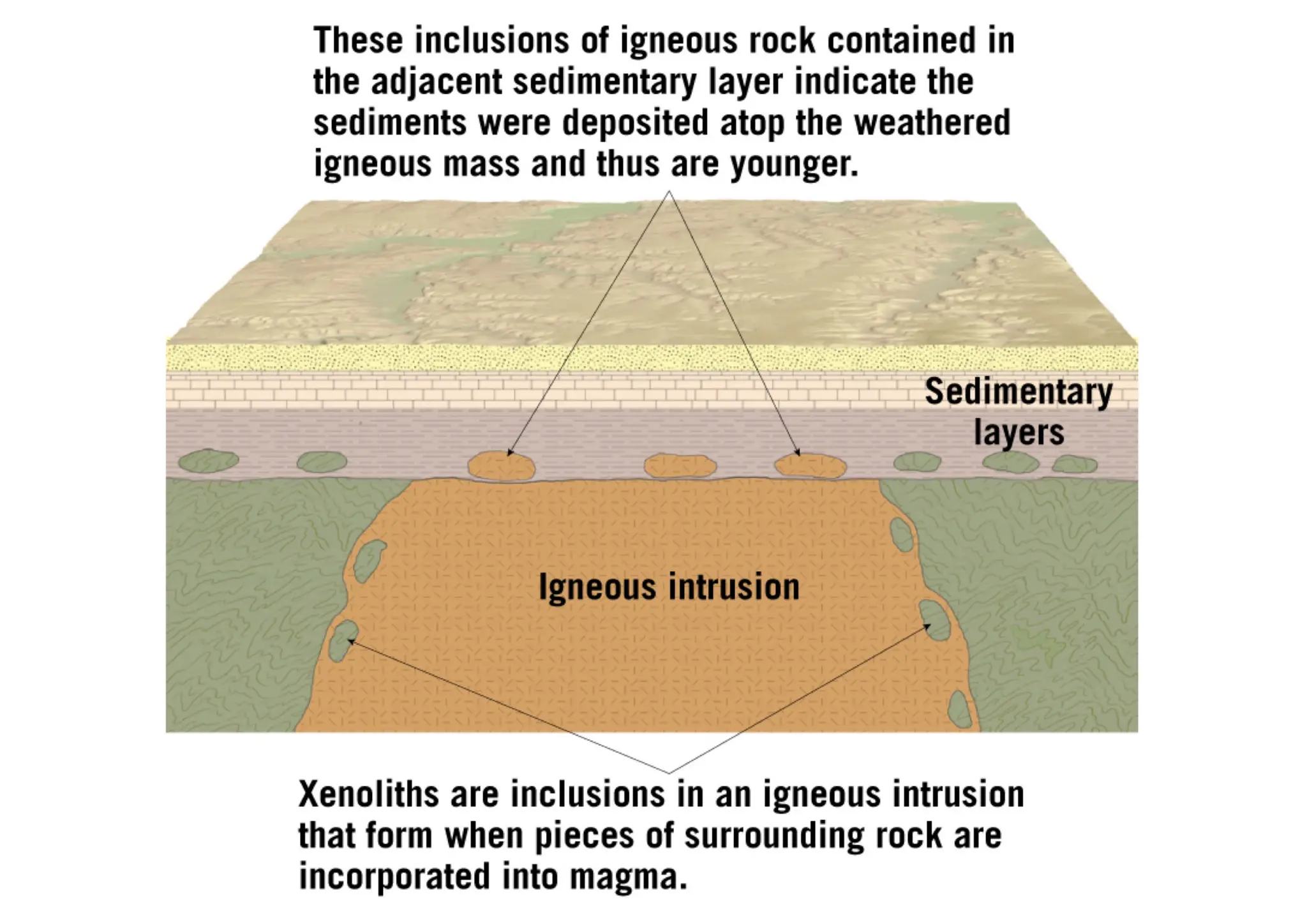
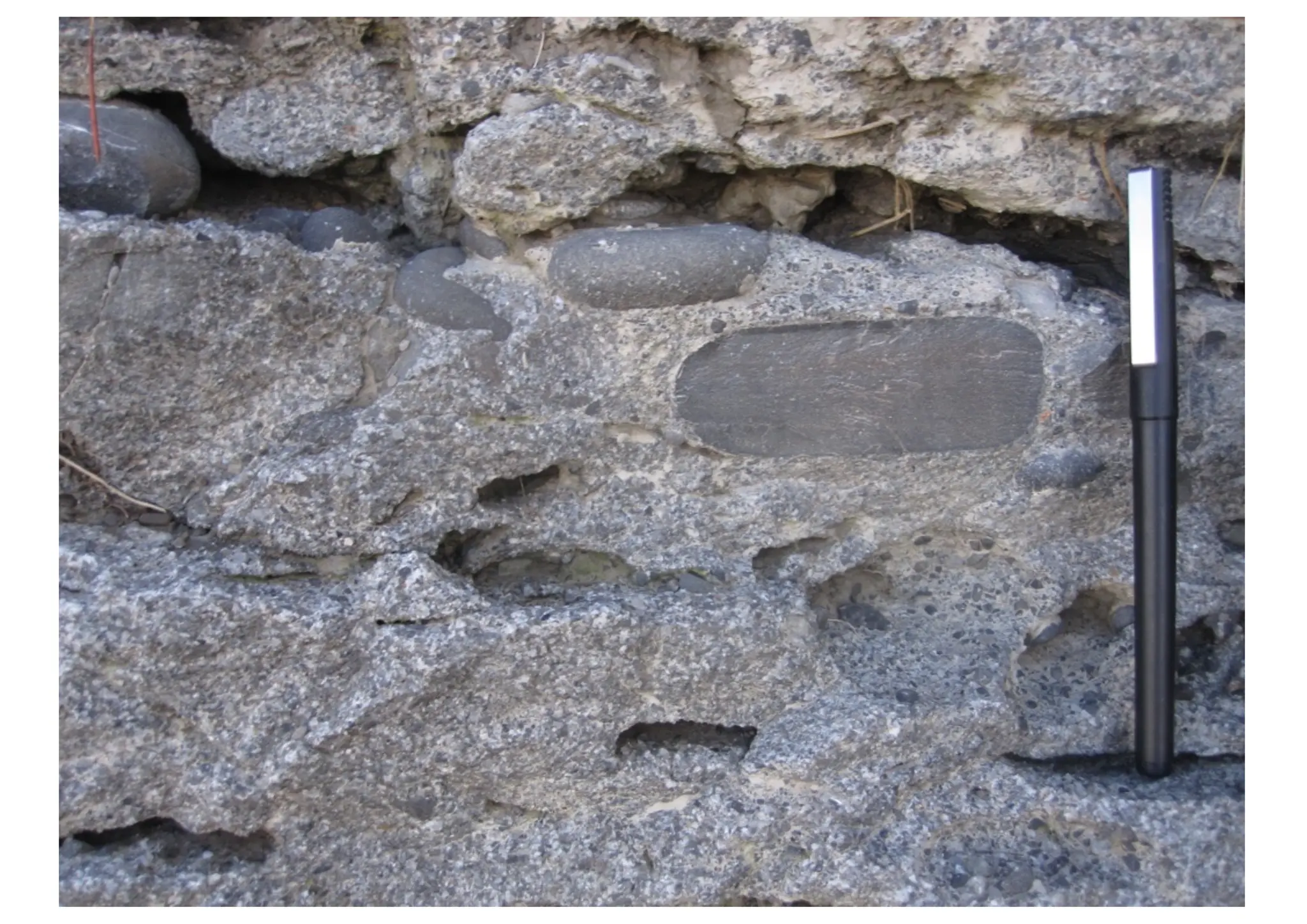
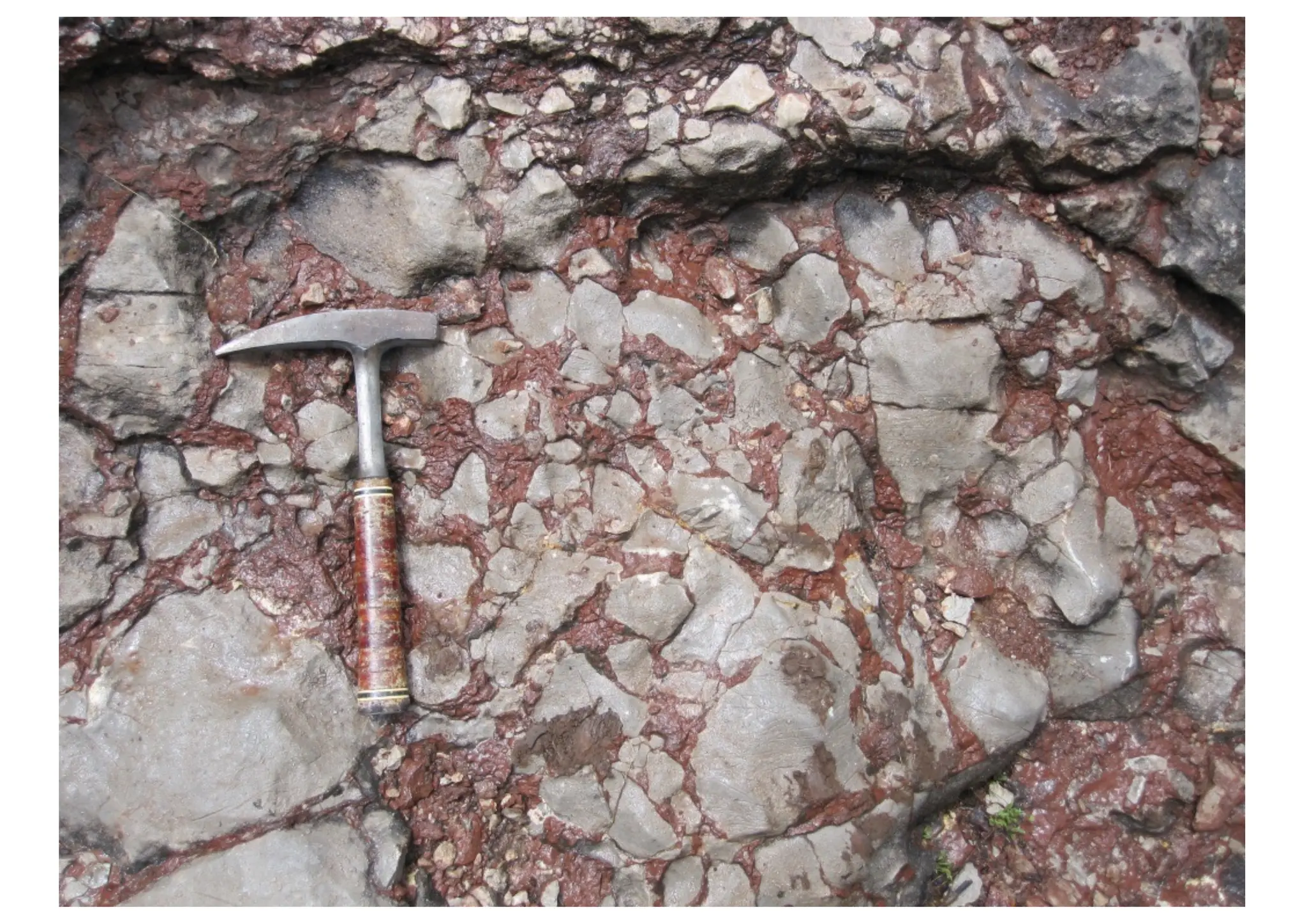
Included Fragments
Fragments of rock that are included/incorporated
within a rock are older than the rock within which
they are included (or the rock containing the
inclusions is younger than the inclusions).
Unconformities - “Missing Time”
• Layers of rock that were deposited without
interruption are called conformable layers
• However, periods of erosion or non-deposition can
produce substantial gaps in the stratigraphic
record
• Unconformities, or “missing time”, are surfaces
with no stratigraphic record of that duration of
geologic time at that location
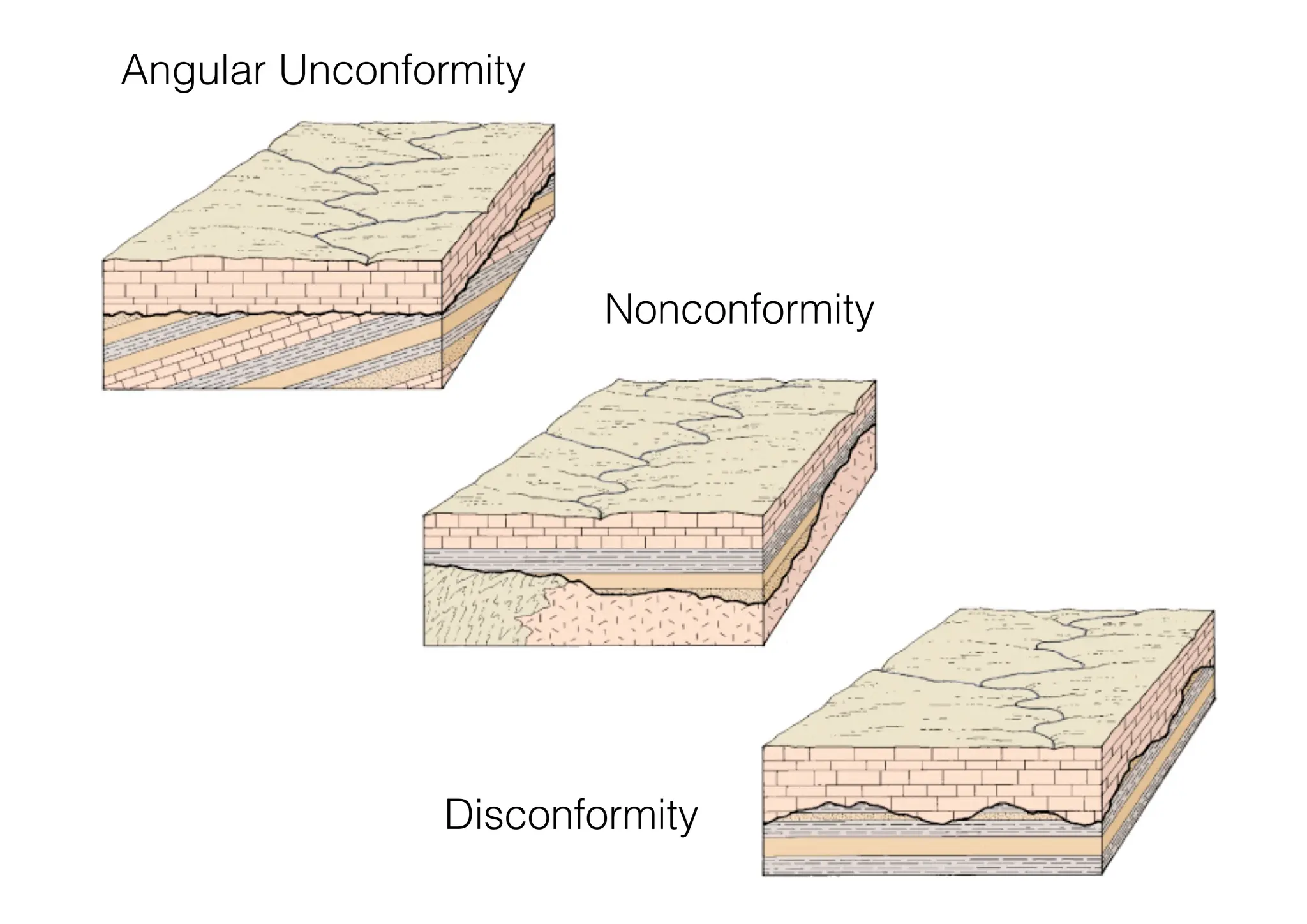
Types of Unconformities
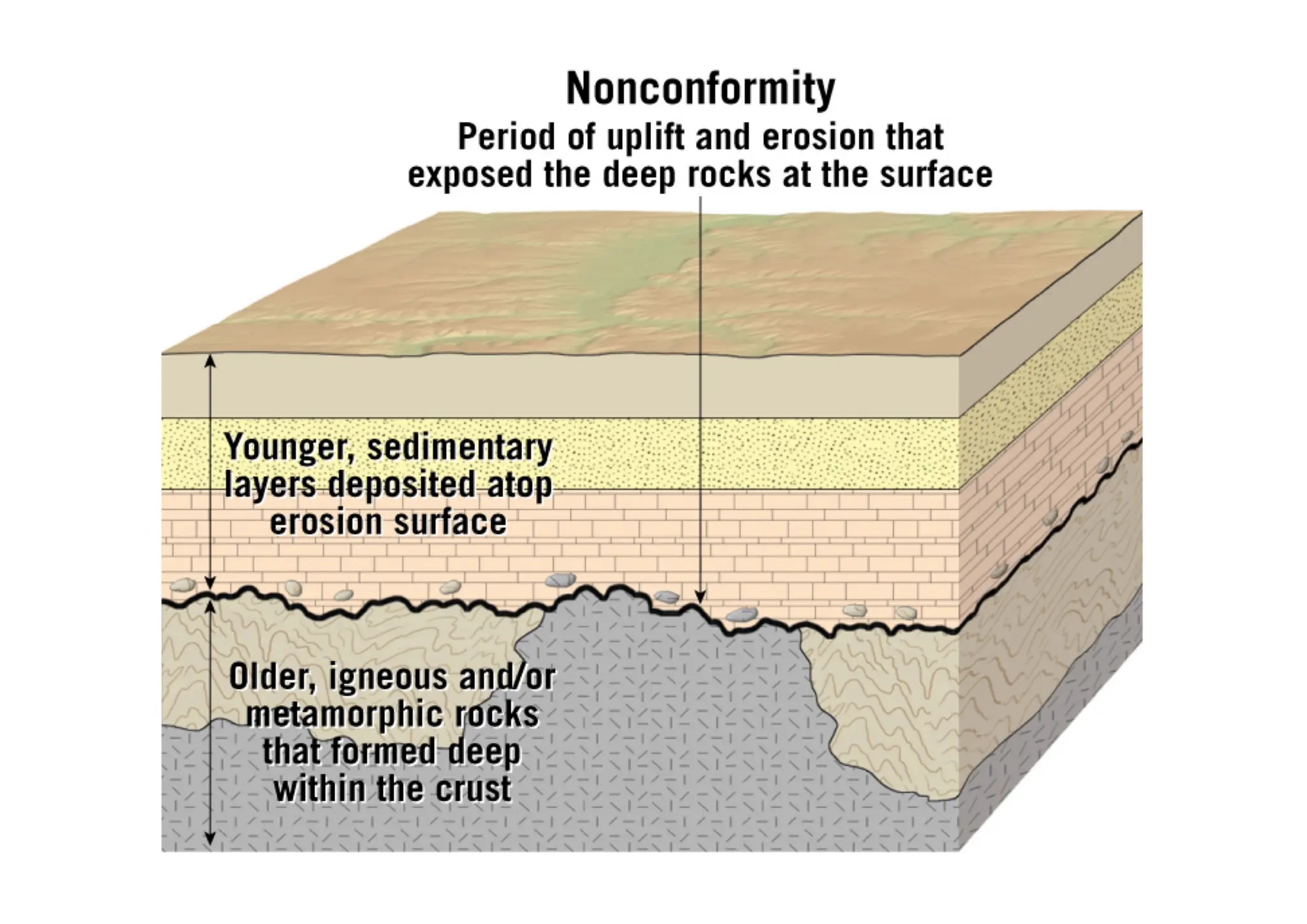
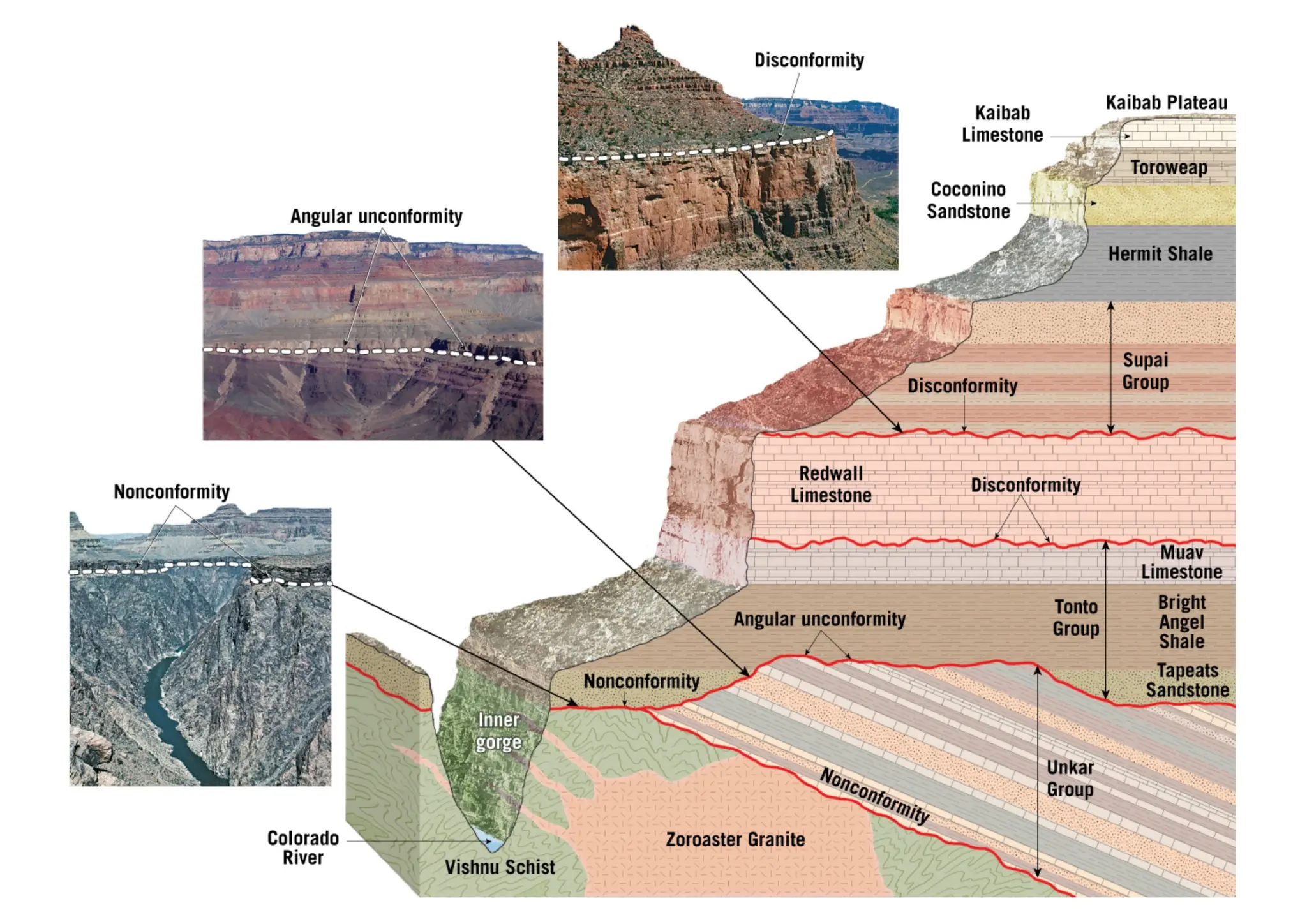
• Nonconformity - sedimentary strata directly overlie
basement igneous and/or metamorphic rock
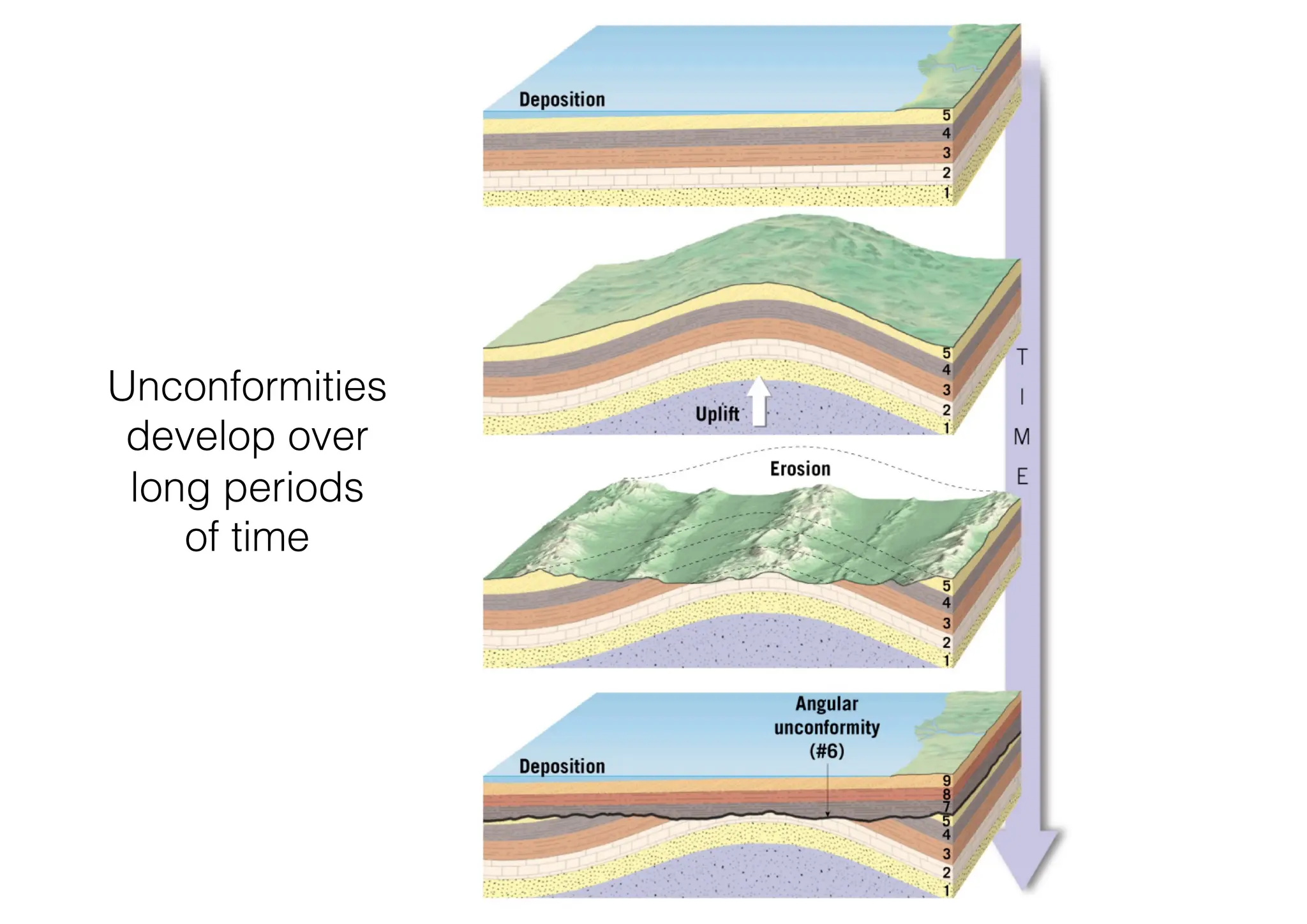
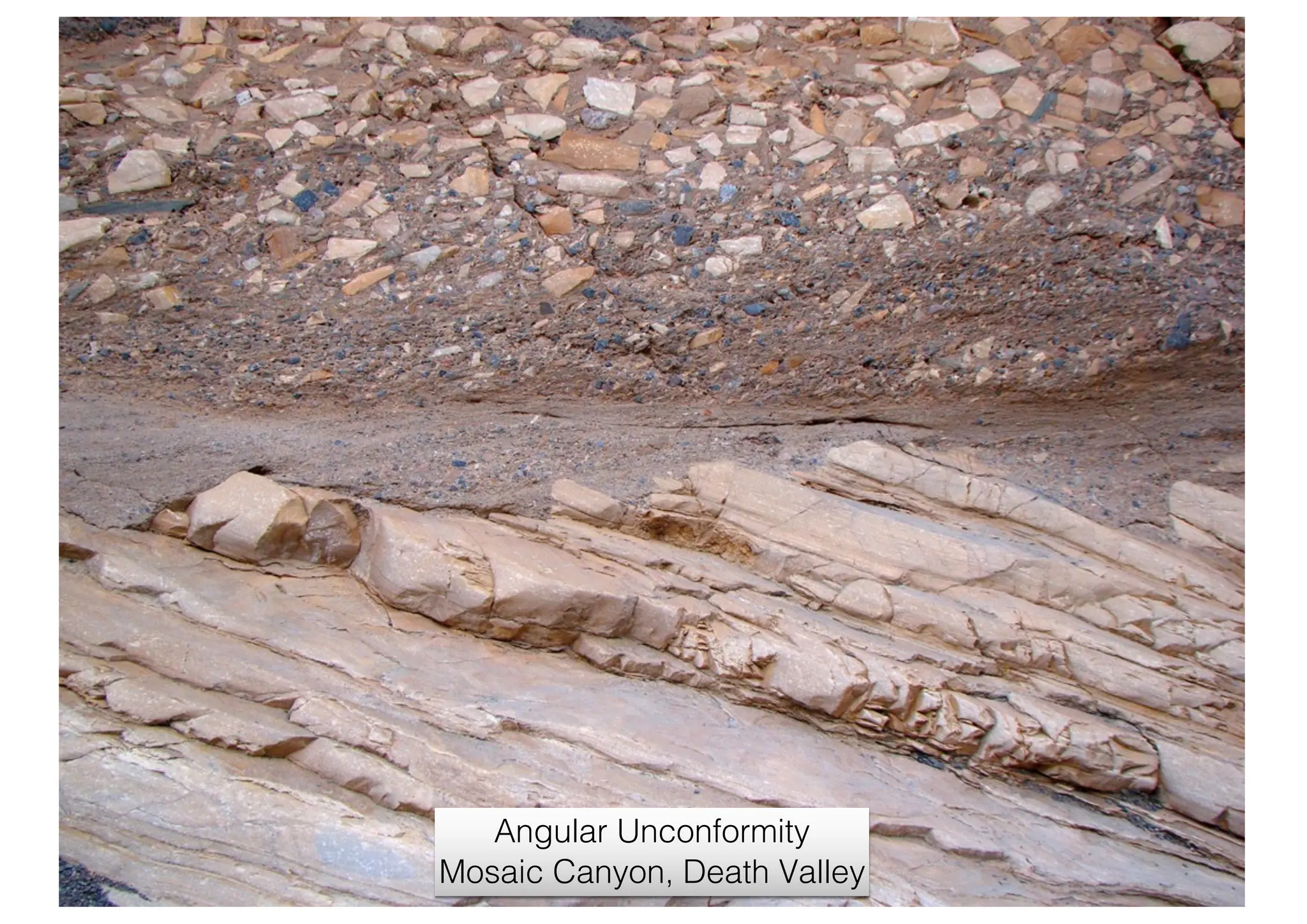
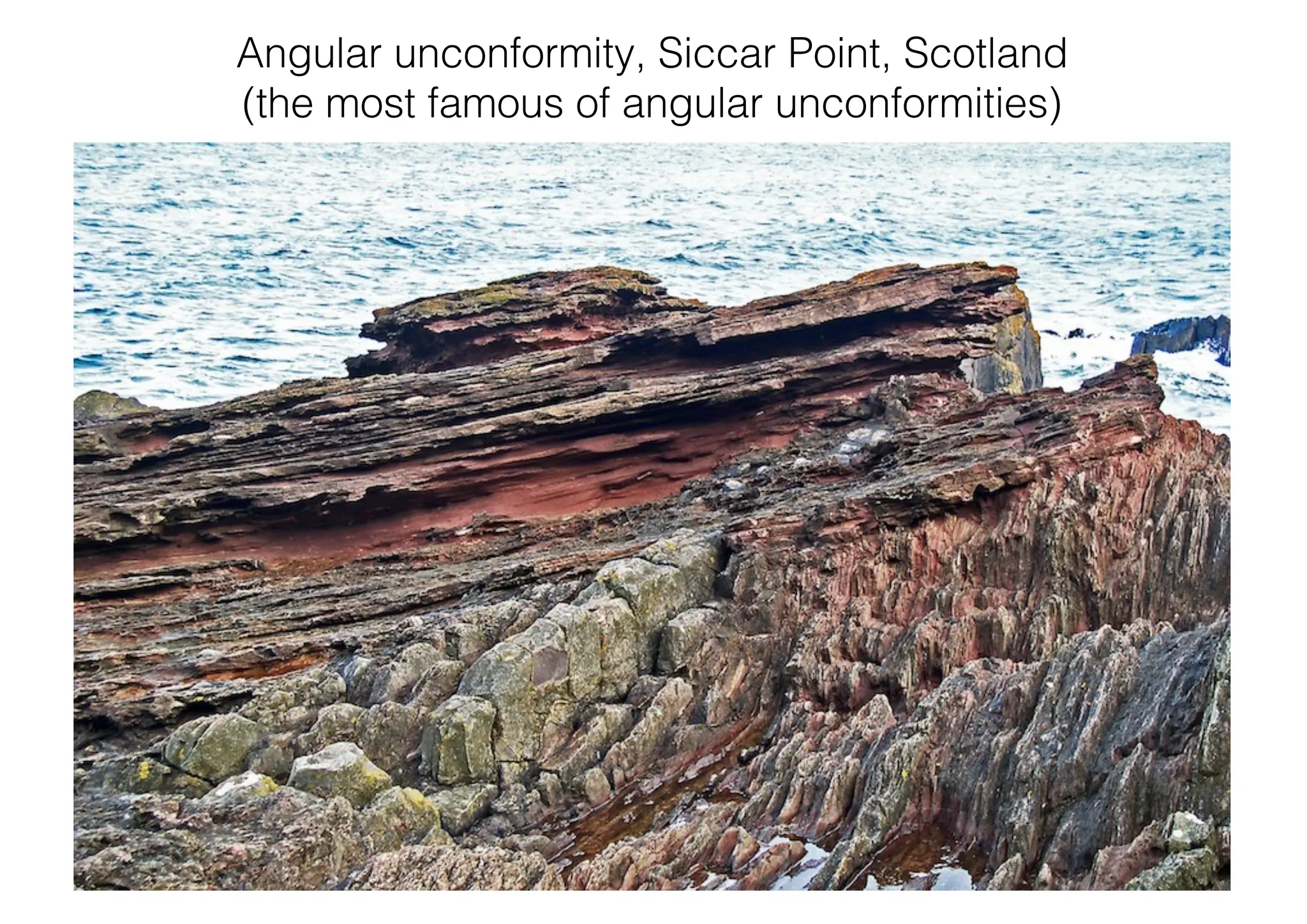
• Angular Unconformity - angular relationship
between overlying and underlying strata. Implies
tilting, erosion, deposition
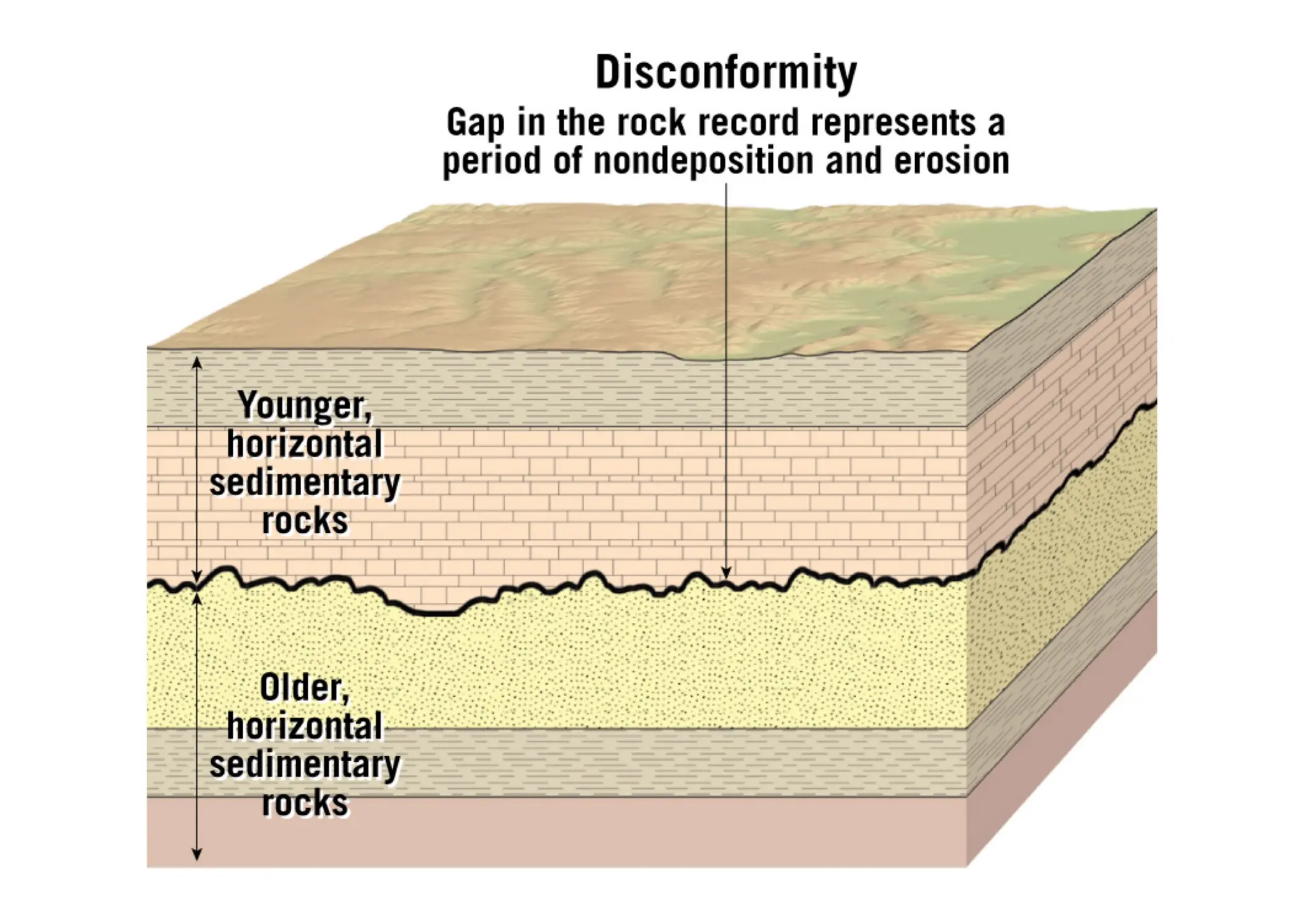
• Disconformity - sedimentary strata are parallel with
one another, but there is obvious evidence for
erosion at the boundary
Disconformity
Nonconformity
Angular Unconformity
Unconformities
develop over
long periods
of time
Angular Unconformity
Mosaic Canyon, Death Valley
Angular unconformity, Siccar Point, Scotland
(the most famous of angular unconformities)
Angular Unconformity, Grand Canyon
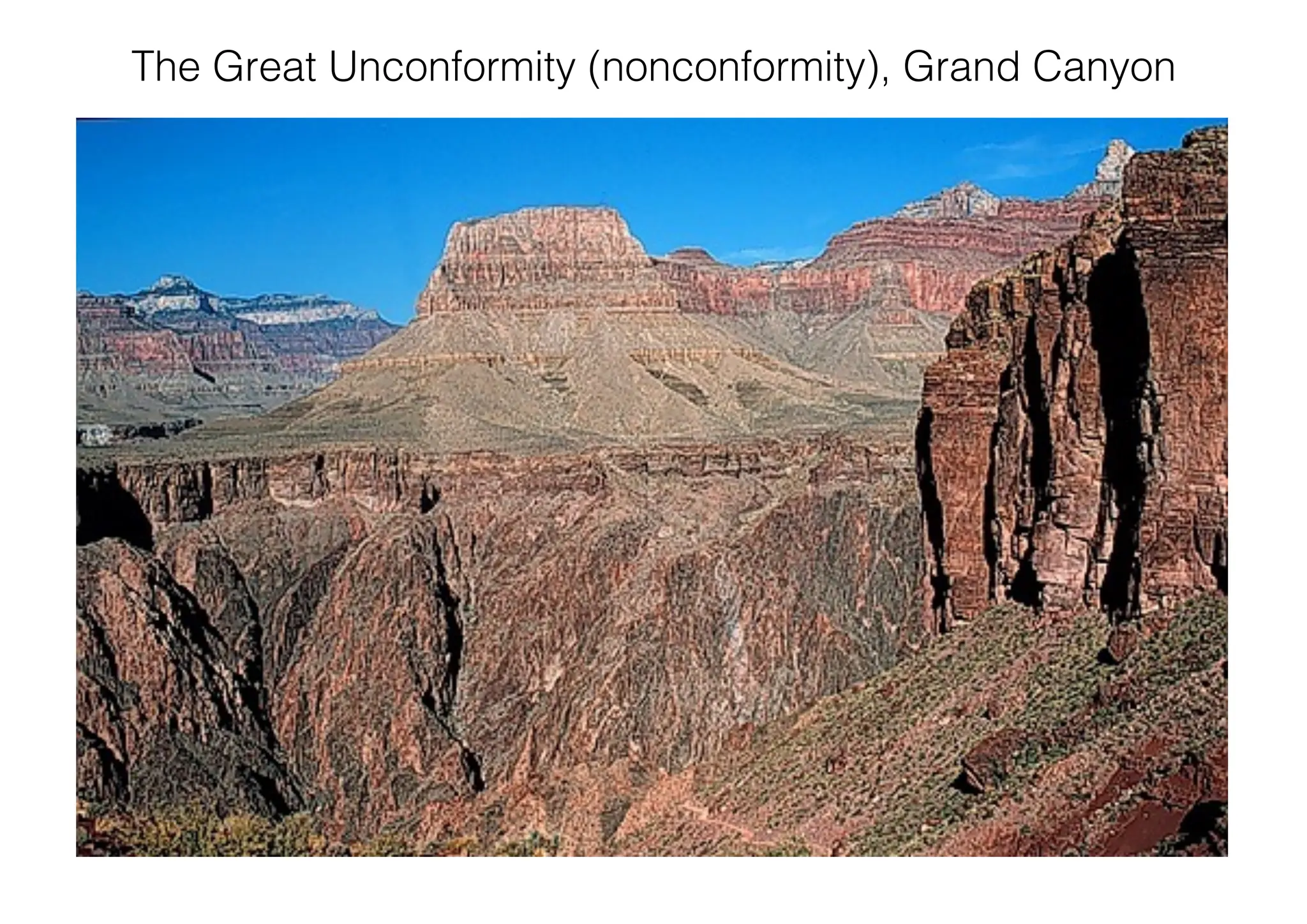
Nonconformity -
The “Great Unconformity”,
Grand Canyon
Cambrian Tapeats
sandstone overlies
Precambrian Vishnu Schist
The Great Unconformity (nonconformity), Grand Canyon
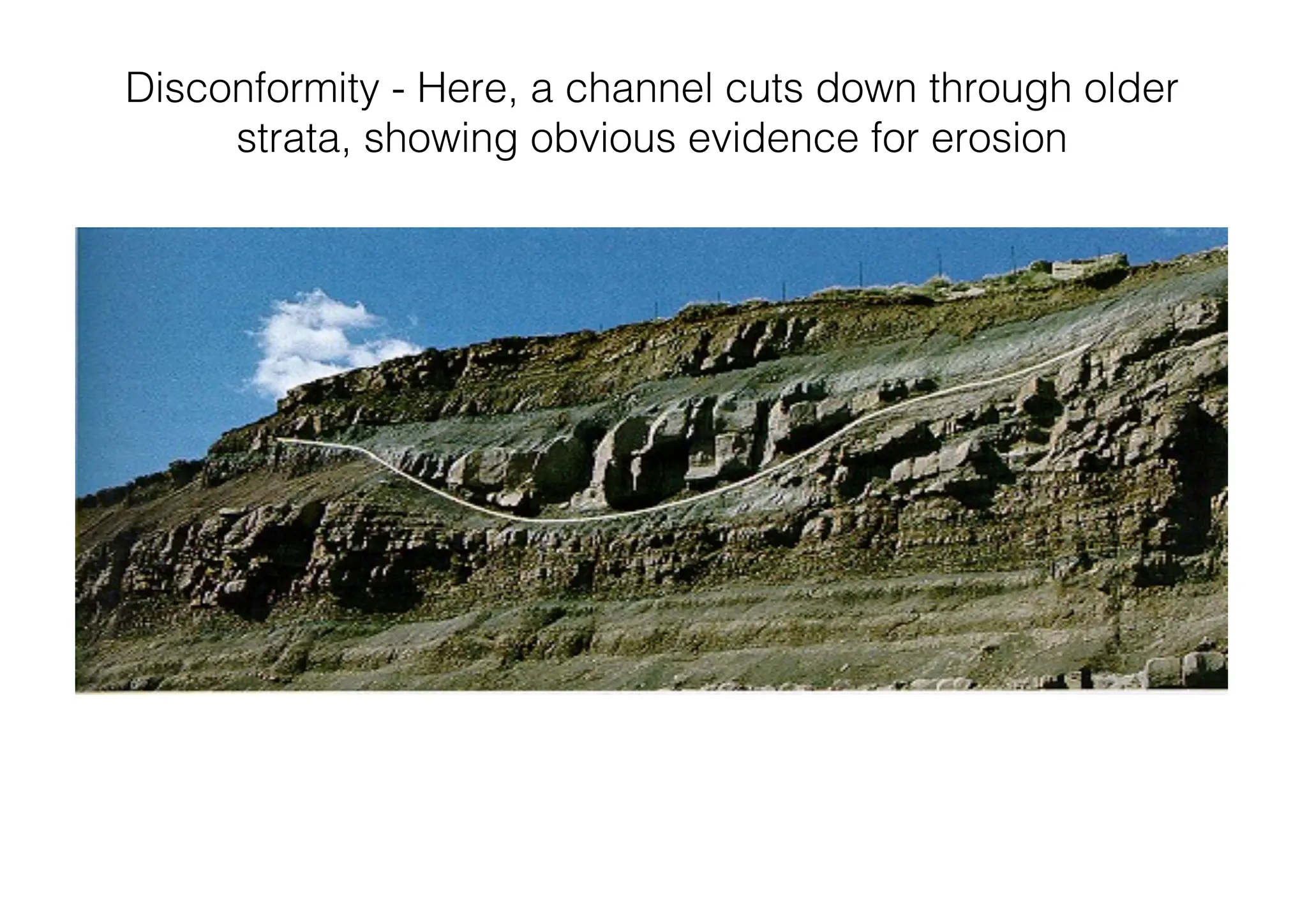
Disconformity - Here, a channel cuts down through older
strata, showing obvious evidence for erosion
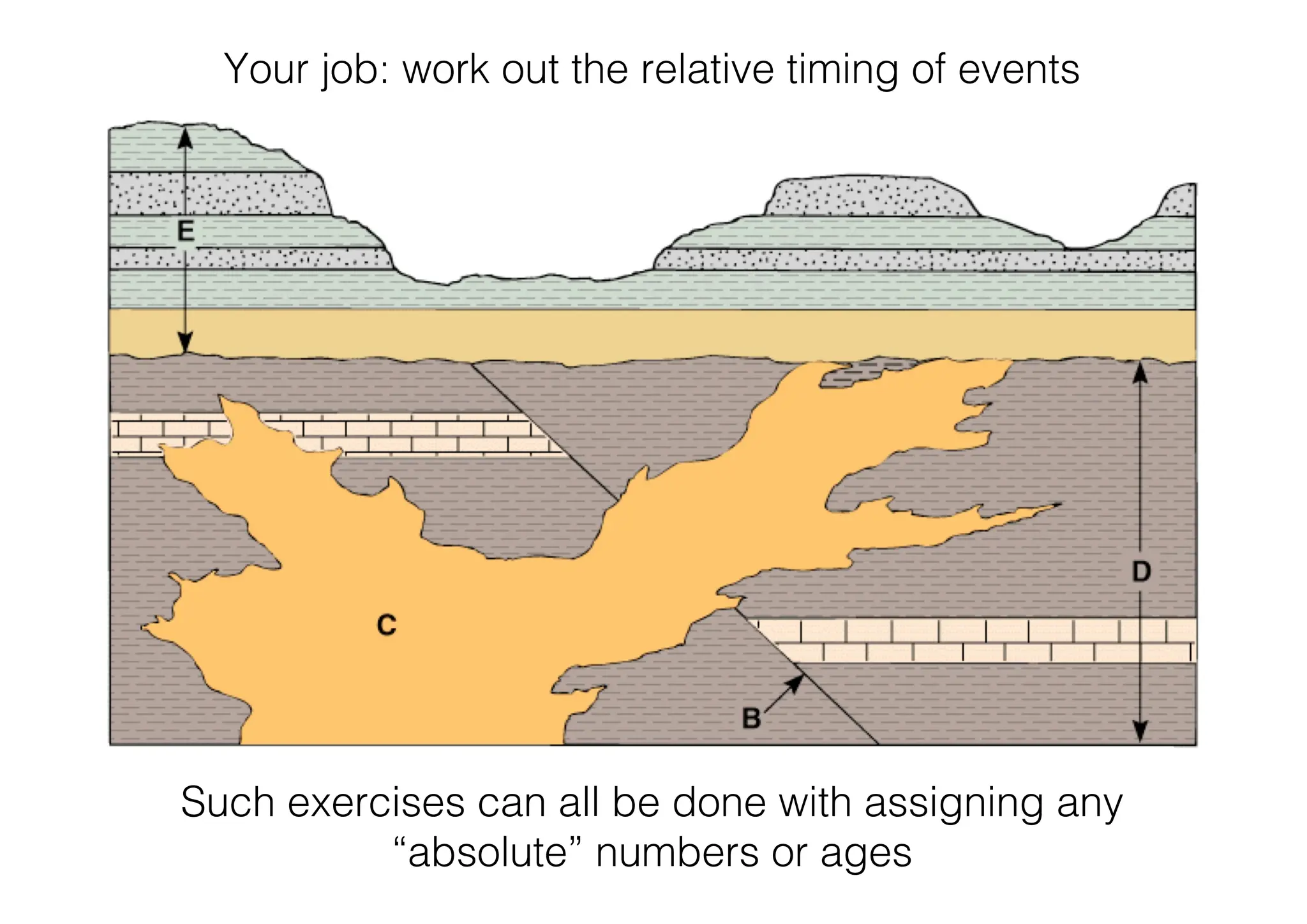
Your job: work out the relative timing of events
Such exercises can all be done with assigning any
“absolute” numbers or ages
Fossils and Relative
Time
Critical for dividing geologic time into small increments
and for correlating rock strata over large distances
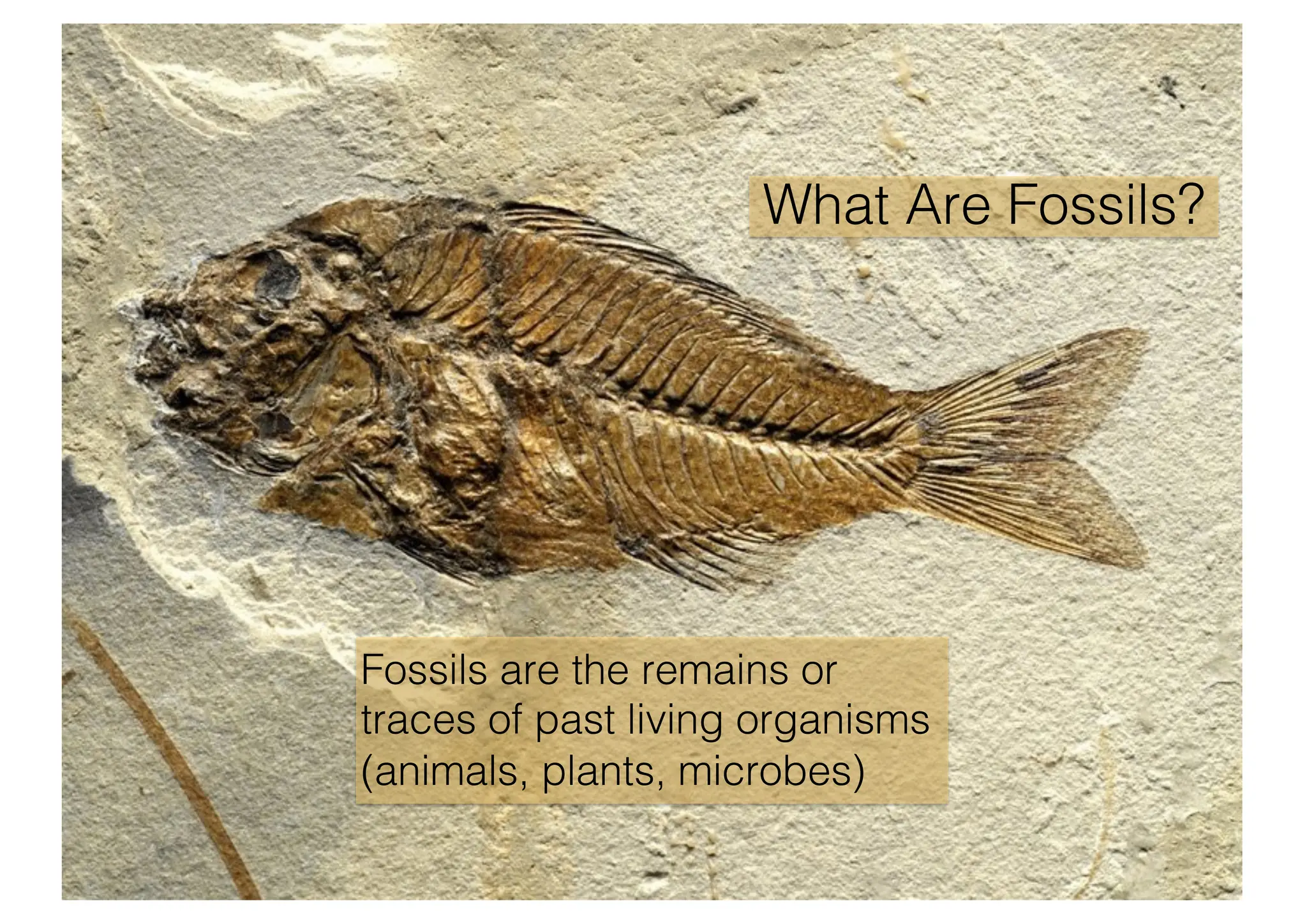
What Are Fossils?
Fossils are the remains or
traces of past living organisms
(animals, plants, microbes)
Correlation of Rock Layers
• Matching of rocks of similar ages in different
locations is known as correlation
• Correlation can use rock type, but commonly relies
on the presence of fossils
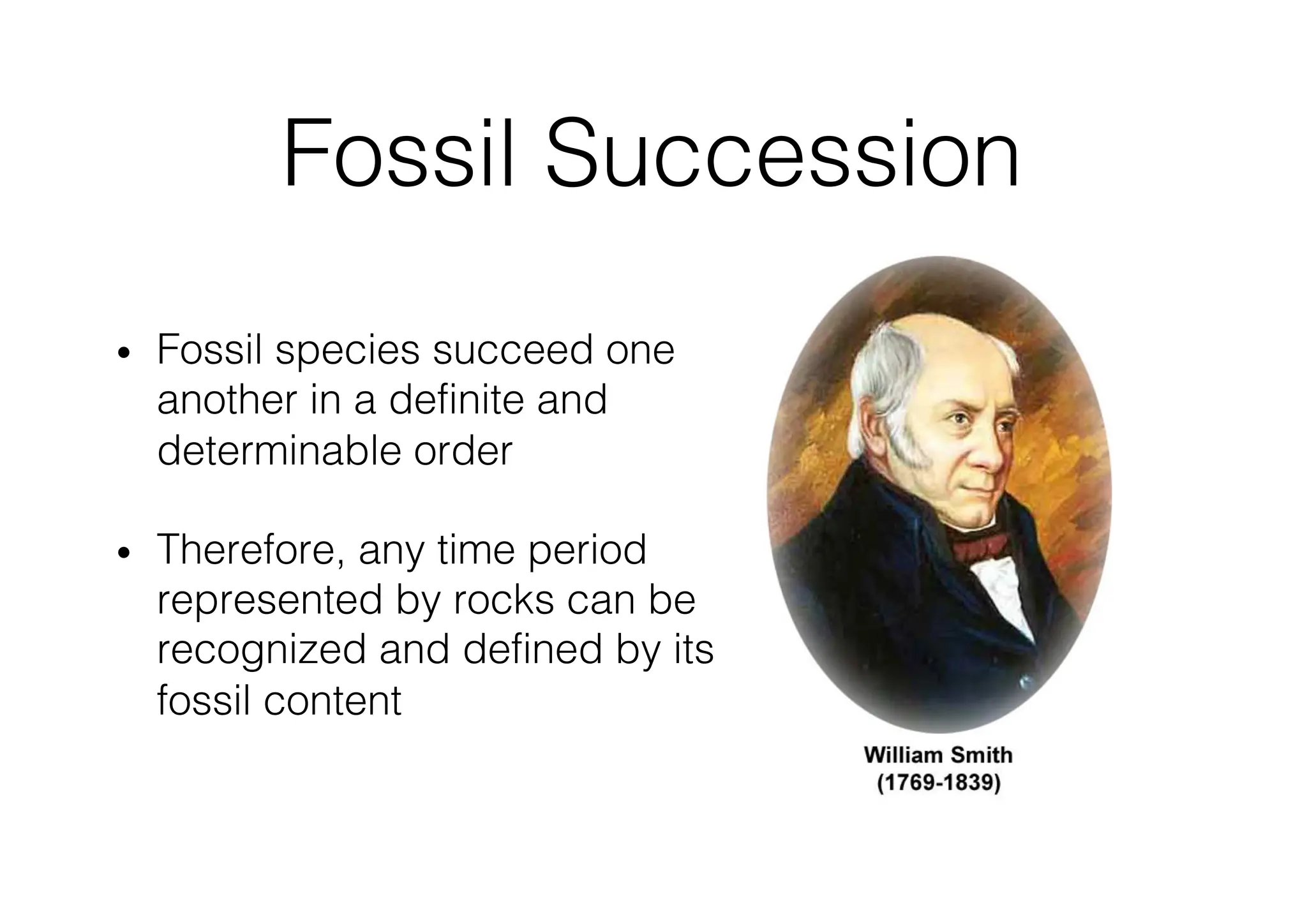
• William Smith (late 1700s) noted that sedimentary
strata in widely separated locations could be
identified and correlated by their distinctive fossil
content
Fossil Succession
• Fossil species succeed one
another in a definite and
determinable order
• Therefore, any time period
represented by rocks can be
recognized and defined by its
fossil content
Usefulness of Fossils Succession
in Geologic Time
• All fossil taxa (e.g., family, genus, species, etc.)
separate geologic time into three parts
• The time before that taxon evolved
• The time during which that fossil taxon was extant
• The time after which that taxon went extinct
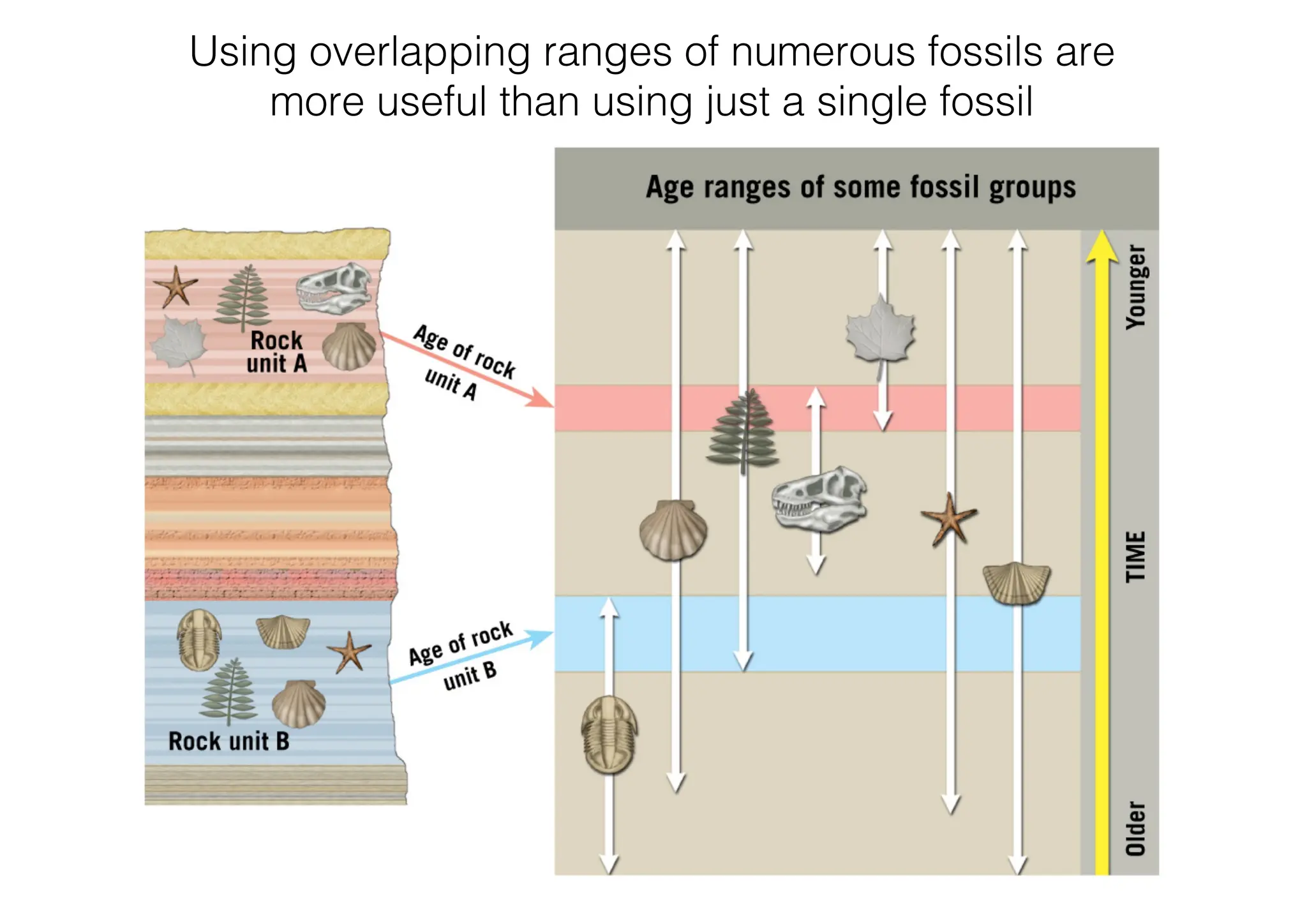
• Thus, each fossil taxon gives us a discrete duration
of geologic time - this is used for correlation
• Some fossils are extremely useful in correlation.
These are referred to as “index fossils”.
• A reliable index fossil species should have the
following characteristics:
• Wide geographic range
• Abundant
• Short geological duration (rapid evolutionary change)
• Morphologically distinct - Identifiable
• Independent of rock type
Index Fossils
• So the best index fossils are planktonic
(floating, drifting) or nektonic
(swimming) marine organisms that
evolve rapidly
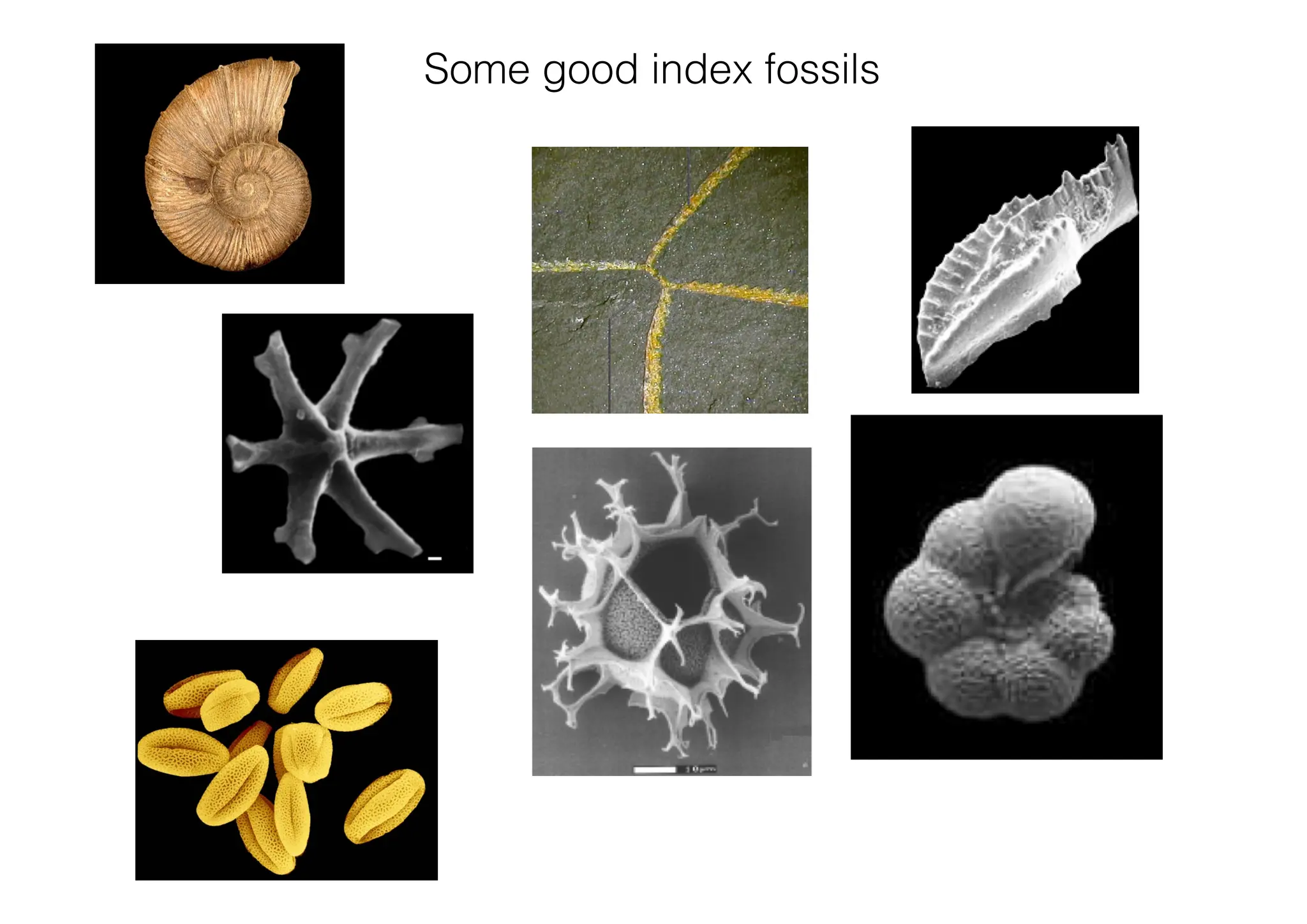
Some good index fossils
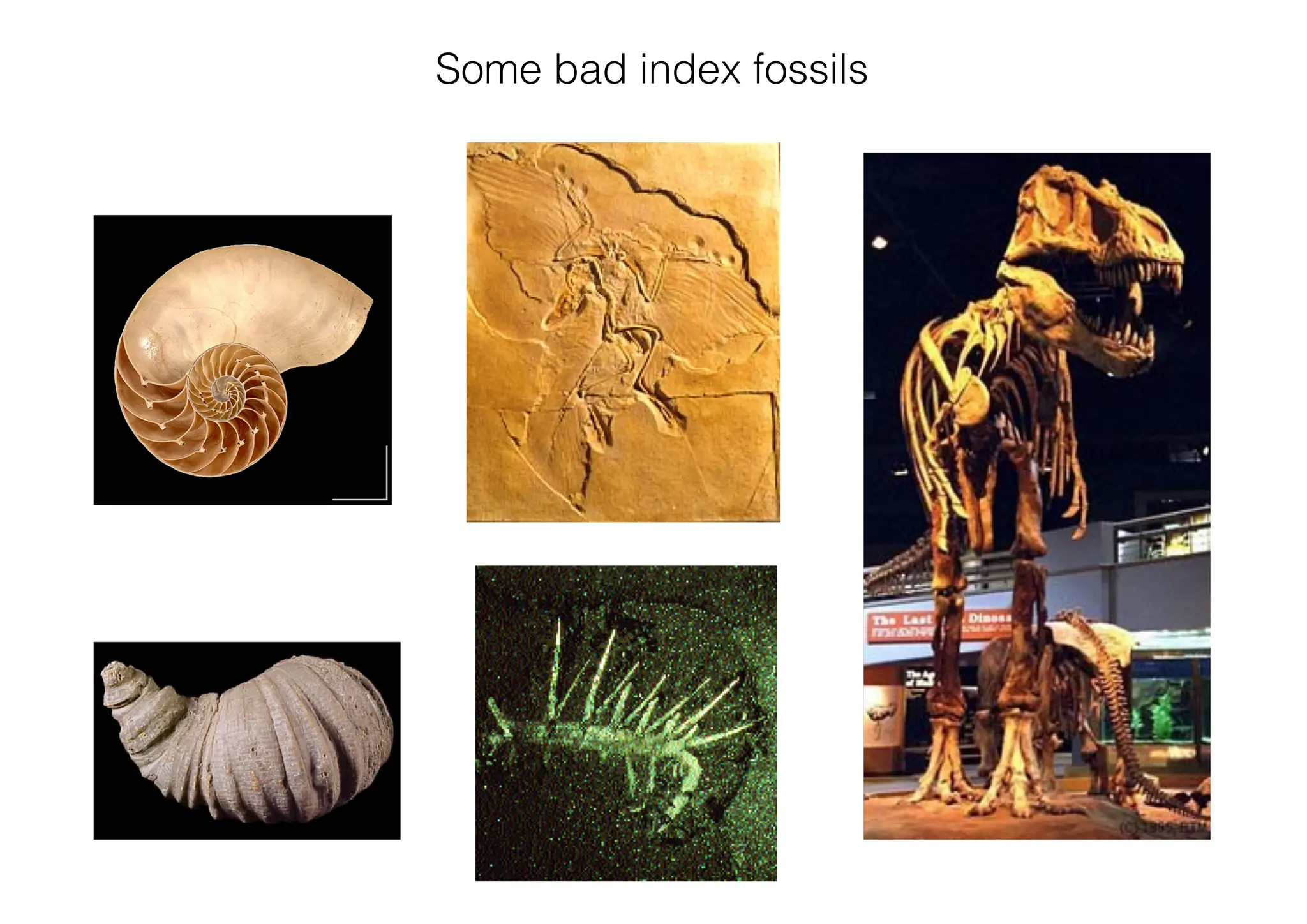
Some bad index fossils
Using overlapping ranges of numerous fossils are
more useful than using just a single fossil
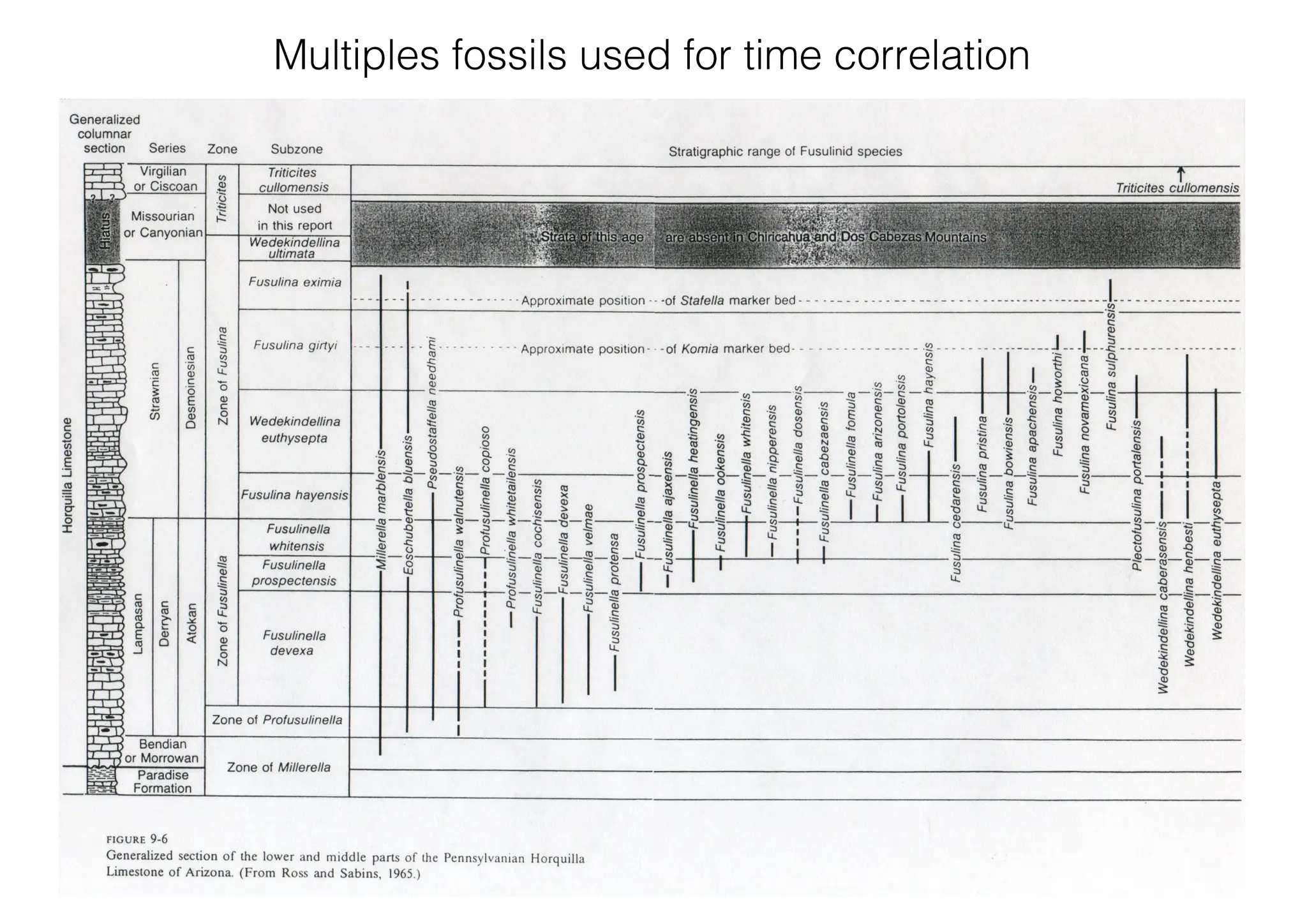
Multiples fossils used for time correlation

07 Relative Time.pdf geologic relative time

  • 1.
    Ordering geological eventsin time Relative Geologic Time
  • 3.
    What the heckhappened here?!? Can we make a relative chronology of events?
  • 4.
    Steno’s Laws andCorollaries Principles of Relative Time in Geology
  • 5.
    • Original Horizontality •Lateral Continuity • Superposition • Cross-cutting Relations • Included Fragments Steno’s Laws and Corollaries Nicolas Steno 1638-1686
  • 6.
    Original Horizontality Because ofgravity, sediments are deposited as (mostly) horizontally oriented bodies. All tilted strata have therefore been deformed (and usually after lithification).
  • 7.
    Tilted and deformedstrata, near Nizwa, Oman
  • 8.
    Original horizontality (andangular unconformity), Grand Canyon
  • 9.
    Lateral Continuity Sediments aredeposited generally as tabular sheets that extend in all directions until they run into a barrier or decrease laterally because of a lack of sediment supply. Breaks in the lateral continuity happen after deposition and lithification.
  • 11.
    River erosion disruptslateral continuity
  • 12.
    River erosion disruptslateral continuity
  • 13.
  • 14.
    Superposition In a successionof sedimentary rocks that has not been deformed, each rock unit is younger than the unit below it, and older than the unit above it.
  • 15.
    Oldest beds onthe bottom, youngest at the top
  • 16.
    Gorges du Todre,Jurassic of Morocco
  • 17.
    Cross-Cutting Relations Fractures, faults,and intrusions that cut across rock are necessarily younger than the rock through which they cut
  • 18.
    The fault isyounger than the rocks it cuts
  • 19.
  • 20.
    Basalt dikes cuttingthrough granite are younger than the granite
  • 21.
    Included Fragments Fragments ofrock that are included/incorporated within a rock are older than the rock within which they are included (or the rock containing the inclusions is younger than the inclusions).
  • 25.
    Unconformities - “MissingTime” • Layers of rock that were deposited without interruption are called conformable layers • However, periods of erosion or non-deposition can produce substantial gaps in the stratigraphic record • Unconformities, or “missing time”, are surfaces with no stratigraphic record of that duration of geologic time at that location
  • 26.
    Types of Unconformities •Nonconformity - sedimentary strata directly overlie basement igneous and/or metamorphic rock • Angular Unconformity - angular relationship between overlying and underlying strata. Implies tilting, erosion, deposition • Disconformity - sedimentary strata are parallel with one another, but there is obvious evidence for erosion at the boundary
  • 27.
  • 28.
  • 29.
  • 30.
    Angular unconformity, SiccarPoint, Scotland (the most famous of angular unconformities)
  • 33.
  • 35.
    Nonconformity - The “GreatUnconformity”, Grand Canyon Cambrian Tapeats sandstone overlies Precambrian Vishnu Schist
  • 36.
    The Great Unconformity(nonconformity), Grand Canyon
  • 37.
    Disconformity - Here,a channel cuts down through older strata, showing obvious evidence for erosion
  • 39.
    Your job: workout the relative timing of events Such exercises can all be done with assigning any “absolute” numbers or ages
  • 40.
    Fossils and Relative Time Criticalfor dividing geologic time into small increments and for correlating rock strata over large distances
  • 41.
    What Are Fossils? Fossilsare the remains or traces of past living organisms (animals, plants, microbes)
  • 42.
    Correlation of RockLayers • Matching of rocks of similar ages in different locations is known as correlation • Correlation can use rock type, but commonly relies on the presence of fossils • William Smith (late 1700s) noted that sedimentary strata in widely separated locations could be identified and correlated by their distinctive fossil content
  • 43.
    Fossil Succession • Fossilspecies succeed one another in a definite and determinable order • Therefore, any time period represented by rocks can be recognized and defined by its fossil content
  • 44.
    Usefulness of FossilsSuccession in Geologic Time • All fossil taxa (e.g., family, genus, species, etc.) separate geologic time into three parts • The time before that taxon evolved • The time during which that fossil taxon was extant • The time after which that taxon went extinct • Thus, each fossil taxon gives us a discrete duration of geologic time - this is used for correlation
  • 45.
    • Some fossilsare extremely useful in correlation. These are referred to as “index fossils”. • A reliable index fossil species should have the following characteristics: • Wide geographic range • Abundant • Short geological duration (rapid evolutionary change) • Morphologically distinct - Identifiable • Independent of rock type Index Fossils
  • 46.
    • So thebest index fossils are planktonic (floating, drifting) or nektonic (swimming) marine organisms that evolve rapidly
  • 47.
  • 48.
  • 49.
    Using overlapping rangesof numerous fossils are more useful than using just a single fossil
  • 50.
    Multiples fossils usedfor time correlation