FORMATION OF ROCK LAYER
EARTH AND LIFE SCIENCE
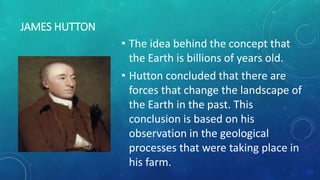
JAMES HUTTON
• The idea behind the concept that
the Earth is billions of years old.
• Hutton concluded that there are
forces that change the landscape of
the Earth in the past. This
conclusion is based on his
observation in the geological
processes that were taking place in
his farm.
PRINCIPLE OF UNIFORMITARIANISM
• states that the current geologic processes, such as
volcanism, erosion, and weathering, are the same
processes that were at work in the past.
• This idea was refined by other geologists that although
the process of the past and the present are the same,
the rates of this process may vary over time. The Earth’s
history was studied using the different records of past
events preserved in rocks. The layers of rocks are like
the pages in our history books.
STRATIGRAPHY
• It is the branch of geology that deals with the
description, correlation, and interpretation of
stratified sediments and stratified rocks on and
within the Earth.
• It is the study of the rock layers(strata).
• Likewise, it will give you clues to the location
of ancient seas, mountains, plateaus and
plains.
STRATIFIED ROCKS
• also known as derivatives rock, may be
fragmental or crystalline. These rocks are
products of sedimentary processes. These
are made of visible layers of sediments.
The formation of rock layers depends on
its stratigraphy and stratification.
STRATIFICATION
• It is also known as bedding, which is the
layering that happens in sedimentary and
igneous rocks formed at the surface of the
Earth that comes from lava flows or other
volcanic activity.
• It is expressed by rock layers (units) of a
general tabular or lenticular form that differ in
rock type.
STRATIGRAPHIC LAWS
• are basic principles that all geologists use
in decoding or deciphering the spatial and
temporal relationships of rock layers.
These include the following: Original
Horizontality, Lateral Continuity,
Superposition, Cross Cutting, Law of
Inclusions and the Law of Faunal
Succession.
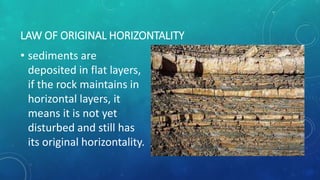
LAW OF ORIGINAL HORIZONTALITY
• sediments are
deposited in flat layers,
if the rock maintains in
horizontal layers, it
means it is not yet
disturbed and still has
its original horizontality.
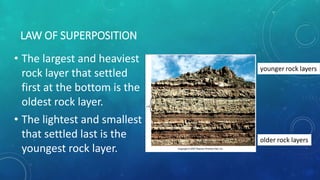
LAW OF SUPERPOSITION
• The largest and heaviest
rock layer that settled
first at the bottom is the
oldest rock layer.
• The lightest and smallest
that settled last is the
youngest rock layer.
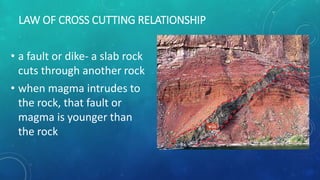
LAW OF CROSS CUTTING RELATIONSHIP
• a fault or dike- a slab rock
cuts through another rock
• when magma intrudes to
the rock, that fault or
magma is younger than
the rock
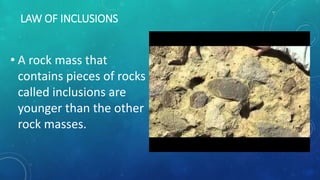
LAW OF INCLUSIONS
• A rock mass that
contains pieces of rocks
called inclusions are
younger than the other
rock masses.
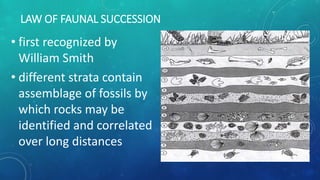
LAW OF FAUNAL SUCCESSION
• first recognized by
William Smith
• different strata contain
assemblage of fossils by
which rocks may be
identified and correlated
over long distances
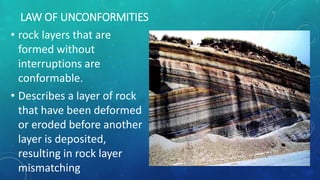
LAW OF UNCONFORMITIES
• rock layers that are
formed without
interruptions are
conformable.
• Describes a layer of rock
that have been deformed
or eroded before another
layer is deposited,
resulting in rock layer
mismatching
THREE TYPES OF UNCONFORMITIES:
•Disconformity
•Angular unconformity
•Non-conformity
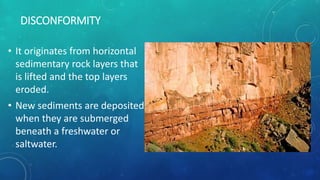
DISCONFORMITY
• It originates from horizontal
sedimentary rock layers that
is lifted and the top layers
eroded.
• New sediments are deposited
when they are submerged
beneath a freshwater or
saltwater.
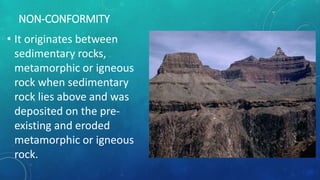
NON-CONFORMITY
• It originates between
sedimentary rocks,
metamorphic or igneous
rock when sedimentary
rock lies above and was
deposited on the pre-
existing and eroded
metamorphic or igneous
rock.
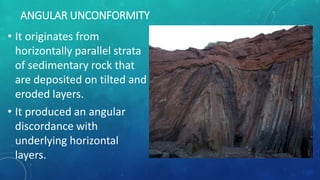
ANGULAR UNCONFORMITY
• It originates from
horizontally parallel strata
of sedimentary rock that
are deposited on tilted and
eroded layers.
• It produced an angular
discordance with
underlying horizontal
layers.
LESSON II: CORRELATION OF
ROCK LAYERS
EARTH AND LIFE SCIENCE
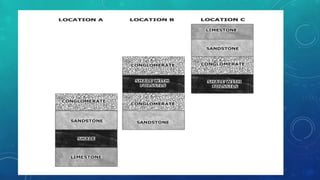
CORRELATION
• The process of showing that rocks or geologic
events occurring at different locations are of
the same age.
• Geologists have developed a system for
correlating rocks by looking for similarities in
composition and rock layer sequences at
different locations.
TYPES OF CORRELATION
PHYSICAL CORRELATION
•color, texture, and types of
minerals contained within a
stratum which make it possible for
geologists to classify a stratum
specifically.
FOSSIL CORRELATION
• is a principle that geologists use to determine the
age of rock. It uses fossils with unique
characteristics, such as geologically short lifespan
and easily identifiable features, and uses this
information to estimate the age of a rock layer in
other areas that contain the same type of fossil or
group of fossils.
METHODS IN CORRELATING ROCK LAYERS
• Rock types and its characteristics
• Index fossil
• Bedrock
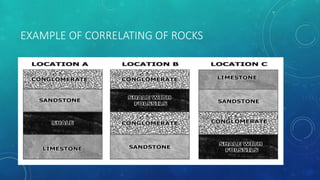
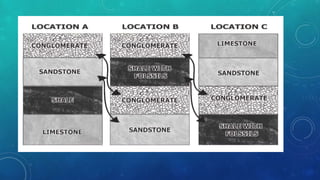
EXAMPLE OF CORRELATING OF ROCKS
FORMATION OF ROCK LAYER.pptx

FORMATION OF ROCK LAYER.pptx

  • 1.
    FORMATION OF ROCKLAYER EARTH AND LIFE SCIENCE
  • 2.
    JAMES HUTTON • Theidea behind the concept that the Earth is billions of years old. • Hutton concluded that there are forces that change the landscape of the Earth in the past. This conclusion is based on his observation in the geological processes that were taking place in his farm.
  • 3.
    PRINCIPLE OF UNIFORMITARIANISM •states that the current geologic processes, such as volcanism, erosion, and weathering, are the same processes that were at work in the past. • This idea was refined by other geologists that although the process of the past and the present are the same, the rates of this process may vary over time. The Earth’s history was studied using the different records of past events preserved in rocks. The layers of rocks are like the pages in our history books.
  • 4.
    STRATIGRAPHY • It isthe branch of geology that deals with the description, correlation, and interpretation of stratified sediments and stratified rocks on and within the Earth. • It is the study of the rock layers(strata). • Likewise, it will give you clues to the location of ancient seas, mountains, plateaus and plains.
  • 5.
    STRATIFIED ROCKS • alsoknown as derivatives rock, may be fragmental or crystalline. These rocks are products of sedimentary processes. These are made of visible layers of sediments. The formation of rock layers depends on its stratigraphy and stratification.
  • 6.
    STRATIFICATION • It isalso known as bedding, which is the layering that happens in sedimentary and igneous rocks formed at the surface of the Earth that comes from lava flows or other volcanic activity. • It is expressed by rock layers (units) of a general tabular or lenticular form that differ in rock type.
  • 7.
    STRATIGRAPHIC LAWS • arebasic principles that all geologists use in decoding or deciphering the spatial and temporal relationships of rock layers. These include the following: Original Horizontality, Lateral Continuity, Superposition, Cross Cutting, Law of Inclusions and the Law of Faunal Succession.
  • 8.
    LAW OF ORIGINALHORIZONTALITY • sediments are deposited in flat layers, if the rock maintains in horizontal layers, it means it is not yet disturbed and still has its original horizontality.
  • 9.
    LAW OF SUPERPOSITION •The largest and heaviest rock layer that settled first at the bottom is the oldest rock layer. • The lightest and smallest that settled last is the youngest rock layer.
  • 10.
    LAW OF CROSSCUTTING RELATIONSHIP • a fault or dike- a slab rock cuts through another rock • when magma intrudes to the rock, that fault or magma is younger than the rock
  • 11.
    LAW OF INCLUSIONS •A rock mass that contains pieces of rocks called inclusions are younger than the other rock masses.
  • 12.
    LAW OF FAUNALSUCCESSION • first recognized by William Smith • different strata contain assemblage of fossils by which rocks may be identified and correlated over long distances
  • 13.
    LAW OF UNCONFORMITIES •rock layers that are formed without interruptions are conformable. • Describes a layer of rock that have been deformed or eroded before another layer is deposited, resulting in rock layer mismatching
  • 14.
    THREE TYPES OFUNCONFORMITIES: •Disconformity •Angular unconformity •Non-conformity
  • 15.
    DISCONFORMITY • It originatesfrom horizontal sedimentary rock layers that is lifted and the top layers eroded. • New sediments are deposited when they are submerged beneath a freshwater or saltwater.
  • 16.
    NON-CONFORMITY • It originatesbetween sedimentary rocks, metamorphic or igneous rock when sedimentary rock lies above and was deposited on the pre- existing and eroded metamorphic or igneous rock.
  • 17.
    ANGULAR UNCONFORMITY • Itoriginates from horizontally parallel strata of sedimentary rock that are deposited on tilted and eroded layers. • It produced an angular discordance with underlying horizontal layers.
  • 18.
    LESSON II: CORRELATIONOF ROCK LAYERS EARTH AND LIFE SCIENCE
  • 19.
    CORRELATION • The processof showing that rocks or geologic events occurring at different locations are of the same age. • Geologists have developed a system for correlating rocks by looking for similarities in composition and rock layer sequences at different locations.
  • 20.
  • 21.
    PHYSICAL CORRELATION •color, texture,and types of minerals contained within a stratum which make it possible for geologists to classify a stratum specifically.
  • 22.
    FOSSIL CORRELATION • isa principle that geologists use to determine the age of rock. It uses fossils with unique characteristics, such as geologically short lifespan and easily identifiable features, and uses this information to estimate the age of a rock layer in other areas that contain the same type of fossil or group of fossils.
  • 23.
    METHODS IN CORRELATINGROCK LAYERS • Rock types and its characteristics • Index fossil • Bedrock
  • 24.