FORMATION OF ROCK LAYERS
Prepared by: Engr. Ariel S. Motas
Engr. Andreana Amor M. Gulay
LESSON 1:ROCKLAYERS
- How are rock layers formed?
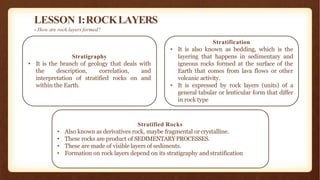
Stratified Rocks
• Also known as derivatives rock, maybe fragmental or crystalline.
• These rocks are product of SEDIMENTARYPROCESSES.
• These are made of visible layers of sediments.
• Formation on rock layers depend on its stratigraphy andstratification
Stratigraphy
• It is the branch of geology that deals with
the description, correlation, and
interpretation of stratified rocks on and
within the Earth.
Stratification
• It is also known as bedding, which is the
layering that happens in sedimentary and
igneous rocks formed at the surface of the
Earth that comes from lava flows or other
volcanic activity.
• It is expressed by rock layers (units) of a
general tabular or lenticular form that differ
in rock type
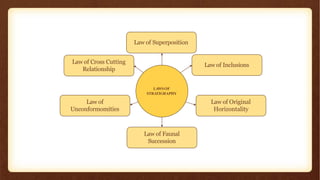
Law of
Unconformomities
Law of Cross Cutting
Relationship
Law of Inclusions
Law of Original
Horizontality
Law of Faunal
Succession
Law of Superposition
LAWSOF
STRATIGRAPHY
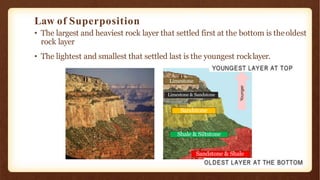
Law of Superposition
• The largest and heaviest rock layer that settled first at the bottom is theoldest
rock layer
• The lightest and smallest that settled last is the youngest rocklayer.
Sandstone & Shale
Shale & Siltstone
Sandstone
Limestone & Sandstone
Limestone
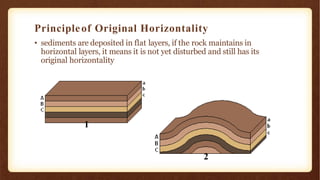
Principleof Original Horizontality
• sediments are deposited in flat layers, if the rock maintains in
horizontal layers, it means it is not yet disturbed and still has its
original horizontality
1
2
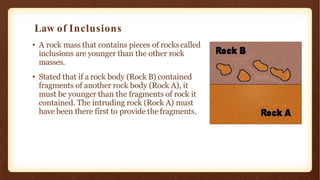
Law of Inclusions
• A rock mass that contains pieces of rockscalled
inclusions are younger than the other rock
masses.
• Stated that if a rock body (Rock B) contained
fragments of another rock body (Rock A), it
must be younger than the fragments of rock it
contained. The intruding rock (Rock A) must
have been there first to provide thefragments.
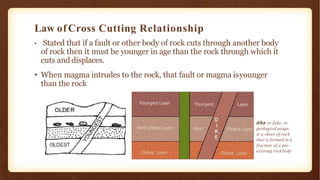
Law ofCross Cutting Relationship
• Stated that if a fault or other body of rock cuts through another body
of rock then it must be younger in age than the rock through which it
cuts and displaces.
• When magma intrudes to the rock, that fault or magma isyounger
than the rock
dike or dyke, in
geological usage,
is a sheet of rock
that is formed in a
fracture of a pre-
existing rockbody
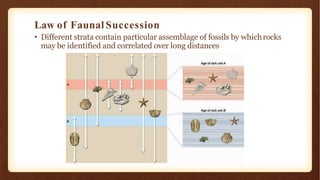
Law of Faunal Succession
• Different strata contain particular assemblage of fossils by whichrocks
may be identified and correlated over long distances
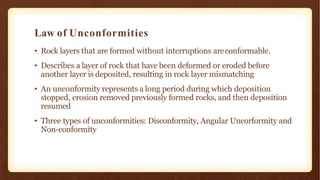
Law of Unconformities
• Rock layers that are formed without interruptions areconformable.
• Describes a layer of rock that have been deformed or eroded before
another layer is deposited, resulting in rock layer mismatching
• An unconformity represents a long period during which deposition
stopped, erosion removed previously formed rocks, and then deposition
resumed
• Three types of unconformities: Disconformity, Angular Uncorformity and
Non-conformity
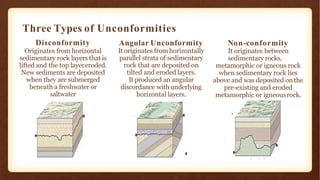
Three Types of Unconformities
Disconformity
Originates from horizontal
sedimentary rock layers that is
lifted and the top layereroded.
New sediments are deposited
when they are submerged
beneath a freshwater or
saltwater
Angular Unconformity
It originates from horizontally
parallel strata of sedimentary
rock that are deposited on
tilted and eroded layers.
It produced an angular
discordance with underlying
horizontal layers.
Non-conformity
It originates between
sedimentary rocks,
metamorphic or igneous rock
when sedimentary rock lies
above and was deposited onthe
pre-existing and eroded
metamorphic or igneousrock.
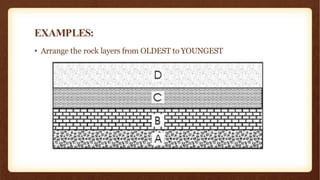
EXAMPLES:
• Arrange the rock layers from OLDEST to YOUNGEST
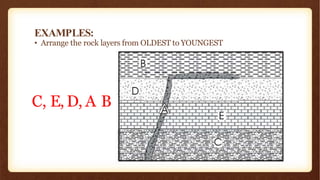
EXAMPLES:
• Arrange the rock layers from OLDEST to YOUNGEST
C, E, D, A B
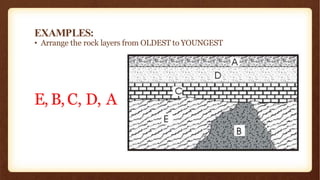
EXAMPLES:
• Arrange the rock layers from OLDEST to YOUNGEST
E, B,C, D, A
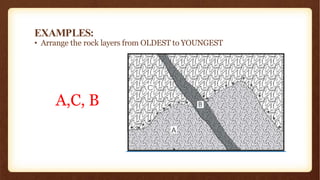
EXAMPLES:
• Arrange the rock layers from OLDEST to YOUNGEST
A,C, B
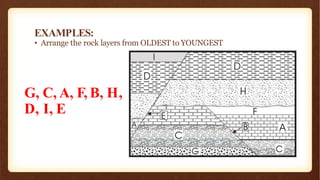
EXAMPLES:
• Arrange the rock layers from OLDEST to YOUNGEST
G, C, A, F, B, H,
D, I, E
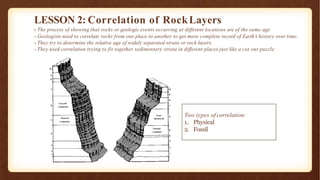
LESSON 2: Correlation of RockLayers
Two types of correlation:
1. Physical
2. Fossil
- The process of showing that rocks or geologic events occurring at different locations are of the same age
- Geologists need to correlate rocks from one place to another to get more complete record of Earth’s history over time.
- They try to determine the relative age of widely separated strata or rock layers.
- They used correlation trying to fit together sedimentary strata in different places just like a cut out puzzle.
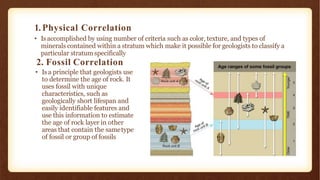
1.Physical Correlation
• Is accomplished by using number of criteria such as color, texture, and types of
minerals contained within a stratum which make it possible for geologists to classify a
particular stratum specifically
2. Fossil Correlation
• Is a principle that geologists use
to determine the age of rock. It
uses fossil with unique
characteristics, such as
geologically short lifespan and
easily identifiable features and
use this information to estimate
the age of rock layer in other
areas that contain the sametype
of fossil or group of fossils
Criteria to be considered in identifying index fossils includes:
• Easily recognizable and it must be easy to identify because of its
uniqueness.
• Must be geographically widespread
• Must lived for only a short time
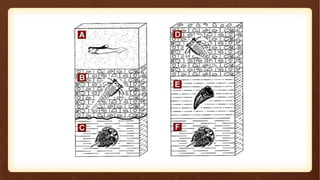
There are fossils which are used to date the layers of rock that they are found in. Fossils
that can be used in this way are called indexfossils, and rock layers with the same
index fossils in them can becorrelated.
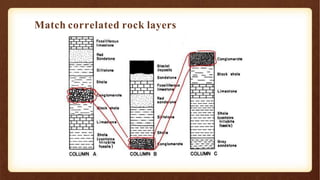
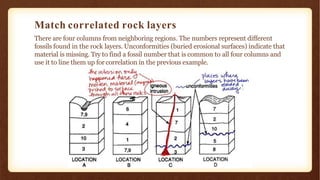
Match correlated rock layers
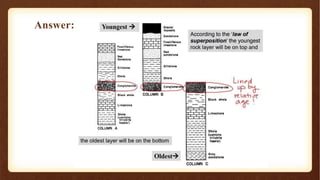
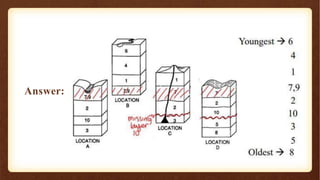
Answer:
Match correlated rock layers
There are four columns from neighboring regions. The numbers represent different
fossils found in the rock layers. Unconformities (buried erosional surfaces) indicate that
material is missing. Try to find a fossil number that is common to all four columns and
use it to line them up for correlation in the previous example.
Answer:
11formationofrocklayers-201115152616.pptx

11formationofrocklayers-201115152616.pptx

  • 1.
    FORMATION OF ROCKLAYERS Prepared by: Engr. Ariel S. Motas Engr. Andreana Amor M. Gulay
  • 2.
    LESSON 1:ROCKLAYERS - Howare rock layers formed? Stratified Rocks • Also known as derivatives rock, maybe fragmental or crystalline. • These rocks are product of SEDIMENTARYPROCESSES. • These are made of visible layers of sediments. • Formation on rock layers depend on its stratigraphy andstratification Stratigraphy • It is the branch of geology that deals with the description, correlation, and interpretation of stratified rocks on and within the Earth. Stratification • It is also known as bedding, which is the layering that happens in sedimentary and igneous rocks formed at the surface of the Earth that comes from lava flows or other volcanic activity. • It is expressed by rock layers (units) of a general tabular or lenticular form that differ in rock type
  • 3.
    Law of Unconformomities Law ofCross Cutting Relationship Law of Inclusions Law of Original Horizontality Law of Faunal Succession Law of Superposition LAWSOF STRATIGRAPHY
  • 4.
    Law of Superposition •The largest and heaviest rock layer that settled first at the bottom is theoldest rock layer • The lightest and smallest that settled last is the youngest rocklayer. Sandstone & Shale Shale & Siltstone Sandstone Limestone & Sandstone Limestone
  • 5.
    Principleof Original Horizontality •sediments are deposited in flat layers, if the rock maintains in horizontal layers, it means it is not yet disturbed and still has its original horizontality 1 2
  • 6.
    Law of Inclusions •A rock mass that contains pieces of rockscalled inclusions are younger than the other rock masses. • Stated that if a rock body (Rock B) contained fragments of another rock body (Rock A), it must be younger than the fragments of rock it contained. The intruding rock (Rock A) must have been there first to provide thefragments.
  • 7.
    Law ofCross CuttingRelationship • Stated that if a fault or other body of rock cuts through another body of rock then it must be younger in age than the rock through which it cuts and displaces. • When magma intrudes to the rock, that fault or magma isyounger than the rock dike or dyke, in geological usage, is a sheet of rock that is formed in a fracture of a pre- existing rockbody
  • 8.
    Law of FaunalSuccession • Different strata contain particular assemblage of fossils by whichrocks may be identified and correlated over long distances
  • 9.
    Law of Unconformities •Rock layers that are formed without interruptions areconformable. • Describes a layer of rock that have been deformed or eroded before another layer is deposited, resulting in rock layer mismatching • An unconformity represents a long period during which deposition stopped, erosion removed previously formed rocks, and then deposition resumed • Three types of unconformities: Disconformity, Angular Uncorformity and Non-conformity
  • 10.
    Three Types ofUnconformities Disconformity Originates from horizontal sedimentary rock layers that is lifted and the top layereroded. New sediments are deposited when they are submerged beneath a freshwater or saltwater Angular Unconformity It originates from horizontally parallel strata of sedimentary rock that are deposited on tilted and eroded layers. It produced an angular discordance with underlying horizontal layers. Non-conformity It originates between sedimentary rocks, metamorphic or igneous rock when sedimentary rock lies above and was deposited onthe pre-existing and eroded metamorphic or igneousrock.
  • 11.
    EXAMPLES: • Arrange therock layers from OLDEST to YOUNGEST
  • 12.
    EXAMPLES: • Arrange therock layers from OLDEST to YOUNGEST C, E, D, A B
  • 13.
    EXAMPLES: • Arrange therock layers from OLDEST to YOUNGEST E, B,C, D, A
  • 14.
    EXAMPLES: • Arrange therock layers from OLDEST to YOUNGEST A,C, B
  • 15.
    EXAMPLES: • Arrange therock layers from OLDEST to YOUNGEST G, C, A, F, B, H, D, I, E
  • 16.
    LESSON 2: Correlationof RockLayers Two types of correlation: 1. Physical 2. Fossil - The process of showing that rocks or geologic events occurring at different locations are of the same age - Geologists need to correlate rocks from one place to another to get more complete record of Earth’s history over time. - They try to determine the relative age of widely separated strata or rock layers. - They used correlation trying to fit together sedimentary strata in different places just like a cut out puzzle.
  • 17.
    1.Physical Correlation • Isaccomplished by using number of criteria such as color, texture, and types of minerals contained within a stratum which make it possible for geologists to classify a particular stratum specifically 2. Fossil Correlation • Is a principle that geologists use to determine the age of rock. It uses fossil with unique characteristics, such as geologically short lifespan and easily identifiable features and use this information to estimate the age of rock layer in other areas that contain the sametype of fossil or group of fossils
  • 18.
    Criteria to beconsidered in identifying index fossils includes: • Easily recognizable and it must be easy to identify because of its uniqueness. • Must be geographically widespread • Must lived for only a short time There are fossils which are used to date the layers of rock that they are found in. Fossils that can be used in this way are called indexfossils, and rock layers with the same index fossils in them can becorrelated.
  • 19.
  • 20.
  • 21.
    Match correlated rocklayers There are four columns from neighboring regions. The numbers represent different fossils found in the rock layers. Unconformities (buried erosional surfaces) indicate that material is missing. Try to find a fossil number that is common to all four columns and use it to line them up for correlation in the previous example.
  • 22.