Introduction to Geology
Phil Murphy
p.murphy@see.leeds.ac.uk
1
“Civilisations are what they dig
from the Earth”
Gibbons
Decline and fall of the Roman Empire, 1776
2
“If Kuwait had of grown carrots
no one would have given a damn!”
Senior Source - NSA
3
Why is geology different from other
sciences?
• Often lacks experimental control
• Incompleteness of data
• Methodologies and procedures used to test
problems rather than the generation and testing of
universal laws
• GEOLOGY WORKS
• (everyone wants to drive to Sainsburys)
4
12_04c.jpg
5
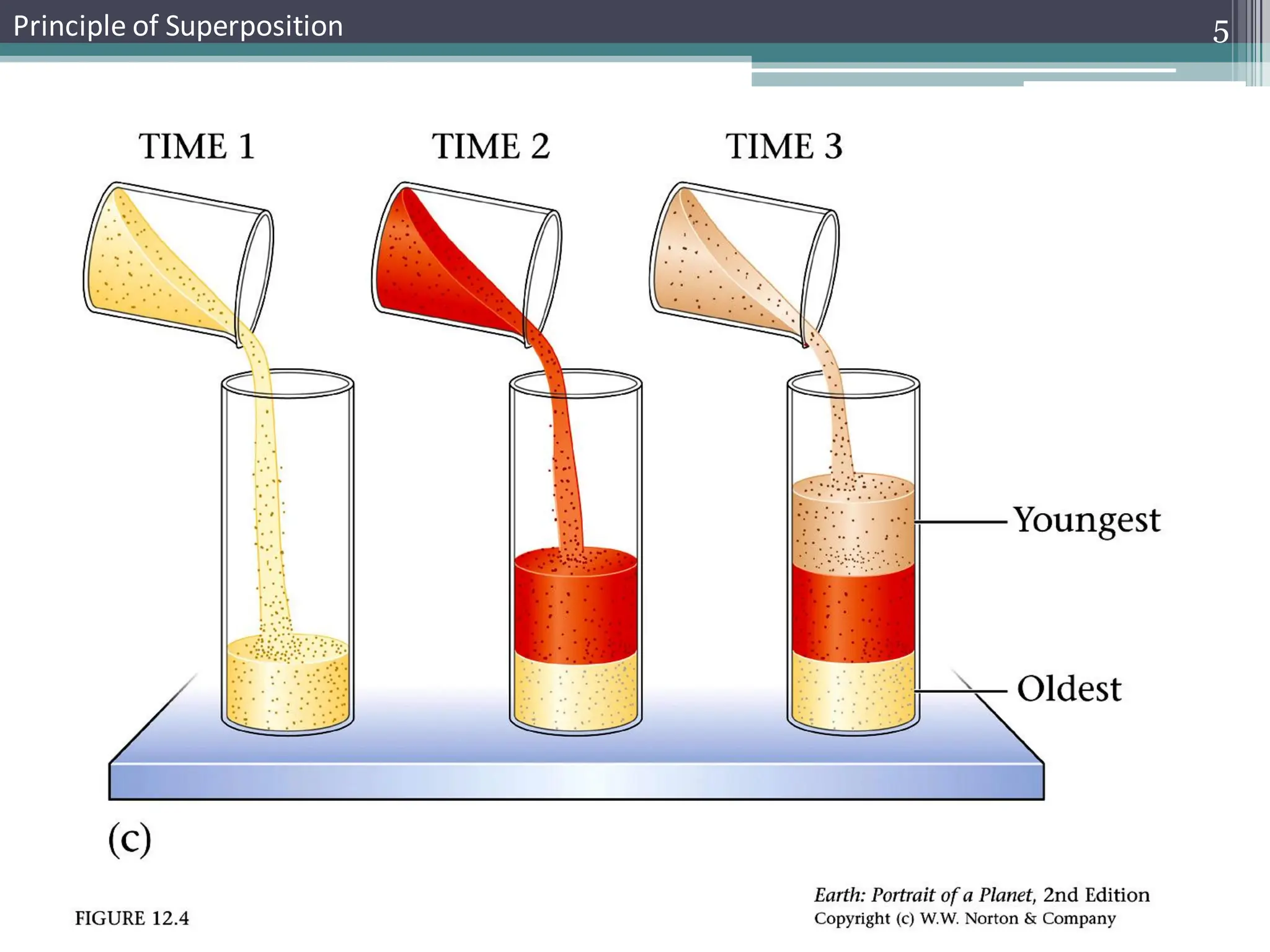
Principle of Superposition
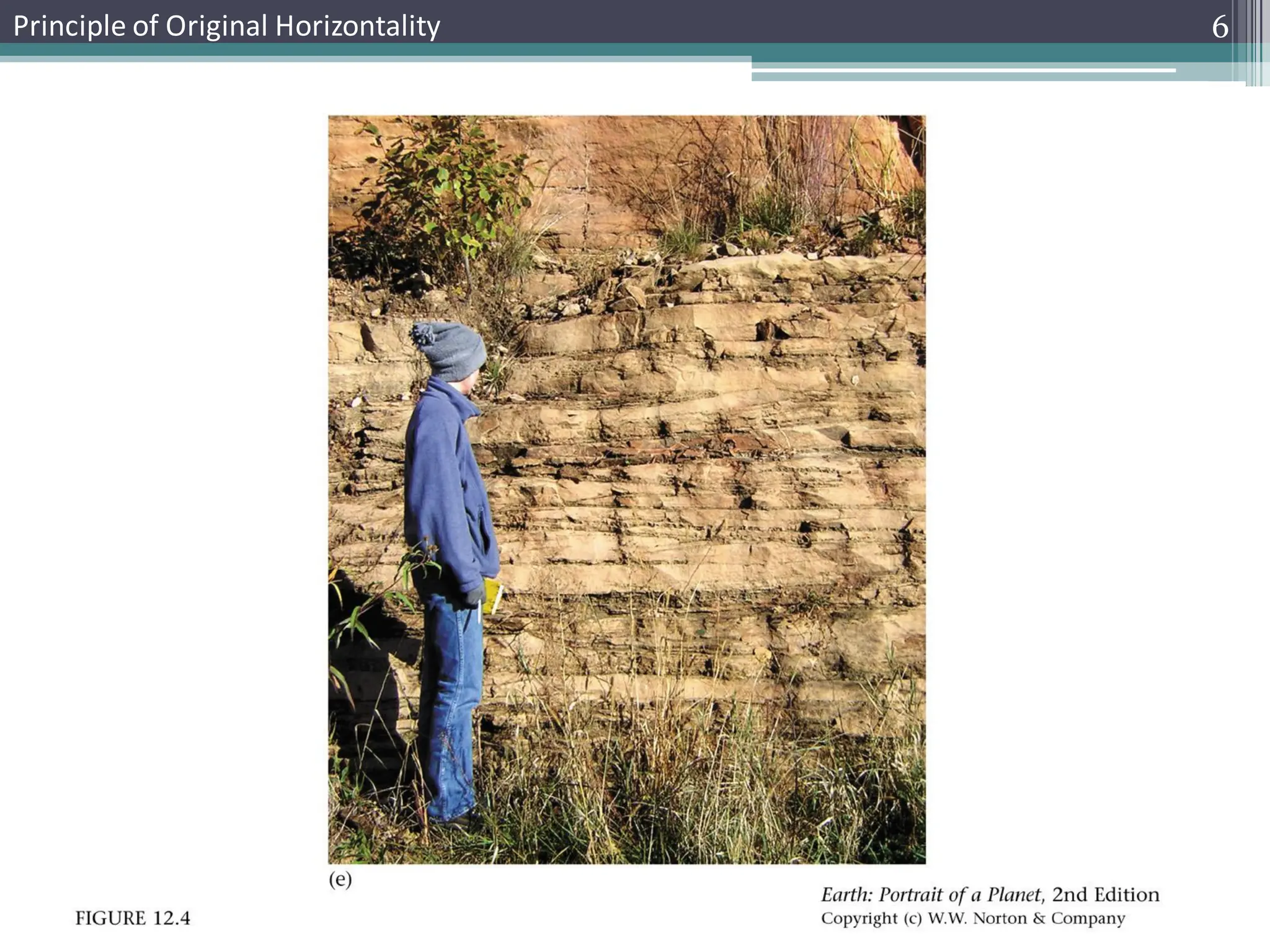
12_04e.jpg
6
Principle of Original Horizontality
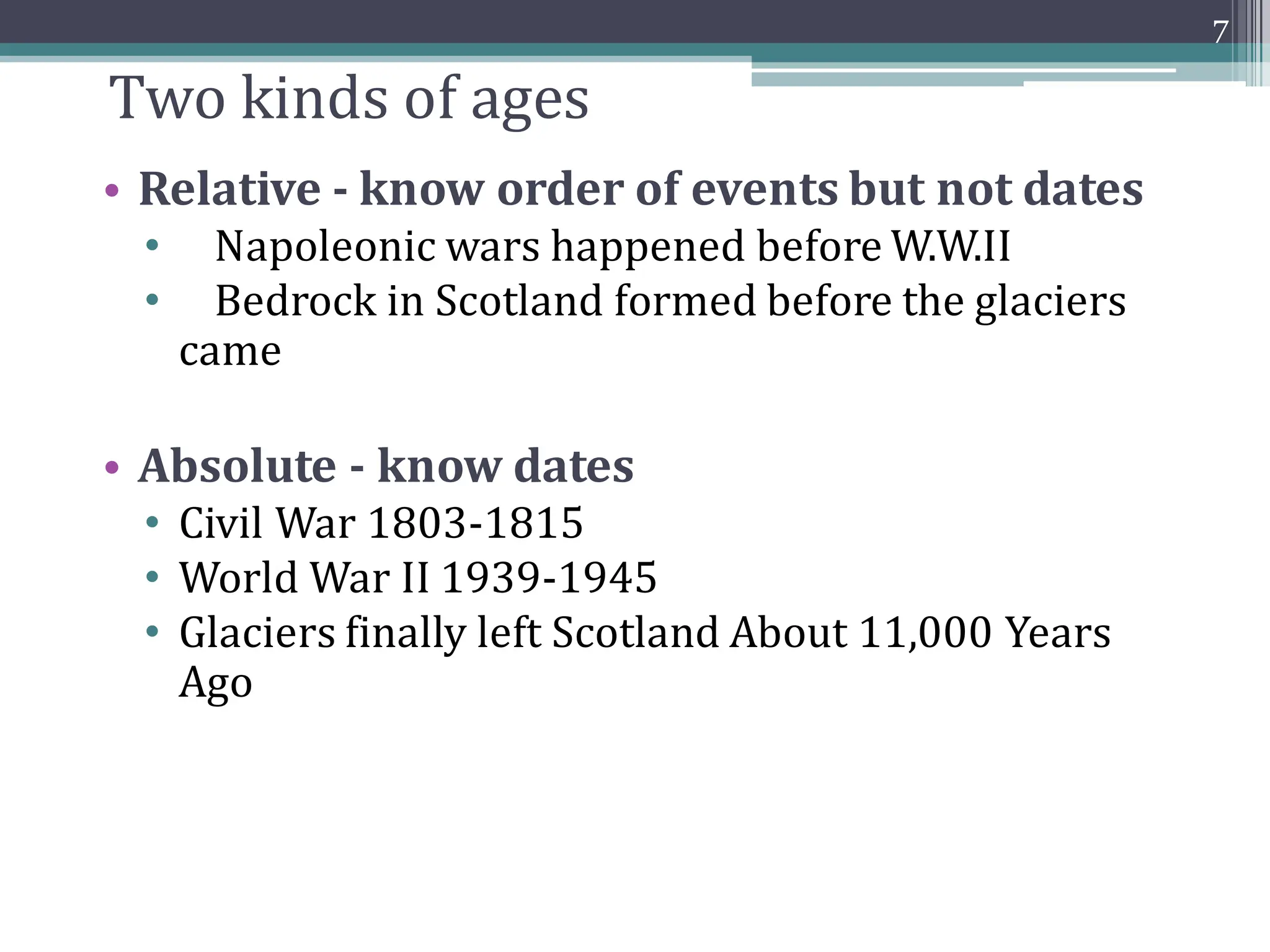
Two kinds of ages
• Relative - know order of events but not dates
• Napoleonic wars happened before W.W.II
• Bedrock in Scotland formed before the glaciers
came
• Absolute - know dates
• Civil War 1803-1815
• World War II 1939-1945
• Glaciers finally left Scotland About 11,000 Years
Ago
7
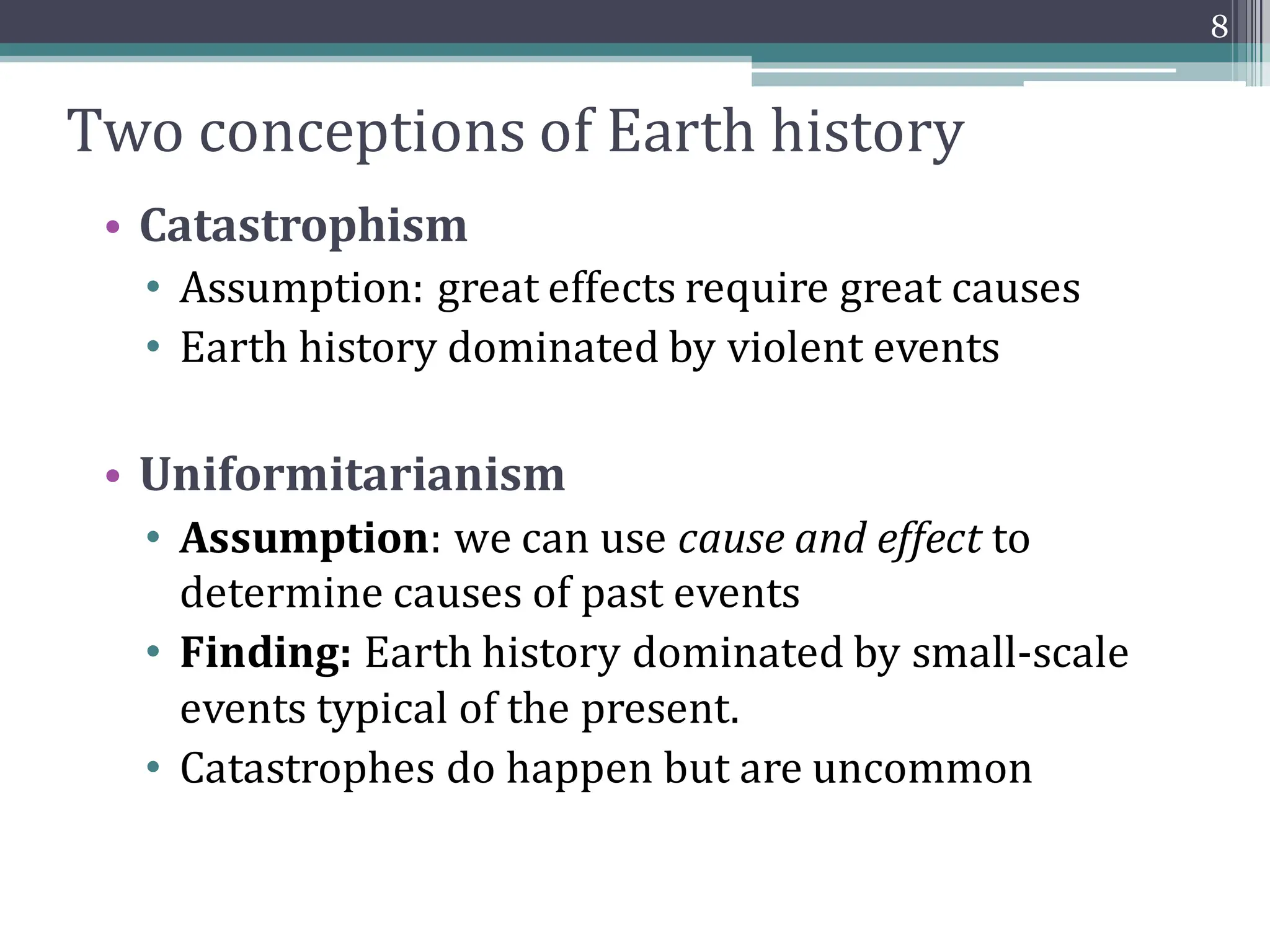
Two conceptions of Earth history
• Catastrophism
• Assumption: great effects require great causes
• Earth history dominated by violent events
• Uniformitarianism
• Assumption: we can use cause and effect to
determine causes of past events
• Finding: Earth history dominated by small-scale
events typical of the present.
• Catastrophes do happen but are uncommon
8
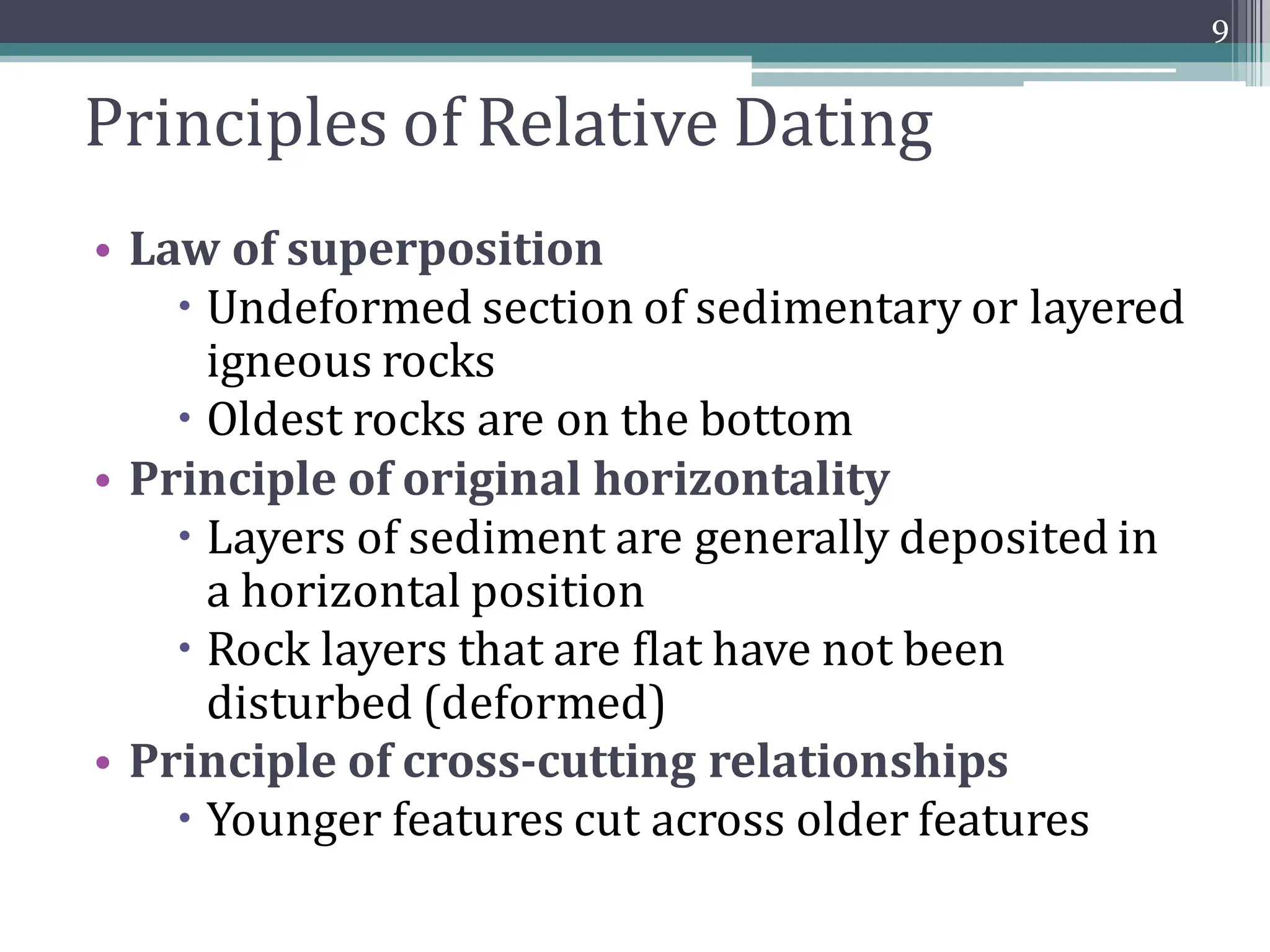
Principles of Relative Dating
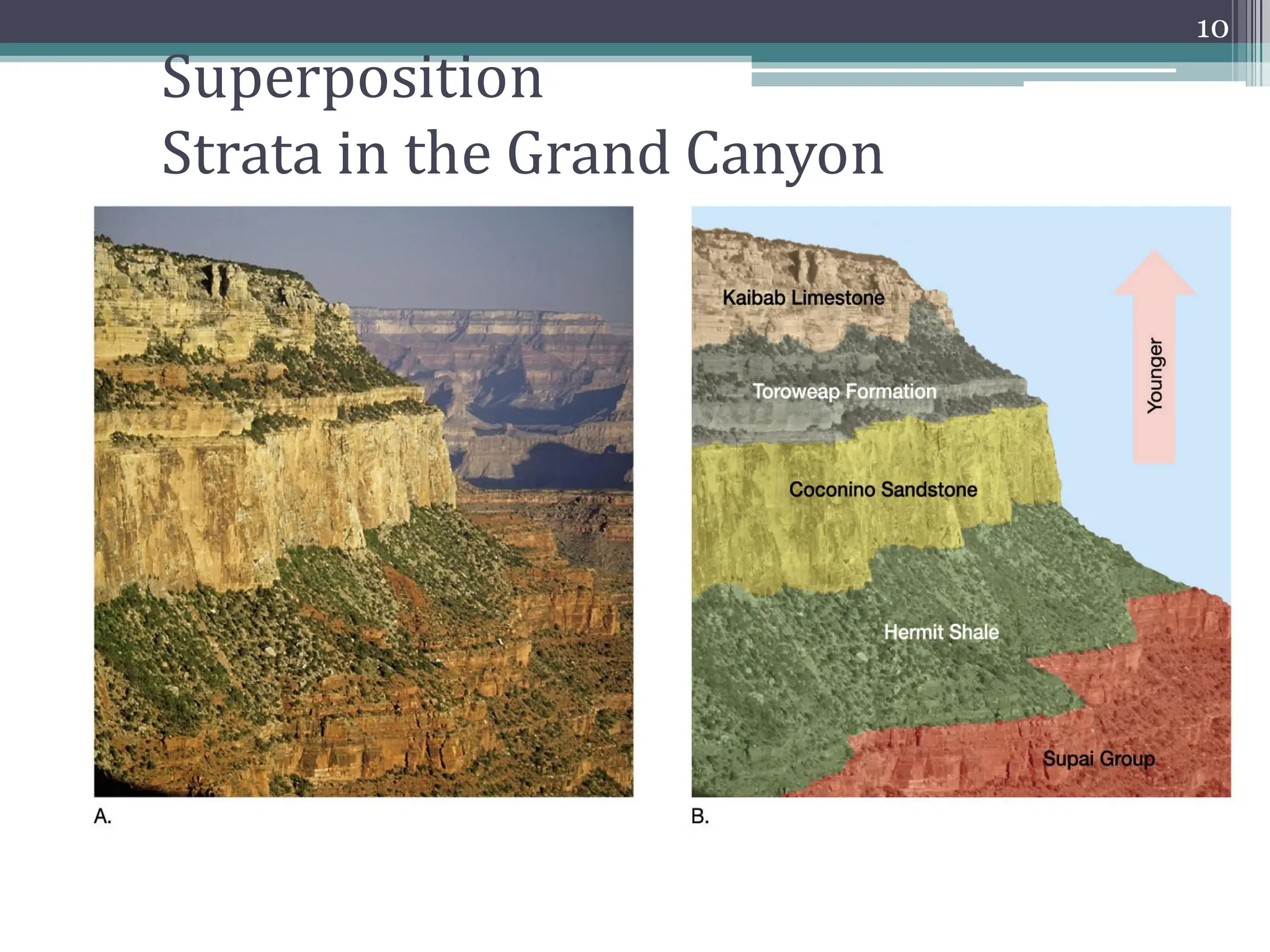
• Law of superposition
 Undeformed section of sedimentary or layered
igneous rocks
 Oldest rocks are on the bottom
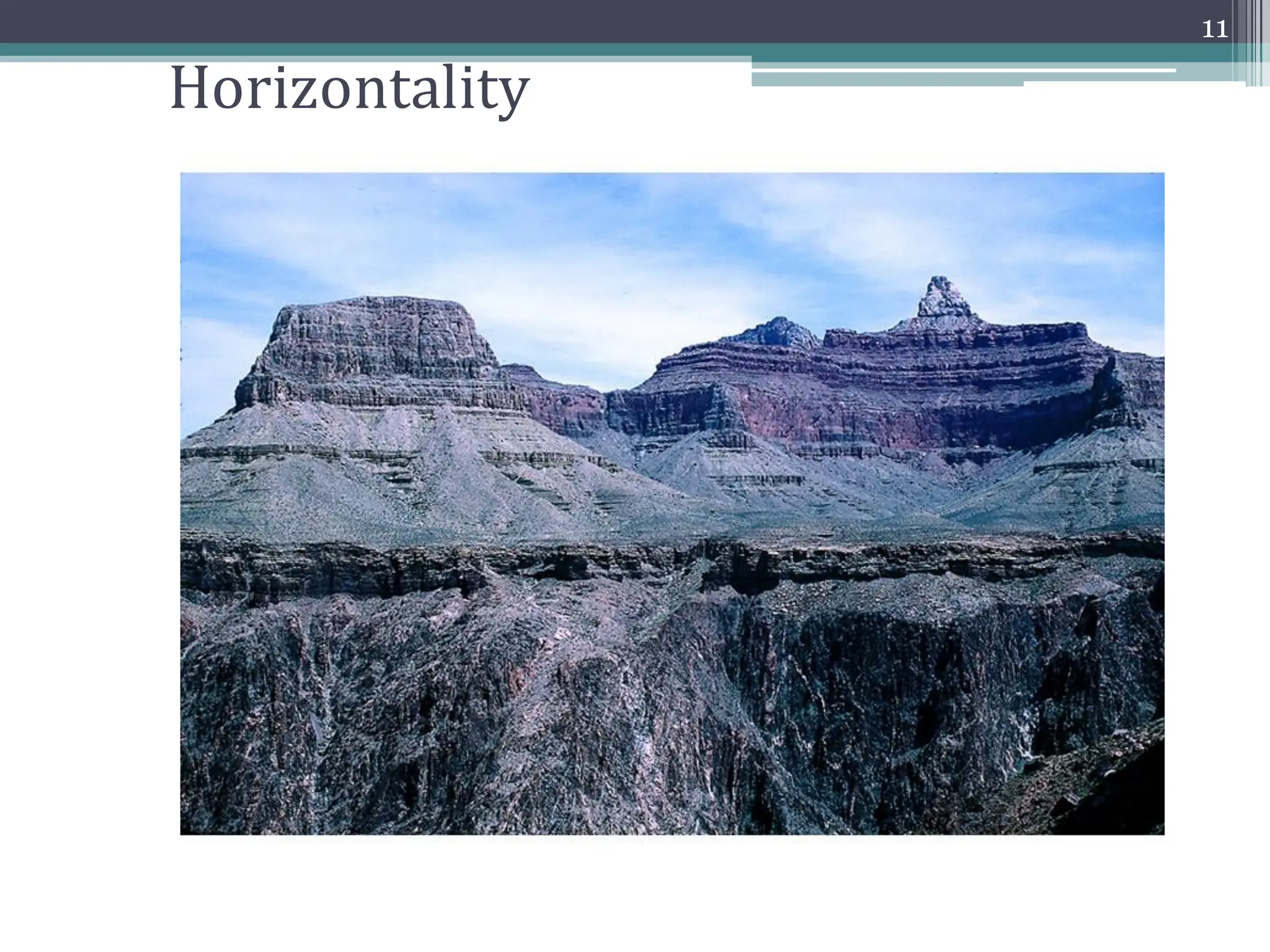
• Principle of original horizontality
 Layers of sediment are generally deposited in
a horizontal position
 Rock layers that are flat have not been
disturbed (deformed)
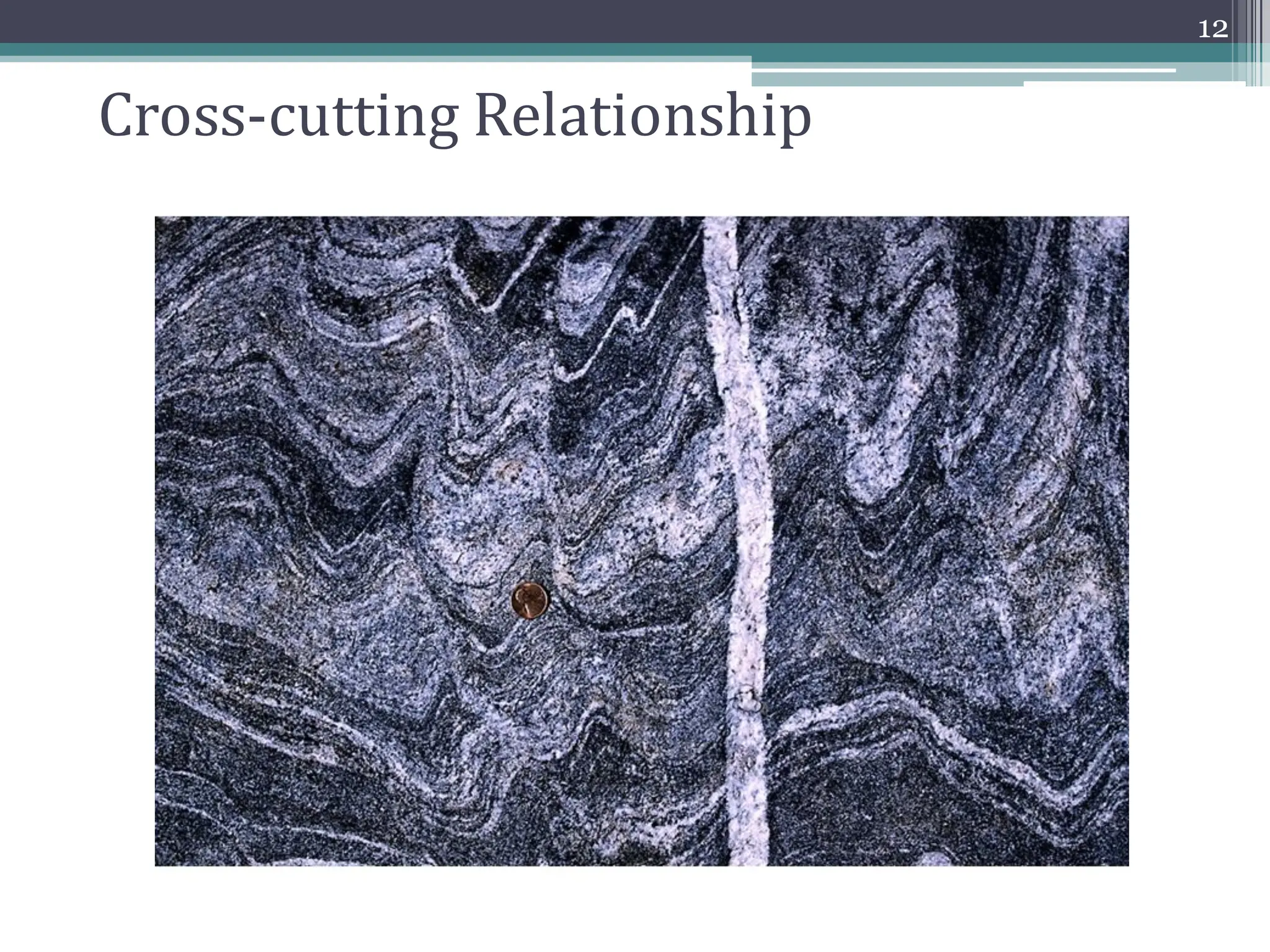
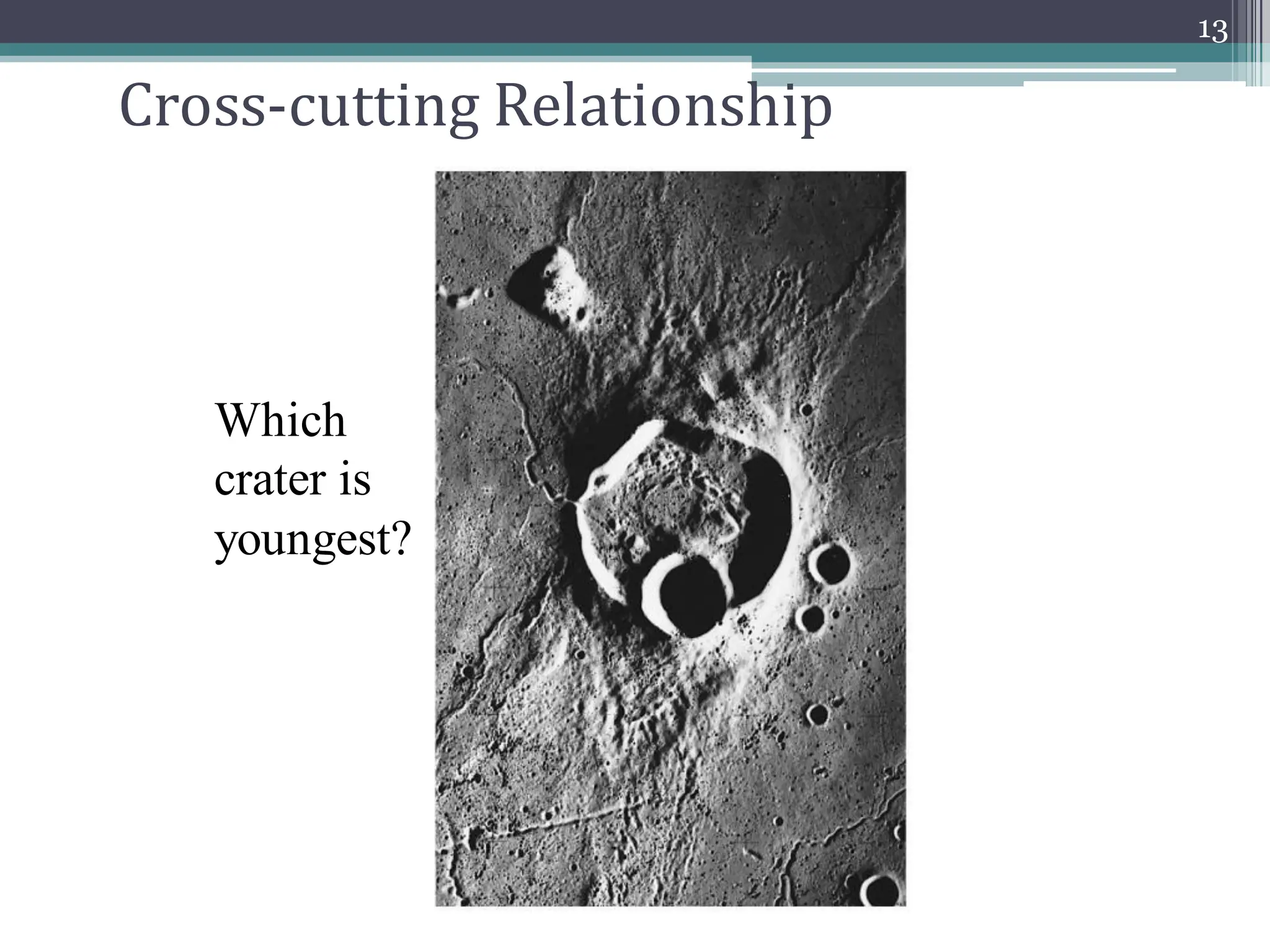
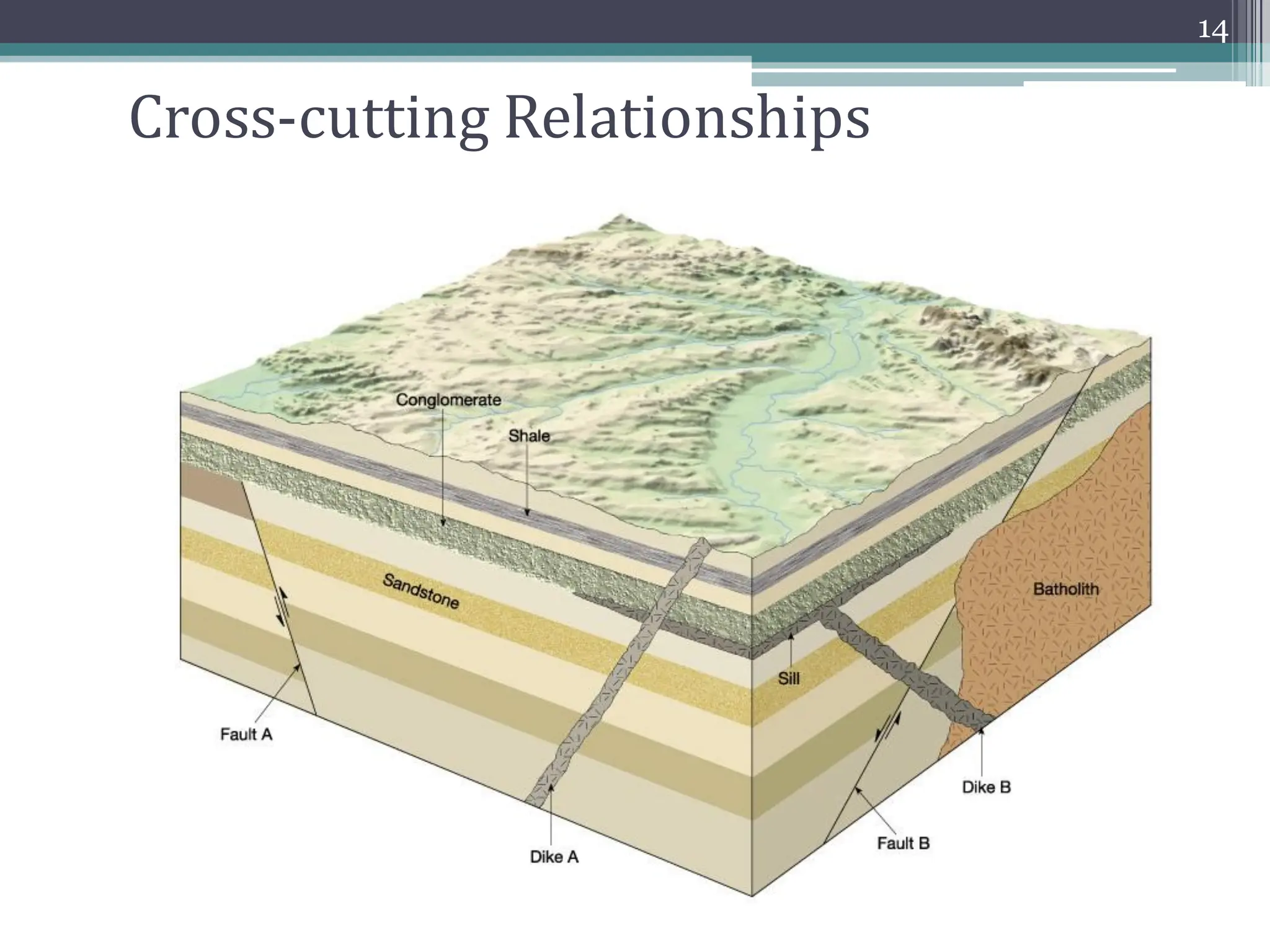
• Principle of cross-cutting relationships
 Younger features cut across older features
9
Superposition
Strata in the Grand Canyon
10
Horizontality
11
Cross-cutting Relationship
12
Cross-cutting Relationship
13
Which
crater is
youngest?
Cross-cutting Relationships
14
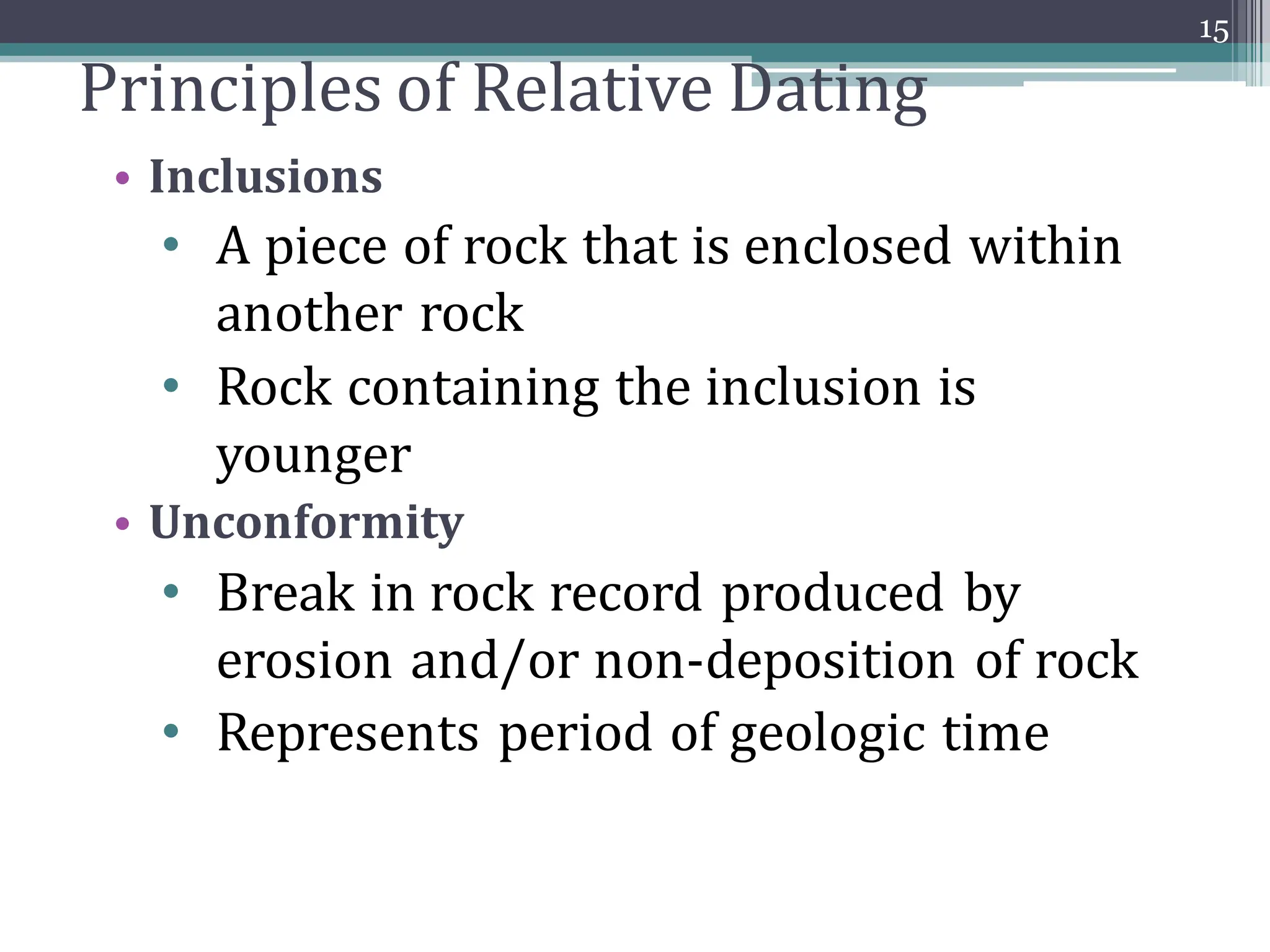
Principles of Relative Dating
• Inclusions
• A piece of rock that is enclosed within
another rock
• Rock containing the inclusion is
younger
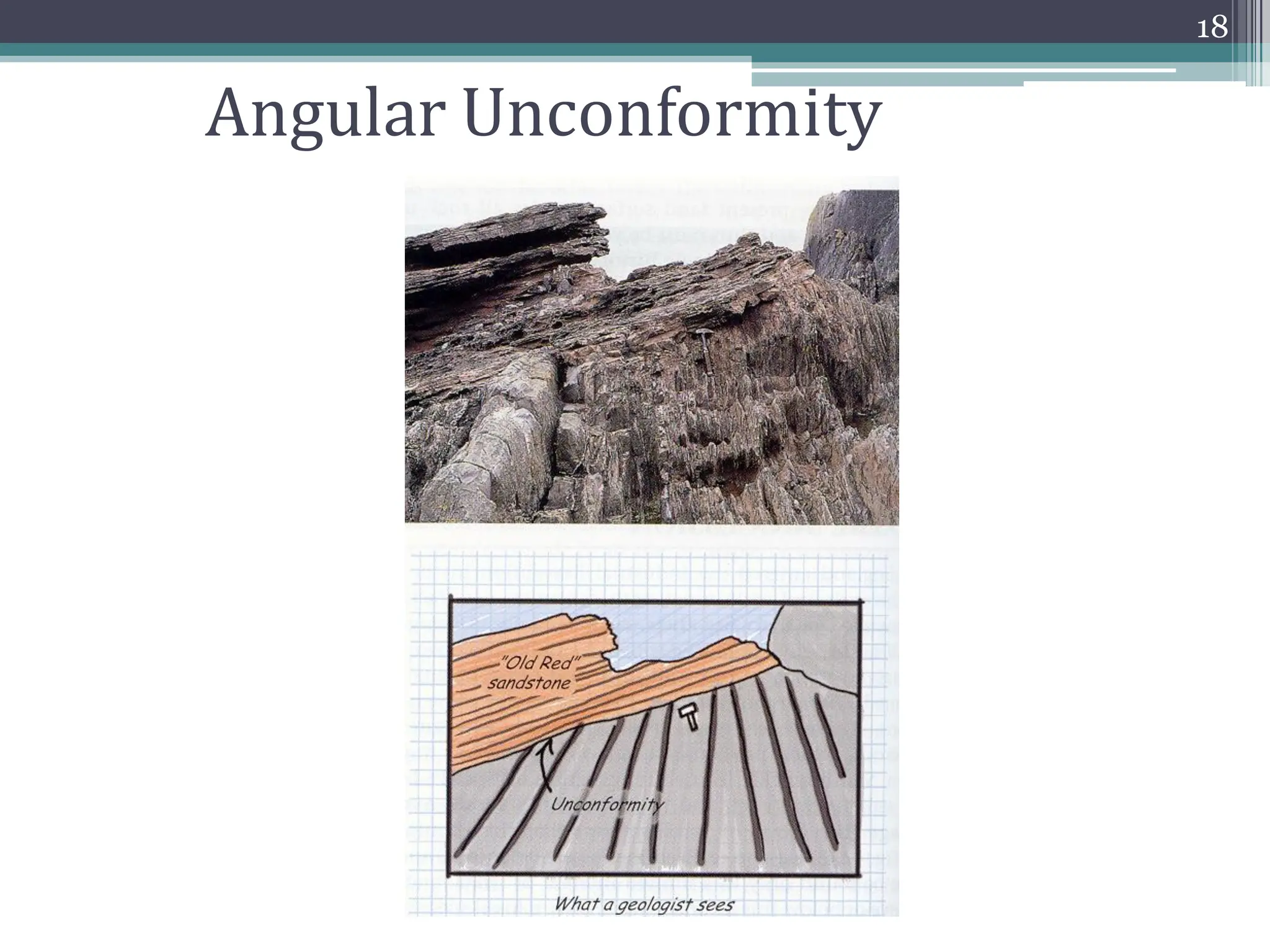
• Unconformity
• Break in rock record produced by
erosion and/or non-deposition of rock
• Represents period of geologic time
15
Principles of Relative Dating
• Types of unconformities
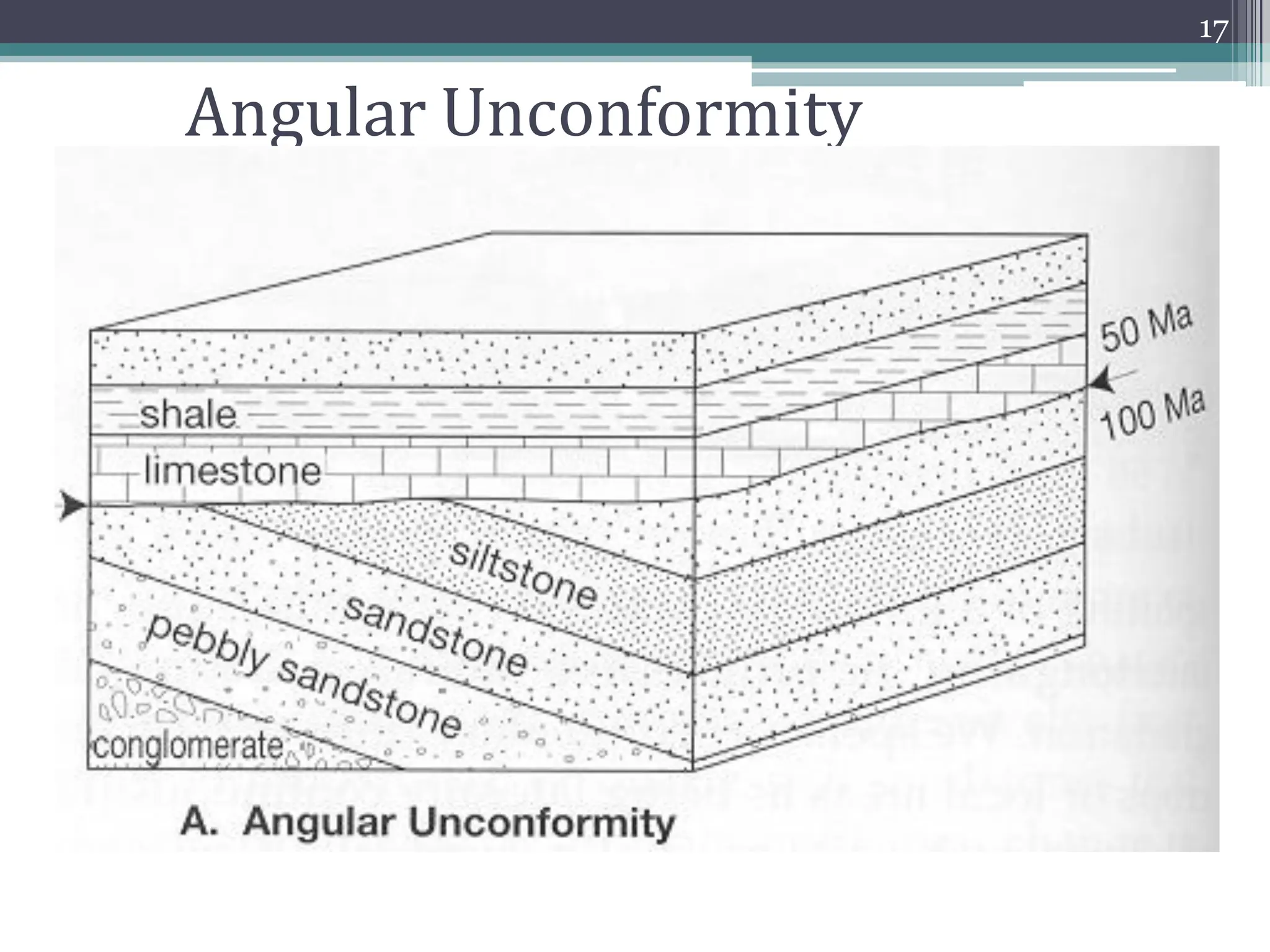
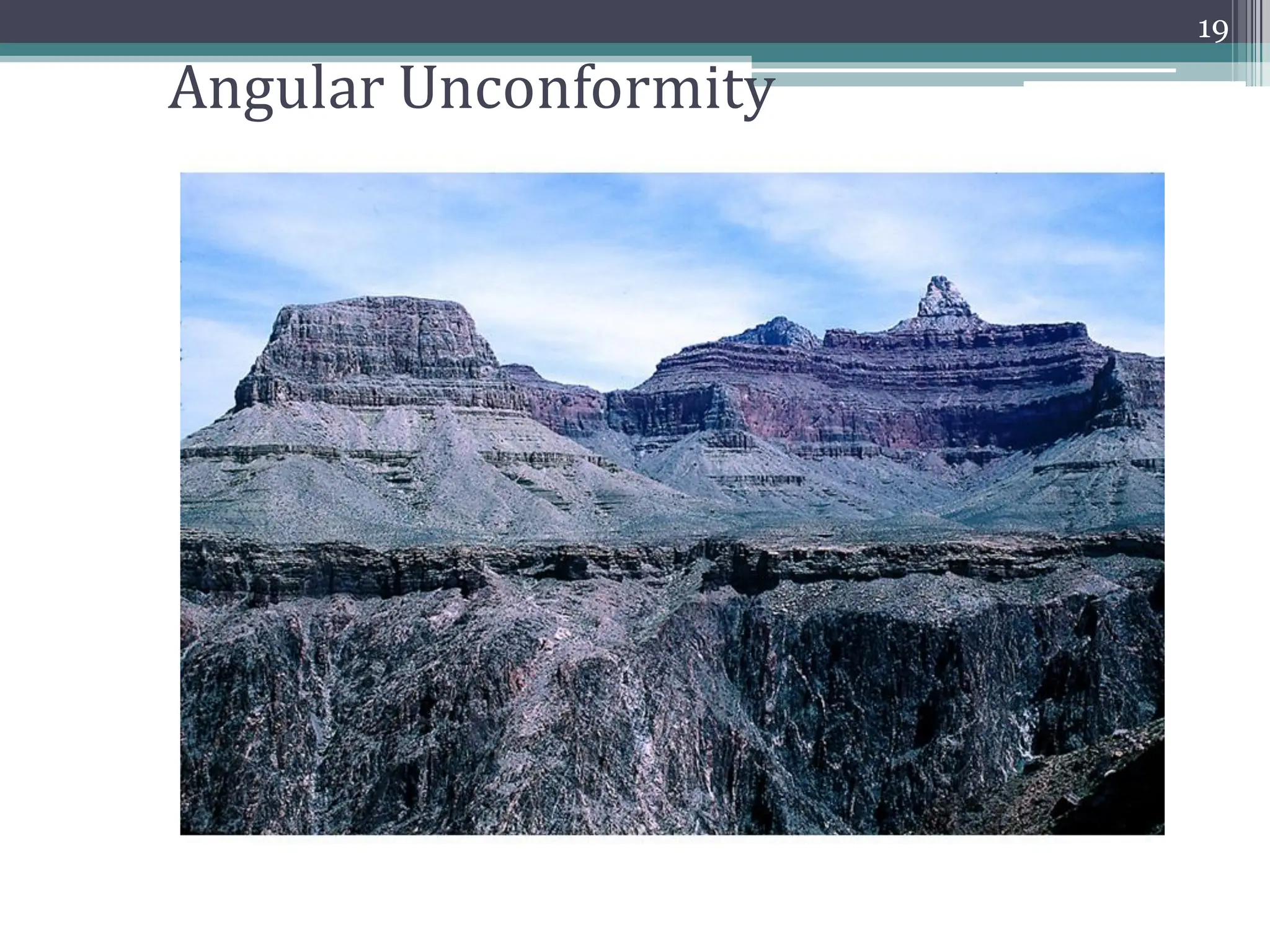
 Angular unconformity
• tilted rocks (disturbed) are overlain by flat-lying
rocks
 Disconformity
• strata on either side of the unconformity are
parallel
 Nonconformity
• metamorphic or igneous rocks in contact with
sedimentary strata
16
Angular Unconformity
17
Angular Unconformity
18
Angular Unconformity
19
Uniformitarianism
• Continuity of Cause and Effect
• Apply Cause and Effect to Future - Prediction
• Apply Cause and Effect to Present - Technology
• Apply Cause and Effect to Past –
Uniformitarianism
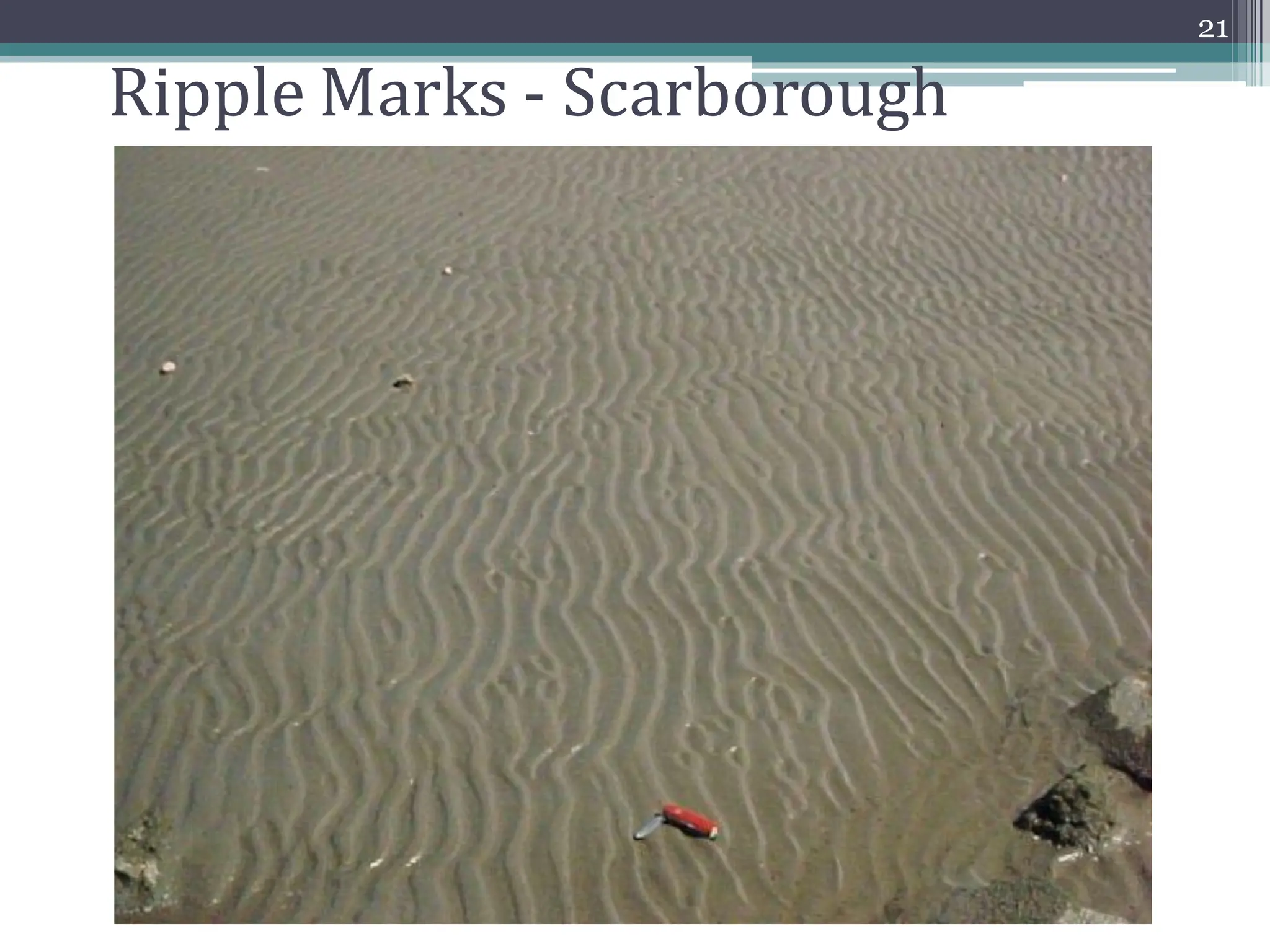
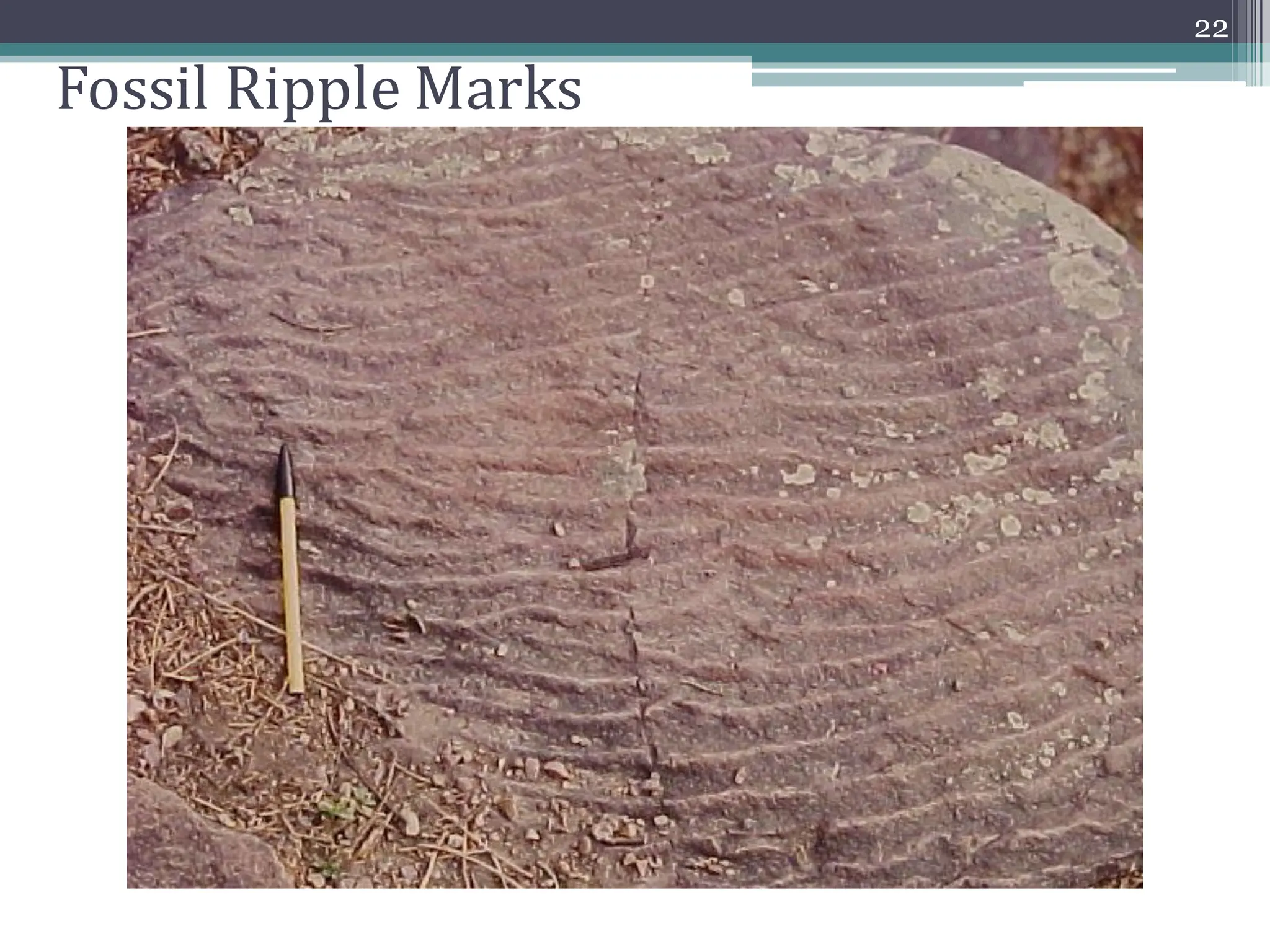
The present is the key to the
past
20
Ripple Marks - Scarborough
21
Fossil Ripple Marks
22
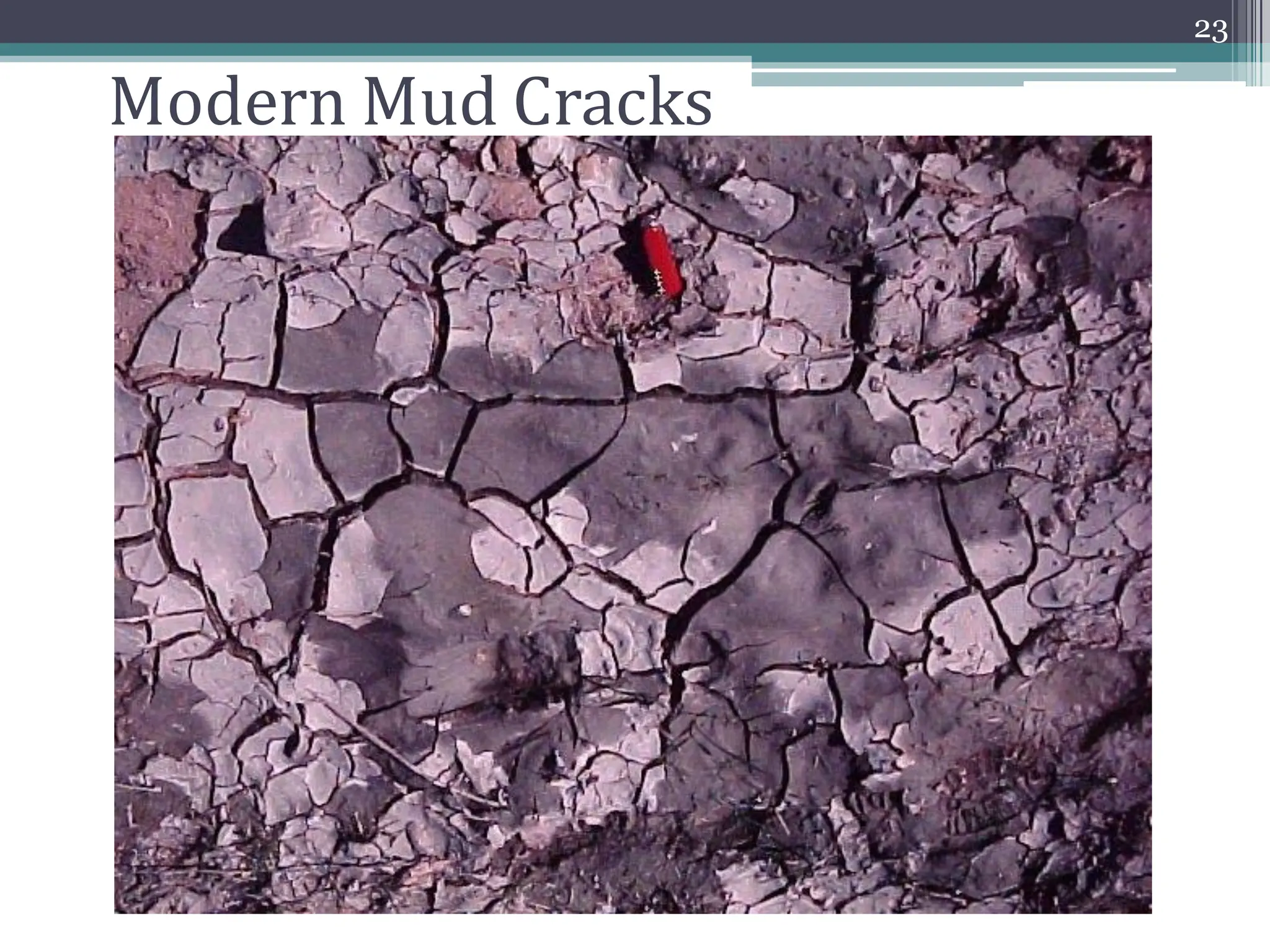
Modern Mud Cracks
23
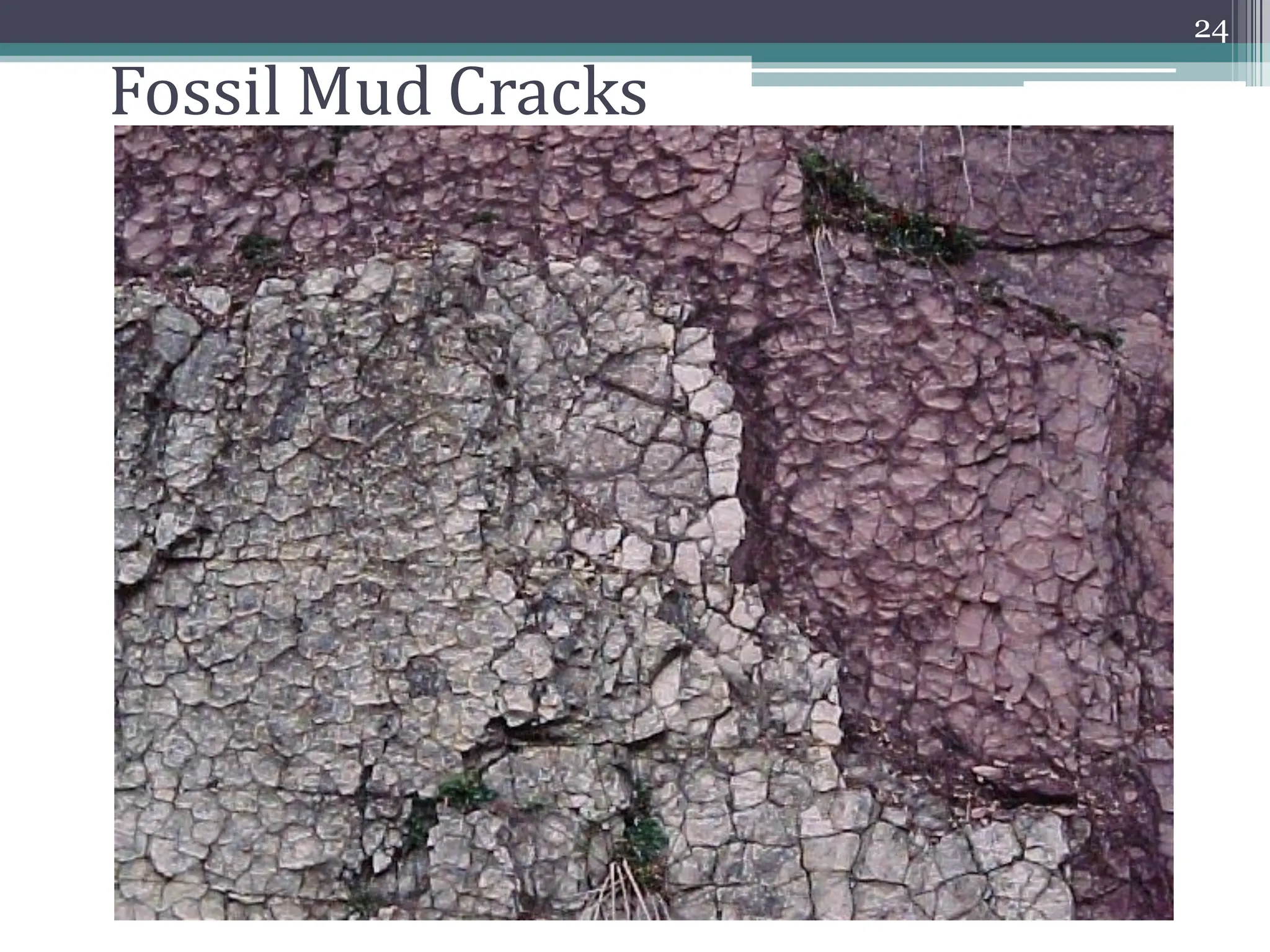
Fossil Mud Cracks
24
The makings of good Index Fossils
• Abundant
• Widely-distributed(Global Preferred)
• Short-lived or rapidly changing
25
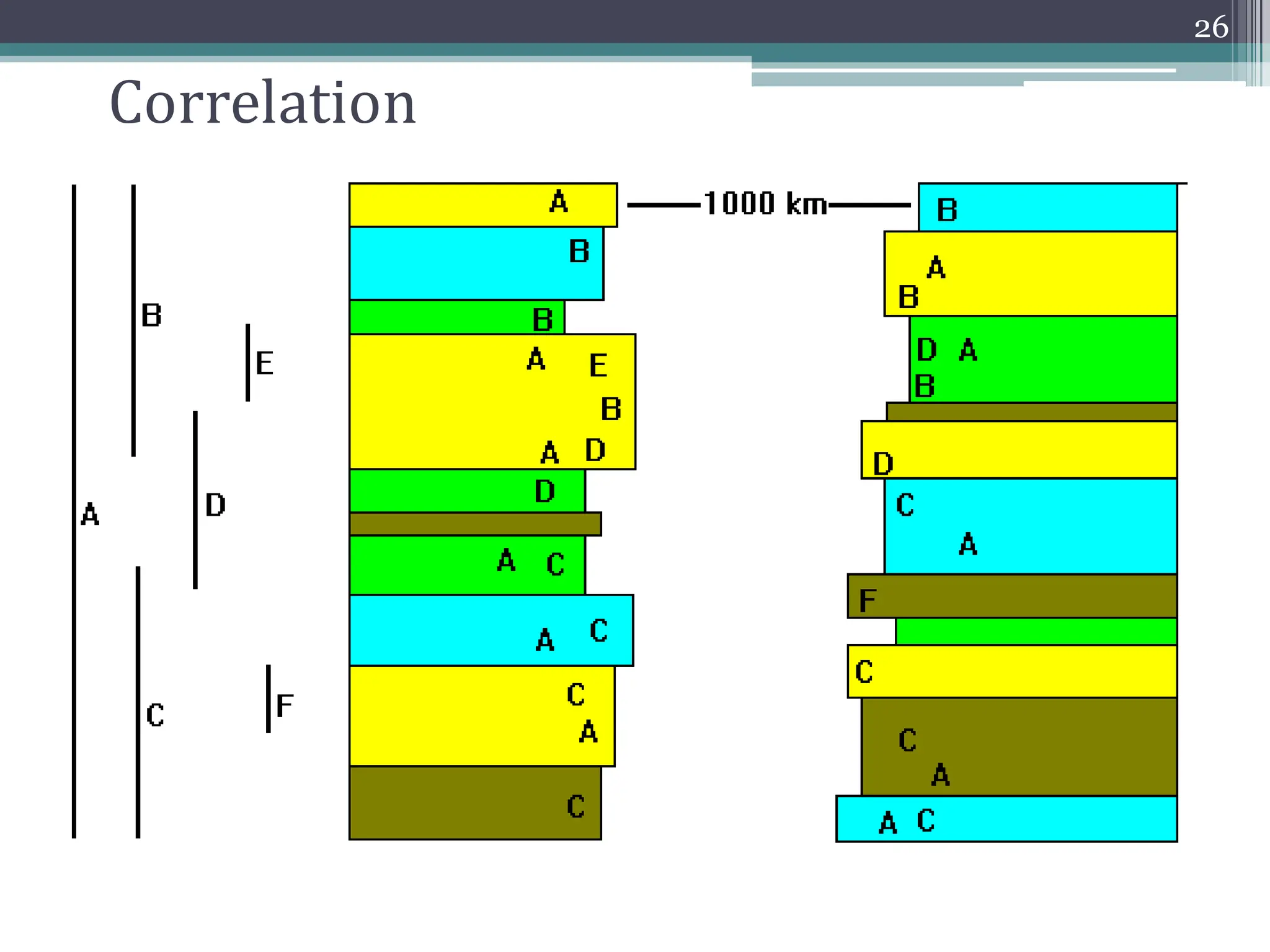
Correlation
26
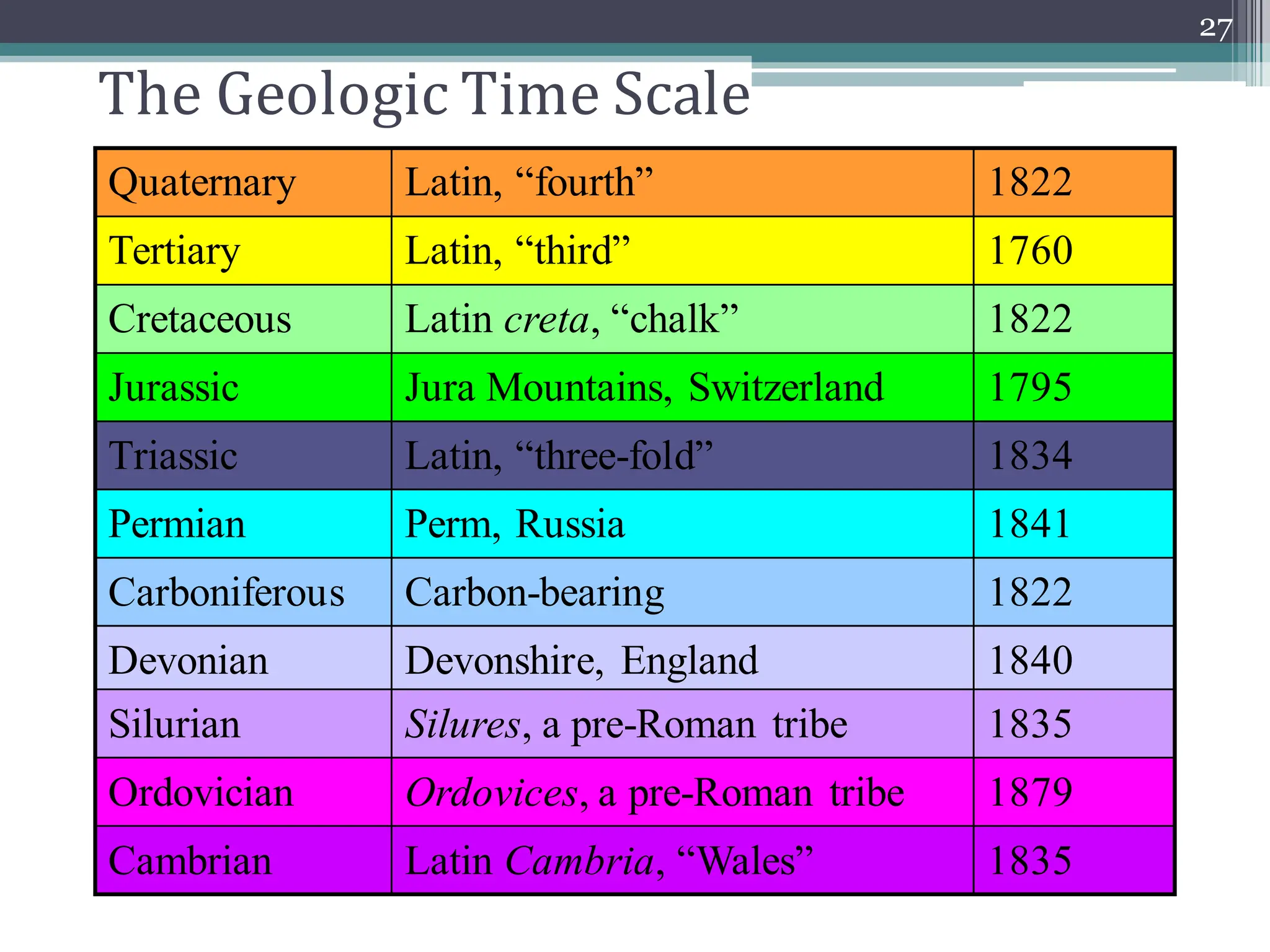
The Geologic Time Scale
Quaternary Latin, “fourth” 1822
Tertiary Latin, “third” 1760
Cretaceous Latin creta, “chalk” 1822
Jurassic Jura Mountains, Switzerland 1795
Triassic Latin, “three-fold” 1834
Permian Perm, Russia 1841
Carboniferous Carbon-bearing 1822
Devonian Devonshire, England 1840
Silurian Silures, a pre-Roman tribe 1835
Ordovician Ordovices, a pre-Roman tribe 1879
Cambrian Latin Cambria, “Wales” 1835
27
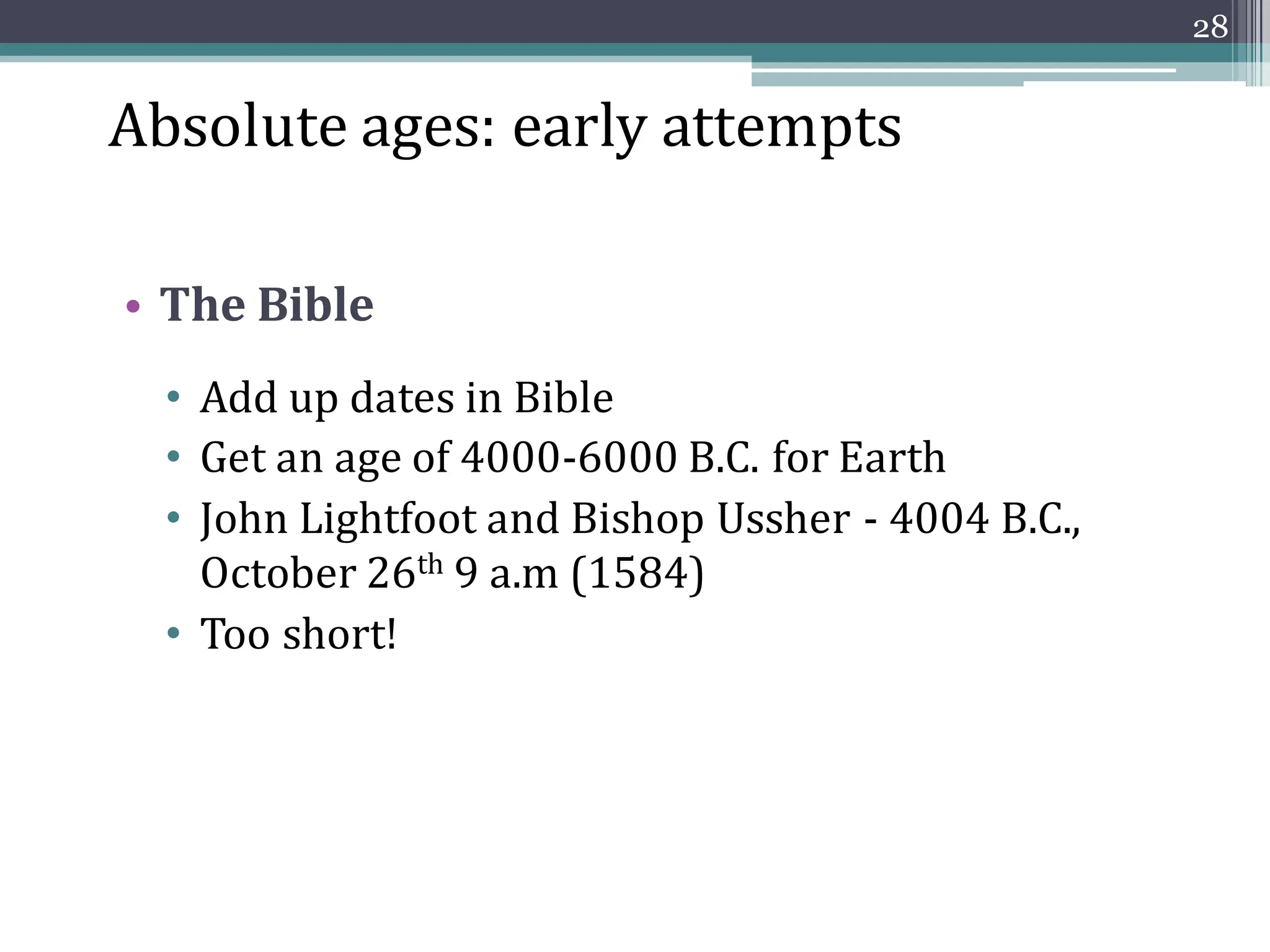
Absolute ages: early attempts
• The Bible
• Add up dates in Bible
• Get an age of 4000-6000 B.C. for Earth
• John Lightfoot and Bishop Ussher - 4004 B.C.,
October 26th 9 a.m (1584)
• Too short!
28
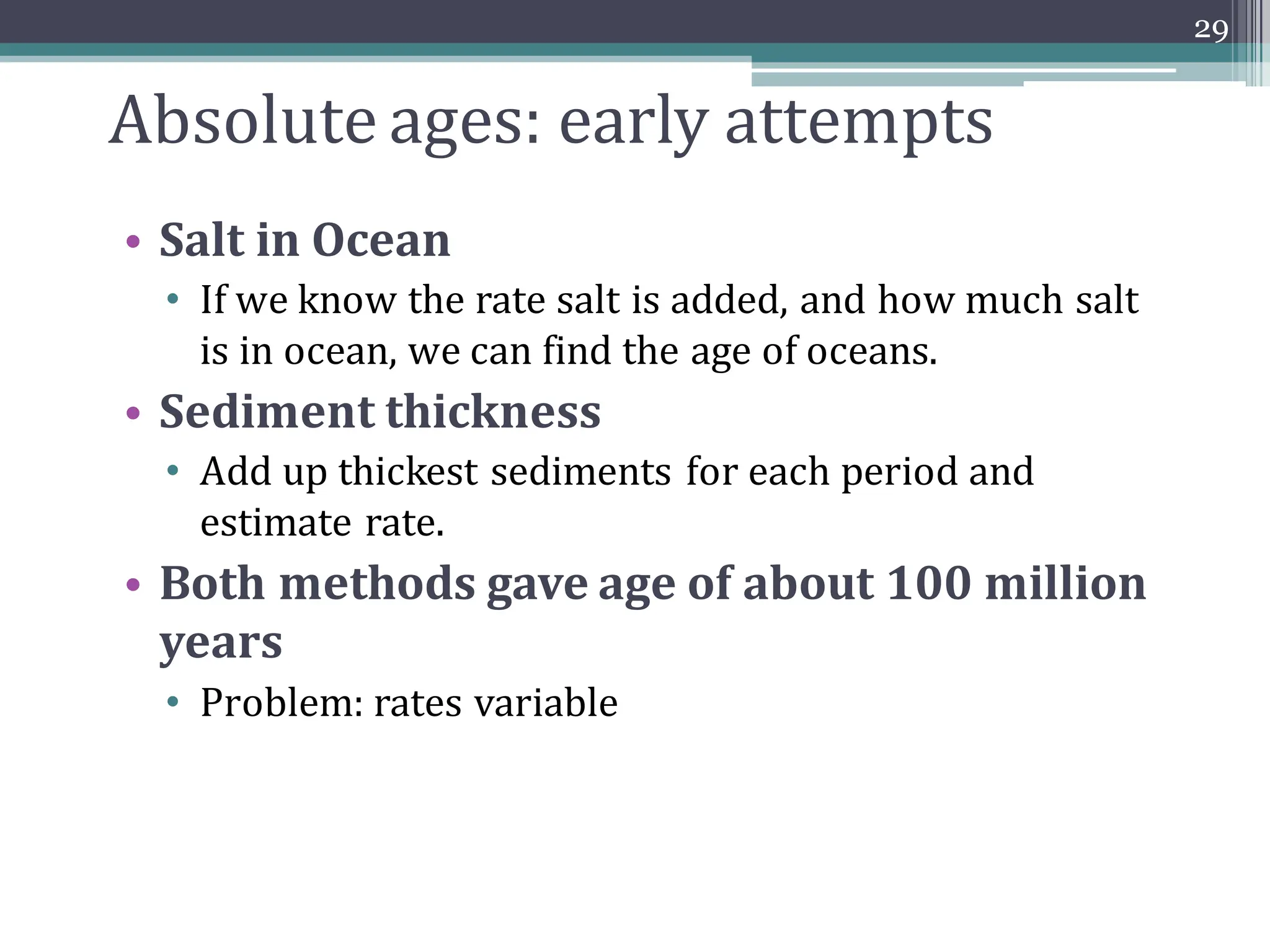
Absolute ages: early attempts
• Salt in Ocean
• If we know the rate salt is added, and how much salt
is in ocean, we can find the age of oceans.
• Sediment thickness
• Add up thickest sediments for each period and
estimate rate.
• Both methods gave age of about 100 million
years
• Problem: rates variable
29
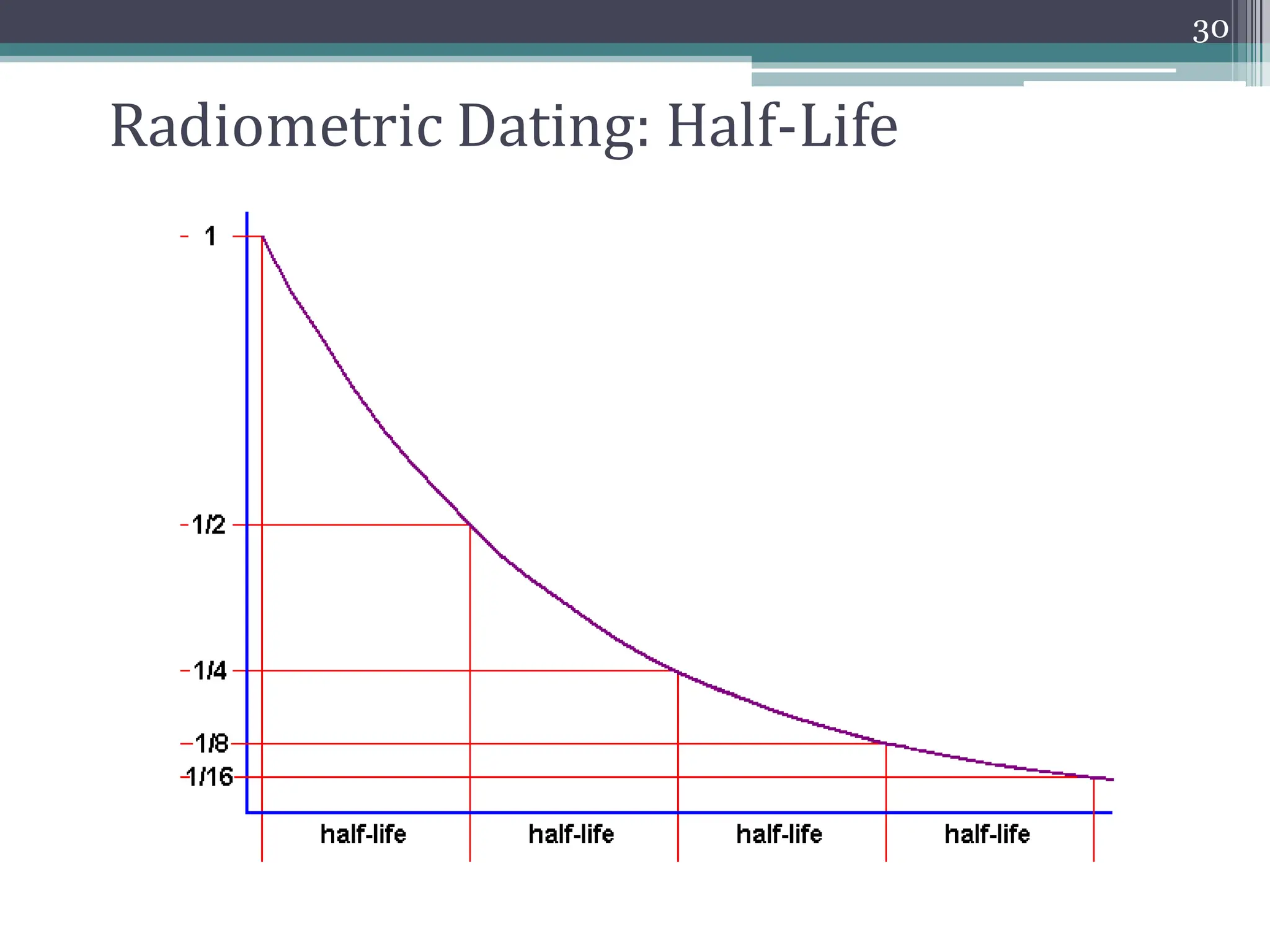
Radiometric Dating: Half-Life
30
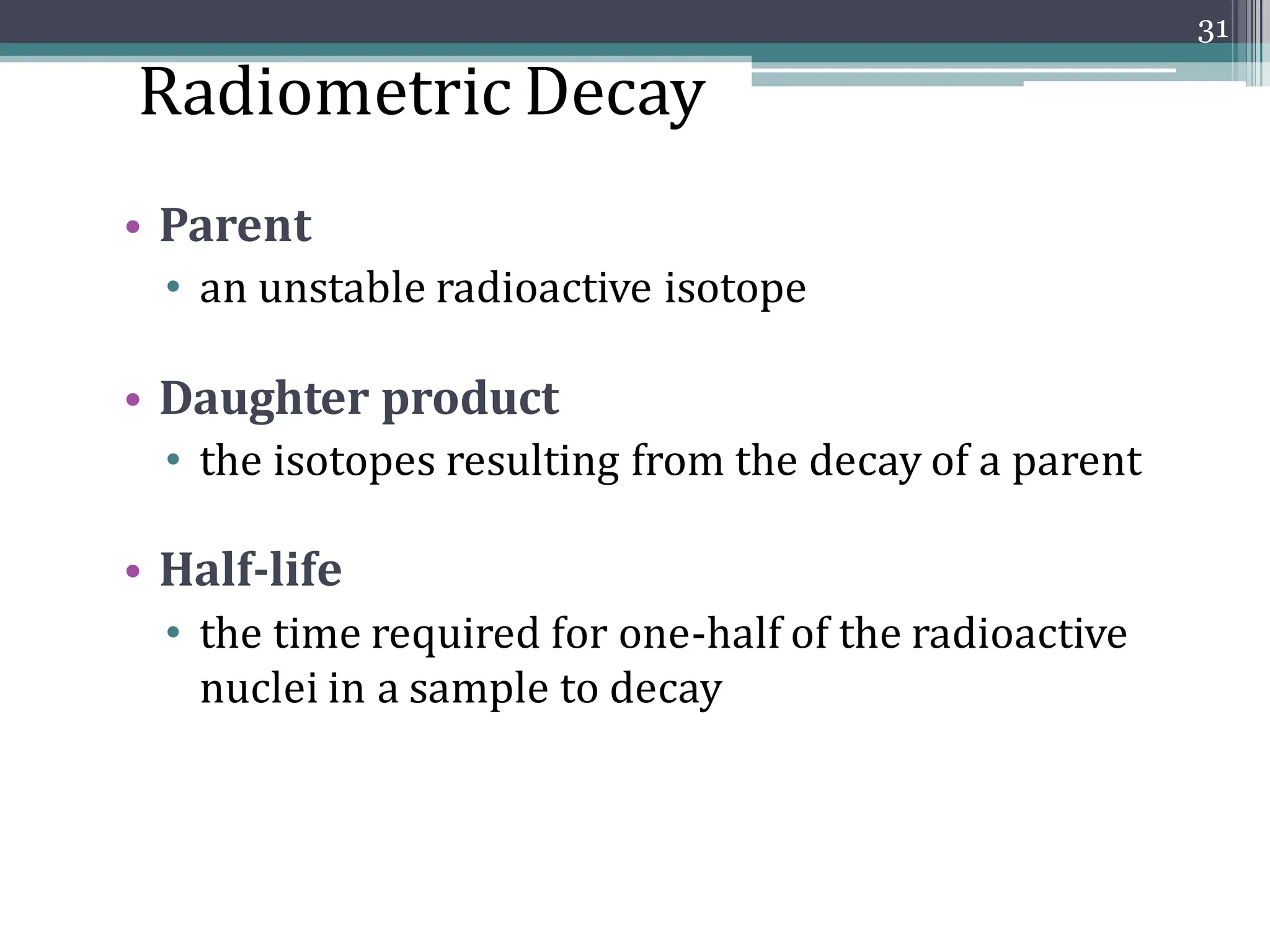
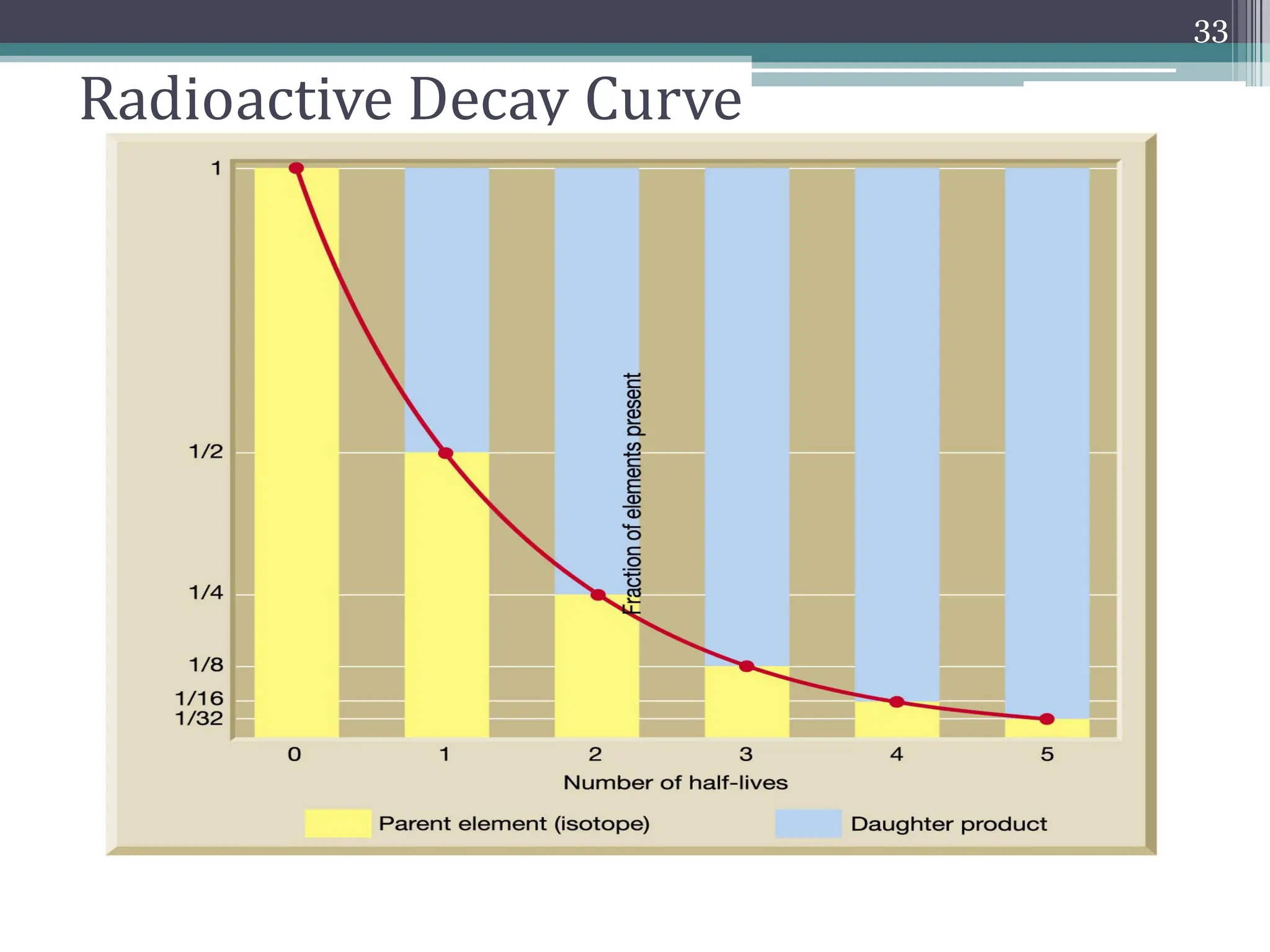
• Parent
• an unstable radioactive isotope
• Daughter product
• the isotopes resulting from the decay of a parent
• Half-life
• the time required for one-half of the radioactive
nuclei in a sample to decay
31
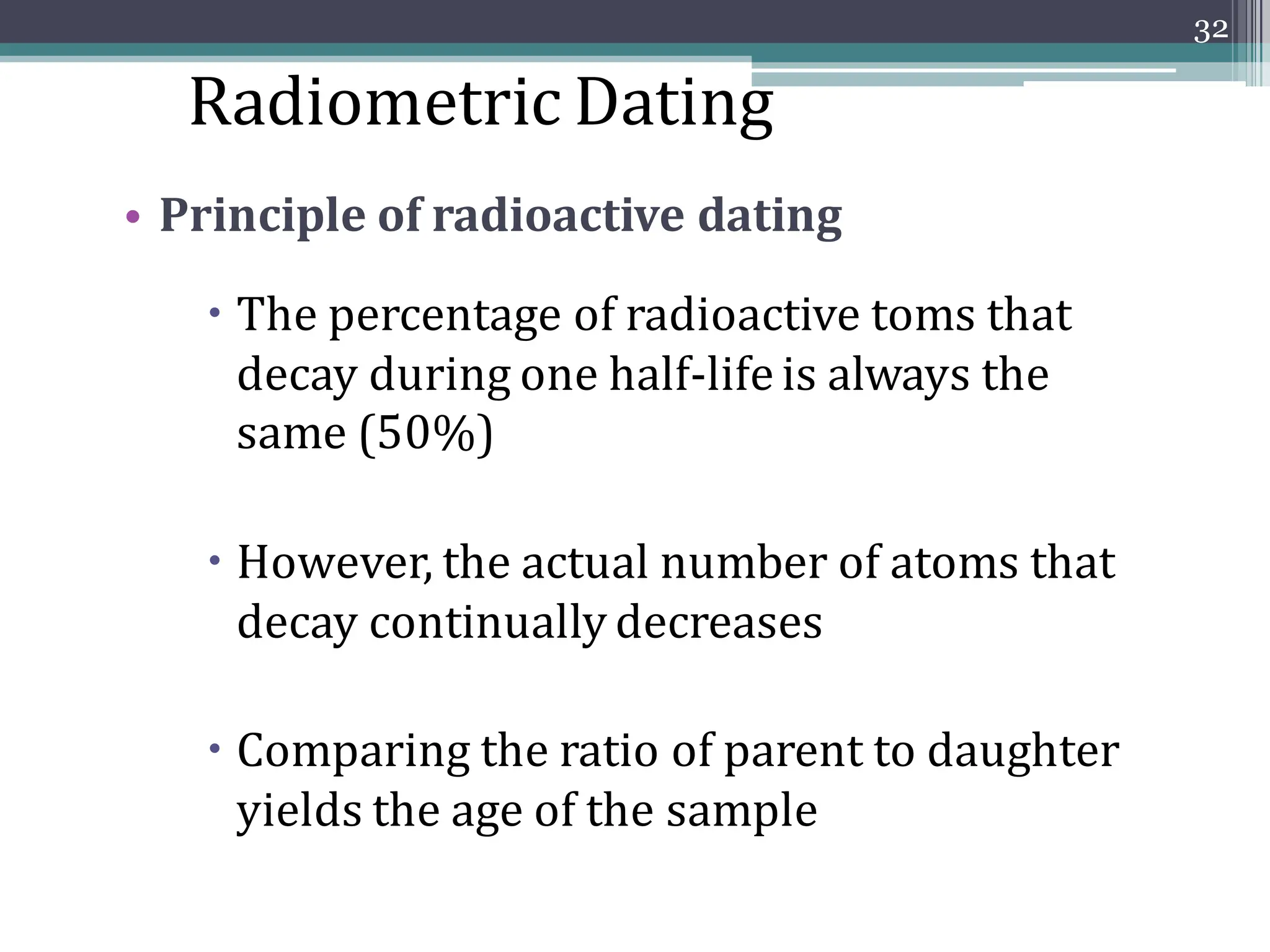
Radiometric Decay
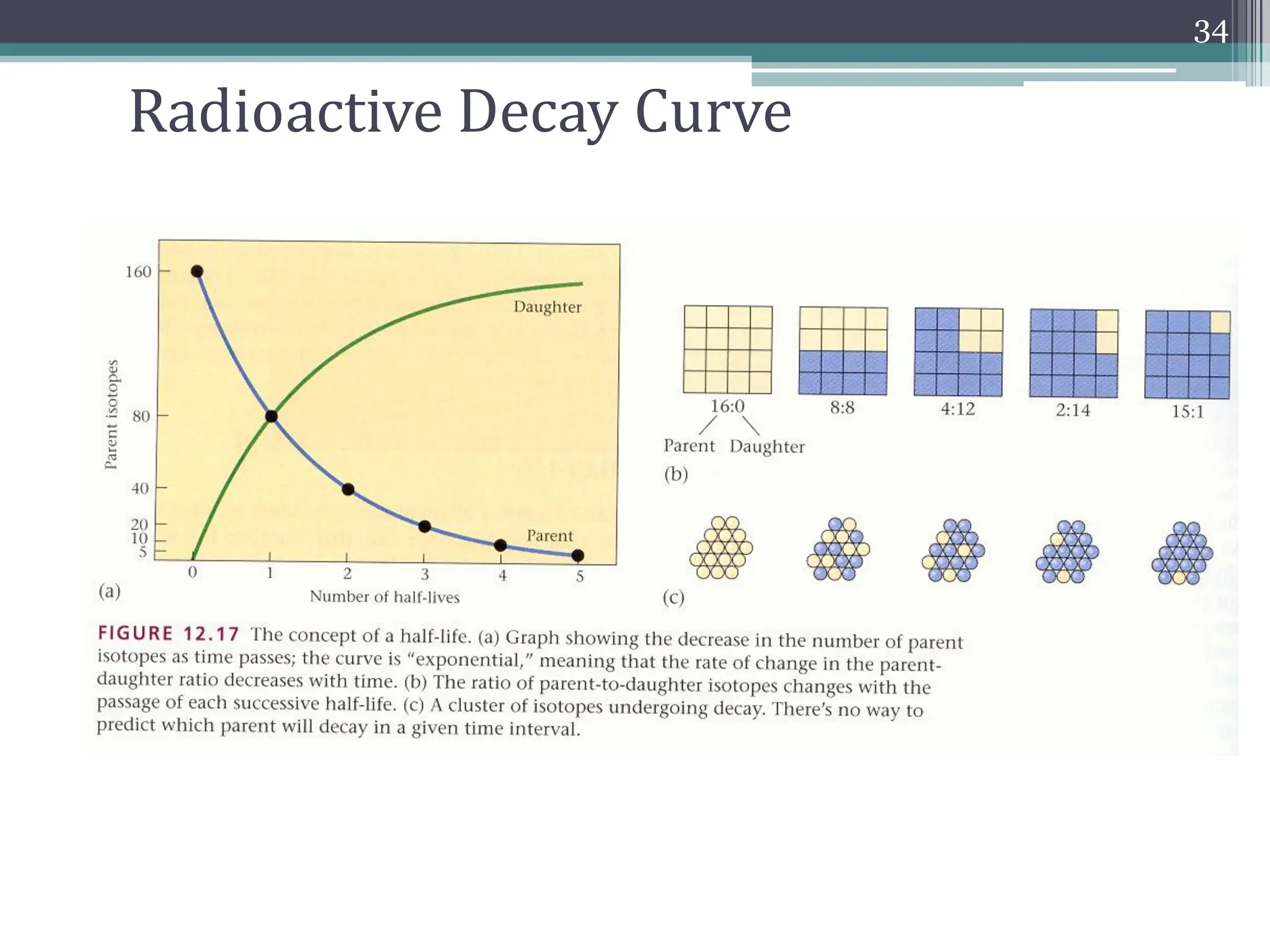
• Principle of radioactive dating
 The percentage of radioactive toms that
decay during one half-life is always the
same (50%)
 However, the actual number of atoms that
decay continually decreases
 Comparing the ratio of parent to daughter
yields the age of the sample
32
Radiometric Dating
Radioactive Decay Curve
33
Radioactive Decay Curve
34
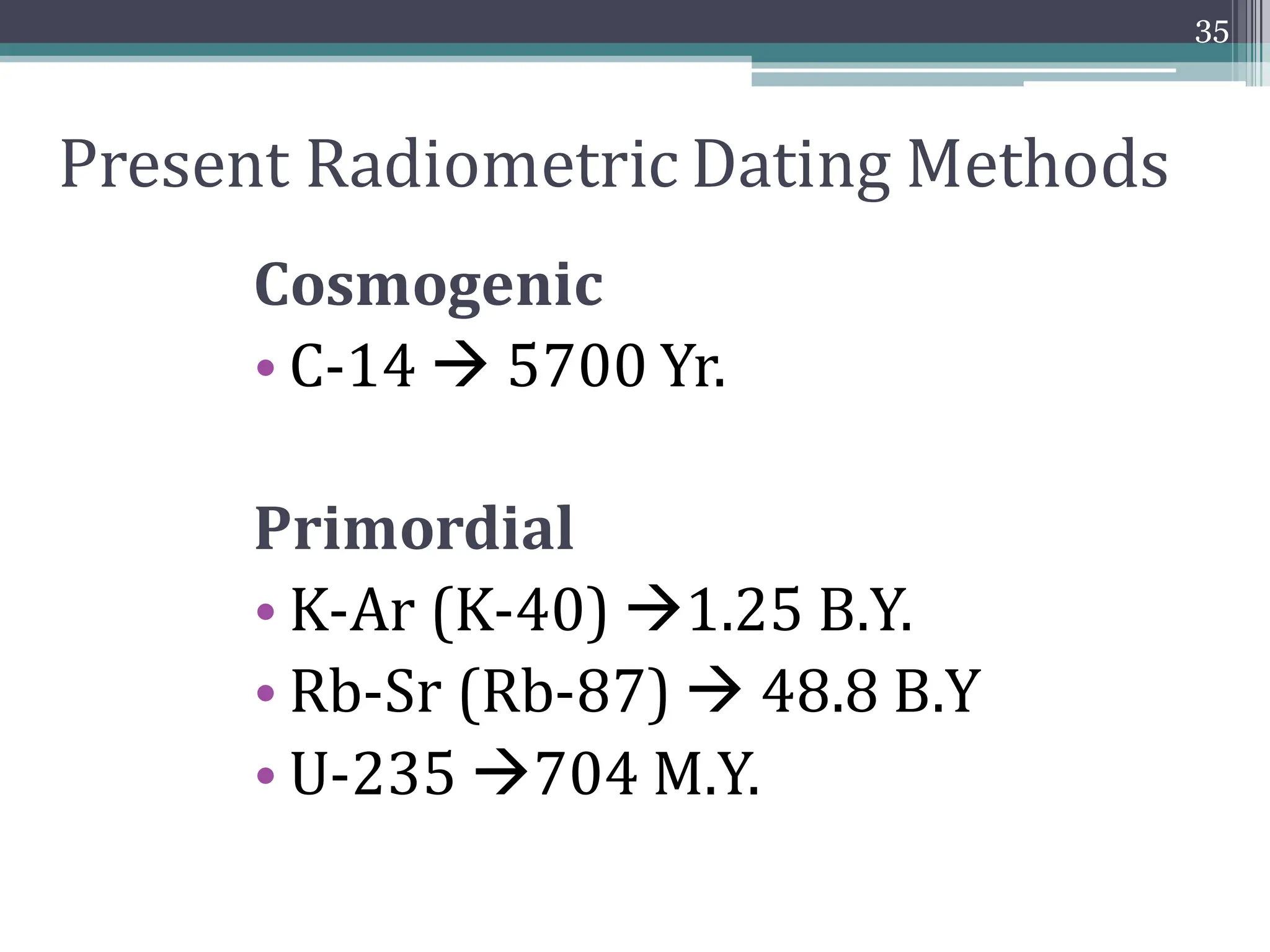
Present Radiometric Dating Methods
Cosmogenic
• C-14 → 5700 Yr.
Primordial
• K-Ar (K-40) →1.25 B.Y.
• Rb-Sr (Rb-87) → 48.8 B.Y
• U-235 →704 M.Y.
35
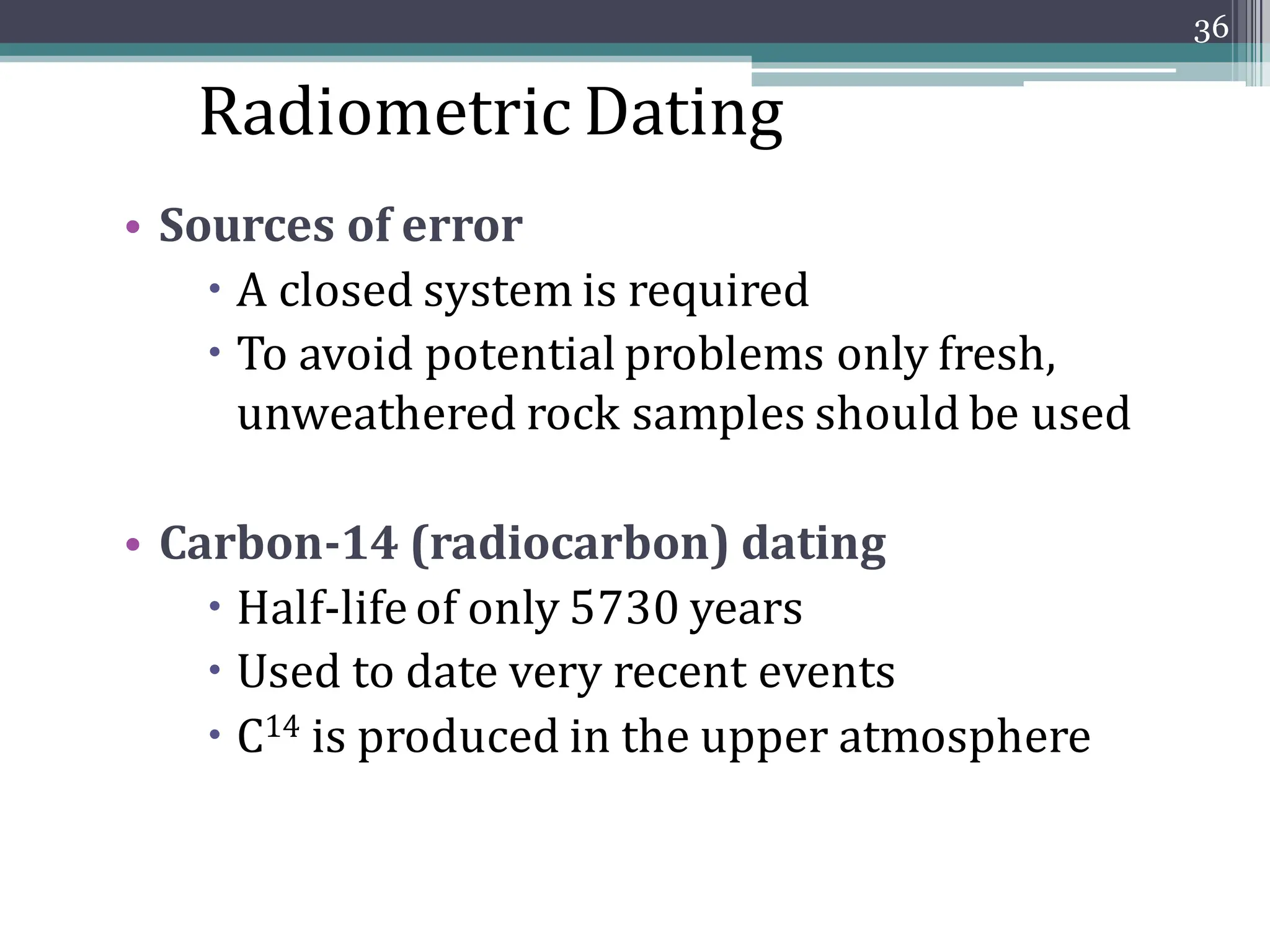
• Sources of error
 A closed system is required
 To avoid potential problems only fresh,
unweathered rock samples should be used
• Carbon-14 (radiocarbon) dating
 Half-life of only 5730 years
 Used to date very recent events
 C14 is produced in the upper atmosphere
36
Radiometric Dating
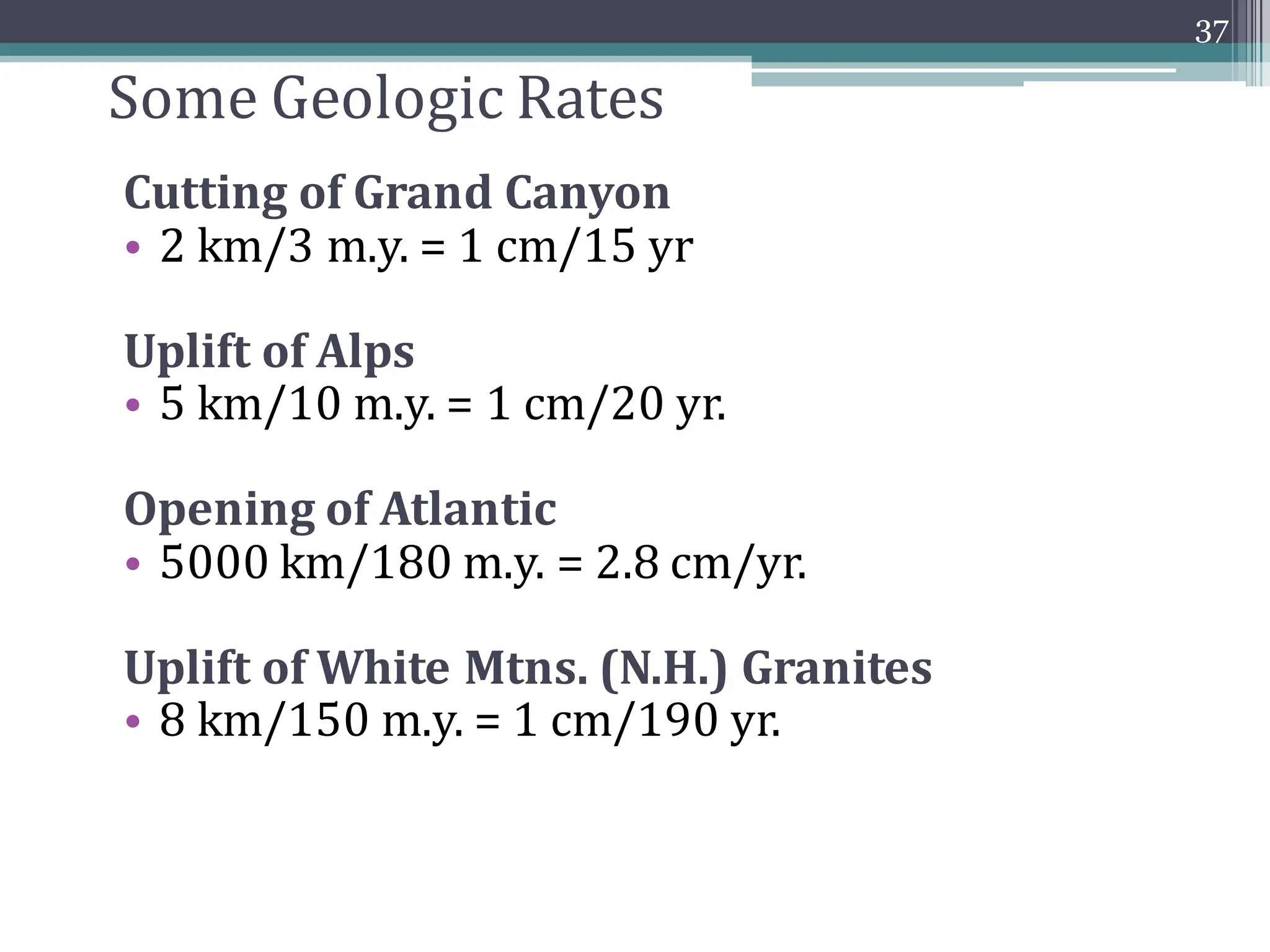
Some Geologic Rates
Cutting of Grand Canyon
• 2 km/3 m.y. = 1 cm/15 yr
Uplift of Alps
• 5 km/10 m.y. = 1 cm/20 yr.
Opening of Atlantic
• 5000 km/180 m.y. = 2.8 cm/yr.
Uplift of White Mtns. (N.H.) Granites
• 8 km/150 m.y. = 1 cm/190 yr.
37
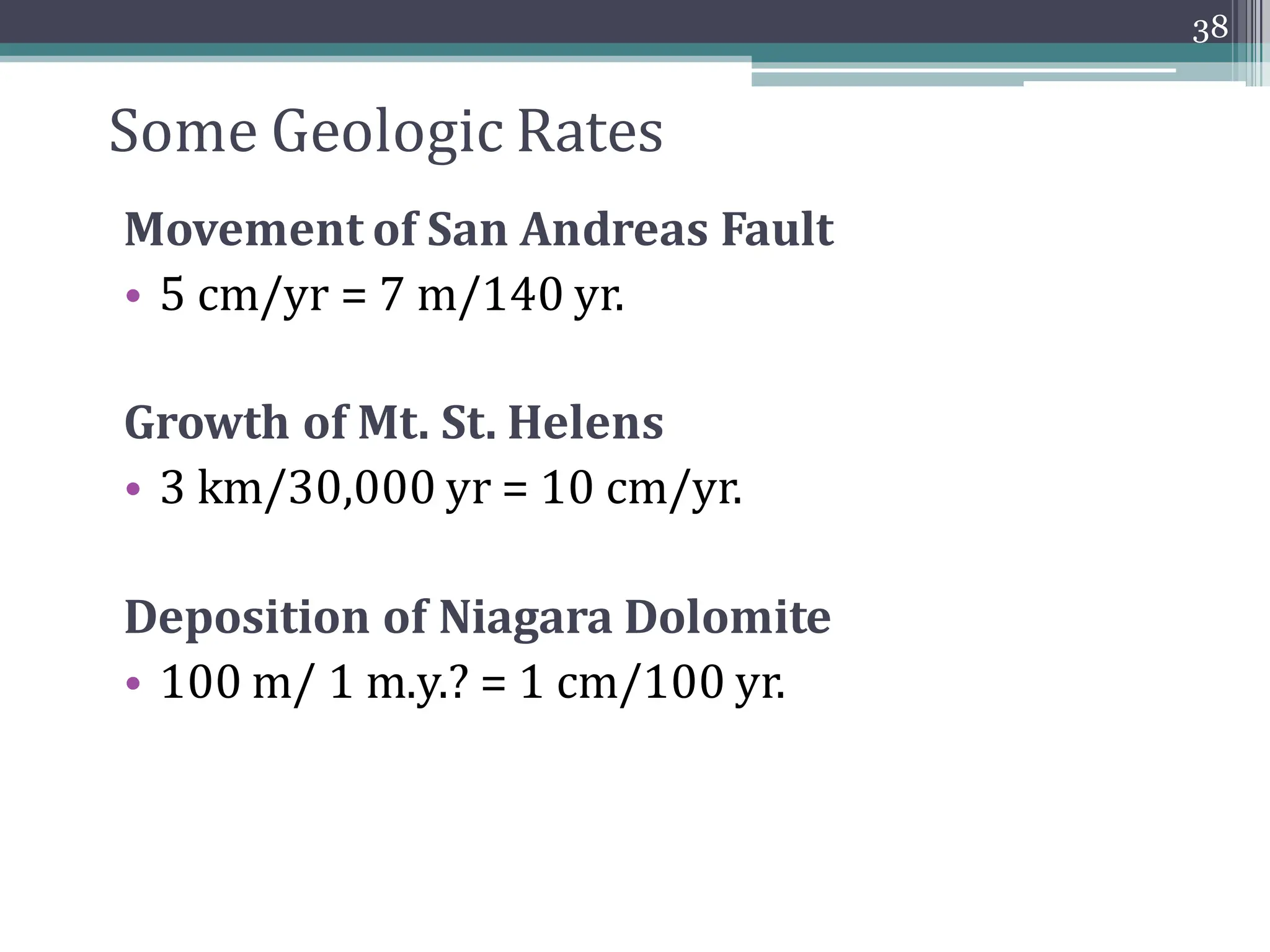
Some Geologic Rates
Movement of San Andreas Fault
• 5 cm/yr = 7 m/140 yr.
Growth of Mt. St. Helens
• 3 km/30,000 yr = 10 cm/yr.
Deposition of Niagara Dolomite
• 100 m/ 1 m.y.? = 1 cm/100 yr.
38

Geology Topic

  • 1.
    Introduction to Geology PhilMurphy p.murphy@see.leeds.ac.uk 1
  • 2.
    “Civilisations are whatthey dig from the Earth” Gibbons Decline and fall of the Roman Empire, 1776 2
  • 3.
    “If Kuwait hadof grown carrots no one would have given a damn!” Senior Source - NSA 3
  • 4.
    Why is geologydifferent from other sciences? • Often lacks experimental control • Incompleteness of data • Methodologies and procedures used to test problems rather than the generation and testing of universal laws • GEOLOGY WORKS • (everyone wants to drive to Sainsburys) 4
  • 5.
  • 6.
  • 7.
    Two kinds ofages • Relative - know order of events but not dates • Napoleonic wars happened before W.W.II • Bedrock in Scotland formed before the glaciers came • Absolute - know dates • Civil War 1803-1815 • World War II 1939-1945 • Glaciers finally left Scotland About 11,000 Years Ago 7
  • 8.
    Two conceptions ofEarth history • Catastrophism • Assumption: great effects require great causes • Earth history dominated by violent events • Uniformitarianism • Assumption: we can use cause and effect to determine causes of past events • Finding: Earth history dominated by small-scale events typical of the present. • Catastrophes do happen but are uncommon 8
  • 9.
    Principles of RelativeDating • Law of superposition  Undeformed section of sedimentary or layered igneous rocks  Oldest rocks are on the bottom • Principle of original horizontality  Layers of sediment are generally deposited in a horizontal position  Rock layers that are flat have not been disturbed (deformed) • Principle of cross-cutting relationships  Younger features cut across older features 9
  • 10.
  • 11.
  • 12.
  • 13.
  • 14.
  • 15.
    Principles of RelativeDating • Inclusions • A piece of rock that is enclosed within another rock • Rock containing the inclusion is younger • Unconformity • Break in rock record produced by erosion and/or non-deposition of rock • Represents period of geologic time 15
  • 16.
    Principles of RelativeDating • Types of unconformities  Angular unconformity • tilted rocks (disturbed) are overlain by flat-lying rocks  Disconformity • strata on either side of the unconformity are parallel  Nonconformity • metamorphic or igneous rocks in contact with sedimentary strata 16
  • 17.
  • 18.
  • 19.
  • 20.
    Uniformitarianism • Continuity ofCause and Effect • Apply Cause and Effect to Future - Prediction • Apply Cause and Effect to Present - Technology • Apply Cause and Effect to Past – Uniformitarianism The present is the key to the past 20
  • 21.
    Ripple Marks -Scarborough 21
  • 22.
  • 23.
  • 24.
  • 25.
    The makings ofgood Index Fossils • Abundant • Widely-distributed(Global Preferred) • Short-lived or rapidly changing 25
  • 26.
  • 27.
    The Geologic TimeScale Quaternary Latin, “fourth” 1822 Tertiary Latin, “third” 1760 Cretaceous Latin creta, “chalk” 1822 Jurassic Jura Mountains, Switzerland 1795 Triassic Latin, “three-fold” 1834 Permian Perm, Russia 1841 Carboniferous Carbon-bearing 1822 Devonian Devonshire, England 1840 Silurian Silures, a pre-Roman tribe 1835 Ordovician Ordovices, a pre-Roman tribe 1879 Cambrian Latin Cambria, “Wales” 1835 27
  • 28.
    Absolute ages: earlyattempts • The Bible • Add up dates in Bible • Get an age of 4000-6000 B.C. for Earth • John Lightfoot and Bishop Ussher - 4004 B.C., October 26th 9 a.m (1584) • Too short! 28
  • 29.
    Absolute ages: earlyattempts • Salt in Ocean • If we know the rate salt is added, and how much salt is in ocean, we can find the age of oceans. • Sediment thickness • Add up thickest sediments for each period and estimate rate. • Both methods gave age of about 100 million years • Problem: rates variable 29
  • 30.
  • 31.
    • Parent • anunstable radioactive isotope • Daughter product • the isotopes resulting from the decay of a parent • Half-life • the time required for one-half of the radioactive nuclei in a sample to decay 31 Radiometric Decay
  • 32.
    • Principle ofradioactive dating  The percentage of radioactive toms that decay during one half-life is always the same (50%)  However, the actual number of atoms that decay continually decreases  Comparing the ratio of parent to daughter yields the age of the sample 32 Radiometric Dating
  • 33.
  • 34.
  • 35.
    Present Radiometric DatingMethods Cosmogenic • C-14 → 5700 Yr. Primordial • K-Ar (K-40) →1.25 B.Y. • Rb-Sr (Rb-87) → 48.8 B.Y • U-235 →704 M.Y. 35
  • 36.
    • Sources oferror  A closed system is required  To avoid potential problems only fresh, unweathered rock samples should be used • Carbon-14 (radiocarbon) dating  Half-life of only 5730 years  Used to date very recent events  C14 is produced in the upper atmosphere 36 Radiometric Dating
  • 37.
    Some Geologic Rates Cuttingof Grand Canyon • 2 km/3 m.y. = 1 cm/15 yr Uplift of Alps • 5 km/10 m.y. = 1 cm/20 yr. Opening of Atlantic • 5000 km/180 m.y. = 2.8 cm/yr. Uplift of White Mtns. (N.H.) Granites • 8 km/150 m.y. = 1 cm/190 yr. 37
  • 38.
    Some Geologic Rates Movementof San Andreas Fault • 5 cm/yr = 7 m/140 yr. Growth of Mt. St. Helens • 3 km/30,000 yr = 10 cm/yr. Deposition of Niagara Dolomite • 100 m/ 1 m.y.? = 1 cm/100 yr. 38