Relationships in Ecology
8 SCIENCE: Thurs. Nov. 4/ Fri. Nov. 5
(8B)
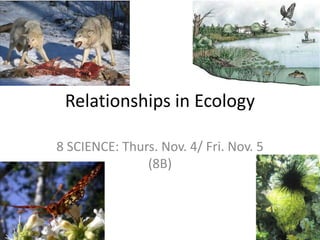
Examples of Relationships in Ecology
• What type of relationship did we learn about
yesterday?
• Predator-prey!
• What is a predator?
• What is prey?
Communities
• Review: What is a community?
• Each organism in a community has a special
role/job
• Each has a particular place to live:
– Habitat
• The physical environment and location where an organism
lives
e.g. the habitat of an earthworm is the soil
– Niche
• The organism’s role or job
e.g. the niche of the earthworm is in recycling the soil with
nutrients so that plants may grow
Relationships in Communities
• Organisms also relate to each other and they
are part of different relationships
• Symbiosis:
– A type of relationship that describes how each
organism is affected in the relationship
– There are 3 types we will be learning about:
• Mutualism
• Parasitism
• commensalism
MUTUALISM
• Both species benefit from the relationship
• Each of the species helps to support the
other’s survival
–E.g.: Pollination: when a hummingbird/bee
spreads the pollen from a flower
PARASITISM
• One species that lives on or within another
species’ body
• One species benefits while the other species
suffers
– Examples: Ticks live on cows and feed on their
blood
– Tapeworms in humans
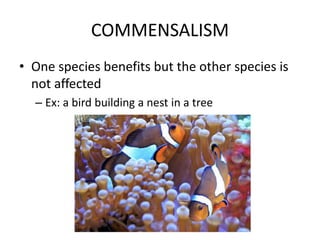
COMMENSALISM
• One species benefits but the other species is
not affected
– Ex: a bird building a nest in a tree

Relationships in ecology

  • 1.
    Relationships in Ecology 8SCIENCE: Thurs. Nov. 4/ Fri. Nov. 5 (8B)
  • 2.
    Examples of Relationshipsin Ecology • What type of relationship did we learn about yesterday? • Predator-prey! • What is a predator? • What is prey?
  • 3.
    Communities • Review: Whatis a community? • Each organism in a community has a special role/job • Each has a particular place to live: – Habitat • The physical environment and location where an organism lives e.g. the habitat of an earthworm is the soil – Niche • The organism’s role or job e.g. the niche of the earthworm is in recycling the soil with nutrients so that plants may grow
  • 4.
    Relationships in Communities •Organisms also relate to each other and they are part of different relationships • Symbiosis: – A type of relationship that describes how each organism is affected in the relationship – There are 3 types we will be learning about: • Mutualism • Parasitism • commensalism
  • 5.
    MUTUALISM • Both speciesbenefit from the relationship • Each of the species helps to support the other’s survival –E.g.: Pollination: when a hummingbird/bee spreads the pollen from a flower
  • 6.
    PARASITISM • One speciesthat lives on or within another species’ body • One species benefits while the other species suffers – Examples: Ticks live on cows and feed on their blood – Tapeworms in humans
  • 7.
    COMMENSALISM • One speciesbenefits but the other species is not affected – Ex: a bird building a nest in a tree

Editor's Notes

  • #6 The interaction is beneficial for both organisms EX: a bee gets its food energy from the nectar of the flower and from moving from flower to flower, pollen gets stuck to its fuzzy coat and it can help to pollinate flowers, allowing them to reproduce Clip of ants in amazon and fungi Unlikely companions clip The shark is getting cleaned and groomed while the remora is getting fed and transported.
  • #7 One species benefits while another is harmed, for example – ticks live on the blood of animals, but can leave sores which can be infected and be harmful to the cow A human example is shown here in this photo – the parasitic relationship of a human and tapeworm. On this episode of Oprah this doctor shows her the size of a tapeworm that can be found in a person’s body – does anyone know how a tapeworm affects a human? Tapeworms are usually found in meats that humans will eat – such as pig, fish, cow and humans ingest these meats and the tapeworms also get transferred – they can be harmful to your digestive tract. Most meat we get here is processed properly so we are not in danger, but its important to cook your meat thoroughly, i.e. raw fish.
  • #8 One species benefits but there is no harm or benefit for the other– for example a birds nest in a tree doesn’t negatively affect the tree This image is one of clown fish, who live amongst sea anenomes. Sea anenomes have a stinging property, however the clown fish have a special coating on their scales, and the sting does not affect them. Because they are unaffected, the can live and hide among the sea anenome to being eaten. The sea anenome does not benefit and is not harmed but the clown fish have a place to live and eat, hide Although some science says that the clown fish also prevent the anemone from being eaten, in which case if both species are benefitting, what type of symbiosis is this? mutualism