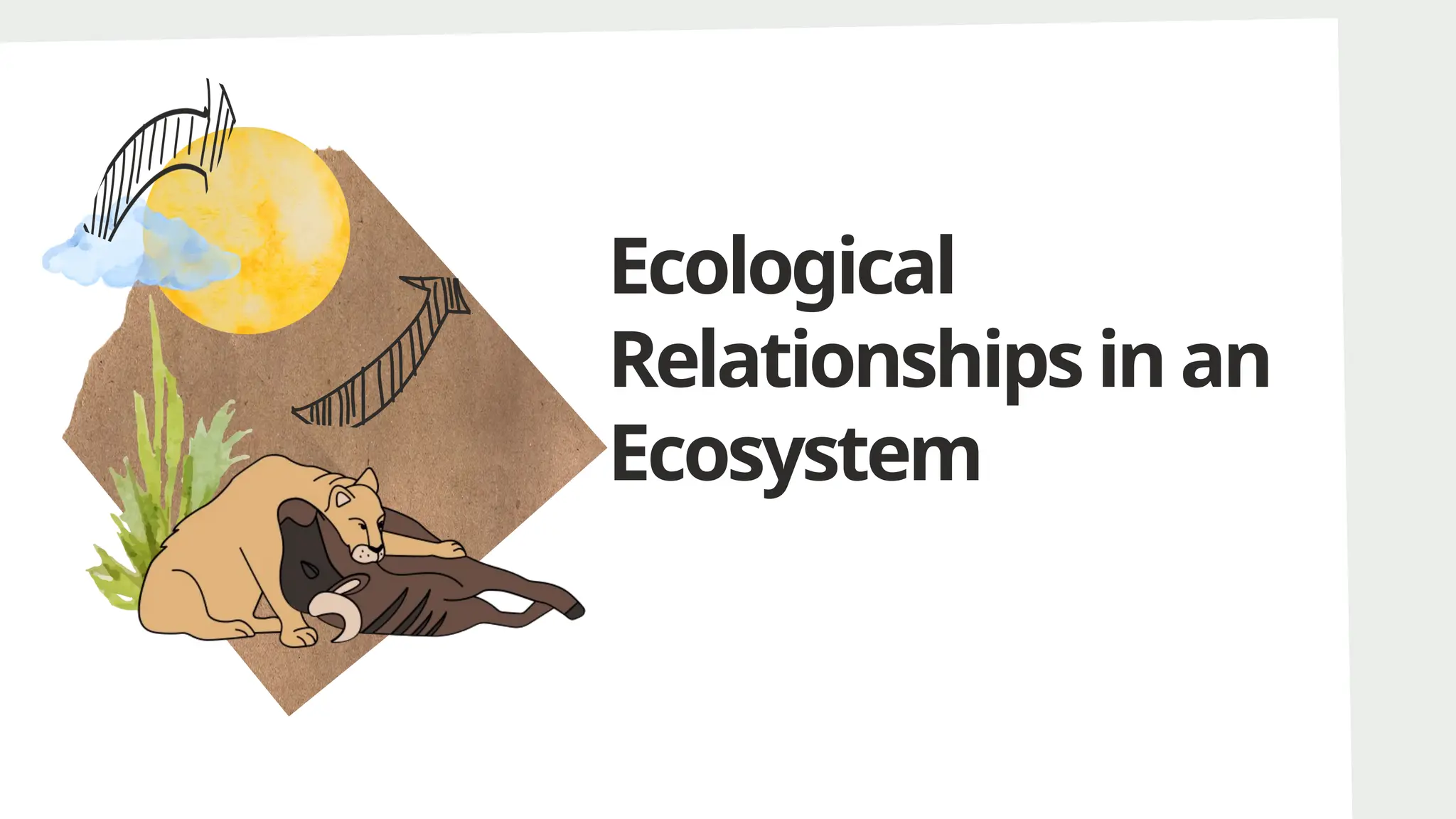
Ecological
Relationships in an
Ecosystem
What to learn?
We will find out the several ecological
relationships through this lesson.
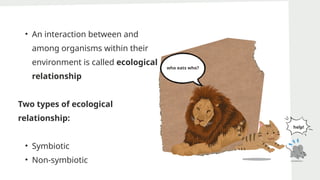
• An interaction between and
among organisms within their
environment is called ecological
relationship
Two types of ecological
relationship:
• Symbiotic
• Non-symbiotic
who eats who?
help!
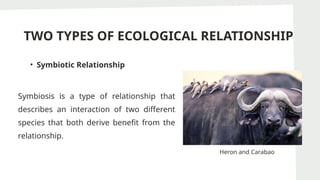
• Symbiotic Relationship
TWO TYPES OF ECOLOGICAL RELATIONSHIP
Symbiosis is a type of relationship that
describes an interaction of two different
species that both derive benefit from the
relationship.
Heron and Carabao
Mutualism
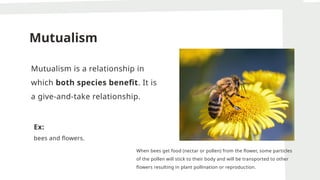
Mutualism is a relationship in
which both species benefit. It is
a give-and-take relationship.
Ex:
bees and flowers.
When bees get food (nectar or pollen) from the flower, some particles
of the pollen will stick to their body and will be transported to other
flowers resulting in plant pollination or reproduction.
Commensalism
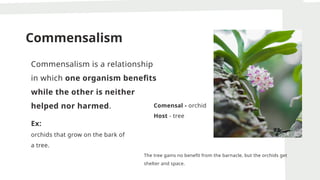
Commensalism is a relationship
in which one organism benefits
while the other is neither
helped nor harmed.
Ex:
orchids that grow on the bark of
a tree.
The tree gains no benefit from the barnacle, but the orchids get
shelter and space.
Comensal - orchid
Host - tree
Parasitism
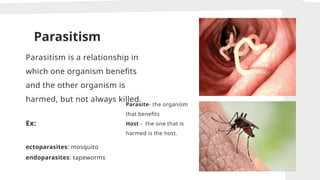
Parasitism is a relationship in
which one organism benefits
and the other organism is
harmed, but not always killed.
Ex:
ectoparasites: mosquito
endoparasites: tapeworms
Parasite- the organism
that benefits
Host - the one that is
harmed is the host.
TWO TYPES OF ECOLOGICAL RELATIONSHIP
• Non- Symbiotic Relationship
It means free living and independence. It is a type of interaction in which
individuals of two different species or two populations function in very
close association but do not affect one another adversely and beneficially.
It is also called neutralism.
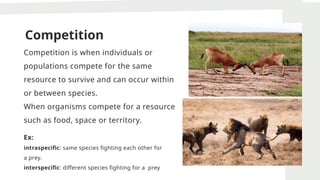
Competition
Competition is when individuals or
populations compete for the same
resource to survive and can occur within
or between species.
When organisms compete for a resource
such as food, space or territory.
Ex:
intraspecific: same species fighting each other for
a prey.
interspecific: different species fighting for a prey
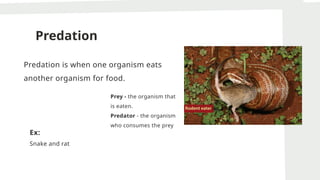
Predation
Predation is when one organism eats
another organism for food.
Ex:
Snake and rat
Prey - the organism that
is eaten.
Predator - the organism
who consumes the prey
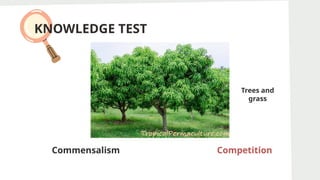
KNOWLEDGE TEST
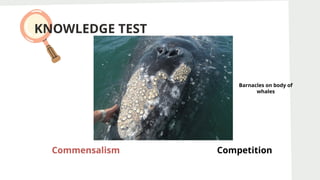
Commensalism Competition
Competition
Trees and
grass
KNOWLEDGE TEST
Commensalism Competition
Commensalism
Barnacles on body of
whales
KNOWLEDGE TEST
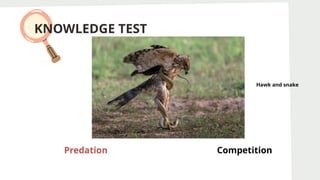
Predation Competition
Predation
Hawk and snake
KNOWLEDGE TEST
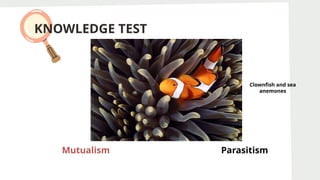
Mutualism Parasitism
Mutualism
Clownfish and sea
anemones
KNOWLEDGE TEST
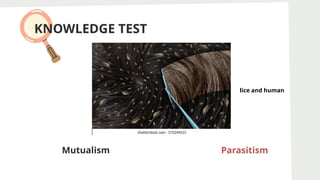
Mutualism Parasitism
Parasitism
lice and human
Thank
you!

Ecological Relationships in an Ecosystem.pptx