A PRESENTATION ON
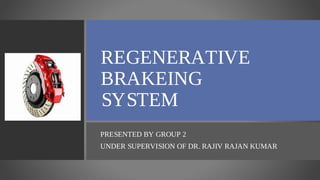
REGENERATIVE BRAKEING
SYSTEM
MARYLAND INSTITUTE OF TECHNOLOGY
AND MANAGEMENT
GALUDIH, EAST SINGHBHUM, JHARKHAND
REGENERATIVE
BRAKEING
SYSTEM
PRESENTED BY GROUP 2
UNDER SUPERVISION OF DR. RAJIV RAJAN KUMAR
ACKNOWLEDGEMENT
On every step there is a need of guidance and support.

Therefore we would like to thank from our bottom of my
heart to Our mentor – Dr. Rajiv Rajan Kumar, Hod of
mechanical who supported us in completion of our team
project.
We also express our heartfelt gratitude to our Principal for

giving us this golden opportunity.
MENTOR - DR. RAJIV RAJAN KUMAR,
(Head of department, Mechanical)
APURVLATA – TEAM LEADER
1.
BAPI PODDAR – TEAM MEMBER
2.
SAKSHI KUMARI – TEAM MEMBER
3.
SANGEETA SUNDI – TEAM MEMBER
4.
SWARUP KUMAR – TEAM MEMBER
5.
TANMAY NAYAK – TEAM MEMBER
6.
TEAM
MEMBERS
CONTENT
S
INTRODUCTION
•
THEORY
•
PRINCIPLE
•
COMPONENTS
•
WORKING
•
EXISTING IMPLEMENTATION
•
BENEFITS
•
ADVANTAGES
•
DISADVANTAGES
•
LIMITATION
•
CONCLUSION
•
INTRODUCTION
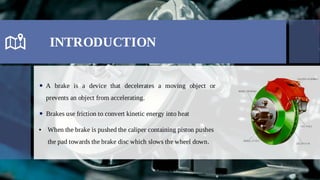
A brake is a device that decelerates a moving object or

prevents an object from accelerating.
Brakes use friction to convert kinetic energy into heat

When the brake is pushed the caliper containing piston pushes
•
the pad towards the brake disc which slows the wheel down.
REGNERATIVE BRAKING
SYSTEM
A Regenerative brake is an energy recovery mechanism that slows a vehicle by converting

kinetic energy into another form, which is used immediate or stored until needed.
Regenerative braking technology funnels the energy created by the braking process back

into the system in the form of charging the battery for further use.
In a regenerative braking system the energy normally lost in the braking process is

transferred to the generator from the rotating axel and then transferred to the battery, thus
saving energy.
PRINCIPLE OF REGENERATIVE BRAKING
SYSTEM
Regenerative braking system based on the principle of Law of conservation of

energy of an isolated system cannot change, it is said to be conserved over time.
Energy can be neither created nor destroyed but can change form.

The most common form of regenerative brake involves using an electric motor as

an electric generator.
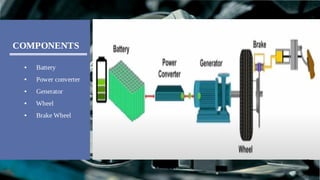
COMPONENTS
Battery
•
Power converter
•
Generator
•
Wheel
•
Brake Wheel
•
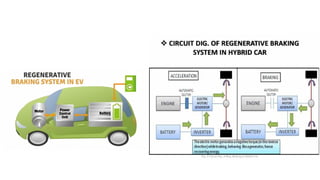
COMPONENTS
WORKING
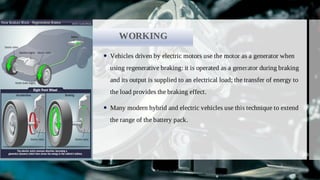
Vehicles driven by electric motors use the motor as a generator when

using regenerative braking: it is operated as a generator during braking
and its output is supplied to an electrical load; the transfer of energy to
the load provides the braking effect.
Many modern hybrid and electric vehicles use this technique to extend

the range of the battery pack.
EXISTING IMPLEMENTATION
Many metro, High speed train applications have surfaced in Japan, France, India, New Zealand, England
•
and Germany.
The SKODA transportation is producing electric trams equipped with regenerative braking system;
•
which are widely being used across Europe.
Some of vechicles using regenerative brake :-
•
The electric car manufacturing giant TESLA, equipped most of its models with regenerative braking
a)
system.
AUDIE-TRON, BMW 18
b)
MG ZS EV and HYUNDAI KONA
c)
TOYOTA PRIUS
d)
FORD FUSION
e)
APPLICATION OF REGENERATIVE
BRAKING SYSTEM
The most common application of regenerative braking is in electric vehicles (EVs) and hybrid electric vehicles

(HEVs). When a driver applies the brakes, the system converts the vehicle's kinetic energy into electrical energy,
which is then stored in the vehicle's battery. This process helps to extend the vehicle's range and improve fuel
efficiency.
Regenerative braking is also used in public transportation systems like buses and bullet trains. This helps to

reduce the environmental impact of the transportation fleet by recovering energy that would otherwise be lost
during braking.
Regenerative braking systems are also used in applications where motors drive loads, such as in electric

elevators, cranes, and hoists. This helps to control the speed of the motor and to recover energy during braking.
Regenerative braking is also used in other applications, such as on bicycles, and in industrial settings where it

can help to recover energy from braking processes.
•
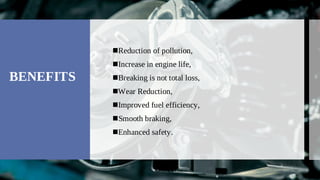
BENEFITS
Reduction of pollution,

Increase in engine life,

Breaking is not total loss,

Wear Reduction,

Improved fuel efficiency,

Smooth braking,

Enhanced safety.

Improved efficiency of electric and hybrid vehicles.
1.
Reduced emissions.
2.
Savings on fuel costs.
3.
Less maintenance, as wear and tear on brake systems is reduced.
4.
Better efficiency, as more energy is sent back to the battery.
5.
Energy recovery.
6.
Reduced wear on friction brakes.
7.
Effective in AC locomotive.
8.
ADVANTAGES
DISADVANTAGES
Not always strong enough to stop the vehicle completely.
1.
Can result in panic braking.
2.
Chips away at driver responsibility.
3.
Increases complacency.
4.
May be less effective at lower speeds.
5.
Still loss of energy.
6.
Less effective in DC locomotive.
7.
LIMITATION
The regenerative braking effect drops off at lower speeds, therefore

the friction brake is still required in order to bring the vehicle to a
complete halt.
The friction brake is a necessary back-up in the event of failure of the

regenerative brake.
Most road vehicles with regenerative braking only have power on

some wheels (as in a 2WD car) and regenerative braking power only
applies to such wheels, so in order to provide controlled braking under
difficult conditions (such as in wet roads) friction based braking is
necessary on the other wheels.
CONCLUSION
The energy efficiency of a conventional brake is only about 20 percent, with
the remaining 80 percent of its energy being converted to heat through
friction. The miraculous thing about regenerative braking is that it may be
able to capture as much as half of that wasted energy and put it back to
work.
This reduces fuel consumption by 10 to 25 percent.
Hence regenerative braking plays an important role in fuel consumption and
also in the field of speed
REFRENCES
https://www.howtogeek.com/

Regenerative braking – Wikipedia

https://www.sciencedirect.com/

https://energyducation.ca/encylopedia/regenerative_braki

ng#cite_notebook1-6
THANKYOU

regenerative systemDOC-20250605-WA0026..pdf

  • 1.
    A PRESENTATION ON REGENERATIVEBRAKEING SYSTEM MARYLAND INSTITUTE OF TECHNOLOGY AND MANAGEMENT GALUDIH, EAST SINGHBHUM, JHARKHAND
  • 2.
    REGENERATIVE BRAKEING SYSTEM PRESENTED BY GROUP2 UNDER SUPERVISION OF DR. RAJIV RAJAN KUMAR
  • 3.
    ACKNOWLEDGEMENT On every stepthere is a need of guidance and support.  Therefore we would like to thank from our bottom of my heart to Our mentor – Dr. Rajiv Rajan Kumar, Hod of mechanical who supported us in completion of our team project. We also express our heartfelt gratitude to our Principal for  giving us this golden opportunity.
  • 4.
    MENTOR - DR.RAJIV RAJAN KUMAR, (Head of department, Mechanical) APURVLATA – TEAM LEADER 1. BAPI PODDAR – TEAM MEMBER 2. SAKSHI KUMARI – TEAM MEMBER 3. SANGEETA SUNDI – TEAM MEMBER 4. SWARUP KUMAR – TEAM MEMBER 5. TANMAY NAYAK – TEAM MEMBER 6. TEAM MEMBERS
  • 5.
  • 6.
    INTRODUCTION A brake isa device that decelerates a moving object or  prevents an object from accelerating. Brakes use friction to convert kinetic energy into heat  When the brake is pushed the caliper containing piston pushes • the pad towards the brake disc which slows the wheel down.
  • 7.
    REGNERATIVE BRAKING SYSTEM A Regenerativebrake is an energy recovery mechanism that slows a vehicle by converting  kinetic energy into another form, which is used immediate or stored until needed. Regenerative braking technology funnels the energy created by the braking process back  into the system in the form of charging the battery for further use. In a regenerative braking system the energy normally lost in the braking process is  transferred to the generator from the rotating axel and then transferred to the battery, thus saving energy.
  • 8.
    PRINCIPLE OF REGENERATIVEBRAKING SYSTEM Regenerative braking system based on the principle of Law of conservation of  energy of an isolated system cannot change, it is said to be conserved over time. Energy can be neither created nor destroyed but can change form.  The most common form of regenerative brake involves using an electric motor as  an electric generator.
  • 9.
  • 10.
    COMPONENTS WORKING Vehicles driven byelectric motors use the motor as a generator when  using regenerative braking: it is operated as a generator during braking and its output is supplied to an electrical load; the transfer of energy to the load provides the braking effect. Many modern hybrid and electric vehicles use this technique to extend  the range of the battery pack.
  • 11.
    EXISTING IMPLEMENTATION Many metro,High speed train applications have surfaced in Japan, France, India, New Zealand, England • and Germany. The SKODA transportation is producing electric trams equipped with regenerative braking system; • which are widely being used across Europe. Some of vechicles using regenerative brake :- • The electric car manufacturing giant TESLA, equipped most of its models with regenerative braking a) system. AUDIE-TRON, BMW 18 b) MG ZS EV and HYUNDAI KONA c) TOYOTA PRIUS d) FORD FUSION e)
  • 12.
    APPLICATION OF REGENERATIVE BRAKINGSYSTEM The most common application of regenerative braking is in electric vehicles (EVs) and hybrid electric vehicles  (HEVs). When a driver applies the brakes, the system converts the vehicle's kinetic energy into electrical energy, which is then stored in the vehicle's battery. This process helps to extend the vehicle's range and improve fuel efficiency. Regenerative braking is also used in public transportation systems like buses and bullet trains. This helps to  reduce the environmental impact of the transportation fleet by recovering energy that would otherwise be lost during braking. Regenerative braking systems are also used in applications where motors drive loads, such as in electric  elevators, cranes, and hoists. This helps to control the speed of the motor and to recover energy during braking. Regenerative braking is also used in other applications, such as on bicycles, and in industrial settings where it  can help to recover energy from braking processes. •
  • 14.
    BENEFITS Reduction of pollution,  Increasein engine life,  Breaking is not total loss,  Wear Reduction,  Improved fuel efficiency,  Smooth braking,  Enhanced safety. 
  • 15.
    Improved efficiency ofelectric and hybrid vehicles. 1. Reduced emissions. 2. Savings on fuel costs. 3. Less maintenance, as wear and tear on brake systems is reduced. 4. Better efficiency, as more energy is sent back to the battery. 5. Energy recovery. 6. Reduced wear on friction brakes. 7. Effective in AC locomotive. 8. ADVANTAGES
  • 16.
    DISADVANTAGES Not always strongenough to stop the vehicle completely. 1. Can result in panic braking. 2. Chips away at driver responsibility. 3. Increases complacency. 4. May be less effective at lower speeds. 5. Still loss of energy. 6. Less effective in DC locomotive. 7.
  • 17.
    LIMITATION The regenerative brakingeffect drops off at lower speeds, therefore  the friction brake is still required in order to bring the vehicle to a complete halt. The friction brake is a necessary back-up in the event of failure of the  regenerative brake. Most road vehicles with regenerative braking only have power on  some wheels (as in a 2WD car) and regenerative braking power only applies to such wheels, so in order to provide controlled braking under difficult conditions (such as in wet roads) friction based braking is necessary on the other wheels.
  • 18.
    CONCLUSION The energy efficiencyof a conventional brake is only about 20 percent, with the remaining 80 percent of its energy being converted to heat through friction. The miraculous thing about regenerative braking is that it may be able to capture as much as half of that wasted energy and put it back to work. This reduces fuel consumption by 10 to 25 percent. Hence regenerative braking plays an important role in fuel consumption and also in the field of speed
  • 19.
    REFRENCES https://www.howtogeek.com/  Regenerative braking –Wikipedia  https://www.sciencedirect.com/  https://energyducation.ca/encylopedia/regenerative_braki  ng#cite_notebook1-6
  • 20.