S. B. Jain Institute of Technology, Management & Research, Nagpur
Department of Electrical Engineering
UNIT 6
Types of Electric Cars
Corse Name – Electrical Engineering Year / Sem –First /2nd
Date of activity – 28|08|2021 Section – E
Roll No & Name of Student -- 528 UKE CHAITALI
ELECTRIC
VEHICLE
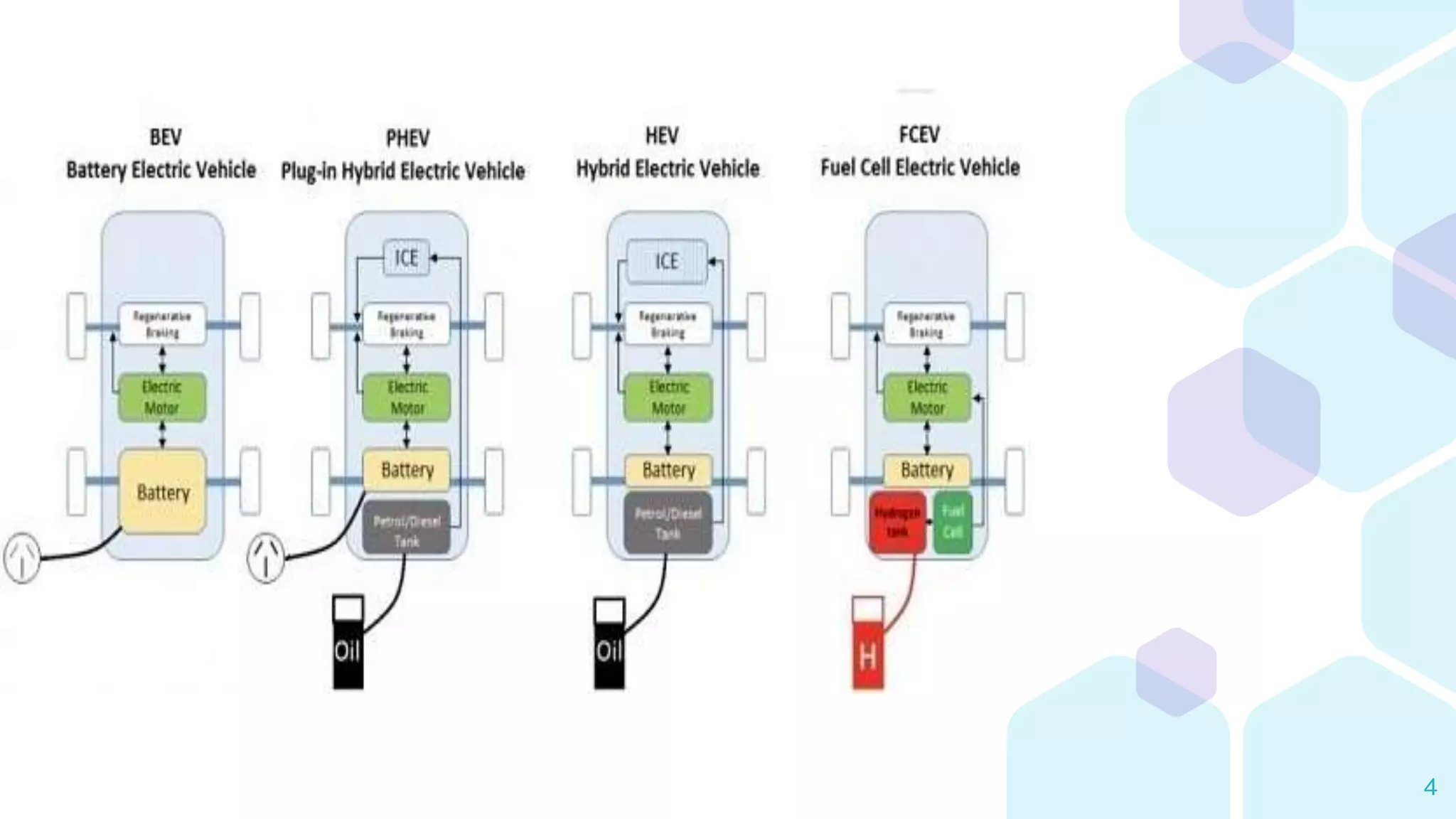
There are 4 (four) types of electric cars –
 Fuel Cell Electric Vehicle (FCEV)
 Battery Electric Vehicle (BEV)
 Hybrid
1. Hybrid Electric Vehicle (HEV)
2. Plug-in Hybrid Electric Vehicle (PHEV)
Types of Electric Cars
3
4
Battery Electric Vehicle (BEV)
A Battery Electric Vehicle (BEV), also called All-Electric
Vehicle (AEV), runs entirely on a battery and electric drive train.
This types of electric cars do not have an ICE. Electricity is
stored in a large battery pack that is charged by plugging
into the electricity grid. The battery pack, in turn,
provides power to one or more electric motors
to run the electric car.
5
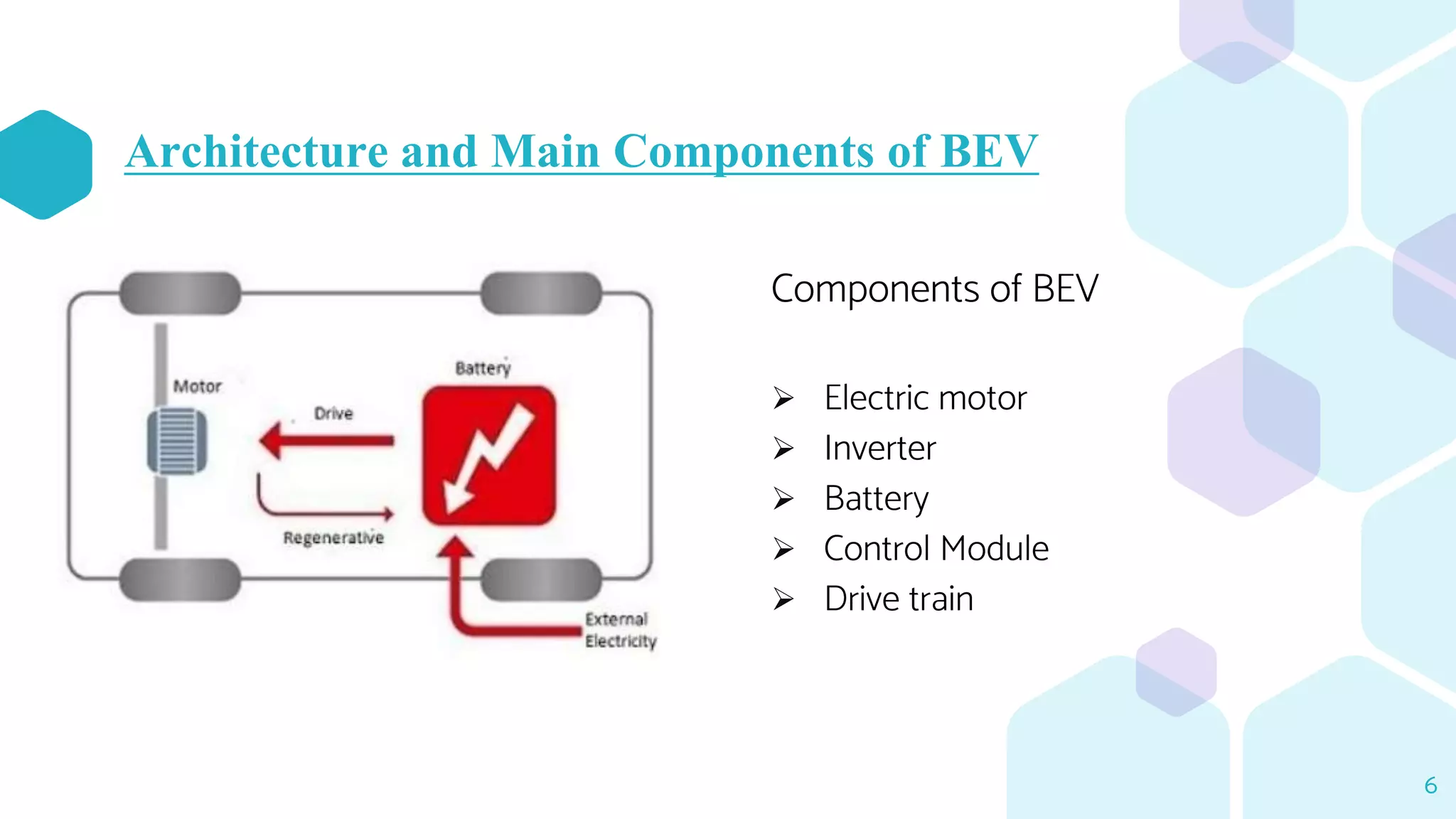
Architecture and Main Components of BEV
Components of BEV
 Electric motor
 Inverter
 Battery
 Control Module
 Drive train
6
Working Principles of BEV
 Power is converted from the DC battery to AC for the electric motor
 The accelerator pedal sends a signal to the controller which adjusts
the vehicle’s speed by changing the frequency of the AC power
from the inverter to the motor
 The motor connects and turns the wheels through a cog
 When the brakes are pressed or the electric car is decelerating, the
motor becomes an alternator and produces power, which is sent
back to the battery
Examples of BEV
Volkswagen e-Golf, Tesla Model 3, BMW i3, Chevy Bolt, Chevy Spark,
Nissan LEAF, Ford Focus Electric, Hyundai Ioniq, Karma Revera, Kia Soul,
Mitsubishi i-MiEV, Tesla X, Toyota Rav4.
7
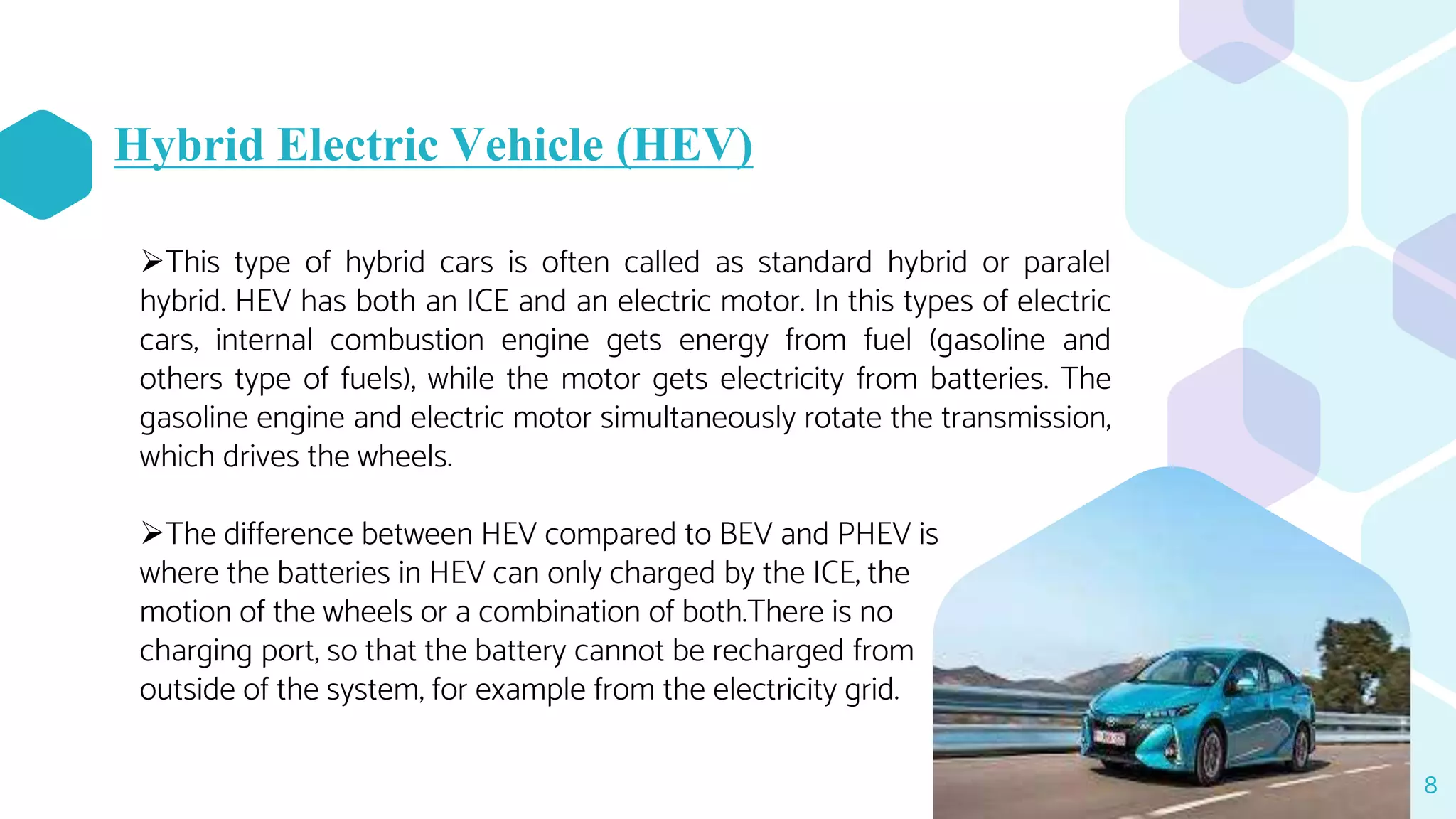
Hybrid Electric Vehicle (HEV)
8
This type of hybrid cars is often called as standard hybrid or paralel
hybrid. HEV has both an ICE and an electric motor. In this types of electric
cars, internal combustion engine gets energy from fuel (gasoline and
others type of fuels), while the motor gets electricity from batteries. The
gasoline engine and electric motor simultaneously rotate the transmission,
which drives the wheels.
The difference between HEV compared to BEV and PHEV is
where the batteries in HEV can only charged by the ICE, the
motion of the wheels or a combination of both.There is no
charging port, so that the battery cannot be recharged from
outside of the system, for example from the electricity grid.
Architecture and Main Components of HEV
Components of HEV
 Engine
 Electric motor
 Battery pack with controller
& inverter
 Fuel tank
 Control module
9
Working Principles of HEV
• Has a fuel tank that supplies gas to the engine like a regular car
• It also has a set of batteries that run an electric motor
• Both the engine and electric motor can turn the transmission at the
same time
Examples of HEV
Honda Civic Hybrid, Toyota Prius Hybrid, Honda Civic Hybrid, Toyota
Camry Hybrid.
10
Plug-in Hybrid Electric Vehicle (PHEV)
 PHEV is a type of hybrid vehicle that both an ICE and a motor, often
called as series hybrid. This types of electric cars offers a choice of
fuels. This type of electric cars is powered by a conventional fuel
(such as gasoline) or an alternative fuel (such bio-diesel) and by a
rechargeable battery pack. The battery can be charged up with
electricity by plugging into an electrical outlet or electric vehicle
charging station (EVCS).
 PHEV typically can run in at least two modes:
 All-electric Mode, in which the motor and battery provide all
the car’s energy
 Hybrid Mode, in which both electricity and gasoline are
employed.
 Some PHEVs can travel more than 70 miles on electricity
alone.
11
Architecture and Main Components of PHEV
Components of PHEV
 Electric motor
 Engine
 Inverter
 Battery
 Fuel tank
 Control module
 Battery Charger (if onboard model)
12
Working Principles of PHEV
• PHEVs typically start up in all-electric mode and operate on electricity
until their battery pack is depleted. Some models shift to hybrid mode
when they reach highway cruising speed, generally above 60 or 70 miles
per hour. Once the battery is empty, the engine takes over and the
vehicle operates as a conventional, non-plug-in hybrid.
Examples of PHEV
Porsche Cayenne S E-Hybrid , Chevy Volt, Chrysler Pacifica, Ford C-Max
Energi, Ford Fusion Energi, Mercedes C350e, Mercedes S550e, Mercedes
GLE550e, Mini Cooper SE Countryman, Audi A3 E-Tron, BMW 330e, BMW
i8, BMW X5 xdrive40e, Fiat 500e, Hyundai Sonata, Kia Optima, Porsche
Panamera S E-hybrid, Volvo XC90 T8. 13
Fuel Cell Electric Vehicle (FCEV)
Fuel Cell Electric Vehicles (FCEVs), also known as fuel cell vehicles
(FCVs) or Zero Emission Vehicle, are types of electric cars that
employ ‘fuel cell technology’ to generate the electricity required to
run the vehicle. In this type of vehicles, the chemical energy of the
fuel is converted directly into electric energy.
14
Architecture and Main Components of FCEV
Components of FCEV
 Electric motor
 Fuel-cell stack
 Hydrogen storage tank
 Battery with converter
and controller
15
Working Principles of FCEV
The working principle of a ‘fuel cell’ electric car is different
compared to that of a ‘plug-in’ electric car. This types of electric
cars is because the FCEV generates the electricity required to
run this vehicle on the vehicle itself.
Examples of FCEV
Toyota Mirai, Hyundai Tucson FCEV, Riversimple Rasa,
Honda Clarity Fuel Cell, Hyundai Nexo.
16
17
THANKS!

types of electric vehicles ppt

  • 1.
    S. B. JainInstitute of Technology, Management & Research, Nagpur Department of Electrical Engineering UNIT 6 Types of Electric Cars Corse Name – Electrical Engineering Year / Sem –First /2nd Date of activity – 28|08|2021 Section – E Roll No & Name of Student -- 528 UKE CHAITALI
  • 2.
  • 3.
    There are 4(four) types of electric cars –  Fuel Cell Electric Vehicle (FCEV)  Battery Electric Vehicle (BEV)  Hybrid 1. Hybrid Electric Vehicle (HEV) 2. Plug-in Hybrid Electric Vehicle (PHEV) Types of Electric Cars 3
  • 4.
  • 5.
    Battery Electric Vehicle(BEV) A Battery Electric Vehicle (BEV), also called All-Electric Vehicle (AEV), runs entirely on a battery and electric drive train. This types of electric cars do not have an ICE. Electricity is stored in a large battery pack that is charged by plugging into the electricity grid. The battery pack, in turn, provides power to one or more electric motors to run the electric car. 5
  • 6.
    Architecture and MainComponents of BEV Components of BEV  Electric motor  Inverter  Battery  Control Module  Drive train 6
  • 7.
    Working Principles ofBEV  Power is converted from the DC battery to AC for the electric motor  The accelerator pedal sends a signal to the controller which adjusts the vehicle’s speed by changing the frequency of the AC power from the inverter to the motor  The motor connects and turns the wheels through a cog  When the brakes are pressed or the electric car is decelerating, the motor becomes an alternator and produces power, which is sent back to the battery Examples of BEV Volkswagen e-Golf, Tesla Model 3, BMW i3, Chevy Bolt, Chevy Spark, Nissan LEAF, Ford Focus Electric, Hyundai Ioniq, Karma Revera, Kia Soul, Mitsubishi i-MiEV, Tesla X, Toyota Rav4. 7
  • 8.
    Hybrid Electric Vehicle(HEV) 8 This type of hybrid cars is often called as standard hybrid or paralel hybrid. HEV has both an ICE and an electric motor. In this types of electric cars, internal combustion engine gets energy from fuel (gasoline and others type of fuels), while the motor gets electricity from batteries. The gasoline engine and electric motor simultaneously rotate the transmission, which drives the wheels. The difference between HEV compared to BEV and PHEV is where the batteries in HEV can only charged by the ICE, the motion of the wheels or a combination of both.There is no charging port, so that the battery cannot be recharged from outside of the system, for example from the electricity grid.
  • 9.
    Architecture and MainComponents of HEV Components of HEV  Engine  Electric motor  Battery pack with controller & inverter  Fuel tank  Control module 9
  • 10.
    Working Principles ofHEV • Has a fuel tank that supplies gas to the engine like a regular car • It also has a set of batteries that run an electric motor • Both the engine and electric motor can turn the transmission at the same time Examples of HEV Honda Civic Hybrid, Toyota Prius Hybrid, Honda Civic Hybrid, Toyota Camry Hybrid. 10
  • 11.
    Plug-in Hybrid ElectricVehicle (PHEV)  PHEV is a type of hybrid vehicle that both an ICE and a motor, often called as series hybrid. This types of electric cars offers a choice of fuels. This type of electric cars is powered by a conventional fuel (such as gasoline) or an alternative fuel (such bio-diesel) and by a rechargeable battery pack. The battery can be charged up with electricity by plugging into an electrical outlet or electric vehicle charging station (EVCS).  PHEV typically can run in at least two modes:  All-electric Mode, in which the motor and battery provide all the car’s energy  Hybrid Mode, in which both electricity and gasoline are employed.  Some PHEVs can travel more than 70 miles on electricity alone. 11
  • 12.
    Architecture and MainComponents of PHEV Components of PHEV  Electric motor  Engine  Inverter  Battery  Fuel tank  Control module  Battery Charger (if onboard model) 12
  • 13.
    Working Principles ofPHEV • PHEVs typically start up in all-electric mode and operate on electricity until their battery pack is depleted. Some models shift to hybrid mode when they reach highway cruising speed, generally above 60 or 70 miles per hour. Once the battery is empty, the engine takes over and the vehicle operates as a conventional, non-plug-in hybrid. Examples of PHEV Porsche Cayenne S E-Hybrid , Chevy Volt, Chrysler Pacifica, Ford C-Max Energi, Ford Fusion Energi, Mercedes C350e, Mercedes S550e, Mercedes GLE550e, Mini Cooper SE Countryman, Audi A3 E-Tron, BMW 330e, BMW i8, BMW X5 xdrive40e, Fiat 500e, Hyundai Sonata, Kia Optima, Porsche Panamera S E-hybrid, Volvo XC90 T8. 13
  • 14.
    Fuel Cell ElectricVehicle (FCEV) Fuel Cell Electric Vehicles (FCEVs), also known as fuel cell vehicles (FCVs) or Zero Emission Vehicle, are types of electric cars that employ ‘fuel cell technology’ to generate the electricity required to run the vehicle. In this type of vehicles, the chemical energy of the fuel is converted directly into electric energy. 14
  • 15.
    Architecture and MainComponents of FCEV Components of FCEV  Electric motor  Fuel-cell stack  Hydrogen storage tank  Battery with converter and controller 15
  • 16.
    Working Principles ofFCEV The working principle of a ‘fuel cell’ electric car is different compared to that of a ‘plug-in’ electric car. This types of electric cars is because the FCEV generates the electricity required to run this vehicle on the vehicle itself. Examples of FCEV Toyota Mirai, Hyundai Tucson FCEV, Riversimple Rasa, Honda Clarity Fuel Cell, Hyundai Nexo. 16
  • 17.