Himashree P
2017027017
DOUGHRHEOLOGY
Dough refers to a wet mass developed after
mixing of wheat flour, water and other
ingredients. Physico-chemical properties of dough
play important role in the bakery, pasta and
ready-to-eat cereals processing industry.
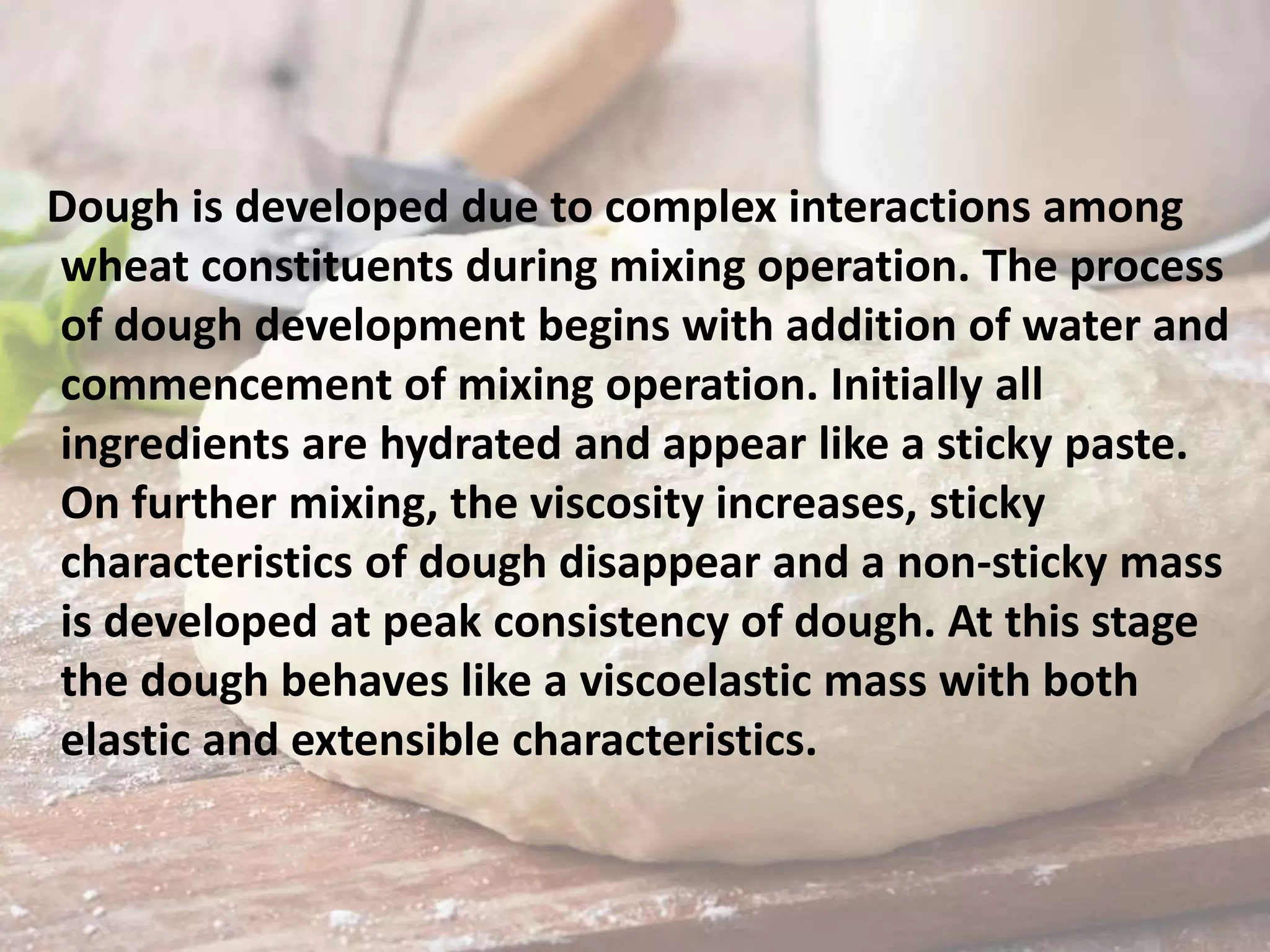
Dough is developed due to complex interactions among
wheat constituents during mixing operation. The process
of dough development begins with addition of water and
commencement of mixing operation. Initially all
ingredients are hydrated and appear like a sticky paste.
On further mixing, the viscosity increases, sticky
characteristics of dough disappear and a non-sticky mass
is developed at peak consistency of dough. At this stage
the dough behaves like a viscoelastic mass with both
elastic and extensible characteristics.
• Wheat dough (well mixed flour with water and
ingredients) under stress undergoes flow and elastic
recovery. These flow and elastic behavior of dough
during processing are referred to as rheological
properties
• Knowledge of rheological behaviour and dough
properties is becoming more important as the
baking industry becomes more automated.
EQUIPMENTS USED IN
QUALITY CONTROL FOR
ASSESSMENT OF DOUGH
RHEOLOGY
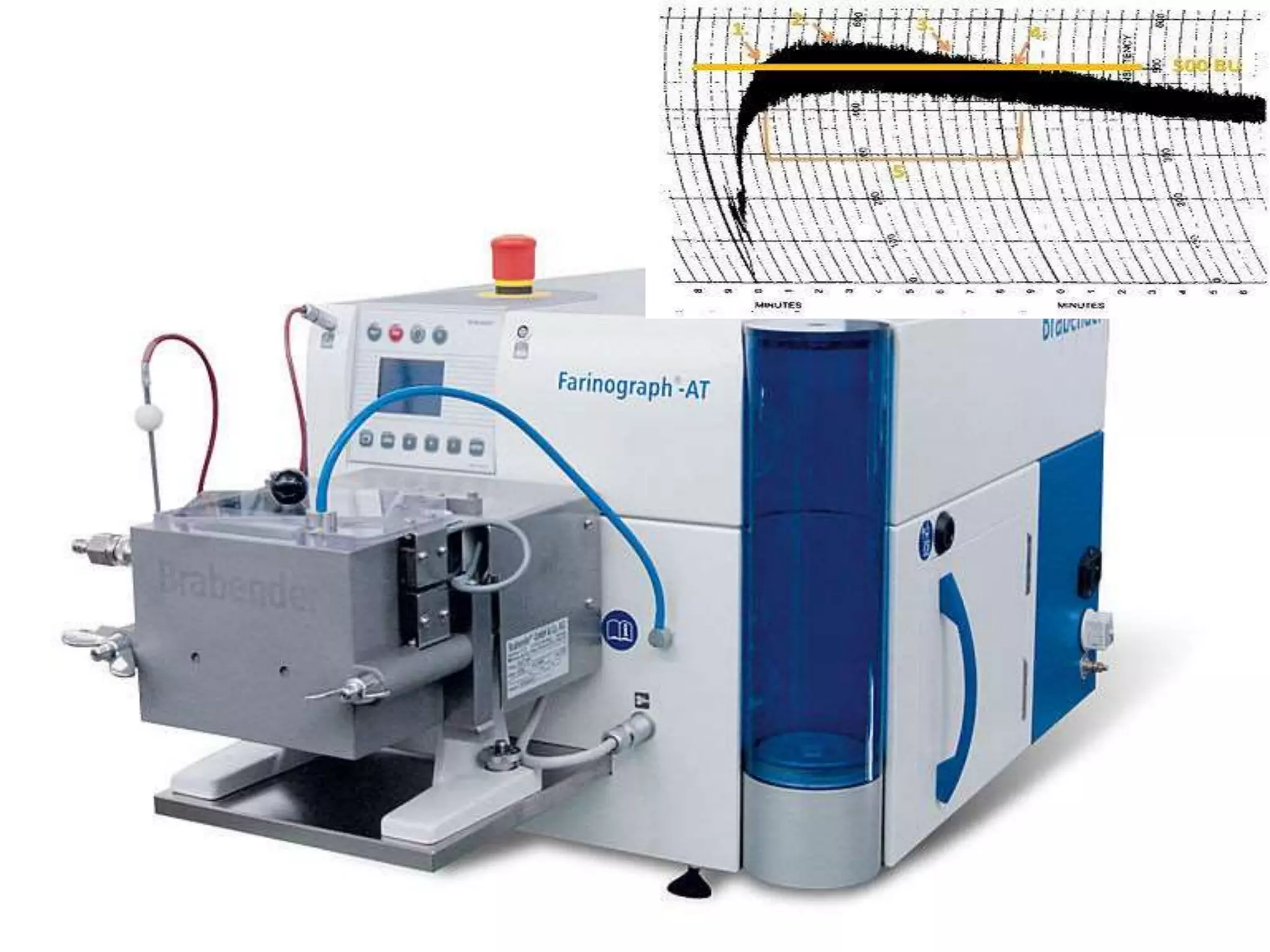
FARINOGRAPH
recording dough mixer
The farinograph is a tool used for measuring
the shear and viscosity of a mixture of flour and
water. It determines dough and gluten properties of
flour by measuring the resistance of a dough against
mixing action of paddles(blades).
The results which include Water absorption, arrival time,
stability time, peak time, departure time, and mixing
tolerance index are used used as parameters in
formulation to estimate the amount of water required
to make dough, to evaluate flour blending
requirements, and to check flour uniformity and also
processing effects.
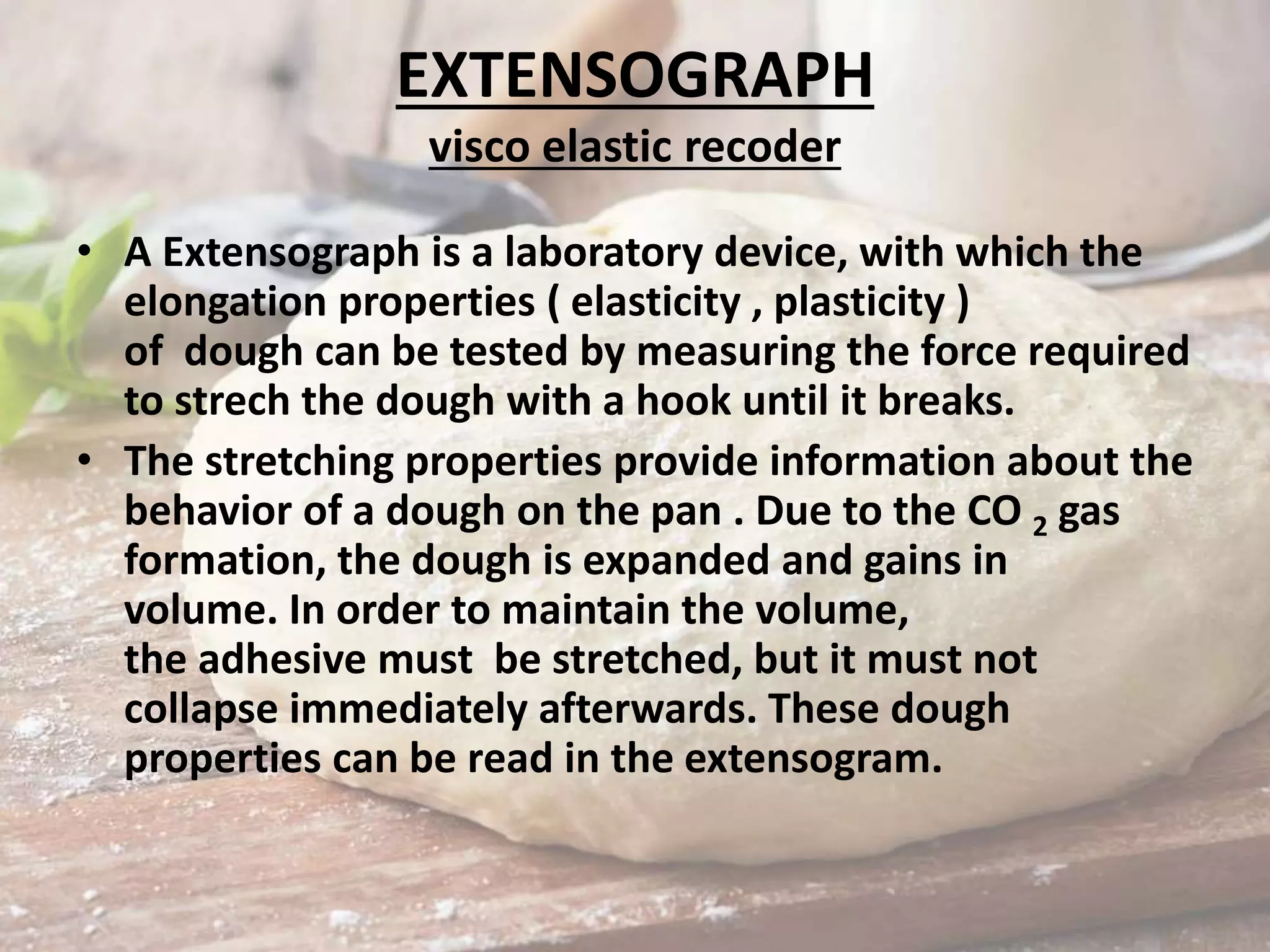
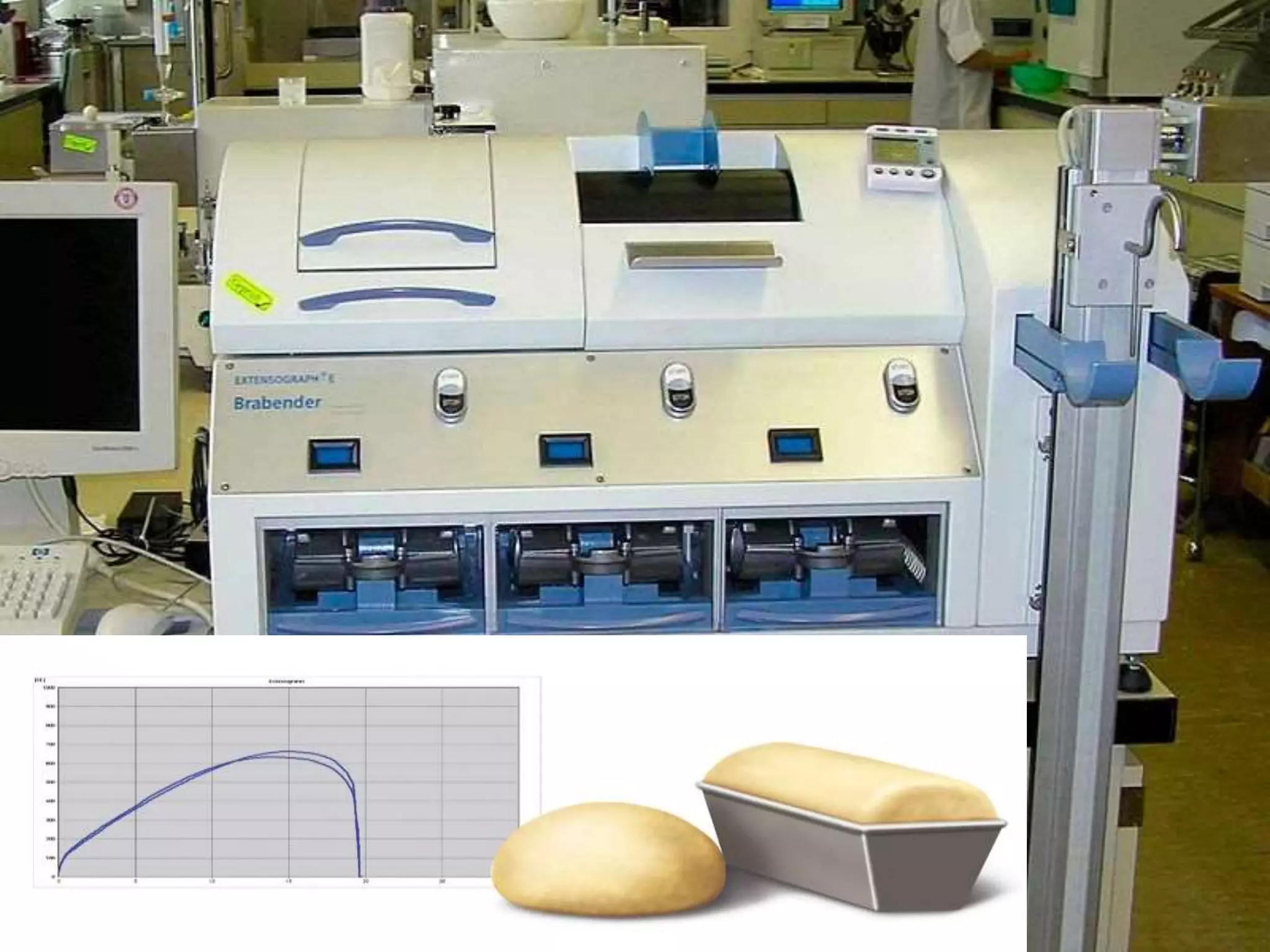
EXTENSOGRAPH
visco elastic recoder
• A Extensograph is a laboratory device, with which the
elongation properties ( elasticity , plasticity )
of dough can be tested by measuring the force required
to strech the dough with a hook until it breaks.
• The stretching properties provide information about the
behavior of a dough on the pan . Due to the CO 2 gas
formation, the dough is expanded and gains in
volume. In order to maintain the volume,
the adhesive must be stretched, but it must not
collapse immediately afterwards. These dough
properties can be read in the extensogram.
ALVEOGRAPH
visco elastic recoder
The Alveograph or Chopin extensimeter, is a tool
for flour quality measurement which measures the
flexibility of the dough produced from the flour, by
inflating a bubble in a thin sheet of the dough until
it bursts. A strong dough requires more force to
break the bubble. The resulting values show the
strength of the flour, and thus its suitability for
different uses.
MIXOGRAPGH
recording dough mixer
• The mixograph test quickly analyses small
quantities of flour for dough gluten strength.
• It determines dough and gluten properties of flour
by measuring the resistance of a dough against the
mixing action of pins. The results include water
absorption, peak time and mixing tolerance.
• Flour water absorption measured by mixograph
often serves as bake absorption in bread baking
tests.
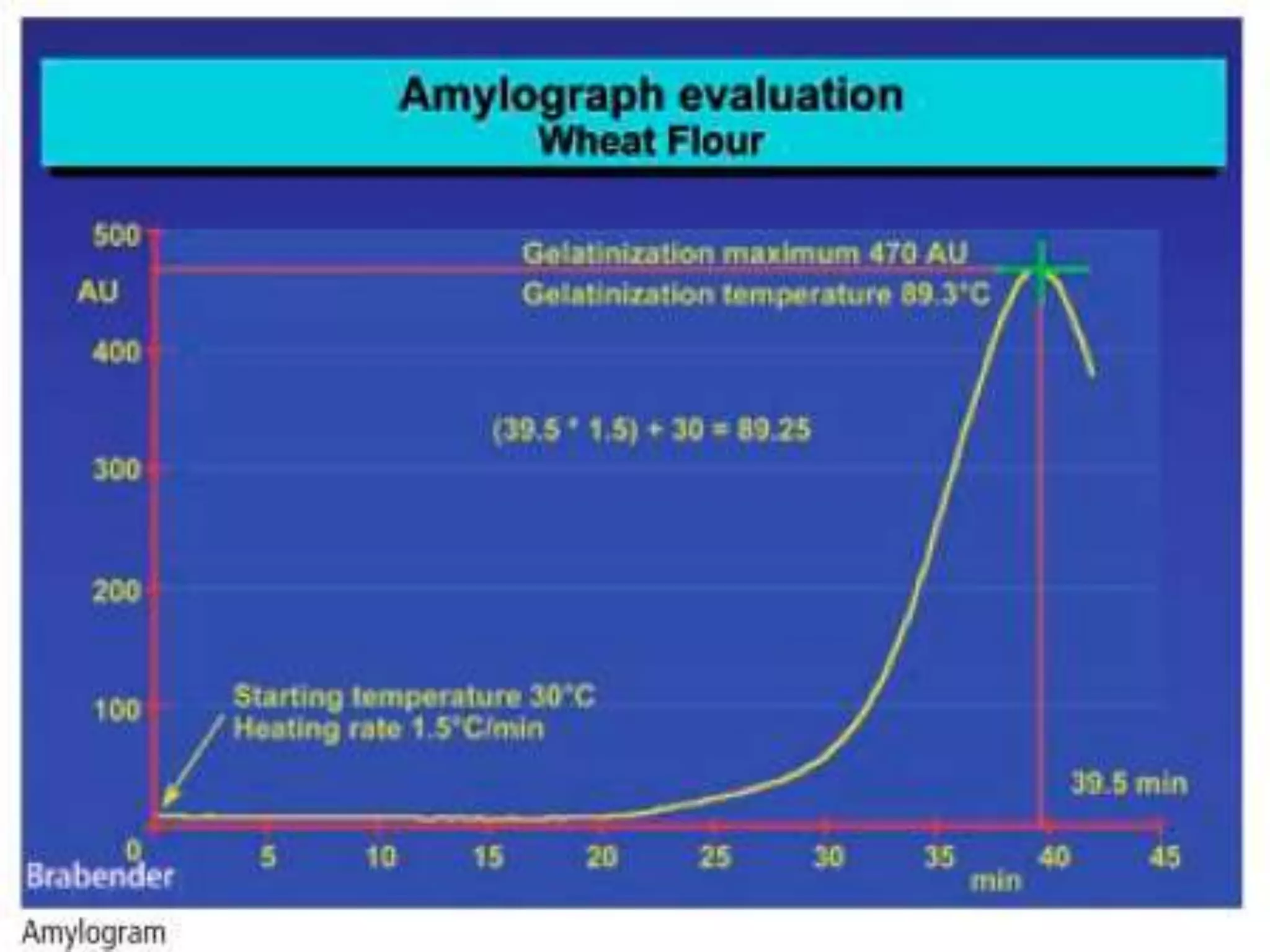
AMYLOGRAPH
viscosity analyser
The amylograph test measures flour starch properties
and enzyme activity which resukts from sprout
damage.
It ianalyses viscosity by measuring the resistance of a
flour and water slurry to the stirring action of pins
or paddles ,being heated at a constant rate.
When the slurry is heated, the starch granules swell
and it becomes a paste. A thicker slurry has more
resistance to the pins during stirring and has a
higher peak viscosity. Generally, a thicker slurry
indicates less enzyme activity and makes better
products.
RAPID VISCO ANALYSER
viscosity analyser
• The rapid visco analyser test measures flour starch
properties and can also used to determine stirring
number which is related to sprout damage.
• It indicates starch viscosity by measuring the
resistance of a flour and water slurry to the stirring
action of a paddle.
• The results include peak viscosity and are expressed
in rapid visco units (RVU).
THANK YOU!

Dough rheology

  • 1.
  • 2.
    Dough refers toa wet mass developed after mixing of wheat flour, water and other ingredients. Physico-chemical properties of dough play important role in the bakery, pasta and ready-to-eat cereals processing industry.
  • 3.
    Dough is developeddue to complex interactions among wheat constituents during mixing operation. The process of dough development begins with addition of water and commencement of mixing operation. Initially all ingredients are hydrated and appear like a sticky paste. On further mixing, the viscosity increases, sticky characteristics of dough disappear and a non-sticky mass is developed at peak consistency of dough. At this stage the dough behaves like a viscoelastic mass with both elastic and extensible characteristics.
  • 4.
    • Wheat dough(well mixed flour with water and ingredients) under stress undergoes flow and elastic recovery. These flow and elastic behavior of dough during processing are referred to as rheological properties • Knowledge of rheological behaviour and dough properties is becoming more important as the baking industry becomes more automated.
  • 5.
    EQUIPMENTS USED IN QUALITYCONTROL FOR ASSESSMENT OF DOUGH RHEOLOGY
  • 6.
    FARINOGRAPH recording dough mixer Thefarinograph is a tool used for measuring the shear and viscosity of a mixture of flour and water. It determines dough and gluten properties of flour by measuring the resistance of a dough against mixing action of paddles(blades). The results which include Water absorption, arrival time, stability time, peak time, departure time, and mixing tolerance index are used used as parameters in formulation to estimate the amount of water required to make dough, to evaluate flour blending requirements, and to check flour uniformity and also processing effects.
  • 8.
    EXTENSOGRAPH visco elastic recoder •A Extensograph is a laboratory device, with which the elongation properties ( elasticity , plasticity ) of dough can be tested by measuring the force required to strech the dough with a hook until it breaks. • The stretching properties provide information about the behavior of a dough on the pan . Due to the CO 2 gas formation, the dough is expanded and gains in volume. In order to maintain the volume, the adhesive must be stretched, but it must not collapse immediately afterwards. These dough properties can be read in the extensogram.
  • 10.
    ALVEOGRAPH visco elastic recoder TheAlveograph or Chopin extensimeter, is a tool for flour quality measurement which measures the flexibility of the dough produced from the flour, by inflating a bubble in a thin sheet of the dough until it bursts. A strong dough requires more force to break the bubble. The resulting values show the strength of the flour, and thus its suitability for different uses.
  • 12.
    MIXOGRAPGH recording dough mixer •The mixograph test quickly analyses small quantities of flour for dough gluten strength. • It determines dough and gluten properties of flour by measuring the resistance of a dough against the mixing action of pins. The results include water absorption, peak time and mixing tolerance. • Flour water absorption measured by mixograph often serves as bake absorption in bread baking tests.
  • 13.
    AMYLOGRAPH viscosity analyser The amylographtest measures flour starch properties and enzyme activity which resukts from sprout damage. It ianalyses viscosity by measuring the resistance of a flour and water slurry to the stirring action of pins or paddles ,being heated at a constant rate. When the slurry is heated, the starch granules swell and it becomes a paste. A thicker slurry has more resistance to the pins during stirring and has a higher peak viscosity. Generally, a thicker slurry indicates less enzyme activity and makes better products.
  • 15.
    RAPID VISCO ANALYSER viscosityanalyser • The rapid visco analyser test measures flour starch properties and can also used to determine stirring number which is related to sprout damage. • It indicates starch viscosity by measuring the resistance of a flour and water slurry to the stirring action of a paddle. • The results include peak viscosity and are expressed in rapid visco units (RVU).
  • 16.