Community OphthalmologyCommunity Ophthalmology
J.B. Chand, DCEH
Himalaya Eye Hospital
Pokhara, Nepal
Primary Eye CarePrimary Eye Care
Eye Health Outside Hospital
Primary Eye Care JBC
March 20, 2006
Primary Eye CarePrimary Eye Care
 Primary eye care is a vital component ofPrimary eye care is a vital component of
primary health careprimary health care that includes thethat includes the
promotion of eye health, prevention andpromotion of eye health, prevention and
treatment of conditions that may lead to visualtreatment of conditions that may lead to visual
lossloss
 The concept of primary health care (PHC) wasThe concept of primary health care (PHC) was
introduced in 1978 in Alma-Ata.introduced in 1978 in Alma-Ata.
Primary Eye Care JBC
March 20, 2006
Primary Eye Care…Primary Eye Care…
 PHC was envisaged as a solution to reach thePHC was envisaged as a solution to reach the
unreached in poor rural populations of manyunreached in poor rural populations of many
developing countries making universallydeveloping countries making universally
accessible to individuals and families in theaccessible to individuals and families in the
community through their full supportcommunity through their full support
Primary Eye Care JBC
March 20, 2006
Aims of Primary Eye CareAims of Primary Eye Care
 To change the pattern of eye care services,To change the pattern of eye care services,
currently often limited to the central hospitalscurrently often limited to the central hospitals
and eye units in the cities, to countrywideand eye units in the cities, to countrywide
blindness prevention programmesblindness prevention programmes
Primary Eye Care JBC
March 20, 2006
PHC ElementPHC Element Relation to Primary Eye CareRelation to Primary Eye Care
Safe waterSafe water Prevention of trachoma and vitamin A deficiency; preventionPrevention of trachoma and vitamin A deficiency; prevention
of diarrhoea which may reduce cataract prevalenceof diarrhoea which may reduce cataract prevalence
Basic sanitationBasic sanitation Prevention of trachoma and vitamin A deficiencyPrevention of trachoma and vitamin A deficiency
Maternal/child care;Maternal/child care;
family planningfamily planning
Prevention of vitamin A deficiency, measles, trachoma andPrevention of vitamin A deficiency, measles, trachoma and
Ophthalmia neonatorumOphthalmia neonatorum
ImmunisationImmunisation Prevention of childhood blindness from measles andPrevention of childhood blindness from measles and
congenital rubellacongenital rubella
Control of locallyControl of locally
endemic diseasesendemic diseases
Trachoma controlTrachoma control
Health and nutritionHealth and nutrition
educationeducation
Trachoma, vitamin A deficiency, traumaTrachoma, vitamin A deficiency, trauma
Treatment of commonTreatment of common
diseasesdiseases
Corneal ulcers, refractive errors, traumaCorneal ulcers, refractive errors, trauma
Provision of essentialProvision of essential
drugsdrugs
Tetracycline eye ointment and vitamin A capsulesTetracycline eye ointment and vitamin A capsules
PHC Elements & PECPHC Elements & PEC
Primary Eye Care JBC
March 20, 2006
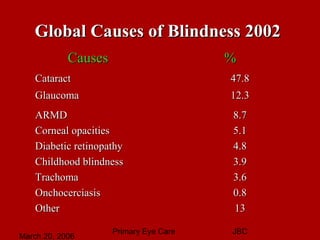
Global Causes of Blindness 2002Global Causes of Blindness 2002
CausesCauses %%
CataractCataract 47.847.8
GlaucomaGlaucoma 12.312.3
ARMDARMD 8.78.7
Corneal opacitiesCorneal opacities 5.15.1
Diabetic retinopathyDiabetic retinopathy 4.84.8
Childhood blindnessChildhood blindness 3.93.9
TrachomaTrachoma 3.63.6
OnchocerciasisOnchocerciasis 0.80.8
OtherOther 1313
Primary Eye Care JBC
March 20, 2006
Nepal: Causes of Blindness 1981Nepal: Causes of Blindness 1981
SNSN CausesCauses %%
11 CataractCataract 7272
22 Retinal diseaseRetinal disease 3.33.3
33 GlaucomaGlaucoma 3.23.2
44 Other infectionOther infection 3.23.2
55 TrachomaTrachoma 2.42.4
66 SmallpoxSmallpox 2.22.2
77 TraumaTrauma 2.22.2
88 AmblyopiaAmblyopia 1.31.3
99 Nutritional etiologyNutritional etiology 0.90.9
1010 MiscellaneousMiscellaneous 7.57.5
1111 UndeterminedUndetermined 1.81.8
TotalTotal 100100
Primary Eye Care JBC
March 20, 2006
Primary Eye Care JBC
March 20, 2006
Comprehensive Eye CareComprehensive Eye Care
 Comprehensive eye care includes the activitiesComprehensive eye care includes the activities
of the eye health promotion, diseaseof the eye health promotion, disease
prevention, curative measures at the time ofprevention, curative measures at the time of
illness, and rehabilitation if the damage causedillness, and rehabilitation if the damage caused
by the disease.by the disease.
 This type of eye health care (CEC) may beThis type of eye health care (CEC) may be
made available, accessible, affordable to themade available, accessible, affordable to the
poorest rural population and should bepoorest rural population and should be
sustainablesustainable
Primary Eye Care JBC
March 20, 2006
Components of Comprehensive EyeComponents of Comprehensive Eye
CareCare
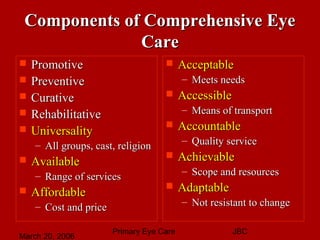
 PromotivePromotive
 PreventivePreventive
 CurativeCurative
 RehabilitativeRehabilitative
 UniversalityUniversality
– All groups, cast, religionAll groups, cast, religion
 AvailableAvailable
– Range of servicesRange of services
 AffordableAffordable
– Cost and priceCost and price
 AcceptableAcceptable
– Meets needsMeets needs
 AccessibleAccessible
– Means of transportMeans of transport
 AccountableAccountable
– Quality serviceQuality service
 AchievableAchievable
– Scope and resourcesScope and resources
 AdaptableAdaptable
– Not resistant to changeNot resistant to change
Primary Eye Care JBC
March 20, 2006
Components of Comprehensive EyeComponents of Comprehensive Eye
Care…Care…
 AppropriateAppropriate
– InfrastructureInfrastructure
– TechnologyTechnology
– Human resourcesHuman resources
Primary Eye Care JBC
March 20, 2006
PromotivePromotive
 Creating awareness :Creating awareness :
– Nutrition educationNutrition education
– Face washingFace washing
– Safe waterSafe water
– Improved sanitationImproved sanitation
 Appropriate information is disseminated to asAppropriate information is disseminated to as
many people in the communitymany people in the community
Primary Eye Care JBC
March 20, 2006
PreventivePreventive
 Stimulation of individuals and their community toStimulation of individuals and their community to
participate in activities in blindness preventionparticipate in activities in blindness prevention
– Adequate safe water and personal hygieneAdequate safe water and personal hygiene
– Use of pit latrines (environmental hygiene)Use of pit latrines (environmental hygiene)
– Consumption of foods rich in vitamin A and nutritionConsumption of foods rich in vitamin A and nutrition
– Vaccine of measles and control of diarrheaVaccine of measles and control of diarrhea
– Protection of eyes against injuriesProtection of eyes against injuries
– Screening of antenatal mothers for sexually transmittedScreening of antenatal mothers for sexually transmitted
diseases.diseases.
– Ocular prophylaxis medicine like tetracyclineOcular prophylaxis medicine like tetracycline
Primary Eye Care JBC
March 20, 2006
CurativeCurative
 First aid treatment or timely referral of patientsFirst aid treatment or timely referral of patients
with injurieswith injuries
 Identification and treatment/referral ofIdentification and treatment/referral of
common eye diseasescommon eye diseases
 Identification and referral of patients withIdentification and referral of patients with
potentially blinding diseases for appropriatepotentially blinding diseases for appropriate
management.management.
 Identification and referral of curable blindingIdentification and referral of curable blinding
diseases like cataractsdiseases like cataracts
Primary Eye Care JBC
March 20, 2006
RehabilitativeRehabilitative
 Since primary eye care is mainly concernedSince primary eye care is mainly concerned
with the community level, the issue ofwith the community level, the issue of
rehabilitation becomes very important forrehabilitation becomes very important for
incurably blindincurably blind
 With training skills can be acquired and theyWith training skills can be acquired and they
can be functional and not have to rely totallycan be functional and not have to rely totally
on otherson others
 Refraction, low vision and certification serviceRefraction, low vision and certification service
Primary Eye Care JBC
March 20, 2006
Primary Eye Care JBC
March 20, 2006
Categories of Eye Care WorkersCategories of Eye Care Workers
 Full time eye care workersFull time eye care workers
 Integrated eye care workersIntegrated eye care workers
 Community eye care workersCommunity eye care workers
Primary Eye Care JBC
March 20, 2006
Full time Eye Care WorkersFull time Eye Care Workers
 OphthalmologistsOphthalmologists
 Ophthalmic clinical officersOphthalmic clinical officers
 OptometristOptometrist
 Ophthalmic AssistantsOphthalmic Assistants
 Ophthalmic nursesOphthalmic nurses
 Optical techniciansOptical technicians
 Other ophthalmic paramedicsOther ophthalmic paramedics
Primary Eye Care JBC
March 20, 2006
Integrated Eye Care WorkersIntegrated Eye Care Workers
 General practitionersGeneral practitioners
 Clinical officersClinical officers
 Other health workerOther health worker
 NursesNurses
 MidwivesMidwives
 Environmental health techniciansEnvironmental health technicians
Primary Eye Care JBC
March 20, 2006
Community Eye Care WorkersCommunity Eye Care Workers
 School teachersSchool teachers
 Religious leadersReligious leaders
 Agriculture extension officersAgriculture extension officers
 Water department officersWater department officers
 Village leadersVillage leaders
 Social welfare officersSocial welfare officers
 Village health workersVillage health workers
 Female community health volunteersFemale community health volunteers
Primary Eye Care JBC
March 20, 2006
Who can Provide PECWho can Provide PEC
 General practicenerGeneral practicener
 General duty doctors at basic health units andGeneral duty doctors at basic health units and
rural health centersrural health centers
 ParamedicsParamedics
 Community based rehabilitation workersCommunity based rehabilitation workers
 Other interested personnelOther interested personnel
 Traditional birth attendantsTraditional birth attendants
 Traditional healersTraditional healers
 ParentsParents
Primary Eye Care JBC
March 20, 2006
How can PEC worker Help?How can PEC worker Help?
Primary eye care (PEC) is the most basic eye carePrimary eye care (PEC) is the most basic eye care
service available to individuals and families whereverservice available to individuals and families wherever
they live and whatever their socio-economic conditionthey live and whatever their socio-economic condition
The PEC worker will be able to manage:The PEC worker will be able to manage:
– Some casesSome cases
– Diagnose other conditionsDiagnose other conditions
– Explain the possible interventions with advantagesExplain the possible interventions with advantages
and disadvantagesand disadvantages
– Help the patient in decision making & encouragingHelp the patient in decision making & encouraging
active involvement of the individual and the familyactive involvement of the individual and the family
Primary Eye Care JBC
March 20, 2006
Primary Eye Care MedicinesPrimary Eye Care Medicines
 Tetracycline 1% eye ointmentTetracycline 1% eye ointment
 Chloramphenicol 0.5% eye dropsChloramphenicol 0.5% eye drops
 Vitamin A capsulesVitamin A capsules
 Silver nitrate 1% eye dropsSilver nitrate 1% eye drops
Primary Eye Care JBC
March 20, 2006
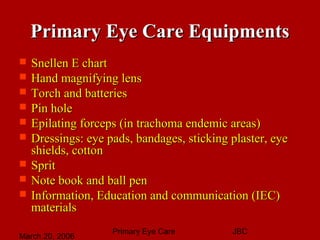
Primary Eye Care EquipmentsPrimary Eye Care Equipments
 Snellen E chartSnellen E chart
 Hand magnifying lensHand magnifying lens
 Torch and batteriesTorch and batteries
 Pin holePin hole
 Epilating forceps (in trachoma endemic areas)Epilating forceps (in trachoma endemic areas)
 Dressings: eye pads, bandages, sticking plaster, eyeDressings: eye pads, bandages, sticking plaster, eye
shields, cottonshields, cotton
 SpritSprit
 Note book and ball penNote book and ball pen
 Information, Education and communication (IEC)Information, Education and communication (IEC)
materialsmaterials
Primary Eye Care JBC
March 20, 2006
Requirements of Primary Eye CareRequirements of Primary Eye Care
 Political and professional willPolitical and professional will
 Human resource (master trainers, trainers andHuman resource (master trainers, trainers and
identification of trainees)identification of trainees)
 Management and material to conduct training andManagement and material to conduct training and
supervise and monitor the impact in communitiessupervise and monitor the impact in communities
 Material (for teaching of PEC workers andMaterial (for teaching of PEC workers and
distribution in communities and for maintaining thedistribution in communities and for maintaining the
management information system)management information system)
 Supplies for PEC workersSupplies for PEC workers
 Budgets; funding for capital and recurrent costsBudgets; funding for capital and recurrent costs
(training, supervision, salaries)(training, supervision, salaries)
Primary Eye Care JBC
March 20, 2006
Primary Eye Care JBC
March 20, 2006
PEC: Eye Health outside HospitalPEC: Eye Health outside Hospital
Primary Eye Care (PEC) activity is toPrimary Eye Care (PEC) activity is to
provide eye health service to the peopleprovide eye health service to the people
outside the hospital.outside the hospital.
Primary Eye Care JBC
March 20, 2006
ConclusionConclusion
 To have a successful primary eye care programme,To have a successful primary eye care programme,
there needs to be coordinated teamworkthere needs to be coordinated teamwork
 There should be regular interaction between the fullThere should be regular interaction between the full
time eye workers and the volunteer eye workerstime eye workers and the volunteer eye workers
 The complementary nature of the team needs to beThe complementary nature of the team needs to be
understood and appreciatedunderstood and appreciated
 Task oriented training of all team members should beTask oriented training of all team members should be
based on the skills that they need to acquire and inbased on the skills that they need to acquire and in
which competence is necessarywhich competence is necessary
Primary Eye Care JBC
March 20, 2006
Thank YouThank You

Primary eye care

  • 1.
    Community OphthalmologyCommunity Ophthalmology J.B.Chand, DCEH Himalaya Eye Hospital Pokhara, Nepal
  • 2.
    Primary Eye CarePrimaryEye Care Eye Health Outside Hospital
  • 3.
    Primary Eye CareJBC March 20, 2006 Primary Eye CarePrimary Eye Care  Primary eye care is a vital component ofPrimary eye care is a vital component of primary health careprimary health care that includes thethat includes the promotion of eye health, prevention andpromotion of eye health, prevention and treatment of conditions that may lead to visualtreatment of conditions that may lead to visual lossloss  The concept of primary health care (PHC) wasThe concept of primary health care (PHC) was introduced in 1978 in Alma-Ata.introduced in 1978 in Alma-Ata.
  • 4.
    Primary Eye CareJBC March 20, 2006 Primary Eye Care…Primary Eye Care…  PHC was envisaged as a solution to reach thePHC was envisaged as a solution to reach the unreached in poor rural populations of manyunreached in poor rural populations of many developing countries making universallydeveloping countries making universally accessible to individuals and families in theaccessible to individuals and families in the community through their full supportcommunity through their full support
  • 5.
    Primary Eye CareJBC March 20, 2006 Aims of Primary Eye CareAims of Primary Eye Care  To change the pattern of eye care services,To change the pattern of eye care services, currently often limited to the central hospitalscurrently often limited to the central hospitals and eye units in the cities, to countrywideand eye units in the cities, to countrywide blindness prevention programmesblindness prevention programmes
  • 6.
    Primary Eye CareJBC March 20, 2006 PHC ElementPHC Element Relation to Primary Eye CareRelation to Primary Eye Care Safe waterSafe water Prevention of trachoma and vitamin A deficiency; preventionPrevention of trachoma and vitamin A deficiency; prevention of diarrhoea which may reduce cataract prevalenceof diarrhoea which may reduce cataract prevalence Basic sanitationBasic sanitation Prevention of trachoma and vitamin A deficiencyPrevention of trachoma and vitamin A deficiency Maternal/child care;Maternal/child care; family planningfamily planning Prevention of vitamin A deficiency, measles, trachoma andPrevention of vitamin A deficiency, measles, trachoma and Ophthalmia neonatorumOphthalmia neonatorum ImmunisationImmunisation Prevention of childhood blindness from measles andPrevention of childhood blindness from measles and congenital rubellacongenital rubella Control of locallyControl of locally endemic diseasesendemic diseases Trachoma controlTrachoma control Health and nutritionHealth and nutrition educationeducation Trachoma, vitamin A deficiency, traumaTrachoma, vitamin A deficiency, trauma Treatment of commonTreatment of common diseasesdiseases Corneal ulcers, refractive errors, traumaCorneal ulcers, refractive errors, trauma Provision of essentialProvision of essential drugsdrugs Tetracycline eye ointment and vitamin A capsulesTetracycline eye ointment and vitamin A capsules PHC Elements & PECPHC Elements & PEC
  • 7.
    Primary Eye CareJBC March 20, 2006 Global Causes of Blindness 2002Global Causes of Blindness 2002 CausesCauses %% CataractCataract 47.847.8 GlaucomaGlaucoma 12.312.3 ARMDARMD 8.78.7 Corneal opacitiesCorneal opacities 5.15.1 Diabetic retinopathyDiabetic retinopathy 4.84.8 Childhood blindnessChildhood blindness 3.93.9 TrachomaTrachoma 3.63.6 OnchocerciasisOnchocerciasis 0.80.8 OtherOther 1313
  • 8.
    Primary Eye CareJBC March 20, 2006 Nepal: Causes of Blindness 1981Nepal: Causes of Blindness 1981 SNSN CausesCauses %% 11 CataractCataract 7272 22 Retinal diseaseRetinal disease 3.33.3 33 GlaucomaGlaucoma 3.23.2 44 Other infectionOther infection 3.23.2 55 TrachomaTrachoma 2.42.4 66 SmallpoxSmallpox 2.22.2 77 TraumaTrauma 2.22.2 88 AmblyopiaAmblyopia 1.31.3 99 Nutritional etiologyNutritional etiology 0.90.9 1010 MiscellaneousMiscellaneous 7.57.5 1111 UndeterminedUndetermined 1.81.8 TotalTotal 100100
  • 9.
    Primary Eye CareJBC March 20, 2006
  • 10.
    Primary Eye CareJBC March 20, 2006 Comprehensive Eye CareComprehensive Eye Care  Comprehensive eye care includes the activitiesComprehensive eye care includes the activities of the eye health promotion, diseaseof the eye health promotion, disease prevention, curative measures at the time ofprevention, curative measures at the time of illness, and rehabilitation if the damage causedillness, and rehabilitation if the damage caused by the disease.by the disease.  This type of eye health care (CEC) may beThis type of eye health care (CEC) may be made available, accessible, affordable to themade available, accessible, affordable to the poorest rural population and should bepoorest rural population and should be sustainablesustainable
  • 11.
    Primary Eye CareJBC March 20, 2006 Components of Comprehensive EyeComponents of Comprehensive Eye CareCare  PromotivePromotive  PreventivePreventive  CurativeCurative  RehabilitativeRehabilitative  UniversalityUniversality – All groups, cast, religionAll groups, cast, religion  AvailableAvailable – Range of servicesRange of services  AffordableAffordable – Cost and priceCost and price  AcceptableAcceptable – Meets needsMeets needs  AccessibleAccessible – Means of transportMeans of transport  AccountableAccountable – Quality serviceQuality service  AchievableAchievable – Scope and resourcesScope and resources  AdaptableAdaptable – Not resistant to changeNot resistant to change
  • 12.
    Primary Eye CareJBC March 20, 2006 Components of Comprehensive EyeComponents of Comprehensive Eye Care…Care…  AppropriateAppropriate – InfrastructureInfrastructure – TechnologyTechnology – Human resourcesHuman resources
  • 13.
    Primary Eye CareJBC March 20, 2006 PromotivePromotive  Creating awareness :Creating awareness : – Nutrition educationNutrition education – Face washingFace washing – Safe waterSafe water – Improved sanitationImproved sanitation  Appropriate information is disseminated to asAppropriate information is disseminated to as many people in the communitymany people in the community
  • 14.
    Primary Eye CareJBC March 20, 2006 PreventivePreventive  Stimulation of individuals and their community toStimulation of individuals and their community to participate in activities in blindness preventionparticipate in activities in blindness prevention – Adequate safe water and personal hygieneAdequate safe water and personal hygiene – Use of pit latrines (environmental hygiene)Use of pit latrines (environmental hygiene) – Consumption of foods rich in vitamin A and nutritionConsumption of foods rich in vitamin A and nutrition – Vaccine of measles and control of diarrheaVaccine of measles and control of diarrhea – Protection of eyes against injuriesProtection of eyes against injuries – Screening of antenatal mothers for sexually transmittedScreening of antenatal mothers for sexually transmitted diseases.diseases. – Ocular prophylaxis medicine like tetracyclineOcular prophylaxis medicine like tetracycline
  • 15.
    Primary Eye CareJBC March 20, 2006 CurativeCurative  First aid treatment or timely referral of patientsFirst aid treatment or timely referral of patients with injurieswith injuries  Identification and treatment/referral ofIdentification and treatment/referral of common eye diseasescommon eye diseases  Identification and referral of patients withIdentification and referral of patients with potentially blinding diseases for appropriatepotentially blinding diseases for appropriate management.management.  Identification and referral of curable blindingIdentification and referral of curable blinding diseases like cataractsdiseases like cataracts
  • 16.
    Primary Eye CareJBC March 20, 2006 RehabilitativeRehabilitative  Since primary eye care is mainly concernedSince primary eye care is mainly concerned with the community level, the issue ofwith the community level, the issue of rehabilitation becomes very important forrehabilitation becomes very important for incurably blindincurably blind  With training skills can be acquired and theyWith training skills can be acquired and they can be functional and not have to rely totallycan be functional and not have to rely totally on otherson others  Refraction, low vision and certification serviceRefraction, low vision and certification service
  • 17.
    Primary Eye CareJBC March 20, 2006
  • 18.
    Primary Eye CareJBC March 20, 2006 Categories of Eye Care WorkersCategories of Eye Care Workers  Full time eye care workersFull time eye care workers  Integrated eye care workersIntegrated eye care workers  Community eye care workersCommunity eye care workers
  • 19.
    Primary Eye CareJBC March 20, 2006 Full time Eye Care WorkersFull time Eye Care Workers  OphthalmologistsOphthalmologists  Ophthalmic clinical officersOphthalmic clinical officers  OptometristOptometrist  Ophthalmic AssistantsOphthalmic Assistants  Ophthalmic nursesOphthalmic nurses  Optical techniciansOptical technicians  Other ophthalmic paramedicsOther ophthalmic paramedics
  • 20.
    Primary Eye CareJBC March 20, 2006 Integrated Eye Care WorkersIntegrated Eye Care Workers  General practitionersGeneral practitioners  Clinical officersClinical officers  Other health workerOther health worker  NursesNurses  MidwivesMidwives  Environmental health techniciansEnvironmental health technicians
  • 21.
    Primary Eye CareJBC March 20, 2006 Community Eye Care WorkersCommunity Eye Care Workers  School teachersSchool teachers  Religious leadersReligious leaders  Agriculture extension officersAgriculture extension officers  Water department officersWater department officers  Village leadersVillage leaders  Social welfare officersSocial welfare officers  Village health workersVillage health workers  Female community health volunteersFemale community health volunteers
  • 22.
    Primary Eye CareJBC March 20, 2006 Who can Provide PECWho can Provide PEC  General practicenerGeneral practicener  General duty doctors at basic health units andGeneral duty doctors at basic health units and rural health centersrural health centers  ParamedicsParamedics  Community based rehabilitation workersCommunity based rehabilitation workers  Other interested personnelOther interested personnel  Traditional birth attendantsTraditional birth attendants  Traditional healersTraditional healers  ParentsParents
  • 23.
    Primary Eye CareJBC March 20, 2006 How can PEC worker Help?How can PEC worker Help? Primary eye care (PEC) is the most basic eye carePrimary eye care (PEC) is the most basic eye care service available to individuals and families whereverservice available to individuals and families wherever they live and whatever their socio-economic conditionthey live and whatever their socio-economic condition The PEC worker will be able to manage:The PEC worker will be able to manage: – Some casesSome cases – Diagnose other conditionsDiagnose other conditions – Explain the possible interventions with advantagesExplain the possible interventions with advantages and disadvantagesand disadvantages – Help the patient in decision making & encouragingHelp the patient in decision making & encouraging active involvement of the individual and the familyactive involvement of the individual and the family
  • 24.
    Primary Eye CareJBC March 20, 2006 Primary Eye Care MedicinesPrimary Eye Care Medicines  Tetracycline 1% eye ointmentTetracycline 1% eye ointment  Chloramphenicol 0.5% eye dropsChloramphenicol 0.5% eye drops  Vitamin A capsulesVitamin A capsules  Silver nitrate 1% eye dropsSilver nitrate 1% eye drops
  • 25.
    Primary Eye CareJBC March 20, 2006 Primary Eye Care EquipmentsPrimary Eye Care Equipments  Snellen E chartSnellen E chart  Hand magnifying lensHand magnifying lens  Torch and batteriesTorch and batteries  Pin holePin hole  Epilating forceps (in trachoma endemic areas)Epilating forceps (in trachoma endemic areas)  Dressings: eye pads, bandages, sticking plaster, eyeDressings: eye pads, bandages, sticking plaster, eye shields, cottonshields, cotton  SpritSprit  Note book and ball penNote book and ball pen  Information, Education and communication (IEC)Information, Education and communication (IEC) materialsmaterials
  • 26.
    Primary Eye CareJBC March 20, 2006 Requirements of Primary Eye CareRequirements of Primary Eye Care  Political and professional willPolitical and professional will  Human resource (master trainers, trainers andHuman resource (master trainers, trainers and identification of trainees)identification of trainees)  Management and material to conduct training andManagement and material to conduct training and supervise and monitor the impact in communitiessupervise and monitor the impact in communities  Material (for teaching of PEC workers andMaterial (for teaching of PEC workers and distribution in communities and for maintaining thedistribution in communities and for maintaining the management information system)management information system)  Supplies for PEC workersSupplies for PEC workers  Budgets; funding for capital and recurrent costsBudgets; funding for capital and recurrent costs (training, supervision, salaries)(training, supervision, salaries)
  • 27.
    Primary Eye CareJBC March 20, 2006
  • 28.
    Primary Eye CareJBC March 20, 2006 PEC: Eye Health outside HospitalPEC: Eye Health outside Hospital Primary Eye Care (PEC) activity is toPrimary Eye Care (PEC) activity is to provide eye health service to the peopleprovide eye health service to the people outside the hospital.outside the hospital.
  • 29.
    Primary Eye CareJBC March 20, 2006 ConclusionConclusion  To have a successful primary eye care programme,To have a successful primary eye care programme, there needs to be coordinated teamworkthere needs to be coordinated teamwork  There should be regular interaction between the fullThere should be regular interaction between the full time eye workers and the volunteer eye workerstime eye workers and the volunteer eye workers  The complementary nature of the team needs to beThe complementary nature of the team needs to be understood and appreciatedunderstood and appreciated  Task oriented training of all team members should beTask oriented training of all team members should be based on the skills that they need to acquire and inbased on the skills that they need to acquire and in which competence is necessarywhich competence is necessary
  • 30.
    Primary Eye CareJBC March 20, 2006 Thank YouThank You