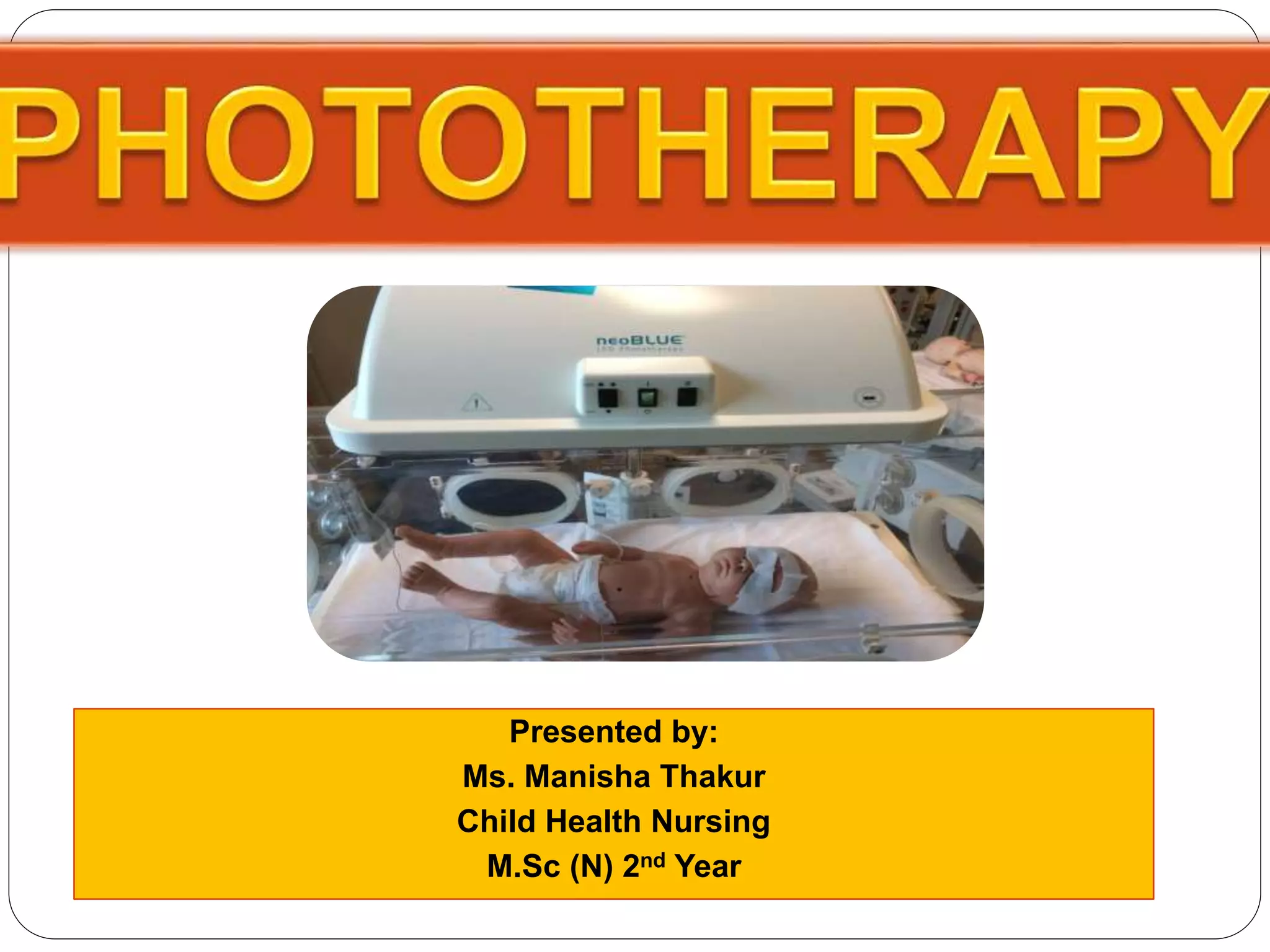
Presented by:
Ms. Manisha Thakur
Child Health Nursing
M.Sc (N) 2nd Year
INTRODUCTION
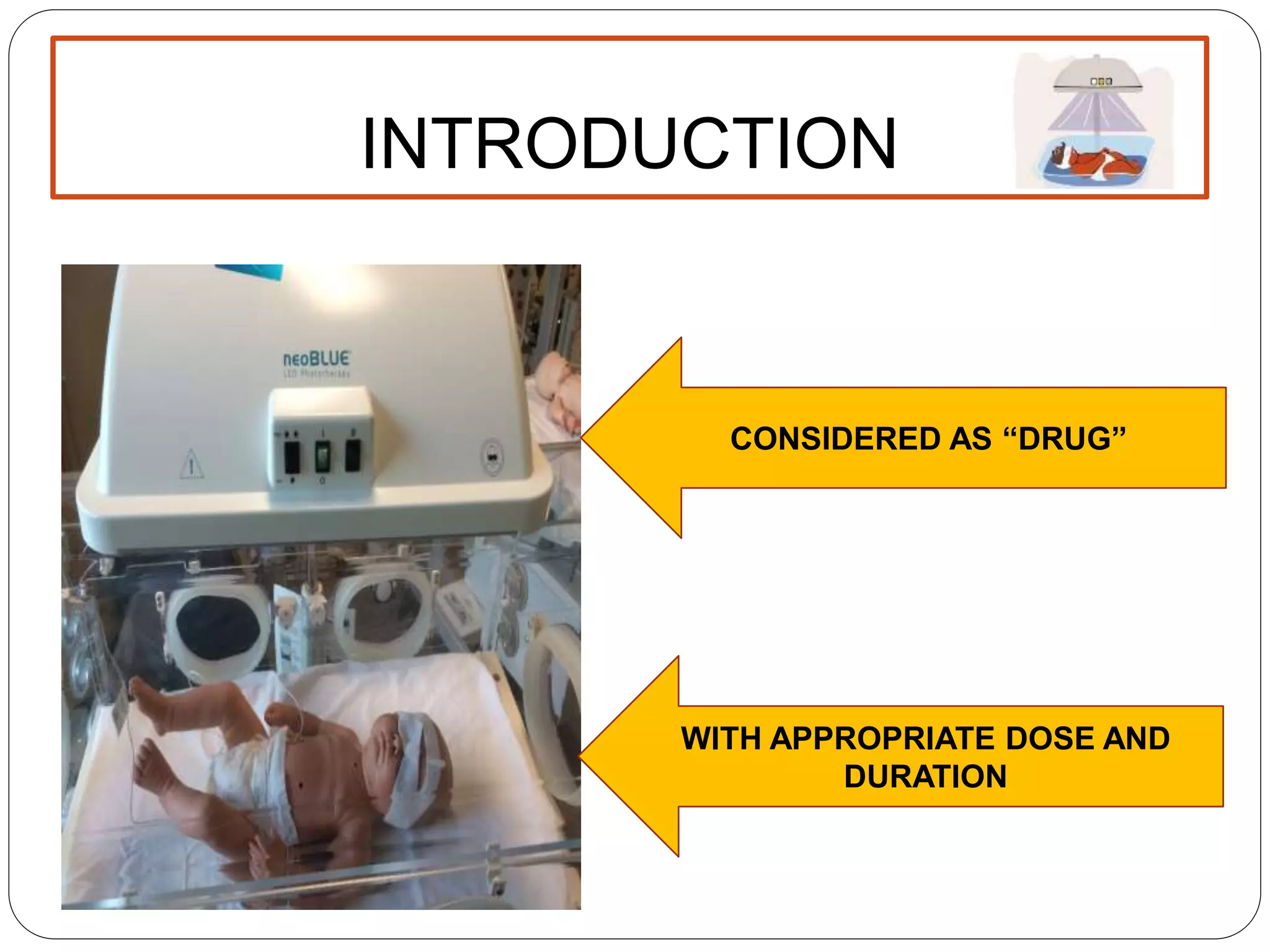
CONSIDERED AS “DRUG”
WITH APPROPRIATE DOSE AND
DURATION
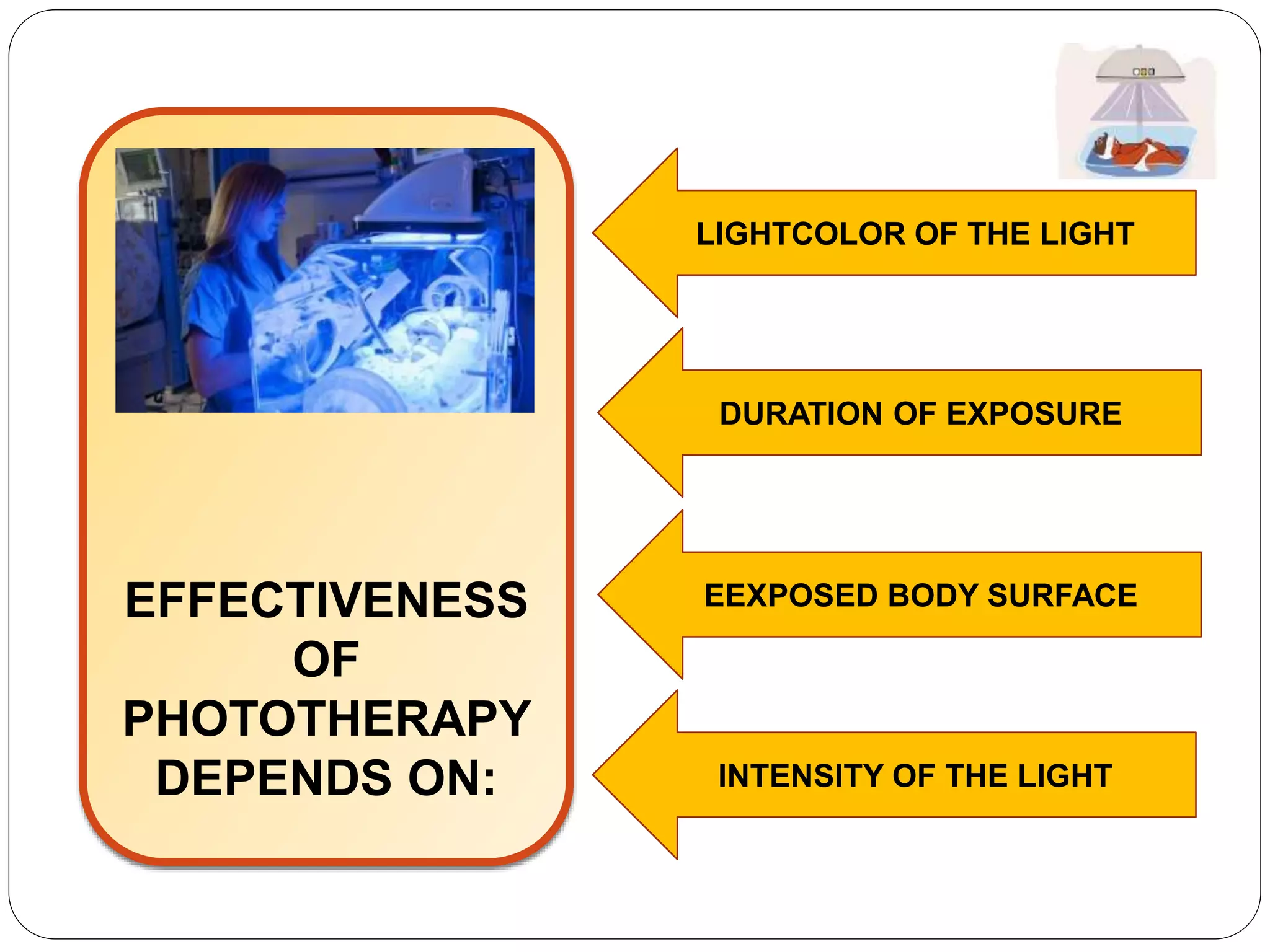
EFFECTIVENESS
OF
PHOTOTHERAPY
DEPENDS ON:
LIGHTCOLOR OF THE LIGHT
DURATION OF EXPOSURE
EEXPOSED BODY SURFACE
INTENSITY OF THE LIGHT
INTRODUCTION
 Phototherapy has been used since 1958 for the
treatment of neonatal hyperbilirubinaemia. It
causes unconjugated bilirubin to be mobilised
from the skin by structural isomerisation to a
water soluble form (lumirubin) that can be
excreted in the urine.
 The aim of phototherapy is to decrease the level
of unconjugated bilirubin in order to prevent acute
bilirubin encephalopathy, hearing loss and
kernicterus.
CONT…
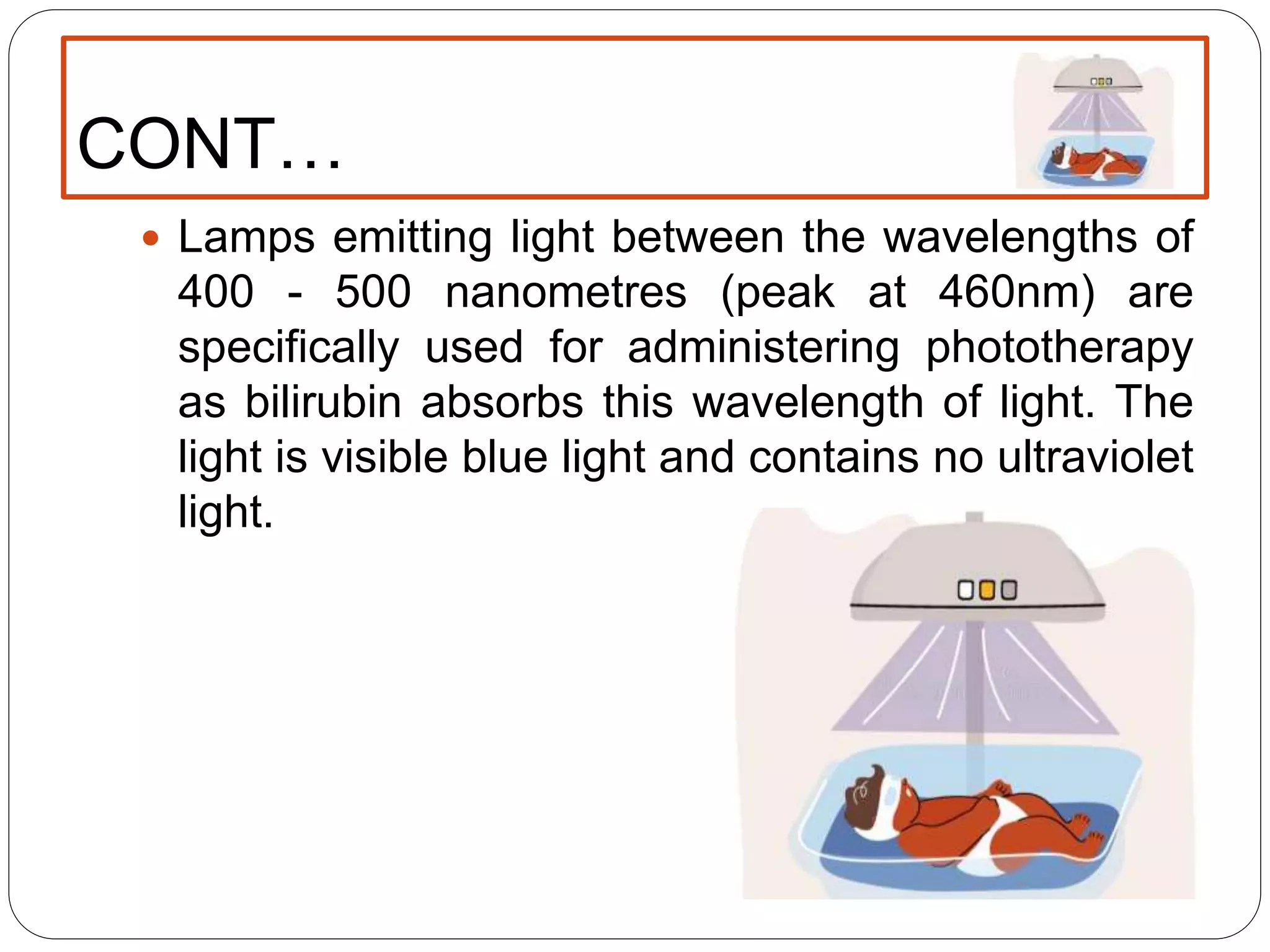
 Lamps emitting light between the wavelengths of
400 - 500 nanometres (peak at 460nm) are
specifically used for administering phototherapy
as bilirubin absorbs this wavelength of light. The
light is visible blue light and contains no ultraviolet
light.
DEFINITION
 Phototherapy (light therapy) is a way of treating
jaundice. Special lights help break down the
bilirubin in your baby's skin so that it can be
removed from his or her body. This lowers the
bilirubin level in your baby's blood.
 It is defined as exposure of skin to a specialised
light sources that converts unconjugated bilirubin
into water soluble conjugated molecules that can
be excreted through normal pathway ( through
urine and feces)
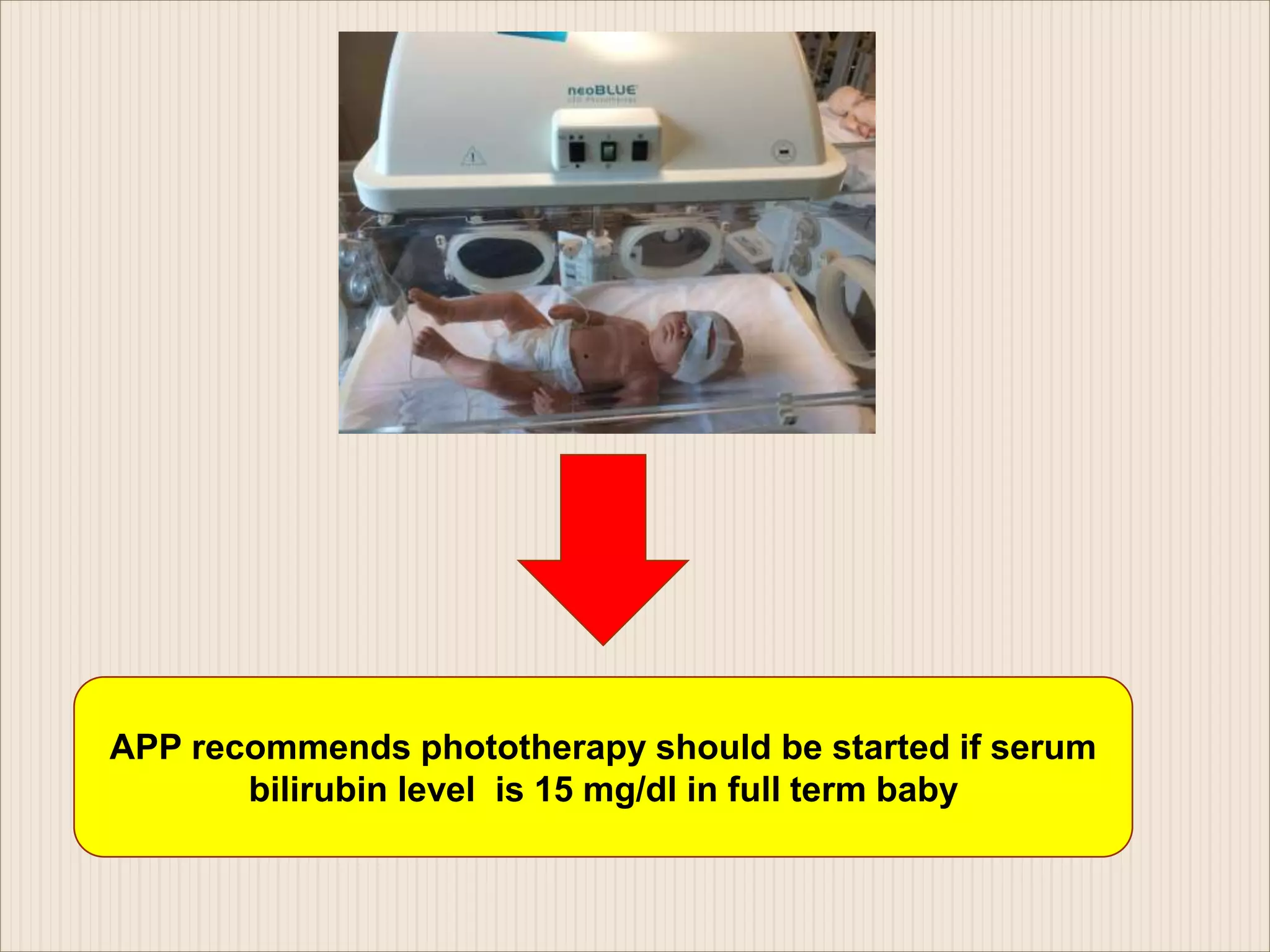
APP recommends phototherapy should be started if serum
bilirubin level is 15 mg/dl in full term baby
Rule of thumb
 If jaundice is pathological then phototherapy
should be started only when the bilirubin level is
more than 5 times of birth weight.
 E.g. birth weight of new born: 4 kg
Then, 4 X 5 = 20 mg/dl
PURPOSE
 To support the care of babies with
hyperbilirubinemia.
 To decrease infant serum bilirubin levels.
 To maintain phototherapy treatment safely and
effectively.
 To minimize infant-maternal separation and
facilitate breastfeeding.
INDICATION OF
PHOTOTHERAPY
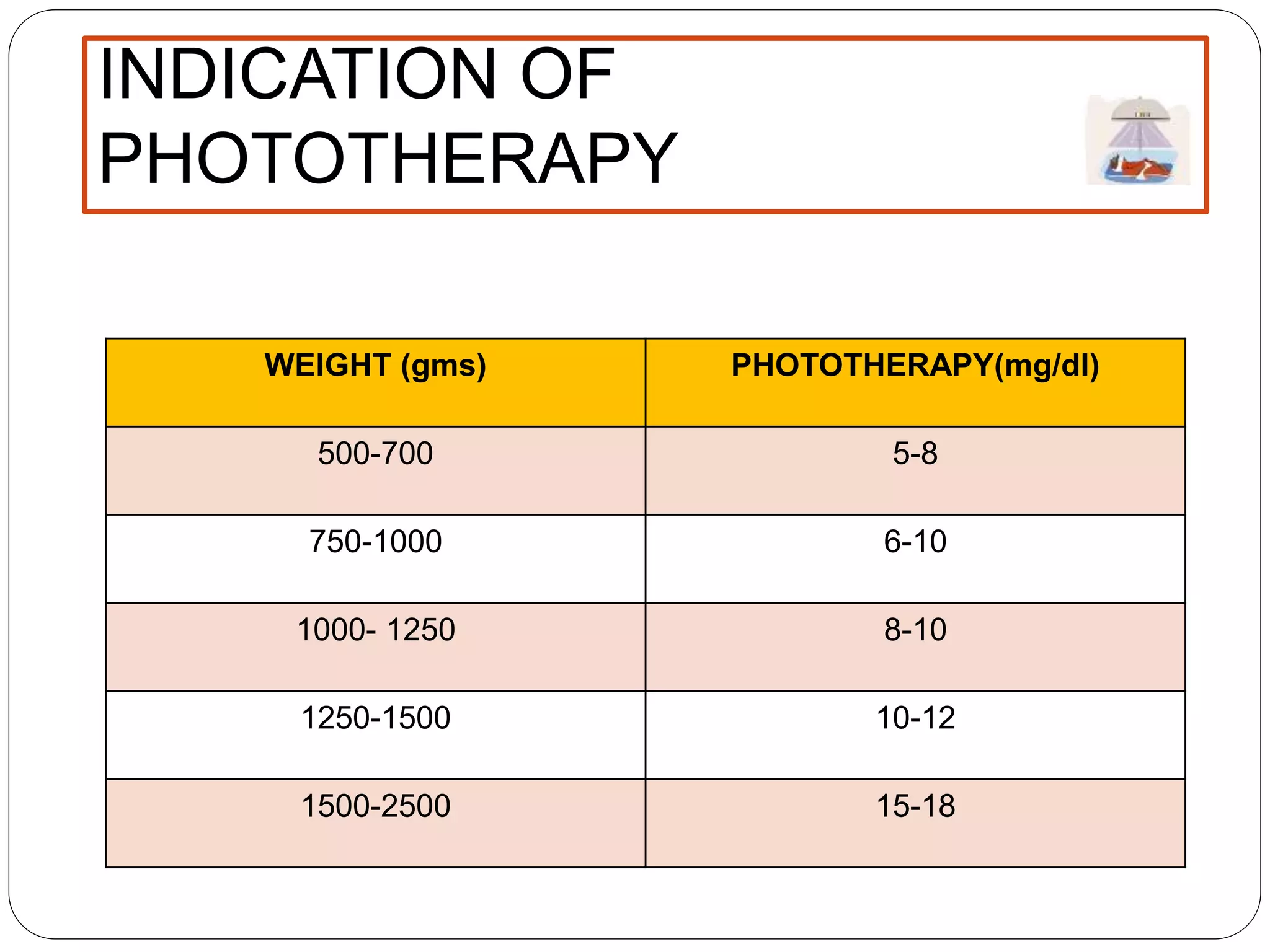
WEIGHT (gms) PHOTOTHERAPY(mg/dl)
500-700 5-8
750-1000 6-10
1000- 1250 8-10
1250-1500 10-12
1500-2500 15-18
LIGHTS USED IN
PHOTOTHERAPY
 Micro White Halogen lights
They deliver light via a quartz halogen bulb and have
a tendency to become quite hot so should not be
positioned closer to the infant than the manufacturers
recommendations of 52cm. The lights can continue to
be bright despite having low irradiance levels.
 Fluoro- 2 Blue and 2 White Fluorescent lights
The fluorescent blue tubes must have the serial
number F20T12/BB or TL52/20W to be special
phototherapy lights. Blue light is the most effective
light for reducing the bilirubin.
CONT…
 Ohmeda Biliblanket - Blue Halogen light
This uses a halogen bulb directed into a fiberoptic
mat. There is a filter that removes the ultraviolet and
infrared components and the eventual light is a blue-
green colour. Biliblankets are not to be used on
infants less than 28 weeks gestation or infants with
broken or reduced skin integrity.
 Blue Fluorescent light
A blue fluorescent tube is fitted into a plastic crib with
a stretched plastic cover over the top for the baby to
lie on
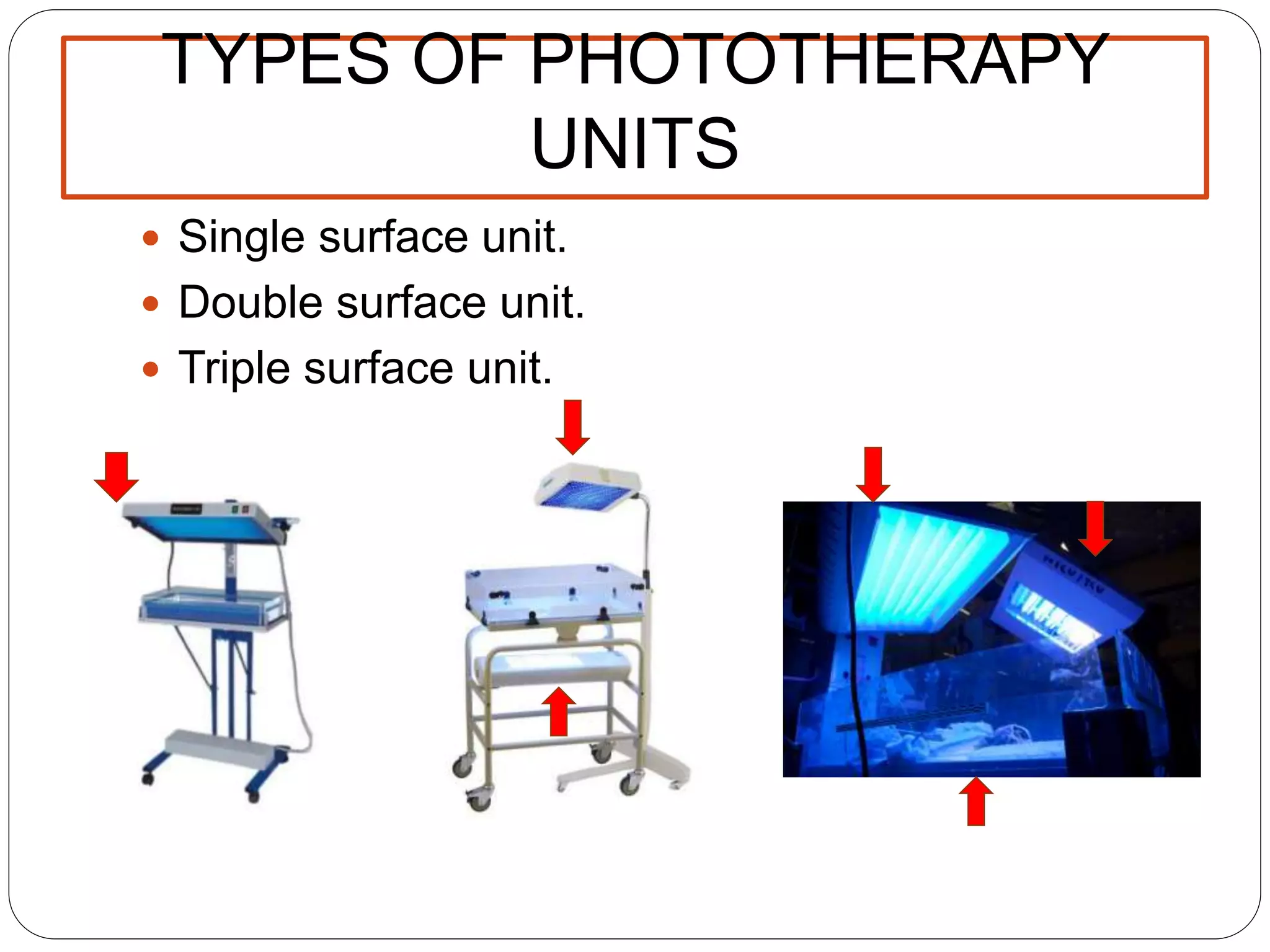
TYPES OF PHOTOTHERAPY
UNITS
 Single surface unit.
 Double surface unit.
 Triple surface unit.
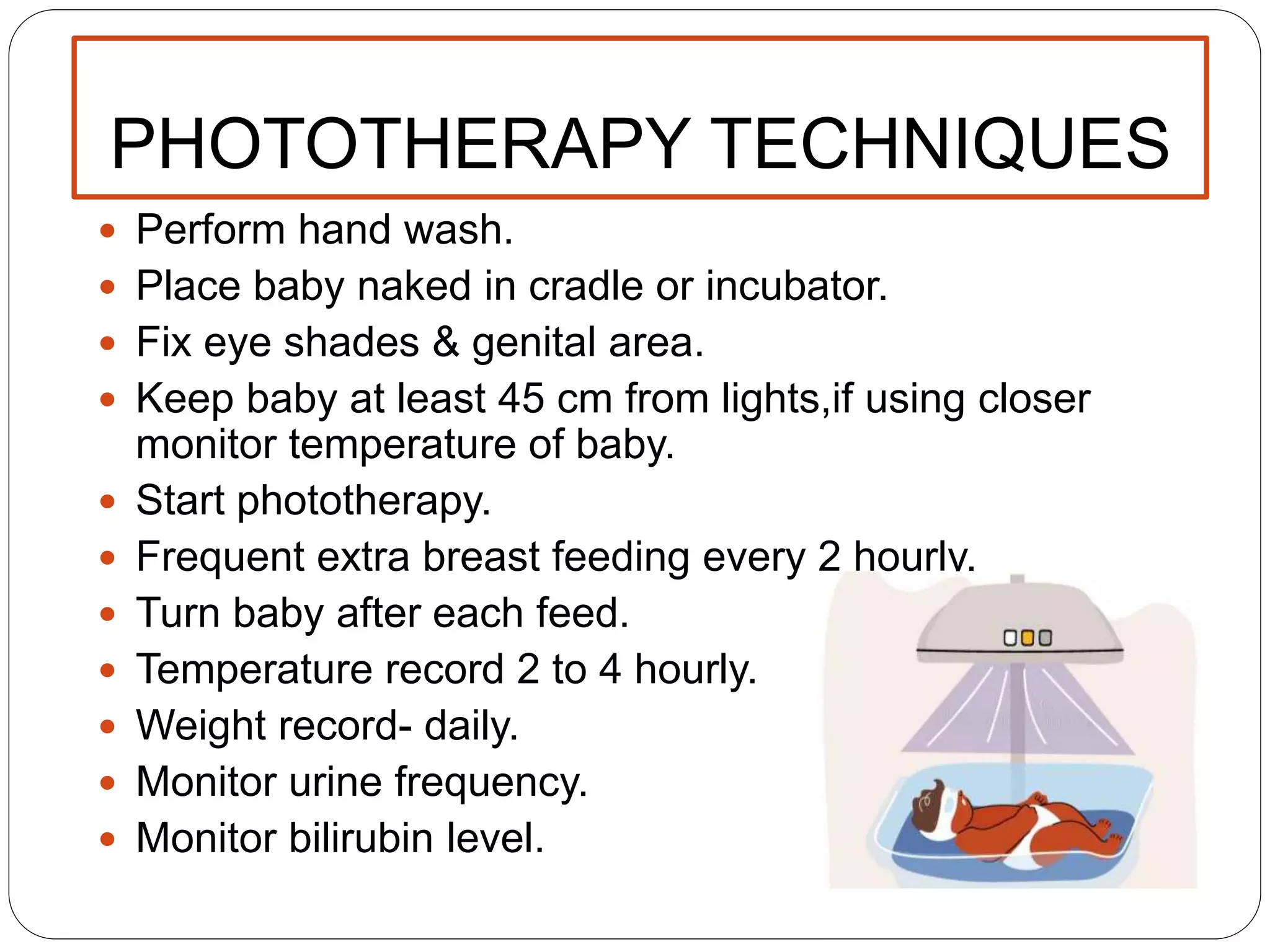
PHOTOTHERAPY TECHNIQUES
 Perform hand wash.
 Place baby naked in cradle or incubator.
 Fix eye shades & genital area.
 Keep baby at least 45 cm from lights,if using closer
monitor temperature of baby.
 Start phototherapy.
 Frequent extra breast feeding every 2 hourly.
 Turn baby after each feed.
 Temperature record 2 to 4 hourly.
 Weight record- daily.
 Monitor urine frequency.
 Monitor bilirubin level.
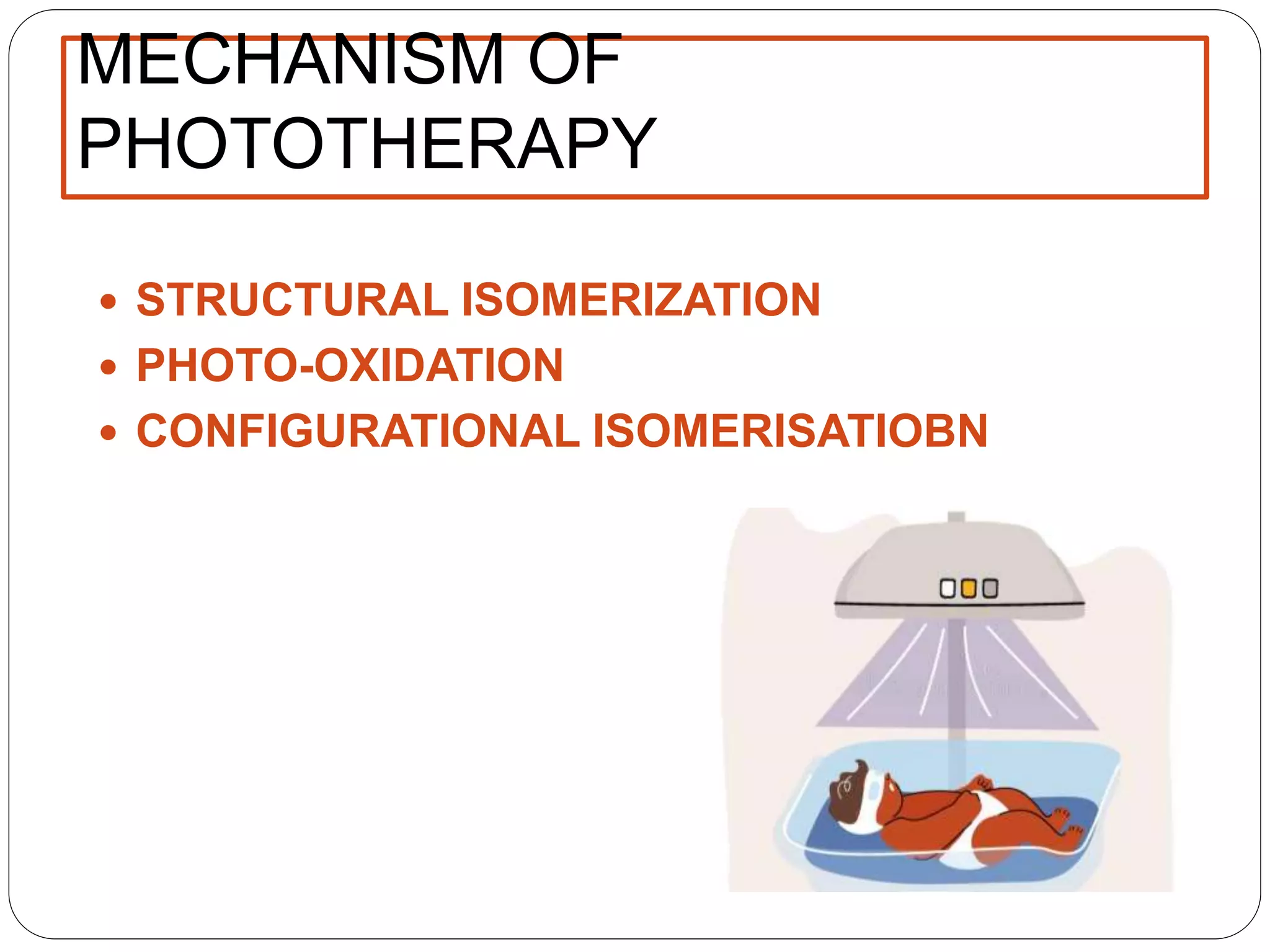
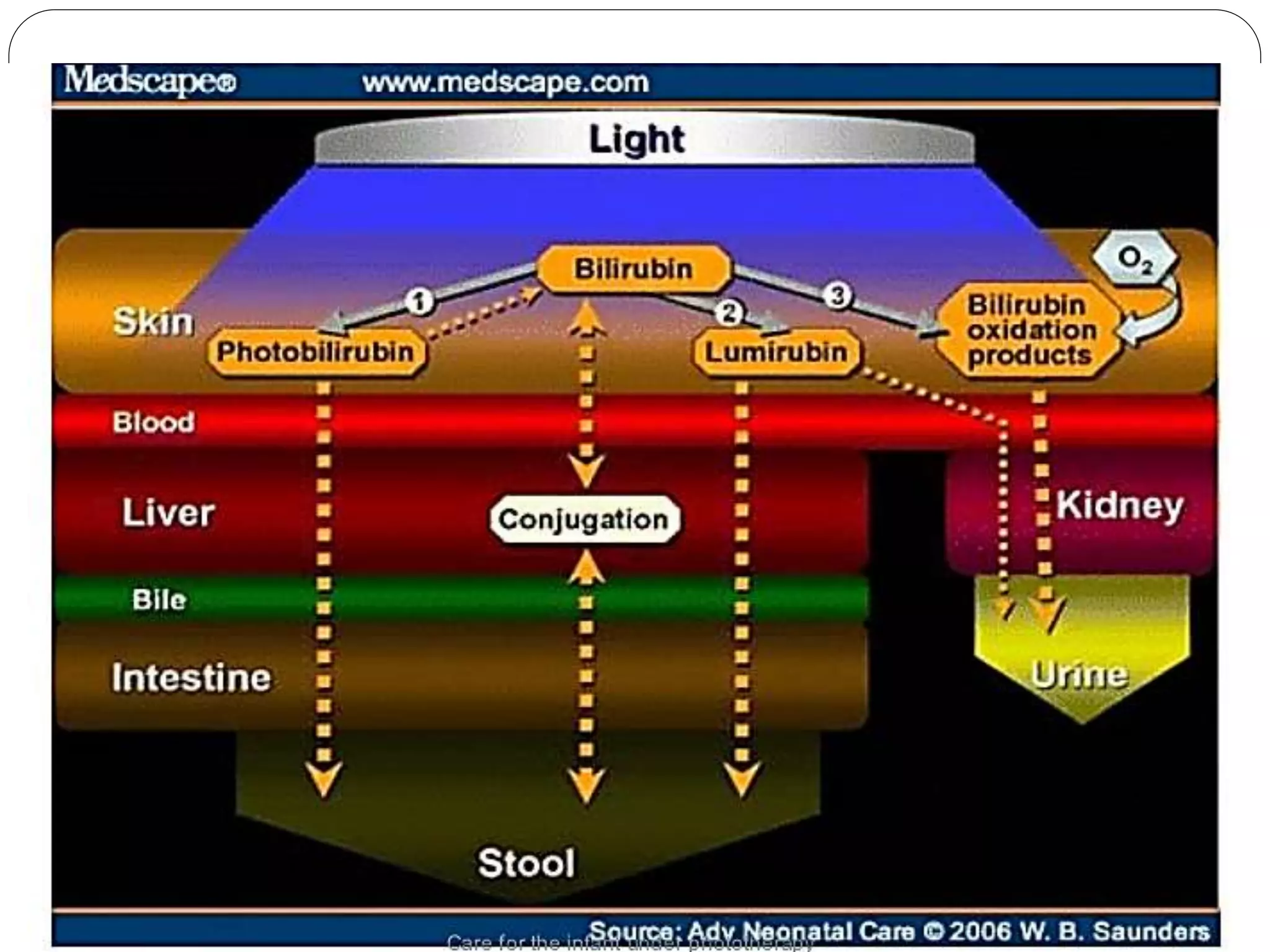
MECHANISM OF
PHOTOTHERAPY
 STRUCTURAL ISOMERIZATION
 PHOTO-OXIDATION
 CONFIGURATIONAL ISOMERISATIOBN
MECHANISM OF
PHOTOTHERAPY
 Blue-green light in the range of 460-490 nm is
most effective for phototherapy. The absorption of
light by the normal bilirubin (4Z,15Z-bilirubin)
generates configuration isomers, structural
isomers, and photooxidation products. The 2
principal photoisomers formed in humans are
shown. Configurational isomerization is reversible
and much faster than structural isomerization.
 Structural isomerization is slow and irreversible.
Photooxidation occurs more slowly than both
configurational and structural isomerization.
Photooxidation products are excreted mainly in
urine.
Nursing care of phototherapy
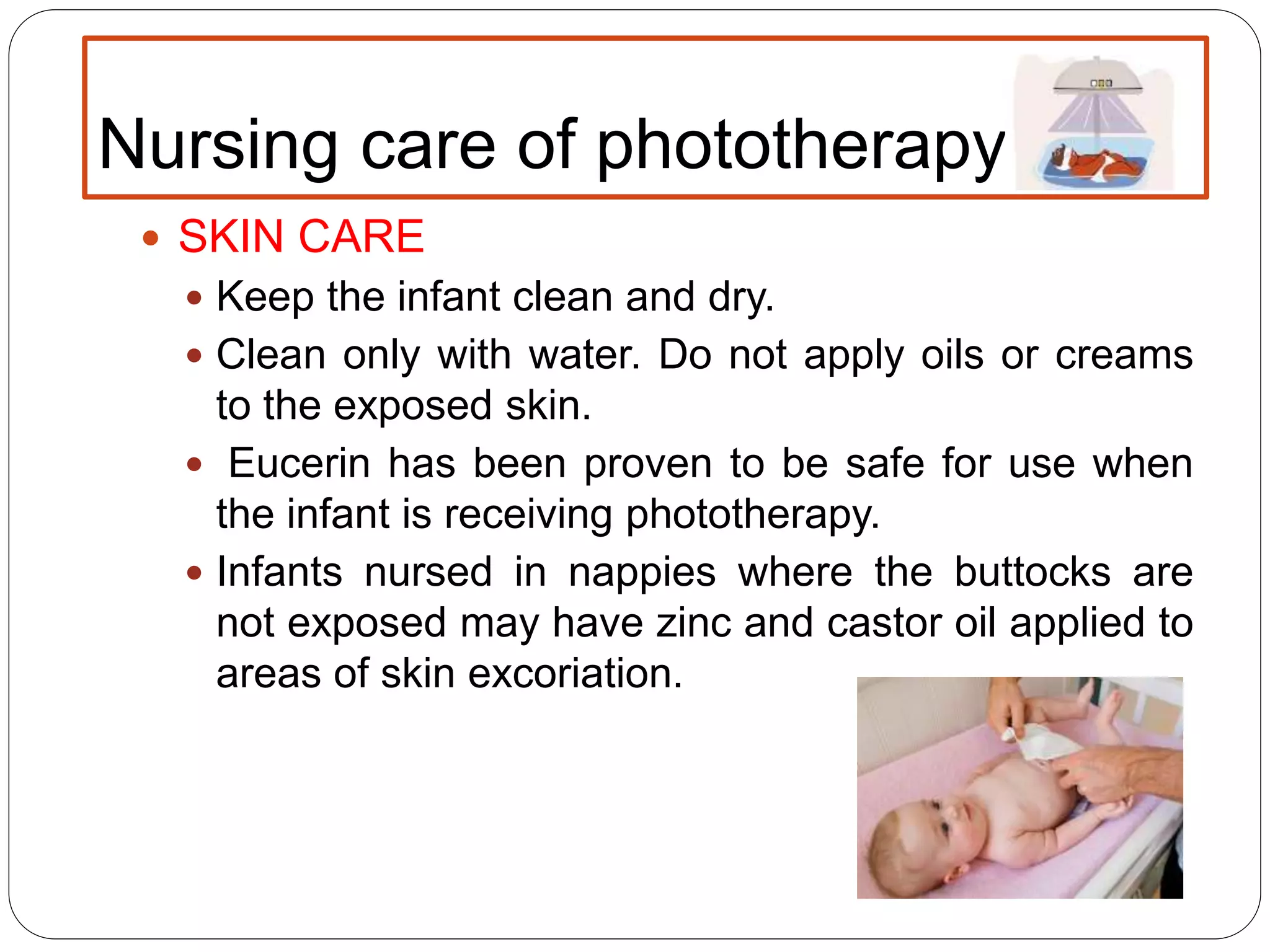
 SKIN CARE
 Keep the infant clean and dry.
 Clean only with water. Do not apply oils or creams
to the exposed skin.
 Eucerin has been proven to be safe for use when
the infant is receiving phototherapy.
 Infants nursed in nappies where the buttocks are
not exposed may have zinc and castor oil applied to
areas of skin excoriation.
Cont…
 OBSERVATION
 All infants in Newborn Care receiving phototherapy
should have a temperature, pulse and respiration
rate documented 4 hourly & prevent dehydration.
 If an infant requires continuous cardiorespiratory
monitoring for other reasons, then, this should
continue whilst under phototherapy
 EYE CARE
 Eye pads should be removed 4 hourly and eye
cares attended with normal saline. •
 There have never been human studies showing that
retinal damage occurs from with phototherapy.
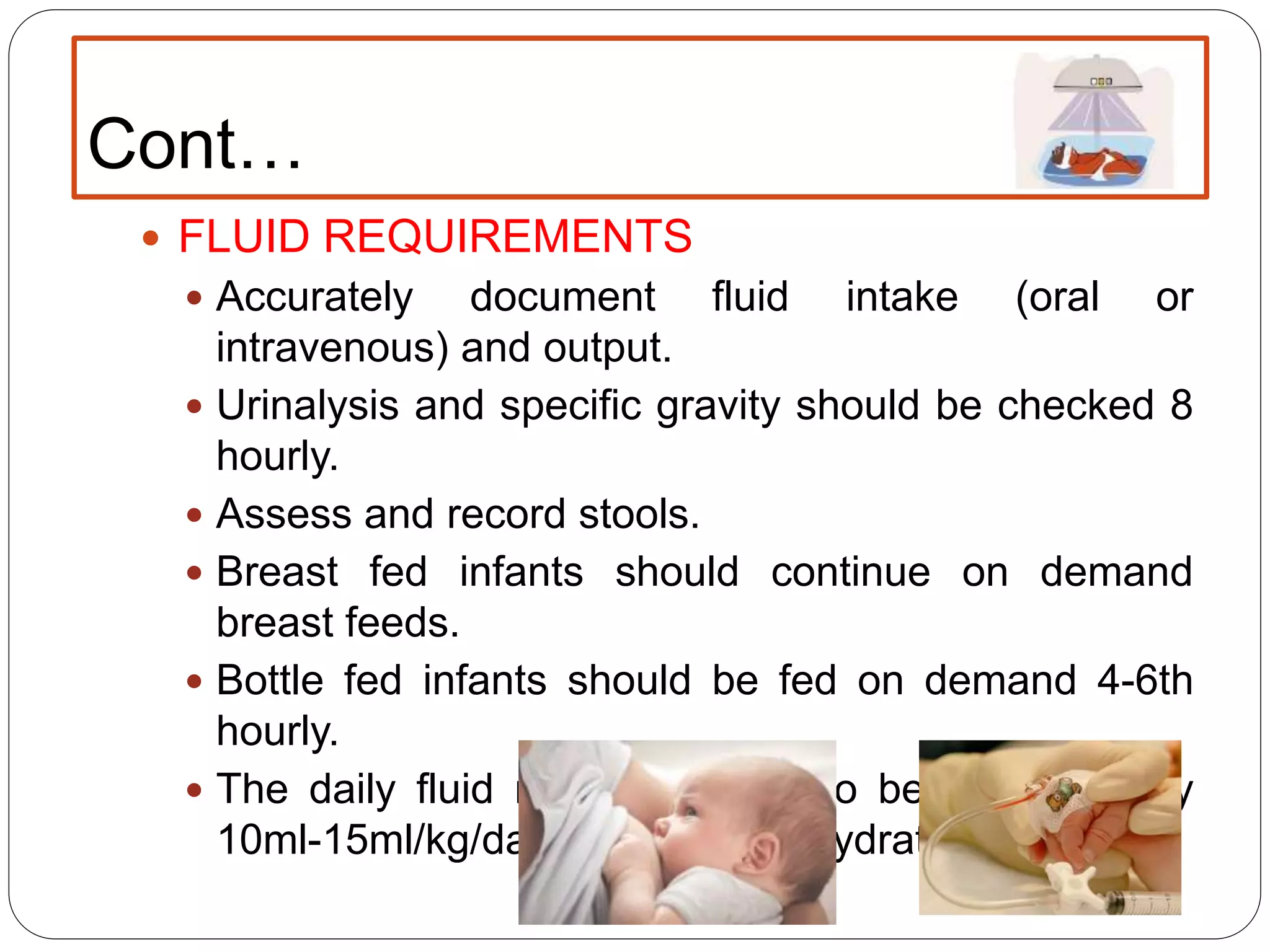
 FLUID REQUIREMENTS
 Accurately document fluid intake (oral or
intravenous) and output.
 Urinalysis and specific gravity should be checked 8
hourly.
 Assess and record stools.
 Breast fed infants should continue on demand
breast feeds.
 Bottle fed infants should be fed on demand 4-6th
hourly.
 The daily fluid rate may need to be increased by
10ml-15ml/kg/day to prevent dehydration.
Cont…
SIDE EFFECTS OF
PHOTOTHERAPY
 Increased insensible water loss.
 Loose stools.
 Intestinal absorption of water, NaCl and k+ is impaired.
 Skin rash.
 Due to phototherapy lights
 Bronze baby syndrome.
 Increase porphyrins due to cholestasis leads to increase in copper
level in serum and liver. This can resolves in 3 days.
 Hyperthermia .
 It can occur due to phototherapy lights.
 Upsets maternal baby interaction.
 May result in hypocalcemia
 Increased calcium excretion leads to decrease in total ionized
calcium level of neonates.
 Phototherapy leads to pineal secretion of melatonin causing
hypocalcemia
 Riboflavin deficiency
LONG TERM COMPLICATIONS
 PDA: photons acts on heart muscles leading to
vasodilation and relaxation of cardiac muscles
 Occular manifestation: ROP, Uveal melanoma
 Skin cancer
NURSING DIAGNOSIS
 Fluid volume deficit r/t inadequate fluid intake,
phototherapy, and diarrhea.
 Increased body temperature r/t effects of
phototherapy.
 Risk for injury r/t effects of phototherapy.
 Impaired skin integrity r/t hyperbilirubinemia
and diarrhea.
 Impaired parenting r/t separation.
 Anxiety: parents r/t therapy given to infants.
Cont.
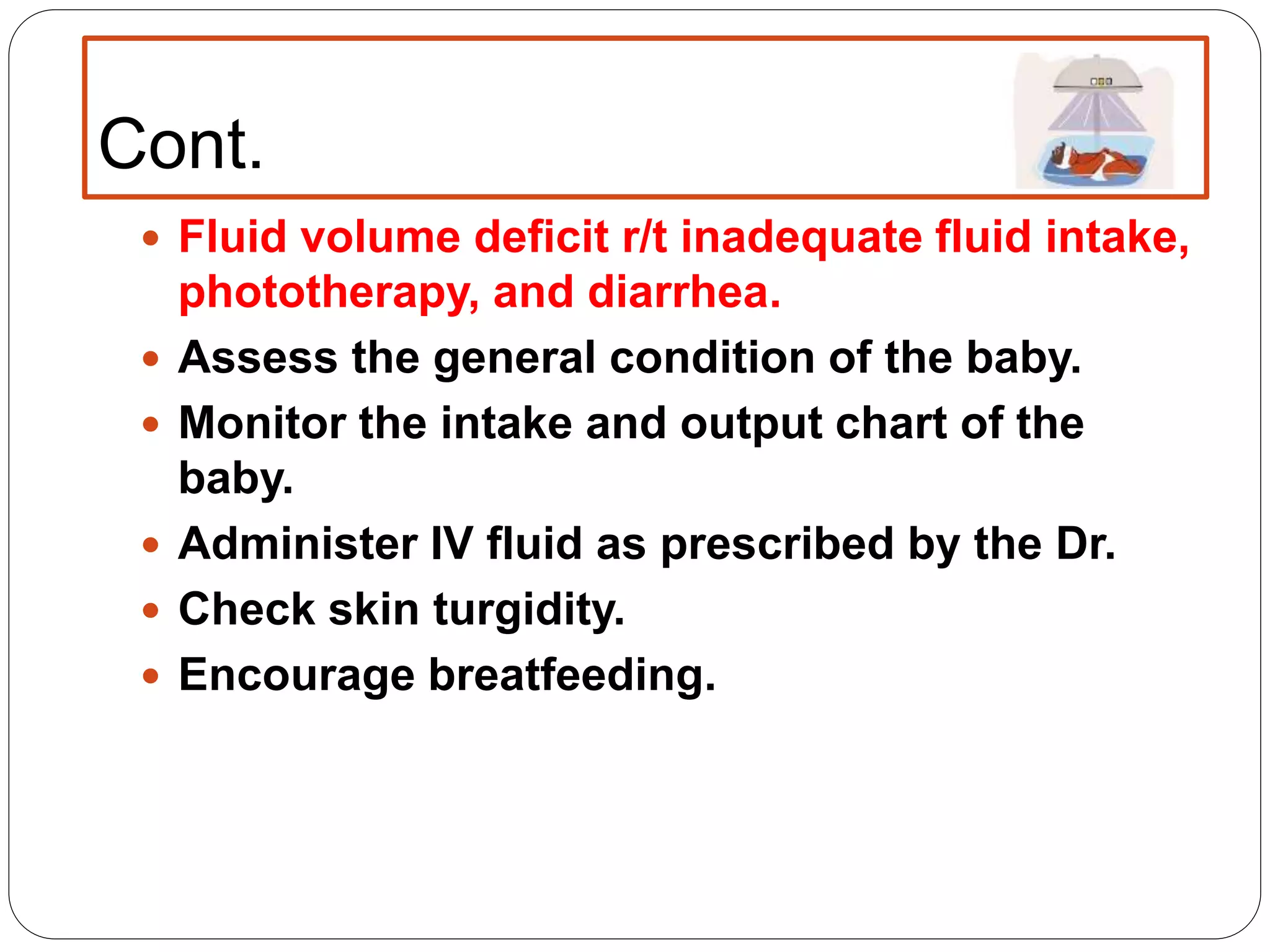
 Fluid volume deficit r/t inadequate fluid intake,
phototherapy, and diarrhea.
 Assess the general condition of the baby.
 Monitor the intake and output chart of the
baby.
 Administer IV fluid as prescribed by the Dr.
 Check skin turgidity.
 Encourage breatfeeding.
Cont…
 Altered body temperature r/t effects of
phototherapy.
 Assess the general condition of the baby.
 Monitor the temperature.
 Keep the phototherapy on manual mode.
 Impaired skin integrity r/t hyperbilirubinemia and
diarrhea.
 Assess skin color every 2 hours
 Monitor direct and indirect bilirubin
 Change positions every 2 hours
 Massage prominent area
 Keep your skin clean and moisture
Cont..
 Impaired parenting r/t separation.
 Bring the baby to the mother for breastfeeding
 Encourage parents to talk to their children.
 Involve parents in care when possible.
 Encourage parents to express feelings.
Phototherapy in neonatal jaundice

Phototherapy in neonatal jaundice

  • 1.
    Presented by: Ms. ManishaThakur Child Health Nursing M.Sc (N) 2nd Year
  • 2.
    INTRODUCTION CONSIDERED AS “DRUG” WITHAPPROPRIATE DOSE AND DURATION
  • 3.
    EFFECTIVENESS OF PHOTOTHERAPY DEPENDS ON: LIGHTCOLOR OFTHE LIGHT DURATION OF EXPOSURE EEXPOSED BODY SURFACE INTENSITY OF THE LIGHT
  • 4.
    INTRODUCTION  Phototherapy hasbeen used since 1958 for the treatment of neonatal hyperbilirubinaemia. It causes unconjugated bilirubin to be mobilised from the skin by structural isomerisation to a water soluble form (lumirubin) that can be excreted in the urine.  The aim of phototherapy is to decrease the level of unconjugated bilirubin in order to prevent acute bilirubin encephalopathy, hearing loss and kernicterus.
  • 5.
    CONT…  Lamps emittinglight between the wavelengths of 400 - 500 nanometres (peak at 460nm) are specifically used for administering phototherapy as bilirubin absorbs this wavelength of light. The light is visible blue light and contains no ultraviolet light.
  • 6.
    DEFINITION  Phototherapy (lighttherapy) is a way of treating jaundice. Special lights help break down the bilirubin in your baby's skin so that it can be removed from his or her body. This lowers the bilirubin level in your baby's blood.  It is defined as exposure of skin to a specialised light sources that converts unconjugated bilirubin into water soluble conjugated molecules that can be excreted through normal pathway ( through urine and feces)
  • 7.
    APP recommends phototherapyshould be started if serum bilirubin level is 15 mg/dl in full term baby
  • 8.
    Rule of thumb If jaundice is pathological then phototherapy should be started only when the bilirubin level is more than 5 times of birth weight.  E.g. birth weight of new born: 4 kg Then, 4 X 5 = 20 mg/dl
  • 9.
    PURPOSE  To supportthe care of babies with hyperbilirubinemia.  To decrease infant serum bilirubin levels.  To maintain phototherapy treatment safely and effectively.  To minimize infant-maternal separation and facilitate breastfeeding.
  • 10.
    INDICATION OF PHOTOTHERAPY WEIGHT (gms)PHOTOTHERAPY(mg/dl) 500-700 5-8 750-1000 6-10 1000- 1250 8-10 1250-1500 10-12 1500-2500 15-18
  • 12.
    LIGHTS USED IN PHOTOTHERAPY Micro White Halogen lights They deliver light via a quartz halogen bulb and have a tendency to become quite hot so should not be positioned closer to the infant than the manufacturers recommendations of 52cm. The lights can continue to be bright despite having low irradiance levels.  Fluoro- 2 Blue and 2 White Fluorescent lights The fluorescent blue tubes must have the serial number F20T12/BB or TL52/20W to be special phototherapy lights. Blue light is the most effective light for reducing the bilirubin.
  • 13.
    CONT…  Ohmeda Biliblanket- Blue Halogen light This uses a halogen bulb directed into a fiberoptic mat. There is a filter that removes the ultraviolet and infrared components and the eventual light is a blue- green colour. Biliblankets are not to be used on infants less than 28 weeks gestation or infants with broken or reduced skin integrity.  Blue Fluorescent light A blue fluorescent tube is fitted into a plastic crib with a stretched plastic cover over the top for the baby to lie on
  • 14.
    TYPES OF PHOTOTHERAPY UNITS Single surface unit.  Double surface unit.  Triple surface unit.
  • 15.
    PHOTOTHERAPY TECHNIQUES  Performhand wash.  Place baby naked in cradle or incubator.  Fix eye shades & genital area.  Keep baby at least 45 cm from lights,if using closer monitor temperature of baby.  Start phototherapy.  Frequent extra breast feeding every 2 hourly.  Turn baby after each feed.  Temperature record 2 to 4 hourly.  Weight record- daily.  Monitor urine frequency.  Monitor bilirubin level.
  • 16.
    MECHANISM OF PHOTOTHERAPY  STRUCTURALISOMERIZATION  PHOTO-OXIDATION  CONFIGURATIONAL ISOMERISATIOBN
  • 18.
    MECHANISM OF PHOTOTHERAPY  Blue-greenlight in the range of 460-490 nm is most effective for phototherapy. The absorption of light by the normal bilirubin (4Z,15Z-bilirubin) generates configuration isomers, structural isomers, and photooxidation products. The 2 principal photoisomers formed in humans are shown. Configurational isomerization is reversible and much faster than structural isomerization.  Structural isomerization is slow and irreversible. Photooxidation occurs more slowly than both configurational and structural isomerization. Photooxidation products are excreted mainly in urine.
  • 19.
    Nursing care ofphototherapy  SKIN CARE  Keep the infant clean and dry.  Clean only with water. Do not apply oils or creams to the exposed skin.  Eucerin has been proven to be safe for use when the infant is receiving phototherapy.  Infants nursed in nappies where the buttocks are not exposed may have zinc and castor oil applied to areas of skin excoriation.
  • 20.
    Cont…  OBSERVATION  Allinfants in Newborn Care receiving phototherapy should have a temperature, pulse and respiration rate documented 4 hourly & prevent dehydration.  If an infant requires continuous cardiorespiratory monitoring for other reasons, then, this should continue whilst under phototherapy  EYE CARE  Eye pads should be removed 4 hourly and eye cares attended with normal saline. •  There have never been human studies showing that retinal damage occurs from with phototherapy.
  • 21.
     FLUID REQUIREMENTS Accurately document fluid intake (oral or intravenous) and output.  Urinalysis and specific gravity should be checked 8 hourly.  Assess and record stools.  Breast fed infants should continue on demand breast feeds.  Bottle fed infants should be fed on demand 4-6th hourly.  The daily fluid rate may need to be increased by 10ml-15ml/kg/day to prevent dehydration. Cont…
  • 22.
    SIDE EFFECTS OF PHOTOTHERAPY Increased insensible water loss.  Loose stools.  Intestinal absorption of water, NaCl and k+ is impaired.  Skin rash.  Due to phototherapy lights  Bronze baby syndrome.  Increase porphyrins due to cholestasis leads to increase in copper level in serum and liver. This can resolves in 3 days.  Hyperthermia .  It can occur due to phototherapy lights.  Upsets maternal baby interaction.  May result in hypocalcemia  Increased calcium excretion leads to decrease in total ionized calcium level of neonates.  Phototherapy leads to pineal secretion of melatonin causing hypocalcemia
  • 23.
     Riboflavin deficiency LONGTERM COMPLICATIONS  PDA: photons acts on heart muscles leading to vasodilation and relaxation of cardiac muscles  Occular manifestation: ROP, Uveal melanoma  Skin cancer
  • 24.
    NURSING DIAGNOSIS  Fluidvolume deficit r/t inadequate fluid intake, phototherapy, and diarrhea.  Increased body temperature r/t effects of phototherapy.  Risk for injury r/t effects of phototherapy.  Impaired skin integrity r/t hyperbilirubinemia and diarrhea.  Impaired parenting r/t separation.  Anxiety: parents r/t therapy given to infants.
  • 25.
    Cont.  Fluid volumedeficit r/t inadequate fluid intake, phototherapy, and diarrhea.  Assess the general condition of the baby.  Monitor the intake and output chart of the baby.  Administer IV fluid as prescribed by the Dr.  Check skin turgidity.  Encourage breatfeeding.
  • 26.
    Cont…  Altered bodytemperature r/t effects of phototherapy.  Assess the general condition of the baby.  Monitor the temperature.  Keep the phototherapy on manual mode.  Impaired skin integrity r/t hyperbilirubinemia and diarrhea.  Assess skin color every 2 hours  Monitor direct and indirect bilirubin  Change positions every 2 hours  Massage prominent area  Keep your skin clean and moisture
  • 27.
    Cont..  Impaired parentingr/t separation.  Bring the baby to the mother for breastfeeding  Encourage parents to talk to their children.  Involve parents in care when possible.  Encourage parents to express feelings.