PREPARED BY:
SOJIYA JOSE,
CLINICAL INSTRUCTOR,
MCH. ALHASA, KSA
 During the first year
growth is very rapid
especially the initial 6
months
Weight;
 Doubles by 5 months
 Triples by 1 year
Height; increased 2.5cm
per month during 6
months, 6months-65c, 12
months-74cm
Head circumference;
 At 6 to 12 months CH-
HC
 At birth-35cm
 3 months-40cm, 6
months-43cm, 1 year-
45cm
 Anterior fontanelle close
by 1 and half month
Chest circumference;
 Approximately equal to
head circumference
vision ;
 Fixation of 2 ocular
images into an cerebral
picture begins to develop
by 6 wks
 Development of
perception begins to
develop by age 7 months
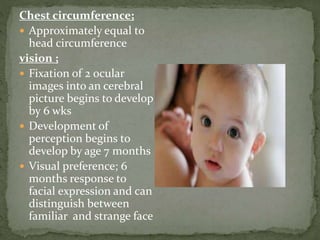
 Visual preference; 6
months response to
facial expression and can
distinguish between
familiar and strange face
 Become stable
 Mucus production in the
respiratory tract is
reduced.
 Systolic pressure
increases and diastolic
pressure decreases.
 Heart rate slows and
rhythm is frequent.
Circulatory system
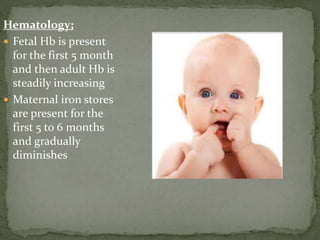
Hematology;
 Fetal Hb is present
for the first 5 month
and then adult Hb is
steadily increasing
 Maternal iron stores
are present for the
first 5 to 6 months
and gradually
diminishes
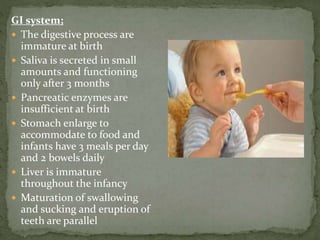
GI system;
 The digestive process are
immature at birth
 Saliva is secreted in small
amounts and functioning
only after 3 months
 Pancreatic enzymes are
insufficient at birth
 Stomach enlarge to
accommodate to food and
infants have 3 meals per day
and 2 bowels daily
 Liver is immature
throughout the infancy
 Maturation of swallowing
and sucking and eruption of
teeth are parallel
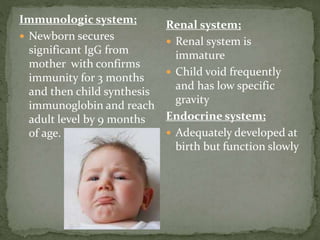
Immunologic system;
 Newborn secures
significant IgG from
mother with confirms
immunity for 3 months
and then child synthesis
immunoglobin and reach
adult level by 9 months
of age.
Renal system;
 Renal system is
immature
 Child void frequently
and has low specific
gravity
Endocrine system;
 Adequately developed at
birth but function slowly
A reflex is a muscle reaction that happens automatically in
response to a certain type of stimulation. Certain sensations
or movements produce specific muscle responses. The
presence and strength of a reflex is an important sign of
nervous system development and function.
Many infant reflexes disappear as the child grows older,
although some remain throughout adulthood.
Rooting reflex; touch or stroke near the corner of
mouth. The child turns to that direction and
search for nipple and this disappears by 6 weeks of
life
Sucking reflex; touch the roof of mouth with
object or nipple or breast, then child begins to
suck it. It begins to end by 6 months of age.
Swallowing reflex; it accompanies by sucking. The
food reaches the posterior mouth is swallowed. It
will not disappear.
Gagging reflex; when food is taken into the mouth
it can successfully swallowed. If passes into the
thorat, then immediate return into the mouth. It
does not disappear
Sneezing and coughing reflex; when anything enters
the upper or lower airways, clearing the upper airway
passage by sneezing and lower passage by sneezing.
This also doesn't disappear
Extrusion reflex; if any substance placed on the
anterior portion of the tongue, then extrusion of the
tongue to prevent swallowing. It disappear by 4
month.
Blinking reflex; blinking the eyes when they are
touched or when a sudden bright light appears, it
protect the eyes from any harm. This will not
disappear.
Doll’s eye reflex; turn the newborn the head to any
side, normally the eyes does not move. It disappear
when fixation develops.
.
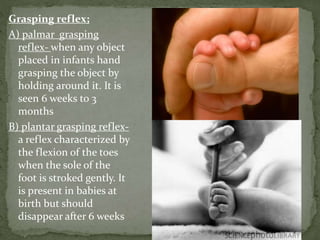
Grasping reflex;
A) palmar grasping
reflex- when any object
placed in infants hand
grasping the object by
holding around it. It is
seen 6 weeks to 3
months
B) plantar grasping reflex-
a reflex characterized by
the flexion of the toes
when the sole of the
foot is stroked gently. It
is present in babies at
birth but should
disappear after 6 weeks
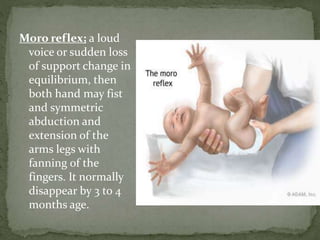
Moro reflex; a loud
voice or sudden loss
of support change in
equilibrium, then
both hand may fist
and symmetric
abduction and
extension of the
arms legs with
fanning of the
fingers. It normally
disappear by 3 to 4
months age.
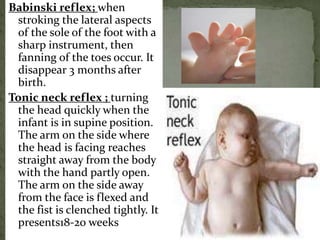
Babinski reflex; when
stroking the lateral aspects
of the sole of the foot with a
sharp instrument, then
fanning of the toes occur. It
disappear 3 months after
birth.
Tonic neck reflex ; turning
the head quickly when the
infant is in supine position.
The arm on the side where
the head is facing reaches
straight away from the body
with the hand partly open.
The arm on the side away
from the face is flexed and
the fist is clenched tightly. It
presents18-20 weeks
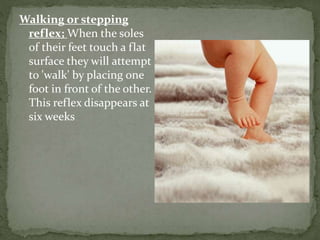
Walking or stepping
reflex; When the soles
of their feet touch a flat
surface they will attempt
to 'walk' by placing one
foot in front of the other.
This reflex disappears at
six weeks
 1 month- hand are predominantly closed
 3 months- mostly open
 4 month- regard a small pellet, looks from the object
to hands and back again
 5 month- voluntarily grasp object
 6 months- increased manipulating skill
 7 months- transfer one object from one hand to other,
use one hand for grasping
 8 to 9 months- infant uses a pincer grasp (the thumb-
and-forefinger motion that’s involved for manipulating
small items)
 11 months- pincer grasp progressed
 12 months- try to build a tower of 2 blocks but fail
Developmental maturation in posture, head
balance, sitting, creeping standing and
walking
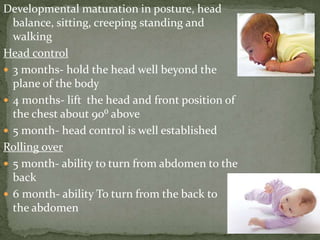
Head control
 3 months- hold the head well beyond the
plane of the body
 4 months- lift the head and front position of
the chest about 90⁰ above
 5 month- head control is well established
Rolling over
 5 month- ability to turn from abdomen to the
back
 6 month- ability To turn from the back to
the abdomen
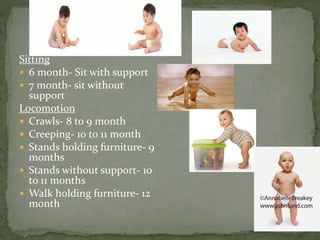
Sitting
 6 month- Sit with support
 7 month- sit without
support
Locomotion
 Crawls- 8 to 9 month
 Creeping- 10 to 11 month
 Stands holding furniture- 9
months
 Stands without support- 10
to 11 months
 Walk holding furniture- 12
month
 Teething is a physiologic process, the crown of the
tooth breaks from the periodontal membrane, some
childrens shows discomfort like- drooling, finger
sucking , biting hard objects, sleep disturbance, refuse
to eat, low grade fever and diarrhea
 First eruption of teeth in 6 to 7 months (lower central
incisors)
 Developing sense of trust (Eriksons phase I)
 Developing trust depends on parent child relationship
and the care . If not, leads to mistrust usually it
develops due to little to too much frustration in first
year of life. The trust that develop is a trust of self or
others
 Infants social development is initially influenced by their
reflex behavior such as grasp and eventually depend
primarily on the interaction between them and caregiver
 Attachment; the attachment of parent and child probably
begins at birth and assumes more importance during first
year crying, smiling, vocalization, visual motor orientation
etc affect the attachment.
 2 components are important to develop attachment i.e..
Discriminate mother from others and ability of object
permanence (Object permanence is the understanding that
objects continue to exist even when they cannot be
observed )
 Separation anxiety; separation of the infant from the
mother leads to sense of physical and mental growth
retardation particularly of emotional deprivation
occurred during the first 3 year of life. It seems from
the 4 to 6 months of age and object permance of
develops this same time. Infant protest when placed in
the crib and object when mother leaves the room.
subsequently infant may not notice mothers absence
and involve in the activity. By 11 to 12 moths they are
able understand mother is going to leave and before
she leaves start to protest
Starnger fear; infant exhibit less friendliness to other
during 6 to 8 months. Fear of stranger and stranger
anxiety become prominent due to infants ability to
discriminate between familiar and no familiar people .
They shows behavior like crying, tuning, clinging to
the parent away from the stranger
 Crying is the first means of verbal communication.
Crying in the first few months no reasons could be due
to maturation of CNS
 Produce cooing sound in 2 to 3 months
 Produce coos, gurgle sound as responds and imitate
sound in 5 to 6 months
 Produce bubbles and say ‘aam’, ‘da, la’ and 8 to 9
months speak da da and ma ma
 Speak meaningful words by 10 12 months
 Infant engage in solitary play
 O-5 months ; playing with their hand, reaching to the
object, turning vocalizing
 5 to 8 months; motor activities- playing with feet,
bouncing, grasping
 8-102months; creeping, sitting reach to obtain toys

Infant (1)

  • 1.
    PREPARED BY: SOJIYA JOSE, CLINICALINSTRUCTOR, MCH. ALHASA, KSA
  • 2.
     During thefirst year growth is very rapid especially the initial 6 months Weight;  Doubles by 5 months  Triples by 1 year Height; increased 2.5cm per month during 6 months, 6months-65c, 12 months-74cm Head circumference;  At 6 to 12 months CH- HC  At birth-35cm  3 months-40cm, 6 months-43cm, 1 year- 45cm  Anterior fontanelle close by 1 and half month
  • 3.
    Chest circumference;  Approximatelyequal to head circumference vision ;  Fixation of 2 ocular images into an cerebral picture begins to develop by 6 wks  Development of perception begins to develop by age 7 months  Visual preference; 6 months response to facial expression and can distinguish between familiar and strange face
  • 4.
     Become stable Mucus production in the respiratory tract is reduced.  Systolic pressure increases and diastolic pressure decreases.  Heart rate slows and rhythm is frequent. Circulatory system
  • 5.
    Hematology;  Fetal Hbis present for the first 5 month and then adult Hb is steadily increasing  Maternal iron stores are present for the first 5 to 6 months and gradually diminishes
  • 6.
    GI system;  Thedigestive process are immature at birth  Saliva is secreted in small amounts and functioning only after 3 months  Pancreatic enzymes are insufficient at birth  Stomach enlarge to accommodate to food and infants have 3 meals per day and 2 bowels daily  Liver is immature throughout the infancy  Maturation of swallowing and sucking and eruption of teeth are parallel
  • 7.
    Immunologic system;  Newbornsecures significant IgG from mother with confirms immunity for 3 months and then child synthesis immunoglobin and reach adult level by 9 months of age. Renal system;  Renal system is immature  Child void frequently and has low specific gravity Endocrine system;  Adequately developed at birth but function slowly
  • 9.
    A reflex isa muscle reaction that happens automatically in response to a certain type of stimulation. Certain sensations or movements produce specific muscle responses. The presence and strength of a reflex is an important sign of nervous system development and function. Many infant reflexes disappear as the child grows older, although some remain throughout adulthood.
  • 10.
    Rooting reflex; touchor stroke near the corner of mouth. The child turns to that direction and search for nipple and this disappears by 6 weeks of life Sucking reflex; touch the roof of mouth with object or nipple or breast, then child begins to suck it. It begins to end by 6 months of age. Swallowing reflex; it accompanies by sucking. The food reaches the posterior mouth is swallowed. It will not disappear. Gagging reflex; when food is taken into the mouth it can successfully swallowed. If passes into the thorat, then immediate return into the mouth. It does not disappear
  • 11.
    Sneezing and coughingreflex; when anything enters the upper or lower airways, clearing the upper airway passage by sneezing and lower passage by sneezing. This also doesn't disappear Extrusion reflex; if any substance placed on the anterior portion of the tongue, then extrusion of the tongue to prevent swallowing. It disappear by 4 month. Blinking reflex; blinking the eyes when they are touched or when a sudden bright light appears, it protect the eyes from any harm. This will not disappear. Doll’s eye reflex; turn the newborn the head to any side, normally the eyes does not move. It disappear when fixation develops. .
  • 12.
    Grasping reflex; A) palmargrasping reflex- when any object placed in infants hand grasping the object by holding around it. It is seen 6 weeks to 3 months B) plantar grasping reflex- a reflex characterized by the flexion of the toes when the sole of the foot is stroked gently. It is present in babies at birth but should disappear after 6 weeks
  • 13.
    Moro reflex; aloud voice or sudden loss of support change in equilibrium, then both hand may fist and symmetric abduction and extension of the arms legs with fanning of the fingers. It normally disappear by 3 to 4 months age.
  • 14.
    Babinski reflex; when strokingthe lateral aspects of the sole of the foot with a sharp instrument, then fanning of the toes occur. It disappear 3 months after birth. Tonic neck reflex ; turning the head quickly when the infant is in supine position. The arm on the side where the head is facing reaches straight away from the body with the hand partly open. The arm on the side away from the face is flexed and the fist is clenched tightly. It presents18-20 weeks
  • 15.
    Walking or stepping reflex;When the soles of their feet touch a flat surface they will attempt to 'walk' by placing one foot in front of the other. This reflex disappears at six weeks
  • 17.
     1 month-hand are predominantly closed  3 months- mostly open  4 month- regard a small pellet, looks from the object to hands and back again  5 month- voluntarily grasp object  6 months- increased manipulating skill  7 months- transfer one object from one hand to other, use one hand for grasping  8 to 9 months- infant uses a pincer grasp (the thumb- and-forefinger motion that’s involved for manipulating small items)  11 months- pincer grasp progressed  12 months- try to build a tower of 2 blocks but fail
  • 19.
    Developmental maturation inposture, head balance, sitting, creeping standing and walking Head control  3 months- hold the head well beyond the plane of the body  4 months- lift the head and front position of the chest about 90⁰ above  5 month- head control is well established Rolling over  5 month- ability to turn from abdomen to the back  6 month- ability To turn from the back to the abdomen
  • 20.
    Sitting  6 month-Sit with support  7 month- sit without support Locomotion  Crawls- 8 to 9 month  Creeping- 10 to 11 month  Stands holding furniture- 9 months  Stands without support- 10 to 11 months  Walk holding furniture- 12 month
  • 21.
     Teething isa physiologic process, the crown of the tooth breaks from the periodontal membrane, some childrens shows discomfort like- drooling, finger sucking , biting hard objects, sleep disturbance, refuse to eat, low grade fever and diarrhea  First eruption of teeth in 6 to 7 months (lower central incisors)
  • 22.
     Developing senseof trust (Eriksons phase I)  Developing trust depends on parent child relationship and the care . If not, leads to mistrust usually it develops due to little to too much frustration in first year of life. The trust that develop is a trust of self or others
  • 23.
     Infants socialdevelopment is initially influenced by their reflex behavior such as grasp and eventually depend primarily on the interaction between them and caregiver  Attachment; the attachment of parent and child probably begins at birth and assumes more importance during first year crying, smiling, vocalization, visual motor orientation etc affect the attachment.  2 components are important to develop attachment i.e.. Discriminate mother from others and ability of object permanence (Object permanence is the understanding that objects continue to exist even when they cannot be observed )
  • 24.
     Separation anxiety;separation of the infant from the mother leads to sense of physical and mental growth retardation particularly of emotional deprivation occurred during the first 3 year of life. It seems from the 4 to 6 months of age and object permance of develops this same time. Infant protest when placed in the crib and object when mother leaves the room. subsequently infant may not notice mothers absence and involve in the activity. By 11 to 12 moths they are able understand mother is going to leave and before she leaves start to protest
  • 25.
    Starnger fear; infantexhibit less friendliness to other during 6 to 8 months. Fear of stranger and stranger anxiety become prominent due to infants ability to discriminate between familiar and no familiar people . They shows behavior like crying, tuning, clinging to the parent away from the stranger
  • 26.
     Crying isthe first means of verbal communication. Crying in the first few months no reasons could be due to maturation of CNS  Produce cooing sound in 2 to 3 months  Produce coos, gurgle sound as responds and imitate sound in 5 to 6 months  Produce bubbles and say ‘aam’, ‘da, la’ and 8 to 9 months speak da da and ma ma  Speak meaningful words by 10 12 months
  • 27.
     Infant engagein solitary play  O-5 months ; playing with their hand, reaching to the object, turning vocalizing  5 to 8 months; motor activities- playing with feet, bouncing, grasping  8-102months; creeping, sitting reach to obtain toys