COMMON BEHAVIORAL
PROBLEMS IN CHILDREN
DR ANKUR PURI
PEDIATRIC INTENSIVIST
Objectives
• Introduction
• Definition
• Causes of Behavioural Disorders
• Types of Behavioural Disorders
• Assessment of common Behavioural
Disorders.
• Description of Behavioural Disorders
• Conclusion
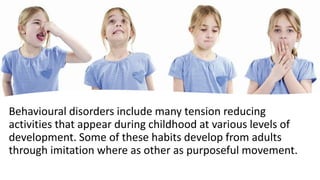
Behavioural disorders include many tension reducing
activities that appear during childhood at various levels of
development. Some of these habits develop from adults
through imitation where as other as purposeful movement.
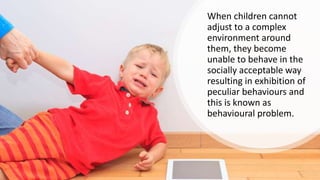
When children cannot
adjust to a complex
environment around
them, they become
unable to behave in the
socially acceptable way
resulting in exhibition of
peculiar behaviours and
this is known as
behavioural problem.
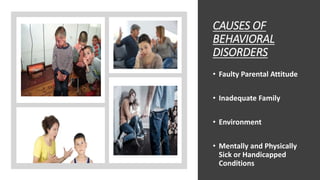
CAUSES OF
BEHAVIORAL
DISORDERS
• Faulty Parental Attitude
• Inadequate Family
• Environment
• Mentally and Physically
Sick or Handicapped
Conditions
•Influence of Social Relationship
•Influence of Mass Media.
•Influence of Social Change.
TYPES OF
BEHAVIORAL
PROBLEMS IN
CHILDREN
Behavioural disorder results due to
deprivation in any one of the area
mentioned below :-
1. Emotional Deprivation.
2. Physical Deprivation.
3. Social Deprivation
4. Other forms.
Emotional
Deprivation
It occurs when a child is criticized,
neglected, ignored or abused by primary
caregiver.
Behavioural problems resulting from
emotional deprivation are :-
• Temper tantrum
• Breath holding spells
• Jealousy
• Insomnia
• Nightmares/ night terrors
• Somnolence
• Bruxism
Physical
Deprivation
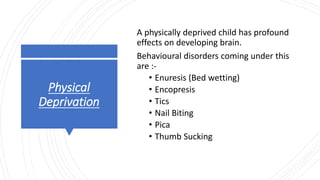
A physically deprived child has profound
effects on developing brain.
Behavioural disorders coming under this
are :-
• Enuresis (Bed wetting)
• Encopresis
• Tics
• Nail Biting
• Pica
• Thumb Sucking
Social
Deprivation
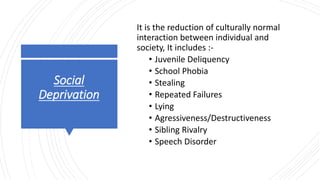
It is the reduction of culturally normal
interaction between individual and
society, It includes :-
• Juvenile Deliquency
• School Phobia
• Stealing
• Repeated Failures
• Lying
• Agressiveness/Destructiveness
• Sibling Rivalry
• Speech Disorder
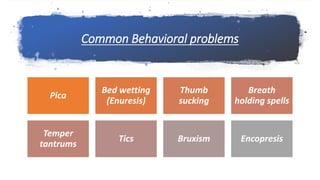
Common Behavioral problems
Pica
Bed wetting
(Enuresis)
Thumb
sucking
Breath
holding spells
Temper
tantrums
Tics Bruxism Encopresis
PICA
• PICA - Persistent ingestion
of non‐nutritive substances
for at least 1 month in a
manner that is inappropriate
for the developmental level.
– Examples: mud, paint, clay,
plaster, charcoal, soil.
• It’s an eating disorder.
• Normal in infants and
toddlers.
• Passing phase.
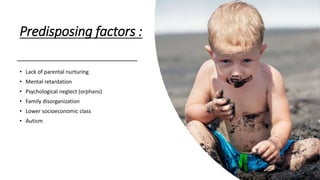
Predisposing factors :
• Lack of parental nurturing
• Mental retardation
• Psychological neglect (orphans)
• Family disorganization
• Lower socioeconomic class
• Autism
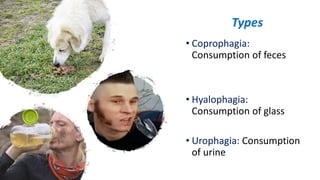
• Coprophagia:
Consumption of feces
• Hyalophagia:
Consumption of glass
• Urophagia: Consumption
of urine
Types
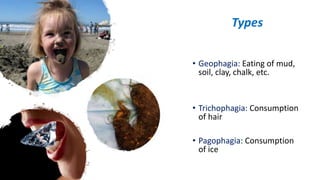
• Geophagia: Eating of mud,
soil, clay, chalk, etc.
• Trichophagia: Consumption
of hair
• Pagophagia: Consumption
of ice
Types
Screening indicated for
• Iron deficiency anemia
• Worm infestations
• Lead poisoning
• Family dysfunction
Management
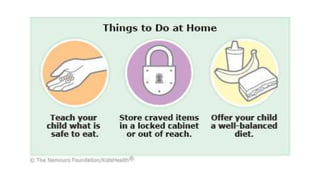
• Parental care
• Developing safe eating habits
• Multivitamins and calcium intake
• Avoid punishment
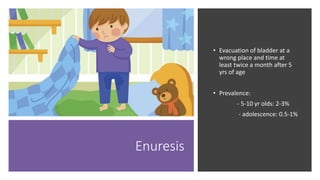
Enuresis
• Evacuation of bladder at a
wrong place and time at
least twice a month after 5
yrs of age
• Prevalence:
‐ 5‐10 yr olds: 2‐3%
‐ adolescence: 0.5‐1%
TYPES OF
ENURESIS
Primary nocturnal enuresis : child has
never been dry at night (90% of cases).
Secondary nocturnal enuresis : child
has been continent for ≥ 6 months and
then begins to wet bed during sleep.
Diurnal enuresis : child passes urine in
clothes during day and while awake
PRIMARY NOCTURNAL
ENURESIS‐CAUSES
• Marked familial pattern.
• 68% concordance rate in monozygotic twins.
• 38% concordance rate in dizygotic twins.
• Maturational delay is the most common
cause
• Hypo secretion of arginine vasopressin (AVP)
hormone may be possible etiology.
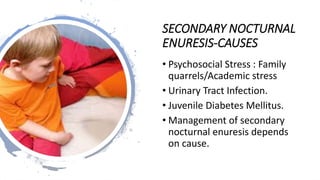
SECONDARY NOCTURNAL
ENURESIS‐CAUSES
• Psychosocial Stress : Family
quarrels/Academic stress
• Urinary Tract Infection.
• Juvenile Diabetes Mellitus.
• Management of secondary
nocturnal enuresis depends
on cause.
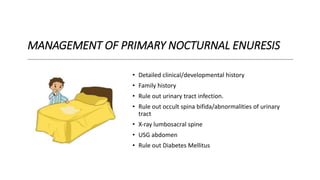
MANAGEMENT OF PRIMARY NOCTURNAL ENURESIS
• Detailed clinical/developmental history
• Family history
• Rule out urinary tract infection.
• Rule out occult spina bifida/abnormalities of urinary
tract
• X‐ray lumbosacral spine
• USG abdomen
• Rule out Diabetes Mellitus
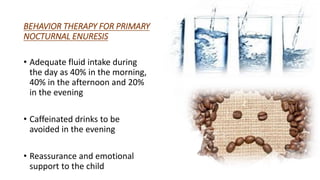
BEHAVIOR THERAPY FOR PRIMARY
NOCTURNAL ENURESIS
• Adequate fluid intake during
the day as 40% in the morning,
40% in the afternoon and 20%
in the evening
• Caffeinated drinks to be
avoided in the evening
• Reassurance and emotional
support to the child
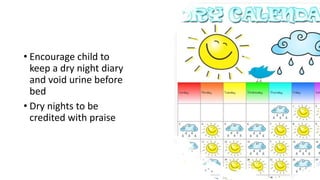
• Encourage child to
keep a dry night diary
and void urine before
bed
• Dry nights to be
credited with praise
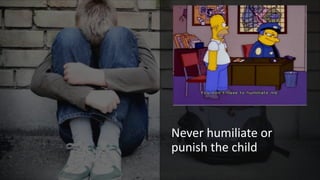
Never humiliate or
punish the child
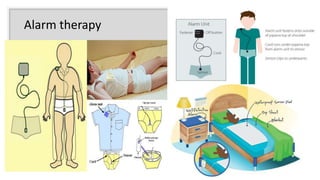
Alarm therapy
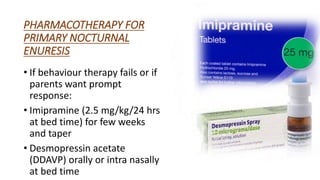
PHARMACOTHERAPY FOR
PRIMARY NOCTURNAL
ENURESIS
• If behaviour therapy fails or if
parents want prompt
response:
• Imipramine (2.5 mg/kg/24 hrs
at bed time) for few weeks
and taper
• Desmopressin acetate
(DDAVP) orally or intra nasally
at bed time
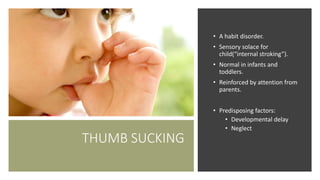
THUMB SUCKING
• A habit disorder.
• Sensory solace for
child(“internal stroking”).
• Normal in infants and
toddlers.
• Reinforced by attention from
parents.
• Predisposing factors:
• Developmental delay
• Neglect
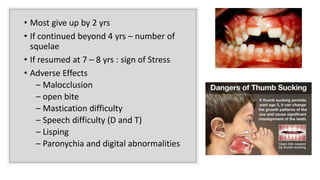
• Most give up by 2 yrs
• If continued beyond 4 yrs – number of
squelae
• If resumed at 7 – 8 yrs : sign of Stress
• Adverse Effects
– Malocclusion
– open bite
– Mastication difficulty
– Speech difficulty (D and T)
– Lisping
– Paronychia and digital abnormalities
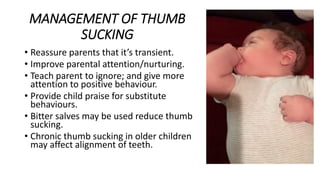
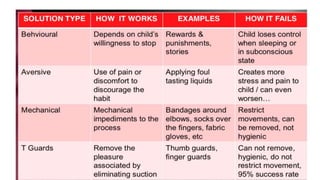
MANAGEMENT OF THUMB
SUCKING
• Reassure parents that it’s transient.
• Improve parental attention/nurturing.
• Teach parent to ignore; and give more
attention to positive behaviour.
• Provide child praise for substitute
behaviours.
• Bitter salves may be used reduce thumb
sucking.
• Chronic thumb sucking in older children
may affect alignment of teeth.
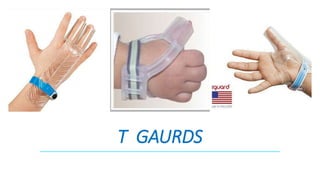
T GAURDS
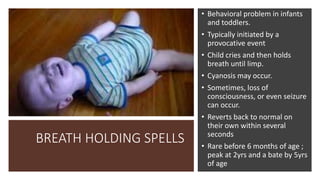
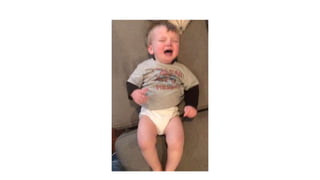
BREATH HOLDING SPELLS
• Behavioral problem in infants
and toddlers.
• Typically initiated by a
provocative event
• Child cries and then holds
breath until limp.
• Cyanosis may occur.
• Sometimes, loss of
consciousness, or even seizure
can occur.
• Reverts back to normal on
their own within several
seconds
• Rare before 6 months of age ;
peak at 2yrs and a bate by 5yrs
of age
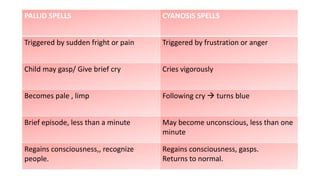
PALLID SPELLS CYANOSIS SPELLS
Triggered by sudden fright or pain Triggered by frustration or anger
Child may gasp/ Give brief cry Cries vigorously
Becomes pale , limp Following cry  turns blue
Brief episode, less than a minute May become unconscious, less than one
minute
Regains consciousness,, recognize
people.
Regains consciousness, gasps.
Returns to normal.
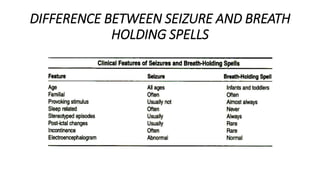
DIFFERENCE BETWEEN SEIZURE AND BREATH
HOLDING SPELLS
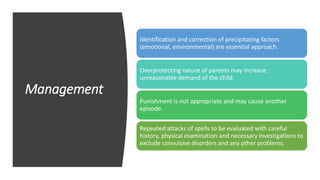
Management
Identification and correction of precipitating factors
(emotional, environmental) are essential approach.
Overprotecting nature of parents may increase
unreasonable demand of the child.
Punishment is not appropriate and may cause another
episode.
Repeated attacks of spells to be evaluated with careful
history, physical examination and necessary investigations to
exclude convulsive disorders and any other problems.
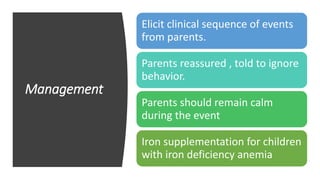
Management
Elicit clinical sequence of events
from parents.
Parents reassured , told to ignore
behavior.
Parents should remain calm
during the event
Iron supplementation for children
with iron deficiency anemia
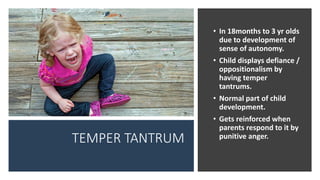
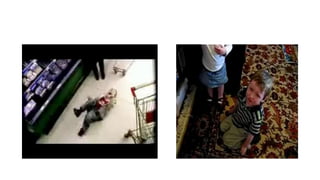
TEMPER TANTRUM
• In 18months to 3 yr olds
due to development of
sense of autonomy.
• Child displays defiance /
oppositionalism by
having temper
tantrums.
• Normal part of child
development.
• Gets reinforced when
parents respond to it by
punitive anger.
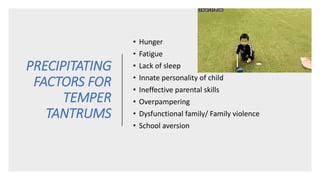
PRECIPITATING
FACTORS FOR
TEMPER
TANTRUMS
• Hunger
• Fatigue
• Lack of sleep
• Innate personality of child
• Ineffective parental skills
• Overpampering
• Dysfunctional family/ Family violence
• School aversion
TEMPER
TANTRUM‐MANAGEMENT
• Set a good example to child
• Spend quality time
• Have open communication with child
• Have consistency in behaviour
In general,parents advised to:
• Parents to ignore child, leave child alone
• Once child is calm, tell child calmly that
such behaviour is not acceptable
• Never beat or threaten child
During temper tantrum:
Management
Praise/reward child for good
behaviour.
“Time Out” as disciplinary
method if temper
tantrum is disruptive and ,
out of control
Refer to Child Guidance Clinic
if temper tantrums persist.
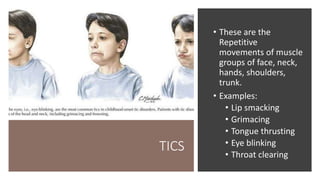
TICS
• These are the
Repetitive
movements of muscle
groups of face, neck,
hands, shoulders,
trunk.
• Examples:
• Lip smacking
• Grimacing
• Tongue thrusting
• Eye blinking
• Throat clearing
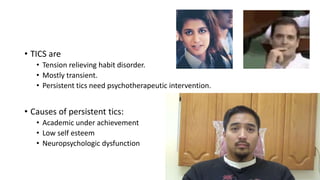
• TICS are
• Tension relieving habit disorder.
• Mostly transient.
• Persistent tics need psychotherapeutic intervention.
• Causes of persistent tics:
• Academic under achievement
• Low self esteem
• Neuropsychologic dysfunction
TICS
IN
BOLLYWOOD
• Eye-blinking, throat-clearing, facial grimacing and sniffing – tics are brief
and sudden unwanted, repetitive, stereotyped movements or sounds.
• Though alarming to many parents, about 20 percent of school age children
develop tics at some point, though less than 3 percent of them display
those tics for more than a year.
• If tics persist for beyond 12 months, you may hear the diagnosis “Persistent
Tic Disorder.”
• If all of the tics are movements, we make the diagnosis “Persistent Motor
Tic Disorder.”
• If all of the tics are vocalizations, we call it “Persistent Vocal Tic Disorder.”
• If both motor and vocal tics persist more than a year, that defines
“Tourette syndrome.”
Management
• Behavioral Therapy: The best-known behavioral treatment for tic
disorders is a form of cognitive-behavioral therapy (CBT) called habit
reversal training.
• A child is taught to recognize the premonitory urge that precedes an
oncoming tic, and to identify the situations that may trigger the tics.
• The child and therapist develop a “competing” response—an action
the child performs when he feels the urge—that is incompatible with
the tic, and less noticeable to others.
• For example, a child whose tic involves sniffling his nose may do a
breathing exercise instead. Children may also be taught relaxation
techniques to decrease the frequency of the tics.
Management
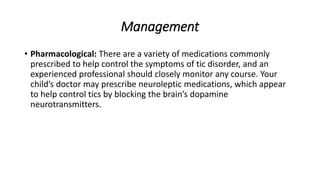
• Pharmacological: There are a variety of medications commonly
prescribed to help control the symptoms of tic disorder, and an
experienced professional should closely monitor any course. Your
child’s doctor may prescribe neuroleptic medications, which appear
to help control tics by blocking the brain’s dopamine
neurotransmitters.
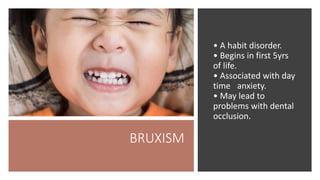
BRUXISM
• A habit disorder.
• Begins in first 5yrs
of life.
• Associated with day
time anxiety.
• May lead to
problems with dental
occlusion.
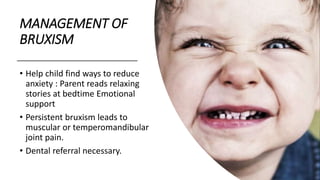
MANAGEMENT OF
BRUXISM
• Help child find ways to reduce
anxiety : Parent reads relaxing
stories at bedtime Emotional
support
• Persistent bruxism leads to
muscular or temperomandibular
joint pain.
• Dental referral necessary.
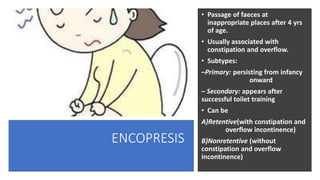
ENCOPRESIS
• Passage of faeces at
inappropriate places after 4 yrs
of age.
• Usually associated with
constipation and overflow.
• Subtypes:
–Primary: persisting from infancy
onward
– Secondary: appears after
successful toilet training
• Can be
A)Retentive(with constipation and
overflow incontinence)
B)Nonretentive (without
constipation and overflow
incontinence)
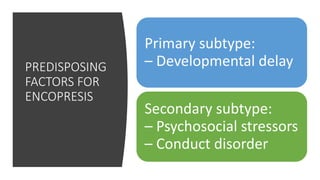
PREDISPOSING
FACTORS FOR
ENCOPRESIS
Primary subtype:
– Developmental delay
Secondary subtype:
– Psychosocial stressors
– Conduct disorder
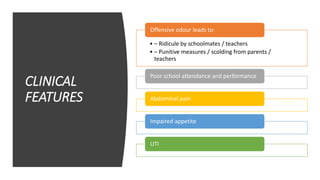
CLINICAL
FEATURES
• – Ridicule by schoolmates / teachers
• – Punitive measures / scolding from parents /
teachers
Offensive odour leads to:
Poor school attendance and performance
Abdominal pain
Impaired appetite
UTI
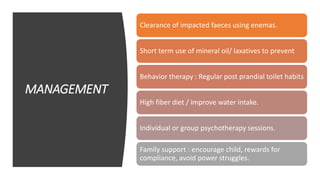
MANAGEMENT
Clearance of impacted faeces using enemas.
Short term use of mineral oil/ laxatives to prevent
Behavior therapy : Regular post prandial toilet habits
High fiber diet / improve water intake.
Individual or group psychotherapy sessions.
Family support : encourage child, rewards for
compliance, avoid power struggles.
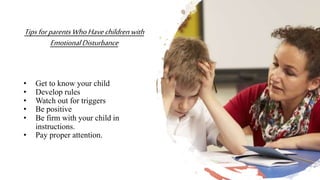
TipsforparentsWhoHavechildrenwith
EmotionalDisturbance
• Get to know your child
• Develop rules
• Watch out for triggers
• Be positive
• Be firm with your child in
instructions.
• Pay proper attention.
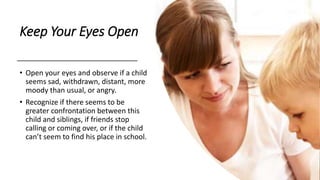
Keep Your Eyes Open
• Open your eyes and observe if a child
seems sad, withdrawn, distant, more
moody than usual, or angry.
• Recognize if there seems to be
greater confrontation between this
child and siblings, if friends stop
calling or coming over, or if the child
can’t seem to find his place in school.
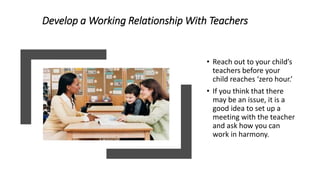
Develop a Working Relationship With Teachers
• Reach out to your child’s
teachers before your
child reaches ‘zero hour.’
• If you think that there
may be an issue, it is a
good idea to set up a
meeting with the teacher
and ask how you can
work in harmony.
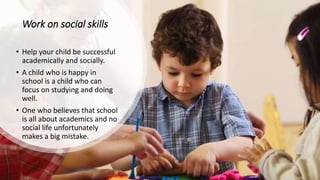
Work on social skills
• Help your child be successful
academically and socially.
• A child who is happy in
school is a child who can
focus on studying and doing
well.
• One who believes that school
is all about academics and no
social life unfortunately
makes a big mistake.
Cont…
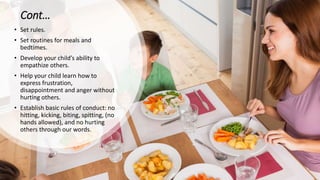
• Set rules.
• Set routines for meals and
bedtimes.
• Develop your child’s ability to
empathize others.
• Help your child learn how to
express frustration,
disappointment and anger without
hurting others.
• Establish basic rules of conduct: no
hitting, kicking, biting, spitting, (no
hands allowed), and no hurting
others through our words.
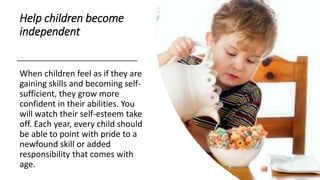
Help children become
independent
When children feel as if they are
gaining skills and becoming self-
sufficient, they grow more
confident in their abilities. You
will watch their self-esteem take
off. Each year, every child should
be able to point with pride to a
newfound skill or added
responsibility that comes with
age.
Cont…
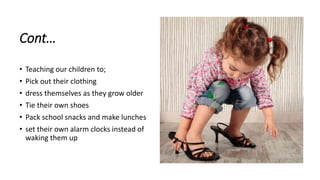
• Teaching our children to;
• Pick out their clothing
• dress themselves as they grow older
• Tie their own shoes
• Pack school snacks and make lunches
• set their own alarm clocks instead of
waking them up
Cont…
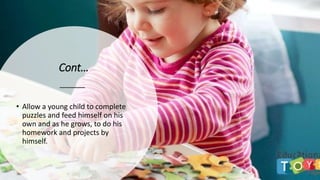
• Allow a young child to complete
puzzles and feed himself on his
own and as he grows, to do his
homework and projects by
himself.
Cont..
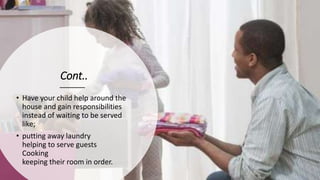
• Have your child help around the
house and gain responsibilities
instead of waiting to be served
like;
• putting away laundry
helping to serve guests
Cooking
keeping their room in order.
Communicate with
Each Child
• Our children should never be
afraid to speak with us. No
matter how tough the topic.
• They should hesitate to
communicate with parents.
• After all, we are their parents and
if they cannot believe in our love
for them, whose love can they
believe in?
Cont…
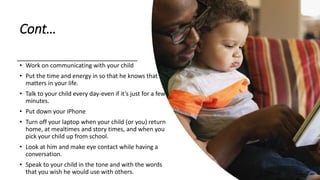
• Work on communicating with your child
• Put the time and energy in so that he knows that he
matters in your life.
• Talk to your child every day-even if it’s just for a few
minutes.
• Put down your iPhone
• Turn off your laptop when your child (or you) return
home, at mealtimes and story times, and when you
pick your child up from school.
• Look at him and make eye contact while having a
conversation.
• Speak to your child in the tone and with the words
that you wish he would use with others.
Most Important
• Express your love every day, no
matter how tough the day.
• Always encourage your child.
• Give positive reinforcement.
Behavioral problems in children

Behavioral problems in children

  • 1.
    COMMON BEHAVIORAL PROBLEMS INCHILDREN DR ANKUR PURI PEDIATRIC INTENSIVIST
  • 2.
    Objectives • Introduction • Definition •Causes of Behavioural Disorders • Types of Behavioural Disorders • Assessment of common Behavioural Disorders. • Description of Behavioural Disorders • Conclusion
  • 3.
    Behavioural disorders includemany tension reducing activities that appear during childhood at various levels of development. Some of these habits develop from adults through imitation where as other as purposeful movement.
  • 4.
    When children cannot adjustto a complex environment around them, they become unable to behave in the socially acceptable way resulting in exhibition of peculiar behaviours and this is known as behavioural problem.
  • 5.
    CAUSES OF BEHAVIORAL DISORDERS • FaultyParental Attitude • Inadequate Family • Environment • Mentally and Physically Sick or Handicapped Conditions
  • 6.
    •Influence of SocialRelationship •Influence of Mass Media. •Influence of Social Change.
  • 7.
    TYPES OF BEHAVIORAL PROBLEMS IN CHILDREN Behaviouraldisorder results due to deprivation in any one of the area mentioned below :- 1. Emotional Deprivation. 2. Physical Deprivation. 3. Social Deprivation 4. Other forms.
  • 8.
    Emotional Deprivation It occurs whena child is criticized, neglected, ignored or abused by primary caregiver. Behavioural problems resulting from emotional deprivation are :- • Temper tantrum • Breath holding spells • Jealousy • Insomnia • Nightmares/ night terrors • Somnolence • Bruxism
  • 9.
    Physical Deprivation A physically deprivedchild has profound effects on developing brain. Behavioural disorders coming under this are :- • Enuresis (Bed wetting) • Encopresis • Tics • Nail Biting • Pica • Thumb Sucking
  • 10.
    Social Deprivation It is thereduction of culturally normal interaction between individual and society, It includes :- • Juvenile Deliquency • School Phobia • Stealing • Repeated Failures • Lying • Agressiveness/Destructiveness • Sibling Rivalry • Speech Disorder
  • 11.
    Common Behavioral problems Pica Bedwetting (Enuresis) Thumb sucking Breath holding spells Temper tantrums Tics Bruxism Encopresis
  • 12.
    PICA • PICA -Persistent ingestion of non‐nutritive substances for at least 1 month in a manner that is inappropriate for the developmental level. – Examples: mud, paint, clay, plaster, charcoal, soil. • It’s an eating disorder. • Normal in infants and toddlers. • Passing phase.
  • 13.
    Predisposing factors : •Lack of parental nurturing • Mental retardation • Psychological neglect (orphans) • Family disorganization • Lower socioeconomic class • Autism
  • 14.
    • Coprophagia: Consumption offeces • Hyalophagia: Consumption of glass • Urophagia: Consumption of urine Types
  • 15.
    • Geophagia: Eatingof mud, soil, clay, chalk, etc. • Trichophagia: Consumption of hair • Pagophagia: Consumption of ice Types
  • 16.
    Screening indicated for •Iron deficiency anemia • Worm infestations • Lead poisoning • Family dysfunction
  • 18.
    Management • Parental care •Developing safe eating habits • Multivitamins and calcium intake • Avoid punishment
  • 19.
    Enuresis • Evacuation ofbladder at a wrong place and time at least twice a month after 5 yrs of age • Prevalence: ‐ 5‐10 yr olds: 2‐3% ‐ adolescence: 0.5‐1%
  • 20.
    TYPES OF ENURESIS Primary nocturnalenuresis : child has never been dry at night (90% of cases). Secondary nocturnal enuresis : child has been continent for ≥ 6 months and then begins to wet bed during sleep. Diurnal enuresis : child passes urine in clothes during day and while awake
  • 21.
    PRIMARY NOCTURNAL ENURESIS‐CAUSES • Markedfamilial pattern. • 68% concordance rate in monozygotic twins. • 38% concordance rate in dizygotic twins. • Maturational delay is the most common cause • Hypo secretion of arginine vasopressin (AVP) hormone may be possible etiology.
  • 22.
    SECONDARY NOCTURNAL ENURESIS‐CAUSES • PsychosocialStress : Family quarrels/Academic stress • Urinary Tract Infection. • Juvenile Diabetes Mellitus. • Management of secondary nocturnal enuresis depends on cause.
  • 23.
    MANAGEMENT OF PRIMARYNOCTURNAL ENURESIS • Detailed clinical/developmental history • Family history • Rule out urinary tract infection. • Rule out occult spina bifida/abnormalities of urinary tract • X‐ray lumbosacral spine • USG abdomen • Rule out Diabetes Mellitus
  • 24.
    BEHAVIOR THERAPY FORPRIMARY NOCTURNAL ENURESIS • Adequate fluid intake during the day as 40% in the morning, 40% in the afternoon and 20% in the evening • Caffeinated drinks to be avoided in the evening • Reassurance and emotional support to the child
  • 25.
    • Encourage childto keep a dry night diary and void urine before bed • Dry nights to be credited with praise
  • 26.
  • 27.
  • 28.
    PHARMACOTHERAPY FOR PRIMARY NOCTURNAL ENURESIS •If behaviour therapy fails or if parents want prompt response: • Imipramine (2.5 mg/kg/24 hrs at bed time) for few weeks and taper • Desmopressin acetate (DDAVP) orally or intra nasally at bed time
  • 30.
    THUMB SUCKING • Ahabit disorder. • Sensory solace for child(“internal stroking”). • Normal in infants and toddlers. • Reinforced by attention from parents. • Predisposing factors: • Developmental delay • Neglect
  • 31.
    • Most giveup by 2 yrs • If continued beyond 4 yrs – number of squelae • If resumed at 7 – 8 yrs : sign of Stress • Adverse Effects – Malocclusion – open bite – Mastication difficulty – Speech difficulty (D and T) – Lisping – Paronychia and digital abnormalities
  • 32.
    MANAGEMENT OF THUMB SUCKING •Reassure parents that it’s transient. • Improve parental attention/nurturing. • Teach parent to ignore; and give more attention to positive behaviour. • Provide child praise for substitute behaviours. • Bitter salves may be used reduce thumb sucking. • Chronic thumb sucking in older children may affect alignment of teeth.
  • 34.
  • 36.
    BREATH HOLDING SPELLS •Behavioral problem in infants and toddlers. • Typically initiated by a provocative event • Child cries and then holds breath until limp. • Cyanosis may occur. • Sometimes, loss of consciousness, or even seizure can occur. • Reverts back to normal on their own within several seconds • Rare before 6 months of age ; peak at 2yrs and a bate by 5yrs of age
  • 37.
    PALLID SPELLS CYANOSISSPELLS Triggered by sudden fright or pain Triggered by frustration or anger Child may gasp/ Give brief cry Cries vigorously Becomes pale , limp Following cry  turns blue Brief episode, less than a minute May become unconscious, less than one minute Regains consciousness,, recognize people. Regains consciousness, gasps. Returns to normal.
  • 39.
    DIFFERENCE BETWEEN SEIZUREAND BREATH HOLDING SPELLS
  • 40.
    Management Identification and correctionof precipitating factors (emotional, environmental) are essential approach. Overprotecting nature of parents may increase unreasonable demand of the child. Punishment is not appropriate and may cause another episode. Repeated attacks of spells to be evaluated with careful history, physical examination and necessary investigations to exclude convulsive disorders and any other problems.
  • 41.
    Management Elicit clinical sequenceof events from parents. Parents reassured , told to ignore behavior. Parents should remain calm during the event Iron supplementation for children with iron deficiency anemia
  • 42.
    TEMPER TANTRUM • In18months to 3 yr olds due to development of sense of autonomy. • Child displays defiance / oppositionalism by having temper tantrums. • Normal part of child development. • Gets reinforced when parents respond to it by punitive anger.
  • 43.
    PRECIPITATING FACTORS FOR TEMPER TANTRUMS • Hunger •Fatigue • Lack of sleep • Innate personality of child • Ineffective parental skills • Overpampering • Dysfunctional family/ Family violence • School aversion
  • 46.
    TEMPER TANTRUM‐MANAGEMENT • Set agood example to child • Spend quality time • Have open communication with child • Have consistency in behaviour In general,parents advised to: • Parents to ignore child, leave child alone • Once child is calm, tell child calmly that such behaviour is not acceptable • Never beat or threaten child During temper tantrum:
  • 47.
    Management Praise/reward child forgood behaviour. “Time Out” as disciplinary method if temper tantrum is disruptive and , out of control Refer to Child Guidance Clinic if temper tantrums persist.
  • 48.
    TICS • These arethe Repetitive movements of muscle groups of face, neck, hands, shoulders, trunk. • Examples: • Lip smacking • Grimacing • Tongue thrusting • Eye blinking • Throat clearing
  • 49.
    • TICS are •Tension relieving habit disorder. • Mostly transient. • Persistent tics need psychotherapeutic intervention. • Causes of persistent tics: • Academic under achievement • Low self esteem • Neuropsychologic dysfunction
  • 50.
  • 51.
    • Eye-blinking, throat-clearing,facial grimacing and sniffing – tics are brief and sudden unwanted, repetitive, stereotyped movements or sounds. • Though alarming to many parents, about 20 percent of school age children develop tics at some point, though less than 3 percent of them display those tics for more than a year. • If tics persist for beyond 12 months, you may hear the diagnosis “Persistent Tic Disorder.” • If all of the tics are movements, we make the diagnosis “Persistent Motor Tic Disorder.” • If all of the tics are vocalizations, we call it “Persistent Vocal Tic Disorder.” • If both motor and vocal tics persist more than a year, that defines “Tourette syndrome.”
  • 52.
    Management • Behavioral Therapy:The best-known behavioral treatment for tic disorders is a form of cognitive-behavioral therapy (CBT) called habit reversal training. • A child is taught to recognize the premonitory urge that precedes an oncoming tic, and to identify the situations that may trigger the tics. • The child and therapist develop a “competing” response—an action the child performs when he feels the urge—that is incompatible with the tic, and less noticeable to others. • For example, a child whose tic involves sniffling his nose may do a breathing exercise instead. Children may also be taught relaxation techniques to decrease the frequency of the tics.
  • 53.
    Management • Pharmacological: Thereare a variety of medications commonly prescribed to help control the symptoms of tic disorder, and an experienced professional should closely monitor any course. Your child’s doctor may prescribe neuroleptic medications, which appear to help control tics by blocking the brain’s dopamine neurotransmitters.
  • 54.
    BRUXISM • A habitdisorder. • Begins in first 5yrs of life. • Associated with day time anxiety. • May lead to problems with dental occlusion.
  • 55.
    MANAGEMENT OF BRUXISM • Helpchild find ways to reduce anxiety : Parent reads relaxing stories at bedtime Emotional support • Persistent bruxism leads to muscular or temperomandibular joint pain. • Dental referral necessary.
  • 57.
    ENCOPRESIS • Passage offaeces at inappropriate places after 4 yrs of age. • Usually associated with constipation and overflow. • Subtypes: –Primary: persisting from infancy onward – Secondary: appears after successful toilet training • Can be A)Retentive(with constipation and overflow incontinence) B)Nonretentive (without constipation and overflow incontinence)
  • 58.
    PREDISPOSING FACTORS FOR ENCOPRESIS Primary subtype: –Developmental delay Secondary subtype: – Psychosocial stressors – Conduct disorder
  • 59.
    CLINICAL FEATURES • – Ridiculeby schoolmates / teachers • – Punitive measures / scolding from parents / teachers Offensive odour leads to: Poor school attendance and performance Abdominal pain Impaired appetite UTI
  • 60.
    MANAGEMENT Clearance of impactedfaeces using enemas. Short term use of mineral oil/ laxatives to prevent Behavior therapy : Regular post prandial toilet habits High fiber diet / improve water intake. Individual or group psychotherapy sessions. Family support : encourage child, rewards for compliance, avoid power struggles.
  • 61.
    TipsforparentsWhoHavechildrenwith EmotionalDisturbance • Get toknow your child • Develop rules • Watch out for triggers • Be positive • Be firm with your child in instructions. • Pay proper attention.
  • 62.
    Keep Your EyesOpen • Open your eyes and observe if a child seems sad, withdrawn, distant, more moody than usual, or angry. • Recognize if there seems to be greater confrontation between this child and siblings, if friends stop calling or coming over, or if the child can’t seem to find his place in school.
  • 63.
    Develop a WorkingRelationship With Teachers • Reach out to your child’s teachers before your child reaches ‘zero hour.’ • If you think that there may be an issue, it is a good idea to set up a meeting with the teacher and ask how you can work in harmony.
  • 64.
    Work on socialskills • Help your child be successful academically and socially. • A child who is happy in school is a child who can focus on studying and doing well. • One who believes that school is all about academics and no social life unfortunately makes a big mistake.
  • 65.
    Cont… • Set rules. •Set routines for meals and bedtimes. • Develop your child’s ability to empathize others. • Help your child learn how to express frustration, disappointment and anger without hurting others. • Establish basic rules of conduct: no hitting, kicking, biting, spitting, (no hands allowed), and no hurting others through our words.
  • 66.
    Help children become independent Whenchildren feel as if they are gaining skills and becoming self- sufficient, they grow more confident in their abilities. You will watch their self-esteem take off. Each year, every child should be able to point with pride to a newfound skill or added responsibility that comes with age.
  • 67.
    Cont… • Teaching ourchildren to; • Pick out their clothing • dress themselves as they grow older • Tie their own shoes • Pack school snacks and make lunches • set their own alarm clocks instead of waking them up
  • 68.
    Cont… • Allow ayoung child to complete puzzles and feed himself on his own and as he grows, to do his homework and projects by himself.
  • 69.
    Cont.. • Have yourchild help around the house and gain responsibilities instead of waiting to be served like; • putting away laundry helping to serve guests Cooking keeping their room in order.
  • 70.
    Communicate with Each Child •Our children should never be afraid to speak with us. No matter how tough the topic. • They should hesitate to communicate with parents. • After all, we are their parents and if they cannot believe in our love for them, whose love can they believe in?
  • 71.
    Cont… • Work oncommunicating with your child • Put the time and energy in so that he knows that he matters in your life. • Talk to your child every day-even if it’s just for a few minutes. • Put down your iPhone • Turn off your laptop when your child (or you) return home, at mealtimes and story times, and when you pick your child up from school. • Look at him and make eye contact while having a conversation. • Speak to your child in the tone and with the words that you wish he would use with others.
  • 72.
    Most Important • Expressyour love every day, no matter how tough the day. • Always encourage your child. • Give positive reinforcement.

Editor's Notes
  • #2 Children acquire many skills as they grow. Some skills, such as controlling urine and stool, depend mainly on the level of maturity of the child's nerves and brain. Others, such as behaving appropriately at home and in school, are the result of a complicated interaction between the child's physical and intellectual (cognitive) development, health, temperament, and relationships with parents, teachers, and caregivers 
  • #12 Behavioral problems can become so troublesome that they threaten normal relationships between the child and others or interfere with emotional, social, and intellectual development. Some behavioral problems include
  • #52 NEXT IS MOVIE HICHKI