Dr. Sherin Shervani
Assistant Professor
ELI - KAU
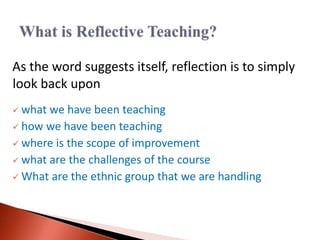
As the word suggests itself, reflection is to simply
look back upon
 what we have been teaching
 how we have been teaching
 where is the scope of improvement
 what are the challenges of the course
 What are the ethnic group that we are handling
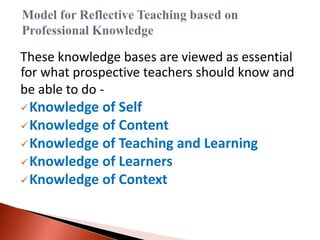
These knowledge bases are viewed as essential
for what prospective teachers should know and
be able to do -
Knowledge of Self
Knowledge of Content
Knowledge of Teaching and Learning
Knowledge of Learners
Knowledge of Context
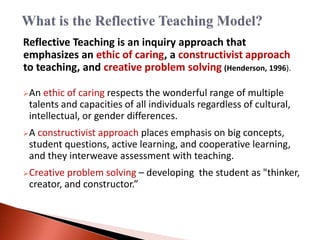
Reflective Teaching is an inquiry approach that
emphasizes an ethic of caring, a constructivist approach
to teaching, and creative problem solving (Henderson, 1996).
An ethic of caring respects the wonderful range of multiple
talents and capacities of all individuals regardless of cultural,
intellectual, or gender differences.
A constructivist approach places emphasis on big concepts,
student questions, active learning, and cooperative learning,
and they interweave assessment with teaching.
Creative problem solving – developing the student as "thinker,
creator, and constructor.”
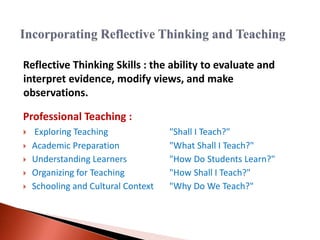
Reflective Thinking Skills : the ability to evaluate and
interpret evidence, modify views, and make
observations.
Professional Teaching :
 Exploring Teaching "Shall I Teach?"
 Academic Preparation "What Shall I Teach?"
 Understanding Learners "How Do Students Learn?"
 Organizing for Teaching "How Shall I Teach?"
 Schooling and Cultural Context "Why Do We Teach?"
 Teachers already think about their teaching and talk to colleagues
about it too. You might think or tell someone How well your lesson
went well or Your students didn't seem to understand or Your
students were too badly behaved in a particular class.
 Actually we need to spend more time spent focusing on or
discussing what has happened, we should not jump to conclusions
about why things are happening. We may only see one side of the
problem.
 Reflective teaching therefore implies a more systematic process of
collecting, recording and analyzing our thoughts and observations,
as well as those of our students, and then going on to making
changes.
 Reflective teaching means looking at what you do in
the classroom, thinking about why you do it, and
thinking about if it works - a process of self-
observation and self-evaluation.
 By collecting information about what goes on in our
classroom, and by analysing and evaluating this
information, we identify and explore our own
practices and underlying beliefs. This may then lead
to changes and improvements in our teaching.
Beginning the Process of Reflection
Teacher diary - Personal observations and record making.
After each lesson, note what happened; describe your own reactions and
feelings; pose questions about what you have observed.
Peer observation - a simple observation task or note taking by a colleague.
This will relate back to the area you have identified to reflect upon. For
example, ask your colleague to focus on which students contribute most in
the lesson, what different patterns of interaction occur or how you deal
with errors.
Recording lessons - Video or audio recordings of lessons; it provides useful
information for reflection.
Student feedback - Students’ opinions and perceptions can add a different
and valuable perspective. This can be done with simple questionnaires or
learning diaries.
What are
you doing?
Why are
you doing
it?
How
effective is
it?
How are the
learners
responding?
How can
you do it
better?
A S K
Reflective_Teaching_leads_to_better_Prof.ppt

Reflective_Teaching_leads_to_better_Prof.ppt

  • 1.
    Dr. Sherin Shervani AssistantProfessor ELI - KAU
  • 2.
    As the wordsuggests itself, reflection is to simply look back upon  what we have been teaching  how we have been teaching  where is the scope of improvement  what are the challenges of the course  What are the ethnic group that we are handling
  • 3.
    These knowledge basesare viewed as essential for what prospective teachers should know and be able to do - Knowledge of Self Knowledge of Content Knowledge of Teaching and Learning Knowledge of Learners Knowledge of Context
  • 5.
    Reflective Teaching isan inquiry approach that emphasizes an ethic of caring, a constructivist approach to teaching, and creative problem solving (Henderson, 1996). An ethic of caring respects the wonderful range of multiple talents and capacities of all individuals regardless of cultural, intellectual, or gender differences. A constructivist approach places emphasis on big concepts, student questions, active learning, and cooperative learning, and they interweave assessment with teaching. Creative problem solving – developing the student as "thinker, creator, and constructor.”
  • 6.
    Reflective Thinking Skills: the ability to evaluate and interpret evidence, modify views, and make observations. Professional Teaching :  Exploring Teaching "Shall I Teach?"  Academic Preparation "What Shall I Teach?"  Understanding Learners "How Do Students Learn?"  Organizing for Teaching "How Shall I Teach?"  Schooling and Cultural Context "Why Do We Teach?"
  • 7.
     Teachers alreadythink about their teaching and talk to colleagues about it too. You might think or tell someone How well your lesson went well or Your students didn't seem to understand or Your students were too badly behaved in a particular class.  Actually we need to spend more time spent focusing on or discussing what has happened, we should not jump to conclusions about why things are happening. We may only see one side of the problem.  Reflective teaching therefore implies a more systematic process of collecting, recording and analyzing our thoughts and observations, as well as those of our students, and then going on to making changes.
  • 8.
     Reflective teachingmeans looking at what you do in the classroom, thinking about why you do it, and thinking about if it works - a process of self- observation and self-evaluation.  By collecting information about what goes on in our classroom, and by analysing and evaluating this information, we identify and explore our own practices and underlying beliefs. This may then lead to changes and improvements in our teaching.
  • 9.
    Beginning the Processof Reflection Teacher diary - Personal observations and record making. After each lesson, note what happened; describe your own reactions and feelings; pose questions about what you have observed. Peer observation - a simple observation task or note taking by a colleague. This will relate back to the area you have identified to reflect upon. For example, ask your colleague to focus on which students contribute most in the lesson, what different patterns of interaction occur or how you deal with errors. Recording lessons - Video or audio recordings of lessons; it provides useful information for reflection. Student feedback - Students’ opinions and perceptions can add a different and valuable perspective. This can be done with simple questionnaires or learning diaries.
  • 10.
    What are you doing? Whyare you doing it? How effective is it? How are the learners responding? How can you do it better?
  • 12.